
 Ask ChatGPT



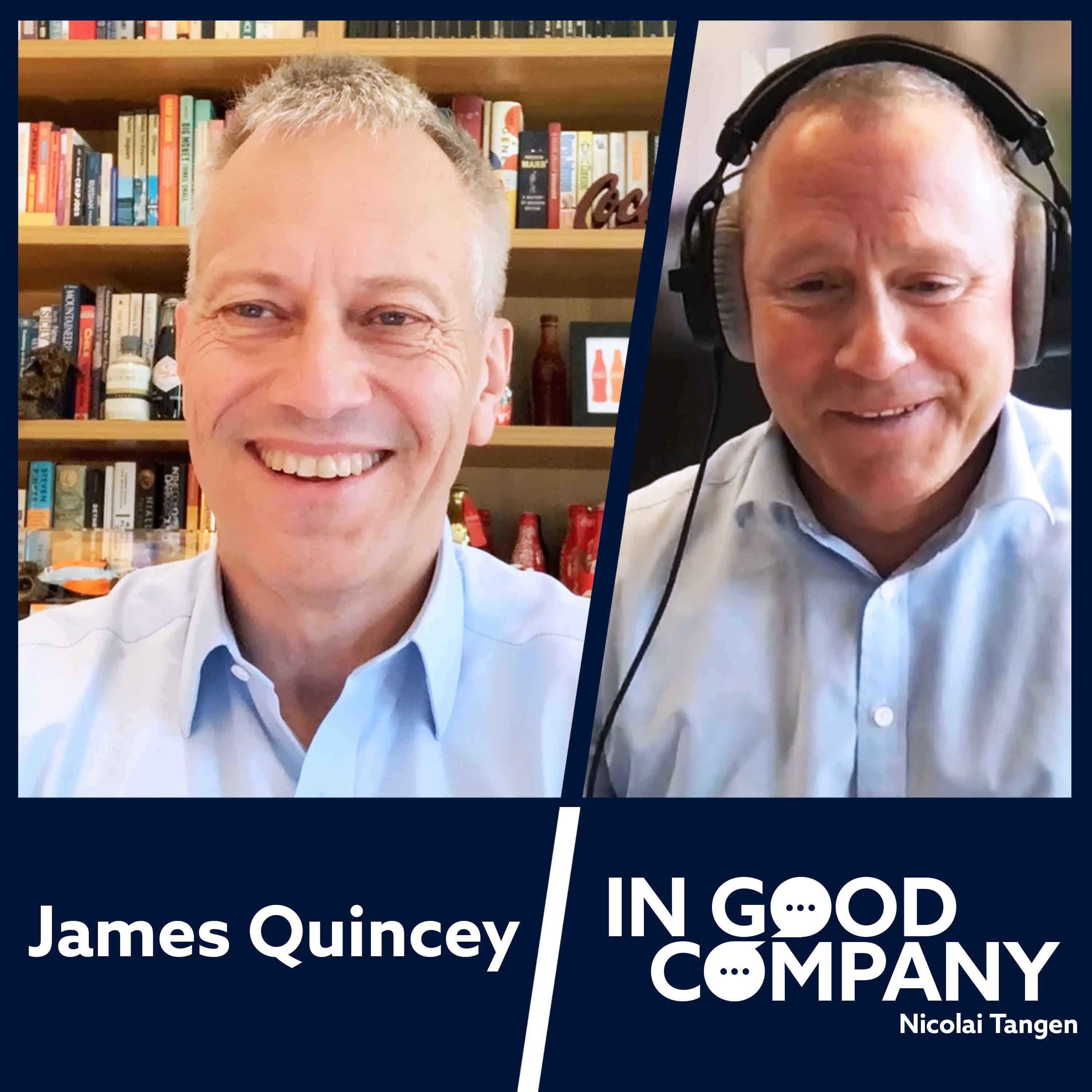
In this episode, Nicolai Tangen interviews James Quincey, the Chair and CEO of Coca-Cola. They delve into the essence of Coca-Cola's brand strategy, distribution systems, current trends in the beverage industry, and the challenges faced by modern corporations.
Written by AI. May contain mistakes.

Get the gist, explore an idea or ask about something said.
 Claude
On In Good Company with Nicolai Tangen, what are the key points of this episode?
Searching your listeningAutomatic transcript. May contain errors.
0:09It's funny, we had Bill Gates on the podcast quite recently and he only had one thing he asked about Diet Coke. Diet Coke. He is a believer. He is a believer. Now, we, of course, all know about Coke. Now, if you were to distill down the kind of secret sauce, what do you reckon has been the secret sauce to Coke? I think one of the pieces, one of the elements of the secret sauce, particularly a brand Coca-Cola, has been this in two dimensions. One has been an enduring ability to be both a touchstone to something you know that has been there for a long time. I mean, the formula is the same, the Spencerian script of the font is the same.
0:55Like there's all these touchstone elements of comfort of the past. Yet each generation of managers have made its marketing and the way it's brought to the marketplace relevant for that moment in time. So it is both representative of continuity into the path and comfort, yet also relevant and exciting about the future. which is a very hard balancing act to do. The other hard balancing act which has been achieved is to be both a global brand and local in each of the countries it's sold in. So, yes, it's a global icon. It's obviously heavily linked to being an American icon. But in many countries, most countries in the world, they see it as a profoundly local brand.
1:38So, again, generations of managers have made it not just maintain a unique, coherent, global unity, but I've also managed to make it profoundly local. I believe that 94 % of the people in the world actually recognized the Coke logo, which is probably one of the highest brand recognitions in the world, right? How do you develop that type of iconic brand? Firstly, a massive, massive, massive amount of consistency, We have never, ever, ever changed the logo. Not that the number of design agencies haven't tried to entice us to do so. Not that it was standardized in 1886. It took us until about 1923 before we standardized the logo.
2:32But once we standardized it, we never, ever changed it. Because, you know, people learn to recognize things, It's not just the words and the sounds, but the visual image. So we have protected jealousy, jealously, all that iconography around Coke and never, ever changed the font and the fact that Coke is red all the time. And I think that, you know, after so many years of marketing and success is part of why it's so widely recognized. One of the brands which has really done the worst on blind test is Red Bull. I mean, people just absolutely hated it. Yet, you know, they made the boxes smaller, they increased the price, and hey, it's selling incredibly well.
3:24So is it all about brand and association? It's about everything. You experience a beverage product with five senses. It's not just about the taste. The package it comes in will – you can get people to debate heatedly whether a beverage, a Coke, is best drank from a can or a glass bottle. I mean, people have strong opinions on the matter, and that's without talking about the liquid. That's just the thing they're holding in their hand because touch matters. Smell matters. Sight matters. Everything matters when you drink the drink. So these tests, you can test one sense if you want, but in the end, it's the package of senses and the ideas that people test that make the brand of the beverage.
4:18You cannot fully disaggregate them. Generally speaking, people prefer things that taste good, but you cannot disaggregate the whole mental imagery of what goes together. Now, you often have athletes in your ads. Why is that? Um, people want to connect with people they know sometimes. We generally spend most of our connectivity on the overall sport or music in general, rather than personalities. Personalities can come and go. But the World Cup is always the World Cup. You know, we've been doing the Olympics for almost 100 years, very long term sponsors of FIFA World Cup, etc, etc. And so it's much easier to build a long-term platform around the property or the event rather than a person who's going to come and go.
5:09You also use Santa Claus as a spokesperson. Yes. True. Why? When you think of code, it's happiness, it's optimism, it's enjoyment. I mean, it's a set of things that are very true about the Christmas period. And so over the years, we have used the vehicle of Santa Claus or the polar bears. You know, famously, one of the more modern characterizations of Santa Claus was actually known as the Son Blum Santa, who, by the way, he was Swedish. So I'm very near to you. and there were actually many Santa Clauses in those 100 years ago and the Sombolou Santa was one characterization that caught on and it just fits very naturally with the brand and the time of year and people coming together and sharing meals and occasions.
6:12Changing tack a bit and talking about your distribution, you know I've been to places where there isn't even clean water but guess what you find in the fridge? A Coke. So tell us about your distribution network. Absolutely. The product reaches almost every corner of the world. And I think there are two aspects which are very interesting. One, by chance, not necessarily by design, it is a product that survives a decent amount of time in tip-top condition. You don't get degradation of the product over time. So it stays in good drinking order for a very long time. Secondly, obviously, we have created demand.
6:58And because we've had the philosophy of everyone should make money along the chain, it gets to the far reaches of the world because there's an economics incentive for it to do so. Actually, there's a good podcast by Melinda Gates talking about actually how ultimately we ended up helping the Gates Foundation move some AIDS medicine around Africa in very, very rural areas. And part of the thing that they, the reason they got the Coke was they thought, well, if Coke can get everywhere, we can get everywhere. But then they couldn't. And they were trying to think, well, why does Coke get there and we don't get there?
7:33Because it's, it's often life saving. And the answer is, everyone along the chain wants the Coke to get there because they make a bit of money. So economics matter. Now you have one competitor called Pepsi, and you may have heard of them. They have a very big market share in Norway, so I think it's one of the countries where it has the biggest market share. How come Pepsi in some countries have a high share and in other countries they haven't? A lot of historic reasons is the short answer. There were some countries where they got to before us and they have had some historic share positions. there are some countries where we fell asleep at the wheel.
8:19I think the one that's big in Norway is actually the zero sugar version of it. Spent too long trying to hang on to tab in Norway. And so that is generally one of the two buckets that characterizes where we have yet to become market leader in every single market. There are a few left that we are not a market leader in. But overall, our leadership position keeps extending each year. Now, looking at the consumption trends, what are the trends? So two ways of looking at consumption trends. One is to say they're incredibly stable. One of the arguments I make with the investment community is to look at the beverage industry and think about, firstly, how stable it is.
9:06If you do a histogram of the growth rate of the beverage industry, the median growth rate is, let's say, 4%. Maybe not in the last couple of years, but let's say historically last 30 years, 4%. And the chance of it didn't grow 4%, it was 3 or 5. I mean, this is not fluctuating in wild numbers. It's a very steady industry. And that's driven by the fact it's really a small ticket item. Beverages are cents or a few dollars, and it's a population-driven business. And the industry is largely as yet uncreated in the developing and emerging market. So there's a long way to go. So firstly, actually, in some ways, the beverage industry is very stable.
9:50It grows at a steady rate, and it's got a long runway ahead of it. Is that why Warren Buffett, who is your biggest shareholder, I think he said that a ham sandwich could run Coca-Cola? i i i uh i'm not sure i would count myself as the bread or the ham um or maybe peas in the ham sandwich um um but i think warren loves it for a whole set of very uh obvious reasons it like i said it's a stable industry we're the market leader we gain shares steadily each year um and And we have a long track record of continuing to grow. We had 61 years in a row of growing our dividend. And that makes us an all-weather play.
10:36Moving on to AI, which is really, of course, the whole talk now. And we discussed it when we met in America. And you mentioned it yourself. It's been driving some of your advertising. Now, tell us, how do you use it? So the first way, I mean, apart from some of the kind of already existing models that kind of optimize for certain things within the supply chain and other ways it's used, I think this next generation of AI examples, the first thing we did, we got, we married the text AI with the visual AI and allow people to make essentially outdoor ads about Coca-Cola through the AI machine. So they were able to go in, pick Coke images, and then tell through the chat AI, you know, what did you want the image to do?
11:23Like, I think the winner was there's a Coke with a cat in space. Like, there's zillions of images. So it was a competition, hundreds of thousands of entries. And we put up a whole selection of the best ones in New York Times Square and Piccadilly Circus on London. And really, it was empowering consumers to play with the assets and the AI technology. So you can clearly see how AI can revolutionize content creation. The reality is it already is in the movies we watch through the CGI, but that's kind of large set piece movies. This is coming down to a kind of a very simple terrestrial level. Every image you see outside on outdoor and not that far in the future on advertising can be generated by the machine.
12:13and that's going to be profoundly change everything. We're also just rolling out internally within our own kind of cloud, basically taking all our internal documents and putting them into the machine. So instead of hopelessly trying to find something in the company, which, of course, you never end up finding, you can just ask the machine, tell me how to do X. And that X could be, how do I give money to a charity that gets matched by company funds? How do I maintain a juice line? How do I do X? And all of that is going to be at people's fingertips. So it's going to make people more productive because it's going to make the knowledge more instantaneously available.
12:57How much do you think it could drive productivity? I don't know how high it is up. What I do know, though, is I would rather be on the front end of this than on the back end. Are you worried about it? Yes. I think there are a lot of general kind of technology-related potential disasters, potential problems, whether it be bad actors or more dystopian kind of outcomes. So clearly, there are ways this can go wrong in a general sense. And there are ways it can go wrong in a specific sense related to us. Some of these models don't necessarily optimize for truth. They optimize for engagement. and they optimize for credibility.
13:41Credibility is not the same as truth. And so I think it's very important as we go on this AI journey, you're never going to understand the math behind it. My brain's not big enough for that. But you can understand that it's an optimization model and therefore questioning what are the objectives that it is being set? What is it optimizing for? And what are the parameters around it? What are the safeguard rules around it? What corridor can it operate in? I think are critical questions that can be asked. Well, we're coming out with an expectation document this summer on this, so stay tuned. Now, moving on to governance.
14:27So we recently voted at your AGM, and we looked at the filing that you sent us beforehand, And you spend a whole 40 pages to explain the salaries and the compensation system. Does it really need to be that complicated? Does it need to be that complicated? Maybe not. But there's a lot of appetite from investors to understand the compensation. And I think rightly so. Have disclosures arguably got too long for the average investor? Probably. But I think this idea that the investor should understand what are the incentive systems in place in the company, what are they driving? Because at the end of the day, incentive systems do work.
15:16They're not the only factor that people pay attention to, of course. There are other guardrails, other incentives, other ways that people derive success in companies, promotions, other things. But incentives are there because they work, or at least partially work, and therefore investors should understand what they are there to reinforce. It's all very well as having a clear strategy. But if we had incentives that pointed in a different direction, then investors, including myself, should be worried. And so I think it's important they understand them. this amount of disclosure is largely driven by the zeitgeist rather than necessarily I think 39 or 41 is the right number of pages now as you know we as a shareholder advocate that the role of CEO and chair should be should be split and you have both the roles which we vote against who is controlling you?
16:19who is overseeing you? I'm overseen of course by the board and the lead independent director and the investors. There are no shortage of investors looking over my shoulder as well. And so we feel that for the Coca-Cola company, combining the two roles is the right answer because we have a robust lead independent director and we have a robust board environment in a business that is very large and very complicated. And therefore, we find that at this moment in time, I mean, this is what best suits the Coke company. It is ultimately a very large enterprise. There's no real, I mean, there's a tremendous amount of transparency and visibility to what's going on in Coke and a lot of observers.
17:05So it's not like there's an absence of oversight, either by the lead independent or the board or the investors or all the other people who analyze the Coke company. So I think perhaps that provides a different environment. And certainly, I would invite people to look at the results are good, too. So I think the governance is there, as it should be, and the performance is also there, which is good. But you are yourself a board member in Pfizer. Correct. How much influence do you feel there that you have over the CEO and the chair? I feel that the board can absolutely execute its role if it so chose to do so.
17:50You know, there are a set of critical decisions by the board, capital allocation, CEO succession. And, you know, being on both ends of the stick, so to speak, between the two boards, I don't feel it's a problem. Okay. Anything you learned from Pfizer that you are applying to Coke? Yeah, obviously I joined them at a rather interesting time at the beginning of 2020. And I had thought that we had got better at innovation. But when I saw what they were able to do to bring the vaccine to the market in less than a year, given that it's normally many, many years before a vaccine is over, was truly a staggering process.
18:35The rate at which innovation can be called forth when you need to, when the focus is there, was firstly incredibly impressive in their case. And I think a source of inspiration to me as I think about our own business.
18:55Now, obesity has grown to pretty epidemic proportions. I think now more than a billion people worldwide are characterized as obese. Do you think we'll be able to reduce obesity rates going forward? I think we can and should reduce obesity rates going forward. I mean, we certainly have probably happened a few decades ago, gone past the point where there are more calories available in the world than human consumption. Generally speaking, for most of human history, we had a slight deficit. Now there's enough food generated. So it absolutely needs to be an overall, and it is an overall governmental policy focus.
19:42And a bit like the earlier question, it's like, what's our role in it? Yes, we have a role. We need to make sure we're offering products that help in that sense, whether it be smaller portions of our calorie products or zero sugar products or as we innovate to reduce the calorie profile. So absolutely, it needs to be part of the future. We are seeing many governments implementing sugar taxes. What is your view on that? Yeah, I think, look, there's a couple of pieces. Taxes certainly tend to affect demand. The question, I think, would be twofold from my point of view. One is, is the action likely to produce the outcome that they're looking for?
20:29If the outcome is less obesity, does a very narrow tax on one product category, is it likely to drive down obesity? And you can look around the world where they have the sugar taxes on soft drinks or beverages in general, and find that essentially, it hasn't made a material difference. The problem needs to be addressed in a much broader perspective. That's point number one. Point number two is I think where the taxes have been put in place that also provide an incentive for innovation, i.e., for example, they're tiered. The more the sugar, the more the tax, the less the sugar, the less the tax.
21:09Then there's an incentive for companies to continue to provide great tasting beverages, but to slowly bring down the calorie profile, as indeed happened to some extent in salt in some countries. So I think, you know, pressurizing things with taxes, really it's about innovation and getting people to change their diets at the time, which is a broad topic that needs multi-pronged action. And I think that's really a matter for the policy. You're also moving into alcoholic beverages. What are the plans here? Yeah, we've been experimenting in the boundaries between the non-alcoholic and the alcoholic world.
21:52As every industry develops, people look for the wide spaces and look for the opportunities that are most adjacent. And there are a set of occasions which tend to mix alcohol and soft drinks, mixes. And we see an opportunity, what is called the alcohol ready to drink category. So premixed cocktails, hard seltzers if you're in the US, spike versions of things. And it's a very interesting space because a lot of the drinks in that space leverage our existing brands. And if they can be provided in a registered format, it's potentially very interesting. So we're currently rolling out Jack Daniels and Coca-Cola premixed.
22:33And I think that's going to be very interesting to see how big could this segment be. We don't need more hobbies at the Koch company, but if this could be a material segment, and I think Jack Daniels and Koch will be a leading indicator, it could be very interesting for us. Now, the last question in this area, you are taking action to reduce plastic waste. Now, what are you doing here, and what do you think is achievable here in the longer term? Yeah, so plastic waste, I think, has two components. and I think with all these kind of systemic issues it's important to make sure that everyone can restate their objectives and clarify what is the outcome we want and I think here it's we don't want waste in the environment whether that be land or sea and actually preferably with a lower carbon footprint if we state those two objectives what we see is that a circular economy on packaging material can achieve both of the objectives so we set ourselves a goal called the world without waste So by 2030, all our packaging will be recyclable.
23:37We'll collect a bottle and can for everyone we sell. And we'll use 50 percent of that back in our own packaging because it often gets downcycled into other uses of recycled PET. If we can do that, we can create a circular economy in which there is no waste in the land and the sea. And the carbon footprint of recycled material is much less than original. So whether that be PET, aluminium or glass, all those three formats collected and recycled have a low carbon footprint. So it's a very attractive objective. Secondly, this is not some blue sky fantasy. There are already countries in the world which have almost 100 percent collection.
24:22Actually, a number of the Scandinavian countries are already there. There are also countries in the world where over half of our PET bottles are made from recycled plastic. In fact, a number of countries in Europe, including some of the Scandinavian countries, all the PET bottles that we sell are made from 100 % recycled PET. So you have a fully circular economy that basically drives out waste and materially lowers the carbon footprint. So this is a very doable long-term objective and the technology available to make it happen. exists. Of course, it can be made better with innovation. So it's a matter of collective will rather than something new that needs to be invented.
25:07James, moving on to leadership, you talk about being an authentic leader, but how authentic can one be when one runs a big public company where you have to be so careful with how you communicate? I don't think there's a difference between being authentic and at times being reserved or being diplomatic. I've probably liked that in my personal life anyway, so maybe that makes it easier. But I think, look, let me put it this way. It was probably possible 20, 30, 40 years ago for you to say one thing to the employees, another thing to the customer, another thing to the investor, etc., etc., etc. Another thing to the media.
25:50But this is a radically more transparent world. And so the first thing, if you recognize that the message ultimately needs to be the same to everyone, otherwise it's going to go horribly wrong, you just start there and say, OK, so there's no point in trying to spin everything everywhere. I just need to tell people what's the point of view, and it's basically the same message for everyone. And then it needs to be grounded in what you believe because there's nothing more obvious, you know, when someone is making it up as they go along. And so, you know, if you're inauthentic, people spot it immediately.
26:31And so I think it's very important to be grounded in, like, what do you believe in and what strategies, what companies, what things are you bought into? And then it's much easier to represent it. I think it would be very hard to represent something you didn't believe in. especially knowing you're going to have to say the same thing to everyone. What's the one thing you would love to say which you're not supposed to say? There's nothing because, you know, why would I not say anything? No, I mean, look, I put it like this to people. Sometimes people find out the South is a very polite part of the world.
27:11Actually, most parts of the world are quite polite and quite indirect. When you ultimately stand back far enough on the world, most parts of the world, shouting and screaming is not a way forward. And so I say to people, look, you need to be able to disagree without being disagreeable. So shouting and swearing, it's like, I may make you feel better, but it's not productive. And so you need to find ways. Yeah, you don't have to agree with everything else, but disagree without being disagreeable. So I think that is the art form here. it's not about hiding something uh it's about communicating uh to be to connect rather than just kind of venting how do you disagree in a good way look i don't let's we don't need to whip out the management books but it's the contrast the shouting and screaming so it's like okay you know let's it's a it's a rational debate it's it's generally speaking the other person on the other side of people wants to feel that they were heard you know without kind of going into mumbo-jumbo.
28:11It's like, yeah, do I understand what you're telling me? I hear what you're saying, do I understand it? Exploring what they're saying and why they're saying it. And then being able to connect and say, okay, I get that. Here's why I'm saying what I'm saying. It doesn't mean you're going to agree. And you have to be able to cope with the stress and the tension in the situation that there's not an agreement, but that doesn't mean you can't mutually understand and respect each other's positions. What's the most difficult part of being a CEO? There's one part of the CEO that you never find out until you get there.
28:46And the way I describe it is if you think about an organization, let's just use the classic idea of an organizational pyramid. It's a big pyramid. And most people think, okay, you spend your years working your way up the pyramid and eventually you'll get to the apex of the pyramid and in a simple way, everyone in the organization will work for you. And every general manager in the job, general manager, job in the pyramid, they have people working for them, but they see their way to the apex. But then when you get to the apex, something different happens. You find out that there's another pyramid, except where it's upside down.
29:24You're at the bottom, at the apex of the upside down pyramid, and above you are zillions of people trying to give you a point of view who want your time. And that doesn't happen to any other person in the organization. And whether it's investors, media, stakeholders, everyone has a point of view and directs it at the CEO. So you are much more fragmented and you have way more stakeholders than anyone else in the organization. And it's kind of a shock when you get there. What's the trick to that? Saying no politely. how do you continue to learn um i like learning i i um i'm probably slowly becoming more old school in the sense that i prefer to read it than to watch a podcast or or a talker um but i'm slowly moving with the times but i i do have to say i still have um uh and a yearning for the tactile nature of getting something uh from a book and being able to ponder it as you read it rather than being marched along at the pace of of whoever's trying to teach you what what good um have you read lately um i've read a few books lately on the on the fiction side i read a book called clara and the sun which is kind of a an in the future novel about a relationship between robots and us it's it's very different um it's a japanese british writer on the kind of more businessy side, I tend to go for more of the history ones.
31:09The last couple I read, I read one called Money for Nothing, which was a history of the South Sea bubble crisis, which I recommend people. The other one was the Lords of Finance, because I'm very intrigued and interested in the fact that ultimately, you know, the underlying structural changes, they always win in the end. Things can go up and down, but the profound structural stuff in the end wins out, which was ultimately the story of both these books. What motivates you? I'm kind of mission motivated in the sense of I really want to do the thing. I have to feel like I really want to do the thing.
31:56Whatever that thing ends up being, whether it be, you know, I think we've, for example, Coke, we put Coke back on a growth trajectory over the last number of years, or I want to learn to be good at X. I normally start off with the perspective, how hard can it be? And then, of course, you find out that most things are much harder than you think, and you're not very good at them. But occasionally, you find some things that you are both good at and you enjoy, or they don't have to be the same. it's a Venn diagram that doesn't overlap between enjoyment and good at but I experiment with lots of different things.
32:31Jensen Huang of Navidia who we had on recently also talks about this how hard can it be but he also talks about working hard and he says well you know you have working hard and then you have working insanely hard. Where are you on this scale?
32:50Life is a marathon you can have periods of working insanely hard but it's hard to live your whole life at that pace um and so you know i think it it the pendulum swings between working hard and working insanely hard um because you can't keep it up uh forever it's life is not a set of sprints uh it's it's a marathon now some people can run a lot faster than other people um but you've got to pace yourself, particularly when you get to be kind of CEO, I think. How do you base yourself? I, you know, I'm somewhat European in that sense. It's like there needs to be some boundaries. I know it's a 24-7 job.
33:32There also needs to be some downtime. You need to be able to walk away. Not always. And if there's a crisis, there's, you know, sometimes you're the only person who can decide and it's 24-7 literally. But you have to be able to walk away and do something else. What's your advice to young people? We have a lot of young professionals listening to this. My first piece of advice or my main piece of advice that comes with a caveat is find something you really love doing. Sometimes people take jobs because they think it gives them status or money. But I feel in the long run, you're likely to rise to the top or be happier doing the thing that gets you out of bed in the morning.
34:21If you don't love what you're doing, the chances of getting out of bed early and working insanely hard just go down in my mind. Certainly do over time. Having said that, the caveat is you need to be okay with the choices that that implies. sometimes people talk about work-life balance it's not a balance between work and life work is part of life your life is composed of a whole set of things and and it's a hundred it's a hundred percent bar chart you can't have more life and more time available it's a question of distribution and if you choose a career that has more time or whatever more money less money more status You have to be comfortable with that choice within your 100 % bar chart.
35:08And what's the most fun piece of your pie chart? Look, everything can be fun. There can be times when you do really cool stuff. I mean, like I got a lot out of all the AI marketing recently. But there can be cool stuff on the family side, like spending time with family and friends, seeing them grow and achieve stuff. Or even for yourself, going off and learning something new or trying something new, even if you're terrible at it, just trying something new and learning something new. And the last thing you learned that you thought was cool? I've become a part of the sad or not so sad trend to trying the swimming in cold water.
35:46And I found out I had to Google how fast I was and see whether it was any good. And I was really slow, unbelievably slow, like right down at novice. And I'm like, okay. But it was fun. Well, I have to say, if you want to come training in cold water, You are very welcome up to Oslo. We have some really good conditions for that. I might come in July.
36:08Just one more thing I'd love to ask you about. So the Coca-Cola recipe, I think it's called Merchandise 7X, closely guarded secret. You know what's in it. If I had a better memory, I would. The formula for Coca-Cola lives in a safe to which only a very few people have access. I went in there once just because I became CEO. I had to go in with someone else, looked at the piece of paper, and more or less instantly forgot everything about it when I walked out the room. How many people have access to the safe? That's a secret. And tell me about the safe. What does it look like? It's very, very big.
36:47Well, actually, most of the safe is the concrete wall. And is the recipe the only thing in the safe? No. There was a filing cabinet. It's like the Matrix. There's a filing cabinet with other stuff in it. I didn't look at the other stuff. And if I came to visit, were I allowed inside? No. That's a simple one. You can look at the outside, but no, you can't go in. Sounds good. Well, you are clearly very good at saying no in a very polite manner. So I have to give you that. James, it's been tremendous to have you on the show. Absolutely love it. Good luck with everything. And, you know, go get them.
37:26Thank you. Great. Nice to see you again. Fantastic. floors. Bye. Bye.
What’s the secret to Coca-Cola’s success? And what’s in the secret recipe? Tune in and find out!
The production team on this episode were PLAN-B’s Nikolai Ovenberg and Niklas Figenschau Johansen. Background research was done by Sigurd Brekke with input from portfolio manager John Santo Domingo.
Links:
Hosted on Acast. See acast.com/privacy for more information.


