
 Ask ChatGPT


 In Good Company with Nicolai Tangen
14 Aug 2024 · 40m
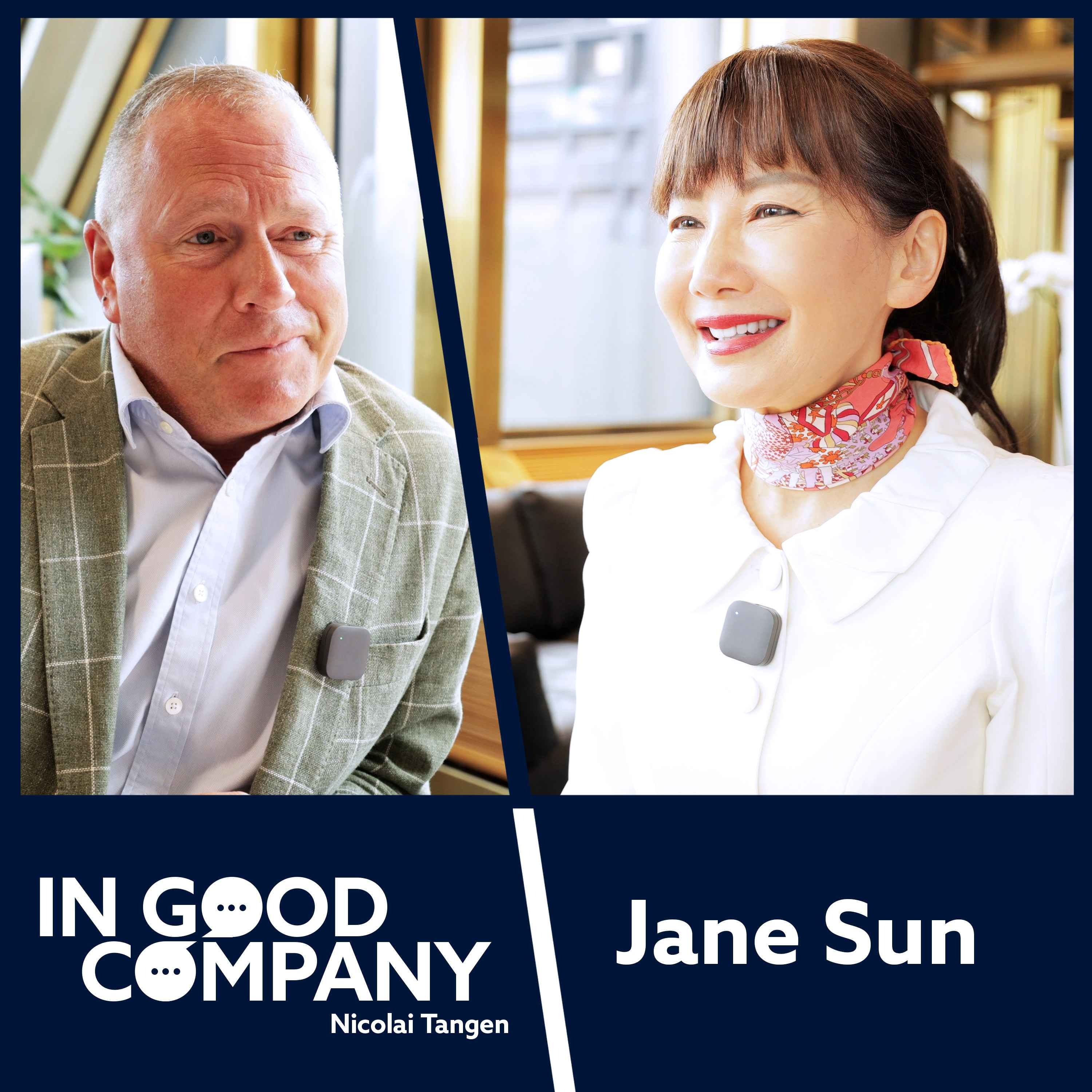
Host: Nicolai Tangen
Jane Sun, CEO of Trip.com
Written by AI. May contain mistakes.

Get the gist, explore an idea or ask about something said.
 Claude
On In Good Company with Nicolai Tangen, what are the key points of this episode?
Searching your listeningAutomatic transcript. May contain errors.
0:01Hi, everyone. I'm Nikola Tangen, the CEO of the Norwegian Southern Wealth Fund. And today in the podcast, we have Jane Su, the CEO of Trip.com. Warm welcome. Thank you so much for having me.
0:21Now, I think this is the first podcast you have done. That's right. That is so, so much fun. Thank you. Now, you built Trip.com into one of the world's largest travel companies. We are the lucky owner, or more than 2 % of the company, or roughly$700 million. So you grew up in Shanghai and studied in the U.S. So what does travel mean to you? Travel means quite a lot to me. Maybe I can start with my journey on travel. I was born in Shanghai and went to Peking University Law School. And during my second year, one of the professors from the USA wanted to come and select one students to go to study in the USA.
1:02And I was very blessed for the opportunity to go to study in the USA. Why did it pick you, you think? It's because I'm always very curious and ask questions when my professors was presenting. So when I arrived in the USA, China just opened the door. It was early stage of the open door policy. My parents were both engineers. They made decent living to support my brother and myself. But if you convert their 200 RMB into USD, it's$20 per month. So I couldn't ask for money to support myself. Instead, I worked two jobs, one as a librarian, The other one is as a bus girl to clean up dishes, making$3 per hour to support myself.
1:57But after I paid my tuition, I have no money for room and boarding. But my professor's family were very kind to me. They took me in and treated me as their own child. So I was very grateful. And I told them in China, the Confucian teaching is that when kids are young, parents take good care of their children. But when parents get older, good children will always take care of their parents. So I told them when I'm able to, I would like to take good care of you. And they said, oh, honey, you don't need to take care of us. But instead, if you can help the international students in the same way as we do for you, we'll be very happy.
2:43Wow. Is that what you've done? Yeah. And I was very touched. Although I was penniless at that time, but I always had a dream that someday, if I'm able to, I would like to establish a scholarship named after my professor. And I was very glad in 2016, I went back to my university and established a scholarship to name after the professors who helped me so much. And we named our old daughter after my professor's wife because she is just like a mother to me. And we celebrated her 93th birthday last year.
3:26Moving on to Trip.com, how did you end up there and how did you end up at the top? In 2005, our board was looking for a CFO and I was very blessed for the opportunity to become the first female CFO in the China market. When I made the decision, I asked myself three questions. First of all, would you like to spend time in Asia? At that time, Asia is growing very fast. So I thought that's a good market. And with my bilingual background, bicultural background, it's good to be a good bridge between Asia with the rest of the world. The second question I ask myself is that if you want to be in Asia, what industry do you want to be in?
4:16And I think, I thought the travel industry really brings people together. And the third question I ask is that if you want to be in Asia in the travel industry, which company has the best opportunity to be successful? And after I talked to our board, I believe our team are very well equipped to take the leadership for the travel industry. Why is Strip.com so successful? Internally, we have a formula which we called 55443. Three means you are at the market level. One and two means you are below the market level. Four is above market level, but the barrier of entries is relatively lower. And five is more above, way above the market.
5:07So the second player without five to 10 years cannot catch up with you. So the two elements we assign value five is branding and service. And why that's important? Because if you build a service and branding, just like Singapore Airlines or Four Seasons, people will trust you and travel with you. And it's very difficult to catch up with you. Is that your kind of goal when you think about your brand and the perception? Are those two brands something you aspire to be, Four Seasons and Singapore Airlines? Yes. In travel industry, these are the good brands. And why those two brands? Because when you board Singapore Airlines, their price is not the lowest.
5:55It's even you charge a premium. But when they serve you, there are lots of signs behind it. For example, when they ask you a question, the steward asks you a question, The eye-to-eye contacts is very good. And also when they put down a cup, for example, instead of put it down and walk away, they put it down, they will move it. The little detail behind the scene make customer to connect with your team. So I studied and learned a lot from these global leaders. So in trip.com, when you call our call center globally, seven days times 24 hours, a live person will answer the phone within 30 seconds in your native language.
6:42When there is an issue, within two minutes, our team will find a solution for you. When something unexpectedly happened, for example, there was a tsunami in Japan, earthquake in Nepal, or Middle East had a conflict, within two minutes, our team will reach out to the customers on the ground, make sure they are comforted, make sure we transfer them to the safe hotel, offer hot meal, hot shower. And the very next day, if our customers would like to come back to their home country, we'll make a priority arrangement for them. So that's why customers trust us when they travel with us. And with that brand, Pre-COVID, the most expensive tool we sold cost about 200 ,000 USD per person per trip, 80 days around the world.
7:37And guess how long did it take us to sell these packages? Not long. Take a guess, how long? Five hours. Very good guess. 17 seconds. Wow. The reason we can't do that is because of the trust in our brand. But tell us, give us a feel for the size of the company. So how do you measure size in your business? So in terms of GMV, total proceeds, we are about... So that's the total sales of your products. Correct, correct. The total proceeds we bring to airlines, to hotel partners, rental car business, local tour operators, attractions. That total is about$160 billion USD. In terms of our revenue, our commission is about$6 billion in 2023.
8:26And bottom line is$2 billion. And how exactly do you make money? We charge a commission. So when we sell hotel rooms, hotel will pay us a commission as a sales channel. So we talked about the two elements we value five. The other two elements we value four is technology and products. We have about 10 ,000 engineers globally to invest heavily to innovate our product and take care of our customers. But once the product is released, people can copy it. So the barrier of entries is not as high as service and branding, but still it's very important. The last element is pricing. We value it at three at the market level.
9:17As the largest player, we can always ask for a very good price for our customers, but we never brand ourselves as the lowest price leader in the market. So when you ask why Trip.com become a very leading player in the travel industry, because of our focus in service and branding, product and technology, and also parity in pricing. So when you grow, what are the growth factors? Do you cover now all destinations, all airlines, all hotels? Yes. Okay. Yes. So our growth strategy is to provide a one-stop shopping platform. So for example, when a customer flies from Shanghai to Oslo, if he or she is booking a business class or first class tickets, we'll recommend a five-star hotel to him.
10:16intercontinental hotel, for example. And then we'll calculate the distance between the Oslo airport to his hotel and send a car to them. And when the customer check in, we'll recommend a very nice restaurant for them. And after they check in, we'll also say, oh, by the way, we have a tool package for you if you would like to travel on the weekend after a business meeting. So one-stop solution make the travel very pleasant for our customers. How does your technology compare with competition? You mentioned that you would give it a four, but what type of advantages do you have on your technology side?
10:58Our technology, we invest heavily every year. We have about 10 ,000 engineers. We use AI to improve our efficiency. The AI is used for four areas. The first one is the user interface. In the past, we need to do search. For example, I'm coming to Oslo with two kids. I would like to have a hotel with two beds, with a swimming pool. And then the system will pop up with a couple of selections. Right now, our Trip Genie is very advanced. You can just talk to the system and it will pop up automatically the selections for our customers. The second usage of AI is the efficiency for our engineering team.
11:43Using Copilot, we'll be able to cut the coding time anywhere between 15 % to 30%. That's a huge lift of our technology team. The third one is customer service. We're able to identify the customer's needs within very short time and give them the best selection, either automatically or, if necessary, with a live person. And the last one is the content generation. With the technology in video and picture, we're able to generate very good content using technology. So we invest heavily to stay ahead. How will this look differently in 10 years' time? What is the future, for instance, of customer service?
12:30In the future, if you look at the past 10 years, our growth trajectory is 20 to 30 percent every year, CAGR. But our headcount in the core center is very flat. The reason we can't do it is because of our investment on the back end to support our customers. So in the future, I think a human intervention is only necessary when there is unexpected events happened. Hopefully standard transactions can all be handled very smoothly through technology. Now, customer experience, I think it's so interesting. And there is this book called Unreasonable Hospitality about this famous New York restaurant. Now, what is the best experience you ever had?
13:20The best experience I had was this past Chinese New Year, our family went to the South Pole. And we call it white desert because without the support of the aircraft or this curation, it's unreachable by humans. So that tells me how important and excellent service is. I think the best I had was in a real con in Kyoto in Japan. Oh, lovely. Yeah, Japan is so famous for the excellent services. Absolutely. Now, how do you make sure that this service mentality is kind of going through the whole company, everybody? How do you make sure it doesn't slip? Our young employee, when they come to our office, most of them are single child because China had this one child policy for a long time.
14:18They were the center of attention in their family. But when they come to our office, we train them to treat our customer as their family. So the slogan is, let our customer hear your smile. So they are trained to take very good care of our customers. Do you think it's more difficult to get young people now to have that attitude? Different years have different challenges. When we first established the company, young people who are from the remote area come here. They want to make money and send it to their family. So if you give them enough bonuses, young people are very willing to work overtime, work on the weekend, or work on the evening shift.
15:07Now, with the living standard that is improving, money is not the incentive they are looking for. Instead, the career path is something we can really give our young employees to grow. So our young employees, when they start with us, if they work well, some of them become BU CEOs leading a big operation in our company. So I always feel very proud of their achievements within our company.
15:39How would you characterize your leadership style? I'm a very few female leaders in the high tech industry. And I think women have lots of good traits which we can bring to our team. For example, we are very willing to make personal sacrifice for the best interest of our company. We are very willing to put ourselves in other people's shoes. So when we negotiate a deal, we very quickly can reach a win-win agreement. We are very good with communication and team building. So I really want to make sure we pave the way for our future female leaders so that they can take on more responsibility. Now, there's a lot of things to drill down on here, but let's start with the negotiations.
16:34You think women are better at reaching win-win? How come? I think a lot of time, instead of fighting my way or your way with the big ego during the negotiation team, when I went to a negotiation conference room, normally I just bring our legal counsel and our finance team. Three of us happens to be ladies. The other side are four of male negotiators with suits, very serious. So the way we break the deal is to really understand what they're looking for, what is the very important interest from the other side, and how we can meet in the middle. So normally the negotiation for us is to find a common interest.
17:25Are we going to achieve one plus one equals to five? It is. If it is, then the partnership makes sense. If one plus one equals two, we are better to stay independent. So very quickly, I think we're able to find our shared interest and maximize our shared interest through our discussion and negotiation. You have been very successful in getting women at the top of your company, right? So it's half the leader group. I think it's 40 % at mid-level. How have you done that? Yeah, we have done quite a lot to empower women's leadership. For example, when a woman is pregnant, we offer free taxi to bring them to work and take them home.
18:09When our employees give birth to a baby, we give$50 ,000 on the baby's birthday consecutively for five years. And we commit$1 billion fund for these initiatives. And I also noticed a lot of high-talented women after they get their master's degrees or PhDs, some of them are 27 or 28 years old. But if you ask the doctors, they will classify any pregnancy after 35 years old as high-risk pregnancy. So we are only giving women 7 to 8 years to build a career, build a family, have children. compared to our male co-workers, they have much longer career paths to build up to that milestone. So we always thought how we can support women better.
19:05So we come up with a policy that if our women employee would like to use high technology to have their eggs frozen, we will pay for it. And that is very progressive. We're the first high-tech company who have done it. So with that concerted efforts, we have achieved very good results. As you said, more than 50 % of the workforce are women, more than 40 % of the middle managers are women, and more than one third of the executives are women. And I still think we can do better in the future. So you mentioned also you thought women were more empathetic and better able to see other people's situation.
19:53So how would I experience life differently as a normal employee in Trip.com relative to your competitors? So now I come to work, right? So I work for you. How would your style make me feel? How would you make me work? Yeah. So for me, our company really supports our employees for two hours, two days, and two years. Two hours, I think it's very important to give your children, your family, uninterrupted, high-quality two hours to have dinner with them, to help them with their homework. So when I arrange my day when I'm not traveling, I go to the office very early. Between 6 to 7 o 'clock, I'm in the office.
20:39I get all the mails, then all my readings. Then starting from 8 o 'clock, my meeting starts and it's very tight. When it's 6 to 8 o 'clock, I pack up all my work paper and bring home. I have dinner with my family, help them with their homework when they were young. But when the kids go to bed at about 9 o 'clock, U.S. market opens. Europe is still in session. So all my overseas calls is when my children are sleeping. I work quite long hours, but it gives me peace in mind knowing every day when I'm home, I give them undisrupted two hours to help them when they grow up. Even today, now they're in college, they're very appreciative of my commitment.
21:28So nine o 'clock you start to work again, and you work until when? I work until midnight. Sometimes if there is a deal, we work overnight. But I think being a CEO, it can take you 24 hours nonstop. Being a full-time mother, it can also take you 24 hours nonstop. But if you want to achieve both, I need to invest twice as much as if you choose to do only one thing. So that's the two hours per day. And if I'm traveling, I always try to be home and our employees to be home to spend the weekends, two days with our family. And then two years for women who are pregnant, it's very important to support them during the year when they are pregnant.
22:16And also during the first year when they're breastfeeding the baby. If you support them during these two critical years, I think there is lots of loyalty from women workers and leaders, and we're able to retain talents. And talking about leadership, now you've been praised for your crisis management skills, right? You ran the company through COVID. Perhaps the most challenging time for a travel company ever, right? It is, it is. What's the key to managing a company in time of crisis? So our philosophy is customer first, partner second, and Trip.com the third. And if you remember, on the Chinese New Year's Eve in 2020, we locked down the border to prevent the disease from spreading.
23:05And Chinese New Year is always the high season for travel. Millions of customers already paid their packages, so they demand a refund. But at that time, the money already is given to the airlines and hotels. So we need to make a very quick decision. What do we do? Customers are innocent. They paid money. Now they cannot travel. But we don't have money. We already give it to the airlines and hotels. So immediately, within five minutes after our executive's decision, we made a decision. We need to take the leadership, provide a full refund to the customers. So, cumulatively, we borrowed$20 billion to advance our refund to the customer.
23:51Now, business is back. Customer really trusts us. They come back to us. The second thing is partner the second. And during crisis, we noticed our small and medium-sized business partners were very short of cash. So, we established a$2 billion partnership fund to help them with cash flow. Now, business is back. All the partners would like to team up with us, provide the best products to our customers. And the third thing is Trip.com, the third. So at that moment, our revenue dropped down to zero. Yet we have 35 ,000 employees to feed. Every employee has a family behind them. So we thought about what Cree can do.
24:39So our chairman and I volunteered to our board, we will take zero salary until industry recovered. And our VP immediately echoed with us. They said we'll take 50 % salary cut. And our employees also echoed with us by telling us we will work four days and take one day off. Or work three days, take two days off. In reality, everyone was very busy taking care of our customers. We work all the time. But that's the way we tell our board and our shareholder, we're here together. We'll weather the storm together. So sure enough, after three very difficult years, we come back, industry is a recovery. We are able to take our customers to travel around the world again.
25:31Well, it's a very strong testament to your corporate culture. Now, how would you define the corporate culture? Our corporate control is customer first. We need to have the big companies discipline and focus, but we also need to have a startup company's passion and innovation. And how do you create that? So inside our company, we have Baby Tiger program. So for example, small business, rental car business. When they started the business, it was very small. We give them a CEO, CFO, and a CTO. They can run as a very small startup company. We give them the funds. We take care of all the corporate factions, for example, marketing, legal, contracting, We have a big team to support them.
26:28For them, they just need to make sure this product is fine-tuned very well. So that enables us to have the ability to launch 70 products simultaneously. But meanwhile, our commitment to the customer is the same. The big BU like hotel and flight have very matured processes for quality control. But just because you're a small business unit, you also need to adhere to our principle to put our customer in the very center position. Now, how do you screen for those type of people? What do you look for when you hire? So now I'm applying for a job and I now have an interview with the big boss. Just what kind of questions do you ask me?
27:19We look at the employees for four very important criteria. The first one is integrity. I think integrity enables us to have a very open dialogue, very transparent, and we can work together very well. The second one is hardworking because GDP is created by people. So hardworking spirit is very important. The third one is curiosity. Always ask good questions. Being very curious, understanding the nutrients, what our new customer is interested in. That enables us to explore new opportunities. And the last one is optimistic. Because as a company, you will always have ups and downs. How do you screen for optimistic spirit?
28:08I ask them, tell me the most difficult situation you have. How did you handle it? That will give me a good sense as to is this employee on a positive side when he or she is facing the challenges. Right. It's interesting. We did a podcast with Magnus Carlsen, a world famous chess player, and he said that the optimistic chess players did better. Yeah. More aggressive and in the investment market, you know, optimistic investors make more money. Yeah. So what's the most difficult thing you've been through and how did you handle it? I think COVID is the most difficult thing for the industry, for the whole world.
28:51I think we handled it very calm. We also built a very strong team during COVID. Instead of letting people go, we really focused on how we can run a very lean operation. And we were very innovative, even during COVID, when the hotel are closed down, attractions closed down. Our chairman leads the efforts to dress up in different costumes. We bring limited traffics to the hotel resorts, upsell for their not only room nights, but also meals. Because during those times, any cash flow to our hotel partners is very precious. So innovation and commitment for our industry is very important.
29:44How transparent are you in your company? How do you share information? We're very transparent. Our philosophy is we need to scientifically manage our company. So number speaking, we use number for all the analysis. So a company, a BU, if they tell me, oh, the opportunity is great, that doesn't get you anywhere. You need to show me the number, right? Because I've listened to some of your speeches at some of these industry gatherings, and you talk about numbers all the time. Because I have a finance background, so I always focus on numbers. So if you show me a very high ROI, of course, the resources is strongly behind you.
30:29But if the ROI doesn't make any sense, no matter how good the story you're telling the team. ROI, a return on investment. Yes. Yeah. What are the numbers you look at every day? I look at the industry growth. So, for example, we look at the baseline, how fast the GDP growth it is. So maybe around 5%. And then I also look at the travel industry. Normally, travel industry can be a couple of percentage above GDP growth. So somewhere around 8 % to 10%. And then our team needs to execute very well to grow faster, lead the industry recovery. So we probably will target at somewhere between 15 % to 20 % CAGR going forward.
31:15And every day you come to work, what are the numbers you look at? I look at the growth proceeds we bring to our business partners. That's the most important items I look at. Now, moving on to the travel industry just now, what are the trends you're seeing? The new trends, I classify them as three E's. The first one is event-driven. So young people are very interested in concerts, music festivals, sports events. So event-driven traveling is very popular right now among our young travelers. Taylor Swift. Taylor Swift is a phenomenon. and a lot more other music artists. The second one is more experiential travel.
32:08So wellness travel, ski in the winter, diving in the summer, hiking in the spring becomes also very important. We need to support our customers for these type of tools. The third one is eco-friendliness travel. Our young people really focus a lot on that. So we offer electronic vehicles for rental cars. We encourage our hotel partners to install a solar panel to reduce emission. And in terms of Chinese travel, how is that developing just now? Oh, very well. So we look at both demand side and the supply side. On the demand side, the search volume for overseas album travel far exceeded 2019 level.
32:54So the demand is there. The buying power is there. I was with the executive in the Dubai airport. They are telling me that the customer's buying power from Trip.com is two to three times as high as the average buyers in their airport. So they love to bring Chinese customers to the airport. It helps them with their sales volume. However, on the supply side, we still have two major bottlenecks. The first one is the visa application. Some countries give free visas, like UAE, Saudi Arabia, Qatar, Singapore, Malaysia, Thailand. They are doing very well. But some other countries still have a long pent-up demand, such as Germany has a long waiting list for six months.
33:48And some other countries, Switzerland, does very well. Within seven days, you can get a visa. if you use expedited services, you can get the visa within the same day. So why does Germany have such a long waiting list? People thought they wanted to have tourists, right? Yeah, I think every country wants to attract travellers, but I think probably the backlog through the pandemic time is very high. And also they might be looking for new working power to process these backups. How does Norway stack up here? Norway is in between. Right. But it's a beautiful country. No, no, you are very confident.
34:31This is the first country I visited after COVID. I know. It's beautiful. So how long time did it take you to get a visa to come here? About one month or so. One month. Now, mass tourism, there's been a bit of a backlash in many parts of the world, just because there are too many tourists, right? In places like Venice and so on, and they're trying to reduce it. So what is your view on that? Yeah, I think for very top travel destinations, we really need to provide a good alternative for travelers. If they have the buying power, it's good for the local economy. When we look at the global GDP, travel can provide about 10 % plus GDP contribution to the global economy and provide more than 10 % of the job opportunity.
35:18So it's very good for local economy. But we need to provide a good content for the long tail products. For example, Italy is beautiful. Rome and Florence is beautiful. But so does lots of remote areas, which is very beautiful as well. We need to do a very good job. So that's why our content team provides a very good alternative. So customers can see not only Rome and Florence. They will see Sorrento. They will see St. Jimianni, all these beautiful places. The world is so big. There are so many places you can see.
36:02Now, Jin, just moving on to some more personal questions. You run half marathons. That's right. I ran pre-COVID, I ran one or two full marathon. On the weekend, I tried to run a half marathon. Like every weekend? Yeah, try to. Wow. If I'm not traveling. And you came here on Christmas because you've been having a skiing accident as well, right? That's right. So my family in the winter enjoys skiing. In the summer, we like to take our children to dive. And in spring and the fall, we do lots of hiking. What is your absolute most favorite place to travel? I think Africa Safari is my favorite. Right.
36:49And what is it with African safari? Close to nature. If you believe in the origin, theories of origin, humans moved from Africa to the rest of the world. So when we go back to Africa, we feel we're going back home. How do you relax? I do lots of exercise. I have lots of friends. I have spent quality time with my families, and I read a lot. What do you read? When I was young, I enjoyed Toy Story's three masterpieces, and one piece is my favorite. Now I read Henry Kissinger's Leadership, and I also read a book to help health. For example, Outlive is a very good book and also Anti-Fragile. It's good for personal health and also very good for the health of our company and community.
37:54Are you going to write a book? Yes, when I have more time. And what will you write about? I want to write what I have experienced. I think our generation is very blessed. My grandmother, she was very talented, but she was taught to stay at home to take care of their children. And my mother was very talented. So they were the generation taught, who were taught women can hold half of the sky. So she became a chemistry engineer, but she could only be an individual contributor. And in my generation, I always feel I'm very blessed for the opportunity. We can go to work. We can lead a big team. But still, there are so many things that we can do more.
38:48If you look at the global prime ministers and presidents, fewer than 10 % of them are represented by women. And I always imagine if we can have 50 % of the prime ministers and president represents by women? Will we be able to find a better solution, a peaceful solution for many of the issues and many of the conflicts? Will we have a better world because of the representation by half of our population? How many women, how many mothers would like to send their sons to fight a war to sacrifice their sins. So I think there are much more we can do. And I want to contribute my efforts to this cause.
39:44Well, I think that's a fantastic place to end. So a world with more female leaders will be a better world. Thank you very much for your support. Thank you so much.
When you are a travel company, how do you deal with a global pandemic?
Trip.com CEO Jane Sun joins Nicolai Tangen in Oslo and share their most memorable trips and experiences.
They also talk about corporate culture, AI in customer service, the travel industry and career building. Sun shares her view on female leadership, and gender equality in the workplace.
So how do you sell out around the world tickets for 200.000 US Dollars each, in 17 seconds? You have to tune in to find out!
In Good Company is hosted by Nicolai Tangen, CEO of Norges Bank Investment Management. New episode out every Wednesday.
The production team for this episode includes PLAN-B's Pål Huuse and Niklas Figenschau Johansen. Background research was conducted by Arabella Graves and Odette Wang.
Hosted on Acast. See acast.com/privacy for more information.


