
 Ask ChatGPT


 In Good Company with Nicolai Tangen
10 Jun 2026 · 28m · 12 chapters
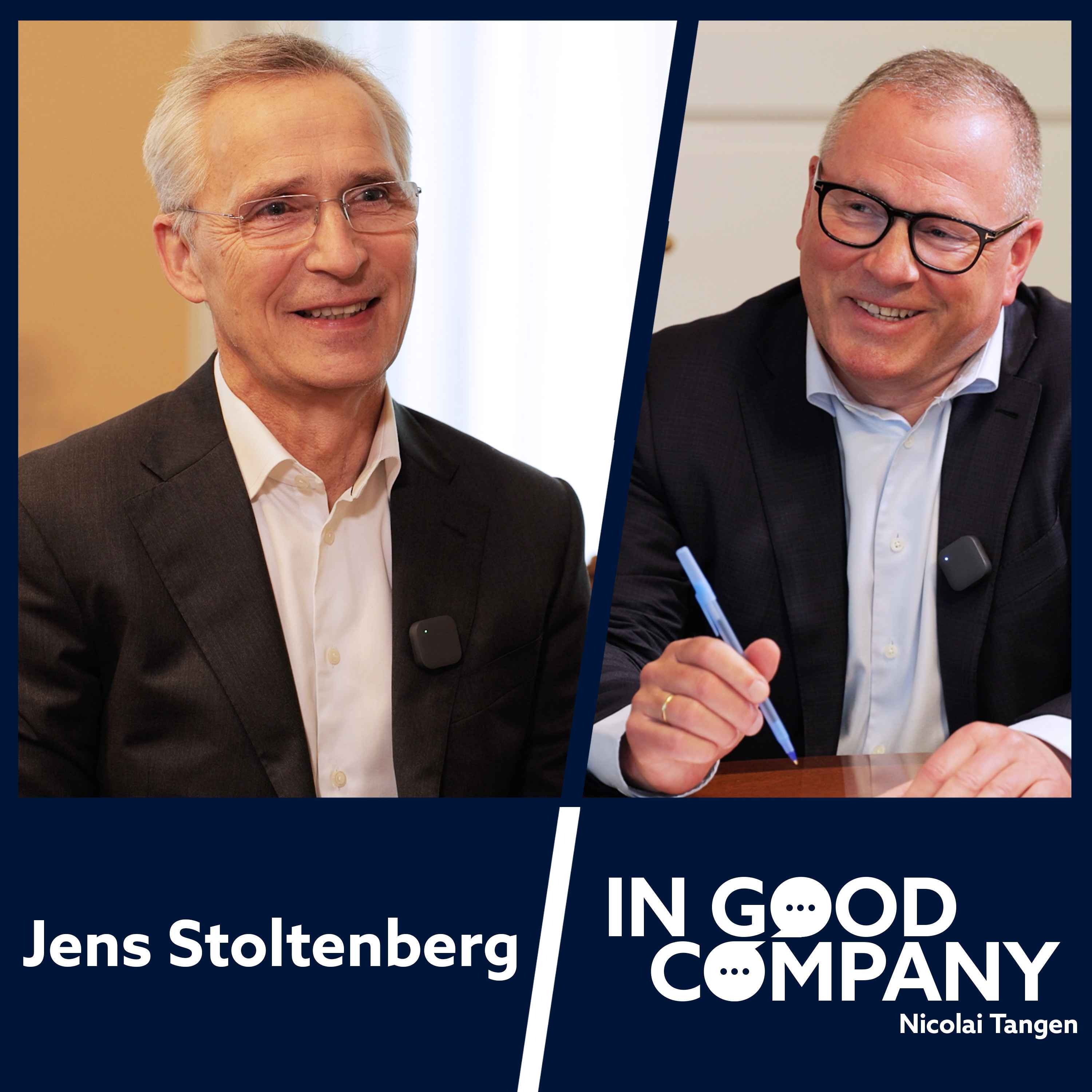
Jens Stoltenberg explains how Norway built and governs the Norwegian Sovereign Wealth Fund, contrasting Norway’s approach with the UK, and discussing fiscal rules, ethics/ESG controversies, tech/defense investment paradoxes, and geopolitical/AI risks.
Jens Stoltenberg (Norwegian politician and former NATO Secretary General; Prime Minister twice; now Finance Minister overseeing the fund). Nicolai Tangen (CEO of the Norwegian Sovereign Wealth Fund; host).
Norway saves all oil and gas revenues into the fund and withdraws only the expected real return (golden fiscal rule: 3%). This prevents “Dutch disease” and reduces complacency, but Norway still faces labor-participation and market-volatility risks. Ethical guidelines were revised after unintended consequences (e.g., defense-tech exposure).
UK lacks a sovereign wealth fund due to higher state take (78% tax rate) and spending. Caterpillar divestment example tied to alleged downstream human-rights harms. Norway buys F-35s/air-defense for Ukraine but cannot invest in key defense contractors. Top 10 holdings are ~25% of the fund; fund owns ~7,000 companies; it follows broad index diversification.
Written by AI. May contain mistakes.
Jens Stoltenberg discusses the fiscal rule that transformed Norway's oil revenue into a massive sovereign wealth fund and compares Norway's strategy to the UK's.
“when I was when I became finance minister 30 years ago in 1996 that was the year we made the first installment into the fund and since then I've followed the fund very closely.”
Stoltenberg outlines the key political decisions that shaped the fund, including saving strategies and investment choices.
“But the third political decision is then where to invest.”
Stoltenberg talks about the challenges Norway faces with its wealth management and the societal implications of oil revenue.
“What do you think it does to a country where you don't really have to prioritize when you have kind of...”
Discussion on the ethical guidelines affecting the fund's investments and the paradox of Norway's defense spending.
“The main source for our wealth is labour, work.”
Stoltenberg addresses the future ethical guidelines for investments and the need for reform to adapt to current global challenges.
“So when you were a NATO Secretary General and you saw that Norway had these things in place, did you just realize that it was increasingly untenable?”
Explore the challenges of integrating tech and defense in investment strategies.
“I hope that we can have broad agreement on revised ethical guidelines.”
Discuss the benefits and risks of investing in top tech companies.
“And Caterpillar is another example for the Norwegian Southern Wealth Fund.”
Examine how geopolitical situations impact the Norwegian fund's strategy.
“Second, I'm just afraid that if we try as politicians to forecast the market, we will end in a very bad place.”
Evaluate Norway's use of AI and its integration into public sector operations.
“We run stress tests which say, for instance, that the fragmented world is generally negative for markets.”
Reflect on the significant changes in political dynamics affecting governance.
“In this ministry, we have just really upgraded the way we use AI.”
Emphasize the importance of education and investment for future prosperity.
“It is that oil and gas is good, but it's not enough to ensure that a country develops in a good way.”
Hear a discussion on the respect for the Fund and appreciation for its leadership.
“but also when I travel abroad to see the great respect that you, but also the Fund has, because you are such a professional, such a well-managed Fund, which serves Norway so well.”

Get the gist, explore an idea or ask about something said.
 Claude
On In Good Company with Nicolai Tangen, what are the key points of this episode?
Searching your listeningAutomatic transcript. May contain errors.
0:01Hi everyone, I'm Nicolai Tangen, the CEO of the Norwegian Sovereign Wealth Fund. And today I'm really excited because I'm here with a guest who has defined the last 30 years of Norway's place in the world. So, warm welcome to Jens Stoltenberg. Thank you so much for having me.
0:24now you created the fiscal rule that turned Norway's oil money into the world largest sovereign wealth fund you've been prime minister twice you led NATO for 10 years and now you are back as finance minister running the fund you helped create so very very interesting it is a fascinating
0:42Jens Stoltenberg: history and of course there have been many decisions making this fund possible but actually when I was when I became finance minister 30 years ago in 1996 that was the year we made the first installment into the fund and since then I've followed the fund very closely. Now this week you compared Norway and Britain two countries who basically produce the same amount of oil right Now, we got a big sovereign wealth fund. Britain has quite a bit of debt. What happened here? How did we prioritize differently? It's always very difficult to compare different countries. But the fundamental message is that the United Kingdom, they have produced more or less the same amount of oil and gas as we have in Norway.
1:29Jens Stoltenberg: In Norway, we have a sovereign wealth fund of more than 2 trillion US dollars. In the UK, there is no Surveillance Wealth Fund. And of course, there are many differences. For instance, the UK is a much larger country, more people. But I think that the main difference, the main reason why we have and the UK doesn't have a Surveillance Wealth Fund is that we decided to have a big government take as part of the oil and gas industry. We have 78 % tax rate. And we have strong direct state ownership. So much of the cash flow goes directly into the state coffers.
2:11Jens Stoltenberg: And second, we have a generally relatively high tax level in Norway. So when we started to earn net revenues from Norway Lengas, we were able to save everything. And that has not been the case in the United Kingdom. There's been some pretty big calls done here. So one, to save the revenues, invest in equities. And then, of course, you also have the spending rule. So what do you think are the most important ones? And were they obvious at the time? No, all of them were politically controversial. And I think what we have learned in Norway is that if you want to make or to create a sovereign wealth fund, you have to make three important political decisions.
2:55Jens Stoltenberg: One is how much to save. The second is how much to use. So how much to put in and then how much to take out of the fund. And then the third decision is where to invest. And to the first question, how much to save? By law, we decided that all the oil and gas revenues are saved. Every cent, every dollar earned is saved into the fund. That's the first decision, how much to put in. The second important political decision is about how much to take out. And then we created the golden fiscal rule back in 2001. And that says that the only thing we can withdraw from the fund is the expected financial real return, meaning that we have estimated that to be 3%.
3:46Do you think you would have done that differently if you knew how big the fund would become?
3:51Jens Stoltenberg: No, I don't think so. Do you think that, for instance, it would have been a clause that the fund cannot account for more than, I don't know, now it's 25 % of the state budget. Do you think, for instance, you would have put in one max at 10 %? No, I don't think so. But of course, I was prime minister when we decided that rule. So maybe I'm very biased. It has served nowhere well for now 26 years. The fiscal rule to only spend the expected real return. And I will always be open to other models to listen to alternative ways of doing this. But fundamentally, I think we need to understand that the oil and gas wealth is not for the Norwegian state.
4:34Jens Stoltenberg: It's for the Norwegian people. And by spending the financial return, we ensure that the Norwegian people today and in the future will benefit from the oil and gas wealth. But the third political decision is then where to invest. And we decided back in 1997, actually in this room, this very room in the Ministry of Finance, to then start to invest in equity. Yeah. In 2001, in the white paper, it said that the money should go to three things. Incentives for work and investments, knowledge and infrastructure. Do you think that's been successful? Yes. First of all, it was not the only thing we should spend on.
5:15Jens Stoltenberg: The main purpose of the fund is to support the state budget, health care, defense, police, whatever it is. second we said that we should spend some on infrastructure we have spent very much on infrastructure i think one of the challenges we face in Norway is that not all our infrastructure investments are very much as they are very profitable meaning that that if you look at the kind of cost benefit the cost is quite high but we have spent a lot on infrastructure Research and education, well, we spend a lot on research and education, at least government-funded. And on taxes, well, roughly one-third of the total oil and gas revenues have financed reduced taxes, in particular reduced taxes on electric cars.
6:10Jens Stoltenberg: So one of the reasons why Norway, you know, almost 100 % of all new cars in Norway are electric. And the main reason is that we have removed almost all taxes on them, and that has been quite expensive. Absolutely. Now, the fund was set up to avoid the Dutch disease. Some people would argue that we've caught some Norwegian disease instead. What do you think about that? How do you think about that? Well, the Norwegian economy is not perfect. We have problems related to, for instance, the fact that we have many people on different kinds of disability schemes, welfare schemes. we struggle to increase the work participation rate and and of course we are vulnerable just by by the fact that 25 percent of our expenditures are financed but by the fund which is very much dependent on fluctuations in the financial markets so yes we have to be aware of those challenges and i think the most important thing we have to do in norway is to look into how can we increase the work participation?
7:13Jens Stoltenberg: How can we ensure that more people work? And therefore, we have implemented a big pension reform. We are looking at how we can further reform our welfare system to make it more profitable and to encourage more people to work. What do you think it does to a country where you don't really have to prioritize when you have kind of... You don't have to have either that or that, you can have both. No, I think, yeah, compared to most of the countries, we are extremely privileged. That's correct. But my message is that in one way, it's luck that we found oil and gas on the winter continental shelf. But it's a result of political decisions that we have managed this income better than most other countries with a big income from natural resources.
7:58Jens Stoltenberg: Through those important political decisions that we saved every cent, that we only use or withdraw from the fund the financial return and that we invested in equity. This is not luck. This is political decisions that enable the fund to become so big. Now everyone supports this golden rule that we only spend the financial return. But in the beginning, and I remember that well because that was 10 years I was prime minister, it was extremely controversial that we didn't spend more because then 3 % of a small fund was not a big amount of money. Now 3 % of big funds is a big amount of money, and therefore it's more accepted today than some years ago.
8:41Do you think it's making the country complacent?
8:44Jens Stoltenberg: At least there is a risk. And therefore we need to be aware of that risk, because we have seen other countries become too complacent if they have too much oil and gas revenues. Again, it helps that we save everything, so the only thing we spend is 3%. Because if we spent it as we earned it, we would have spent much more. And then we would have been without any oil and gas revenues when the production now has started to go down. But again, it's not a problem to be rich. But there is a challenge to not become complacent. And the main message from me as Minister of Finance is that the main source for our wealth is not oil.
9:34Jens Stoltenberg: The main source for our wealth is labour, work. And therefore we need to do whatever we can to mobilise more Norwegian to work more.
9:49Changing the tax a bit here. Last year you suspended the Ethics Council. Why?
9:56Jens Stoltenberg: Because it had some unintended consequences that was not foreseen by the Norwegian parliament when they decided these ethical guidelines back in 2004 and adjusted them in 2024. The fund is still managed within an ethical framework. You know better than anyone that there is still a responsible management. There are expressed expectations to the companies. the fund can be in dialogue with different companies and in some cases also die in west from those companies the thing we and of course they have to follow Norwegian law it has to follow international law the thing that and the management of the fund is based on core guidelines from the OECD and the UN the thing we suspended was a part of the ethical guidelines a system where we have an independent ethical council giving advice to the Norwegian bank, to the fund, to withdraw from companies.
11:05Jens Stoltenberg: And then you set down a committee to review this. What do you hope they will come up with? I hope they will come up with guidelines that will ensure that we continue to have a solid ethical framework around the fund, but which will work in a better way than the previous guidelines did at least over the last years. Because what we have seen is that these ethical guidelines have led to that we are not invested in major companies producing key defence capabilities, which Norway are dependent on. Norway buys F-35s, but we cannot be invested in Lock and Martin producing those F-35s. We cannot be invested in Boeing, which are delivering key military capitalists, not only in Norway, but to NATO allies and to Ukraine.
11:55Jens Stoltenberg: And for me, that's a paradox that companies which are so critical for our security, we buy a lot from them, but we cannot own 1 % of the equity. So when you, of course, you've got more experience than anybody else, having been the NATO Secretary General. So when you were a NATO Secretary General and you saw that Norway had these things in place, did you just realize that it was increasingly untenable? Yeah, yeah. The reason why I took the initiative, one of the reasons I took the initiative last fall to address the ethical guidelines was the experience I had from NATO. As NATO Secretary General, I traveled around and urged allies to build up the defense industry, to work more closely with all these companies.
12:41Jens Stoltenberg: And then I realized that the American pension fund, which I had been working so closely with for so many years, had a guideline, a rule saying that we cannot be invested in those companies I wanted more of. And that was a contradiction. It was a paradox. And, of course, in one way, that didn't matter so much when the fund was smaller and the world war was more peaceful. Now we live in a full-scale war going on in Europe, in Ukraine. we do whatever we can to support Ukraine. Again, the key capabilities, the patriot missiles, the interceptors, the air defense systems we are delivering to Ukraine are delivered by companies that Norway cannot be invested in.
13:21Jens Stoltenberg: That's a paradox. But you have five political parties in the coalition. Do you think you'll get them to come along? Yes. I cannot guarantee on behalf of them, but at least I hope that we will have a recommendation from this independent expert council, actually shared by a former governor of Norwegian Central Bank, Svein Hedrem. Then we will have their proposal. It will be a public hearing about that proposal starting later on this year. And then we will present the proposal to the parliament next spring. Let's see. I hope that we can have broad agreement on revised ethical guidelines. And also another paradox is that we see that tech and defense, it's more and more integrated.
14:14Jens Stoltenberg: And of course, a broad-based international sovereign wealth fund, as the Norwegian sovereign wealth fund is. If we cannot be invested in the big tech companies, which deliver, of course, different services to many defense companies, then we cannot be a broad-based international sovereign welfare anymore. So that's another paradox, another challenge we have to solve. The challenge that you've had an ESG backlash in other parts of the world, whilst the Norwegian political parties basically have unchanged views, just how is that opening up, what should we say, challenges? I guess we saw that with Caterpillar in particular, right?
14:56Jens Stoltenberg: Yes, but I think that Norwegians and I and the Norwegian government, we are concerned about environment, sustainability, governance, all those considerations which are in the ASG framework. But sometimes the way this has been applied, it has been understood, has not functioned very well. And Caterpillar is another example for the Norwegian Southern Wealth Fund. This independent ethical council, based on the guidelines the parliament had decided, recommended that the Norwegian Southern Wealth Fund should sell out or die in vests from Caterpillar. Caterpillar is an important provider of a lot of trucks and other things we use in Norway.
15:48Jens Stoltenberg: The Norwegian government is a customer. But then a small amount of those trucks are then sold to the U.S. government, which then sell them to Israel. And then in Israel, they use them to violate international law, destroying Palestinian homes. We all agree that that's bad. But the question is whether Norway cannot be invested in a company where a tiny part of what they do contributes through two governments, the U.S. government and the Israel government, to do bad things. if that's in itself is sufficient to totally leave the company to not be invested then it's very hard to see how we can be invested for instance in the big tech companies absolutely big tech companies now some people ask you know who are the big gainers from what's going on in the in the tech world and it's basically one of them is the Norwegian sovereign wealth fund right I think last five years, 1 ,600 billion Norwegian kroner from the top companies.
16:49Now, the top 10 companies in the portfolio accounts for 25 % of the fund. What are your reflections about that?
17:00Jens Stoltenberg: First, it's the same as you just stated, that hardly anyone in the world has earned more money from tech companies than Norway, because we have been investing in them for a long time. We have followed up as the equity and share prices have increased, and also the returns from those investments have been incredible. Then, of course, if something goes up, it's also a risk that it can fall down. And I will not speculate about the likelihood of what will happen in the U.S. stock market or with these specific companies. As you said, 10 companies, roughly 25 % of the sovereign wealth fund. But my main challenge is to address the issue, should we change the guidelines?
17:47Jens Stoltenberg: Because the guidelines decided by the Norwegian government is that you should be broadly invested in all listed companies, follow the international markets and a kind of index fund. and I think that if I started to politicize that and to say that no, no, now I believe that the market in the US will go down because it is so high, first of all, it has been a kind of concern for many years and that will continue to increase. So if we had made that decision four or five years ago, we have lost a lot of money. Second, I'm just afraid that if we try as politicians to forecast the market, we will end in a very bad place.
18:29Jens Stoltenberg: So I'm confident that we should still remain a broad-based international index fund with some active management by you and your people. And then there will be downturns. But do you think it makes sense to own 7 ,000 companies, given that the big ones are so important? And given that if something bad happens, somewhere in the world, the fund typically owns it. Do you really need all these companies? Well, again, it actually used to be close to 10 ,000. Then we have reduced to 7 ,000 to minimize a bit also the administrative costs. And of course, I'm not ruling out that there will be also adjustments in the future.
19:15Jens Stoltenberg: But the fundamental idea that we should be broadly diversified over different markets, different companies, that that's the best way to have the best return over time and the lowest risk, that I still believe in. It has served us well for all these 20, 30 years, actually. And I believe that's the basic right approach also for a government-owned 7-world fund in a democratic nation.
19:46Mr. Stoltenberg, we have some big privately held companies coming to the stock market this year, you know, SpaceX, Entropic, OpenAI. Do you think the fund should be able to also own private companies?
19:58Jens Stoltenberg: Well, this is a very sensitive political issue in Norway. And, of course, it has been a great advantage that we have a very high degree of transparency. We have easily defined benchmarks. And that's more straightforward, at least, to establish when we have listed companies, as we invest in today. then I admit that there is a dilemma that some of these big private companies will most likely soon become public companies and then we will buy into them. So the paradox is as soon as SpaceX or Antropic or whatever or OpenAI becomes public companies, then nowhere will invest based on the fact that we follow the markets and are invested in almost all enlisted companies.
20:45Jens Stoltenberg: That's a paradox. Whether that's a big enough paradox to change our policy, I think it's far too early to decide. But at least I think we should be aware of that that's a challenge that we face, that we buy as soon as they are listed. We run stress tests which say, for instance, that the fragmented world is generally negative for markets. We are seeing rivalries between some of the superpowers. We are seeing trade barriers and so on. Just what are your reflections on how the current geopolitical situation is impacting the fund? That we have to be prepared, as also you have stated many times, that the value of the fund may actually fall substantially and that will have a direct impact on the Norwegian state budget.
21:32Jens Stoltenberg: We have just presented the revised budget and in the revised budget to the Norwegian involvement, we have some scenarios. If we have the same development in the national stock market today as we had after the oil crisis in the 70s, the value of the fund would have gone dramatically down and it would have taken more than 15 years before we came back to the starting point. And of course, since we spend 3 % of the fund into the state budget, it will affect our estate budget. The way to try to prepare for that is that actually when now the value of the fund and the stock markets have increased substantially over the last years, we have actually spent a bit less.
22:21Jens Stoltenberg: So we have spent like 2.7%, 2.8 % over now many years. So we have actually saved, you have created a kind of buffer. There is no way to totally avoid consequences, but by being careful when the market go up we have some buffer when and if the market goes down. So where do you think the biggest risk to the fund is now? To be honest I think that's an extremely difficult question to answer because it is the unpredictability that in a way characterise the world both financial economically, but also when it comes to security, geopolitical unpredictability. Wars are bad for business, at least for global business, maybe specific companies.
23:11Jens Stoltenberg: And we have a very dangerous situation in the Middle East, and we have a full-scale war in Ukraine. I hope that there will be ways to end this war, but wars are dangerous. They can spiral and come out of control, and then it will affect global markets. the value of the fund. So it's not only the human cost of war, but also the economic cost. And then, of course, I believe that AI is changing global economy. I believe that AI is creating a lot of value. But, of course, with this enormous increase in the share prices, there is a risk that it may go down. But again, my task is not to speculate. My task is not to forecast future stock prices.
23:58Jens Stoltenberg: My task is to define the best strategy for Norway to manage the uncertainty and, again, diversify many markets. That's the best way to reduce the risk for Norway. The technology company share prices have gone up because there is so much potential in the technologies, right? do you feel that Norway is using AI enough? I think to say enough will be wrong. But we are actually quite good at using AI. According to Eurostat, we are the European country that is using AI the most. So based on EU statistics, we are quite good in Norway using AI. But given that we are highly educated, very digital, and not too keen on working, should we not use it much more?
24:56Jens Stoltenberg: Absolutely. And I think it is a great potential. But again, if you use it, whether the glass is half full or half empty, it depends what you compare with. If you compare with other European countries, we are doing quite well. We are using a lot in Norway. If you compare with what should be an ambition, yes, I think we should use it more. Then I think the issue is not only about using AI. It's about using AI in the right way and in the right, as I say, frameworks. In this ministry, we have just really upgraded the way we use AI. We have developed a new way of integrating AI into our daily work.
25:33Jens Stoltenberg: We have integrated the AI models we use here with the data banks of the Central Bureau of Statistics and the Ministry of Finance. So now I can just go into my computer and make the most beautiful charts and figures by just using the enormous amount of data that the Minister of Finance is responsible for, including the Central Bureau of Statistics. And I think that the public sector could and should use AI much more. I think it's a great advantage that the average kind of Norwegian is quite educated and is used to use different digital things. and therefore we should just simulate more use of AI.
26:16Jens Stoltenberg: Talking about beautiful graphs and figures, so you were out of the country for 10 years. What was the biggest change or surprise that you had when you came back into the ministry? Well, the biggest change from... Because I'm in that paradoxical... I have experienced that. I'm back now in the ministry. I was 30 years ago. So I was Minister of Finance in 1996, and the biggest change from that time was that in 1996 it was zero in the Norwegian Surveillance Fund. Now it's more than US$2 trillion. If you compare with the last 10 years, the 10 years I was out in NATO, so politically I think the biggest change is that we have an even more fragmented political landscape.
27:05Jens Stoltenberg: So being a responsible minister, being a minister of finance, is in one way more challenging now, because we just have to negotiate more, we have to make more compromises to get things agreed in Norwegian parliament. So Mr. Stoltenberg, just to round off, what do you think are the most important things to remember for the next 30 years? It is that oil and gas is good, but it's not enough to ensure that a country develops in a good way. The most important thing is, as always, that we are able to ensure that people work and that they are well educated and that we invest for the future. The oil and gas helps us, but it's not a guarantee.
27:51And if you were to give some advice to the people running the fund, what would you say?
27:57Jens Stoltenberg: Continue as you do, because you do an excellent job. and I'm proud always when I work or meet you, but also when I travel abroad to see the great respect that you, but also the Fund has, because you are such a professional, such a well-managed Fund, which serves Norway so well. Thank you, and thank you for everything you've done for the Fund and for the nation. Thanks so much.
If anyone can tell the story of how Norway built the world's largest sovereign wealth fund, it's Jens Stoltenberg. As the fund marks its 30th anniversary, Nicolai Tangen sits down with Norway's Finance Minister and former NATO Secretary General to trace the decisions that turned oil revenues into $2 trillion in national savings. They discuss why Britain and Norway diverged so dramatically despite producing similar volumes of oil, the thinking behind the spending rule, and the risk of complacency when wealth feels guaranteed. Stoltenberg also explains his reasoning behind suspending the ethics council, the paradox of excluding defence companies Norway itself purchases from, and what he believes will matter most for the fund in the next 30 years. Tune in!
In Good Company is hosted by Nicolai Tangen, CEO of Norges Bank Investment Management. New full episodes every Wednesday, and don't miss our Highlight episodes every Friday.
The production team for this episode includes Isabelle Karlsson, Halvor Njerve and PLAN-B's Niklas Figenschau Johansen. Background research was conducted by Une Solheim.
Hosted on Acast. See acast.com/privacy for more information.


