
 Ask ChatGPT


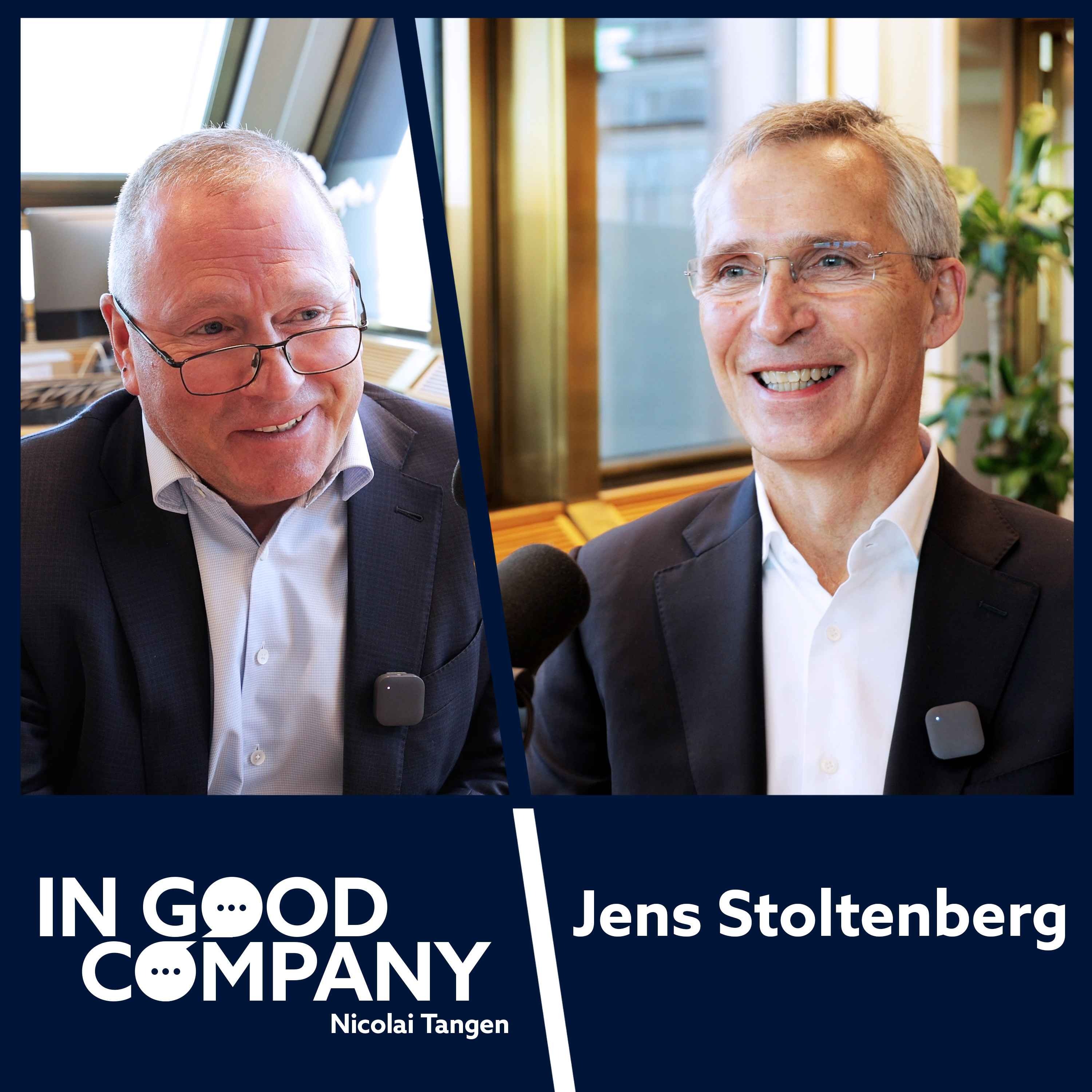
 In Good Company with Nicolai Tangen
16 Oct 2024 · 55m
Written by AI. May contain mistakes.

Get the gist, explore an idea or ask about something said.
 Claude
On In Good Company with Nicolai Tangen, what are the key points of this episode?
Searching your listeningAutomatic transcript. May contain errors.
0:00Hi everyone, I'm thrilled to be here with Jens Stoltenberg who just finished off as the Secretary-General in NATO. and before NATO. He was the Prime Minister of Norway. Warm welcome, Jens. Thank you so much for having me.
0:22So I'm having here, you know, a book which you wrote, which came out eight years ago, which basically covered the period until 10 years ago. And it's got a beautiful picture of you on the front here. But just what are the most important changes in the world since that book came out? The most important changes, at least related to my task and my responsibilities in NATO, is that the world has become more dangerous. That's the bad news. The good news is that NATO has become stronger to protect close to one billion people. Of course, there are many other changes, but seen from a security perspective, we have now a full-scale war in Europe.
1:11We have a new, very devastating conflict in the Middle East, risk of escalation. And we have significantly more global rivalry between great powers, the United States, China. And then we have cyber hybrid terrorist threats as a constant threat to our security. So fundamentally, we live in a more unpredictable, more dangerous world than we have done for decades. If we cover some of these points here, so how do you think the Ukraine situation will end? What's the most likely? Wars are by nature extremely unpredictable. So therefore, I will be very careful predicting how that will end. But of course, we all want this war to end.
1:59The challenge is that the quickest way to end the war is to lose a war. But that will not lead to peace. That will lead to occupation of Ukraine. And Ukraine will not be a sovereign, independent, democratic nation in Europe anymore. It will be a country controlled by Moscow. So if you want the war to end in a way where millions of Ukrainians still can live in a free democratic society, then we need to convince President Putin that he will not win on the battlefield, that he has to sit down and negotiate, agree a solution where Ukraine can still be a sovereign democratic nation. And I don't believe that we can change Putin's mind, but I think we can change his calculus, meaning that I don't think we can change his ambition, his goal of trying to control Ukraine.
2:52But I think that by providing military support to Ukraine, we can ensure that the cost of achieving that goal for Russia is so high that they will accept a solution where Ukraine prevails in one way or another. The decision of not giving more offensive weapons, which was kind of renewed lately, what do you think about that? Well, NATO allies have delivered a lot of offensive weapons. The reality is that, of course, we have gradually changed over the years. I remember when I came to NATO in 2014, then some allies, the United States, the United Kingdom, and a couple of others, Canada, they provided some military support, some training, but hardly any lethal weapons.
3:42It was a big discussion, for instance, about javelins, the anti-tank weapons, which has proven extremely important on the battlefield in Ukraine. but then off and i think actually we should have done more before the full-scale invasion in 2022 but after 2022 the full-scale invasion nato allies have delivered much more military support than president putin expected and to be honest also we expected we had big discussions on whether we were going to deliver battle tanks now allies deliver a lot of advanced modern battle tanks, including US Abrams tanks, European or German leopard tanks. We deliver advanced air defense systems, Patriots.
4:25We deliver long-range artillery, also cruise missiles from, for instance, United Kingdom and France, and then also F-16s. So the scale and the quality of this military support is much bigger than anyone was able to foresee just a couple of years ago. I think the dilemma which continues to be discussed among allies is to what extent should we allow Ukraine to use all these weapons against military targets inside Russia?
5:02And allies have different policy. Some NATO allies have said there are no restrictions except for adhering to international law. Others have imposed some restrictions on the use of weapons deep into Russia. What do you think? I think we need to remember what this is, that this is a war aggression. Russia has attacked another country. That's a blatant violation of international law. According to international law, Ukraine has the right for self-defense. Self-defense includes the right to strike legitimate military targets on the territory of the aggressor, meaning Russia. So therefore, I have argued for loosening up these restrictions, and many allies have done so.
5:51And then there is an ongoing conversation among NATO allies exactly to what extent they should remove all the restrictions when it comes to hitting legitimate military targets under a territorial version. If Ukraine have to recede more territory, is that more likely to happen, you think? i'm extremely careful even though i'm now stepped down as sector general uh to to in a way to to speculate because it can be self-fulfilling prophecies if you start to say that we believe that ukraine has to do this and that or cede more territory then of course it can boost the morale of the russians and reduce the morale of the ukrainians and even though i know that i'm not speaking behalf of nato anymore i think it matters what we all say uh when it comes to what we believe that Ukraine also may be forced to.
6:43Fundamentally, it is only the Ukrainians that can decide what are acceptable conditions. They are paying the highest price. They are sacrificing people every day to fight for their freedom. And again, I think that the path to peace is to convince Putin that he cannot win on the battlefield. There is a very close relationship between what happens on the battlefield and what can happen around the negotiating table. So if you want some kind of acceptable solution where Ukraine will remain as an independent nation, then military strength on the battlefield is the way to convince Putin that he has to accept that.
7:26Then, of course, it's for Ukrainians to decide how much they are willing to give up to achieve peace. i've met many finnish politicians of the last couple of years since finna now had joined nato i think we even have the president in oslo today yeah yeah you're absolutely right and um and i and alex stubb the president of uh of finland uh um they're always or they're often and many other finnish politicians have have in a way shared with us the history of finland It's different from Ukraine, but there are some parallels. They were invaded by the Red Army in 1939. And they were able to, as a small country, to inflict much more heavy losses and pain on the invading Russian or Soviet forces.
8:18so the Red Army didn't achieve their goals but to end the war Finland had to accept to give up to cede roughly 10 % of the territory and their second biggest city, Vyborg which is now part of Russia but of course in return they gained borders and security that has lasted for decades I'm not saying that this is the parallel for Ukrainians and NATO membership A NATO membership. What's been the most important advice you've given your successor, Mark Rutte? First of all, I've been very careful giving any advice because I just don't think that people are leaving a position should be to, especially not in public, to explicit on advice and so on.
9:05I have great trust in Mark Rutte. He's a great leader. He has been prime minister for, I think it's 14 years. And of course, just to lead coalitions, to find compromises, I think is the best way to qualify to become a Secretary General of NATO, to know how to reconcile different views. But I cannot hide that, of course, the most important task for any Secretary General of NATO is to keep this big family together. And we are 32 allies, and we don't always agree on all issues. So his main task is to ensure that despite these differences, that we are able to rally around the core task to protect and defend each other.
9:50You have, over the last few years, become more vocal about China. What are the concerns you have? First, I would like to say that if, for instance, read that book. I read it twice. Yeah, yeah, yeah. Love it. I know I was a great believer in China for many years. Yeah. And I was extremely impressed. I remember I visited China in 85 or 86, at least in the middle of the 80s, and I was extremely impressed by the changes that Deng Xiaoping did and how they were opening up their economy, how the economic growth of China changed the world. partly for the people in China, lifted hundreds of millions of people out of poverty, but also actually important for the rest of the world by creating a big new market, by providing a lot of products to global economy.
10:42Norway benefited. We sold a lot of energy, oil, gas into the Chinese market or global market. And then we bought a lot of things from China, good price. So that has been a great success story. for China and for the rest of the world. Then I can not say exactly when my view started to change, but I remember I was very disappointed the way China reacted when the Norwegian Nobel Peace Prize Committee awarded the peace prize to a Chinese dissident. I think it was in 2010. And then they actually imposed heavy sanctions against Norway. and behaved very, they wanted us to apologize. And that behavior was quite shocking.
11:30And then, of course, after I arrived in NATO and over the last years, we have seen a much more assertive China trying to dominate, control the South China Sea. They have lost, actually, in the international court in The Hague. So what they do there is a violation of international law, threatening neighbors, threatening Taiwan. and China is investing heavily in new advanced weapons, including nuclear weapons, without any transparency. And then, of course, in Ukraine, what we see there is that security is not regional. Security is global because China is the main enabler of Russia's aggressive war against Ukraine by providing the microelectronics, the components for Russians to build the bombs and the missiles they're using in Ukraine.
12:24So the closer and closer alignment between Russia and China also, of course, is one of the reasons why we are concerned. Let me add one more thing. And that is that we don't, when I was Secretary of General of NATO, I remember very well that we didn't say that China is an enemy or an adversary. We need to engage with China on issues related to climate change. They have to be part of the global economy, of course, and in the future, hopefully also on arms control. But we have to be not, it's important that we're not naive and not make the same mistakes as we did, for instance, when it comes to Russia, being over-dependent on gas from Russia.
13:02We should not be over-dependent on specific commodities or technology from China. The fact that there are stronger and stronger links between the autocrats in the world, what are the implications for the Western world? That we have to be together when we see that the autocrats are more and more aligned. And then, of course, that's partly we, meaning partly NATO allies of 32 nations on the both South Atlantic, but also with other countries, which at least don't want to be part of a kind of orthocratic alliance. And again, Ukraine is perhaps the clearest example. Russia is responsible for war aggression.
13:47The main providers of weapons and enablers of that war is North Korea, Iran, and China. And this is not rhetoric. This is real and makes a difference on the battlefield. And we also see how Russia and China are exercising more together, also around Japan and other parts of the world. So this is really a global picture that makes it even more important, of course, to need to allies stand together, but also to work with partners all around the world, including South Korea, Japan, and many other countries. How do you read the activities around Taiwan just now? Well, we see that China again and again repeats different threats, both in rhetoric, but also with these very high profile exercises where they're actually exercising how to invade Taiwan.
14:43And that will be extremely dangerous. And the rhetoric is dangerous. Therefore, it is important that military force is not used to change status quo in and around Taiwan. There are millions of people living there. NATO allies recognize that, and Norway recognize that there is one China, but we also support the idea of people having the right to live in a democratic and open society. We had the same idea with Hong Kong, that it was two systems in one nation, that Hong Kong should be some kind of democratic part of China. That didn't last for very long. And of course, it will be a tragedy of millions of people living in Taiwan experiencing something similar to what the people of Hong Kong has experienced over the last years.
15:38How should the business leaders and we as investors think about engaging with China? This is an extremely difficult question. But I think just to be aware that there are dilemmas and to be conscious about those dilemmas helps. I have been and I continue to be a strong believer in free trade and most of my political life I really worked for free trade agreements including the open European market and I believe that globalization free trade benefits us all having said that freedom is more important than free trade and sometimes you have to recognize that you cannot have free trade if it if the cost is that you actually undermine freedom.
16:21And one example is Russian gas. Until 2022, many European governments meant that buying gas from Russia was a commercial issue. It was not a political issue. Politicians should stay out of a commercial deal between commercial companies in Europe with commercial companies in Russia. That proved very wrong because to buy gas from Russia is not a commercial issue, or at least much more than a commercial issue. It was a security vulnerability that Russia utilized after the full-scale invasion of Ukraine. They tried to coerce European allies from supporting Ukraine by using the gas. And we should not repeat the same mistakes with China.
17:05It's quite amazing that we ended up in that situation, actually, with Russian gas. it was amazing, but I think we need to remember that it was a quite common European view that all kind of trade with Russia was a good thing. And again, I have been partly part of that view. I have been in favor of trade with Russia. I've been in favor of trade with China with very little restrictions. And gradually, I saw how, especially Russia, but also to some extent China has used trade as a political tool. And therefore, the politicians have responsibilities to put in some regulations, laws, to ensure that we don't make the really big mistakes.
17:54But within those regulations, there has to also be judgment by each individual private commercial company. and the dilemma is that the extremes will not work we cannot have absolutely open and free trade there has to be some security considerations part of those decisions but on the other hand we cannot isolate China so to find this balance where we have some trade some economic relations but without making ourselves too vulnerable I cannot give an exact answer But the dialogue between governments, companies on how to find this balance is the best way to try to at least find the best way forward together.
18:43Last hotspot, Middle East. How do you think that will play out? It's difficult to predict Ukraine, even harder to predict the Middle East. And what we see now is a tragedy. It's dangerous. And there is a risk of further escalation. and especially with Iran, which has destabilized the region for many years and continue to do so. As a Norwegian, I think it's important to remember that in 1993, we had the Oslo Accord, which has been heavily criticized for many years. But I still believe that that's, in a way, the only way that can create some kind of lasting solution. And that's a two-state solution.
19:30You need a state for the Israelis and you need a Palestinian or a state for the Palestinians. It's not easy, but the alternative to continue as we do now is absolutely not viable. So therefore, sometimes crisis creates the momentum to find new solutions. And hopefully, at least one thing that can come out of what we see in the Middle East now is a renewed effort to find a two-state solution. There are some voices that want the EU to play a more important part in defense policy. What is your view on that? My view is that if it's done in the right way, it's very good. If it's done in the wrong way, it's very bad.
20:10What's the right way? The right way is that EU should do more, and they have started to step up when it comes to, for instance, strengthening the defense industry, meaning overcoming the fragmentation of the European defense industry, to increase defense spending and to in general strengthen European defenses meaning that that will also strengthen NATO 96 % of the people living in the European Union they live in a NATO country so that will be more or less the same what is not good is to create alternative and competing structures and to underpin this idea of the European Union defending Europe.
20:55But can you see that some people are in favor of this given the US position? Yes, but I think that's dangerous. I think that any attempt to in a way split or divide Europe from North America will undermine our security because we live in a more dangerous world. And if we go alone, we will be weaker and more vulnerable. And the European Union cannot defend Europe. 80 % of NATO's defense expenditure comes from non-EU NATO allies. That's, of course, the United States, but also Canada, a big ally. The United Kingdom, the second biggest defense spender in NATO. But also, this is about geography. Turkey in the south, extremely important for fighting ISIS, fighting terrorism, bordering Iraq and Syria.
21:48In the north, Norway and Iceland, perhaps not the biggest NATO allies, but very important for the transatlantic link. So geography and resources makes it clear that this idea that EU should develop some kind of independent defense will just undermine and duplicate the NATO structures. And the NATO structures has to – North America and Europe together is the only way to defend Europe. Together, we have 50 % of the world's military might and 50 % of the world's economic might. So as long as we stand together, North American Europe will be safe. Yeah. Good. Space. Yeah. You cover a lot of issues.
22:30Well, the world is so complex, right? It is. What's going on in space from a warfare point of view? So first, I think what we see is that there's more and more weaponization of space. and what happens in space matters more and more for what's going on on the earth. That's obvious for communications, GPS, but cyber, and then of course targeting a lot of military operations in Ukraine are dependent on satellites in space, and any future conflict space will be important. What we also then see is that, again, Russia and China are developing capabilities that can actually be used as offensive weapons.
23:18And this is a dangerous development. And again, there is a need for transparency. There is a need for arms control. And there is a need also for allies and partners to stand together to address these issues together. and um in a way a bit related to that ai um what are the issues surrounding that when it comes to some people uh in america say that we should build ai into everything we do into all the weapons all the cars everything right to beat the chinese in this kind of fight what how do you see ai impacting warfare so i i have to admit that i have read and and listened to many experts uh explaining about AI, and I still struggle to fully understand the full implications.
24:09But I think what is obvious that AI has and will even more so in the future change the nature of warfare, perhaps as fundamental as the Industrial Revolution did. Because you have to understand that if you go from Caesar to Napoleon, the soldiers could actually participate, the soldiers participating in the Roman Empire or a part of the Roman Empire, they could actually make a difference on the battlefield during the Napoleonic War because they had the technology that actually was applicable also at that time. Then from the Napoleonic War to the First World War, everything changed with the Industrial Revolution being also then implemented into warfare.
24:57I think we see something similar now, a fundamental shift where we don't fully understand. But autonomous systems, facial recognition, drones, cyber attacks by using also AI, has the potential of changing warfare so much that it's very hard to fully understand the full implications. We have already seen it on the battlefield in Ukraine. Yeah. It's not the secret that some of the drones and the surveillance systems that NATO operates also uses AI to process information. So this has already started, but we are only seeing the beginning of a fundamental change of the nature of warfare. Interestingly, the two Nobel Prizes that were won over the last week in chemistry and physics, you know, have AI underpinnings.
26:00So he is really changing a lot of things. But the fact that we regulate AI so much in Europe, is that holding back our defense capabilities? So far, I've not heard the defense industry complaining about that, but maybe. And I think the challenge, the dilemmas every time we approach new technologies is that in one way, we want ethical standards. We want transparency. We want regulations to prevent the misuse of important technology. On the other hand, if we only impose restrictions on ourselves, be it in Europe or North America and Europe, Western Alliance, but our adversaries, they have no restrictions, then, of course, we can just make ourselves more vulnerable.
26:50Fundamentally, this is very much the same dilemmas we are faced with nuclear weapons. of course, nuclear weapons are extremely devastating and the potential to really destroy human life in the way we know it today. So in that way, it's very easy to be against nuclear weapons. And I would like to have a world without any nuclear weapons. The challenge is that as long as they exist, I think we are safer when we have nuclear weapons to deter the adversary of using those weapons against us. So unilateral disarmament is dangerous. What is good and what you should strive for is balanced, transparent, multilateral arms control.
27:38That applies for nuclear weapons, but fundamentally it also applies for all other technologies, for instance, AI. Cyber. Well, in one way, we've already touched upon it because cyber and AI is interlinked. and it just demonstrates that warfare conflicts can take place in many domains. In the old times, we had, in a way, air, sea, and land, but now we have space as a domain and cyber as a domain. But do we have strong enough offensive capabilities in cyber? Or are we just continuously under attack and defending ourselves? No, again, these are sensitive issues. And I know that some countries are very reluctant to speak too much about it.
28:27But I know, and it's not a secret, that NATO allies also have offensive capabilities. I think we call them national effects, but it's only a different word for the same. And I had a very interesting experience when I actually saw in one of the allied countries how they used. I was actually in a kind of command center, cyber command center, where they actually used cyber offensive capabilities to attack ISIS. This was back in 2016 or 2017. And that was extremely effective, how they used, NATO ally used cyber to take down the cyber networks of ISIS in Iraq and Syria. then of course that's perhaps the most not the most advanced adversary that you can face but of course there are offensive capabilities because cyber is now a domain as air sea land and the other domains are uh it's a it's a domain and a truly global domain there are some problems one problem is that attribution is harder in cyber uh so one of the first challenges you will face with a with a full-fledged cyber attack is to actually decide who is attacking you um uh second um the other challenge is that is that um um it's it's it's there's a much more more much more blurred line between conflict and non-conflict when when when do you have to trigger article five when you have to declare war uh when you have a cyber attack because Because cyberattack is something that goes on almost every day in different ways.
30:16And when do you surpass the threshold of something which will trigger a full response from the armed forces, from perhaps NATO as an alliance? So the French statesman Clément Saint said, war is too important to be left for generals. And you have paraphrased this by saying business is too serious to be left to business leaders alone. What do you mean by that? I mean by that that I believe in free trade, I believe in private business, but I believe that some of the issues related to commercial decisions are too important to be left to commercial decisions or considerations alone. And again, we have touched upon the most recent examples, gas from Russia, or over-dependence on commodities from China, or the export of key technologies from us to authoritarian powers.
31:12It may be a good business deal, but it will be undermining or dangerous for our own security. Or, for instance, allow authoritarian powers to control critical infrastructure. Again, maybe good business deals, but may potentially make us vulnerable. So this is what I mean by it's too important to be left to businessmen alone. U.S. venture capital firms have ramped up efforts within defense. But we haven't really done the same in Europe, even though NATO has a venture capital arm, right? Yes. How do you see this developing? Well, I think that we need to invest more in our defense industry. And we also need to realize that we need venture capital.
32:01We need innovation. And that's the reason why NATO, again, I'm now stepped down, but I'm sure that Margaret, the current Secretary General, will follow up on this, has stepped up the efforts to work with private business to ensure that we maintain the technological edge, which has been the benefit of Western countries for decades and helped ensure our security. We always had the most advanced technologies. That is not so obvious anymore, especially in light of the Chinese economy and their ability to also develop new technologies and use those technologies in their defense production. There is also another change that has happened over decades.
32:49back in the 40s and 50s and 60s, perhaps even the 70s, most of the defense technology was developed by the government. Nuclear was a big state-run program, a Manhattan program in the US. GPS, this kind of internet was actually a result of government finance, government-controlled entities, research programs. This has totally changed. Now, most of the advanced technologies are developed in private business, in private companies. AI, cyber, the whole Silicon Valley, the whole - And SpaceX. All of these things are now private. But the governments and our defense sector, which is, of course, still state responsibilities, are totally dependent.
33:42So we need to work with the private business to ensure that we keep as militaries the technological lead to ensure that we have the best armies in the future.
34:00Jens, let's change tack here and move into happier territories. We have something in Norway called the spending rule, Handlingsregeln, which you first as a brilliant student of economics worked on, then as a minister of finance and prime minister and so on. And it's a rule which tells how much of the Norwegian sovereign wealth fund can be spent every year to support the budget. And it's really been a cornerstone in the economic planning in this country. Now, what inspired you to create this rule? it was the understanding that norway was going to get a lot of revenues from the oil and gas and much bigger revenues than we expected um and therefore when i was prime minister in 2000 then we actually had only net oil revenues only for a few years the first net oil revenues came to Norway in 1996.
34:55In the beginning, they were quite small. Then it was obvious that we needed some way of deciding how much we could spend. And we were very afraid of what we refer to as Dutch disease, to spend too much. And therefore, we started partly in a kind of academic, but also then a political discussion on how to establish a fiscal rule for how much of the oil revenues we could spend. And the purpose was actually twofold. One was to ensure that not only our generation, but also future generations get the benefit of the oil and gas resources that we have found on the Norwegian continental shelf. That's a kind of long-term perspective.
35:43The other reason to establish the fiscal rule and the pension fund was to ensure that we could stabilize the Norwegian economy to separate earnings from spending and prevent overheating of the economy. And therefore, we established the pension fund. And the first money was allocated to the pension fund in 1996. But perhaps as important was this fiscal rule, where we decided that all the oil and gas revenues was going to go into the Norwegian pension fund, and then that the only thing we're going to spend was the financial return, which we estimate to 3 % in yield terms per year as an average. And therefore, the fiscal rule says that we should only spend on average the fiscal return 3 % estimated, and that has served Norway very well.
36:44It's quite a feat to manage to get political consensus around the spending of such vast resources, and probably one of the successes of, well, one of the main successes of the fund. Has it worked the way you thought? Yes, and if anything, it has worked even better, partly because the fund has become much bigger than we expected. For many reasons, oil and gas production at Norwegian Continent Shelf has been bigger, prices have been higher, and we also have good investments because people like you have been able to manage the fund in a very good way. So the combination of all these things have made the fund much bigger and therefore also the fiscal rule more important.
37:29If you had at the time when the fiscal rule was made, had also made a rule for how much in total could the fund contribute to in percent of the budget. What do you think that percentage would have been? I think it would have been lower than the current percent, which I think is now 25 % or roughly almost one quarter than which state expenditure or state budget is financed by the return from the oil fund. So instead of 25, what do you think it would have been? No, I am not able. But then I think it's important in a way, as I'm not able to give it an exact number, but I think it's also important to understand that there are concerns.
38:09And I'm careful going too much into that debate because that's a very Norwegian debate and I'm careful being too specific on issues I've not worked so close with over the last years. But I think the idea back in 2000 when we made the fiscal rule was in a way that this was going to, it could last forever. Because in one way, NATO has, no, sorry, Norway has spent zero of the oil revenues. The only thing we have spent is the fiscal return on the oil revenues. And of course, that can last forever. As long as we have the installment, the challenge, and you know that better than anyone else, is that, of course, we now have so much of our wealth in the stock market.
38:50Then, of course, there can be big fluctuations that can have an impact on the Norwegian economy. And that's a new risk, which we didn't face, at least not in the same way before.
39:06And I'm always a bit careful changing these kind of fiscal rules too often, because that will undermine the credibility. Perhaps it's better to have an imperfect rule which is credible than to always try to run for a more perfect rule which is constantly changed. Because this is a self-imposed restriction. And the biggest success, in a way, is that a democratic society as Norway has been able to handle this enormous amount of cash without spending it. I remember back in the 1990s when we had this discussion and started to invest in equities and had the first allocation to the pension fund. Many experts, also economists, colleagues of mine, said this cannot happen.
40:00The democratic institutions, politicians, they will spend. If they get the money, they will spend. So they were actually in favor of reducing the oil and gas production to keep the wealth in the continental shelf. and the actual former governor of the Norwegian Central Bank, Hermann Skåne, he led an export group and they said it cannot work. Politicians will spend if they get the money. We have proven them wrong and that's the biggest success. But again, if you start to change these rules too often, you may undermine in a way the magic of the line in the sand, which is the fiscal rule. I think we can say well done Norwegian politicians and well done, the Minister of Finance.
40:41And the management and the NBIM and all those who have been responsible. Jens, we talked about how the world has changed since you wrote this book. How have you changed? I have become, as I say, more realistic about the dangers. I have always been extremely optimistic and embraced the world and free trade and openness. I am less that guy now because I've seen the backside of that medal or that coin.
41:21Then, and I've always been in favor of the transatlantic bond of America and Europe together. But of course, being in NATO for 10 years, I'm more aware of the importance. So I'm more, as I say, even more committed to that idea. i'm 10 years older and and first and foremost not first and foremost but but on top of that for the first time in my life i'm i'm in one way free meaning that and that's not only a good thing i always worked in the public sector as an economist as a politician and in nato which is also public sector and now i'm i'm back in norway and start a new life which is very different from the life i've lived up to now and that's a danger it's scary but also a good thing yeah You mentioned that both you and Rutte had worked in a multi-party system, you know, with lots of parties.
42:12You have to work with the union and so on. Now, that experience, how has that made you a better diplomat and negotiator, you think? Well, I think that's the most important thing I brought to NATO, and that's the most important thing that Mark Rutte brings with him to NATO, is of leading something where you have to find compromises. I've never been a CEO, but I think when you are a CEO, we just make decisions that's at least my my my impression in a private company and you have a very clear mandate when you're a prime minister especially in multi-party governments and with not a clear majority in the in the parliament which is the case in more and more at least european countries then you need to find compromises every day that's just the the the rule of of of the game and and and that's also when you are the boss in nato that's the same you You have not many parties, but you have 32 different countries, and they all have to agree.
43:07Because you talk about beautiful compromises. Most people don't think compromises are so beautiful, but you really like them. Yeah, I like them partly because I think that very often, actually, the solution is better when you make a compromise. Then you find something which balances different interests, and that's very often the best solution to take into account different interests, different views. But second, that's the only way to make decisions and to move forward. And our democratic societies are compromises between capital and labor, between right and left, between different political views.
43:43And overall, I believe that these open societies with different interests are better than extreme societies that are just ahead to one religion or one political ideology. Now, Nordic leadership style is also more, it's a flatter style. It's more about consensus and so on. Was that also something you brought into NATO? No. Yes, I brought it into NATO, but it was less conscious than I was aware of because I just brought the way I have led Norwegian governments for 10 years. I brought that same culture to NATO. So I afterwards or after some years, after some time, I realized that that was to some extent a new style.
44:31But I believe in talking to people, having open access to people and to also be frank. So I think it's much easier to have good decisions when the people you work with actually have the courage of telling you that you are wrong or we have to do something different or this doesn't work. instead of people who are afraid of criticizing or being frank and open with you. You ran this country during the July attack, the terror attacks that we had, and through the Ukraine situation in NATO. How does one lead during these dramatic situations? What's the key to stoicism? It's to remain calm, in a way, and to make sure that you sleep.
45:19because it is important to be able to function. So I've seen some people in crisis exhausting themselves too early. So you need to protect yourself. That may sound a bit egoistic, but I think if a leader shall function over time, you need to ensure that you get the support, the help, so you can do what you have to do as a leader, to be there to formulate a message to be present, especially in the public domain for a political leader. And therefore, we also need not to be shy to ask for help and support. How do you work with feelings? I'm a bit strange there because when the crises are acute, I suppress them.
46:07I just keep them away. And in one way, I think that helps me dealing with feelings. um so i remember especially in 2022 no sorry in in in 2011 the terrorist attacks on the 22nd of of july friends of mine were killed uh people i knew very well worked with were killed but i didn't fully take that into as i say myself until days after because i think actually the fact that i had the role to play that i had to lead that i had to give speeches to be present to give comfort to those who lost their loved ones that helped me to deal with my feelings um of course it's not a sustainable way you cannot do that forever but for at least the first days to have a task helped me to deal with my own feelings is it lonely it is lonely but but perhaps less lonely that's that people believe also i and that's a party up I think if anything, I'm quite good at asking for help, asking for advice, calling people, asking to come, to talk to them about the big things, the small things, the feelings.
47:24And I think it's a bit up to yourself as a leader to be able to open up and accept people into your life. And if there's anything I'm quite good at is to allow people to help me. Who do you allow to help you? Almost everyone. Meaning, of course, those who are closest to me, working with me, family members, my wife. But it can also be more or less random person who are there. If I have some makeup before a TV show or something, I can ask those, what do you think about this? What do you think about that? So I think it's about the openness to advice and not be afraid of getting advice. Now, you may not particularly want to talk about it, but you have this incredible presence, right?
48:16One of the most incredible presences I've seen. And, you know, I was so lucky I came down to Brussels to have dinner with you. And you lived in this gated community. And I, you know, had dinner with you at seven o 'clock. I came in through the gate, walked for 50 meters. And then there is one person standing on the street welcoming me. And that's you. And you are the Secretary General of NATO and a very, very important man. And I just felt a bit overwhelmed by that experience. I like people. I like you. And that's a natural thing for me to go out and say hello. But who taught you that? How did you pick it up?
48:54No, I never thought. How did you pick it up? It just falls natural for me. it may be that I learned it more from my father than I'm aware of because he was also very open for like people. And I think it's impossible to be a politician without liking to be together with people. I get energy from being together with people. And therefore, that's not something. It's not a cost. It's something that actually gives me something. when I'm together with people. Then, of course, sometimes I also need to rest. And then I just leave. Maybe suddenly I go early to bed or I don't attend the reception or dinner.
49:45Or in the weekends, I can go out in the Norwegian forest and I love to be alone or only together with my wife or a close friend. But in general, it's something that actually gives me energy to be together with people. Talking about people, just how you, at NATO, you've been dealing with, you know, people who are perceived to have, you know, large egos, I guess. What's the key to reaching consensus with them and getting to agreement? No, I think it's about taking their concerns seriously. and to even if we disagree on many issues, they may actually also have relevant points and concerns. And without being too specific, of course, there have been a lot of attention of how did we manage four years of President Trump in the White House.
50:43And it's no secret that I disagree with him on trade or abortion or climate change. But in one way, that was not core issues for NATO. So what I focused on was what matters for NATO. And actually on those issues, we had a large degree of agreement. His main message was that European allies had to invest more in defense. He conveyed that message in a way which was a bit, let's say, not as, he didn't use, different than many other political leaders. But the core of that message was absolutely the same as President Obama had done before him or President Biden does now. And I took that concern seriously.
51:30And I think that helped. The same with President Erdogan. People asked me, how does that work? Well, he has expressed serious concerns about the fact that no other country, NATO-allied country, has suffered more terrorist attacks than Turkey. So take that seriously. So I think focus on the issues, that's the best way of addressing strong political leaders.
52:00You're now back in Oslo. How does it feel? It's great to be back in Oslo. It's a sunny fall day. It's not always sunny, Norway, but it is actually, I like Norway. I like Oslo. This is the time where I'm born and grew up. I have my family, my wife here. So that's great. It's a bit different, of course, but it's a new life. And it's fascinating to open a new chapter of my life. Why is the forest so important for you? because for me nature is a place to be a bit alone or to be together with one or two persons and be close with them. It's a way to both just relax but also to exercise. And then, of course, it's nice to go out and have dinners but actually one of the best ways to be together with other people is for me just to walk and we talk and we walk for half an hour or three hours uh but you also cook yeah i cook also because i hunt i hunt okay no i am i i do a very strange thing i my family has has no what should i say had no interest for hunting but then when when i was 50 i had some 50 years crisis as we call it in norway so then i started to do strange things including climbing some mountains which was something i never did before and starting also to hunt which was a totally new experience and then i hunt three four days every year and often i don't shoot anything but sometimes i am able to shoot a norwegian reindeer yeah and then i one of the specialties is then to prepare the reindeer for friends yeah and i was lucky enough to be at one of those dinners but the thing that really impressed me was that you served earl grey ice tea no earl grey ice cream which you had made yourself yeah but that's now this is a very good podcast because now we get all the best information about me because i i have i i when i lived in nato i had the privilege of having a chef in the house of course there were a lot of dinners and representation so on but they also prepared food for me and uh and especially during the corona we were a bit stuck in that house so i spent more time in the house and than than normal and then i started to actually learn from him how to cook.
54:21I'm not a chef, and there are many, very few dishes I'm able to make, but for instance, to make my own homemade ice cream, I actually bought a machine so I can make quite good ice cream, and it's not so difficult, but it's nice to serve ice cream, which you have prepared yourself. Yes, the Norwegian population and the European population should make food for you every day, because you have served the country and Europe and made it a safer place. So a big thanks for doing that and a big thanks for being here today. Thanks so much, Niklas. Thank you.
In this episode, we are honored to welcome Jens Stoltenberg, who recently concluded his tenure after ten years as Secretary General of NATO. He has had a long, impactful career within Norwegian politics, including serving as Prime Minister for a total of nine years. Jens shares his unique insights on global security challenges, the importance of strong alliances, and the evolving geopolitical landscape. From discussing the ongoing conflict in Ukraine to reflecting on how the world has shifted during his time at NATO, Jens offers thoughtful perspectives on leadership, decision-making, compromise, and his deep belief in the power of collaboration.
In Good Company is hosted by Nicolai Tangen, CEO of Norges Bank Investment Management. New full episodes every Wednesday, and don't miss our Highlight episodes every Friday.
The production team for this episode includes PLAN-B's Pål Huuse and Niklas Figenschau Johansen. Background research was conducted by Une Solheim.
Hosted on Acast. See acast.com/privacy for more information.


