Ask ChatGPT
 In Good Company with Nicolai Tangen
4 Jun 2025 · 39m
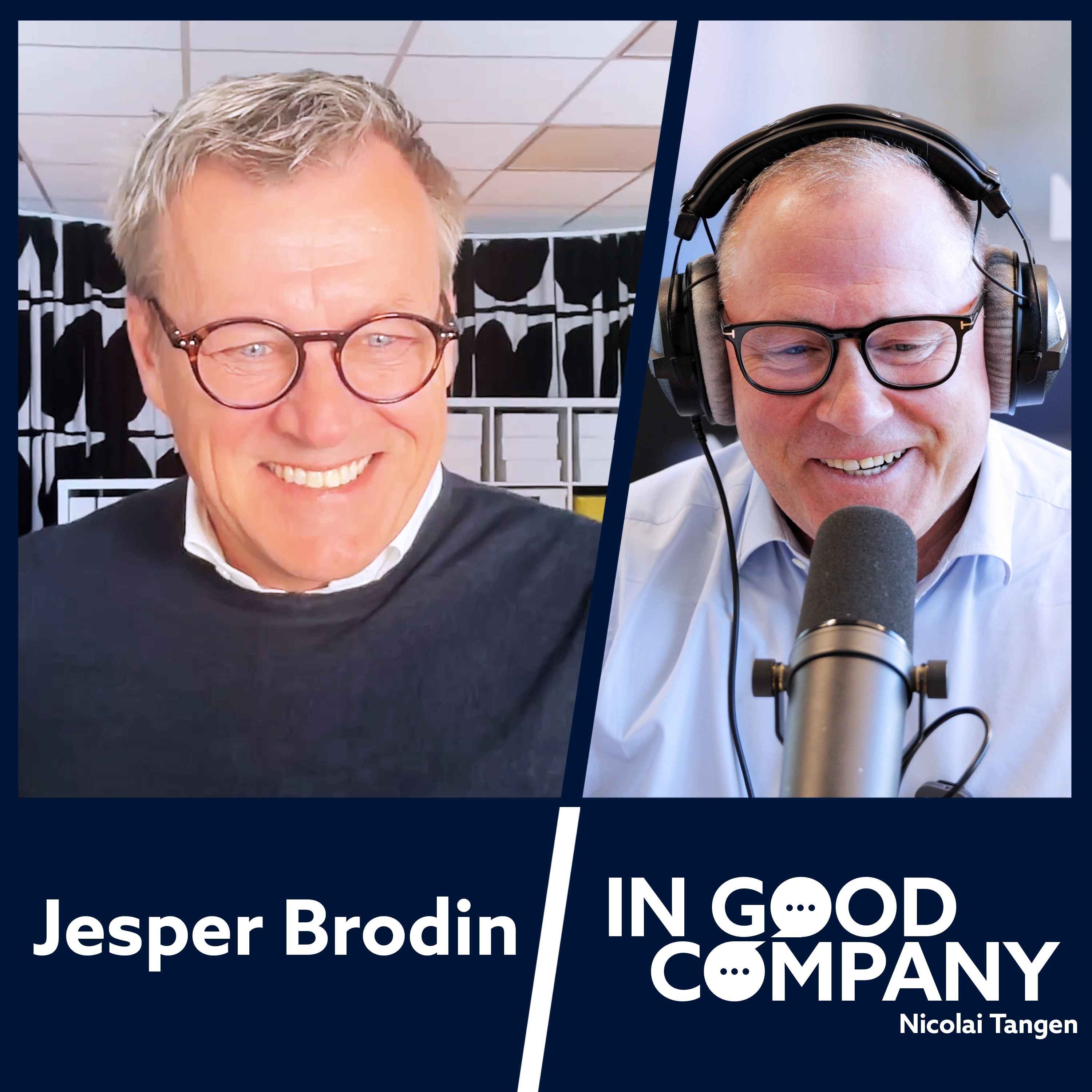
Description: Nicolai Tangen interviews Jesper Brodin, CEO of Ingka Group, discussing IKEA's evolution, democratic design philosophy, sustainability initiatives, and leadership principles.
Written by AI. May contain mistakes.

Get the gist, explore an idea or ask about something said.
 Claude
On In Good Company with Nicolai Tangen, what are the key points of this episode?
Searching your listeningAutomatic transcript. May contain errors.
0:01Hi, everybody. I'm Nikolaj Tangen, the CEO of the Norwegian Soverein Wealth Fund. And today I'm really thrilled to welcome Jesper Borodin, the CEO of IKEA. Now, IKEA, as you know, runs these iconic blue and yellow stores that have transformed perhaps your living room, but for sure hopes worldwide. And they brought a slice of Scandinavian design to almost 900 million visitors every year. Wow. That's quite something. Well, that's quite something. Thank you for the opportunity, Nikolaj, to be part of this incredible podcast. And thank you for doing the commercial for IKEA, so I don't have to.
0:46Jesper, I would love just to go visiting a store with you. So can we just put on our customer hat and let's go into an IKEA store. So we enter the door. What is the first thing we see? Actually, it's interesting since I had the pleasure to work very close to Inva Kamprad, our founder, for many years. Walking a store with him, I realized that there is nothing left to chance, so to say. So the first thing you will actually experience coming to IKEA is a person. In a time of AI and digital revolution, it can be quite interesting that we believe that nothing can replace that human first impression when somebody greets you.
1:28and that somebody will also hand you a bag, which was Ingvar's, of course, insight, that if we hand out bags, you will begin your shopping even sooner. So that is both a friendly gesture and a smart commercial trick from IKEA. And these are not small bags. These are pretty big ones, right? The blue ones. Well, the blue bags have... We use the yellow bags when you're inside the store and then you replace it with blue when you leave. The blue bags have become iconic. And I think in hundreds of millions of households, they serve for moving things, as laundry bags and whatnot. I even know that some of the professional tennis players of the world use them when they go to their center courts for games and so forth.
2:10So it's an iconic IKEA product for sure. Now, what are some of the other things that we should note? We go through this maze, right? At the entrance, we try to send a couple of messages. One message is around food because typically our customers have traveled from somewhere and we know for sure that you don't make good business deals on an empty stomach. So we want to promote the opportunity to actually spend some time in a restaurant. You have the opportunity to, if you bring your kids, to actually drop them off in the small land area, which is like the haven for kids to play and have fun while the parents are looking for things for the home.
2:50You would definitely see some inspiration around life at home and home furnishing. You would see a strong message around low price that we would send. And today, these days, you would always see messages around how we try to show up as a company in terms of being people and planet positive and so around sustainability. So these are some of the messages. Now, at the end, you then have some kind of shockingly cheap offer to remind everybody before you leave that you are super cheap, I guess? I think you're using amazing words here, shockingly. We sometimes say tappa undone produkter, which means breathtaking items.
3:30So we try to promote a low price at the beginning. But for IKEA, it's an interesting thing because our job is not really to be cheap. We serve people within wallets out there. What we always try to say is a story about not only the low price, but how we made it, what are the built-in sustainability around it, the functions, the quality items, and so on. So it's hopefully not just a good offer, but actually a story around it. How many meatballs do you sell a year? I don't know. It's a lot of meatballs. We are actually one of the big food companies of the world. It's interesting because I recall back in, it must have been back in 2013 or 14, we took a look at ourselves when it comes to food, which is a complementary part of our offer and not the primary one.
4:19And we realized with the help of some big organizations that we actually have quite a food footprint, both when it comes to sales customers, but also when it comes to health aspects and sustainability aspects. So I know for a fact this was a starting point for us to actually start the journey towards also offering plant-based, more healthy alternatives and so forth. But we are probably the biggest seller of meatballs in the world, I would say. I suspect. Now, affordable design for everybody. It sounds pretty simple, right? But why has nobody managed to replicate what you do? I think there are a lot of good companies out there who try it.
4:57But it's an interesting question because it is definitely a very tricky task what we're trying to achieve. So we have this formula of design, which we call democratic design. So that represents five things. It represents function. So at IKEA, we sort of say committed to do things functionally, folding chairs, storage units, things that truly work for people in life at home, not at least in small spaces. That's a great commitment to quality where we work through understanding true families' needs. We only sell sofas with washable covers, for instance, and so forth. So quality is the second dimension.
5:43The third dimension, or there is no real numbers to them, but a third dimension is about form, where we then have decided to take a Scandinavian look on things. So we do have traditional things, we do have more modern things, but we have our particular Scandinavian point of view on how we think things should look like, typically quite simplistic. Fourth dimension, sustainability, which says a lot about how the product was made. in relation to people and planet. And then you have all of these at a low price. So one of the things that is required is definitely scale in order to, so to say, achieve all these identities in a product.
6:22But it requires a lot of knowledge from an engineering point of view to actually build things in a smarter way. So again, I think a lot of competitors do a good job, but IKEA is dedicated for every product to try to actually design it in a way to prove that you don't have to be rich to be smart. If we were to just spend a few minutes on the products, how many products do you typically have? So we typically have between some 9 ,000 and 10 ,000 products to offer in any given market. And how many would be there for a long period of time? How much do you change and how much would be kind of evergreens?
6:55Well, we actually change about 20 % of our products annually. Now, I would say approximately half of that would be color updates of textiles or it might even be products that we learn things and we do improvements technically, quality-wise, and so forth. But at least 10 % would be entirely new products. And how many of these kind of totally classic things like the Billy bookcase and so on, how many of those do you have? So in our range, we have approximately, you can say, 20 % of our range would be top families, as we call them, or key products in IKEA. You're right. Billy is definitely one of the long-lasting products in IKEA.
7:37You have clip-on, you have playing armchair, and you have quite a number of storage units as well. We have our kitchen unit, our PAX wardrobes, and so on. Nevertheless, these products are also updated. There are color changes. There are improvements to it. The PAX wardrobe in IKEA, which is one of the oldest products, has recently been remade. So instead of being two people for 25 minutes to assemble a wardrobe, you can actually click it together in five minutes. Do you only have IKEA furnitures at home? Now I start to sound like a salesperson. I really am. But you lured me in there. No, I don't only have IKEA products.
8:15I have a lot of IKEA products in my home for sure, but not only. Where did the concept of flat pack furniture come about? Well, it's been argued who was the inventor of the flat pack. But definitely this goes way back to the early days of IKEA. And Ingvar himself and Gilles Lundgren, one of the first designers, if not the first actually designing IKEA, they basically had a co-creation on a table, a side table to a sofa, where they realized that if they could find a way to take off the legs, you would save approximately 80 % of the air and thereby drive down the prices. So this product, Kohlövet, is claimed to be one of the first, if not the first, flatback product.
9:00And still today, it is incredibly interesting because if you look at what that does from a cost perspective and a climate footprint point of view, it's just an incredible invention. Has IKEA ever stolen a design? I wouldn't be able to answer that if I look back earlier generations. But if you look at my own period at IKEA and also being the leader of IKEA of Sweden, who is the design company, I think we pride ourselves to develop our own designs. Of course, we will be inspired of the different trends of the time. But we are very careful to not copy anybody else or infringe on anybody's rights.
9:40And I can't remember even, if you look at the last decades, any argument around that.
9:52Ingvar Komprad founded IKEA in 1943 when he was 17 years old. And you worked with him for a very long time, right? Well, I had the opportunity to work as assistant to him, starting in late 99, for three years, actually. And then, of course, ever since we became good friends and I had the pleasure to work with him. How would you describe him as a person? because he was a bit of a, what should we say, a fairytale type of figure in Sweden, right? Well, he was a very special person. When I started as his assistant, I didn't really know him that well. And what I found, many things I found interesting, and one of the things was he was a very authentic person.
10:34So as he told me his life story, you know, he made a success in his late 30s. The company was growing, he made a lot of money. and only to realize that for him, the personal success or the value of money had actually quite little interest for him. So he returned to his childhood style and his childhood principles, which was a person who lived a quite thrifty life. He was very cost-conscious. I tried to convince him to change his old Volvo, but he kept it for the rest of his life. Today it's donated actually to the Volvo Museum in Gothenburg. And as far as I know, it still runs. he was a true entrepreneur.
11:13He was a person with great vision. He was not so good at strategy, I would say. He skipped that part and he went straight for actions on the store floor, on the factory floor and so on. And he just, that was the two places he loved to be. He basically detested the boardrooms or the committees. And for him, life was about the factory, developing products with people or the store, making sure that we make a better job for our customers. It's interesting. I suspect that a lot of retail founders are a bit the same way, right? Really obsessed about the stores. There are several people who have similar philosophies as he had.
11:54He was also of that generation who basically understood how to scale business and create value through scale. And Inva was a master in that. How do you make sure that his values are still present in the firm? Well, I think he did a good job with the values. The values in IKEA is not something that comes as a communication slogan afterwards, but it's actually integrate from the recruitment to how we like to work. And it is interesting because the question came when he passed away, how we would continue to maintain and develop the IKEA culture. And I've seen through the last years, you know, that has been probably the most difficult period for any one of us in business, like for yourself.
12:36We have had pandemic, war, economic turmoil, trade war, climate crisis. So these have not been easy times. What I've seen in IKEA is that we have been able to do quite well, maintain speed in the company, a lot thanks to the values where people know that they are actually mandated to take decisions and empower themselves and that we try to lead in a humble style together. I believe Ingvar would have been proud if I've seen how actually we are leading the company today. One of the things you focus in a lot on is sustainability. And whilst some other companies have kind of backtracked a bit here, you are really holding the ground.
13:18Why are you so convinced about this? Well, I think to start with, I think it's an interesting divide in the world. And I see more and more companies actually being on the train ride to become climate smart. But many of them might not shout it out loudly. Many think that they are still in the early days of it. But interesting enough, I've seen also in the banking world and in services, in particular in the U.S., but also in parts of other parts of the world where people have backtracked, which I found interesting. Now, in our case, we took the decision to be a leader when it comes to climate smartness.
13:57actually even before the Paris Agreement was signed. We have been a pioneer in figuring out both how do you understand your impact, how do you measure that in terms of what is called Scope 3, which means basically end-to-end for the company. And interesting enough, at this moment, many years into the climate work, what we have found, except that it's good from an ethical perspective because we like to contribute from a moral standpoint, It is something that has strengthened IKEA's brand massively. We have data points that shows across all of the world how important this is for people. And here comes the most interesting part of the world, maybe, Nikolai.
14:36A lot of people think that the climate transformation would come at an extra high cost or, so to say, as a burden. What we have found out is from raw material production, transport, retailing, all the way to customers, that it's actually helped us reduce our cost and become a much smarter financially set company for the future. Because what is interesting is if you ask people, they rate environment very highly, but they are not really very keen to pay extra for it, are they? That's right. I think one of the common misunderstandings with that, which I would subscribe to a while ago myself, there was a lady I met in making a home visit in Belgrade a couple of years ago.
15:20So she was a single mother, two kids, two jobs. We had a discussion because she was passionate about the environment. She was very fearful for climate change. She saw that all around and for her kids' future. And when I asked her if she was prepared to pay extra for an IKEA product that would be climate smart, she said no. And then she explained to me, I don't have the money. So I have two jobs. I have two kids. My mother comes and helps me when they're back from school, etc. Do you really expect me to pay? And she was very clear to say, I expect you, Jesper, and leaders like you and me, Nikolai, to take our responsibility.
16:00And I think she was morally right. But I didn't know then that she was actually financially right. There is no need to pay extra for sustainability. On the contrary, everything we have done in IKEA to become climate smart has actually made us save money. And when you think about it, it's obvious because, of course, if you use less material or material in a smarter way or have the opportunity of circular material, would that make you more expensive or would it make you lower? Of course, it's lower price. If you implement renewable energy instead of expensive oil and gas, you don't only get independence.
16:38You actually, of course, get a lower energy bill. Our energy bill in IKEA is 29 percent lower than before Paris Agreement. And then you continue step by step in the value chain. And even if it's not always that easy, it requires investments and it requires that you take a big step, putting your whole scale behind it. Otherwise, you don't get the financial benefits. You've taken all this one more step forward to even creating a secondhand market for your products. The secondhand part, I would say it's still a bit of a test and trial from our side. It's very much appreciated by customers. If I look at the total carbon footprint of IKEA, it's not the thing that has contributed the biggest carbon reduction.
17:25But we're on our way. So what we do is we offer take-back service to our stores. We do sell second-hand furniture through all our stores globally. And recently, we have started to engage in Norway, in Spain, and we are intending to roll it out globally. We have actually created our own second-hand digital platform where then customers can actually get an easier way to sell their IKEA products from customer to customer. Very interesting. Now, you are known for these huge stores outside cities, but you now have opened a flagship store on London's Oxford Street. Tell me about it. Why is this? I think it's one of the biggest investments we've done, to be honest.
18:10So hopefully it will work. It's an interesting thing because a few years ago, when we started to deep interview customers around the world, this is actually before IKEA transformed into Omni Channel and online at all. Back then, some eight years ago, we were more or less only store-based. So when we spoke to customers, they told us that if you don't show up on an ordinary workday, when I put my kids to bed and I need something. If you don't show up online in my phone or on my laptop, I'm going to start to deselect you. So that was a very important message for us to hear from my customers. The same customers often said, in particular the ones living in the bigger cities or the metropolitan areas of the world, say, we will go to IKEA in Tokyo, in London, in York from time to time.
19:04But again, if we don't have an IKEA around the corner or 10 minutes away, we might choose somebody else. So we began a journey of transforming into online services. The whole logistical backbone of IKEA was re-engineered. And as part of that, you can say the cream on top was that we started to experiment with smaller versions of IKEA in cities. Interesting enough, I think we made so many mistakes and so many miscalculations on what we thought customers in the city would like to have. But seven years down the road, we've actually found a format which is much like a big store. It's just a bit smaller, but you can actually buy everything from Ikea.
19:45You can have your meatballs. And obviously, you won't be able to pick up your sofa from Oxford Street, but you will be able to shop everything. And a lot of products you can take with you on the same day, actually. How is it working out? Well, it's a couple of weeks in. We are running in the second week. It's one of the biggest successes from an opening point of view we had so far. So already the first week, it was the second biggest store when it comes to visitations in IKEA. And if you compare that then to the big stores out there, that has to be seen as a success. But we need to give it a year to see also that we manage as well when it comes not only to attract people, but also financially.
20:28Well, for sure, I will check it out when I'm in London next. It's a cool place. It has a couple of extra spices to an IKEA experience that I think you will enjoy.
20:41How is the geopolitical situation impacting how you source and how you think about your supply chain? Well, you can say for decades we were used to, I think, in our generation, year by year, easier to do multilateral deals, less issues with borders. So we were, so to say, I think, taking for granted that the pathway of collaboration around trade would continue. And then we find ourselves, since some 10 years back, in a much more challenging situation. I think it's understandable. The world is changing. As I met somebody in Davos in January who said that we have left one world order and we haven't yet established a new one.
21:27And times in between tend to be a little bit chaotic. And that's what we're seeing today. So obviously you can say it puts pressure on companies in general. And big companies like IKEA find ourselves in the interesting dilemma that way back companies used to be quick and governments slow. and if you look at the speed of governments right now and not for a good reason it's difficult for us as companies to to keep up um so what we do we continue to invest um we continue to think long term in our markets and basically we have to mitigate some of the issues around the trade restrictions and so on along the way why do you think swedish companies are so much more successful than Norwegian companies in terms of rolling out internationally.
22:14Well, is that so? I think we have had different successes, right? I think Norway has been incredibly successful in energy when it comes to companies like Jara, working with fertilization and so on. So there are different things in Norway that is, of course, phenomenal. Sweden has been good in technology and with IKEA as one of the leaders, but many more like H &M. I think maybe one of the reasons that Scandinavians in general are successful is that we know that we're small. So in order to be successful, we have to be out there. We have to adapt. We have to understand different cultures and look for opportunities and win-win.
22:55And I do believe, as of today, in this world, I think Scandinavian companies and leaders in general are in the forefront of looking for win-win solutions. You mentioned technology. Tell us how you think technology will shape IKEA going forward. To start with, you can say IKEA was late in the digital revolution, if you like. So basically, platform companies like Amazon and more revolutionized retailing for good, I would say. And that revolution started in the early 2000s. IKEA continued to be very successful with our store formats and with our business. So it was first somewhere around 2012, 14, 15, we started to see changed behaviors with our customers.
23:44So we were late on that. And as I referred to before, we decided to make the online and the omni-channel transformation. Interesting enough, Nikolai, as we took that decision, we had no clue about the pandemic that came a few years later. Now, thanks to us shifting to online, it actually saved the company during the pandemic. We would have been in massive red numbers, in layoffs, and in great retraction of volumes and everything if it wouldn't have been for the opportunity to actually operate through online. So it gave us a good lesson, I think, to keep your eyes and ears open for the changes in the world.
24:22So we see AI is coming big. And for us, that's going to revolutionize. And it's already in our value chain revolutionizing goods flow. helping simplify and saving costs through goods flow. It's helping us in customer service at scale. It's helping us when it comes to home planning, how you actually serve your customers in making a sense of home planning in the future. And probably it's going to help us in many more ways that we don't know today. Your big blue catalog was more ubiquitous than the Bible in the Nordic region. Do you still print it? We don't print the catalog, actually, since a couple of years back.
25:02There are a few markets I know that keep it as an extra, you can say, marketing injection. But as we knew the catalog as like the foundation for home furnishing, it started to lose its role when online came. So we at the last years, it was also just observing to say that it was a waste of resources. It was a waste of paper in the end. And we find other ways, better ways to engage with our customers.
25:34Jesper, how would you define your leadership style? Well, I think from a leadership perspective, I think I'm a fairly good representative of the IKEA values, or at least some of them. So I think people would describe me as a person with a lot of willpower, but also humbleness. I'm an employee like everybody else in IKEA. And I think for me, it's important to stay grounded in reality. I worked with Ingvar. I had the opportunity not only to learn from him, but also realize that we shared a lot of the same viewpoints of staying grounded with people out there in our factories, in our homes, in our stores.
26:13I get joy from that. And I believe thereby also sometimes I and we in IKEA find actually the pathway to speed in the future because we are close to reality. What's the key to staying grounded? Well, I think happy marriage is number one. And the stability in your life in general, I think, is required. Because today, to be a leader, it requires you to be agile. Again, we have seen crisis after crisis. You need to develop a way of resilience in your life, a way of recharge, a way of, I think, accepting that in many ways, you need to accept dilemmas and accept that you don't have the answers. but that you can be open, transparent, authentic in your leadership will allow you to actually collaborate with people and hopefully do a better job than if you are the know-it-all, so to say.
27:09You mentioned speed a couple of times. How do you make sure that IKEA is a speedy place? And why is speed so important? Well, speed is important. I think agility and speed is important because the world is changing in a faster and faster way. We have seen that in technology. We see that in politics and so forth. And being a big company, I think it's one of the biggest risks for us is that we are too slow and too bureaucratic. And obviously, being part of a big system, there is always a force of nature that invites you to make things more complicated. Maybe hire a little bit too many experts, too many meetings and so on.
27:48So you need to constantly try to cut down on meetings, encourage people to take decisions, to take risks, to dare to do mistakes. IKEA was never there, right? It was developed year by year by people who had the courage to take those risks. So I think the biggest threat today for us, besides things like climate change, economic turmoil, would be our internal capability to actually be entrepreneurs. How do you encourage people to take risks? I mean, it's per definition a risky business. Well, I try to be a good example myself and do mistakes. What's the biggest mistake you ever made? Well, where should we begin?
28:30I think if you look at the last part, if we say the definition of mistake is that you have acted on a problem but didn't find the right solution, if you say it like that. And I think the last years we have been more entrepreneurial than in a very long time, in particular when it comes to transformation of retail. So we have invested both digitally and physically, as we spoke about city stores and other things that simply didn't work in the beginning. But by having that spirit and not just working linearly, but actually iterate a lot of different tests and trials, you will be faster in finding the pathway to the future.
29:10so how do i encourage people well i have one of my favorite techniques is i have a banana card and the banana card was actually invented in a dialogue with a big group of ikea colleagues who said openly that i will feel sometimes afraid of daring to make mistakes what will be the consequences so i invented this card where i basically co-sign in advance for your mistake And I've handed that out to a lot of people. And I actually do follow up with everyone who I handed this card to. But more as an encouragement to say, if you do a mistake and you look for somebody to share that burden with, you can count on me.
29:47And obviously, symbolically to say, don't wait with acting on your ideas. If you have an idea and you don't act on it, it's not only that we miss the opportunity of learning. but I think people who don't act on ideas slowly and gradually there's something dying inside if you give up on acting on your ideas and for us it's important to be a live community of people who go for their ideas and continue to look for the next horizon you talked about recharging and so on I gather that you are also a rock star no, in that case who have been totally misinformed. I like rock music, though. And you play rock.
30:32You play in a band, right? I do. I do. I've always done, actually. Lord Beaverbrock. Yeah, that is the recent band. That's correct. So we are going to play a song here, but not on air, but we'll cut it in afterwards. Which one should we put in? I think you could actually play Z Generation. It's a tribute to the youth out there who's actually working as activists in the interest of our and next generation. Fantastic. Let's listen.
31:14What does music do to you as a person, as a human being? Well, I've always been interested in music since I was, I think, 12, 13 years. To be honest, the first interest in music was, I noticed that if I learned to play the guitar and sing, I was more lucky when it comes to the competition of girlfriends and parties and other things. So I had a thought about it. But my musical interest developed into new areas along the way. Do you think that's why people start in pop groups generally? Probably below the age of 20, I would guess that 80 % of them have less interest in music. That's just my opinion.
31:58But in any case, for me, to be serious, I think music is a way of relaxing. So after a tough day at work or a tough week, if I get one hour with my electric guitar and to play a little bit, that's super relaxing. It's like totally disconnecting. It's a bit of meditation for me because you can't do that. and have other thoughts in your head. So it's a way to clean out your mind a little bit. And it's also incredibly fun to play with others. Yeah, yeah. Do you think it does anything to your leadership? Well, I think all of us need to have our channel of recharging. And for me, music is definitely one of them.
32:35And writing music, writing lyrics, writing music, gives me, so to say, another dimension to life. And it opens up to many other dimensions as well. and of course as a hobby to have the opportunity to meet the band to record in a studio to focus on something totally different gives me a lot of recharging of batteries for for what i do at work i think it's very important i think if you have something outside work which you really are passionate about it makes it easier to cope with stress easier to um you know think about other things makes you a more interesting person more fun uh no we should all uh should all get a rock band you know also that in the roles that we have also leading us see also big organizational companies you can get trapped in your own rabbit hole of your own importance but also you can get stuck in your problems and and also even in the worst case um the myth that if you gear up a little bit extra and work longer hours will be the sleep less etc that that will be the pathway to success and obviously it's the opposite you need to find ways to to broaden your perspective and recharge looking at your journey at IKEA what are you the most proud of like a couple of things sometimes it's it can be details great products have been part of developing and so on but if I take any area I think it is starting in 95 in IKEA in Pakistan Karachi Pakistan was my first assignment These were the days when IKEA was looking at sourcing opportunities outside Europe.
34:13So I was put there to build up sourcing of textiles. I did. It was an incredible success in many ways from my business growth. But it was also the first time at IKEA when we started to confront ourselves to say, do we need to bring our values to our supply chain as well? Or is it enough if we apply them on our own offices or communities? And in the end of the day, we, so to say, came to the conclusion that we have to be a leader when it comes to environmental aspects and social aspects. And that goes for everything we do in our value chain. I was part of developing that in Asia as a young leader.
34:51And except for knowing how well it works today and what that has meant environmentally, but also socially for a lot of people, I found an incredible joy to know that it's helped IKEA to strengthen its finances. So to be a good business is actually also helpful when doing good business. What is your favorite IKEA furniture or product that you sell? We have a kitchen department for six years. So kitchens is, I would say it's the most complex product in IKEA because it's part of a system. So you need to know many products in order to make a kitchen. And I found that absolutely fascinating. And in your mind, what's the key to a good kitchen?
35:31Well, a good kitchen from a home furnishing perspective is actually quality. So by integrating quality in every part of your design and still being able to scale that proves that you're actually, it's proving the IKEA Democratic design formula that you can make an affordable kitchen at the best quality. But then I think kitchen for people is about the heart of the home. It's about providing solutions where people, you know, relax, do the homework, work from home, enjoy friends, family, celebrations. So the kitchen, as I see it, is really the heart of the home for people. Do you cook? I do. What?
36:11I thought you would ask, are you a good cook? I'm not. Well, in our family, I am the chief dishwasher. sure but i i have a couple of my pasta bolognese is uh is good what uh what is your what is your vision and and your dreams for ikea for the next 10 years so for ikea for the next 10 years i think the dream is to continue to to be able to grow and meet and reach more people both offering jobs and meeting more customers around the world. And I think the biggest dream in all of that is to be a proof point that it is actually possible to be a good business by doing good business. So the integration of people, respectful people principles when it comes to diversity, inclusion, respect for people, but also setting up IKEA as a truly climate smart value chain and driving financial excellence through that is the big vision.
37:16Last question, what is your advice for young people? Because we got tens of thousands of them listening into this. I think for young people today, and I do have the pleasure to meet a lot of young people and young leaders. I set up actually a group of young activists that is advising me in my management group. And they do have full access to the company, by the way. We have a very nice agreement that they actually write a page in our annual report every year that I don't proofread before they write it. I think the generation today has more information and is also lured by misinformation more than probably any generation before.
37:59So I think the important thing is to have hope and to be outspoken of your principles, what you represent and what you stand for. And at the same time, I think when you think about the future, look for something, continue to look for the things that you're good at and the things that you love to do. And if you can find the combination of those two things, you probably will find happiness. And if you don't, there is always another opportunity to try something new around the corner. Well, you for sure have created a lot of happiness in millions of homes, which you have furnished. And so big thanks for doing all that for the world and for making all our homes a better place.
38:39It's been great talking to you. Thank you. Thank you so much.
Ever wondered how those iconic blue and yellow stores became a regular stop for shoppers around the world? In this episode, Nicolai Tangen sits down with Jesper Brodin, CEO of Ingka Group – the largest IKEA retailer, to unpack how the company is reinventing itself for the future. They explore IKEA's democratic design philosophy, the company's sustainability initiatives, and how the business is adapting with new city-center stores. Jesper shares insights from working alongside founder Ingvar Kamprad and reveals his leadership approach of encouraging risk-taking through his "banana card" system. With nearly 900 million store visitors annually, IKEA continues to revolutionize home furnishing. Tune in for a fascinating glimpse behind the flat-packed furniture empire!
In Good Company is hosted by Nicolai Tangen, CEO of Norges Bank Investment Management. New full episodes every Wednesday, and don't miss our Highlight episodes every Friday.
The production team for this episode includes Isabelle Karlsson and PLAN-B's Niklas Figenschau Johansen, Sebastian Langvik-Hansen and Pål Huuse. Background research was conducted by Une Solheim.
Hosted on Acast. See acast.com/privacy for more information.