
 Ask ChatGPT


 In Good Company with Nicolai Tangen
7 Oct 2026 · 54m · 28 chapters
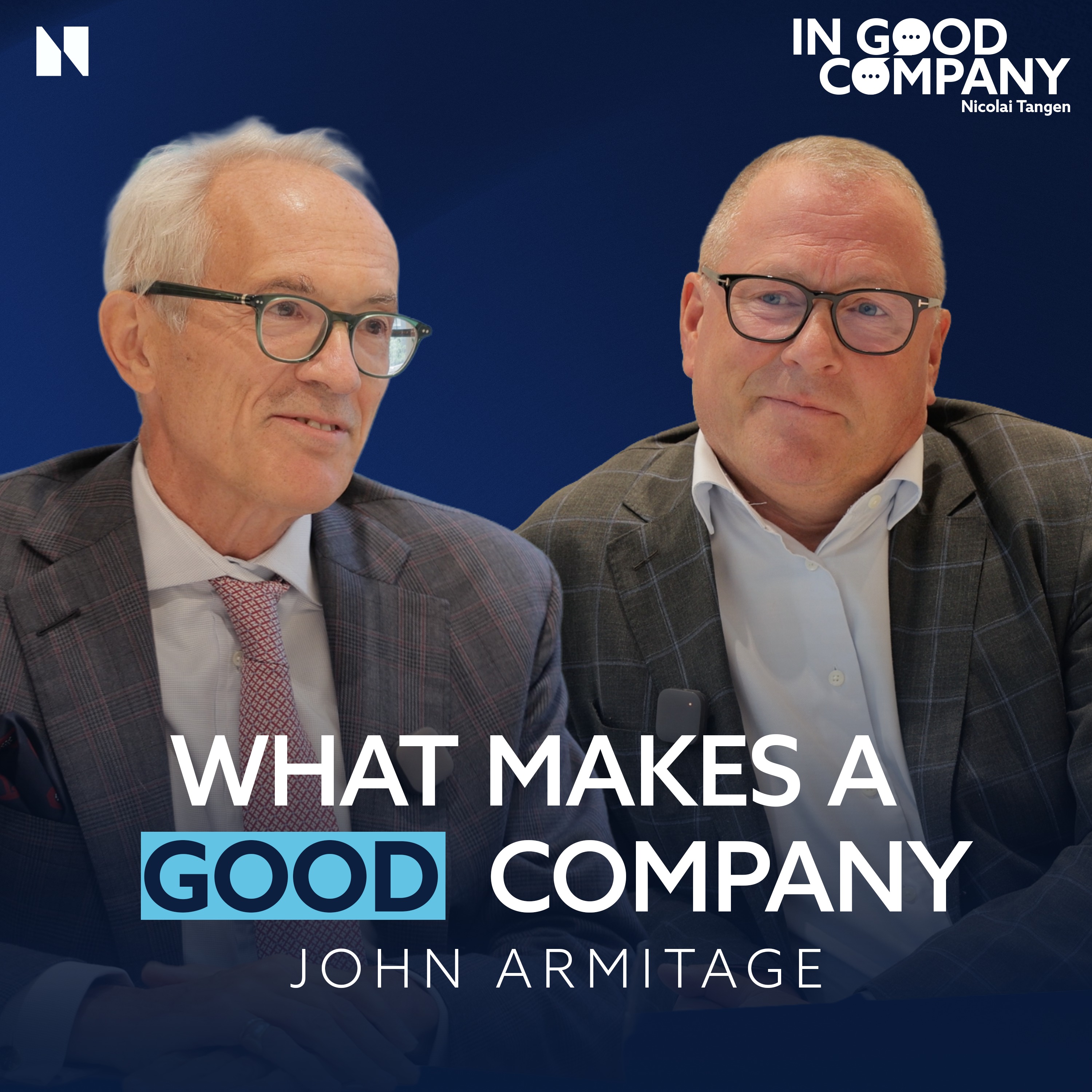
John Armitage (Edgerton Capital) explains how he evaluates companies and builds positions, emphasizing moats plus management quality, capital allocation, culture, pricing power, incremental margins, and disciplined valuation (skeptical of EV/EBITDA). He also discusses risks of overusing AI in investing and in human cognition, and how he maintains conviction amid market noise.
John Armitage is a long-time investor at Edgerton Capital (about 30 years), previously worked at Edgerton Capital for five years and earlier as an analyst/client. He studied modern history and does heavy spreadsheet modeling with a “detective overlay” when data is private.
AI should “short circuit” research but not replace thinking; overreliance can “rot” mental arithmetic. Great companies require realistic management and truthful accounting. High incremental margins and pricing power signal durable economics. Valuation matters, but EV/EBITDA is misleading.
Boeing and Rolls-Royce (moat + mismanagement). Berkshire Hathaway’s textile-to-capital-allocation transformation. Intel’s failure to innovate. Airbus modeling via private order pricing; NVIDIA sensitivity to memory cost inflation. Visa as more modelable. Management examples: Ryanair’s Michael O’Leary; Intel’s Pat Gelsinger changing stock-based comp accounting. Portfolio examples: selling Altice after slight misses; selling Fiserv after results didn’t match expectations. AI holdings/exposure: NVIDIA, Amphenol, ASML, and hyperscalers.
Written by AI. May contain mistakes.
Discusses the detrimental effects of over-reliance on AI for mental tasks.
“If you use AI too much, your brain is going to rot.”
John Armitage explains what constitutes a good company versus a good investment.
“Well, you know, I think, first of all, obviously, there's a difference between a good company and a good investment.”
Armitage discusses why pricing power is crucial for business success.
“And if you can't grasp that, I think you're on a hiding to nothing.”
The conversation shifts to different investment styles and the importance of understanding market cycles.
“clients like investing in defined styles.”
Armitage shares his worldview on current market conditions and economic trends.
“And, I guess, to find otherwise in my time, I've invested in most things ranging from a metals company located in the Forbidden Zone of Russia, to oil and gas, to oil services, to technology, to retail.”
Discussion on how education, particularly history versus finance, influences investment strategies.
“But I know plenty of people who have MBAs and I know plenty of people who read art subjects.”
Armitage explains the intricacies of modeling companies and the importance of understanding key factors.
“And you have to use inferences from companies to apply them to numerical output.”
Learn how to analyze profit and loss statements, focusing on margins and cash flow.
“sensitivity of what the further spike in memory costs inflation do to them.”
Discover the key indicators for evaluating a company's balance sheet and client structure.
“What are the kinds of things you look at?”
Explore how to judge management's effectiveness and the importance of honesty in leadership.
“And that was run by a very, very, very compelling person who was brilliant at cutting costs.”
Understand different valuation methods and why they matter in investment decisions.
“sometimes suffer from this phenomenon of paralysis by analysis.”
Learn where to source investment ideas and the importance of diverse perspectives.
“The risk is you say to yourself, well, I've had a really bad six months.”
Exploring the differences between the investment cultures of London and New York.
“But I'm not a sort of, I'm not kind of permanently on the phone.”
Discussing the role of data science in investment and the speaker's skepticism about it.
“But equally, you can get too close to things and have not enough detachment, and you can be in too small a world.”
Examining how AI impacts the investment landscape and decision-making processes.
“and AI as a tool for our investment process.”
Insights on how to achieve alpha in modern markets and the implications for investors.
“People who don't do mental arithmetic lose the ability to do it.”
Strategies for coping with stress and decision-making during market volatility.
“keep this sense of intrinsic value and sticking to your guns?”
Discussing the difficulties and risks associated with stock picking in today's market.
“We don't like, we're very bad at violent movements.”
Talking about the changes in investment philosophy and company management over time.
“And if you take one of those supports away, you know, if you take one of the legs of the stool away, it can fall to the floor.”
John discusses his focus in investing and experiences with the management committee.
“And when you came into the morning, you didn't even walk around the office.”
The challenges and cautious approach in today's economic environment are explored.
“It could be, one, the fact that if other people know more, you have to know more.”
John shares his strategies for constructing a diversified investment portfolio.
“And I like having small positions which can grow if we like them.”
The discussion contrasts long-only strategies with hedge fund approaches post-GFC.
“And so many things in the US economy are keyed off AI that inevitably we have, we and every other portfolio will have more of it than they think.”
John explains the difficulties in shorting stocks and market dynamics.
“And for a very long period, when interest rate, it's been less difficult recently, because since interest rates went up, but for a very long period, when interest rates were low, everything floated up.”
John reflects on his early career and the launch of his investment fund.
“I mean, you were very successful at Morgan Grenfell.”
John clarifies how Egerton operates under a unique decision-making structure.
“Now, you call Edgerton a benevolent autocracy.”
John shares how he relaxes and enjoys his personal interests, including reading.
“I walk, I talk to friends, I find people interesting.”
John offers valuable advice for young individuals starting their careers.
“I'd get bored with doing the same thing every day.”

Get the gist, explore an idea or ask about something said.
 Claude
On In Good Company with Nicolai Tangen, what are the key points of this episode?
Searching your listeningAutomatic transcript. May contain errors.
0:00If you use AI too much, your brain is going to rot. And it's quite simple. People who don't do mental arithmetic lose the ability to do it. It's just simple. So we want AI to help us and to short circuit things, but we don't want it to think for us.
0:30Hi everybody. John Armitage has been the most important person for my professional development. I traveled with him for several years when he was my largest client back when I was an analyst. And then I worked for him for five years at Edgerton Capital. Nobody has taught me as much about investing in markets as John has. So John, it's an honor and long overdue to have you here. It's going to be kind of a masterclass, how to look at a company, how to build a position and how to run a firm for 30 years without losing your edge. John, welcome. Thank you very much. And it's a great honor to be here.
1:06Let's start with the basics. What is a good company? Well, you know, I think, first of all, obviously, there's a difference between a good company and a good investment. And second, and I would say, look, many things go into something being a good company. And today, a lot of people talk about moats. Moats are critically important. But at the same time, if you have a moat without the right management, you get destroyed. And look at Boeing under its previous CEO. look at Rolls-Royce before the brilliant new chief executive who's running it. Rolls-Royce had a moat, but somehow, as he put it, it was a burning platform.
2:00I would also say that if you think about the theoretical value of a company, it's the value of the future cash flows. Therefore, how those future cash flows are invested is important. So one of the things that's important is capital allocation. And if you think what Berkshire Hathaway originally was, it was a New England textile mill, which got closed. And look what it turned into. And that's because of capital allocation and culture. And I think culture is critically important in a company.
2:38and look at the way Intel lost its way for such a long period. And that was because they didn't dare to innovate. They didn't dare to enter new fields. And there was a business with incredible market shares getting eroded. So I think culture, capital allocation, and moats are all very important. What's the first thing you look at? So here I give you, OK, this is a company. This is a new idea. What is the first thing you look at? Well, the first thing I look at is, is it worth the time? How do you design that? Well, many businesses are fairly priced. There's no point in spending a lot of time on something which is fairly priced.
3:17What is the point? And the second thing I think about is, can I understand it? Will I understand it? I once had a very interesting meeting with the CFO of a drug company. and I asked him how they were able to assess whether a phase three clinical trial would be successful or not. And he said, look, we can't assess it. We just think of them as a series of options. And I sort of thought to myself, well, look, if you're the CFO of one of the largest drug companies in the world and you don't know whether a phase three trial is going to be successful, how the hell am I going to? So what are the type of companies you can understand?
3:52Well, we try to understand as many types of companies as is possible. And where, look, I'm not a physicist. I can't write code. But I'd like to try and feel that I can understand why NVIDIA might be successful. And what's very important for us is to understand the inherent operating leverage in a business, by which I mean, what is it that will make it massively out or underperform expectations? And if you can't grasp that, I think you're on a hiding to nothing. How many great companies are there? Probably more than you think. And we own some of them. And there's a lot we don't own and haven't owned.
4:42But the nature of great companies changes over time. Look, Coca-Cola is a great company. and there isn't a substitute for Coke. But the fact is, it's probably underperformed the market in the last 25 years. And why is that? Because they haven't come up with the new Coke. Well, when they did, it didn't quite work, did it? That's true. One of the things that you taught me was the importance of pricing power. Why is pricing power important? What is it, first of all? Well, pricing power is the ability to have a product whose price you can raise despite competition. And why is it important? Because all companies face cost inflation.
5:23Because all companies, because the world is more competitive for companies today than it was before. Because trade barriers are lower. Because technology is something which opens up competition. and if you can sustain your pricing power, it is a sign that you have something truly marvellous about your business. And because if you can price more than your cost inflation, you're going to structurally achieve margin growth. And how does cyclicality come into play here? Well, we are not a style-defined firm. are in some ways I wish we were, because I think if you're style defined, you probably have greater staying power than if you're not, i.e.
6:11clients like investing in defined styles. So we do invest in cycles. And it's very important to get those right. Because if you invest with a cyclical company, you often feel the best before a downturn. So cycles are important, particularly if you're like us, and you try to sort of traffic in whatever is doing well. Are you sure you haven't got a style as a firm? I mean, I think we have a style which is to do with investing in, I like to define it. I like to invest in a company where if the stock market closed, I wouldn't feel worried. And I like to invest in - That's a style. That is some sort of style.
6:52And I like to invest in a company where I feel I have valuation protection on the downside. And I like to invest with management, which are realistic. And I hate to invest with management, which use accounting policies to make their results seem better than they in practice are. And I hate to invest with management where you feel they have a sort of where life is always rosy. What other type of industries you would never touch? We're not very big on drugs.
7:34And, I guess, to find otherwise in my time, I've invested in most things ranging from a metals company located in the Forbidden Zone of Russia, to oil and gas, to oil services, to technology, to retail. But I think today some industries are more exposed to competition than others. And that's because of the impact of technology.
8:06Do you think you have to have a worldview to be a good investor? I think you have to have a view about economic conditions. But I don't think it has to be more sophisticated than, is this a time when companies are swimming upstream against the current as opposed to downstream with the current? Unless you are trying to be a macro investor.
8:44and that's not what we can do and it's not what we would do and I would leave that to geniuses like Stanley Drucker-Miller. What is your worldview now? My worldview is, look, markets are high. Interest bond yields have gone high. In the US, we've got two wars. The oil price is up. And the markets are odd. The markets are high. It's strange. How do you read it?
9:20How I read it is that if we didn't have the stimulus of AI-driven growth, and if we didn't have strong earnings in the US, the world would be in a different place. Now, you didn't study finance. You studied modern history. How does that shape your way of looking at the world, do you think? Well, I don't think it necessarily shapes my way of looking at companies, although I do think history is about investigating things. And you have quite a sort of good training at doing that if you do it properly. I happen to think that I've never found it easy to tell whether a good investor benefited or not from reading business studies.
10:04I know you have an MBA from Wharton. No, undergrad. But I know plenty of people who have MBAs and I know plenty of people who read art subjects. And I can't, you wouldn't know it from the way they invest. And I personally believe - Do you hire MBAs? Yes, but I never really look at it. We have hired MBAs. My father, when I was young, told me that universities were about education rather than being a technical school. And you should focus on that. And that's what I believe in.
10:38You are really into modeling, right? I mean, you believe in your spreadsheets. We are into modeling. And I think, although there's a lot of very good work from the sell side, concentrated in individual firms and a lot of very good work, I think too many of the sort of leading analysts, models are for juniors. And I think there is a fine art to modeling, which is about the right sort of detail, but not too much of it. Tell me about it. Well, if you have too much detail, garbage in, garbage out. Too much detail, minor changes of assumptions, everything goes haywire. When you're forecasting how a company will do, you need to be able to isolate what are the absolute key factors and focus on them and apply a qualitative lens to that.
11:33Okay, let's model a company. How do you, what goes into the top line? Well, I mean, if we talk about a company like Airbus, which we have a big holding in, there it's very simple, isn't it? It's the number of planes you sell times the price. You don't know what the price is because it's all contractual. So the way you have to think about Airbus is what might the incremental margins be on each unit? How will those develop? develop, when will pricing trends in the order backlog manifest themselves in revenues? What about the big lumpy cost items that they can forecast, like R &D, and that they do forecast?
12:16And how will FX work? And the answer is, with a company like Airbus, a lot of the information is simply private. You have no way of knowing what the price on an order is. So how do you model it? You try to piece together inferences from what they've told you. And if you take a reinsurance company, and we had big holdings in reinsurance companies, reinsurance contracts are private between the insurer and the reinsurer. You have absolutely absolutely no evidence about a contract and about the level at which losses kick in and about how the losses are divided. And again, you sort of have to take their word on it.
13:03And then you have to look at how their reserves have developed over time, because how their reserves have developed over time tells you how they've estimated losses in the past. And one of the things about insurance is that good companies tend to do better and bad companies tend to do worse. So in general, much about companies is private. And you have to use inferences from companies to apply them to numerical output. Look, if you take NVIDIA, one of the big issues about NVIDIA is memory cost inflation and what it does to their bill of materials. Because NVIDIA makes 75 % gross margins. Now, as it happens, they've just guided to gross margins in the near term.
13:56But you kind of have to piece together what the composition of their bill of materials is, how memory price contracts have worked, when they will impact, and then try to work out the sensitivity of what the further spike in memory costs inflation do to them. There is a lot in companies which is very private. But then there are some companies like we happen to own Visa, where they make 67 % margins. You kind of know roughly what drives the top line. And the costs are pretty clear. And mixed effects are a lot less relevant. So I'd say modeling a company, the skills involved range from being quite sort of numerical to applying a sort of detective overlay to what you're told and drawing inferences from what you're told and thinking about it and stress testing it as much as you can.
15:01One of the points at the profit and loss statement, which you taught me to focus in a lot on, was the margin at the margin, the incremental. Incremental margins. Incremental margins. Why is that so important? Because if companies have sales overshoots or undershoots, a very high incremental margin relative to a lower stated margin can cause a big profit beat or a big profit loss. So should it be high or low? You want high incremental margins, but you also want to start with high margins. It depends what you're shooting for. If you think you've found a recovery story, which no one else has found, you want massively high incremental margins.
15:44Because incremental margins, no one really factors in the benefits of what a really good incremental margin can be. People don't really dare to do that. So that's why NVIDIA is so good, because they sell a few extra things and bank profits. But NVIDIA has a very high margin to start with. What are the other things you particularly look at down the profit and loss account? I look at accounting policies. I look at depreciation rates. But once you've got to the EBIT or EBITDA, The operating profit, everything else is pretty simple. What about cash flow? Very important. You know, what's the point of profitless prosperity?
16:33What about balance sheets? Very important. And someone I know who's a finance director once said to me that accrual accounting, which is the way standard profit and loss accounting works, is a balance sheet output. And I think that's correct. And so you can't disaggregate balance sheet moves from P &L moves, and you have to focus on them. So now here is a balance sheet. What do you look at? What are the kinds of things you look at? You look at what's happened to the inventories, because that will impact revenues they've recognized and costs they've put on the balance sheet. And then you look at the terms of trade, how their payables are doing, how their receivables are, and you look at whether the cash has gone up.
17:19And then you look at artificial measures they could have taken to boost cash, like factoring receivables. You look at all kinds of things. Oh, you talked about clients. So one of the things you told me was that it's important to have many clients, so that one client is not too important. And then that your sales, you shouldn't sell everything in one month. So for instance, running a ski. That's true. You know, like a ski lift is not very good at air because you don't control the snow. It depends whether it's a monopoly or not. Do you like, tell me, monopolies and market power, how do you look at these things?
17:55Well, I think monopolies are generally good if they've been honestly produced. You know, and I think market power is a very nice thing to have if it's been honestly achieved. Yeah, for sure.
18:10You talked about management. So, and you mentioned some which were outstanding and really, really important. Just how do you judge management? Well, you know, one of the things I pay a lot of attention to is do managements admit their mistakes? And one of the most outstanding executives in the world is Michael O 'Leary. And if you sometimes, if you listen. For the listener, Ryanair CEO. Yeah. And if you listen to Michael O 'Leary, sometimes you'd think he hadn't created the world's most profitable airline, but he just made a series of mistakes. And here is someone with an incredible focus on detail.
18:51He's quite relentless. Also very funny. Also very funny. He has a team of really super people around him. And he's highly aware of what he does right and wrong.
19:07When Pat Gelsinger came into Intel, one of the first things he did was change their accounting so that stock-based comp was added back to earnings. You kind of think, like, really? What does that tell you? So stock-based comp is not part of compensation. It's not a cost. Like, really? Is that realism or not? You know, I look for management which is realistic and grounded and can see that things aren't always rosy. What are the red flags? Consistently missing expectations. And that feeling that someone is always presenting a picture which is slightly biased to be positive. That feeling that people don't like or can't admit something might be wrong.
19:56But isn't there any... And it's an intuitive thing, that. Yeah, but isn't that also a geographical thing about it? I mean, not always. You know, one of the best sales I ever did was of a company called Altice. And that was run by a very, very, very compelling person who was brilliant at cutting costs. It was a French cable company, and then it became a telecom company. They used a lot of leverage, and the model really worked. if you have, the model was not much growth in the top line, but some, a lot of cost cuts, a lot of leverage, acquisitions. And I remember there was one quarter when the numbers came in just slightly light.
20:38And I'm always quite suspicious when companies don't have much top line growth, because I think if they don't have much top line growth, what's the room for a mistake. And I remember I just didn't really like the fact there was just a very slight miss. It didn't really affect the medium-term numbers the way we modeled them, but I just decided we should sell it. And so we did sell it. And I was just a bit suspicious of the model. What did you base the decision on? I based the decision on the fact that I thought the model, the business model, didn't have much room for something to go wrong. And that's very important.
21:18Does a business have room for something? What's the benefit of a high margin? The benefit of a high margin is that if you have a sales shortfall, your P &L isn't short to pieces. Do you think there's a risk of getting too close to managements? Yes, I do. And my partner, Ralph, calls it paralysis by analysis. And I think it's a bigger risk today than it used to be. Why? It's a bigger risk today because today, Today, information has proliferated around the world. Think of the number of analysts who write on a stock. Any time any company executive speaks anywhere in the world, there will be people listening to him and reacting to it.
21:58So you get deluged by information. And one of the difficult things about investing today is, on the one hand, you always have to cover the bases. It's a bit like panning for gold. You just never know. And you have to cover the bases. You have to listen and be aware because there might be something valuable in it. And also because other people are. And if you're not and someone else is and they decide something's going wrong, you're screwed if you haven't realized. So one of the big differences from when I was young is you have to absorb so much more. The problem with absorbing so much more is it's probably a bit like a semiconductor.
22:37It just gets imprinted on your brain. And it can be difficult to get away from it. And so we do sometimes suffer from this phenomenon of paralysis by analysis. How important is valuations? Well, valuation is really important to me. And it's probably been too important in my career, because I've probably missed lots of great growth stocks. But I like owning things where there is some valuation support on a conventional basis. And I hate, with a passion, EV to EBITDA valuations. I think they're meaningless. When you say conventional, what are the type of matrixes you look at? PEs, free cash flow multiples, EV to EBIT maybe.
23:25But EV to EBITDA, you get these neoclads today are valued on EBITDA. And the biggest cost they have is depreciation. Yeah, that really makes Tell me about PE.
23:38Tell you about? What's high, what's low? Well, when I was young, 20 times as high. I guess now it depends on the growth rate. I tend to think of if I can buy a fast-growing company on a multiple next year of - PE, by the way, is price divided by earnings. So it's kind of how many years it would take for a company to make its own share price in earnings. I mean, I have less comfort than some people for high earnings multiples. And someone I have a huge amount of respect for, who I think has got the most incredibly powerful intellect. He thinks GE is a cheap valuation. To me, it's a bit rich, 35 times earnings.
24:18I feel like if you can buy a good company with decent double digit growth near 30 times next year, that's attractive in today's environment. Some people start by spending a lot of time on valuation and then end up spending less time on it. Like Warren Buffett, for instance, more into high quality stocks than they were earlier on. Have you? You have not in that direction? I feel the issue with that is that you can get too attached to the quality and not notice something's underperforming. And here's the luxury of permanent capital. And we have weekly redemptions. Would you have thought differently about it if you had permanent capital?
24:59I've never thought about permanent capital. I don't particularly want it. I think the risk with permanent capital and lockups is that they're a trap. The risk is you say to yourself, well, I've had a really bad six months. This stock's collapsed, but I really like it. It'll work itself out over the two or three-year periods my investors have got to stick with me. And then you realize it won't. and you allow permanent capital to be a luxury, permanent capital or long lockups, they become a luxury which removes the tension of needing to make, of needing to grapple with proper investment decisions.
25:37I worry it would make me relax and be complacent. Because you can't be complacent in the stock market. I think it takes more than that to get you to relax, John. But you were dismissive of EBJ. Yes. Which is a different way of looking at valuations. Just why are you dismissive about that? Because depreciation and amortization is a cost. Why should you add that back? It's a real cost. Companies need to replace their capital. And then you get serial acquirers, which always have some amortization. And quite often, serial acquirers put more costs into intangible assets than they should. And the amortization of those costs is added back to EBIT.
26:25Why would you do that?
26:29Let's move on to good ideas. Where do good ideas come from? Well, they come from all the people around me. And they come from, look, the stock markets yield lots of profits for people. Therefore, there are lots of people who are incentivized to give you good ideas. And I think you have to be eclectic about where you get those ideas from. and I have a lot of very clever partners. I read lots of research. I trawl through what is produced by the major investment banks to decide whether I think something looks interesting. And ideas sort of dawn on me over time. Do you find good ideas from the sales side?
27:17Yeah, often. And sometimes very good research. And in pockets, some outstanding research. And who are the investors you talk to? If you want to name them, you don't want to. I'm not one of these people who's always on the phone. And I'm not a particular networker. But there are some people I deeply admire and like catching up with a few times a year. And look, I think Chris Hahn's got an amazingly powerful intellect. I really like some friends in New York, like my friends at Lone Pine, like Marla Gonker at Sogo Cap, like Eric Mandelblatt at Soroban. And the world is full of clever people. But I'm not a sort of, I'm not kind of permanently on the phone.
28:05I feel like the New York investment community is quite kind of incestuous. And they talk to each other all the time. And I'm not really like that. I would be a bit embarrassed ringing people up to ask them what they thought about things. So from that point of view, is London a bit of a backyard? Well, London, I think the difficulty with being in London is that if the important things happen in America, there's a risk you are late. And sometimes it's important to follow the fashion. And sometimes it's important to be where the dominant economy is. Often it is. It would have been, and we'd probably have done better if we had been there this year.
28:52But equally, you can get too close to things and have not enough detachment, and you can be in too small a world. Was London the center of the universe when you started? Yes, it was. And it is a third, and it is not now. Yeah. That's a different discussion. Now, you are not employing data scientists. Tell me about it. Well, I've never wanted to invest in companies where I was reliant on the latest channel check. And I think in any case, channel check results are a function of something else which is more powerful, which is the business itself. And I'd rather try and understand that. And I'm a skeptic about opinion polls.
29:35And I know that data scientists do more than look at opinion polls. But I'd rather not invest in something where, oh, gosh, the latest credit card data shows the following. That's one thing. But the world has moved on. And we do have some data scientists, technologists today who are helping us get to grips with AI. and AI as a tool for our investment process. How does AI change the art of investment? Well, I think AI changes a lot. I'm not sure whether it's a good thing, but I think it changes a lot. What does, at the moment, AI enable you? Well, if you're in the business that we're in, as opposed to the Jane Street Capital business or probably the Citadel and Millennium business, if you're in the business that we're in, What does AI give you?
30:31It gives you instant access to knowledge, which can be formatted any way you want, so you get conclusions. That's what it can give you. I do think there are two risks with that. One is that if people ask the same questions, are they going to get the same answers? No one really knows, I don't think. But But is it going to turn out there's a single source of truth? And the second thing I worry about personally and for all our people is that if you use AI too much, your brain is going to rot. And it's quite simple. People who don't do mental arithmetic lose the ability to do it. It's just simple.
31:16So we want AI to help us and to short circuit things. But we don't want it to help. We don't want it to think for us. Is it going to make market more efficient? Is it making market more efficient? I think markets are infinitely more efficient than they were when I was young. And clearly, AI will. And AI will speed things up. And maybe we'll all have to be... I don't think anyone knows the extent to which do large language models and the answers they give train on like search results? You know, Google will surface answers based on the questions that have been asked. If more people say, if more people ask a question on Google, it's more likely to surface the same answer to me, based on with the nuance that it's based on my knowledge of me.
32:13Is that true of AI? Will it produce a herd effect? I don't think anyone knows. If it produces a herd effect, then maybe you'll have an opportunity to get away from the herd. Do you think alpha is a thing of the past? I think it's definitely much harder. And what are the implications for people like you and similar fans? Well, that's good. So what do you do? I mean, I don't want to, I don't want to, okay, how do you get alpha today? You can get alpha today by being highly, highly concentrated. And you can get alpha today, both in single stocks and thematically. I think very few people are capable of doing that well.
32:58I really do think that. And the professional buyers of investment products, they love concentrated portfolios. Why? Because they run lots of funds. So they like concentration. And I don't think they really understand that concentration is just marvelous when it goes right. But when it goes wrong, boy, it's a disaster. So I don't want to go the route of just putting everything on red. And what are the implications? I don't know. We just have to keep doing what we do and see whether we can do it effectively. So in this world where there is more momentum, there is more AI and so on, just how do you keep this sense of intrinsic value and sticking to your guns?
33:46Well, numbers are numbers. And earlier this year, well, we're having a pretty poor year this year. And there was a time when I really felt like, my God, maybe I should jump off a cliff. But you think that from time to time, right? Yes, I do. But I did this year. And I came to realize that, fine, we'd missed a humongous great trade, what was important for us was, did we think the numbers that underpinned our investments were valid? And if they were valid, would we make money? And so we stuck to that. And that was bloody lucky. Because if we'd chased the crowd at the time I was most depressed, it would have been a disaster.
34:27What kind of situation are you talking about now? Well, I mean, there was a time when you couldn't give away visa. And luckily, it's up 20 % since then. And that's true of other stocks, when many of the real high flyers dropped a lot. And so I feel like you have to be true to yourself and work out, are the numbers, the valuation numbers that underpin your position, are they valid? Will they work out? And if they do, is the position attractive? And you have to just stick to that. You've been through most type of market situations in your professional life. In what type of markets are you doing the best?
35:13Trending markets and trending stocks. We don't like, we're very bad at violent movements. Violent movements tend to be emotional. They tend to often presage a big change in the environment. They tend to be caused by geopolitics or big economic shifts. And if you're stock pickers like we are, or like we try to be, what resonates with you are the numbers in your spreadsheet. What resonates with you is the conversation you had with that company a few weeks ago. And you think to yourself, it can't have changed that much. And so you can be far too late to realize there's a change. And when I think back to 2008, I think we were handicapped then by sitting in London, because sitting in London, when people told me that US house prices had gone up a lot, and they compounded at 7 % per annum, I thought, well, that's quite low.
36:12And I just didn't have a clue. And I didn't really have a clue about how the linkages would work into the broader economy. And I think that is the danger of being a stock picker. you can be too focused on the individual investment and not really realize that it's part of a jigsaw in the economy. And it depends on lots of things. And if you take one of those supports away, you know, if you take one of the legs of the stool away, it can fall to the floor. When you have these volatile markets, how do you cope with stress personally? I wake up every morning wondering whether I'll ever be successful again.
36:57That's the truth.
37:01And my wife and I have this discussion, God is it all over? That is the truth. And I walk around the office feeling a bit black. And then I try and count my blessings because I'm very fortunate. I've lived in a great time. and when my father's generation were young, well, not that I'm young now, life was all a bit worse.
37:28Now, when I did my master's degree in social psychology, I interviewed you to talk about pattern recognition. So, yes. So, just remind us, just when do you use pattern recognition and when do you use analysis and just how do you switch between the two? Well, first of all, when you talk about pattern recognition, I feel a bit like the character in Mollier who was told he was speaking prose. But what I mean by, and he didn't know it. By gut feel. We can call it gut feel. Look, look, you know, there are times when we, I think when we don't understand something which has on the face of it had a minor impact on earnings, we're reasonably quick to pull the trigger.
38:14And what I mean, you know, we had a long-term holding in a company called Fiserv. And it was a very good investment for us. They had some results which weren't quite what we thought they were. We didn't understand it. And we sold the position. And subsequently, you know, it was one of the names which did go down a lot. It was the same with Altice. You know, I tend to be. But these are pattern recognitions, right? Yes, they are. Yes. So those would be two examples. So you don't like disappointments? I don't like disappointments. Why? And if there's a disappointment, I always tend to cut the position back a bit.
38:48Because people say disappointments only don't come along in ones. But also because I kind of like confirmation of a thesis rather than contradiction. So when people do a bit better, do you buy? Often. You have an incredible ability to not think about where the share price was. Well, you have to because nearly every good investment you ever make has gone up a huge amount
39:18Yeah, and the stock price doesn't it the stock doesn't know you're trading in it
39:26How do you build a position then well we start slowly and We start so you say slowly you mean small or you know we start small and then we try and do a lot of work How quickly do you put on a position? How quickly can you put on a position? Well, it takes time for it to get big. But obviously, we can put a position on very quickly. And what typically happens is either I will suggest something or one of my partners will. And if they do, I have the sort of Sisyphean task of trying to keep up with them. So one of my partners will suggest something and I will, I don't know, spend the weekend working on it or something.
40:05and then there is a process of working out the thesis. I ask questions, get answers, ask more questions. Questions get obviously all the time with the company. We build up a model. We think about it. We interrogate each other and if we generate greater conviction, we add. How long time does it take? It can really vary. I mean, I couldn't say. It's interesting. A lot of very, very good investors start small to kind of create that urgency. I think that's easier. I think that's an easy way to do it. Because the other thing is, a new investment has to displace an old one. And it's just psychologically very difficult to tear up an intellectual presupposition.
41:02You own this company, it's done well for you. It's psychologically just very different. It's harder than it should be to substitute something else for it. Has Edgerton changed a lot since you started it roughly 30 years ago? Well, thanks to Jeff, our CEO, we're a great, you know, we're much better run. Not that we were badly run. We didn't have to be a modern business when you were in it. We didn't have to be. Now you do have to be. There are all kinds of regulatory demands on you, et cetera. But in terms of the investment philosophy? Are we better run? Well, I mean, if you look at the numbers, it's hard to say we're better run in relative terms because - But is it the same philosophy?
41:49Yes, it is the same philosophy, yeah. Yeah. Do you have the same focus? I remember talking on focus. So we moved when I had the pleasure of working for you. We moved into new fancy offices. You had never visited. I have quite a lot of focus. You had never visited the office. And when you came into the morning, you didn't even walk around the office. You went straight into your cubicle and started to invest. Well, I have quite a lot of focus. I thought that was pretty good focus. Or weird. I have quite a lot of focus. I mean, what I will tell you is I'm not on the management committee. I have never been on the management committee.
42:26I do not read the minutes. And the other day, there was an internal presentation on something, which I listened to. And I said to one of my partners, look, why weren't you there? And she said, oh, I wasn't invited. And so I said to someone else, why wasn't Jelena in the presentation? And this guy said, well, it was the management committee and you. And I didn't know who was on the management committee. So luckily, I don't have to do any of that. But is experience an advantage in today's investing world? I'm not sure. Sometimes I think you have to be young and naive to embrace visions. Sometimes, and I do think that as you get older, you get more conservative.
43:08And in my case, that could be for two reasons. It could be, one, the fact that if other people know more, you have to know more. And it could be a feeling that when I started investing, look, inflation was coming down, interest rates were coming down. We had the fall of the Berlin Wall. We had 40 years of peace. And what's happened? A long time when we thought free markets and liberalism would win. And what's happened now? Economies have maxed out. Corporates have sort of done a lot to raise their earnings. We have two wars, and the West is under threat. And so maybe I am more cautious as a result of it.
43:59Just a few words on how you construct a portfolio. How many stocks do you hold? Well, we hold about 40. And the biggest positions tend to be sort of eight to six. And I like having small positions which can grow if we like them. I like being thematically diversified, which is very unfashionable today, because professional buyers of independent funds value concentration. I don't think they know what can happen when concentration goes wrong. And I don't really like financial leverage or portfolio leverage because longs and shorts can have positive values and both can go against you at once. So how do you read the AI concentration in the market just now?
44:56I don't like it, but it's very powerful. And are you participating? Yes, we are. We own NVIDIA and a brilliant company which supplies into it, Amphenol. We own ASML. We own two hyperscalers. And so many things in the US economy are keyed off AI that inevitably we have, we and every other portfolio will have more of it than they think. Why? And you mentioned exposure. So historically, you were mainly a hedge fund. Now you're a bigger long-only. Do you think long-only is easier? I had a view after the GFC that - Global financial crisis. After the global financial crisis, that I had a view that we would end up by being too conservative, and that we wouldn't make the most possible returns for our clients.
45:54And therefore, I wanted our clients to have a mixture of long only and long short. And that's been correct. And in the long run, if you think that markets go up, not paying a performance fee should help, particularly if you're a fund which doesn't go leverage long. Why is shorting so difficult? Well, many stocks go up over time. And for a very long period, when interest rate, it's been less difficult recently, because since interest rates went up, but for a very long period, when interest rates were low, everything floated up. And in periods of euphoria, people believe all kinds of things. And in periods of euphoria, any company can raise capital.
46:43Now, when you started back in 94, you were fund number two in Europe, I think? Well, I'd been like, yeah, we were, yeah. And in a way, it was a good time. And in a way, it was a bad time to start. How come? Well, it was a bad time because our first opening, we raised the equivalent of 1.25 million euros, which was not a lot of money. and it was a good time because there weren't many people doing it and somehow we had a good and we had a good start and it was a good time because there were just fewer funds today how many funds are there all doing the same thing loads and loads and loads and loads how do you differentiate and how do you raise enough money to be viable and to uh to get attention when costs are higher.
47:36It's a bigger risk. How did you come up with the idea? I mean, you were very successful at Morgan Grenfell. Well, I'd been very lucky at Morgan Grenfell. And having worked for a brilliant and amazing guy called Mike Dobson, who helped me a lot in ways which he probably didn't even realize. and then I'd been given a unit trust to run, mutual fund. And that was a huge break for me because it meant that I had an independent track record, which was totally my own. And that fund did, it was a six-year fund. I ran it for six years. It beat the index 10 % a year. It was the number one out of 85 funds over its period.
48:19And that gave me the confidence that trying to go on my own would be a viable thing. And then I met a very good man who I thought would be highly complimentary to what I did, Bill Bollinger. And that I felt would get us off to a good start. Well, for sure it did. Now, you call Edgerton a benevolent autocracy. What does that mean? That means that two people must love a position for it to be large. And that if I don't love it, it won't be large. Two people must endorse something for it to be of significance. It doesn't mean that I have anything to do with the management of the company, which I don't.
49:12What's the one thing about you that most people don't know? Well, as I'm not really a public figure, a hell of a lot, I'd have thought. But I suppose, I mean, a new thing in my life, which I've rather enjoyed, is sponsoring the publication of nice books. And I've just got a new, I've been lucky enough to come into contact with a wonderful academic and a wonderful book designer. And a new book is about to come out on Wordsworth's manuscripts or one of his manuscripts. So I like private press books. How do you relax? Reading those books, I guess. How do I relax? My wife would say I never relaxed.
49:57But I mean, I do the usual things. I walk, I talk to friends, I find people interesting. I go on holidays, sit by the sea and work. I find it relaxing to be in control of my work and to be working on interesting things. And if I was just leaving behind 300 emails a day and lots and lots and lots and lots of stuff, which I had to do when I came back, I wouldn't find that relaxing. And I read. I like reading. And what keep you going? Well, I feel today that you are younger at my age than you used to be. A, I've got nothing else to do and no value to bring to anything else, I don't think. I would get bored if I stopped and went to a bookshop every day.
51:00I'd get bored with doing the same thing every day. the markets are interesting. You feel like you never achieve enough. When you're doing badly, you feel like you can't go out on the low. And when you do well, it's kind of too much fun. And I really like the people around me in our firm. I really like my partners, and I really like everyone who works there. what is your advice to young people well my advice to young people okay well first of all i would say study what you like because you'll be good at it and you'll be better at it than if you study something you don't like and in my opinion there's absolutely no point in studying something on business it's not going to help you the second thing i'd say is nearly everything is more interesting than you think if you follow it closely.
52:02The third thing I'd say is, so, you know, we've, there was an old Etonian prime minister in the UK until quite recently, well, a few years ago. And what his career showed is that, you know, up till you're 21 or whatever it is, you can get by by being very clever. And therefore, after that, you actually have to work. And I think to succeed in life, in your career, you need a lot of luck being in the right place at the right time. You need enthusiasm, and you need drive. And I think the intelligence, you need a modicum of intelligence, but it's not like working at Anthropic. And you need to be happy in your personal life.
52:50and I once I once met Scott Nuttall who runs KKR and we'd invested in it the stock had done really really well it was the beginning of the year I was still feeling the afterglow of the previous year which had been good and Scott came to our office and I said to him look Scott you know thanks for KKR but I don't want to ask you about that what I want to ask is how do I get to be like you, effortlessly successful at the top of KKR, looking, I didn't say this, looking like he was 20 years younger. And how do I get to be like you? And he said to me, marry well. And I have married well. And it's important to be happy in your life.
53:37If you're not happy in your personal life, you're not going to be happy at work. You're not going to do well at work. No. John it's been fantastic I want to thank you first of all for hiring me paying me well treating me well being such a tremendous gentleman giving me advice to go to the Courtauld Institute helping me set up AKO because without you there would have been no AKO capital no AKO foundation and I would not have had this job well big thank you you're very sweet Nikolai but it's all down to you LEGENDRA иг XML APK USHAN RESUN,'1 terminator GLUR management IN JUST
Nobody has taught Nicolai as much about investing as John Armitage. First as his largest client, later as his boss for five years at Egerton Capital. For this episode the two meet in London, where John walks through his approach to investing: what makes a company worth the time, why pricing power matters more than almost anything, the red flags that make John sell, and how a position gets built slowly. John also talks about 30 years at the same firm, and why AI should help you think rather than think for you. Tune in!
In Good Company is hosted by Nicolai Tangen, CEO of Norges Bank Investment Management. New episodes every Wednesday, and don't miss our weekly wrap-up on Friday’s.
The production team for this episode includes Isabelle Karlsson and Halvor Njerve and PLAN-B's Niklas Figenschau Johansen and Håkon Klemsdal. Background research was conducted by Simran Sahajpal.
Hosted on Acast. See acast.com/privacy for more information.


