
 Ask ChatGPT


 In Good Company with Nicolai Tangen
16 Sep 2026 · 36m · 19 chapters
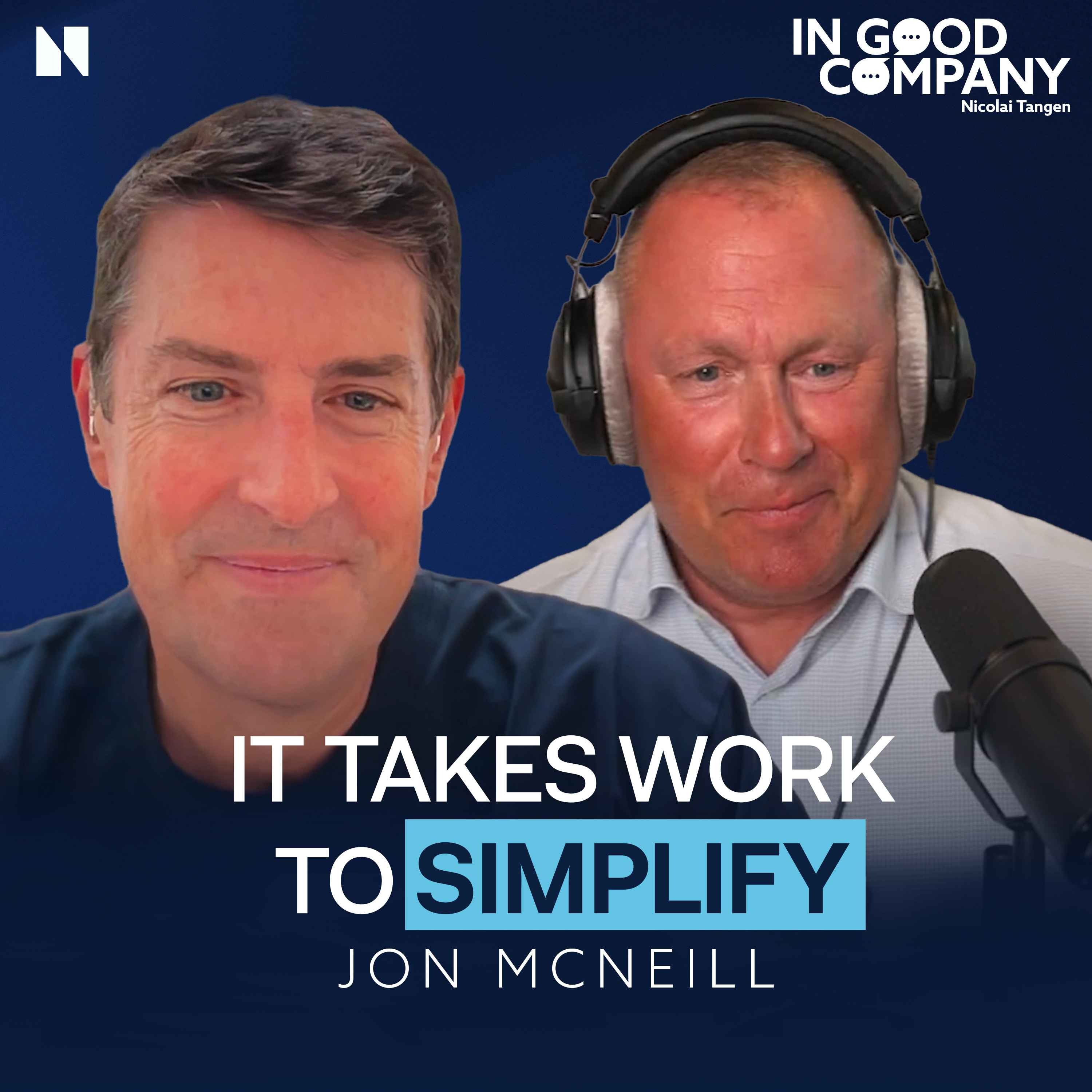
John McNeill explains his “algorithm” for building companies like Tesla and SpaceX: question assumptions, delete unnecessary steps, simplify and test manually, accelerate cycle time, then automate last. He argues automation should follow process perfection, not precede it, and that ambitious goals plus weekly operational “heartbeats” drive compounding innovation.
John McNeill spent three years reporting directly to Elon Musk as Tesla president, later became Lyft COO, and now builds companies at DVX Ventures. Host is Nikolaj Tangen, CEO of the Norwegian Samhain Wealth Fund.
“Automate last” prevents costly mismatches; speed must come after simplification; set goals big enough to force new thinking; culture favors humility and rapid learning.
Tesla’s Model 3 e-commerce configurator had 300,000+ combinations, leading to a two-model approach; auto-financing paperwork was reduced to one paragraph; Tesla combined battery/cabin cooling into one heat pump; Model 3’s overly automated line required manual “tent” production after calibration issues and cash-flow shortfalls; production targets rose from 50 to 1,000 cars/week.
Written by AI. May contain mistakes.
Learn about Tesla's early struggles with cash flow and the decision to revert to manual processes.
“We almost went bankrupt because we didn't have the cash flow that we predicted coming off a Model 3.”
Discover why questioning base assumptions is vital for innovation in business.
“What are some of the simplest examples of things you need to question?”
Learn how simplifying the car purchasing process at Tesla led to increased sales.
“Yeah, so we were trying to sell 100 ,000 euro cars online for the first time.”
Explore how Tesla simplified auto financing documents by questioning their necessity.
“So it's one of the worst parts of the customer journey, but it's also one of the most complex parts.”
Understand the importance of mapping processes to identify and eliminate unnecessary steps.
“So if there's an assumption based on those, it's a good one.”
Discuss the concept of eliminating parts in processes to enhance efficiency and reduce complexity.
“But I mean, clearly, if you've got no part, you've got no business.”
Learn why introducing speed later in the process is crucial for success and quality.
“Because speed reveals where the process breaks.”
Explore how Tesla adopted a speed mindset comparable to Toyota to enhance productivity.
“why does speed come in so late in your strategy?”
Gain insights into how China learned from Japan to improve speed and efficiency in manufacturing.
“measure of speed is a mindset at Toyota.”
Learn how China's approach to manufacturing emphasizes learning from others and refining processes before automation.
“How have they managed to make it a mindset in the whole of China?”
Discover why perfecting processes before automating is essential for successful manufacturing.
“What should be automated and what should be kept manual?”
Explore how Tesla and SpaceX drive innovation through systematic weekly progress and ambitious goal-setting.
“not only for the organization, but for those providing capital to the organization.”
Understand the significance of setting ambitious goals to inspire teams and drive transformative change.
“But those huge breakthroughs are broken down into a couple percent that you pick up every week that eventually you figure out how to land a rocket and catch it.”
Learn about the unique work culture at Tesla and SpaceX that combines intensity with periods of rest to avoid burnout.
“But the whole point of the process really is to get started.”
Discover the key traits to look for when recruiting individuals who can thrive in high-pressure environments.
“The first thing we look for is curiosity.”
Learn about the key traits that lead to success in innovative companies like Tesla and SpaceX.
“And then we'd ask for examples where they'd done this themselves.”
Explore the complexities of changing a company's culture and the influence of founders.
“And what would make you think this is just beyond repair?”
Understand the importance of staying connected with products and customer experiences.
“John, what is the biggest mistake you've made in your life?”
Get valuable mentorship advice for young people navigating their careers.
“up on ring number one yes yep very sam walton-esque what is something about you that most people don't know.”

Get the gist, explore an idea or ask about something said.
 Claude
On In Good Company with Nicolai Tangen, what are the key points of this episode?
Searching your listeningAutomatic transcript. May contain errors.
0:01We almost went bankrupt because we didn't have the cash flow that we predicted coming off a Model 3. And the only way we saved ourselves was to go back to the manual process. We literally built a tent in the factory outside and produced cars by hand, first 100 a week, then 500 a week, etc. Until we could actually build an automated line that reflected reality. When we looked back on that and said, look, we almost killed the company, what would we do differently? We said automate last. You've got to perfect the process before you automate, otherwise you just might bury yourself. And in that case, we almost did.
0:47Hi everyone, I'm Nikolaj Tangen, the CEO of the Norwegian Samhain Wealth Fund. And today I'm in really good company with John McNeil. Now, John spent three years reporting directly to Elon Musk as president of Tesla, then was chief operating officer of Lyft and now he builds companies at DVX Ventures. Lots of people have worked for Elon but John actually wrote a book about how to do things, the algorithms, which basically lays out how Musk used to build Tesla and SpaceX. And so today we are going to go through this, you know, point by point so that you also can sort out your business and make it a huge success.
1:23So John, big thank you for coming on here. It's an honor to be on with you Nikolai. Now, step one. Question every requirement. Tell us about it. What are some of the simplest examples of things you need to question? I think the simplest example is you start to question everything. Because oftentimes people who have been in a business or looking at a problem for a long time have not questioned the base assumptions. And so one of the first steps that we took towards innovation at Tesla was look for those places that hadn't been touched in a long time by interrogation or questioning and really start to question them.
2:03Because when you start to question these assumptions, many of them fall by the wayside as unproven. Give me some examples, some of the stuff that you questioned. Yeah, so we were trying to sell 100 ,000 euro cars online for the first time. Anybody had done this in 2016. And every person that's in e-commerce knows that the more clicks you have, the less conversion you have to the actual sale. We had 64 clicks when we started out. And you could design anything on the Tesla. You could pick your colors, your materials, your front motor, your rear motor, whether you wanted ludicrous, etc. So the first question that I assumptioned was, or assumption that I questioned was, do we need a true build to order system?
2:50And it turned out that when you quantified that, we had over 300 ,000 different combinations that we were trying to build as a first stage manufacturer. Makes life really hard. So I went to the team and I said, hey, look, I think we could make our lives a lot easier. I could remove a lot of clicks from the process. I think we could sell more cars if we could kind of just coalesce around the data. And what the data says is people really buy two cars from us. They buy a performance car or they buy a long range car. So how about we just have two models? We'll let people choose the colors for sure.
3:24But then we'll be able to manufacture to scale and we'll be able to size our supply chain to scale. I had been at the company about a month when I brought this to the rest of the team. And I sort of was ducking for cover as I presented it. And the head of manufacturing looked up and he said, do you know what this would do to me? And I said, no. He said, you would make my life 10x easier. And then the head of supply chain said - Not a bad thing. Exactly. Why is it so difficult for people to break rules and change rules? I think number one, humans are natural complicators, not simplifiers. You know, Mark Twain had the famous line, And I would have written you a shorter letter if I would have taken the time.
4:00It takes work to simplify. And very smart people, very bright people tend to complicate rather than simplify. And so questioning assumptions is the first step to simplification. And a lot of people avoid that and don't do it. And we just tried to build the muscle memory in ourselves and to the organization. First step is simplify, simplify, simplify. And the first step to that is question the assumptions that are put in front of you. Was there some things that people thought were untouchable, which you also touched? We touched auto financing. So it's one of the worst parts of the customer journey, but it's also one of the most complex parts.
4:41And around the world, an auto lease or auto loan document is about 12 pages long, with dozens and dozens of paragraphs. So one day I questioned our lawyer and I said, why do we need these 12 page documents? How many of these paragraphs are the requirement of law or regulation? He said, that's a great question. Nobody's asked that before. Let me come back to you. He came back and said, precisely none. And I said, are you kidding me? None of these are the requirement of law or regulation? He said, John, it's worse. We have all the case law in place to back us up. If somebody doesn't make a payment on a car, we can go get the car.
5:18That's inscribed in case law around the world. We don't really even need most of this document. And so I said, can we have a one page or one paragraph agreement then? I'm agreeing to pay this much for the car at this interest rate over this term. And here's my monthly payment. He said, we can. So how do you tell a dumb rule from a rule that makes sense? Rules that make sense are, in our world, a requirement of safety, of law, or physics. And those are kind of immutable. So if there's an assumption based on those, it's a good one. Everything else is in the dumb category until proven otherwise. Okay.
5:59Step number two in your book, delete every step. Yeah. So what does that look like? So the practical step that we had our managers take was to literally take a wall and put sticky notes on the wall and map the entire process that we were looking at. So whether it was a manufacturing process, a sales process, map each step, and then put a sticky note for each sub-step underneath the step. And then we would ask the critical question, which of these steps does the customer pay us for? They don't pay us for quality checks. They don't pay us for purchase orders. They pay us for the product. So which of these things circle the things that are actually involved in producing the product?
6:42When you do that, it looks like about 90 % of the steps may not be necessary. Tell me about some of the stuff you cut. Yeah, so there was in some manufacturing processes and some loan processing processes, a quality check between each step. So a person would do work, it would sit and wait. A quality person would look at it, it would sit and wait, it would go back into the flow. We took the quality checks and eliminated them and basically said to the person doing the work, you do not pass this along until it's ready to be passed along and therefore we don't need a quality check. And we said to the person downstream, if it's not of high quality, you can pass it back and we're measuring the passbacks.
7:29And so we can tell where the good quality is and where it isn't. And that helped us eliminate quality checks, which exist in every organization worldwide. I think there's a quote from you somewhere, the best part is no part. But I mean, clearly, if you've got no part, you've got no business. So, you know, examples of things where you took away too much and had to add back? Yeah, there's plenty of those. And so that was a clue to us. When we had to start adding back, we'd cut too far. But to your point, the best part is no part. What that means is, can we combine things? And so, for instance, in an electric car, you have a cooling system that cools the battery.
8:04and you have another cooling system that cools the cabin for the passengers. We said, hey, the best part is no part. Can we eliminate one of these and combine it? And so Tesla's today have one single heat pump system that cools the battery and cools the cabin rather than two. That's one less system that can break and one less system that we have to manufacture. Rule three, simplify. Skura, you must be impressed that I read the book. Yes, yeah. I know it by heart, John. Yes, yes, this is wonderful. Okay, simplify and optimize. So how is kind of simplification different from deleting things? So once you've deleted, now you've got a new process that you have to try out.
8:47And it's got a whole lot less steps. And so what we do in the third step is we put that new process together. And we start to test it manually first. This is hard for technologists because we all want to put hands on keyboards. Especially in the age of AI, we want to rush to the digital solution. And what we insist teams do is they manually run the process first and then start to add the fourth step, which is the magic ingredient of speed. Because speed reveals where the process breaks. And a lot of people say you can't get good, fast, or cheap. Pick two. It turns out that really great process yields good, fast, and cheap.
9:25It's got to be high quality to run fast. And once you're running fast at high quality, you're running high throughput. And so you're actually getting cheap. So we combine really those steps three and four to say, start to run the process and speed it up, speed it up, speed it up, speed it up. When is simple simple enough? I think in our case, we tried to achieve margins that were twice the margins of the industry. And so we started out above that. We set a goal for ourselves of gross margins equal to Apple. And Apple's gross margins are roughly 30%. The car industry's gross margins are roughly 10%.
10:05And so we aimed for 30 and said, if we can reach this, we're going to be world class. And for years, the gross margin hovered between 24 % and 28%. So we were more than almost two and a half times the gross margin of our competitors. And that's the metric we used. We had a hard time defining what perfect looked like, but we knew what great looked like. And so we started to aim for great with a financial metric that the markets could understand and investors could understand. Now, speed. Step four, accelerate cycle time. So first of all, why does speed come in so late in your strategy? Basically, because if you speed up a bad process, you're just getting to the bad answer faster.
10:52This is ubiquitous with AI right now. People throw AI into an existing process and you're not only getting to the bad answer faster, you're getting to the bad answer more expensively because you're spending tokens. And so we introduced speed after we've insisted on simplification, deleting, simplify. And now we're going to add speed to really polish this process and have it first reveal its faults because it's hard to get speed. with faults. And so naturally in any new thing, you start to show faults first. You remove those and speed starts to accelerate. So in the example of like the Model 3 or Model Y, when we started production, we wanted to get 50 cars a week through the production line.
11:38Then we sped it up to 100. So we doubled it. Then we doubled it again to 200. Then more than doubled it to 500. Then doubled it again to 1 ,000. And each of those steps... What's the key to get people to get the finger out? Get the finger out in what sense? Just get the speed up. Yeah. The key is really two things. One is perfecting the, or eliminating downtime in the process. So most process speed gets lost in downtime. Just things sitting in between steps. And speed helps you, a speed goal helps you eliminate those very quickly. So you get your biggest gains from eliminating actually where the thing's not moving.
12:23And then secondly, you get a lot of muscle memory from practice. And people get better with repetition. And machines actually get better with repetition too. I can't remember which Formula One driver said that for the perfect machine, speed is a unifying force. Yes. I think it was either Schumacher or... Schumacher, I think it was... Yeah. At least it gets attributed to Schumacher. But exactly. Speed is the unifying force in almost any process. And whether that is a piece of software or a piece of hardware or manufacturing or a customer delivery process. Why is it so difficult to get people to hurry up?
13:03I think it's a mindset. Like we actually learned this from the Japanese. You know, the people at Toyota talk about a very different financial metric than the rest of the people in the industry. They talk about velocity of cash. and everybody in that organization is wound around when we take a dollar in, how fast can we turn that into a dollar profit? And an example of that is when we, when we started to produce the model threes and model Ys, it took us about five days from a pile of aluminum to a finished car, or I'm sorry, 15 days from a pile of aluminum to a finished car. It took Toyota four.
13:37So what that means is Toyota means two and a half times less working capital than we needed. And, and that measure of speed is a mindset at Toyota. And we try to make it a mindset at Tesla. And I try to make it that mindset now the businesses that I'm involved in is the speed metrics, especially velocity of cash, is really kind of the highest level of competition in business. How have they managed to make it a mindset in the whole of China? China, I think, absolutely understands. They're excellent at going to school on the best of the best. And they went to school in their next door neighbor, Japan, and said, how can we replicate this?
14:17And they start with brute force with the 996. And so 9am to 9pm, six days a week, that's brute force. But then they... That doesn't really pass label laws in many other countries. Exactly, exactly. So then they move to automation, but they move to perfection process before they move to automation. So they start with brute force, then they move to perfect process, and then they automate. And they've got speed goals at every step of the way. And so they were able to build factories for us unless half the time we could do it in Europe or North America. You went to a weekly heartbeat. What does that mean?
15:02So the weekly heartbeat means we wanted to know that we were going to make our quarter on a weekly basis. I had an old mentor that said, if you want to make a quarter, make your month. If you want to make your month, make your week. If you want to make your week, make your day. And if you want to make your day, make your hour. And so rather than going completely off the deep end and saying to people, we're going to have an hourly heartbeat, we had a weekly heartbeat. But that meant that Elon could walk up to me on any given point in time and say, are we going to make our quarter? And I would with certainty give him an answer because I knew what the pulse of the business was.
15:37And so every week, that weekly heartbeat was pulling together the demand side of the business and the supply side and making sure that we were absolutely in sync. Even though we were being thrown curveballs with tariffs and with supply issues, etc., we were going to make our quarter one way or the other. And we were going to exceed it if we could. Last step, automate. Yes. Why is it lost? This is last because automation is like a concrete that you pour over a process. And once you do, to remove it takes a jackhammer. So you got to be very careful when you pour that automation in. And a lot of these steps of the algorithm, we learned by making mistakes and doing postmortems and say, how would we avoid this?
16:20And we famously made a big mistake with the introduction of Model 3. We were talking about production hell, but production hell was largely of our own making. we had designed the most automated manufacturing line in the history of automotive manufacturing, and we designed it entirely digitally. And we designed the machines digitally and laid out the factory digitally and put all the automation in place before a single brick was laid in the factory. Then we went to install the machines on the factory floor. And I remember walking the floor with Elon. And I looked at two machines and I literally out loud said, oh God.
17:01And he said, what's the matter? What are you talking about? What's your problem? I said, look at these machines. They have to be calibrated every hour. And that means that humans have to get in there with tools and the machines are six inches apart. We've designed this digitally. We didn't design it in the real world. And now we're going to have to take this whole thing apart. And that was one of many examples of what went wrong on that line. That line never went into production as a result. We almost went bankrupt because we didn't have the cash flow that we predicted coming off of Model 3. And the only way we saved ourselves was to go back to the manual process.
17:37We literally built a tent in the factory outside and produced cars by hand, first 100 a week, then 500 a week, et cetera, until we could actually build an automated line that reflected reality. When we looked back on that and said, look, we almost killed the company, what would we do differently? We said automate last. You've got to perfect the process before you automate, otherwise you just might bury yourself. And in that case, we almost did. What should be automated and what should be kept manual? I think the process, any process that you're experimenting with, simplifying, etc. should be manual first.
18:15Famously, like the founders of DoorDash, five computer science graduates or undergrads at Stanford started DoorDash not with automation, but they started it with PDFs of menus and a telephone number at the bottom of the screen where you could order food. And they literally went out and picked up the orders, paid for the orders and started to plot the workflow and removed all the dumb requirements they could. And they automated last. And John, you'd be pleased to hear that we had the DoorDash founder on the podcast. Oh, fantastic. Yes. He talked about it. Yeah. And so they teach this to undergraduate at Stanford.
18:51Go manual before you go automation, because it's going to teach you everything you need to know about the business. And that's the key, is knowing when to automate a process is when you've got that process perfected as best you can. And you've added speed. And now you're ready to add the power of automation to speed it up even further. So when you see people across the board, across the world now, adding kind of AI automation on top of a lot of, you know, old cumbersome processes, what are your thoughts? My thoughts is this is just speeding up disaster because you've got these old cumbersome processes that you're now speeding up and adding expense to versus really being thoughtful about where you apply AI and perfecting your process first.
19:33Doesn't take that long. It doesn't take that much work. And then adding the power of AI on top of that. But really challenging executives to look for the key levers in their business and applying AI and automation to those key levers so that they have a P &L impact that they can point to that is powerful not only for the organization, but for those providing capital to the organization. What you describe in the book helps to speed things up, produce faster and cheaper. does it help innovate? Yeah, that was really the point of the model is that we use the algorithm to drive innovation and not incremental change, but quantum change.
20:23And this is really what's behind the kinds of innovation you see coming out of Tesla or SpaceX. It's a weekly process that is driven by the CEO. And this, I think, is I talk about secret ingredients. One of the things that I think academics, when they study Elon Musk 20 or 30 years from now and say, what made this person such an effective industrialist? One of the things that's going to stand out is that he managed the key aspects of the simplification and innovation of the business weekly and drove weekly progress, which adds up over time to look like huge breakthroughs. But those huge breakthroughs are broken down into a couple percent that you pick up every week that eventually you figure out how to land a rocket and catch it.
21:14Eventually, you learn how to produce a car at twice the margin that your competitors can produce and eventually learn how to let the car drive itself. But does it help to kind of own and control the whole business and to have no labor unions? I mean, the framework, I mean, tell me about the framework. Yeah, the framework definitely favors those who control their entire production system. And you'll see that there's a lot of vertical integration once you start to innovate this way, because you need to have control of the systems. A good example of that is in robotics today. And when you start to build the hand of a robot and understand that many of the actuators that you need to make that hand work don't actually exist, then the only way you can really break through on that innovation is to produce your own and vertically integrate.
22:08So you do see in the most successful companies that are innovating at a breakneck pace, they're vertically integrating, and that would include not only Tesla, but places like BYD and Shomei in China, where they are innovating this way, too, through controlling the entire process, which includes some of the key inputs. Steve Jobs also had this reality distortion field or whatever you call it when you set totally crazy goals. How does that tie into this? I think goal setting is a key, key piece of this. And if I had a redo on the book, I'd put another chapter in for goal setting. Because I think the principle is probably pretty clear.
22:47When you set a goal of 5 % to 10 % growth, you're going to get 5 % to 10 % growth. When you set a goal of 50 % to 100 % growth, people have to rethink entirely how they're doing that. You obviously can't deliver 100 % growth with the same formula or system that you're delivering incremental change with, with 5%. And so part of Elon's magic and part of Steve Jobs' magic with the reality distortion field is to set incredibly ambitious goals, not just for financial outcomes, but really to change the mindset of the people that are actually doing the work. But I mean, where does it meet realism? I mean, if you say, hey, we're all going to be living on Mars in two years' time, how hairy can goals be before they become totally unrealistic?
23:30Before they become ridiculous or unrealistic? I think that's a great question. I used to tease Elon that when he put a goal out there, I knew that if we had 50 or 60 % of the goal, he'd be thrilled. He said, absolutely. Absolutely, I will. And so that's part of it is you're setting a mindset difference. It can't be so ridiculous that people just give up from the start and say this is impossible. It's got to be somewhat within reach. And that's a key part of that ambitious goal setting. But the whole point of the process really is to get started. And as teams start, they start to learn and the feedback loop starts to fold back on itself and you get recursive learning within an organization, which means you're getting more rapid innovation.
24:14if you start down this path of how could we double, how could we get to Mars in two years, how could we get a car to drive itself? That whole process, when you begin, you start to build a compounding advantage versus your competitors who haven't yet started the journey. How much fear was there in the organization? I would say that the most common trait of people at SpaceX or Tesla is humility, believe it or not. And there's not much fear. And when Elon lays out a goal, the most common response is a response of humility and confidence at the same time. That sounds weird, but let me break that down.
24:55The first response is a response of humility. I have no idea how to do that. I have no idea how to achieve that. The second response is, but we'll go figure it out. And that's this response of confidence that world-class people tend to have. I don't know how to do this, but let's go figure it out. And we're going to chip away, chip away, chip away at this problem until we figure it out. I think that's mindset number one. Mindset number two is just being ready. You're going to have a lot of failed launches and failed tests before you get to that final goal. So you've got to be able to absorb the failures, rapidly learn from them, not repeat them.
25:33But again, the progress you're making is compounding against competitors because your competitors typically are too fearful. to start that journey. So just starting gives you an edge in the race. How many nights did you sleep on the factory floor? I spent probably weeks worth of nights on the factory floor for the launch of Model X, for the launch of Model 3. And that was because we wanted to show that we were in the problem with the people and that the problems that were happening at the edge in manufacturing mattered. It mattered to cash flow. And we also considered ourselves teachers of this methodology.
26:15So if something was so critical, we were trying to get the cash flow from a particular product and it wasn't coming, we wanted to show folks, here's the method and the formula and the framework you can use to break through these problems. And we'll be with you in the trenches as we do this. And that was part of the leadership model. Did your wife think it was a good idea that you slept on the factory. She did not. In fact, she would tease me and say, I'm pretty sure the executives at GM or Toyota are not sleeping on the floor. How sustainable is this model? How do you burn out people? It's not sustainable in the sense that when we hired people, I would tell people, you are joining special forces, not regular army.
26:56And here's the difference in those two models. Number one is special forces aren't deployed continuously. They're deployed in short bursts of time for key missions. And so there will be some short bursts of time where you're sleeping on the factory floor, but those are short bursts of time. But the trade-off for that is you're going to be working in a platoon with the best of the best. You're going to do the best work of your life. You're going to be thrilled when you break through these problems. But most nights, if you came into the office at 7 p.m., you could roll a bowling ball through this office and not hit anybody because we are a special forces model.
27:29And we're training daily from eight to six. It's an intense environment and there will be these periods of intensity, but they're only periods because to your point, Nicolai, you'd burn people out if that was continuous. So when you look at people to recruit, how do you spot somebody who could execute properly and not just talk a good game? It's a great question. The first thing we look for is curiosity. So in interviews, we present a very difficult problem. If we watch how curiosity played into they're breaking down the problem and they're pursuing an answer. And then we'd ask for examples where they'd done this themselves.
28:07And so first thing we look for is curiosity, because people that are curious tend not to be satisfied with the status quo. And that was the first ingredient we needed. Second ingredient we look for is a bias to action. And then we would go into, we would ask them for an example of something that they had done in their career or in their academic experience that they felt like was world-class. And we would break down how they got the insight. Again, looking for curiosity. We would break down what first steps they took. Did they have a bias to action? And if they had three key ingredients, curiosity, bias to action, and intelligence, it was a pretty good bet that they were really going to thrive at a place like SpaceX or Tesla.
28:47So if we parachute you into a struggling company, what's the first thing you do? How do you attack it? First thing I do is I look for how the financial model or how the financial machine of the business actually works. Because what I'm looking for there is what are the two, three or four key levers financially in this business that I need to understand? Because that's then going to tell me where to go to work and where innovation might help this company break through. And so that's the first thing I look at is teach me the money machine of the business. Tell me where the leverage is, and then let's go figure out how we double, triple, or quadruple one of those levers and make the business now in a much more strong, profitable situation that we can then further innovate off of.
29:41And what would make you think this is just beyond repair? I'm leaving. I think attitude of people who are accepting the status quo versus those who are dissatisfied. and not curious and don't have a bias to action. I think the culture is the first signal that would tell me that it might be beyond repair. Can you not change a culture? I think changing culture can happen over time, but it takes, in my experience, long periods of time to change a culture. Why is it so slow? Why is it so difficult? It's embedded in the DNA of the business. And most culture comes from founders. I've even seen at General Motors, a 150-year-old company, that the DNA that Arthur Sloan put into that company still exists.
30:32And that DNA is not only injected into the company by the founder, it's perpetuated over time and really becomes very difficult to shake. So changing culture is not for the faint of heart, nor is it for the people who are short on time. So interesting. Sometimes I ask people to define the corporate culture and they come up with some defining characteristics. And then you say, but hey, these are just your personality traits and that's exactly what they are. Exactly. Yes, they're personality traits of the founder, typically the leader.
31:06John, what is the biggest mistake you've made in your life? Boy, where do we start? I think if we limit it to business mistakes, I would say eating my own dog food. There have been businesses where I have gotten lazy and not sampled the product every day. And it wasn't until I read Sam Walton's book Made in America that I started to appreciate sampling your own product on a daily basis. And one of the things that Sam says in that book is he famously would call his customer service telephone number every day on his way into work to understand how customers were being greeted and treated. And the biggest mistakes I've made is when I've stepped away from the product and I haven't experienced what the customer is actually going through and using that product, whether they're experiencing frustration or joy.
32:04And so I would say my biggest failures have come from that, from being disconnected. So when you're on the board of Lululemon, you run around in Lululemon stuff. I do. I'm wearing Lululemon right now. I'm going to a Lululemon store later today. I drive General Motors cars. Every day I drove a Tesla off the line because I wanted to have that experience. And I would tell Elon, like I've got a 20 % rule that's a little different than like a Google 20 % rule where you can 20 % of the time work on whatever you want. I told him that 20 % of my time is going to be in the front lines because I want to experience what the customer is experiencing and what our employees are experiencing.
32:45And our frontline employees, this is one of the best hacks in management. Frontline employees can tell you exactly what's wrong with the product because they're hearing it from customers all day long. They can tell you exactly what the customers want in the product. And oftentimes they give you a very quick cheat sheet as a manager to go make really effective change. Because when you're out on the front lines asking people, what would you do if you had my job? You don't typically get 500 different answers you typically get like three or four of the same answers over and over again and it's very revealing and so i uh i that's helped me avoid a lot of mistakes when i ran my own company i i called the switchboard every day to make sure it was picked up on ring number one yes yep very sam walton-esque what is something about you that most people don't know.
33:34I have just an absolute admiration, joy, and appreciation of music of almost all types. I was lucky to have a musical mother who put this love into me early on. And I almost went to university to study music. I loved it so much. But what I discovered when I got to university and got into engineering was music had taught me a base eight math system. And it was incredibly, incredibly helpful to me, understanding advanced math and engineering. So I'm grateful to it, but a lot of people don't know that I was almost a music major. So when you see a production line, do you think about it like a symphony?
34:19A little bit, yeah. When I see robots welding, you know, 300 robots welding a chassis, it does look like a symphony a bit to me. John we have a lot of young listeners what is your advice to young people? Grab a mentor as soon as you can and two types of mentors there's vertical mentors people that are ahead of you in the journey maybe by a generation they can provide wisdom and experience and then what I call horizontal mentors grab people that are high potential that are in the similar situation that you are, maybe you're a first-time product manager, maybe you're a first-time CEO, grab five or six first-time CEOs who are non-competitive in a business similar to yours, size, maybe growth, get together with them once a quarter and have a session where it's complete Chatham House rules and you bring your biggest problem to that group and learn from them, but also have mentors in place that have been in that journey before who can say, I've seen that movie, let me help you get through it.
35:19I wouldn't be where I am today without a half doesn't mentor, some of whom I mention in the book, all of whom I mention in the acknowledgements of the book, because they've made me who I am. Really good piece of advice. Big thank you for being here today. Once again, love your book. And thanks for sharing your secrets. Thank you, Nicolai. It's been a pleasure talking with you. Likewise.
35:51We'll be right back.
Nicolai Tangen sits down with Jon McNeill, CEO and Co-Founder of DVx Ventures and author of The Algorithm: The Hypergrowth Formula That Transformed Tesla, Lululemon, General Motors and SpaceX. Having spent three years as President of Tesla reporting directly to Elon Musk before serving as COO of Lyft, McNeill draws on that experience to lay out his five-step formula: question every requirement, delete unnecessary steps, simplify, accelerate, and automate last. They discuss Tesla's near-collapse during Model 3 production, its industry-beating profit margins, and how McNeill spots talent through curiosity. Tune in!
In Good Company is hosted by Nicolai Tangen, CEO of Norges Bank Investment Management. New full episodes every Wednesday, and don't miss our Highlight episodes every Friday.
The production team for this episode includes Isabelle Karlsson, Karoline Woie, Olav Vhile and PLAN-B's Niklas Figenschau Johansen and Håkon Klemsdal. Background research was conducted by Simran Sahajpal.
Hosted on Acast. See acast.com/privacy for more information.


