
 Ask ChatGPT


 In Good Company with Nicolai Tangen
7 Aug 2024 · 1h 1m
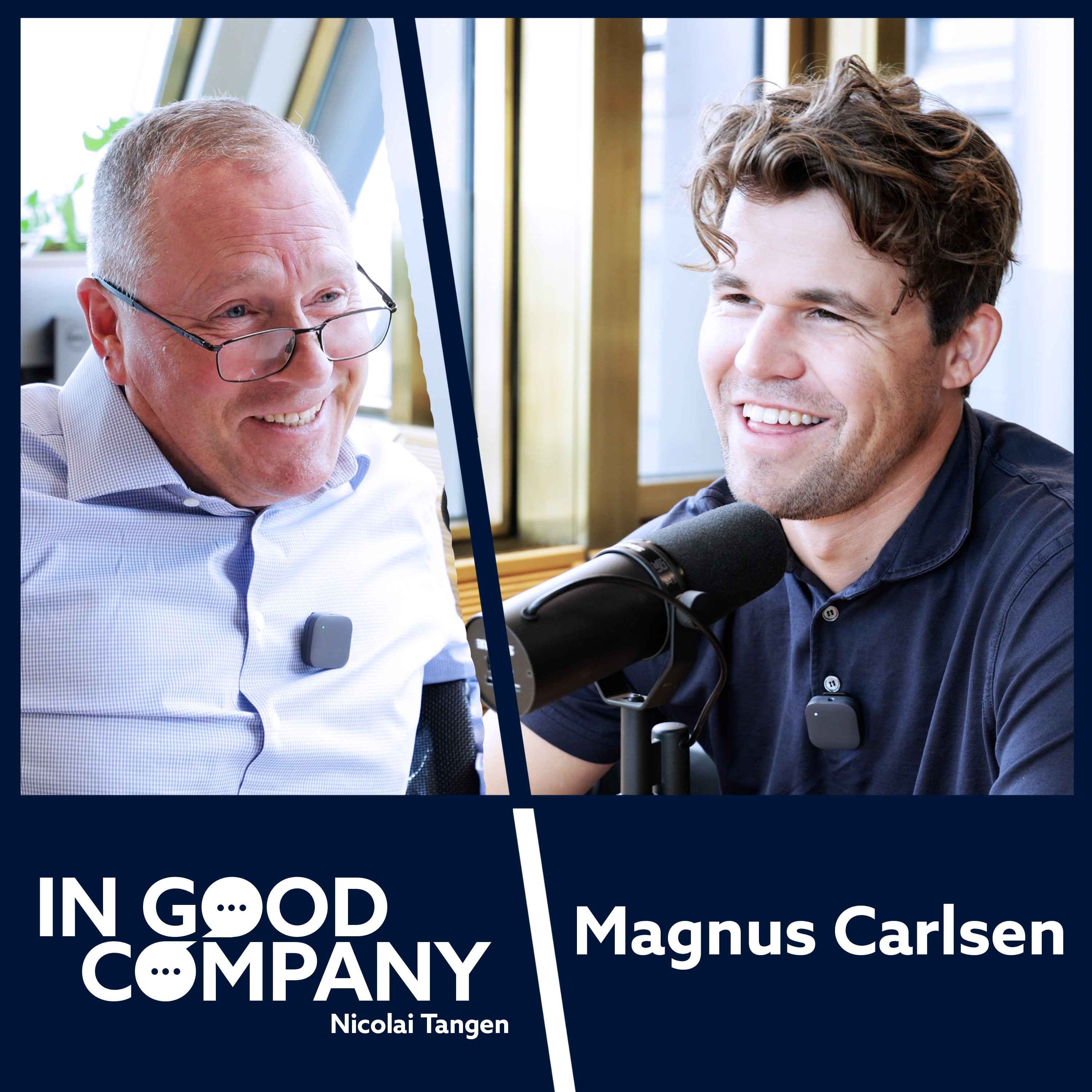
In this episode, Nicolai Tangen interviews Magnus Carlsen, the highest-rated chess player in history. They explore the connections between chess and investing, covering topics such as strategic thinking, risk management, intuition versus analysis, and the importance of curiosity and optimism in both chess and business.
Written by AI. May contain mistakes.

Get the gist, explore an idea or ask about something said.
 Claude
On In Good Company with Nicolai Tangen, what are the key points of this episode?
Searching your listeningAutomatic transcript. May contain errors.
0:00Hi everybody and welcome to In Good Company. Today we are incredibly honoured to have a guest who needs very little introduction. Magnus Carlson, the highest rated chess player in history. And today we're going to talk about business, or actually we're going to talk a bit about what we as investors can learn from chess and from you, Magnus. Very welcome. Thank you very much.
0:30now um during the second world war in britain pretty much every chess expert were recruited to the ultra project which was basically cracking codes used by the nazis and so there's been this assumption that brilliant chess minds are brilliant at everything and i was just wondering yeah what do you think we in business can learn from chess it's uh funny you should mention that because my father's parents uh they were they were born uh before the war they were very much into everything that's American and English because those were sort of what they saw as the victors of the war. But one of the books they had at home, which they recommended to me at an early age, I think I was about 10 or 11.
1:24It was a small book, but it was called Code Ultra, I think, a translation to Norwegian, about how they cracked the Enigma code. But I didn't know until the time of the Imitation Game movie that actually chess players were involved in that. So that angle I didn't really know. I also know that at some point, I don't know exactly which, but there was at least one hedge fund on Wall Street that was actively recruiting chess players and I think at least a couple of people made a really good career from that. But I think playing chess at an early age certainly teaches you to solve complex problems in a limited amount of time.
2:16Continuing to only play chess probably will not get you far in business. But I think it's a good start. Absolutely. Now, when we invest, we use intuition quite a bit, right? Or we typically call it pattern recognition. We find it useful when the situation is complex, when we have a lot of experience, and when we've seen similar situations before. So pretty much bang in line with what you are doing in Blitz. How do you look at your intuition versus analysis? Just how do you think about the trade-off? What is there a trade-off? I think chess players, when you play chess professionally at a high level, your brain is really trained to narrow the search and to use intuition because you know there is a limited amount of time.
3:08So you're trained to recognize patterns and sort of make these quick decisions. And I think I am very much the type of player who uses that more than others. I can certainly calculate, make deeper decisions based on deeper analysis. But it is not necessarily my forte. Usually when I lose games, it's because people have looked deeply at something that I've intuitively discarded. um discarded and i guess that's a way you can get an edge and in business as well for sure um but do you use intuition to figure out which uh kind of uh which directions to analyze more or um absolutely i use my intuition so how many so how many do you end up with so you use your intuition, you then think about how many different alternatives?
4:19I would say as a rule, if I think about more than three alternatives, I'm clueless. Then I've probably, then I'm probably not happy with any of them. Usually I think about two alternatives of what to do. And I usually have a bias towards one of them, but I try and cut that out as much as I can and try and look at both alternatives objectively. And then again, if both of them don't satisfy me, I might look at a third. I heard you somewhere say that you felt that you didn't add much value after 10, 15 minutes. i think after 10-15 minutes um that's when you first of all it's hard for our minds to to have the level of concentration that you need for much longer than that but i think you usually start looking pretty widely at stiff at other alternatives and sometimes they can lead somewhere but usually they don't.
5:27So yeah, I would say for a fairly deep think about 15 minutes is probably a good time. Well, we often see people who overanalyze situations. So if you were to go on after 15 minutes, what would happen then? After 15 minutes, I'll probably be widening the search and or just end up going in circles. so I probably would not add too much value after that and I might end up because my thought process is not that it's a bit chaotic so I might end up playing a move that I that I was considering earlier and then I forgot why it was not good because it's it was 20 minutes ago and my brain had just processed a lot of information since that time.
6:27So I've forgotten a crucial detail. A lot of things can go wrong if you think for too long, that's for sure. Well, what we see often in investing is that if you spend too much time on it, you become more certain, but the decision doesn't improve. I think that's a very good way to put it actually
6:51and that's true that often if I'm not a perfectionist in chess I am a practical player I want to get as good a result as possible and I know that I have limited time but you see a lot of perfectionists they think for 45 minutes and they end up making an obvious move that they certainly considered from the get-go. So I think there's certainly something in that. I'm just slightly puzzled. I mean, you are the number one player in the world and you've already characterized your thinking as chaotic and you're not the perfectionist. So how do you tally this? so i am i i want to learn and i want to get as good as good a chance as possible so i mean saying i'm not a professional is slightly inaccurate but it is in the sense that i will not sort of widen my search in order to make sure that I don't miss anything from the get-go.
8:05Or at least I will rarely do that because I know it's not an effective usage of my time. I think for everything in life, if we had unlimited time to make decisions, we would make them quite differently. But there's always this element of, yeah, I have to make a decision at some point. Now in investing, it's about long-term strategy and so on. How long-term can you be? How far ahead do you think? So when you start out, how many moves have you thought about? So the thing about openings, you usually have something prepared, but after that, you have a general idea of what plans you want to use, what plan structures are good, what pieces would be good in those structures.
8:56So with these patterns, you can plan quite far ahead in terms of what you want to achieve and where you eventually think you might win the game. So you always look far ahead, but then you also have an opponent who constantly tries to ruin your plans. So all the time you have both things in mind, short-term and long-term planning. When do you find chess easy and when do you find it hard? I find chess easy when I can sort of play with flow. When the first thought that comes into my head is usually the right one, then that's when it's easy. when I'm always, when I'm not, when I'm on the front foot, when I'm not reacting to what my opponent is doing, that's like, that's really, really important.
10:01Like a very sure sign of bad form is that you, you see your opponent's threats sort of before you see your own response because they should sort of come at the same time. But yeah, chess is just easy when I can play with intuition. That's a simple answer. Now, in chess, you have perfect information. What do you think would have happened if you didn't have perfect information like in business? So chess is unique in the sense that you have perfect information, but you but it's still very difficult so i sort of think about it in the way that we are well informed we all sort of have the same tools but it's about how you use those those tools and the information um that you have so yes we do have perfect information but i i sort of i don't see it that way because uh you still cannot you still cannot calculate every um every possibility but you also play poker a bit uh i also yeah i i played a bit of poker for sure yeah um where there is an element of chance uh yeah that's annoying part that's the annoying part of playing poker I think games like poker are interesting in a different sense but what I feel is that the best players now they play in a different way so they play in a less exploitative style so they sort of treat the game as if everybody has the same information rather than they try and sort of create their game as something that doesn't really depend on their opponents.
12:11In the end, the gameplay is not that different, I would say.
12:23Moving on to Risk. So when do you decide to play conservatively and when do you play more risky? My level of aggressiveness, risk-taking in a game depends a lot on the tournament situation, but also on my opponents.
12:44Against more passive opponents, people who play solidly, who are risk-averse, I will naturally take more risks and vice versa. If I know I'm playing a very aggressive opponent, I might take a more cautious approach. Why? Because I think that I don't need to create imbalance in the game. My opponent will create that imbalance. And I generally believe that imbalance in the game in the long run is good for me. Of course, in the short term, it can be dangerous, but in the long run, it's going to yield me the best results. Because they will fail. Because if the games are more in balance, there will be more decisive games, fewer draws.
13:42And since I will generally make better decisions in those situations, I will come up out on top. if you see another scenario where people play really really solidly then I probably will have to take more risks in order to get chances to win and then I might sometimes overstretch so I feel like people who are really solid but also are good at counterattacking taking their chances like you cannot you cannot be solid without the threat of counterattack and that it's a it's a surprising amount of people who are solid but with little counterattacking threat but the counter attackers those i feel are are the most dangerous for sure how can you calibrate this before the game are you how can you calibrate opponents risk tolerance It comes down a lot to opening choices.
14:46Whether you want to steer the game into more quiet waters, sometimes how long you want there to be an element of computer preparation. Maybe if you're playing a risk-averse opponent, you will take them out of book, so as to say, from the opening stage to force them to make difficult high leverage decisions as early as possible. Has your attitude towards risk changed a lot with age?
15:26I think my attitude hasn't changed that much. I've probably gotten better in general at assessing um sort of what is what is the appropriate amount of risk to take at times but then you also counterbalance that with sort of youthful um youthful spirit which makes it take take a bit more risk and i think it sort of ended up more or less in the same way I'm certainly more conscious of these things now. I try and balance them more, but I think I end up in more or less the same spot.
16:17Moving on to teams. So you have a team who helps you prepare, right? How does a team work? So right now I don't have a big team. I've had different people working for me in the past, but now I have my main coach, Peter, who's been helping me. I've known him for 20 years and he's been my main coach now for 11. For him, it's mainly about computer preparation, finding new ideas, which is becoming more and more difficult. and basically providing me with a bit of a choice so I can decide what to do against certain opponents and that I can sort of take it in different directions. So what happens? So a work day, when do you go to work?
17:18I honestly, I don't do very much these days in terms of preparation. I mainly play and prepare for the games. I look at chess all the time in the sense that I'm always studying the newest games and playing for practice, but I don't sit down in the morning and think I'm going to do this, this, and this. That's sort of what my coach does, that he works on something new every day. um does he find that out himself or you steer him uh sometimes i steer him sometimes he will start out working on something uh and then i will you know i will look at it see whether i like it or not but generally he's a lot better at this than i am uh and he also like he knows my preferences in general uh so he generally has an idea of of how to to do this but honestly i find i find the analysis opening analysis bit um i don't find it that interesting it's more of a necessary thing to be able to to get uh new positions and to get situations where you can sort of prove your playing strength but i don't find it particularly interesting in itself so i'm really happy to to sort of delegate that in general but when you say he's better at it than you are better at what uh he's better at using at using computer engines to find new ideas basically using different engines and comparing them, trying to go sort of a bit deeper in directions that the computer doesn't necessarily show at first, trying to find ways that I can play where I sort of increase my opponent's risk more than than mine like where i can take risks but not not unacceptable risks but it is is really getting it's really getting much more difficult if we're talking about this 15 years ago his he was doing the same job 15 years ago but for anon who was a world championship back then and i think he'll tell you that his job was a whole lot easier then it's getting very very very difficult what's getting more difficult to find new alternatives yeah basically you have you can look at it in in in the way that you have a market that's much better informed now and the people are using more or less the same tools um so it's much much harder to find to find an edge did you train differently and prepare differently let's say 10 15 years ago from about 14 to 11 years ago I didn't really have a coach I was generally I had some I had training camps with people but I was mostly doing this stuff on on my own but it was not nearly as deep as what is being done now and i think also back then um it was easier to get by with playing worse openings um basically now everybody sort of knows everything there have been new ways that have been discovered that makes it so much more difficult um to to get a game so uh i think i could get by then i could not get by now without um without proper analysis was it more fun in the past the game yeah um so i think for improving chess players having access to all this information at an early age at an early stage is great it's great to get you at a higher level earlier um they used to say that back in the day like in order to learn a new opening that takes a month now even top players can just turn on their computer engine by an opening course and within five hours like you can know like if of course if you like if you have the understanding and so on like you can you can pretty much know these things pretty well so um yeah it's just a it's just a different And it's just a different age.
22:36I think computer engines have been great for spectating chess. But for the players, yeah, it's made it more difficult. Does that mean that there are different types of personalities which will do well in chess going forward, do you think?
22:56So for now, I consider myself kind of a hybrid generation since I did grow up with computers, but I was not reliant on them. I was still using a lot of time with the chessboard and chess books as well. I think we're seeing the first generation now of like pure computer kids. And they play chess in a less pragmatic, sorry, less dogmatic. more sort of computer-based way in that they are less intuition-based and so much more sort of brute force calculation. So it's going to be interesting to see if this sort of new type of chess player beats the older ones that are more like me, that are more based on feel.
24:04Do you think it would have implications for which countries dominate the game? I think we're already seeing a generation now of Indian players. Obviously, there are huge individual differences But what most of them have in common is that their calculation is extremely good. Even those players who have zero understanding of the game and their intuition or in zero understanding, I generally mean that their intuition is not that good. they calculate so well that with longer time controls they can still get by and give even people like me a really really hard time what about china
25:01chinese players are are a bit different it's it's hard to say i feel like there's a bigger variety within uh chinese players you have some players who are a bit of the same as the uh as the indians but you also have others who have completely different styles you have the um world champion right now ding who's well he's not doing great at the moment but at his peak he was like an incredible intuitive, dynamic player. So yeah, definitely very different styles there. Any talent in this country? There are definitely a lot of people who are very enthusiastic about chess and are talented as well. in terms of whether anybody's going to become the new minus, sort of, or world champion one day.
26:10That's probably going to be hard, especially since we don't have the numbers that countries like India have. But I don't find that as important. I want people to enjoy chess, learn it at an early age so that you can have joy of it, your life. And if it can teach you other skills as well, then that's even better.
26:43Moving on to learning. So after becoming world champion in 2013, you said, I'm still far away from really knowing chess, really. there is still much i can learn and there is much i still don't understand how do you feel about that now i wish i could say something no actually i don't wish because that would be worrying um i would look at the way that i played 10 years ago and think that i was clueless about a lot of things. I think I play better now, but then also other people play better. So my results are not necessarily better. But I feel like I'm still learning all the time. I don't think I'm at a point in my career where I will drastically change the way that I play.
27:41but I do feel that my understanding of certain ideas certain positions is always evolving what was the setback you learned the most from when it comes to chess I've always been very optimistic almost almost blindly so um so i've had i think two two like two and a half specific periods of my chess career where i've stagnated or even gone a bit back. They were all before the age of 19. And during those times, I always kept a very positive mindset. I always had pretty much delusional ideas of what was going on. I always thought that
28:49this is going to turn around next game next tournament i probably gained a rating that was a bit higher than my actual level so i was like trying to push really hard um to play towards that level um and maybe i was taking i was taking too many risks i was forcing a bit but i always thought like next time next game next tournament and then all of a sudden turned around and that's what happened every single every single time that i just needed like one good moment and then i believed that everything was going to be going to be great again and ever since then i certainly had bad tournaments i've had like two three months periods where i don't play but I've sort of kept the same mindset most of the time that overall I think I'm really good at this and it's going to turn around um so I haven't really had that one moment in a big tournament in a championship where I'm thinking like this is going to take some time to recover from it's always gone like remarkably remarkably well well it's interesting this positivism you know positive people also make more money i always think i've always thought in chess that the right balance is somewhere between optimistic and delusional that's where you go what do you mean by delusional here you have people in chess who are like absolutely delusional optimists um who like uh former world championship kramnik um whenever i um whenever i played the game uh he would say off afterwards yeah it's a miracle you survived and uh he would say again against me and everybody else and i don't know like i don't know if he completely believed it but then like he would he's super fast so he would rattle off variation after variation how he could potentially have won if if he didn't win it was just it was usually a miracle so um i'm probably more on the side that i'm on the optimistic side but i keep my my feet underground at least a little bit more but it's an interesting kind of survival mechanism yeah I do think I do think so and if you if you always have a slightly more optimistic outlook you will take more opportunities you will see more opportunities you will take more risks you will put more pressure on your opponents so I think it's
31:51yeah it's a good thing it also makes you a happier person supposedly at least if it gives good results right but i mean it makes it sort of easier to um uh to to to play the game um often when i play the best i'll make a move based on intuition and then i'll i'll spot a reason right after like oh i missed that one maybe that was a mistake and I'll think no actually it wasn't it wasn't a mistake I missed something but still sort of my optimistic mindset made me make the right decision quickly based on intuition and if you're a pessimistic person if you overthink you will not do that does any of this uh explain the kind of happy streaks oh yeah for sure um uh i i can recall like streaks where i just go on winning winning and i think i'm like playing amazing then i look back and analyze and it wasn't that great so what explains the results then because i put a lot of pressure on my opponents and my optimism and my confidence makes them less confident how important is psychology these type of psychology in chess i think psychology is very important you have these all these people who have the same tools like they do you have a lot of people who understand the game at a level that is at least similar to what I do.
33:37But as long as they don't have the right mindset, they will inevitably not take enough risks. They will leave chances at the table, maybe others. They are too optimistic. They will take too many risks. so like having having a balanced mindset like knowing where to when to go for it when to to not like you're always obviously never going to always make the right decisions but um yeah if you're conscious of these things like inevitably you're going to um to make better decisions than than your opponents do you think um successful chess players deal with failures differently than less successful players is that how much of the winning recipe is in how you deal with failures i generally try to sort of avoid failures rather than rather than um sort of learn how to deal with it but what i do know is that my best results over the last 15 years.
34:53So my rating has probably oscillated, classical rating has oscillated between 2880 and 2820 for many years now. But my performance right after a loss is over 2900. So apparently I do something really well. I think I am probably likely to take a bit more risk after losing.
35:29I think that's one thing that I will put a lot of pressure on my opponents in such a situation.
35:39But I think a more interesting situation is not in classical chess, but it's in rapid and blitz tournaments where you have a failure. You fail to win a winning position or you lose a painful game. And then that's when a difficult part comes, when you have to play a lot more games that very same day. And that's when you can see, even myself, just um you try to do the right things but your mind just cannot be balanced so you end up sort of you end up sort of spiraling um and that's what i find really really difficult it's interesting that you take more risks after losing right because in most situations in life people take less risk after losing it will depend on the situation but i think on average yes i will take I will take more risks.
36:44Investors generally take less risk after losing. Yeah. In my most recent tournament, I did lose a game early on.
36:57I made two draws and then I lost one. So I was sort of minus one, not a good score. And then I was playing the number two player in the world. And then I actually decided that I wasn't going to take any risks. I wanted to stop the bleeding, which is not typical of me and this time it actually worked out great um i sort of managed to steer the game into fairly quiet waters and then i sort of then i sort of started not taking risks but at least i um i didn't take like i had so many opportunities to steer the game towards a draw and i and and i didn't but i think just in general like having that little fire in me that i normally have where i really really want to strike back um in in classical chess like it's it's i don't know i i think it's just given me a fairly fairly good good balance also like i'm extremely focused after a loss because i don't want to um i don't want to don't want to lose another one so i probably like spend more energy on those games as well do you have the same type fire as you had when you were younger rarely but but sometimes um i had a tournament recently where uh i was um i had a good start but there was um a guy way ye chinese guy uh who's ranked number 10 in world now he had a tournament of his life there was a rapid and blitz event and And at some point I realized that a good event is not going to be nearly enough for me.
38:57I have to win every single game now. And that was my mindset. I was winning these games purely on will, taking risks here and there. And I ended up winning 10 games in a row and I won the tournament. but it's I don't know you cannot always you cannot always do that that was easier for me earlier like now I really have to fire myself up how do you get into that mental stage I think at that point you sort of have to treat every game as do or die really you're sort of told that you know you shouldn't do anything special like but i think in those situations sort of a different mind like these things obviously could go horribly wrong but if you want to try and get on the streak where you just win every single game then yeah i think you just have to to to take risks every single game and be like being like survival like 100 % but you do self-talk do you go into the bathroom look yourself in the mirror and say magnus get your finger out sharpen up here i don't feel like i don't really need to do that because when i sit down at the board that's what i need to what i need to do but i i do know that i i need to like put every inch of pressure on my my opponent and and yeah maybe go more from optimistic to delusional probably
40:46How do you cleanse your mind after a loss, after a bad game? When I lose, it kind of depends on how I lose. If I feel that I did a lot of things well, but at a certain moment I sort of didn't calculate deeply enough If I did something that I, if I made a mistake that I, I know that I can make and it's not a mistake necessarily of negligence, then I'm sort of, it annoys me, but I'm sort of fine with that. and and then my mindset is basically we move on if if i know that i've made avoidable mistakes if my mindset was wrong all these things yeah then i i have to try and reset um completely like just take a minute to myself like focus on breathing try and be somewhere else for for a moment and and see if i can get it back but it's yeah it's it's at that moment is is not easy um if you don't have a day to recover then it's usually hard to get back if you if you make a bad move in your in your personal life do you manage to put it behind you quickly as well what do you make bad moves in your personal life i think um i think um at times like i will make decisions sometimes like out of negligence i will not do the right thing and that's that can be a bit it can be annoying it can be embarrassing i think i experienced a lot of the same emotions that that everybody i i do as other people like i find it also really hard to change to change patterns completely yeah now um in the fund we have this uh investment simulator where we analyze mistakes investment mistakes and you of course have your famous chess engine what do you what do you get out of that i do find it interesting to um to look at my games with engines after and i like i always do that um but it's very important to be able to identify what are sort of human mistakes and and what are um what are what are the mistakes that only like computers can identify because you cannot condition yourself to try and play like an engine or at least with my style i cannot um so at certain times like looking at games with engines like you have to be you have to try and understand um what you did wrong even if the reason is non-intuitive in order to learn, but you cannot base everything on that because your opponents, they will continue to be human and make human errors and also make good and bad moves as humans, not as engines.
44:31I've heard you talk about physical health and how that impacts your games and in a way your mental health. Just how do you feel that they're interlinked? I mean, you're a fit guy, right? i think for anything uh you wanted to um like yeah if you're um if your body is fit your mind is fit you're going to perform better i have probably been lazier in the last few years when it comes to when it comes to fitness than than i was before um how many how many times a week do you work out i don't i've like i've never had a schedule much so now nowadays i golf a lot so i do get um like my steps every single day i play a bit of paddle i do when i'm at home i probably do like once a week uh strength workout but i don't particularly like that um so i was definitely like fitter before when i was in my early 20s I would win a lot of games purely on stamina because I was like physically stronger but yeah nowadays I find it difficult to sort of be in that shape.
46:01How was your golf? I started golf last year and I really enjoy it but I'm not very good but it's um it's a way for me to at least you know uh get some exercise every single day when we go back and look at your uh your history and i think yourself you say that you were at really at the top of your game in 13 and 19 what what stand out with those years
46:40i think 13 14 um i was really fit i i just started working with a new coach that helped a bit that i had some some ideas but it It was not only that, I think it was just at that time I was sort of at my peak, like close to my peak physically and mentally. And then 2019, I think I just had a period where I had like a lot of leftover preparation from the World Championship in 2018. I couldn't really that 2018 um the match was all draws 12 games but they were of extremely high quality so when I came to other games uh other tournaments later I wasn't playing that one game guy all the time so I could use some of the preparation like other people were sort of more forgiving so I think that was like a very specific moment and also that was the start of AI in chess uh you that that was the start of people working with uh with neural nets so that gave some people an edge uh because some people learned how to work with them to find new ideas quickly uh and so like in a in a few months time you could suddenly be ahead in the openings in a way you couldn't uh you couldn't be for years before that uh so i think that was like a very specific moment in time whether that would have carried on a bit in 2020 if it hadn't been for everything closing down i'm not sure um but i think that was just a very specific moment in time because ever since then um i've had like ups and downs but my level has been quite consistently a little bit lower than in 2019.
48:55What do you feel about AI's involvement in chess? I think there was a very specific moment when AI was extremely exciting for players and coaches. Now it's still interesting to see, especially if you compare neural nets to traditional chess engines and also hybrid engines how differently they think but now everybody sort of has their same tools so they're working with them it's definitely a lot less exciting and it's more now they've probably contributed to evening the playing field even more what what has it added to your game
49:53i think um and the newer neural network engines they've uh definitely contributed to the way that I evaluate sort of time and material, I mean, broadly, and also King Safety. My view on the importance of King Safety short-term and long-term has changed, and I think my understanding has improved so much since 2019. In what ways? And you have more now of an understanding of how both taking time to build a safe king, sacrificing material to weaken your opponent's king, or safeguarding your own king. These are things that humans are intuitively not very good at. And it's a thing that engines used to be even worse at.
51:04And now these neural nets, they understand it. Well, they don't understand, but they do it so well
51:14that we're learning a lot from that. And I've had to reevaluate a lot of things for sure. What do you think is the most value aspect that humans can still add to this game.
51:33There used to be a thing called anti-engine chess. I don't think that would work anymore. Supposedly, like, engines did not play well in closed positions that are more strategical, less tactical. That is less of the case anymore. essentially humans can play chess and they can they can explain to other humans what the engines mean but i don't think we can do a lot a lot more than that i think for training purposes having a human touch is really good um still but honestly like you can get really good at chess these days without any human input and where do you where do you think this will take chess over the next decade i think chess will get faster and faster at a high level um i don't know if this is direction that we we we're gonna go but i'm very excited about the prospect of playing chess 960, which is basically that the pieces on the first rank are being randomly chosen before the game.
53:00So you end up playing without opening theory. And I find that extremely exciting to play if you're going to play with longer time controls. I feel now with longer time controls, the game is just a bit too easy and forgiving with all the preparation you have. But overall, yeah, I think everything that's happening in chess with engines and preparation is just going to mean that we have to play faster chess in order for there to be enough room to both show your strengths and weaknesses. Given all the AI interference or involvement in chess, are you surprised that it's still so popular and people find it so exciting?
53:50I think the thing about chess is that it's complicated, but it's also simple enough. I think people like that it's relatively easy to understand, not to understand, but to play. Also, I think it's as simple as the Queen is a really strong piece. People like that the pieces are relatively powerful compared to other games. and I think it doesn't necessarily matter that much that we're so terrible at it compared to engines.
54:36It's made the game less mysterious, for sure. Chess players used to be magicians on the board. We're clearly not anymore, since everybody can see now what we do right and what we do wrong. But that's also the good thing. It's made it more accessible. Chess used to be this mystery where nobody understood what was going on. Like humans sort of had to explain that. But now humans only have to explain why the engine, which basically is very close to the truth, why it's showing the score that it does. And this means that people can follow the score. And honestly, like most people watch sports or games for entertainment.
55:32They are not that interested in all the technical aspects. They mostly want to watch the score to see who wins. And if it's fast, then better. So I think overall, no, I'm not particularly surprised that chess is still popular. Would it have been as popular if it was invented now? I'm not sure. But chess has such a rich historical background as well as modern tools to follow it. So I think probably a lot of good things are still in store. Last few questions here. Have you ever had the imposter syndrome? him i don't consider myself particularly brilliant genius or or that intelligence so yes i've had times where i've seen people whom i consider to be smarter than i am do worse at chess and it really makes me wonder whether sometimes whether I'm actually this good?
56:42Are everybody just fooling me? Less recently, I've sort of accepted it more now, but I've had brilliant people talk to me as if I'm the smartest person in the room, and that really makes me uncomfortable because I see myself as an intelligent but not brilliant guy who happened to find the one thing that he can do really, really well. Do you think this mindset is the reason why you've been so successful?
57:21I think this mindset has definitely kept me grounded and I think it's been really good for me in chess. But I cannot say that this or that is the reason because I don't know. Is there a piece of advice from a mentor or coach that has stuck with you forever? I've had a lot of good advice over the years, but I think maybe the best advice that I got was from Simon Neudesteyn at a fairly early age. He was not my main coach or anything, but we would probably meet up once a week or every two weeks, depending on whether I was playing tournaments and so on. And then we would go through some of my games.
58:05and once he noticed that for a few black games in a row i played the same variation of the sicilian defense and he said i don't care whether you consider this to be good or a bad opening if you're not going if you're not going to um explore then you're not going to learn and And so he said, he just went to a shelf. Like he's like me, he's not a very organized person. He went to the shelf and he said, this book, this opening, learn this instead. And so I learned that opening. I tried that in the next game. Then I tried something else. And that thing, like always being curious, thinking about whether thinking about learning rather than being um stuck in and sort of the same comfortable patterns has been has been really important to me and in addition to to golf what are the other things you're trying to learn and explore in your in your normal life these days i'm i'm trying to learn spanish um because i will be moving to spain after a bit apart from that why are you moving to spain because of weather um i've i've had you know um i've had a lot of winters in norway but i feel like i'm privileged enough that i can i can sort of choose more where to to live i still want to spend time in Norway, but I probably don't want to spend six months of winter here.
59:52But apart from that, I have fairly simple pleasures in life. So I had times last year where I thought that I was going to try and carve out sort of a new career path that I could pursue at the same time as chess but so far i haven't really found it and also so far i haven't been any less happy because of it good now last thing um what is your advice to young people
1:00:37be curious learn read and play chess but don't pursue it as a career unless you're going to be the best in the world very good magnus you are a real magician uh big thanks for for being here thank you so much thanks
How can strategic thinking in chess be applied to investing? In this episode Magnus Carlsen and Nicolai Tangen discuss the comparison between business investing and chess. They also talk about risk, how to recover after losses, AI in chess, strategizing against different opponents and how to always explore and stay curious. Magnus also reflects on self-doubt and the power of optimism in achieving success. Don’t miss this engaging episode with the world's greatest chess player. Tune in!
In Good Company is hosted by Nicolai Tangen, CEO of Norges Bank Investment Management. New episode out every Wednesday.
The production team for this episode includes PLAN-B's Pål Huuse and Niklas Figenschau Johansen. Background research was conducted by Sigurd Brekke and Patrick Du Plessis.
Hosted on Acast. See acast.com/privacy for more information.


