
 Ask ChatGPT


 In Good Company with Nicolai Tangen
22 Jan 2025 · 53m
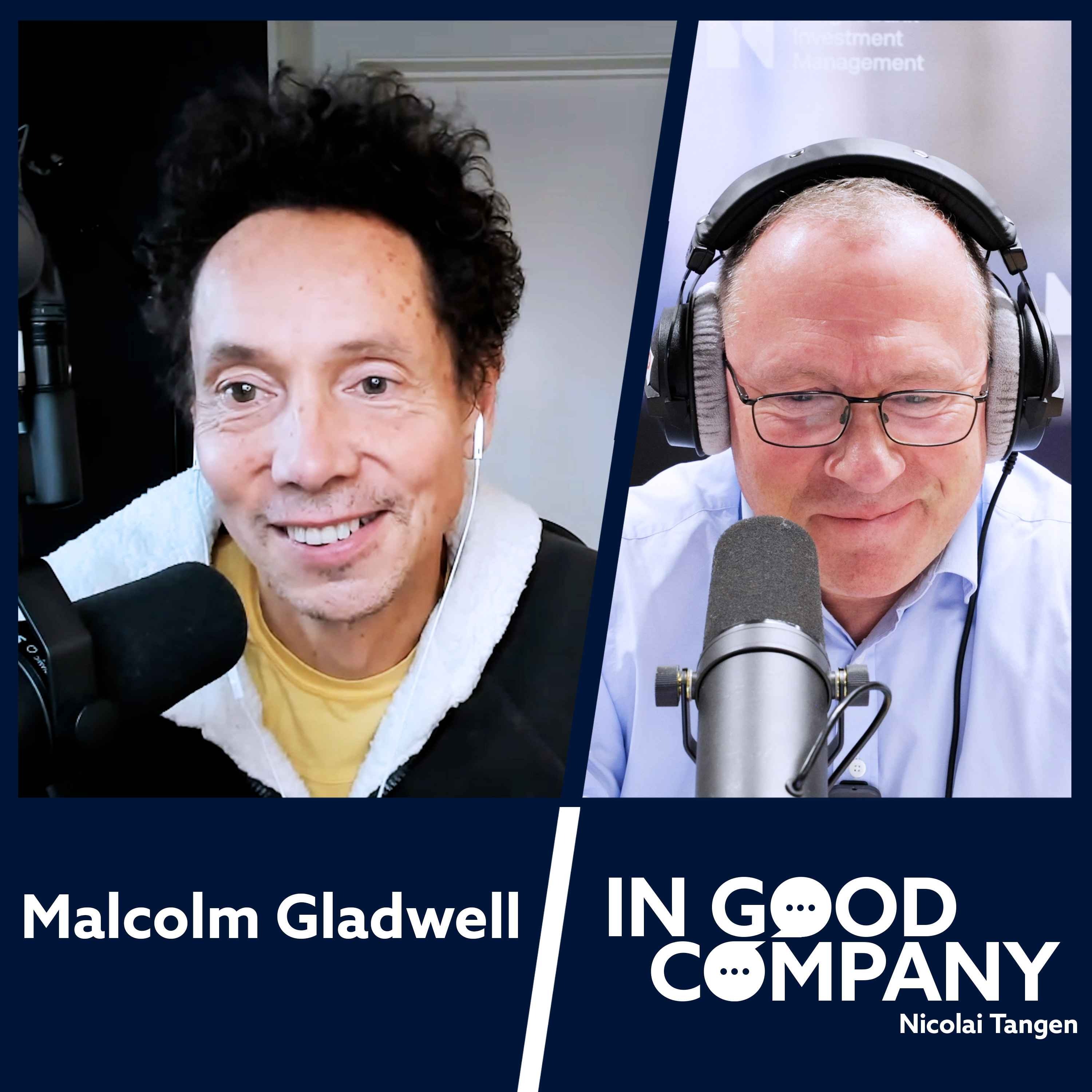
In this episode, Nicolai Tangen interviews bestselling author Malcolm Gladwell, who shares his insights on enduring human challenges in the face of rapid technological advancements. They discuss wealth psychology, leadership, the nature of mediocrity in sports, and Gladwell's creative process.
Written by AI. May contain mistakes.

Get the gist, explore an idea or ask about something said.
 Claude
On In Good Company with Nicolai Tangen, what are the key points of this episode?
Searching your listeningAutomatic transcript. May contain errors.
0:01Hi everyone, I'm Nikola Tangen, the CEO of the Norwegian So What Wealth Fund. And today in Good Company, we have a tremendous guest, Malcolm Gladwell, who has refined the way we think about things like success, intuition, and how ideas spread. Great to have you here, Malcolm. Wonderful. Glad to be here.
0:28Malcolm, what are the most important things which have changed in society over the last 25 years? Oh, wow. I would turn the question on its head in which is I think we spend a lot of time talking about the things that change and too little time talking about things that haven't changed.
0:50We've seen this sort of advent of this avalanche of new technology. And I'm always deeply impressed by how little technology changes the way we function as human beings. We seem to be, and how we're always left at the end of the day, with some fairly difficult and intractable human problems. While technology sails ahead and deals with ever more sophisticated problems, you know, it always comes back to the same thing, which is, can human beings find a way to cooperate with each other in an efficient and functional way? And that's been the problem for thousands of years. And it doesn't seem to get any easier, despite the fact that we're surrounded with ever more sophisticated tools for trying to make that happen.
1:35And why is that? Because I think it's funny, because sometimes I meet with companies and I ask them, what kind of problems do you have? And they all talk about, you know, well, we're trying to build down the silos. We're trying to get cooperation up. We're trying to get people to share, trust each other more, feel safer. And so on. Seems like it's the same problem everywhere. And been the same problem. I'm sure had you had that conversation 50 years ago, you would have heard a version of the same thing. Different buzzwords, but people coming back to the same fundamental questions. I mean, a couple million years of human evolution is a lot more powerful force than a couple hundred years of technological advance.
2:24I think that's probably what we're talking about here. There's an imbalance between those two processes. What is the most interesting technology change you are seeing now?
2:39I mean, the obvious answer is AI. Although... Can I answer a slightly different question? The single most, I think, issue, change in the Western developed world is demographic. It is the aging of the population, which I think impacts the way in which all kinds of other technological innovations are used. So that, you know, we are profoundly older than we were 50 years ago. Had AI come along 50 years ago, I think you would have seen a very, very different pattern of adoption than you would see now. So if you go back to the beginning of the baby boom where you have across the West an extraordinarily large generation of people entering professions for the first time.
3:33And that was – when those moments happen, those demographic moments, you have an opportunity to change the patterns of practice. because patterns of practice in any domain are obviously heavily kind of specific to generations. We don't have that now. So instead of having a new generation embracing a technology and bringing it to the profession, we're faced with the task of converting existing professional domains to new habits of practice. That's not impossible. It's just harder. So you think when we get older, we're a bit beyond repair? Not beyond repair. I just think making an argument to a 55-year-old doctor that they should cede some enormous share of their diagnostic behavior to AI is so much harder than it is if you're telling that to someone who's in medical school.
4:26And for good reasons. Why would they change? Their patterns of practice are set. There's no threat to the way they do business. Everything about the new technology strikes them as being profoundly upsetting. I've seen some of the data from the experiments where they try and get doctors to adopt AI. And what you see is there's no question the AI is better than them. When they have a chance to use AI, they don't want to use it. And the main objection is it takes away, essentially, it takes away the fun of practicing medicine. But COVID really changed the technology uptake. I think that's right. Yeah, that's a kind of exogenous shock to the system that allows for this kind of dramatic technology adoption.
5:17You, in a way, invented the concept of tipping point. What type of tipping points are you seeing now? I do think, if I want to come back to this demographic thing, I actually think we don't spend enough time on this. In the United States, for example, college-age population, the number of kids applying to college is plummeting. It's one of the most dramatic shifts that we've seen in generations. And I really think that's important. And I cannot tell you why it's important. I don't think we know yet. But I really do think there's something that's, you know, that could be a good thing. It could facilitate the introduction of new kinds of kind of cognitive technologies like AI because we simply have a smaller cohort of people who are competing for them.
6:05It dramatically changes the kind of social balance of power within industrialized societies if that sector of the population is shrinking. I don't know. It just – but it strikes me that we've been living in a world where we have been steadily expanding the number of college-educated people for 150 years. and that may be coming to an end. And that's weird. Well, if you think it's weird in the States, I mean, Europe looks much worse, right? When you look at the demographics in Europe. And I just spent a month in New York meeting, well, altogether more than 50 American CEOs. And the first time I've heard them talk about declining demographies in Europe and that therefore they weren't putting their best people elsewhere.
6:51Demographic trends, to my mind, will always trump technological trends in terms of their kind of seismic significance because they go to the core of who we are, right? They're, you know, I don't know. So I think, yeah, to my mind, that's really, really an important change.
7:14Moving on a bit to evolution and learning, you have argued that being open to correction builds trust and credibility. Why is it so hard for leaders to admit they're wrong? Because they're confusing two things. I think that they're confusing admitting you're wrong about your ideas and admitting you were wrong admitting to a kind of moral failing. I do think admitting to a moral failing is something that is fundamentally damaging. I don't think your colleagues will forgive you easily or move on quickly from the knowledge that you have done, that you have revealed some fundamental flaw in character.
8:01But admitting that you were wrong about an idea or an action and that you understand the nature of your mistake and are endeavoring to do something about it strengthens my belief in you as a leader. It makes me think that you are someone who's better adapted to a fast-changing world. And also it makes me feel better as an employee because I understand that this is an environment that doesn't penalize risk-taking. And I think people confuse those two. You have revised some of your pretty strongly held positions. What type of things have you revised? The biggest example would be around crime. I mean, I've returned to crime in almost every one of my books.
8:49And if you read all of them, starting with The Tipping Point 25 years ago through to my last book, you will see that I have been returning it and essentially more than updating it in some way. And now to the point where I think that the way I talked about crime in my first book was simply wrong. Why were you fascinated by crime in the first place? Well, I was living in New York at the time when New York City, in the early 90s, when it underwent this very, very sudden reduction in crime, as did many American cities, but New York was the leader. And then New York underwent a second decline in crime, which was unique to New York.
9:31And I just simply, I found it so fascinating, and no one could give me a good explanation for why. which is, that's why I wrote my first book, was to try and kind of wrap my hands around the phenomenon of how is it possible that a city could go from being thought of as one of the most dangerous urban areas in the West to a place now, I mean, New York is basically on par with Paris in many respects in terms of its crime rate, which is, you know, if I had said that to you, Nikolai, in 1990, you would have said I was crazy. I mean, in our lifetime. Absolutely. How has your view changed? I've become, well, mostly because an idea that I sort of played with in my first book, which I return to much, much strongly in my most recent book, I'm more and more and more and more impressed by the fundamental asymmetry of human behavior.
10:29And I didn't fully think through the implications of this in my first book. In my first book, I celebrated a theory of crime reduction that said, that what we want is more proactive police presence. In other words, send police out into the community and have them very aggressively take note of and correct small instances of disorder because in doing that, they will send a message that large kinds of disorder are impermissible. What we realize now, what the criminological world has kind of realized now, is that that's not the way crime works. Crime is not something embedded broadly in the community.
11:17Crime is something that is generated and sustained by a tiny, tiny, tiny fraction of the population. And if you can find that fraction, you can create highly effective policing that is both limited, that is profoundly limited, that is just targeted and limited to... So we're talking, you know, in New York City, we're talking about a couple of thousand people who are probably at the core of the crime epidemic. And this is in a city of 9 million people. That is something that did not occur to anyone in the 90s. And what are the implications of this? the implications are that so there's two dimensions to this one I wrote about in my last book and one in this book one is that it is spatially specific that if you look at any urban area in the world and look at patterns of crime you will find that they are specific to street segments so blocks city blocks and that those that specificity is has a kind of permanence In other words, if I return to Oslo 10 years from now, I will find crime occurring on the same street corners today as I did 10 years ago.
12:37That's one. And secondly, that it is demographically specific, that it is certain individuals in certain age cohorts who are within certain social networks that are responsible overwhelmingly for sustaining criminal activity. And so if you can paint a picture of that network and look at the core of that network, you can, instead of trying to track 1 ,000 people, you can track 10. And that is, I mean, a kind of, that is so distant from what we thought the job of a police force was 25 years ago. I mean, it's night and day. It's like, it's precision. It's the difference between, you know, in chemotherapy in the 50s, you attack the whole body, and now you detect some tiny portion of the tumor.
13:36It's the same analogy. Interesting.
13:44Different type of social network is we find in sports. and you say that failure and mediocrity in sport can teach us a lot. So what are your thoughts there? You were a previous runner. You still run. Yeah. You ran faster in the past, of course. Yes, I did, as do we all. Yeah. Well, you know, it's funny. I have many feelings about sports and it took me a long time, But I came to the – I listened to too many CEOs. So many CEOs or people running companies told me that they like to hire former athletes. And for a long time, I dismissed this. And then I realized there must be something there, that there must be picking up on – there must be something specific that is taught in sports more effectively that's taught in other domains when we're young.
14:43But the second question is, is the thing that's being taught in sports specific to being good at them? Or is it just specific to participating in them? In other words, to benefit from whatever good is coming out of being a long-distance runner, do you need to be an Ingebrigtsen? Or can you be Malcolm Gladwell coming somewhere in the middle of the pack? And the answer is, I'm now convinced that there may be as many, if not more gains, to being good or mediocre as opposed to being very good. I don't think you want to be the—and I think we get—for among other reasons, the time costs of being exceptional are so large that they crowd out other kinds of knowledge and skill acquisition.
15:29What you want to be is someone who is simply acquiring the kind of discipline and thought processes that come from participation in a sport without being overwhelmed by it. So if I'm mediocre in sport, what is it that I gain from it?
15:53If you are – well, if you're mediocre because you don't train very hard, you're not getting – So let's say I'm training hard. I'm getting up early. I'm going for it. But hey, I'm just too fat. I don't move fast enough. And I think, and I would further, if I was someone who was hiring, find it impressive that you persisted even though you were mediocre. In other words, the idea that somebody could devote a large amount of their time and attention to something and be comfortable with the fact that they weren't, that wasn't being, that wasn't receiving an immediate reward is interesting to me. Right?
16:28That they have, in other words, an attraction to—first of all, they have a self-definition of success, not one that's externally constructed. And two, that they're happy to persist in an activity even though the world doesn't recognize their persistence in some tangible form. That's really, really crucial, right? What I'm interested in is the extent to which somebody is—their motivation is self-generated. That's the crucial thing. Well, we certainly see more grit, more working on process, focus on process rather than results. A lot of team spirit and work coming out of it. A lot of positive things.
17:14How has your background in sport helped form you? Well, many ways. I do think it teaches – it taught me at a very young age. I was a big high school runner. The distance between preparation and reward in sports is one of the key lessons. There's no such thing as instant gratification. And that's – for a 13-year-old is a really, really, really important idea. And to lay down the notion at 13 that it is October and we're going to go for a 10-mile run and you will not see the results of this until you race in May is really, really useful at that age. I mean, it's useful at 61, too. But to have that lesson.
18:10And the second thing that how well you do is a function, not just of the intensity of your effort, but more importantly of the consistency of your effort, is another really, really important. You know, when I look at my college years and even my professional years, I am not someone who ever does anything at the last moment. Never do. I never stay up all night. I never work past, you know, I don't work in the evenings. I meet deadlines. Why do I meet deadlines? That's a very runner's kind of thing to do. There's no such thing as last-minute preparation. In fact, the opposite is true. You're supposed to do nothing at the very, very end before a race.
18:54So those are all kinds of foundational ideas for an adolescent to be introduced to. And the third thing is this intensity consistency thing is something only recently I've dwelt a lot on. And I've been struck by how many successful people I know are people who value consistency over intensity. that this idea that you get up every day and you do something and that that is a far better way of succeeding than concentrating, doing these bursts of kind of hyperkinetic activity which exhausts you and which give you very little time for reflection. The thing about consistency is it allows for, it gives you space to reflect.
19:44And one of the things that, one of the strategies that I've tried to follow in my work is trying to build space for reflection into creative cycles. Start early enough that I have the time to kind of put something aside and come back to it. And that allows you, gives you so much more insight into what's wrong with what you're doing. How do you do that? Start earlier. And do, again, it's the consistency. Better to do two hours a day, you know, starting six months early, than to do six hours a day starting one month early. Yeah. There are a couple of things. I mean, one is consistency builds trust.
20:26And we even see it in investment results. You know, a consistent track record is much better than a more volatile track record. It's perceived as more trustworthy. But in terms of your disbelief in procrastination, we have other thinkers, such as Adam Grant, who is advocating for procrastination. Why could you elaborate a bit on that? Well, I don't. To be fair, I'm describing my own approach and why I think there may be benefits to someone engaging in the kind of sporting activity. I'm not saying this is true for all people or all domains. and there's certainly a case. The lovely way about the way human beings operate is that there are many, many different ways of solving a problem.
21:17I'm describing one particularly fruitful avenue.
21:25Now, you identify as an introvert. What have you learned about introverts' approach to challenges? But are you really an introvert or are you just saying it?
21:40Well, the introvert is someone who is not hostile to social interaction. On the contrary, we can be inspired by it, thrilled by it, love performing. But someone for whom social interaction is costly. So I am someone who is, I enjoy this conversation. I enjoy interviewing people. I enjoy giving talks. But it's costly. In other words, it does not invigorate me. It drains me. Thanks. So that just means that we, because we regard those activities, we understand those activities to be costly, we ration them like you would in any – whereas the extrovert does not ration those things. I watched – once watched Bill Clinton work a room.
22:28He's the quintessential extrovert. he's so invigorated by meeting people that he will do it indefinitely. I mean, he would stay in that room for hours if he had the chance. That's not what the introvert is. So I suppose, you know, do I think there's something, I don't have a kind of preference for, I don't think one mode is superior to the other. It's just a kind of, you know, it's, I find the classic extrovert position that interaction is invigorating. I find it deeply mystifying. I don't understand how that's possible. But I don't think it's a bad thing. I just think it's just a kind of foreign activity.
23:10Where does extroversion come from? Well, these seem to be, of the kind of big five personality traits, introversion and extroversion are the most genetically determined, right? So conscientiousness would be the least— oh, no, motivation. We know that motivation seems to be the least, and conscientiousness seems to be the least genetically determined, and extroversion and introversion seem to be the most. So it's purely kind of baked into our systems. Because I've been thinking quite a bit about energy. Where does energy come from, and how do we measure it, and how important is it? Yeah. Is that the same?
23:52Is extroversion the same as energy, or is it different? No. I think energy, I lump energy in my mind with enthusiasm and that the person who is energetic is typically the person who has simply done a better job of finding the thing that gives them pleasure and excitement. And that once you've found that, most of us are energetic, but the problem is that most of us haven't found it. So when we observe, like what I said earlier, if you look at the big five personality traits, you know, introversion, extroversion, conscientiousness, openness to experience, neuroticism, agreeableness, the one that is the least genetically determined is conscientiousness.
24:42So the things that make, the cluster of traits that surround motivation. And the question is, why would that be so—what is the environment doing there in a way that it's not doing when it comes to extroversion, introversion? And the answer is that for us to express our motivation, we need to externally come upon something worthy of our time, attention, and I say enthusiasm because that's the way it— And to the extent that it is a little bit or some, it is genetically mediated, it's that some people just look harder or are much more inclined to find things that excite their enthusiasm. So when we hire people, when I hire people, I'm very interested in this trait.
25:36And I like the person who can find pleasure and joy in very, very small things because it strikes me that, oh, that person is going to be easy to motivate. But the person who's very, very, very, very particular is going to be harder to keep them focused. How do you tease this out in an interview? No idea. I mean, I have some ideas. I think we're all very, you know, the truth is there's almost nothing we do worse than assess someone's personality in a short period of time, right? It's like it's just we're uniformly bad at it. When we do it, we tend to do it badly. We tend to be misled by all kinds of things.
26:25You know, I don't think there's any kind of substitute for substituting some longer interaction. Or for, you know, as a journalist, there's a very standard thought experiment that a journalist has. so Nikolai suppose I was assigned to write a long 10 ,000 word profile of you and I was given two conditions you can have unlimited access to Nikolai or you can have unlimited access to everyone in Nikolai's life which do you choose the good journalist would always choose the latter that I feel I can get further in understanding you if I had unlimited access to all the people around you, even if it meant I could never talk to you, than the reverse.
27:20That's not because you will mislead me, but just because there are real limits to the extent to which I can accurately gauge who you are from your own self-presentation, right? There's just too many defenses, too many—and too many things about which you, like all of us, are unavoidably subjective. You know, we're just poor judges of ourselves. So I would do better if I could get your spouse, mother, sibling, co-worker, best friend. That's just going to be way more useful.
27:57Why do people at the top complain more than others? This is one of the mysteries. There are many mysteries that I find with wealth. there are several wealth paradoxes. One is the wealthy should logically complain less about taxes and be less sensitive to tax rates than the poor, right? Because they're wealthy. It makes up, you know, they still have so much left over. They can still live their lives. And yet they seem to be far more sensitive to even subtle changes in tax rates. Now, that may be because they're more focused on it, whatever. There's all kinds of other reasons you can come up with.
28:40But fundamentally, as a psychological problem, you would think the acquisition of great wealth would permanently remove any worries I had about impingements on my wealth, right? Because you're rich now. But people never—they never seem to—rich people never seem to reach the point where they say, I'm rich. And that means I can now focus on enjoying myself, hanging out with my family, going sailing, you know. No, they're still obsessed with the impingements on their own wealth. So that's sort of mystery number one. Mystery number two is that you would think that the acquisition of great wealth would make you aware of the fact that the rest of the world looks at you differently.
29:23In other words, if I am a 17-year-old working two jobs with no money and I complain, the world understands the nature of my complaints. You're young. You have no money. You're family. But if that 17-year-old grows up to be a billionaire, the world looks on that same set of complaints very differently. Instead of being sympathetic and understanding of them, the world now says, why are you complaining, right? So there's a certain point in the maturation of an individual where we have to realize we can no longer behave in the same way as we did previously if we would like to maintain the respect of the rest of the world around us.
30:06Many, many wealthy people don't make that transition. They don't understand that we don't want to hear about their complaining anymore once they have enormous wealth. Why don't they get it? Well, that's a really interesting question. Part of it, there's a benign explanation, which is that we, and I'm sure you've observed this too in talking to people who are powerful, that we permanently inhabit the world of our youth, right? In other words, if somebody grew up in very humble beginnings and attains enormous wealth, some part of them is always someone who grew up in humble beginnings. In other words, they can't transcend the psychological framework they established as a young person.
30:54That's one definition. The second definition is, the more insidious one is that the condition of, you know, the function that being embedded in a network is, is that it is a form of correction. In other words, my friends around me govern my utterances, my behavior. They're the ones who make me aware of when I've stepped over a line. As those influence, when you get higher and higher and higher up the scale, the number of people in that correcting circle starts to shrink. You're not getting feedback anymore on your behavior, right? So you complain because all your friends complain and nobody's telling you not to.
31:49Exactly. Think about my three-year-old gets nonstop feedback on her behavior. I mean, every single thing she does. If she grows up to be a billionaire, that will vanish. And that's a very different condition in which to live your life. Related to this, many successful people stay at work much longer than they need to. and I meet a lot of people who continue to work really, really hard long into the 70s and even 80s. Why is it so important for them to continue going? Well, because it's fun, right? I mean, I suspect I will be one of those people and I mean, you know, from a kind of, Could I, for example, retire at this moment?
32:38I could. My brother has retired. He's retired at my age. His friend, best friend, retired. I mean, lots of people in my age retire. I'm not retired. Why? I have no intention of so doing. Why not? There's no reason for me to do what I do, continue to do what I do, other than I find it enjoyable. And I always have. And it's just a way of feeling connected to the world. I think it's a very—actually, I don't find that. pattern of behavior problematic, I find it kind of lovely. But do you think it is because they have their identity tied up to their position? Yeah, but I think that's fine. I think, you know, it can be, there are versions of this that are highly problematic.
33:22Joe Biden staying in office long past the point where he should have. That had really profound consequences for his party and for the country. That's the worst case scenario, a lack of self-awareness about, or the CEO who is no longer capable of doing their job, who's hanging on. But there are other versions of people who remain very involved with what they're doing that I think are lovely and wonderful. And in a world where we are transitioning to a world where I'm guessing longevity is going to undergo some pretty dramatic improvements. So we better get used to this. My daughters are probably going to live to what?
34:09I don't know, 120? I mean, Nicola, you and I might, we might actually, our expectation of when we die may in the next 10 years so dramatically change that we might still be living very productive lives at 100 or whatever. In which case, you know, am I really going to spend the last 35 years of my life idle? No. I mean, it seems inconceivable. So why wouldn't I want to continue doing the thing that makes me happy? Well, one of the things you do is also to see when other people are sagging. You are contrarian in your thinking. And why is it so difficult to be contrarian? Well, for many people, there are real stakes involved in being contrarian.
35:00And, you know, the contrarian investor, I remember once years ago interviewing, I did a whole piece on Nassim Taleb. And before he was sort of famous. And he was describing, you know, he had a long tail fund. And the nature of a long tail fund is that every day you lose a little bit of money in the hopes that one day, that a day that you have no idea, you cannot predict when, you will make it all back in a rush. So this is the person who wrote The Black Swan? Yeah, the person who wrote The Black Swan. And, you know, he was, that is a contrarian investing position. There are very few people at that time, particularly, who took that kind of position.
35:43And it's really, really hard because you face nothing but social pressure for 95 % of the time of the duration of your fund, right? Everyone around you, every friend you have, everyone you went to business school with, everyone you worked at whatever Bear Stearns with is making money every day and you're losing money every day. There's consequences. The contrarian doctor who decides that a certain kind of treatment is more advantageous than another will face the disapproval of their peers and patients until such time as they can prove it. And that can be years. I mean, I've told stories of – I remember writing a story about the guy who essentially invents combination chemotherapy, who was ostracized by his peers at the National Cancer Institute for 10 years.
36:32For 10 years, he couldn't even get graduate students to work in his lab, right? 10 years. And then at the end of it, he was like, oh, by the way, I fundamentally changed the way we treat. He got his payoff then, but he had to have a level of— My point is, if you're a journalist, there is no social cost to being contrarian. None. If anything, there's a benefit. You stand out from the crowd. What's the most contrarian thing you think about these days? These days?
37:08That's interesting. The problem is there's many definitions to contrarian. There are positions I have that are contrarian within my social circle but are not contrarian in the world at large. So, you know, if you, in my social circle, it's quite contrarian to believe in markets. I believe in markets. I share your view on that one. Yeah. When you, how do you come up with ideas for your books? The search for a new idea comes after activity, not before. In other words, I don't come up with an idea and then go out in the world and pursue it. What you do is you immerse yourself in the world in the hopes of coming up with an idea.
37:51In other words, you write. So ideas emerge very often out of the previous thing you were working on. Because you chose to write about this unusual area with an uncertain outcome, what you did along the way was to serendipitously come up with a bunch of other ideas. The reason people have difficulty with ideas is that they're static. Finding ideas is they're static. you can't be static. You must be moving. And sometimes, so movement is, intellectual movement is good for its own sake. And that is a kind of,
38:30that's a difficult thing to grasp when you're starting out. An easy thing to grasp when I think you're older. What does a day look like for you?
38:40it depends what stage I am in the process but I like many writers I think writing is in the morning there's a few hours in the morning that are quite essential for where I'm highly productive there is a certain amount of kind of random reading of things of people who I find interesting and and then but the real heart of it is there are certain periods over the course of the year where I have very concentrated bursts of lots and lots and lots of interviews of people. And that's the core. That's when you—and I will—you know, typically what happens when I'm doing something is I will have a very narrow sense of what I want, and in the course of doing multiple interviews, that will inevitably broaden.
39:26Do you do them in person?
39:31Well, when I can, a lot on Zoom now these days, because it turns out to be very efficient. I wish when I was, if I didn't have a family, I would travel a lot more to do my interviews, but there are real kind of external limitations now on how much I can travel. Now, you are a world superstar, so you probably can interview whoever you like, but who is at the top of the list for the moment? Well, I'm interested. I'm doing a big project on
40:04on the death penalty at the moment. That's one of the big things I'm doing and there's a particular case I'm interested in. You know, I have I don't have a kind of hierarchical wish list. In other words, if you told me tomorrow that I could interview you know, have an hour and a half with Donald Trump I would I'm not interested in talking to Donald Trump or if you told me I could I could talk to any Fortune 500 CEO I wanted to for an hour and a half tomorrow. I would say, actually, I'm fine. I don't need that. But what I would like is, you know, it's funny. I'm going to do this thing with Eli Lilly in Las Vegas, and I'm interviewing a guy.
40:45He's not the CEO. He's, I don't know, how many steps down. It's a very big company. Let's just say he's five steps down. I love talking to the guys who are five steps down. I'm laughing because I'm actually interviewing the CEO soon oh I see nothing against the CEO I'm sure he is super interesting but there are real limitations about what he can say and there are real limitations about what he knows and from a journalist standpoint what he would have what the CEO would have is a broad conceptual understanding of where the company is headed very useful if you're an investor but I'm a storyteller what I want are specifics details, like oddities, anomalies, like, and the person who's five steps down is the one who knows that, who can say the thing that the CEO will almost never tell you is, I had this funny moment when I ran into this person and they said the following thing.
41:41And I went back and I talked. That's not what their life is, right? Whereas the guy who's five steps down, he's actually on the phone with the customer or he's on the phone with the guy in the lab and And the guy in the lab says, you know, oh, my God, you wouldn't believe what happened yesterday. Like, that's the story I want. You know, we had this assay, and I thought it wasn't going to work. And it turns out, or whatever, you know. So that's why I want. And I don't know that the guy five steps down, the guy I want, I don't know who he is. Right? I can identify the CEO, but I need to do some digging in order to find.
42:17I had an interview last year. We were doing all this stuff with IBM. And it was during COVID, actually. And there was a guy who was part of their logistics practice. And it was just like so interesting. It was stuff I had no idea about. He had like really specific granular insight. And this whole point, of course, you would notice, I didn't notice, that bottlenecks during COVID were a behavioral problem. They weren't actually—it was a particular human dynamic about people cascading decisions. And he used a very specific thing and walked me through it. And it was like, that's what I want. I mean, he was in the middle of it.
43:01And he was excited about—genuinely excited about the details of that particular problem. Do you think CLs are boring? Well, I think they should be. Why? I mean— Why should they be boring? Well, they shouldn't be. To go back to something you said earlier, that trust emerges out of consistency. And you were talking in that sense, I suspect, largely about consistency in performance. But I think it's also true of consistency in self-presentation. we want someone who you don't want the CEO who is when you say someone is interesting what you mean is there is a variation in their self presentation like if you think about I am not consistent in self presentation there's sometimes when I get really really wound up and there's sometimes when I I'm not what you want in a CEO you don't want someone like you know, and then you want someone who's right.
44:09That's the job. The job is really hard and needs a kind of focused, steady attention. And that's enormously reassuring to the investor. But the manic, you don't want manic behavior in someone who's running a large scale enterprise. You may want that in the person five steps down, but not in the person running the show. I haven't really thought about boring and consistency as a management quality, but I totally see what you mean. Very interesting.
44:43What are you currently reading? I am reading, what am I reading? I'm reading a bunch of books on forgiveness because it's so central to this thing I'm doing on the death penalty. and I'm very interested in what the kind of practical implications of forgiveness are. In other words, it's one thing to talk about that is, I forgive you. And then the second harder question is, all right, so what does that actually mean in terms of how I would respond to some transgression by you and how would that play out in a formal process of law, which is a very, you know, in a vengeance-based criminal justice system such as we have in the United States, that's a very, very, very crucial question.
45:35What made you start to work on this topic? Random. This one is actually—I had a friend who said to me, I have this friend named Kate who's really interesting. You should talk to her. And I said, what does she do? He said, she's a psychologist. And I said, all right. And I started talking to her, and then it just led. It turns out she is really interesting and led me in a million different directions. Do you read a lot of books at the same time? I read a lot of fiction at the same time. I tend to read a lot of detective fiction and spy novels and things. And I realize, I've been doing it my entire life, and I realize that a lot of, I think there's so much to be learned.
46:21I mean, I enjoy them. But then secondarily, I think unconsciously, I am drawn—I'm looking for lessons about how to tell complicated stories, which is what a—and how to order—the definition of a good spy novel or a good mystery is it is an exercise in disordered information flow, right? that if I'm talking to you about an event that happened yesterday, the fall of Syria, I say, Syria fell yesterday. Assad's in Moscow. And then we proceed to talk about why, right? If I was writing a thriller about it, I'd flip it. I would withhold the fact that Syria fell yesterday and Assad's in Moscow. And we would start at the beginning and at the end, and the big surprise would be the whole thing falls apart and Assad's in Moscow, right?
47:17That's disordered information. That's a much more, the efficient way to talk about Syria is the first way. The fun way is the second way, right? So I'm in the fun business. I'm in the disordered information. Now, disordered information stories are really, really, they're much harder to tell. Every child knows how to tell an orderly story, but a good disordered story is like there are only at any given time in the world of literature what, 50 people who can tell a good one? I mean it's an astonishingly small I'm talking about in the developer an astonishingly small number of people, right? Why is John McCary revered 50 years after he wrote some of his best work?
48:00Because he could do the disordered story. So what are the other keys to that? Well it's about pacing so So I can't withhold information forever. Otherwise, you leave. You become frustrated. You don't understand what the point is. So I have to impress upon you that the enterprise in which we're embarked has a payoff, even though I can't tell you what it is, that you need to be patient. And I need to kind of service your impatience throughout the story by giving you little bits that create the confidence in you that there will be a dramatic resolution. I need to know that the reader needs to know, the listener needs to know that the storyteller can pull it off.
48:48What's her name? Harry Potter. Rollins. That was her genius, was that she could, in a 600-page book, she could telegraph to a nine-year-old that there was enough going on here that it was worth investing in this process that could take weeks. Do you read the Harry Potter books? My kids are too young. They will. When the time comes, we will do an awful lot of Harry Potter. Do you finish books? Do you always finish them? No. So to this very point, when I lose confidence in the storyteller's ability to land the plane, I just abandon the book. And how quickly can that be? How fast can that be? I have abandoned books with five pages left.
49:36Right. And what's the quickest you abandon a book? Probably the first page. If I just think you're not setting it up for me in a way that's compelling, or you're trying to tell me too much. The tip-off is when they try and tell you too much on the first page. By the way, there are important lessons. Our mutual friend, Malagankar, loves to talk about storytelling and investing. She's absolutely right that that's what we're looking for. We're about to entrust our money to an entity, and we need to know that they have a story about what they're doing. and the story needs to be compelling and it needs to, in many ways, resemble the story that I'm talking about.
50:22And we have to have the confidence that we're embarking on this journey that it will end well, right? That's a storytelling function. You don't know, you know, Apple in 1980, whatever, you don't know they're going to land the plane, but somehow Steve Jobs manages to communicate the confidence that he can. He's a storyteller, a really good one. How do you relax?
50:51Well, running would be one, and reading my spy thrillers and hanging out with my children would be the leading ones. And what is your advice to young people who want to think differently? Travel would be the first. In fact, I think it may not even be necessary at the beginning to go further than that. I just think, particularly now, when you have one of the dysfunctions of elite production in the West is that we increasingly sequester young people in these homogeneous universes, right? They're simply not getting access to people outside their class, peer group. And that's fine. It's a very efficient way of learning the modes of kind of elite performance.
51:53But it really hampers them when they are put in a position where they have to deal with someone outside of their world. And what is the fastest way outside of that bubble? It's to travel. I just think, I don't think a university education, for example, is complete if it does not require the student to not just leave the school, but leave the school and go somewhere that is profoundly different in its social structure and political structure and whatever structure than the place they grew up. Well, Malcolm, you have taken us on travel after travel with your books. You are just an incredible storyteller, and you have pulled it off time after time after time, and we are looking forward to you pulling it off again with your work on forgiveness and other things.
52:45So a big thanks for being here. Fantastic. Thank you so much, Nikola. This has been very fun. Thank you.
In this episode of In Good Company, Nicolai Tangen and bestselling author Malcolm Gladwell explore why core human challenges remain unchanged despite technological advancement. Gladwell shares fascinating insights on wealth psychology and leadership, revealing why successful people can't step away from work and what makes mediocrity in sports valuable. He also takes us behind the scenes of his creative process, explaining why he prefers interviewing people "five steps down" from CEOs and how he crafts compelling narratives. Ever wonder why the wealthy tend to complain more than others? Or what makes some people naturally contrarian? Tune in to find out!
In Good Company is hosted by Nicolai Tangen, CEO of Norges Bank Investment Management. New full episodes every Wednesday, and don't miss our Highlight episodes every Friday.
The production team for this episode includes Isabelle Karlsson and PLAN-B's Niklas Figenschau Johansen, Sebastian Langvik-Hansen and Pål Huuse. Background research was conducted by Teodora Cowie.
Hosted on Acast. See acast.com/privacy for more information.


