
 Ask ChatGPT


 In Good Company with Nicolai Tangen
28 Apr 2024 · 18m
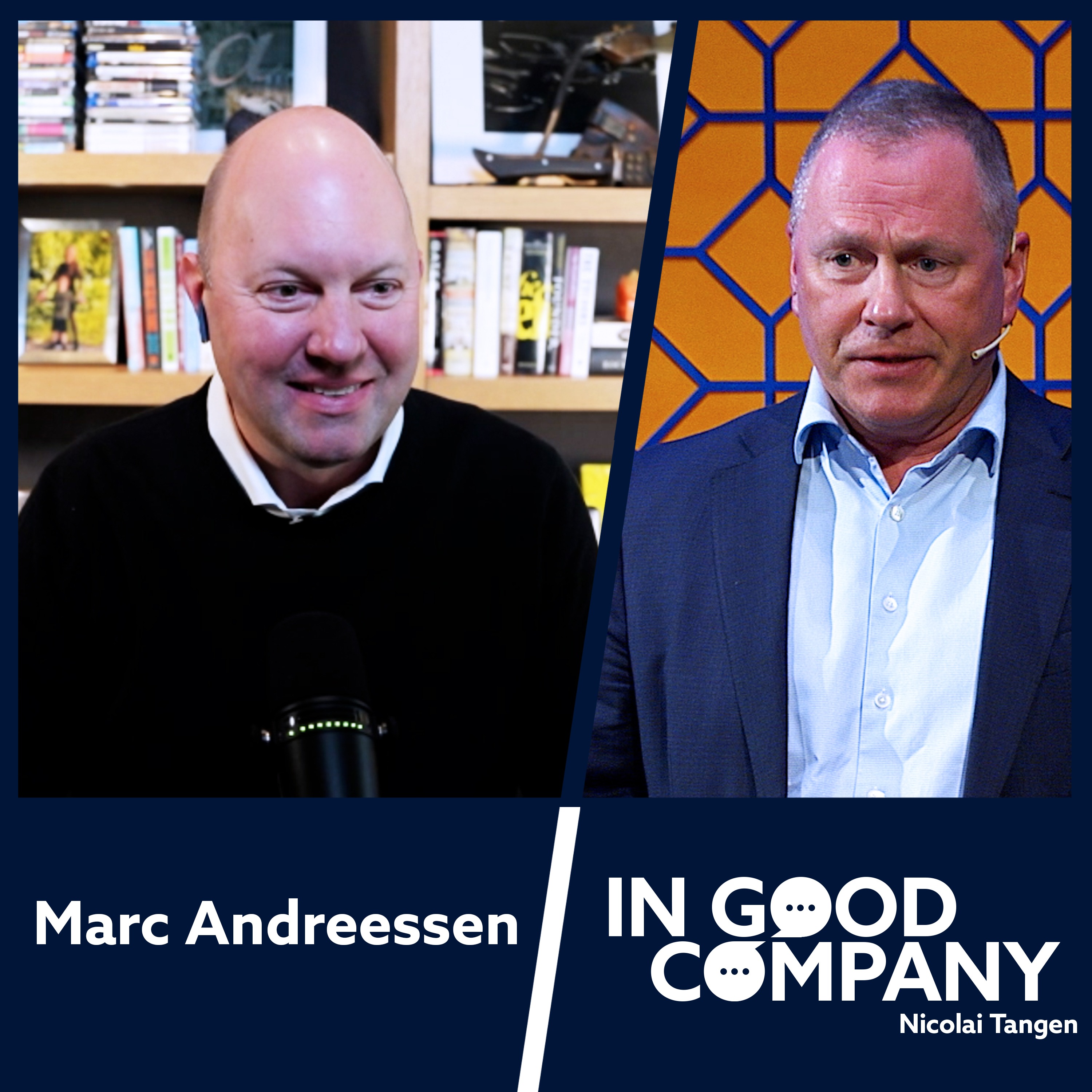
Host: Nicolai Tangen, CEO of Norges Bank Investment Management
Insights from Marc Andreessen on AI, technological disruption, and the competitive landscape between the US and Europe.
Written by AI. May contain mistakes.

Get the gist, explore an idea or ask about something said.
 Claude
On In Good Company with Nicolai Tangen, what are the key points of this episode?
Searching your listeningAutomatic transcript. May contain errors.
0:00Hi, everybody, and welcome to this podcast with Marc Andresen. Marc Andreessen, probably the best venture capitalist the world has ever seen. Now, this conversation took place at the investment seminar that we had in Oslo. And for the rest of the conference, you can find all that on our website. But the conversation with Mark was super interesting. We talked about how to make money, who is going to win the AI race, what's happening between the US and China, and so on. Now, normally, these podcasts, you can run at one and a half times speed. Not with Mark Andreessen. He is already going max speed.
0:34Tune in.
0:43Our next guest is a real legend, Mark Andreessen, probably the best venture capitalist the world has ever seen.
0:57Hi, Mark. Good to see you again. Hello, good morning. How's everybody? We are really well, thank you. Now, Mark, where are we going to make money going forward? Well, so in our business, the theory is relatively straightforward, which is we make money on technological disruption. And so we make money when these new startups form and, you know, either try to go take down a big incumbent or try to create some kind of new market. And so that's what we do. I think for the world at large, the challenge is just that there's a fundamental supply-demand imbalance between the amount of capital that's seeking productive economic investment opportunities and then the number of those opportunities.
1:42And so I think there's a very large macro problem on making money in the economy. And tech and venture capital can only be a small part of that answer, but hopefully we will be a part of that answer. Yeah. Well, you are sitting in the middle of Silicon Valley and you kind of invented the Internet. So kicking off the AI question, just how will the AI race pan out here? Yeah, so the theory and the hope, certainly that we're betting against and investing hard against, is that AI, and specifically these new breakthroughs around AI, like generative AI, represent a new platform. And in the tech industry, that's a sort of very powerful concept, because the idea of a new platform in the tech industry is sort of a new foundational technology that you can then imagine reinventing thousands and thousands of application categories on top of.
2:30And the tech industry historically has been fueled by these platforms. You know, the original one was the mainframe computer that then led to mini computers, client-server computers, personal computers, mobile computers. And every time there's a platform shift, there's an opportunity to reinvent the industry and reinvent basically the entire ecosystem and all the different ways that people use technology and create an entirely new generation of companies. And so we certainly believe that AI is a new platform shift. We believe that AI is one of the really big platform shifts. We think this, you know, the possibility exists that this is on par with the microprocessor.
3:04And so, you know, we think there's an opportunity to take a very broad perspective here and invest in many different, both core technologies and also use cases of AI. Where is the kind of fight going on just now? What is it about chips and money or people or electricity? Just what exactly is it? Yeah, so the most dramatic thing about this sort of AI shift is that it's what I call an 80-year overnight success. And so the original paper on neural networks, which are the foundational technology of AI, was actually written in 1943. And then you had over the course of the last 80 years, you had entire generations of researchers who basically tried to make AI work and for the most part weren't able to do it.
3:44In fact, when I was in school 35 years ago, AI was a discredited field because there had been an AI boom in the 80s that didn't pan out. And so it's a technology sector that's sort of been in search of working products for a long time. Essentially, what happened was the breakthrough moment was in 2022, and it was the chat GPT moment. And so it was actually 79 years into the technology. But it was a breakthrough moment, and then it was a breakthrough moment of it went basically from not working to working incredibly well in one step. And, you know, the technology is not perfect yet. There's still a lot of work to be done.
4:16But fundamentally, you know, these products are just incredible already in what they can do. And they're far better out of the gate than, you know, the microprocessor was or the Internet was. And so it's this kind of rare situation where you have this dramatic leap in functionality happening extremely quickly. As a result of that, basically every part of the tech ecosystem is trying to react and trying to figure out how to incorporate AI or trying to build on AI or trying to basically compensate, figure out how to compensate for weaknesses in AI. Every single sector of the tech industry is reacting right now.
4:47There is a massive chip shortage. This is the biggest supply-demand imbalance in chips that we've ever seen as an industry. And so there's a massive fight happening there. There's a massive wave of data center innovation development. There's actually power. A lot of people are now trying to figure out how to power and cool these giant data centers. There's actually a resurgence of interest in nuclear power around these data centers. And then there are basically fights happening up and down the software stack. The fight that gets probably the most publicity at the moment is the fight between the software companies building the so-called foundation models.
5:19And so there's sort of a big fight between a view of the world in which there will be a few big models. that basically win everything, and then an alternate view of the world in which this is more like the microprocessor, and there will actually be many thousands of different models running on billions of devices of many different shapes, sizes, descriptions, customized in various ways. And actually, that latter thesis is the thesis we're investing against very aggressively. You said last year that we should just stuff AI into everything we do, like weapons, cars, everything, in order to beat the Chinese.
5:52What do you, could you tell us about it? Yeah, there's sort of two policy debates happening around AI. You know, somewhat for sure in the EU, but for sure in the US. And there's sort of one policy debate, which is, you know, AI is sort of weird and scary, and we should regulate it, and we should kind of prevent it from happening in different ways. And, you know, the EU has put in place these kind of very onerous regulations the UK has followed. And then there's a big fight happening in US politics around this. and so this is sort of an inward looking kind of domestic policy viewpoint and people have all these fears around AI there's a completely different conversation which is the geopolitical conversation and that's the conversation of basically geopolitical competition with China and of course the minute you get into that conversation it becomes very clear that we need to win and specifically the reason we need to win is we need to win the AI race with China sort of a very analogous way that we won the sort of technology race with the Soviet Union in the previous century, which is we have two basically dominant mindsets, regimes of Western democracy and Chinese communism that both have aspirations to transform the world.
6:59Both of those are supported by major nation states. Both of those are supported by major militaries. Both of those are supported by major economies. And both of those are supported by major tech industries. And if you look at the precedent of the Cold War with the Soviet Union, the reason the West won was because of sort of a triangle of technological superiority, economic superiority, and then national security, military intelligence superiority. But, you know, we decided we wanted to win and we won. Right. And by the way, our victory ended up actually being great for the people of Russia. Right.
7:29It was actually really great for the Soviet Union to fall. And, you know, people in people in Russia are much better off today. And so, you know, I think this is very straightforward. Like we need to win. We need to win by being better technologically, better economically, and better militarily. AI has been identified as the core technology for the future of the nation state by both U.S. military planners, by the Pentagon, as well as by the Chinese planners. And so it will be one of the main areas in which these kind of two hemispheres compete. And I think it's important that we win. Where do you think the West is now relative to China?
8:01So the West has, I would say, all of the advantages and disadvantages of a decentralized system and a market economy and a sort of a system in which governments don't control everything. And, you know, the huge advantage of that is innovation and entrepreneurship. The disadvantage of that is, you know, it's very difficult for our systems to plan. You know, there is no top-down American technology strategy. There is no top-down European technology strategy. Those concepts are kind of, you know, antithetical to our systems. And so we're very robust and dynamic in general, but, you know, we're very messy.
8:31The Chinese have both the advantages and the disadvantages of a centralized system, much like the Soviet Union did. They have a command and control system where the Communist Party owns and controls everything, and they can direct their private companies to do whatever they want, which they're doing right now with sort of increasing force. And then they have all the disadvantages of a centralized system, which is they have a command system. They're actually in the process of trying to crush their entrepreneurial system right now. They're trying to basically drive their entrepreneurs out of, in many cases, out of business, in many cases, out of the country.
9:02And so it's like the Cold War with the Soviet Union. it's an asymmetric situation. Each side brings strengths and weaknesses. And then I would say, you know, each side is tempted to embrace the model of the other side to try to get the advantages. So the Chinese have kind of this fake entrepreneurial system, you know, that they kind of try to foster. And then we have this sort of, you know, sort of not very effective, you know, central planning function, you know, in D.C. and in Brussels, you know, that doesn't work very well. And at least I would argue we should lean into the strengths of our system and, you know, and try to benefit from the fact that we should have a much more dynamic economy.
9:33I mean, we should have much more entrepreneurship. And hopefully that says what we'll do. Talking of dynamism, when we met, you also talked about the importance of investing in American dynamism. And I guess that also goes for European dynamism. What do you mean by that? Yeah, so, you know, look, this is sort of part of, you know, this is part of the challenge for the geopolitical conflict as well as our domestic issues. And so, you know, look, both the U.S. and EU, I mean, we're, you know, we are the result of the Industrial Revolution, right? We are a result of the first Industrial Revolution of things like steam power.
10:03We're the result of the second industrial revolution, you know, with things like electricity. We're the result of the of the computer age. You know, the West represented by the U.S. and Europe is where, you know, most of these technologies over the last 300 years were developed. And historically, our society has benefited enormously by this. You know, we have the highest standards of living. You know, our you know, our children over time have, you know, have done the best. And generally it's been a very synergistic, positive process. You know, in the last 50 years, I think both American society and EU society has sort of lost faith in the idea of technological progress and lost faith, frankly, in the idea of economic progress and, you know, decided to become, let's say, I don't know, much more, you know, cautious, much more risk averse, much more, you know, sort of unwilling to think of change as a positive and exciting thing.
10:50And, you know, you actually see that, I would say, in America right now, you know, the relationship between industry and the government is at a 50-year low. So it's actually quite a large amount of hostility between government and industry. And the same is certainly true in Europe. And so, again, our view is like, look, we need technology. We need technology. We need innovation. We need markets. We need these things to function. Why? Because we need growth. We want our societies to be growth societies. We want people to think that there's opportunity. We want people to be able to think in positive some terms.
11:23You know, we don't want people to think in terms of like for me to get something, I have to take it away from somebody else. We want to think about our society as societies that can grow and flourish where our children will do better than we do. And so American Dynamism is sort of a very direct investment program that we have focused on injecting a lot more technological energy into a lot of the sectors of the economy that the government's very involved in. And certainly defense and intelligence are a big part of that, but also energy and law and education and health care are also big parts. And all of these sectors, frankly, I think they're really suffering from a lack of technological change and innovation, and they could really use it.
11:58What would be the key to get Europe to become more dynamic? I mean, not that we are not dynamic in Europe, but compared to Silicon Valley, we seem to be lagging a bit behind here. Yeah, so look, if you did a rank order of the top 50 technology companies 30 years ago, a large percentage of them were European. I think it was about 40%. If you did a rank order today, I think it's one out of 50. And so, you know, Europe has really fallen off. And I guess the way I would describe it is it seems, at least from the outside, it seems to be almost entirely choice, which is it seems like it's been a choice to sort of prioritize regulation and risk aversion and the precautionary principle over, you know, over innovation.
12:34You know, the most acute version of that, obviously, is the energy sector, you know, with the sort of sort of voluntary stand down of energy development, which, you know, I think has led to, you know, real geopolitical stresses with respect to Russia. And so, you know, I look, I think I think it's been a choice. I think the political leadership class in Europe has decided that they want this. The voters so far have supported them in wanting it. It has consequences. I think the consequences are becoming clearer. I think fundamentally it's a choice at a societal level. The voters will either step up or they won't, and the leaders will either step up or they won't.
13:07But I think the results of the current approach are in, and I don't think they're very good. Any reflections on your responsibility as a venture capitalist or venture capital investor at a time where technology is becoming so integrated into the race between the superpowers? You know, Elon Musk with Starlink suddenly being key in Ukraine and so on. How do you think about it? Yeah, so I would describe it as we're 100 percent on the side of the United States and we're 100 percent on the side of the West. And so we never as a firm, for example, had an investment program in China. We always viewed that there would be difficulties from that, which for a long time looked like a mistake, but I think is now increasingly clear.
13:47So we're 100 % on the side of the U.S. and the West. As a firm, we don't have our own foreign policy. We have basically the foreign policy of the U.S. State Department. And so we're sort of in complete lockstep with our government. All of our programs that involve anything involving national security will be based on the U.S. government's view of friends and allies. you know i would say this you know this was a controversial position basically up until russia's invasion of ukraine um and so up until russia's invasion of ukraine basically there was a prevailing ethos in silicon valley that national security is somehow bad or undesirable or the tech companies should not want to you know be involved in it and there was this famous incident where google had this program with the u.s department of defense that their you know their employees basically rioted on campus and forced them to cancel um at the same time that google actually had an AI lab in Beijing that by definition is anything in China sort of connected to their security state.
14:37And so there was a fair amount of, I would think, internal dissension division in Silicon Valley in terms of what the right role is between the Valley and the US government. Basically, what we've observed is the minute Russia invaded Ukraine, it was obviously a catastrophe for Ukraine and a terrible thing. And I wish it hadn't happened, but it caused sort of an instant sort of re, I don't know, like a depolarization of this issue, certainly in the the US and in the Valley where all of a sudden people who historically had been very averse to tech involvement in defense all of a sudden became very in favor of it.
15:08And, you know, the most vivid example, there was this company, Anderil, that was a very politically controversial company, you know, our new defense contractor, you know, building all these automated defense systems. It was a very controversial company in the Valley, basically right up to the day, Russia invaded Ukraine. And ever since, everybody loves it, you know, which the founder of that company points out, you know, there's some, you know, some irony to that, because the company is doing the same things. But, you know, I think the Russian invasion of Ukraine really highlighted for a lot of people, including a lot of people on the political left in the U.S., that actually national security really matters.
15:38And there are actually bad people in the world and there are, you know, going to be invasions and there are going to be bad things that happen. And the Western democracies need to be able to respond and need to be able to be state of the art, being able to cope with these situations. And then, of course, the, you know, the attack in Israel, you know, is a sort of a second, again, another terrible thing, but a second kind of factor that has caused people to say, okay, we need to make sure that Western democracies are actually armed up. Yeah, yeah. Mark, finishing off on a completely different tack here.
16:04In one minute, how can we become better investors? Because that's the theme of the conference. Yeah, so I think the question always, I think the question for sort of large institutional investing, the question is, you know, deployment of large amounts of capital. There just are not that many places in the world to get growth. And so, you know, the fundamental challenge every large-scale investor I talk to deals with is, you know, most of the capital that they invest, you know, just kind of by definition, can't go into high growth sectors, just because there aren't that many high growth sectors, they're actually, you know, quite, quite hard to find.
16:35And so there are basically a small number of places in the world that have growth, there are a small number of people who are starting the kinds of companies and trying to build the kinds of industries that are going to be able to deliver growth. And so, you know, you know, and generally speaking, you know, Western investors are quite supportive of this. And so, you know, venture capital is quite well funded. But, But, you know, I think focusing in on that specifically the places and the people who are going to be able to generate growth. And then, quite frankly, the other thing is, you know, it's very helpful when these investors also weigh in more broadly than just with money and also weigh in with their influence and, you know, with their level of authority and their level of, you know, persuasive capability and so forth in their societies.
17:10You know, the growth is something that we should be aspiring for and that is actually good, not just from an investment standpoint, but from a societal standpoint. Fantastic. Well, big thanks for sharing your thoughts with us. and all the best and luck going forward. Great, thank you very much. It's great to be with you guys.
Marc Andreessen, a pioneering Silicon Valley entrepreneur and co-founder of the influential venture capital firm Andreessen Horowitz, talks to Nicolai Tangen at our annual investment conference. In this engaging conversation, he shares insights on how to make money in today's economy, the global AI race, the competitiveness between Europe and the US, and much more.
The production team for this episode includes PLAN-B's Pål Huuse and Niklas Figenschau Johansen. Background research was conducted by Kristian Haga.
Check out the full recording of our Investment Conference How to become a better investor | Investment Conference 2024 | Norges Bank Investment Management (youtube.com)
Hosted on Acast. See acast.com/privacy for more information.


