
 Ask ChatGPT


 In Good Company with Nicolai Tangen
14 Oct 2026 · 44m · 22 chapters
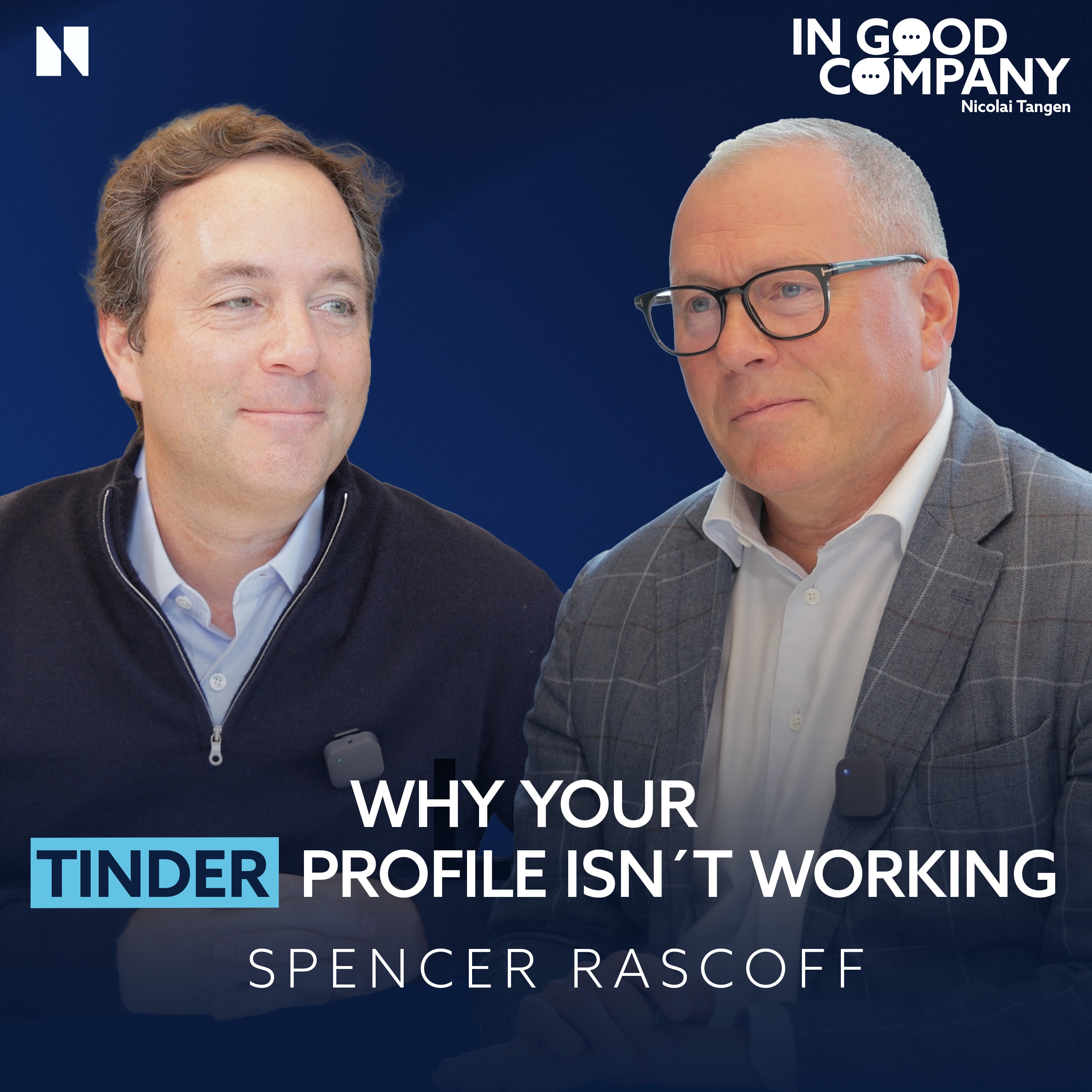
Spencer Roscoff, Match Group CEO (Tinder, Hinge, and other apps), explains how dating apps use recommendation algorithms and richer profiles to improve matches and chats, why online dating may reduce divorce, how Gen Z dating has shifted toward social group hangouts, and his view of loneliness as a major societal health crisis. He also discusses Match Group’s 2025 turnaround and how AI is used for safety and profile improvement.
Spencer Roscoff (CEO of Match Group; previously built Zillow, later became CEO in Feb 2025 after a Wall Street-focused period; runs a team of ~2,000 employees across brands). Nicolai Tangen (host; CEO of Norwegian Sovereign Wealth Fund; chairing Match Group; owns ~1% of Match).
“There’s no such thing as a loser”; online dating exposes people to broader diversity; online daters have lower divorce rates; loneliness is “worse than smoking” and driven by social media, remote work, weaker institutions, and cost pressures; Match aims to get users off apps (“designed to be deleted”).
“Q unification” improves recommendations; profiles with 7+ photos and prompt answers outperform “one gym selfie”; AI prompt feedback suggests more clothing diversity; Tinder events in 25 cities (dry singles mixers, classes) with in-app messaging afterward; Norway DoubleDate adoption: ~3.5M matches since March 2025, ~53% of Norwegian Gen Z women using it; AI message screening to reduce sexually suggestive wording; employee engagement at Tinder improved from ~25% disengaged to near-doubled engagement within a year.
Written by AI. May contain mistakes.
Spencer explains the recommendation algorithm used to match users based on behaviors and preferences.
“So this is one of the biggest shifts in human behavior that we have ever seen.”
Discussion on what makes an appealing dating profile and factors that attract users.
“So right now, our recommendations are not real-time, which is a big problem.”
Insights into the demographics of dating app users and patterns of interaction based on age and gender.
“Do you have to have a dog in there as well?”
Spencer discusses how dating behaviors have shifted post-COVID, emphasizing social dynamics among Gen Z.
“But we don't tend to look at socioeconomic impact.”
An exploration of the loneliness crisis and its implications for society, exacerbated by technology and social media.
“I mean, the average men look at women, you know, sub-25, and women look at men at 40.”
Learn how social media and changing societal norms contribute to loneliness.
“What do you think causes the loneliness?”
Discover how changes in alcohol consumption are altering dating behaviors.
“I think we create a very liquid solution to this problem where people at scale can safely meet new people.”
Learn about Tinder's new events designed to encourage social interactions.
“What does the change in alcohol consumption, what does that do to dating, you think?”
Explore how dating practices differ across cultures, particularly in Asia and Scandinavia.
“Asia, especially Japan, involves parents in the dating process much more than the rest of the world.”
Understand the unique social dynamics and dating patterns in the gay community.
“So of our users in Norway, more than half of the women between 18 and 28 are using DoubleDate.”
Discover how AI is reshaping dating app experiences for users.
“but many of them tend to seek shorter term relationships.”
Speculate on the future of dating apps and market dynamics.
“You might not want to – that might be perceived as sexually suggestive.”
Learn how leadership can address company challenges by focusing on people and innovation.
“You took over in February 2025 and the business was in a bit of a trouble then.”
Discover the importance of employee engagement and strategies to improve it.
“I figured it out a little quicker than that.”
Understand the process of product development through consumer research and insights.
“We brought a lot of Gen Z users into the building.”
Explore how to create a culture of innovation and the challenges involved.
“So great people properly organized and motivated, build great products.”
Learn what qualities to look for in hires, especially in the tech industry.
“I mean, the employment laws are a little harder to exit people in certain countries in Europe, for example, and that can slow down.”
Analyze historical business practices and how they compare to modern leadership.
“I play pickleball every weekend, either with friends or family.”
Hear about personal experiences of failure and the importance of relationships.
“I try to bring that attention to detail to our products.”
Gain insights on work ethic and tips for succeeding in the professional world.
“people like a full view of other people.”
Learn essential career advice for young people entering the job market.
“And when I'm at concert today, I see little three-year-old toddlers with those big headphones because parents are very intelligently putting headphones.”
Discover the value of effort and dedication in early career stages.
“but especially early career, you need to prioritize work.”

Get the gist, explore an idea or ask about something said.
 Claude
On In Good Company with Nicolai Tangen, what are the key points of this episode?
Searching your listeningAutomatic transcript. May contain errors.
0:00You don't want to date a loser, right? Well, we believe there's someone for everyone, so I don't pass judgment. There's no such thing as a loser. That's kind of your business model, isn't it? There's no such thing as a loser. They're just somebody that hasn't met their right person yet. That sounds really good.
0:24Hi, everyone. I'm Nicolai Tangen, the CEO of the Norwegian Soren Wealth Fund. And today I'm joined by somebody really special, Spencer Roscoff, the CEO of Match Group. That's the company behind Tinder, Hinge, and around a dozen other dating apps. Now, think about it for a second here. 40 % of couples today meet online, not through friends, not at work. So this is one of the biggest shifts in human behavior that we have ever seen. And Spencer, he sits in the middle of it. A bit of an outsider, he built the property giant Zillow before taking over Match a year and a half ago. And we, in the Norwegian Southern Wealth Fund, own 1 % of Match, so we are chairing you on, Spencer.
1:02Thank you. I am glad that you are. I appreciate it, and thank you for having me. Now, how are Matches actually made? We have a recommendation algorithm, the Rex Algo, which tries to figure out who to show to whom. The way I like to think about it is there are decks of cards kind of on the table. Imagine 10 decks of cards on this table with 52 cards each. The order of each deck has already been determined by us based on certain rules associated with each user type. Like there might be a deck that is optimized to show people in a particular order to keep them as a payer, essentially, to retain their monetization.
1:42There might be another deck for first-time user to drive engagement based on first-time users. There might be all these different goals. What we've recently done was we've done what we call Q unification, where we've combined all of these decks into one and then resorted the cards. And that's radically improved the quality of recommendations as measured by matches and chats and sparts. So what exactly has happened there? We've basically customized and personalized the order of a much larger stack based on what we know about you as compared with other people who have exhibited similar behavior to you in the past.
2:18And is that based on who I like? Yes, exactly. So if somebody likes people with red hair, they see a lot of red hair? They will, but one of the big limitations is they'll only see people with more red hair a couple hours later. So right now, our recommendations are not real-time, which is a big problem. When will it be real-time? By the end of the year, which is the way other recommendation algorithms work. If you're on Spotify and you like a certain type of music or Instagram or TikTok, you can see the algorithm changing as you give it more signal real time. That will come later this year. We think that has a lot of potential.
2:51In addition to looks and so on, what are the other things you sort according to? They're profile information. So we've made a lot of effort over the last year and a half to make profiles more rich. So additional content. And now you can leave what's called a contextual like. So old Tinder, you would just swipe right, which basically says, I'm interested in this person. New Tinder, the profile has lots of different information, like what do they do for work and what's their relationship with their friends like and what they like to do on weekends. And when you respond, you're now indicating that you're interested in that particular item that you're saying, yes, I like that they like to go for hikes.
3:27And so now you've not only told that recipient that you like, that they like to go on hikes, but you told us that you like people that like to go on hikes. How much data do you have?
3:43Near infinite. I mean, we have billions of matches every couple of years. How many people do you have drilling down in this? How many scientists? We have this recommendations algorithm team that just eats and sleeps this topic is probably 40 people, including some very senior people from TikTok and other companies that have really pioneered the recommendation algorithm space. What's the most surprising finding you have seen? My most surprising finding was how much potential there still is 15 years later. I mean, when I joined this company a year and a half ago, I assumed we already had the world's best recommendation algorithm.
4:19And we've improved it so much in the last 18 months. And I think there's so much more potential. That was surprising to me. What's a perfect guy? A perfect guy? Like who performs the best on Tinder? Somebody with a complete profile that has demonstrated the time, put in the time and effort. It's the opposite of what we have far too much of, which is the one photo gym selfie with his shirt off. Guys think that's appealing to women. It's not. What's appealing to women is seven or more photos, rich profiles, content words, not just photos, answering the prompts, basically demonstrating effort. That's what women are looking for.
5:03Do you have to have a dog in there as well? Dogs help. Yes, everyone loves dogs. Okay. Cats. My profile. Cats don't help as much. So my profile, I'm married, but I'm on Tinder. I'm on all of our apps. And my profile says I'm married. I'm the CEO. I'm here for research. But my profile has pictures of me with my dog. I also have a picture of me with my wife on my profile. Are you like a popular? Are you popular on Tinder? I do okay. I do okay. But of course, this is just for research. And I don't, you know, I never. What's the perfect woman? Likewise, just showing lots of content. So it's showing that they also have friends and that they do interesting things.
5:38So we actually have a feature that we're testing right now, which basically uses AI to score your profile and make recommendations. So, for example, for my profile, when we ran it through that system, it said I need more diversity in my clothing because I basically wear the same. The same blue sweater. The same blue quarter zip with the same blue shirt underneath basically every day. And most of my photos were like that. And so you want to show more sides of yourself. You want to show you with your friends, you with a glass of wine, you at a concert, you at the beach, because you're showing diversity of your experiences.
6:12If you were to pick out a few of those things, what is it that really matters? Is it like beach, friends, clothing, wine? It kind of depends on whom you're appealing to. I think for a typical Gen Z user, it's probably you with friends or you doing fun activities. You don't want to date a loser, right? Well, we believe there's someone for everyone, so I don't pass judgment. There's no such thing as a loser. There's no such thing as a loser. They're just somebody that hasn't met their right person yet. That sounds really good.
6:49Historically, men dated horizontally and down and women dated horizontally and up socioeconomically. Is that still the case? You know, we don't know much about the socioeconomic nature of our users. We, you know, on Tinder and Hinge, our two biggest apps, we don't ask for that information. On pairs, the number one app in Japan, we do. We actually ask for salary. We include blood type. I mean, Japan is a very different culture. But we don't tend to look at socioeconomic impact. What's your gut feel? My gut feel is that that's probably still right. That's probably a lifelong societal bias that probably online dating hasn't changed much.
7:36Although, I mean, we are proud of one thing that online dating has changed, which is it's expose people to a much larger array of people than they otherwise would have noticed. So if you were mostly meeting people through your social network in real life or through friends, you're going to end up with people of a more similar socioeconomic or even racial makeup. But online dating exposes you to a much broader array. So perhaps, actually, this would be an interesting thing to study. I haven't studied this or I haven't seen research on this, but I would guess, I would speculate that we have contributed to greater diversity of socioeconomic relationships.
8:11What percentage is men? We don't share that. It's higher than women, right? It is higher than, well, for Tinder, it's higher for women and for Hinge. But some of our apps have more women than men. You know, The League and pairs tend to skew more female. The League is our app for highly ambitious people. My guess is you'd be on The League if you were on a dating app. and that tends to skew more female. But because Tinder has so much liquidity, I mean, it's the number one dating app in 166 countries, even though there's a greater percentage of users that are men than women, we still have many tens of millions of women.
8:52And so in any given city, there's a wide selection of potential. So what's the average age of men that women look at? Well, about 60 % of our users on Tinder are Gen Z, are 18 to 28, and about 60 % of our users on Hinge are also Gen Z. So our typical user is kind of 25-ish. It would probably be our median user, 18 to 28 Gen Z. But I just saw some numbers that men look at women. I mean, the average men look at women, you know, sub-25, and women look at men at 40. I haven't looked at that. That would be, that's also, you know, you should work in our... You need to look at your numbers here because this is good fun, right?
9:33Yeah, this is good fun. No, you should join our analytics PR function. I'd love to. Because there's lots of fun data PR stories to mine from this content. Is facial hair on the way up or down? You're asking me all these questions I haven't prepared for or been asked by anyone. Mustaches are all the rage. You know, mustaches are the cool Gen Z thing globally now. I'm not a, you know, it's not for me, as you can tell, as I sit here clean shaven. But facial hair and mustaches in particular are definitely on the way up. Yeah. Can you look at like fashion trends, where they're going? Like, you know, you have the online retailers.
10:17You can basically see what colors are trending, which direction in various cities in the world, right? You can see this is trending in Munich. This is trending in Frankfurt. it's really fascinating. Have you done anything like that? No, we haven't, but I've written it down in my notepad and we now will. You're right, we absolutely can mine that type of data. Is it like a winner takes it all? For a single user in a single market or online dating? No, I mean in the dating. Is it like some women and some men get all the hits, all the likes? I see. No, and this is a bit of a surprise to me as well.
10:55I think there's a societal perception that that would be the case. But no, there really is a person for everyone out there. We see people of all types, of all body types, of all appearances, of all profiles, finding matches. So people, and here the recommendation algorithm is quite good to put the right people in front of the right people. People are finding one another. I am inundated with emails and wedding invitations and comments on social media of people who have found their spouses, their partners, their relationships on Tinder, Hinge or one of our apps. I mean, we are flooded with them.
11:33Are divorce rates higher or lower? We think they're lower. That's what the research says. The people that meet online have a lower divorce rate than people that meet in person. Why do you think that is? I think that people that date online have sort of played the field and vetted lots of potential partners. So once they settle down, they've had more experience and understand more about themselves. This is another thing I didn't really appreciate until I entered the category. But online dating is as much about learning about your potential mates as it is about learning about yourself. and I think once you've gone through that online dating journey, you're more ready to stay in a marriage because you've experimented and explored and learned more about yourself and your preferences.
12:21Spencer, moving on to how we date, how has the dating scene changed? What's different? It's changed a lot. It's so much more social and, you know, young people bring friends into dating. In fact, they don't even use the word dating. A date is a very high pressure
12:41experience. Gen Z users tell us that when they think of a one-on-one date, they think of it like a job interview in a very scary, stressful way. Part of this is their response to COVID and the pandemic where young people lost a couple of years of kind of societal adaptation where they were learning how to form relationships, how to make small talk, how to, you know, many of them don't drink as much alcohol, partly because they missed a couple years of development in late high school, early college. So as a result, dating today is more about friends first. It's you and three friends and, you know, her and five friends all kind of hanging out and you're all getting to know each other over a couple weeks or months.
13:21And then people start to sort of couple off. So it's much more of a social experience than a one-on-one experience. When you see the numbers about loneliness, what do you think? I think it's tragic. It's an existential risk to society, to our species. It's what drew me to this job, to be quite frank, that there is a serious loneliness epidemic, which is a global health crisis. And it's worse than smoking. It's worse than smoking. It's more lethal than actually smoking. It is the key to longevity. If you want to live a long, happy life, you need to find a partner and find a social network of close friends.
13:59That is actually what contributes more than health or exercise or eating well. It's actually a close relationship. What do you think causes the loneliness? It's been exacerbated by social media. Undoubtedly, we're all obsessed and absorbed in our phones, and that's caused us to live more isolating experiences. People are spending less time physically with other people. Working remote has made that worse. People are less connected to social institutions like their churches, their political parties, their unions. The things that, you know, the ways and places that people used to physically congregate to meet people in person, we have a looser connection to those, especially in the United States, but really globally.
14:40And then the cost of living has gone up so much, cost of housing, education, and other things, that people are having fewer children. and that also is loosening social bonds. I saw one survey which said that 45 % of men between 18 and 25 have never approached a woman in person. Yes. That's shocking, right? It is shocking. And it is partly because they're afraid, they're nervous of it. It's also because they don't want to be perceived as overly aggressive. So the Me Too movement and other social trends over the last 10 years have made it feel awkward and almost like aggressive. If a man went up to a woman in a bar and said, hi, can I buy you a drink, which would have been a very normal activity even 10 years ago, that can be perceived as an overly aggressive move.
15:35Perceived by the woman and then perceived back to the man in that way. So do you think it's getting better or worse or just? Well, it's I don't think that trend is going to change. I think that at least for the next couple of years. Now, Gen Alpha, we've done a lot of research on Gen Alpha, which is 12 to 18. Gen Alpha 12 to 18 is quite different than Gen Z 18 to 28. Gen Alpha is more of a reversion to the mean. Gen Alpha, they date, they hook up, they have boyfriends and girlfriends in high school, kind of in a more traditional way. They're still very social, but they don't have the scar tissue from the pandemic.
16:15So you think COVID caused a lot of this? Yes, I do think it did. I think there was a trend in motion already, and then COVID accelerated it. I care deeply about this problem. And it's one of the reasons that I decided to basically come out of retirement to take the CEO role, because I think this is an important problem, that Match Group is one of the very few companies that's actually addressing. I think the social media companies and the AI companies all are inadvertently contributing to this problem. And I think the online dating companies help address it. But are you also contributing to the problem given that you have to be perfect?
16:50No, I don't think we are. I think we create a very liquid solution to this problem where people at scale can safely meet new people. and we work very, very hard to get them off the app and in person. So Hinge's whole tagline is the app that's designed to be deleted. We take it very, very seriously at Hinge in particular. We want people to use Hinge to meet the one and then delete Hinge. But I mean, if you mesh them too quickly, you're not going to make much money. That's okay. That is totally fine. Are you sure about that? I am positive. And as a shareholder, you should support that because the positive word of mouth far exceeds it.
17:28So I'll use my brother and sister as examples. They're in their early 30s. They both just moved in with their partners that they met on Hinge. And yes, we lost their$20 a month that they were paying when they both stopped subscribing to Hinge. But the word of mouth that they have spread of having told hundreds of their friends that they met their person on Hinge has undoubtedly created much more revenue for Hinge than the revenue that we lost from them. What does the change in alcohol consumption, what does that do to dating, you think? It makes it harder. I mean, alcohol is not very good for you health-wise, but it does lower your inhibitions and make it easier to socialize.
18:06And so it's changed the types of dates that people go on. People go on dry dates now. They go for a walk in the park. They go for a class, an event. Tinder has pushed very heavily into events. We now have events in the app in 25 cities. We'll be global, probably 75 or more cities by the end of the year. What kind of events are these? These are fun singles, mixers, pickleball events, learn how to play mahjong with singles, go for a meetup in the park. They tend to be dry events. Sometimes there's music. Many of them have some sort of educational component. So learn the way we say learn something, do something, move something.
18:53Those are generally the themes. They usually don't have alcohol. and we have this digital layer on top of the event. So inside of the Tinder app, you can see all these fun things to do. I was just sharing with your team, we were looking at Tinder here in New York at the events of fun things to do. And you can see photos and mini profiles of the people going to the events. So you can actually see, oh, are these people I want to meet? And then afterwards, you can come back to the Tinder app and message with the people that you matched with and say that you like them and talk with them. And if you didn't get their number because you were too nervous or you thought it was too forward to ask for their number at the event, then Tinder is there for you afterwards, which is a really important use case as well.
19:36Is it a big difference between geographies? With respect to events, no. No, but in terms of all these patterns, like cities versus countryside, Japan versus America. Yes, so Asia is very different. Asia, especially Japan, involves parents in the dating process much more than the rest of the world. Oh, my. Asia has a much more intentional culture. So you bring your parents along to the... You sort of use... Your parents use the app with you almost. Always. Yes. No, you don't really bring your parents along on the date, although I'm sure some people do. But they're kind of riding shotgun with you.
20:17And certainly in India as well, you know, Indian parents play a large role. In Scandinavia, we have seen huge adoption of our social products, especially on Tinder. So our response to all of these themes that you've raised has been to bring your friends into the experience, to make it a more social, fun, low-pressure, lightweight experience so it doesn't feel like a job interview. And double date is the most important feature there. So on Tinder, you now kind of team up. You can have up to three double date partners. And then the two of you, let's say you and I were a double date pair, we'd be swiping through pairs of women.
20:54And if I swipe right on this pair of women and they swipe right on us, then we're in a four-way chat. And three and a half million double date matches have happened in Norway just since March of 2025. Oh, wow. It's 53 % of our female Gen Z users in Norway. So of our users in Norway, more than half of the women between 18 and 28 are using DoubleDate. And it's about 48 or 50 percent of all Gen Z users on Tinder in Norway use DoubleDate. Why do you think it is? Because it's a social culture where people naturally bring friends into their search behavior, whether it's for clothing or concerts or travel or relationships.
21:38High smartphone usage, openness to try new things. This is why Norway was literally our first market or one of our first markets when we launched Double Date. We selected Norway intentionally, and it's been wildly successful. That 50-ish percent number compares with about 25 % in the United States of our Gen Z users use Double Date. Just a bit more, why do you think this goes down well in Norway? Well, you certainly know the culture better than I do, but the way it's been described to me by our social scientists who study this type of thing is that the culture is incredibly social and young and people bring their friends into things.
22:14That it's a social culture with kind of a bring your friend attitude and mindset. Are these patterns very different in the gay community? Yes. The gay community tends to be, I'm stereotyping of course, but many of them tend to seek shorter term relationships. many of them have long-term relationships that with friends that also move into intimacy and friendship kind of move back and forth so in the straight community it'd be pretty rare to be close friends with your ex-girlfriend for example or someone that you had had intimate relationships with it tends to be like a clean break and in the gay community it's it's not you tend to sort of float in and out of friend, intimate, friend, intimate.
23:05And there are different sort of privacy and safety concerns in the gay community. Within the gay male community, they're not as concerned about physical safety when meeting one another, but they are concerned about their own physical and emotional safety in terms of having their own safe space that they don't have to worry about people that are not accepting of the LGBT community infringing on. So Sniffies is our gay product. It's one of the top gay dating platforms, and it's got incredible brand love from its community. And it feels like a safe space kind of separate from the straight community where gay users can go and feel protected and feel like they have their own community, which is something that they deserve and seek.
23:58How do you think AI will change this going forward? Well, for our company, and I know you interview a lot of executives, it's hard for me to, you know, I can't state enough how much it's changed the way the company operates just in the past year, the way literally every single person, including me, does their job has changed significantly or very significantly over the last 12 months. Software engineers work differently, marketers, comms professionals, HR people, lawyers, like everybody does their job differently than a year ago. The only thing I can equate it to is perhaps, you know, very early in my career, I worked at a couple of companies which didn't have email yet, believe it or not.
24:41And when we all got email, everything changed. And the way people work changed. That's the closest thing I've seen in my career. So it's changed the way we work internally. Everyone has superpowers now. In terms of the product, it's also changed things radically. We use AI and the product to help people get closer together. Basically, you can think of like AI is this friend that stands behind me, and it's a friend that stands behind her, and it helps push us closer together. How? By helping us put our best foot forward. So we use AI, for example, to read your message before you send a message through and screen for inappropriate content and make suggestions of, hey, you're being a little forward.
25:22You might not want to – that might be perceived as sexually suggestive. You might want to change the way you're wording that. We use AI to help you improve your profile, to tease out content about yourself, but never to present you in an authentic way. So, for example, Hinge has a feature that gives prompt feedback. So Hinge will say, what do you like to do on Sundays? And if you write in your profile, brunch, the AI will say, you know, come on, Spencer, you can do better than that. Tell us what you like to eat for brunch. And he'll say, eggs. And he'll say, come on, you know, what's a funny story the last time that you had brunch with your friends?
25:57So you'll kind of be conversing with AI through text in order to improve your profile. And the final output when she's looking at my profile is I will have a much more full featured, robust profile, which will make me more interesting to her because my friend AI has encouraged me to put my best foot forward and it's showing. So five, 10 years from now, what is this whole scene going to look like? What's your best guess? My best guess is that Tinder in particular will have really turned a corner in terms of regaining product market fit with Gen Z because of this social roadmap. app because Tinder will not stand for hookup, which is kind of the stigma that the Tinder brand has had historically.
26:40Tinder will stand for a fun, safe way to meet new people with friends. It will mean dating with friends. Hinge will still be the leader in the intentional dating space. So Tinder will probably be the first dating app that one uses. Hinge will probably be the last dating app that somebody uses. And we'll have made huge steps forward in terms of safety. So and who Uber I think is a good analogy where Uber went from like I don't know if I feel safe getting in the backseat of a stranger's car. Maybe taxis are safer because they they're regulated. That was five years ago to today. You think yourself well, if of course I feel safe because of all these features that Uber has provided to me and that has unlocked a massive addressable market for Uber that I think far exceeds what people expect.
27:26Do you think the pricing structure will change so that I can pay a heck of a large amount of money to get a really, really good fit? I think we may, you know, you'll see some services experiment with that. But I think that addressable market will be relatively small. And because it's a network effects business, we need free users. We need a lot of people who don't pay anything. And many, many people, by far the majority of our users don't pay anything. And that's very important. That's important to the liquidity pool. So I don't see that changing. You might see us experiment with higher expense products, but I think more likely you'll see us improving the efficacy of the free service, which will improve retention of the payers.
28:11Let's move to Exabit here. You took over in February 2025 and the business was in a bit of a trouble then. It was. What had gone wrong? The company had sort of lost its way. It had not been innovative. It had been run too much by Wall Street for Wall Street, essentially, which to me means very short-term focused, very focused on squeezing every nickel out of our users and lost sight of what we were here to do. So what did you do then? By the way, what's the first thing you do? So hey, you have a new boss. What do you do? First thing I do is look at the people. Well, so I did kind of a listening tour.
28:55I tried to listen more than I speak for the first 100 days or so. I figured it out a little quicker than that. How many did you speak to? Oh, gosh, hundreds and hundreds of employees. I mean, I went to every one of our offices globally, 12 offices. I spent a ton of time on the road. I had hundreds of one-on-ones. I still do. I did skip levels, all my directs and their directs and then their directs. So just tons of private conversations with people. Because you don't sleep so much, I gather, from your team. So for instance, this one, we are recording at 7 o 'clock in the morning. Yeah. And had you been up too, you probably would have been at 5 in the morning.
29:37I've been up since 5. And yesterday I took a red eye from California to the East Coast. Yeah, no, I work very, very hard. I think my employees deserve that. My philosophy is I'm the highest paid person at the company. I should be the hardest working person at the company. That's my philosophy. And I set a pretty rapid pace for my team to follow. The first thing I did was look at the people. So I have this kind of philosophy, and I say it all the time. My employees are kind of sick of hearing me say it. Great people, properly organized and properly motivated, build great products that are informed by consumer insights that generate audience, which generate revenue and profit, which then generate shareholder value.
30:20So it's this kind of circle, this spiral that starts with great people, properly organized and motivated. So I spent almost the first year just focused on the people. How do we make sure we have the right people in place? How do I make sure they're motivated? We did an employee engagement survey, for example, on Tinder, which was our most troubled brand. and something like 25 % of people said they were disengaged and only about 40 % of employees were engaged. A year later, the numbers have radically changed. So the disengagement has been cut in half. The engagement has almost doubled. We gained 17 points of employee engagement in a year, which our third-party vendor that surveys this for companies globally says is unprecedented.
30:59They've never seen such a large improvement in employee engagement. So it starts with the people, motivation and organization. then they have to build cool stuff. They have to build cool stuff that attracts audience. And so the next thing we did was we completely cleared the product roadmap. I said, forget about everything you've been building. Let's start from scratch. What should we build for our users? And to do that, you need consumer insights. So we started doing a lot of consumer research. We brought a lot of Gen Z users into the building. We hired a lot more Gen Z employees. We restarted the internship program.
31:29So we had no college interns before I was here. This summer, we had 30 college interns. How many are you all together in the firm? We're about 2 ,000 employees. And what do they do? Well, Tinder has about 600 people. Hinge has about 500 people. And the rest work on a variety of things. Just focusing on Tinder for a second. Of the 600 employees, about 200 of them are in product and engineering. They build things. They build the apps. They design the products. Probably 50 to 100 of them are in marketing. We market this product globally. We're in almost 200 countries. And so they build social assets.
32:04They do marketing plans. We have a significant customer support function to handle our tens of millions of users and challenges that they face. But ultimately, we try to have as many people as possible close to the product, close to solving problems for our users. So that was my sequence of this turnaround was people, then products. Then we start thinking about monetization. And then the final output is the Wall Street stuff. kind of, you know, then once you have people building products, generating revenue and profit, then the share price will take care of itself. And you have done a lot of things before, like in you have, you were a serial entrepreneur, very successful, made a lot of money, all that kind of thing.
32:45I've started companies, I started a company called Hotwire, which we sold to Expedia for$700 million. I started Zillow, which we took public and got to more than a$10 billion market cap. And then I've started 12 other companies, some of which have succeeded, some of which have failed. I've invested in lots of startups. So I've been in and around the tech industry for a long time. And what is it that you have taken from these experiences into the Match Group? It's basically this recipe. So great people properly organized and motivated, build great products. So you've done it before? I've done this before.
33:15We did this at Zillow. I mean, we started Zillow from scratch and I assembled a team of great people. I organized them properly. I motivated them. And then we did consumer insights to build great products. We got to 200 million people use Zillow every month. And it's just in the United States. So almost everybody in the United States uses Zillow every single month. What have you done? What have you done? Just tell me about the corporate culture. How has that changed?
33:41We moved to a culture that prioritizes and rewards innovation, even at the risk of failure. So I was always, you know, you remember when Amazon launched the Fire Phone? They were going to compete with Apple and build a phone. When Amazon shut that down a year or two later, Amazon very famously promoted the whole team that built Fire Phone. They put them in other roles in the company. Instead of firing them, they promoted them. And that story always, you know, that always inspired me. How long time does it take to change corporate culture? I thought it would take longer. I thought it would probably take two or three years.
34:17I was able to change the culture at Match Group within a year. Do you think it's quicker to change people in the U.S. than elsewhere? Hmm. Maybe. I mean, the employment laws are a little harder to exit people in certain countries in Europe, for example, and that can slow down. I mean, some people can actually be changed. Yeah. Some people need to be exited and then replaced with people who have a different attitude and already have a changed attitude. What are the type of people you hire? What do you look for? Especially in this AI world, I'm just looking for people with intense curiosity who are tinkerers and builders.
34:55most of our people that we hire now have side quests, side projects. Like a very common interview question I'll ask is, what are you using AI for on the side to build and tinker? And they'll say, well, I'm going on vacation next month with my extended family. And so I built a web app for the 20 of us that are going on this trip. So everybody can coordinate schedules and we can plan together. And I use Claude Code to build that. What are you using for outside work? Outside work, I built a chess game for my three kids and I. So when I make a move, it sends a text message to all three kids, and then they reply via text.
35:34So we're kind of playing one-on-three chess using AI via text, for example. Do you beat them? I used to. I don't anymore. I was kind of a semi-professional chess player when I was young, and I'm a very good chess player. And two of my three kids now beat me regularly.
35:52Now, some personal questions. How do you relax? I play pickleball every weekend, either with friends or family. I have a very close relationship with my wife. We hang out, we relax, we drink wine, we go for hikes. I live pretty close to the beach and I love the ocean and the beach. They're very rejuvenating for me. So I try to see the ocean 100 days a year if possible and I go for walks on the beach quite about it. What do you read? I read American history 1860 to 1930. And what's good about that period? It was the period of rapid industrialization, huge cultural and business change, the taming of the America West, kind of the end of the U.S.
36:37frontier, and the beginning of modern business and really modern politics. How do you think today compares with that period? Well, I just finished two biographies, one House of Morgan by Ron Chernow about J.P. Morgan and his descendants, one Titan about John D. Rockefeller and his descendants. And it's changed so much. When you read those biographies, and these people were fabulously wealthy, their wealth actually is, I mean, this is like Elon Musk kind of levels of wealth, the equivalent of hundreds of billions of dollars in today's wealth. but their businesses operated so slowly and at such relative small scale no technology no email no you know no slack no ai um i don't know how they would do i'm not sure how successful they would be as business leaders today the pace that we keep today is so different and that to me is what i mean those biographies go so deep they're a thousand pages long they talk about the actual like day to day of what did these people do.
37:45And, you know, it just, it dawns on me reading those biographies that the, I mean, some of their skills obviously are transferable. Many of their, what made them successful. Which parts? Well, they were cutthroat. But much of what they did to make them successful is illegal today. Yeah, sure. Maybe partly because of their success. So I'm not sure if many of those skills are probably not transferable. But the attention to detail, I think, of Rockefeller in particular is obviously transferable. I try to bring that attention to detail to our products. But the way I operate, the way I run my company, the way most leaders lead today is much more teams and teams of teams focusing on employee engagement and managing at scale and motivating large groups of people.
38:35I think for that, the skill that I learned from the many biographies I've read of Teddy Roosevelt and Franklin Roosevelt are more transferable. FDR, you know, great recent book, Trader Do His Class, which I also just read, talks about how he mastered his social media of the day. You know, his platform was not TikTok or podcasts or Instagram or LinkedIn. His platform was radio. And using radio to communicate and motivate and inform and alliance build to advance his agenda, to create this response to the Great Depression and then the response to World War II. I mean, he was a masterful communicator.
39:16And that skill is clearly transferable to today, but of course with different technologies and different platforms. So when you look at all these leaders, who do you admire the most? I probably admire Teddy Roosevelt the most because he was an incredible communicator. His rambunctious sense of urgency and activity resonates most with me. I'm constantly in motion, and so was Teddy Roosevelt. And his love of conservatism and nature also really motivates me. He was 100 years ahead of his time in recognizing the importance of environmentalism. and we today are still grateful for what he gave to us in terms of creating the modern environmental movement and the national parks in the United States.
40:06A bit like your audience on the apps, people like a full view of other people. So to get a full view of you, what is the biggest personal failure you've made? I've had several layoffs in my time, including one at Match Group shortly after I began. And I don't really view that one as a failure because I didn't hire into that situation. But in 2008, we did layoffs at Zillow in response to the financial crisis. In 2001 at Hotwire, we did layoffs in response to the 9-11 crisis. But these are kind of business failures. What about some personal failures? Personal failures? Have you had some big screw-ups in your life?
40:47I haven't had a lot of big screw-ups in my life, knock on wood. No. I mean, I have regrets. My parents have both passed away. My brother passed away at a young age and I had very close relationships with them. But obviously I regret not having invested more time and focus in those relationships when they were available to me. They're not really failures, but they're regrets. What are what's something about you that most people don't know?
41:15You know, I was a competitive chess player and take chess pretty seriously and learned a lot from chess. um my i i grew up in and around the music industry which is why i'm a little bit hard of hearing i i've got a kind of because your father was touring with some famous bands right my father was the tour producer and business manager for the rolling stones and you two and david bowie and paul simon and pink floyd so but did you come on to those tours i did i did in fact that's the one time i've been to oslo was with the rolling stones in 1990 uh on the on the urban what's your favorite band urban jungle those guys um i you know i spent the most time with and i've seen the most rolling stones concerts but i think in terms of of musical tastes u2 is is my favorite band they're the music that i listen to the most today so did it really impact your hearing it actually did yes i mean starting at age age two i would go to concerts and back then in the 70s we you know stones concerts were very loud and leonard skinner concerts and 38 special and lots of other bands that my dad was producing their tours for.
42:17And when I'm at concert today, I see little three-year-old toddlers with those big headphones because parents are very intelligently putting headphones. I think to myself, that was not the way I grew up. I was standing right next to the speaker and no headphones for me. So Spencer, in addition to using headphones, what are the other pieces of advice for young people today? Well, I mean, my daughter is 21 and is entering the workforce and she's going into your field. She's going into financial services and investment banking. And the advice I give to her and other students is, young people might not like this advice, but be the first person in the office in the morning, be the last person to leave the office at night.
42:58I know it's not fashionable to say, but putting in the time, that's incredibly important. You need to be in the room. Don't take a job that's primarily remote. Ideally, take a job that's in office because you want to be a sponge. You want to try to be in the room and learn as much as you can. Don't optimize for short-term income. If you can afford to take that job that pays a little bit less, but you can learn a little bit more, try to optimize for education and learning at your young age and put in the effort. Work hard. Again, I know this is not a popular thing to say, but there will be time a little bit later in life, maybe even as early as your late 20s, when you can start prioritizing you.
43:40but especially early career, you need to prioritize work. And again, I think the pendulum has swung such that that's not a very favorable thing to say anymore but I'll say the quiet part out loud which is there's no substitute for that type of effort especially early career. Well, you're for sure putting in the hours. You are the first guy in the office and as big shareholders, we very much appreciate all your hard work. It's been great speaking to you. Thank you for having me. Thank you. It was fun.
44:15We'll see you next time.
What actually makes two strangers match? Nicolai Tangen is joined by Spencer Rascoff, CEO of Match Group, the company behind Tinder, Hinge and a dozen other dating apps, for a conversation about how modern romance really works. They get into the algorithm doing the matchmaking, what separates a profile that works from one that doesn't, what Gen Z has changed about dating, and why loneliness has become such a big part of the story. Along the way, he shares what he's learned about building companies, and why Norway caught his attention. Tune in, this one's good fun!
In Good Company is hosted by Nicolai Tangen, CEO of Norges Bank Investment Management. New episodes every Wednesday, and don't miss our weekly wrap-up on Friday’s.
The production team for this episode includes Isabelle Karlsson and PLAN-B's Niklas Figenschau Johansen and Håkon Klemsdal. Background research was conducted by Une Solheim.
Hosted on Acast. See acast.com/privacy for more information.


