
 Ask ChatGPT


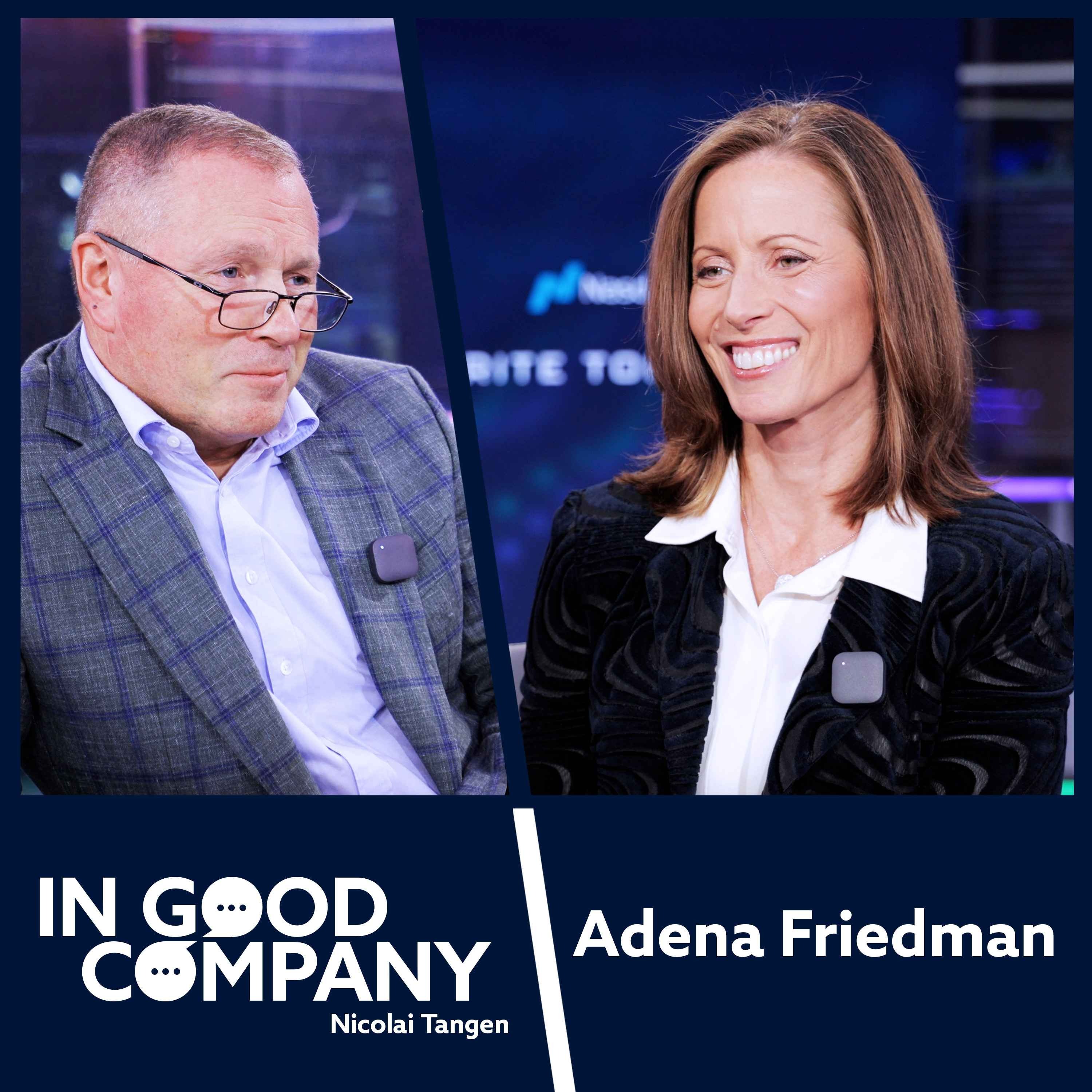
 In Good Company with Nicolai Tangen
18 Dec 2024 · 39m
Written by AI. May contain mistakes.

Get the gist, explore an idea or ask about something said.
 Claude
On In Good Company with Nicolai Tangen, what are the key points of this episode?
Searching your listeningAutomatic transcript. May contain errors.
0:01Hi everyone, I'm Nikolaj Tangen, the CEO of the Norwegian So-en Wealth Fund, and today we are thrilled to be joined by Adina Friedman, CEO of Nasdaq. Now, Adina transformed Nasdaq into a global tech powerhouse, and she's now one of the most influential leaders in global finance. So, Adina, welcome. Well, it's great to be here. Thank you so much, Nikolai, and welcome to Nasdaq. Well, exactly, because I'm visiting you, so I'm sitting here with a Nasdaq mug, you know, and feeling kind of part of something pretty big.
0:35Could you start with the basics here? So, what is Nasdaq? Sure. Well, NASDAQ, of course, is a world-class market operator, and we're extremely, extremely proud of that foundation. But as you know, we have expanded our business to become a global technology provider to the financial industry. And we focused on expanding our business in three key pillars, and they all kind of form the foundation of a good market. So we've got our liquidity pillar, transparency, and integrity. And if you think about it, you need all three of those things to make for a world-class capital market. But as we've kind to become a technology provider partner to our clients, we've used those themes to really expand our business.
1:12Now on the cup I had here, it says Nasdaq rewrites tomorrow. So what is tomorrow going to look like for Nasdaq? Well, tomorrow we are now, we're going from a market operator to a technology partner. And over time we want to become kind of what I would call an ecosystem partner to the world's capital markets and the financial system. So our vision is to be the trusted fabric to the world's financial system. And that really does mean that we are not only here just to be a software provider to our clients, but to help them solve their problems in more material ways. How do we drive from delivering software to delivering a market ecosystem that makes the capital markets around the world more efficient and effective?
1:51How do we become that risk management partner that really drives the banks to be higher integrity as well as more efficient so they can drive more liquidity into the markets? Those are the types of things that we think about as we expand the business. You say that you want to be a trusted partner, and you for sure are trusted by some very big companies, right? Because the five biggest companies in the world are listed on Nasdaq? The seven, but yeah. The seven, hey. So, you know, you want to buy shares in Apple, Microsoft, Amazon, Alphabet. You basically do it on Nasdaq. But you also have a lot of people in Sweden.
2:22We do. How come? Yes. In fact, we own and operate the markets in the Nordics other than Norway. So Sweden, Denmark, Finland, Iceland, and the three Baltic countries, we own and operate this market. And we also have a market technology business where we provide technology to the world's markets. So 130 markets rely on us for their technology to run their markets. And that's also operated out of Sweden. Sorry, why haven't you got Norway? You know, we wanted to have Norway. And why didn't you get it? You probably remember. Well, we decided to take a friendly approach with the Norwegian exchange. And unfortunately, there was another exchange operator that decided to take a less friendly approach.
3:00And they unfortunately won. But we did try very hard to come in as a friendly partner to the Norwegian exchange. Does each country need a stock exchange? It's a good question. I would say that each country wants its own exchange. And it's important to recognize when you're forming a country, there are a few key pillars that really underpin building a country. You've got roads and transportation. You've got education. And you have airports and things to make it so people can come in and out of the country. But you also have to have an economy. And when you look at the economy of a country, it's really underpinned by the central bank and the exchange operator and then the banking system.
3:34And exchanges are kind of a critical pillar and they become kind of a national icon to a country. Now, does every country need to have its own exchange? I would say in today's modern capital markets, capital flows are global, money moves seamlessly around the world, but there are very local elements to exchanges where they appeal to local innovators, local market participants, local investors. And so there is a benefit to having a country have its exchange, but having it connected into a global ecosystem to allow for more capital flows is what we think is the future of markets. Some people are moving the listings, right?
4:10So instead of being listed in London, for instance, they want to be listed in the U.S. because they think they get better valuations. How does this work? What is driving these differences in valuation between countries? Well, I think, first of all, having a listing in multiple countries has been a part of the markets for quite some time. The ADR, probably the American Depository Receipt, or the GDR, which is a global depository receipt. Those are contracts that have allowed companies from other countries to go and put a second listing into a different country. But more and more what we're finding is it's not so much the ADR that's coming, but the primary listing is moving.
4:42And I think the reason why you're seeing companies choose, from outside the United States, choose to move their primary listing to the United States is really because today the United States, the markets are extremely liquid. They're the most liquid in the world. We have the most diversified investor base in the world. So you have a really healthy retail ecosystem in addition to an institutional ecosystem, in addition to, let's say, a hedge fund community and other players that really drive market liquidity. And that allows companies to raise capital more efficiently. And we also have a research ecosystem that allows investors to understand these companies more deeply, which then gives them more confidence to invest.
5:20And all of that is not by accident. I mean, that's been, you know, the contract of the United States in terms of all the work we've done to develop our markets and the innovation ecosystem is now playing to our benefit. I would point, though, to Sweden as being an anomalous and very, very positive story in Europe. And I really mean that. And there's some great anecdotes as well as data. Yeah, they've got a great startup scene. I mean, it's just an amazing, amazing startup ecosystem, great innovation culture, and And a great equity culture by their citizens. So I was looking at the data and 37 % of people in Sweden have direct retail accounts for equities, for domestic equities.
6:01And so if you think about how powerful that is inside an economy where you have retail, then you have a great pension system and they deploy capital into the market. Then you have global flows, you know, global players who come in and participate in that market because we have a great market system. and you also have these tax advantage savings accounts that encourage the citizenship to get involved in retail, I mean, in investing in equities. And all of that creates a combustion that, again, creates a really great market ecosystem in Sweden. So it's possible to do this in countries outside the United States, for sure, but it's a lot of ingredients that have to come together to create the right recipe.
6:37If I start up a company and it gets really big, are you going to call me and ask me whether I want to list on Nasdaq? Is that how it works? I would say that if you start a company and it doesn't have to get really big, we will call you up and ask if you want to list on NASDAQ. So we list companies of all sizes on NASDAQ. And we're very happy to have a startup come earlier in their life and choose to make their stock available to everyday consumers and everyday retail investors. And then grow up as a company. Like, you know, when Amazon went public many, you know, a couple decades ago, they were worth$300 million.
7:10And they've grown up as a public company and done remarkably well in the public market. So that's a great success story. Do all their exchanges try to steal them away from you? You know, it used to be that there was kind of a view that Nasdaq was the home to smaller companies. But today, Nasdaq is home to the largest companies in the world. And what happened was these companies would come to Nasdaq as small companies, but then they'd stay. And 52 years later, we are now the home to, we have$30 trillion of market cap listed on NASDAQ and we're home to both the largest companies in the world, I would say that we're the home...
7:44So 30 trillion. 30 trillion. And New York Stock Exchange? Somewhere right around that. So we're almost equal. You know, we are really neck and neck now for the market cap of the listed companies listed on NASDAQ versus New York. And the fact is that once they got to NASDAQ, we gave them a home when, frankly, at the time, because we were formed in 1971, and at the time, New York had rules that didn't allow these companies to list there. So we started as a tech innovator in our space. We democratized access to the capital markets for retail. And we actually had listing rules that allowed young, innovative companies to come before they were profitable.
8:19And that was a change in paradigm in the United States. They came. So the first class of companies to come to NASDAQ, Comcast, Applied Materials, Intel, and then a really cool truck building company called PACCAR. That was the first class. And they're still here. They're all in the NASDAQ 100. And then we, of course, attracted Microsoft and Apple. And those companies came and then they stayed because they realized that we gave them a home, we gave them great service, we gave them a great market, and since then we've also become great partners to them from a technological perspective.
8:55At the same time, there are more private companies than before. Now it's partly because of private equity, but it's also because many companies choose to stay private. So why should companies go public and have a listing instead of being private? Well, I think we could have a really good, engaged discussion about this, Nikolai, as a large asset owner yourself, as to how do you look at asset allocation across private and publics, and how do you think about the public markets and what you're trying to achieve in the public markets versus the private markets. But I think that there are structural and cyclical reasons why the public markets are more or less attractive to companies.
9:30But cyclically, of course, it's just It's just a matter of, are public investors ready to underwrite risk in a time when you have changing interest rate environment like we're having right now? But more structurally, the question is, is the burden of being a public company such that it makes it so that it becomes more attractive to remain private? And that's where we have to work with the government to think about the balance, the regulatory balance, between the responsibility of being a public company and making your stock available to everyday consumers and everyday retail investors, but also the ability for you to continue to drive your strategy and make changes and continue to progress in a way that is still attractive to institutional investors.
10:13Will you also make money on private companies at some stage, you think? We actually are involved in the private markets today in two ways. The first is Now's Like Private Market, which allows for private companies to seek liquidity, periodic liquidity in their stock. So we can buy and sell companies even though they're not listed in a stock exchange. That's correct. But you have to be a qualified buyer or an institutional buyer. So there's a limited number of investors who have that available to them. And then also we support the asset management and asset owner ecosystem but with our tool called investment where we allow for asset owners to make smart asset allocation decisions by seeking out the asset managers that they find most attractive both public and private.
10:52And so we do get involved in the private markets in those ways. Now, there's been a trend over the last years towards high-frequency trading, right? So, extremely frequent trading. You know, measure it in nanoseconds. We do. I suspect, I read that the light travels only 30 meters in a nanosecond, so pretty short period. Now, how does this high-frequency trading work? Yeah. Is it good for you? Is it good for you? I mean, I would say that it's good for the system. So I will say it that way, because what we look for with high-frequency trading firms, they really are the modern market makers. They're committing capital into the market.
11:29And even if they're committing capital into the market for a very short period of time, they are there to make it so that at any given time, you as an asset owner or any asset manager or any retail investor can come in and put an order in the market and get it executed instantaneously at any time. And there's price discovery all the time, meaning there's always a bid-offer spread available in that stock so you know exactly where you can buy it and sell it, at what price. That's what the high-frequency firms provide to markets all over the world. And while they are doing it in very small increments and they're doing it in very short periods of time, they're there constantly to be that liquidity provider.
12:05So they provide an important service, and at the same time, they make money. So, you know, of course, they're going to make money in terms of very small tickets and kind of the differences in the spread, as well as making it so that they're taking risk and they're getting rewarded for taking risk. There's something called dark pools. How do you work with them? So the dark pools actually compete with the lit markets. Yeah. So that's a little bit different, right? So I would say that, you know. So they're bad news. Well. For you. Okay. So the financial industry. Because we think they're good news.
12:31Yeah. Well, the financial industry is a world of coopetition. Yeah. So I just need to say that. Like, there's no kind of bright lines here. It's really a matter of finding ways to work with everyone in the context and basically working with our clients where they are. Yeah. So for dark pools, NASDAQ does compete for order flow from dark pools, but we also provide technology to dark pools. So we actually do provide our trading systems and make those available to dark pools if they want to partner with us. And we will actually operate those dark pools on their behalf as a technology provider. But at the same time, we will compete with them to try to get the order flow onto the lit markets.
13:07Now, in the U.S. and in Europe, so in the Europe, I would say about 50 % of the trading in Europe occurs in dark pools and internalizers. and almost the same in the U.S. It's about 45 % of the trading occurs in dark pools and in internalizers. So in a dark pool, you don't really see who the buyer and the seller is. I mean, that's the challenge, is that if you're an investor and you want to understand what's the best price to buy and sell my stock, the dark pools don't contribute to that information because everything's happening in the dark. That's why they're called dark pools. And you have to be a very sophisticated investor to gain access to them.
13:40So we think that it's important to make sure you're at least creating a competitive playing field that allows the lit venues to compete on an equal basis with the dark pools to make it so we can be the first place that you want to place that order and not into the dark. The fact that there is so much concentration in the market now, you know, a few companies account for a huge proportion of the value of the stock exchange, is that a worry? I mean, I would have to say that's just the nature of the economy as it's kind of been progressing, right? You have these huge companies that have really defined the future of our economy, really, in terms of the technological innovation that they're underwriting, the risk they're taking, the scale that they're providing to really underpin the future of technology.
14:20And they have therefore become very large parts of the economy because the entire economy is becoming technological. Yeah. And so it's really the natural progression of economy towards these technological phenomenon, really. I think that at the same time, there are still 5 ,000 companies listed on NASDAQ. So it's not like there are many, many companies that are innovators and change agents and people who are in every single sector of the economy, creating change, driving new things, bringing new ideas into the market and also and or and or just very mature companies operating in every sector of the economy.
14:56So I don't actually agree that it's a bad thing. It is the nature of the economy as it exists today because technology is such a huge driving force of the economy.
15:10Changing tack a bit here. So, Adina, you became CEO in 2017. Yes. What does one do when one becomes the CEO of a big company? How do you approach it? Well, I think first it's important to understand what you're walking into. So, I started it now as an intern 31 years ago. So, I knew the company very well. Well, so you were at university. Right after. Yeah. So I knew the company very well coming into the role of CEO. But you also have to make sure that you're looking at it with fresh eyes and understanding kind of where is the company at the time. The second thing is that I came into a company that was very well managed and had a great foundation.
15:51So it was, I had the fortune of coming into the seat and playing offense from day one. Yeah. So my first year as CEO, we really focused on driving our strategy. Did you set a new leader group when you came in? Not when I took over as CEO, but in the years progressing up until I became CEO, I was able to develop the team that I was able to have as CEO. So the prior CEO gave me the latitude to say, okay, how do you want to form your team? How do you want to make sure you've got the right people in the right seats to take us forward? And he and I worked together on making that happen so that I came in with a strong foundation, great business, great team.
16:26And then it was a matter of, okay, but how can we run faster? How long did you work together in the transition period? I came back to NASDAQ. I had left NASDAQ to go and become the CFO of Carlisle for three years, and I helped them go public. And I came back in 2014 as president. I became CEO in 2017. So we worked together almost three years. Oh, wow. And that, I think, was excellent. That's quite a long period, right? But I had to prove myself when I got back. It wasn't like, oh, you're going to be CEO. It was you could become CEO. Right. But were there other people at the same time who also could become CEO?
16:57Like, was there a race going on? There was no race. It was more just making sure that I was ready to take on the job. Okay, so if you don't make a complete fool of yourself, you'll be the CEO. Or if I can show that I can really drive the company forward, I can be the CEO, which I did, I like to think. But this transition was very smooth. I mean, it was kind of a textbook transition. And so I took the job, and the first thing we did, we had two strategic efforts right when I started. One was, let's redefine the strategy of the company. and two was let's really dive into how can we revitalize the U.S.
17:28capital markets. Because again, we were at a period where we weren't getting a lot of IPOs and the regulatory burden was becoming quite onerous. And so we wanted to make sure we were recalibrating the markets. But the focus on strategy was a great way to engage the team right off the bat. So we know that we're a great market operator, but we also knew that we had the ingredients to be a lot more. So we took a kind of a three-pronged approach to evaluating the strategy. One was, what are the technology trends that are going to redefine our industry in the next decade? So let's have conviction on that.
18:01Two was, what are the industry trends that are going to redefine our clients over the next decade? So we know, how do we want to align ourselves with that? And three was, what do our clients think we're great at? What do they think we're not good at? And where do they see us as a strategic partner? So we took all of that input and we brought it to the team and we said, OK, how do we redefine where we're going? We had technology assets. We were already providing technology to other exchanges. We were providing technology to corporates to help them manage their lives in the public markets. But it wasn't we weren't a scaled player in that space.
18:36We were a very niche provider. And we went out to our clients. They said, you're really good at what you do. You're a great market operator. But here are my biggest problems. So with banks, it was dealing with a lot of regulatory risk, dealing with a lot of capital risk. And we've got a lot to do in managing criminals out of our network. So then you bought quite a few tech companies. That's right. And then we also - What kind of things did you buy? So for that particular area of our strategy, which we kind of look at as the liquidity and the integrity strategy, we focus in two areas. One is scaling up our capital markets technology to be not only the best at providing technology to other exchanges, we also rewrote our entire trade lifecycle technology ourselves that we're now deploying to our clients, but we also scaled up in terms of being a great technology provider to other exchanges.
19:24And through the Clipso, which is through the Adenza acquisition, the Clipso product is a scaled risk management platform for all of the market participants in the world. And so it allows them to manage their lives in the markets much more successfully. So that was one part of our strategy. The other part was we bought Verifin and Axiom SL, also part of the Adenda transaction, to be a scale provider of regulatory reporting and anti-financial crime technology. And we complement that with our surveillance technology. So we now can help them really manage all of the integrity capabilities within the banks and brokers and all the capital markets tech within the banks and brokers and exchanges that really make it so that they can get on the field successfully and be successful.
20:05So now the stock exchange bit is actually the division where you make the least money, which is quite interesting. Now, this company called Verifin, which is a leader in anti-financial crime solutions. Yes. And so I didn't know you had that before I started to read up on you. Why are you fighting financial crime? How does that come into it? Yeah, it's a great question. So we have been a provider of surveillance technology for trading firms and for exchanges since 2010. And what that means is we help them root out market manipulation and criminal activity within the markets and within their trading firms.
20:39And when we went and talked to them about what could we do to expand, and we did a complete strategic review of how can we expand this business? Great business. It's growing really well. It's a SaaS technology. It's very modern. So how can we make it so that we get bigger there? Because it's a great segment for us to play in. They all said, what we're really challenged with is anti-money laundering and fraud within the banking system. Can you help us with that? And we said, okay, well, that's good to know. So we went back and we evaluated every single company in the space of anti-financial crime.
21:09And we actually came out with one name of one company that we thought was the best in the business. And by far the most technologically advanced, they had 2 ,500 clients, they were very skilled in the United States, but they hadn't yet reached the tier one and tier two banks. And that's where we're really strong. So we knew we could complement their capabilities, and that's Verifin. And they were not for sale. But you managed to buy them. You charmed your way into it. Yeah, we did. We went to the owner. We talked to them. We went to the firm. We talked to them. And at the end of the day, they saw us as a great partner because they're growing 20 plus percent a year.
21:45So they're just a fast grower, incredible technology. We can learn a lot from them, but they can learn a lot from us in terms of how they go up market. Is there a lot of crime in the financial markets? There's an enormous amount of crime in the financial markets. What kind of crime? So there's an estimate that there's$3 trillion that is laundered through the system, the financial system globally every year, and half a trillion dollars that's lost to fraud every year. And that's globally. In the U.S., we kind of zeroed in on the fraud challenge. And in the United States, there's$150 billion lost to fraud every year.
22:17If you think about that, if we were able to recover all that fraud and keep that in the right hands and to the hands of the consumers, that would increase our GDP by 50 basis points. So the GDP of the country would be growing at a half percent more if that money wasn't lost to fraud. Well, we can need that in Europe. Well, and then in Europe, I think the unique element of the United States and why Verifint's been so successful here is that there's a law that allows banks to share certain information in order to fight crime. So they can share it with a third party. They can't share it with each other.
22:51They can share it with a neutral third party. We are that neutral third party. So we have created a consortia data lake made up of all of the banks' transactions from across 2 ,500 banks. We get about a billion transactions a week through that platform. And we then apply very advanced AI algorithms to be better than anyone in rooting out criminal behavior. That then makes it so the banks can be more efficient, fewer false positives, and more effective by showing them more real positives, to make it so that their fraud program is much more effective. Same with AML. It's a more complicated problem, but a similar approach.
23:30Let's move on to you and kind of the leadership. Now, what kind of experiences during your career have you had that you think have shaped your leadership style the most? Well, I had a couple. So the first was when I was 30, I became the head of the data division. So they had the company decided to reorganize. We had a trading division and a listings division, and data set within the trading division. And they decided to branch that out and make it its own division. So we ended up with three divisions at NASDAQ. And when I was 30, they asked me to be the head of it. So that was a big one. And I had been running products.
24:07I've been running some of the data products as a product manager, a couple of the trading products. So I was already kind of owning the business of these products. But then to run an entire division was a huge step up. And I learned a lot. I had to learn a lot because, first of all, I had to recognize the fact that I didn't know everything for the first time. And I had to really rely on others who knew a lot more than I did. And the second thing is that I had to scale a business. I mean, I had to create a business and scale a business within a company. And that was a great opportunity for me to demonstrate leadership skills.
24:38Did you have a mentor who helped you on the way? I did. So my first manager was a great mentor and he was my manager for seven years. He ran the trading business. So then when I branched out and took the data business, he actually retired, but he remained a great mentor to me and just someone who could help me. What does a good mentor do? A good mentor is there to listen, to give you, and I would say mentor slash sponsor, because I think they're slightly different. But in that particular case, he was both a mentor and a sponsor. Number one... So what's the difference? I would say a mentor is someone who does not have a vested interest in your personal career, that they're there to be kind of an outside advisor to look in and say, let's talk about where you want to go, what are the things that you do well, what do you want to be able to do better, what's holding you back, and helping you navigate your career, but without a vested interest in your career.
25:30A sponsor has a vested interest in your career, meaning they might be your boss or your boss's boss, and they're there to say, let me figure out how to catalyze your career and make it so that you can move faster up in an organization. But here are the skills and capabilities that you need to be developing. Let's work together on making sure that that happens. That's a sponsor. How many people do you feel that you sponsor? That you have a like a where you have in a way a vested interest or you really follow their career moves? Well, I mean, I certainly in a way you are a sponsor to all of your direct reports, but they've gotten to the point where they have moved up all the way through the organization.
26:01So ordinarily, if you're a sponsor, you're looking one or two or three levels down in the organization. And I would say that I'm, you know, I don't claim myself to be a sponsor because oftentimes it's not something you explicitly discuss. But there are certainly many people within the organization that I feel that I have a best interest in watching and helping them with their success. As a mentor, I do actually take on formal mentorship. And I usually have two mentors at a time. So I'm mentees, sorry, at a time, further down in the organization where I'm there to help them think about their career differently or to help them develop skills.
26:37But I'm not in there. I'm not directly assigned to helping them with their career. but I am ultimately helping them think about their career differently so that they can then navigate their career successfully. What did you learn at Carlisle? Well, I went to Carlisle to be their CFO and to help them go public. So a few things. First, Carlisle, a different part of the industry. So I learned private equity and a fascinating part of the business. I'd always in my heart thought I wanted to go into the buy side because my dad had been in the investment management industry. My brother was running a hedge fund.
27:09So I thought this is where I was destined to be. So I went into Carlisle and learned the private equity industry. That was one. Two, very different culture. It's a collaborative culture as opposed to NASDAQ being a little bit more, at the time at least, a command and control culture. So understanding how to manage a partnership as opposed to a C-corp, you know, a more hierarchical business, was very interesting. I had three bosses, so very different way of doing business. And I think I learned a lot from that in a positive way. And then the third thing was that the finance organization at that time was bigger.
27:40It was more complicated and it was very global. So for me, I also was able to expand my leadership skills while we took the company through a very unique journey of going public. So learning how to take a company public was a great skill because when I got back to NASDAQ, I was able to look out and say, what was that process really like? Are we doing enough to support our clients as they're going public? Can NASDAQ be a better partner to our clients in the process of going public? So it actually brought a lot of knowledge back that I was able to apply to the business. Do you think you're a better leader now than when you were 30?
28:11Oh, definitely. How are you different? Well, when you're 30 and you're taking on, you know, you kind of want to think that you know everything for one thing. And second of all, you're trying to figure out how not to do everything, but to make it all get done the way that you want it. You know, that's like, if you know what I mean, I mean, there's a scalability to that that has some limitations. So when you're 30, you're trying to learn new skills, learn how to manage, learn how to lead, and obviously drive a business forward. And so there's a lot that you're learning that you probably are not doing perfectly along the way.
28:44So how do you do it differently now? So when you go from being a manager to a leader, it's the difference between directing people in their activities to empowering people so that they can be empowered to do a better job at their job than you can do at their job. Isn't that just amazing? And that is a total difference in skill set. Isn't it just amazing you ask people to do something without setting any limitations or defining it to kind of accurately? And then they just come up with things which is beyond what you could do. Beyond what you could do. So what does that require? I love it. It requires a lot of trust.
29:19Yeah. And you have to, the most important thing a leader can do is put the right people in the right seats. Yeah. And to think, I want to put a person in that seat that will be better at their job than I can ever be at their job. because by them being better at their jobs, all of them, then the whole company is a better company. And you get a chance to empower them to do great things and to make sure your capital allocation decision, set the vision, set the direction, make sure you've got the capital allocation decisions to drive that direction successfully. Pick a few projects where you want to get personally involved and otherwise empower the team to do great things.
29:55But it takes some confidence, right? Yes, I would agree with that. It takes confidence in yourself, but it also takes confidence in the team. And it's difficult to do when you're 30 because if they do everything better than you, they are going to be your boss, not you, right? Right. Well, in fact, that was an interesting moment for me because when I took the job as the head of the data division, there had been someone who was running data within the trading division. And he was not the person that ultimately took the job. So he worked for me. And that was an interesting transition from being a peer to having that kind of relationship.
30:27So I did have to learn, and I learned very quickly, he knew a ton that I did not know. And he was great at certain elements of the job. So my job was to empower him. And that was the first time I had to figure out how to work with someone who knew more than I did about something and was better at certain things than I was at something. And so how do we empower that person? How do you bring them in as an advisor? How do they, and working successfully with them. And I actually have to say, I think that was one of my big learnings when I took the job as data. So that when I ultimately became the CFO, that was the first time when I realized that I had to go from being a manager to like a true leader.
31:06And because there were a lot of elements of finance that I had, there was a lot of expertise embedded in the team. And I was never going to know everything. And that moment of realizing my job is to empower them to do great things, that was a big step up for me personally.
31:24Let's talk about culture. How many people are you? We have about 8 ,500 employees all around the world. And what do they do? About half the team are technologists, software engineers and all the people that support software engineering. And then we have, obviously, a large sales organization, a product team that really helps what I call a business product team that really supports the business strategy and the execution of the strategy across the business. And then we have market structure experts, legal and regulatory experts, and then of course all of the corporate functions. And what type of people do you hire?
31:57I mean, let's say now you interview me, what are you looking for? So the first thing I would look for is someone who is a team-oriented person. So confidence, what we call confidence and humility, right? So you have to understand who you are, what you're great at, what you're not great at, and how you're going to make sure that you fill in the gaps to make it so that you can deliver great things. The second thing is curiosity, constant curiosity. It is a fast-moving world out there. Technology is moving at a faster pace than ever before. The capital markets are constantly evolving. And if you're not intellectually curious, you're going to get stuck in a box pretty quickly.
32:34And you might stick us in a box, and that is not where we want to go. So constant curiosity. And then, of course, whatever the expertise that we're asking for is, I think, table stakes, of course, to the role. But then the last thing is kindness and, you know, kind of how do you work really well in groups? How do you make it so that you manage by influence, you lead by influence, so that you get more done than your job would necessarily entail? Do you think kindness is underrated in this society? I think that there's a reputation within certain industries that kindness is a weakness. I think kindness is a strength.
33:12You know, our business, we are a technology business, but we are founded on the notion of relationships. I always say that even in the trading business, where it is a very analytical decision as to whether we go first in your routing tables or not, that relationships break ties. And so at the very least, relationships break ties. But at the most, they drive trust. And if you are the trusted provider, clients naturally want to do more with you. And that trust is the most important thing that you can gain. and I think kindness is a big part of building that trust. I think the concept of kindness is quite funny because when you are 20, the cool people, they were not kind.
33:49They were the least kind, okay? And so nobody wanted to be kind because then you were just like a loser. Now you fast forward until you're 50 and if I were to pick one trait, which I would really love to have in my partner or colleague, it's kindness. Of course, because at the end of the day, kindness is generally a reflection of confidence too. And I think those things go hand in glove with each other. And at the end, that's what you're really looking for, is that kind of kind, confident, humble leader, person who can relate to other people, who can get the most out of another person, and who cares about those other people and their success.
34:28That's a great leader, and that's what we look for. You mentioned that curiosity was a key thing that you were looking for. What are you curious about these days? Everything related to the future of technology. Everything. Are you curious about anything non-technology related? Oh yeah. I mean, so when I was in college, I was a political science major. So, and I really studied, actually, my concentration was in Soviet studies. So international relations, what's happening in the world? How do nations come together or fall apart? How do they drive their economies forward? what are the ingredients for a successful economy, a successful society.
35:05I care deeply about that, and I'm very curious about that. You also have a black belt in Korean kickboxing. True. Well done. Is there anything from that sport that you have taken into business? Oh, definitely. Like what? Well, first is the training part of Taekwondo, which is Korean kickboxing, is, in my opinion, the fun part, the part that's hard but fun. the sparring part of Taekwondo is the scary part. But at the same time, you have to put yourself in a position where you have to overcome fear. I think it's important as a person, I think it's important as a leader that you put yourself in a position to overcome fear.
35:46And Taekwondo is very good at that because I was very fearful of sparring. The second thing is the need to play offense and defense all the time. It's like chess. I think chess is also another great skill to have if you're going to be a business leader because you always have to remember every offensive move requires a defensive move at the same time. So in sparring, you can learn that really the hard way because you get all excited. You're about to kick someone in the head and it feels great. And then they just punch you in the gut. You know, so you have to make sure that as you are trying to figure out how to position yourself to do the offensive move, that you're not leaving yourself exposed defensively.
36:20So that those are the two things that I learn a lot about. Do you have fear? I do. I mean, well, every person has fear. I do not come into the job with fear. I had enough experiences in my early career. Not everybody has got fear. Yeah, I mean, I would say that I had a lot of experiences early in my career where I had to overcome that sense of fear, you know, to kind of how am I going to prove myself, how I'm going to make sure that this is successful, that when I got the job as CEO, I felt extremely ready. And in the job as CEO, you don't feel fear. I mean, you have moments of making sure that you manage through challenging situations, but all of the experience that led up to that gets you prepared for that.
37:01So I don't walk around with fear, but I do think that it's important. A couple of CEOs I've spoken to on these podcasts, like Bob Iger at Disney and also Michael Dell, they say that they haven't got the fear gene. Well, I would say that I have a healthy fear gene, but the most important thing you can do is train yourself to overcome it. Yeah. Now, how do you relax apart from kickboxing? Well, my husband, his profession is he's a pottery instructor. He was a lawyer for a long time and then had a second career as a pottery instructor. So he's taught me potteries, which is very meditative. Have you got like a wheel at home?
37:40We do. So we have a small studio at home. Nice. We go on Saturdays and we'll throw pots and he teaches me. He's very good and I'm very bad. But it's a very relaxing way for us to spend time together. We also play a lot of pickleball and we play that competitively. So we have a good time with that. Very good. Now, finally, we've got tens of thousands of young people listening to this. What is your advice to them? I would say first, always stay curious. Always make sure that when you have the opportunity to say yes, you say yes. Early in my career, I was asked to do a lot of things that were outside the scope of my job.
38:17And I would always just say, okay, I'll do that. And then you go back to your office and you go, hmm, I wonder how I'm going to do that. But, you know, you have to figure it out. And that's the great thing. If someone's trusting you to give you that project, they think that you're going to be able to figure it out, so take it. Now, if you say yes to too many things, then you need to sit down and say, okay, how do I prioritize these things? But the fact of the matter is say yes and stay curious. Well, Alina, you for sure have figured out NASDAQ. Well done, and congratulations. Thank you very much.
38:45It's great to spend time with you. Thank you.
Meet the woman leading the exchange where $30 trillion in market value trades. Adena Friedman takes us behind the scenes at Nasdaq, revealing how this iconic institution is reshaping global finance through technology. Discover how Nasdaq is fighting trillion-dollar financial crimes and hear personal insights on leadership from one of the most influential voices in global finance. Tune in!
In Good Company is hosted by Nicolai Tangen, CEO of Norges Bank Investment Management. New full episodes every Wednesday, and don't miss our Highlight episodes every Friday.
The production team for this episode includes Isabelle Karlsson and PLAN-B's Niklas Figenschau Johansen, Sebastian Langvik-Hansen and Pål Huuse. Background research was conducted by Une Solheim.
Hosted on Acast. See acast.com/privacy for more information.


