Ask ChatGPT
 In Good Company with Nicolai Tangen
25 Jun 2025 · 47m
Written by AI. May contain mistakes.

Get the gist, explore an idea or ask about something said.
 Claude
On In Good Company with Nicolai Tangen, what are the key points of this episode?
Searching your listeningAutomatic transcript. May contain errors.
0:01Hi everyone, I'm Nikola Tangen, the CEO of the Norwegian Sovereign Wealth Fund, and today I'm in real good company with Vaz Narasimann, the CEO of Novartis. Vaz has one of the most fascinating backgrounds in pharma. He is a trained physician who also worked in the front lines fighting tuberculosis and malaria in developing countries before rising to lead one of the world's largest pharmaceutical companies. We own 2.3 % of Novartis, and that's worth more than$5 billion, roughly 10 ,000 Norwegian kroner per Norwegian citizen. So Vaz, big thanks for joining us. Great to be here, Nikolaj.
0:47Just briefly to kick off, for those who are not familiar with Novartis, just what are your areas of focus? Yeah, we're one of the largest biopharmaceutical companies in the world, focused on innovative medicines in oncology, cardiovascular disease, neuroscience, and immunological diseases. Very good. And we'll come back to many of those. Now, you have a different background compared to many other pharma CEOs. How do you think that has shaped your approach to leading Novartis? Well, I think it's helped in many dimensions. I mean, coming from being a physician, coming from a scientific background, I'm definitely steeped in the R &D elements of the work we do.
1:29So I'm always thinking about the medicine, how the medicines impact patients, very data-driven, always thinking about how these medicines might fit into clinical practice. And given that the core of what a biopharmaceutical company does is find breakthrough innovations that matter for patients in the long run, I think it's a really helpful background. I had to learn a lot about business. I didn't go to business school. I had to learn all of the ins and outs of capital allocations and balance sheets, P &Ls, running businesses. But I think the combination of a medical background and business background has served me well.
2:02Yeah, absolutely. Absolutely. Well, to be frank, business is not so difficult compared to medicine. So I think you assumed you know the right things. Now, you were running the R &D efforts at Novartis before taking over as a CEO. So when you took over, what kind of changes did you implement? Yeah, I think the biggest change that we took on was to focus the company. And the idea was our best elements of Novartis were in our R &D engine, finding breakthrough medicines that moved the needle on a range of different diseases. At the time, we were a sprawling conglomerate. We had areas like consumer health, generics.
2:43We were in eye care and eye devices with the Alcon business. And so the idea was to focus as a pure play innovative medicines company. Now, it took a lot longer than I expected to make that all happen. It took around five, six years of spinning businesses. So we got rid of our consumer or moved out of our consumer health business. We spun Alcon, spun Sandoz, sold our Roche steak. And what's incredible to me now, when you look at our company, our market cap is$235 billion. When you add back all of those companies that we put out into the public markets, you add another almost$100 billion to that market cap.
3:20So in the end, we really unlocked a lot of value by focusing. In the old days, you could argue that you had some really stable revenue streams, which kind of offset patent cliffs and so on. Now you are more a pure, streamlined pharma company. What does that do to the attitudes in the company? I mean, there was this belief that if you had these more stable businesses, that you could offset the peaks and valleys of R &D productivity in our industry. Because naturally, we have large patent cliffs, and we have to manage through those patent cliffs. But actually, what we found is something else was happening.
3:55A lot of distraction and inability to allocate capital to where we found the most likely impact and the most value. So in the end, we're appropriately diversified within biopharmaceuticals. We're in different technology platforms, and we invest a lot. I'm sure we'll talk about these advanced technology platforms. We're diversified in therapeutic areas. But being diversified across business lines just diluted our effort. And in the end, it's really interesting. If you look at Novartis' history, we've actually managed through all of our patent expiries, major patent expiries, not because we had these other businesses, but because our innovation engine actually delivered the next wave of breakthroughs.
4:37So in a sense, we have to bet on ourselves, play to win and not play not to lose. Do you think you structure your R &D differently compared to other pharma companies? You know, we do do some things that are different. I mean, we have a function called strategy in growth, which we created a few years back. It's run by a wonderful former Wall Street analyst from Bernstein, but has built a whole team together that relentlessly looks at the outside world, really brings in those insights and challenges even early stage researchers. Is what they're doing really going to move the needle for clinical care?
5:13So we bring those outside insights even to the earliest stages of R &D. We also radically focused, and that's something Novartis always was not really good at. I mean, we were in far too many therapeutic areas, too diluted. And what we did is we focused on four therapeutic areas, cut out a lot of the other areas, and then really built on the deep expertise of our people. I think that's really delivered results. And I think that now the question is how we can use AI and other technologies to get an edge on our peer set. I'd say the one other thing that we do that's unique is we invest in these technology platforms.
5:51We're the world leader in radio ligand therapies, the world leader in cell and gene therapies, one of the world leaders in RNA therapeutics. And that's a belief that you have to keep investing at the cutting edge of science to lead in the long run. So if you think about where this industry will be in 2035, you have to keep investing in these leading edge technologies so that you're ahead of the curve. If you were to rank your therapeutic areas according to attractiveness, how would you stack them? That's a tough one. And, of course, there's no different metrics I think you would use. I mean, clearly, each one of these areas has different dynamics.
6:28I mean, in cardiovascular disease, you're looking at large-scale population health topics and trying to figure out how to better tackle heart disease and related cardiovascular conditions at scale. In neuroscience, we're very focused on neurodegenerative diseases and genetically driven diseases. These are much more focused areas where you're really, you know, mining the mysteries of the mind. You know, immunology has a whole set of different challenges, so it's not easy to rank. I really like to think that we need to be strong in all of these four areas. It does bring to mind an important tangent, though, that I think we always have to remind ourselves when we think about R &D in our sector.
7:08I mean, what we do is remarkably hard. I mean, when you think about it, we are trying to unpack 2 billion years of evolution of cells and these processes that happen in multicellular organisms and to find a single drug target and then actually drug that target so that it impacts the human body in an effective way is an incredibly daunting enterprise. And the fact that we do it at all, I like to tell our people, it's a miracle that fits in the palm of your hands. It's a miracle we do this at all, much less doing this multiple times over 200 years. So I think it's always important to remind oneself of how hard it is to do the work we do in each one of these therapeutic areas or the modalities that we work in.
7:49We are living at a time where there are more miracles than normal because of the way science is moving, right? So when you look at everything you are involved with, what are the most significant scientific breakthroughs on the horizon that you are excited about? Yeah, I think a couple of things, and they range across the whole spectrum. I think on one part in terms of population health, our ability to intervene earlier and earlier in disease to hopefully prevent diseases from even getting to later stages, I think will be incredibly important. Demography in the world is only getting more challenging.
8:26Huge aging populations, healthcare systems under strain, not enough young people always with the fertility rate falling to actually fund these healthcare systems. So we're going to have to prevent disease. In our experiences, you can go earlier. We're working very hard to find how can you intervene earlier and earlier in various cancers. We just had another important data set in prostate cancer intervening early. And the idea is how can you intervene so that the cancer doesn't get to a stage where ultimately it requires hospitalizations. So I think early intervention is a huge area of focus. I think another exciting area clearly is the idea of can you completely reset diseases.
9:05This all comes out of the world of cell and gene therapies, where we already learned that for certain genetic diseases, and Novartis is one of the leaders here, we're able to almost deliver a cure or a dramatic response by using the gene therapies to actually replace a gene in the body. So now what we've learned, and there's actually data coming out just this week, that you can actually use cell therapy to reset the immune system. And there's a whole range of immunological diseases that are very severe, affecting young people and old people. And the idea here is with these therapies, using cell therapy, you can reset the immune system and turn back the clock on their disease by 15 or 20 years.
9:45And so this is, I think, a staggering innovation that will change the lives of, hopefully over time, millions and millions of people. Another area I'm very excited about is an area called RNA therapeutics. It allows you to give medicines that you usually take every day. You only need to take them every six months or maybe once a year. And most people don't take their preventative statins or other medicines. So if we can get to infrequently administered therapies, that would be incredibly exciting as well. And if you'll indulge me, just one other I think is super exciting is radiopharmaceuticals or radioligand therapy, where Novartis is a pioneer here.
10:21What we've learned is we know radiation can attack tumors and stop tumors from growing or even eliminate tumors. But now we can basically target radiation right to where the tumor is in the body using a drug linked to a radioactive particle. And this is opening up a whole new area of medicine. So these are just some of the examples that we see. Well, so these are some of the examples. But I mean, how do you personally stay on top of this? I'm quite passionate about it. I mean, as I said, I'm a physician scientist. And my favorite meeting of the month always is our Innovation Management Board, which I've chaired now for 13 years since I was the head of development all through my time as CEO.
11:04I read every one of those documents because, you know, that's in the end, I think, what a company like us has to deliver. I mean, for us to stay relevant in the world. Tell me about that meeting. So it's once a month. Is this like the lifeblood meeting of the company? I do feel like it's the lifeblood meeting of the company. We review the projects that our research teams are bringing into later stages of research, which are the medicines that I take to humans. So who are in the meeting? How many people are you? Well, there's a lot of people who end up attending. But the core members is about seven leaders, head of research, development, strategy, and growth, or commercial leaders, and myself and the CFOs, maybe eight people.
11:44How long does it last? Sometimes it's two, four-hour meetings. Sometimes it's one, six-hour meeting. but it is a long meeting. It's not for the... Do you run it? I do. I chair it and I've chaired it now for a number of years from development times to today. But of course, chairing a meeting like this is really just getting the best perspectives from all of the leaders in the room. I mean, what can I possibly know compared to all of these experts? We always have the teams come in, our experts in whether it's cancer or heart disease or research experts or development experts. scientists, physicians.
12:23And I think one of the most important things we've gotten much better at is having a debate. And I think debate is the only way you can navigate these complex topics and finding these miracles that we talk about. If you're not willing to have the countervailing position in the room, if it's just rubber stamping, then of course you're liable to easily fall into all of the biases that come in to taking decisions in medicine and R &D. So, Vaz, I'm now Novartis' top cancer researcher, okay? I come into this meeting, you know, I've given you 200 pages to read beforehand, and here I come, Nikolai Tang, the great cancer guy.
13:04So, what happens? I come in there, do I present, or you just go straight to questions, or what happens? We've evolved this over the years. We used to have long presentations. Now we assume the pre-read is read and we ask the person, the leader to give us, you know, just a three minute summary of the case. And then we usually try to also put up a slide that has from the team's view, what were the reasons to do the project or what were the reasons not to do the project? We also have a portfolio analytics group that gives us lots of data and analyses on these projects. And then we have a discussion.
13:38And my role is to get the room to really discuss the topic and have a debate and see, are we doing the right thing by funding this project to the next toll gate? And if you were to terminate a project, does that happen in these meetings? Yes. And that is, I think, one of the most important things a well-run R &D organization has to do. You have to be intellectually honest as to where projects are. Do they fit in your strategy? Do they have the data to support going? and you have to have the courage to kindly but firmly explain to teams that we have to stop here and we've got to use the resources for other things.
14:17That's obviously never easy, but we always try to celebrate the teams and tell them it's not the teams that failed. If they did their work right, the signs simply didn't deliver the way we expected. And that's okay. That's just part of the work that we do. Most of our projects ultimately fail. Well, I have to say, I would have loved to sit in on that meeting. That sounds even more interesting than our investment meetings. in the fund, you know? Yeah, hour six can get a little tough. So that's where I think I've built up some meeting endurance over the years.
14:51Moving on, AI and digital, you really have been a champion in the digital transformation in pharma. Now, you mentioned briefly in the beginning some of the digital initiatives, but what would you say are the most important ones that you have? I think clearly AI's impact in research and development in our industry will likely have the longest lasting impact. There's a lot that's happening in operations, manufacturing, supply chain, finance. And that, I think, is important, clearly having an impact already. But ultimately will become, I think, standard across our sector and other sectors. The biggest question here is, can you use AI to either discover what is a drug target?
15:34So think of it as the key lock that we need to unlock. So find those key locks. And then can you also use AI to optimize the key into the lock so that that key can ultimately unlock the biological process that we're talking about? Now, as to where we are today, we're already using AI with Isomorphic Labs, the Google DeepMind company, other partners to optimize those keys. So we have some ideas for the keys. AI takes all of the information known out there and inside the company and optimize those candidate drugs and then helps us speed up the process by predicting how it will ultimately do in preclinical safety, toxicology, in terms of its pharmacokinetics, its manufacturability.
16:18That process is now, and that's really happening now at scale in companies like ours and at other companies. And I think that will hopefully shorten the early drug development process by years. And that's, I think, really exciting. And then the bigger question is, could you actually unlock biological processes with AI and actually understand? And that I think we're further away from. So you work with Microsoft, Palantir, but you mentioned the Isomorphic Labs, which is Hasabe's venture, right? You've got the Nobel Prize inside Google. Just how do you work with them? What do they do for you? Yeah, so it's a very, I think we're one of their two partners.
16:58And basically what we do is we give them, again, to take the key lock and the key analogy. We give them some locks that we know or we hypothesize are very important in diseases like cancer or heart disease that we simply have not been able to drug or i.e. find the key for. And we say we've struggled with our traditional methods. Can AI, can their capabilities ultimately enable us to find those keys? And so what they do is they use AI to design new drugs. And what's been very interesting is AI comes up with drug structures that we've not thought about or really explored. And so we're starting to see the early results.
17:38I think we now have over six different projects going with them and hopefully to expand more into the future. And we'll see if AI can solve what we call our undruggable targets. So can the AI help us drug the undruggable? That's the question. It's interesting how relationships with technology companies has been key to success in pharma, right? Because that wasn't the case in the old days. How do you see this changing going forward? It's a big shift. I mean, I think, you know, we've learned over the years, Palantir has been an amazing partner of ours. We've been working with them since 2017. They've helped to build a data like we call Data42, which we think is one of the most advanced in the industry.
18:16helps us mine all of our data just using a simple text field. Microsoft Research Labs has been a great partner. I think what it is is you have to find the right use cases. It's easy to try to chase all kinds of things. And we fell into that trap. We chased far too many AI and data science projects. But as we've learned over the years, if you get the right use cases and you find the right partners, I mean, Amazon has helped us completely automate our patient services in the United States as another example. You need those partnerships because we simply don't have the technological know-how in-house.
18:49Do you think you're better at working with the tech companies than your competitors? I don't know. You'd have to ask the tech companies. I do think one of the great things about Novartis is we're willing to pioneer at the cutting edge. If you look at a lot of the technology areas in our industry, whether it's therapeutic platforms, AI, data science, we're always at the leading edge. That also means we often have to fight through many of the early challenges and often means also we have the failures associated with that. But that's kind of the ethos of our company. We're at the leading edge.
19:28You've been very outspoken about the challenges facing the European pharma industry. And I heard you, for instance, in Davos. And I was just like, wow, this guy is actually, he's pretty outspoken. He's telling us what he really thinks. And there are many CEOs who actually don't do that. So tell us about this. Tell us about the situation of pharma in Europe in kind of no uncertain terms. And that I've pretty consistently done also directly to the senior leaders. You know, Europe has been the home of the pharmaceutical industry. I mean, when you look at it 100 years ago, the earliest pharmaceutical companies all came up along the Rhine River and related parts of Europe.
20:10It's where the industry ultimately was created. And over the last century, it still has been the real powerhouse of the world. When you look at where drugs are most manufactured right now, it's in Europe, where a lot of R &D activity is happening in Europe. Clinical trials is happening in Europe. But at the same time, what's happened is European governments have just commoditized the innovation that we deliver. And more and more through budget constraints, constraining how they reward innovation, propping up the generics industry with artificially elevated prices, not taking on the hospital sector.
20:48They've constrained and constrained to the point now where Europe, population slightly larger than the United States, its market size is half or even less than half of the U.S. and not growing. whereas the U.S. and now China. I mean, China is the second largest pharmaceutical market in the world, growing almost at 20 or growing certainly double digit. And so Europe needs to do something because clearly the U.S. administration wants manufacturing to move. We've seen$250 billion of announcements from companies saying they're going to invest more, U.S. and European companies saying they're going to invest more in the U.S.
21:22So Europe has to act. They have to figure out how to award innovation by not capping drug prices, penalizing companies when they have new technologies and new innovations, not artificially finding ways to really constrain the innovation environment. Or it will over time leave. I mean, it's just the economics. Is Europe acting? Not fast enough, no. I mean, I think Europe is trying at the European level to do what they can easily. But I think the real hard conversations still have to happen. And I think certainly the trade situation will push that topic even harder, as will the Trump administration's push on international reference pricing.
22:06But what's preventing Europe from moving? That's a good question. I mean, I think it's political will, ultimately, and fundamentally a belief that the industry won't move or it won't lead to a shift. And as you know, I mean, these shifts don't happen rapidly. But slowly over time, in 10 years from now, you start to say, today, about 40 % of new drugs, 30 to 40 % of new drugs are not launched in Europe. European patients don't get access to them. They're primarily launched in the US, to some extent, China and Japan. That number will slowly increase. Slowly but surely, you'll see manufacturing leave.
22:40Novartis had four manufacturing plants in the UK. We have zero today. Step by step, you'll see. And then suddenly, I think it'll get to, unfortunately, to a crisis, as it did in Japan for the pharmaceutical sector. And then governments will act because patients will demand, where are these medicines? Governments will be looking at, where do the jobs go? But unfortunately, I think until we get to that crisis point, it's easy just to hope that the status quo will be good enough. Is the problem Brussels or is it the individual countries? I mean, I think the challenge, of course, Brussels would say they don't control innovation ecosystems in individual markets.
23:17And so individual countries have to make their own decisions. That said, I think with a 27-member bloc, without some sort of coordinated action, given the trade is ultimately managed at the EU level, it's going to be very difficult to tackle this problem because of just the differences in GDP per capita across the European Union. So I think Brussels needs to come up with a framework to guide the countries. Otherwise, we won't get out of this situation. What would it take for the countries to think more about the common destiny of Europe rather than just their own situation? Because it's not only in the pharma industry we're seeing this, right?
23:54We're seeing it in pretty much every industry. It's true. And of course, I think governments would say they've got to figure out defense. They've got to figure out energy. They've got to figure out the pharmaceutical sector. Sure. I mean, I think it's going to take ultimately leadership. And, you know, I think some more of the European leaders have to galvanize support across Europe. And I think that, of course, that's challenging. But you need, I think, some senior leaders in Europe to say they're going to take this on. I think if each country sits in their corner and kind of hopes that this will work itself out, I think the story will keep unfolding the way it's unfolding.
24:30Well, I mean, Draghi wrote the report, but I guess not so much is happening. Despite the world changing, right, with tariffs and barriers and so on moving, are you surprised that not more is happening after this report? I mean, I think there was at least recognition, and I have to say that at least the tone from the European Commission is much more about economic competitiveness and less about the whole period of time where we had so many new bureaucratic elements being added, whether it was CSRD or the due diligence or water, and all of these things added on top of each other. That said, I think action has been slow.
25:16And I think while the talk has been high, ultimately, companies respond to when they see real concrete action. The EU did put out new pharmaceutical, proposed pharmaceutical legislation, which improves somewhat from their already really damaging approach to protecting pharmaceutical data. But already that's still worse than where we were three years ago. So we actually went from a place where we got much worse, and now we're less worse. And then that's supposed to be a victory. So I think there has to be more of a sense of urgency. So Vas, I'm giving you this magic wand. You can change three things in European pharma.
25:54What would you change? I would say that we should have a European-wide list price system that then countries can adjust based on GDP per capita that then gives us a framework for list prices across Europe. I think second, there should be no allowance for capping growth of the pharmaceutical sector. So basically, if you take a country like Italy, our entire growth in Italy is paid back to Italy at the end of the year. And so it's very hard to grow a business if you're always paying back your growth to many countries out of this. So we've got to end this practice. And then third, I think Europe has to end also its practice of propping up the generics industry.
26:39Go to the U.S. model where we have high innovation and then generics prices that are the lowest in the world. And then you'll find the fiscal space to invest in innovation. These are three, I think, very doable changes. We wrote about it in the Financial Times, and let's see. How does the new geopolitical situation impact the way you think? Well, I think, first, what I tell my people is we've been around for 250 years. We have to focus on our controllables, focus on our finding the next wave of medicines, launching them well, and doing our work. That's where the energy of Novartis has to go. Now, I think on how we adjust to the current situation, I think the most important thing is to have more flexibility.
27:19And what we've decided to do is ensure we have manufacturing capacity in the U.S. for the U.S. so that we can manufacture our most important medicines for the U.S. in the U.S. for Europe, and then similarly have manufacturing in China so that flexibilizes our supply chain. We're also working to flexibilize our R &D clinical trial ability so we can obviously adapt. So I think you have to create much more adaptable systems in your company and much more ability to react to how the policies change. When it comes to China, you've called the Chinese innovation ecosystem a wake-up call for the industry.
27:57And you also talk about staggering pace of clinical trial recruitment in China. Just tell us, why are they getting it right there? Well, you know, China, the story is interesting. When you go back to 2014, China was not a power player in biopharmaceuticals. First, they made some important changes in their policy and regulatory framework. They modernized their drug regulator and increased the quality standards for all manufacturers, which kind of eliminated a lot of the local players who were below appropriate standards. They created a national reimbursement system called the NRDList for new medicine.
28:34But then they also decided to create a process called value-based pricing, VBP. that when drugs are at the end of their life cycle, they become extremely cheap. They put all of this together into a package. And then step by step, they began to speed up their regulator, speed up their clinical trials. Now, there was a big boom five, six years ago. And then ultimately, it didn't pan out. And of course, there was then retrenchment. And then as often as the case, as you know, now the sector has come back very strong. And what we see, the biggest shifts are one, we're no longer seeing fast follower alone.
29:07we're actually seeing novel innovation, novel drug targets, novel technologies. Two, the pace of clinical trial start and recruitment in China is now the fastest in the world. It's outpacing Europe, certainly outpacing the US. Three, the drug regulator has sped up. So you can get approvals now in China almost at the same speed as you get in the US. And I think there's capital as well flowing into the Shanghai biotech sector, and that's creating a lot of company formation. So this has led, I think, now to, for the first time, multiple new drugs in recent years, novel drugs originating from China, getting approved in the US.
29:46And the pace of that is only continuing. So I think all big biopharma now is looking to Shanghai, alongside Boston and San Diego and some of the other hubs. Is there a risk that US and China will stop accepting each other's clinical data? There's a risk. I think it would be very damaging. I mean, the whole ecosystem at the moment is built around the fact that we run global clinical trials. I mean, the U.S. is usually about 30 % of most clinical trial recruitment. Clearly, China now makes up an increasing proportion. If you were to balkanize the world of clinical trials, this would be hugely damaging for biopharmaceutical innovation.
30:24You will set back drug timelines significantly simply because you just can't fully recruit in the U.S. Europe has also slowed down. So we need Asia to kind of complete our trial recruitment at the appropriate pace. And also, if you think about it from an efficiency standpoint, we can get approvals in both markets around the same time. So that, of course, increases our return profile. Otherwise, you're going to have big discrepancies in timelines between the geography. We touched on pricing here, but Novartis is ranked number one in the access to medicines Index. Tell us about your commitment to global health, generally.
31:02Yeah, I mean, look, I started as a global health physician, deeply passionate about that personally. I've worked on, as you mentioned, malaria, TB, HIV, AIDS. So that's a passion project of mine. Now, the reason we're really, I think, viewed as a leader in access is we not only provide access to our efforts in tropical diseases, malaria, leprosy, and related conditions, We made it a priority seven, eight years ago to say we want to provide access to our latest innovations as fast as possible in low-income countries to when we provide access in high-income countries. We do that through a variety of different mechanisms, emerging market brands, other approaches that hopefully get these medicines to more and more patients.
31:46And that allows us to have much more reach perhaps than many of our peers. And I take great pride in that. So you can get a Novartis hematology medicine or heart failure medicine or immunology medicine anywhere in the world. And we figure out access programs so that no patient gets left behind in many of these diseases.
32:12Moving on to leadership, what's the most fun part of your job? I think interacting with people around the world. I think about this year, I've already been in Japan, I've been in China, I've been all across Europe in the U.S. And interacting with our people, and that's an evolution. I mean, I would have said, I think, earlier on in my time, I love the science, and the most fun part of my job is that IMB meeting and being involved in all the scientific decisions. But now that I'm in year eight, I realize so much of this role is providing energy to the people. You have to, I mean, you're the chief energy officer and you have to give energy, you have to build belief.
32:51And that comes through human interaction in the end. And that's what really powers a company to navigate all of the challenges that we have. So that's definitely what gives me the most energy. Have you always been the energy officer? No, I don't think so. I've learned so much. How do you learn to be an energy officer? You know, I've had great coaches. I've had to, I think, really reflect on what is the role mean. I mean, so much of giving energy is having energy. So a whole approach around mindset, movement, nutrition, recovery for myself to make sure I can show up every day with energy. But I also think the unlock is when you realize that leadership is really about the possibilities you create for your teams and the people around you.
33:37Leadership's not about the org chart. It's not about the hierarchies. It's about the possibilities that you create. And if you make that mental jump, then you realize it's all about the energy you give, possibilities you can create. And then it becomes, of course, a self-fulfilling cycle. You feel the energy, you give the energy. And I think that was certainly a big jump for me over my leadership journey. Did you have a particular moment where it became clearer to you? Yeah, I mean, I think, I don't know if there was a particular moment, but there were definitely moments where I think my old leadership model was not working.
34:11I mean, I started out as a very technical, very intelligent, kind of know-it-all leader. There was a point you hit a wall, especially when you're in front of sales forces, and you have to inspire and motivate a team that has to walk into a doctor's office and get basically told no 10 times, and then hopefully get the one yes. Different leadership, different approach. And I led R &D organizations where you have to get people to motivate through failure. Only one out of six, seven, eight projects succeed. And you got to motivate people through that. So I think with each one of these experiences, I've adapted and tried to learn how to lead better.
34:46I think of myself always as being a student of leadership. I mean, how do you keep working on it, getting better? There's no destination on that leadership journey, but you have to keep asking yourself, how can you adjust and get better at this? But I mean, did you transform from like a nerdy introvert to the extrovert you are today? I think I'm still probably a nerdy introvert at heart. I would probably... Well, you're hiding it well. You're hiding it well. Yeah, exactly. I think I've learned to be more adaptable and sort of see how best to bring, I think, the best out of every situation. I don't know if there was a moment, but certainly the CEO job pushes you, right?
35:27It pushes you in directions because you're immediately thrust in front of so many different stakeholders. And learning the language of those different stakeholders, learning how to navigate all those different stakeholders. You have to fail at it as you go, and hopefully you learn and get better and better. And I think that's how the process obviously unfolds. You mentioned the importance of being energized yourself. Where do you get your energy from? Yeah, I think a few things. I think our people gives me a tremendous energy, so interacting with them. I believe so deeply in the work that we do.
36:03I still, when I see a clinical trial result, which I'm very fortunate to be one of the first ones to see, and it's ultimately a medicine that worked in a phase three clinical trials, I cry because it is so hard to do what we do. This is the collective work of thousands of people around the globe, likely for over a decade. And then we get a result where we actually move the needle for patients with a disease. and then you say, let's keep going, right? In the face of whatever setbacks that you have, that gives you energy. Letters from patients. I'm very fortunate to get letters from patients who are medicines whose lives they've transformed.
36:45I mean, all of these things give you that little jolt, that little push to fight through some of the more trying moments of being a CEO. But you mentioned also your own physical health and so on, just, and nutrition. And what are the kind of things you are particularly... Oh, yeah. Yeah. So look, I got taught very early on from my coach that I work with today, his name is Scott Pelton, this approach, mindset, movement, nutrition, and recovery, and I stick with it. So mindset, clearly mindfulness, meditation, observing yourself, observing why you think the things you think, why you feel the things you do, and then setting yourself up in the right mindset each day and for each interaction or each moment.
37:28even when I have to show up on the In Good Company podcast. Nutrition, you have to think, why do you eat the things you eat? And how you eat will affect your performance, even in small ways. So it's something I always think about. Obviously, movement. I mean, exercise has a lot of impact on the nervous system. Over the years, I've learned that exercise can reset your sympathetic and parasympathetic nervous system. By the way, so much of leadership comes down to managing your nervous system. you're likely not going to make a good decision when you're on high sympathetic drive. When you're more balanced, parasitic, sympathetic, you're more likely to get all the inputs that you need.
38:05So observing that in yourself is hugely important. And then recovery, I've learned over the years, the power of sleep. I mean, I'm obsessed with trying to optimize my sleep. I've got, you know, technology, sleep technology, sleep supplements, all kinds of things to really say, hey, how can I get seven plus hours of very high quality sleep and recover? And all of those things compound over time and then give you the energy. Well, you're very thoughtful about these things. When do you wake up in the morning? I wake up at 5.30 every day. What's the magic ingredient that you eat? What is your most kind of strange thing that you eat?
38:44Strange thing that I eat? If there's anything strange. I'm a lifelong vegetarian, so I've never had meat in my life. So, you know, that may be strange, maybe not so strange. I would say there's many. Well, I mean, a lot of people in India. Well, I mean, India has a lot of vegetarian, you know. I mean, it's very common, right? Yes, absolutely. And your parents were from India. It is. It is. It is. Yeah, absolutely. You know, nothing really strange. I mean, I eat whey protein every morning, two scoops of whey protein every day. It's kind of the way I start my day. Nothing else magical I can think of.
39:19I mean, I do try some of the various supplements like ashwagandha and some of this stuff. It's probably all a placebo effect, but nonetheless, I definitely test these things out.
39:35How would you define the corporate culture at Novartis? You know, we call it inspired, curious, and unbossed. And that was something that we put together in 2017 when I first started and we stuck with it. And it's very much grounded actually in work by many psychologists who really understood for knowledge workers, three things really motivate knowledge workers. A sense of purpose. So that's inspired. A sense of growth and learning and a sense of they're improving themselves. That's curiosity. And a sense of autonomy. So can you create kind of an unbossed environment with the appropriate guide rails and objectives?
40:13So that's what we set out to do. It was very bumpy. We came from a very top-down, much more hierarchical culture. I think we've made a lot of progress, but we still debate it. And I always tell my people, it's great that we debate it. And as long as we're debating the culture, the culture is probably getting better. And we're probably thinking about how we want to interact with one another. But those are the three key elements, and we stick with it. But I mean, unbossed, that doesn't sound very Swiss. No, actually, I think it's Scandinavian. So actually, you guys probably should take the credit for it.
40:44Happy to. But the idea is, you know, can you, it's more of a servant leader empowered culture. So can you actually create ownership at every level of the organization where the leader is creating the environment, removing obstacles, creating clarity? And that's some of the things I learned. I mean, Unboss initially was really misinterpreted. It was kind of interpreted as anarchy or kind of people can do whatever they want. Actually, what we want to say is we have clear objectives, clear goals, but we want to create this high support, high challenge environment. You're supported. You've got to make your own calls, but we challenge, we hold accountability, and we expect results.
41:24And if you can get that right, it really drives performance. And if I look at the last three, three, four years, we've been at the top of the league tables on TSR and growth. So it's paid off, but it's been a long journey for sure. India has produced some of the most impressive leaders we have in the world today has your Indian background you think informed your leadership style in any way? I do I think yes I mean I was raised kind of very full in a very philosophical environment my grandparents and my parents all deeply Hindu but also always trying to expose us to philosophical thinking. And so even to this day, I would say some of the best leadership books are books like the Bhagavad Gita or the Tao Te Ching, which really talk about servant leadership or finding a sense of purpose and direction.
42:16So I think it certainly had a very strong guide. I think also when you observe immigrant parents who have to come up and fight for everything from where they come from very little and living that experience, I think certainly, you know, Builds resilience and determination as a child, for sure. Well, in India, even the gods have to be humble. Are you humble? Am I humble? That's like a trick question I sometimes feel like. I think I try to be humble. I try to, let's say, keep my feet rooted in the ground. I think one of the hardest things as a CEO is it's easy to get lost in all of it, right? It's easy to think, not separate who you are as a person with the role.
43:03It's a role. It's a role we have the honor to play for a period of time in our lives, but it's not who you are. So you have to keep staying grounded. I think family is super important. I'm an incredible wife, great kids, great parents to keep me grounded. We have to stay grounded. Otherwise, these roles can build up an ego and you get really lost. There's a great book about this actually called The Power Paradox. from a doctor, Keltner, and he talks about how unchecked power, you will lose your empathy considerations, you'll lose your understanding of humility, and you'll lose the very things that actually afforded you the opportunity to be a leader, ironically.
43:43Yeah, I agree. It's a very good book. Now, what do you read? I'm a big nonfiction reader. You know, right now I'm working my way through Nexus from Yuval Noah Harari. You know, I think a very interesting author and often, you know, great insights from those books. So, you know, I love, you know, science and nonfiction books. probably my favorite one of my favorite books is Enlightenment Now by Steven Pinker which is grounded in the data that we live, despite all of the challenges we read about in the news feed, we live in the greatest moment in human history and if we can remind ourselves of that and keep building on that on a science-based way not easy in today's world yeah, that's where progress lies And talking of which last question And what advice would you give to young people?
44:45Yeah, I think not one piece of advice, but a few pieces of advice. One, build range, build breadth and experience early on. I mean, try to get diverse experiences. It's so tempting, and I fell into the trap of wanting to race up the ladder. And actually, Novartis actually ended up pushing me into all kinds of lateral directions in R &D, in marketing, in manufacturing. And all of those experiences actually now enable me to do the job that I have right now, though I didn't realize it at the time. So I think building range and getting different experiences, functions, geographies, even things you may not expect, you'll always learn something if you go in with an open, curious mindset.
45:27that. I think too, you know, there's not, it's not a race. I mean, it feels like it's a race. It's not a race in the end that you got to enjoy the whole process of whatever direction. And there's no plan. I never expected to be a CEO. Most of my career moves were not the plan that I actually had. Frankly, they went up going in a different direction. So there's no plan. It's not a race. You've got it. You've got, it sounds cliche, but you've got to find a way to be in the moment of the journey while still obviously pushing yourself forward. And then find great sponsors. I mean, I would not be where I am today if some people did not take huge bets on me.
46:07And you need to find those sponsors. Well, Vas, I can easily understand why people have taken huge bets on you. You clearly have the range. You enjoy what you do. And you are in the moment and a very, very impressive CEO. So big thanks for being with us today and all the best going forward. Thank you so much, Nikolai. It's an honor to be here. Thank you.
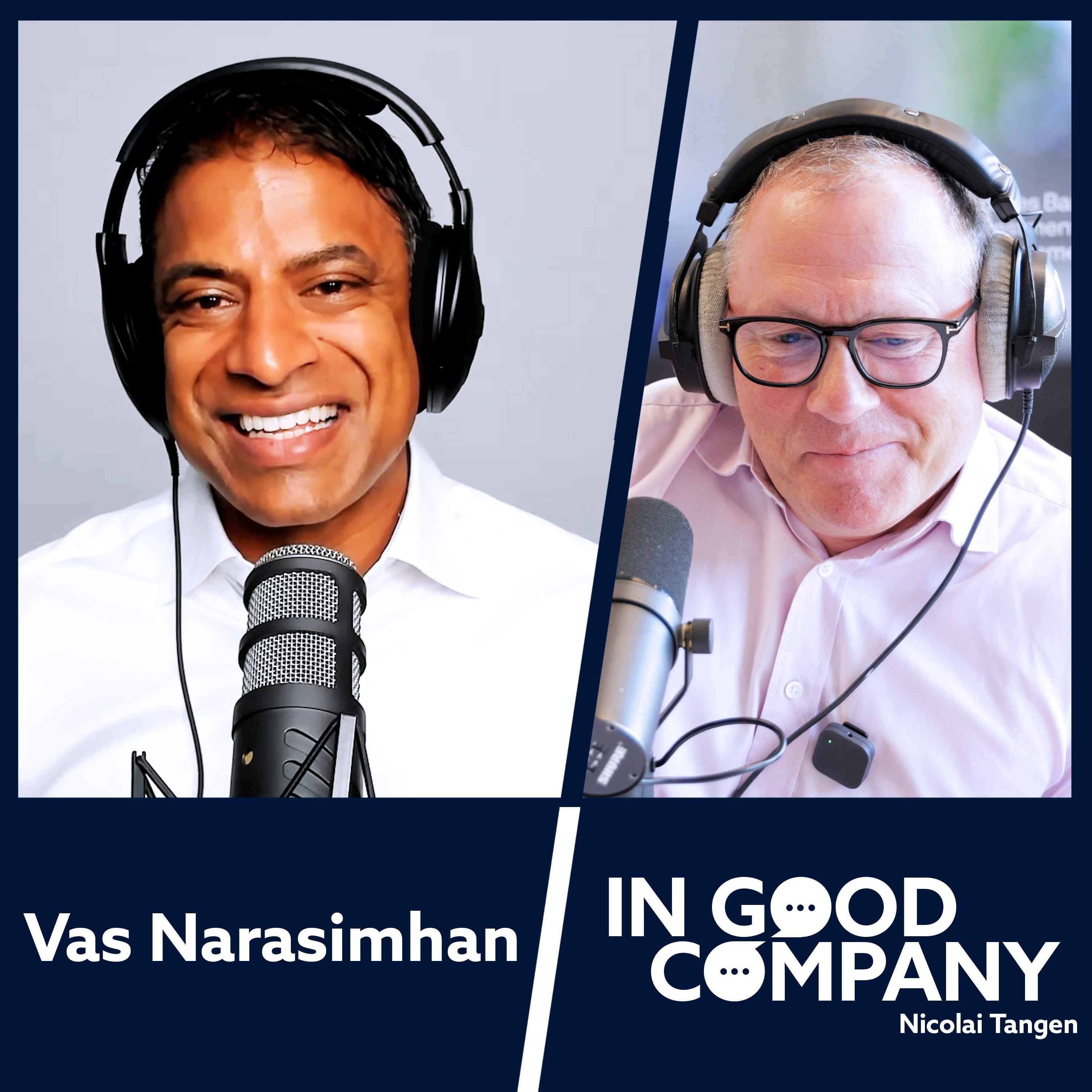
Can AI help us find cures for diseases we've never been able to treat? Nicolai Tangen speaks with Vasant 'Vas' Narasimhan, CEO of Novartis, about pioneering pharmaceutical innovation. They explore breakthrough cell and gene therapies, AI partnerships with leading tech companies, and how Novartis transformed from a sprawling conglomerate into a streamlined drug discovery company. Vas shares his unique perspective as a physician-scientist turned CEO, his concerns about Europe's declining pharma competitiveness, and his leadership philosophy of being the 'chief energy officer.' With €235 billion in market cap and groundbreaking treatments reaching patients worldwide, Novartis continues unlocking medical breakthroughs. Tune in!
In Good Company is hosted by Nicolai Tangen, CEO of Norges Bank Investment Management. New full episodes every Wednesday, and don't miss our Highlight episodes every Friday.
The production team for this episode includes Isabelle Karlsson and PLAN-B's Niklas Figenschau Johansen, Sebastian Langvik-Hansen and Pål Huuse. Background research was conducted by Isabelle Karlsson.
Hosted on Acast. See acast.com/privacy for more information.