
 Ask ChatGPT


 In Good Company with Nicolai Tangen
20 Aug 2025 · 41m
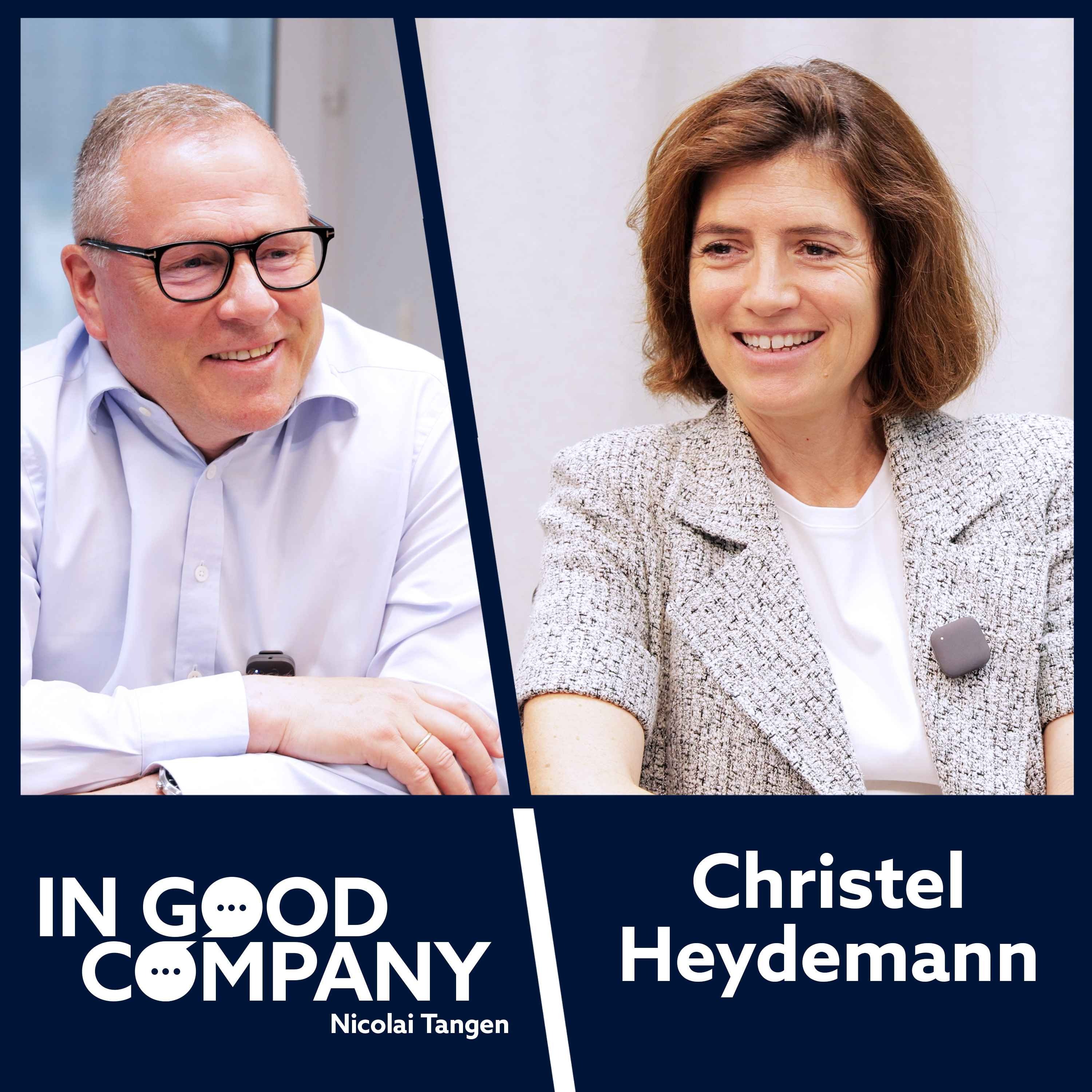
Host: Nicolai Tangen
Christel Heydemann, CEO of Orange Group
In this episode of "In Good Company," Nicolai Tangen interviews Christel Heydemann, the CEO of Orange, one of the largest telecommunications companies globally, serving 290 million customers. They discuss the future of telecommunications, challenges within the industry, and Christel's leadership philosophy.
Written by AI. May contain mistakes.

Get the gist, explore an idea or ask about something said.
 Claude
On In Good Company with Nicolai Tangen, what are the key points of this episode?
Searching your listeningAutomatic transcript. May contain errors.
0:00Hi everyone and welcome to In Good Company. I'm Nikolaj Tangen, the CEO of the Norwegian Sovereign World Fund. And today we have a very special guest, Christelle Edelman, the chief executive of Orange Group. Now, Orange is one of the largest telco companies in Europe and in the world, actually, with 290 million customers. And Christelle is an engineer by training, transformative leader and an avid mountain tracker. So we're going to learn about a lot of things, Christelle. Big welcome. Thank you. It's a pleasure to be here.
0:42Why is the telecom sector interesting? Actually, what's interesting is that we are in everybody's life in actually in good moments. And we don't realize it, but we rely on connectivity all the day. I mean, as companies are humans, we're always connected. We look at our phones. And so the technology is surrounding us and that's what we do. So we are here in the life of the citizens, the people, our families. And then, of course, where it's actually more impacting is, of course, we are here in times, in good times. The Olympics in Paris, for instance, were the great experience where everyone was connected and everyone could see.
1:19But it's also the case when things go wrong. And that's, I mean, you've seen a number of blackouts in countries or when there's extreme events. And that's when actually connectivity is more important than ever because you want to reach out to your family. You want to connect. So I think that's why the telecom sector is so fascinating because we are here. People don't realize that there's a lot of technology behind it. It's simple. You turn on your mobile phone and you see the connectivity. Actually, you're not happy when it's not connected, actually. Absolutely. What are the most important trends in this sector just now?
1:54Well, I think this industry has gone through many cycles of transformation. And so, of course, there's been first the big mobile adoption, and then the web and the mobile phones and the smartphones and the big data and the streaming of video on our networks, which has really changed the profile of the traffic on our networks. Of course, the big trend these days is the fast adoption of AI. And the big question is, what impact will that have on our networks and what type of traffic, what will change? Will we need low latency type of use cases when everyone has glasses? So we're thinking about the, we're very humble because the size of the possible.
2:35So latency is the speed it takes for. Latency, because you think of, I mean, video streaming was really, I mean, downloading video. And there's been a lot of things on our network, which actually people don't see. but content delivery networks and all that. With AI, there's going to be a lot of use cases where some use cases will be a lot about security. Some will be AI at the edge on your mobile phone when you need real-time translation, for instance. Some of it requires actually a lot of compute power in the cloud because you can't distribute it. So there's a lot of potential scenarios, and we're looking at it.
3:08We've actually created at the GSMA an observatory of AI traffic because what is for sure is that today AI keeps on increasing the volume of traffic. You see it with social networks. And I think what's probably the biggest trend is that we are a trusted partner for our customers. It's today the art of the possible because of AI, the increase of fraud, the fake news, all this debate around, am I talking to someone who's a real person when I get a phone call? And so there's also... Well, you are talking to a real person here today. I'm talking to a real person. What are the main challenges? Well, the main challenges in the telecom industry is, of course, that the value in telecom industry has been huge.
3:52Value creation when mobile adoption was spread out. Now, demography in Western world is flat, if not declining. And so there's a big question about value creation because it's a capital intensive industry. And so how do we continue to invest in our networks while creating value in mature markets? So the big question, of course, especially in Europe, there's going to be more consolidation because especially in Europe, the industry is very fragmented and it's a business of scale. And you've been vocal about the need for consolidation. So the situation now, each country, three players, or roughly 27 countries, three players, that's a lot of players.
4:34In America, three players in a much bigger country. Correct. And what are the implications of this fragmentation? So the implications is that it's a business of scale. So if you have 150 million customers on a mobile network, it's not the same, or even 500 million, or even 1 billion, as China Mobile has in China. It's not the same as if you have 20 million customers, as we have as a large operator in most of our countries, and even lower in most countries who have less than 5 million. So the cost of running the network per customer is actually more expensive in Europe than it is in other countries.
5:07So that's why we have to consolidate. Give us a feel for the difference. So, okay, I'm China Mobile, 1 billion. Correct. I'm some kind of dineer operator in Europe, let's say I've got 10 million. What's the difference in terms of cost of operation here? So the difference is ability to invest in your network, because for the same number of customers you put on your network, so of course, the size, the geography impacts. But in a given city, The cost, I mean, it's procurement because you buy millions of, I mean, mobile sites. When you're China mobile, we buy thousands of mobile sites. So there's just, it's not the same order of magnitude.
5:43And then, of course, so that's the speed, the rollout of 5G, for instance, is moving much faster in the US or in China than it is in Europe. The ability to reach the, I would say, to develop, I mean, fiber in Europe, we have the same debate. And that's because the markets are fragmented. actually, we're not benefiting from this 450 million market size that Europe is. And that's because we just have 27 member states with 27 different markets. And as a customer, how do I see it? Well, as a customer, you see it because, I mean... But do I pay more than... So as a customer, actually, you pay... You don't pay more.
6:23The consumers in Europe see the benefit. If you live in a big city today in Europe, and we have price points, especially in this country where today in France, I mean, France has the cheapest mobile data packages actually in Europe and probably even much cheaper than in the US. So that's very good for consumers. The challenge is long term, the ability to invest in network. And of course, resilience of network is a big question because of extreme events. I was mentioning it. The ability to continue to invest in it. So consumer on a day-to-day basis, you may not notice it, but for political leaders, and we've seen that, you see telecom operators selling their networks, their fixed network or their mobile networks, and then it's a kind of sell and lease back model because of the pressure on their cash flow and the level of debt.
7:12So that's actually, from a consumer standpoint, day-to-day, you don't see it unless you travel. Which is also why they have regulated it in this way, right? So the European competition regulator has thought that, you know, we need big competition in every country, right? You need three players, and so therefore you get the prices down, but you have no European champions. Exactly. And that's what, I mean, the Mario Draghi report was clear. I think it's going to be very difficult to combine to one single telecom market for various reasons in this environment. You take, I mean, security, I mean, country debt, and spectrum, for instance, is a big topic.
7:50But this is something that the member states will hardly transfer to the European Union. That being said, I think as a telecom operator, our job is to be this platform because we operate in many countries in Europe. And we can have this platform that helps, I would say, unify the customer experience. And we benefit from the scale, actually, of being across multiple countries. But it takes time. And for the time being, we are so focused on competing in every single market with, frankly, deflationary prices. Many other sectors, including utility sector, you take energy, water, food, everything, the prices have increased in the past years.
8:29That's not the case in telecom. So you mentioned platform. You are, in a way, providing a platform. You are putting in billions and billions in investments. And then, hey, social media companies come, make lots of money, much more than you. Correct. So do you think this is fair? Well, I mean, that's kind of a leading question. I mean, you know, business is not always fair. How did you end up in this situation that you are spending so much money and making so little money compared to these other guys? Well, I think part of it is because, I mean, that's the concept of, I mean, innovating on top of networks.
9:02And we are trying to create this platform that would allow us to gain scale. But part of it is because we are highly regulated. And this regulation is not just about the price and the antitrust. I'm talking about the regulation. Even the price of the infrastructure we sell is regulated and there's a whack. I mean, the whack is in the regulation. It's not the whack that our investors expect and that we as a company have. It's something that there's a parallel world of regulation. So whack is the cost of capital, right? Cost of capital that's in the regulation for infrastructure. So I think the way the regulation today is in our sector is really based on this will to open the telecom market to a lot more competition.
9:42And we need to update that. Now, the OTT player, as we call them, whether it's a video platform, social networks, I mean, the issue is that somehow they monetize data of customers because there's no free lunch. If you have free of charge service, they must have a monetization model. The issue that we see today is that, of course, their monetization model relies on more traffic on our network because the more traffic they generate, the more data they get, the more publicity they can make. Of course, for us, more traffic on our networks means more investment. So I think that's where we have a challenge and we are trying to fix it and to discuss with them because whether you have…
10:22Are you going to make good returns on your next big investments? Well, we're trying to reduce investments as a consequence. And that's what the telecom industry is going through. So we are trying to reduce investment and to limit. Of course, we don't want to decrease the quality of experience for our customers. That's a challenge. Who should bear the cost of an increased quality of video on your mobile phone when it's to serve only some of the social or video platforms? And when actually we're just doing our job, which is to provide the same quality to everyone. So there's a lot of debate and we're trying to innovate in that front.
10:58So we are now at 5G. What is 6G going to look like? Well, I don't think we're going to see 6G, actually. I think we're going to see 5.5, 5.6. So we're going to move into a nearer. Okay, what is 5.5? Actually, now 6G upgrade, that's not going to be... We got used 2G, 3G, 4G, 5G. We got used to it. And I think now we're in the world of software. Software is not about Big Bang, hardware renewal, etc. So it's going to be progressive upgrade of our existing 5G network that will be software. So that's why it's going to be a release software. And it's going to, I don't think, I mean, of course, some people are working on 6G, but it's not going to happen anytime soon.
11:35So security, how is security going to change? Well, security, I mean, we were talking about AI. I mean, I think there's a lot of questions around AI adoption and ethics around AI and private data and for companies as well, not just for consumers. And I think the question about increase of fraud and fake news and cyber attacks, of course, we're investing a lot on cybersecurity to protect our networks, to protect our customers. And we see, I mean, the speed at which the threats are increasing is just accelerated as fast as AI is accelerating. And that's going to be, I mean, a request more and more.
12:18We see that from our customers. And that's true for consumers because people are not picking up the phone anymore because they are not sure whether it's fraud or whether it's actually a real number. How often do you look at your telephone? Oh, way too often, actually. Even though I tell my kids not to. I can, I mean, in meetings, it's, I don't know. So it depends. If I get bored in a meeting, then I know if I'm looking too much at my phone, I know I should move to something else. Do you have digital detox periods? Actually, given I have kids that are still young, they are my detox because when I go back home in the evening, they want me to read them a story and they don't care whether I've had a good day or a bad day.
12:59I still have to work. So that's my detox.
13:07Just coming back to the security and so on, how should we think about supply chains? So, for instance, Chinese providers of infrastructure. Well, I think supply chains are really interconnected these days. And we've seen that during COVID. And we see that today, the technology. And of course, we follow the rules when in some countries where we are instructed not to use some vendors. And that's especially true for 5G, for instance, Chinese vendors for 5G in Europe. That being said, when we see the speed of innovation in China, we work as well with Chinese vendors, of course, more in Africa than in Europe.
13:50What's difficult is that, of course, I mean, Chinese vendors or European vendors, when there's scarcity, and we've seen that with all the supply chain disruption, I mean, whether it's a chipset, whether it's energy, actually, which is a big, big, important item for the continuity of our activity. Of course, all the equipment, the devices, we don't like to have one source, one vendor. So we tend to have this policy where we, of course, want to rely and diversify our sources. But in some areas, it's very difficult. And mobile network is an example where there's, I mean, China vendor or two European vendors.
14:28But if you just look at the technology, how does the Chinese technology compare with European and American? Well, I mean, is it better or worse or same? I've worked 15 years at Alcatel-Lucent. So I've seen the Chinese vendors growing. It's actually cheaper. I mean, the more advanced, more efficient from an energy standpoint. So it's actually a very good technology. I don't think European vendors are far behind, but they're actually not benefiting from the size and the investment that Chinese operators make in China. And so Chinese technology, when it comes to mobile network, are very good. How safe is my communication?
15:07Depends what's your routine. Make sure you upload, make sure you update your OS on your phone whenever there's one new, because most of the, I mean, there's a lot of training we have to do. And that's true for company leaders. That's true for individuals. But there's a reason why you get a node for whether you're on the Apple environment or Android environment. But there's a lot of investment from tech companies on security, I mean, on protecting consumers. And so make sure that you update it whenever there's a new OS coming on your phone, because most of the time it's to fix a security issue.
15:44What do you put in the expression digital sovereignty? Well, digital sovereignty is complex because the reality is that it should not be understood as let's close the border. And if we think about Europe, digital sovereignty for Europe. Europe relies a lot on technology that comes, we were discussing China, but of course, US technology, chipsets coming from Asia as well, devices, I mean, mobile devices coming from Asia as well. So I think digital sovereignty, the way we call it is really strategic autonomy. We've defined it at Orange on the four C, one being the control, understand your supply chain, understand, try to avoid having, I mean, single vendors type of environment, choice.
16:24I think choice is both having many options, but it's also reversibility. And there's a lot of question behind, I mean, can you move backward in case you want to change? Not easy with many technology. if we think about cloud and all the AI tools. So choice, control, competence, because I think many very often, and that's true in Europe, but that's also true when I talk to country heads in Africa, for instance, having the competence and the skills and the know-how to be able to understand, just to understand what are your weaknesses and how should you use the technology, that's also part of strategic autonomy, the skill set.
17:05And then, of course, the fourth one is really the scale. So it's making sure that you benefit from the scale. And that's where Europe is somehow at a difficult situation because of the fragmented environment in Europe. Do you have a responsibility to try to close the digital divide, i.e. that poor people have less access to your services than more wealthy people across the world? Is that part of your responsibility, you think, or are you only about making profits? No, that's very important for us. And we operate in countries in Africa where actually when we bring connectivity to some people, we bring energy together.
17:58So we enable people to grow and to study and then to have a job and then to connect to the world. And so that's really deep in our conviction. And that's why we are really, I mean, in Africa, especially, that's true in Europe as well. But to some extent, the level of connectivity in Europe is much ahead, of course, what we see in other parts of the world. So that's always been very deep in our values to make sure that we reduce the gap.
18:31Christel, let's move on to artificial intelligence. What part of AI are you the most excited about? Well, I think what's most exciting with AI is the speed of innovation. And what is really exciting is that AI will enable also to accelerate innovation in other sciences. And so connecting, I mean, some science verticals to, I mean, you think of healthcare, drug discovery, you think, I mean, science in physics, being able to use AI to have twins for cells. I mean, the exponential and the more we think of it, the more we have ideas of things that could accelerate. So to some extent, it can be also a bit scary because we feel that we may lose control.
19:20But really, it's exciting to see how AI may allow us to address issues that really we thought were not possible. I mean, to have new drugs to address. We think, of course, of resources being able to create new materials. thanks to physics. So that's, of course, outside the telecom industry. But that's really, if we think about the possible, that's just fascinating. When did you get this wake-up moment? Well, I think I keep having it. Every time I talk to companies who innovate with AI, I'm still as amazed as I was two years ago, first time I saw how fast OpenAI, Chad GPT was adopted. And every time I see a new field And I'm still amazed at how it even seems that it keeps accelerating.
20:12Do you think people generally have realized what's going on? I think on one side, there's been a lot of debates. And there are a lot of debates, especially in Europe. We've been debating regulation. We had the AI summit in Paris hosted by France and India. And there was a lot of debate. So people talk about, I think, I mean, you talk to young people. They use AI all the time. So they're already into it. But they don't use it with the, I mean, it's just to manage knowledge somehow. I think the more we think of it, I don't think most people realize on one side, especially in Europe, I mean, we need to be humble.
20:51We need to learn. We need to adopt AI because I think what would be, I mean, an issue for Europe would be to stay behind and to wait and see until it's actually too late because time is really accelerating. And speed is not something where we tend to be good at in Europe because of, I mean, the political environment, the regulation, et cetera. And so I think it's our role as company leaders to work with, of course, our suppliers as well, to make sure that we really adopt AI as fast as possible. There's a lot of questions on ethics, which we have to address. How is it changing, Orange, the way you work?
21:28Well, the way we work, we've developed, I mean, we've provided tools to employees. We have 70 ,000 employees who use it every day. So that's more day-to-day management, testing it. And then, of course, we're developing. I mean, now there's this agent AI, agentic AI, which job by job, we're testing it. I think what's very interesting is that AI will be a technology very decentralized. So you need to define, of course, some very strong fundamentals, platforms and protecting the company. But then you need to put the technology in the hands of managers because that's where the transformation happens.
22:06And it's not something that we can decide in a headquarter or in a meeting room and then decide that we're going to spread. So I think there's a lot of things very interesting with AI. And we see it, whether it's in finance, in HR, in sales, in customer support, of course, big, big time for customer support. Now, it takes time as well to roll out that scale because it addresses things that we all know. I mean, quality of data and then making sure you cut the silos that you may have in your technical depth, etc. So there's a lot of things that we were working on already before that just keep on being visible with AI adoption.
22:44I believe that earlier this year you demonstrated the world's first real-time conversation using generative AI enhanced by 5G. So what is that? Well, we have this demo at Mobile World Congress where actually, if you want to have real-time translation, and what's interesting with AI is that voice will be, I mean, in many actually, will be a new interface. Some of it will be back to voice in the way we interact with our mobile phone, because it's going to simplify the interface with machine. And so voice will be a new human machine interface, not new on the mobile phone, of course, but it's going to be new in many other devices.
23:27And so it's very exciting because our industry comes from this voice interaction. We've moved to data and now everything is IP, etc. But voice will be important. The latency that we require to have this type of conversation between humans is a very low latency. You feel it immediately if it's not the latency that's required for voice. And that actually puts challenge on our networks if you really want to have that experience with an AI translator, for instance, or with an AI agent and getting this voice experience. Now, if the agent is on your mobile phone, latency can be managed. I mean, assuming you have the right compute power in your mobile phone.
24:07So there's a lot of technology challenges behind. But this experience of voice in the tech world is really different from this best effort environment which we've built with data and IP and video so far. So if you speak French and I speak Norwegian, what would that conversation look like if we had live translation? what kind of delays would there be? Well, that should be the objective, to have a natural conversation with people using their natural language. And when will we have that? Well, that's, I mean, today the technology is not at the right level. Or today the technology starts from voice, translates with text, so you have voice, text, text, voice.
24:59For that to happen, you need voice, really a voice type of direct interface to get the low latency. So there's, I mean, you have some experience, but to get it at scale on our networks, it's going to take a few years. But it's not decades. It's really... It'd be cool, huh? I think for Europe, if you think of it, I mean, the US or the China market, they benefit from one language. One of the issue in Europe, issue strength let's put it that way the diversity of languages and culture if AI could help reduce the barriers and between people that would be cool now I don't think we should stop studying languages because it's also studying cultures and understanding each other yeah yeah well you are in a way multicultural right married a German and raising children with a lot of languages so you know all about it moving on now um what kind of things should a telecom company do i mean you're into money uh so where where what's core what's not core well that's that's a good question because we've tried to diversify i think all telecom operators have tried to diversify sometime time unsuccessfully for us.
26:15I mean, we tried to create a bank and we decided to move away from it. The real question is, what do your customers expect you to provide to them? A lot of people, I mean, a lot of companies come to us and they see the power of having the customer base we have, the network. So as a distributor of technology, we actually do a lot of things. And that doesn't mean you need to do it yourself, which was the case in terms of creating the bank. So you can be a distributor. Of course, cybersecurity is something that is an adjacency, which we've developed and makes a lot of sense because we want to be a trusted partner.
26:53And I think the more we progress, the more AI is rolled out. This notion of trust in our relationship with customers, with governments, is going to be very important, with companies as well. So we want to really put trust at the heart of everything we do, which means that you can actually add a lot of adjacencies behind this concept of trust. Because, I mean, we do, I mean, infrastructure, for instance, for us, infrastructure is, of course, something that we use for our networks. But think of it, we have submarine cables, we have vessels to repair submarine cables. And we consider that this is part of our business line around valuing infrastructure, which we think many telcos have moved away because they had to.
27:39We think that's a fundamental value that's in the company to be in this infrastructure layer. When it comes to services, I was saying cybersecurity, but we are reselling or innovating with many types of services. Home security also, we do that in France, in Spain. We are reselling energy in some countries, sometimes successfully, sometimes unsuccessfully. But in any case, insurance is something we do as well. In any case, the diversification of services remains something that has not been, and I think even the telcos who have been the most advanced, it limits to 10 % of our total turnover. So now in the B2B space, for instance, cloud, AI, cybersecurity, for sure, are big diversification that we've made and that we will continue to invest on compared to the traditional connectivity, of course.
28:31You have a technical background and spend time at Boston Consulting Group, Alcatel-Lucent, and Schneider. How do you think that background is forming? How do you think about strategy? Well, I think that, I mean, I don't go deep in understanding the technology, but being able to ask questions to engineers, to really, and I like to understand some of the technical challenge we have. And so being able to dive, I mean, we could talk about quantum, for instance. I mean, I studied quantum physics when I was at school. I find it fascinating some of the things that are behind this disruption, technology disruption with quantum.
29:12So being able to understand some of those challenges, and I think we live in a world where technology is everywhere, and disruption has come as much from great customer experience as from deep technology disruption. So I think my engineering background is really trying to understand in a more systemic approach the impact of technology. We never, I mean, technology, sometimes technology can be seen as we are technology pushers instead of being a solution or problem fixers. And I think that's the challenge of engineers, that sometimes we love to build very complex solution to a problem that may not exist.
29:53So that's where my engineer background is also very balanced by my very pragmatic leadership style, which is, okay, this is way too complex. Explain to me very simply what's the problem we're trying to fix. So, and I think you need to both when you run a big company, but being able to go deep and really spending time with engineers is also fascinating, especially in a company that invests so much in technology. Tell me a bit more about your leadership style. Well, I'm someone pretty direct, so I don't like to waste time in meetings when people try to not say things or when we don't put the real issues on the table.
30:33But I'm a very energetic person. And I think I've had that, I've learned that from one of the CEOs I work for in the past who was saying, you know, in companies you have energy givers and energy takers. I'm definitely an energy giver. And I think to run a company of the size of Orange and to make sure that people get excited by indeed, I mean, hiking mountains, addressing challenges, winning together, I think this positive mindset of, I mean, providing energy to everyone to accomplish big challenges, I think is fantastic to move things. Well, you know, CEO stands for chief energy officer. Chief energy officer, yeah.
31:10Where does your energy come from? What is energy? Well, for me, you know, I wake up every morning and I'm like, actually, the more challenges we face, it's not that the more excited. Because frankly speaking, managing crisis is not something that's exciting. But somehow, I get excited by challenges. And the bigger the challenge is, the more excited I am. And it comes from, I think I've had, I mean, part of it is I was lucky and I was born under the right star, I guess. But part of it is because I've seen the power of winning with teams. And I've seen that when I was an account manager and winning a deal where everyone thinks you're going to lose a deal.
31:48And then suddenly you see this pride and the spirit of it. So this winning mindset is extremely powerful to climb mountains. And I think... Who are you trying to show? Who do you want to prove? Nobody. Myself. No parents or... No, of course. I mean, I think my parents are very proud of where I am today. And so I don't think they're really... They still struggle to understand what is it like, your agenda. You know, my mother was a professor in university, so she understands what it is. But going from meetings to meetings, not really understanding what I do in meetings is something a bit weird. But of course, no, I want to be, I mean, I'm more excited by the impact I can have on the people I work with.
32:31And that's why this winning spirit and, you know, showing to people that sometimes people feel that things are impossible. And then they realize that actually with hard work, teamwork, things are possible. Did you do competitive sport? Not at all. No. I was dancing, I'm running and I'm swimming. So I'm not, but I have this very competitive mindset where I like to win. And where does it come from? I don't know. I don't know. Maybe because I was the elder sister and I have two twin sisters who pushed me, you know, I had to fight at home. So maybe that's where. How has your leadership style changed with age and experience?
33:10I think I'm still genuine. I mean, some of it, of course, experience is I go faster to addressing issues. You know, when I was a younger leader, I would sometimes, you know, say, look, I mean, politics, there are things you can say, things you cannot say, et cetera. And now I've learned that, I mean, time is really the scarce resource in my job. And so making sure that every time I see a small issue, I address it with, it can be even people relationship in my team or with people I work with. And so I'd rather pick up the phone and say, look, is there an issue here? And sometimes you realize there's a big issue that people are trying to hide.
33:51And so you can address it. So I think being probably more direct and addressing things more openly is even more present now than it was when I was a young leader trying to figure out what are the things you can say, you cannot say. Are people generally direct in Orange with their feedback? I think they were not. And actually, we had our leadership meeting where we gather a lot of, I mean, all our leaders in the company. And I've been very explicit with them that I want people to come to me with, don't tell me what you think I want to hear. And when I say something, I expect you to say, I disagree.
34:27Because we need to have debates. How long time does it take to get that type of attitude into a company? Oh, years. I mean, culture is something that we're working on, but it takes years to change a company culture. And by the way, it starts from the top. Totally. What part of the orange culture are you still trying to change? Well, I think, you know, we've defined our company values and there's one that's very important, which is boldness. And I think as a company, we're very good at managing risk. But this boldness, which means willing to test, willing to learn from failures, accepting failures, and speaking about failures, we tend to have a culture where we talk a lot about the things that work well, but we don't talk about the things that do not work.
35:12And that's my direct style but also making sure companies grow only. You learn more from actually failures and mistakes than from things that work well because sometimes you're just lucky and things go well but actually you can learn a lot more from failures. Do you have a system in terms of how you prioritize your time? Well, I'm not sure I'm a master at that. I'm still working on it because time is really the challenge. But yeah, I have a system. I try to, all the Fridays in my agenda are free up from meetings until the week starts. And then I can add the, but Friday is the day when I like to think, do things that can be, so can be urgent things or can be thinking and planning and stepping back and meeting with people that may not be directly in the agenda.
35:58And are you in the office every day? I mean, I travel because I like to go in the field, but otherwise, yeah, I'm in the office. I don't work from home. In terms of this direct feedback and so on, the state has a stake in you, right? The French government owns 23%, yeah. Do you think that impacts your corporate culture? Are you a bit of a state-owned type of thing? I mean, of course, historically, we still have civil servants at Orange. And so part of the culture in France or in some other countries where we were incumbent is coming from this administration mindset. Now, a lot of people came in the company long after, but definitely in the company culture, there's part of it, which is, I mean, coming from the administration world.
36:40And how do you change that part of it? Well, that's all the things we're doing, which is there are good things that come with this. So we're trying to keep what is good because... What is good? Well, the good thing is that this deep, I mean, willingness to serve customers. And, you know, people, when there's a storm and the network is down, people don't count their hours. They just go in the field. We had this big storm in Mayotte where the network was completely crashed and we had people who lost their house. Still, our colleagues were coming to work repairing the network even though they had lost their house.
37:17So that's really deep. And that may come from this civil servant culture, even though we're not coming from the administration in every country. So that's very powerful. Of course, some of the things which are maybe more, I mean, you take leadership development, talent development. I don't think administrations tend to manage people more equally. And I think that's some of the things we're addressing.
37:49What's the best career advice you ever got? Actually, I've had a lot and I did not follow all of them. because I tend to, and I've worked with a lot of great CEOs. What's the ones you haven't followed which you are glad you didn't follow? You know, I've had a lot of advice. Actually, I had one advice, which was don't join the Orange Board of Directors because I had a proposal to join two boards. I would not be the CEO of Orange today if I had not joined. So I did not follow that advice, which was - Because you were on the board for five years before you became the CEO. I was on the board for five years and my instinct was I should join this Orange Board because I've been in the telecom industry for 15 years.
38:29So I'm going to bring value as a board, as a director on the board. But I mean, that's one example. But I think sometimes I've had advice on don't take that job too risky. And actually I'm like, well, maybe if it's risky, that means, okay, I can fail, but I'm going to learn. And if I succeed, then I'll be more visible because guess what? Nobody would expect me to succeed. And where do you get that risk appetite from? I think, and that's something I tell, I mean, when people ask me advice for young people, I don't like to get bored. So every time there's new technology crisis, not that much, but I mean, new challenge to overcome or new project to win.
39:10I like this idea that we're going to learn together and do great things together. And I've had that, I mean, again, this winning mindset, which is it's much better to win big things than just to win small things. And I don't like to get bored. So when I feel I'm not learning, which I'm not bored. These days we learn. We learn every day is bringing new things. But if you were to turn this around and actually make this internet advice for young people, which we always do at the end of this podcast, what would you tell them? It's really if you go to work and you feel you're getting bored. I mean, have the courage to move on and move out of your comfort zone.
39:49And of course, being bored sometimes is good because that means you also have some time. But if you get bored and you just go to work thinking, well, I just go to work. I mean, when people are young, I mean, they have their entire life to accomplish. Life is always too short, actually. So don't get bored. I mean, knock on the doors of other people or talk to your managers. In my case, when I was getting bored in my jobs, I went to my manager and said, well, I think I'm not learning anymore. What can I do more? Which doesn't mean changing jobs, but at least making sure you ask for it. Well, Christelle, life is short.
40:28Time is scarcity. And we are really happy that you spent some time with us. We've learned so much. Big thank you. Thank you. Thank you for the time.
What does the future of telecommunications look like? Nicolai Tangen speaks with Christel Heydemann, CEO of Orange Group, about running one of Europe's largest telecom companies with 290 million customers. They explore Europe's fragmented telecom market and the challenges of consolidation. Christel shares her direct leadership style, why she's an 'energy giver,' and her philosophy of tackling big challenges head-on. Discover how Orange is building tomorrow's connected world. Tune in!
In Good Company is hosted by Nicolai Tangen, CEO of Norges Bank Investment Management. New full episodes every Wednesday, and don't miss our Highlight episodes every Friday.
The production team for this episode includes Isabelle Karlsson and PLAN-B's Niklas Figenschau Johansen, Sebastian Langvik-Hansen and Pål Huuse. Background research was conducted by David Høysæter.
Hosted on Acast. See acast.com/privacy for more information.


