
 Ask ChatGPT


 In Good Company with Nicolai Tangen
21 Aug 2024 · 45m
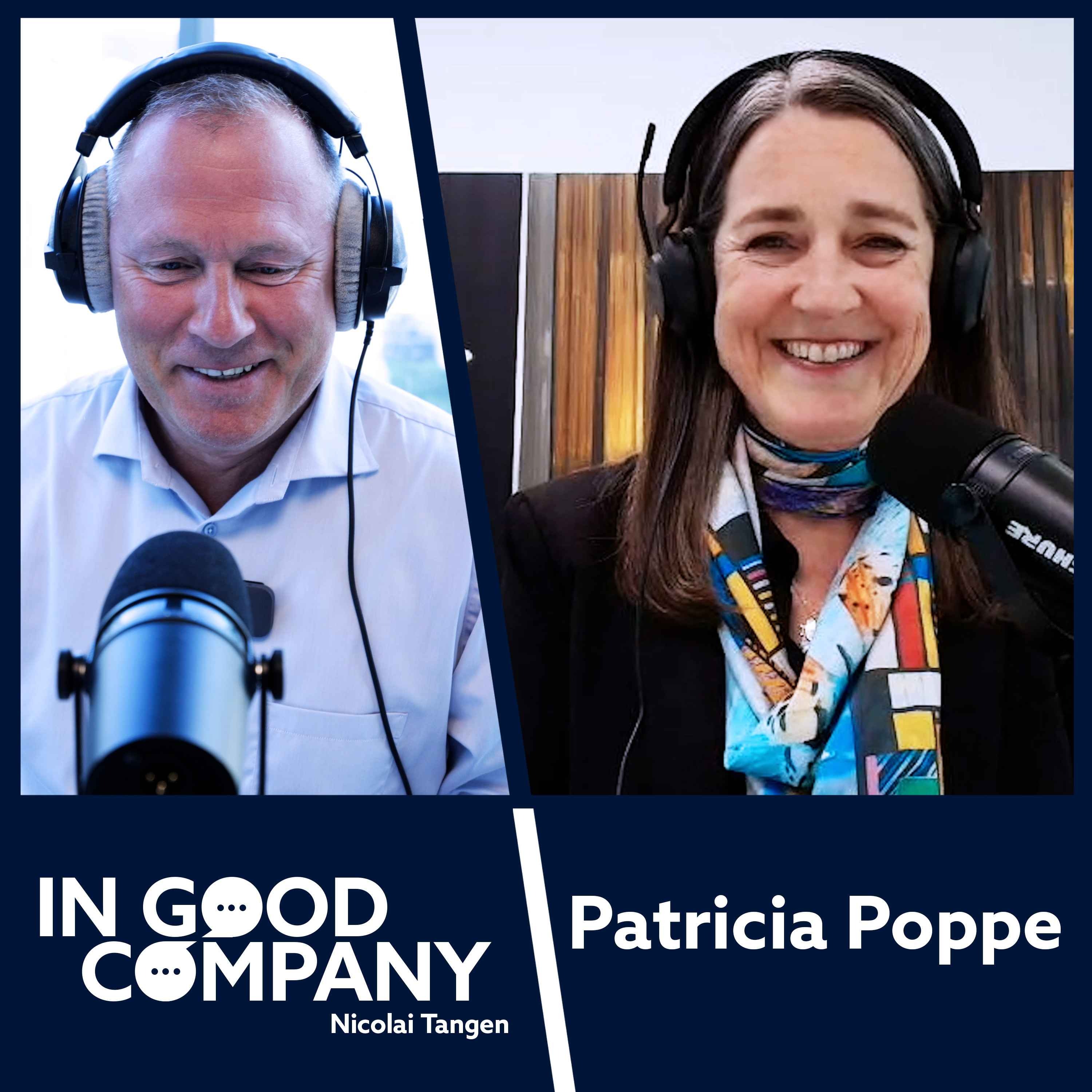
Host: Nicolai Tangen, CEO of Norges Bank Investment Management
PLAN-B's Pål Huuse and Niklas Figenschau Johansen
Arabella Graves and Kristin Verpe
This episode features Patricia Kessler Poppe, CEO of the Pacific Gas and Electric Company (PG&E), discussing her transformational leadership approach and the company's recovery from bankruptcy due to climate-driven disasters.
Written by AI. May contain mistakes.

Get the gist, explore an idea or ask about something said.
 Claude
On In Good Company with Nicolai Tangen, what are the key points of this episode?
Searching your listeningAutomatic transcript. May contain errors.
0:00Hi, everyone. I'm Nikola Tangen, the CEO of the Norwegian Sovereign Wealth Fund. And today we have Patti Poppe with us, the CEO of PG &E, one of the United States' largest utility companies. The fund owns more than 1 % of the company, just under half a billion dollars. And so it's a big position for us. Now, in 2021, Patti took over the company, which was then in crisis. Well, you were pretty much bankrupt. And now Patti is here to teach us how to lead with love. Warm welcome, Patti. Well, thank you, Nicolai. It's so great to be with you. And thank you for your ownership.
0:43Just to kick off, what is PG &E in a few words? We are a combination natural gas electricity provider to almost 40 million people in the state of California. We serve 16 million of them. Proud to be the energy provider to northern and central California. Great. Now, what happened before you joined? I would say a series of, in some cases, particularly wildfire, disaster, climate-driven, and frankly, a company that hadn't built infrastructure to withstand these new extreme climate conditions. Great harm was done to people, communities, wildfires, that devastated towns, lives were lost, and our company went bankrupt.
1:36I think some people refer to us as the first climate-driven bankruptcy, and we are rebuilding our company as a result. Wow. What's the key to rebuilding a company after something like that? I think recognition that we need to make it safe and make it right. In fact, I got some advice from Mary Barra, who is the CEO of General Motors. When I took this job, I felt she had had some experience when she took over the helm at General Motors. She had some real crises and safety-related crises to deal with. So I called her, and she said, well, I'll give you the advice that Warren Buffett gave me. And I said, well, okay, I'll tune in.
2:19And that advice was make it right and do it fast. And so it actually became very influential in my thinking about making our system safe as quickly as possible and making it right for those who had been harmed. It's quite a challenge to take on. I mean, do you like problems? I do. I'm an engineer by training. And so I enjoy problem solving. I also think that it was a great opportunity for me to build on my previous experiences. In fact, our current board chair, Bob Flexin, encouraged me when we were doing the recruiting process. that this could be my, in fact, professional final exam, that everything I learned in my years in automotive about lean manufacturing and operational excellence, combined with my years in the utility running a very successful utility in Michigan, were going to be put to test.
3:09And that PG &E was, at the end of the day, just a utility, but it was a utility that was in need of great transformation. And so I felt compelled to come and do my part. what what lies in the advice make it right do it fast i think uh the idea that we need to certainly uh heal those who had been harmed and make sure that we didn't forget what happened and i think do it fast means uh make the changes necessary to make that system safe and so the The wildfire mitigation efforts that we've implemented, technology, infrastructure, really have been game changers in the environment in which we operate.
3:59We've dramatically reduced wildfire risk. We have dramatically improved our infrastructure, and yet there's more to do, and so we're doing it as quickly as we can. I've heard you say that you thought it was attractive because this was not about financial engineering or change this was about operational change so so what you do first day into the job you come to the office just how do you approach a task like that well first and foremost I knew I had experience with something we refer to at PG &E as our performance playbook we had key elements the safety management system, a lean operating system, and something we call breakthrough thinking.
4:41Those three key components I knew would be the key components for transforming the culture of PG &E, creating a safety culture, and creating an environment where we could serve and we could reliably deliver. So my first day, I will tell you what I did. I drove to Paradise. Well, no, pardon me, I started my day at our union hall and met with our union president and his executive team because I knew I would need the partnership of my workforce. And I wanted them to know that I both knew that I needed them and that I respected them. So I started there and they found it quite interesting. I showed up in my pickup truck in my blue jeans and it was just me, no entourage.
5:24And they were like, who are you? And I said, I'm the new CEO. And they said, where are your people? I said, I don't know, but I'm here with you first. So I did that first. And then I drove up to Paradise, California, which was devastated by wildfire. And to see, this was three years after the fire and it was still felt apocalyptic. The devastation was still obvious and we were rebuilding as quickly as we could, but it made it, It really came home for me that this was a challenge that required speed. Where had you learned to empower people and to get them aboard the way you did? Through my career, I was a lifelong operator.
6:11And to your earlier question, I knew it wasn't a financial transformation. It was an operational transformation, which appealed to me. Um, we, uh, I learned both in the implementation of lean operating system that that's a bottoms up, uh, people driven, continuous improvement, culture mindset, sort of, um, uh, toolkit. And, uh, so I had learned when I went to the utilities, when I left automotive and went to the utilities, I ran power plants and I got to experiment with implementing lean techniques in power generation and then implemented it in customer-facing functions and then in all the operations when I led operations at Consumers Energy, operations and engineering, that all of these lean problem-solving toolkits, standard work and visual management and problem-solving were very much applicable to the utility work environment.
7:09And so I had all of that experience. I used to wonder when I was a young professional how CEOs knew what to do. Patty, you're still a young professional. Well, thank you. You can't see the gray hair well enough, I think. I used to wonder, and now I actually was walking into this role knowing exactly what to do. I knew that this utility required a way of operating that made problems visible faster and taught people how to solve them. and that if I could enable my entire workforce to be problem solvers, not a handful of problem solving specialists, but in fact, the entire workforce to be problem solving professionals, then there was nothing that we couldn't do together.
7:53And I've already seen the early signs of progress here at PG &E of how impactful that can be. When you approach a situation like that, how do you map what needs to be done? I mean, you say you had a playbook, but this was a different situation. Yeah, well, my new leadership team, thing one was to have the right team. So I had to hire an entirely new leadership team. Everyone had either left or had been asked to leave. I had, my attorney was still there, thankfully, my general counsel. He's a very important part of our team. He stuck around, but everybody else we had to hire. And so the first thing to do was to define our purpose and define...
8:36Did you hire of people you knew from before? I knew of them. I hired very, very talented utility professionals from across the sector and then peppered in a few non-utility experts and specialists because I like a little competitive mindset and competitive experience peppered in. I think it's part of my secret sauce that I both learned in a competitive industry plus the utility industry. Why did they want to join you? I think we felt, all of us felt compelled to serve. We knew that the industry needed us to make PG &E successful. We knew California needed us to deliver on the clean energy transition, to really bring an energy system that was climate resilient and affordable and reliable.
9:26we all felt like we had the right experience to come and run this company to meet its full potential and to deliver on this commitment to the people of California and therefore the people of the world. And when you say competitive element, what do you mean by that? I mean, I grew up in the automotive industry and that was, you know, dog eat dog. You had to improve every day to succeed and to thrive in that environment. I think some people would look at a utility and think that because we have regulated cost recoveries and regulated revenues that perhaps were less competitive minded. So I like some commercial experience combined with the technical expertise that's born in a utility with that commitment and purpose-driven mindset combined with a commercial mindset that every dollar matters, that we need to improve for customers every day at a lower cost.
10:32But how do you get a competitive mindset into what is basically a monopoly? I think teaching people how to think competitively. competitively. So it helps to have a few of the executive team with that commercial mindset. But one of the most important things in our lean operating system is making problems visible, showing our daily performance, having not just reliability targets, but cost targets. We have an operating and maintenance expense reduction expectation. We build on that expectation and teach people that they can, in fact, do more for customers at a lower price. We can save money for customers while we are improving their service.
11:11I remember learning that in the automotive industry, that quality and cost could both be improved simultaneously. And that's what I've learned in the utility sector. It's the same. We can improve customer outcomes at a lower cost.
11:28What have you done to the corporate culture since you joined? Yeah, our objective was to deliver on creating a culture of service and performance. And we've done that. We started with something we call breakthrough thinking, which is a part of our performance playbook. Breakthrough thinking is something where we teach people that the past does not need to be a predictor of the future. In other words, what is true today does not necessarily have to be what's true tomorrow. You get to cause your future. We get to cause our performance by a pursuit and drive for breakthrough outcomes. So we have put over 2 ,000 of our leaders through a four-day breakthrough intensive workshop where they learn that what was true in the past is not necessarily true in the future.
12:21And they learn that they can believe in themselves. And how do you teach them that? To remind them that every great innovation didn't used to be true. Every great outcome didn't used to be true. And part of our team really needed to, frankly, have some healing about the past. You can start to believe your press when people say we're criminals, when people say we were irresponsible. People can start to believe that about themselves. We have to help people learn a new file about themselves, that their potential is theirs to cause and theirs to achieve, and they have to believe that they can achieve wildly outrageous outcomes because they stand for them to be true.
13:04So, for example, we've taken a stand that everyone and everything is always safe. Now, some people in an environment like ours might say, well, that's impossible. You can't do that. Well, we've proven we've reduced our employee injuries by over 50%, 70 % in some areas. We've reduced our number of preventable motor vehicle instruments or incidents in dramatic fashion because we've taught people that they have to challenge how things have been done in the past in order to do them differently today.
13:44You talk about the philosophy of leading with love. What does that mean? By the way, I'm a huge believer in this, so you're talking to the converted here. Okay, good. Well, I got a lot of rolled eyes when I first said that when I joined the PG &E team. But what I believe is, number one, we need to humanize our business. I do think business in general can be a force for good, but ours in particular, people ask, are you an engineering company? Are you an energy company? I say we're a people company. We are people who are serving people. That is the heart of our business. And so we need to recognize that love is a fundamental attribute of taking a job and taking it from a work pay transaction to a commitment to serve and to bring your full self to the work.
14:41I've had the unfortunate duty to attend a funeral of a co-worker who died on the job. And the outflow of love and the expression of love at such a funeral is too late. The moment to demonstrate love is on the job when someone is doing something they don't understand or taking a step that is too high risk or not taking the necessary steps to be safe. That is the moment to love one another is to interrupt the work, stop the job and make sure we're doing it safely. And so that is definitely safety and a safety mindset is an underpinning of how we demonstrate love for one another at work. But that same commitment to safety through our safety management system is how we keep our customers safe and demonstrate love for our customers by doing the hard things so that they can have a safe and reliable energy system.
15:40What other things than safety have you implemented to express this philosophy of love? Yeah, we have a joy survey that we conduct. I do believe that when people, one of the stands that we've taken as a management team is that it will be enjoyable to work with and for PG &E. So to measure that, we're not just making these lofty statements we intend to measure. We measure our safety performance. We measure joy at work. How do you measure joy? We ask four questions. Question one is, do you enjoy working at PG &E? Number two is, are you proud to work for PG &E? Number three, are you loved at work at PG &E and are you known at work?
16:25And it might surprise you to know that over 80 % of our coworkers are both proud and enjoy to work for PG &E. Now those are up double digits since we did the first survey. We've been taking the survey a couple years now. To feel loved at work is about 50 % of my coworkers feel loved at work. And that's something then that we've created a whole conversation with. You know, one of the things that I observe in athletics, for example, these professional athletes, when they have a winning or a losing season, they will always inevitably say, I love my teammates. I would go to the ends with them. They jump into each other's arms.
17:08They laugh together. They cry together. They have the full expression of their professional joy. And I think we in corporate America I think there's only so much joy that one can observe or demonstrate at work, that there's a professional joy that for some reason athletes get to know the full expression. I'm challenging my team to know the full expression of their emotion, and that's because they can be purpose-driven. and when you are purpose-driven and you do the hard thing, why wouldn't you know the full expression of your joy and love for one another as you are fulfilling your full potential as a human being?
17:48This isn't work for pay, but this is work for purpose. But why do you think the athletes feel it differently from people in the workplace? I think there's a culture that says it's okay for athletes to fully express joy. I want to change that culture in corporate America. Why not? Why can't people feel their passion and maybe their passion is spreadsheets? Okay, good. Show your passion for your spreadsheets and feel loved and valued for being the best spreadsheet person there ever was. For us doing line work and gas work and providing heat on the coldest day and light on the darkest night, that's way more important than putting a ball in a net.
18:31why can't we know full joy and love of one another as we deliver such work? You said people were rolling their eyes when you started to talk about it. Are they rolling their eyes now? Way less. There might be a handful of them. I haven't met them. If they spend any time with me, I'll help them get through it. Is there some religious underpinning here? I think that each of us have talents and capabilities that when we are fully expressing them, we are fulfilling our life's purpose. What the genesis of those talents and skills are, I think each individual can choose the source of them. For me, I certainly have a source where I believe that I was called to serve the people of California and the people of PG &E at this time, and that I was prepared for a time such as this.
19:28I believe that for myself. So you've seen an increase in the joy index, fewer people are rolling their eyes, these kind of things. So specifically, what are the biggest changes you've seen amongst the people you work with? Yeah, I think their freedom to innovate, their freedom to have the big ideas, their freedom to contribute to the cause, and the freedom to be known and loved at work. Every day at 10.20 a.m., the executive management team reviews yesterday's performance. We are passionate about the work that our people do. Our people know that they have a channel where they can communicate what the barriers are that are preventing them from solving the problems that they face.
20:15I am watching their capability to solve problems unfold. I am watching, as I do, go and see visits to see the work and see how they do it. I am observing them taking more and more ownership for our business and for our ability to serve our customers. And so we see that in our safety measures, in our speed to deliver measures, in our reliability and in our affordability measures, our cost reduction measures. We're seeing those ideas take material shape in how our business is performing. And I think we're on the cusp of continued breakthrough in being able to deliver what I think is the most exciting time in our industry since Thomas Edison originally invented it.
21:06We can't do what we've always done and deliver the new decarbonized energy system at the lowest societal cost. We have to do it differently, and I'm watching my team step up for that challenge. is is there not a contradiction between making a safer organization and one with more innovation so for instance in the large uh energy companies everything has to be safe even in your headquarter on land you kind of hold the handrail you uh you park your your car uh you know in the right way so that you are tired into the spot yeah you're back in the morning because you're tired in the afternoon and you crash less, all this kind of stuff.
21:45Can you really have a super safe environment in that part of the business and then be innovative, try out new things, take risks when it comes to procedures, technologies, and so on? This is where I think the lean operating system is so powerful and what Toyota taught us decades and decades ago. You can have standard work that is determined to be the safest work. But then you set a target, your breakthrough goal, whether it's zero injuries or whether it's 10 ,000 miles of underground power lines. And within the space between here's how we do standard work today, and here's the breakthrough goal that we're trying to achieve, that's where innovation gets applied.
22:31And then you set a new standard, and you continuously improve, and you continuously improve, and you continuously improve that standard. So yes, backing into a parking spot is something I'm expected to do and everyone who works at PG &E is expected to back into their parking spot, but we just innovated and added new cameras that are available in our passenger cars. They're now in our bucket trucks. Why couldn't we innovate and create new tools to make backing up even safer yet? The standard is back into a parking spot. Now we have cameras and in some cases we need a spotter. We will continuously improve our ideas and set a new standard of excellence and then continually improve that standard.
23:13I do not think there's a conflict between innovation and safety.
23:21You've got 16 million customers. How long time does it take to rebuild trust? A long time. I would love to think that we could be granted trust, but that's something that gets earned every day. We have shown through our customer satisfaction survey results and transactional survey results that when a customer has an interaction with us, their satisfaction and their trust goes up. But many of our customers don't have interactions with us other than receiving a bill and paying it. It can be a very passive arrangement. And so What does it do for your trust effect that your bill is just going up and up?
24:07Because you have been criticized for rate hikes in California over the last few years. Yes. And I think it's not just a California problem. I think that's a national problem. I think we have to earn, improve, and tell customers and help them see what we're doing to help them save money. And this is one of the things that I'm very excited about with our team. we are building an infrastructure that will be less costly to maintain and therefore will parlay into cost savings for customers. We have something we call our simple affordable model. And that means that we can invest in climate resilient infrastructure, but save operating and maintenance costs.
24:49By doing this lean operating system, we're finding ideas every single day. Some of them big ideas like our self-insurance program or reimagining our vegetation management program, our inspection programs, and some small ideas like getting laptops to new employees faster from our IT team. This range of cost savings idea will translate into bills that are going down well less than inflation, and in some cases will go down in absolute value, and help to earn the right to then deliver a decarbonized economy, which incidentally is more affordable than our current energy system. We have forecasts that show as we decarbonize our service area by 70 percent, that includes transportation decarbonization, a household spend on energy will go down by 20 percent because electricity is a more efficient fuel than gasoline.
25:45So the fuel switch from gasoline to electricity will save households 20 percent today and in the future, and the more customers who participate in the electrified decarbonized economy, more families, more households will benefit economically. And I think our industry has done a bad job of making that case. I think everyone's wringing their hands a little bit that, oh, the decarbonized economy will cost more. It'll cost too much. And I think they're thinking at the extreme level. Let's think about the journey and know that innovation will enable us to continue to decarbonize at a lower societal cost.
26:23And I think that we will earn trust and be seen as the leader, both industry-wide, but certainly for our hometowns in California, they're going to experience it first. Patty, what are the pros and cons of being a publicly listed utility and owned by people like us, right? Living in Norway, we own a chunk of a Californian utility versus being owned by the state or local municipality. You know, I used to ask myself when I first joined the industry, I wondered, why aren't we not for profit or why aren't we just an agency of the government? I soon learned that investors make us sharper. Our access to the capital markets, People say that we're not a competitive industry and our rates are set.
27:13We have a captive customer base. All that's true. We have regulated monopolies, but we do compete for capital. And trust me, Nikolai, you rack and stack us. You help us see where we rack and stack. You know that safer utilities are more economically viable and have better earnings potential or lower risk. You know that a well-operated utility is a better investment. Therefore, we rack and stack each other on our operational efficiencies and effectiveness. I care very much where I sit relative to peers. So it creates a competitive mindset that we can then deploy. And I think having access to the capital markets is more affordable for customers, especially when we're competing for that capital.
28:03And I think that makes our business better. And I think there's no tradeoff in my world between serving customers and serving investors. Our simple affordable model is the way that we deliver earnings growth and cost savings for customers. you mentioned in the beginning you were one of the first climate-led bankruptcies just let's spend a minute on on climate and how it impacts you
28:33so I wasn't quite aware of the cost of vegetation management for a company like yours the fact that you have to cut down trees to reduce wildfire risks and now you are putting a lot of your infrastructure underground, right? You basically dig it down. Tell me about that. Well, first of all, it's much more economic for customers today, given, and particularly in our service area. We've identified 8 % of our lines, not all of them. We're not going to underground every mile, people. I did not go crazy. We have 8 % of our lines that are high density tree, and therefore spending$1.5 billion. We were spending as much as$2 billion a year to cut down trees.
29:18That's a lot of trees you need to cut down. That's a lot of trees. And come back and do it every year, every year, every year. And that expense gets passed along to customers annually. In our business, we can trade expense for capital at a 7 to 1 ratio or a 1 to 7 ratio. We can trade a dollar of expense for$7 of capital and keep a customer's bill flat. So you take that$2 billion a year, times seven, that's$14 billion a year. We can invest in climate resilient infrastructure, aka undergrounding, in these highest risk miles and hold customers' bills flat. Now, our goal is to actually do it for less.
29:56So we reduce the amount. We don't go seven to one. Maybe we say five to one. We start to reduce how much vegetation management we're doing. That's a cost savings to customers. We invest in the infrastructure, spread it out over time. We have safer infrastructure, more resilient to climate change, and lower cost. That's a win-win-win. I'll make that math work every day. Now, talking about math, you also have what you call a triple bottom line, right? So you care about people, planet, prosperity. Just how do you balance the interests of so many stakeholders? Here's the most important thing. With a triple bottom line, it's not one or the other or what's most effective today.
30:40It has to be all three every day. So people, our customers, my coworkers, the planet, and the prosperity of our communities. So I don't think it's hard to balance all three of those all the time. You just have to be conscientious about it. So burying those power lines is also more environmentally friendly. The wildfire emissions is a massive carbon sink. and we lose the benefit of the vegetation when a forest burns and when we have to trim the trees, especially those that are just growing into the lines that are healthy trees. We have to take out a lot of dead and dying trees as well, but this idea that the triple bottom line is some sort of trade-off is wrong.
31:27It's a trade-off for all three all the time. And I do think this decarbonized economy, We are entering into what I consider the golden era of our sector and our industry, that we can deliver this decarbonized economy at a lower societal cost. That's the triple bottom line in action. But you have to think that way at every decision. How are you going to deliver a decarbonized energy going forward? We start with decarbonizing our power supply. And so the energy that we delivered to our customers last year was 100 percent carbon free. We have a hydro and hydrogen and renewable energy system in California, and we specifically at PG &E.
32:15We're going to enable the electrification of transportation because transportation is the number one source of carbon emissions in our service area. So enabling electrification of transportation also means that we can utilize the first dynamic demand and supply ever. EVs are the best thing that have ever happened to the grid. EVs both can be charged when we have excess power. And in California, because we have the largest penetration of rooftop solar, we have a massive oversupply of energy midday. We can leverage that, call it free energy, to charge electric vehicles and then discharge those electric vehicles on a peak summer day as an energy resource.
33:00On the roads today, in my service area, we have almost 9 ,000 megawatts of supply in the form of electric vehicles. Now, we can't use that supply today. They're not bi-directional, but the automakers are starting to make bi-directional vehicles. the Cadillac Lyric, the Ford Lightning. Those vehicles have the capacity to put power back on the grid. In the next coming years, those will be a supply resource and a demand. We've never had anything like that. Lights come on when it's dark. Air conditioning comes on when it's hot. Cars can charge any time with the right price signal and they can be a resource back to the grid, we can now start to more fully utilize the grid, lower the peak, raise the belly of the duck, fill the belly of the duck, as I like to say, of the duck curve, use the excess capacity that we have, and more fully utilize our grid.
33:55Our grid today is utilized about 45 percent, the electric grid, especially the distribution system of the electric grid utilization is about 45 percent, but it's overbuilt plus 15, 20 % for the handful of peak days in my service area. Let's use those, lower that peak, raise the belly, more fully utilize our grid, just like any other asset utilization that lowers the unit cost of electricity. So when do you think your car pool will be a real force in energy storage so that you can take it back when you need it? Well, so technically, the bi-directional charging of vehicles is starting to take shape.
34:37Over the next five years, it'll be more and more prevalent. But even just the act of smart charging those vehicles, only utilizing them when we have excess, you know, only charging them when we have excess capacity is a form of grid beneficial demand. And so that's happening today. You know, in my service area, we have 560 ,000 electric vehicles. 28 % of new vehicles sold last year were electric, which was up from 22%. It's rising again this year. People are saying EVs are less and less popular. I don't know about that. That's not happening in my neck of the woods. Where we live, our EV demand is growing.
35:14In fact, Santa Clara County, 43 % of new vehicles sold last year were electric. We're building the infrastructure. You are living where that kind of stuff is happening, right? Yes, and we're going to be able to... across America. But another thing, what about the data centers? What is that doing to energy demand? We see a big benefit to data centers. In fact, we had a meeting in New York last week with our investors and our analysts, and we shared with them that we see that we can differentiate between what's called good load and bad load. All data centers are not the same. Data centers, but we can show that if we added a gigawatt of data centers and spent about either call it half a billion to 1.5 billion dollars to build out the infrastructure for that specific gigawatt of data centers, we can save customers one to two percent on their bill.
36:10Their bill could go down one to two percent because the offsetting revenue exceeds the cost to deliver that new load. But there's a break-even point. And so we've now identified the break-even point. But I'll tell you, in my service area, because we serve Silicon Valley, there is great demand for data centers. We have 3.5 gigawatts of demand. We need to confirm that that 3.5 gigawatts, which of those 3.5 gigawatts are good load for customers. We think it's a significant portion, but we haven't built that into our plan. Our earnings guidance and our industry-leading earnings guidance actually is not dependent on that.
36:48So that's all upside to customers and investors in PG &E's service area. How do you look at nuclear as part of the future, and in particular the small modular reactors? Well, first let me say that we own and operate a large reactor, two of them. We own and operate Diablo Canyon nuclear power plant, and the state actually did a pretty significant shift in perspective about the lifespan of Diablo Canyon. It was scheduled to close. One of the units scheduled to close this year and another of the two units next year. And instead, the state passed legislation to extend the life of that plant by five years.
37:29We're applying for a license extension with the Nuclear Regulatory Commission for 20 years because that's their standard life expectancy. I do think baseload carbon-free energy, like nuclear energy, without a doubt, has a role to play. We're proud to operate Diablo Canyon Nuclear Power Station, and it's one of the highest performing nuclear plants in the nation. We're proud to be the operators, and we're thankful that the state had a change of heart for the next five years. I think small modular reactors very much could have a role. I don't foresee PG &E building one anytime soon. Because they're still too expensive?
38:11Yeah, and too high risk. I don't want to be bleeding edge on a technology like that. I want somebody else to be. I think the DOE is really stepping up to help fund that kind of research in the United States. I know others globally. But when you say risk, you mean cost risk rather than nuclear risk? Yes. You don't mean nuclear risk. I don't mean nuclear risk. I mean cost overrun risk. We've got enough capital that we need to deploy just in the energy delivery system that that's where we're focused at PG &E. Now, you talked about the grid and how the grid can help. Interestingly, the NVIDIA CEO Jensen Huang said that he thought the place where AI could help the most could actually be grid efficiency.
39:00What do you think about it? I do think grid AI is going to be a key enabler to this supply and load picture that I was describing earlier. This is a new optimized grid. I tell people all the time, if Thomas Edison took a walk with me today, he would recognize most of the stuff, but not for long. Because these distributed resources, these new and dynamic energy demand with EVs and rooftop solar, we can optimize those resources today with a smarter, more digitized grid. I was just with Jensen Yang last week, and he and I had a great discussion about what the potential is to decarbonize the economy and the role AI is going to play in making sure that we do that in the fastest way and the smartest way.
39:53moving topic a bit here you were you were the first female CEO who moved from one fortune 500 company to another um now you have also um uh founded a scholarship for female industrial engineers and so this is clearly very very close to your heart why are there so few female engineers? You know, it's a great question. I think for a lot of young women, I think they wonder if it's meant for them. And I'll just say this, I have two daughters who are both engineers. And so I've done my part for society with my husband, who is also an engineer. So the deck was stacked, let's just say, for our children.
40:35But, you know, as I watched my girls grow up, we worked hard to introduce them to things like FIRST Robotics. My husband and I are big supporters of the FIRST Robotics program, which really demystifies and makes fun science and engineering. I think too often we treat science and engineering as boring and quiet when in fact it can be fun and exciting, and getting more young people, especially underrepresented people, who might not have exposure to being an engineer and seeing how much fun it can be. I think confidence building through early, especially in middle school and high school for girls is very important that they get exposure to science and math and how much fun it can be to solve problems.
41:22And FIRST Robotics does a really great job of making it fun and creates an athletic-like environment for scientists and engineers in their middle school and high school years. And that was a game changer for our daughters. It was essential in their own success, in their own confidence. And so I just think we've got to reach kids earlier, particularly the girls, and help them see that math and science can be fun and can be for them. Totally agree. We actually do have some of the same challenges in finance. So we work hard on it. What do you do to relax? Or do you ever relax? You know, I'm a believer that relaxing, following hard work is the best kind of relaxing.
42:10Like, so I like to, when we take vacations or what have you, I like like a family skiing vacation because you work hard all day and then you can relax and take a breath. I find that in my work. I do believe that when you do what you love and you do what you were born to do, it isn't hard. it's joyful and so taking a breath after a hard earned victory is fun but I'm quick to get back to work because I just love what I do and I'm blessed in that way that's great lastly what is your advice to young people?
42:54I really believe that young people need to know them, learn about themselves and know themselves I subscribe to a Japanese philosophy called Ikigai. That's spelled I-K-I-G-A-I, Ikigai. And it's about a purpose-driven life. And I think too many young people pursue a career that brings them the economics that they're looking for, chasing the dollar. So yes, you should get paid for what you do. But Ikigai says not only should you, you shouldn't settle for just getting paid, you should also do what you're good at, Do what you love and do what the world needs. So if you can know yourself and know what you love, know what you're good at, parlay that into something that the world needs, my goodness, and then get paid for it.
43:44That's what I feel I have. I have a job where I'm good at it. I love it. The world definitely needs the people of PG &E to do what we're doing. And then you combine, we get paid for it. that's a purposeful life and a purpose-driven life. And I would encourage someone to pay attention not to what somebody else thinks you're good at, but what do you love? What do you love that you are also good at? Don't let somebody else define that for you. Find that for yourself and then pursue it with abandon.
44:17Patty, that's a beautiful place to end. A big thank you for being with us. And And thank you for empowering the world and please keep it up. Thank you, Nikolai. Thanks for having me.
The Californian energy company Pacific Gas & Electric Company (PG&E) serves millions of customers across the state. However, massive wildfires left the company in bits and pieces. A new CEO was appointed, Patricia Kessler Poppe, and she’s built the company up from bankruptcy to having millions of customers, with special emphasis on leading with love. But how well does that work in corporate America? Tune in!
In Good Company is hosted by Nicolai Tangen, CEO of Norges Bank Investment Management. New episode out every Wednesday.
The production team for this episode includes PLAN-B's Pål Huuse and Niklas Figenschau Johansen. Background research was conducted by Arabella Graves and Kristin Verpe.
Hosted on Acast. See acast.com/privacy for more information.


