
 Ask ChatGPT


 In Good Company with Nicolai Tangen
23 Sep 2026 · 50m · 28 chapters
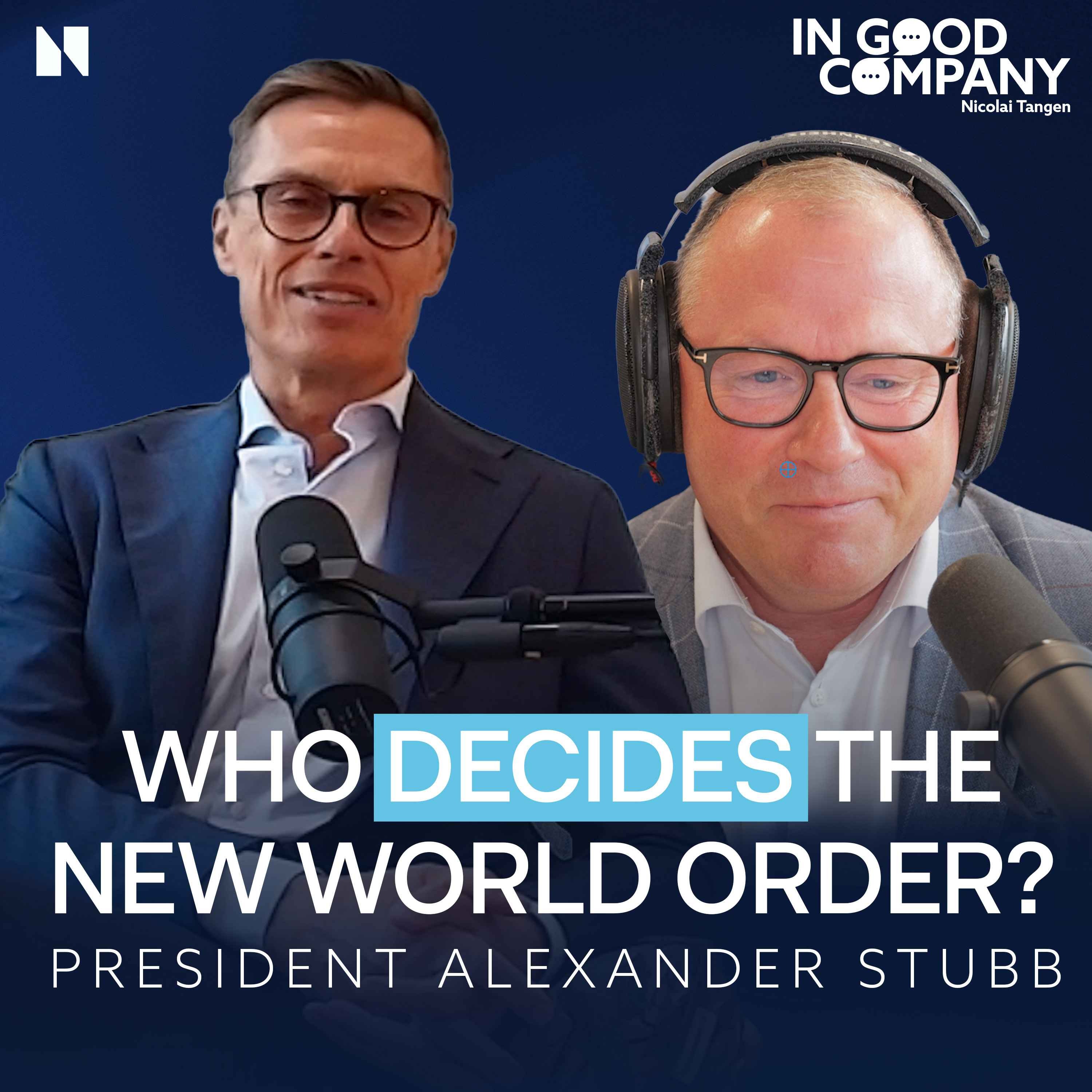
Alexander Stubb argues the world order is shifting like past turning points (1918, 1945, 1989). He claims the “global South” will shape the next order, pushing a choice between UN-centered multilateral norms versus multipolar, transactional chaos. He warns democracies are losing to social media and big tech power, and says AI could either equalize or deepen injustice, depending on governance. He supports faster, local-to-global AI control bodies because regulation lags. He also discusses Finland’s defense posture, NATO’s transition, hybrid warfare, and his view that Ukraine will achieve a “defense victory.” Notable examples include Chinese infrastructure in Africa, AI compute/data/energy requirements, and Russia’s hybrid tactics (cables cut, GPS jamming).
Alexander Stubb is President of Finland; former Prime Minister and long-time EU/foreign-policy figure. Nikola Tangen is CEO of Norway’s Soban Wealth Fund.
reform the UN Security Council (more Africa/Latin America/Asia representation); NATO is transitioning not in crisis; Europe is more united; Trump is effective and diplomacy can use personal relationships.
Written by AI. May contain mistakes.
Explore the challenges democracies face in the age of social media and technology.
“Democracies have not been able to cope with social media and with modern technology yet, and they're losing the struggle.”
Discussing the changing world order and the role of the global south.
“In short, what's the most important message in your book?”
Examining the influence of China in the global south and Western responses.
“But that means that the UN has to be reformed so that the South has agency in it.”
Analyzing the end of Western dominance and the rise of new global players.
“and do a little bit more concrete cooperation.”
Discussing the impact of AI and technology on power dynamics and economies.
“And of course, an additional spice to this comes with the new U.S.”
How democratic systems are failing to adapt to technological advancements.
“And I think that this is not a game with, you know, only US versus China.”
Debating whether AI will create equality or deepen societal divides.
“We also see big tech companies in many ways being more powerful than states.”
Discussing the necessity of frameworks for regulating AI on a global scale.
“for mankind, they have a very limited understanding of what the societal impact is.”
Exploring the concept of values-based realism in addressing global challenges.
“I think the best best to start is the US, followed by perhaps Europe and China, where we start looking at these new rules and containment in a new kind of a way.”
Discussing Finland's perspective on happiness and its role in global prosperity.
“And I think the difference between diplomacy and business is that in diplomacy, you look for win-win situations and quite often for compromises, whereas in business, it's quite often a zero-sum game and a transaction.”
Explore the need for reform in regional and global institutions, especially the UN.
“But my ideal is that these sort of regional multilateral institutions come together in the United Nations.”
Discuss the factors contributing to Finland's happiness, including welfare and education.
“But if people fall down the system, you have a fairly good and strong system of security and welfare.”
Examine the threats of polarization and inequality in democracies, particularly in the U.S.
“But I think, you know, Finns are quite proud of the fact that we're happy.”
Learn about the unique political structure of Finland and the balance between president and prime minister.
“But we also need to understand that the world is never going to be perfect.”
Understand Finland's defense strategy and its decision to maintain spending post-Cold War.
“No, you see, I've been prime minister myself.”
Analyze NATO's evolution and the current transition within the alliance amid changing security dynamics.
“And I say kind of unfortunately, I was one of the few that advocated Finnish NATO membership.”
Delve into the concepts of traditional and hybrid warfare in the context of modern conflicts.
“from 2 % to 5%, when defense industries are booming all around Europe and the United States.”
Evaluate the ongoing situation in Ukraine and the potential outcomes of the war.
“Hybrid warfare, it's a little bit more difficult to detect than define.”
Learn about the complexities of the Ukraine conflict and its implications for Russia and Europe.
“You know, the prime minister in Norway and I, we consider ourselves to be in the back office.”
Explore the current state of European leadership and the unity formed by recent crises.
“Well, it's a really difficult question, you know, because we have this almost illusion of a European constitution, which is U.S.”
Understand the potential impacts of Ukraine's war on European nations and NATO membership.
“You know, I'd love to give you an answer directly, and I have it in my head, but it's not my business.”
Discover the complexities of working with President Trump and the U.S. from a European perspective.
“I think they'll be as close to the EU as possible.”
Learn about the significance of personal connections in effective diplomacy and foreign policy.
“So it's very much, you know, on one hand, a bilateral relationship, Finland and the United States.”
Gain insights into the importance of information and the host's reading habits for staying informed.
“Jonas Störe the Prime Minister of Norway to the golf course because he doesn't play golf and I can't take Trump skiing with Jonas Sturder because he doesn't cross-country ski.”
Learn about the speaker's reading preferences and exercise philosophy.
“And you mentioned a lot of the people you talk to.”
Discover insights on personal failures during political leadership.
“And that sort of, you know, keeps me agile and awake.”
Hear about the speaker's unique breakfast recipe and cooking passion.
“that was my biggest failure, taking things too personally when I was PM.”
Explore valuable life advice aimed at the younger generation.
“And Alex, in addition to that, if you were to give advice to, some advice to young people, we have a lot of them listening into this, what would be your advice to young people today?”

Get the gist, explore an idea or ask about something said.
 Claude
On In Good Company with Nicolai Tangen, what are the key points of this episode?
Searching your listeningAutomatic transcript. May contain errors.
0:00Democracies have not been able to cope with social media and with modern technology yet, and they're losing the struggle. We also see big tech companies in many ways being more powerful than states. So you can ask the question, you know, is Anthropic or is Facebook more powerful than Norway and Finland?
0:30Hi everyone, I'm Nikola Tangen, the CEO of the Norwegian Soban Wealth Fund. And today I'm in really good company with Alexander Stubb, the president of Finland. Finland has 5.5 million people, a 1 ,340 kilometer border with Russia, one of the happiest countries in the world nine years in a row. It punches fire about its weight, and so does President Stubb. When Europe needs a way through to the White House, Alexander is often the one who gets the call. Earlier this year, Alexander wrote a book about how the old world fell apart and who decides what comes next. I've really been looking forward to this.
1:07Alexander, big welcome. Nice to be with you, Nikolai. In short, what's the most important message in your book? The most important message is that the world order is changing, much like it changed in 1918, 1945 and 1989. And the ones that are going to decide what it looks like is going to be the global south. And the choice is between multilateral norms-based institutional order and cooperation versus multipolar transactional chaos and conflict. Why is the south going to decide the future? Because they basically have the size and scale to do that in terms of population, economy, and technology.
1:52So the end of Western dominance is over. But I don't think the East is going to dominate either. So we're going to start getting a whole bunch of new players. And my vested interest coming from a small country is that it would be a multilateral system based on the UN. But that means that the UN has to be reformed so that the South has agency in it. The African leaders say that we in Europe, we just come and wag the finger whilst the Chinese come with the capital. Is that a worry for you, the Chinese influence in the South? Yeah, I mean, definitely the Chinese have played the long strategic game much better than we Europeans.
2:32You know, the good old saying goes that a Western leader came to an African country, landed at an airport which was built by the Chinese, drove down a highway which was built by the Chinese, and then gave a press conference in a hotel built by the Chinese saying that you should not be cooperating with the Chinese. And I think that's sometimes a mentality. So my take is that we need a more dignified foreign policy. We need to be more humble. We need to wag the finger a little bit less and do a little bit more concrete cooperation. You say that the West mistakes wasn't bad intent. It's just that we just saw the world through our own eyes.
3:11So what did we get wrong? Well, I think it's quite normal. I mean, we're all prisoners of our own identity. I mean, you and I are Scandinavians or Nordics, we're Europeans, we're very Western oriented, and we've been born or at least had our professional life in sort of a post-Cold War order. So that sort of skews what we think about the world and what we now have to understand that in order for you to be able to survive in this new world, you need to change. What we got wrong was this sort of innate arrogance that history ended and the West would kind of dominate and everyone would follow. And that's not the case anymore.
3:47You look at the Gulf states, which are extremely prosperous. You look at India, which is now the most populated country in the world. You look at some of the big players in Africa, like Nigeria, South Africa, Egypt. You look at Brazil and Argentina, and suddenly you realize that it's not the West that dominates anymore. And of course, an additional spice to this comes with the new U.S. administration, which has quite a different approach to multilateralism than many of us in the West in general. And some additional spies from the fourth power. And you and Mark Carney wrote this summer that we now have this fourth group incoming technology block built on compute, data and AI.
4:28And so how is this going to pan out? Is that now the most powerful of the four, you think? Yeah, it's not really a fourth block as such. I mean, if I would rename my book, it would be the rectangle of power because I had the global West led by the US. But I think now, out of choice and very proudly, the US would not want necessarily to lead that block anymore. So I would call us perhaps the global North. But, you know, Mark and I think obviously that technology, especially AI, is going to change everything. It changes the way in which we work and the economy, it changes politics and the way in which we communicate, it changes war and the way in which we conduct it, and it changes science and the way in which we are as human beings.
5:14But of course, this is about access. So my argument is that we should see this more as a win-win, not as a transaction, because AI, of course, if you want to dominate, you need two things. You need compute, so kind of data and capacity to handle it. And secondly, you need energy or more specifically, electricity. And I think we need to have a balance between the east, west, north and south on this. And I think that this is not a game with, you know, only US versus China. It's much more complicated than that. How are democracies adopting to the new technology? Badly. And the reason is that, you know, democracy as such was originally created, say, in the 19 or 1700s by the likes of John Locke and Montesquieu and Rousseau and Hobbes and others to be very slow and cumbersome, you know, sort of back deals.
6:10And you had a lot of time to respond to things. And, you know, the US Constitution was basically created in secret as a compromise. And you don't have that luxury anymore. You have to react to everything all the time. And, you know, coming back to the book, the original version actually of the working title was digital democracy or digital dictatorship. And I think, you know, democracies have not been able to cope with social media and with modern technology yet. And they're losing the struggle. We also see big tech companies in many ways being more powerful than states. So you can ask the question, you know, So is anthropic or is Facebook more powerful than Norway and Finland?
6:54And I think it's a legitimate question. Political science can't necessarily give you the answer. Well, we see it in financial markets. The market capitalization of some of these companies are bigger than countries. Do you think AI will be an equalizer or do you think it will amplify injustice? It can go both ways. And that depends on the choices that we make in the upcoming years. I mean, if you look at the mix between biology and technology, then it can really be a destabilizing factor which creates different types of homo sapiens. So when you start doing DNA manipulation or sequencing of genomes, then suddenly you start creating different types of human beings.
7:38I think Yuval Harari talks quite well about what he calls a useless class. So at least in the fight between capitalism and communism, you always had the choice that the working class was useful for the capitalist system. But what if we move into a world where that is not the case anymore? What does that mean for governmental and societal structures? What I find with a lot of the big tech guys, who are obviously doing tremendous advances for mankind, they have a very limited understanding of what the societal impact is. I mean, apart from a few specifics, like Demis Hassabis, who works very much, you know, AI and good for good, and he's looking at different types of ways of controlling frontier AI.
8:27So my argument here is, Nikolai, it can go either way. It can be an equalizer or it can be the creation of different types of human beings, homo sapiens. Well, another person, Bill Gates, he is advocating creating a domestic and international framework for dealing with AI. What are your thoughts about that? Oh, I definitely agree with that. But I'd be looking at the stuff that Demis Hassabis and other tech leaders are working on right now, because what we have understood is that regulation is always going to be one, two, three years behind. So we need some kind of control bodies that can deal with this and make sure that frontier AI doesn't give us an apocalyptic result in, for instance, cyber attacks.
9:12And because things are advancing so fast, legislators can rarely sort of hold up. So I do think that we need to start probably a little bit local. I think the best best to start is the US, followed by perhaps Europe and China, where we start looking at these new rules and containment in a new kind of a way. And then at the end of the day, you take it into some kind of a bigger governance body like the United Nations, which I still think that should be the ultimate goal in trying to preserve mankind in this sort of technological revolution. Given how we now embed AI into weapons and cars and batteries and research and into everything pretty much, do you really think it's feasible to get the US and China to cooperate on this?
10:04I think out of necessity, yes. So that's why it's kind of good that there's a certain balance of power here with critical minerals and capacity to compute and the power of the chips. And then the companies, is it a closed system? Is it an open system? Who can use it? Who can't? And, you know, I do think that there needs to be a dialogue between China and the US, Chinese companies and American companies. But of course, Europe, the global south and the rest of the world needs to be involved as well. I mean, we used to talk about Europe as a regulatory superpower, setting the standards for trade, whether you liked it or not.
10:44Now we need kind of an AI regulatory superpowers to make sure that things don't run astray. Moving on to the new order then, you call your answer values-based realism. What does that mean exactly? Well, it means two things. One is that you stay true to your values. So in your case, in my case, Finland, Norway, you know, the Nordics, Western Europe, it's probably about democracy, freedom, rule of law, human rights, fundamental rights, international institutions. That's the sort of starting point of our sort of value base, equality and justice as well. And then realism again means that not everyone in this world will share those values.
11:32There'll be countries that have different identities. I believe actually that human rights and fundamental rights are universal, but there might be someone else who doesn't believe that. and my realist side comes from that you cannot solve these problems of the world just between Finland and Norway. You know, climate change, artificial intelligence, energy, development, environment. These are all global problems and we need to solve them globally and that also sometimes means compromise. You don't need to compromise with your own values but you need to realize that in order to get results you need compromises.
12:14If you have all these ad hoc coalitions with a different set of countries for every problem, how is that going to work in practice? It's going to be extremely messy and we're starting to see that already. And I think the difference between diplomacy and business is that in diplomacy, you look for win-win situations and quite often for compromises, whereas in business, it's quite often a zero-sum game and a transaction. And we need to understand that the world will not work on transactions. It will work on compromises and on solutions. You previously compared this with 1918, 1945, 1989, and then you talk about a new balance.
12:55What will the new balance look like? And when could we foresee something like that? What is it? You kind of have three options, if I may. First one is that we sort of continue with this almost chaotic transactional world where we see an increase in conflicts like Russia's war aggression on Ukraine or the Middle East or Sudan and many others, where there are no norms and rules on warfare and on conflict, etc., etc. And at the same time, you see this emergence of a lot of ad hoc coalitions, quite unholy alliances as well, which are not bound by values, but purely by interests. The second option is, you know, some kind of a multipolar world where there are some rules and norms, but they're quite iffy and they're very often based on the pure sovereignty of nation states and very little compromise.
13:58And it could also be that we move towards this world of regional integration like the EU or ASEAN or Mercosur or the African Union. But my ideal is that these sort of regional multilateral institutions come together in the United Nations. But in order for that to happen, we need to reform it. So we need to reform the Security Council, which has five permanent members with veto powers. We need to have at least one country from Latin America, two from Africa and one more from Asia. We need to look at different solutions because we can't solve these world problems just with regional transactional deals.
14:44Alex, let's zoom in a bit on Finland. Why is it such a happy place? well you know i don't know i think if you start from maslow's you know hierarchy you could say that we have a lot of the basics in life in order much like one would have in in norway or in sweden or in denmark or in iceland the nordics in in general but i i think it begins from this sort of innate understanding of equality and justice and then trying to implement and incorporate that into a society, which then brings us to a welfare state where you really should have and have an open economy. But if people fall down the system, you have a fairly good and strong system of security and welfare.
15:30There are other elements that have to do with happiness. For me, it's about education. I think that's a big part. If you have a civilized population, by and large, who understands, who reads, who follows. I think that gives you meaning in life. And then finally, I think we have a very close attachment to nature. So those things, you know, make the country quite happy. And I think we were the happiest country in the world for nine years running now. Of course, the feeling is also quite subjective. But I think, you know, Finns are quite proud of the fact that we're happy. We don't always show it, you know, we don't walk around the streets and smile all the time.
16:10Happiness is very subjective, but the best way to measure it is to actually to ask people, how happy are you from one to ten? You know, there is nothing better way to measure it. When you look at the factors going into this, what do you think is the biggest, what's under threat? Which part of this are you the most worried about? Polarization and inequality in society. You know, we see that in a lot of liberal democracies. I mean, I can mention, of course, the United States, which is probably the most polarized liberal democracy in the world right now. And then, you know, we get into difficult identity-based issues of immigration and race, skin color even.
16:50But I think the key here is sort of this promise that globalization gave to everyone that everyone will be doing well. But if people feel that, well, this free trade system or these international institutions are not delivering for my needs, That would be a big worry for me. And we need to have that dialogue. We need to be open about it. We need to discuss it and make sure that everyone has at least an equal opportunity. But we also need to understand that the world is never going to be perfect. Not Norway, not Finland. You know, we don't live in a utopia. It's always going to be a balance. But people need to have the feeling that we're working for each other in one way or another.
17:33That way we will avoid the threat of polarization and division. In Finland, you have this special split between the prime minister who does the domestic things and the president. You do the foreign policy and the military. Do you also have influence on the domestic scene and topics? No, not really. Not constitutionally. But I guess as what we would call in Finnish a value leader, the president always has a voice. And that voice is quite often a megaphone. So if I say something linked to domestic policy, then it becomes a subject of discussion. And I feel that I should not meddle in issues that have to do with, let's say, the state budget or the allocation of resources.
18:21But I do feel that I can and must have a voice in issues that have to do with values and ethics and well-being. So I can set the target in these questions quite high, but people do understand that I'm not the one deciding how much money goes to education or how much money goes to a specific road somewhere or to a hospital. And I think the Finnish system is actually quite ideal if and when we want to maximize our foreign policy power in the sense that the president really is focused on foreign security and defense policy. And I'm also the commander in chief, whereas the prime minister is focused on domestic issues and the EU.
19:09So the most important thing is that the link between the president and the prime minister is good. then the president can do a lot of the stuff outside of Europe and some bilateral stuff in Europe, whereas the prime minister focuses on EU affairs. This system is ideal. There's no other world leader that has as much time for foreign policy than I do. And I think that's quite good. Is the prime minister ever envious that you get so much traction on the international scene? No, you see, I've been prime minister myself. So I've always thought that it's extremely important that the president cooperates hip to hip with the prime minister.
19:46So, for instance, you know, yesterday morning I gave him a call and asked, how are things going? You know, what does your agenda look like this week? Where are you going to travel? We're going to have an Arctic summit at the end of the week up in Rovanieme in Lapland. We coordinated that. So, you know, envy is probably the wrong word. but put it this way, the prime minister's job is much tougher than the president's job. And the reason is quite simple. And it's quite almost sort of, you know, humane is that unfortunately, a lot of people for ideological reasons, want the prime minister to fail.
20:25I certainly felt that as a PM. But most people want the president to succeed because he or she is in charge of foreign policy. So the starting point for the PM and the president are quite different. I guess in a way it's like, you know, if you run the sovereign wealth fund, everybody wants you to succeed too, because they all want to make more money. It's a bit of the same thing. I guess you could say that, you know, the president is the chairman of the board and the prime minister is the CEO. And then you can figure out yourself who has more pressure. After the Cold War, most countries in Europe cut defense spending, but you kept it up.
21:00What did you see that the other people didn't see? Well, first of all, we didn't join NATO after the Cold War. And I say kind of unfortunately, I was one of the few that advocated Finnish NATO membership. I felt that we should have integrated into the West 100 percent. But we did join the European Union and that helped out. It wasn't so much what we saw after the Cold War, but it's what we had seen during the Winter War, the War of Continuation. So from 1939 to 1944, we always felt that we were living next to a big neighbor who had the potential of aggression. And we decided that if we don't join NATO, we need to maintain a strong and independent defense, especially the land forces, but also the air forces.
21:51That's why right after the end of the Cold War, we decided to buy 64 F-18 fighter jets. That's why we kept conscription, so obligatory military service for men. That's why we went to the secondary market to buy artillery and made sure that, you know, if, well, a difficult day came up, we would be prepared. And the good thing with that was, of course, that we were so NATO compatible that when we then ended up applying for NATO membership after Russia attacked Ukraine in 2022, it was pretty much a foregone conclusion. And we had the quickest accession negotiations in the history of the alliance because we were more NATO compatible and more NATO ready than most member states in NATO themselves.
22:41Is NATO in a crisis today? No, I think NATO is in a transition. So again, I tried to look at the sort of long arch of the alliance, both as a student of it and as a president of Finland. So the first phase was NATO 1.0 when it was a deterrent to the Soviet Union in the Cold War. The second phase was NATO 2.0 when it started to focus more on peacekeeping and crisis management around the world. Finland was involved in peacekeeping in Kosovo and in Afghanistan, just to name two. And now we're looking at a transition where Europe will take more role, especially unconventional forces inside the alliance.
23:26But I wouldn't say an alliance is in a crisis when it's increasing its defense expenditure from 2 % to 5%, when defense industries are booming all around Europe and the United States. But there is a burden shift going on. And that, for me, is a transition, not a crisis. The U.S. will remain involved in NATO because it's in their vested interest to do so. And more European NATO, how does that change NATO? What's different? Well, it means that the NATO countries that are in Europe take more responsibility for their conventional forces. And, of course, France now also doing it on nuclear weapons.
24:06So it means that you ramp up your land forces, you ramp up your air force, and if you are a sea-bearing nation, you ramp up your navy, you work a lot on cyber, you work on space, you fill up your stockpiles, you integrate your military operations with NATO operations, and especially with different types of responsibilities. So the United States has been quite clear on a few capabilities that it will not provide anymore, not during peace times, nor in a crisis situation. And some of them we need to basically replace with European goods, if you will. But some are not necessary because there are things that we don't need.
24:51The most important thing is that we do this in a calm, cool and collective manner. And I think that's the trajectory that we have right now. And I'm quite confident that we'll do it also. We are already seeing cables cut and drones over airports and so on. Are we already in some kind of war? Well, it depends on the definition of war. I always say that the line between war and peace has been blurred. And the best way probably then to differentiate this to say that on one hand, And you have fairly traditional kinetic warfare, which we now see between Ukraine and Russia. That kinetic warfare has, of course, then taken on modern tenets and directions with drone warfare or long-range missiles or electronic warfare.
25:37But then the other part is hybrid warfare. And hybrid warfare is really a mix of different things. You know, it can be a cyber attack. And we, of course, have cyber attacks all the time coming from Russia and actually other state actors and non-state actors as well. Cables cut is hybrid warfare. You know, airspace violations is hybrid warfare. GPS jamming is hybrid warfare. And then, of course, sabotage is hybrid warfare as well. The difference is that, you know, with kinetic warfare, you know it when you see it. Hybrid warfare, it's a little bit more difficult to detect than define. But certainly there is intimidation from the Russian part, but I wouldn't call this Article 5 activity yet.
26:23I believe you're just back from Kiev. How do you think the Ukrainian war will end? I think it'll end well for Ukraine. And I've said it from the beginning that in the theory of war, if a big one attacks a small one and tries to deny its independence, sovereignty and territorial integrity, the mere existence of the small one, in other words, independence and sovereignty at least, means that the small one has won. That's why in Finland, after the Winter War and the War of Continuation, we called it a defense victory. So I see a defense victory in the cards for Ukraine. And of course, right now, Ukraine is doing better militarily, politically and financially than it has at any time during this war.
27:10This doesn't take away from the tragic atrocities and the dead and the wounded. But the bottom line is that the losses of Russia are much higher at the moment, both in the battlefield and also economically. You know, Ukraine is very strongly backed by Europe and the United States. So, you know, I hope this war will end as soon as possible. But that means that Russia has to understand that it will not win this war. And all of us are working on trying to find a peace agreement at the end of the day. When do you think it will be? I can't give you a timeline of it. You know, we've had many different deadlines throughout.
27:55The Americans are working very hard, you know, and we're in contact with the U.S. administration. The Ukrainians are working very hard. You know, the prime minister in Norway and I, we consider ourselves to be in the back office. So we try to do a lot of the coordination in the back. But I can't give you a deadline. But I think it's not going to end because of economic problems for Russia or bank runs. It's not going to end because of losses in the battlefield for Russia. But it will end if the current regime feels the pressure from the population. And of course, the good news is now that over half of the Russian population wants this war to end.
28:34And I think that's already a good sign. And of course, it wants the war to end because Ukraine is successfully hitting oil refineries, which then hits the gas pump of the Ukrainians where they have rationing and limits. And they're also hitting logistics centers. So let's see how things pan out in the next few months. But I think we need to prepare for a cold winter in Ukraine. What would need to happen on the military side for you to say that, hey, now we can relax a bit in Finland? I don't think we'll ever relax. You know, we're quite calm about it. And, you know, in my capacity as commander in chief, I'm one of the few people who has all the information about Finnish security, starting from the border to the security of supply to our military operations.
29:22And I certainly sleep my nights very calmly. I mean, last week I spent almost every day of the week with our commander in chief, General Janne Jaakola and his team. So, you know, we're not going to let down our guard because our philosophy is that in order to avoid the worst, you have to prepare for it. And I feel that we have always been prepared and therefore created a very strong deterrence, which is on one hand our strong defense, but now, on the other hand, also NATO, and not to speak of the close defense alliance that we have with Norway and with Sweden. Moving on to Europe, does Europe lack leadership right now?
30:06Well, it's a really difficult question, you know, because we have this almost illusion of a European constitution, which is U.S. like, which is led by a president and an institutional structure. So I think Europe is led today very much by Ursula von der Leyen and Antonio Costa, so the president of the European Commission, president of the European Council, and some of the leaders of the big states like Emmanuel Macron, Friedrich Mertz, George Meloni, Donald Tusk, and also an outsider from Europe now in the form of Andy Burnham. So I do feel that there is strong leadership in Europe, as good as it can be.
30:50But we just have to understand that, you know, Europe is less than a state, more than an international organization. And that's why the leadership structure will always look a little bit messy. Are you more or less of a believer in Europe than you were five years ago? Much more. I mean, and that's hard to say. And the reason I say this, I don't, you know, basically, I've never seen Europe more united than it is right now. And I've been an avid student and a diplomat and a politician, in other words, an actor with European affairs since the early 1990s. And I say this unity comes, you know, if you look, for instance, at Brexit, that united Europe, all the 27 remaining countries said, you know, we're not going to do that because that is not in our interest.
31:38And at the same time, you have a whole bunch of more applications coming in from the Western Balkans, now from Ukraine, Moldova and others. Secondly, I think we were quite united around COVID. You know, it could have gone very sour, but the commission and Ursula von der Leyen did a lot for, you know, vaccines and the procurement thereof and the distribution. Then thirdly, when the war in Ukraine began, we rallied around the European flag and supported Ukraine. And the same thing happened when we started to have energy shortages. And then also, I should say that it's not only the security pressure coming from Russia that unites us, but of course, now the American administration is being quite tough with Europe, you know, sometimes for the right reasons.
32:24And that has made us unite and made us more geopolitical. So I'm quite bullish and I'm quite optimistic about the unity and the future of the European Union. But I do have one caveat. You know, when the war in Ukraine ends, when the administration changes in the United States, it's important for Europe not to let down its guard and start sort of fighting against about, again, about irrelevant stuff. So pressure from the East and pressure from the West has united Europe quite strongly. Should Norway become a member? You know, I'd love to give you an answer directly, and I have it in my head, but it's not my business.
33:00You know, I'm one of my best friends in politics is Jonas Störe, your prime minister, and I speak with him every day. But it's not for Finland to decide whether Iceland joins or whether Norway joins or whether anyone else joins for that matter. If you ask me the question, would it be in the interest of the other Nordic states that Iceland and Norway were members of the European Union? the answer would be yes, much like it was in the interest of Norway, Denmark and Iceland that Finland and Sweden joined NATO. But we don't decide on that. You decide on it completely and independently yourselves.
33:39You call Brexit amputating your leg with no medical reason. Should the UK return to the EU, you think? I would love for the United Kingdom to join the European Union, but probably the more realistic path right now is to bring the United Kingdom as close to the European Union as possible on key issues. And of course, security is one of the key issues right now. There are other things that we should work on, but that's up to the Brits, Andy Burnham, and the European Commission to work. My vision is actually of a large Europe, a geopolitical Europe, even with 40 members, but those countries that don't join the European Union should be brought as closely as possible because we need this cooperation in order for us to be able to solve the big problems in the world and in order for us to keep the value unity that we have.
34:35I mean, what binds the UK, Norway and Iceland and other countries that are not in the EU with the EU? Well, it's the values of democracy and freedom and free trade and human rights and fundamental rights and rules and norms. And we need to find the right balance. And I would put Canada into this pot as well. You know, I keep on saying a little bit tongue in cheek that I'd much rather see Canada as the 28th member state of the EU rather than the 51st state of the United States. But of course, that's up to Canada to decide what they do. What do you think? You think they'll join the EU? I think they'll be as close to the EU as possible.
35:14And that's what Mark Carney and his team are doing right now. Again, when you feel that your position is threatened, for instance, with tariffs, then you sort of huddle up and think, where do I look? And I'll take that to the EU as well. I mean, suddenly the EU has forged free trade agreements, which took a long time to do with India, with Mercosur, with Japan, with South Korea, and many others. And it's doing that when it sees that one system is failing, it starts looking elsewhere for other systems. And I do welcome that. I think, you know, we're starting to see the emergence of a geopolitical Europe and a Europe which is a little bit more independent in its own actions.
35:58And I think that's a good thing. You're famous for your golfing with Trump. What is it with Trump that Europeans don't understand? Well, I don't think there's that much to understand. You have to understand that President Trump is one of the most consequential presidents in American history. You might like it or dislike it, but he is forcing change. He's forcing change in the United States and he's forcing change globally. So he's driving his MAGA agenda. And then you can kind of do two things. One is you can close your eyes and complain and, you know, don't speak and engage. The other one is that you realize what America and President Trump is doing, and then you engage.
36:42You try to have an impact on a few issues, such as NATO or Ukraine, and then you realize that there isn't much you can do about other things. So if the question is, what don't Europeans understand? It's probably that they don't understand or want to admit that President Trump is very effective in what he does. What is it that makes him so effective in your mind? It's difficult to say. You know, I really don't know, not as a political scientist or as a president. And it's probably not my job to analyze it either. I try to work with President Trump and the United States on issues which are of mutual interest.
37:24So on NATO and on defense, we have a defense cooperation agreement. There are thousands and thousands of American marines and soldiers training in Arctic conditions with our armed forces. I work with the United States on icebreakers, which they need. So they will buy 11 icebreakers. Four of them will be produced and built here in Finland and seven in the United States. I work a lot on Ukraine and try to explain my position. So it's very much, you know, on one hand, a bilateral relationship, Finland and the United States. And then on the other hand, an alliance relationship inside NATO. So I'm quite pragmatic in the way in which I try to deal with the United States, with President Trump himself, but also with people that work around him.
38:15And you'll know that I'm an avid transatlanticist. You know, I did my undergraduate degree in the United States. I've always worked a lot with things American. And I'm also a big fan of the American Constitution and the founding fathers and the Federalist Papers. So, you know, I try to work very pragmatically with the U.S. Talking about where you work. So President Kekon, he used to take the Soviet leaders into the zona. Your predecessor, Nino Stor, he played ice hockey with Putin. Is kind of golf the new zona? I don't know. I think diplomacy has many different, you know, sort of paths. And a lot of people don't understand that diplomacy is on one hand state to state relations.
38:57So that's kind of, you know, geography, values, history, culture and interests. That's kind of classic. You do your memorandums of understandings and agreements and etc. But then on the other hand, it's also the personal and you can't kind of separate the two. So, you know, my job, you know, foreign policy is also about three things. It's values, interests and power. We have values and we have interests in Finland, but we have limited power because we're a small country. So the only way in which I can have power is to have influence. And influence comes from information and information comes from networks and networks come from personal relationships.
39:36so I'm very glad that I've been able to you know forge a relationship with President Trump but I don't want to you know inflate that or my role in it at all you know I'm just a small player for President Trump and and I understand my place. If you get him into the Zona who do you bring along? I'd probably take Jonas Störe you know so because we're in the back office I can't take Jonas Störe the Prime Minister of Norway to the golf course because he doesn't play golf and I can't take Trump skiing with Jonas Sturder because he doesn't cross-country ski. So a sauna would be a good place.
40:15Now, you mentioned people and superpower. Now, when I researched you before this podcast, I spoke to a lot of people who all claim that they're very close to you. They all feel that you're a close friend and that's a lot of people. What's the key to establishing those relationships? Well, I don't know. I can't give you the answer. It's probably the people that you spoke to that have to do that. But my hero and my mentor is my father. He's now 91, and he was the chief talent scout of the National Hockey League here in Europe for 40 years. He just retired a couple of years ago, but now he has to help out again.
40:59He's all with it and really enjoying it. and he's always been an extremely helpful person. There's now a book coming out on him this fall, which is called Jörernstub, How Can I Help? Which sort of, you know, I've tried to incorporate that into my life as well. I don't sort of differentiate between people that much. I try to be friendly and empathetic with everyone. And I'm also quite an open person and I quite enjoy that. I like conversation. I'm a very curious person. I learn a lot from people. And if that then leads to a fact that you end up befriending folks, I think that's great. And I also, you know, I'm still closely in touch with my childhood friends or people that I, you know, worked with when I was a young researcher.
41:50I'm good friends with the director of the Norwegian Foreign Policy Institute, still in touch kind of stuff. So I just keep it up. And of course, with modern communications, it's much easier. I'm probably too much on my phone. That's the reason, right? You say that information is power. And you mentioned a lot of the people you talk to. Just what do you read? I read a lot. So, you know, I read an array from normal, obviously, news feed to columns, editorials and opinions. So I read a lot of, you know, Financial Times, Economist type of stuff, New York Times. Then I read some journals, especially foreign affairs.
42:33That's close to my heart because of the job that I have. And then I read a lot of books and mostly fact books. I'm quite bad on novels. And I do have this kind of rule, one plus one plus one. So, you know, during the day, read a book for one hour, exercise for one hour and do your phone only one hour. but I'm afraid I failed badly on the last one. I'm more on my phone than one hour a day. But you also exercise a lot more than one hour a day, right? I mean, you are like a total maniac on the exercise front, aren't you? Yeah, I mean, not that much anymore. I mean, when I was a little bit freer, I did put in the hours and especially when I was training for, you know, big races.
43:17But my rule of thumb is one hour exercise gives you two hours of energy. The problem is that two hours of exercise takes away one hour of energy. So I have to be very, very careful. I can't be a Christian Blumenfeld anymore, you know. You still do your triathlons? I do, but I do that more for training purposes. And I do short distances rather than the full Ironman, because that then requires the two hours of day. But I try to mix in because, you know, I'm sort of, I'm 58. So that means that you have to be a little bit careful with what you do. But I do try to get in some swimming, some biking, some running, some gym stuff, some pilates, some yoga, these kinds of things.
44:02And that sort of, you know, keeps me agile and awake. I mean, I would say 58. That's the prime, you know. I mean, I fully agree. 58 is the new 20. When you look at your life, what's been your biggest personal failure? You know, it's a question that I'm quite often asked, and I sort of mull around it. But I've come to the conclusion that it was probably my two years as prime minister, well, one year, and chairman of the party. not so much the substance I can you know argue for that and live with it but the fact that I took things too personally so I thought that the attacks on me as prime minister were attacks on me personally of course some of the stuff was you know very personal I don't deny that but I took it too personally and with the wisdom of hindsight and having learned from that experience I don't do that anymore.
45:04I try to detach the institution in me, in other words, the president of the Republic of Finland, from the person in me, in other words, Alexander Stub. And I admire, and I look at a lot of the prime ministers around the world who are getting constant attacks. And I, in many ways, admire the way in which they are able to just be sort of binary and have their prime minister side and their sort of personal side, you know, one of them being our current prime minister or our previous prime minister. And I have a lot of admiration from that. So that was my biggest failure, taking things too personally when I was PM.
45:48Yeah, it's interesting because politics is just getting tougher and tougher, right? So for sure, it's a valuable insight to have. What is something about you that most people don't know? I make really good banana pancakes. So it's my favorite breakfast. I can't have too many of them because I need to control my cholesterol. And the recipe is very simple. You take two eggs, then you take a banana, you mash it, and then you take some oats and you put all that into a bowl. you sort of whisk it together and it becomes this dough. They put some olive oil on the pan and put the piece of stuff on the pan, make sure it doesn't stick and it becomes a good nutritious breakfast.
46:36So banana pancakes is what I do. Very good. And Alex, in addition to that, if you were to give advice to, some advice to young people, we have a lot of them listening into this, what would be your advice to young people today? Well, I give the same advice that my parents gave me when I was young and that, you know, I have given my children who are now 24 and 22. And it's kind of four things. It's dream, believe, work hard and succeed. But in order for me to explain that, they're just not words. So dream means for a youngster that you always have to have big dreams in life. There's nothing wrong with that.
47:20Most of your dreams won't materialize. I wanted to become a professional ice hockey player and then a professional golfer, but it just didn't work out. And that's part of life. Second, believe. You always have to believe in yourself because if you don't believe in yourself, if you have doubts, then no one else will do that as well. and in order for you to be able to believe in yourself you also have to accept failure so things are not going to turn out as you expect in life and you just have to move on you have to be agile thirdly work hard i've never met a person who has so to say succeeded in life or had a meaningful life who hasn't worked hard you you need to put in the hours at some stage in your life but be merciful i don't believe in these people who claim that they work 20 hours a day and only sleep for.
48:10I think that's utter rubbish. That's not working hard. That's working stupid. Then my fourth and final one is success. And here it's very important for young people to understand that success is not running the Norwegian Wealth Fund. It's not having the title of president of Finland. It's not being a millionaire. Success is about having a meaningful life day in and day out. And meaning usually comes from helping others, that you have a feeling that you have had an impact on someone else's life. When someone else is down, you talk to them. And therefore, if you sort of have these four things in mind and understand that your life is going to be very different from mine or from Nikolai's life, that you'll have to have a curious mind, you have to be flexible and have many different careers and times in life, I think you'll do well.
49:06So I hope these four pieces of advice, dream, believe, work hard, succeed, are useful for youngsters and slightly older folk like myself as well. Alex, I think that's a beautiful, beautiful place to end. Big thank you for taking the time. Thank you very much. It was my pleasure.
49:29Thank you.
How are democracies adapting to the new technology? In this episode, Nicolai Tangen talks with Alexander Stubb, President of Finland, about defence, diplomacy and the shifting world order. They discuss why Finland kept its defences strong long before joining NATO, how the war in Ukraine might end, what AI is doing to democracies, and why Stubb believes the Global South will shape what comes next. He also reflects on failure, resilience, and what a successful life actually looks like. Tune in for an insightful conversation!
In Good Company is hosted by Nicolai Tangen, CEO of Norges Bank Investment Management. New episodes every Wednesday, and don't miss our weekly wrap-up on Friday’s.
The production team for this episode includes Isabelle Karlsson and PLAN-B's Niklas Figenschau Johansen and Håkon Klemsdal. Background research was conducted by Une Solheim.
Hosted on Acast. See acast.com/privacy for more information.


