
 Ask ChatGPT


 In Good Company with Nicolai Tangen
24 Jul 2024 · 39m
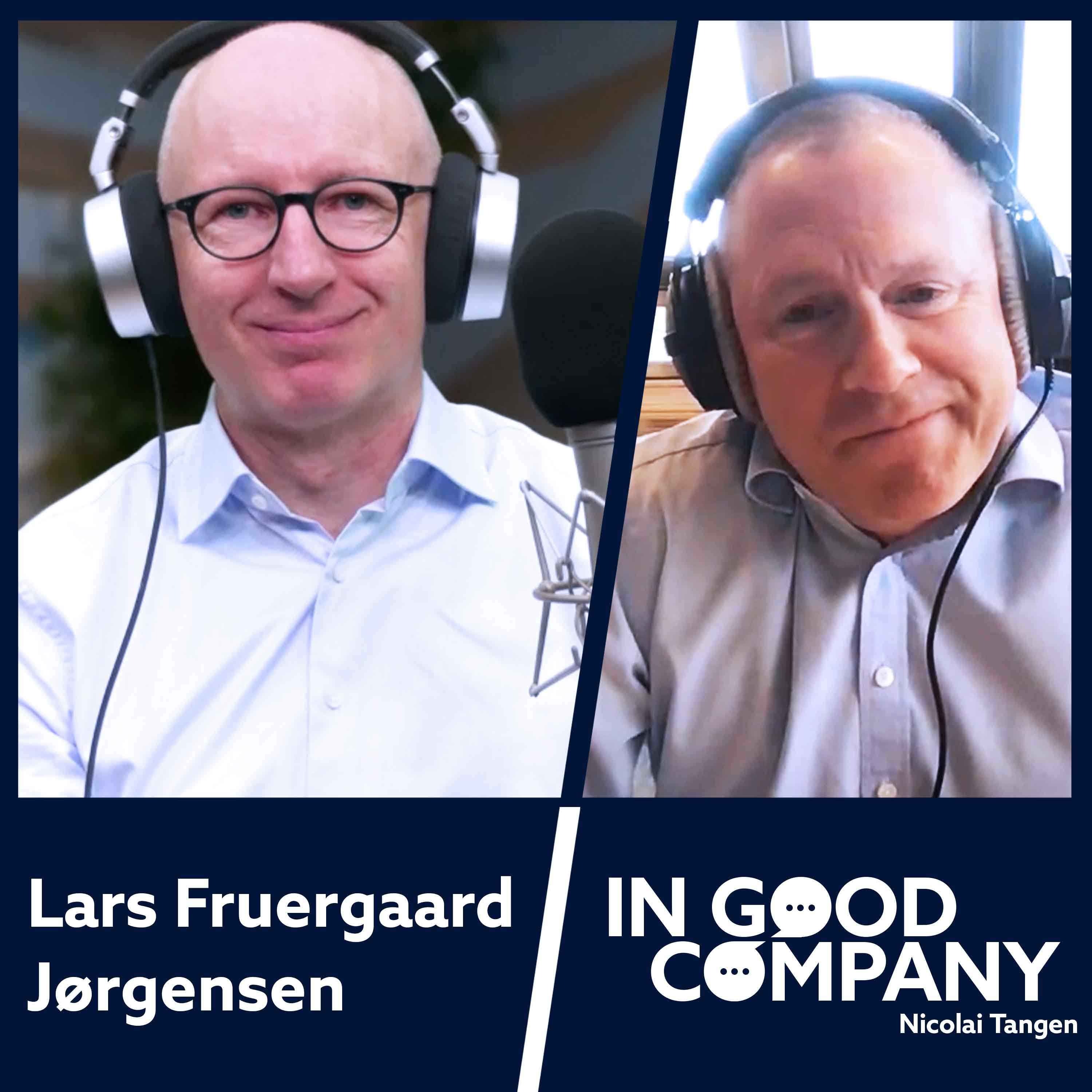
In this episode, Nicolai Tangen interviews Lars Fruergaard Jørgensen, the CEO of Novo Nordisk, a global leader in diabetes and obesity treatment. The discussion revolves around the complexities of obesity, the implications of new weight-loss medications, and the evolving landscape of healthcare in Europe and the U.S.
Written by AI. May contain mistakes.

Get the gist, explore an idea or ask about something said.
 Claude
On In Good Company with Nicolai Tangen, what are the key points of this episode?
Searching your listeningAutomatic transcript. May contain errors.
0:01Hi everybody. One of the most amazing things that's happened over the last year or so is the explosive growth of weight reduction medicines. Nova Nordisk, one of the world leaders, is just incredibly interesting. And we have therefore decided to rerun the interview we had with the CEO. We are back on the 7th of August with a total new lineup for the autumn. You will be amazed. Tune in.
0:33Lars, very welcome to the podcast. Novo Nordisk has got an unrivaled reputation worldwide, so it's fantastic to have you on. Thank you, Nikolaj. It's an honor to be here. Now, I thought I'd kick off on obesity because it's such a big problem. And it's tripled in 75. More than 1 billion people are obese. And I read somewhere that it now accounts for nearly the cost of obesity, nearly accounts for 3 % of world GDP. Now, what are the drivers behind this? It's interesting to reflect on obesity and the fact that it's now being recognized as a disease, not among all, but increasingly. And until now, there's not been real efficacious medicine.
1:17And when you don't have efficacious medicine, often the medical community is not highly engaged in a disease. So what's happening now is that we acknowledge that it's not just about lifestyle. is not just about how much we eat, it's actually about genetics, that different people are in different situations from a physiology point of view, and it really takes help for those people. So that's what's now opening up the whole market. We've been researching in this for 25 years, at a time where most felt that obesity is a graveyard, it's not a place to go. So we're really excited to see that now there's hope for many of those people who have been struggling, keeping weight down for many their whole life.
2:07Would you say it's mainly an illness or a lifestyle problem? I think it's a combination. It's a very complex disease. We know that nowadays it has become very easy to get access to food, often processed food. We live in ways where we're not expending as much energy as we used to. And then if you are genetically disposed to store fat, so to say, you will be storing fat. And that is seen from your body's point of view as a sign of health. So it's really difficult to reverse when we become bigger, so to say, because it's seen as a way to protect you and prepare you for difficult times. so of course it's a complex matter we also know that some do not put on weight some stay lean their whole life almost no matter what they do whereas others they store fat and they gain weight so it's not one or the other it's actually a complex disease that are many factors at play How are the demographics changing this?
3:17You can say when I was born the world population was probably a couple of billion. Now we're approaching 8 billion. We live longer and longer. And wealth today and price of food means that even in the developing countries, you can access food and calories in a way where you don't have to work that long to be able to buy unhealthy food. So wealth and demographics actually plays in here. And we see it as a problem that's hitting all societies, both the Western world and also the emerging countries. Yeah, because historically it was a high income problem, right? But now it's widened out. Yeah. And some of the worst foods in this world to buy, so to say, are really, really inexpensive.
4:21And in big cities where you end up spending a lot of time commuting forth and back to go to work, often the time available for actually cooking a healthy meal is very limited. And it also often ends up costing more to actually do the healthy choice compared to the less healthy choice. So lifestyle, socioeconomic conditions, societal structures together with genetics plays in. Where does childhood obesity come in? Yeah, that's kind of the alarming thing that we see now that childhood obesity is growing significantly. And we know that if you already as a child have been living with obesity, there is a big risk that you'll actually be struggling with that your whole life.
5:12There's also a big risk that you will be, say, stigmatized. You will get, say, a lower degree of education. Your lifetime income level will be lower. So it's a very large societal challenge to deal with. And of course, when we talk about children, I still think there's an opportunity to focus on prevention, making sure that school systems, how we organize societies, is designed in a way that we can prevent childhood obesity with the aim of then also reducing obesity as an adult. But when adults like you and I, we become obese, it becomes much harder because then you're starting to see it as a chronic disease and it becomes really, really difficult to reverse.
6:05Yeah, I saw that only 1 % of obese people get back to healthy body weight. So certainly it doesn't look so good for me.
6:17Now, you have the kind of solution here, right? With your drugs. And you were the first pharma company, I think, actually, to have a product which went viral on social media, on TikTok. helped by Elon Musk. So tell us about your drug here. Yes, so we have been focused on diabetes for 100 years now. We're celebrating our 100th anniversary this year. And in those efforts, we come across this GLP-1 mechanism, which works in a way where it reduces glucose level when it's too high, and then it stops working when you have brought down the glucose level. When we took it into clinical development, we realized that it's actually a mechanism that has a number of benefits on different biologies.
7:06And it also turns out that it works in a way where it can be used in obesity. For instance, it reduces the appetite, so it makes you feel full, which is obviously a key benefit when you want to address obesity. So some probably 15, 20 years back, we had to make a choice whether we actually wanted to take it into obesity research. And it was actually a tough discussion because back then we knew that most obesity medicines actually had failed in the marketplace. Some of them had turned out to have some side effects that were not acceptable and products had to be withdrawn from the market. So we had this situation where we had something we knew was a safe and efficacious product in diabetes, a big business opportunity, and did we really dare to take it into obesity?
8:05But we back then felt that if it actually works in obesity, we need to create those data. We need to demonstrate to the world that opportunity because obesity is a leading cause of type 2 diabetes. So it will actually prevent the disease that we are put in the world to deal with. So we took the chance and it turned out that the first molecule reduced weight by some 6, 7, 8 percent. Some got to 10 percent. That was actually what good looked like back then. we took it to market and we saw some uptake but it was not something that really opened the obesity market then we explored a second generation type 2 GF1 mechanism which was prolonged in its action profile so it was a weekly medicine so the GF1 circulated say in the body for a week and that proved to be even more efficacious glucose lowering agent It also proved to have a significant risk in cardiovascular disease.
9:12And we then also tested in obesity. And there we saw that patients lost some, say, 16%, 17%, 18 % weight loss and a significant part also more than 20%. And that was really what, say, created a change in the marketplace. because if you can get to that level of weight loss, you're redefining what the individual patient feels about being obese. And you're also, from a medical point of view, really generating a weight loss that's really interesting from the medical community. And that's what now has opened up and created this very significant uptake we see. How do you make sure that only the people who really need it get it?
9:57Yeah, that's one of the challenges we are dealing with because obviously weight is a significant issue for many people. These products are injectable products. They require a physician that makes a script. So you have to talk to your doctor. We communicate to the doctors how to use the products, what's the mechanisms, what are some of the, say, safety concerns that it takes that you have to start patients in a right and compliant way. So we have a keen focus on that. But it's also clear that when you bring a product with these characteristics, it takes a lot of attention, and you also have a lot of activity on social media, which is difficult for us to control because we cannot.
10:51So we are, of course, doing whatever we can do to make sure that it's established as a medical condition. It's the patients with a high BMI as what is indicated on the label that's getting the products. But it is a difficult setting to manage fully.
11:20How do you balance making profits with actually helping people around the world? Yeah, that's one of the other challenges we are working on. And you can say to take the risks we take to spend, say, a quarter of a century in researching, for instance, obesity or curing diabetes with stem cells. That takes a very, very, say, strong balance sheet. it takes that you can shoulder the risks of the failures. So that's a platform for future innovation. But of course, we only succeed if we really get the innovation to patients. So last year, we served 40 million patients. So we keep adding more and more patients to those we serve.
12:09But 40 million is still a very, very small fraction of the numbers we spoke about. There's more than 500 million people living with diabetes. So in the eye of society, you could say that we have failed because we have not yet reached more of those patients. So we try to, across the world, have affordability options for those who are the most vulnerable. That ranges from the highest GDP country like the U.S., where last year, as an example, 63 ,000 Americans got free insulin from Noon Oil. So if you fall between the cracks of the U.S. healthcare system, we pick up the bill. if you live as a child in Africa or other low-income settings we have a cap price of a vial of insulin at a few dollars in the low and middle-income countries so that brings down the daily treatment cost to say 10 cents or something like that which is actually quite inexpensive but if there's no cool chain if there's no healthcare infrastructure structure, it's not enough just to have inexpensive medicine, because the markup in just transportation in, say, in Africa can be higher than the drug cost.
13:37Now, we are shareholders, so we want you to make money. And actually, each Norwegian owns the equivalent of 10 ,000 kronos worth of NovaShare. So it's a very big holding for us. But is there a way to get far more prices down and volumes up in a bigger way? like in a proper shift? Yeah, if you look at it, one could say that generic companies who produce big volumes inexpensively should be getting products out to many more patients. But actually, they do not because they serve established markets. So to really get to many more patients, you need to develop infrastructure and need to develop markets.
14:23and there's a limitation to how products are adopted in, say, lower income settings because healthcare is less advanced. So it's as much about building capacity. How do you now see the development in the U.S. versus Europe for the pharma industry? In the U.S., you have a market structure which is basically driven by, say, private health care. And it's funded via insurance schemes where employers or the government buy insurance scheme, and then you have private, say, health care delivery in most cases. So that creates a market that's very open for innovation, because if you're an employer and you have employees in your staff, you would like that population to be as healthy as possible, have a high health resilience.
15:23So that leads to adoption of innovation. And then you can scale quickly in the U.S. if you have innovation, but you also have very quick erosion when you have loss of exclusivity and competition comes in. And then the government is trying to make health care reforms, trying to mitigate some of the downsides of this rather complex private healthcare system. Another key element of the U.S. market is that there's a big venture capital focus on biotech and translating science from academia into companies, and that's creating a source of innovation for the industry. So there is a very, very strong ecosystem for life science in the US.
16:17If you compare that to Europe, it's unfortunately much less attractive. There is much less capital in the venture side of funding innovation to be established in biotechs. So you see much fewer biotechs. You also see that it takes much longer time to get products approved by the European Medicines Agency. And after that, we have to go country by country to seek reimbursement. And now, recently, the EU Commission is still not officially posted, but there's been a leaked policy proposal where they actually make, say, data protection even shorter. So we run the risk of making drug development in Europe even less attractive.
17:07So I'm very concerned that innovation will move out of Europe. I'm very concerned that European citizens will have lack of access or much slower access to some of the new medicines. And that creates less economic activity for the industry in Europe. So I think that's a lose, lose, lose, less health benefit for patients. Healthcare systems that are more challenged because you are not getting the benefit of the medicines. and you have less economic activity, so less tax payments in Europe. So when Europeans get into regulating for the benefit of health and then actually doing it by destroying, say, conditions for industry, I think it's a big issue that I'm working hard to address.
18:00Yeah, when you add together your arguments here, it sounds pretty seriously worrisome, right? So are you going to become more of an American company then, Lars? You could say we are very much an American company. Maybe around 45 % of our business is in the U.S. We have research in the U.S. We have manufacturing in the U.S. But we are a global company. We also do research manufacturing elsewhere. But it's clear that if you look at our latest obesity innovation, that was launched in the U.S. first. And now we are in Denmark and Norway, our two home countries. And Europe will come down the road. And this is the general picture that medicines are launched the first in the U.S.
18:52and when there is capacity, say, Europe is being considered. I think that's a problem because I think if you take obesity, that's going to turn into the medical intervention with the highest return on society because if you can prevent type 2 diabetes, if you can prevent a number of cardiovascular diseases, if you can prevent a number of cancer forms, etc., that's a very, very big benefit for the individual, but also for the healthcare system in terms of avoiding cost and also making our populations more and more productive at a time where we have aging populations. And in Europe and elsewhere, we have a smaller and smaller, say, population of active people to actually support that.
19:40So I think there's a lot at play here that we have to get right in Europe as we transform to, say, a new geopolitical context where there are a lot of threats on the horizon, so to say. But what exactly can you do to change the development and to try to level the playing field? So the pharmaceutical industry has actually proposed in Europe that because the aim of the commission is to make sure that all Europeans will have access to latest innovation. and as an industry we support that obviously we want all to have access we don't want to force people to take our medicines but we want all to be able to have the chance to consider whether you country by country want to adopt this innovation so we have actually committed to make it very transparent that for all our new products where are we in the regulatory approval process so country by country where are we in getting it to market.
20:41Some countries decide not to reimburse it. Some countries say that until it's launched in these four countries, we are not going to start the process of assessing it. Then we're also saying that we will actually support selling at differentiated pricing levels linked to purchase power of the individual country. So if you live in Romania and have lower, say, GDP per capita, price can be lower. And we commit to actually strive towards bringing products to the market within two years in all countries. So that's actually the first time the industry has come forward with a solution that's actually addressing the political wish of giving all the opportunity to access the latest innovation.
21:31And we think that's a better solution than starting to deteriorate, say, industry conditions, where at least the leak proposal indicates that unless we have launched in all 27 member countries, we'll actually have a reduced, say, period of data protection down to six years. And many products takes more than six years to recoup the investment. and that means that if you have that uncertainty whether you will actually have a longer data protection period which you will not know until you have launched and negotiated country by country, if you have to deal with that risk up front, many countries will opt out of actually developing that opportunity and we take the risk as an industry.
22:19We spend all the money in developing the data and then we actually offer society the opportunity to assess whether you want to use a medicine or not But if the conditions are such that we never get to take the risk, we don't create that opportunity for society. So I think it's a very, you know, it's a flawed logic to actually do, say, industrial, say, policy change to achieve the aim of health benefit for all Europeans.
22:55changing tack a bit now you have you talked about um uh different countries you have lived in the netherlands u.s japan how do you see the differences between these cultures and do you have different type of corporate cultures within noble so there are these differences uh among national cultures and it was interesting when i worked in the netherlands there were actually some tensions between headquarter and the Dutch team. And often Denmark and the Netherlands are compared as very, very similar. But I was relatively young back then, and I still remember what I learned in business school. And there we had one topic on cultural differences between countries.
23:38And I remember a book by Geert Hofstede actually talking to how you can measure different cultures on, I think it's seven dimensions. And power distance was one dimension. And it turns out that the power distance in Denmark is very, very low. So basically, you can just walk into the boss's office and, you know, start arguing with the boss. Whereas in the Netherlands, there's a higher power distance. So the boss is the boss. And perhaps even more so in France and Germany, right? Exactly. So sometimes the Dutch team would come to a meeting in Denmark and be seen as arrogant, because here comes a person you think is just like you, because Denmark and the Netherlands are often compared.
24:20But then because of this national trait of having a higher power distance, they show up a bit more self-confident. But that was perceived as arrogant. So I actually made a small slide, an opening slide, whenever the Dutch team came and told us, OK, we look the same, but on this dimension, our national cultures are different. So we just wanted to say that if we come across as a bit arrogant, it's not because we are not respecting you. It's because of our national culture. And when you travel around the world, you find that Americans have certain traits, Japanese quite different traits. Japanese are very consensus-based.
24:58You run a very long discussion. If the manager starts by saying what he or she believes, the team would not disagree. So we have to invite for discussion, say that there are different ways forward here. I would like the team to discuss what could options be. And then you kind of, there's a Japanese word for binding the roots. So you bind the roots behind the decision. But then when you have made it, you can make sure that it's implemented exactly as you have agreed. So selling in the idea is part of the process. If you in the US start by saying, you know, I'm the manager, I'm very much in doubt.
25:36what should we do? Then Americans would say, okay, what kind of manager are you? What do you believe in? So you can say, in the North we want to have respect and we want to respect differences, but you have to show it in different ways based on that underlying national culture. So I think we can still have the same New Nordic way, but showing respect in different ways based on that national underlying culture. So you now run the second largest pharma company in the world and Novo accounts for 10 % of Danish GDP. So how do you make sure that you stay grounded?
26:19I'm born as a very grounded individual and that helps. I have people around me who remind me that I'm just a hired hand and don't think too much of myself. And you grew up on a farm, right? I grew up on a farm and that also helps you being grounded. But there is this thing in Denmark, this Yander Law, that you're not supposed to show off. Maybe we do show off a bit more in Copenhagen than in the rest of Denmark. We are accused of doing that. But being a large company in Denmark also creates an opportunity to get close to the decision makers. Being a small country also means that we can actually work together and collaborate in private-public partnerships that can actually showcase the world, how you can tackle societal challenges.
27:10So when the government asks me to lead a change initiative, I step up, I mobilize the company, and together with ministries, municipalities, regions in Denmark, academic institutions, we actually try to deal with, for instance, obesity as a societal challenge, acknowledging that if we succeed in preventing in school systems, we take a burden away from the individual, we take a burden away from the healthcare system. Very interesting. It ties in with your long-term thinking. And Nova has been in business for 100 years, yet you only ever had five CEOs. It's kind of incredible, right? And I think the only other company that comes to mind would be L 'Oreal in Paris.
27:58What are the advantages of having this longevity? When you look at our business cycles, which is based on innovation, it takes 10, 20 years to develop medicines. So you can say the positive cycle we are in now, that's fueled by what prior generation of leaders and employees in Illinois developed. So that means that I can look good based on that. But my real contribution is actually what the next generation of leaders will be bringing to patients. So having that very long perspective, what are the sources of innovation? How should the company look like, say, in 10, 20 years? That's my key focus.
28:49while doing that, of course, there are a lot of important aspects to handle right now. Ramping up supplies, getting commercial tactics right, develop the obesity market and all of that. But really setting us up for sustainable growth in decades to come is important. And there it makes sense to have a really, really long focus, which jives with also our ownership structure of having a foundation controlling the shares of Noir Noir, not having more than 25 % of the shares approximately, but say majority control via more votes per share. Which is a really interesting Danish ownership structure. But knowing that perhaps you'll hang in there for 20 years, I mean, don't you wake up in the morning and think, gee, I'm going to be in this hamster wheel for another 15 years?
29:46I mean, isn't that a bit depressing? No, it's not. You know, I don't have much to compare with because I've been with the company for 32 years. So for me, you know, I'm the first one in my family who's not a farmer. But all my ancestors on both my mother's and father's side, they kind of lived on the farm. So they had the same, you know, every day you wake up and you run the farm and you do that until you pass it on to the next generation. So in a way, I'm also... So being in the hamster wheel is a family thing. Yeah. But the thing about farming is that you make, you know, you put some seeds in the ground, you nurture it.
30:26And if you're lucky, because you are also up against nature and biology, then you can also do a good harvest. So for me, that's, you can say, living the purpose. And it's a huge privilege. And then, of course, I have to organize myself in a way that, you know, it doesn't come across as being in a hamster wheel, but actually a fun exercise. Very interesting. Now, how do you make decisions? You come across as a very analytical person. Are you analyzing all kinds of things to death? Or do you believe in pattern recognition and gut feel? Have you got gut feel? Yeah, I'm a sensor, so I pick up a lot of impressions.
31:12I try to talk to our stakeholders, employees, our scientists, and I form my views.
31:26And of course, we also need to do business cases and a lot of analysis. And when we look to acquire technology or a pipeline asset, we have to somehow assess that market opportunity. But I would also say that there are a lot of biases. If you look at how we saw obesity, we were biased by the relative modest uptake of the prior generation product and didn't see the inflection point. so it's a combination you need to really understand the fundamentals and that's about I'm not a scientist but there's something about believing in some core capabilities really understanding what are our unique strongholds and when we tend to double down on that even though it looks difficult we tend to succeed now we are operating with more uncertainty from a geopolitical perspective.
32:23And I think what has happened in the world over the past few years, that nobody had given more than a very remote likelihood of probability, it means that we have to plan in ways that are not, say, linear in its thinking, but it's more based on some fundamental beliefs. So I'm a collector of impressions. I sense things. And then I try to write down some core beliefs about what do we really believe in. And most of my decisions are based on some really fundamental core beliefs about the future. And then, of course, I have many people working who do more of the, say, detailed planning, and then you test some of these core beliefs up against the detailed plans and a conclusion is created.
33:14That's so interesting. What do you think is the one key to being a good sensor? being curious being avoid getting to conclusions too quickly so people tell me that it's difficult to give me negative feedback because I react my body language starts reacting so I actually share with people that I really appreciate feedback also when it goes against what I typically believe in but give me some time to digest it because I take it I just mentioned that this is like my farm. This is who I am. So something that's negative around No Nordisk, it hits me. So it's really important for me that I'm not judgmental, that I'm really curious, that I'm really open.
34:04So I get all the impressions. Also, those that maybe go against what we are doing right now. if you become too stubborn, too fixed on your past decisions, so to say, you are starting to narrow the option space and you start getting blinded and say one bad decision might be followed by another one. So it's really being curious, really being slightly paranoid and use your own doubts to fuel curiosity and get to know more. And of course, it's harder to be in doubt than to be firm because when you're firm, life becomes easier. But there is a risk that you are heading in the wrong direction. So I spend a lot of time speculating and being in doubt.
35:00And that leads to asking questions, being curious. and the ambiguity, I think, is important. But then, of course, you also need to come track and make a choice. So my team also knows that when a certain time has passed, I become very fixed on what we have to do and it's very difficult to persuade me to do something else. So really curious until that decisive moment where everybody understands, okay, now I crossed the line and now it's an emotion and there's no way back. Which can also be a bit dangerous at times, but it's important from reflection to decision.
35:44We have thousands of young people listening in. What would be your advice to young people today? My advice would be to think non-linear around your career because we are working in ways today that is much more demanding compared to when I joined the workforce. Most people are within one meter of their cell phone all the time, so this is always on. It's a really big threat for our cognitive capacity. Many young people have also more holistic career aspirations or say life aspirations. You want to have a family life. You want to raise a family. You want to contribute in different ways. So when I joined the company, and if you look at my career, it has been relative linear.
36:43I had one opportunity to actually leave Noonores for two months between two jobs when I moved back from Japan to Denmark. I took a two-month break with my family and traveled. I think we need to find ways to have nonlinear careers and take career breaks and do different things throughout our career to stay creative and not end up being in this hamster wheel you alluded to before. Because we are going to burn out our brains if people work with intensity like we work today. And sometimes maybe also shifting to another role in a different function. Take a step down in your career and get to learn a new area.
37:25So take breaks, travel, learn new things. Yeah. So society is changing a lot. And I think as a company, we need to also create the opportunities for young people to both do fantastic achievements in a company, but also find ways that you can actually take a break, read charts, explore something else, And then actually come back with new impressions, new energy, new perspectives on the world. Well, that's a wonderful place to end. You are a very, very impressive CEO and running a most incredible company. So a big thanks for being on and big thanks for making the world a better place. Thank you, Nikolai, for the opportunity to have a good discussion here today.
38:09And thank you also to what you do, because I think you're also trying to define stewardship. And it's also important to have shareholders who actually have, say, a broad agenda. Because ESG is being debated these times. And it's important that shareholders also step in and articulate, I think, the holistic ownership agenda. So thanks for doing that. Thank you. Thank you. well that was that was really really nice thank you
Rerun:
“I'm very concerned that European citizens will have lack of access or much lower access to some of the new medicines” says CEO of Novo Nordisk. He also share some interesting perspectives about the importance of purpose and their new weight loss drug.
The production team on this episode were PLAN-B’s Niklas Figenschau Johansen and Nikolai Ovenberg. Background research was done by Sigurd Brekke with input from portfolio manager Gemma Game.
Hosted on Acast. See acast.com/privacy for more information.


