
 Ask ChatGPT


 In Good Company with Nicolai Tangen
27 Aug 2025 · 48m
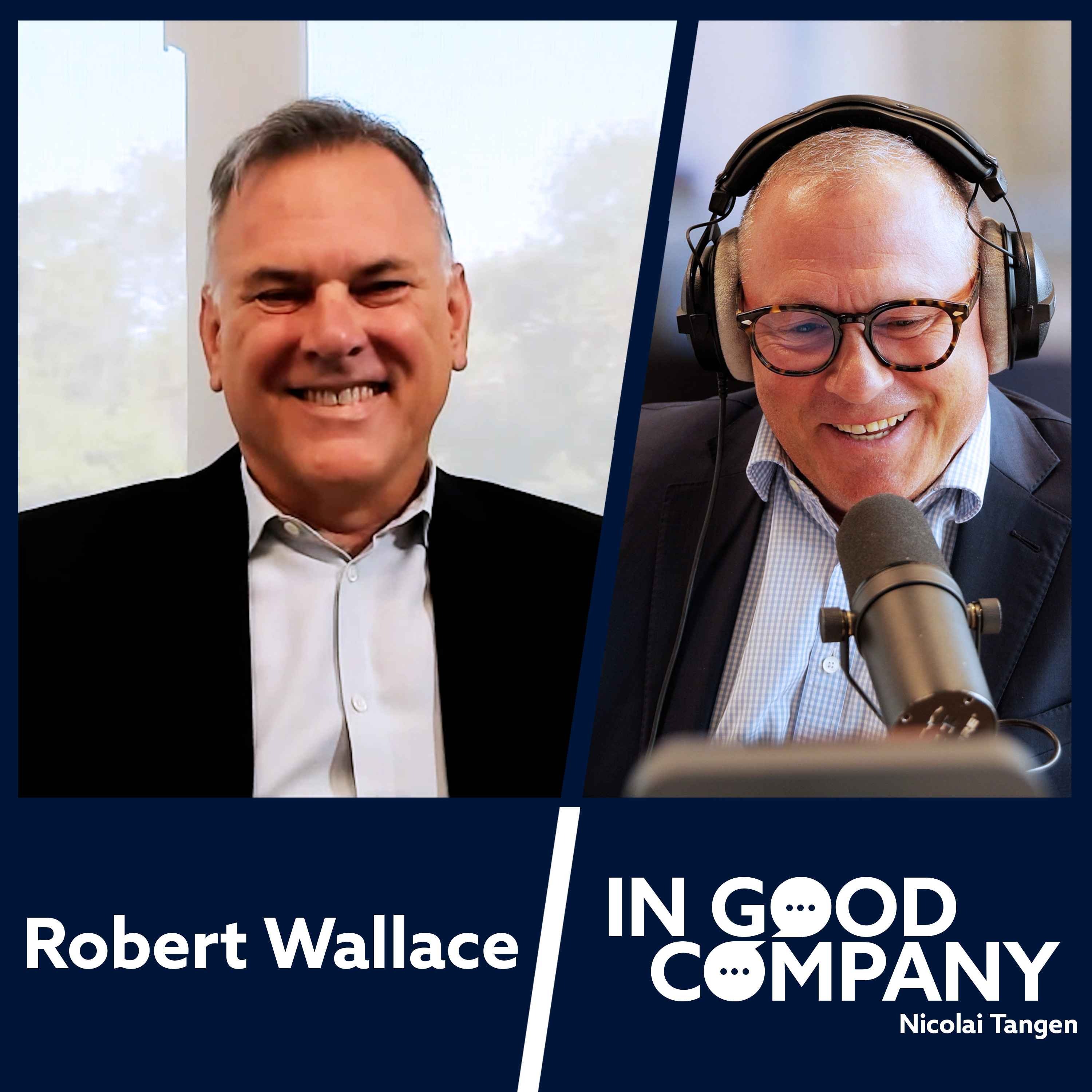
Host: Nicolai Tangen, CEO of Norges Bank Investment Management
Robert Wallace, CEO of Stanford Management Company
Exploration of investment strategies for Stanford's endowment, leadership principles, and personal insights from Robert Wallace’s journey from ballet dancer to institutional investor.
Written by AI. May contain mistakes.

Get the gist, explore an idea or ask about something said.
 Claude
On In Good Company with Nicolai Tangen, what are the key points of this episode?
Searching your listeningAutomatic transcript. May contain errors.
0:00Hi everyone, I'm Nikolaj Tangen, the CEO of the Norwegian Soen Wealth Fund. And today I'm in really good company with Rob Wallace, who's built one of the most impressive careers in institutional investing. Now, Rob is the president and CEO of Stanford Management Company. And if you are on screen, you can see the wonderful campus behind him. I'm in my, hey, I'm envious here. The Stanford endowment runs more than$40 billion and is one of the most successful university endowments anywhere. His journey took him from learning under David Swenson at Yale onto leading Alta Advisors, a London-based investment firm, before joining Stanford in 2015.
0:43And here he has delivered exceptional returns. So well done, Rob, and great to have you on. Nice to be with you, Ngoi.
0:59Just to kick off, what's the kind of core investment philosophy at Stanford? Yeah, it's actually reasonably simple. So we start with, like any institutional investor, we start with the goals we have for the endowment. And if you're a perpetual educational endowment like Stanford, you generally have two primary goals. The first is you want your endowment to provide a material amount of support for the current generations of students and scholars. So this year we're distributing about two billion dollars from the Stanford endowment to support the current operating budget of Stanford. And that support is one of the reasons that Stanford is one of the least expensive private four year colleges to attend in the country.
1:46It's one of the reasons that nearly 90 % of undergrads at Stanford graduate with no student debt. And it's one of the reasons that, you know, that we can offer need-blind admission to undergraduate students. And research is supported with that$2 billion, of course. So that's goal number one. You want to be impactful to the current students and scholars at your institution. The second goal, and that's that$2 million is about 5 % of the endowment. The second goal is we want to be at least as supportive for all future generations of students and scholars. And there's a little tension that comes when you have both of these goals.
2:29One, you know, one pushes you towards an investment program that has a lot of stability. And the other pushes you towards wanting to preserve purchasing power so that you can spend 5 % a year. and also offset the erosion that accompanies inflation. And the inflation that we care about at Stanford is higher education price inflation, which tends to run a little bit higher than consumer price inflation. So if you're distributing 5 % of your endowment every year and higher education price inflation is 3 % or 4%, you need an expected return in your investment program of around 9%. So the goals we have for the endowment suggest an investment strategy that has an equity bias because we need a pretty high return.
3:14So roughly 70 percent of the portfolio is invested in equities here of one type or another. And 30 percent is in things that are less risky than equity. And when we put all that together, we think we have a chance of being able over the very long run to provide a material level of support for the for the students and scholars at Stanford. and still preserve purchasing power. And that's really the crux of the investment strategy. How would you say it differs from other university endowments? Is it different or is that pretty much the model for my portfolio? I think those core goals are the same.
3:48And so, I mean, everybody might have a different take on the amount of risk they need in their portfolio to hit their expected return. Some people might say a 60-40 blend is more appropriate. Others might say 80-20. I think 70-30 is roughly probably in the middle of the pack. And the differences really mostly would come in how you execute on that general strategy. What constitutes the 70? What constitutes the 30? I'm sure we'll get into that. But I think at the highest level, most endowments are managed reasonably similarly these days. Now, in a way, the endowment model was invented by David Swenson at Yale, and you trained under him.
4:34What was the most valuable thing you learned? Oh, gosh. In a few minutes. Yeah, a few hours. I think a few key things, the importance of thinking from first principles and having a lot of analytical rigor backing up your work. Remind us the first principle. First principles means thinking from a premise, a logical premise, and supporting each step of your decision-making process with logic informed by data. And that's where the rigor comes in. You want to have a lot of data supporting what you do in your investment work. And that's really one of the things that I think differentiates investment from, say, speculation, right?
5:22So investors are very disciplined. You know, particularly if you're managing a perpetual endowment that has a very, very long term horizon like a sovereign wealth fund, you know, you need you really need to be very, very disciplined because you're making decisions that that are often five or seven or 10 or even 12 or 15 years out in terms of their investment horizon. And so, you know, it really matters what you're doing with each decision that you make. And so David was great about bringing first principles thinking and a lot of rigor to the way he invested capital. And the other thing that I learned from David is the importance of sort of paying attention to the intersection of supply and demand and fear and greed.
6:10He was fantastic at understanding where the opportunity set was in that space. And he was, you know, he was part, you know, part scientist, but also part psychologist. And I think I saw him put that into practice. He was incredibly good with people. He had a very strong ability to reason qualitatively as well as quantitatively. And that turns out to be a really important skill when you have a model like we do at Stanford and like David pioneered at Yale, where you're working with external partners to actually execute the individual security level decisions in your portfolio. That ability to understand your partner, to understand what motivates them, to understand their skill, their level of discipline, their temperament, their character, and their alignment of interest with you and your institution.
7:09Alignment of interest, the kind of principal agent attention was something that David paid enormous attention to. So, Rob, given that training, what kind of changes did you make to the Stanford portfolio when you arrived? Yeah, so I arrived in 2015. A portfolio was about$20 billion. And one of the things that I noticed was we were dramatically overly diversified, not at the level of asset allocation. That was fine. You want to be diversified in terms of your asset allocation. But within each asset class, we had far too many investments. So for us, that means we had far too many external partners.
7:45We had 300 external partners helping us manage a$20 billion portfolio. I remember real estate was 8 % of the portfolio in 2015, and we had 53 external partners helping us manage 8 % of the portfolio. So, you know, dramatically overly diversified. And the reason for that was the culture of the office here and the decision making model that the office had been following fostered that type of very diversified kind of low conviction investment. So one of the things that, and it had done okay, but there was an opportunity to make it better. And the way that I thought we would make it better is we needed to have a much higher conviction, more concentrated portfolio with fewer partners that were more carefully selected.
8:36and then really critically important, Nikolai, with whom we could develop a strong, trustful, knowledgeable relationship. We think of them as partners because we're really working in hopefully a constructive and supportive way with our partners, understanding how their opportunity set evolves, being able to lean into the wind, being able to help them be contrarian when their opportunity set is particularly attractive. So that usually means their performance has recently been poor when their opportunity set is attractive. And, you know, you need to really know your partner and have huge confidence in their work and whether you're aligned with them to send them money when their performance has been poor.
9:17So we do that routinely. But to have that type of partnership with people, you can't have too many of them. So we wanted to go from 300 to something less than 100, which should, you know, not be sort of at a high level, not be too hard, not too too many.
9:40Rob, what's the biggest challenge facing the endowment model just now? Yeah. Well, I mean, it certainly gets a lot of attention in the media. You'll hear things frequently or read things that the endowment model is dead. And I think one of the challenges is that public equity markets have been so strong, and particularly the US public equity market, has been so strong for the last 10 or 15 years. Really, coming out of the 08 crisis, I think it's just been on a nearly historic bull market, punctuated by only a couple corrections. And so valuations now in the US are at near all-time highs. I think the only time the US market's been more highly valued on several important metrics was 1999 than it is currently.
10:28And so, you know, we're at a very high level of valuation. That's what happens after a 15 year bull market. You know, you have you have multiple expansion outpacing earnings. We've had tremendous earnings growth in the United States, but we've had a lot of multiple expansion on top of it. So when you have that type of result in a major asset class like U.S. public equity, a more diversified portfolio like endowments tend to run for reasons we can talk about, important reasons, will look a little less good, I think, than just a single asset class portfolio that happens to be all in U.S. equity.
11:07So people kind of say that the endowment model is dead because of that. There's also been a lot of debate about private assets. So with private assets, we mean private equity, venture capital, and so on. Just what's your take on that just now? I mean, I think it's probably maybe to back up and say, so when you have private equity and early stage venture capital and things like that in your portfolio, you have to understand that the dispersion of outcomes in those asset classes is very, very wide. and they're very expensive to access. And you're going to, you need to be absolutely sure that you understand your ability to be in the top of the range with your work net of these enormous fees that you pay to access the asset class because the middle of the range is not very good.
11:58And there's a huge left tail, you know, below the middle of the range where half the investors' outcomes sit that's really quite poor, certainly less attractive than, you know, U.S. public equity, for instance. So how do you make sure you end up in the top corridor? Well, it takes a lot of work, takes a lot of rigor. It takes an enormous amount of care and careful selection of your partners and close work with your partners once you are working with them. And that's one of the reasons you don't want to have too many partners. It's hard to find a lot of good early stage venture capitalists. I mean, there's probably 10 or 12 in the United States that generate the substantial majority of all the profits generated in any venture cycle.
12:41And so in venture in particular, but also in buyout and other private categories, you absolutely need to be at the top of the distribution. How helpful is it to be Stanford? I mean, you are the dream client, right? And a lot of the whiz kids went to Stanford too. That's right. A lot of the whiz kids. Stanford is sort of one of the parents of Silicon Valley, for sure. And we benefit enormously in the investment office from having that network. And it helps. It helps a lot. And we should be able to find ways to create, to some degree, our own venture opportunities. And we've been working on that over the last decade.
13:27That's something that, for instance, I could not have done when I was working in London, but I can do here in Palo Alto. How do you select private equity partners? Very carefully. We will usually, almost all of them are groups that we find ourselves or are referred to us in some sort of qualified way from our network. We very, very seldom end up working with a partner that is introduced to us from a broker or cold calls us. So it's kind of a curated set from which we then the initial step would be spending a lot of time with the partner over a series of meetings in person and going through all the things I mentioned earlier.
14:12What is their process? What is their motivation? How do they are they rigorous? What is their investment judgment like? What's their philosophy? What are their ethics? Are they aligned with Stanford? There's a lot of smart people in private equity who do good work, but who are going to make a lot of money for themselves before you. What you really need is that incredible talent and that incredible discipline that will treat Stanford's capital like it's their own capital or better. And then you're aligned and you have a better chance of success in the long run. Rob, perhaps for the sake of full disclosure, I could say that I, in my previous life, ran some capital for the great university.
14:54And my was that a rigorous process to go through that selection. That's right. Well, you built a great firm and we were delighted to work with you and still are. So, you know, I've been on that side of it. But if you were to look at the hallmarks of a great investment organization, what is it? I mean, I think certainly you need to be, if you're managing an endowment that has the type of asset allocation that we have, where you're investing in these alternative asset classes, and you're trying to invest 40 or$50 billion, it's hard. You need to be early. You need to create your own opportunities.
15:36you're never going to get enough capital to work with a disciplined partner that's not going to outgrow their opportunity set with too much capital. You're never going to get enough of your endowment to work to have a high conviction portfolio if you're not there first, if you're not there early. So you need to be early. You need to be creative. You need to be very forward leaning in terms of your ability to find new opportunities. In order to do that work, you need a team that's energetic, that's open-minded, that's passionate about their work, that work well together. So one of the things we care a lot about at Stanford Management Company is having a team of individual, very high performers, people that seek and accept a high degree of personal responsibility, but who care more about the overall result of the team, the overall result of the endowment than their own individual area.
16:32And when you have that type of incredible motivated person that has very low ego and is team oriented, you know, you can accomplish enormous amounts of wonderful things. So one of the things that we've been doing for the last 10 years is hiring for our team, our analysts, right out of Stanford undergrad. So these are 21 or 22 year old people. When they graduate, they're young, they're super intelligent, they're super energetic. And they grow very fast. We show them the entire investment world, all the asset classes all over the world. In real time, they get to interact with the best investors in venture capital or public equity or real estate.
17:13And they grow very, very fast, very quickly. They kind of absorb information like a sponge. and after they've been in this program for a remarkably short amount of time, a few years, they're really competent. And after they've been in this program for seven or eight or nine or 10 years, they're fantastic investors. How many people do you take? We take one or two a year. And how many people apply? Dozens and dozens. And one of the ways that we find people that are particularly well suited is we teach a class. We teach an undergraduate seminar. Maybe you'll be kind enough to come help us teach at one time and talk about your work in Norway.
17:58But we have a small seminar of 20 students that apply to take the seminar. And we can tell through the course of that seminar who really feels passionate about this work. And then we often offer them an internship. And sometimes that internship matures into a full-time job. I have to say, I mean, what a dream start on your investment career. It's just unbelievable. Now, what makes a good investor? So when you have these young people in the seminar, how do you identify good potential investors? So a lot of intellectual curiosity, always questioning the ability to kind of combine quantitative and qualitative data thoughtfully.
18:44In the type of investment that we do, both aspects are really important. And so we tend to find that the best endowment style investors kind of spike enough in both areas that they're quite competent in both areas. But then the real skill is how you bring them together and to form investment judgments. And some people are just kind of, I would say you can teach a lot of that, but there's also some of it that is sort of seems to be innate in somebody. The way that people tend to just sort of naturally or natively process information. Some people just have a very facile way of bringing together all of that different type of data, prioritizing it correctly, synthesizing it in a way that really makes sense.
19:29And they make the best investors. Do you find that really clever people are able to take risks? I find it's a spectrum. Um, and, uh, I think I've sort of, I'm not sure I'm right about this, but I've kind of come to have a theory that we all sort of, because of our temperament and our experience, we all fall on a different part of the risk return continuum. Um, some of us take on naturally happy and comfortable taking a lot of risk. And some of us are naturally very risk averse. And I, I think it's okay to be either, um, you can't have a long-term investment. portfolio as an endowment that's too risk averse because you'll fail to preserve purchasing power.
20:13So you need to take enough risk in your portfolio. But on your team, I think it's okay to have a variety of people that are on that continuum at different places. The important thing is that they're all sort of on the efficient frontier so that they're, for whatever amount of risk they're taking, they're getting the highest level of return possible. So that efficient way of thinking about risk is probably more important. And it's actually helpful to have people on your team that are on different parts of that spectrum. To which extent do you delegate these type of decisions? We really work together on everything.
20:50I'm the chief investment officer, so ultimately, I make the decisions. But the real way that the decisions are made is we work iteratively in small kind of deal teams on individual investments. We work collectively on our larger strategic issues like how are we going to change our asset allocation, which we don't do very much, but we look at once a year. And really the decisions sort of, they're not consensus decisions, but they do evolve in an iterative way as we work together in these small teams. So how does it work? So now I'm one of the lucky few. I've been trained by you for five years. I'm roaming around, finding this great company or this great manager.
21:34And I come back to, you know, back to the ranch. And it's just like, hey, Rob, I just saw this amazing company. I would, you know, this group of people. Wow, we're going to make a total fortune. So where do you go from there? I give you the idea. And just how do you work on this? So, I mean, we have to spend more time. I have to spend a lot of time with the potential partner and get to know. I have to kind of go through all the work again. Sometimes I'm part of that process very early. I might be even in the first meeting. Sometimes there's several meetings before I join the group. But no matter what part I join, I have to kind of go through all of that work all over again.
22:15I have to talk about how they do their work, how they make decisions, what they care about, talk about many, many case studies from their past, understand them as people. What's their background? What motivates them? What do they care about? And that takes a long time. And then we kind of write it all up in a 40 or 50 page investment memo. We talk to everybody we can who knows the group, who knows their work, sometimes people that they've worked with in the past, sometimes their peers or competitors. and we try to kind of triangulate or substantiate our own views through that reference type of work.
22:55There's obviously a quantitative assessment of their track record and an opportunity set as well. And we put it all together in a big investment memo. We write it and we write it down. It's mostly text. And we find that's really important, Nikolai, because when you have to write something down In all of its full complexity, the qualitative things are hard to kind of write it down and have it in black and white and have it hang together. It really helps us make the right decisions. It's funny how sometimes even after you've worked on an opportunity for months and you think you know everything about it in your head, you write the memo and you read the memo and you've missed something.
23:39something's important that's not there or something's there that's uncomfortable um and that you know that still happens even now and i've been you know a cio for 21 years that still happens what's the one thing that really puts you on fire so here i am i'm a manager i run you know i run this group i'll come into your office what's the one thing i can say uh that really would make you wake up oh if you're if you're sloppy if you treat if you if you if you're if you throw capital around without discipline. Or if you clearly are out to make money for yourself and you don't really care about your partner's work.
24:15And on the opposite side, what is it that really gives you kind of total excitement? Every once in a while, every few years, you'll have a meeting with a partner or a potential partner where it's just so clear that they've got just some unique capability, unique way of looking at businesses and understanding business models. For instance, what? I mean, I think most people are familiar with Chris Hahn from the Children's Investment Fund. He's got a brilliant understanding of businesses and business models. We did a podcast with him recently, as you know. Yeah, that's right. And he's so fantastic on so many different levels.
24:56But when he formed the Children's Investment Fund, I was the point person on that relationship. I was at Yale. Yale was the initial investor with TCI. I was in the very first meetings with Chris and the Yale team and David Swenson. And it was obvious. I mean, I was pretty junior at that time. But it was obvious even then, even in that first hour or two or three. So can you just go back? So here you are. You are in Yale. You are at Yale. Tell me about that hour. So we were in London. We went to see him. And he had just left Perry. And it was more than an hour. It was probably three hours. And we just did all the things I described a moment ago.
25:35We talked about his work and his philosophy and how he thought about businesses. And, you know, he wasn't as fully formed a thinker as he is now. But the key element of how he understands investment opportunities, how he processes risk and return, how he thinks about quality businesses. That was clear in I think it was 2003. I think he launched TCI in 2004. So we spent six or nine months with him before he even took our capital or anyone's capital. We were the first investor. And, you know, it's just I don't know as a whole. It was just how he thought. It was how deeply and not only deeply, but how clearly he thought about things because he did all the work.
26:19So, you know, he did an enormous amount of work, but he was able to synthesize the two or three or four things that really, really, really mattered. And he weighted those two or three or four things appropriately in his final investment analysis. And it's very hard to do that. Do you find that many good investors are on the spectrum somewhere? Yeah, we see a little bit of that. Tell me about it. Well, I don't know. I'm not a psychologist. I'm not capable of defining it precisely. But there's an intensity and a focus. you know for the great investors it's not about how much money they make at all they're not generally not motivated by their personal wealth which is strange to say but it's it's very often true they're motivated by the their passion for investment they love the intellectual challenge of it they love the you know the constant growth they love the constant learning and the variety of information they need to process as an investor.
27:22And they want to be an excellent investor, and the money comes along if they do that, great, but they don't focus on the money. The asset gatherers focus on the money. That's a different thing. That's not being an excellent investor. That's building a great asset management business, different thing. But if you're a great investor, you're consumed by what you're doing. And that often can look like someone's a little bit on the spectrum, I suppose. I think it's so interesting because you see it in music. You have old people just continuing on until they die, but you also have it in investments, right?
27:55People are just really curious. They're not in it for the money. They got enough of it. But they just love it, right? Yeah, I think you see it in any field of endeavor that just requires a tremendous amount of focus to succeed, which is most, you know, you see it in athletics, you see it in the arts, as you said. You certainly see it. You see it in investment. What's the average length of relationships you have at Stanford? How long do you keep a manager? I haven't calculated it. We had that huge portfolio turnover. So we had 300 partners. We put 265 of them into liquidation. We kept 35 of the original 300.
28:32We've added another 50. So we're 10 years in now, but that's not long enough for me to give you the right answer. But if I look over my whole 20-year career as a CIO, I think the average tenure would be 12 plus years for a partner, maybe closer to 15. When do you sack them? When they lose discipline, when they outgrow their opportunity set, when their motivation fades, when we've made a mistake. We do sometimes, hopefully not too often, but we do sometimes make mistakes initially and our work is somehow incomplete or we don't understand something. And then sometimes this happens less often, but sometimes the opportunity set goes away.
29:21So or our ability to access the opportunity set changes. So, for instance, a real time example is China. We've made a tremendous amount of money for Stanford investing in public and private opportunities in China. And it's a fantastically interesting and wildly inefficient market, both public and private, which is a great initial condition for us and our partners to operate. But the nature of the political reality between Washington and Beijing and as a U.S. nonprofit institution governed by the rules of the United States, of course, the way that that relationship is evolving has made Stanford, has made China much less accessible for us.
30:09I think the opportunity set's as rich as ever, but for Stanford, it's not. And so that's one example of where we have to change the way we work with our partners because our ability to access that opportunity set has changed.
30:27Changing tags a bit, you are very passionate about research universities' role in innovation. And of course, you're sitting in the kind of main hub of it all. So explain this model, please. Sure. So it's a model that the United States really has followed since the end of World War II. And it's reasonably straightforward. The United States federal government receives taxpayer funds and they have priorities for national innovation, areas of research that are strategic priorities for the United States. So what they do, the taxpayer funds, is they put that money out for competitive bids from research universities, Stanford obviously included, but dozens of others.
31:14And we compete with our peers, with our tremendous and excellent peers, for that research money on any particular thing, a health care issue or research into cancer or research into some engineering problem. and the person who puts the most competitive proposal in front of the federal government wins that contract. We do the research. That's usually basic research that we're doing, basic science. And then when we've researched it, we publish it. And that publication is for anybody. I mean, it's completely wide open for people to see the results of their taxpayer money at work. And then private companies come, take the results of that basic research, and build interesting technologies on top of it and build interesting companies that provide valuable goods and services to U.S.
32:07customers and global customers. And so that innovation model really, I think, has led the world in innovation for 80 years. It's been a very, very successful model, and it has accrued, in my opinion, at least to the benefit of the United States and the world. and so I am passionate about the role of research universities and it's a good model and it's worked extremely well. So if you were to give some examples on how the endowment has really supported the innovation ecosystem, what would be one or two examples? There are dozens of examples in healthcare, in innovative research into life-saving healthcare.
32:52I heard the story of, and this kind of combines medicine and AI a little bit. We had, I think it was a six-year-old infant who had a genetic disorder come to the hospital at Stanford. And the medical school at Stanford works with the Stanford Hospital, but faculty goes back and forth between the hospital and the medical school. And this baby was having seizures. There was quite a serious situation. And within eight hours, the staff at the hospital faculty of the School of Medicine had sequenced the baby's genome, had isolated a million possible genetic variations that were likely one of them was responsible for the seizures, and used AI, used machine learning models and methodology to isolate 50.
33:4350 of the thousands or millions of possible genetic variations. And then they went in and looked at each one of those 50. The humans went in and analyzed each, and they found the one that was causing the seizures, and they were able to make a genetic correction and save the infant's life. That whole process took eight hours. So that type of work is an example of what Stanford can do. Obviously, technologies like semiconductors, a lot of them were developed at Stanford. That was the beginning of Silicon Valley back in the 50s and 60s and 70s. Google was started at Stanford. So, you know, tremendous companies have been started and grown and fostered at the university.
34:33I think right now we have 20 Nobel laureates on faculty. Wow. Wow. um rob moving back to your uh younger uh days you are one of very few people in the investment world who's been a ballet dancer and um you you danced for you danced professionally for 16 years right that's right i did yeah wow wow so it's just amazing hey i mean you still look fantastic and very agile and all that kind of stuff but um tell me about the the journey from a ballet dancer to the financial world. Yeah. It sounds strange to people when I talk about it, but to me, of course, it was very natural and sort of evolved and seemed very organic.
35:18But I did sort of fall in love with classical ballet when I was about 13, and I had seen Mikhail Baryshnikov, in my opinion, the greatest male dancer of the 20th century, perform live in Washington, D.C., where I grew up. And I just couldn't believe that anybody could do what he was doing on stage. The athleticism of it was captivating to me at that time. And so I ended up going to a ballet class in suburbia, Washington, D.C. I was the only boy. I was 13, surrounded by about 15, 13-year-old girls. And I told that story to David Swenson in my first interview for him at the Yale Investments office.
36:00And he said, stop, stop, stop. That was your first and most important lesson in supply and demand. But I just immediately, you know, kind of fell in love with ballet and the physical challenge of it. And then I thought, well, you know, look, I'm really enjoying this. Maybe I should see if I can have some success as a professional dancer. So I graduated from high school a little bit early. I turned professional at 17. And my deal with myself was, let me try it for a year and see how it goes. And if it doesn't work out, I'll go to college. So the, you know, the backup plan was always go to college.
36:38I always knew that eventually I would go to college, but you, you know, you, you, those early years are too important as a classical ballet dancer to go to college. You have to really turn professional when you're young. So I turned professional 17 and kind of think of it as 16 one-year decisions to keep dancing. And I ended up, Baryshnikov ended up hiring me in New York City in American Ballet Theater. I had a tremendous, it was a lovely time in American dance to work closely with Baryshnikov and great choreographers like Mark Morris and Agnes DeMille and Jerry Robbins and, you know, and even Martha Graham was still active at that point.
37:17But, Rob, Baryshnikov, he continued until very late at life, right? He did. He stopped doing classical ballet. So, I mean, he, he, he, uh, first of all, even into, into, into his late thirties, which is very, a very advanced stage for an elite male classical ballet dancer. He was still quite a beautiful, I mean, very capable, incredible male, uh, technique, even in his late thirties. But, you know, but, but he started to really change the types of roles he was doing. And by the, by the time he was in his forties, he was no longer really doing the real bravure of classical ballets anymore. It's just not possible to do it.
37:59But he continued dancing in other types of dance until I think he's in his 70s. I think he's still doing a little bit. He was an absolute genius. What's a great quote that somebody said that talent hits a target no one else can hit and genius hits a target no one else can see. barishnikov was so far ahead of his time as a male classical dancer he you know he was truly a genius so to work with him and he picked me out of the core to fill in for him when he got hurt one one time in the at the world premiere at the metropolitan opera house in new york to work with great dancers and great choreographers that was a journey that you know for 16 years uh just completely i found completely wonderful and very immersive we were talking about the importance of kind of passion and intensity and focus.
38:50Those were things I really enjoyed about classical ballet. Then I got a little bit old. I was 32. My wife and I were expecting our first child. I kind of knew that it was time for me to, you know, start to think about career change. So, I decided that was the right time to go to college. So, I ended up going to Yale as a freshman. I was a normal freshman, except I was 32 and not 18. And while I was, you know, All three of my children were born while I was an undergraduate at Yale. We didn't have a whole lot of money, so I had two part-time jobs, one of which was teaching ballet to the kids in New Haven, Connecticut, and the other of which was working as an intern in the Yale investments office.
39:31I just applied, and it was an ad in the student newspaper. Still had newspapers at that time. And I applied, and they accepted me, and that's really how I learned about investment management, how I learned about endowment management. Wow. I just think it's such an amazing story. How has that discipline from ballet helped you in life? I think it's helped me a lot, and I don't think it's anything unique to ballet. I think any time you want to succeed at something that's very challenging in any walk of life, it requires a lot of discipline. And that's true for investment management. I do think one of the I've reflected on this and I think one of the things that ballet and investment, long term investment management have in common is you're always working for something that's years away.
40:22You know, every day you walk into the ballet studio, you're working on your technique. It takes years and years and years before it pays off, you know. And when you're investing endowment capital for Stanford, you walk in every day, you do any work and you don't and it's going to pay off five or 10 years later. That's how long it takes in this type of investment that we generally do. And so that kind of willingness to do the work and stay focused, even though the kind of the payoff is so far in the future, that feels very similar to me in both professions.
40:58How would you describe your leadership philosophy or style? I think, you know, if you get great people and you give them opportunities to grow and they're hugely individually motivated, but also they're team players, the leadership challenge gets a lot easier. Because, you know, to some extent, most of the work is done for you just by creating that that fact pattern, that initial condition. You just want to you want to be a people work well together. They grow. They listen. They learn. You listen to them. You grow. You learn from them. You have fun doing it together. And so I've always kind of felt like that it managing.
41:44I've never managed, you know, a big team. I've always managed several dozen people. and I felt like I need to kind of treat them like, I wouldn't carry this analogy too far, but I grew up with three brothers. The four of us were born within five years. We were very close. We love each other. We were very supportive. We had a wonderful young life, but we were also intensely competitive. And I think that's sort of what I think of for the small teams that I run. I want that kind of, I want it to feel a little bit like a family, but also to have a lot of energy and a lot of drive and a fair amount of competitive spirit.
42:24And so that's what I think of when I think of my own leadership style. That's what I want to create, and that's what has worked for me for 21 years. What drives you now after 10 years at Stanford? Well, the first few years were so hard, Nikolai. I mean, we were changing so much in terms of the office, the team, the way we worked, the portfolio, massive, massive changes to the portfolio. We had to work on the governance around the investments office. The first few years were so hard, and we knew that we wouldn't see the results of them for, you know, five or 10 years. So now we're starting to see, you know, the really positive effects of that early work.
43:06And so that's very motivating because I'm really enjoying getting to see the benefit, you know, the result of that effort. I'm very motivated by the mission at Stanford. And I talked about it a moment ago. And I'm a deep believer that Stanford is one of the points of light in the world doing work that the world needs to be done, that we should care about. And I'm very proud of the endowment's role in supporting that work. And so that's massively motivating to me. And then I just love coming in every day and working with my colleagues, working with our partners around the world who are fascinating and incredibly talented and such a joy to learn from.
43:50And so it's a fantastic investment job. Rob, before we wrap up, when do you wake up in the morning? Between five and six. First thing you do? After I pet my dog on the way downstairs, I check my email. Right. And how do you relax?
44:15Not well, probably, I think is the answer. I have three children. They're all grown now. And my wife and I try to spend as much time with them as we can. I don't have a lot of I read a lot but I don't have a lot of hobbies outside of family and work so that's really I think maybe family is the way that I best relax and what do you read? I read widely I read fiction, non-fiction I consume a lot of books now we got thousands of young listeners listening into this What is your advice to young people? Yeah. Well, it's such an interesting time to be a young person, and the world is so dynamic and challenging.
45:05And I think the technology we see emerging in AI and other areas is going to offer a lot of opportunity to young people and also a lot of challenge. One of the things I often think about that I feel like I've benefited from in my career is I've listened to the bottom-up singles more than I have sort of top-down kind of strategic goals. So, you know, the reason I was a ballet dancer was because I loved ballet. It wasn't a sensible economic move for, you know, for a teenage boy in Virginia to want to become a classical ballet dancer, but I loved it and I did it and I did it for 16 years and I found it massively rewarding.
45:47The reason I do endowment management is because I love it. I love the people. I love the process. I love the mission, but I'll tell you one short story and that may be helpful to young listeners. When I was graduating from Yale, so for me, I'm in my mid-30s at this point. I had an offer to go to Harvard Business School. I had been accepted at Harvard Business School and David Swenson came and said, well, look, you can go to Harvard Business School or you can stay and work here full-time in the Yale Investments Office and give it a try. And if you don't like it, I'll help you. I think you're going to learn more here and you'll enjoy it more.
46:23And if you don't like it after a few years, I'll help you find something else. And so, you know, I think if you were building a resume, you might well have 25 years ago, you might well have said, well, you know, maybe Harvard Business School is more important for my CV. but I listened to what David was telling me and I adored the people I was working with, David Swenson and Dean Takahashi, this right-hand man. And I said, that's the right thing for me. And the same thing happened when they said, come to Stanford. And I knew the mission was going to be important, but I also knew that the people were going to be in me.
46:59I was going to learn a lot. And so that bottom-up thinking is really important for young people to pay attention to. I think some young people try to get a CV built and they end up making decisions top-down more than listening to what they really enjoy and where the people that they respect and from whom they're learning something. That type of single is really very, very important to pay attention to. Well, Rob, I have to say, in addition to the job I have now, the other job I would have loved to have would be to work with you. So perhaps sometime in the future. But in the meantime, your passion for everything you've done and for the university is just so clear and it's coming through so very clearly.
47:46And big thanks for being with us today. All the best of luck going forward. Thanks, Nikolai. Pleasure to be with you. Thank you. you
What shapes the investment strategy behind one of higher education's largest endowments? Nicolai Tangen sits down with Robert Wallace, CEO of Stanford Management Company, who oversees more than $40 billion for Stanford University. From his unique journey as a professional ballet dancer to becoming a leading institutional investor, they explore the endowment model's challenges, the art of selecting private equity partners, and what makes truly great investors excel. Robert shares how he transformed Stanford's investment approach by dramatically consolidating their external partnerships, and reveals why passion for the work matters more than financial rewards. Stanford's endowment distributes $2 billion annually, supporting students and research. Tune in for an insightful conversation!
In Good Company is hosted by Nicolai Tangen, CEO of Norges Bank Investment Management. New full episodes every Wednesday, and don't miss our Highlight episodes every Friday.
The production team for this episode includes Isabelle Karlsson and PLAN-B's Niklas Figenschau Johansen, Sebastian Langvik-Hansen and Pål Huuse. Background research was conducted by Isabelle Karlsson.
Hosted on Acast. See acast.com/privacy for more information.


