Ask ChatGPT
 In Good Company with Nicolai Tangen
20 Nov 2024 · 54m
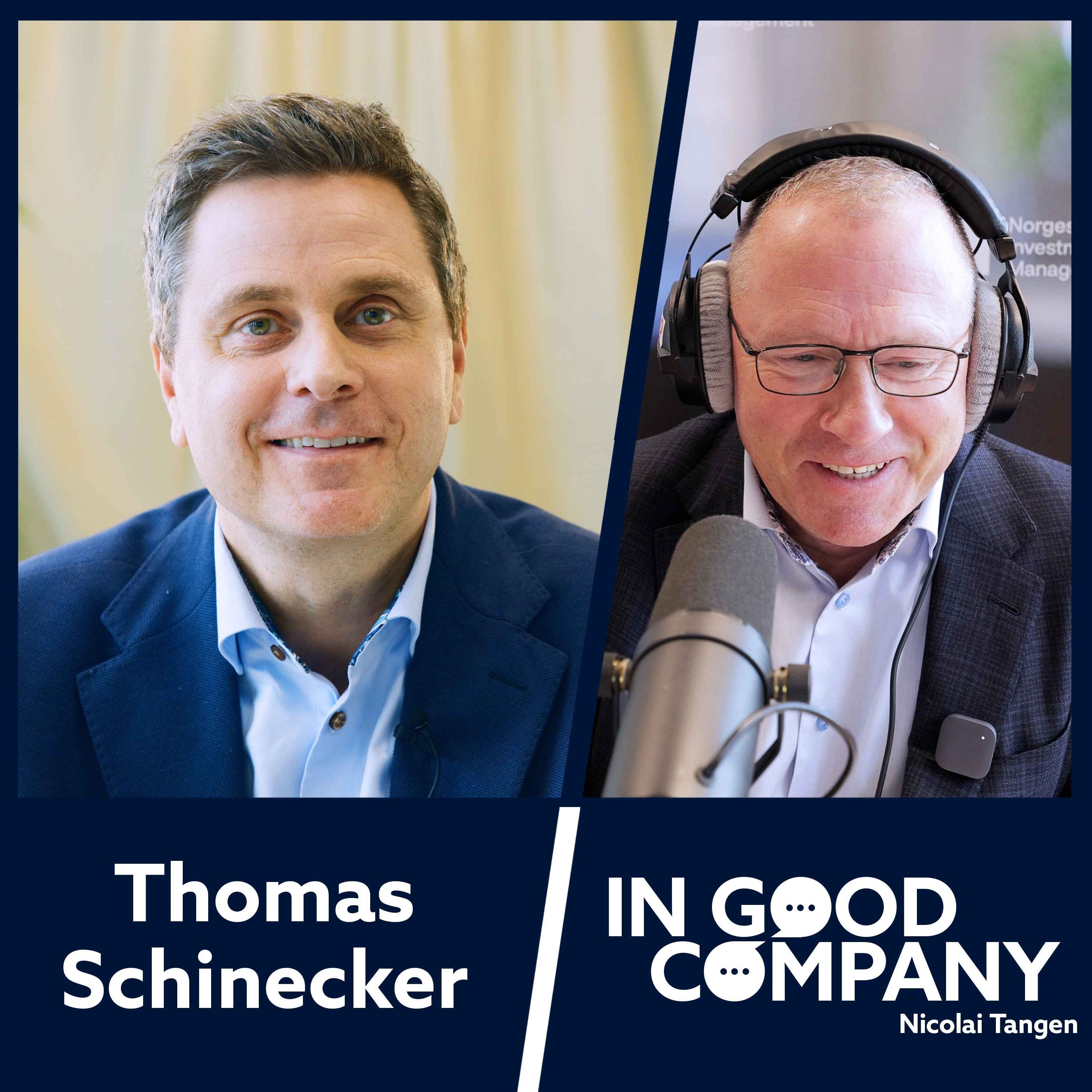
In this episode, Nicolai Tangen interviews Thomas Schinecker, the CEO of Roche, a leading global healthcare company. They discuss the future of cancer treatment, the role of AI in drug discovery, the challenges of conducting clinical trials in Europe, and Roche's pioneering efforts in personalized medicine and innovative research.
Written by AI. May contain mistakes.

Get the gist, explore an idea or ask about something said.
 Claude
On In Good Company with Nicolai Tangen, what are the key points of this episode?
Searching your listeningAutomatic transcript. May contain errors.
0:00Hi everyone, I'm Nikolaj Tangen, the CEO of the Norwegian Sober and Wealth Fund. And today we have Thomas Schinecker, the CEO of Roche, which is one of the leading healthcare companies in the world. Roche was founded in 1896, so it's really old. Lots of tradition have really innovated in healthcare, saved millions and millions of people. And we are proud that we own 2.3 % of the company worth more than$6 billion. So a big thanks, Thomas, for joining us today. Thank you very much for the invitation.
0:40So, Thomas, when you drive into Basel, right, you have Roche on one side of the river, Novartis on the other side of the river, two of the leading pharma companies in the world. So, how come that this little Swiss town has grown to become one of the super centers for bio pharma? I think it's all in the history of that region, starting with the chemical industry and then later moving into the pharma part of the industry. So I think it's all basically in the history of that region and located in the center of Europe it's actually quite ideally located. In addition it also has an ecosystem in terms of good universities, good educational system in general and I think this really attracts a lot of people around the world, really talented people that can can drive the innovation.
1:33Well, we love it when we see these kind of hubs of different types of industries. Now, one of the things with, you are, you know, the leader in cancer, and I read this book called The Emperor of All Melodies, about the incredible progress that's happened in cancer survival rates over the last 50 years. Could you just briefly take us through the main milestones in that development? Yeah, so on the oncology side, I think one of the major breakthroughs was clearly the understanding of our genome. If you look back in 2003, it costs billions to sequence one genome and took, I think, more than 10 years to sequence a single genome.
2:17Now you can do that within just days, and it costs you hundreds of Swiss francs or dollars, whatever currency you're looking into. So really understanding the genome was a real breakthrough. And with that, you could understand better the drivers of what actually drives cancer, certain oncogenes, etc. And with that, you can target much more precisely the root cause of cancer. Then I think the other breakthrough was when we found a way on how to use antibodies, something that naturally occurs in our body, but to take these antibodies and target them much more precisely at different diseases, including cancer.
2:58And I think cancer immunotherapies are a great example of that, where you can actually activate the own immune system to fight the cancer. And I think we'll go more in that direction as well. One topic we're working on is the personalized cancer vaccine. So really in how you can even more enhance your own immune system to fight off the cancer. So there are a number of steps that have been happening. And on the other hand, I think there's a lot of innovation that can still happen. and a long way to go to really eradicate cancer. How strong is your leadership in cancer treatment now? We've been one of the leading companies in oncology for, I would say, the last two decades at least.
3:42First, with the acquisition of Chenentech, where we actually got a lot of access to this know-how on how to engineer antibodies to better target different cancer targets. And at the same time, we need to continue to invest in research and development in oncology. Right now, we're investing about 50 % of our global R &D budget. So 50 % of$13 billion into the oncology space because we want to continue to drive innovation and set the next standards of care. And how would you define your market positions in the other areas? So we're a leader in healthcare overall. If you look at Just by Revenue, Roche is the second biggest healthcare company in the world, with both having pharma and diagnostics under one roof.
4:34On the diagnostics side, we're clearly the market leader. And in pharma, we're the leader in a number of different spaces. I think neuroscience is one area where we're clearly the market leader. Hemophilia, we're the market leader. In ophthalmology, we're in the process of becoming the market leader. In oncology, we're now one of the top three companies in the world in terms of cancer medicines. So you have, on the last call, you said you have 20 new products in the pipeline, of which nine has been launched. So when you look at that pipeline, how excited are you compared to what you have been historically?
5:09If you look at the last 10 years or 15 years even, we've launched about two new medicines every year. And this is quite a feat. If you look at the fact that to develop a new medicine, it takes on average around 13 years. And from the beginning of development all the way to the launch of a medicine, only about one out of 10 makes it. Now, this is not a rush-specific number. This is just an industry number. So launching two every year is quite a feat. And that's the rate we want to continue. And if you continue that rate, we'll launch 20 medicines also in this decade. Now, in our pipeline, we have many, many more potential medicines, but there's always nutrition.
5:54And so you have to work on many things to get just two out of the door at the end. Now, the big thing, of course, of the last couple of years have been the obesity space where you did have the opportunity to enter. Now you have entered at a later stage. Just what happened there? Why were you a bit late out of the box? Yeah, actually, Roche was also a leader in cardiovascular metabolic diseases in the past. And back in 2010, 2011, we actually had one of these incretins in our pipeline. And also Chugai, one of our daughter companies, has developed an oral incretin. Now, you know, as everything in life, sometimes you make right decisions.
6:41Sometimes you don't make the right decision. I think we've made a lot of very good decisions, and that's why we are a leader in areas like multiple sclerosis or hemophilia. But I would say here, clearly, we should have stayed in this space throughout this phase of the last decade. Because the topic about obesity is also a topic beyond just adipositas. It's a topic of other diseases. If you look at what diseases are caused by obesity, cancer, you know, there's a higher rate of cancer in obese patients than non-obese patients. If you look at kidney diseases, if you look at different eye diseases, if you look at potentially neurological diseases like Alzheimer's and Parkinson's.
7:30So obesity really has influence much broader. And so by tackling this, we actually go into prevention of diseases. and this is what healthcare systems want from us. Healthcare systems want us to move more towards the area of prevention. Are you surprised by how many problems are linked to obesity? No, I'm not surprised at all. If you look at the global population, about 50 % of the world's population is obese at this stage. And so in order to tackle some of these comorbidities, we will have to tackle the topic of obesity. Now, you're also working on brain shuttle technology, which allows larger molecules to enter the blood-brain barrier.
8:17What can this do? So this will be transformative, especially for diseases that happen in the brain, like neurological diseases, multiple sclerosis, Alzheimer's and Parkinson's, just to name a few. And what this technology does, it actually helps the antibody, which is a big molecule, to get much more easily into the brain. If you take a normal medicine, only or even less than half a percent of this medicine that you inject into the body actually makes it to the brain. So it's very hard to treat diseases that happen in the brain. And why is that? Well, we have this blood-brain barrier. And this blood-brain barrier is there to protect our brain from viruses, from bacteria, from other things that could go into the brain and could damage our brain.
9:11And with this brain shuttle, which is a protein attached to the antibody, we can actually transport the antibody much more easily into the brain. And with that, we can treat diseases that otherwise could not be treated as effectively. In fact, we have a very promising Alzheimer's medicine in our pipeline, and this antibody actually uses exactly this technology. And we hope to launch that by 28-29 timeframe, because then we can really tackle one of the biggest problems in healthcare today.
9:51Now, you work with a lot of different partners in many different areas. Have you done it for a long period of time? What do you think is the key to forming successful collaborations in the pharma industry? Why are some of them successful and some of them are not? Yeah, so we invest about 13 billion Swiss francs every year in our research and development. And with that, we're actually the highest spender in terms of R &D in the industry. Now, even though that sounds a lot, and it is a lot, it's only a fraction of the total money spent in healthcare in R &D. So it's clear that if you want to be at the frontier of innovation, you cannot only rely on projects that run in-house, but you also actually have to tackle and understand some of these projects that are happening outside of our company.
10:45So us and other pharma companies are constantly at the lookout to find very promising projects, compounds that we could bring in-house. Now, if we look at our pipeline and what we've delivered over the last 10, 15 years, About 50 % of the molecules that we've launched, the new medicines, came from Roche, and the other 50 % came from the outside. On the other hand, what I mentioned in the beginning is that if you look at the whole development process, it's a long process. It's 13 years on average for the industry. Only one out of 10 medicines make it. This is, of course, true for our own pipeline, but it's also true for everything that you bring in from the outside.
11:29So this is basically the risk that we have to take in order to bring great innovation to patients that also partnerships may fail during this process. But if you want to bring true innovation, this will not happen without taking any risks. Now, there are some similarities between a pharma pipeline and an investment portfolio, right? You invest in products for the long term to generate returns. Now, have you got a particular kind of investment philosophy at Roche to make this successful? Yeah, so when we look at our portfolio and our potential new medicines, we, of course, look at each medicine as an individual.
12:12But we also look at the portfolio overall. And similar to other investments that you would do, you do actually NPV calculation. You calculate, you know, what would you have to invest and what's the potential return. At the same time, we look at something we call probability of success. And so we have to understand, you know, what's the risk that we're taking in terms of technical scientific risk, but what's also the financial risk? And then when you look at the overall portfolio, it has to make sense. So, you know, you can do a number of projects that are high risk, but also high rewards. But you also have to kind of combine it with projects where the certainty is higher.
13:00Again, the high risk, high reward projects, there's a reason why they're high risk and high rewards. It's because, for example, in Parkinson's, people have worked for decades, for decades to find a new medicine. It's very, very difficult. But if you make it, of course, it's a huge benefit to society, but it's also a big benefit to our company if you make it. So you can make individual such bets, but you can't only make such bets because we also have to earn back the money in order to keep investing in R &D. We can't do any good for patients if we are not able to earn back our R &D money. You mentioned at the beginning your strong position in diagnostics.
13:44What are the advantages of having both diagnostics and pharma in-house? I think it's critical. If you look at where healthcare is going, healthcare is going to expect from us that we improve outcomes, but also reduce cost of care. Because we know that the healthcare budgets are limited. And I think here, the combination of diagnostics and pharma can play a big role. So we believe that there is much more of a trend to go towards prevention, stopping disease from progressing, but also curing. Now, if you want to prevent the disease, you actually want to find the high-risk patients. And these high-risk patients, you want to treat preventively in order for them not to develop the disease.
14:33So you need a good diagnostics to find those patients to then be able to give them the right medicine. If you want to stop disease progression, you really have to understand the cause of that disease and find a very targeted treatment to make sure that you stop the progression of this disease. And the same for cure. For cure, you know, oftentimes there is genetic reasons or other reasons that cause a disease to happen. Again, you need a diagnostics to understand that in order to give the right kind of treatment. So we see this trend really happening over the next decades. This will be even stronger.
15:15And having both diagnostics and pharma, we are better positioned than any other company to actually manage to serve the needs of what the healthcare systems and what patients at the end need across the world. And where does healthcare data come in here? Because you were early in here by acquiring Foundation Medicine and Flatiron, among other things. Why is this an important space to be? Well, healthcare data plays a role clearly across the different parts of the value chain. And it plays a big part in research and development. If you want to develop a new medicine or new diagnostics, you have to have a lot of data to understand how to best target, which molecule to design, etc.
16:02So the more data you have, the better it is for you as a starting point to develop new medicines and diagnostics. At the same time, I think when it comes to treatment of patients, data plays a big role. For example, you can use diagnostics and understand the cause of disease for a number of different patients. And then you can look at how these patients were treated and how these treatments worked. Now, if you can go back and you can look at this on a bigger population level, it will actually help you to decide which treatment to give for what kind of diagnostics for what patients. So to combine that is, I think, very critical to be even better in treating our patients and improving their lives and being more precise in the diagnostics.
17:04Thomas if we drill down a bit further on innovation like a naive question why are some pharma companies better at innovation than others what is it in particular that makes some companies stand out I think one topic is culture as a company I think that's something that differentiates us We are able to recruit and retain the most talented people. We have a very low turnover. In fact, if you benchmark us compared to other companies in the industry, we are one of the best, if not the best, company in that aspect. And given the long nature and the long cycles of our industry, it's important that we have also a certain level of continuity of people working on certain projects.
17:54When people keep switching between projects, I think that's not a very good thing. The second piece is, as a company, you have to follow the science, and you have to see where is their new scientific breakthrough, like we did with antibodies, like we're now doing with using artificial intelligence and using organoids in our research and development. And then you have to jump on those. you have to have the long breath for those then to become reality. And I think that's important. If you keep changing the course in a business that has such long cycles, it's actually not good for innovation to happen.
18:39What is it that sets the Roche innovation culture apart? So I think one is the culture that we have with our people, which is a very empowering culture. The second piece, I believe, is also the unique setup that we have. We have on the pharma side actually two early research engines. One is Jugai, a company in Japan that we own the majority of. Another one is in the U.S. called Genentech Research and Early Development. It came to us through the acquisition of Genentech. And the third one is pharma research and early development. It gives us three unique shots at goal to develop new medicines. They all have very different cultures, different approaches.
19:32And when you look at innovation, it's actually helpful to have this kind of, you know, different approaches and not only have one approach across. How is AI going to change the way you innovate? So this is actually an area where GRAT, so Genentech Research and Early Development, has a huge focus on. We have an amazing team there of people who are world experts in this area. And AI plays and will play a role in the entire process of research and development. In the early stage of research and development, for example, what used to be done were you synthesize a lot of different molecules and then you test every molecule in vivo, so in the cell, to see which one works.
20:29Nowadays, what you would do is you take all the data that you have, you let AI design among thousands and thousands of molecules, those molecules that have the best attributes, and then you just test a handful of different molecules in vivo. And what that means is that we can actually be much faster, we can be much more cost-efficient, We can test a lot more different molecules much faster and with that actually bring medicines to patients much more quickly. So that's one area. So if you do speed, for instance, what is it going to do to speed? So we set goals for R &D by 40%. And it doesn't mean that we are particularly bad that we have to set a goal of minus 40%.
21:21It's just where we believe that the industry will be at the end of the decades when we really implement AI end to end. And what about costs? How much cheaper will it be? So costs, our target is to reduce it by 20%. You know, on the one hand, we can be more effective. But on the other hand, we also want to do more. So potentially, we can also increase the number of medicines that we launch every year, which would be great news for patients but obviously also for our company. So in addition to speed and cost, what do you think it will do with the final drug, with the final products you come up with?
21:59Will there be significantly better, you think? Yeah, I think that you should have a lot more innovation happening in a much shorter period of time. And if you have that, you will also obviously have better medicines. I think what it will also do, actually, AI, is a lot of the manual work that's being done today, like writing study protocols, like doing all the regulatory submissions, which are 800, 900 pages of paper. If you can use AI for all of that, and of course you need to proofread and you need to make sure that everything is correct, but it can massively reduce the amount of effort and we can use the time of those people not to do manual labor, but really invest the time into developing new medicines.
22:53So I think there will be also shifts in the kind of work that people are doing. So you said that now one out of ten drugs make it. What do you think that number will be in ten years' time? Well, on one hand, you will bring up the volume, right? So that will be helpful. So in terms of what exactly we will achieve in terms of the success rate, I think you will have still a lot that will not succeed because ultimately you will have to test it. And there are a lot of attributes that have to work in order for medicine to work. But can you imagine if you just increase it by a factor of two? just to go from 10 % to 20%, you would double the amount of medicines that are being delivered to patients.
23:43I mean, that would be huge and a game changer. What do you think will happen to cancer survival rates, let's say, in the next 10 years? I think it will continuously improve. And, you know, the goal is clearly to eradicate cancer. And if you look at the time of HIV, when the first medicine was developed, the second medicine was developed, I think the key of how to basically achieve the fact that people don't have to die of HIV anymore was actually to combine medicines. And the reason is, if you use one medicine, the virus will change and will have different mutations. So it will escape that medicine.
24:33So by combining multiple medicines, it's much, much harder for this virus to escape. And it's the same for cancer. For cancer, you know, when you put a selective pressure on it by adding a medicine, you know, the cells that are, you know, affected by this medicine, they will die. But if there are certain mutations, they will escape that mechanism. And they will find a different mechanism. And that's what exactly we see with cancer. And so by applying multiple medicines, you can probably at one stage get to the same situation as we've done with infectious diseases like HIV. And I believe the immune system will play a big role.
25:19You know, if we can activate the immune system to fight the cancer, to identify the cancer better, then I think we also will make a big step forward.
25:33moving on to um europe's uh place in the world here so europe is falling behind uh china and the u.s when it comes to uh to clinical drug trials and i think the european share has halved over the last 10 years which is pretty pretty dramatic what why is that yeah i mean if you look at innovation, I would say there are probably four regions in the world where innovation is really coming from. One is the US. One is Europe. China is really accelerating. If you look at the patent applications coming out of China, it's taking over. It's advancing very quickly. And the last area is Japan. Now, what the U.S.
26:26is doing quite well is, so all of them have pretty strong academia, I would say. But what the U.S. is doing particularly well is that they have a much better environment for startups. So there is a much better access to venture capital. And with that, you have a lot of people actually moving to the U.S. So they have a lot of talent going to the U.S. And you see a lot of the innovation, which is translated from academia into these biotanks, that actually happening more in the U.S. and probably also China now than, for example, in Europe. So I think Europe has to get that right. The second piece that Europe has to get right is they have to reduce the amount of bureaucracy.
27:13If you look at clinical trials, et cetera, these are done in countries where you have less bureaucracy. If it takes you a year from the time you apply for clinical trial to being able to start a clinical trial, that's a year of lost time, a year of time where we cannot save a number of patients' lives if this medicine makes it. So I think Europe really needs to work on the bureaucracy piece as well. What particular part of bureaucracy is holding you back? Are these GDPR-related issues or what are they? GDPR-related issues, but in general, all the approvals that you have to get to start a clinical trial, if that takes a year, it's just a year lost in time.
28:04You said China was taking over here. What could you be a bit more specific about China's role? Yeah, so looking in China, first, if you look at the amount of patents that are coming out of China, this is going up exponentially. If you look at the talents that you can find in China, I mean, it's just amazing. You have a lot of people that studied in the best universities in the world that have gone back to China and have opened biotechs, are working in universities, etc. And one has to say, you know, if you look at the mentality in China is, you know, they want to be a leader. And then they put all the effort, all the strength of the country, of the people behind it to become a leader.
28:58I think sometimes if you look at regions, and I'm just going to pick Europe because I'm European, so it's always easier to pick on yourself. Maybe sometimes we've become too comfortable. I would say the prosperity that we have is sometimes also a bit of our enemy. If you want to stay ahead, you cannot rest on the achievements from the past, But you constantly have to work at that. And I think this is where China has a different attitude. To which extent can you tap into the talent in China? So China is actually one of our biggest countries in terms of number of people we have there and also in terms of markets, sales, etc.
29:52But beyond that, we don't only have commercial organizations there. over the past years and partly decades, we've built up also a presence on the research and development side. Pharma has been there for a bit longer, but also in diagnostics, we've been there for the last couple of years. And it's important because, you know, first of all, we want to tap into the talent that is there. And second, if you have strong R &D presence, you also can tap much more easily into the biotext because, you know, you have the connectivity, you speak the same language, you can, you know, only assess the science outside if you have great scientists inside.
30:41And so I think from that aspect, I think we're in a pretty good shape. And clearly China is going to and will remain a big priority for us, simply also because there are 1.4 billion people in China. And a lot of these people still don't have great access to health care. And so there's a lot of work that can still be done. Are you acquiring patents and companies in China? So we've done a couple of licensing deals from biotechs where we licensed in a number of molecules. And I have to say, the science is great. Is it better now than in the US, you think? I wouldn't say that at this stage. I would say, you know, if you look at, you know, around the globe, US, Europe, China and Japan are where most of the innovation is coming from.
31:34U.S. is clearly, I think, still in the leadership position, but China is catching up very quickly.
31:44Moving on to the important topic of pricing. Of course, there's always been a trade-off in the pharma industry about how much you charge and how many people will benefit from it. Generally, are drug prices too high now across the world? Well, if you look at pricing, you also have to look at the model of how innovation happens. As I mentioned, you have in pharma a cycle of about 13 years to develop a new medicine. And you have a risk profile where only one out of 10 medicines make it. So you actually have to earn the money back with one medicine that you couldn't with the other nine that failed.
32:36And you only have a short period of time. You only have around 10 years, and in some parts of the world this time is shortening even, 10 years to earn back the money. And then you have the entry of biosimilars. You have the entry of generics. and so the benefit to society is of course already during these 10 years when you have launched this medicine but the benefit to society goes way beyond if you look at if you look at just the medicines that we have launched in our history now 44 medicines are now on the WHO list of essential medicines, like antibiotics, like Valium, you know, a number of other cancer medicines, etc.
33:26Now, if the innovation didn't happen before, because there were no incentives for innovation, then these medicines would not be as widely available as they are today. In fact, I always say that our industry is actually the pipeline of the generics and biosimilar industry. So if you break that, it doesn't work. I think a good example where you can see where if you don't have that incentive and it doesn't work is antibiotics. So there haven't been new antibiotics for 50 years. Now, we've been developing antibiotics, two antibiotics, because we see there's an ethical responsibility. And we believe that, unfortunately, there will be more pandemics that will come.
34:17And unfortunately, one of the pandemics that could come could be a bacterial pandemic. And then the vaccines will not work. Then we need new antibiotics. But why is no one, especially not a lot of biotechs, why is no one working on this? It's because the business model doesn't work. If, you know, you have a company developing a new antibiotic, what would happen is that antibiotic would not be used. It would only be used once all the other antibiotics fail. So there is not a huge incentive for biotechs to go in it. They have to survive. They have to survive. A company like ours, we can invest a certain piece of our money that we have in research and development to do this.
35:07But biotechs cannot. And unfortunately, a lot of innovation happens in biotechs. So you need to create more of an incentive system for this innovation to happen. So in conclusion, if we break the incentive system, then we will be in a situation there will be no more progress in terms of innovation. And that's why I think it's important to understand the full context when you think about pricing. When you think about pricing in less developed markets and the ethical aspects around that, do you take a different approach than a lot of farmer companies? So we, and I think many other pharma companies, actually have differential pricing.
35:47Differential pricing means that based on also how well the medicine works on the one hand, but also what's the affordability, you try to price it in a fair way. And that means that richer countries will have to pay a little bit more on the medicine than poorer countries. And I think this has to be this kind of contract between richer countries and poorer countries. Now, if you have certain politicians that want basically the best price in the world, which is in, let's say, a country in Africa, the danger is that a lot of pharma companies will say, well, you know, if I have to give to developed countries like in Europe or the US, I have to give the same price as a country in Africa, I cannot introduce it in Africa.
36:46So I think there has to be an understanding that we have differential pricing between the different parts of the world. And you can't have world leaders asking for the same price as in some country in Africa or in Latin America. So now you'll, five year hence, you will have reduced your R &D cost by 20%. you have reduced the time frame by 40%. And instead of one out of 10, you now have one out of five succeeding, right? Will that mean lower costs for patients? Well, I think that, again, you have to look at the total impact that you have. Now, if you go to a situation where you prevent diseases from happening, then maybe that one medicine costs more, but the total cost because you don't have to give this medicine for the next 10, 15, 20 years goes down or you have less treatments in hospitals because people get less sick etc.
37:44So I think you have to look at it's not as simple as saying you know each medicine but you have to look at the total impact on the healthcare system and it's clear and that's our commitment. We want to help improve the outcome for patients but we also want to reduce the costs in the healthcare system. And we have to reduce it by going more towards prevention, by going towards treating people less in the hospital, but more in the home setting. Because, you know, if people constantly go to the hospital, that also drives costs in the system. Plus, you know, people who are sick also don't want to be confronted with their disease all the time.
38:25So they actually don't want to go to the hospital. So I think if we can get that done, we can bring down the cost in the healthcare system overall.
38:38Moving on to leadership, you've been the CEO of Roche for a bit more than a year. What's the most fun part being the CEO of Roche? Yeah, so I've been with Roche for now 21 years. And, you know, I love this company. I love the culture in this company. and I love the purpose of our company. And, you know, if you can see the kind of innovation that we're working on, it's just amazing. And, you know, you can see the impact that you can have on patients' lives. I mean, when I talk to some of our researchers and medical doctors, You know, when we run a clinical trial that sometimes takes three to four years in the phase three, and then the day when they see the results and they see that the results are positive and what impact they can have on patients' lives, you have people that have tears in their eyes because they see the kind of impact they can have.
39:44And so I think that's just amazing, you know, to work on something like this. The second piece is, and maybe that's also why I've been with the company for 21 years, I really care about the people in our organization. And for me, it's fun to work with these people. It's fun also, you know, to develop leaders, to see them grow. I think that's also something that is very fulfilling for me. So those are things that I really enjoy and that I can do even more in the role that I'm in right now. What's the biggest difference between you and Severin Schwann, who was your predecessor? So I've been working closely with him over the last four or five years when I was the diagnostics CEO.
40:31I would say two things that I see. One is he studied finance and law, and I'm a scientist. So you got a PhD in biology. I have a PhD in molecular biology and did research in the area of cancer oncology. I think that's one element. The second piece is, you know, if you look at where I lived and grew up in my life, I was born in Germany. But with the age of nine, my parents moved to Singapore, to Asia. And this was where I grew up. I lived in total of 12 years in Asia. I went to the US to study and work in the US. So it's something that I really enjoyed, working in so many different cultures. And I would say those are two elements that are probably a bit different.
41:27What did you take away from your upbringing in Asia? Well, first of all, Singapore is at the equator. So I loved the warm weather and I loved the food. But beyond that... The chili crab. For example, dim sum, you name it. I just love Asian food. To the point where every time we go eat in Switzerland, I always say, let's go eat Asian. And my family is not so happy about that because I would go eat Asian every day. But beyond that, I think you can learn something from every culture. Clearly, in Singapore, the work attitude, right? I mean, they have a very strong work attitude. you know, if you look at the US, the approach to innovation, I think the culture is more extroverted than some of the Asian cultures.
42:20And I think it helps me in the role that I'm in, because I work with people from all kinds of different parts of the world. And what I've always seen and what I've realized is, you know, in a certain culture, like the German or the Dutch culture, people tell you directly what the problem is. In other cultures, sometimes you have to read a little bit between the lines. So I think one of the things is this cultural sensitivity to really understand the other side that you're talking to. And I think it just helps me really working with the different regions in the world. People with PhDs are often less, have less risk appetite are you where are you on the risk seeking scale yeah i don't know if people with a phd have i haven't heard that theory um but uh i would say you know i think without taking risks you cannot be successful you know in anything in life to be successful you have to step out of your comfort And how do you make decisions?
43:33Are you an intuitive decision maker or are you basing everything on analysis? I think here, again, you probably have to have a balance. I like to understand the data and I like to understand the problem. I think oftentimes when people don't try to fully understand what the problem is, they come up with solutions that don't work. you can only get to the right solutions and topics that make the life of everyone easier in the company if you first fully understand the problem. And then what for me is important is to have sparring partners to understand the different perspectives on the data. And I think that's important to come to a decision because you may have one perspective and other people have different perspectives.
44:30So to really fully understand that. But at the same time, you have to also get to a point where you then quickly make a decision. You know, oftentimes people just spin along on the data and they never get to the decision. Now, one of the things I often do also is I talk to the different experts. Now, it depends, is it the decision I have to make or is it someone else in the organization that has to make a decision? But if it's my decision to make, I try to talk to different experts and I try to understand, you know, does their view and their decision conform with what I believe? If that happens, I think that oftentimes these are probably the easier decisions, right?
45:15If I see that everyone else has a different opinion, then I must be wrong. But oftentimes it's something in between, you know, where you have different, then I know it's a difficult problem, right? when you have very different opinions. And then at one point in time, you have to make, based on the facts, based on the information that you have, you have to make the decision and you have to go forward. And oftentimes, you have to hope that decision is right, but there may be times when your decision is wrong. But some people you can talk to are CEOs in other companies who have been educated at Roche.
45:56You have CEO of Biomarine, Bayer, Gilead, AstraZeneca. Now, why has Roche been so successful in developing leaders? Yeah, I think on the one hand, it's clearly a sign that we have a good culture. And on the other hand, it shows that we have been very good in hiring great people and developing those people. So I think this ability to develop people and have a strong focus on people is what drives a lot of innovation and also good decision making. Because at the end, innovation is also based on good decision making. So investing in people, I think, is something very critical. And it's not something that we've just done over the last couple of years.
46:45It's something that we've done for a very, very long period of time. And that's how you build a strong base of strong talents in the organization. You said you'd been at Roche for 21 years. And if we take the last three CEOs, they have been there for an average of 15 years as CEOs. Now you look at the S &P 500, the average time is five years. So incredible, incredible length of service. What are the kind of the pros and cons of that? So if you look at the fact that we are 127 years old, it shows you that we've been quite successful with this kind of model. What the benefit is, is clearly that given the fact that we have a very long cycle of development of 13 years on average, you also have to have a long breath.
47:41you can't you can't change direction every one two or three years because actually then nothing will happen in this industry you have to have determination you have to have stamina you have to have resilience because you will have setbacks but at the same time you need to be open to change and drive change forward and be also very performance oriented So clearly the long view is important, but also during this long view, you have to deliver. And if you look at just the last quarters where we had very significant growth of 9 % each quarter, I think we also deliver in the short term. It's not only just long term and wait, we will deliver in the long term.
48:29No, for us, it's very clear that you also have to deliver on the short term. What are the advantages of having family backing? So the Roche family and the Hoffman family have the majority of the voting rights in the company. What kind of advantages does that give you? This long-term thinking. If you constantly change direction in a company, first of all, of this size, I mean, to change direction of a company of more than 100 ,000 people also takes a bit of time. And then you look at the long cycle of innovation that we need. So this long-term thinking, I think, is very critical, apart, again, with delivering short-term performance.
49:13And the structure we have is really beneficial for that.
49:22Some personal things. Thomas, being a head of an incredible pharma company, do you live a very healthy life? Well, I try for sure. Of course, I think it's also important because a job like this is quite intense in terms of the amount of time that you work, etc. So being in a healthy space is critical to actually deliver performance. What do you eat, for instance? Oh, extremely healthy. You know, right now, over the last couple of years, so at home, we hardly eat any carbohydrates. We eat quite a little amount of meat, etc. So, but I have to admit, it's more my wife than myself. So, you know, sometimes when I'm on a business trip, I can escape that a little bit.
50:14But when I'm at home, I can't. Sports? I love sports. But, you know, age is catching up with me. You know, I love soccer. I used to play when I was a child. And I love squash. Squash, I guess that has to do with the fact that I grew up in Asia. And squash is a big thing in Asia. And if you look at the amount of running and calories that you burn, actually squash is one of the best sports you can do. I don't think you can say that age is catching up for you. You're only 49 and super young. Yeah, but I see it when I play soccer now with my son and other friends. Ten years ago, I could keep up right now.
50:58I have to say, playing with 30-year-olds becomes quite difficult for me. Sometimes my head knows what to do, but my body doesn't catch up with my head. You have a slogan in Roche that you cure medicine so that people can spend more time with the people they love. How do you spend your time with the people you love? Yeah, so basically 90 % plus of my free time I spend with my family and with my kids. The kids, you know, we go hiking, we go do sports. Also enjoy going on holiday with them. We go once a year, we go, and it's mostly Easter, we go somewhere into the sun. because, you know, after a long winter, we need to recover and really get energy from the sun.
51:48So we do that, and I really like that. I guess it also has to do with the fact that I grew up at the equator, that I really long for warmth and sun after a long winter. What do you read? So being a science geek, I guess, I love reading lots on science. you know actually still reads publications because I just find it very fascinating and it keeps me up to speed on what's happening on the science side that's why I also love having conversations with scientists because I learn something all the time so I like that you know I spend a lot of time you know reading up on you know politics also history things like that I really enjoy reading those things.
52:42What is your advice to young people? Yeah, so having three kids, I guess I have to give advice quite a lot to my children. You know, one of the things that I tell them is, you know, what happens in social media is not the real world. The real world can actually be quite exciting and people should spend more time in the real world. and you know oftentimes what you see in social media is just also not completely true the other thing I tell them is you know there are no shortcuts in life so you know if you want to achieve something the only way to achieve it is through hard work there is no other way to achieve things than other than through hard work and and I think that's important for people in the younger generation also to realize.
53:39Well, sounds like you worked really, really hard. Big thanks for being on the podcast. Big thanks for curing all the diseases. And please keep up all the good work in Basel. Thank you very much for the conversation.
What’s next for cancer treatment and personalized medicine? How is AI reshaping the future of drug discovery? And can Europe keep pace with China’s rapid rise in health care innovation? In this episode, Nicolai welcomes Thomas Schinecker, CEO of Roche, one of the world’s largest health care companies. They discuss Roche’s leadership in cancer treatment, breakthroughs in diagnostics, and the impact of cutting-edge R&D in areas like precision medicine and AI. Schinecker also shares his views on the rapid growth of China’s pharma industry and the challenges Europe faces in keeping up with global clinical trials.
The production team for this episode includes Isabelle Karlsson and PLAN-B's Niklas Figenschau Johansen, Sebastian Langvik-Hansen and Pål Huuse. Background research was conducted by Sara Arnesen.
Hosted on Acast. See acast.com/privacy for more information.