
 Ask ChatGPT


 In Good Company with Nicolai Tangen
19 Aug 2026 · 50m · 27 chapters
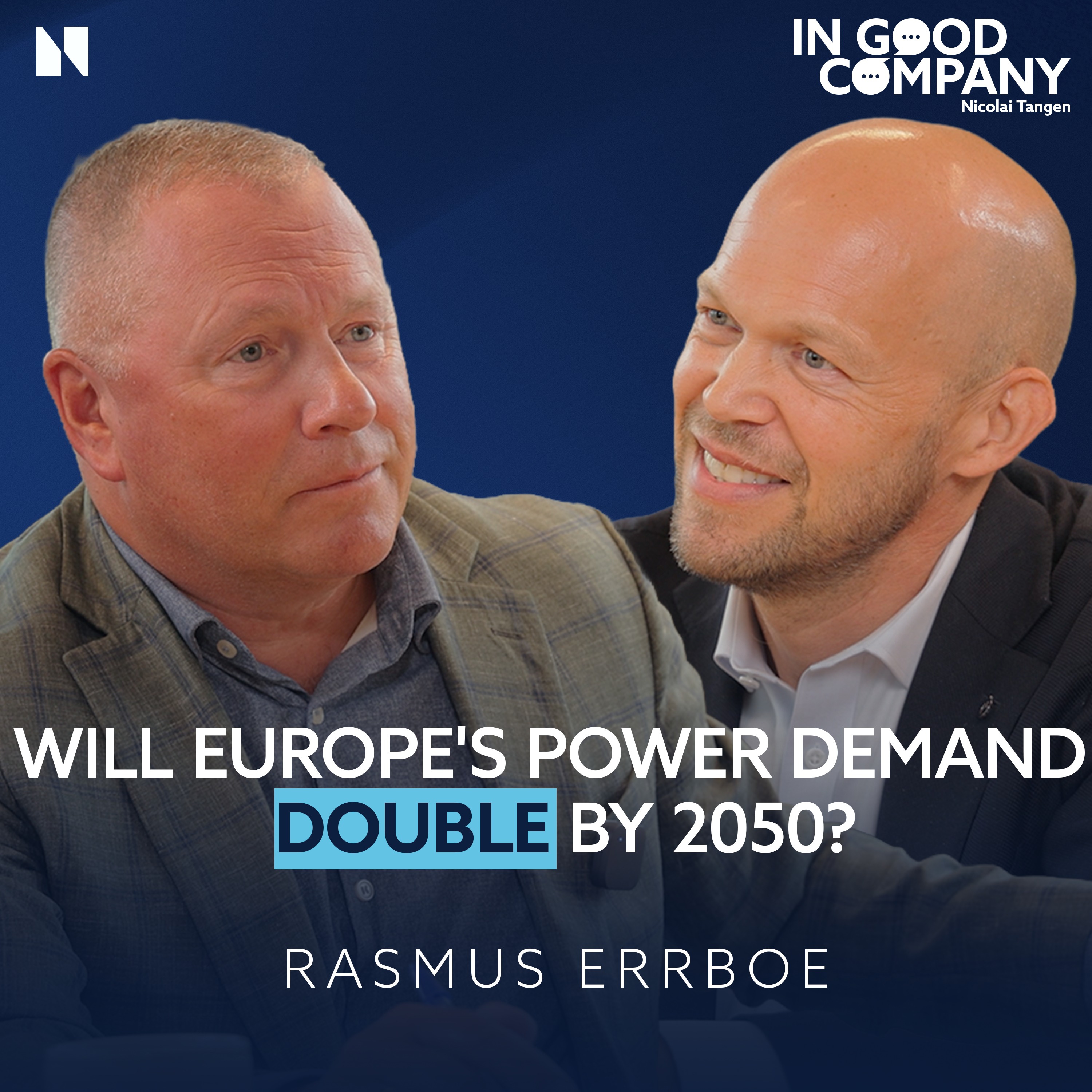
Ørsted’s transformation from Danish oil and gas to global offshore wind leader; offshore wind cost “boom and bust” (LCOE falling ~70% then rising ~50%); US policy backlash including an 80%-complete project stop-work order; rebuilding trust after write-downs; geopolitical and affordability drivers for renewables; offshore wind scale and risk management.
Nikola Tangen, CEO of the Norwegian Sovereign Wealth Fund. Rasmus Erbo, CEO of Ørsted (joined 2012; led turnaround after US setbacks; company 50% state-owned in Denmark with retail/global investors; Equinor ~10% owner).
Denmark’s long-term political predictability enabled offshore wind; LCOE reversal driven by higher interest rates, supply-chain costs, and unhealthy tender competition; US stop-work order made an unfinished asset a liability; Ørsted should have stepped back sooner (focused on volume vs value); trust is rebuilt by doing what you say and clear communication; Europe’s fossil fuel imports (~€400B) make renewables cheapest for the system.
Vindeby turbine history; Storbelsbrun bridge analogy for US project; Hornsea C4 (135x Central Park) and Hornsea 3 (~300m turbines); Hamburg commitment to tender up to 300 GW offshore wind by 2050.
Written by AI. May contain mistakes.
Learn about the unexpected challenges faced during an offshore wind project.
“And then I get a phone call from our general counsel that I have worked with for a decade.”
Discover Ørsted's transformation from fossil fuels to offshore wind energy.
“So like 35 years ago, you built some turbines off the Danish coast.”
Explore how Denmark became a leader in offshore wind energy.
“But it took a long time before wind power generally took off, right?”
Examine the barriers to offshore wind development in Norway.
“So I think all the way from the beginning, Denmark has had that sort of commitment and foresight to offshore wind.”
Understand Ørsted's decision to pivot from fossil fuels to renewables.
“I think if you look at it here in Norway, the challenge has a little bit sort of been to get it off to a good start.”
Learn about the fluctuating costs and market dynamics in offshore wind.
“so I can take no credit for the decisions that were made.”
Delve into the various factors impacting offshore wind economics.
“I would actually move that point in time even further sort of back.”
Hear about Ørsted's experience and challenges in the US offshore wind market.
“So I think if you, first of all, if you think about it in the context of us, it's important to sort of differentiate between the US and Europe.”
Understand the implications of receiving a stop work order on a project.
“came out with our intention to do the capital raise that we're probably also going to talk about.”
Explore Ørsted's decision to sue the US government over project issues.
“The way I think about it, just a layman's term is for if there are any people from Denmark listening, then they will know about Storbelsbrun, so one of the biggest bridges in Denmark connecting Zealand and Jotland.”
Learn about the challenges Ørsted faced in project management and decision-making.
“and we looked at the facts, and we looked at the permits.”
Explore how political factors influence Ørsted's risk management strategies.
“So I don't know if that particular situation that we just talked about can happen.”
Understand how geopolitical events shape investments in renewable energy.
“And then we have sort of retail investors and global investors as well.”
Examine the expected growth in energy demand and the role of renewables.
“Do you think we underestimate the need for power going forward?”
Discover Ørsted's leadership in offshore wind and their competitive advantages.
“There are good wind years and bad wind years, no doubt.”
Learn about Ørsted's shift from oil and gas to renewable energy and the challenges faced.
“And the transition from being both an oil and gas company into being a pure play renewables company has obviously also sharpened that focus.”
Discover the complexities and risks of constructing large-scale offshore wind farms.
“What's the most difficult part of what you're doing?”
Explore the potential and current limitations of floating wind technology in the industry.
“all of that is something that we spend a lot of time thinking about.”
Examine China’s impact on the global wind energy market and Ørsted’s strategy.
“Because in countries where you have a significant potential for bottom fixed or onshore wind on solar, there I would not spend a lot of time on floating.”
Learn about the advances and investments in the European wind energy supply chain.
“So I think it's important when we talk about China to make a few distinctions.”
Discuss the strategic implications of sourcing decisions in a partly state-owned company.
“If you came and just said, hey guys, we're just going to buy Chinese turbines now.”
Understand the leadership qualities required to navigate a company through a crisis.
“We have a three-year turnaround plan, and we are six quarters in.”
Explore strategies for keeping team morale high during significant organizational changes.
“But I felt that that was the right thing to do and provide that clarity to our team so that they knew what we were up against.”
Listen to a personal story about career choices and the lessons learned from them.
“And I think you as a leader, you need to continue to remind yourself to not take that for granted and continue to speak into the purpose in your communication.”
Explore the speaker's career choices and personal reflections on life balance.
“I have made many mistakes, just to be clear.”
Valuable insights on personal growth and career advice for the younger generation.
“I have, in my view, the best job you can dream of.”
Discussion on the importance of teamwork and support in leadership roles.
“Many young people in particular, or some at least, have this misconception that being a CEO is a very lonely life.”

Get the gist, explore an idea or ask about something said.
 Claude
On In Good Company with Nicolai Tangen, what are the key points of this episode?
Searching your listeningAutomatic transcript. May contain errors.
0:00And then I get a phone call from our general counsel that I have worked with for a decade. And to be honest, I sort of, I look at the phone and then I actually put it down again because he had called me. But he rang again. Yeah, exactly. Then he sent me a text and said, Rasmus, you should probably just give me a call. And then within less than 10 minutes, we received what is called sort of a stop work order, which is effectively a one-pager that orders you to stop the construction of a project in the US that at the time was 80 % done. That was pretty extreme, unexpected.
0:57Hi everybody, I'm Nikola Tangen, the CEO of the Norwegian Sovereign Wild Fund. And today I'm joined live from Oslo by Rasmus Erbo, the CEO of Ørsted, the largest offshore wind company in the world. Ørsted used to be a Danish oil and gas company, sold its fossil fuel business and rebuilt itself around offshore wind. Warm welcome, Rasmus. Thank you very much, Nikola. I'm very happy to be here. Now, just tell me about the start. So like 35 years ago, you built some turbines off the Danish coast. Yeah. How come? Yeah, so first of all, I've been with the company for 14 years or so, so I cannot take credit, obviously, for the entire journey.
1:36But you are right that roughly 35 years ago, the first offshore wind turbine in the world was set up in Denmark in a place called Vindeby. And why did an oil and gas company start to build wind turbines? Ørsted is basically founded as a merger, if you will, in 2006. So this happened. This was only part of the company back in the days. But what happened from 2006 and onwards was that that was the start of this journey from being a fossil-intensive company into becoming the global leader of offshore wind today. So that is really where the transformation started. But it took a long time before wind power generally took off, right?
2:22Why was that technology so expensive for such a long time? Yeah. Even today, offshore wind is still, in many ways, you can say a niche industry. If you look at it in the totality of the energy system in Europe, I think there is today 38 gigawatts or something installed in Europe. So, of course, it takes time when you build up an industry. But especially from the years from 2015 to 2020, those were years where we were really starting to see the sort of the invasion and industrialization starting to happen. and also costs starting to come down. How come Denmark became the kind of superpower here, which you were until China took over, but you were very big and very dominant, both as an operator, but also in terms of constructing these turbines?
3:07I think it's a combination of several things. I think what is important for an industry like ours is sort of predictability and the ability to sort of think long-term, both politically, but also from an industry perspective. So I think all the way from the beginning, Denmark has had that sort of commitment and foresight to offshore wind. It is a relatively sort of stable political environment. The framework, there has been bumps on the roads, clearly, but the framework has been relatively robust for decades. And then also the industry was sort of ready for it. We are sort of a country with coasts and you have investors today, you have us today.
3:51So there was this sort of glooming industry ready to work with the government. Well, I mean, you got a coast, but so does Norway, right? You do, for sure. A long one and a lot of wind. And so when you look at Norway, what are your reflections when it comes to wind power? If you look at it, if you lift it up, just one notch and just look at Europe, which is our sort of the core region for us. There is no doubt that there is a massive potential for offshore wind in Europe. We can talk much more about that. I think if you look at it here in Norway, the challenge has a little bit sort of been to get it off to a good start.
4:41As an example, the seabed is relatively there. The depth is relatively significant most places. So it's very much floating. Floating is still early days. So you kind of need that sort of standardized approach to also bottom fixed or fuel wind in Norway and in many other countries. What about land? Land is clearly an opportunity for Norway. Our focus is on offshore wind. We sold our Europe Onshore business. But from my perspective, I see a significant opportunity. Now, in 2017, you sold your oil and gas. Yes. How come?
5:30In 2012, 2013, the transformation of Ørsted from being a fossil-intensive company into becoming what we are today really started to sort of kick off. We basically saw a very significant opportunity within offshore wind. Sort of the base in the first years was in the UK in particular. So we basically looked at the entire sort of footprint we had. But was this some kind of McKinsey report that decided this? Not at all. I joined the company in 2012. I joined one month before the then CEO, Henrik Paulsen. I was the youngest employee in the legal department, so I can take no credit for the decisions that were made.
6:24but the way I think about our transformation was it's very much a question of sort of just looked at the facts just looked at the facts for for Europe on on climate change the management took I would say two three very bold strategic decisions one and and sort of the key driver was to pivot based on the facts saw the opportunity and then executed the transformation of us is etc. It's basically a story around execution and execution, execution, not just talking, but changing the core of your company. And that is what started to happen already in those years. And then we sold our oil and gas pistons.
7:03And for a long time, offshore wind looked fantastic, right? Capacity increasing, prices coming down and so on. But then in 2022, something happened. Absolutely. I would actually move that point in time even further sort of back. So if you look at it from 2015 to 2020, you basically saw perfect conditions for the cost out of offshore wind. You saw what we call, not to be too technical, but LCUE, levelized cost of electricity, to go down by roughly 70 % from 15 to 20. From 20 to 25, we have seen LCUE going up again with roughly 50, so 5-0%. And that's really in that period of time where you have seen a lot of failed tenders So wind farms that has been won, but not has been built.
7:52And it is basically that sort of reset that has been a bit of a challenge for the industry. Now, it seems as if we are sort of on the other side and we are starting to see the economics of offshore wind stabilize before what I expect will be a cost out again. But what was it that people underestimated at the time? Because other players also needed to take big write downs. Absolutely. Was it just inflation, interest rates? Just what was it exactly? So I think if you, first of all, if you think about it in the context of us, it's important to sort of differentiate between the US and Europe. So while we have sort of stepped away from tenders and not participated in tenders and so on in Europe, all along, we have actually delivered on our core business on offshore in Europe despite these spikes in the pricing.
8:48The U.S. is a different story for us, and that is really where we have seen the write-downs that we can also talk about. But it's important to make that distinction. Absolutely. And we'll come back to the U.S., but just when you look at the assumptions you made and the projections and so on, just how does it feel to see it playing out so differently than what was expected? Yeah.
9:13sort of the key things that drove LCOE up again in those years were, of course, sort of interest rates starting to go up. It was sort of supply chain costs starting to increase. And also the tender frameworks basically becoming, sort of changing into Europe, becoming a little bit of a test lab for different ways by which you can tender out offshore wind. And if you combine that with a period of time where you also saw significant interest from oil and gas companies coming in, then you had what I would say sort of was a competitive environment that was not healthy. Let's go to the US. So August 2025, you've been CEO for six months, and then suddenly you get a call from the US.
10:07What was that about? Yeah, it was the 22nd of August. It's one of the days I will remember for the rest of my life, that for sure. I have quite a few of those, by the way, for 2025. I sat in, it was a Friday evening around eight o 'clock. I sat in the couch with one of my three sons and watched TV and sort of was exhaling a little bit after not just a long week, but also a summer that had been relatively intense because we, on the 11th of August, came out with our intention to do the capital raise that we're probably also going to talk about. Eight billion euros of equity, biggest capital raise ever done for renewables, biggest capital raise ever done in the Nordics, all on a pretty tough backdrop driven by the US.
10:58and then I get a phone call from our general counsel that I have worked with for a decade and to be honest, I sort of, I look at the phone and then I actually put it down again because he had called me but he rang again yeah, exactly, then he sent me a text and said, Rasmus, you should probably just give me a call and then within less than 10 minutes we received what is called sort of a stop work order, which is effectively a one-pager that orders you to stop the construction of a project in the US that at the time was 80 % done. That was pretty extreme, unexpected. And the challenge, of course, in addition to the project, was that we were in the middle of the capital race process.
11:54So we knew at the time that we had a weekend in front of us where we needed to deal with not only the project, ensuring the safety of our people, the shutdown of the project, all of that, but also making sure that the capital raise was still sort of intact on a Monday morning. I mean, an unfinished offshore wind project, it turns an asset into a liability, right? It does. The way I think about it, just a layman's term is for if there are any people from Denmark listening, then they will know about Storbelsbrun, so one of the biggest bridges in Denmark connecting Zealand and Jotland. For me, this is a little bit like sort of building the bridge and then being asked to stop your construction 50 meters before you build the paying terminal.
12:43You have it all built, but you don't get your cash flow. So then you sued the government? we did on the I think it was I know it was on the 4th of September how does it feel to sue the US government
13:03it was not a decision that we took lightly as you pointed out before I was a relatively young CEO at the time I still am it was something that we obviously carefully thought about in the period between the 22nd of August and the 4th of September. We sort of obvious pros and cons and so on, but at the end of the day, when we looked at it... But you were a lawyer, so you looked at all kinds of things. Yeah, but I don't... That's not my job title today. So what I did was that I made sure to surround myself with all the right people to take that decision. Obviously, something we also discussed with our board, our owners, and so on.
13:54At the end of the day, we decided to file the lawsuit because we just looked at the merits, and we looked at the facts, and we looked at the permits. We had spent seven to nine years to get the permits in place. We felt we had a very strong case. Should you have been in this project in the first place? of course Nikolai when you look at it now and when you look at the implications on Ørsted of not only that project but also our ocean wind project that we stepped away from in the US and our sunrise project that we are constructing now of course Ørsted would have been better off without that's pretty obvious if you were to be self-critical what would you say the mistake was
14:42I think that the way I look at it is where I think we, what we should have done is that we should have been able to, we should have stepped back sooner. So if I look at those years, we had a capital markets day in June 23, where we set the bar high. We took the write downs on ocean wind in the US in the fall of that year. We set the bar too high on the capital markets day. We were too focused on volume rather than value. and then we didn't step away fast enough when we saw starting to see the writings on the roll in the US. But generally speaking, how can you plan a 30-year project when government policy can change in the next election?
15:37Because it can happen in Europe too, you think or not? Absolutely. So I don't know if that particular situation that we just talked about can happen. I certainly don't expect that. But political uncertainty and sort of shifting winds, if you will, of course. We have spent a lot of time also since I took over to really make sure that our approach to risk management and our approach to managing those obvious risks that you talk about is as robust as at all possible. Of course, countries, where you have bipartisan support to offshore wind and where you have sort of the regulatory stability that I talked about before is something that we preferred or prefer.
16:25But there are also many other things to it. It's about constructing and developing your projects in a way where you at any given time basically can afford to step back. Do you think, so then you raised a lot of money, right? I mean, a huge capital increase. Do you think you're too, is there a danger that you are becoming too risk averse now? I mean, I saw, for instance, that you did not win the latest tender in Denmark. I mean, are you too careful now? It's an obvious bias to look out for, no doubt about it. If I look at it from my perspective, just personally, you know, when we did the capital race, you go to your majority owner in Denmark.
17:09The state. The state. and you ask for 4 billion euros from Danish taxpayers. Denmark is sort of, I think we have more than 200 ,000 retail investors. Of course, that comes with a great deal of responsibility, but also humility from my perspective. You're humble, basically. Do you feel like a state-owned company? I feel like the company we are, which is a company that is 50 % owned by the state. And then we have two other large shareholders. And then we have sort of retail investors and global investors as well. Was it like the prime minister said, okay, we'll give you the money, but just don't screw up again?
17:52No, the way it works in Denmark is that it is sort of the arm's length principle, sort of the governance is that we are run by the board of directors. in our state. But sort of back to your question before about sort of whether we are at risk of being too risk averse. Yes, there is a risk because for me, it is incredibly important that we deliver on the commitments to all of the investors that I looked in the eye in the fall last year. That's important to me. Yeah, I can see that.
18:29Sticking with politics, but a different kind. I mean, the geopolitical situation has really changed the whole energy situation, right? Just how do you look at that now? How much of the geopolitical situation is it that drive investments into the renewable energy sector now? I think it's a very significant driver of the change that is happening right now in Europe. It is sort of sometimes as if one energy crisis was not enough. The second one that we saw and are seeing sparked by the events in Iran earlier in the year, it's really as if that has really sort of finally, if you will, sort of made everybody realize that the dependence that Europe as a region have on imported fossil fuels, where you import close to 400 billion euros of fossil fuels, is simply not sustainable in any way for the long term.
19:29So therefore, for me, in the first part of my career in Ørsted, we talked a lot about climate change. Nothing has changed for me on climate change. It is the same. Look at Europe this summer. Everything is still as urgent as it has been all along for me. But now, it's not only about energy security, it's also about affordability. Because what has become quite evident, also because of these geopolitical events, is that the cheapest solution for the energy system as a whole in Europe for the decades to come is a system that is to a large extent based on renewables. Are you surprised there is not more focus on it?
20:13I think I am pleased to see the urgency that I now see. Take an example from my backyard, if you will, sort of on the 26th of January, nine state heads stood side to side in Hamburg and committed to tendering out up to 300 gigawatts of offshore wind by 2050. One thing is the target. I have seen many targets over the year, but there was also more clarity about the how. So that for me was a clear example where you are really starting to see change. We talked about the tender yesterday in Denmark, you know, also close to two gigawatts being tendered out. There are tenders coming in the Netherlands and Belgium and the UK.
21:00There's really momentum coming for offshore wind on the back, also on the geopolitical changes we talked about. Are you surprised that people are talking less about the climate? I'm actually not surprised in the sense because if you look at it from as a, not as a CEO, but just as a father of three, and of course the affordability point is very close to mind. And so therefore, sort of the fact that
21:42the fossil fuel sort of imports imports has really shown now that renewables is a cheaper solution. That is really starting to then sort of change the picture. And then I also think that climate change is as relevant as it has been all along. Do you think we underestimate the need for power going forward? I think it depends on who we are. My view is that I see a very likely scenario where the demand for electricity in Europe towards 2050 will close to double relative to where it is today. And if you just look at that and take that as a factor, take AI as an example. AI doesn't need molecules, it needs electrons.
22:31So I think sort of the electrification demand for Europe is going to be massive in the decades to come. If you could change one political decision to get it moving faster, what would it be? Good question.
22:48It would be to, maybe it's not a change, but what is really important is that governments deliver on what they say, on their intentions when it comes to renewables. I have seen many intentions over the years, many targets over the years. If the nine governments that I talked about before, if they just deliver what they talked about in Hamburg, as I said before, then we will be in a very good place. Offshore wind is less than 1 % of global energy. Is that a big enough market for a company like yours? Absolutely. I think you can sometimes become a little bit blind to the magnitude when you talk about offshore wind.
23:39You have a lot of these sort of statements about number of gigawatts and so on. One gigawatt of offshore wind is 30-40 billion Danish kroner in terms of sort of capital education. Just to understand the magnitude. We have Horn C4 in the UK that we have built. That's right now our biggest offshore wind farm. It's 135 times Central Park. One turbine is more than 200 meters tall. One turbine rotation will power a family for 24 hours. the scale is really significant. And then right now we are constructing Hornsea 3 next to Hornsea 2. There the turbines are close to 300 meters tall. But isn't the trend for an energy supplier to be able to offer different types of sourcing, right?
24:42If you have too many windmills at the same place, if there is a lot of wind, electricity prices go down, right? Because there's so much supply. A hundred percent. So that's really an important point. So when you look at the energy system and you look at offshore wind, you need to see it as part of a total energy system. So when I talked about that the cost for society will go down, and based on a renewable system, it is assuming that you have sort of solar, you have onshore wind, you have batteries, you have offshore wind, you have also peak gas for the hours where you need it. And that gives you that sort of closer to a baseload profile that society needs.
25:21So you need it all. It's not either or. You need it all. But what about wind versus solar? Because solar prices are dramatically falling, right? Absolutely. But I think the premise behind that question is that there is an either or. If you agree with me that electricity demand, it doesn't even have to double. But let's just assume that it's going to go up with 1 % to 2 % for the next sort of 15 years. You need it all. You need both solar and offshore wind. Offshore wind has scale that we just talked about. Offshore wind is more sort of a load factor. It is complementary to solar, as I talked about before.
26:05It is sort of closer to the load centers, the industrial centers, where you really need the energy. There are so many benefits, but you need it all. a question which is going to sound a bit naive and I didn't kind of know much about it until we started to buy wind farms but it's blowing less you know like in the UK you know in Europe there's less wind no no is it just where we have the turbines I you are the risk officer was so worried about it he thought I should sell he thought I should sell my sailing boat no so we of course spent quite a bit of time modeling this, and we have for decades. One of the things that comes with doing offshore wind for, as we talked about in the beginning, close to 40 years, if you have an abundance of data, of so much data that you pick up at all of the anodes on all of the turbines.
27:06There are good wind years and bad wind years, no doubt. This year, we are actually above the norm. So we model in a detailed manner what is a normal wind year and we track it and we communicate on it and we don't see a trend where it's blowing less. It might feel so here and there. So you have a good wind year and it's a bad hair year. Yes. Okay.
27:33We may take that out. That's for you to decide. That's not for me. Why are you going to win hair? Two. Okay. So why are you going to win this race?
27:50Today, we are the global leader in offshore wind. We have a distinct capability that we have built up over decades. And the transition from being both an oil and gas company into being a pure play renewables company has obviously also sharpened that focus. We have an organization that is incredibly good at sort of constructing wind farms in a way where risks are sort of mitigated and done in the best possible way. In only less than two years, we have 18 gigawatts of offshore wind. We have more than 1 ,500 turbine spinning. Sort of what you can do with that fleet in terms of sort of the hubs, and it's obviously something that is a competitive advantage.
28:40What's the most difficult part of what you're doing?
28:49I think one of the... There are many things. There is not a week that goes by, to be honest, where I don't get some sort of inbound, a call with something on a project somewhere in the world that is not going according to plan. we are constructing infrastructure at sort of massive scale so believing that this is just sort of clockwork is sort of naive so sort of dealing with the challenges is something while sort of staying on track is obviously something that we deal with but something that any company of course have to deal with I would say that the timelines is challenging that we talked about before the fact that it takes four or five years to construct the wind farm.
29:37The fact that the tenders that were won in Denmark yesterday is for wind farms that will be finalized in 1932. Sort of managing the timelines from a risk management perspective, from a commitment build-up perspective, all of that is something that we spend a lot of time thinking about. What is your view on floating wind? So floating wind, i.e., they are basically tall constructions which float in the water rather than being fixed at the seabottom, right? At the seabed. Örsted have as part of sort of our change strategy that shortly after I took over early last year, we basically changed our strategy into sort of focusing only on bottom fixed offshore wind.
30:24So we stepped away from floating, we stepped away from green fuels, we sold our Europe onshore business. So basically focused on where we believe first of all, we are the most competitive, but also where we are confident that growth will come. The reason we stepped away from floating for us is not because we don't believe, I don't believe it will come. I certainly believe it will come. But I think it's going to take more time than people expect. Is there a good business case for it? There can be one day. I don't see it right now for us at least. Back to what we talked about before, it's about affordability.
31:02It's about cheap power for the consumers. And at a point in time where that is so much in focus, then the LCOE of floating is simply significantly higher than it is for bottom fix. So therefore, unless you are in markets where you have no other options than that, then for me it makes sense. What do you think about countries which are willing to massively subsidize these type of developments?
31:26I think you are we talking floating or in general yeah and if if you have if it from a societal perspective is if you have a view that you believe over time that that will bring you the cheapest power for your consumers then it makes sense to me how do you think it will depending on the country. Because in countries where you have a significant potential for bottom fixed or onshore wind on solar, there I would not spend a lot of time on floating. But if there are places where it will bring the lowest price over time, and you believe that, it makes sense.
32:08China. Yes. Tell me about the Chinese buildup of turbine manufacturing capability. we are since you started in the business just what how has how has the Chinese part of the business changed yeah so first of all for us just to be clear strategically we are not active in China we are not active in China as a developer and we are also not active in China from an OEM perspective in terms of sort of sourcing we are the global leader of the industry outside of China. But that obviously also means that it's sort of diligent to follow the trends in the industry and what is going on. And we also do that.
32:55And of course, there is a very significant learning curve in China because you are starting to really see that they are constructing a lot of offshore wind. So I think it's important when we talk about China to make a few distinctions. I think first of all, it's important to just remember that offshore wind is a global industry as a whole. The industry is getting monopiles from China. So the foundation that's going all the way to the bottom of the seabed, the industry is getting cables from China. The industry is getting vessels from China. So why are you not using Chinese equipment? We are using monopiles as an example.
33:38On turbines, it's, to me, in many ways, a different conversation. I think, first of all, it's important to remember that the European supply chain has come a very long way. Just the last three years, the European supply chain as a whole has invested 14 billion euros in manufacturing capacity on sort of factories, ports, vessels, and so on. So you should not in any way underestimate the capability of the European supply chain. And our view is that with the points I mentioned before about it being a global supply chain, the European supply chain can deliver the build-out that we see right now. Would it be possible for you as a partly state-owned company to buy anything else than European?
34:31If you came and just said, hey guys, we're just going to buy Chinese turbines now. But you keep your job. Right now, when you look at the frameworks in Europe, Chinese turbines is not part of the mix. And we are active in Europe. And then we are active in Taiwan, Korea, and Australia, and then the US. So for us right now, Nikolai, it's not... Qualitatively, are they on par? In terms of... The quality of Chinese turbines?
35:07It's difficult for me to say, because again, we are predominantly doing sort of market screening. When we look at, when we source, we don't only look at the price, we also look at sort of the statistic fit, and we look at the technology, and also very much we look at how it fits with our operational base. Why are the Chinese manufacturers so incredibly successful when it comes to turbines? As I understand it, again, we are talking about markets where we are not active because in the markets where we are active, it is basically Siemens investors. But of course, it looks like that in markets around that they are able to deliver a competitive product from a price perspective.
35:55Let's move on to ownership. should you not merge your activities with Equinor's activities
36:07my focus right now is on delivering on the plan that we have put out one and a half years ago because you did have some merger talks at some stage so right now just to be clear we are three years into a turnaround plan, Neulay. We have a three-year turnaround plan, and we are six quarters in. And we are right now very much on track. We have now firm ground under our feet, and we have a lot of work in front of us, no doubt in Ørsted, but we are in a good place. We are very pleased to have Equinor as an owner. They have around 10 % of Ørsted. and for now we treat them as exactly that as an owner.
37:00What would be the positive sides with the merger? I don't really want to sort of entertain that because it's really not where we are. Okay. Rasmus, when you are a CEO and you go through the type of periods that you did in the beginning with the US situation, the money raising and so on, Just what does it take from a leader to run a company in a situation like that?
37:33I think, first of all, for me, I answer this question with a great deal of sort of being humble about it because I have been the CEO for one and a half years. I know us really, really well. I know the people in us really well. I know our values. I know our culture really well. So therefore also what is required for us. But I don't want to sit here and just sort of try to throw out the truth for everybody else managing a crisis. What has been important for us and for me has been, I basically spent, I personally, I focused on four things last year. Different from sort of the company priorities and so on we can talk about.
38:18But for me, where I decided this is where I really need to sort of spend more time. It was to set a new strategic direction. And we did. It was to set a new team, which we have. It was to get the biggest decisions as right as possible. And what I mean with that is that when you're running a company like us, and when you're doing capital allocation of this magnitude, Decisions that in isolation, just look at this as just a project decision, are in reality strategic decisions that can define your path for the next many, many years. So getting the biggest decisions as wide as possible last year, and then finally resetting our approach to communication, internally and also externally.
39:05We are needed to rebuild trust. And in order for you to rebuild trust, in my view, it's obviously pretty simple. You just need to do what you say you're going to do. And that also requires that you and your communication are very clear. And you need to listen a lot. But I have needed to be very clear about the path and the journey we are on and also the challenges we have in front of us. As an example, we decided in management quite early to go out and be very clear about the fact that we had to adjust our organization and reduce the number of people in Austin with around 25%, even though we will only be finalized by that, by the back end of next year.
39:52But I felt that that was the right thing to do and provide that clarity to our team so that they knew what we were up against. What does it do to morale in a company when a lot of the people join to change the world and certainly they are in a crisis uh instead you know you reduce by 25 the number of people just how do you how do you rally the troops how do you keep morale yeah um a few things i
40:21again it's important to understand our situation that we we basically had leading up to to the crisis years, sort of the three, four years ahead of me taking over, we have had sort of a decade of tailwind. And then going from that into something that for different reasons became quite difficult, of course, leaves a mark on sort of the self-perception and even the self-esteem of the organization. But at the same time, what I have seen is an organization that has proven to be incredibly resilient. And I think one of the reasons for that resilience has also been that our people all the way through have felt a very strong purpose.
41:12You don't work for Ørsted if you don't believe in a vision of a world that runs entirely on green energy and you believe in our ability to continue to be the global leader and offshore wind for the long run. We are not going anywhere. This is a long game. So I think that purpose has helped. And I think you as a leader, you need to continue to remind yourself to not take that for granted and continue to speak into the purpose in your communication.
41:44Now, we've started a new thing in this podcast, which is to ask the guests about the biggest failure. What's been the biggest mistake or failure in your life on a personal level? Yeah, on a personal level.
41:59I'm 47 years old. I have made many mistakes, just to be clear. But if we pick one that is partly relevant for also sitting here is probably the fact that I, many years ago, decided to go into law school. I I finished law school I worked for a great law firm one of the biggest in Denmark for years but I relatively soon on that journey realized that this was not the path for me I looked around and I looked at the life and I just felt something sort of was lacking for me and so therefore from then on from that realization I probably had to work a little bit harder than I sort of would have had to.
42:52So why did you choose law school? It wasn't like your parents were lawyers. No, I'm the only person in my family who is not in some sort of medical profession. So the dark sheep, if you will. In order to probably answer that, you probably need to also understand how I was raised. and I was raised in a family where career and jobs were secondary. It was important. You needed to feed your family. You need to sort of, but the really important stuff was the family, was sports, was being a good friend. I've never been asked about grades in my life from my parents. And they drove me anywhere in Denmark so I could live out my dream, which was to become a professional tennis player.
43:39Didn't work out. But then there was something in me. Is this a Danish thing? You know, the Higge aspect of life is more important than making money? I don't know if it's a Danish thing, but I think in my upbringing, it was about balance. What should you have studied? I should have studied some sort of finance. Some sort of. So the reason I then ended up deciding to go into law school to answer your question was because I felt that I wanted to try to have a career. So I looked more at sort of what that could look like, but I had a little bit of a naive understanding of what it would entail. And also I didn't know myself well enough.
44:24I mean, I kind of think in a way lawyers and finance is the same kind of thing. I mean, if you'd said, yeah, I want to be a priest or a yoga teacher, you know, I mean, but... Yeah, but I think for me... And talking of which, what is something about you that people don't know? Oh, I think there are quite a few things that people don't know, to be honest. I am a relatively private person. One of the things I've had to sort of get used to in the role is obviously also the fact that you become a bit more of a public person. So I don't, this is the second podcast I have done in my life. I don't give that many interviews.
45:04So I think there are many things people don't know about me. I think if I were to sort of pick a few things, if we take what we talked about before, I spent my entire youth on a tennis court. We lived eight meters from a tennis club. Eight meters. And I lived there. Were you good? I made it to the Danish national team. Okay, wow. But then I dropped from there. But I was pretty good, yes, until I was 16-ish. And how do you relax now? Now, I live a relatively simple life. I recharge with my family. I have three sons. They all live at home. They are my batteries, basically. So I basically recharge with them.
46:02We can talk a lot about longevity and how you make sure you stay fit mentally and physically as a CEO. And yes, I don't drink at all. I go to bed between nine and ten, seven days a week, more or less. I try to do a lot of exercise. But at the end of the day, I can take all the ice baths that I would like. But if my family is not thriving, I cannot be what I need to be in my job. So therefore, where I recharge is basically with them, with my family in different shapes and forms. Are you enjoying life? Yes. I have, in my view, the best job you can dream of. I am incredibly motivated. to be part of turning us around.
46:59I have been part of the journey all along. I feel a lot of a great sense of accountability. And that's a huge driver for me to turn it around. I am incredibly privileged that everyone around me are healthy and happy. And I feel in many ways, I didn't know what it was like to be a CEO. How could I? I have read the same books as everybody else. But I have found the job to be the toughest job I have ever had, no doubt. But also the most fulfilling. You have three sons. What is your, I mean, last question here, what is your advice to young people?
47:49No matter what you decide to do, I have a lot, but I will try to be brief. no matter what you decide to do in life in your career first of all focus on what you learn all along focus on what you learn rather than just the results because at the end of the day that is what is going to get you there
48:12find out what is your purpose back to our conversation I probably found out a little bit too late but after that point in time my career has been different I felt a different fire.
48:29Realize that there is no substitute to working hard and being nice to people. You have to, in order to learn, in order to become what you need to become. And then there will be a certain point in your career where it's going to be more about whether you are in the right place at the right platform. There's a bit of luck and so on. But there are many years where you just need to work hard and be nice. And then a little bit the same, but remember that all of this that we are doing here is a team sport. Many young people in particular, or some at least, have this misconception that being a CEO is a very lonely life.
49:15that there is sort of, you are lonely on top and I don't know how you feel about it, but for me, I don't feel lonely at all. Oh, I agree. I feel super supported by the people around me. It's 100 % a team sport. So realizing that, the sooner you realize that, the better you're going to do. Awesome. It's been great having you here. Thank you so much. Thank you.
49:45We'll be right back.
Nicolai Tangen sits down with Rasmus Errboe, CEO of Ørsted, the world's largest offshore wind company, to discuss the company's evolution from a Danish oil and gas business into a pure-play renewables leader. They talk through the US government's stop-work order on an 80%-built project, the lawsuit that followed, and the record €8 billion capital raise that supported Ørsted's turnaround plan. The conversation also covers what has driven offshore wind costs up and down over the past decade, and how Errboe has approached leadership during a demanding period. He also reflects on a personal decision from earlier in his life that he later came to see differently. Tune in!
In Good Company is hosted by Nicolai Tangen, CEO of Norges Bank Investment Management. New episodes every Wednesday, and don't miss our weekly wrap-up on Friday’s.
The production team for this episode includes Isabelle Karlsson, Halvor Njerve and PLAN-B's Niklas Figenschau Johansen and Håkon Klemsdal. Background research was conducted by Karoline Woie.
Hosted on Acast. See acast.com/privacy for more information.


