
 Ask ChatGPT


 In Good Company with Nicolai Tangen
30 Oct 2024 · 38m
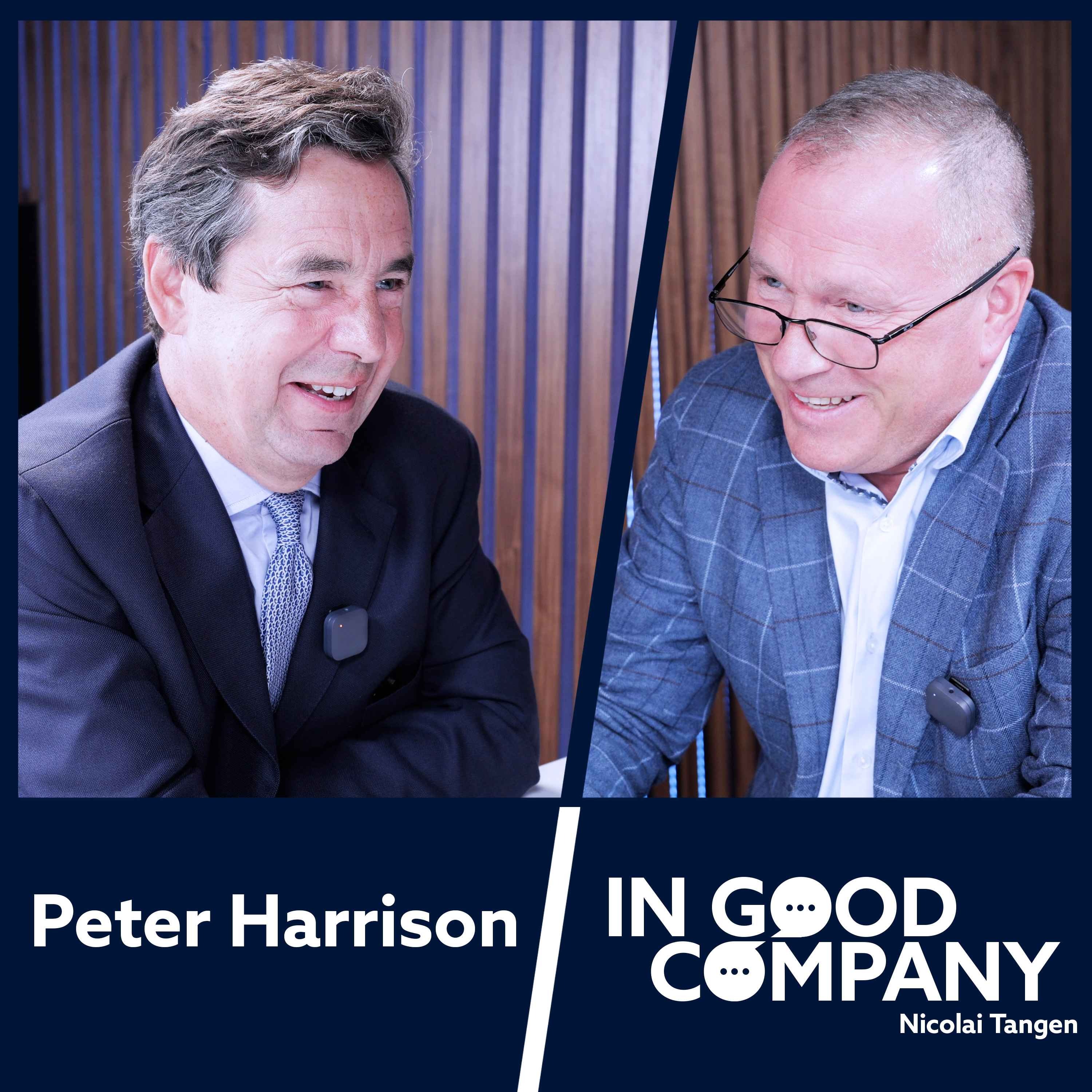
In this episode of In Good Company, Nicolai Tangen interviews Peter Harrison, the CEO of Schroders, one of Europe’s largest asset management firms with a rich history spanning nearly 200 years. Peter discusses key industry shifts, the impact of technology and AI on asset management, challenges posed by the UK market, and how risk-taking and team resilience are essential for success.
Written by AI. May contain mistakes.

Get the gist, explore an idea or ask about something said.
 Claude
On In Good Company with Nicolai Tangen, what are the key points of this episode?
Searching your listeningAutomatic transcript. May contain errors.
0:00Hi, everyone. Today, we have the great pleasure of having Peter Harrison on the show. Peter is the CEO of Schroders, one of the biggest asset managers in Europe. And amazingly, Schroders has been in business for roughly 200 years. Peter, great to have you here. Thank you. Great pleasure.
0:26It's also quite fun because Schroders is one of the longest standing partners we have in the fund, in the Norwegian Someone Wealth Fund. We have relationships going back to, you know, roughly 25 years. Yeah, I know. It's a great privilege to run money for you. Yeah, absolutely. So what's the, you know, only 45 out of 1 million companies exist for 100 years and you've been doing it for 200 years. What's the trick? So I think the key is committed ownership. We've got a family backing who takes a 20-year view of where we need to go. And because of that, the business has changed and evolved. And we've been in lots of different businesses in the finance sector throughout that time.
1:08But we've continued to change. And I think that's only possible if you've got a committed long-term ownership structure, which allows that change. If we do the last 10 years, what are the biggest changes you've seen in investment management? Huge. So massive growth of passive management, huge growth towards privates, a collapse in fees. So just for the listeners, private is like private equity. Passive is index funds. Absolutely. And private debt. The world is moving away from public companies towards private companies. A revolution in governance, a huge agenda on climate, collapse in fees. So wholesale changes.
1:49The industry is going through a major disruption. A while back, there were lots of English companies in this industry, really, really grand names, doing very well, huge tradition. And then the Americans came and ate your lunch. So look, I think there's two things. The capital markets moved towards America. That was the first thing. And they started with a huge domestic bias. But I don't think the UK companies evolved. And part of what we've been in the business of doing is trying to change the business to where the fast-flowing water is today. There's very, very different markets. And if you don't change, you're not going to be in the fast-flowing water.
2:23Why are the Americans doing better? Well, I think the size of the domestic market makes it able to create scale. And this is a scale business at the end of the day. You need to invest hugely in tech and data. and if you cannot shrink to grow. And I think too many companies saw the disruption and they thought, actually, we're going to shrink. We're going to try and cut costs. We took the view we needed to invest to grow. And it was a different strategy, but it's, I think, the only way through it. And the Americans, being American, they tend to want to invest to grow. But it's not only the asset management, it's also the banks, like the merchant banks.
2:57Absolutely right. Absolutely right. Are the Americans working harder? Are they cleverer? What is it? No, no, they're not working harder. They're not cleverer, but they do have some innate advantages. of scale to start with. They had more partnership-type structures, which I think is a very good structure in an asset management business, because you're sharing 100 % of the pie with people in the business rather than a portion of the pie. And I think we've also seen this very big change of the growth of privates. And in private markets, the bigger you are, the bigger the moat. Are you sure they're not working harder?
3:29So I heard a story, which I actually think may be true uh when the americans came to to london they had the widest margin and the most profitable day on part of the week on friday morning because the english guys had been out drinking on thursday night well and so there were just wider spreads less keen competition and the american guys were just like in there friday morning bang hitting it i don't know if i walk around this building this is this place is full so i can only speak for here but but then we've been successful during that period yeah what's been the most important things that shredders have done lately look we've we've pivoted towards privates we've pivoted towards wealth we've spent a lot on technology we've spent a lot on sustainability and what that means um and i'm sure we should talk more about that but i for me the ability to move and innovate and being being really tough on ourselves to change and i think that that requires cultural change and it requires new capabilities so so it's required a lot of change during the last 10 years now um how does the kind of the decline of the uk capital market play in here so if you go back go back 15 years the uk has one of the largest pools of domestic savings in the world yeah and we regulated that out of existence so it basically bought government bonds and and stopped taking risk and we put consumer protection at the center And that shrank the UK as an equity market considerably.
4:56Saw huge outflows over the last 15 years. And then we put in a corporate governance code which said conflict between shareholders and companies is a good thing. And everything, every league table was the more times you vote against management, the better. And those two things were unhelpful for listings. They were unhelpful for thriving domestic capital. Those are now changing. And people are going back towards more risk taking. They're going back to a more constructive environment. but i so the the listed market has struggled i think what's happened at the same time is london has boomed with private markets with hedge funds um as a center for you know people coming together we've got some fantastic life sciences the problem is it's being it's foreign capital which is driving those businesses not domestic capital so the returns are not going to uk savers and i think as a country that's a big problem but it's also probably the constituencies of of the stock markets right so um uh the u.s market has compounded at roughly twice the rate of europe of the last 10 years of course due to a lot of you know much more tech companies yeah in in the uk more mining oil yeah we've got the companies of 100 years ago and and they're not the companies that are driving the growth of the future and i think creating a listings environment where people want to and creating an environment where where management want to be listed in london has been a big part of the change which has been going on over the last few years to say this is unacceptable.
6:23You cannot have your best companies going and listing overseas. How important is the salaries and board salaries, CEO salaries, a lot more scrutiny in the UK? It's a huge amount of scrutiny. I think it's this notion that there's a conflict between shareholders and management. And for me, the best businesses are grown by great management, but good alignment with shareholders. And the more agency problems you get, the more people don't aim at creating great businesses. And I think that's been part of the UK problem. What does Brexit do to this? Well, Brexit was just, it undermined two things. It undermined confidence in the UK as a place to make long-term decisions.
6:59And it created two or three years of complete hiatus. And then after Brexit, you had Boris Johnson's government. You had a whole set of challenges around Liz Truss's budget and the guilt crisis. All of a sudden, the UK as a serious counterpart and a place to invest started to decline. We've started to see that correct, but those scars take a while to heal. Now, the effort to reboot the pensions industry to get better outcome for pensioners, how is that going? Because you've been part of some of these committees. Yeah, it's been a big effort to change. I think we've done a couple of things. We've changed all the listing rules and changed a lot of the structural stuff.
7:39You're about to see a big set of changes come through in the corporate governance environment and a return to comply or explain as a way of how do you – If a company doesn't follow the rules, do they get the opportunity to explain why they're doing it differently? And I think that's going to come through helpfully. And you're getting a freeing up of a lot of the capital, which was previously just put into risk minimization. We have in the UK$300 billion in tax-advantaged cash savings and virtually no financial advice. Everybody sits in cash rather than taking risk. Well, if you don't take risk, you don't earn return.
8:12And that's the UK's problem. We put consumer protection right at the center and killed risk taking. Is there a danger that in order to attract companies, you loosen up on the rules and regulations to the extent that it becomes, you know, Wild West? Well, that's the argument that a lot of people will make. The other question is if you take no risk, you don't get a return. And so I think the answer is you have a set of rules. And if companies abide by those rules, they can list in the UK. and then it's for active managers to choose which they want to own and which they don't want to own. And I think the UK has always been good at active risk-taking.
8:49And I think you're slightly careful that you don't set a set of rules which are so prohibitive that no one wants to be here. And that's where we were five years ago. That's changed. Do we need a unified European equity capital market? Yeah. And will we get it? No. Why not? Too politically difficult. There's too much stress within the European experiment to see that convergence come together. If we had it, what would you do? Well, I think you create a big enough single capital market that it starts to be competitive against the US. The challenge of the last few years has been that we used to have London, New York, and one or two other markets.
9:31Now, there are probably 15 challenges to be a global financial market. And Europe needs to act, get its act together and act its size. But it's so fragmented and there's so many bits of arbitrage. I mean, if we just take, we had a set of rules that came out called MIFID, which was a, sounds really geeky, but actually there was really, really pernicious changes that took place in the way a lot of research was done. But every country interpreted them differently. And as a result of that, you got more fragmentation. and you get ultimately atomization and the US will carry on growing. So MIFID was an effort to get the clients to pay separately for research.
10:15But that was one part of it. It also was hundreds of thousands of pages of reporting, et cetera, which was, you know, sits in a vault somewhere. I've no idea whatever happens to it. From an asset management point of view, are you happy with the government so far? Oh, yeah, this new government. I think they've picked up the baton of needing to change and understanding that growth is important and understanding the environment for growth and industrial strategy is important. So that bit seems to be coming through. But it's very early days. Government is tough and it's really tough when there's no money.
10:47And in the UK, there is no money. And that's going to, you know, how do you balance growth and higher taxes? You mentioned the private market or, you know, private equity and so on. What kind of role is that going to play for individuals who save for retirement? I think it needs to play a much bigger role. Why? Well, because a lot of the future is around how we fund climate transition, how we fund synthetic biology, how we fund AI. Public markets are not naturally good at A, disruption, and B, funding change. So you're going to see that innovation come from private markets. And if we don't embrace that and we hide in those companies of 100 years ago, those new returns and that disruption will only be a cost to end savers rather than a benefit to them.
11:33So I think there is a big change required. I mean, public markets are shrinking really quickly. The number of companies that are delisting is down, what, 40 % over 20 years. The stock in trade of a traditional public markets investor, your clients, our clients, is shrinking. The availability of alpha is shrinking. They have the ability to outperform markets. So for me, those are really big issues that, as the frog quietly boils in the pan, don't get talked about enough. And I think one of the big changes we're going to see is wealth markets, which don't traditionally have big exposure to private markets, are going to move much more into privacy.
12:13And you're seeing it in the States. You're seeing it in the biggest families. I mean, you cater for private equity. you also cater for wealth management, right? Yeah. So this is a relatively new thing for you. Yeah, in the last, we've done wealth management for many years. We've made it a lot bigger over the last 10 years and we've doubled the size of the company and that's mainly been through growing our privates business and growing our wealth business. AI, how is that going to change the way you do things? Everything. In what ways? Well, I think it fundamentally changes the landscape of the companies we invest in.
12:44In the very short term, we will spend a lot of time trying to do things better in the probably far more quickly than we realize we will find we do things very very very differently and the moment we're all thinking about the better bit but actually the real change will come from when we do it differently so i think the first place we'll see a major changes in wealth because my sense is that people will turn to their beautiful ai assistant who will become who will know them better than anybody and ask them for wealth advice in a way that they currently ask people. And I don't believe our portfolio managers are different from any other industry.
13:25If AI is helping understand the human genome backwards, the microbiome backwards, it can certainly help you become a better investor. I think it's beholden on us to make sure those tools and that data is in front of our portfolio managers when they make decisions.
13:43moving on to investment philosophy is there a schroder way of running money no there is a schroder set of philosophy about how you create great teams and how you take risk um but our philosophy is you create individual markets require different different treatments so if you're investing in china you need a different approach but you almost certainly will have a relatively small team with great tools. You'll be led by brilliant people. You'll grow people internally rather than try and hire them in. So now you are on how to build good teams. How to build good teams. Okay, let's do that. So how do you build good teams?
14:18So first thing, you need brilliant leaders of those teams. You need to give them great tools. They need to be the right size. They need to be near their local markets. And you need to give them space to get things wrong because great investors don't get it right every single day. Then they might be wrong for three or four years at a time and you've got to be willing to put your arms around them and support them. But the critical thing is you understand the risk they take and they're good risk takers and you've got your head around who is managing their way through that and the path dependency of returns.
14:48So we are invested with some of your best teams, right? What would you say they have in common? What do great teams have in common? Huge consistency of people, openness to external thinking. They look out, they don't look in. And they're great risk takers. What is a great risk taker? They understand the risk-reward equations, and they understand when they change, and they understand why they've been wrong in a way that is, you know, you can be wrong in China because state-owned enterprises are doing something because of some government stimulus, or you can be wrong because you've just picked the wrong company, or you've got a, the company you have, the motors disappeared, and you end up clinging onto it for too long.
15:30You need to understand the price action and how the business is changing. and be willing to change. And some people get stuck, others move. And it's the ones that move and are able to adapt and hold on to a consistent philosophy. And so often you see people wavering. And if you see people wavering, the chances are they won't be able to navigate through long-term change. One of the pros and cons of not having one way of running capital, because Fidelity, I guess, It's got one way of running capital. The capital has got one way of running capital. Well, capital has got several ways of running capital because they give it to lots of individual teams and then they're very clever at the way they aggregate it up.
16:15But I think for me, it's the accountability. So you've got that ability to look at a team and say, our oil price forecast doesn't come from one central person and then put it into the whole system. And when it goes wrong, blows up the whole system. So it creates a business resilience that is stronger. But I think that accountability of a team whose job it is, and they can see everyone in the team, they all know who's accountable for what. When you're trying to do that on an organizational scale, it's really hard to hold that accountability in alignment for long periods of time, particularly through change.
16:51And what you tend to see is those companies that have a whole organization investment process can go through long downward spirals because the organization starts to question its own raison d 'etre. And I think in a world where we need to be very adaptive, the ability to have small teams adapting is a lot stronger. Now, you've got to give them great tools. You've got to give them great data. What are great tools? Well, so for me, when I first joined this industry 35 years ago, our competitive advantage was being able to key in 10 years of reporting accounts into a spreadsheet. to build a two-year earnings model, right?
17:29Yeah. That doesn't win anymore, does it? Today, that takes about two seconds to do that. But there is a huge amount of unstructured data out there telling us what's going on in businesses, what companies are really doing, what the supply chains look like. That unstructured data takes a lot of getting and processing and bringing it out. Those are the sorts of things I mean by great tools. The joke I always have is that Bloomberg has something like 100 ,000 functions. and a great portfolio manager might use 30 of them. And that's not the right answer. How do you get the right information in front of your investors so they make great decisions?
18:05How do you train people? You grow them. I think we're in apprenticeship business. And that requires a lot of mentorship. It requires a great recruitment process at the beginning. And it requires the ability to move people through a system and gradually give them accountability. So when I joined as a graduate trainee, you spent time. I spent a lot of time as an engineering analyst, and then I could go on and do another industry. And bit by bit, you learn your craft. I'm not a great believer that we are good at bringing in rock stars from the outside. There are businesses that do that incredibly well.
18:45The Citadels and Millenniums do that. That's not us.
18:53let's move on to your leadership what's been the main management lessons for you as you have moved from being an investor to becoming the ceo it's tough the best job in our industry is being an investor right so so you know that's that's that's the first hard bit and you have this this crisis moment where you don't turn on your bloomberg in the morning you turn on your you turn on your emails were you a good investor no not good enough and it was the realization i wasn't a good enough investor. Is it the Peter principle? You rise to your own level of incompetence in a hierarchy or something like that.
19:26So the first thing was getting over being an investor and not trying to drive from the backseat. The second was understanding what sort of leader I was, because you don't really know that when you start on the management journey. And what kind of leader are you? Well, I've discovered that I'm connecting with the organization and trying to drive the hearts of the organization as much as the minds of the organization has ended up being the style that I've done. I'm passionate about innovation. I spent my time, paid my way through university writing code. So I'm a bit of a geek. so for me the getting the innovation being really consistent about your strategic vision just being resilient and not be banged off course um but making sure you take the organization with you because the problem in most businesses is the huge layers of permafrost that don't think change has got anything to do with them and how do you bring those people through and create those new capabilities How do you melt permafrost?
20:29I think culture change. So great teams, right, is the difference between a good company and a great company. And great leaders within those teams will drive that change. But you need to shine daylight into dark corners. It's the best disinfectant. And how do you do that? Well, part of it is creating an open and honest environment. So let's say we make an error on a client account. There's two ways of responding to that. First is the obvious way, which is how do you learn from it? And the second way is finger pointing and all the rest of it. If you create the environment which says we want to learn from this, most people want to come to work to learn.
21:15And I think you've got to create that learning environment and that trusting environment. And once you do that, we're not a particularly big company. We're 6 ,000 people. We can be trusting. Well, we are 700. So we think 6 ,000 is a heck of a lot. Have you been bold enough? So if I look back, what's the thing I wish I'd done more of is be more bold. And in what ways should you have been more bold? So we should have done more private markets earlier because compounding up. We should have probably been more willing to acquire more teams and not do as much organically. And I think I look back the things.
21:50But you have acquired quite a lot. We have acquired quite a lot, but we acquired small, because I didn't want to destroy the culture. And so for me, because the challenge I think is that public market culture and private market culture are really different. And can you get them to coexist in the same organization successfully is hard. And that was the thing which you've seen ruin many companies. So I said, we're going to work really hard at this, but we're going to go slowly. With hindsight, the disruption in our industry has been way quicker than anyone thought. Well, one of the things you bought was part of Casano, which is where I started my career.
22:26Well, you bought it in 2013, part of it. And that's where I started straight after school. And that's doing pretty well, right? It's on fire. It's probably the fastest growing wealth business in the UK. And it's got all the characteristics. It's got strong culture. It's got great investment performance. And it cares deeply about its clients. And if you have those three things, actually businesses will carry on performing for very long periods of time. Do you still have the queen as a client? I couldn't possibly comment. In a short period of time, you will pass the baton to Richard Oldfield. Do you think that'd be difficult?
23:05Very hard. Why? Well, look, I've been in this industry 35 years. I started here as a graduate trainee. I might have gone elsewhere, but I will miss this. It's a very special company. and I will miss it massively. And you feel a great sense of indebtedness to being it's a privilege to run a company that you start your career in. Now, if I were to play devil's advocate a tiny bit here. So whilst you being the CEO, asset management have grown a lot, right? More than 100%. But fees generally come down, right? Because there's more, well, there's generally pressure on fees, costs gone up, profits down, and the market capitalization is down compared to when you started.
23:50Just how do you look at these various things? So we started with a traditional equities business, which has gone through huge disruption. And everybody who had a traditional equities business 10 years ago has seen a huge change. And many of those businesses are down 90 % or actually don't exist anymore. So what we've done is invested heavily in those new businesses. And we're crossing a valley. So as a traditional business has come under pressure, We've grown those new things. And as you see in our results, the pace of growth of those new things now outstrips the decline in the old business. So as we cross the valley, the compound maths does your work for you.
24:27But it takes a long time. And we were never going to be able to tear up the really strong foundation that we had in that traditional business. It would have been wrong to. So for me, it was going to be a long transition. we took the view that that was the right way to make the transition but I if I look at us against our peers I think we've we've done you know a really strong job but I totally take the point that you know at the end of the day shareholders want alignments better returns I just realized I asked a pretty stupid question whether the queen was still a client I suspect she isn't well no I didn't want to put you right on that but i could change the royal family but one of the one of the one of the highlights of of my uh of my time here was was coming to open our building and showing around which was which was one of a legendary moment yeah she opened it right yes
25:25moving on to culture so um family still owns 44 and you said that was the key to surviving for 200 years um just what are the disadvantages of having family ownership are there any so no i think the the key is um it creates a huge capital discipline but it also has a creates a blockage in a way because you you don't naturally want to dilution per se is a lot lot harder to do mentally if you're if you're a family that's that's held on to but so our shares in issue today are virtually the same as they were in 1959. So that's the only negative. And everything else is a positive. But you see that ability.
26:09So Bruno Schroeder sat around our boardroom table for 60 years, and he said to me pretty well at every meeting, get it right on a 20-year view. Now you still have two family members on the board. Yeah. But if we hadn't have had that license to change, I don't think I would have had the license to start the transition and the inflection that we've done. because we had to transform. Otherwise, we'd have been one of those businesses that was really struggling and not investing to grow. Are you 100 % confident that it's right to be independent? Yeah, I am, actually. I mean, it's, look, there's an industry where the scale is getting more and more important.
26:43So our biggest competitors, Blackstone, Blackrock, have got hugely bigger in this period. But if you want to be an active alpha manager, scale is not everything. Doing a good job for your clients is frankly the most important thing. Now, in interrogation, you added actually. Yes, I think it is actually. Actually, it's a qualifier. And it means that you are normally not 100 % sure. What are the things that make you less sure about this? Well, I see the industry is going through. Everybody's talking about who they merge with and all the rest of it. So it is a very active debate in our industry today as to how people are going to get to scale.
27:23right so and the most common thing is people merging and everyone's up for sale our view has been that you can you can navigate that by investing for growth growing these new businesses and seeing your way through i'm acutely aware that's a controversial statement most people disagree with it so i think i think you do have to qualify it but for us we can we can achieve it because of the family background would it make sense to merge some of the uk players oh if you're some of the smaller players you probably do need to merge yourself away because if you're 50 70 80 200 billion business, you're not viable because you can't invest in the data science.
27:57You can't invest in the AI. But at 770, you think you're big enough? Look, what's different about our 770 is that it's all active and it's all private and it's all wealth. It's all high fee earning rich businesses, not got a big chunk of passive in there. So I think that it's a much richer mix of businesses than some of the businesses which look bigger than us, but frankly, they're all passive.
28:24Moving on to sustainability and ESG, what do you make of the recent swing in appetite for ESG? Well, first thing to say, it's been politicized. So you've seen this huge geographic diversion. And you absolutely have passed peak debate. I mean, so a lot of people don't want to talk about it now and you've seen it. But I think in boardrooms and people's awareness of the importance of Climate, I don't think that's debated at all. So what companies are getting on and doing is very real. It's just people spend a lot less time talking about it.
29:05So how do you think it will develop going forward? So I think the first thing is it's gone from hand-waving to data. And in our industry, there is a price to pursuing sustainability. So we have to understand that if we want to be good at this, and we are, we're in the top three of doing it, that comes as a ticket. So a lot of people have said, we don't want to pay that price. The second, I think, is that we will get more and more regulation and more and more fragmentation of regulation around the world. And that is a pain in an industry which is about global scale. So you have different interpretations in Japan to Korea to China, etc., which are all difficult.
29:43um but i if you come in a different way companies report gap profits right but different companies put a different cost on the external environment so if you're a tobacco maker you create cancer if you're an oil company you create carbon emissions if you're a um uh a soft drinks maker you create diabetes we treat all those gap profits as the same the races are not the same But the impact-adjusted profits of businesses are really very different. And I think society will increasingly look at our businesses and say, if you don't make profits the same way, we need to think about investment in a different way.
30:24Because the real impact-adjusted profits of a portfolio differs. And asset managers sit there between asset owners like yourself and asset creators in companies. And I think it's our job to shine a light on what's the cost of delivering that performance. And if we can't shine that light, we're failing in our duty. You are the fifth largest foreign player in the Chinese market. How do you see that going forward? So China's going through a major correction post-property crisis. You've seen huge growth in cash deposits in banks as the wealth effect of the destruction is coming through. But you're also seeing a huge, massive energy transition going on in China.
31:10And I think you will see a return to risk taking at some point. I mean, the Chinese have had a huge benefit of moving people from the countryside to cities, and that's given them a productivity boost. That productivity boost isn't enough to carry on into the future. They need financial productivity. And to achieve financial productivity, they probably need external players in to help show them what good financial productivity looks like. And a strong position running wealth, fund management assets, private equity assets, I think is really additive for our future growth. But today, it's losing us money.
31:51And one of the bets that I've made that hasn't been right has been the scale of that bet. But if you take a 20-year view, you'd be delighted with it. But in a world with increased geopolitical frictions between the US and China, for instance, what are the dilemmas of being a large player in China for you? Well, it's really interesting, isn't it? Most US players have stopped talking about their Chinese investments in their public statements, but they haven't pulled back from their activities on the ground because this is one of the largest savings markets in the world. It's a huge, you know, it's second only to the US.
32:27Have you stopped talking about it? No, we've said very open about it. Jens Stoltenberg, who recently stepped down as the Secretary General of NATO, you know, he talks more vocally about thinking about defense and security rather than just doing business and profits. Have your priorities changed? I think the reality of our business is we will be a taker of the geopolitical environment. We have to be sensitive to it. And governments will take whatever defense decisions they want to make. I personally think that there is a huge opportunity for savings growth in China. And we should, as a West, want to be engaging with that.
33:18We want to engage with them on green transition. We want to engage with them on corporate governance, just as we do anywhere else in the world. And we should be, if we don't, if we, we've got two choices as a society. We either walk past on the other side of the road and say it's all too difficult and it's horrible, or we cross the road and help. And I think being part of the solution has always been, to my mind, the right way of doing it. It's sometimes a lot braver and harder, but I think we don't engage, we're going to get what we deserve. How does India look to you? looks great at the moment but let's be quite clear right china you go back 10 years ago china was booming and india was nothing anybody wanted and now it's the other way around and i'm sure in 10 years time it will move again but the growth of the middle class the the innovation that's going on in india is phenomenal fanatical and phenomenal but in our industry it's a super tough one too We've got price control from the regulator, great savings, but in aggregate, we cannot own 100 % of an Indian business, which is a challenge.
34:22But we've got a big position in China. We're also number seven in India. And the rest of Asia? How do you see that? I think you've got to look country by country. I mean, overall, it's clearly growing very strongly. But I think that the most interesting one is the corporate governance change going on in Japan. That is a sleeping giant of domestic savings, corporates who've never really got the message. And bit by bit, that is changing. And that excites me.
34:53Talking about excitement, what do you read? A lot. What? One of the greatest privileges is I'm a judge of the FT Book of the Year. So I read a lot of books about business. So anything which is about society today for me. So there's a brilliant book just out, The Longevity Imperative, that says we're getting ourselves thinking about longevity completely the wrong way. Jonathan Haidt's book about the impact of mobile technology on children, the stuff ravenous about food systems being broken around the world. Those are the really big issues I think we face. Come on, give us some more titles. You read all these books.
35:31Oh, Supremacy on AI. Amy Edmondson was our winner last year, which you obviously covered in your podcast, which was a brilliant book on learning from failure. And I think there's so much great, I mean, there's so many brilliant books being written. Absolutely. I just don't have enough time to read them all. I agree. Yeah, we do review a lot of them on LinkedIn, so please check it out there. Who's been important in your life in terms of a mentor? I think mentors are really valuable and I've got several um I I've one one particular mentor took me took me out the other night and he said what are you going to do and I said I'm not sure if I'm going to have an executive thing he said let me tell you something you're no spring chicken you shouldn't be thinking about being an executive in your mid-60s give it up go and do something valuable and you need you need people sometimes to tell you what would that be and so for you to do something more valuable now uh after November what would that be I I'm gonna I'm gonna spend six months doing all the things that i have never done before and they are i i look i'm going to go i spend a lot more time fishing i'm going to spend a lot more time on the water i'm going to spend a lot more time reading and then i'm going to go and do some crazy things like grow flowers and um go bird watching you name it i'm going to do all this and then it sounds like typical english activities well i'm going to spend six months bird watching plants i'm going to immerse myself in other stuff and out of that i hope to come up with what i should be doing afterwards i'm not going to stop doing things but what i am clear about i'm not going to do something executive sounds like a really good plan uh peter lastly what is your advice to young people so i think if i reflect back do not assume that climbing the greasy pole is the route to being happy.
37:20So a lot of people look at the societal structures and say, I want to be more senior in organization and all the rest of it. If I look back, I should probably say the portfolio manager. I think they've got to engage. I think a lot of them don't engage. And I think a lot of them need to look outside of the algorithms that they are victims of. And they get fed the same stuff and that people stay in a very narrow pipe. And I think, how do we, I mean, it's a mentorship program. How do we help break that cycle of saying there's one view of society? Because I think people need to think very differently about who they really are and what they really want out of life.
37:57And rather than just saying it's about the next promotion. Yeah. Well, Peter, big thanks for being here today. And a big thanks to you and Schroders for the partnership we've had for 25 years and for the money you have made for Norvish Bank Investment Management. Thank you for the trusty places. Thank you. Great pleasure.
38:16Mmm.
In this episode, Nicolai sits down with Peter Harrison, CEO of Schroders, one of Europe’s largest asset managers with nearly 200 years of history. Peter shares insights on navigating a rapidly evolving investment landscape, from the shift toward private markets to the impact of AI and technology on asset management. He also dives into the challenges of the UK market, reflecting on how changing regulations and global competition have reshaped the industry. Tune in for Peter’s thoughts on building resilient teams, risk taking and his advice for young professionals.
In Good Company is hosted by Nicolai Tangen, CEO of Norges Bank Investment Management. New full episodes every Wednesday, and don't miss our Highlight episodes every Friday.
The production team for this episode includes PLAN-B's Pål Huuse and Niklas Figenschau Johansen. Background research was conducted by Sara Arnesen.
Hosted on Acast. See acast.com/privacy for more information.


