
 Ask ChatGPT


 In Good Company with Nicolai Tangen
26 Aug 2026 · 1h 12m · 32 chapters
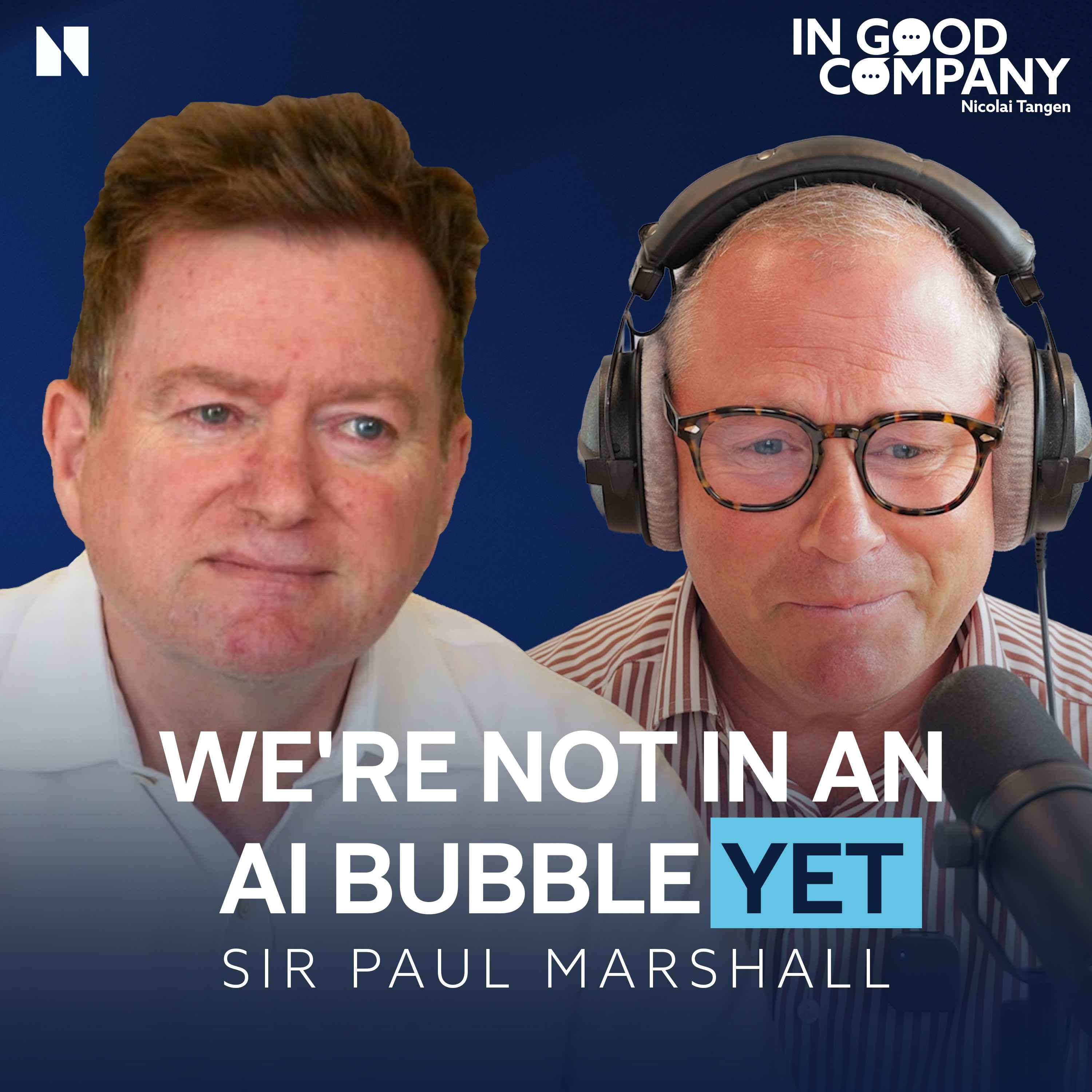
Sir Paul Marshall (Marshall Wace) discusses why markets are getting more competitive, the “logic of shorting,” and how Marshall Wace built TOPS/AlphaCapture (a system that turns sell-side ideas into systematic trading signals). He also covers risk, learning from mistakes, AI/ML’s impact on investing, and philanthropy in UK education.
Sir Paul Marshall is a co-founder of Marshall Wace (started in 1997 with Ian Wace). He helped create AlphaCapture/TOPS and wrote Ten and a Half Lessons from Experience. Marshall Wace runs a discretionary+systematic model and is described as managing about $90B AUM with ~750 employees and ~200 in tech.
Continuous innovation is the main driver of long-term hedge fund success; markets may be getting more competitive (especially as retail becomes empowered), even if not fully “efficient.” Shorting is structurally harder due to broker/press incentives, risk management asymmetry (can’t average up when wrong), and expensive stock borrow. AI will be transformative, but “situational awareness” and market ecology still require humans.
Iraq War oil-services long position (1990) as his worst investment; 2008 AUM drop from ~$14B to ~$3.5B without gating; TOPS origins in 2002 using sell-side intranet “virtual portfolios”; Korea leverage-ETF unwind and momentum crash as a case for human market ecology; philanthropy via ARK schools (~39, aiming ~50).
Written by AI. May contain mistakes.
Sir Paul Marshall shares a personal story about his worst investment experience during the first Iraq war.
“My worst investment ever was probably the first Iraq war.”
Sir Paul discusses the unique aspects of Marshall Wace, including AlphaCapture and the synergy of discretionary and systematic investing.
“And I should say, I mean, when you say I started Marshall Weiss, Ian Weiss and I started Marshall Weiss.”
Paul emphasizes the significance of continuous innovation for long-term success in investment management.
“I think the single most important thing is continuous innovation.”
Discussion on the dangers of hubris in fund management and the importance of recognizing one’s own limitations.
“Physicians own them rather than them owning the positions.”
Paul compares the challenges of starting a hedge fund in 1997 versus today, focusing on capital requirements and market changes.
“I'd always wanted to have my own business why?”
Sir Paul recounts his experiences in raising capital and navigating crises such as the Asian financial crisis and the 2008 financial crisis.
“I think the AUM you needed in 1997 was 50 million.”
Paul discusses how he copes with stress, highlighting his high tolerance and enjoyment of crises.
“You just went straight into this big thing.”
The conversation shifts to the growth of Marshall Wace and the strategic decision to partner with KKR.
“I think one of the criteria we now do personality tests for all of our hires.”
Explore the rationale behind involving KKR as a minority investor in the business.
“And I think it was probably 13, 14 when we were starting to really see the fruits of that.”
Learn about the development of TOPS, an innovative Alpha Capture system.
“Let's move on to TOPS, which is your Alpha Capture system, and which is in a way what you're famous for, right, as a firm.”
Discover how AI is transforming trading strategies and decision-making.
“What are the type of things you can look at now?”
Discuss the implications of retail investors on market efficiency and competitiveness.
“from 200 quant researchers to 10 ,000 quant researchers, by which he means we'll have 10 ,000 agents.”
Examine how AI impacts headcount and the types of roles needed in finance.
“I mean, are retail investors there to be fleeced?”
Explore the concept of human skills complementing AI in investment decision-making.
“Why does man plus machine beats a machine?”
Learn how human intuition plays a critical role in market analysis, especially in volatile situations.
“And clearly, there will be some things that the AI can do better.”
Discover the revolutionary potential of AI and its implications for the future of markets and capitalism.
“Today, I think, unlike the FT who said we were in a bubble two years ago, I think that we're not in a bubble yet, but we will go into a bubble at some point in AI.”
Understand the indicators that could lead to market bubbles and how to navigate them effectively.
“The semi-index in the US is at a five or 10-year low, depending on how you look at it.”
Examine how robotics and AI will reshape work dynamics and domestic life in the coming years.
“I wouldn't want to predict that, Nikolai.”
Explore the balance between analytical methods and instinct in investment decision-making.
“there wouldn't be any sense that you're in combination looking after the home.”
Learn about the complexities and risks associated with short selling in the market.
“but I think that the one in less short supply is that, I think gut feeling is not the right, it's not gut feel in the sense...”
Understand the importance of debriefing and risk management at a portfolio level.
“My worst investment ever was probably the first Iraq war.”
Discover the processes and programs designed to develop new portfolio managers.
“which I certainly with Ian tried to instill is one of humility in front of the market So we all fail every, the whole point we made earlier, we all fail every day.”
Explore the key personality traits that contribute to success in hedge fund management.
“coming straight out of business school or college.”
Learn about the philanthropic initiatives focused on education and their impact.
“I love your concept of high agency people because it's what we are looking for too.”
Learn about Sir Paul Marshall's philanthropic focus on education and the creation of schools.
“Paul, let's move on to philanthropy and here we should, in a way, start to call you Sir Paul because you've been knighted for your tremendous effort in the philanthropic space in the UK.”
Explore how Sir Paul's Christian faith shapes his views on equality and opportunity in philanthropy.
“I look at Ian, who doesn't have faith, and he has just as much passion as I do.”
Discuss Sir Paul's media investments, including GB News and The Spectator, and the reactions they provoke.
“It's highly influential and an incredible brand.”
Hear Sir Paul's retrospective views on Brexit and its economic implications for the UK.
“But it doesn't get the advertising revenue because of the campaigns against it and against the advertisers.”
Delve into Sir Paul's ambitions for his legacy and his personal interests outside of work.
“And maybe, the ideal thing is Britain embraces innovation and then the EU sees somebody on their doorstep embracing innovation.”
Learn the importance of questioning established scientific narratives.
“And that's what real science is in terms of this, instead of this nonsense about follow the science, which we've had in the last five or ten years.”
Understand the value of patience and seizing investment opportunities.
Reflect on the conversation's key takeaways and express gratitude.
“A big thanks for taking the time, sharing part of the secret source, all your thoughts, your wisdom.”

Get the gist, explore an idea or ask about something said.
 Claude
On In Good Company with Nicolai Tangen, what are the key points of this episode?
Searching your listeningAutomatic transcript. May contain errors.
0:00My worst investment ever was probably the first Iraq war. So it goes back a long time. I remember because it was August, the date of the invasion was August the 2nd, 1990. It was my birthday. And then seven months later, the Americans finally struck on Iraq. By that time, I built a very significant long position in oil services, oil stocks and so on. And I had an absolute nightmare, absolute nightmare performance. My worst performance yet ever by a long way. Could have lost my job, really.
0:47Hi, everybody. I'm Nikolaj Tangen, the CEO of the Norwegian So-and-Wealth Fund. And today, my guest is one of the most successful investors of our generation. Sir Paul Marshall started Marshall Ways in 1997, and today is one of the largest and most successful hedge funds in the world. Marshall Ways combines man and machine, and they built the world's first alpha capture application, which is like a system that collects trade ideas from thousands of brokers, tracks who gets it right, and puts money behind the best. Now, Paul has also written down what he knows about investing in his book Ten and a Half Lessons from Experience.
1:24He's also huge on philanthropy. So let's explore these and other things today. Paul, warm welcome. Thank you, Nikolaj. Great to see you again. It's been far too long. Absolutely. And I should say, I mean, when you say I started Marshall Weiss, Ian Weiss and I started Marshall Weiss. Very much a partnership. And it's remained a partnership, a broadening partnership all through its life. When you started Marshall Weiss, who decided that Marshall was going to be before Weiss? Alphabetical. Now, today you run around$90 billion. What is it that Marshall Weiss is best in the world at? Well, it's very presumptuous to say you're best in the world at anything.
2:08But I guess what we could claim, I would probably claim two things. We're probably best in the world at AlphaCapture because we created AlphaCapture. So that was our unique contribution. Secondly, I would say we may be best at the world at combining discretionary with systematic investing. So over the years, our original route in discretionary fundamental investing has been combined with systematic. And they actually turn out to be highly synergistic. So our discretionary side has benefited hugely from the systematic side. The systematic side has benefited hugely from sitting in an environment where people basically are very focused on fundamental and on the market.
3:00So it's never, ever been remotely detached from market. In fact, it's a very market-orientated way of doing systematic. And we'll come back to that. But why have you been successful now roughly 30 years when so many other funds have kind of fallen by the wayside? What do you think is the key to... I think the single most important thing is continuous innovation. So a lot of people in our industry perfectly legitimately started as a very smart guy looking at balance sheets with a Bloomberg terminal. And that's all you needed. And some very smart, not very many, but some of you maybe, But some very smart guys have continued to flourish, primarily relying just on being very smart.
3:51But we have gone well beyond that and effectively embraced every type of innovation to the point where we're almost now a tech firm rather than an investment management firm. So it's changed out of all recognition because we innovate every day, basically. Because you do say in your book that most fund management careers end in failure. Yes. Well, that was a different point, really. And that was kind of reflected the observed pattern of my previous firm, but also a lot of fund management firms, I think, get into the problem of hubris, where they grow and grow. They don't have discipline around capital, and they don't have discipline around or a sense of their own mortality.
4:42And so a lot of firms get too hubristic, too big. And size matters, which is another thing in the book. So they get too big in the market. Physicians own them rather than them owning the positions. And when they're wrong, that can drag their business down and destroy their return patterns. How are you reminded daily about your mortality? Do you have somebody telling you? I don't have anybody at my shoulder. But you basically, as you know, Nikolai, if you look at the success ratios of managers, a really good manager might have a 53%, 54 % success ratio. So 46 % of the time they're wrong. So every day, one day and two, you go home feeling you're a schmuck.
5:27And my wife can testify to that. I can come home. I feel I'm a schmuck. I got something wrong. So you've got to be pretty head in the clouds not to understand that actually it's a very fragile path and it's very difficult. Well, it's a humiliating job, but yet there are a lot of hedge fund managers who are not so humble, but that's another discussion. Yeah. But let's go back a bit. 1997, you were head of European equities at Mercury, which was a tremendously successful company. And then you suddenly decided to walk away, start a fund with Ian Wace. why? I'd always wanted to have my own business why?
6:10I don't know, that's something in me it's just, I even made the mistake of announcing it within six months of being at Mercury that my long term goal was to have my own business but Ian it was Ian who approached me and he was the head of sales so he was doing sales originally head of sales at Warburgs he was the first person I ever spoke to in the market. He called me my first day at Mercury. And they were part of the same company. Then he became head of proprietary trading at Wahlberg's. And then he became head of proprietary trading at Deutsche Bank. So he moved away from sales. And so he wanted to hedge, he was ahead of the game, really, wanted to set up a hedge fund in Europe at the time when there were only arguably two other equity long, short hedge funds in Europe.
6:58And he approached me and And the timing was perfect from my point of view. Is he, are you like the analytical, kind of the deep thinking analytical machine? And he's kind of the fast moving kind of thing? I would say that was the original basis. Ian is also very strong on technology. He's a great believer in the power of technology. And he created Wahlberg's trading system, which still exists within, I think it's UBS now, that ultimately owns it, called Oasis. So he brought an interest in tech, which, to be honest, I was not very focused on. And so we're extremely, I think you know Ian a little bit, we're extremely complementary and understand each other's strengths and weaknesses.
7:46And you said that you were fund number three in Europe. So there you had already two other firms. They were... Odie and Edgerton, I think, were the two. Yeah, Edgerton, FYI. FYI is where I learned my things. And by the way, John Armitage is coming up in a future episode, so stay tuned. Cool. Now, how much more difficult is it to start a hedge fund today than what was the case back in 1997? What does it take? That's a great question. I think the AUM you needed in 1997 was 50 million. AUM as a tender management, right? As a tender management. Now, because of the regulations, basically, most people estimate it's 300 to 500 to get started and cover your costs.
8:37And I think also, in those days, my expectation of our business and of the industry was it would remain a cottage industry, highly fragmented, lots of small operations. As I said at the beginning, people were looking at annual reports and crunching their numbers and making calls. And that's how I thought it would stay. And now, of course, it's become highly concentrated, just like almost every industry. It's become concentrated. It's become very, the entry barriers have risen and risen and risen. It's much more dependent on technology and operational capability, financial capability. All of these things matter much more than they did originally.
9:17You got half your start capital from Soros. How did that come about?
9:24Well, we basically just went and knocked on the door in New York. And the meeting was actually with Stanley Druckenmiller. And there's a very funny story, which is too long to tell on this podcast. In five sentences. Somebody said, be careful with Stanley. He's like a lizard. He'll sit in the corner of the room, won't say anything, and then he'll pounce. And we basically, that's exactly what happened, didn't say a word. Ian, then at a certain point he said, tell me, do you ever use any charts, technicals when you invest? And Ian said, quite frankly, I've never met a rich chartist. And Stanley said, thanks very much.
10:07And that was pretty much the end of the meeting. We went outside the room and the people who brought us there, which was almost Andy, said, by the way, you just met the world's richest chartist. Absolutely. Well, we've had him on the podcast. He's very, very successful and very good. Yeah, he's a great man. And he's a good choice. And, you know, evidenced as his investment in you guys. Yeah. Now, just after you started, you had the Asian crisis. You just went straight into this big thing. I think Asian crisis was actually when we were marketing. I can remember in New York, it might have been the day of the Soros meeting, the market was down 7 % on one day.
10:48But no, first off we launched, we had the 1998 LTCM crisis, which we were fine with. And the Russian crisis, but we didn't have much exposure either way, so we weren't affected very much by that. Have you ever been close to failing as a firm? Yes. Well, to some degree. And so in 2008, we went from$14 billion AUM before 2008 to$3.5 billion. And the reason primarily, our performance definitely wasn't worse than other people. But our client base was weak in the sense that it was largely funder funds because we'd never actually marketed. We never went out like some competitors to institutions and tried to build a firm client base.
11:40We relied on people knocking on our door. So it was only in 2004, 2005, which is seven years in, that we had any marketing people. And Fund of Fund is a fund which takes money from retail investors and invests in funds like yourself. Yeah, and what happened was a lot of them got into difficulty and had liquidity problems. A lot of our competitors gated investments, even though there was no real basis for gating because there was no liquidity issue. We did not have a liquidity issue, so we did not gate. So we became the cash point. And assets under management went down from 14 to three and a half.
12:19What do you feel like? To be honest, we were angry with our competitors. but I never felt much angst for some reason. I actually enjoy crises so it was a moment of I was actually more excited by what was happening and what was going on in the market than I was stressed by the risk to the business. How do you cope with stress? Do you have feelings? Do you get angst? Less and less. I think one of the criteria we now do personality tests for all of our hires. And one of the things we use the five core personality trait test. And one of the five traits is stress tolerance. And I have an extremely high stress tolerance.
13:20and kind of first or second percentile. So I don't get overly stressed. I actually enjoy crises. They're the best. Do you think your wife would agree with you? Yes. She would. When did you? But I think she would, yeah. When did you first understand that, wow, we want to do something big here. We're going to be really successful and kind of high-five in ways and, you know, really happy about life? Well, there was obviously a successful period after we created Alpha Capture in kind of the 2004 to 7, 8 period. But then the real, and then obviously 2009, 10, we were building out of the crisis, learning our lessons, doing things a bit differently, more strategically.
14:11And I think it was probably 13, 14 when we were starting to really see the fruits of that. in terms of the growth of the business and the solidity of the returns. You sold a stake in your business to KKR. Well, I think you've done it in two stages. But why did you want to have a private equity firm as a part owner of your business? They approached us and they actually approached us twice before we were interested to have a conversation. And I would say that the key element of the whole discussion was that they only wanted to be a minority investor, not a majority investor. That was critical to me.
14:55But the key at the time, 2015-16, was that we were a partnership. We wanted to create some kind of way of putting a value on the shares in a real market-related sense. And there was a secondary benefit, obviously, that being endorsed by a firm like KKR was a pretty good endorsement and no doubt helped us with institutional fundraising. Would you have done it again?
15:27That's a very good question. With hindsight, we feel that we would have succeeded in pretty much the same way anyway, but they've been a fantastic partner to us. They're a great firm. They have a highly entrepreneurial culture at the top of the firm. And so there's never been a moment when we've not thought that we've really regretted it. I mean, I think it's very unusual in the sense it's an investment that's worked for both sides.
16:03Let's move on to TOPS, which is your Alpha Capture system, and which is in a way what you're famous for, right, as a firm. Just tell me about the start of it. Yeah, so the genesis story is that Ian, this was 2002, five years in, Ian said, you know, there's got to be a better way of measuring the street, the sell side, because we were giving out commissions, like some people still do today, I think, by a voting system or some kind of qualitative assessment of their research. It was a big budget. And so Ian said, well, you know, how can we measure this more scientifically? And so we gave to a young intern called Anthony Clegg the job of saying, how can you measure the cell site?
16:55And what he did was the age of the internet. And he said, well, let's create an intranet and get all of the salespeople on the sell side, it was initially just Europe, to contribute their ideas via a portfolio system. So we created a virtual, each of them had to run a virtual portfolio for us in a transparent intraday basis. And this was at the time was completely a radical change. It was almost like a reverse engineering of the relationship between the sell side and the buy side.
17:33but very quickly it caught on. I was the big skeptic because I had the arrogance of the buy side. I said, well, surely the sell side doesn't generate very much value and I was completely wrong. And within a few months it was clear that the sell side were actually creating a lot of value for us which we could, originally we weren't even telling to monetize it which we could monetize and turn that into real portfolios that we would manage. After about two years, we launched a real monetized portfolio under the Marshall Ways banner. And you put, what, 10 % of the capital or something into it? Correct, yeah.
18:12How does it work now then? How many external contributors do you have to this platform? Well, it's hundreds. We don't give the exact number, but it's obviously all over the world. And the first phase of the evolution was to take it from Europe to the US, which is in 05, and then to Asia in 06. And that was, if you like, the global rollout. Then the next thing is that, obviously, this is how we got into the subject of continuous innovation. we knew we had to develop optimization to extract the best data to identify how to combine signals combine contributors combine signals about contributors look at patterns, so on and so forth then the next thing was to look at our trading because essentially TOPS traded and trades around twice turns over twice a month so much more than our fundamental side of our business.
19:17So that led us to go into algorithmic trading very early for a fundamental firm, obviously not so early for a systematic firm. And then post-2010, we developed very active machine learning to mine the signals properly and to branch out into all other types of data to bring in to create signals. So TOPS became much, much more than an alpha capture system. It's a proper, very market-orientated, systematic strategy. So with AI, what's some of the mining you can do? What are the type of things you can look at now? Well, AI, obviously, some of the things that people associate with AI actually were already happening with machine learning, like scraping for sentiment, scraping every broker's note for sentiment, scraping social media for sentiment, looking at balance sheet data, all kinds of fairly obvious things you could already do.
20:22What AI does is take it to a whole new level, a whole new depth. And so whereas looking at sentiment data might be looking at kind of fairly basic signals and word patterns. AI allows you to look at the whole context of every single piece. But what I would say, Nikolai, is that today, although AI we think is going to be totally transformational of our top system, the biggest change to date has been on our fundamental side, where it's been completely revolutionary. and this is again where the synergy comes in because of the infrastructure we have we've been able to apply it immediately to the way we do fundamental investing and everything to do with distillation of information to start with them so multiple varied ways of tools to distill information for our managers so that we absorb all information very rapidly overnight and they have it at their fingertips but then also we've moved to the point where we already have agentic portfolio managers developed far by our fundamental teams by transforming their skills into a portfolio system.
21:39And all of that is before we go to recursive self-improvement. So our head of tech thinks that we're going to go from 200 quant researchers to 10 ,000 quant researchers, by which he means we'll have 10 ,000 agents. and they'll be recursively analyzing all of the data, improving and developing new ways of implementing the signals into live portfolios. How many people are you in the firm now? We're around 750. And how many people are in tech? 200, a little over 200. It's interesting because in the Norwegian Summit Wealth Fund we are at 700 and we have roughly 200 in tech. Oh, yeah. So we're moving on a parallel path.
22:26Except you've got rather more assets than us. Well, well. But hey, what is it? Have you increased the numbers in tech since you arrived? Yeah, yeah. Meaningfully, yeah. Yeah. And on the AI side, of course. But hey, this is really interesting, because it kind of leads it into your book, Ten and a Half Lessons from Experience. And there you talk about, you know, the fact that actually people can, you say markets are inefficient, humans are irrational, investment skills is measurable and persistent. The thing is that with people like you operating in this market, aren't markets just becoming more and more efficient?
23:12How can a human being beat these markets? I think although efficiency itself is a kind of convenient myth, it is also the case that markets are getting more efficient. I would agree with that. And that's because information, which when you and I started, we used to talk about information edge. It's very difficult now to have an information edge because the good firms are receiving and processing the data all the time in real time. but analytical edge still remains and what you've always got to look at is the ecology of a market so I think actually what's going to happen with AI is that more retail investors will feel more and more empowered they'll think that they have just as much information as Nikolai Tangen or Paul Marshall and therefore and they arguably do if they're well organised therefore they're empowered to make investment decisions And so the share of trading done by retail will go up and up.
24:14And I would say that you can't necessarily rely on retail to be as skilled as the best hedge funds. So I think it is getting more competitive, but I'm not at all clear whether it's going to get more efficient over the next years. Is the retail part of the market kind of the market where U.S. professionals can make more money? I mean, are retail investors there to be fleeced? I think that's always been the theory, right? So you look at the markets with the highest retail share, like China, Taiwan, Korea, the US is now growing, and they're likely to be more inefficient because of the way the decisions are made.
24:59And that's definitely been the case in terms of where a lot of the alpha has been able to even get extract. So I'm saying that's likely to continue. Clearly, the retail investor is going to be more empowered now than he or she was in the past. But I still think they won't take decisions. They won't have the same risk management culture. They won't have the same set of criteria as institutional hedge funds, specialists. So 700 people, 200 in tech, that leaves 500 people. In 10 years' time, how many people do you need, you think, with all these machines? We, at the moment, think that the headcount, there's no reason why it's going to move very much from here.
25:43It went up a lot in the last three years towards 750. It's been stable for two years. We think that AI is leading to huge boosts in productivity and the quality of decision-making. But it's not leading anybody to say at the moment, there's one team where they've cut back, one fundamental team where they've cut back the headcount. That's one out of 15. Not leading anybody to think that we'll need less people. We may be needing a different type of person. That's a different question. But we don't think we need less people. we think we're going to get more out of the existing people. Very interesting.
26:33It's exactly our philosophy here as well. But does it help you trade more cheaply? Just what does it do on that side? I wouldn't say that. Yes, but that is not the primary focus. We're not in the age. We're not directly competing with high-frequency traders. We haven't made the decision yet to go in that direction. It just helps us to trade. I mean, we've obviously been trading more cheaply forever. I mean, our trading cost numbers are very low, I would suspect, compared to any other traditional hedge fund other than systematic hedge funds. But we're not going down the route of HFT and giant data centers just focused on that yet.
27:25Why does man plus machine beats a machine? So that saying, which is one of the chapters in the book, originally came allegedly from Garry Kasparov after he was defeated by Deep Blue in 1997, so just when we started Marshall Weights. And the original, the first part of it was, a machine beats a man. But a man plus a machine beats a machine. And I guess the reason I'm confident of that is it presupposes that there are skills that the AI can't do and will be less good at than a human. And clearly, there will be some things that the AI can do better. So we now have a term, now casting, which the whole business of assembling data and getting every single possible input together in order to anticipate courtly earnings and positioning and so on and how a stock, that is, we think, getting commoditized.
28:33So that is getting a harder space, which never was the main space we operated in. That's a kind of pod shop space. But what will remain, in my opinion, is the skill of judging the market, judging how the market behaves in particular circumstances. So if you just take the recent fun and games in Korea and kind of this momentum crash we've seen in the last four to six weeks,
29:17obviously you have the particular example of Ken Griffin but taking out situational awareness. That's a man, a thing a machine wouldn't have done. But every good hedge fund in that environment would have looked at this set of circumstances and they're looking not just at the fundamentals, which is of the stocks, but also the ecosystem of the market. What's going on here? What is happening in Korea? What is happening to the... Who are the buyers and sellers of the Korean market which has set this all off, supposedly? What's happened to the leverage ETF market? What's happened to hedge fund holdings and foreign holdings of Korea?
29:56what's happened to the hedge fund behavior in the United States, then you get into understanding how, looking at how risk managers in traditional hedge funds would have been basically de-risking the funds because their vol was too high. So they're systematically de-risking, arguably, in our opinion, at the wrong time because of high vol, rather than because of anything wrong with the fundamentals. So what I'm saying is there's a whole balance of things which include both the fundamentals and the technical situation and the eco, the ecology of the market, which I don't think a machine yet will be very good at.
30:32It's the human who brings it all together and sees the opportunity and senses blood in the distress. So you mentioned a lot of the factors which are impacting the market just now. And you have the machines, and here we have the human, Paul Marshall. How do you interpret today's market? Where are we? Today, I think, unlike the FT who said we were in a bubble two years ago, I think that we're not in a bubble yet, but we will go into a bubble at some point in AI. But at the moment, the fundamentals for me for... Stepping back. Artificial intelligence is the most important thing that's happened in your and my lifetime, arguably in the history of capitalism.
31:21I think it's, I try very hard to find superlatives to try and communicate internally and externally what's going on. The best one is kind of the idea of a Cambrian moment when there's a huge explosion in biological evolution 500 million years ago. It's that type of thing, or it's like the steam engine. It's an intelligence explosion. And it's huge. And we look, you've got the external data and you've also got our internal data and our own use of tokens is exploding at the same rate as you see on OpenRouter or as we see in Anthropics data. And so all through the year, I've looked at what's going on in terms of the token explosion and I think we're early days, particularly because in six to 12 months, we're probably going to go into recursive self-improvement when this is going to be happening 24-7 overnight.
32:17We're going to set our computers to work overnight. Well, they already do, but they're going to be self-improving overnight. What is the recursive self-improvement going to do, you think? Well, I think it's going to be coming up with, whereas at the moment the humans are coming up with the skills, or the prompts and then the skills which we put in to test overnight, the system is itself going to be self-correcting, evaluating, changing the skills, et cetera, and modifying the skills. So it's going to, we're only at the very, very beginning. And I think hedge fund management is somewhat at the tip of the spear in terms of AI.
32:56So we actually have an early glimpse of the scale of the change. Corporates are much slower to adopt it for all kinds of historic and bureaucratic reasons. Big companies find it difficult to approve things quickly. So the adoption numbers kind of carry on exploding. And so I think we're in an early day. So that coming back to the market, then you look at the market, and as you know, you look at the valuations of the stocks in the center of the story, they're cheap. The semi-index in the US is at a five or 10-year low, depending on how you look at it. The Korean market is at an all-time low valuation.
33:37Now, there are arguments about the cyclicality of some of the stocks, but essentially the stocks have only moved up now in line with earnings, if that. And so that part of the market is going to carry on powering ahead, in my opinion. And we haven't really seen the big effects yet in terms of the productivity benefits from adoption. So the rest of the market will also benefit from that. So I think we're going to go into a very good period. It will no doubt have its bubble components and it'll get overheated. We already had one overheating moment. But I think that's what we've got to navigate is a market where there'll be a lot of excitement and periodic overheating.
34:24But the underlying fundamentals are very strong. When do you think we'll go into a bubble? I don't know. I can't predict when we'll go into a bubble, But for the bubble to really happen, it needs, one, I think, rates to stay low and therefore to encourage speculation. Two, valuations to get very extended, which definitely hasn't happened. Three, increasing leverage, unsustainable leverage, which you had in the Korean ETF. market. That was a bubble phenomenon. But it's now corrected. So the numbers have basically gone from$60 billion of leverage ETF down to$20 billion in the last five weeks. And you'll get those types of leverage conditions.
35:22And I guess the NVIDIA 500 million deal, if they then try and turn those into CDOs of GPUs and sell two times levered versions of those instruments. Those are the types of phenomenon we got in 2007-8. But we're not there yet. I think my path would be absolutely we're going to have a big bull market with a bubble top and you're going to have to navigate all of that. But I don't think we're there yet. How much higher is the end of the bull market from where we are now? I wouldn't want to predict that, Nikolai. It depends where the earnings are. Is AI deflationary or inflationary? Well, I think the consensus which I share is that in the short term, it's somewhat inflationary because of the demands for chips and going through the supply chain for energy.
36:22that is inflationary and the inflation happens before we're seeing the real disinflationary effects in terms of productivity growth but I personally fully expect to see very big productivity growth and some weakness in the labour market certainly for the new entry level labour market at some point probably quite soon actually You're seeing it in the UK university. The university data is not good. So that's going to come, and probably within six to 24 months. That's in my personal... It's not there yet in the data, but I think it's going to happen. And that will be bullish for markets because it will take the pressure off interest rates.
37:12In the first instance, that will be bullish for markets. What about the wave of humanoids and robotics? Well, that is almost like another wave, right? I sign up pretty much to anything that Elon says or does. And even if it happens slightly later than he says, I think there's every reason why physical AI will be a major factor in terms of, we're already seeing it in China, but as a deployment and implementation rollout, two years, three years. So that's going to be another wave of the story. It also will feed massive token. Nobody quite knows how big the token draw will be from physical AI, but it will be big.
37:59I kind of think you'll reduce the number of divorces when you get these humanoids because they're going to take care of the stuff that make people divorce, i.e. who's going to take out the rubbish, who's going to empty the dishwasher. It may be, but my wife wouldn't agree. she would probably say that the healthy sharing of tasks is a good thing. And if you subcontract it all to a machine, there wouldn't be any sense that you're in combination looking after the home. It becomes a vacated space. So is the time you sell the market when the token use decelerates at Marshall Ways? Possibly, yes. Go down or just decelerate?
38:44I think that would depend. Yeah, that's a very good question. It depends on why it's decelerating and what the blend of between the different tokens is and so on and so forth. I haven't thought enough about that question. It's a good question. But generally deceleration, I would say probably deceleration. In fact, yeah, now that I think about it, it doesn't need to go down. That would be far too late. It's deceleration.
39:13Moving back to your original kind of job, the fundamental analysis, what makes a good investment? What do you look for? What makes a good investment is not quite the same as what makes a good company. So what makes, in the book, I talked about the Ben Graham phrase, in the short term, the market's a wearing machine, in the long term it's, sorry, a voting machine, in the long term it's a wearing machine. And I do believe in both of those things, right? So I think that a good investment has to respect both ends of that spectrum. And the weighing machine is obviously about weighing cash flow and free cash flow.
39:50And voting is about what is the market? What does the market think? How's the market positioned? And so you've got to get both ends of the spectrum right. And that's why my, I was thinking about this, but my personal time frame is probably three to 12 months. So I need to look at the long-term value of a business and why it could be worth a lot more or a lot less if it's short. But I also need to be very assured that there are enough catalysts in the next 3 to 12 months which are going to confirm my hypothesis vis-a-vis the market. Now, nobody really knows that you were one of the people I interviewed in connection with my master's thesis on asset management, which I did in social psychology.
40:35some seven, eight years ago. And the topic of that one was the top portfolio managers in Europe use of analysis versus gut feel. Could you remind us where you are on that scale? Are you analytical or are you a gut feel kind of guy? Well, I think anybody's got to be both these days, right? So I spent the first, my apprenticeship doing analysis, right? like my time at Mercury, was all about learning all the analytical tools. And that is a necessary but not sufficient condition for doing this job. But what I believe, I've come to believe more and more in the importance of heuristics, which is what I think your thesis was about, and gut feel.
41:28and interestingly I've come to the view more recently that by far the best assurance of people doing well is their own track record and their level of experience so I actually think the level of experience in markets is getting more rather than less important because of the need to be able to deal with volatility and an understanding of patterns and how they worked in the past. So I would say everybody needs to be both, but I think that the one in less short supply is that, I think gut feeling is not the right, it's not gut feel in the sense... No, it's pattern recognition. Yeah, exactly. It's pattern recognition, and it comes from a long amount of experience.
42:17So I think experience is heavily undervalued in the market. although the problem with experienced people is that they become too stuck in their ways so you've got to be what you've got to look for is experience but also the flexibility and the ability to evolve and change yourself as well as to innovate which is a tough combination why is shorting so difficult? so shorting is this is another chapter in the book and some of these points are obvious to people in the business. But first of all, the shorting, the ecosystem of the market is set up for long investing. Basically, the brokers, all the press, everybody is essentially interested in success stories and they're actually conflicted because they want to boost, they want to have business of the company so they can't be seen to be negative.
43:09That's the first thing. The second thing is a risk management problem, which is that when the stock goes up, you are short more of it. If you're longer stock and it goes down, you have less of it and you can add to it. You average down. It's a very good and healthy discipline and it actually helps you to exit with a good overall outcome. If it goes up against you, it's very hard to add to the position. And then the third thing is that shorts can be very expensive. And essentially when you're borrowing the stock, you're competing against the smartest people in the market because you're essentially only competing against hedge funds.
43:48and they're typically smart people. And therefore, the view of the stock is reflected in the borrow rate. So it becomes a very expensive exercise. So all of those reasons make it different from Long's. Do you find that people can be good at both? Yes. Are you good at it? Hopefully. I think that my actually, certainly when we started Marshall Waste, I absolutely loved shorting. So I discovered that I enjoyed shorting more than longs, probably because you're fighting more against the tape and more against consensus. But aren't they just kind of pretty depressing people who you don't want to have a bear with?
44:26Oh, yeah. But it's a very, very... I would never choose to be a short seller as a profession. It's a nightmare. For the reasons I gave. And they've got a lot to be depressed about because they can't make the same kind of returns. If you have short... If you have a small directional bias and you have shorting as part of the way you generate alpha. And shorting is the way you fund your longs as well, to have more long growth in the market. Shorting is a great thing. Let's move on to debrief and training. And you write a lot about it. I know you spend a lot of time and are very, very thoughtful about how to learn from mistakes.
45:02What's your worst investment ever? My worst investment ever was probably the first Iraq war. so it goes back a long time but it wasn't a stock level this was a portfolio level and I remember because it was August the date of the invasion was August 2nd 1990, it was my birthday and then seven months later the Americans finally struck on Iraq and in January, by that time I built a very significant long position in oil services, oil stocks, and so on. And I had an absolute nightmare. This is a long only portfolio. Absolute nightmare performance. My worst performance ever by a long way. Could have lost my job, really.
45:56And it was just a major, major failure of risk management. What kind of system do you have to learn from mistakes at Marshall Ways? I know one of the things we talked about before was debriefing of trades. We don't debrief individual stock trades because, going back to what I said earlier about success rates, we don't have drawdown limits on individual stocks because individual stocks are not the essence of producing great outcome for your clients. Unless there is a small number of highly concentrated hedge funds where each individual stock does matter. But for us, it matters less. What matters is the overall portfolio construction.
46:37So we debrief very heavily and risk manage very heavily at the portfolio level. We have drawdown limits for portfolios. We don't have drawdown limits for individual stocks. Clearly, if somebody is losing a lot of money in a stock, we want to look at it. But we don't have any formal debrief process. How do people learn them from the mistakes? If I'm a portfolio manager and I have a bad year, what kind of information do you give me? Just an immense amount of information. So you will have your success ratio, your win-loss ratio, so understanding your slugging ratio, which I think is incredibly important for a fundamental manager.
47:19For systematic trading, the slugging ratio doesn't really come into it because there are highly diversified portfolios. And in the world of the future, for fundamental managers to do well, they have to have a very high slugging ratio. Explain slugging ratio. Slugging is the proportion of your gains that are in a small number of stocks where you've chosen basically to really lever your conviction, show your conviction. So we look at the success ratio, slugging ratios, alpha by sector, by country, by longs, by shorts. These are all the kind of top-down metrics you'd look at to try and understand what a manager is doing well or badly.
48:00and yes clearly if there's one individual stock which has hit you for 3 % of NAV or something you would want to look very deeply into why that happened but people hate looking at their own mistakes do you actually get them to learn from them? absolutely yeah the culture of the firm is which I certainly with Ian tried to instill is one of humility in front of the market So we all fail every, the whole point we made earlier, we all fail every day. And so it's quite natural to look at your mistakes and that's how you grow and you learn. And I think one of the traits of people at Marshall Ways is humility.
48:45We don't like people who are arrogant. We don't, sorry, we always like people, but we don't like people who, we don't like arrogance. And it typically will mean you don't get hired if you're arrogant. So when you kiss people goodbye, I mean, clearly there must be limits to how many mistakes you can make. Yeah. But the reality is we have a much higher level of stability than typical firms which have a lot of managers. And that's, I think, because it's very difficult to get into Marshall Ways. and to get in as a portfolio manager, you have to already have a demonstrably strong track record, which goes back over quite a few years.
49:28From another firm? From another place, yeah. Do you train anybody from scratch? Yeah, so we have 120 people still on the fundamental side and most of the analysts want to become firm managers and there's a process through which they go where they gradually get more access to capital over time with the ultimate goal. And quite a lot of our managers are people who've grown up in martial ways. But it's a long process where we can plot, monitor everything about everything they do, and just like we do with our tops contributors. And they gradually, we find out what they're good at, what they're not good at, and they have to prove each step of the way.
50:11So it takes, as it should do, actually for anybody's own protection, and it should take time to be proven. How long time?
50:22I wouldn't want to put a number on it because you obviously get occasional exceptions. But typically I would say 10 years, if you're starting out of college or out of business school, 10 years to be really proven as a great fund manager and be given the kind of money we give to our big managers. And how do you train them? Is it like apprenticeship? they work with an experienced person or do they go through it? We now have an Elevate program, which is a training program for potential stars coming straight out of business school or college. And that's kind of a whole bunch of different types of training and access to people across the firm and access to external training.
51:06And then there's... from then on they largely learn under their managers they they can operate within uh an alpha and we have an internal tops program if you like an alpha an alpha program which allows them to to test their stock picking uh and before they run any money at all uh and then when they would run money they would start initially just advising on a sub book then they would go to running a sub book, a small size, then they would ultimately go to running a fully-fledged portfolio. We also have an emerging managers program run by one of our senior managers, which is designed to take people in who have got very special claims to run money but haven't necessarily got as much experience as we'd like to see.
51:59So there's multiple routes in, if you like. But the great thing, as you know, Nikolai, in this business is that there is immense data to assess everybody and everything. And so with that data, you can form judgments. If you sit on the other side of the table now, I'm straight from some kind of fancy-pancy university, and you're interviewing me because I would love to become a portfolio manager at the great Marshall Ways firm. What kind of questions do you ask me? Well, can I back to back a wave slide? Give a background to that question. We've come to the view in the age of AI that what matters more than skills today is traits.
52:44So it is not sufficient anymore that people come from a great university and got first class degrees. I don't completely trust the university system anymore in terms of what it produces, because the traits you need to do well in university include memory and memorializing and copying and pasting and serving up what you know the examiner wants rather than creativity. And what the traits you need in the age of AI include agency. Well, primarily it's agency. So the ability to be self-driven, self-motivating to learn for yourself. Curiosity, which is not necessarily proven by university. And then disagreeableness.
53:31So amongst the personality traits that we test for are openness, yes. stress tolerance yes but also disagreeableness which doesn't mean what traditionally people think it means it doesn't mean that you're not a nice person it means that you are willing to take on and challenge the consensus on any subject like like like being like being an ass being an ass yeah no it doesn't disagreeableness it doesn't mean being an ass it means that you disagree. You're able to disagree. It actually means you've got to be able to disagree in a civilized way. And so the ideal traits of a hedge fund manager, which is a very unusual combination, have got to be very open and very disagreeable.
54:20Do you think society creates less disagreeable people these days? I think society, unfortunately, we're in an age of the clone. and bureaucracy and expert class. And the traits you needed to succeed in that era, which I think is ending, were essentially the age of the exam passing classes. And that era is ending, hopefully. And the new era will give more value to agency, entrepreneurialism, openness, curiosity. I love your concept of high agency people because it's what we are looking for too. But how do you find high agency people? It's difficult, right? So you've got to, because the normal system is producing, well, some of them are high agency, but it doesn't necessarily, the university system doesn't necessarily reward high agency.
55:25So you need to see evidence of creativity outside what's normally expected. You need to see entrepreneurialism as a sign of high agency. Hobbies that are taken to significant lengths of achievement are signs of high agency. And then the way you test people and both in the tech side and the fundamental side and quant research, we now have tried to adapt the way we test to try and test for originality in thinking.
56:05Paul, let's move on to philanthropy and here we should, in a way, start to call you Sir Paul because you've been knighted for your tremendous effort in the philanthropic space in the UK. What are your priorities within philanthropy? Well, right from the start, education has been the big passion. And we set up a charity called ARK, about 26 years ago now, with other hedge fund managers, mainly in the UK. and although we did stuff outside education, including a lot of work on HIV in Africa. But just a few more words on ARC. I mean, you transformed part of the UK education sector. Yeah, we were very fortunate that there was a moment in British education when there was a really reforming moment.
57:02It started with Tony Blair and then Michael Gove. And there was an opportunity to go into the sector and help turn around failing schools. That's how it started. And obviously, we knew nothing about education, but we said we wanted to apply the types of disciplines we apply in our day-to-day business to this. And we spent a lot of time in the States understanding the charter school movement, understanding how the successful schools delivered in the inner city, and then sought to apply it in the UK. And it's been very rewarding for Ian and I and for the other people who are there at the foundation.
57:43We now have about, well, we have 39 schools. We've just taken over a very interesting chain in Yorkshire, so we're going to around 50 schools in some of the most disadvantaged parts of the UK. And we go in and try and do education, schooling in the way that leads to great results. And it has been transformational. We've had outstanding results. Has your Christian faith influenced the way you think about philanthropy? I think so, yeah.
58:20Because I really admire those who do it without Christian faith. I look at Ian, who doesn't have faith, and he has just as much passion as I do. But for me, the idea that we are all basically equal in the sight of God of God and every person is sacred, every soul is sacred. That leads me towards education because essentially outcomes are not equal in our society, and I don't believe they should be, but everybody should have as much as possible an equal start in life. And so that's led me, in the way I think about politics and philanthropy, to be very much focused on equality of opportunity and giving everybody as fair and good a start as they possibly can have.
59:17You also ventured into the media industry and made some, what should we say, controversial investments, in particular a spectator, and you were also in the running for The Telegraph, right? So tell me about it. Well, I started getting into the media as a frustrated customer because I wasn't satisfied with what I was receiving in the media. And that led me to set up something called Unheard, which I hope you subscribe to, which is set up really designed to provide, to challenge people's thinking. So it's a heterodox site with no political alignment designed to challenge one's thinking. So it's what I'd like to read every morning.
1:00:07Then I was a co-investor in something called GB News, which is the one that's controversial, actually. And then The Spectator and The Telegraph came up for sale. I ended up bidding for The Spectator, amongst many others. and I think it's the world's oldest political magazine, founded in 1828. It's highly influential and an incredible brand. It had great editorial team, but it was pretty poor management on the technology side. So there's an opportunity to turn around the technology and continue to build the business. I mean, there's a long tradition in the UK of wealthy people owning media companies.
1:00:54But yet, when you came in here, I mean, my, there's been a lot of, what should we say, different opinions about it. Yeah. Why do journalists hate wealthy people? I don't think all journalists do. And I don't necessarily think... I'm sorry, I should rephrase it. Why do they don't like that wealthy people go into media? Well, I think all journalists are distrustful of any proprietor, potentially, because the proprietor is perceived to have the power. And a lot of journalists, I think, are very comfortable where they are. And journalism is actually a relatively comfortable profession. if I compare it to fund management we there's a lot of similarities between fund management and journalism because we both essentially need to be curious understand what's happening today predict what's going to happen in the future the difference is if a fund manager gets it wrong he or she is out of a job there are many journalists who consistently get things wrong again and again and again and they're still in the same job because journalism is primarily or has become tribal and so actually you're not seeking the truth, you're seeking to please a tribe.
1:02:15That is profoundly unhealthy. So I want to challenge the tribal thinking. So I've gone into the area, the spectator doesn't really fall into that category, but Unheard and GB News do, go into the areas where I think things have become too tribal and provide something alternative. Are you buying political influence? I hope not. I mean, I think that the media is perceived to have a lot more influence than it does in terms of the written media. I think the TV media does have a lot of influence. So I think GB News is more influential than I'd expected, and that's why people are so upset about it, because it's challenging.
1:03:07essentially the TV landscape in the UK. The written journalism landscape in the UK is pretty balanced. There's right and there's left. The TV landscape prior to GB News was essentially progressive, secular progressive. BBC, Channel 4, ITV and Sky are all pretty much the same worldview. And GB News is coming and challenging that worldview. So the 55 % of the population was unserved by the existing TV news providers. And that's why people are very upset about it. But that's also why it's been very successful. So, yes, and therefore that has been influential. Has it been successful in your eyes? Well, it's not successful financially, but it's been very successful in terms of its market share because it's now overtaken comfortably both BBC News and Sky.
1:04:04It's the number one news channel in the UK within five years. But it doesn't get the advertising revenue because of the campaigns against it and against the advertisers. But that will change in due course. You were a keen Brexit supporter and also helped finance that campaign. What do you think about the decision in retrospect? At the time of the decision, I was probably like a lot of people on both sides, 55-45, didn't have a strong view, but I had a marginal view in one direction. And my reservation, so I believed in Brexit for sovereignty and I believe that the British tradition of common law and democracy and rule of law in one country as opposed to internationally was absolutely part of what Britain was.
1:04:59And therefore, I was very supportive of that aspect. I had reservations about the economic effect because of the friction impact of leaving the single market. I've now come to the view that I was completely right about the sovereignty issues. And we haven't done enough on that. We haven't left the ECHR and done the complete Brexit. But I was wrong on the economics. Actually, we'd be much better off if we'd made a proper break with the EU and embraced innovation because I think that in... And you can see the divergence between the US economy and the European economy. Your EU is a regulated entity where the bureaucrats are in charge.
1:05:47There's no innovation. and the US is forging ahead. And Britain, sadly, because of the political dysfunction, failed completely with the city to embrace blockchain and become a world leader in that area. We've kind of halfway house on AI. We avoided the European AI Act and Data Protection Act, but we haven't really embraced the same freedom as the United States. And we embraced net zero, which basically means we have the highest electricity prices in the world. And the only place where we did take advantage of the freedom was in biotech and genetics, where we have a separate regulation on genetics.
1:06:39And as a result, we're now starting to produce genetic crops. But if we'd embraced innovation, essentially followed the American model, on the areas where we have natural strength, we would now be having some very interesting signs of growth. And I think that's the future for the UK. I think the same goes for a lot of many parts of Europe. So you're not alone there. Yeah. And maybe, the ideal thing is Britain embraces innovation and then the EU sees somebody on their doorstep embracing innovation. and follow suit. So the pressure eventually causes a change within the EU, which would be a good thing, obviously.
1:07:21Nikolai, I'm sure, like me, as an investor, looking globally, Europe is of very little interest. It's 25 % of our gross commitments, but in terms of what's going on, most of my day is understanding what's going on in the US and what's going on in Asia. for sure in the technology landscape US is leading that's for sure US and Asia yeah absolutely
1:07:55what do you want your legacy to be?
1:07:59to have made as much difference as I can to a lot of people's lives and at the moment to save Britain not that I can do that single-handed but I think Britain has gone down a very bad path in several ways, and I want to make a contribution to sorting that out. How do you relax when you are not trying to save Britain?
1:08:24I like to do gardening and planting trees, but that's a little less relaxing at the moment. I'm about to go to France and discover how many of our plants and trees have died. I like to watch football. But that's also become less relaxing since the Glazers destroyed Manchester United. So I haven't been relaxed about that for 20 years. But gardening, sport, music, reading. What do you read? At the moment, I'm slightly obsessed with the Holocaust, which sounds a bit morbid. But I do think it was the most important historic and moral event of the 20th century. I just finished reading a book called Into Darkness by Gita Sireni about the Commandant of Treblinka and how that evil happened and who he was I think the best book that everybody should read is Night by Elie Wiesel and so that's yeah that's slightly my obsession at the moment and if we finish off on a hopefully slightly more uplifting note what is your advice to young people?
1:09:43I think it links back to a lot of the earlier conversation first of all be agentic Second, don't take anybody's word for anything. The motto of the Royal Society is nullius in verba, which is loosely translated as don't take anybody's word for it. And that's what real science is in terms of this, instead of this nonsense about follow the science, which we've had in the last five or ten years. So young people, as they go through university, need to interrogate everything they hear read for themselves certainly don't trust the university consensus and so that's the second thing and then the third thing I would say is be patient because life is certainly much longer than I anticipated you've got lots of time to do all the things that you want to do and there are great things to do and and as we I mean we were just saying before we started that this is the most exciting time ever to invest.
1:10:54So it's an incredibly exciting moment to enjoy and to make a difference. Well, that's a great place to finish. A big thanks for taking the time, sharing part of the secret source, all your thoughts, your wisdom. Wow, you've done so many things. Congratulations. Thank you, Nika. It's great to talk to you.
1:11:22Thank you.
What does it take to build one of the world's most successful hedge funds, and keep innovating for nearly 30 years? Nicolai Tangen sits down with Sir Paul Marshall, co-founder of Marshall Wace, to unpack the firm's journey from a $50 million startup in 1997 to a firm managing $90 billion today. They dig into TOPS, the pioneering AlphaCapture system that reshaped how buy-side and sell-side interact, the "man plus machine beats a machine" philosophy that shapes how Marshall Wace blends human judgment with AI, and why disagreeableness and agency now matter more than a fancy degree. Paul also opens up on his Christian faith, his education charity ARK, and his ventures into media through UnHerd, GB News, and The Spectator. Tune in for an insightful conversation!
In Good Company is hosted by Nicolai Tangen, CEO of Norges Bank Investment Management. New episodes every Wednesday, and don't miss our weekly wrap-up on Friday’s.
The production team for this episode includes Isabelle Karlsson and PLAN-B's Niklas Figenschau Johansen and Håkon Klemsdal. Background research was conducted by Karoline Woie.
Hosted on Acast. See acast.com/privacy for more information.


