
 Ask ChatGPT


 In Good Company with Nicolai Tangen
22 Jul 2026 · 48m · 28 chapters
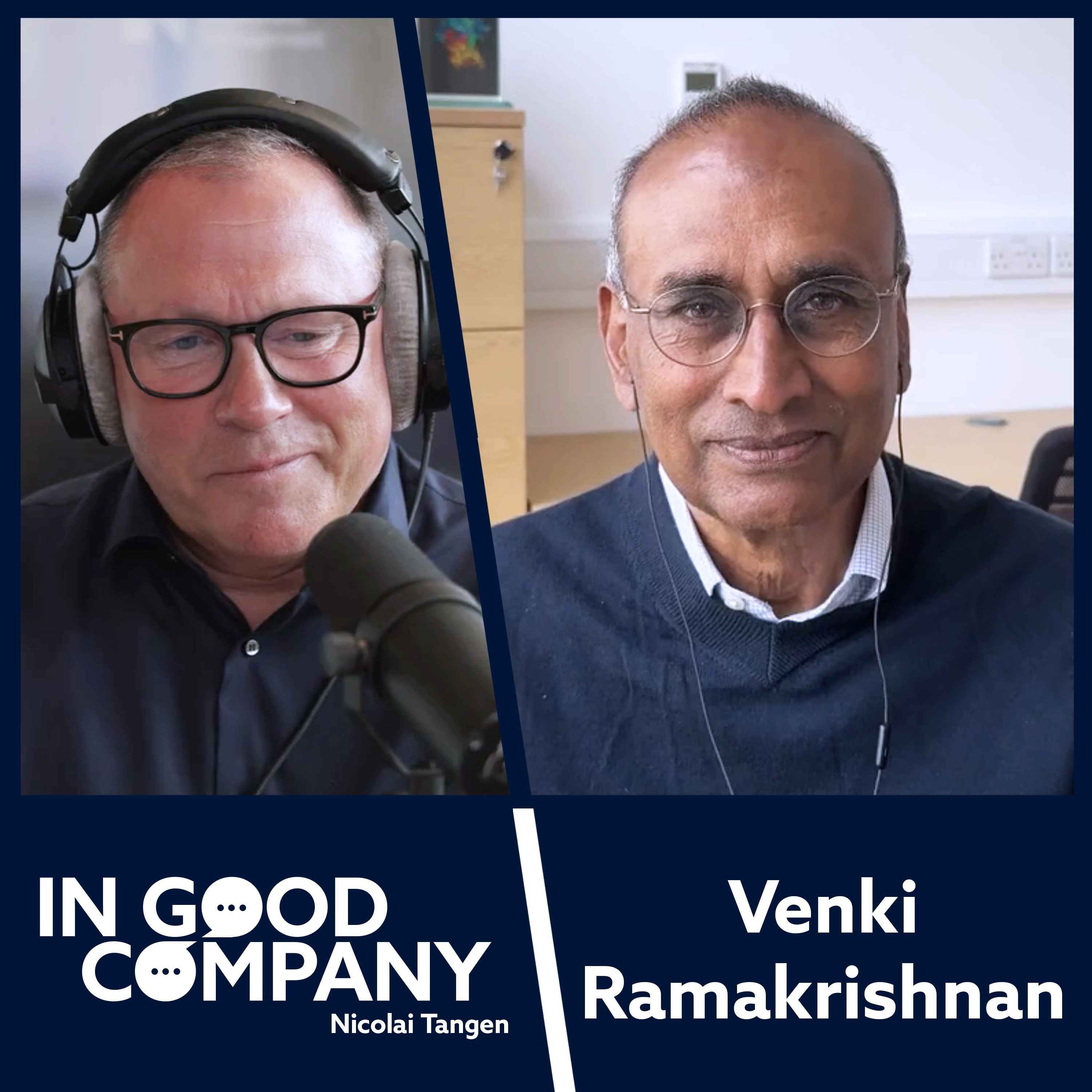
Longevity science vs hype—what aging is biologically, why the human lifespan ceiling (~110–120 years) hasn’t shifted much, and which interventions might extend healthspan (not necessarily lifespan). Ramakrishnan argues that “living forever” is highly unrealistic; the most plausible near-term gains are more people reaching 100+ by slowing aging.
Sir Venki Ramakrishnan, Nobel Prize in Chemistry winner; former President of the Royal Society; author of Why We Die. Background: trained as a physicist, then became a molecular biologist; leads/works in structural biology and aging-related research; advises on science communication and policy.
Written by AI. May contain mistakes.
Venki discusses historical perspectives on avoiding death from pharaohs to modern beliefs.
“You start your book with the pharaohs of Egypt, who believe they could transcend death.”
Venki defines aging as the gradual loss of function due to cellular damage.
“But if you look at all of the difficulties involved, even in, you know, going to Mars, you realize that it's incredibly hard.”
Venki explains the molecular damage that occurs in cells and its effects on aging.
“But it seems like two ideas are getting a bit blurred, right?”
Discussion on historical life expectancy and the factors affecting aging today.
“But people are asking, can you make this program go backwards just a little bit so that the cells still maintain their identity?”
Venki addresses the difficulties in reversing aging and the limitations of current research.
“I think the prime minister typically in the past sent letters to everybody turning 100 and then suddenly became just too much work, right?”
Venki discusses the various hallmarks of aging and their significance.
“And we also don't know, for example, in mice, it didn't actually increase the longevity of the mice, you know, these reprogrammed mice.”
Learn about the different biological markers of aging and their significance.
“or somebody's a heavy drinker, maybe their liver ages faster.”
Discover how AI is changing the landscape of aging research and discovery.
“How is AI changing the pace of discovery?”
Discuss the views of tech billionaires on solving health issues and longevity.
“And it doesn't happen in the digital world.”
Examine the motivations and ambitions behind billion-dollar longevity startups.
“They think, oh, we solved the problem of payment transactions, so we should be able to solve death.”
Discuss the paradox of extending health without extending life.
“$5 billion, a whole bunch of Nobel winners.”
Learn about the investment strategies of longevity-focused companies.
“But anyway, that's a point that's debatable.”
Explore Brian Johnson's personal approach to longevity and its implications.
“Calico, New Limit, Brian Armstrong, Brian Johnson.”
Investigate breakthroughs in stem cell research and their potential impact.
“one guy who's mixing up all sorts of different things and then how do you even judge whether something is working or not you know in one person when you mix everything up let's move taxibiteria.”
Discuss the controversial trend of young blood transfusions and its skepticism.
“And maybe this can restore damaged or aging tissue.”
Understand the science and fiction behind cryopreservation techniques.
“They would get blood from young donors and sell them at a huge markup to rich old men.”
Explore the challenges of cryopreservation and the current state of research.
“It's not because cryopreservation itself has no basis.”
Discover the most promising areas of research for extending healthy lifespan.
“In the meantime, if we gave you$3 billion to conduct research into whatever you wanted, where would you have put that money?”
Learn practical strategies for promoting healthier aging, including diet and exercise.
“Now, in the meantime, we just want some more healthy years.”
Understand the importance of sleep and stress management in the aging process.
“The other thing I should mention is sleep, because a lot of recycling and repair happens in our sleep cycle.”
Examine the societal implications and ethical considerations of potentially doubling human lifespan.
“of it a lot of aging is related to stress you know there's i'm sure people who are happy probably uh you know have less stress and less you know damage to their systems and so on i mean up to a point.”
Discuss the benefits and challenges of transitioning from physics to biology in research.
“I think it creates a serious problem, especially if, let's say, you have advances in aging research and you have treatments that are highly sophisticated and expensive.”
Explore the differences between physics and biology and the importance of a broad educational background.
“It's a different scale and different kinds of problems.”
Discuss the impact of AI on education and the importance of maintaining human intelligence.
“My view is having a broad curriculum is always an advantage because it really gives you an understanding of the different areas of science, different ways of thinking and so on.”
Understand the challenges faced during his presidency and the importance of conveying science effectively.
“One is how to convey science to the general public, how to convey the importance of science to not only the public, but to the government.”
Examine the importance of music in life and its emotional and cognitive impacts.
“And your son is a professional cellist and a music professor as well.”
Reflect on the meaning of life, the inevitability of death, and how to accept it.
“you can easily change a person's mood with music and affect their physiology.”
Conclude with reflections on the conversation and appreciation for the guest's insights.
“You know, he was a little bit sad that it was going to be over, but I think he took it reasonably well.”

Get the gist, explore an idea or ask about something said.
 Claude
On In Good Company with Nicolai Tangen, what are the key points of this episode?
Searching your listeningAutomatic transcript. May contain errors.
0:00Hi everybody and welcome to In Good Company. I'm Nicolai Tangen, the CEO of the Norwegian Sovereign Wealth Fund. Now, longevity is one of the hottest topics in the world right now. Billionaires are pouring money into it. You know, when they were young, they wanted to become rich. And when they are rich, they want to become young. The wellness industry is selling it and opinions about how to live longer and everywhere. So we wanted to find out what is real, what is hype, And how close are we to live forever? To help us answer this, I'm joined by Sir Venki Ramakrishnan, the noble winner in chemistry, former president of the Royal Society and author of the incredible book, Why We Die.
0:44Venki, warm welcome. Thank you. You start your book with the pharaohs of Egypt, who believe they could transcend death. Why did you begin there? Well, the pharaohs are an interesting story because humans try to avoid death by a variety of strategies. Plan A is simply to try not to die. Plan B is to try to believe that even if you die, your whole body will be resurrected and you will go to some paradise. and plan c is that maybe your body will decay but you will have an immortal soul that will you know outlast you and you can occupy other bodies and so on so now many thousand years later how close are we to living forever i think there's no physical or chemical law saying that our lifespan has to be what it is today i mean if you look at today we can expect at the most to live to be about 110 to maybe 120 years.
1:51Only one person has exceeded 120 years. But saying there's no physical law doesn't mean anything because, you know, there's no physical law that we can't eventually colonize other galaxies. But if you look at all of the difficulties involved, even in, you know, going to Mars, you realize that it's incredibly hard. And so I put this long life extension, hundreds of years in that category, you know, which is highly unrealistic today, despite what, you know, you may hear from various people promoting hype. Before we kind of dig deeper, how do you define aging? Aging is, I would say, the gradual loss of function of our systems.
2:42That is from our molecules, cells, tissues, to the entire body. It gradually loses function due to accumulation of damage and changes with time. And that's how I would define aging. Now, it has external manifestations. You know, you can't walk as fast. You're not as strong. you're more susceptible to infections. So there are many external manifestations, but underneath it are these accumulated damages to our cells, tissues, and ultimately comes from our molecules. Well, you are 74. I can't see so many external manifestations in you. Well, I'm lucky because I have a dark skin and a northern climate.
3:28So that gives a superficial illusion. confusion, but if you were to look at the inside of my body, you would find it's quite old. Well, we should talk about that later. But it seems like two ideas are getting a bit blurred, right? So extending life means slowing the aging process, and then rejuvenating cells means making old cells young again. So what's the kind of the difference between the two? Okay, so most anti-aging strategies have to do with preventing damage or slowing down, you know, damage and dysfunction, okay? But one class of strategies involves trying to get cells to go backward in development.
4:14And the way to think about it is a fertilized egg can develop into every kind of tissue in the body. That's what it does, right? And if you look at the early embryo, it has many cells, but each of those cells could become any type of tissue. Those are called pluripotent stem cells. But as the embryo develops, the stem cells become specialized. So some cells can only make cells of the blood system. Others can only make cells of the nervous system and so on. There are many types of cells, but still a small class of cells. Now, but this process normally never goes backwards, except in real life it does.
5:00For example, the child born of, you know, old parents, like 30-year-old parents, it starts the clock from zero, right? And in fact, the child born of a 40-year-old woman is not older than the child born of a 20-year-old woman. So at some point, you know, there is this resetting. And the resetting is not completely perfect because there's a lot of selection involved in birth. You know, any cells that are defective simply don't make it to a full-grown child. So that's the process that people are trying to reverse. And the first proof was when John Gurdon took a skin cell from a frog and took the nucleus and put it into an egg and could grow a completely brand new frog that was a clone of the original frog.
5:53This showed that you could actually reset the clock in a skin cell and make it develop into a whole new frog again. And then Yamanaka showed that only introducing four genes into some cells, any cells, can make it go backwards all the way to that early form of a stem cell. And that's the logic people are trying to use. Now, of course, you don't want to make all your organs go backwards all the way back to pluripotent stem cells because there would be a big confused mess and you would get tumors and so on. But people are asking, can you make this program go backwards just a little bit so that the cells still maintain their identity?
6:42The skin cell stays a skin cell and the muscle cell stays a muscle cell or the liver cell stays a liver cell. But it's slightly backwards in development, you know, has gone backwards. So you can think of it as a way of trying to reverse the aging clock. And that is an exciting area. But, you know, making it work in humans in a safe and effective way, it's not clear how long it'll take. No, no. What's actually going on inside our cells as we get older? Well, many things happen. So one is that our molecules get damaged, and a primary source of damage is if you damage your DNA so that, you know, it is problematic, it results in two things.
7:33One is the cell can sense the damage, and it can send the cell into a program called senescence, where it doesn't function normally, and in fact, creates, secretes inflammatory compounds. Now, early in life, this is a cancer prevention mechanism because if you have to damage DNA, you don't want that cell to hang around because it may mutate into a cancer cell, right? And so this is a mechanism to get rid of these cells where damage is sensed. But if the damage persists, it can also alter the genes that are part of the genetic program, and that can also cause dysfunction. So there are ways that, you know, molecular damage can cause dysfunction.
8:19Now, this kind of damage then results in the cell itself not regulating itself properly. The organelles in our cell called mitochondria, which have their own DNA, but also interact with the rest of the cell, they also can get damaged quite a lot. So you can see these kinds of damages occur due to all kinds of things, exposure to chemicals, even water alone can cause DNA damage. That was discovered by Thomas Lindahl, for which he won the Nobel Prize. So just the act of living causes damage, but we have sophisticated repair mechanisms that constantly repair the damage. But at some point, the damage starts accumulating.
9:08with age. Those mechanisms are never perfect. Talking of which, so a century ago, most people died when they were 50 or before. And today, the average is roughly 80. You mentioned one person had made it to above 120. So why has that ceiling not moved? Okay, there's a difference between the average on the ceiling. So life expectancy has doubled in the last 150 years, but that's mostly due to improvements early in life. For example, infant mortality has gone down. You know, many infectious diseases can now be cured. So accident rates have been reduced dramatically. So all of those things mean that we can live to an older age.
10:01So the average has gone up. Okay. But even in the 1500s, Michelangelo lived to be almost 90. So it's not, you know, that nobody lived to be an old age in the olden times. It's just the average was low. And we solved it by public health and vaccination and nutrition and medicine. Okay. Those are the four big things. But as you get older, then aging starts to kick in. And that we've not actually made a lot of progress in. And so the maximum lifespan has not actually changed a lot. It's changed a little bit because, you know, people do live longer and so more of them make it to over 100. For example, the number of people over 100 is increasing everywhere.
10:49Yeah. I think the prime minister typically in the past sent letters to everybody turning 100 and then suddenly became just too much work, right? In Japan, they produce more diapers for old people than for babies. Yes, that's a whole other problem. What is happening is society is getting older, but the fertility rates are going down. So society is becoming skewed towards an older population. But how do we crack this 120-year barrier? What do you think will crack it? Well, I think if you slow down aging, it's unlikely that you'll get huge gains. What you will get is more and more people reaching, say, 100, okay, or beyond.
11:34I think the way that people might be able to crack the 120 is by this kind of reprogramming, which is, you know, trying to get cells to essentially reverse, effectively reverse their aging, their biological age by resetting some of these clocks. But although it's been demonstrated in animals, there are real problems getting it to work in humans. Why? Because, you know, the way that they introduce it in animals is either they have transgenic mice, which turn these genes on or off. And by the way, we don't know if these genes are really safe over the long run. Some of them are oncogenes, for example, which can cause cancer.
12:27the other other way to do it is by packaging these genes inside a viral shell these are called adenoviral vectors and then you introduce them now the problem is that these genes have to go into all of the cells in the tissues of interest and do it sort of uniformly and all the evidence says that, for example, when they target a pancreas, only some cells, you know, some clusters of cells in the pancreas are reprogrammed and other cells are not reprogrammed, okay? Now, in mice, this still causes some benefit, it still produces some benefit. But you can see, if you want to do it in humans, you have to be able to do it in a much better controlled and safe way.
13:18So I don't think, I think there's a lot of excitement and there's a lot of hype. I personally don't think it's around the corner as far as humans are concerned. And we also don't know, for example, in mice, it didn't actually increase the longevity of the mice, you know, these reprogrammed mice. They just, older mice looked healthier by various criteria than younger mice, but it didn't increase their lifespan. Different organs age at different rates. That's the other problem. What organs age the quickest? I think it would vary quite a lot depending on the person. You could imagine, for example, if somebody's a heavy smoker, maybe their lungs are aging faster than, or somebody's a heavy drinker, maybe their liver ages faster.
14:07I just don't know. I think one of the more interesting papers on it It simply showed that if you apply most standard markers, then different organs in people had different biological agents. Talking of these markers, these hallmarks of aging, what are the most important ones? I think you typically talk about 12 of them, but what are the most important ones? I don't think you can say one is more important than the other. As a molecular biologist, I think damage or modification to DNA is fundamental and really drives a lot of the rest. However, they're all important in their own frame. For example, damage to mitochondria is a thing in itself.
15:00And loss of stem cells is a factor in itself. Of course, you could say underlying it all, maybe the primary cause is damage to our DNA and the response to that DNA damage. How is AI changing the pace of discovery? I think AI is very, very good at recognizing patterns in large data. And so, for example, in my field of structural biology, it has really revolutionized the ability to predict structures just from the sequence that you can get from just sequencing the gene, for example. But I think with aging, aging is a complex multifactorial process. It's not just one thing. I mean, I mentioned DNA damage.
15:54That's not the only thing. There are all sorts of things that are interconnected. And how to make sense of that is not clear. And what sort of data you would feed to AI to train it is also not clear. However, what I can say is that AI has been advancing so dramatically that it's hard to predict anything about AI. What are the kind of things you can do now in your lab which you couldn't do? Well, I mentioned, for example, you could predict structures. Another thing that you could use it for is for looking for patterns in genes. For example, one obvious thing is if you sequenced lots of centenarians, you could then ask AI to look at the genomes and ask, does any pattern emerge here that makes sense, for example.
16:52Demis Osabis, who won the Nobel Prize for Everfold, he predicts that within 10 to 15 years, there won't be any illnesses left. Any what? That there won't be any illnesses left. Yes, I know that. Potentially, potentially. I actually know Demis quite well. And in fact, he asked me to be on the advisory board of one of his companies, Isomorphic Labs. And I think he's a brilliant guy. However, I would say in this case, maybe he's being a bit over-optimistic. And the reason I say that is not because AI won't give us clues about potential drugs or even causes, for example, of diseases. But I think going from there to having treatments is a complicated process.
17:45And it doesn't happen in the digital world. it happens in real people. You have to have real medicines, real, you know, which you make. So all of that stuff is in the analog world. And I think that is going to take longer. Do the tech people just think that life is a software that can be hacked? Yes, I think they have that bias, whether it's conscious or not. They do have the bias of looking at the entire world as if it's a software problem. And the world is not digital. The world is analog. And I think they simply don't want to confront that. Why is there certainly so much money going into longevity research, like tens and tens of billions?
18:34I think there are two reasons. One is the one you pointed out, for example, about Japan, which is true of all societies. All societies are getting older, and governments and health agencies are extremely worried. How do we deal with societies where a huge fraction of the population is quite old and there's a smaller and smaller fraction of the population that's of working age that can support them? So the one solution is to try to put money into aging research. And the goal of this is not what you described earlier of living for a very long time, but rather to make your life as healthy as possible, but not necessarily extending life, but more increasing health span rather than lifespan.
19:24Okay, the fraction of life you're healthy. That's one reason. And that's a very widespread reason. Everybody will sign up to it. Okay. But the other reason is that there is a group of people who just have these grandiose visions, okay? And it's all based on the fact that they made billions of dollars in their 20s before they were mature. And they simply think that everything is just going to go their way. And these people don't want to die, okay? I mean - Why don't they want to die? Well, they love their lives. They like the feeling of control. They think, oh, we solved the problem of payment transactions, so we should be able to solve death.
20:09Why are they all men? I do think, you know, they're all middle-aged men, often married to younger women, by the way, which is a strong incentive to want to live longer. But I should say maybe it's some male thing, you know, of wanting control and so on. You're right, you know, and I do point out in the book that they're mostly middle-aged men. Tell me a bit more about these men. What more do they have in common? They like control. They like power. They like, obviously, they like wealth. And so they're used to having everything their way. You know, if they want to buy an island, they can buy an island.
20:52If they want to buy off a government, sure, They can fund some politicians' campaigns and then, you know, give them money and then, you know, suddenly the regulations disappear. OK, so excuse me for being a bit cynical, but you can see this in operation today in the U.S., right? So I think they're used to that kind of power. And they also have these grandiose visions. You know, they feel like we're the only intelligent species in the universe or maybe. and therefore we need to populate the universe. And there's a fantastic book by Adam Becker called More Everything Forever. And it's about these people who just want more of everything and they want to conquer space, galaxies, et cetera.
21:44But I don't know if they really mean it or if they're saying that so that it sounds like a noble cause, okay? And the real reason is they simply want more power and they don't want to die. Now, one of these Bezos-backed ventures is called Altos Labs, right? $5 billion, a whole bunch of Nobel winners. I should say that one of the driving forces behind it was actually Yuri Milner, who is another tech billionaire. Yeah, yeah. What are they betting on? I think that, well, you know, officially their stance is that they don't, they're not interested in extending life, but they want to extend health.
22:27And in fact, Rick Klausner, I was at the opening of the Altos launch in Cambridge and Rick Klausner, who's, you know, their chief scientist said, look, our goal is not for people to live forever. Our goal is for everybody to die young after a long time. Okay. So my immediate reaction was, if somebody is young, why would they suddenly die? You know, I mean, this is a little bit of a paradox. You're saying I'm going to keep everybody healthy and then suddenly they're going to drop dead? Doesn't seem likely to me. I think what you'll end up doing is postpone that, you know, slow decay and decline to a later stage in life.
23:16But anyway, that's a point that's debatable. But that's their stated goal. But I have a feeling the people who are funding it are interested in two things. One is they think there's a lot of money in aging. And so, you know, if you hire the best scientists, which they did, some of the top scientists in the field went to Altos because of the resources and the salary offered was far better than anything you could get in academia. And so their bet is if we hire some top scientists, they will come up with useful stuff that then we can monetize in the longevity business. And so that's a clear, you know, standard, you know, investment strategy.
24:09But the other strategy is deep down they think, well, maybe these guys will crack the problem and, you know, maybe we'll end up living not forever, but maybe a much longer time. We have another, we've got a few other players who tried to crack it. Calico, New Limit, Brian Armstrong, Brian Johnson. What are your reflections? I mean, I do know of Brian Johnson, who's another tech billionaire who spends$2 million a year, apparently, on his own longevity. He monitors his aging. He does all sorts of treatments and so on. And, you know, he seems a pleasant enough guy from watching his interviews, you know, and I think it's fine if he does that.
24:54And he looks pretty young for a guy in his late 40s. but my son is almost 50 and he looks just as young without any of those longevity treatments so so i you know the trouble of ryan johnson is no control experiment it's it's one guy who's mixing up all sorts of different things and then how do you even judge whether something is working or not you know in one person when you mix everything up let's move taxibiteria. So stem cells kind of deserve their own chapter here. You say in your book that an 80-year-old has the 200th amount of stem cells compared to a newborn. Now, what are the genuine breakthroughs in this area?
25:43Well, the big breakthrough in stem cell research will come from reprogramming. Okay. So if they can implement reprogramming safely in humans and, you know, demonstrate, first of all, they need to do a lot more research on animals. So it has worked in mice, right? It has worked in mice, but remember, it's very limited experiment. And even in mice, the reprogramming is highly heterogeneous. That is, even in the same organ, there are clusters of cells that get reprogrammed. Other cells don't get reprogrammed. Okay. There's one interesting experiment that's being done in Boston, which is about trying to restore, you know, regeneration of tissue, trying to regenerate eye tissue by injecting these factors directly into the eye.
26:40And maybe this can restore damaged or aging tissue. Like, you know, many diseases in old age cause retinal degeneration, which can lead to blindness. And that's actually been approved for clinical trials. But again, you know, many things that work in mice fail in clinical trials. I mean, that's almost the norm. And so you have to simply wait and see what happens. So hundreds of clinics already sell stem cell injections. Oh, well, I think, you know, people, for example, when scientists found out that, you know, if you connected an animal, old and young rat, and exchanged their blood supply, the old animal seemed to benefit from the blood of the young animal.
27:33And immediately there were companies that were starting to sell young blood. They would get blood from young donors and sell them at a huge markup to rich old men. Do you think there is something to it? No, I'm highly skeptical. Another area is cryopreservation. So basically you freeze yourself and hopefully you wake up later. Yeah, this is currently, I would say, in the realm of science fiction. It's not because cryopreservation itself has no basis. For example, we can freeze eggs. We can freeze even embryos. We can certainly freeze, you know, lots of even small larvae of worms and so on. So there are many things we can freeze.
28:21And the method of freezing depends on cooling them to very low temperature, like liquid nitrogen temperature, without the water freezing into ice. OK, because if it freezes into ice, ice expands compared to water. So it destroys all the tissue around it. That's why, you know, if you freeze your strawberries in your freezer and you thaw them again, they don't look like fresh strawberries. OK, so the reason you can do it with small things is because you can transfer the heat fast away from it fast enough before the water has a chance to form ice crystals. So you get essentially, you know, a sort of native state.
29:09Now, nobody has been able to freeze even a small animal like a mouse. Okay. And there was some report about a mouse brain being frozen. Then when I looked at it, it's not even a whole mouse brain. It's only a section of a mouse brain, a thin section of a mouse brain they've been able to freeze. Okay. So I would say to these people, when you can freeze a mouse and thaw it so that it can run around again, then come and talk to me. I'll be interested. Until then, it's just, you know, I think of it as nonsense. In the meantime, if we gave you$3 billion to conduct research into whatever you wanted, where would you have put that money?
29:52What's the most promising part? You mean for aging research? Yeah. Okay. I would put it into three or four areas. One is we know that caloric restriction does help with aging. Okay. And this has been true in many species. It has some consequences which are not always good, but maybe you can separate those. So I would put money into caloric restriction pathways. That to me is the most promising short-term goal. Okay. Then, you know, we talked about old and young blood. Well, one possibility is to try to ask what is in your old blood and what's in young blood? What are the differences and what, how do they promote aging or prevent aging?
30:40You know, so, so that's another area. I talked about cells that sense damage and going to, into the state called senescence. And that's a natural process That's very useful throughout our lives. But as we get older, the number of senescent cells increases too much beyond our body's ability to clear them. And so there are efforts to target senescent cells for destruction. Again, it's a question of being able to do it in the right amount and not damage all our other cells. So that's another promising area. And then the fourth is the part that we talked about, which is cellular reprogramming. And I think that is perhaps one of the more exciting long-term goals.
31:32And I think that's another area where you could do a lot of useful research. Now, in the meantime, we just want some more healthy years. And so where do we start? Well, you know, caloric restriction pathways suggest an obvious answer. One is... So this is basically just being hungry. No, I don't think you need to be hungry. You're right that people on a truly caloric restricted diet, they're hungry all the time. Which is why I don't do it. No, and nor do I. Okay. But you can eat moderately and you can eat, you can try to not be obese. You can control your weight. By the way, GLP-1 drugs have now shown all kinds of effects, not just for preventing diabetes or for extreme obesity.
32:26And so they could be investigated further as well. Do you think they'll extend lifetime? They might. I don't know about extending life, but they might make it old age healthier. But they have consequences. For example, you have muscle loss, you have other side effects. So people need to figure out how to use them safely. You know, if you're going to try to give it to healthy people, you have to try to make it safer. But anyway, so I would say caloric restriction suggests an obvious answer, which is, you know, don't overeat. And why does it work? It works because it turns on pathways that are involved in recycling, you know, defective molecules and defective organelles and generally affects your protein synthesis so you don't make, you know, misfolded proteins.
33:27So there are lots of things that affect our metabolism that benefit us as we age. The other thing I should mention is sleep, because a lot of recycling and repair happens in our sleep cycle. And people underestimate the importance of sleep. And that's another very important aspect. And, of course, the third one is exercise. And exercise, you know, we talked about rejuvenation and regeneration of tissues and so on. And exercise actually stimulates that. Let's just sleep first. How much do you sleep? I try to get about eight hours of sleep a day. And, you know, if I get less than seven hours, I don't function very well.
34:18There is this saying, when you're young, you sneak out of your bedroom to go to parties. And when you get older, you sneak out of the parties to get back to bed. why i unfortunately i was i was i was a sleepaholic if you like even when i was young you know so maybe why why do we appreciate sleep more when we get older i i don't know maybe maybe you know we're just not as energetic and not as you know we don't have the same stamina as we did when we were young. But as I pointed out, you know, not only I, but even my son and I believe also my grandson, you know, we all like our sleep. You know, I'm not sure we're all-night party animals.
35:05No, sleep is beautiful. What about exercise? How much do you exercise? I try to exercise. You know, firstly, I ride my bicycle about a few kilometers each way to work every day. but apart from that I go to the gym and I do a combination of weight training and cardio I don't my knee is not great I used to be a runner but now I mostly do an elliptical cross trainer which as somebody from Norway you'll appreciate it sort of mimics mimics cross-country skiing you know much better for much better for the joints yeah but talking about Norway what about ice baths and cold plunges and saunas? You know, the trouble with all of these things is they come from one or two observations, which may or may not be even validated.
35:57And there's no control experiment. Okay. I would be very, very skeptical of those sorts of treatments. I doubt that they do much, to be honest. Well, hey, they do a lot for me. I did both an ice bath and sauna this morning and it makes me feel uh oh if it makes you okay so let me let me address that anything that makes you feel good is probably okay probably good for you at some at some level because a lot of it a lot of aging is related to stress you know there's i'm sure people who are happy probably uh you know have less stress and less you know damage to their systems and so on i mean up to a point.
36:41You know, if you like drinking, I wouldn't say, you know, go out and get drunk every day. I'm not sure that's a good idea. But if you, you know, if a cold plunge in a sauna makes you feel good, that's great. You know, you should do it. Let's move to the ethics. Now, if we could double the lifespan tomorrow, do we actually want to? I think it would cause huge changes in society, not all of which will be good for society. For one thing, you know, changes in society require turnovers of generations. Old generations don't, you know, older generations don't voluntarily change society. Often change is driven by the young.
37:25And so you might end up with a very stagnant society. The other is that as old people, as people get older, they accumulate wealth, influence, and power. And of course, these three things go together. And so you will have the same group of people controlling society without turnover. And that is not a recipe for a good society, you know, because people who are entrenched in power have no reason to change and, you know, may not act in the best interest. of everybody. And I should point out that if you look at great discoveries in science and mathematics, they're almost all done by young people, okay?
38:11You know, people in their 40s are younger. And, you know, yes, there are a few exceptions here and there, but even those people often did great work when they were young. It's just that they've continued. And interestingly, Recently, Ishiguro, the famous novelist, pointed out that even in literature, this is true, that generally speaking, people who are younger, people tend to write their greatest works when they're younger. One example he gave was Tolstoy. War and Peace was written when he was in his 30s. That's supposed to be this big, profound novel, and yet was not written by an old man. So, you know, I wonder what it'll do to, you know, society generally if we have everybody living for a very long time, and especially combined with drop in fertility rates where you're not replacing them.
39:14During COVID, we treated the old people first. Was that wrong? Well, it wasn't wrong because they were by far the greatest risk. So, you know, the likelihood of dying of COVID doubled every eight years of life, you know, roughly speaking. And so an 80-year-old was many, many times more likely to die than, say, a 40-year-old or a 30-year-old. So I think if you wanted to save lives, you know, that was not a bad thing to do. The rich people already live a decade and even some places more than that. Yeah, 15 years in the US and about 10 years in the UK. So what reflections do you have around that or extending it further for rich people?
40:04I think it creates a serious problem, especially if, let's say, you have advances in aging research and you have treatments that are highly sophisticated and expensive. Then you can imagine a two-tier society where rich people can get all of the latest and fancy treatments and will live even longer than they do now. And so the disparity in power, because as I pointed out, people accumulate power and wealth, will be even more. And moreover, their children will also be at an advantage. So you may end up creating a multi-tiered society, you know, or at least a two-tiered society where, you know, there's one rule for the very rich.
40:53And it's not just even wealth, but it's even years of life. And then another situation for the rest of society and especially for the poor. Vicky, let's talk a bit about you here at the end. You grew up in India. You trained as a physicist and then switched to biology. Why is physics a good place to start? Well, I'm not sure. Or is it? You know, I think it didn't hurt me, but I'm not sure it's necessary, except that one thing physics does is it trains you very well in mathematics and in quantitative thinking. And that can be useful. But I can tell you physicists who try to become biologists without really becoming biologists, but staying as physicists, they don't tend to do very well.
41:45OK, the best physicists, best people who have gone from physics to biology are people who stopped being physicists and really learned how to think like biologists. Because biology involves a different way of thinking. It's a different scale and different kinds of problems. For example, physicists almost, there's no such, I never heard of a control experiment in physics because the experiment itself is designed so that, you know, it's designed to be extremely simple and answer a particular question. And in biology, the system is so messy that you have to do control experiments, And so that's one concrete example.
42:32But there are many other ways. And for example, everything in biology requires thinking in evolutionary terms. And that doesn't come quite naturally. Physics is generally a highly reductionist science. Although now many physicists are going into complex systems and so on. But traditionally, it has been a highly reductionist science. So I think there are cultural differences and you have to bridge those differences if you want to succeed in making that transition. Do you think with the advent of AI that having a broad curriculum is more or less an advantage? My view is having a broad curriculum is always an advantage because it really gives you an understanding of the different areas of science, different ways of thinking and so on.
43:22And one worry I have is that we are going to simply delegate everything to AI, which would be a recipe for making humanity stupider, I think, and more ignorant. And I think what we really should be doing is leveraging AI so that it's another powerful tool in our armory. I mean, computation was a tool, you know, all sorts of modern robotics is a tool. You know, we have all sorts of tools, chemical tools, you know, biological tools. And I think we should think of AI as another powerful tool. What did you learn as a president at the Royal Society? Well, I learned a lot of things. One is how to convey science to the general public, how to convey the importance of science to not only the public, but to the government.
44:21And, you know, I became president at a very particular moment in British history when it had voted to leave the EU. And then towards the end of my term, we had the global pandemic. And so, So, you know, I had to deal with really quite serious issues as president. And I think the fact that I was an American citizen who had come to Britain and I didn't have a, I didn't grow up here and didn't have a network of people here, I thought that might have been a disadvantage. But on the other hand, it made me viewed as somebody with no ax to grind, you know, somebody who was perhaps something of an outsider, but therefore objective.
45:05So it may have helped me as much as it hurt me. Why is music so important in your life? And your son is a professional cellist and a music professor as well. So he must have taken some inspiration for your love of music. You've clearly done some homework on me. Anyway, no, I've always enjoyed music. And I think music is one of those universal, things. I don't quite understand, you know, Steven Pinker in his book sort of dismissed music, you know, he thought it was just an artifact of no evolutionary significance. I think he's wrong. And I think music is a demonstration of very, very high cognitive ability.
45:50And so you can see how evolutionarily it's important. But more than that, I think music, really, we have evolved to so that music has some deep, you know, emotional and physiological triggers in us. And, you know, you can easily change a person's mood with music and affect their physiology. So I think there's something profound about music. Do you think it makes you live longer? I don't know, but it can certainly make your life, the life you have far more pleasurable. Do you think gratitude makes you live longer? I don't know if any of these things particularly make you live longer. I think, you know, some things you do because they're worth doing, not just because everything, everything is not about living longer.
46:40It's about enjoying life while you have it, right? Are you afraid of dying? I think we all are at some level, but I think, you know, I mean, my father and my brother-in-law both died in the last year and a half. And my father was almost 99. And I would say, you know, he faced, you know, when he was told, look, now you only have a few days left. You know, he was a little bit sad that it was going to be over, but I think he took it reasonably well. And my brother-in-law, you know, he suffered from a sudden diagnosis of pancreatic cancer, but really, you know, was very measured and, you know, sort of rational about it.
47:25So I hope if, you know, not if, but when my time comes that I'll face it with the same kind of, you know, equanimity or rationality that I saw in these people. You had a Freudian slip there and said, you know, if you die, do you believe in afterlife? life? No, I don't. But no, I meant when I died. I don't know if it was a Freudian slip. Thank you. It's been tremendous to speak with you. What an incredible experience. Big thank you for taking the time. Thank you very much for having me.
How close are we, really, to living forever? Longevity has become one of the hottest topics in the world, drawing huge investment and endless opinions about how to live longer. To separate science from hype, Nicolai Tangen turns to Sir Venki Ramakrishnan, Nobel laureate in chemistry, former President of the Royal Society, and author of Why We Die. They unpack what ageing actually is, why the maximum human lifespan has hardly moved, the promise and limits of cellular reprogramming, and the ethics of a longer-living society. Venki also shares the simple habits that matter most: sleep, moderation, and exercise. Tune in for a clear-eyed conversation on life, death, and everything in between!
In Good Company is hosted by Nicolai Tangen, CEO of Norges Bank Investment Management. New full episodes every Wednesday, and don't miss our Highlight episodes every Friday.
The production team for this episode includes Isabelle Karlsson, Olav Vhile and PLAN-B's Niklas Figenschau Johansen and Håkon Klemsdal. Background research was conducted by Karoline Woie.
Hosted on Acast. See acast.com/privacy for more information.


