
 Ask ChatGPT


 In Good Company with Nicolai Tangen
23 Oct 2024 · 45m
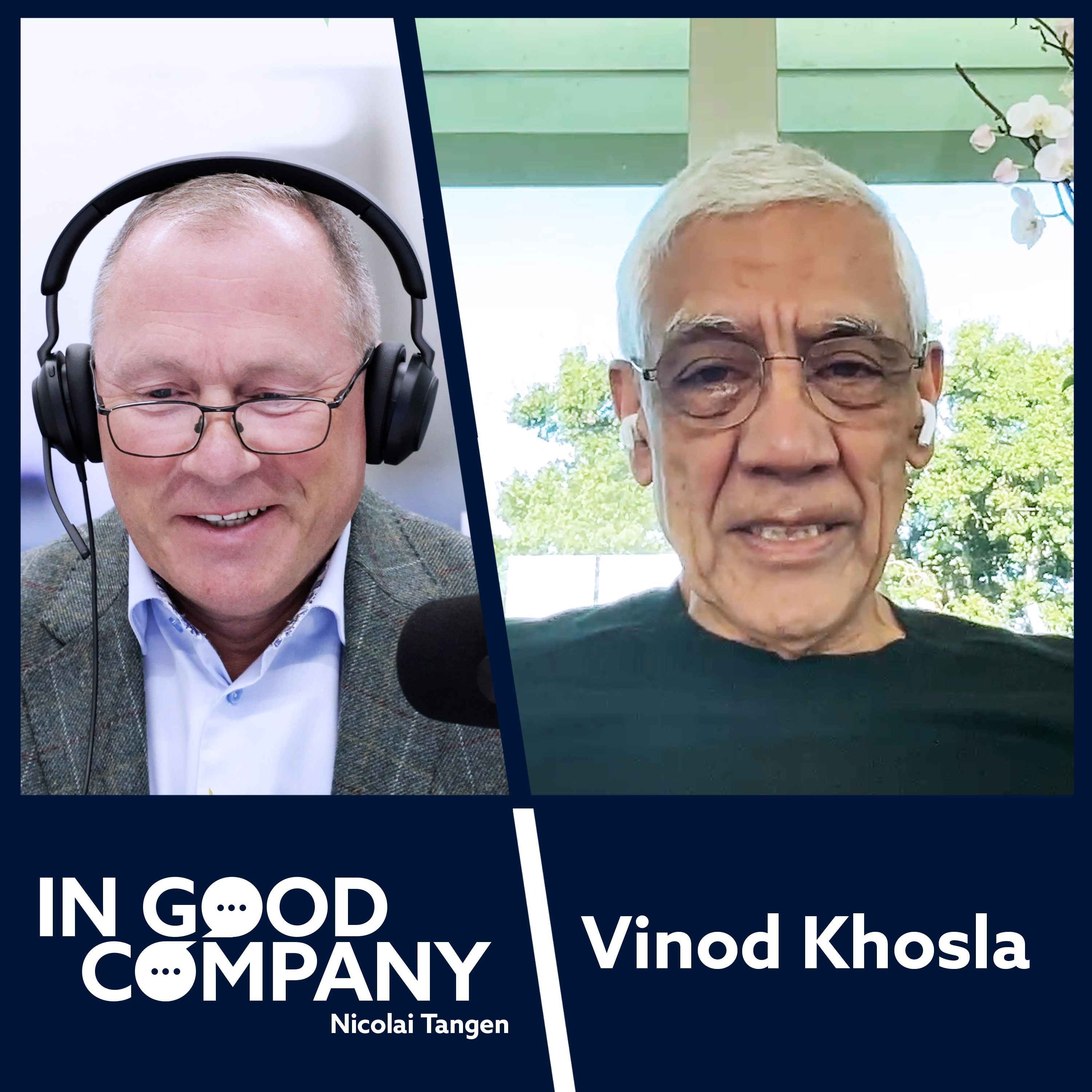
In this episode of In Good Company, Nicolai Tangen interviews Vinod Khosla, co-founder of Sun Microsystems and founder of Khosla Ventures. The discussion revolves around the significance of the improbable in shaping the future, the transformative potential of technology, and Khosla's insights on investing in innovative ventures.
Written by AI. May contain mistakes.

Get the gist, explore an idea or ask about something said.
 Claude
On In Good Company with Nicolai Tangen, what are the key points of this episode?
Searching your listeningAutomatic transcript. May contain errors.
0:01Hi, everybody. Today we are in a really good company with one of the most successful entrepreneurs and venture capital investors all the time. Vinod Kosla. Vinod co-founded Sun Microsystems back in 1982 and Kosla Ventures in 2004. And Kosla Ventures is making money in technology whilst also doing good stuff for society. So a warm welcome, Vinod. Great to be here.
0:34you say that it is only the improbable which is important what do you mean by that you know um most in this goes immediately into my views on expert opinion it's very good at predicting the an extrapolation of the past as opposed to a new kind of vision for the future. So when you look at forecasts and predictions, only time they're important if the world changes, if the weather changes from today to tomorrow. But if you look at expert opinion, when Russia invaded Ukraine, Experts were, this will be over in two days. The same is true of almost all large changes. Then the experts revised their forecast to exploit the past.
1:36It's entrepreneurs specifically who invent the future they want and create unlikely scenarios. areas. Studies like Ukraine, I cite, are when the Department of Energy in the United States forecast the number of electric cars in the U.S. In 2010, they made a 25-year-later forecast for 2035, and Elon Musk and Tesla exceeded that forecast in 2016. So, one of those trying to make a different future their vision happen is what drives change. And they're improbable in that sense. How do you identify these situations where experts are totally wrong? I think it's very hard to identify precisely these situations.
2:30When we invested in OpenAI in 2018, is when we made the commitment to invest, it was hard to say when there would be a breakthrough in AI. What was predictable was the trend line was an exponential. It was very likely we were in the flat part of the curve of an exponential, the early changes. And then the breakthrough happened. So there was a particular paper in 2017 that turned out to be quite important for AI progress. And because of that, suddenly AI capability took off. I would call that improbable because nobody else was predicting it. But it took Sam Altman and his team at OpenAI to make that a reality.
3:24In fact, the paper wasn't written by Google by OpenAI. It was written by Google researchers. and then it became important. And they scaled it. They believed in it. They scaled it. They made it happen just like Elon Musk believed in electric cars and made Tesla happen. And so Lord changes are almost always driven that way. There's not a single automotive player who's developing really state-of-the-art self-driving cars. It's not the Volkswagens of the world. it's Google, which has no business being in automotive. And that's what I mean by improbable. When Amazon started, we were an early investor in Amazon.
4:11It was the same. Nobody thought they took a take on Walmart. How do you find these situations? Is that people coming to you? Is it people you know? Is it things you read? How do you get across the map? Well, there's multiple factors. First, the opportunity has to be right. So you have to, you know, most people, especially most experts in any area, when you look at radical change, they tell you why it can't be done. There's a breed of people that are entrepreneurs that say, why not? If there's a plausible path for why it could be done, and aren't those ready to make it happen through persistence, I think that's what you look for.
5:03It's the right personality in the right environment. The timing is right for a large change. The rationale makes sense. There's a technology breakthrough. When mobile phones came, for example, Uber was possible or Airbnb was possible. And then they make that happen. So take the examples of cell phones. Steve Jobs had a vision which was very much criticized because people said a phone without a button, without buttons for dialing. We are old enough to remember when Nokia and others, Motorola, were the two big cell phone players. But they didn't imagine this future. Steve had a different vision and was really about a device that would not mostly be used for talking.
5:59But it was a phone. It was an oddity that was hard to believe. So that's another very large improbable. What have been your best investments? I mean, you've been invested in quite a few of the names you mentioned here already, but what kind of stand out? Well, first, we invest as a team. But I'll mention another improbable because I think it's very important in the nature of these exponentials. in 1996, we invested in a company called Juniper that said TCPIP would be the protocol for the internet. There was not a single telco player, AT &T, Verizon, they had different names then before their mergers and all that, that predicted TCPIP would be the protocol for the internet.
6:50And they had other more technical reasons for going with other protocols. We just bet on that. We got a 2 ,500x investment over about five years. So I was at Kleiner Perkins then. We made$7 billion on a$3 million investment. That was very nice. But it was because we stepped into an area which was both important, TCPIP turned out to be important as a protocol for communications. And it was very large. And nobody else was betting on it. So Nokia, Alcatel, Lucent were all the big names that bet on other protocols. And we bet as a startup on this, and we won. huge win. I was at Kleiner Perkins at that point.
7:51We also invested in Google. But it was a couple of flaky PhD students. But they had real resolve in the ideas made sense. And you didn't know how large it would be, how important the improbable would be. When they were talking about organizing the world's information, It was hard to extrapolate in 1996 from two kids talking about that to it will change the world in many, many ways. So those are all improbables. characteristics of people with the resolve and determination, with persistence, with low probability, high impact bets. And the environment being right for them to find a toehold and then expand from there.
8:44Those are characteristics we look for from an investment point of view. So, Vina, now I'm a flaky PhD student. I come into your office. What kind of things do you ask me? I say, hey, I got a super plan. I'm going to change the world here. We see that all the time. And we have to judge how persistent will they be. If you're talking to them about the investment for a month or two, you can usually tell how fast they will learn, how fast they will change in the day. In uncertain scenarios, fast learning is more important than experience. And we can come back to that. Experience seldom helps in these environments.
9:25In fact, experience is a set of biases which causes you to extrapolate the past and not go after a radically different future. How do you screen for fast learning? How can you figure out whether I'm a fast learner? You can watch somebody and see how well they answer questions. If you challenge them, how they respond, are they thinking from first principles and saying, let me examine this assumption or are they being reactive? I know this to be true, which is very common in experienced business people. We've always done it this way. We've had the world. This is always what I've done this for 30 years.
10:13Those are all bad signs for an entrepreneurial person. You've done it for 30 years and more. So how do you make sure that you don't fall into that trap? You know, and that's one of the hardest things I do. I think the hardest thing I do is decide how I stay relevant to fresh thinking and fresh areas. You know, when I invested in Juniper, which was the ATA protocol for the internet, it was very hard to say we could win. But there was an idealized vision of why it would be superior to what others, much more expert opinion was saying would happen.
11:01And examining it from first principles, like why won't it happen? And people will tell you because ABC. And then you say, if I can challenge ABC, then it might, in fact, happen. So it's this first principles thinking and then being willing to change people's mind rapidly that great entrepreneurs always learn rapidly from being in the field. I always say a lot of changes are not always plannable, but they are discoverable in a series of iterative steps by smart thinking.
11:43let's um utilize some of your smart thinking now and let's try to predict the future which you have done in a in a fantastic ted talk so you have identified 12 trends for the future and i'd love to dive into each one of them if you don't mind but just uh before that just what these trends what do they have in what do they have in common what are they about my particular area of expertise, and I hate to even call it expertise, it's more speculation, it's smart speculation, or I call them intelligent guesstimates of what might be possible, is technology driven. So technology causes a change, which causes a change of
12:28and then you sort of say, with that, is there an entrepreneur who can drive that change to happen? Somebody like an Elon Musk make electric cars possible when General Motors couldn't. And they attempted that and spent quite a lot of money before Elon Musk did on electric cars. It's technology-driven change and a change in assumptions, which make the exploration of the past somewhat invalid if you can make the new vision happen. Of course, the rest of the world generally doesn't believe this rapid change. Nobody believes in Airbnb as people would let strangers into their house or that Uber would be a large business or that you could build retailing on the Internet, e -commerce, and not have retail stores like major retailers like Walmart.
13:25These are all radical assumptions before they happen. and that people would be happy to buy through. Let's dive into some of these radical predictions you have. First one, expertise will be free. AI is moving so rapidly. We are very close to the point where AI is as good as the median person in most areas. So whether you're looking at an oncologist, a primary care doctor, a teacher, a structural engineer, a minerals engineer doing minerals resource discovery. AI is getting good enough to be huge leverage on today's people with expertise in that area. And I think very, very soon in all these areas and all areas of expertise, more accurately, I should say in most areas of expertise, AI will be better than the human.
14:29And then because it's computation only, it can be replicated infinitely. There's a million doctors in the U.S., a couple of hundred thousand primary care doctors and then specialists in various areas. But if you could have 10 times the amount of expertise, it would be near free. and we could provide a lot more primary care without much cost and maybe even substantially lower cost. What are the implications of free expertise? What will it do to the world? Well, I'm starting to think through the implications. I think that world will be quite deflationary, but deflationary in a good way. There will be some bad side effects.
15:17That job may be replaced, whether it's a salesperson being replaced by an AI salesperson, which is being developed, AI replaced by a structural engineer or structural engineer replaced by an AI. If you take the$300 billion or$400 billion we spend on physician salaries in the US and say 90 % of it will go away, that has to be deflationary. Will it make the world a fairer and more equal place, you think? I'm absolutely certain we have an opportunity, and I use the word opportunity carefully, to make the world fairer, more accessible. I do believe, and I've been arguing that a country like India should offer free primary care AI, just like they offer free payments.
16:07There's no Visa and MasterCard in India with their tax on all transactions. that is possible and free teachers for free ai tutors for every child we have ai in fact my wife runs a non-profit that has an ai that can assess a student in their weak strengths and weaknesses faster than a human can and more accurately and then teach to their weakness that level of education precision will come for almost free. In fact, it's offered for free on the CK12 website today. And we want to scale it globally. And it only costs the cost of computing. You also say that you think labor will be free. I do think, and this is a little harder to project today, but almost certainly over the next five years, we will develop bipedal robots.
17:10That means robots that have two legs and two arms that can do the kind of work humans can. The hardware for that is quite easy. And by the way, I believe that industry will be larger than all of the auto industry in 25 years. And nobody's planning for that large change. But nobody's planning for expertise being free. A free PhD in every area you want. whether it's cell biology or material science. But if we get to that, which I think very, very likely we will in the next five years, possibly sooner, and many people, including Elon Musk, are promising it sooner as factory workers that are robots, that have the agility of humans, human fingers for assembly work, fine work, human strength, human form factor fit into the current environments because they're designed to be the form factor of humans.
18:16I think that can be near free and infinitely replicable. If you had a billion such robots, and we do have a lot of cars, so I always compare it to the auto industry because it's a physical thing, they could do more work because they can work 24-hour shifts than all the human labor today, whether it's farm workers, whether it's assembly line workers or other tasks, household tasks, for example. What about the growth of computing power, which you also talk about? I think that's growing naturally. I think it will continue growing. I think we are already on that trend line. And so computing as a cost per unit of computing is declining very, very rapidly.
19:11What has been very expensive is programming these computers, and most people can't program a computer. I do think we will get to a world where you can program it with voice in natural language. Whether you're speaking Hindi or English or Japanese, doesn't matter. You program these computers in human language and you can use them much more effectively. So the range of uses could expand dramatically because what I'm talking about is essentially an AI computer programmer. And that makes all the hardware that's getting very cheap very quickly in silicon chips make much more accessible. And you'd use it almost transparently.
19:59You know, today we don't think of electricity. I think computing will be like a background activity, like electricity. So when computing is free or, you know, extremely cheap as electricity and water is now, what will it change? for example you know the obvious small things are like building efficiency in your home watching you knowing who's in the room turning off the lights turning down the things knowing your calendar knowing when to turn the heat up or the heat down all those kinds of things but those are my minor I think you will be able to program almost any task. There's 7 billion humans.
20:48Each could have 10 agents. So imagine 70 billion agents running around the Internet doing tasks for computers. Today, you have to go call an Uber. You might say something as simple as, I have a meeting at 10 o 'clock there. get me there on time. And that means first, knowing where that is, looking up my calendar and saying, I have to get to San Francisco to this particular address, checking traffic, how long will it take, determining when I should leave, calling me an Uber to make sure it shows up on time. All those are tasks that an agent could do for me. or it could be as simple as I want a personalized exercise program, design one for me.
21:41Who would own these agents? I think it's independent companies. I saw a company yesterday that's designing physical programs for people individually. They started by having physical trainers who were experts in their area design individual programs, and you could support 10 or 20 consumers per trainer. doing an hour of training a week or something. Now they're up to 150 people per trainer. Why? Because AI starts to do much of the training program design under the supervision of the physical trainer. And for the next decade, we will see a lot of this. Imagine a software program that's an intern to a senior programmer.
22:27Imagine a physician AI intern that's an intern to an expert AI doctor. And so we will see this supervised release of AI for the next decade, maybe five years. And then these start to be good enough. And more importantly, us humans have more confidence in their capability. And we let them do more and more. So I think it'll be a gradual introduction of these under human supervision. I also mentioned one other thing. I use the word probable or capable. We will have these capabilities, but some societies will oppose them. You know, when the looms for textile, making textiles were introduced, people opposed them.
23:24most new technology has been opposed and whether the incumbents who get short-term harm like a job replaced by a robot let that happen or not is going to be a major determinant of the pace whether this takes 5 years, 10 years or 25 years to happen some societies will introduce them faster than others and they will make economic progress faster than others Others will focus on we have to preserve jobs, which I think will be a losing battle. And countries that do that will lose the economic race because of a higher cost structure. But it will be an important issue of how society introduces. I think policy will be the single biggest determinant of the rate of introduction of these.
24:14So governments will matter. Democratic process will matter. long-term views with Matt. I, in fact, worry China may have a very different Tiananmen Square type approach to introducing these technologies. And other countries may have much more of a democratic process. We recently saw the Screen Actors Guild in Hollywood oppose the use of AI generated content. That's a good example. Instead of saying we will leverage that content, we'll be the
24:53we'll use it as a creative tool to expand what we can do and expand infinitely entertainment available to people. They chose to oppose it because it was short-term jobs. It's a real concern. I'm pretty empathetic to the people who are disrupted whenever whenever you're trying to disrupt the world. You say that you think AI will play a larger role in entertainment and design. Almost certainly. I saw a tweet yesterday, two days ago, by an artist who said, oh, I just use AI to finish my music. I have so much unfinished music. 90 % of my music is music I didn't finish. Now AI can help me finish it and release it.
25:42Music, for example, can become interactive. You know, take a simple entertainment area like video games. They've grown a lot. They were a tiny fraction 20 years ago compared to Hollywood or film and traditional video and audio, music. They've become much larger than music as an industry. Why? Because it's much more interactive and humans like interactive. Could music become interactive where every person mixes their own music to their preference? Absolutely. So we can be Luddites about it and look retrospectively and resist change or expand the repertoire. In fact, most music today is produced very differently than it was in the early 90s when we didn't have digital music.
26:33We didn't have stems. We didn't have music to mix. You know, what's happened in music is the same that's happened in software. Open source contributions that people can mix and match and create new music out of. Or even build their own library so every song isn't a fresh song. Do you think it will be better music? It'll be better music. It'll be more diverse music. It'll cater to a larger range of users. And for a particular purpose. You know, if I'm getting ready to compete in the Olympics and I want to get all energized, it'll be different music I want than if on a Sunday morning I just want to relax and meditate.
27:15I'll have personal music. And in fact, I'll be able to read my brain signals and say what kind of music would calm me down. I use this every night. Last night, before going to bed, I use a device that actually measures. my brain activity and says, based on this baseline, I'm going to stimulate your brain for 10 minutes. It's like brushing your teeth. I brush my brain too. And it stimulates my brain for the theta waves, the low frequency waves that result in better sleep. And so when I brush my brain this way with electrical measurement and stimulation, hence for 10 minutes before I go to bed, I sleep better.
28:04So music can do the same. We'll have personalized music generated for each person. And we will still have Taylor Swift and the celebrities of the world, and we'll still have even more diverse range of what is classical music.
28:22People will have a lot more choice. What about the tailor making of medicine? You talk about the science of medicine changing as well. We are already doing it. You know, cancer is a large problem in the world, of course, in human health, with very few really effective solutions. We can delay death a little bit. But if you could tailor design a protein to interfere with that cancer, one person's cancer, not a drug approved for all 7 billion people on the planet, which is how we approve drugs. and each cancer is different, each person's disease and genetics are different, we will be able to custom design it.
29:05In fact, we have a company called N1 Bio. The idea is the population size for the target drugs is one person, N1, N equal to one. So it's starting to happen. I think drugs take longer, so I expect it will be 10, 15 years before that becomes more of a paradigm, but absolutely AI will let us design drugs predictably for one person's cancer. What about food? What will you do to food? The food we eat will be the food we eat. But can we produce it with a lot less chemicals, for example? Absolutely, because robots can pick bugs off trees instead of bombarding them with pesticides or herbicides. So we are already doing it.
30:00We are doing strawberries and other things in greenhouses completely done with robots that can control it and precisely control temperature, fertilizer for each plant, produce much sweeter strawberries. So there's a particular class of Korean strawberries that are almost never grown because they're too expensive to grow because they need detailed care. We are routinely producing them. I do think AI will have less an impact on agriculture, but I've just given you some examples. We had a company that John Deere bought that drove through fields and custom sprayed herbicide on each weed after reading each plant through a camera, identifying it as a weed and killing it one weed at a time instead of spraying the field with herbicides.
31:02And the same applies to pesticides. That's a good example of how you change agriculture. Of course, you can fertilize individually also each plant because their needs may be different. Will we have cars in our cities? I believe cars were a great addition to humanity. Most cities are too congested. And today, only about 200 of the 4 ,000 cities on the planet that should have public transit have public transit. Why? Because it's very expensive on capex, very inconvenient for the user. and the less the usage, the less frequent the schedule to make the economics work, and then people don't want to use it.
31:48I do believe self-driving will introduce two-person public transit vehicles, sort of personalized public transit, going point to point so it never stops where other people have to get off because you're not sharing the vehicle. and you avoided the cost of the driver. So we go from a van to a bus to a double-decker bus to light rail to heavy rail because there's a person driving the vehicle. And so we go to larger and larger aggregation, which results in more stops along the way because there's more people on our train and slower transit time, less convenient schedules. we are designing a system now in say california in fact in four different cities we have won contracts to build public transit as a startup where the idea is it will be point to point like an uber and it won't stop anywhere along the way not even traffic lights so it will be faster than a chauffeur driven car because it won't be in congestion it won't stop at stop lights will go point to point.
33:02If you get off your restaurant job at 1 a.m., it'll be there for you as a personal vehicle to take you to the stop where you want to go without stopping anywhere else. I'm very excited about this. I think at some point, once we prove this out, and I think in the next five years, we will have enough systems implemented that every city will go to this kind of an idea and cars in cities will decline. Of course, there'll be cars, but my bet is most cars, greater than 50 % in most cities will be eliminated by 2050 or so. I have to say I have very good throughput with my electric scooter, which I use to work every day.
33:49But hey, we shall see. What about flying? Aggregate, if everybody was using a scooter, the throughput per hour or the streets you drive would be lower than if you had a public transit system doing self-driving little pods, if you might imagine that. Yeah, now I can see that. What about flying? You think we'll fly a lot faster? Yeah, you know, after the Concorde, we gave up flying faster and the speed of sound was the limit for most aircraft flying, other than specialty aircraft for the military and hypersonic missiles and things like that. We will get there. And I think we are working on that.
34:31That probably doesn't have a lot to do with AI. But AI will help in material science, design of materials. I think it can be done with very traditional engineering today. and it just nobody has taken on that challenge to say we can fly at Mach 5, 4 ,000 miles per hour or 6 ,000 kilometers per hour. That'd be exciting. It'd make the world a shorter place. You could go from London to New York for lunch and back. Yeah. Clean power. You are also a strong believer in nuclear fusion. How do you say this? Fusion hasn't worked because no entrepreneur has worked. We've had the ITAR project and started with the assumption it would take 20 years and 25 years, coordinated between a lot of nations, a huge bureaucracy.
35:27What has happened since 2018, and it is interesting, in 2018, we decided to invest in OpenAI, and we also decided to invest in Commonwealth Fusion. and it made Fusion real. Now there's a dozen startups that are credible startups in Fusion. So I'm very optimistic. In the next five years, nobody will doubt that Fusion is a viable technology. And then we'll have the 30s and 40s to scale it up. And scaling up is much faster. My hope for fusion is we use current power plants, but replace coal boilers and natural gas boilers with fusion boilers. We may need to replace the turbine too. But retrofit old plants with fusion clean power, much cheaper, much cleaner, and of course, much more scalable.
36:29Because you're not needing more coal or more natural gas. It has very little input. So then energy will be free too, basically? You're free, I hope. Well, energy is interesting already. If you have a large solar facility in India, you can get a contract for$1.7 per kilowatt hour of electricity, per unit of electricity. That's pretty close to free. You know, in many parts of the world, They're paying 10 times that today. Now, solar power is not reliable or dispatchable. You want to watch the game when the game is on, not when the sun's shining or the wind's blowing. So we need to stabilize energy.
37:16I'm pretty optimistic that fusion will solve that problem. Battery storage can help solar and wind scale. And I do believe geothermal, super hot geothermal is another area we've not done enough work in that will provide very low-cost, sustainable, renewable power. And more optimistic predictions. Resources will be plentiful and carbon will find solutions. We predicted peak oil in the 1960s. And what happened is, at the right price of oil, people went looking for oil and we discovered a lot more oil than we imagined. We are in minerals like lithium, copper, cobalt, where we were in 1960s in oil.
38:03We've only looked on the surface in very traditional ways. I don't believe we've developed the sensors to go look a kilometer or two under the Earth, but those are entirely possible. I don't think we've used AI to start looking for minerals. And so my bet is the next five, seven years is about developing the tools to go look, and then we will discover more minerals. Once we have the tools to find them much better, and there won't be a shortage, we'll also learn recycling in unusual ways. And so I'm pretty optimistic that if I look in 20 years, The things we think will be short, copper, lithium, iron ore, of course, one, we will learn to use them much, much better.
38:57With AI, you can do structural design that's using much less steel, much less copper. But we will discover more minerals. And I don't believe in 20 years we'll be talking about a mineral shortage. We'll be talking about a mineral glut.
39:21You paint a very positive picture of the world here, and you mentioned earlier some of the things which could hold this back from happening. Which part of the world is going to benefit most from these trends, and where will they be the biggest obstacles for achieving these things? So the one thing to keep in mind is these things are relatively unpredictable. I go back to the improbable. I'd say any one location, if you ask me about a country that it is extremely improbable, it'd be that country. But I always say we don't know which improbable is important. But among a thousand improbable, some improbable is very probable.
40:10And so the mistake we made in looking at one thing and saying that's improbable is not realizing there's a thousand possibilities, a thousand improbables, one of which will become the probable thing that changes the world. So will minerals be discovered in the Himalayas? Possible. But I couldn't predict that. It could be under the ocean. It could be in the deserts in California. So this is the reason I focus so much on the improbable and creating many more improbables in, in hockey terms, more shots on goal or soccer, any sport. If you have more shots on goal, one of those improbable shots will score for you.
41:02And that is the approach we have to take, not the approach experts say, prove to me the path exists in a particular place or a country. And this is very important in realizing why most of the innovation has come from Silicon Valley. It's an attitude towards making the improbable happen. Taking the improbable, making it possible, then probable, and then making it happen. It's this journey from high uncertainty to high certainty. You know, nobody imagined the world of Google or the media companies, you know, YouTube, Twitter, Meta. They didn't even know they were in the media business when traditional broadcasters were looking at media.
41:56But they are the dominant media companies now, at least by market cap. So this is how one has to think about this world of invention and innovation and allowing lots of things to fail. I like to say I don't mind a 90 % chance of failure on a project. If there's a 10 % chance, I change the world. And in this world, what is your advice to young people? Look, each person is different. 20 years from now, I'll be telling them, pursue your passions. I used to say, pursue your passions as long as you can make a living at it. I'll drop the as long as you can make a living at it, because I think there'll be enough abundance in society for society to support a minimum level of living for everybody, independent of the job.
42:51People, kids at six years old won't be taught to study so they can get a job. It'll be studied so you can explore your interests or pursue your passions. I think it will be a different kind of world. That's my advice to young people. One generation past the generation of young people today, these people in the middle, will have a hard transition as we lose jobs, as jobs transition. It'll be hard. The disruption is hard. The rate of change will, my bet, slow down because of this disruption and how disruptive it can be on people who... But abundance, if we can change the world from 2 % GDP growth to 5 % or 6%, there will be enough abundance in 50 years.
43:42And we can do the math for GDP growth rates and per capita income growth rates at those levels. It's a wonderful world we can be in. The transition will be hard. It will be difficult. It will depend on government policies. but in democracy those policies will be determined by voters and I think we will need things like universal basic income in other things and we will have the resources to afford them very hard to imagine today very improbable that we can afford universal basic income in any society but I think it will be possible Wonderful It's been really, really great talking to you All the best of luck and keep up the good work.
44:27Thank you very much. Great to talk to you.
Why is the improbable so important? Will robots replace human labor? And how will AI change the science of medicine? In this episode of In Good Company, Nicolai sits down with one of the most successful entrepreneurs and venture capital investors of all time, Vinod Khosla. Co-founder of Sun Microsystems and founder of Khosla Ventures, Vinod shares his thoughts on investing in transformative technologies, the importance of taking bold risks, and the power of focusing on what seems improbable. Tune in to hear Vinod's philosophy on the future of robotics, clean energy artificial intelligence and more.
In Good Company is hosted by Nicolai Tangen, CEO of Norges Bank Investment Management. New episode out every Wednesday.
The production team for this episode includes PLAN-B's Pål Huuse and Niklas Figenschau Johansen. Background research was conducted by Une Solheim.
Hosted on Acast. See acast.com/privacy for more information.


