Ask ChatGPT
 In Good Company with Nicolai Tangen
16 Apr 2025 · 49m
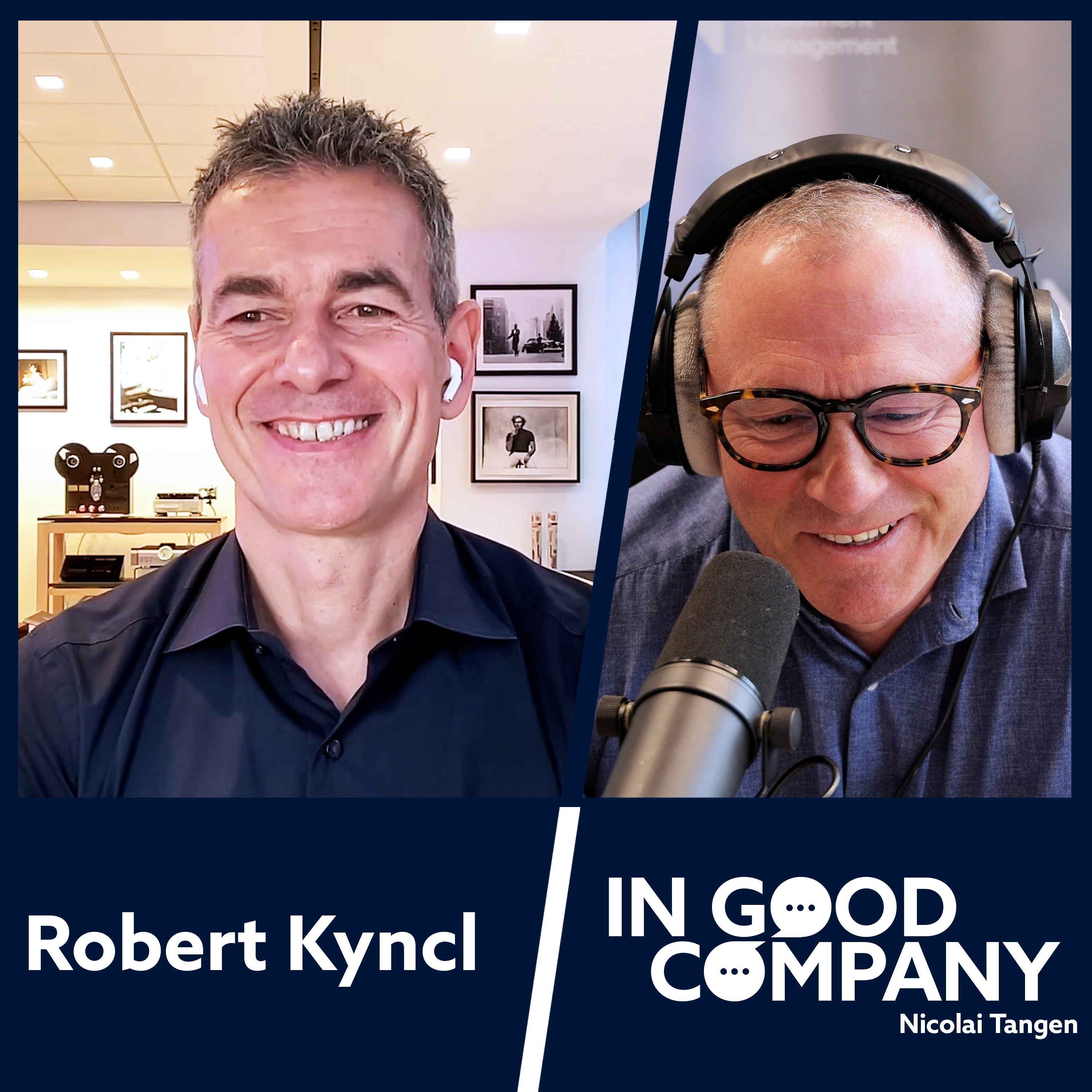
In this episode, Nicolai Tangen interviews Robert Kyncl, the CEO of Warner Music Group. They discuss Kyncl's journey from Czechoslovakia to leading major tech companies and ultimately, a top record label. The conversation covers the evolution of the music industry, the necessity of record labels in the digital age, and Kyncl's leadership philosophy.
Written by AI. May contain mistakes.

Get the gist, explore an idea or ask about something said.
 Claude
On In Good Company with Nicolai Tangen, what are the key points of this episode?
Searching your listeningAutomatic transcript. May contain errors.
0:00Hi everybody and welcome to In Good Company. I'm Nikola Tangen, the CEO of the Norwegian So and Wealth Fund. And today I'm in really good company with Robert Kinsel, the CEO of Warner Music Group, one of the world's largest record labels. Now, they have incredible artists, including my favorite Coldplay, Ed Sheeran, Dua Lipa, and even the Norwegian Legends Aha. Very good. Robert, what a pleasure to have you on. Same here. Thank you so much.
0:34Now, we need to kind of kick off with your beginning. You were born in Czechia. And so how does your background shape you as the leader you are today? So actually, you know, when I was born and grew up, it was Czechoslovakia, the country rebranded three times in my lifetime. It tells you something about change that I'm probably used to. But the way it shaped me was interesting. My parents, my mom was a teacher. My dad was a doctor in a socialist communist society, not earning much. But the values they instilled in my sister and I actually apply in the capitalist world in the United States. For instance, to always value education, because education is something nobody can take away from you.
1:23When you go through something like nationalization in Czechoslovakia, people are used to losing their possessions, but you cannot lose your education. So our parents were really focused on that. Or, you know, my dad would say, whenever I was a competitive athlete, cross-country skier, and whenever I would fail somehow, my equipment failed, etc. My dad would be like, oh, that's great. Nobody's going to remember the fact that your bindings failed, but everybody's going to remember your ranking. And it was one of those wake-up calls to me early on that excuses don't really matter because those are forgotten, even if they're good ones, and that it's only the results that matter.
2:06I have to say, if you were a really good cross-country, you moved to the wrong country. You should have moved to Norway, right? I know, I know. There are a lot of Norwegians who were kicking our butt. Absolutely. But you were also interested in music from early on, right? You played a couple of instruments. Yeah, very much. There's a saying that every Czech is a musician. And there are deep classical music roots in the country. And my sister played a piano. I played cello. And then after playing cello for about three years, I then played Spanish guitar. And my teacher actually is wonderful. He was a blind teacher who was a skier as well.
2:40So I was his teacher. And I was his guide for skiing. and he was teaching me just wonderful art. And it was a great long relationship. And by the way, I just reconnected with him about six months ago, which was incredible. That's good. Now, you've been doing incredible work at HBO, Netflix, and YouTube before you stepped in as a CEO of Warnham Music Group. So just take us through the journey here. I started, like many others, in a windowless mailroom in a talent agency, stapling pictures together with resumes which got mailed to casting agents. Those were my humble beginnings until I got promoted to an assistant.
3:19I was pretty much doing this for the first three years of my career. Then early on, I joined a mutual phone company, which was a movie co-financing company early on in the 90s. That's when I learned how to value content, how it's paid for, and how it's distributed. From there, I went to HBO. It was at its height. Sex and the City, Sopranos, etc. And I worked on the international side, launching territories, HBO, India, HBO, Korea. And then I did about a three-year stint in a VC-funded startup in the year 2000. That was like a risky move, right? From high-flying HBO to a completely unknown company on the internet, which was just slow, you know, right as the bust happened, right?
4:01In March 2000, the dot-com bust. but our company we were working through it and within three years I ended up at Netflix which at that time had roughly 500 ,000 subscribers and I was DVD by mail and then 2005 started to focus on streaming because we knew at some point we wanted to transition the business and disrupt our own disruption and so I started to work on that built up the team and the rest is history And then in 2010, I was recruited to Google and joined YouTube and helped basically grow it into what it is today. And, you know, at that time, it was roughly$450 million in revenue. It was small, it was very messy, sued by lots of different people.
4:51And Eric Schmidt told me, figure out how you stop them from sending us paper. And instead, we send them paper, meaning money. Commercialize, you know, fixed relationships, commercialize it, and build a business. And, you know, and we did that, you know, along with lots of other people. Why did you transition into the music industry? When you have two sort of hockey sticks like this, you know, two big disruptive forces, scaling, it doesn't really get any bigger than that, right? Netflix or YouTube, it doesn't get any bigger. So you have to actually set your sights on something smaller and more focused.
5:27So I chose music because I love music. We spoke about that. I think music has this incredible power of being absolutely ubiquitous. Everybody in the world has some kind of relationship with music. And everybody has a soundtrack to their life. Music is like a timestamp, basically. You know, there's a bunch of timestamps throughout your life. And, you know, I have this favorite saying that art decorates walls, but music decorates time. And I think that's very powerful. And because of that, music goes through ups and downs in the industry, but it's resilient and gets through all the downs. And I think it's incredibly interesting to work in a company, transitioning company from one thing that it has been to something new that it will be.
6:14And I just find that intellectually stimulating and it's fun to work on that. It's amazing when you have reunions and you put on the music, you play it at the time. I mean, my, you are just back there, you know? Yeah, exactly. but it invokes emotions right that's what happens what do you listen to now well obviously i listen to all of our artists before their music is released you know sort of like an internal system for that so i do all of it and it's kind of fun to do that right and then kind of try to imagine how that's going to do and then kind of look how it's doing so so i like playing that game with myself and what is your predictive power it's uh it's not so great.
6:52And why do you think that is? Because I haven't really applied any system to it. I'm just doing purely by feel. And I think what you have to do is you have to have some kind of a method to the madness. You have to figure out some patterns that you follow. And then eventually you start narrowing your scope a little bit and you get better at it. And I noticed that But lots of folks who work here, say in A &R, they have different approaches to finding artists, selecting artists, thinking about hits, etc. But they have a system. And I think that's very, very important to have your system because it just allows you to progress and get better.
7:32And so I don't have it myself yet. I just kind of do it for fun on the side.
7:41now i asked daniel ek the founder of uh you know spotify what he thought i should ask you and so he had a question here i've asked a lot of people you see so um what's what his uh question is what's what's been the biggest cultural adjustment you have to make going from a technology company first like youtube to a creative company like one of music group i think there are two i'll name two The first one is, I think there is this unfair assumption that everybody in the digital world has of, let's say, content companies, that they don't like technology. And when you come into a company like Warner Music, when you realize that all employees want it, they all have it in their personal lives.
8:31They have their banking apps, their private chauffeur apps, whatever it is, they're living their life online, like very, very well. But they may not have it in their professional life, not because they don't want it. It just hasn't been built for them and hasn't been made available, but they want it. And I think there's just been this, my assumption was like, yeah, people don't want it. They actually do. So we've been working really hard to obviously fix that and provide as many of these tools as possible. So that's one. So that was a very pleasant surprise. And I would say the other is culturally, the organizations in most media companies are set up in very distributed manners with lots of different PNLs and lots of different infrastructures.
9:19and in today's world they can function like global companies can function in a much much simpler setup so i think but that doesn't that has to come with cultural change right it cannot happen on its own but i think that's a that's an important cultural difference let's say from technology companies or from you know a whole bunch of companies in other industries which have come up with a simpler organizational design well there seems to be so many ways the music industry is changing just now, right? It's changing in so many different dimensions. What do you think are the main changes we are seeing just now?
9:54Or the most important ones? So one, obviously, there's one big change which I obviously was part of, which is democratization of distribution. The music companies were the ones who got you distributed in a physical format, right? There was lots of inventory issues and shelf space issues and all of that to get sorted out. And today it's in digital distribution it's simpler and anyone can publish so the role that we the music companies played in distribution has decreased obviously there is still a role for because it has to get pushed through supply chains into many different distribution points and there's complexity involved with that but it's decreased versus the past but in the world where anyone can publish, no one can be heard.
10:43The level of noise increases so much that it's really hard to succeed on your own on a repeated basis. You can have like a one-off success, but if you want to do this as a career, you want to succeed, you want to build catalog, you want to build lots of value. It's a very, it's a difficult job. And for that, you need a team and you need global infrastructure, which we have, you know, the large companies in the global infrastructure all around the world that helps you break through the clutter. And that becomes a combination of both technology, because you need to collect lots of different data and know how to use it, and also creative prowess around each of the artists and what to do with their brand and with their art.
11:30So it's become much more sort of integrated business between technology and creative on a global scale so with with infrastructure that we can unleash everywhere so i think our value has shifted decreased on the distribution side and increased on breaking through the quarter what's the most important thing you you add here as a record label and then how does it change during the life cycle of an artist let's just start with the beginning how do you how do you how do you find them and what do you add in the beginning i'll uh i'll give you so so we are one of the companies that actually has a great dna and history and discovering artists very early yeah whether it was uh ed sheeran uh bruno mars dual lipa cardi b um uh zack bryan you know benson boone etc it could go on so artist development is very core to what we do.
12:30I sat down with, you know, when I started, every time I ran into an artist, I would ask, you know, they would tell me, oh, you have some amazing people in your company. It's awesome. I was like, yeah, tell me who. And they would give me the names. Immediately, I just stepped up an email and emailed that person. And so many times they're like mid-level executives. And so I was like, hey, I'd like to meet you. So I would meet with them. So there was this one ANR exec that I met with. and I was asking her the same question. How do you find artists? How do you find somebody that you believe in that you think is going to develop in the superstar?
13:03And she was telling me, I look for their connection with the audience before I even listen to their voice. And I was thinking, oh, it's interesting. How do you do that? You look at the likes online or like how do you discern comments, et cetera? He's like, no, I'm watching the audience. I was like, what do you mean? And like, and the live stream is like, no, I go to the shows. I was like, and you know, this is a very young executive, by the way, like, you know, in twenties. And I was like, well, but I thought that's what the older A &R guys were doing. I was like, well, I do that too. I was like, and how does that work?
13:37She's like, well, I watched the audience. And if the audience is an emotional connection to the artist, that is priceless. And it's, and it's, it's amazing. And if it's there, and by the way, the connection is either they're, they're have misty eyes or crying or they're shrieking or they're laughing. and if it's there then we work with them on the art and develop their voice and just like develop the artist skill set and the connection is there and now now we have something that we can really build a long-lasting long-lasting career on i was like interesting and she's like and you know what's important that if it's a female that that audience is teen girls because they're the earliest adopters you know and shakira and beyonce etc right and and if it's boys it's even more important so it's basically you know i just described to you a system that nr executive has to find artists early and build them into stars and philosophy and philosophically what is it that creates that connection it could be their attitude it could be uh their lyrics you know the topics that they care about uh i think it's deeply personal but it's like it's gonna be there and it's what makes them unique and uh but the thing that's interesting is like what i just described to you it's not that you can like force this on another nr executive right people have different systems i'm giving you one but it's like this is a young person who's very very successful and um and then it has discovered an artist and has a system can that connectivity be learned do you think?
15:10Can an artist learn to connect? I think people try over time. I think it probably can be, but it's easier to learn. If you have it, it's easier to obviously develop your art than learn the connectivity. But I think it comes with probably increased focus to learn that connectivity. But this is all the beginning, the nucleus of it. But then what we have to do is figure out, okay, how do we grow the artist's audience and not go into big concert venues immediately that will be half empty, but instead grow them gradually and build up a group of fans that will be with them forever. And you just need to build a core from which everything grows.
15:57So let's say now I have my guitar, I'm playing in Camden Town, in some kind of bar, Robot Künstl comes in, it's just like, hey, look at that guy, Nikolaj. He's got great rapport with the audience. So you come to me, but just what do you do with me the next couple of years? How do you build it? It all depends, obviously, what you need specifically, which also varies. Because sometimes artists are also songwriters, so they write their own music. Bruno Mars was an example of that. He was an excellent songwriter, and that's how he started. And then he started to singers music so initially maybe you may be a songwriter and you're writing for other people and then you try your own luck right with that and it's like you're deciding which ones you do which ones you don't or it's a collaboration with somebody so so many times it's also about not just about like perfecting your voice but it's also about collaborating with the right people whether it's songwriters that you work with or collaborations from uh from a singing perspective so it all depends on who the artist is and what they need there's tour support like helping them set up small tours that help them start building the nucleus of the super fans that will be with them all of that's work and there's a really great example with Teddy Swims, one of our current stars who five years ago wasn't and he has just done an incredible job with us to build up his core audience.
17:32He would travel to Europe, do small shows, and build it. And we do research. We look based on a lot of the data that we have. It's like where they should tour, what they should do, where the focus should be. So it becomes a deep collaboration. How is it different when it's a long-time established group, let's say Coldplay or one of these? Why do they need help? Why do they need help? Yeah, that's, I asked them the other day, the same thing. I do need help. And look, the, if you're an aspiring artist, you want to become big and relevant, right? If you're a huge superstar or band like Coldplay, then you want to remain relevant, right?
18:19Of course, you know, so it's like you're at the top of the heap and you want to make sure that you stay there. And again, it's in the world that's increasingly noisy, right? and across all forms of media, but in music, it's very noisy, but across everything, it's very hard. So you want to make sure that you're creating hits and that people around the world hear your new art. So we just did a new album with Coldplay in October, and it was a great success. But all of us were nervous, and everybody worked extremely hard to make it succeed. Nobody sleeps on their lures just because it's Coldplay. It's actually that much more nervous because we want to really make sure that it delivers on its promise.
18:58And so I think if you look at it today, no matter how much distribution has democratized, all the big stars are signed with large music companies. And because it takes a village. It takes a village. Again, if you're looking for sustained and repeatable success, if you're just looking for one thing, it doesn't matter. The concert business seems to have changed and just become a bit grander in a way, right? So Adele built a$100 million pop-up stadium. Many artists do like 10 nights at Wembley. I mean, Taylor Swift, I guess, is a story in herself. Yeah, Coldplay. Massive tour. Absolutely. How should we read that?
19:42What is it a sign of? Well, I think initially there was a pentat demand from COVID, right, obviously, but then it sustained. And I think in a world that's increasingly digital, people crave physical experiences that's it it's as simple as that and if music uh decorates your time right it's soundtrack to your life when you have a couple favorite bands or or artists and they're they're playing in a venue near you you go right because it's like you like the collective enjoyment i think i think when you can enjoy obviously a lot of people enjoy music by themselves right you're working out biking running whatever uh or even just at home working but when people enjoy it the most is when they're sharing it together with others and usually they start moving they start dancing right and it's just it's like expression of joy so so i think you know live music is here with us to stay and and we'll be we'll continue to be very successful are you a good dancer nope you should ask my wife my wife my wife is dominican which means she's an excellent dancer and she will criticize me all the way till Sunday about my dance moves.
21:01How has the streaming concept changed what you do? Streaming is more efficient distribution. I spoke about in the past when it was, you know, whether it was LPs or CDs or tapes, you know, there was a lot of inventory. so you know that a lot of people who are in the inventory business it's not that much fun like there's returns and breakage and all of that so music is very fluid it's perfectly aligned with the internet it's very efficient distribution and what it does is it reaches more people than before and it allows people in a non-demand fashion people could hear music before through radio you're sitting in the taxi or the restaurant and you hear it but in a way, in a personalized way that you can select what you want and personalize it and have your playlist, that is now accessible to a lot more people.
21:53So it has grown the business. And I think, obviously, credit goes to Daniel for driving Spotify through the decades and building the business, as well as others, what we did with YouTube and Apple and Amazon, etc. So there's a lot of subscribers around the world. But still, even today, we are lagging SVOD, subscription video on demand, which we shouldn't. So you can imagine that there is still a lot more addressable audience for us to take. And that gap is even bigger outside the United States and lots of developing markets. So a lot more room to grow. Music is cheap, no? It's probably the best deal that consumers get in anything.
22:45It's definitely cheaper than X. Like if you think about it, it's cheaper than anything because it's been lagging inflation for a very long time. Why is it so cheap? Because, and I don't mean it as a criticism. It's, you know, the industry post Napster and Kazan and all the file sharing services was obviously on its knees. And then the streaming services came and drove growth. and pricing just remained the same from the time any of those services got established. Nobody has moved price up despite whatever inflation there may have been. But it was the right choice because that was the time to hunt, hunt for new subscribers and just focus on volume and focus on growth.
23:30And I think now we're entering the era where it's important to do bold hunting in places where the penetration is very, very low and continue to do what we've done in the past. But then in territories which are where the penetration is high, maybe not as high as that's filed yet, but like high, then we also start harvesting on price and increasing that. So I think, you know, whatever worked in the past 15 years doesn't have to be applied exactly the same way for the next 15 years. And we just, you know, we just need to be a little bit more laser focused and audience segmented in our approaches.
24:04So when you say harvest, you mean increase prices slowly and carefully until just below the point where they live? Correct. Which, of course, nobody wants. We don't want that. The DSPs don't want it. But I think it's important to not have a one-size-fits-all strategy, which is what we all had for 15 years, which was the right thing to drive growth. But now we've got to have two sizes. So let's say now the value of music to the consumer is 100. Where does the money end up? So what goes to the artists? What goes to you guys? What goes to streaming? It all depends on who the artist is. There's so many.
24:38That's one of the things I learned. There's so many, you know, the company has grown. It's been around for many, many decades. And, you know, there's catalogs and there's new releases, there are distribution deals. So the spectrum is really, really wide. I mean, just think about it, right? We have deep, deep catalogs from Fleetwood Mac to Joni Mitchell, Eagles. you got David Bowie too historic catalogs which is just incredible what happened by the way my younger daughter like one of her favorite bands is Fleetwood Mac she's 22 now it's been her favorite band since 19 and it's just incredible the power IP the power that IP has yeah absolutely interestingly one of the guys said aha Magne Fue Holman he suggested I asked you about this So kind of the pedigree artist, right?
25:30Yes. Where old songs are becoming new hits for new generations who, they don't care when it was made or whatever, right? Yes. On that topic, just what have contributed to this renewed interest? So I have to say, actually, since you're speaking of AHA, you know, I grew up in a communist country, closed borders, no freedom of choice of media or speech. there was very little imported music. AHA was one of the LPs that I got. I think I had like seven LPs when I was growing up. AHA was one of them. So you know the Sunil West Giants on TV? Yeah. And it's like, by the way, when I said that art decorates walls and music decorates time, for me, AHA decorated my time.
26:21And I know exactly where I was in the 80s in Czechoslovakia. and how it made me feel then. The renewal of interest comes in different ways. One, which is, you know, we do these catalog licensing deals with all kinds of platforms. And then if it's an open platform, sometimes users, just users for fun, take the music and they do something with it and attach it to a video. And sometimes that takes off. By the way, that's how Fleetwood Mac took off on TikTok. Uh, so it happens that way in a very, very organic way. Right. And this didn't used to be there. The other sort of more managed way that this happens is, uh, when current artists want to remake a song that was iconic.
27:12David Guetta is like a master at this, right? David Guetta is one of our artists. He's a famous DJ and producer. And he, he just, uh, loves to find, you know, just iconic songs and remake them. And, and he just, he just remade forever. young right with ava max and uh and alphaville and uh you know and it's like suddenly the song is just charting everywhere uh but by the way the i have to i have to say that one of the most incredible stories of the last six to nine months has been lincoln park it's a band that released their first album with us in in the year 2000 a few years ago their lead singer passed away they went through replacing uh replacing him the the resurgence that they had last fall was like unlike anything we've ever seen the success of their new album was insane the pre-sales were the highest in warner's history and and their catalog just shot through the roof and this is a band that's been with us for 25 years and it's just you know nobody deserves the success more than these guys.
28:21But it's just, it's incredible when that audience is there, it stays. It doesn't go away. And it just underscores the value of IP, despite whatever happens on the macro level. What are the challenges when it comes to copyright and the reuse and mashups of older music? The challenges, they've always been there with the advent of social media, And YouTube was the first one. So I actually had the privilege of working on that early on. This is like what I referred to when Eric Schmidt said, I figure out how you stop them from sending us paper and we send them paper. And it's basically how do you track fragments of copyrights in other copyrighted material or in other videos or audio, et cetera.
29:11And how do you apportion the money? you know, and what tools you give. And so early on at YouTube, we built something called content ID that allowed us to do that basically fingerprint the content. And then as people uploaded it to YouTube, we would then be able to sort of parse it out and then have commercial relationships to give the copyright holders the ability to either block it or track it or monetize it. And then there had to be commercial split, obviously negotiated for that. And I think that's, the same thing that will develop in the age of AI because it's basically just UGC on steroids.
29:46So it's just everything is faster, bigger, but I think we've laid down a really good framework more than 15 years ago for how to do this and we can learn from that. What's the catalog you wish you had? More. More and more. There's so much. There are companies. I have all the catalogs you haven't got. Which one do you want to buy? It depends what the price is. What multiple are you charging? Average. Average. Like, you know, there's obviously iconic music like Michael Jackson, right? And Queen. Again, I just named two where I also had the LPs behind the Iron Curtain in Czechoslovakia, right? So, you know, it just kind of enforced that.
30:34But, you know, those two stuck with me along with AHA back then. It's, you know, I love, yeah, those two I would obviously get. Unfortunately, competition has them, but such is life. But we have some really amazing ones ourselves, which I'm tremendously proud of. Another one I'm really proud of is Tracy Chapman. is just, you know, that one for me timestamps my college years here in the United States, right? So it's like different bands and different times and it was so great to see her perform at the Grammys a year ago and yeah, it's fun Pink Floyd? Yeah, Pink Floyd as well, yeah. That one for me would go to the 80s in my life, yeah.
31:18It's kind of funny because we, you know, we have a jingle on the podcast and we were thinking about having this money right? But it was so expensive to have it that we made our own instead.
31:35We kind of touched on AI. Just how is it going to change your business? I don't think we know yet exactly, but we're very focused on it. I think there's two different ways that it can happen. One, just like for any other business where you use it for efficiency. so it's like that's got nothing to do with music it's just like standard practices and sort of standardizing our workflows so that you can then automate a lot of those through application of AI the other which is music specific is for what we discussed which is how do you track an attribute but the other is also creation right and there's obviously creative tools that exist today there'll be more in the future whether open source or closed source and and i think they'll ultimately have two separate two types of outputs one which is what i would call more like background music that it's not like associated with any artist it's more like mood music and and i think ai will probably take a big chunk out of that because you know it will be easier to do it at larger scale probably more you know better precision etc so i would say that may be an area of music that may be under attack uh pretty that's that's pretty clear the other is artist-centric music and that's when it's so when you say mood when you say mood-centric music what is that like uh sundown uh it's yeah like i'm i'm not thinking like when i listen to it i have no idea who the artist is it's more like i'm working and it's just something playing in the background elevator music uh you know it's just it doesn't have any clear artist association yeah or voice sometimes it doesn't even have a voice but sometimes you know many times it does but it's it's not it's not branded with any artist and that's why i'm using the words artist centric for the other bucket which is like you know it's this this is either Ed Sheeran or it's substantially similar to Ed Sheeran, right?
33:43Or Bruno Mars, Dua Lipa, etc. And I think this type of content will, we have to handle extremely carefully because it's obviously people's identity and their livelihood and so, but very importantly, their identity. And here, it needs to be very permission based, whether they want to be duplicated or not, and whether it's their existing songs or completely new songs. But this is the area where we're really focused a lot. And our work on this is with three constituents. One, which is the platforms themselves, because that's where the content ends up. So how we treat that. The second is with the model companies.
34:24And the third one is with the governments. And in this order, in that ascending order of priority. Because obviously with government, it's important to work on things like AI, no fakes act, et cetera. but sometimes it takes a long time for it to actually come to fruition, right? It doesn't mean we don't do it, but we don't rely on it. So it's a multi-front work.
34:52Robert, let's change tack a bit. What's the corporate culture like at Warner Music Group? I kind of call it a 15, depending on where our market cap is, 15, 16, 17, 18 billion dollar startup. because you want to retain that as much as possible to have the entrepreneurial feeling. At the same time, we're a public company, which means lots of reporting and stability and visibility, etc. I'm constantly juggling these two feelings that I want to move fast and disrupt things fast as a startup. At the same time, I've got to operate within certain structures. I would say it's very entrepreneurial. And you kind of have to, I think the best way to tackle it is that you need to decide as a leader, which roles can be entrepreneurial and which ones need to be much more structured.
35:50Because that's really the way to manage, because you can't apply all the same to everybody. And I think that's a mistake. So that's what I'm feeling through and feeling my way through. and obviously the closer they are to frontline to the artists you want them to be entrepreneurial and the closer so the more right brain right the more entrepreneurial you want them to be and the more left brain the closer to the center of the company the more structured and then you can have like a global platform that unleashes the creative people what are the challenges of having the left and the right brain in the same company that's the fun of putting that together because i don't think that you can have a successful company in our space that doesn't have both.
36:38It doesn't work because if it's only right, it's going to be too small. It's not going to scale enough. And if it's going to be only left, it's going to lose all the creativity and deal flow, etc. So you need to find how to bridge it together. And then you also realize that when people spend more time together, that they're not that different. I always used to say, you know, when I was working at YouTube is that engineers are like songwriters. They both write software. It's just one is storytelling software and the other one is like utility software. One is code and the other one is notes. But they're writing something that's digitally disseminated throughout the world.
37:21And they kind of behave the same way. You know, star engineers are, you know, they can be peculiar, just like star songwriters or artists. Have you adopted any kind of unconventional cultural practices? Do you have like concerts every Friday? No, we don't. You know, I do all hands meetings, obviously, with the company, but that's not that unconventional. Well, you know, what I do is with all of my reports, we do you know friday uh sort of you know quick one page of like what have you you know what did you get done this week uh what are some of the important things for next week and what do you need from me and so all of my reports do this on friday uh i read it over the weekend and i know what i'm going into next week right and maybe i realize okay i need to set up two meetings on this topic because, you know, it came up through the documents.
38:16And it's a very efficient way to understand what are the important things happening every week in the company. But also it gives people, like it forces people to articulate their work. I read about another person in the US who is asking people to list five things they did during the week. Yeah, I think he copied me. I think he must have done. What do you look for when you hire somebody? One is an open mind. I think it's extremely important because we live in a world full of uncertainty and actually increasing uncertainty where visibility is limited. And you need people who know how to pivot on a dime if necessary and have a very, very open mind to rethink things.
39:00I've always like disrupting, right? Like if you look at it from my choices of employment, I was always disrupting something. and uh so it's very hard for me to sit still and just kind of be part of something that doesn't change like i uh i do that so i like to hire people who have that in them because that obviously makes my job easier too right and you know through having sort of lots of change makers so change makers with a very open mind because when you have an open mind especially when you work in a company like ours or any other large multinational company you have to you know ultimately you get to a matrix setup.
39:39You can't have people who are too rigid about things, right? They got to be flexible to work with each other, give up control, still demand, you know, performance. But, you know, it's okay to not have control and you can still succeed. And these are important traits. Do you disrupt your own colleagues? In what way do you mean? Well, I mean, you disrupt everything left, right and center. Do you disrupt things internally in the group? They would probably say so.
40:12I think I actually work with our head of HR quite a lot because a lot of these things tie to what your HR processes are and how certain things are set up.
40:28Also with our head of comms because one of the things that I learned is that you can do all the different things, but if people don't know it, if the message doesn't translate, if it doesn't resonate, you don't have people on board, ultimately it doesn't work, right? And you don't accomplish anything. So, you know, having the collaboration around communications becomes much, much more strategic. How do you communicate internally? How do you get people to climb the mountains? So, A, all-hands meetings, right? and again, it's not just me, right? Obviously, I include other colleagues from the leadership team.
41:06How often do you do them? We do it every six months and we'll see. I didn't want to in my previous job, we did it every quarter. I didn't want to overload it right away. We have a lot of things to do, lots of change but now we're doing it every six months. But it brings the company together, which is important. The thing that I do every week on Friday is I publish basically what I read this week on a Slack channel. So it's not spamming the whole company. It's only people who want to follow that. And which is quite a lot, but it's, I find it helpful because I read a lot of news, whether it's political news or entertainment news or business news, and just every day, at least an hour of that.
41:54So, so I basically collect not everything that I've read, but basically a bunch of notable stories. And then I share them. What kind of things do you read? Um, I mean, a, there's a, there's an, uh, uh, headlines, uh, headlines, uh, newsletter that I get from one person that gives me like probably a hundred headlines every single day on different important topics. So that's like my most succinct way to absorb everything that's happening in the world right now. What is it called? it's uh his name is ape is it a burns i forget right i'll i'll get it back to you i'll get back to you on that and uh but it's extremely useful and um and then uh you know i read wall street journal uh you know all of the publication bloomberg fd uh new york times that's right so i read all of those uh then i go through uh apple news because then you rope in a whole bunch rather than it goes beyond business, right?
42:54So it's more into like general life, et cetera. And then I have lots of different newsletters that I subscribe to, like Strategery, et cetera, Ben Thompson, you know, and just read all of that on topics that have nothing to do with Warner, right? But just to be generally smarter. If you were to distill it down, what is driving you each day? when you work with uh amazing creative force you know artists and songwriters and for me the favorite part of my job is meeting them uh when you when you work with them what drives you is that you want to figure out the best way that we can help them unleash their art on the world and that's kind of fun maybe because when you see that happening and when you see the blue flame and getting bigger and you know until it's like really flaming uh it's it's incredible and in order to do that you you have to not sit still and disrupt the company itself right because the industry is changing and that's also cool so it's like for me it's the it's the constant evolution and the ability to shape things for the future again you know it's disruption it's uh yeah i guess i in one word it's disruption right because i think through disruption you find opportunity it makes you stronger smarter and you can't be afraid of it and uh yeah i just don't like to sit still and so this job allows me to do that and when you have to sit still how do you relax i don't know by reading news uh but uh no i like watching tv a lot actually uh that's like favorite way to completely disconnect.
44:37I'm a voracious watcher of movies and TV shows. Such as? White Lotus, Lioness. I love a lot of stuff that's on Paramount Plus, all the Taylor Sheridan shows. Yellowstone, I love that. Gilded Age on HBO was fun. But obviously, White Lotus is great. And Black Mirror on Netflix, amazing. Drops of God on Apple TV+. Incredible show. There's just so much. The new look on Apple, incredible. So there's just so much great stuff to watch. And yeah, so that's a way for me to completely disconnect. We have tens of thousands of young listeners to this podcast. What's your advice to them? What is it that you have told your two daughters?
45:36Sort of the same thing that my dad told me, which was, you know, nobody will remember the reasons why you failed. They'll just remember your ranking or whatever the result is. You know, just focus on driving results and always stay two steps ahead of your boss. I learned it from one of my first jobs 30 years ago when I was an assistant, where my boss told me, be two steps ahead of me and you'll be a winner. And, you know, of course, there's two steps means like, you know, there's a tree, right, of decisions. But it literally stays with me to this day. That's how I think about things because it allows you to iterate very quickly with people when things are thought out a little bit more.
46:25And it doesn't have to be precise. How do you stay two steps ahead of your boss? Anticipation. You anticipate what is the next question after you've answered the first one, right? And you've answered it this way or that way. And then you've got maybe four scenarios, but you just kind of think it through. So you prepare it. And because of that, you can have much more dynamic conversation versus, oh, I have to get back to you on this and that. like you progress and you make faster progress. So I think that's really, really important. It stayed with me. Honestly, I learned that in my late twenties and it stayed with me to this day.
47:01And, you know, I say this to my daughter, I mean, this might not sound that nice, but when you say I'm doing my best, if the result isn't good, it means there's no more upside from you. right so you know you should think about that before you say that that you're doing your best and um um you know so it's uh there are a few things like this and and i think the you know the immigrant mentality in me is i always felt because i have an accent it wasn't an accent i always felt like it probably holds me back somehow so i have to do more you I don't have connections. I was like, I have to do more than the Americans in order to get the same.
47:47And when you do that, somehow it stays with you. And then you always just end up doing more, always. And so I think it's good to outrun the other people. Well, Robert, all I can say is that it doesn't sound like your immigrant accent has held you back too much. It's been incredible talking to you. What a fun company. What an incredible world. And a big thanks for coloring our times with this incredible music and for making life so much fun. Thank you. We're really proud of the company. We love what we do. And we're disrupting ourselves and working on providing much greater value to artists and song editors and users all around the world and being good partners to our distribution partners.
48:37Thank you.
With all the technology available, why do artists still need record labels? Join Nicolai Tangen in conversation with Robert Kyncl, CEO of Warner Music Group, as they explore the transformation of music business. They discuss Kyncl's journey from Czechoslovakia to leading Netflix, YouTube, and now Warner Music, the streaming revolution, and how record labels discover and develop artists today. Kyncl shares insights on balancing creative and business priorities, the impact of AI on music, the value of iconic catalogs, and the future of live performances. He also reveals personal leadership lessons and his approach to driving innovation in an industry constantly disrupted by technology. Tune in!
In Good Company is hosted by Nicolai Tangen, CEO of Norges Bank Investment Management. New full episodes every Wednesday, and don't miss our Highlight episodes every Friday.
The production team for this episode includes Isabelle Karlsson and PLAN-B's Niklas Figenschau Johansen, Sebastian Langvik-Hansen and Pål Huuse. Background research was conducted by Isabelle Karlsson.
Hosted on Acast. See acast.com/privacy for more information.