

 Invest Like the Best with Patrick O'Shaughnessy
4 Nov 2026 · 1h 5m

 Add vo to ChatGPT or Claude to ask about everything you hear
vo listened to this episode to put together the overview and transcript, so there may be the odd mistake.
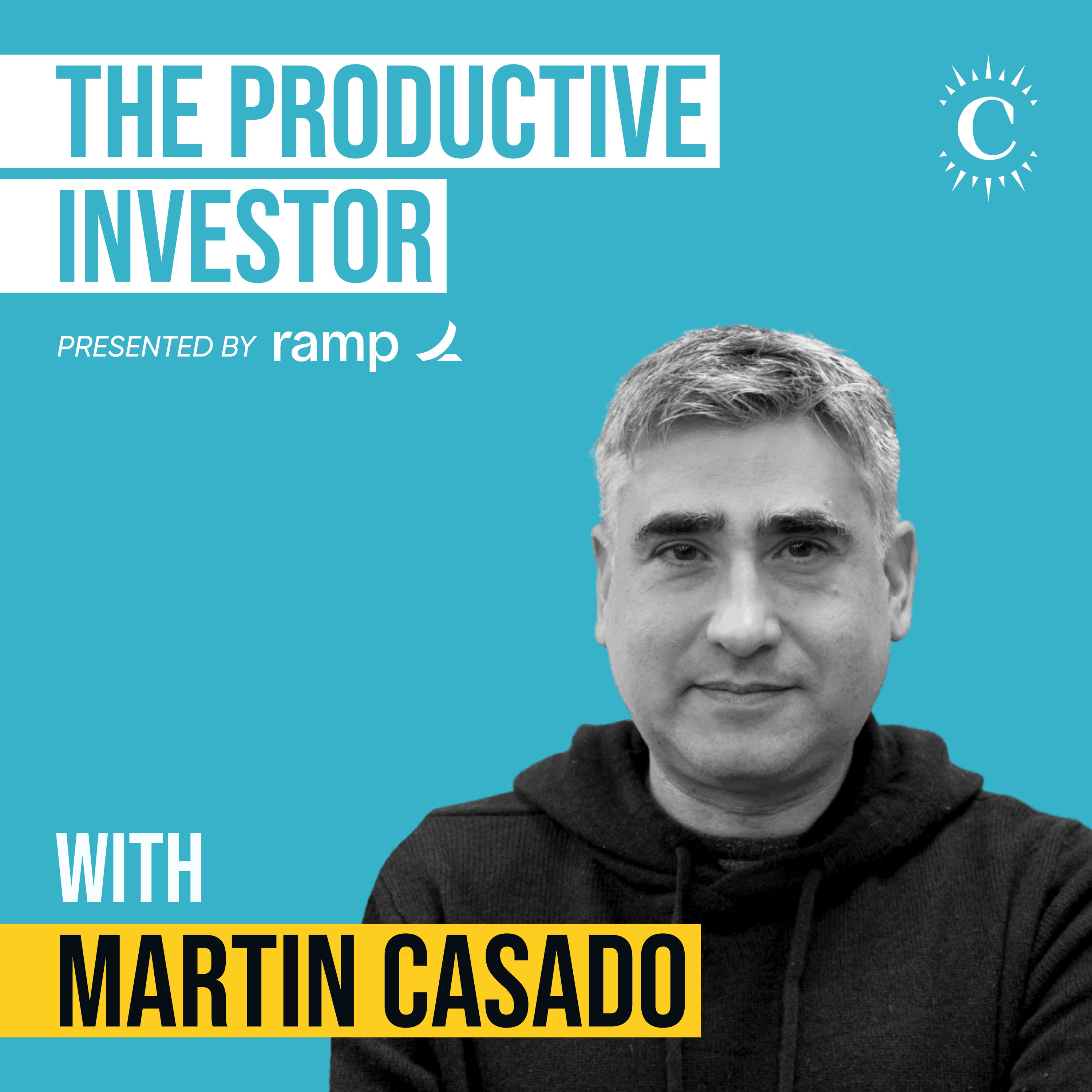
Martin Casado discusses how different investing mindsets map to deal diligence, why “network effects” lack consensus, and how AI is reshaping infrastructure, security, and capital markets—especially frontier model economics and model lifespans.
Martin Casado is a computer-science-focused infrastructure investor (PhD-heavy team) with decades in tech investing and hundreds of deals. He emphasizes technical diligence over “financial mindset” proxies and infrastructure/compute/network/storage/database investing.
Investors should separate moat “mechanism” from moat “shape” (super-linear vs linear vs sublinear with scale). Defensibility is often overemphasized in growing markets; frontier models can accrue most market dollars when demand is effectively infinite. Model lifespans are short (about 3–6 months), so frontier players must ship quickly. AI changes infrastructure by increasing software volume and enabling agent-native systems (including new database and networking entrants). Security will see “breachpocalypse” dynamics similar to early internet, but AI will also help harden systems.
LinkedIn, GitHub, telcos (durable network effects); Uber as possibly marketplace/scale effect; Metcalfe/Swan; Snowflake as resilient infrastructure; GrokBot personal use; Faith in World Labs “Atlas” 3D/dynamics model; “Sleep No More” VR-like future.
0:00Ramp is the only platform built to make your finance team leaner, faster, and better, saving businesses 5 % annually on average so you can stay focused on growth. Ramp just opened for business in the United Kingdom, so if you're running a business in the UK, you can now use Ramp's AI-powered finance platform to manage cards, expenses, bills, approvals, and accounting all in one place. I run my business on Ramp and so should you. Learn more at ramp.com slash invest. Rogo is the AI platform purpose-built for financial institutions, serving tens of thousands of bankers and investors at hundreds of leading firms worldwide.
0:37Rogo's AI agents autonomously execute large chunk of your firm's workflows. They can screen deals, draft sims, run buyer outreach, and do diligence on data rooms, all with full security and compliance handled. Every action feeds Rogo Intelligence, the firm's context layer, turning years of deal experience into a secure, governed institutional memory that makes each new transaction stronger than the last. To learn more, visit rogo.com slash invest. Open AI, Cursor, Anthropic, Perplexity, and Vercel all have something in common. They all use WorkOS. And here's why. To achieve enterprise adoption at scale, you have to deliver on core capabilities like SSO, SCIM, RBAC, and audit logs.
1:20That's where WorkOS comes in. Instead of spending months building these mission-critical capabilities yourself, you can just use WorkOS APIs to gain all of them on day zero. That's why so many of the top AI teams you hear about already run on WorkOS. WorkOS is the fastest way to become enterprise-ready and stay focused on what matters most, your product. Visit WorkOS.com to get started.
1:48You recently wrote about four buckets of styles of investing that might be applied, call it venture, private market tech, let's call it. Can you enumerate those and just like say a sentence on the fact of an H? I'm just at this point in my career, I've been there for a decade, I've been hundreds of deals that I sit in these discussions and I just realized people aren't communicating very well. So I did this exercise where I'm like, what are the mindsets people bring to investing? And I think there's basically four types of mindsets. So the one that we were talking about before is like this traditional finance mindset, which is the correct proxy for the health of a business is the market it's going into and its finances.
2:22What are the SAS metrics? What is the size of the market? And that is a proxy for the entire business. So that's one. Clearly growth investors do this. But like more and more, you see early stage series A people do this, which to me is a little bit discordant. Then there's what I call productive investors, which you believe you're investing in a productive asset. And the productive asset is what's creating value. And if you believe in that, as it creates value, it will create market. And as it creates value, you're going to have to find ways for the business to catch up to that value. And so the type of diligence you do if you're a productive investor is more like, what is the technical approach?
2:55What are the adjacent markets? How fast is this likely to evolve? How close is it to a capturing value? Like that sort of stuff. Is this the right team to build it? Then there's what I call frontier investing. I think this is the romantic idealized version of VC from like the 60s and 70s, which is kind of YOLO, man. It's like founders know better than VCs and they've seen something that I don't see and they're going to go out there and do it. And like, who am I to second guess them? And they almost look like talent networks, right? Like I would say Chris Dixon. I mean, remember when he was investing in Nootropics, he invested in Soylent, he invested in Oculus, he invested in Coinbase and in crypto.
3:29I mean, it's like every science fiction trope from the 70s and 80s you kind of invest in and you just don't overthink any of these things. So it's almost like the strong form of the productive. And then the last one, and it is always so surprising how prevalent it is, is speculative investors. They don't even care about the asset. They just want to time a market. You'll see this like in crypto and in secondary markets. They don't know about the underlying asset. They probably don't even know about the actual business metrics, but they're like, well, this looks cheap. It's clearly going to go up in value.
4:01Oh, this is the top of the market. You know, like I'm going to get out. They're trying to like time markets. They're actually just doing speculative. They're not really interested in like, will the business grow? And again, the problem is, is if you have all of these archetypes, you can justify any deal or not justify any deal. So if you don't know what your beliefs are, you'll always justify whatever personal bias you have. If you think about yourself as a productive investor focused on, I love this idea that disruptive technologies, you should not look at some of these traditional things that so many investors talk about.
4:31Talk about what you do look at. You look at so many companies. What is your method by which to assess whether or not someone might be creating a truly disruptive piece of technology, a valuable asset? So I only do computer science investing and I only do infrastructure investing. And I think infrastructure as an industry has a certain shape, certain buying behaviors, the technology looks a certain way and the industry acts a certain way. And so what you're trying to do is you're trying to take a technical approach and you're trying to map it into that techno strategic framework. And the way you do that, there's a number of approaches.
5:05One of them, you're like, what are the leading companies doing internally? And this will give you a glimpse on maybe this is how platforms evolve. Or perhaps the team that is doing this didn't in another context. And now they're actually bringing it to this context. I think it's one of these things where like, how much can you diligence without actually just using the numbers for a proxy? You can talk to customers, will they use this? You can see if there's like adjacent budgets that are growing that can arguably fragment to become this. Or maybe you have early signs of willingness to pay, but they actually haven't figured out the business model.
5:39Like I always think every tech wave, you know, I've been in the industry for 30 years, every tech wave, people like hand ring about margins. Everyone like, I remember for the cloud and I remember from Oval, I remember for the internet. Clearly now people worry about margins. So maybe you're like, there's a willingness to pay and there's a lot of interest, but we haven't figured out the cogs yet in the actual viable business model. So like you're using partial indicators, not full indicators in order to do this. And so my team is a lot of technical people, product people, many have PhDs. We don't second guess the tech, like the founder will know the tech better than us, but we can ask the question, how does this tech fit into the broader platforms, fit into spending?
6:17How does this tech fit in with our understanding of stickiness and defensibility? And then we look at early market numbers and we'll say, hey, listen, a financial investor would puke at this, but it actually shows that the customers are really interested to figure something out and will they be able to figure something out? So there's a lot of diligence you can do. Where with frontier investing, I don't think you do any of that. It's people, is this the best team to do this crazy thing? And then you just YOLO? You were saying before we hit start that nobody understands network effects. Can you explain what you meant?
6:46I've realized that even the most common terms I use, there's no consensus on. And so, for example, network effects is the favorite one that I pick up. I asked you before. I messed it up. No, you didn't mess it up. You said what like a third of people say. So I said, so what is a network effect? And what did you say? I said a product that gets better as it adds a marginal user. Right. So to me, this is almost a tautological definition because most products will get better as you add a user, right? They will find a bug. They will provide feedback. They will tell other people. That doesn't say anything about defensibility.
7:18But other people, when they use the term network effects, they actually mean the original meaning of the term network effect from the 70s, which is a telephone network, where when users join, they interact with each other. That grows super linearly. And that's where you get like natural monopolies. And other people use the term network effect more to be like an actual flywheel. So like a self-reinforcing flywheel. So not just like things get better, but like it self-reinforces in some sort of a way. That's where you hear the term like data network effects. But even in that sense, like you don't know if that self-reinforcement is super linear or not.
7:51So you don't know if it makes it defensible or not. So you have this very common word that's on 70 % of pitch decks where a founder is sitting in front doing a pitch and nobody has consensus on what it means. And so how would you define it? So I think the root of the confusion is not a definitional problem. I think the root of the confusion is conceptually we conflate the mechanism with the shape of the moat. There's many things that could create a moat, right? Like a brand, scale, a two-sided marketplace, a network effect. But that moat, to reason about that, is only really useful if it has some properties that makes the company defensible against somebody else.
8:32If that moat grows super linearly with scale, like a classic Metcalfe-Swan network effect would, that's really defensible. If it grows sublinearly with scale, it may not be useful at all. And so I think, do you and I have a conversation of defensibility? I think the first thing we need to do is not conflate the shape of the moat with the mechanism that caused it. So first, I think we should say the moat that we have is super linear, it's linear, or it's sublinear with scale. And then the second thing, a lot of things actually contribute to a moat. For example, like we mentioned, network effects will, or scale effect.
9:06What's a scale effect? A scale effect to me is as the company scale, it can reduce unit economics normally because it has pricing power, for example, or maybe CAC goes down because of brand. What's a two-sided marketplace place, that's very different to me than a network effect. That's where basically you've got self-reinforcing supply and demand. So I think that there are many mechanisms, and then there's the shape. And then to have a discussion, I think you want to make sure that the shape is something that actually provides long-term defensibility. And the last thing I'll say is it's almost impossible to have these conversations in isolation because we're actually talking about competitive equilibria.
9:39Because if you have a network effect, then maybe the competitor has a network effect too. And maybe if they have more capital, then you can grow faster. That probably impacts the shape of your mode. You may not grow as fast marginally because they're stealing your customers or something like that. And so I just think that we need a very, very basic concepts. We need to not conflate the notion of the actual shape with the actual mechanism. And then I think we should enumerate the mechanisms because something like the definition that you had just doesn't really help anybody. Can you give examples of super linear, linear, sublinear just to bring it to life?
10:12Yeah, for sure. A common view of where network effects came from was from the 70s. I forgot the name of the economist that did it, but he worked at Bell Labs. And he noticed for trained networks and communications networks, the interactions of users grows with the square of the number of people that join. As a user joins, they can communicate to many other people. So the actual number of connections grows more than the number of users. Therefore, the value grows more than just linearly with an adding. The same thing with destinations on a highway or destinations on a train. So that would mean that if you have two competing companies, one takes$5 million of funding and the other takes$5 million of funding.
10:53But this one is marginally better, marginally larger. This one's a little bit larger. for the same amount of investment, it will grow faster than a challenger. The growth actually increases over time, and that's why you get a monopoly. Whereas sublinear means if I'm a leader and I invest the same amount as a challenger, I grow marginally slower than the challenger. That would be sublinear. Clearly, this is very important when it comes to modes because if you have two competing companies and there's a sublinear mode, the challenger will always catch up to the leader because the leader has to spend ever more money to grow all things being equal.
11:28Favorite recent company examples of these different types? How many actual network effects in the Metcalfe's law of super linear do you think there have actually been? Very few. I don't know. I feel like this almost never happens. Like, I think we can all agree the telcos. That's why we had to break them up. We can probably all agree LinkedIn. They haven't had to change very much and they seem to have a permanent status. Social networking. But all of these examples, it's like the interconnections of people. I would say GitHub was another one that had... It was effectively interconnections. It's interconnections of users, right?
11:59So I think there are not very many examples, but when you have them, these are these very durable, high-value companies. So that, to me, would be like a classic network effect. Other companies probably are more scale effects. For example, people will say Uber. I'm not sure that that would follow the definition of a network effect, maybe a two-sided marketplace, because you have the drivers and you have the passengers, maybe you could use that. But even then, you don't have a lock on either of them. Like all drivers drive for everybody and all passengers could use anybody. That was more like a funding scale effect because they could raise more money and therefore the unit economics went down.
12:33My meta observation. So first off, I actually think the network effecting was more a personal annoyance and me being a pedantic. But I actually think defensibility in most is, It's not really even worth talking about most of the time. Let me explain why. Here's my experience for what it's worth. If a market you're investing in is growing, then companies are not going to want to compete. There's like a lot of new white space that gets created. And so what they'll try and do is they'll try and just move into other white space. Talking about defensibility is kind of a second or third order thing.
13:01If the market is growing. And if the market is slowing down or shrinking, normally it consolidates anyways, independent of most or not. And so I do think we spend a lot of time as investors hand-wringing about defensibility, when in practice, it doesn't really matter, especially in growing markets, which we invest in. And we've seen this with AI. I remember early discussions on models. I mean, I can't tell you how many investors are like, I will never invest in a model. It'll never accrue value. It's not defensible. That's fine. But as long as the market's growing in a large market, it's going to accrue a lot of value.
13:32I remember this about the neoclouds. They're never dependsable. The quality of revenue is bad. I think that we kind of trick ourselves as investors by thinking in terms of defensibility, when if there's a growing market, it's kind of not even worth considering. Do you think that's a unique privilege of your stage of investor? And then once you get later stage, probably like someone that's buying the Anthropic S1 needs to probably think about defensibility. I mean, it depends on your thesis on the size of the market. I mean, if you believe or 0.1 % penetrated, this has got a long way to go and value will accrue.
14:04And if you're liquid, you can go in and out of the market if values accrues. I think the nature of venture has really changed actually in general. If you read Arthur Rock, it was really frontier-like investing and people didn't think about quality of revenue. They didn't think about defensibility so much. It was like people and it was tech and it was new markets. Over the last 30 years, The tech market has grown so large. The amount of money that's available to investors has grown so much. And then the size of the private companies has grown. Like a private company today rivals public companies.
14:39It was just 10 years ago. And so I say in some level, VCs have actually become public investors. And then a lot of the people that have entered VC have come from more business school and traditional finance background. So I think a lot of the mindset comes from that world, but I think it gets applied too early. Financial mindset gets applied too early. Like a traditional investing financial mindset gets applied too early. And it's very often, for example, I talk to like a junior investor and they're like, oh, the quality of revenue is bad. I'm like, homie, we didn't even know how to monetize the internet.
15:12Like business models always lag disruptive technologies. If you truly believe you're investing in a disruptive technology, that's what you truly believe in. A, you should believe it creates TAM. So why would you worry about market size? Because it's creating market size. And B, it's disruptive. So we don't even know what the pricing model is. Remember how long it took for us to go from perpetual to recurring years of hand-wringing, et cetera. And so my caution is that most investors should know what kind of investor they are. Maybe you're a financial investor. That's how you view the world. But then you're not actually evaluating tech.
15:47You're not evaluating the disruptive power tech. You're literally looking at the quality of revenue, which, by the way, is going to naturally move you towards non-disruptive technology. Because if it's disruptive, you probably don't know what the business model is. You probably don't know what the TAM is. On the other hand, if you believe I invest in tech and tech creates value, and that's the type of investor you are and you do that early, you should not consider these other things. I think it's less about, is there a right way to invest? No, these are all legitimate, coherent, right ways to invest.
16:16It's more about, don't be confused in your basic approach, because otherwise you become incoherent. you're like, oh, I'm a disruptive tech investor, but I'm looking for a good NRR. Like it doesn't work that way. Vanta automates compliance so your team can spend less time on security reviews and more time getting customers. Vanta cuts audit prep by 82 % and gives you instant up-to-date proof of trust without all the manual work. So you can close deals faster and with less friction. Customers report a 526 % return on investment and more than 16 ,000 companies use Vanta, including Ramp, Harvey, and Snowflake.
16:54Get started with$1 ,000 off at vanta.com slash invest. Ridgeline is the first end-to-end system of record with embedded AI for investment management firms running portfolio accounting, reconciliation, reporting, trading, and compliance on one unified platform. Firms are moving off legacy technology and onto Ridgeline because of how far ahead Ridgeline's AI features are compared to anything else in investment management software. I've been hearing from a lot of investment managers about AI, and they fall roughly into two camps, with some unsure where to even start and others convinced they can build their own order management system over a weekend.
17:30The reality is that running an investment firm will always require governance, controls, and a single source of truth for your data. And no amount of AI enthusiasm changes that requirement. Ridgeline is built on exactly that foundation, which is why I believe that the firms that come out ahead in the AI era will be the ones running on Ridgeline's unified platform. If you're serious about your firm's AI strategy, Ridgeline should be part of that conversation. And you can request a demo at ridgeline.ai. How would you describe the state of the union today in your world and infrastructure? Like, obviously, it's changing really, really fast.
18:03There's new kinds of companies, but there do seem to be some layers or some categories. Yeah. How would you describe what it looks like today? Yeah. So for me, the definition of infrastructure is like the differentiation is actually technical, where I don't view SaaS or apps as that way. If you invest in a SaaS or an apps company, it's like a technical investment. It's like a business model innovation. So because for us as a technical innovation, it has to sit kind of in the traditional technical stack. So the traditional technical stack for infrastructure is compute, network, storage, and databases, right?
18:35And each one of those has a subcomponent and they all have buyers. We're seeing that being kind of reformed with AI a bit. And so all of them are being disrupted. But also now you have models, which I would consider infrastructure. They look to me more like ASICs than they look like traditional software. I mean, like the capital needs, the competitive pressures on them. And then I think they're disrupting the entire application stack above them. Like we don't even know if they will layer. I mean, maybe you could argue with Jeff, you can kind of put them in software, but traditionally they're their own separate entity that you can't marry to software very well.
19:07And so I would say we're in kind of a point of maximum disruption, but all of the infrastructure supporting software, whether it's vibe coded or not, or whether it's to build models or not, I mean, that doesn't change the major components. And so I think we do have a bit of a traditional mindset of compute network storage databases. But we also throw up our hands and like, this is all changing so fast. Because for example, when you're worried about dev tooling in the past, you're worried about ergonomics for a human. You don't really worry about that. And then actually a lot of the design decisions that we made as technologists were like, well, a human's going to be using this so it can't be too complicated.
19:38And then you would trade off things like safety or you trade off things like reliability. We don't really have to do that anymore because the models are doing it. So I think this is kind of the biggest refresh of computer science infrastructure we've seen maybe since the internet, maybe forever. Would the shorthand for this be that each of those five portions of infrastructure are being refactored for agents? Is that overly simplifying? So I split it in two pieces. People are vibe coding a lot of stuff. There's more software being written ever before. And that stuff has to run somewhere. That's not agents.
20:07That's just normal software. Maybe it's an agent that created it, maybe it's a human being created it, but it needs databases and it needs compute. So that's one thing. It's like the product of agents. And then the other one is like, we're building these new systems that have AI at the heart of them. And then how does that change it? Those are the two. So just assume way more software being built and has to be run and deployed somewhere. And then think that now we also have systems that actually create agents. It seems like each new wave of technology, there's a new kind of database that's needed.
20:35Are you seeing that across all the areas that you care about, that because of AI, there's whole new entrance? Yeah, I think so. I mean, I think a lot of infrastructure is getting a bit sleepy. And now because agents are very sophisticated, that's no longer the case. So, for example, let's take OLTP. What is OLTP? OLTP is a transaction database. I think the oracles of the world. That's a pretty mature industry. You didn't see a lot of movement. Maybe you saw like movement to the cloud or something like that. But now we're seeing really interesting companies that are like, you know what? the hard thing about using a database from a programmer's standpoint is databases always have their own languages and they've had their own languages for technical reasons.
21:13And it's really, really hard to have them work with normal programming languages. And one of the reasons is if you change that language, like anybody that knows databases wouldn't know how to use it. And you'd have to like train a whole version of programmers to use this new language. But now we're actually seeing databases come out, which are entirely new way of thinking about databases. or way better properties, they don't really have to train anybody because the agents already know how to do it. I think these things are path dependent. Like some sectors, a new entrant is going to come and change it.
21:42Like databases, OLTP may look entirely different in five years. And some, the incumbent may figure it out and be like, hey, listen, we're just going to add a few things. Networking, of course, which is this, I did my PhD in networking. So it's an area of special interest. Like that's been so sleepy and boring for the last 15 years. And now because these clusters that we're building are so large and they've got like such rigid performance constraints. We're seeing net new networking companies come out for the first time since Arista. You're seeing changes in the materials used to build them. You were seeing optical come up.
22:13And so there's a lot of interesting stuff in networking. Compute, the whole notion of what are the abstractions to run an agent on? Is it like a container? Is it a VM? Is it a durable workflow? something like temporal, that is changing. But I do think we're at a point of maximum disruption where many points of the infrastructure stack can be rebuilt. Can we spend a few minutes on models? Dropik S1 came out this week, obviously a beautiful view into the business itself. But I'm actually more interested because the infrastructure stuff in what you think about just the state of these things today.
22:46I mentioned all the debates, closed versus open, the public frontier versus the private frontier that the companies keep for themselves, movement of talent, opportunities, things that don't exist that should, whatever's on your mind about these things and how you see them evolving. I'm fascinated to hear. So I think the biggest question is, is what happens if and when the market slows down? Because I think we've got three years of data of what happens in the existing very big, fast-growing market. And what happens there is being on the frontier means you've got tremendous pricing power. Even if you're just an epsilon better than the next guy, you've got tremendous pricing power.
23:23There's no demand problem. You've got basically infinite demand. And so these frontier models that are the best tend to get 80 % plus of the market dollar weighted. And that's happened for three years. But you could argue the reason that's happening is because we've not saturated the market at all. And people are always going to want the smartest thing. And so then under that view, there's nothing structural that are going to change as long as the market's growing. And you could argue this is going to go on for quite a while because what is a penetration 0.1 % or something like that. They say 3 % of the enterprise, but actually from budget-wise, it's like 1 % or less, right?
23:55And so there's just a lot to grow given how useful the technology is. The more interesting question to me is what happens if the market starts to saturate in pockets? So if that happens, things shift to open source. Will you lose pricing power on the frontier? One thing that we don't really do a good job of accounting for when we model out the numbers for these companies is what happens if you invest in a model and then you don't get the next model out really quickly? Let's assume that Anthropics stumbles and they don't release a model for six months. What is the lifespan you think of the previous model?
24:29A very short period of time. It's very, very short, which is entirely different than we've ever had in software. In software, we've always assumed some long tail. But it turns out what happens if you put out the SOTOM model and everybody loves it, then something internal happens. I don't know if it's regulatory. I don't know if it's technical. I don't know if it's a breach, whatever. And then you slip three months, right? It could be the case that you lose the entire market. In my experience, and I see a lot of these model graphs from apps companies and from pitches, I would say the lifespan of a model is three to six months.
24:58So that means you have to release the next model. So again, for this conversation, I think it's a very interesting conversation. We should tease it apart. Like, what happens if the market continues to grow and doesn't saturate? I think we already know because you have three years of data and it just means the frontier wins and they do a great job and great models. Then what happens if either the use case is saturating and you don't need more intelligence or the market starts slowing down for another reason? Nobody knows the answer to that. I think there's a very real world where the value comes crashing back down into open source.
25:26And we'll see a shift that we've never seen because software has always had a long tail of retention. On this trip, I've been asking a lot of people what percent of software coding tasks are already saturated. And the typical answer is very, very high percentage. That's been the biggest market. And yet it still seems like people are spending like crazy on frontier tokens to do coding, which it seemed a little at odds. Like if I could do it with a six month old model or something that's vastly cheaper. Well, these are two different statements. This is a great thing to dig in on, but we need to be very careful.
25:57So statement number one is I'm not using more tokens. I have enough tokens. I've automated 95 % already, so I can't automate anymore. And I think that we're getting pretty close to that. Comet number two is therefore I can use a cheaper model does not follow from comment number one. So if you and I are competing startups, we've got Martine's startup, we've got Patrick's startup, right? So we've got competing startups. And because we're in competitive equilibria, are you going to choose a dumber model to compete with me? In competitive equilibria, you wouldn't. You would always pay 10 times more for the smartest model.
26:29Yeah, always, always, always. And so there's this very open question of will you saturate tasks so that you don't need a smarter model? And I think it's very hard to do that in a Darwinistic economic equilibria when you're actually competing. And some of them may, but I think at the end of the day, it's about can you get software out faster? Can you make it better? And can you compete in the marketplace? And that will necessarily push you to the more intelligent thing. Now, that said, clearly things will slow down because you're actually not spending more tokens. And so either you have to increase prices or you're going to have to go broad.
27:05But in my experience, the pricing is maintained for sure. And because of the competitive equilibrium, like you'll always want the smartest thing. And then we're just seeing a broadening use of these outside of code, general knowledge work. I'm a huge Grock-Bot user. It's like my favorite thing ever. And so I think we're starting to see, hey, I take over more and more of these. Say more about your personal experience with that, What you're doing with it, what you're learning from that experience. My new Grok is so funny. I mean, you have a whole automation thing going on. I know, it's so good. I just feel like I've waited my entire life for this power, this technology to show up, right?
27:39Like I want Star Trek. I want to go home and I want my house to greet me and I want to talk to it and I want to have the face show up on the monitor and I want the whole thing. We've never been able to do it and now it's kind of trivial. So I use GrokBot for a lot of stuff. I use it on personal finances. My big hobby is modular synthesis. I like synthesizers, like making music. Oh, cool. But like the 1970s, like patching, tweaking type stuff. It helps me with a lot of that stuff. So I use it for a lot of like standard things. But my new passion project is I want GrokBot to embody itself. I say, I want you to be the living AI in my house.
28:11That's what I want. And I want it to be just like Star Trek. Help me make this happen. And it's literally... Buy stuff. It's literally buying stuff. So I was like, oh, let's try this. I was like, yesterday I bought a few hundred dollars worth of gear that's coming to the house. and like I'm going to have it embody itself so that what gear is it buying? I don't even know. It's like these weird like these weird open source projects. And like I mean it's like this really obscure stuff. Like I know some home automation stuff. Like I know like Zigbee Life. I know some home. But it's like really obscure stuff that it's decided to buy.
28:42But like I just have in my head this vision of that kind of vintage view of what the future looked like. Like the 70s view like you watch the house. Yeah like I just want that. I've basically just been feeding it pictures and descriptions, and I want it to create that by itself. And so I'll let you know how that goes. What is this and other experiences using this technology, since you're probably in the 0.0001 % of creativity using it? What does it tell you about what's coming? Yeah, this is it. I just feel people keep thinking of these things as software, and it's not. And I think we just keep mapping it to things like search, and it's not.
29:17And we really have created general flexible technology that can bring us many of these future things that we've always dreamed about. We just didn't have the technology to implement. And I just feel like we're so constrained from our presuppositions of what software can do that people aren't doing as many of these things. I'll give you another example. You know, I worked with Faith in World Labs, great company. And one thing I realized as part of that, and what they did is they created a model that would generate 3D scenes. they released a model called atlas a few months ago and that would like generate basically anything but also supported dynamics it would move and i realized we're this close being able to step into a movie imagine like miyazaki probably wouldn't be happy with it but imagine like having spirited away running and you throw on your vr glasses and you walk in you're there and like did you ever see sleep no more like of course yeah i went to it why isn't there a sleep no more in vr that you're walking in, like the whole thing is going on.
30:12And like, just for those that are listening, Sleep No More is an immersive play, which is three hours. It was in this three-story hotel or something like that building in New York. And you're like running around trying to figure out and like Hamlet is being played out or whatever. We're starting to realize how powerful this stuff is. A lot of these tropes and visions of the future from the fifties and sixties we can actually make. And I just think that the biggest constraint is no longer the tech. It's literally our creativity. and it's just because we've been beaten down by 30 years of software being shit.
30:42I mean, let's be honest, software has sucked. Technology's been hard to use. Old people hate it. It's most often broken. And now we're actually in a point where this stuff could actually start working. And so for me, it's like, I'm so excited for what this brings. It's tempting to say you could just freeze the models and their current capability and still get all of what you described. So there's like a diffusion question I'd like to explore. Before we do that, what if anything do you think is missing from the models? Like, how do you hope or wish or dream that the models themselves continue to get?
31:10I think if you step back and you look at like what we know as an industry, the current tech stack, anything that's digital with enough capital, you can solve. And the reason is, is because anything you can simulate on a computer, you can create RL environments for, whether that's 3D using Blender, whether that's general application use of a computer, whether it's code. You and I have talked about this before. I think when it's all said and done, the most interesting thing about AI, the meta thing, is that you can take a money kid and you can point it at a problem and it will solve that problem.
31:42Maybe it's expensive, but at least you can solve it. In the past, you'd be blocked in engineering and you'd die. Now you can actually just direct money at problems and solve these problems. So I feel very confident saying anything in the digital world, because you can create an environment and you can RL it and you can train on it, we can solve. So I just feel very comfortable. Anything you do with a computer, AI will be able to do. So maybe it doesn't do it now, but like you can just see that path happening. What I don't know is, does the same thing apply to the physical universe? Sure, you could set up a lab to like Nick Speakers or whatever, you know, to do that.
32:12But like, are the scaling curves the same? Is the distribution the same? So anything to do with robotics and the physical world and science and medicine, I have no idea if it follows the same laws. And so I think that's still an unlock. But I feel very comfortable that the current digital side is done. How have you processed all this interesting security stuff? Breaches, I've heard it called breachpocalypse. It's obvious that we're like entering a very interesting era in cyber. What do you make of all this? I lived through on the ground with formal studies in security. I lived through the internet and it was way worse than this.
32:45Like by this time with the internet, we had worms that had cost billions of dollars of economic damage. We'd taken out critical infrastructure. Remember Windows 95? You're probably too young. No, I remember. Okay. Remember Windows 95? Just barely. So it used to be that if you took Windows 95 and you installed it and it was connected to the internet, before the installer was done, it'd be infected. Like, it's been taken. Not a joke, right? So like, you didn't even have time to patch it. It was so chaotic and there was so much mayhem. And this is what happens every time you've got a new technology that changes the nature of how we run computers in the security posture.
33:26And we're definitely dealing with another one of those moments. And so I think we can look to what happened with the internet, which is like, there's a few years of mayhem. You do have breaches that cause real issues. And then, you know, the industry evolves. And normally the way you think about security is like, will the good guys be able to spend more money than the bad guys? If the answer is yes, which is typically the case, you will come up with a technical solution. And I think that will be the case here. And you're already starting to see it. These vulnerabilities that you see showing up, this is good.
33:52That means that somebody used the model to make things safer by pointing out the vulnerabilities. I think that's going exactly like you would expect it to go. But I think the net impact of software will be much more secure because AI is also securing it. Can you talk about capital? There's very interesting things happening in capital markets. There's clearly lots of demand destruction happening. We're not funding things that we would have in a different environment because the cost of capital to fund them is too high. And the cost is rising because the returns are so high on anything AI. So you've got these, I was looking at this company this morning where if you and I had seen the deck five years ago, we'd be like, this is an amazing software business and we should fund it.
34:28And now it seems to pale in comparison to other things that we could put our capital to. The capital itself feels like this interesting variable in this whole equation as a constraint. I'm curious how that feels to you. I sit on the boards of a lot of great companies that have the problem that you have. Profitable, growing 40, 50, 60 % at scale, 300, 400, 500 million in ARR. What do those companies do? You can't really IPO because they're subscale, but they're great companies. And I think about my own personal portfolio. I'm like, whatever, I'm in muni bombs, man. I'd rather be in these companies, right?
35:01And so I think that everybody would be happy with an asset that grows 40%. Like you'd be happy with your personal money being in there if you could guarantee it. And so I still think these are very good companies. I feel it's more a question. Again, this is my naivety of not understanding this of like, are we going to see a shift in the market so that people can get exposure to this asset class? Because I think the risk profile is very, very different than AI. Nobody knows what's going to happen to AI when the market slows down. Nobody knows. It could be easy come, easy go. It could keep going forever.
35:33Like nobody really knows. And so the only free lunch I've ever seen in investing is diversification. And I would love to personally have a basket that includes these slower growing, but these assets that don't disappear. Are most of the ones, though, that are in your mind extremely subjected to this disruption risk? There's lots of companies with that rough profile, which seem terrifying in the face of how easy it's going to be to create software. I'm an infra guy. So for me, more software means you need more infra. We don't Vibe code databases yet. Like you do if your database... Would Snowflake be a well-known example of kind of what you're talking about?
36:09Yeah, it's a great example. It's not just building it. It's really hard to have the long tail of features, the long tail of performance tricks to actually operate these things as really, really tough. And so let's say that Snowflake is growing 30 to 40 % and the economists are good. Like, I don't think that they're at any risk of being disrupted by AI, maybe by Databricks, but that is like pre-AI type of thing. And so again, I'm very naive when it comes to these things. I'm a very simplistic thinker. My view is like, I don't think AI is going to disrupt these. I think they are good businesses.
36:38I think more and more, the industry is going to want to wrap these up and get exposure. And I don't know what that looks like. It's kind of interesting. Like we're even seeing SPACs come back. I get a lot of calls now for companies that sit on the board, which are good companies where these SPACs are like, hey, listen, like we can make this stuff go public. So I think that the financial markets have to figure that out. There's a lot of companies that will be disrupted by AI, but there's a whole bunch that will not. And I just think the market doesn't know what to do with them right now? Most meetings that you have around here, at least for me in the last, let's say, three months, half the meeting is about compute and that the product across categories just needs more compute that is available to accomplish its goals.
37:14So there's another way of asking about the capital thing. You guys manage a ton of money. Everyone's deploying their funds at very fast paces. Each company that's working requires lots of capital. I'm trying to get a sense of the feel of how much capital itself is the constraint that like if we just airdropped a trillion dollars more in all the funds, that would be a good thing. I said this before, but I'm going to reiterate because it's so important. I really think the big disruption of AI is the fact that you can throw capital at problems. In the history of tech, you haven't been able to do that because it was always an engineering problem, which just doesn't scale.
37:52The mythical man month is a mythical man month for the reason. 10 years ago, if I had five founders show up and they asked for a billion dollars and I gave it to them, what would happen? Sits there. Or they would detonate, right? They'd like hire a bunch of engineers and then you're really fucked. You can't throw capital in it. Can you explain the mythical man month? That's a very interesting idea. The mythical man month basically says that you can't increase the speed of engineering. It's like a natural law. It's sublinear. It's very sublinear. And it has to come with organizational communication, which is one of the conclusions.
38:25But the takeaway for those that are listening is that this comes from, I think, Fred Brooks, right? And like the 70s, which is basically like you had these software projects and you wanted to get them out faster. And so they would throw more people at and then it would go slower. Engineering has always been this bottleneck. And in my experiences, and I had my own startup, I did it for 10 years, right? It is totally true. You can't scale engineering. And to me, the biggest shift, like if we step back, like industrial revolution level shift with AI is I can take 20 people and I can give them a billion dollars and they can use that.
39:00Now, do they make 500 million from that billion or 2 billion? I have no idea. But the fact that you can productively use that money is so new and it's so interesting. And so at some level, the capital markets need to figure this out because they are taking this money and using it. And if you look at Anthropic and OpenAI, they've probably raised more money in aggregate than the entire downstream ecosystem combined by a factor of whatever. They are these mechanisms of turning money into growth. So that's one side. But there's another side, which is the debt side, which is quite a bit different than the equity side, which is I do think that currently I'm not a growth investor, not a public markets guy.
39:36I'm not a debt guy. But here's what I'm sitting on the ground. we're running out of available debt. And if you're the Norway pension fund, are you going to give debt to a random neocloud or buy T-bills? And I think that we're just at a point where you don't have enough money to go around. And so it's going to prefer the investment grade companies. And then those that are not investment grade will have a harder time. So scale wins again. Scale will win. And then it'll be a harder time raising debt. If your business model requires you to raise debt, there's just not enough debt to go out. So I know you're talking about capitalism, and like general capital, you're going to see a ton of liquidity.
40:11I think that that feels fine to me. The debt side, I don't know these markets, but I definitely know it's harder to get debt now. And I think what this will mean, if we want to have smaller players around that are not IG that get debt, they're going to need to prepay, which means their customers are going to need to prepay. So I think over time, this all kind of flows back to the availability of cash and capital because you do have limited amounts of debt. This reminds me to ask about Neolabs, neoclouds, inference providers and companies. I don't know if you call these infrastructure or what part of the stack.
40:41Yeah, yeah. I'll view those all as infrastructure. So if you take those categories in turn, there's lots of them. Lots of them have been funded. Very few of them are at scale. I'm curious how you think this plays out, like what roles they should and will play, what the market feels like. These things are growing so unbelievably fast in those cases. I'm very interested by these companies and I'm curious what you think of these categories. Well, let's put Neolabs aside because I think that's the least well-defined of all of them. I included them to be clear because so many of them seem to be building their own.
41:12They're becoming Neoclass. Like every pitch, so many pitches turn into some version of like we're building a token factory with some degree of vertical integration. And some Neolabs are going all the way down to like buying land and power and all the way up through the token. You know what I mean? So there's this weird like. Yeah, I think so. In my world, that wouldn't be considered a Neolab. That would be it. Like all Neoclabs want to be token factories. So I would view if like your output is like a token of an existing model architecture or something. Yeah, you're a new cloud. Like all of them want to do that and they will all verticalize.
41:42The actual real limitation right now is harbor supply. That's it. It's not capital. It's not debt. That's the actual real limitation and power. So new cloud to me is one that actually provides the physical infrastructure that ends at tokens. And so they can provide GPUs. They can provide fine tuning services or they can provide tokens. But as I think of like a data center that actually has the GPUs in it. That's what a NeoCloud is to me. A NeoLab to me is, give me a billion dollars, we're going to come up with a new model architecture. And I love a lot of these business plans are like, if we solve ASI, that's our business model.
42:14Like literally like that. And by the way, to be fair, that's what OpenAI's original thesis was. And to some extent, Anthropics, which is like, if you solve the intelligence problem, the business model part is easy. So that's to me a NeoLab is new architecture, model training, and sometimes they'll buy their own infrastructure and buy their own GPUs, but like, that's not what they're building towards or selling. The real constraint right now is power. It is chips. It is materials. With that sort of a limitation, 80 % of these things are going to go to the scale providers. 20 % are just going to be kind of hard to reach places, niche type places.
42:49Like I have the relationship with a random government that has the power. You know, it's kind of funny. I've met this company, a GPU marketplace. That's what it does. But it's like the most low level version of it. And like many of their GPUs converted chicken sheds, you know, like chicken coops or like people in farms are like finding ways to provide it. So the market is so large, there will always be a significant portion that just doesn't make sense for the SpaceX's to do. Like SpaceX is not going to go and find out how to create a marketplace of chicken coop GPUs. I think this is what ended up happening is the 20 % is large enough to have a very wide fragmented array of folks.
43:24But then the 80 % of the market are going to be these homogenous things like SpaceX. I heard this story recently that someone asked Larry Page how much of compute will be orbital. And he said five nines. And the reason was it's just physics. Eventually, it's all going to be in space. The actual space thing actually pencils out. But the reason it makes the most sense is just regulatory. Just because it skirts it? Yeah. There's 500 proposed legislations to stop data center building the United States alone, including Texas, right? Like if you can't build a data center in Texas, I don't know what we're doing anymore.
43:53If that regulatory pressure continues and you actually can't break ground, and I've heard from many of the top data center people like it's very tough to break ground right now, then either you go international or you go into space. Your comment on these software companies growing 60 % reminds me to ask about prevailing valuations in the market. And as a productive investor that's focused on disruptive assets being created, even if the disruptive asset is truly incredibly valuable and great, every one of those has a price that will ruin the return of investing in it if it's too high. So this is another one of my bugaboos.
44:27I don't know how you can be a VC and not believe tech creates value, which is the first conversation they had. Now I'm going to have a second conversation, which is I don't know how you can be a VC and not believe markets are efficient. What are we doing? Like we're capitalists. You have to believe markets are efficient. I think private markets are very efficient and private markets figure out the price. And so I just don't try and bet against the market. I think a lot of people think that private markets aren't efficient. And so you can find the deal and find the non consensus deal. And all of those deals were incredibly competitive.
44:55And I didn't win by looking for a deal or whatever. I pay the market price and maybe I'll get a little discount for negotiating or whatever, but I never really worry about that. And so as a productive investor, I just trust that the markets are actually pretty smart. And I trust that the markets will value it given risk adjusted. And I believe that my diligence reduces that risk for me. I don't do it on market value. I'm not trying to find a better price. I'm just trying to find a less riskier asset. Doesn't it follow though, that then the approach would be to actually try to index the private markets?
45:26Like you just try to own literally the market weights of... Oh, I would love to, but you can't. I would love to. Of course. Yeah. So this is right. So this is where this all lends to. And this is kind of how we think about investing. Of course, if I can have an index of every competitive deal. Like literally, my dream would be I get 5%. You're doing cognition when you buy a cursor. I've gotten 5 % of every competitive. Like I really believe private markets are super efficient. I do. And I think that the consensus is actually smart because I'm a capitalist and I believe in markets. And so if I could have 5 % of every competitive deal where you've got legit investors in it, I'd be happy.
46:00But you simply cannot do that. You can't do that for competitive reasons. You can't do that for capacity reasons. So as an investor, you have to come up with, how do I not run the competitive bus hub? Even more importantly, how do I not run out of our ability to keep track and help these companies? Because I do take the boards. I do get very involved, very involved. That's just impractical. So the way that we think about it, which you've heard before, but I'll restate it is, for every legitimate sector, and by that legitimate sector, we define it as there's good founders in it, because we don't second guess founders.
46:31They're risking their futures and the opportunity costs and their family's wealth, then it's a good sector. We do the work to try and decide for every good sector, which is the top company. And that means you look at the team, you look at the tech, and you look at the monetization potential, you look at the market growth potential, you look at all of that stuff, and then we choose the best one. And then we assume that the market is efficient. That's kind of the approach. So it's kind of an index, but we're actually segmenting it by market. Sometimes we get it right, and sometimes we get it wrong.
46:57But that way, you're indexing the interesting markets. Yeah, there's this thing in indexing called stratified sampling. It's from my old quantitative days. You can buy a small subset of the index and have your tracking error to the index be very low because actually literally what you're describing is effectively stratified sampling. Get exposure to the best, biggest, whatever per category, and that will perform similar to the index. Yeah, okay. I think venture capital early on, and I wasn't there, I just read the books. I think it believed that tech created value. I mean, often there was no business to evaluate.
47:30And I just don't see so much hand-wringing about bubbles or this or that or the other thing. The market price is the market price. To me, there's always this huge dissonance when I'm talking with other investors. They're always decrying the bubbles, which nobody could ever predict. By definition, everybody's calling it a bubble. It's probably not a bubble. It's almost a bubble like when everybody's investing because they think there's still upsides. And then they don't somehow think private markets are efficient. Remember, I got VC canceled because I'm like, non-consistent investing is dangerous.
47:58I once on Twitter was like, hey, listen, I think it's dangerous to invest against consensus because basically there's follow on capital risk. And from saying that, many prominent VCs came out and they were like, oh, like all of these deals that we've done were non-consensus. And I think there's something very tied to the ego and the identity of investors that they have to believe that they can truffle hunt and find the non-consensus to think they're smarter than everybody else. But I think the reality is, certainly if you look at our portfolio, the ones that return money were actually very, very competitive in general.
48:27I just think these markets are actually quite efficient. I love the idea of market efficiency and private markets being one area that you disagree with lots of well-known. Apparently all of them. Are there any other areas like that where you feel especially alone? Yes. There's another one that drives me nuts. This is my last one, I promise. Another thing that drives me nuts is this belief that if you put money in private markets, it doesn't somehow grow the talent of private markets. I love Roloff. I think he's fantastic. He's an incredibly intelligent guy. He's a great board member. But he gave this talk.
48:59Do you remember at TechCrunch Disruptory? Many investors believe this. So this isn't to call off Roloff because I was actually a huge fan of his. But he was like, venture capital is not an asset class. There's only 20 startups that matter. And that's it. If there's too much money going in, you've overfunded private markets. And to me, this is ludicrous. Capital creates opportunities and markets and value. And even though there is so much more money that has gone into the private markets in the last 20 years, the value in the private markets has kept pace, right? You've gotten massive private companies, tons of opportunities, very large exits.
49:33And so this zero-sum thinking about private markets, it's so bizarre. Like we're venture investors, we create value, like tech creates value. If you put more money in it, it'll grow. And you will be surprised, and maybe you won't be surprised, but I've been very surprised at how common this mindset is. I'm very often, I'll talk to a pretty senior GP who's been investing for 20 years. They'll be like, oh, there's too much money. I'm like, what are you talking about? There's been more money in there. We need more ecosystem, more value, more investment. So I do believe money in private markets creates TAM.
50:04It creates the investable TAM. I think it creates value. I think there's more opportunity to deploy money now in private markets than it ever has before. Even very simple examples of that are like companies not going public. Like if there's more private money available, why would you even go public? Again, we need to all step away from zero-sum thinking. I think we all need to believe that technology creates value. Now, especially with AI, we need to believe that capital enables technology to create value. And if that's the case, more money in private markets, we should deploy the money and we should create the value.
50:36Your finance team isn't losing money on big mistakes. It's leaking through a thousand tiny decisions nobody's watching. Ramp puts guardrails on spending before it happens. Real-time limits, automatic rules, zero firefighting. Try it at ramp.com slash invest. As your business grows, Vanta scales with you, automating compliance and giving you a single source of truth for security and risk. Learn more at vanta.com slash invest. Ridgeline offers one unified platform that automates away the complexity across portfolio accounting, reconciliation, reporting, trading, compliance, and more, all at scale.
51:12Schedule a demo at ridgeline.ai. Every investment firm is unique, and generic AI chatbots don't understand your process. Rogo is built by finance professionals. It's connected to your data, learns your process, and quickly produces client-ready outputs. Check them out at rogo.com slash invest. The best AI and software companies from OpenAI to Cursor to Perplexity use WorkOS to become enterprise ready overnight, not in months. Visit WorkOS.com to skip the unglamorous infrastructure work and focus on your product. You've been on NBA GM terms. You're like the player that's like on fire. It can like jump really high between Cursor and Fei-Fei's company and OpenRouter.
51:53You know, all of these in a very short period of time. Well done. but I'm more curious about lessons you learned about M &A and what's going on in this market, having been a part of maybe the three biggest major scale M &As in the last couple of months. So actually, I kind of have a history with strategic M &A going back to my company. So when I sold my company to VMware, it was a$1.26 billion exit, which at the time was the I think I beat David Sachs' Yammer. It was the highest acquisitions. Who's counting? Yeah. It was kind of funny because Catalyst showed me this chart. It was just multiples of revenue at the total exit.
52:30And there's two outliers. And it was like, yeah, we're in the company. And they're like really close to each other. I was like, marginally better. It was a small bet. At the time, I think that was the highest acquisition of multiples of revenue enterprise software. And then actually, I was part of a deal that beat that, which was the tabular acquisition to Databricks. And then, of course, Curse, I think it was the largest price fit acquisition ever. And of course, you know, Fei-Fei's acquisition is a very large acquisition. I've just been a part of a lot of these strategic M &A. And so I think my comment only goes to strategic M &A.
52:59I've noticed a few trends. One of them is there's almost always deep personal alignment because it's a real risk for both sides. I think like Lisa Su and Fei-Fei, or think Michael Truel and Elon, or think like Alex and Patrick. I mean, you almost always have people that have same visions of the future and they think about it the same way, whether it's you think in terms of markets or you think in terms of infrastructure or you think in terms of data. That's almost always present. There's some existing alignment. The second one is you have to take it from the mind of the buyer. So what the buyer is doing is they're basically buying an option on a large market.
53:37So in the case of VMware buying Nasira, they're buying a$1 billion option on a$40 billion market. And so in order for that to make sense, you kind of have to solve the inductive proof for them. You have to show them the base case, which is we have this business that sells into networking and we can get that budget. And then you have to do the inductive step. And you guys have virtual machines. So if we attach this to a virtual machine, we can sell more. And then therefore, for part of you, we can sell a whole bunch of these things. So you almost because they're buying a future option on a market.
54:08The company's job is to show the inductive step. The company being acquired or both of them. The discussion. The clearing has to. Yeah, the discussion for the M &A has to be that you have the base case. You have the inductive step. Therefore, you can get this to this market, which is like the large markets that happens. And that conversation, in my experience, is one kind of only founders can do and maybe investors that really understand strategically what is going on. But those conversations are almost like really high stakes enterprise sales. I've been a part of a lot of more auction-y type M &A.
54:41You never have those conversations. You're looking at the financial metrics in the spreadsheets and kind of buying an asset, et cetera. they've got a very different flavor. But I think that especially with the timelines going down on tech, I think we're going to see more and more strategic exits. So I think it's probably important for people to get pretty smart of how these things look. And it's very different than they assume. And most people assume you should hire a banker and you should have an auction and get the highest price. Hiring a banker is fine. You can do that if you want. But the idea that you're going to go to the apex predator, someone like whatever, Mark Zuckerberg and play poker, Like you're kidding yourself, right?
55:15Like these things are built on trust and telling out a story, not playing games or playing poker. And so I just think that there's a mindset that you need to have if you're going to engage in these things that's quite different than the intuition. So can you tell from your perspective, the story of, let's say the cursor, since that's the biggest one of that acquisition, since you're such an involved investor, give us the story. We're just about ready to get a raise done. We raised a few billion dollars that was getting done, but this is about the time that Mythos came out. And if you work backwards, you realize it probably costs, I don't know how much it costs, but it probably costs, say,$3 billion to make Mythos.
55:48And so we're like, if Cursor is going to build models, we need to raise more money and get access to those compute. And so then, of course, that kicks off strategic discussions. There's not a lot of people that have access to that much compute. And so then you have those conversations. And then, of course, there's quite a bit of interest in the company as a result, just because the company had by far the most users and by far the most data. Again, this is one of these great examples where, in the end, SpaceX had the compute, and Cursor did have the data, and it had a team that had very successfully built models and built this practice, and code was very important.
56:19So there was just a lot of alignment. And it always helps to have a raise, because that helps actually set the value and set the price of these things. So that was actually a fairly straightforward deal. I'm curious if there's anything similar lesson-wise from OpenRouter or from Fefe's company, World Labs. Anything else that is shareable from those two experiences that might bear some lessons from this kind of strategic M &A? So I'm going to go back to what I said, which is for these strategic M &A, the most important thing is the intuition, especially of a lot of investors, is there's a deal going down.
56:51We need to play games. We need to leak it to the press. Drives me fucking nuts. We need to get other companies in. and you don't realize like you're literally dealing with the most sophisticated people on the planet. I just don't think you walk up to Zuckerberg and you're like, oh, like I'm going to beat you in poker, dude. That guy will fucking take out your sucker. Every one of these deals, and these are world record deals, the companies in very good faith engaged with the buyers. They didn't play any games and they knew that they were worth a certain amount of money because they had done raises or there were market comps and there was a lot of trust.
57:27Having now done so many of these deals, I've just found that that approach for strategic M &A is the right approach. And I've been part of deals that are that size that have fallen apart because somehow a board member got into the head of the founder that, oh, you need to get competitors. You got to leak it to the product. I mean, God, that open router deal drove me nuts. Like I got leaked. Did you notice, by the way, that World Labs did not get leaked? Yeah, interesting. Didn't get leaked because we didn't tell anybody. It was like me and a few people. open router was leaking constantly, right?
57:57And I think a number of VCs think, oh, this is how you drive up the price or this is how you get it done. You see these things leak all the time. That destabilizes deals. Again, I think the most important thing is a structural thing, like your intuition as an investor in particular, that this is like some commodity asset and it's about playing poker. It's just wrong. If it's strategic deal for a lot of money, I think you need to do it very professionally. I think you need to develop a trust relationship. I think you need to do it in good faith. You should not leak these deals and realize that the people that are counterproductive to this are the most sophisticated people in the industry.
58:30The founders in every one of these cases treated it that way. Michael Trull treated it that way in the team. Alex and Chris treated it that way for Open Router. And for sure, Fei-Fei treated it. How are you seeing the role of investors evolve? Both literally how it's evolving across these many, many boards that you're on, but also some commentary on if you think investors generally of your type are doing a good job or actually helping companies. It seems like because the stakes are so high, growth is so big, the capital dollar amounts are so big that all these investors are overseeing. It's kind of crazy.
59:01Some commentary on like the role of the investor. One thing I will say is venture is not what it used to be. The startup ecosystem is not what it used to be. I mean, if you look at the largest private companies right now, they would rival any public companies 20 years ago. I think like Stripe or Databricks or like SpaceX before an IPO or Anderol or these companies are massive. And so one of the problems is, is what it means to be a startup has shifted so much that now you have this undefined quagmire of who should probably be public investors investing in early stage startups. And I just don't think those intuitions are right.
59:39And so I think that's kind of the root of the confusion. I think maybe it just actually makes sense to start delineating a bit more on the private side. Or if you have later stage people investing in earlier stage companies, maybe a little bit more self-awareness. Like, for example, you wouldn't put me on a mining company board. So remember 2021, we'd have these PE investors, and they would invest in these series B companies. I would sit on the board with these people. And it's like, it's literally like putting me on the board of a mining company. Yeah. It's like trying to like reason about the company.
1:00:11through like burn. Like, dude, you're going to be miserable here because all we do is burn cash for a long time. It's more kind of the blending of the lines because private companies are a real asset class for late stage investors. A lot of this is just growing pains. Like how much larger do you think the market is now than it was 30 years ago? A thousand times? So of course, of course, the industry is going to have to mature around that. And of course, you're going to have to view it like a kind of later stage investor, of course. But I just think that there's this funny identity crisis with a lot of later stage investors who view the world that way just because they're in private markets and their VCs think that, for example, I would never invest in a late stage company.
1:00:54Like, I don't think it goes the other way. I'm like, what would I do? I go there and tell you how to like run a finance opera. It's just not me. So I think that's it. It's basically the encourage of traditional banking and traditional finance and venture, which absolutely belongs there. I just think sometimes it kind of reaches a little bit too low. And then you have these issues. You have these issues in M &A where they're like, whatever, let's run an auction and let's do all this other stuff. You have it in the operations of a company where like you're 20 people and they're ready to burn or they're over-rotating on metrics for disruptive technology.
1:01:25I just feel like we need to kind of bring back traditional productive VC for some subset of this and there's enough market for everyone. Has anything changed about how when you meet somebody for the first time. Like if I came and watched 10 meetings in a week with you 10 years ago when you started, and then I came today and watched 10 meetings with you, have you changed how you conduct your early interactions with founders? Yeah, a lot. I mean, I think most investors go through this, especially when you come from the operating world, you have to learn how to listen as an investor. And then you also have to learn how to ask the questions that you really care about so that you can answer the questions to yourself.
1:02:06It's a very delicate balance. I do feel like a lot of meetings with founders tend to be pretty performative on both sides. Like you don't know what to ask. And so you'll be like, who's your competition? And then a lot of it is just asking questions for asking questions sake, but like it doesn't actually inform your decision. And then especially if you're an operator, you'll hear something you disagree with and you kind of want to fix that problem, but that's kind of not your job. I have learned, and I'm not perfect, but the primary job is just to listen. A founder will tell you what they believe.
1:02:38If you disagree, you disagree, but that's what they believe. So often they'll say something like, well, but I would do it better, and therefore it's a good investment. It's truly an art. You have to make a decision based on that meaning. There's a lot of silly questions you could ask that are not really going to inform that decision. What if Amazon does that? What is OpenAI? Whatever. You can answer that yourself. Maybe you can figure out how they think. But there are key questions that you really want to know. And kind of knowing which ones those are during the time of the meeting and getting those in is a hard thing to do.
1:03:07And I think I've really refined my ability to do that. Maybe a fun place to close is just to ask what has you most excited. We've talked about lots of the magic of this new era of technology and things that weren't possible before bottlenecks that are now gone. I know all of that excites you, but if you had to just step all the way back and describe why this job is so incredibly fun right now and why you're most excited. I'm more and more of the belief that this is an industrial revolution level shift. And for me, the industrial revolution went from basically a zero sum world to like a non zero sum where value is being created, net new value is being created.
1:03:44and I think this is a very similar shift where before to solve problems you had to solve very complex engineering problems which basically didn't scale and were very tough and then you'd have to maintain them and that's why all software has always sucked to basically being a capital problem. I don't know about the real world yet I think we'll get there but I think we've turned this into a capital resourcing problem and we're capital allocators and so I just feel like we're just in this very very strategic position to help drive the future in a much much more direct way than we ever have been before.
1:04:16Because I think this is a scale-up capital game that causes that to happen. I don't believe private markets have limited TAM. I think they have unlimited TAM. And the more money that goes into them, the more value that would be created. So I just feel like we're in this very privileged position, very key to the innovation chain. And we're both very lucky to be here. I love that every two-year schedule that we're on, I hope we get to do it again in another two years. I can only imagine what the world's going to look like two years from now. We'll have our Grokbots talk. Thank you so much for your talk.
1:04:44it. Thank you. If you enjoyed this episode, visit Colossus.com. You'll find every episode of this podcast complete with hand edited transcripts. You can also subscribe to Colossus, our quarterly print, digital and private audio publication featuring in-depth profiles of the founders, investors and companies that we admire most. Learn more at Colossus.com slash subscribe. Patrick O'Shaughnessy is the CEO of Positive Sum. All opinions expressed by Patrick and podcast guests are solely their own opinions and do not reflect the opinion of Positive Sum. This podcast is for informational purposes only and should not be relied upon as a basis for investment decisions.
1:05:22Clients of Positive Sum may maintain positions in the securities discussed in this podcast. To learn more, visit PSUM.VC.
1:06:09Thank you. at vanta.com slash invest. The best AI and software companies from open AI to cursor to perplexity use WorkOS to become enterprise ready overnight, not in months. Visit workos.com to skip the unglamorous infrastructure work and focus on your product. Ridgeline is redefining asset management technology as a true partner, not just a software vendor. They've helped firms 5x in scale, enabling faster growth, smarter operations, and a competitive edge. Visit ridgelineapps.com to see what they can unlock for your firm. Every investment firm is unique and generic AI doesn't understand your process.
1:06:44Rogo does. It's an AI platform built specifically for Wall Street, connected to your data, understanding your process and producing real outputs. Check them out at rogo.ai slash invest.
My guest today is Martin Casado, General Partner at Andreessen Horowitz.
Martin has spent three decades building and investing in technology infrastructure. We discuss why traditional approaches to investing often fail to capture disruptive technologies, how AI is reshaping the economics of software, and why the ability to turn capital directly into technological progress may be the most important change of all. Martin also shares lessons from some of his biggest investments and acquisitions.
Please enjoy this conversation with Martin Casado.
For the full show notes, transcript, and links to mentioned content, check out the episode page here.
-----
Become a Colossus member to get our quarterly print magazine and private audio experience, including exclusive profiles and early access to select episodes. Subscribe at colossus.com/subscribe.
-----
Ramp’s mission is to help companies manage their spend in a way that reduces expenses and frees up time for teams to work on more valuable projects. Go to ramp.com/invest to sign up for free and get a $250 welcome bonus.
-----
Trusted by thousands of businesses, Vanta continuously monitors your security posture and streamlines audits so you can win enterprise deals and build customer trust without the traditional overhead. Invest Like the Best listeners get a special offer of $1,000 off Vanta when you go to vanta.com/invest.
-----
WorkOS is the infrastructure B2B and AI-native companies use to sell to enterprise. It covers everything enterprise security requires: SSO, SCIM, RBAC, Audit Logs, AI governance, and more. Trusted by 2,000+ fast-growing companies, including OpenAI, Anthropic, Cursor, and Vercel.
-----
Rogo is the AI platform for finance. They're building agents for Wall Street that are trained to understand how bankers and investors actually do work: from diligence and modeling, to turning analysis into deliverables. To learn more, visit rogo.ai/invest.
-----
Ridgeline has built a complete, real-time, modern operating system for investment managers. It handles trading, portfolio management, compliance, customer reporting, and much more through an all-in-one real-time cloud platform. Visit ridgeline.ai.
-----
Editing and post-production work for this episode was provided by The Podcast Consultant.
Timestamps:
(00:00:00) The Four Types of Investors
(00:04:58) Why Moats Rarely Matter
(00:14:45) The State of AI Infrastructure
(00:19:21) Frontier Model Economics
(00:24:12) What AI Makes Possible Now
(00:29:14) AI and Cybersecurity
(00:30:52) Why Money Can Finally Scale Engineering
(00:37:21) Neo Clouds, Neo Labs, and Data Centers in Space
(00:40:52) Why Private Markets Are Efficient
(00:47:23) Lessons From Strategic M&A
(00:54:17) How the Role of the Investor Is Changing
(00:58:49) Why This Is an Industrial Revolution


Scan the code with your iPhone camera
Listen in the app.