Ask ChatGPT
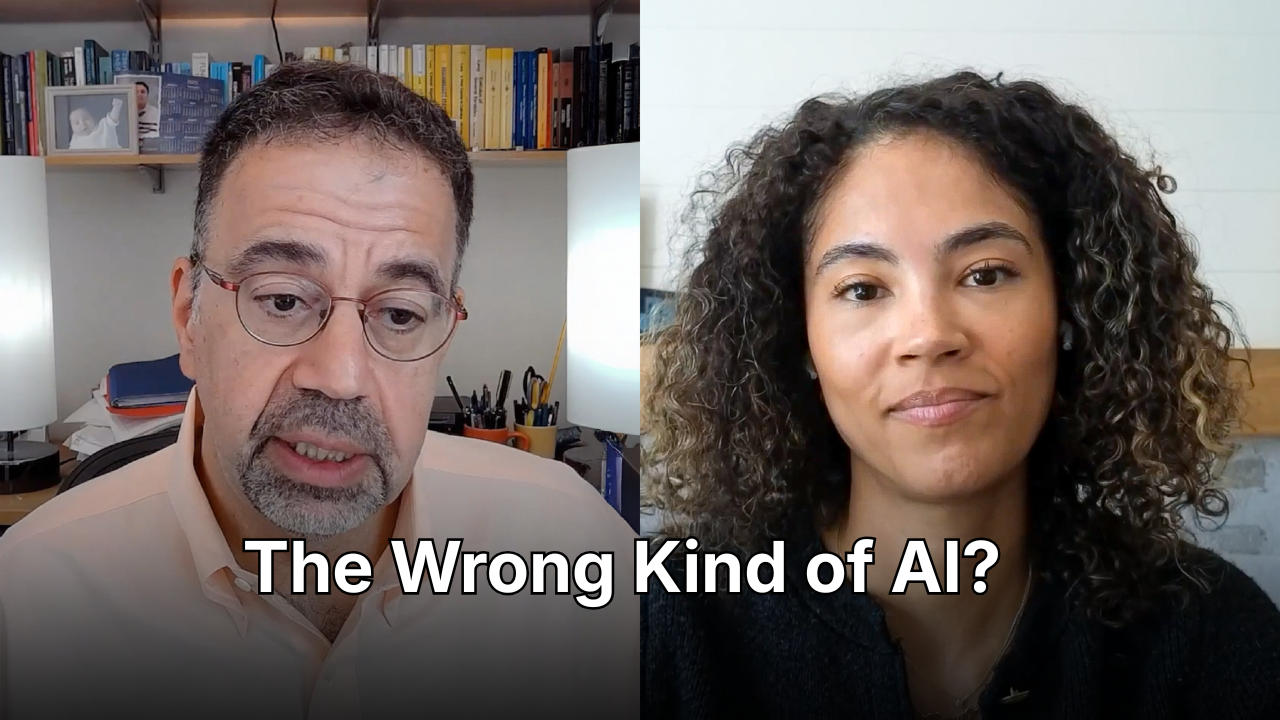
 I've Got Questions with Sinead Bovell
22 Oct 2026 · 22m · 10 chapters
Yossi Matias (VP, Google Research) discusses how AI will change “systems thinking” and the future roles of scientists and builders, driven by virtual/AI labs, ambient intelligence, and cross-disciplinary collaboration. He argues researchers will spend more time asking the right questions and iterating with AI collaborators, while everyday life will increasingly use embedded AI that people stop noticing once it’s reliable. He highlights Earth AI as an example of turning satellite and sensor data into actionable predictions (e.g., flood forecasting via Flood Hub; Nigeria funding villagers ahead of floods).
Yossi Matias is VP of Google Research (Google HQ, Palo Alto). Host is Sinead Bovell, a futurist interviewer for “I’ve Got Questions.”
systems thinkers act like “organizations of one”; future skills include judgment, ethics, communication, and adaptability; new roles will emerge (e.g., an “AI-trition” to fix embedded home AI).
Waymo self-driving cars becoming normal; AI translation assumed to work; flood prediction and healthcare/education parallels.
Written by AI. May contain mistakes.
Discussion on how the role of scientists may change by 2030 due to technology.
“This episode is brought to you by Google Research.”
Exploration of the importance of connecting disciplines in scientific work and the potential for collaboration.
“lab, if you will, and not only virtual lab, it's essentially an AI collaborator that is polymath because it reads across disciplines.”
Exploration of how technology and continuous connectivity will transform daily life by 2030.
“I mean, Hilbert, for example, a great mathematician, actually started studying doing physics pretty late in his career.”
Discussion on how AI can assist in crucial decision-making processes across various sectors.
“if you go outside of this building and around in this area, you see so many Waymo cars.”
Insight into the skills and roles needed in future workforces as technology evolves.
“is going to be facilitated with technology.”
Explore the essential skills for the next generation to thrive in a tech-driven world.
“right questions, you need to understand what matters.”
Yossi predicts a future where AI will be as common as calling an electrician.
“I wonder what that world's going to look like.”
Discuss the vast opportunities and challenges posed by emerging technologies today.
“So if we're to move to the present for a second with all of this, it feels pretty cool what's in the pipeline, what will be possible, the problems that we'll be able to solve, the systems thinkers that we're training.”
Yossi emphasizes the critical need for innovation in healthcare to save lives.
“That's a huge opportunity for us to actually save lives, improve lives, and we're already seeing good progress on that.”
Explore how collaboration and big questions can drive future innovations in technology.
“A lot of the things that currently we're working on, actually, were not on the radar just a few years ago or sometimes a few months ago.”

Get the gist, explore an idea or ask about something said.
 Claude
On I've Got Questions with Sinead Bovell, what are the key points of this episode?
Searching your listeningAutomatic transcript. May contain errors.
0:00Yossi Matias: A lot of the magic happens actually when we bring together various people, but also connecting disciplines, connecting dots. What you described, that's a systems thinker, and in some ways it's like an organization of one. The person that you're hiring has to also think like a miniature company. You have all of these miniature departments, you're building, you're thinking about ethics, you're asking the right questions, and then you're continually evolving like a company would. So what types of roles or skills do you think you would be hiring for in the future that maybe don't exist today? We're looking for colleagues and workers that can actually ask the right question, that can actually then identify the opportunity.
0:35Yossi Matias: Sometimes we call them soft skills, but they're skills, right? In a world where every researcher may have their own virtual lab, if you will, the researcher becomes what today we think about as advisors or researchers who have their own labs. I feel like I wouldn't do my job if I didn't share a prediction with you. I have a feeling. So right now we have electrical engineers, but when something goes wrong in your house, you call an electrician. So if you think about this future with ambient intelligence and maybe there's AI that you can just talk to your wall, what is that role going to be? An AI-trition where the person you call to fix the AI embedded in your house and your device, who is that going to be?
1:12I'm in Palo Alto right now at one of Google's headquarters. I just got off the stage with Yossi Matias. He's the VP of Google Research. And I describe Google Research as one of the places inside Google where the future gets prototyped before all of us get to experience it. So I wanted to ask him, what is he building? What are they working on? Where does he see all of this going? And what does that mean for all of us? I'm Sinead Bovell, and this is I've Got Questions.
1:39Yossi Matias: This episode is brought to you by Google Research. Thank you so much for having me. Good morning to Yossi and to everyone. So I've had the opportunity to go behind the scenes of Google research these past few months. I've met with your researchers and your scientists. I've learned about what you're building, what's coming up, and the scientist's view on where the future could be going. One thing is becoming clear. The role of a scientist could be changing. So if we're to fast forward a few years to 2030, what do you think the role of a scientist is? What does it look like? One thing which is, I think, quite exciting, if I look into why are we actually becoming scientists, it's really about curiosity, it's about exploring, it's about inventing.
2:24Yossi Matias: In fact, as a kid, I remember there were these two series that I really loved reading. One was about explorers, one was about inventors. And to some extent, I think that what we're doing as researchers and scientists is in a way being inventors and explorers, but how we're doing it is changing all the time. Now, the world of exploration is just expanding, right? Before we had to do all this work in order to make this progress and now suddenly a lot of this heavy lifting, we can actually use technology to actually help us with that. Then suddenly we need to think differently. Now, for example, even today in a world where every researcher may have their own virtual lab, if you will, and not only virtual lab, it's essentially an AI collaborator that is polymath because it reads across disciplines.
3:13Yossi Matias: So suddenly in a way the researcher becomes what today we think about as advisors or researchers who have their own labs which is more into asking the right questions into doing these iterations. So in a way this is up leveling everything that we do. So I do believe that in the future actually the role of scientists is going to be more similar to what we do today as when you think about advisors about senior scientists that are actually working with labs of grad students, postdocs, and so forth. So it's in a way going to evolve into that. And the pace of that is something that we need to pay attention to because we're not really set for that, right?
3:54Yossi Matias: The academic systems and what we're doing. So I think this is time of transformation, which is, you know, it can be quite intimidating some time, but I think the opportunity there is quite extraordinary. And it's really cool that you said you have this virtual lab, so this team of scientists that can follow you through your life. The lab goes with you. It's mobile in a way, I think, which is really interesting. And what that concept looks like as a scientist moves throughout their life, does their team of scientists, their AI agents move with them? I think that's something cool. And if I can add to that, I think that one of the things that I believe that a lot of The magic happens actually when we bring together various people, but also connecting disciplines, connecting dots.
4:37Yossi Matias: One thing that we observe over the years is that scientific work is driving people to more specialization, even within an area. And therefore becoming more difficult actually to work across disciplines. I mean, Hilbert, for example, a great mathematician, actually started studying doing physics pretty late in his career. and Einstein actually published some of these papers with a colleague on who and you see he was doing the physics and his colleague did the math. Now again the opportunity now to work with systems that are can actually bring together those disciplines and enable everybody to actually work more across disciplines and therefore actually look into things more in a holistic way I think this is going to evolve over time which I think is very exciting.
5:28Yossi Matias: I think still specialization and knowing to go deep is going to be incredibly important. Yeah, I would agree. And if we were to expand the picture outside of just the role of a scientist, how does my life change in 2030? I've heard about what some of the researchers here are building. What does that look like for me in a few years? It's interesting. So we can ask ourselves actually, let me return the question to you. You're a futurist. So are you looking more into the future or into the past as a futurist? It's probably split. Okay. So if we would ask the same question, say, about how did our life change versus 10 years ago?
6:08Yossi Matias: What would be our answers? Interesting. Maybe the role of continuous communication. I think it's something that's transformed our world in a way that we don't even think about, that we're in contact with people all the time, everywhere we go, the world comes with us, I think is maybe a way that it's changed. Yeah, I think, okay, so I think that in some ways, things are changing dramatically. And in other ways, they're not, right? Because some of the things that I mean, what do we do, we look after interesting problems or important problems for our lives, and how we communicate with each other.
6:43Yossi Matias: Obviously, with technology, we actually enable building bridges. So I think that it's amazing that today we can have connectivity among friends and families and so forth. At the same time, we're dealing with more information coming our way, so we need to manage that. So I think we're going to see the same in many aspects of our life and work, where suddenly we have all these tools and capabilities. And in a way, one observation about technology is that once we start using it and it's good enough, we're stop paying attention to that we just use it and and that's I like to call it as ambient intelligence so the best form of intelligence that we're using around us is that it's working so good that we just use it we don't actually pay attention to that and then we're still trying to achieve our goals so I think that we're going to see this acceleration in many areas you know it was just a few years ago actually that we're talking about when and some people actually were asking if they're going to be self-driving cars and now it's if you go outside of this building and around in this area, you see so many Waymo cars.
7:50Yossi Matias: And this is, by the way, one unique experience that even though for most technologies, after I use them a few times, I'm getting used to it, it's a technology that is just working and I still find it magical every time I do. Yeah, it's true. And I know you had mentioned a little bit about Earth AI, which we've talked a lot about and I've gotten to meet some of your researchers working on it. And when you combine that with that idea of ambient intelligence and the questions that you'd be able to ask Earth AI. I know as someone with a business background, being able to ask you, where should the shop go, right?
8:23If you want to launch a business, where should it be located? And if you're a nonprofit, that's a question that you wouldn't have been able to hire a team to figure that out of consultants. But you can just ask Earth AI that question. Do I make this shop or should I lease this building? These are really extraordinary questions.
8:39Yossi Matias: Yeah, I think it's a great example because if you go enough backwards, the question is, even for, say, responders or governments, where is the flood currently happening was out of reach. At some point, it became available through satellite imagery and so forth. But when I started looking into that, this was 10 years ago, actually visiting India and seeing actually a village that was flooded overnight, the question of where is the flood going to hit tomorrow was totally out of reach. It was totally a surprise. And now actually we have pretty good predictions so people can actually anticipate where it's going to be and take action ahead of time.
9:14Yossi Matias: In fact, just a few months ago, the government of Nigeria sent millions of dollars to villagers ahead of a flood that we're using in our API for what we call flood hub where we actually put our prediction capabilities. So in a way they could actually see the future, take action, and actually keep people safe. Now with Earth's AI, we can take it to the next level because today when you're taking this prediction, some people need to ask, okay, so what actions should we do? What priorities? Where are people located? But just imagine you can just ask a question. So in this upcoming flood or in upcoming storm, what are the impacted communities?
9:50Yossi Matias: What is the infrastructure that is likely going to be impacted? how can actually mobilizing help so that to help people similarly think about how to do the same in healthcare how to convert the signals that we are getting from our devices into actionable information such as hey you may want to call a doctor so it's really about the objectives are not changing what is changing is the level in which we can actually expect to actually be able to operate on them on our daily life on our work life on humanity challenges and so forth so it's all the time up leveling and again if you go back I remember when you know the days that people asked me so what's what's going to what are kids going to do if you if they can just google every fact or look at in wikipedia right I mean are they going to be lazy or stupid well I think they're much smarter right because that's a given now and now we can actually take to the next level so I think we're going to see up leveling everything that we do but we may not notice it because it's just going to happen organically.
10:53I just had a vision of getting a text from your city official. We've transferred a hundred dollars to your bank account. We anticipate a flood coming to your neighborhood. We're going to need you and your family to evacuate. And then we just don't even think about that. And that just becomes natural. So in that future of ambient intelligence, where we're just streaming it, we don't think about it and it just works. What would need to be true from a capability standpoint in AI for that to be the case? What
11:18Yossi Matias: it's already happening because it's coming all the time in a way that we just assume that it works so you know that's why we're working on all this foundational work all the foundational work on understanding generative ai and new models so that actually these capabilities once they're getting into a certain threshold of trustworthiness and effectiveness and helpfulness we just embed them in our life and we just take them for granted by the way this reminds me that talking reflecting Backing back, I remember when my son, Michael, who I think is somewhere here, was in school. He came to me one day and said, hey, Dad, what's going on with your translate thing?
11:59Yossi Matias: I just actually translated this page and one line was actually not very good. And I thought to myself, just a few years earlier, this was actually science fiction. To even have a translation, in fact, you had to send it to translators to do the work for you. And now this became kind of, in a way, assumed that you just do it right. So I think the same applies for practically everything that we do. A lot of stuff that today we expect a lot of hard work or experts, etc., is going to be facilitated with technology. We're just going to use it and then ask the next question. I expect us to be as busy as we are today because just our goals and targets are going to raise the bar of what we're trying to do.
12:38One thing that's interesting, I'm really curious to see how many people would consider themselves a data scientist at Google, because that term, that role wasn't invented until 2008 after the data revolution from the last general purpose technology, the internet. So what types of roles or skills do you think you would be hiring for in the future that maybe don't exist today?
13:00Yossi Matias: Yeah, the question for role is quite interesting because if I try again to reflect on roles today and how do they compare to what we expected before, I think they're quite different. I think that the opportunity for builders is going to be huge, but what does it mean to be a builder is changing all the time because of the knowledge, the tools, the capabilities to do that. How to build, but also how to do research is going to be important and more important than ever. So I would advise how you do that. These are part of the skills, but it's in a way also part of the role, because what are we actually looking for when we are working with others?
13:34Yossi Matias: We're looking for colleagues and workers that can actually ask the right questions that can actually then identify the opportunities, that can use technologies to the best possible way to actually build things that matter. Now, what's also going to be more important than ever is the how, is the capabilities that sometimes we call them soft skills, but they are skills, right? It's how to communicate, how to listen, because really, if you want to ask the right questions, you need to understand what matters. You need to apply judgment and you also to apply the right judgment on the ethics of how to do it in the right way, how to be sensitive to what are the trade-offs.
14:14Yossi Matias: So I think all these, if I try to then translate it to what really we should expect and how we should actually want the next generation to grow into, we want them to be skillful, to ask questions, to be able to do research, to use technologies, and importantly, to know how to adapt and how to learn. because the pace of change is such that in any given moment, what we're doing is going to change. Now, we also should recognize that we are now in a kind of a transition because there are all these very powerful technologies. And there's a lot of chatter about, oh, I can just use it to solve problems.
14:48Yossi Matias: But there's a certain friction in using them. But I think we should assume that much of the friction that we see around us is actually going to go away because somebody is going to help actually collectively we're going to reduce this and therefore what we're going to remain with are disempowerment and use it. So it's really, I don't think we're going to be in lack of problems that we need to solve and how we're going to solve them is going to change all the time. So being able to adapt to that is going to be quite important. And what you described for the skills of the future or who you could be hiring, they have to think about ethics.
15:25What questions are they asking? They also have to and somewhat a builder. So that's a systems thinker. And in some ways, it's like an organization of one, that the person that you're hiring has to also think like a miniature company. You have all of these miniature departments. You're building, you're thinking about ethics, you're asking the right questions, and then you're continually evolving like a company would, which is also a really interesting way to think about it.
15:49Yossi Matias: Yeah, in a way, it's related to earlier we talked about scientists, and I was thinking about how AI can actually help us be across more disciplines. so you don't necessarily need to find another expert to be able to do some progress. You can actually use technology in order to actually work more across disciplines. Similarly in other domains, actually now when I hear about people with no experience with coding using Vibe Coding to actually do basic coding and therefore empowers them to actually do more with that. And similarly, when people can actually sketch out some product design and so forth.
16:27Yossi Matias: So this notion of everyone can play roles in different ways by using technology, again, I think is going to accelerate. And this is incredibly important. By the way, at Google, always we looked into, for example, product leaders as people that would have a computer science degree or an engineering degree, is something quite important to know how to make those connections, how to build those bridges. So a lot of what we do is really bringing together things. And I think that to your point, the ability for every person to actually play more roles in doing that is very empowering. As is, by the way, the ability to ask questions and get analysis and practically get kind of, if you will, a small seminar work done on your behalf with a system that can give you a very quick acceleration of taking decisions, of helping you to also decide what you need to build as well as how to build it.
17:26And I think, I feel like I wouldn't do my job if I didn't share a prediction with you. I have a feeling. So right now we have electrical engineers, but when something goes wrong in your house, you call an electrician. So if you think about this future with ambient intelligence and maybe there's AI that you can just talk to your wall. What is that role going to be? An AI-trition where the person you call to fix the AI embedded in your house and your device, who's that going to be? I wonder what that world's going to look like. And I have a feeling we'll be hiring for that.
17:53Yossi Matias: I'm sure many here are getting calls from family to fix the Wi-Fi at home. So hopefully we can solve that problem at some point. My parents think I work in IT. Here you go. So if we're to move to the present for a second with all of this, it feels pretty cool what's in the pipeline, what will be possible, the problems that we'll be able to solve, the systems thinkers that we're training. What would be keeping you up at night in this moment?
18:25Yossi Matias: You know, the one thing I think is really because the opportunity is so vast and so broad and practically everything that we look around, there's something we can do to make it better. I think that the biggest thing on my mind is how do we make sure that we're really meeting the moment and taking the right opportunities to work on and to tackle. There's a huge variability on what we can do. We can use now technology and, you know, we have an amazing talent that every project, every effort, everything that we do can make a difference. The question is, how do we do the biggest difference that we can?
19:01Yossi Matias: And again, if I think about the opportunity that we have today to take societal problems, anything from health care to crisis resilience, to education, to energy development. In all of those, there's an opportunity to have an opportunity that can make impact on so many people in such a profound way. And making the right choices of how to actually go after the right opportunity is, to me, one thing that I think everybody should worry about or think about because of the urgency. And again, I'm incredibly optimistic about how we can actually use innovation and technology and working together in order to actually address and give a positive impact on people's lives, daily life, business, but also importantly on all the societal challenges that we have.
19:51Yossi Matias: Think about healthcare. That's a huge opportunity for us to actually save lives, improve lives, and we're already seeing good progress on that. So that's actually the main question on my mind is how to actually get the fastest and the most effective way. And also, because there are so many opportunities, when I think about the Google Research Organization and what we're doing and the teams, the amazing talent that we have, one question that we're constantly asking, on the one hand, we can have a lot of impact. here and now and very soon. On the other hand, actually, an important mission that we have is really to look into what's on the horizon, what's around the corner, what are the new innovations or things that nobody was thinking about yet that are going to make a big impact into the future.
20:38Yossi Matias: A lot of the things that currently we're working on, actually, were not on the radar just a few years ago or sometimes a few months ago. So what are the next things that we can uncover, we can actually make the next big jumps in every area that we have. I think the opportunity is exciting and is there. And it's something, by the way, that we encourage. We actually spent here a few days now asking what are the big questions that we need to ask in all levels. And importantly, how can we bring everybody in collaboration so as to we can focus on the next big questions and have the biggest possible impact.
21:11I think the bigger the questions become and the more advanced technologies that we get to solve these problems with, I think we're all going to be up later. I think that that's what the future looks like too, everybody working all night with their agents. Yossi, it's been a pleasure. Thank you all so much.
21:27Yossi Matias: Thank you so much. Thanks, Sinead. Thank you. Thank you. Thank you.
From the rise of ambient intelligence to the changing nature of work and scientific discovery, what might be possible by 2030? What skills will matter most? And how do we decide which problems to solve as our technological capabilities expand?
In this episode of I’ve Got Questions, I sit down with Yossi Matias, VP of Google Research, for a fireside chat about the next frontiers of AI and science, and how the technologies being developed today could reshape our everyday lives.
We explore his vision for the future, the possibilities emerging across disciplines, and what it means to prepare for a world where the boundaries of what’s possible are rapidly expanding.
Chapters:
00:00 Intro
01:39 A future where every scientist has an AI lab
04:26 What happens when experts can work beyond their specialty?
05:32 Everyday life in 2030
08:02 Earth AI: Asking bigger questions about our planet
10:53 When AI becomes something we take for granted
12:38 Soft skills, new roles, and the future of hiring
15:19 Thinking like an organization of one
17:25 Sinéad’s prediction for a new job in the AI era
18:06 What keeps the Head of Google Research up at night?
21:11 Closing thoughts
This episode is brought to you by Google Research
Listen to the show on other platforms:
Apple Podcasts – https://podcasts.apple...
Spotify – https://open.spotify.com/
Follow my work here:
Website: https://www.sineadbove...
Substack: https://sineadbovell.s...
Instagram: / sineadbovell
LinkedIn: / sineadbovell
X: https://x.com/sineadbo...
YouTube: / @sineadbovell
Follow Yossi Matias:
https://www.linkedin.com/in/yossimatias
https://x.com/ymatias