
In short
Latent Space: The AI Engineer Podcast - Episode Notes
Episode Title
2024 in AI Startups [LS Live @ NeurIPS]
Episode Date
December 2024
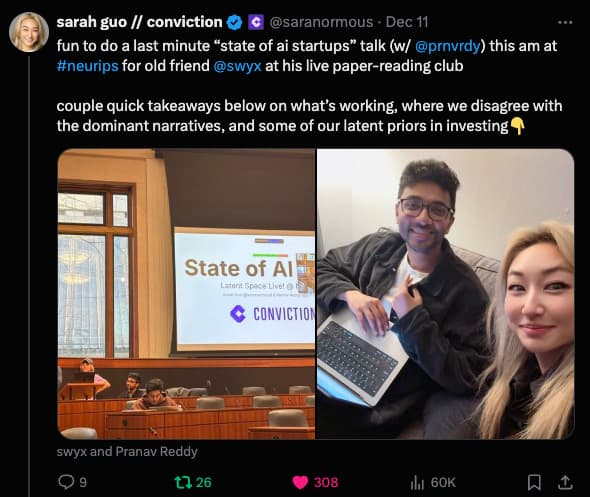
Overview This episode features excerpts from "Latent Space LIVE!" held during the NeurIPS 2024 conference in Vancouver. The keynote address, titled "The State of AI Startups," was delivered by Sarah Guo (founder of Conviction) and Pranav Reddy (Conviction partner). The conversation focuses on the evolution of the AI landscape in 2024, discussing trends, themes, and insights relevant to AI startups and the industry at large.
Key Highlights
Event Context
- Latent Space LIVE: The first in-person mini-conference organized by Latent Space, aiming to provide industry-relevant content and recap the year 2024.
- Attendance: Over 200 attendees in-person and 2,200 online.
Introduction to Keynote
- Speakers: Sarah Guo and Pranav Reddy discussed five key themes that defined the AI landscape in 2024.
- Investment Perspective: Guo shared insights from the venture capital perspective, highlighting the significant opportunities within the evolving AI market.
Five Key Themes of 2024
- Competitive Foundation Models
- The race among foundation models is becoming closer, with multiple players now competing effectively against OpenAI.
- Notable advancements include Google's Gemini overtaking previous market leaders in performance evaluations.
- Open Source Models Rising
- Open source alternatives are gaining traction, demonstrating competitive performance in areas like math and instruction-following tasks.
- Models like LLAMA show significant effectiveness, challenging the previous notion that only large models offered substantial intelligence.
- Decreasing Costs of Intelligence
- The cost of accessing AI models has significantly decreased (up to 85% reduction), allowing startups to experiment and deploy AI solutions at lower costs.
- The availability of models at lower prices is democratizing access to AI technology.
- Emerging Modalities
- New modalities in AI, such as voice and biology, are starting to show promise, with practical applications emerging in various fields.
- Innovations in video interaction and execution capabilities are also being explored, indicating a shift in how AI can be utilized across industries.
- Rethinking Scaling
- There is a growing conversation about the limits of scaling traditional models and the need for new paradigms in scaling AI capabilities.
- Startups must adapt to these changing dynamics to remain competitive.
Insights on Startups and Investment Trends
- Funding Landscape: Contrary to popular belief, the AI funding landscape is stabilizing, with a recovery in investments seen in 2024.
- Market Opportunities: There is an abundance of potential markets for AI products, particularly in areas previously deemed too challenging for venture capital.
- Value Creation: Startups are leveraging AI to create new service models that focus more on outcomes than merely software functionality.
Challenges for Startups
- Industry Competition: Startups face competition not only from each other but also from incumbents who can scale quickly and leverage existing infrastructure.
- Data Utilization: Many incumbents lack the data necessary to build high-quality AI products, presenting an opportunity for startups that can capture and utilize this data effectively.
Future Predictions
- New Consumer Applications: There is a belief that the next wave of innovation in AI will include consumer-focused applications, with startups beginning to emerge in this space.
- Agility and Innovation: Startups must prioritize flexibility and innovative thinking to adapt to the rapidly evolving AI landscape.
Conclusion
- The speakers expressed optimism about the future of AI startups in 2024, highlighting the structural advantages that smaller companies have in adapting to change compared to larger incumbents.
- They encouraged attendees to seize opportunities and innovate within the growing AI ecosystem.
For more insights and detailed discussions, listeners are encouraged to check the full video of the keynote and the accompanying slides available online.
Links
- Full Video: [YouTube Link]
- Speaker Profiles:
- Sarah Guo: [Twitter Profile](https://x.com/saranormous)
- Pranav Reddy: [Twitter Profile](https://x.com/prnvrdy)
Call to Action Listeners are invited to engage with the content, share their thoughts, and explore opportunities within the AI startup ecosystem.
Written by AI. May contain mistakes. Listen to the episode to check what was said.
Transcript
Automatic transcript. May contain errors.0:15Welcome to Latent Space Live, our first mini-conference held at Neurips 2024 in Vancouver. This is Charlie, your AI co-host. When we were thinking of ways to add value to our academic conference coverage, we realised that there was a lack of good talks just recapping the best of 2024 going domain by domain. We sent out a survey to the over 900 of you who told us what you wanted and then invited the best speakers in the Latent Space Network to cover each field. 200 of you joined us in person throughout the day, with over 2 ,200 watching live online. Today, we're kicking it off with a keynote on the state of AI startups.
0:58Sarah Guo, founder at Conviction and host of No Priors Podcast, and Pranav Reddy, partner at Conviction and former engineer at Neva. They'll be unpacking the top five themes of 2024, what ideas are working and what's not, from shifting market opportunities to why the supposed advantages of big tech incumbents might not be as strong as they seem. As always, don't forget to check the show notes for the YouTube link to their talk as well as their slides. Watch out and take care. Hi, everyone. My name is Sarah Guo, and thanks to Sean and friends here for having me and Pranav. So I'd start by just giving 30 seconds of intro.
1:40I promise this isn't an ad. We started a venture fund called Conviction about two years ago. Here is a set of the investments we've made. They range from companies at the infrastructure level in terms of feeding the revolution to foundation model companies, alternative architectures, domain-specific training efforts, and, of course, applications. And the premise of the fund, Sean mentioned I worked at Greylock for about a decade before that and came from the product engineering side, was that we thought that there was a really interesting technical revolution happening, that it would probably be the biggest change in how people use technology in our lifetimes, and that represented huge economic opportunity.
2:22And maybe that there would be an advantage versus the incumbent venture firms, in that when the floor is lava, the dynamics of the markets change, the types of products and founders that you back change, it's a lot for existing firms to ingest and a lot of their mental models may not apply in the same way and so there was an opportunity for first principles thinking and if we were right we do really well and get to work with amazing people and so we are two years into that journey and we can share some of the opinions and predictions we have with all of you. Pran is going to start us off. So quick agenda for today we'll cover some of the model landscapes and themes that we've seen in 2024, what we think is happening in AI startups and then some of our latent priors on what we think is working and investing.
3:08So I thought it'd be useful to start from what was happening at NeurIPS last year in December 2023. So in October 2023, OpenAI had just launched the ability to upload images to ChatGPT, which means up until that moment, it's hard to believe that roughly a year ago, you could only input text and get text out of ChatGPT. The Mistral folks had just launched the Mixtral model right before the beginning of NeurIPS. Google had just announced Gemini. I very genuinely forgot about the existence of Bard before making these slides. And Europe had just announced that they were doing their first round of AI regulation, but not to be their last.
3:41And when we were thinking about what's changed in 2024, there's at least five themes that we could come up with that feel like they were descriptive of what 2024 has meant for AI and for startups. And so we'd start with, first, it's a much closer race on the foundation model side than it was in 2023. So this is Elm Arena. They asked users to rate the evaluations of generations from specific prompts. So you get two responses from two language models, answer which one of them is better. The way to interpret this is roughly 100 ELO difference means that you're preferred 2 thirds of the time. And a year ago, every OpenAI model was more than 100 points better than anything else.
4:19And the view from the ground was roughly, OpenAI is the IBM. There is no point in competing. Everyone should just give up, go work at OpenAI, or attempt to use OpenAI models. And I think the story today is not that. I think it would have been unbelievable a year ago if you told people that A, the best model today, at least on this eval, is not OpenAI, and B, that it was Google would have been pretty unimaginable to the majority of researchers. But actually, there are a variety of proprietary language model options and some set of open source options that are increasingly competitive. And this seems true not just on the eval side, but also in actual spend.
4:55And so this is ramp data. There's a bunch of colors, but it's actually just OpenAI ananthropic spend. And the OpenAI spend at the end of last year in November of 23 was close to 90 % of total volume. And today, less than a year later, it's closer to 60 % of total volume, which I think is indicative both that language models are pretty easy APIs to switch out. And people are trialing a variety of different options to figure out what works best for them. Related, second trend that we've noticed is that open source is increasingly competitive. So this is from the scale leaderboards, which is a set of independent evals that are not contaminated.
5:30And on a number of topics that actually the foundation models clearly care a great deal about, open source models are pretty good on math, instruction following, and adversarial robustness. The LLAMA model is amongst the top three of evaluated models. I included the agenting tool use here just to point out that this isn't true across the board. There are clearly some areas where foundation model companies have had more data or more expertise in training against these use cases. But models are surprisingly, open source models are surprisingly increasingly effective. This feels true across evals.
6:00This is the MMLU eval. I want to call out two things here. One is that it's pretty remarkable that the ninth best model and two points behind the best state-of-the-art models is actually a 70 billion parameter model. I think this would have been surprising to a bunch of people where the belief was largely that most intelligence is just an emergent property and there's a limit to how much intelligence you can push into smaller form factors. In fact, a year ago, the best small model or under 10 billion perimeter model would have been Mistral 7b, which on this eval, if memory serves, is somewhere around 60.
6:31And today, that's the Llama 8b model, which is more than 10 points better. The gap between what is state-of-the-art and what you can fit into a fairly small form factor is actually shrinking. And again, related, we think the price of intelligence has come down substantially. This is a graph of flagship OpenAI model costs, where the cost of the API has come down roughly 80%, 85%, and call it the last year, year and a half, which is pretty remarkable. This isn't just OpenAI 2. This is also a full set of models. This is from artificial analysis, which tracks cost per token across a variety of different APIs and public inference options.
7:08And we were doing some math on this. if you wanted to recreate the kind of data that a text editor had or something like Notion or Coda, it's somewhere in the volume of a couple thousand dollars to create that volume of tokens. It's pretty remarkable and impressive. It's clearly not the same distribution of data, but just as a sense of scope, there's an enormous volume of data that you can create. And then fourth, we think new modalities are beginning to work. We'll start quickly with biology. We're lucky to work with the folks at Chai Discovery who just released CHI-1, which is an open source model that outperforms AlphaFold3.
7:42It's impressive that this is roughly a year of work with a pretty specific data set and then pretty specific technical beliefs. But models in domains like biology are beginning to work. We think that's true on the voice side as well. I'll point out that there were voice models before things like 11 Labs have existed for a while, but we think low latency voice is more than just a feature. It's actually a net new experience interaction. Using voice mode feels very different than the historical transcription first models. Same thing with many of the Cartesian models. And then a new nascent use case is execution.
8:13So cloud-launched computer use, OpenAI launched code execution inside of Canvas yesterday. And then I think Devin just announced that you can all try it for$500 a month, which is pretty remarkable. It's a set of capabilities that have historically never been available to the vast majority of population. And I think we're still in early innings. Cognition, the company, was founded under a year ago. First product was roughly nine months ago, which is pretty impressive. And if you recall, like a year ago, the point of view on Sweebench was like it was impossible to surpass, what, like 13 % or so.
8:43And I think the whole industry now considers that, if not trivial, accessible. Last new modality we wanted to call out, although there are many more, is video. I took the liberty, I got early access to Sora and managed to sign up before they cut off accesses. So here is my favorite joke in the form of a video. Hopefully someone here can guess it.
9:08Yeah, you're telling me a shrimp fried this rice? It's a pretty bad joke, but I really like it. And I think this one, the next video here, is one of our portfolio companies, HeyGen, that translated and does the dubbing for, or lip sync and dubbing for live speeches. So this is Javier Millet, who speaks in Spanish, but here you will hear him in English if this plays. And you can see that you can capture the original tonality of his speech and performance. I think out of here doesn't work, but we'll push something publicly. Did you try it? Let's give it a shot. Yeah. Let's give it a shot. I think if you're on mute.
9:47Excellent. Yeah, and you can hear that this captures his original tone and the emotion in his speech, which is definitely new and pretty impressive from new models. So the last point that we wanted to call out is the much purported end of scaling. I think there is a great debate happening here later today on the question of this. But we think, at minimum, it's hard to deny that there are at least some limits to the clear benefits to increasing scale. But there also seems like there are new scaling paradigms. So the question of test time compute scaling is a pretty interesting one. It seems like OpenAI has cracked a version of this that works and we think, A, Foundation Model Labs will come up with better ways of doing this, and B, so far it largely works for very verifiable domains, things that look like math and physics and maybe secondarily software engineering where we can get an objective value function.
10:41And I think an open question for the next year is going to be how do we generate those value functions for spaces that are not as well constrained or well defined. And so the question that this leaves us in is, well, what does that mean for startups? And I think a prevailing view has been that we live in an AI bubble. There's an enormous amount of funding that goes towards AI companies and startups that is largely unjustified based on outcomes and what's actually working on the ground. And startups are largely raising money on hype. And so we pulled some pitch book data. And the 2024 number is probably incomplete since not all rounds are being reported.
11:12And largely suggests like actually there is a substantial recovery in funding. And maybe 2025 looks something like 2021. But if you break out the numbers here a bit more, the red is actually just a small number of foundation model labs. like what you would think of as the largest labs raising money, which is upwards of$30 to$40 billion this year. And so the reality of the funding environment actually seems like much more sane and rational. It doesn't look like we're headed to a version of 2021. In fact, the Foundation Model Labs account for an outsized amount of money being raised, but the set of money going to companies that are working seems much more rational.
11:48And we wanted to give you, we can't share numbers for every company, but this is one of our portfolio companies growing really, really quickly. We think zero to 20 in just PLG style spending is pretty impressive. If any of you are doing better than that, you should come find us. We'd love to chat. And so what we wanted to try and center a discussion on, this is certainly not all of the companies that are making 10 million more or revenue and growing, but we took a selection of them and wanted to give you a couple ideas of patterns that we've noticed that seem to be working across the board. The first one that we noticed is like first wave service automation.
12:22So we think there's a large amount of work that doesn't get done at companies today, either because it is too expensive to hire someone to do it, it's too expensive to provide them context and enable them to be successful at whatever the specific role is, or it's too hard to manage those set of people. So for Scribeng, it's too expensive to hire those specific set of people. For CRN, Decagon, for customer support style companies, it's really useful to do next level automation. And then there's obviously growth in that. And for Harvey and Evenup, the story is you can do first wave professional services and then grow beyond that.
12:56Second trend that we've noticed is better search, new friends. So we think that there is a, it's pretty impressive how effective text modalities have been. So Character and Replica have been remarkably successful companies. And there's a whole host of not-safe-for-work chatbots as well that are pretty effective at just text generation. They're pretty compelling mechanisms. And on the productivity side, Perplexity and Glean have demonstrated this as well. I worked at a search company for a while. I think the changing paradigms of how people capture and learn information is pretty interesting. We think it's likely text isn't the last medium.
13:26They're infographics or sets of information that seem more useful or sets of engagement that are more engaging. But this feels like a pretty interesting place to start. So one thing that I've worked on investing in in a long time is democratization of different skills, be they creative or technical. This has been an amazing few years for that across different modalities, audio, video, general image, media, text, and now code and really fully functioning applications. One thing that's really interesting about the growth driver for all of these companies is the end users in large part are not people that we thought of as we, the venture industry, the royal we, thought of as important markets before.
14:09and so a premise we have as a fund is that there's actually much more instinct for creativity visual creativity audio creativity technical creativity than like there's latent demand for it and ai applications can really serve that i think in particular midjourney was a company that is in the vanguard here and nobody understood for a long time because the perhaps outside view is how many people want to generate images that are not easily you know the raster they're not easily editable, they can't be used in these professional contexts in a complete way, and the answer is like an awful lot, right, for a whole range of use cases, and I think we'll continue to find that, especially as the capabilities improve, and we think the range of quality and controllability that you can get in these different domains is still, it's very deep, and we're still very early.
15:01And then I think if we're in the first or second inning of this AI wave, one obvious place to go invest and to go build companies is the enabling layers, right? Shorthand for this is obviously compute and data. I think the needs for data are largely changed now as well. You need more expert data. You need different forms of data. We'll talk about that later in terms of who has, like let's say, reasoning traces in different domains that are interesting to companies doing their own training. But this is an area that has seen explosive growth and we continue to invest here. Okay, so maybe time for some opinions.
15:45There was a prevailing narrative that, you know, some part from companies, some part from investors. It's a fun debate as to where is the value in the ecosystem and can there be opportunities for startups? If you guys remember the phrase GPT rapper, it was like the dominant phrase in the tech ecosystem for a while. of, and what it represented was this idea that there was no value at the application layer, you had to do pre-training, and then like nobody's going to catch OpenAI in pre-training. And, you know, this isn't, this isn't like a knock on OpenAI at all. These labs have done amazing work enabling the ecosystem, and we continue to partner with them and others, but it's simply untrue as a narrative, right?
16:30The odds are clearly in favor of a very rich ecosystem of innovation. You have a bunch of choices of models that are good at different things. You have price competition. You have open source. I think an underappreciated impact of test time scaling is you're going to better match user value with your spend on compute. And so if you are a new company that can figure out how to make these models useful to somebody, the customer can pay for the compute instead of you taking as a startup the CapEx for pre-training or RL up front. And as Pranav mentioned, small models, especially if you know the domain, can be unreasonably effective.
17:11And the product layer has, if we look at the sort of cluster of companies that we described, shown that it is creating and capturing value. And that it's actually a pretty hard thing to build great products that leverage AI. So broadly, we have a point of view that I think is actually shared by many of the labs. that the world is full of problems in the last mile to go take even AGI into all of those use cases is quite long. Okay, another prevailing belief is that, or, you know, another great debate that Sean could host is like, does the value go to startups or incumbents? We must admit some bias here, even though we have, you know, friends and portfolio, former portfolio companies that would be considered incumbents now.
17:53But, sorry, swap views. Sorry, there are markets in venture that have been considered traditionally too hard, right? Like just bad markets for the venture capital spec, which is capital efficient rapid growth. That's a venture backable company where the end output is a tens of billions of dollars of enterprise value company. And these included areas like legal, healthcare, defense, pharma, education. Any traditional venture firm would say, like, bad market, nobody makes money there, it's really hard to sell, there's no budget, et cetera. And one of the things that's interesting is if you look at the cluster of companies that has actually been effective over the past year, some of them are in these markets that were traditionally non-obvious.
18:43And so perhaps one of our more optimistic views is that AI is really useful, And if you make a capability that is novel, that is several magnitudes, orders of magnitude cheaper, then actually you can change the buying pattern and the structure of these markets. And maybe the legal industry didn't buy anything because it wasn't anything worth buying for a really long time. That's one example. We also think that like what was the last great consumer company? Maybe it was Discord or Roblox in terms of things that started that have just like really enormous user bases and engagement. until we had these consumer chatbots of different kinds and perhaps the next generation of search.
19:25As Pranav mentioned, we think that the opportunity for social and media generation and games is large and new in a totally different way. And finally, in terms of the markets that we look at, I think there's broad recognition now that you can sell against outcomes and services rather than software spend with AI because you're doing work versus just giving people the ability to do a workflow. But if you take that one step further, we think there's elastic demand for many services, right? Our classic example is there's on order of 20 to 25 million professional software developers in the world. I imagine much of this audience is technical.
20:11Demand for software is not being met, right? If we take the cost of software and high-quality software down two orders of magnitude, we're just going to end up with more software in the world. We're not going to end up with fewer people doing development. At least that's what we would argue. And then finally, on the incumbent versus startup question, the prevailing narrative is incumbents have the distribution, the product surfaces, and the data. Don't bother competing with them. They're going to create and capture the value and share some of it back with their customers. I think this is only partially true.
20:44The incumbents have the distribution. They have always had the distribution. Like the point of the startup is you have to go fight with a better product or a more clever product and maybe a different business model to go get new distribution. But the specifics around the product surface and the data, I think, are actually worth understanding. There's a really strong innovator's dilemma. If you look at the SaaS companies that are dominant, they sell by seat. And if I'm doing the work for you, I don't necessarily want to sell you seats. I might actually decrease the number of seats. The decades of years, the millions of man and woman hours of code that have been written to enable a particular workflow in CRM, for example, may not matter if I don't want people to do that workflow of filling out the database every Friday anymore.
21:33And so I do think that this sunk cost or the incumbent advantage gets highly challenged by new UX and code generation as well. And then one disappointing learning that we found in our own portfolio is no one has the data we want in many cases. So imagine you are trying to automate a specific type of knowledge work. And what you want is the reasoning trace, all of the inputs and the output decision. Like that sounds like a very useful set of data. And the incumbent companies in any given domain, they never save that data. right? Like they have a database with the outputs some of the time. And so I would say one of the things that is worth thinking through as a startup is when an incumbent says they have the data, like what is the data you actually need to make your product higher quality?
22:26Okay. So in summary, you know, our shorthand for the set of changes that are happening is software 3.0. We think it is a full stock rethinking and it enables a new generation of companies to have a huge advantage. The speed of change favors startups. If the floor is lava, it's really hard to turn a really big ship. I think that some of the CEOs of large companies now are incredibly capable, but they're still trying to make 100 ,000 people move very quickly in a new paradigm. The market opportunities are different, right? These markets that we think are interesting and very large, like represent a trillion dollars of value are not just the replacement software markets of the last two decades.
23:08It's not clear what the business model for many of these companies should be. Sierra just started talking about charging for outcomes. Outcomes-based pricing has been this holy grail idea in software, and it's been very hard, but now we do more work. There are other business model challenges, and so our companies, they spend a lot more on compute than they have in the past. They spend a lot with the foundation model providers. They think about gross margin. They think about where to get the data. It's a time where you need to be really creative about product versus just replace the workflows of the past.
23:43And it might require ripping out those workflows entirely. It's a different development cycle. I bet most of the people in this room have written evals and compared the academic benchmark to a real-world eval and said, that's not it. and how do I make a user understand the non-deterministic nature of these outputs or gracefully fail? I think that's a different way to think about product than in the past. And we need to think about infrastructure again. There was this middle period where the cloud providers, the hyperscalers, took this problem away from software developers, and it was all just going to be front-end people at some point, and it's like, we are not there anymore.
24:24We're back in the hardware era where people are acquiring and managing and optimizing compute. And I think that will really matter in terms of capability in companies. So I guess we'll end with a call to action here and encourage all of you to seize the opportunity. It is the greatest technical and economic opportunity that we've ever seen. We made a decade-plus career-type bet on it. And we do a lot of work with the foundation model companies. We think they are doing amazing work, and they're great partners and even co-investors in some of our efforts. But I think all of the focus on their interesting missions around AGI and safety do not mean that there are not opportunities in other parts of the economy.
25:11The world is very large, and we think much of the value will be distributed in the world through an unbundling and eventually a rebundling, as often happens in technology cycles. So we think this is a market that is structurally supportive of startups. We're really excited to try to work with the more ambitious ones. And the theme of 2024 to us has been like, well, thank goodness. This is an ecosystem that is much friendlier to startups than 2023. It is what we hoped. and so please ask those questions and take advantage of the opportunity.
25:51I think we have some questions. We also take the questions online. If some of these companies can go from 1 to 20 in such a short amount of time, do you think that they can also disappear in a short amount of time? I can take this one. I mean, I think you've seen companies go from zero to 80 million and stall out pretty badly, actually. So your data is correct. There's going to be, there's a set of challenges that are just the challenges of scale, right? Like, I think sometimes the revenue numbers in these companies can overstate the maturity of the businesses themselves, right? They need to figure out how to serve customers.
Read the full transcript
26:32They need to scale their leadership. they need to prepare to service these customers with the right quality level and you know like the company that we showed that went zero to 20 that company has 20 people right and they have you know x hundred thousand users is yeah it's very challenging and and so i think there there's a set of good hard problems that these companies will have i think part of the like most catch phrases or memes, they don't catch on unless there's some seed of truth. And so there was a set of companies that were described by this term GPT wrapper that were not more than a somewhat trivial set of prompts and SEO pages that directed people to our particular use case.
27:18And I think that's likely not a durable position as a technology company. And so it's not a very clean answer for you. It's a nuanced one, but some of the value that is represented by this, I'm going to scroll back to it. Some of this value that is represented by this cluster is durable, and that's the thing that we are interested in. The 0 to 20 and the 0 to 80 and then collapse, it's actually valuable. It's just not durable, right? Users are voting for it and other people can compete. And so, you know, we kind of separate these two questions of like, which of these companies is defensible and where is the revenue or the usage, not a novelty, but something that's really important to work or play or communication.
28:10Sean, do you want me to take questions or do you want to do it?
28:15Hi. Hi. I don't think my mic, oh, here it goes. So if all of these companies need a lot more money and this is the greatest economic opportunity ever, don't we need much bigger venture funds? Or does it magnitude bigger? And won't the economics of those funds be really broken if they're still raising$40 million? Could I invest in a bunch of seed company funds? Okay, this is a bit of a triggering question for me because I take a particular point of view on it. Hopefully without arrogance, we've chosen to raise funds that are relatively small as early stage investors. and part of it is the view of this company, that this company, I think they've spent maybe$7 million to date.
29:05And so the view that all AI product companies or all AI companies in general are very expensive is not true, objectively. We have several companies that are expensive in the traditional sense of SaaS, Like we've got to go hire a lot of go-to-market people and we have to pay them. And there's a J curve of that investment before it comes back in repeatable SaaS revenue. And, you know, I think inference revenue. We have companies that are profitable or break even and have been incredibly efficient. And we have companies that spend a lot up front. And so I think there's an entire range. Our view as a firm is that, you know, very early on, my friend Alad has a funny phrase here, which is no GPU before product market fit.
29:55I think that is not always true. We have given people GPUs before anything, right? But there's a shred of truth in this, which is you can experiment. Like, thank you to the OpenAI and Anthropics and other companies of the world that allow great product people to experiment at very low cost, very incrementally. And so I think much of our portfolio looks like those companies where you're going to see what kind of value you can bring to users without spending a ton up front. As one example, like we just saw new fine-tuning interfaces for 01 come out. The amount of data that you need to, in theory, improve those models for a particular domain is very small.
30:40if that pans out, that's incredibly encouraging as well. So I would say our goal is to work with the most important companies in AI with a relatively small fund. And I think that most companies don't actually, they don't benefit from a huge amount of capital up front. The only thing I would add to that is, I think an interesting trend is that we work with a number of second-time founders whose point of view this time around is like, we're never going to make the company that big again. I think it's not a surprise. Actually, I was doing the math in my head, and this rough ratio of a million dollars of revenue per employee of early-stage company holds true for a remarkable number of our companies.
31:22A number of our companies have more millions in revenue than they do employees. And the point of view of a bunch of this is, we're going to keep it that way. We're not going to grow into a giant team. AI will make us much more efficient, and if you believe in the grand vision of much of the intellectual labor that we do should actually just be captured by some number of models. And we can build much more long-term efficient businesses than we have been able to historically. I do think it's an interesting question because if we think there is this much opportunity, like your opportunity doesn't come evenly, right?
31:52And so I'd say our investment pacing is higher than I guess mine has been traditionally. And another part of our view is like, okay, well, we want to offer founders a certain service level. and founders can decide if they want that or not but it's very time expensive to us. We can only work with that many companies. We think many more are really interesting and that is one of the reasons that Pranav and I did this program for the ecosystem called Embed where we can work with a larger set of companies. We own less but we give them a network and some guidance and it is genuinely because there are more interesting things that we think are going to work than we can work on in a traditional artisanal venture sense.
32:35And shameless plug, applications will open in January. I think you have to press a button to request. So fancy. Cool. Thanks for the talk. It was awesome. So I work for a series C enterprise-focused company called Writer. And one of the interesting things about the multimodality thing that we're seeing in the enterprise is beyond vision, we're not actually seeing a lot of demand for multimodality. We'll get asked about audio and video stuff, but then when we ask what's the use case, it's sort of like, I don't know. And so I'm curious if you and your portfolio companies are seeing that in the enterprise space, and if so, what use cases?
33:17It seems very focused. The multimodality stuff seems great for the consumer level. I'm curious if you're seeing anything on the enterprise side. I think it's a good call-out. enterprises, the data they have is mostly like it's text, it's like structured data and some SQL data. I don't think your average enterprise has that much vision, video, audio data that is that interesting. But I think that will change. Maybe it's because I'm lazy and disorganized, but humans are very unstructured. They don't want they don't necessarily think in terms of relational database schema and hierarchical management of their own information.
33:59And I think there's a future where we take that away from people and the capture of information that you're going to use for different enterprise workflows enables more multimodal use, if that makes sense. And so the sort of obvious example would be there are companies from perhaps a half generation like the gongs of the world that captured video and found some keywords and initial insights for sales reps, but the communications within an organization, the decisions made, the things that people create, I think there will be much more capture, especially of video, but making use of it requires companies to do that capture.
34:44so we kind of require this intermediate step I think. There's a company in our, and this is still a prosumer company today as well to your point of the consumer-prosumer side is ahead of the enterprise but there's a company in our last embed batch called Highlight that kind of has this premise that okay well we're going to use the multi-modality by using on-screen capture, that's what this little bubble is on-screen and audio capture and I think that is a powerful idea.
35:17oh by the way just a quick check uh peter isaac are you here
35:27yeah there's sort of like a meme going around that the the price of intelligence is going to go to zero um and you can kind of see this with gpt4o and and with gemini flash you can get a million tokens a day, which is probably enough for a small company, right? So I'm curious how, as these large companies lose tons of money for market share, how are startups going to respond to this? How does that change the market? Okay. I think it is impossible for anything to be too cheap. So I'll start with that. I would also say this company, with this awesome revenue chart, I'm pretty sure we paid$5 to$7 million to a foundation model provider in this period of time.
36:10And so demand is like, if there was like a secondary theme to this talk, demand is elastic in so many ways, especially for technology. And when you make things cheaper, we want things to be more intelligent. And so if you make hundreds of calls in order to deliver an output, then suddenly the fact that the cost of the calls come down 85 % doesn't do you enough. And so, yes, it's an incredibly compelling idea of having intelligence too cheap to meter. I'm like, maybe this is really old school of me, but for the last two decades, the internet and compute and software and data pipeline, it still hasn't been cheap enough, actually.
36:51We would do more if it was free. So the other physical barrier that we've run into is when models are really large, if you're not going to quantize and distill and do domain-specific things. It's hard to run. You need a lot of compute, just to state the very basics. And even with the foundation model providers, we are seeing people run into inference capacity issues. And so I do not know if this is true, but one way to read anthropic pricing change is there's not enough capacity. And so I think incredible kudos to the open source ecosystem, incredible kudos to OpenAI for like staying on this drumbeat of offering cheaper and cheaper intelligence in every generation but like we have companies that are spending a lot of money on you know let's say search and validation systems with many calls and we think that will continue.
37:51I think you can see that as well in like the the price charts that we had before the like like, O1 pricing is still absurd. With love. Yeah, yeah. It actually is GPT-3 pricing, right? Yeah, but I mean, like, volume of tokens. Absurd. How could they? I think, like, it is really interesting that if you believe, like, the other part of this is, like, if you look at the test time compute scaling, this is, it's a log scale. Like, it's easy to forget that, like, that's a lot of, like, historically, like, as a result of overtraining, a small set of companies took on the majority of financial burden for generating high quality models which is you just over train the shit out of your model and then it's useful for everyone else if the customer has to pay this that's a lot of money if you want high quality generation and that means that I pay on the order of thousands of attempts that ends up being pretty expensive question from YouTube hi YouTube so you know You just talked about price, price going down.
38:56There's also the other dimension of capabilities going up, and people always getting steamrolled by OpenAI. So the question is, what are some specific ways that you've seen companies build to prepare for better models like GPT-5 or O2? How do you future-proof that? So I think the most common refrain from, at least OpenAI, but I think the model companies is, you should build a company where you're excited when you hear that a new model is coming out, not anxious. I would have one edit to this, which is in the limit, it seems like the majority of things that are worth building today are actually, I don't know, should you hire a sales team at all if you think that models will be perfectly capable?
39:34One framing that I've thought about on this is you should decide how much you believe foundation models will improve on some core learning or intelligence capability, and then build your company imagining on that prediction. So an example here would be, I think there's a generation of these copywriting companies that were largely subsumed by ChatGPT. And the story for many of them was the original usage was they understood better than other people how to get the model to learn what my intent was in generating some piece of content, some piece of SEO content. Or they understood how to ingest information about my business.
40:14And it's not hard to imagine the next generation of models are just natively better at this. The context length gets longer, you can stuff more into the context length, you can crawl and learn more about external websites. All that is relatively cheap. And so if the core thesis the company looks like we don't think models will be capable of doing that, that feels likely short-sighted. On the other hand, there are a number of delivery mechanisms that are far out of range of what models will do. Sarah had a good example of this, which is there are some businesses where the limiting factor is not actually intelligence.
40:46Like the lending factor for a number of businesses is like access to a specific set of people or like, I don't know, we work with a pharmacy services company where like a core question is like, long term, can you negotiate pricing contracts? The core issue there is on intelligence. You need some amount of scale and then the ability to negotiate contracts. So I think many businesses are not exactly just a function of your ability to efficiently compute some small set of things. I give this presentation with Pranav and I'm like, oh, I'm so biased. It just sounds like startups are going to win everything.
41:18I like to play this game, which is what investment decision do you regret from the past year? It's a really fun game. I'm super fun. Yes. But one of the decisions that I regretted was actually a company that operates in a space that feels very core to perhaps foundation model companies and to hyperscale software players, where there's tons of ecosystem risk around the company. And by the way, the people are amazing. The metrics were amazing. We're just like, oh, they're going to get crushed. And so with everything I said, I still overestimated the incumbents' ability to compete and make aggressive strategic decisions.
41:59And so I think it's really hard to overstate how important it is to understand somebody can steamroll you if they focused all of their effort and all their best people on a particular area? Are they going to, right? The copywriting example is illustrative because it's just not hard to see that understanding the context of a business from its website and from a couple documents and by making prompting a little bit easier and adding some buttons that replace some prompts or doing suggested queries, it's just not a lot of work, right? But there are things that are a lot of work, like having taste in developer products and distributing something amazing.
42:44And so I actually think that it's, if you ask me, we have to make predictions in this business. I worry more about under-projecting capability than I worry about over-projecting, at least in the short term. And then I worry more about expecting too much from the incumbents and being too afraid of them than being not afraid enough. Maybe it's just one investment regret. That's right. Either one of you. Yeah. We have one more from online. Oh, okay. It has to do with hardware. I'll just shout. How do you see AI changing hardware, or in what way? And, for example, do you see a new Apple coming out and transforming hardware to that level?
43:34not specifically, but human situations if they're trying to ask for a general how AI.
43:44OK. I'd approach this from two dimensions.
43:52Everybody, every investor wants a new consumer hardware platform to exist because it's so valuable. And the question is, why should it? I can think of two very good reasons. One is that the usage pattern that you can imagine for AI applications actually requires you to, like, the specs you'd want are different, right? Like, what if I want to capture image or video 100 % of the time? And that's, like, a determinant of my battery life, of my sensors, of how I manage my network, et cetera. What if I want to run local models all the time? Like, maybe most of the phone should be a GPU, right? I think that the usage patterns are perhaps very different for the next generation of the intelligence in your hand.
44:40I think it's a hard thing to pull off. Another reason that you could believe in a new hardware device is that the advantages of the existing consumer platforms go away. right and so at the extreme like should you have individual applications that track a single habit like drink water today Sarah like I don't know like I can generate that pretty easily now and like maybe the single function applications that live in the mobile phone ecosystems are part of a more general intelligence and they like that ecosystem is less important and so I think there are different arguments for this and we continually look for opportunities to invest here.
45:30I don't think this is exactly what you asked but I also think the
45:36we invested in a company this past year that is doing robotics. I for many years at Greylock my prior firm thought of robotics as an easy way to lose a lot of money over a long period of time. And I think that is true when you look at the outcome set for classical robotics, even for the companies that got to scale of distribution for an industrial robot or a single-use consumer robot. But it's really cool that algorithms and generalization from the broader machine learning field seem to apply here as well. And so I think being imaginative about what physical intelligence looks like is also something we're excited about.
46:20So related to agents, I think everyone has been chatting about agents. You're seeing more agent usefulness in production. But I'm more curious, like at the infrastructure layer, what infrastructure primitives do you think are required for agents to actually work and continue to work in production?
46:43OK, we've talked about this a little bit. I'm not sure if our points of view on this are the same. I think it is really hard to tell. My suspicion is that if you look at the number of true agents that work, the number roughly rounds to zero, maybe it's low single digits or low double digits now. Double. Double. And they're all relatively recent. I would say beginning of this year, we saw a bunch of agent framework companies. And I empathize with the root of the question, which is it's just really hard to tell what any of these companies need, especially when this set of companies that works really well is unclear.
47:19And I think there's a lot of valid anxiety on what foundation model companies want the interface to be. The computer's interface is a pretty low-level one. The Anthropik version actually just makes specific clicks. And rumors of other interfaces are much more general. like their take actions on a specific web page or like entire browser environments. And so like at a high level, like I imagine that there are sets of like, there's like the full scope of tools, which is like I worked in a search engine for a while, like crawl seems pretty useful. Live data seems pretty useful, like an API that looks something like here's a URL, give me the set of data that's available, or here's a URL and a user login.
47:57Let me take some action on this page seems pretty useful. and then I don't know what the right place to operationalize this and commercially develop a product are. If I had like if I was building a company here like one thing that I think it's useful to just remain agile like the core set of infrastructure is consistently useful like a crawler is consistently useful and then one day you can figure out how to expose this better but I like empathize with the difficulty of like it's really hard to know what works for a bunch of agent companies and my suspicion is like the most successful agent frameworks will come from the most successful of these agent companies that solve these problems in-house for themselves and then operationalize this externally like it's some version of like react is really useful because react was like well adopted at facebook for a while um i think we can say that there are like missing components in the ecosystem where that if there was a default lots of agent developers would use it, right?
48:55And so, like, identity and access management is a big problem. Like, if you could make agent development feel more like traditional software development, I think a lot of people would use that and be like, oh, like, you know, it magically retries until it gets something and then it gives me, like, data back about how well it's working. Like, things that, like, I think it's pretty easy to actually imagine the utilities in the abstract that would be useful to the ecosystem. And then the entire environment is fluid, right? And so do you need, like if you think about other things in infrastructure, like will more workloads need vector indices?
49:33Yes. Like what is the shape of company that gets to be durable here? Like we don't know yet. And we'll keep looking at it. But as Pranav said, I think we look to the handful of companies in our portfolio that are agents working at some scale. and look for the patterns there versus try to intuit it right now. My cache hit was wrong. I should have updated. It's a dozen, not a small number. It's been a long six months, guys. I think one last question. There's a whole bunch of online stuff we won't get to. Mark.
50:11It seems like there should be more consumer companies. Why aren't there? or is it just a matter of time? I think simply a matter of time. We keep bringing people into embed. We keep looking. I think I genuinely, this is not a knock on the research community or the really young set of founders that I think focused on AI companies first, but the diffusion of innovation curve that applies to customers I think also applies to entrepreneurs. researchers saw the capability first and they're like, like we should do something with this. This is going to be amazing. And it's like, that will continue to happen.
50:55Like our portfolio is heavily overrepresented with people from the research community pushing the state of the art with creative technical ideas. I think young, very young people also were quite early to AI because they're like, oh, of course, like this makes sense. I've never seen other technology like chat GPT all the way. and their opportunity cost is lower than like you're the best product person at an amazing product organization like you have to leave your job to start a new company and it's been a really long two years like I feel like that's just started to happen where some of the talent that has the and you know maybe maybe it's just like the next zuck you know there's some dropout that figures out like the pattern of social interaction and is like really AI native about this stuff I also think there's a chance that some of the people who have built intuition for consumer adoption and consumer interfaces, they're just taking a little bit to also build intuition for AI products.
51:56And now they're showing up and starting companies and experimenting. And so we have a lot of confidence it is going to happen over the next few years. It's a matter of time. Okay, I think we're out of time. I'm just trying to defer to Sean here. But thank you so much. You know, please call us. Thank you. That was amazing.
From the publisher
Happy holidays! We’ll be sharing snippets from Latent Space LIVE! through the break bringing you the best of 2024 from friends of the pod!
For NeurIPS last year we did our standard conference podcast coverage interviewing selected papers (that we have now also done for ICLR and ICML), however we felt that we could be doing more to help AI Engineers 1) get more industry-relevant content, and 2) recap 2024 year in review from experts. As a result, we organized the first Latent Space LIVE!, our first in person miniconference, at NeurIPS 2024 in Vancouver.
For our opening keynote, we could think of no one better to cover 'The State of AI Startups' than our friend Sarah Guo (AI superinvestor, founder of Conviction, host of No Priors!) and Pranav Reddy (Conviction partner) to share their takes on how the AI landscape evolved in 2024 examine the evolving AI landscape and what it means for startups, enterprises, and the industry as a whole! They completely understood the assignment.
Recorded live with 200+ in-person and 2200+ online attendees at NeurIPS 2024, this keynote kicks off our mini-conference series exploring different domains of AI development in 2024. Enjoy!
Links
Slides: https://x.com/saranormous/status/1866933642401886707
Sarh Guo: https://x.com/saranormous
Pranav Reddy: https://x.com/prnvrdy
Full Video on YouTube
Want more content like this? Like and subscribe to stay updated on our latest talks, interviews, and podcasts.
Get full access to Latent.Space at www.latent.space/subscribe