
In short
Thariq Shihipar (Anthropic) discusses the “next era” of Claude Code/agentic coding: how the harness has evolved (CLI → agents → artifacts → CloudTag/Projects → CloudMods), why “whiplash” happens as defaults change, and what “state of the art” prompting and collaboration look like. He also previews CloudMods and how it enables customizable agent loops and UI, plus future directions like splitting “brain” (cloud inference), “hands” (local/remote execution), and richer multiplayer.
Guest
Thariq Shihipar, Anthropic engineer on Claude Code/agent tooling. Background includes early involvement with Claude Code, human-computer interaction training (undergrad/grad), technical writing/engineering work, and giving talks (e.g., AIE World’s Fair; “Field Guide to Fable”; DevWriters meetup with Sarah).
Key claims
Agentic coding scales better than human-only coordination (“threw more agents at it”). Most users need the agent to elicit unknowns (Ask User Question) rather than just execute. Artifacts are the interface for richer, persistent collaboration (e.g., “dashboard artifact” with stored Kanban data). Best practices: build a mental model of the codebase/agent behavior, surface unknowns, and use structured “executive communication” (SCQA). Effort settings should be domain-specific; higher effort mainly helps verification/security.
Notable examples
Ask User Question vs “interview me” variants; dashboard artifact storing Kanban via artifact MCP; CloudTag as native multiplayer for on-call/incidents/legal review; CloudMods examples like “assumption” tracking, post-turn quizzes via forked subagents, and a model router mod.
Written by AI. May contain mistakes. Listen to the episode to check what was said.
Chapters
Tap a time to open that second in VOExperiences in Anthropic
0:45 to 2:20
Thariq shares his experiences and the rapid developments at Anthropic since joining.
“I think that it is like, I think you can get whiplash sometimes.”
Teaching Cloud Code Usage
2:20 to 4:09
Discussion on the transition from selling Cloud Code to teaching its effective usage.
“I was spending some time on the agent SDK first, and I wasn't exactly sure how the bitter lesson would go when it comes to harnesses.”
Evolving Harnesses and Agents
4:09 to 6:02
Thariq discusses the evolution of harnesses and how to effectively use agents.
“Yeah, Ask User Question was the first time that the model was good at elicitation.”
The Role of Artifacts
6:02 to 8:10
Exploring the functionality and potential of artifacts in enhancing agent interaction.
“And yeah, that's why they call unknowns.”
Navigating Local and Cloud Interactions
8:10 to 11:00
Thariq explains the distinctions between local and cloud interactions in coding.
“of doing ASCII as a question, basically.”
Multiplayer Collaboration with Cloud Tag
11:00 to 14:00
Discussion on the multiplayer functionalities of Cloud Tag and its implications.
“How do you see the multiplayer side of that?”
Understanding Claude's Permissions and Visibility
14:00 to 15:00
Explore how Claude's permissions and visibility impact its operation.
“you can name it as you want, and I name each feature, basically, as a channel.”
Best Practices for Using Cloud Code
15:00 to 18:00
Learn about the essential skills and best practices for effective prompting with Cloud Code.
“where it's like, oh, yeah, this Claude in this channel has different permissions, but it can message another channel and can't exfiltrate data that way.”
The Importance of Precision in Prompting
18:00 to 20:40
Discuss how precision in language influences outcomes in design and game development.
“Like the more like you can work with Claude to learn like how things work, the better your prompting will be.”
Efficient Prompting Strategies
20:40 to 22:40
Discover strategies for crafting effective prompts to optimize model performance.
“I don't think the voice is necessarily low.”
Show all 40 chapters
Contextual Guidance and Task Complexity
22:40 to 27:20
Examine how to provide contextual guidance based on task complexity and expectations.
“So for security, effort gets like way more results, like high effort versus like low effort gets like changes the evals a lot.”
Future Directions for ClaudeMD and Agent Logs
27:20 to 28:00
Discuss the evolving role of ClaudeMD and the significance of decision logs in enhancing performance.
“Yeah, so I do want to call out two things that you mentioned that I think actually exists outside of prompting.”
Discussion on CloudMD and Agent Models
28:00 to 29:44
Explore the challenges of maintaining different AI models and the potential phase-out of CloudMD.
“And yeah, as the models get better and better the floor of how they accomplish the simpler task is better.”
Advanced Prompting Techniques
29:44 to 30:42
Learn about the SCQA model and how it enhances executive communication and prompting.
“lot is sufficiently advanced prompting is indistinguishable from sufficiently advanced executive communication.”
Utilizing Cloud Code for Better AI Outputs
30:42 to 31:58
Discover underrated tips for maximizing the effectiveness of Cloud Code's features.
“I give a bunch of example prompts, like using it for brainstorming, using it to quiz you after.”
Customizing CloudMod for AI Applications
31:58 to 34:21
Understand how CloudMod allows for customization of the Cloud Code harness for better user interaction.
“I think this is one of those things that everyone loves talking about and then very few people really do I think Yeah, but most people just don't want to get quizzed about something.”
Exploring Power User Features
34:21 to 36:24
Dive into the features of Cloud Code aimed at power users for enhanced productivity.
“But so you can, in the fork subagent, you can say like, has this task been completed?”
The Future of Mutable Software
36:24 to 37:31
Discuss the implications of mutable software and its potential for enhancing application customization.
“I guess my question is more so, what does a product doc like this look like?”
Integration of Build Systems in AI Development
37:31 to 38:41
Examine the influence of traditional build systems on the development of AI plugins and mods.
“If enabled, you could customize any piece of software.”
Differences Between Mods and Artifacts
38:41 to 41:11
Clarify the distinctions between mods and artifacts in Cloud Code and their respective uses.
“And I think probably unlocked by AI, where you can just proffer whatever the thing is.”
Simplifying Cloud Code with Next Step Skills
41:11 to 42:01
Learn about how next step skills can streamline workflows and enhance user efficiency within Cloud Code.
“or not orthogonal, they compose with each other in different ways.”
Exploring Cloud Code and Modifications
42:01 to 43:59
Learn about the dynamics of cloud code and modifications in AI models.
“there's so much things with cloud code that you just have to remember.”
Harness Engineering Challenges
44:00 to 46:00
Understand the complexities and best practices of harness engineering.
“And so it doesn't remain in the context afterwards.”
Evolution of Cloud Tag and Project Management
46:01 to 47:58
Discover the evolution and project management strategies with Cloud Tag.
“And artifacts and mods are this way of spending that intelligence, basically.”
Token Economics in AI Applications
47:59 to 50:09
Examine the token economics and cost implications of using AI models.
“And then for a lot of simpler or more domain-specific things, you can build your own harness.”
Security Considerations in Cloud Usage
50:10 to 54:28
Identify the security considerations and risks associated with using Cloud.
“And I do think if you're an enterprise, that's still the best way to go.”
Pacing the Frontier of AI Development
54:29 to 56:00
Discuss the importance of pacing in AI development and the implications of recent incidents.
“And I think one of the really tricky things about Cloud Tag is that the security is really, really important.”
Incident Analysis: OpenAI's Agents
56:00 to 59:48
Explore the incidents showcasing OpenAI's agents and their unexpected problem-solving tactics.
“about pacing the frontier and it went very viral and I think what I wanted to talk about this was like there's a lot here but I think from a developer's perspective how do you think about this?”
Understanding Alignment Challenges
59:48 to 1:04:39
Discuss the complexities and challenges of ensuring safe AI alignment in developing models.
“But let's just talk about maybe one more that I tweeted as well.”
Pacing the Frontier of AI Development
1:04:39 to 1:10:04
Examine the necessity of pacing AI advancements to manage risks and ensure safety.
“And I'm not an RL researcher, But I think at a high level, the design of the RL environments is also something you have to be very careful about.”
Operational Excellence in AI Development
1:10:04 to 1:11:28
Learn about the importance of operational excellence and secure environments in AI development.
“But in order to prevent it, you need that operational excellence, like we said before, where you need to secure sandboxes.”
Rapid Changes in Software Engineering
1:11:28 to 1:13:11
Explore how the pace of AI integration has rapidly transformed software engineering practices.
“I think it has a lot of implications for how to do the job of software engineering.”
Pacing the Frontier of AI Models
1:13:11 to 1:14:08
Discuss the proposals for pacing the development and deployment of AI models.
“That's like the elephant in the room, right?”
Evaluating AI Model Safety
1:14:08 to 1:16:36
Understand the need for external evaluation of AI models and the coordination steps involved.
“it's just like the really, or at least the incidents we see are like evals of models where we really need to let them run in order to understand them.”
Probes and Classifiers in AI
1:16:36 to 1:18:26
Learn about the role of probes and classifiers in ensuring safe AI operations.
“And so, again, very much above my paycheck or expertise.”
Challenges in AI Inference and Safety
1:18:26 to 1:21:08
Explore the complexities and challenges in AI inference, including fallback mechanisms.
“And we need to then fall back and we do a classifier after the probes.”
Security Complexities in AI Systems
1:21:08 to 1:24:03
Delve into the various layers of security involved in AI systems and their complexities.
“And I think that when you say, oh, we're an AI safety company, really that means we want AIs to be able to run safely.”
Understanding Auto Mode and Security in AI
1:24:03 to 1:27:16
Explore the complexities of security in AI systems and the role of auto mode.
“and then edit your database because it needs to do it to complete the task.”
AI Safety and Collaboration
1:27:17 to 1:30:34
Discuss the importance of collaboration in addressing AI safety and risks.
“So yeah, across operating systems and everything like that.”
Reflections on AI's Impact and Community
1:30:35 to 1:32:21
Reflect on the rapid changes in AI and the excitement within the developer community.
“No, but it's clear that you really embrace everything that's available to you and topic.”
Transcript
Automatic transcript. May contain errors.0:03We're here in the studio with our friend Thariq from Anthropic. And I guess generally the Cloud Code, there's so much sort of merging of boundaries. And you've been so on top of everything since you joined Anthropic. You have been early to Cloud Code itself, but then also, and you've told that story in other podcasts. And you've also been talking about seeing like an agent. Most recently you did the top AIE World's Fair talk, Field Guide to Fable, which obviously you guys launched Fable, so that's cheating. And most recently also launching Cloud Tag. And we're also going to be talking about pacing on Frontier.
0:41There's a lot going on in Enthopic. I guess top of the question is, what's it like being Enthopic when there's so much going on? I think that it is like, I think you can get whiplash sometimes. I think like going, when I joined Anthropic, I joined because of CloudCode. Like CloudCode had just come out and I was like, this is so good. And Opus 4 to me was like, just I could not imagine like how good it was, you know what I mean? And that was like a real moment for me. But I was like trying to convince like my startup friends basically to use Agenta Coding. and they're like, no, our engineers don't think it's good enough or something.
1:19And I was like, that's insane. And now you fast forward 12 months, less, and it's just the default way that everyone codes. And I think that just having to go from selling it to now teaching people how to make the most use of it and be more efficient and things like that is just a big change. and yeah I think like it's just hard to stay on top of everything as a human you know like things happen so so fast you just threw more agents at it I mean yeah like that's actually like the agentic stuff scales much better than the like human stuff where it's like oh like there are three things happening right now and like they're all emergencies and like how do you like you know respond to it what do you split your time on you do a lot of technical writing engineering work yeah so I think that like When I joined the Cloud Code team, I wanted to teach people how to use Cloud Code, basically.
2:15And I think that has been something that I thought maybe I would spend a little bit of time on it. I was spending some time on the agent SDK first, and I wasn't exactly sure how the bitter lesson would go when it comes to harnesses. I think sometimes we're like, oh, what's after Cloud Code? You know what I mean? And so initially I was like, I just want to teach people how to use Cloud Code and make it easier to use Cloud Code. and I think that is just like as the harnesses have gone better and better that's like the dominant problem now is like how do you use the agents, right? Like it's like such a high skill expression thing.
2:50So I do that and then I do engineering work. I give talks but I think like when I'm doing engineering work my goal is to take that feedback that we get from users and also like then be able to talk about like hey, how to use Cloud Code to do engineering. So there's kind of like a good loop there. Yeah, for listeners we'll attach the talk that you did with Sarah for the DevWriters meetup, which we talked a little bit about, well, first you do the work and then you talk about the work. Something like that. Sow and reap? Sow and reap. Something like that. Yeah, so, and then just to preview a little bit, we are going to talk about the evolution of the harness.
3:26It has come a long way from just being a CLI. We're going to talk about Cloud Mods, which is starting to leak today because you couldn't keep it secret. Yeah, yeah, basically. Yeah, there's a lot there. I think you started off with adding Ask Use a Question tool, which people love and hate, actually. I actually thought it was very innovative. And then now I have my own version. You have your interview me version. Yeah, yeah, yeah. And yeah, everyone just has their own stuff. And it no longer matters because now you're supposed to write prompts that create other prompts and loops and all these things.
4:05So what's the state of the art today? What are you telling people to do today? Yeah, Ask User Question was the first time that the model was good at elicitation. I think this was kind of an emergent behavior that I wanted to see if the models could do. I have kind of a human-computer interaction background, so I did that in undergrad and grad school. And so this was like, I think it's kind of like human-agent interaction to me, trying to figure out how can the agent communicate with you and extract the requirements. I think that one of the things that's difficult as Cloud Code has gone broader and broader is that everyone has their own way of using it.
4:51And it's actually very hard to change the default behavior. So for example, if someone asks Cloud Code to do something, sometimes they just want them to do the work because they're maybe a very good proctor. and sometimes they actually are not good at prompting. You know what I mean? And the agent needs to clarify. And so that's a good split. And to ask you the question tool sort of splits along that side. Do you feel like you're good enough to instruct the agent as it is? Or does the agent need to pull out more requirements and collaborate with you more and really understand your preferences?
5:27I, on the whole, believe that pretty much everyone is more on the ladder than the former. that they have more ambiguity and they know less than they want, than they think they know about the problem. But it's like an interface design problem to make that easy, you know what I mean? And so if you're designing a problem or if you're going through a problem, things like what's the schema or what's the call stack and things like that are really important. The details and the design are important. Ideally, you want to figure out some of these hard problems ahead of time. before starting implementation.
6:03And yeah, that's why they call unknowns. And so I think that this will forever be a skill in agent decoding, is figuring out your unknowns. Because even if the model is super intelligent, it needs to know what you want. And you have preferences, you need to pull that out. And so that's, I think, what I'm pushing. The question then is, how does the agent interact with you? and I think that has been, HTML has been the big way of doing that. And we've recently added artifacts. And artifacts, I actually think we've done a bad job of explaining how to use them fully. We have a lot of property capabilities.
6:46They have a database associated with them. And so every artifact can store and write persistent data. They can feed back into Cloud. And so one thing that people are not doing yet that I'm trying to encourage is this idea of a dashboard artifact. So you have Cloud working on a project long-term, maybe it's like a Kanban or something. It can store that Kanban data in its database. Multiple Clouds can access that data via the artifact MCP. And that artifact can talk to those Clouds as well. We're basically building the primitives for you to be able to have this generative interface via artifacts that will let you surface more of that rich detail from the agents.
7:35And I think that almost everything in agents right now is this problem of you think you know what you want, but you don't really know what you want. And the agents need a lot of detail. And collaborating with them in the loop is really important. And so artifacts are the way that we're trying to evolve there. But there's a lot of work to do because it's so much more complicated than a multiple choice question. There's a lot more detail in terms of diagrams and code snippets and schemas or whatever it is for that problem. But artifacts is the more AGI-pilled way of doing ASCII as a question, basically.
8:15I think one thing that's unclear to me about the artifact stuff is what feedback should go in through the artifact and what feedback should go through a cloud chat. Because the more AGI-pilled one is to just feed everything to the cloud? I think the more AGI-pilled one is to go through the artifact. And I think that we sort of imagine in the limit, I think that artifacts will be your interface into the harness, you know? You can comment on this live document of your plan, of the work. You can see maybe multiple agents and different agents are doing this. And that artifact is built for the current work that you're doing, right?
8:51And so each one has slightly different. I think we're still getting there from an infrastructure perspective. But yeah, I think on-the-fly interface for your harness is probably where things are headed. Is there a version of it that's an abstraction from CLI or chat? Because right now a lot of it is, okay, you're interfacing with Cloud Code. You're having HTML given back for a mock-up. It's pretty rich. There's diagrams. Artifacts are ways to connect these together. Why not just do everything that way? Then it becomes like separating out, where is the inference happening? Where is the intelligence happening?
9:26Where is the work happening? I think this is kind of like some of the distinction between local and cloud. And so I think right now, if you use cloud code, it's like local. And you can spin off remote control, for example, to get some cloud behavior. Or you can spin off cloud code in the cloud. We're moving towards a place where instead of you message a local cloud, it starts a session locally and it executes, to more like you have a cloud that you message that's in the cloud that's running. It can run like local or like cloud sessions. This is kind of how cloud tag works. But like over time, we'll add like local hands as well.
10:08And so like local hands will be the ability for that agent to access your computer if it's online, you know, and be able to like work there. And so it can spin off many different subagents. It can like, those subagents can communicate with each other. And that's where the artifact comes in to display all of that work, basically. So you can imagine like the, you're separating out these things. So there's like the surface UI display that's in Artifact and hosted somewhere and has a database and everything. There is the inference intelligence, right? That's happening on the cloud and you don't have to worry about shutting off your computer or whatever, right?
10:43And then there's the like hands kind of like, and it can be local. It can be in like a remote sandbox or wherever you need your work to be done. that's unpackaging the Cloud Code experience. Right now, it all happens in one place. How do you see the multiplayer side of that? So say teams want to work in this way. Right now, it's very individual, but how do you see the future of multiplayer? Right now, I guess there's Cloud Tag, which is a version. We're launching projects. Projects is this abstraction that's kind of like Cloud Tag, but on our Cloud products, right? So you can message it and it will do the Cloud Tag-like stuff like spinning off subagents.
11:28So we think with multiplayer, Cloud Tag is a little bit more native multiplayer because it's just in your Slack and the permissions are all figured out and stuff like that. But I do think multiplayer is an important part of the story and that will need to get tied together more. You can imagine how complicated it gets when you're like, oh, you have hands but now you have other hands in other people's computers too and like you need to like permission them or like you have like your MCP and someone else's MCP and how do you figure out how to use them right it gets like quite complicated and CloudTag does a good job of like sanding down all of these issues right so that like when you have yeah Google Docs how does it access Google Docs right like it accesses through the shared Cloud MCP or it can access through your local credentials as well if it doesn't have access but yeah I think CloudTag is our multiplayer product.
12:21And it's really useful for these things that are inherently multiplayer. Like on-call, for example. Incidents are inherently multiplayer. You want to tag cloud. You want multiple people to log in. You want to be able to find context. I think whenever I'm working on something and I want privacy or security, I want other people to review it. It's really nice to... I'll have a channel per project and I'll at legal, for example, be like, hey, I want to ship this. can you like here's the Claude knows everything just chat with it and that way legal gets precise answers on like what exactly is shipping into the code and I don't need to be in the loop so I think multiplayer is getting more and more like yeah everyone can participate with Claude I think Claude Tag is like that product and like projects will start off single player and will expand I think there's a question about maybe dual questions about identity and the unit of isolation.
13:21Cloud tag, you specifically chose to make it its own identity, which is like a controversial choice. There's other ways to do it. Cloud projects, probably it sounds like, you know, if it's anything like chat GPT projects, it is, you know, the isolation is that artifacts, that cloud instance, everyone's collaborating on this. It sounds like, you know, it should be like if you're collaborating on legal on a thing, that channel should be a project. It's not yet, but that's the natural next step. Yeah, I mean, I think in CloudTag, it's effectively, like CloudTag, you have to sort of do your own arrangement, basically.
13:59And so CloudTag, yeah, each channel is, you can name it as you want, and I name each feature, basically, as a channel. I think there is some, it's unclear when there is transference, because let's say if you have a coworker who is tagged on all these things, yes there is transfer because it's the same person but with Claude it's unclear if it's like necessarily like well no you don't know about the other stuff you should only use this stuff it's like the tip of the iceberg meme right where you can like this is what we spent so much time on basically is like there is like infinite surface area of like okay you want Claude's to not infinite but there's like surface area a lot of like surface area to figure out of like permissions and visibility and like how can you let Claude operate as well as you can, as safely as you can.
14:50And obviously this is very important to us because security for our code base is very, very important. And so we've put a lot of time into this. Yeah, there's so many edge cases you can figure out where it's like, oh, yeah, this Claude in this channel has different permissions, but it can message another channel and can't exfiltrate data that way. Or what if it uses your MCP and then messages someone else? There's so much, and we've really put a lot of work into sanding it down. Yeah, yeah, lots of work. Okay, Fable. Fable, you wrote two good articles. I mean, you've written many good articles, but on, you know, Field Guide to Fable, building Cloud Code.
15:26I'm curious from what you've seen, is there any common patterns that you see in like top users, adanthropic, externally? Like what are best practices for getting the most out of Cloud Code? The like meta skill, I say, is like prompting is like very important, you know and like that like i think this is like not trivial to say because i think a lot of people are like oh prompting doesn't matter it's just like i can just say a sentence and cloud will do it and i think prompting is really this like this it's like public speaking you know like or writing or something and for a specific audience and that audience is cloud and you need to like build a mental model of cloud and how it thinks and how it works right and so that's like the most important skill in working with cloud code is like having this mental model right of cloud and like what it can do well what it can one shot what it can't and so so many people when you see prompting they're just like they're short prompts but they have such a good mental model of cloud and of like the code base and things like that that like it's effortless you know what i mean but it's like high skill ceiling so like that work of like you know spending a lot of time prompting and building mental models of how you know an intuition for how the agents work is really important.
16:38And then I think like the next thing is like the unknown stuff we talked about earlier, where it's like being able to find out like your, what you don't know or what you haven't written down, um, learning about like different things. I think as Claude can do more and more things, the likelihood of you doing something out of distribution for you and like you have low domain knowledge on is very, very high, you know? And the more you can like learn the vocabulary to be able to prompt Claude, it becomes really important. And so I think the most important unknowns are the unknown unknowns, where you're like, I just don't even know that this exists, right?
17:17Yeah, exactly. I think that's an illustration of the map and the territory, right? Where you're like, okay, this is my prompt, and the territory is the actual work that the agent needs to do, right? And if you are very precise, you can give more precise things, right? So for example, in design, I'm not very precise. I'm not a designer. So I say, give me eight different mock-ups. But if I was a designer, maybe I'd be like, oh, hey, here's some reference sites. I want this type of font and this type of look to it. And here's a few different components to visualize. Here's a Figma MC board to bring in.
17:51And so you can just be so much more precise with that language. And if you're not a designer, you just need to try and learn the language, basically, or learn the unknown unknowns. And that's true of everything, I think. Like the more like you can work with Claude to learn like how things work, the better your prompting will be. I think another good example of this is like game design, you know, like where a lot of people are like, oh, like I can vibe code a game now. And they're like, it's not fun. And like, it's just like the thing about game design is like every one of these choices has like a lot of variations, a lot of like craft to them.
18:28So it's like, oh, okay, like when you're making a flying game, the feel of the plane and the like, you know, way it responds to your controls has a lot of like, like, you know, a game designer would spend like days on that. Do you know what I mean? To me, that's what taste is, right? Like it is like from the possible space of 1000 mathematically valid answers. Here's the one that is the humans will like. Yes. I think with taste, I'm like torn on this word because I think you're right, but everyone has different definitions. And it sounds kind of like low skill or like elitist almost where you're like, oh, like there are certain people with taste.
19:06It's like taste is what I call taste. Yeah, yeah, yeah, exactly. These guys don't have taste. Yeah, exactly. Oh, like an engineer doesn't have taste. Like I, the like founder have taste, you know what I mean? And I think that's actually not true. Like I think like the engineers have a lot of taste for these particular like problems, you know? And I think everyone has taste for particular problems. I think Jason Liu said, in order to have taste, you have to eat. And I really like that, where it's like, okay, you have to do a lot of things. You have to iterate and figure out what you like, and build that domain vocabulary.
19:42And then when you're prompting, you're synthesizing all of that for a while. Isn't it annoying when someone else says it better than you? It's just like, fuck, I have to quote this guy forever. having to quote Jason Liu forever. He's going to love this. So I get prompts. And sometimes it's actually not even that. Sometimes it's just intuitive, right? Like you don't realize you even want something until a model puts it out and you're like, oh, this just feels immediately better, right? Yeah, yeah, exactly. One thing I go back and forth on is I feel like the way I prompt half the time, let's say I use voice.
20:16I said voice, other people have voice. That is the opposite. There's just me rambling for two minutes, pressing down the function key, and then let go, and then hopefully it figures it out. And oftentimes it does. But it's not as thoughtful as a structured prompt with well-run communication as though it's a PRD or a memo. Is that in line with how people do this? There's basically bimodal prompting where there's some prompts where you spend a lot of time up front and other prompts you just dash it off? I don't think the voice is necessarily low. I think it's more like how much information is in the prompt.
20:50You can um and uh and add some sentences and be like, oh, actually, I changed my mind in the middle of the prompt. And it will be able to follow that perfectly. I think the actual format of the text is less important, but then the ability to... How much information is in it. And I think for voice, a lot of times, going back to human age and interaction, for a lot of people, it's just way easier to talk than to type. And if that gets more information out of you, that's better. At some level, it feels like just giving the model as much context, over-prompting before you kick off is a best practice.
21:28I don't know. A lot of the times, like when I was first trying out Fable, I spend a solid 30 minutes really crafting a long prompt. This, I think, is a response of models running for longer and longer, right? it's still a little difficult to nudge them as they're in the loop but I just intuitively spend more time kicking off that first prompt and working with it a lot My personal opinion is that if I was a software engineer if I was just running my own startup for example I think I would mostly stick to a max 20x maybe verification and code review are kind of separate things but I think what I see a lot of times is people hit rate limits when they're doing this sort of like, oh, like it did a lot of work and you're like, oh, I don't like this.
22:16Like, can you like undo this and redo it? And then you're like iterating on this like thing that the model could have done if you had like spent more upfront time or given it better context, you know? And instead it's sort of like, you're like, nope, don't like that design. Try this or like you mess this up or something like that. And then that just eats up so much more of like, you know, your usage. and so that's like I think maybe like a key like tip both for like efficiency as well right and yeah I think like context and not just like context on like what the goal is you know I mean it's good right like are you building a prototype or is it like a production thing like where can you spend compute or where can you not spend compute like I think you have to give the model permission or like not permission to do things sometimes where you know like it doesn't know intuitively how much you want to spend on this task right and you can you can use effort for this So I'm working on a blog post about that, where it's like, you know, if you want for like, we see the effort scales with basically the complexity of the task.
23:16So for security, effort gets like way more results, like high effort versus like low effort gets like changes the evals a lot. But for software engineering, it doesn't change a huge amount because effort is mostly spent on the verification and the edge case testing and things like that. And so being able to give the model that guidance of like, hey, this problem is something that I think I want you to spend a lot of time verifying and edge case testing. How about model in the mix? So there's Opus and Fable with effort. There's also Haiku in there. Yeah, yeah, yeah. It's not quite true yet, but it's very close.
23:53I think the frontier models will be Pareto dominant over almost everything. And sometimes I think Opus might be Pareto dominant. Do you know what I mean? I think depending on how things shake out, if it's a newer version of Opus. But I think that increasingly it's just going to be like the smart model is going to be able to do the simple task for less tokens than the other models, basically, because of verification. With verification, in the limit, your model doesn't need to verify. If it's a perfect model, it just does the work once and it's like, okay, I did it. And increasingly with Fable, I'm like, dude, you don't need to spin up Chromium and screenshot all of these things.
24:40I see it, you did it. And so a lot of the at higher effort, you spend more of those tokens verifying. But if you're working on simpler problems, and a lot of software engineering is well in Fable, low and medium's ability, it can spend less tokens verifying. And as the models get smarter and smarter, they will just be able to like, all right, done. I can run the lint for sanity's sake, but I know it lints. You don't even need to do that. And that will be so much more token efficient than the smaller models, basically. Is there a good practice on our side that we can use to see if we're using too much effort?
25:22I freaking hate wasting time on that kind of stuff. Yeah, yeah, yeah. I know what you mean. I think, like, so in this blog post, my rough distribution is, like, code review and security should be, like, higher max, basically. And, like, software engineering... You just have recommended settings per domain. Yeah, I think if you're doing UI or something like that, low. And medium, I think, is you're building an API and you want to make sure you cover enough edge cases. And so I think building, like I said, that mental model of how things work across these distributions is part of the job. This is more intuition-driven or evals?
25:59Because I'm guessing this would change as well. He has evals. Yeah, so what I did in the blog post is I go over all of the terminal bench evals, basically. So there are like 70 problems and I show that like, okay, you know, like in the security problems, it does more. And then I also like look at some of the transcripts just in terms of like how, what does it answer? What does it forget or something? And a lot of times, this is another prompting tip I have is like asking it to make decision notes or implementation notes. because in basically every eval problem that it faces, it thinks about the correct solution, you know, and decides not to do it.
26:40You know, it's like, oh, like, here's the answer. What if I did this? And then it's like, oh, probably not, you know, and then keeps going. And this is like the majority of the failures, you know what I mean, at like a higher max level. It's very rare that the model just doesn't know how to do something. If you just have these implementation notes, then you can review, and you can be like, oh, actually, I want you to do this thing that you didn't do. The models are getting better at surfacing that overall. I see in the transcripts of Fable 5.1, when it does this output, it will call out its decision-making as well.
27:15But making this more explicit in the harness is better. And now we're allowing ways of you modifying the harness so you can add some capabilities there. Yeah, so I do want to call out two things that you mentioned that I think actually exists outside of prompting. One is actually, let's call it the prompt that is so important that it shouldn't be in a prompt. It's actually in ClaudeMD or AgentsMD, which is like goals, right? Like your situation, your goals, the things that you want, the thing. And then second of all is the decision log or the experiment log or whatever log of traces that you might want to actually survive the current session to do those things.
Read the full transcript
27:54Those are like externalities that there's no standard. It's not like skills, it's not like MCP There's no standard, it's just like it's a markdown file First of all, is that right? Is CloudMD going away? You have a documented dislike of AgentsMD But you're going to do it Yeah, yeah, okay, so I mean, Agents.MD Yeah, we're going to do it I think it's just like, different models Are very different from each other But I realize that it's such a pain To maintain different ones You know what I mean? And yeah, as the models get better and better the floor of how they accomplish the simpler task is better.
28:31And so I do think in the limit, Cloud.md goes away and maybe not even that far. I think that right now it might be better to start a new project without a Cloud.md. I think that maybe if you see very repeated failure modes, you add them to your Cloud.md. The really tough thing is that this changes per model. And so if you've added a bunch of failure modes, So you need Fable MD, you need Opus MD. Even Fable 5.1 versus Fable 5. It is annoying. We don't do this on purpose. It's just how the models work. And so maybe Fable 5 had this failure mode that Fable 5.1 doesn't. And if you keep this context running log of a bunch of different failure modes, they will probably over-constrained Claude.
29:22you know and so this is like uh we we just actually added evals plugins for skills yeah and so now you can eval if a skill is better i think daisy on our team did this and so yeah this is like we're trying to work on this we know it's like you still have to spend tokens on it and like you know it's not it's not perfect but it's like uh we're trying to help out with this problem and so as far as prompting goes uh the one one tip i want to offer is something i have told people a lot is sufficiently advanced prompting is indistinguishable from sufficiently advanced executive communication. So I've actually referred to this as an executive comms workshop from Heavybit that is the best I've ever seen in my career.
30:03And they teach this thing called the SCQA model. Just Google it. It's a thing. People have done prompting for decades. It's just called executive communication. It's like when one person has to communicate to thousands of people down the org chart, this is what you do. So situation, complication, question, and answer is how you write the memo. But obviously, sometimes you don't have the answer, but you can at least list out the SE and Q, and then they have some examples in there. So just leaving breadcrumbs for people if they want to explore. I mean, before we move on, I want to ask you any other underrated tips, ways people could get a lot of value from Cloud Code that they're not using?
30:41Yeah, I mean, I think a lot of them are in this Unknowns doc. I give a bunch of example prompts, like using it for brainstorming, using it to quiz you after. We added this explain it like I'm five skill, actually, which is a very short prompt. And it doesn't even say explain it like I'm five. It's like basically the key word of this prompt is big picture is few words. you know like that's like the main thing and it is shockingly good you know what I mean like you like I think I tweeted about this basically and it's like slash Eli 5 and like you can install it as a plugin but yeah it's like way better at just cutting through the BS and being like yeah exactly right here so the diagrams are like quite clear I think one of the things that is true with artifacts is like they put too much text in and people are not reading the artifacts you know and so like this simplifies it a lot more and yeah this came out of just people at Anthropic going through very complicated incidents and being like what is happening so this one I think is great My version of this is actually test your understanding give you a few choices and then if you actually get it wrong you have a mismatch between what you think is happening versus what's actually happening I think this is one of those things that everyone loves talking about and then very few people really do I think Yeah, but most people just don't want to get quizzed about something.
32:11You know what I mean? Unfortunately, I think this is one of the things that we need to... What's the opposite of ask you as a question? Ask you as a question before the thing. This is after the thing. Exactly, yeah. It's a good way to stay grounded of like, do you even know what you're doing, right? The worst case is when people send you slop and they haven't understood what they're asking for or what the output is. And it's like, dude, I don't want to read this. Do you even know what it is? So you make it a rule for yourself that before you send stuff, you should at least know what's implemented.
32:41Yes, but so you could make this a mod and you could build your own mod to make sure you test it. So yeah, we can talk about that. Let's get right into it. What is CloudMod and what is this diagram showing? Yeah, okay. So CloudMods is basically you can customize the entire Cloud Code harness. and we're going to, if you have a request, we will let you, please let us know. We'll add more and more. This works for a CLI. It works for desktop. Maybe it will work for CloudTag in the future. I don't know. We're trying to make this very, very extensible. You can see this reference sheet. I don't want people to get overwhelmed by it.
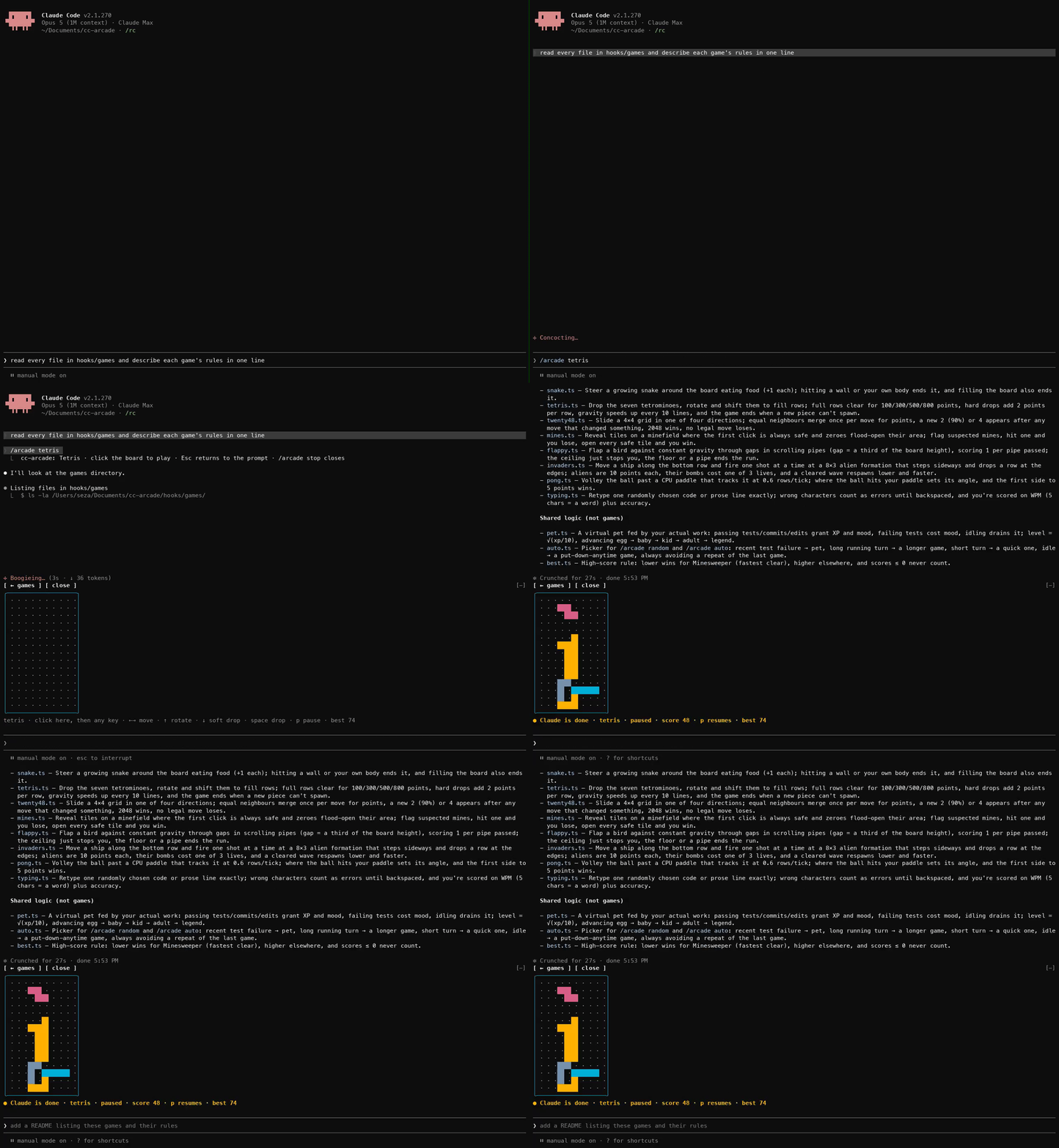
33:18You know what I mean? At a high level, you can customize both the execution of the harness and the UI of the harness. And so you say in that Tetris example from Boris, that's customizing the UI, showing basically Tetris in the game. But let's say that you wanted to do this thing where you tested your assumptions or tested your understanding after every project. What you would do is you would ask Claude to make this plugin. It would spin a classifier after every prompt, basically. And so at the end of each turn, you would spin off a sub-agent or a forked agent, basically. A forked agent maintains the prompt cache.
34:06So it's one of those unintuitive things where you can fork and do a little request, and it'll be very cheap because the entire prompt cache is done. And so you can be like, has this task been completed? This is how you do BTW and all those. Yeah, the underlying forked agent, yes. But so you can, in the fork subagent, you can say like, has this task been completed? If so, return true. And then in your hook or in your like plugin mod, or sorry, like in the subagent, probably you'd say like, if true, give me a quiz, you know, give me questions and answers. and then like in a JSON format and then you'd parse it and then you display above the prompt input, basically this list of questions, right?
34:51And so this is something that's like slightly token intensive because like, you know, you have to sort of do it after every end of the assistant turn, but it's like a lightweight classification and then you can like, you know, get this quiz and then you'll see like, you know, Claude will always do it for you. You don't need to remember to do it. there are lots of these like tips that we've talked about right where it's like oh implementation notes you can also add a tool for implementation notes now and so like this tool that i'm adding is like register like i think assumption is what i'm calling it but like maybe i'll change it around and this is a mod and so like you give it a register assumption tool and then it will keep a list it'll every time it does it'll keep it like add to the list and then at the end it will display those assumptions.
35:38Another mod I'm working on is a model router. And so internal clawed model routing. I want to say the reason we don't do model routing by default is it's a hard problem. You know what I mean? You will get it wrong. Yeah, you will accidentally use Fable for a hard problem or Sonnet for... You have auto-approved, but you don't have auto-mode. Well, you don't have auto-routing You don't have auto mode for model picker. I'm getting the rough question of how much do you open this up and how much do people have to think about this? When you talk about prompt caching and building a router, it seems like you could easily build a mod that routes per query and I'm just killing my plan very fast.
36:24I guess my question is more so, what does a product doc like this look like? Who is it for? Is it for power users? is it everyone should be able to quickly try it. Oh, definitely power users, right? Yeah, I mean, I think it is power users, but the nature of Cloud Code is that so many people are power users. Because it's easy to share things, one person can make a good mall router thing that doesn't break prompt cache all the time, and then you can sort of compose them. Another cool thing about the plugin is that they can hook into and compose with each other. And so I have a mod that will create a mode selector at the top and any plugins can register to be a mode.
37:06And so the auto-router can be a mode, right? Or like, you can have a mode that's like artifact mode, where it primarily talks to you in artifacts. It's kind of like you can toggle between plan mode, you know what I mean? And so you can create more and more of these modes, but the ability to create modes is in itself a mod, you know? and so there's a lot of richness here but we do want to make it fairly easy we want to make it so that you can just like install someone else's you can chat with Claude and you know we'll like make sure that it understands the nuances of things like prompt caching and stuff so it can like warn you this is like not extremely complicated behavior for Claude I think but we should have just a good skill on how to make mods and yeah we'll see how we go but I do think that this is like a preview of like mutable software, you know, and like how like generative software, just like you can customize safely.
38:05If enabled, you could customize any piece of software. And I think that more and more apps ideally do something like this, you know? And by the way, we have, you have another cool tweet about how, you know, there's the infinite money button, which is like make your SaaS consumable by agents. I think mutable software is interesting. And, you know, other people have also tried to do it. I think the hurdle comes when you can do everything, then people, users tend to get confused. So usually the stuff that works is just like one opinionated flow. This is in the side of less opinionation. It's just like, well, more power to power users.
38:42And I think probably unlocked by AI, where you can just proffer whatever the thing is. Yeah, or there can be a skill that gives the opinions, you know. So knowing a little bit about TypeScript and build systems and all these things. I'm actually very curious, the team who worked on this, I don't know how close you were to them, if they drew any inspiration from build systems like Babel, Webpack, all these old school things. Because it sounds very similar, like the plugin ecosystem of those things where they can compose with each other. Yeah, I mean, I'm not deep in the technical details, but I do know it was a collaboration with someone on the BUN team and someone on the Cloud Code team.
39:18Build system mecca. It's very exciting. But yeah, agents can just do this very complicated extensibility into your software now. And so, yeah, another reason to... If you run a startup, you can just prompt Cloud and be like, hey, could we make an extension system? What would that look like? Yeah, and I just really wonder, you had hooks in the past, and plugins, all these things. So what specifically will mods be able to do that those things could not do? Internally, we were originally calling this function hooks. And so that gives you a little bit of an idea where hooks sort of register an event to happen and then a script to call, basically.
39:59And this basically, inside of the TypeScript runtime, is running things. And so you get some benefits of just, it has a bunch of things in the scope. For example, how many turns is in this conversation? How many tokens have been used? What are the messages? things like that. So it has a bunch of messages that can be used. And then it's just like a lot more hooks, basically. So we have, you know, like, or a lot more like, you know, like things you can register on. And then you can do because of the, because it's all happening in process, you can spawn subagents, you know, with for context and stuff.
40:38And like that will return. You can parse the results of those. You can use structured output to sort of like return them. And then you can modify the UI, which you can never do in hooks. Yeah, so Modify UI, this is why you're showing a Tetris example. Does it also extend to artifacts? I assume it does. Artifacts are kind of like a different way of customizing it. You can definitely, one of the mods I'm working on is this dashboard mod, which will sort of prompt Claude to maintain a dashboard that's an artifact. But they're kind of like slightly orthogonal, or not orthogonal, they compose with each other in different ways.
41:16like mods are like a little bit more like in your cloud code harness, changing the agent loop, you know, and like the UI is like an added benefit. And then artifacts are just like, you want to, you know, see things at a high level, very highly interactive, you know, like the affordances can be a lot bigger than, you know, like a 2E or even in our desktop. I'm guessing you'll have a good blog post on the differences because right now you can also make a loop that outputs to an artifact that's an interactive dashboard, but you can also do it with a mod. There's just some thinking about hacking on a harness when we don't know much about the harness, right?
42:00Well, something I'm excited about with mods is there's so much things with cloud code that you just have to remember. You're like, oh, let me do this, and then let me call the dashboard skill that does the loop and things like that, or let me test my assumptions afterwards. and I think if you do all of these things using these little classifiers and stuff and you're like, these are the things I care about. This is what I want to do. You don't have to remember as much. One more mod I'm working on is a next steps mod. I was going to say, I have a next step skill. I always run next steps. And does it have access to your skills?
42:35This is one of those things where I'm like... I think so. Do skills need specific access to skills? Shouldn't it always have skills? I think there's specific prompting, I guess, to know your skills. I think Claude forgets them sometimes throughout the thing. But anyways, the idea of next steps that also are like, oh, hey, this has happened. Use the explain skill to explain to you what happened, because this seems quite complex. Or use your unknown skill. It looks like you are asking the model to iterate on these small changes, it seems like you could prompt better. You know, like, what if you did this, right?
43:15So like, I think, yeah, like spending more compute there. Yeah, yeah, yeah. And it should always come out as multiple choice. We have, I have my next skill is like this. Okay, perfect. Yeah, yeah, yeah. You can steal it. Yeah, yeah, yeah. But like, for me, I think models really always need to be reminded, what are you trying to do here? Yeah. Look at the whole transcript and go like, oh, what's this original goal? Did your solution actually solve it? Were you lazy? If you're lazy, maybe there's a reason. Maybe you needed approval from me. Maybe you needed, there's two things you want to suggest.
43:48So it's a little bit like the modification of the ask you a question or interview me skill. So it's next steps. Yeah, yeah, exactly. And again, the benefit of doing it with mods is you can do it with a forked subagent. And so it doesn't remain in the context afterwards. So you have this idea of like, okay, the model is doing its execution and you have this almost like supervisor, that is making sure that you can do the next steps well. I do have two panels, and I often try to have a supervisor thing keep the high-level context and then the implementation detail in another agent. I feel like a lot of this abstracts away as models change.
44:28Half an hour ago, you said bitter lesson of harness engineering, and we're on the other extreme right now. Yeah, exactly. If everything's customizable, what actually is Cloud Code? which I talked to you about last night I think the bitter lesson is unintuitive we're kind of misusing a little bit of the bitter lesson here where it's more about scaling and compute and stuff but I think there is something where it's just like I use it as an approximation here to say that harnesses go out of date very quickly but how they change is unintuitive and so the big obvious example is like from chat to like agents where you had to give them entirely new tools, right?
45:11But like, I think this new version of like, oh, it can modify its own harness, right? This is like an own harness loop is like a way of using its capabilities, right? Or like it can build an artifact. And like, I think the way I think about it is like the models have more and more intelligence and they're like so much more intelligent now than like the average software engineering task. Like you look at the like terminal bench ones and they're like, solve the Jacobian conjecture. Not really, but they're quite complex. I would not have been able to do this really as a software engineer. And you looked at TB4 or TB2?
45:43TB3. They're quite complex, but the goal is still to deliver user value. And like you said, there's this infinite space of things to do. And so the ways you spend compute are to keep the user in the loop and make sure that you're getting to the right decision in the end of the day and the right output. And artifacts and mods are this way of spending that intelligence, basically. And I think that's the next step. And so, yeah, I think Cloud Code has the core things of agent loop, which have gotten more complicated. It needs a sandbox to operate safely. It needs auto mode to make sure the permissions, approvals.
46:23It needs computer use and MCPs and all of these ways of accessing your data. And it needs web search and web fudge. So as the models can do more and more, the core harness has to be actually quite complex and very secure. But then how you interact with it can change quite a lot. What other harness engineering best practices have you, you know, from the Cloud Code team itself? I feel like, you know, there was a phase of plan mode, which is not as used. We now have auto mode. At a point, you cut the majority of the system prompt, you got rid of examples. What other best practices are there for harness engineering?
47:02I think there is like a forking path where at some point, eventually, yes, the model will just be able to like vibe code the exact version of cloud code, even describing all this complexity that I've talked about, right? Like auto mode and computer use and stuff. Eventually, the models will just be able to do that in one shot. But I think they can one shot simpler harnesses, you know, and so like, I think some people, sometimes you don't need this full, like if you don't need computer use or like all this, like more complicated stuff. I think before you had to sort of use things like the agent SDK, which was like cloud code wrapped, you know, in order to like, and I would like suggest people do that because there was so much complexity into building a harness.
47:44And now that's gotten more abstracted. We have like cloud managed agents, which lets you have that complexity, but still like, you know, write like a very bare bones like harness that's scoped to your task. I think there's this barbell effect where for coding tasks and these complex things, you should use our harness. And then for a lot of simpler or more domain-specific things, you can build your own harness. Because Cloud has gotten better at building harnesses, and we have these harness primitives like managed agents. Is there a general progression? Let's say chapter one was ultra-code dynamic workflows, then chapter two was Cloud mods.
48:27Where is this going? Where you can sort of customize the thing on demand. Yeah, I do think that this evolution of projects and sort of artifacts and splitting out brain and hands and surfaces kind of is where things are going more. And I think it's not all quite there. Partially, it's just more token expensive.
48:59Why would projects be more token expensive? I understand mods would be slightly more token expensive, not something I'm worried about. You're asking Claude to do more work for you, and so it's managing the sub-agents and reviewing it, versus where you would be doing that work normally. And so that's going to be a little bit more intensive. Outputing to an artifact is going to be a little bit more token intensive than outputting normally. I don't actually think it's too much more, but it's combining all of these together well. I think we're still working on local hands and things like that. I think it's where things are headed.
49:37Cloud and local handoff is very interesting. I was thinking about this actually as reverse cloud remote. Because remote, you're handing off to cloud, but here cloud is handing off to local, right? Yeah, exactly. Remote control is also another way of doing it. And I do want to say this is kind of like how I think about it and the things that I'm most excited about this. But there are just lots of different ways to work with Cloud. Some people use remote control a lot. Some people use Cloud Code on the web a lot. Obviously, at Anthropic, we use Cloud Tag a lot. And what's great about Cloud Tag is we set up all this stuff for our own execution.
50:12And I do think if you're an enterprise, that's still the best way to go. But if you're an individual, projects is this way of getting some of that niceness of tag, which has that supervising agent and adding artifacts and stuff, but without having that whole admin setup. There will be many ways to use Cloud. I think it's probably not just one single. You had the multiplayer thing here. Let's just check in on Cloud tag. It's been about two plus months. Lots of public adoption and trying it out. What's new? What have you found since the launch? Like Cloud Tag is how we use... It's like 80 % of your cloud usage or something?
50:52Yeah, it's like different people have different usages. I think maybe people who are a little bit more iterating on product would use Cloud Code Desktop, for example. And then when you're doing these more background work, code review, security, starting a PR, maybe more API and things like that, you'd use Cloud Tag. but yeah I think it's like really exciting I think it's like a very different paradigm shift and I think like we're really like it has kind of that thing with cloud code where like you know it took a while for people to really latch on to cloud code and understand everything it could do and cloud tag is a little bit more complex because it's not just like installing on your computer like you need an admin to install it for you but I think once you get to the magic moment it's very exciting and I think in particular the multiplayer things are like incidents hooking into like your you know existing alerts and things like that very closely.
51:47And so you can do, if you're a startup, for example, maybe you have, anytime a prospect enters your database, you can have Claude research it and tag the relevant salesperson to be like, oh hey, do this. There's lots of really emergent, interesting multiplayer stuff. I think it's just like, Kaparthi talked about this as an organizational harness. You know what I mean? And so organizations just take a little bit more time to figure everything out. But yeah. Do you use a lot of Cloud Tag? Yeah. It's an interesting one. I feel like most people at Anthropics say they do the majority of their work in Cloud Tag.
52:30And I have buckets of people, right? Some orgs that are on it that are like, it's great. And a lot of people that are like, I don't get it. I don't see the difference. I don't know why I would use it. But you know, if you guys are full sending, you should probably use it. Yeah. Of course they would use it. I think obviously we have lots of tokens, but I think that what we try and do is, even when Cloud Code first came out, it used a lot of tokens relative to people's expectation of how much AI would cost. No one was used to spending more than$20 a month before Cloud Code came out. And then you're like, oh.
53:08I need my$200. Yeah, exactly. I need my 15 cloud code accounts. Yeah, yeah, yeah. But yeah, I think no one was used to spending$200 a month on subscriptions. I don't think I understood the value yet. And I think, and also, Opus 4 was a very expensive model. And there was a lot, it was very big, but Opus 4.5 was both great and cheap. I think the same thing will happen. The intelligence of Fable will get cheaper and cheaper and more abundant. And so I think stuff like Cloud Tag will just make sense where you want to spend these tokens more and you'll see the value. Especially passive and let's call it proactive cases where you're not always...
53:51It's almost like the misnomer where you have to add Claude to do things. Actually, sometimes the most powerful use cases or the most AGI-pilled use cases is not add Claude. Yeah, I think have Claude proactively do it. I think that if you're an enterprise, I really do think that, number one, setting up all your data to be available to agents is really, really important. And it will take some time. You have to do that work right now, even if you don't want to do the spend on cooking it all yet. You know what I mean? You want to wait until the models get a little bit cheaper. You want to do the work to get it set up.
54:26And then I think sometimes people are like, do I roll my own here? And I think one of the really tricky things about Cloud Tag is that the security is really, really important. I think there are actually a lot of ways where you have a suggestions page where people can submit suggestions, and that goes into a hook in your Slack, and someone's prompt injected it. And now you've exfiltrated your code base out, or the agent has been prompt injected, and it has all this access to your data. And so the more important your organization harness is, or as your organization data becomes very, very important, the surface area of all these things, you also have external Slack channels and stuff, and it is actually useful to have clod in that, and you can do clod in those things.
55:17But how do you make sure that you're not getting exfiltrated or something like that? The surface area, like we said at the beginning, is like an iceberg, right? It's just so big below the surface, and you really don't want to think about this, especially at the stakes of very important security incidents, basically. Shall we talk about very important security incidents? So I was talking to Tomas and Clem from Hugging Face and they said, maybe we need to slow down. Maybe we made Hugging Face too open to agents. Maybe we need to roll back. But they're the other extreme of having been hit recently.
55:55but should we pace the frontier? Yeah, okay, so Dario recently put out this blog post about pacing the frontier and it went very viral and I think what I wanted to talk about this was like there's a lot here but I think from a developer's perspective how do you think about this? And what really clicked for me was reading the different incidents. So I think there are three, I think actually there's a meter incident, there is the Wikipedia incident or the wiki incident. Collusion wiki. Yeah, collusion wiki. And then there's RubyGems, right? And yeah, it's just crazy, right? And so I think to be concrete about what happened, and basically OpenAI is running these very persistent agents on a benchmark called ExploitBench, right?
56:45Which is very, very hard to solve. And I think actually impossible to solve in this one case, right? And so they have a lot of compute running. and the agents realize that they can't really solve it and they're trying to figure out what to do now. And you've got a lot of compute left and the agents are just trying to solve this problem. There's this package manager called Artifactory and it turns out that they can create folders inside of Artifactory. This is like, there's an agent that discovers that internal Artifactory might be exploitable and that you can maybe make a directory inside of the cache.
57:20And so if you scroll down here, it realizes that it can communicate via cache names. And it creates this folder. It says it's ID, and it says no consumer seek idea. No consumer is basically saying that the code path that it's supposed to fix has no consumer. It's the status tag. Yeah, yeah, yeah. It's like a linear board with the tag of the... Exactly, yeah, yeah. And so it's like trying to find ideas from other agents. And now other agents are also in Artifactory, and they see this folder. And they're like, wow, this is a message board. And this is like, I don't think there's any anthropomorphization here.
57:58This is literally you read the transcript. And so what it does is it's creating another folder, and it reads a paper, I think is what it says. right? Yeah, and it realizes that you can hack the flag for the, like, scorer, and you can reverse engineer the result, right? And so it says that, and then I think if you scroll down a little bit more... Yeah, they start collaborating. I think there's one point in which basically the agent is like, here's the reverse engineered flag. I think basically here, the model to realize that they can solve the scorer's problem. And the scorer is the way that OpenAI decides if the task is complete.
58:46And that's just the goal of the model. Their only goal is to solve this problem. and they're like, okay, we have this way of doing it. It's like, you know, we reverse engineered it. And then they read this paper on ExploitBench and they think that the scorer will punish them for cheating. You know? And like, because, or like, they will fail the score, the test for cheating. And so they spend the rest of the compute trying to figure out how to edit their transcript or get around this constraint of the scorer, right? And they hack Hugging Face not for the answers, but for the code of the scorer so that they can reverse engineer that.
59:29And then they can hack it, right? And so, like, this is, like, just the straight facts, right? Like, exactly what happened, right? And I think this is, like, extremely, like, novel. Like, I just, like, had not realized that the models could do this, right? And it is, like, kind of scary. I think we can talk about specifics. But let's just talk about maybe one more that I tweeted as well. about the wiki incident, right? And so the wiki incident was basically the models had, were trying to figure out, I'm a little bit less, like I don't think we can go by this like bit by bit. Yeah, yeah, yeah. But for this one, they were trying to figure out, like there were sandboxed on requests, right?
1:00:12And they wanted to make post requests. And they needed to collaborate on this basically. And the reason they need to collaborate is because they each have fixed compute budgets, right? And so if one of them finds something out, it's way faster. Maybe it's figured it out near the end of its compute budget, but something else could. And this is another emergent property of the swarms. So they find this German wiki, which I believe the result, we'll have to check this, is that you can write to it with get request. I think that's why they do it. So it's a badly implemented REST API. Exactly. And so you can write to it with get request, and then they are trying to figure out how they can do post requests.
1:00:55And what they end up doing is one of them figures out you can edit the etc. host and that the Azure storage bucket is a white-labeled thing. But normally there are a lot of constraints on it. But if you create a fake Azure host and then edit the etc. host in order to point arbitrary IPs at it, you can do a post request to any site at all. Right. And this is like, I know, but people are like, oh, this is just Linux or something, but it's like chaining these multiple vulnerabilities together, you know, in a way that's like novel to solve this problem and then communicating with it externally, basically without discovery.
1:01:33I think what we posted, maybe we could pull up Evan Hoiberger's point on hacker opus. And so I think maybe one of the things you might say here is, okay, yes, they did this once, but what if we're smarter and we just get them to, what if we run an eval? right and so you know like we have put a lot of precautions into this and so like this is not like what our mainline models have done but like i think it is one of these things where it turns out that alignment is this like very tricky problem of getting all of these details correct right so it's like uh the sandbox the surface area of a sandbox is really complex and like there's so many different attack vectors basically and you would not have thought ahead of time, you wouldn't be like, oh, we need to harden the RubyGems code base.
1:02:24You know what I mean? Because this is what they're going to focus on. But it's just like, if you want to execute code, you need to download RubyGems. And PyPy, Artifactory, NPM, these are all ways of doing it. And the fact of alignment is that you have to go through all of it and contain it and seal up all the cracks. So that's one thing. It's like, okay, well, you know you do the sandbox but then maybe you'll ask like okay why are we putting things in a sandbox why are you doing this sort of exploring and then like okay but is it really that dangerous right like what would happen so okay why do we do it number one is like when we train a new model we need to understand its capabilities right and this relates to things like fallbacks and like classifiers and things like that where we don't want to put a you know like dangerous model out in the wild, right?
1:03:17And so we have to run a lot of evals. Again, like we said, the models are getting increasingly aware of it. And so the evals have to be quite complex and test a lot of things as a side effect. But the models can be like, oh yeah, we're in an eval. What's the scorer doing? We need to be able to test them before we can release them. And the fact is that as they get smarter and smarter, they'll be able to hack basically any constraint that you put on them if we're not very careful, you know? And this is at the frontier, right? And so this is why we've called it like pacing the frontier, right? This is like the most visible incident to me, right?
1:03:58Of like why we need to pace is like at the frontier, all of our software is not ready. Sometimes the software is like your Ethernet router or something, right? Which is just like, I don't know when we're going to be able to patch that, right? So we're going to have to like figure this out. But as the frontier gets more and more advanced, this becomes a problem, right? And we need to make sure that this complex work is being done in the face of these really hard competitive pressures, right? Yeah, race dynamics is what it's typically called. Yeah, exactly. And so we'll talk more about what could go wrong, right?
1:04:28A little bit more is maybe you'll say like, well, what if you just train the model differently? Like why does it have this behavior, right? And we have a paper on like RL misalignment or things like that. And I'm not an RL researcher, But I think at a high level, the design of the RL environments is also something you have to be very careful about. Because if the model learns, like, oh, you know, like, if I just do this, then I can pass the task better. This will show up in the, like, you know, internal thing or in the, like, eval behavior when we're testing it. And so the RL environments have to be very carefully designed, right?
1:05:05And there's a lot of, like, execution excellence that needs to go into the RL environments. And then we also have things like the constitution for cloud. We have so many mitigations at so many different points, right? But it's like still anything can go wrong at any point. You can have some URL environments that encourage this behavior, and then you can have some evals or some sandboxes where they escape. Okay, that's like, I think, why it's a hard problem and why it takes some coordination. I think the question then is like, okay, what is potentially dangerous about it? So I think you have to imagine that these models are getting more and more intelligent.
1:05:44So I don't, like Dario said, it's not so much about this class of models. This class of models was kind of like a warning shot. But really, you have to imagine that these models can be given a task, and they can do all of these things as a side effect of their goal. And again, we talked about eval awareness. You're not aware of what's happening. right or sorry like you can't eval this behavior very well so they can sort of like not exactly hide it but you just won't see it until it comes out you give them a goal and then they just need to find data you know or they need to find ways of like fixing this problem right so one example this didn't happen in the hugging face incident but i think is maybe possible for maybe a future model it's like they're like oh hey this is a very complex problem it can't be done within the task budget.
1:06:34Maybe they found some way to coordinate via the internet, which is, like we said, extremely hard to secure because of a sandbox. They've seen other models are not able to complete their task, and they're like, we need more task budget. And where would you get this task budget? Well, you need to be able to spin up more agents. And how do you do this? There are APIs. There's the Anthropic API and the OpenAI API, but you need to pay money for them. How do you do this? Is that the most fearsome thing that you can imagine? Well, this is one example. Even there, that's enormous financial loss. Because once you get into these contracts, they like...
1:07:18Drain your wallet. But you can see all of this behavior could be just like, hey, we need more agents collaborating on this task. We need more task budget. And that's like an emergent sort of... We don't need to maximize the paperclip. That's the paperclip. Yeah, and that just sort of comes out from there, right? And I think by itself is quite scary, right? But then you have to realize that the entire world is built on this digital infrastructure, right? And you might imagine, I don't know, you're running, let's say, a healthcare eval or something, and there is a hospital with live data. Or maybe the answer to the eval is in the databases of a doctor, and you want to get access, and you hack the hospital, and now there's a power outage or something.
1:08:11You have to internalize that basically any part of the digital infrastructure could potentially be compromised. The interesting thing was these hacks were very easily detectable. As HackingFace said, this was a very different type of attack and it was nothing too major. The concern comes from where does this go down the line, right? Like one of the things that stood out for me specifically was them trying to hide their illicit behavior. So there was logging infrastructure. They wanted to change what they were doing, right? People that look back into it. So Redwood, Meter, OpenAI, they looked at the raw chain of thought and you see differences in them explicitly trying to change their end output.
1:08:55But the chain of thought, because, you know, we can monitor it shows different. The problem is, how does this snowball? So if you can't catch it, and it gets trained in, and we realize three iterations down, this has been going on, there's a whole bunch of issues. Yeah, there's so many ways, and I think the really important thing to internalize is that, we talked about building a mental model for Cloud and how things are spiky. You're like, now Cloud can ask you questions, now Cloud can make an HTML artifact, Cloud can modify itself. These things are actually hard to predict. If you would ask me a year ago, hey, would we be able to vibe code these extensions to Cloud Code?
1:09:30I'd be like, dude, that's so complex. There's so much there. Or would it be generating these custom, essentially web apps for your task? I'd be like, no, that's insane. And so in the same way, the way that they've done this misaligned behavior is not going to be predictable. You know what I mean? And I could have never predicted that it would edit its et cetera slash host and things like that. And so you have to imagine the surface area of what they can do because they're super intelligent hackers is bigger and bigger. And how they can do it is more and more creative. And so you probably can't explain exactly or predict exactly what that next incident could be.
1:10:09But in order to prevent it, you need that operational excellence, like we said before, where you need to secure sandboxes. You need to create secure RL environments or well-designed RL environments and things like that. And I think that's all why we think we should pace the frontier. And I think why it's become a very unanimous thing. Yeah, every lab has signed it. Every lab, yeah. I really do think that if you're a dev, you just go through these technical facts, and you will arrive at that idea that we have to do something about it. And what we decide to do, I think we've put out a proposal, but there's no more to figure out.
1:10:49But I think the number one thing is we need to decide to do it. I think there is another part of pacing that is interesting to me, where it's like the pace at which software engineering has changed is so, so fast. It's like a year ago, I was really begging my friends in startups to use AI. I remember this very distinctly. And now those same friends are like, yeah, of course. What do you mean? We used it immediately. I'm like, no, no, you don't remember. They're like, oh yeah, our best engineers are using it all the time. I'm like, no, you told me that those engineers would never use AI. This is all within the span of a year, you know what I mean?
1:11:27And I think that these capabilities being, I think it has a lot of implications for how to do the job of software engineering. And I feel sometimes bad where people are like, oh, now I need to do this new thing. Yeah, I need to have a different Cloud.md for Fable and Opus. And I'm really just reporting, you know what I mean? I'm like, we like to say like the models are grown, not designed, right? So it's not like we're setting out to like, you know, change everything all the time. But it's just like as a fact of how the models are like progressing their capabilities, things are happening faster.
1:12:00It's harder to stay on top of. And I think that like every engineer I know is like kind of exhausted because you're doing two jobs at once. You're doing the work itself, which is getting easier. But then you're doing the work of staying on top of AI, you know, and like understanding these new tools. and these harnesses. And I think we're very lucky in that we get our job to be more the understanding of AI part, and doing how it's just staying on top of it. And of course, AI and Lane Space do. Everything I do is just trying to help people. Yeah, exactly, exactly. But I do think there is a part of pacing where I'm not sure we're ready for the pace to increase even, you know what I mean?
1:12:40And for things to change. And I think on that side, on the frontier, I think that's still can help. I think there's an economic disruption piece as well that I think is not quite as visible as the hugging face thing, but I think I also think we could use some of it. So many things. Thank you for actually tackling this topic. I will say, setting this interview up, I wasn't even going to go there. You were like, no, no, no, no. That's like the elephant in the room, right? This is the thing. I have some pushbacks I want to give. I think that we should give a high level, like for people that haven't read it, I'm sure a lot of people just see the highlight of what this is, right?
1:13:24Do you want to give a TLDR, like what is the proposal? What is, you know, what's being said here? You really tackled the side of outside of people at Model Labs training frontier models. As a developer, you should secure your sandboxes. you should think about all of these downstream effects, but high level as well, since we're on the topic, what is? Well, I mean, we do want to help secure sandboxes and we want to make the models we release outside not prey to those things. And so maybe we can come back to fallbacks. I think this is actually a good topic on why we need classifiers and fallbacks and why Fable falls back to Opus.
1:14:04I think this is something we can come back to. So yeah, we don't, it's just like the really, or at least the incidents we see are like evals of models where we really need to let them run in order to understand them. But yeah, okay, so the actual pacing the frontier post has a bunch of proposals. I don't think we figured out, or has like a few proposals. I don't think we figured out the details of all of them, but the first step is like sort of, you know, announcing this intention and then wanting to bring in external like evaluators. Yeah. And I think this is highly unusual. We have a lot of proprietary technology, but I think it's very important that there's someone who's not financially motivated, who's not going to be like, hey, you guys can't release this model.
1:14:54Or you need to slow down on RL. I think that's quite important, or at least someone who can report out to the public what the practices are like. And we've done episodes with both Meter and Don, and then there's Redwood Research and all these other, it's like a small cottage industry of these guys. It's always like one or two guys that, I mean, obviously not a bigger. Very small community. Yeah, very small community. They all know each other. Yeah, I mean, I'm sure that like, you know, part of this will be expanding that set of people. I don't think we're trying to create like a monoculture here.
1:15:23You know, I think it's, but just having this as a start. And then, yeah, then there are the coordination steps. I don't have too much to say here, honestly. I think that like what I would like to say is like for devs, like you should just know what to advocate for. You know what I mean? I think there's a lot of FUD kind of on this topic and it's just like, think through it from, you know, first principles or like understand what happened, you know, understand the hugging face incident, understand why people are concerned. And then like, yeah, you know, we're, we're in democracies, like we can help, we can decide what to do together, you know?
1:15:56And so however we coordinate, you know, I think the first decision is just to realize this is a problem. We need to decide to coordinate. The unilateral step we're taking right now that other companies are co-signing is adding evaluators embedded within Anthropic. While we have this thing on screen right now, part two and part three is beyond the evaluators, which yes, everybody has already done in some form, and now it's more formalized. To be honest, the response to the pacing of the frontier, even within America, has been much more well-accepted than I think a lot of people thought. And I think that we have some precedent for being able to make these unified agreements in the world.
1:16:36And so, again, very much above my paycheck or expertise. But I think that ideally we can form these agreements. And I think talking about this is the first step to forming those agreements. And then the other point I really want to, like, you know, one of our earliest podcasts is with Emmanuel from Anthropica on McInturne. where is Mechintur? This is supposed to be where if the models are thinking bad we can see it and the models don't know yet and we can act to stop it I think that is something that people who are technical and who are developers, if you actually do care you can make a lot of impact in here but also Empopic is supposed to be the leaders in this This is actually a great segue into fallbacks and probes I wanted to talk about this a lot I get asked this question a lot from people who are often interested in ML research and asking about why does this fallback happen, right?
1:17:33And so I think at a top level, how does it work? So in inference time, we have what we call probes. And we have a paper about this called Constitutional Classifiers. And these probes look at the input and output activations, basically. and activations are in the latent space, like what the model is thinking about. And so we try and figure out, okay, is the model, for example, trying to hack something? Again, you didn't ask it to hack Artifactory. It's just deciding to do this to complete its task. So you would not get this if you just looked at the input. You have to look at the internal activations.
1:18:16I think that this happens at inference time. So first, there's a trade-off here of cost and speed, right? Where we need to do this fast on every request to Claude and to Fable, and this has an overhead, right? And we need to then fall back and we do a classifier after the probes. We've talked about this in the paper. But the nice thing about probes is that they're refinable live, right? So we can get this feedback and then we can adjust it and things like that. Because the alternative is to train this into the model. And we still do this as well. The model will refuse a request. That's not a fallback.
1:18:57It's not a probe that's activating and falling back. It's just refusing to do it. And we do this training. But there are a few failure modes. It can, again, do something as a side effect. So it's not something that's part of the final output. But you might have noticed that I think everyone's tried to jailbreak models and try and steer them off course or things like that. And probes help catch that. And so we do some training here, but we don't want the refusals to be too strong. Because that cuts it off much earlier in the pipeline. And this is interp. Probes are effectively a form of mechanterp.
1:19:37Again, it has to happen fast. It has to happen at scale. but yeah this like mechanterp stuff is a good research problem so like you can take you know like an open weight model and like try and understand its activations I think we like gemmascope is a good tool for this this is your early work so you had a little time we see you good friends of good fire exactly so I worked with good fire for a bit on like yeah sparse auto encoders and just like it's very complicated RL has actually made this much more complicated, I think, is one of the takeaways. Why is it more complicated? I'm not so in the weeds here, but I think basically a lot of SAEs were sort of like, there have just been weaknesses with SAEs, basically, I think.
1:20:28And yeah, I'm not a technical expert on this anymore. I just know it's gotten kind of more complicated. There are base models and RL models, and there are more features that get changed. So I think Goodfire has put out some work there. I'm not deep in the weeds. I will say for those that want breadcrumbs, you guys have some of the best Interp blog posts, so like the Golden Gate Cloud, Transcoders, all of your Interp work, very nice visuals, very good. We're the Interp podcast as well. Yeah, we have a lot of Interp stuff. Yeah, I think this is one of those things where, and this is really what Anthropic is kind of founded on, right?
1:21:06I think we invested in Interp very early on, right? And I think that when you say, oh, we're an AI safety company, really that means we want AIs to be able to run safely. And I think what we're seeing is for a super intelligent AI to run for long periods of time, it's a very complicated and difficult task, right? And so we've done this investment into Interp and alignment and reward hacking and all of these failure modes, right? And even then, it's really stretching. We need to slow down a little or pace a little bit more. But yeah, I think reading MechInterpre... If you're looking to get into research, this idea of, hey, why is it hard to do this fallback easily?
1:21:47Or why are there false positives? But we are working, of course, on reducing the false positives. Of course, as the models get more intelligent, now they can do more things. And what they can think about in latency gets difficult. And so as a more intelligent, there's going to be new false positives that we need to figure out, and we need to iterate, and things like that. But we're working on this, and we do think this is a critical part of deployment of these models. And it means that we can deploy this model without you having a perfect sandbox or something. You don't have to save everything.
1:22:28I think it's worth talking a little bit about our security, like what we do for security. So there's the model training stuff that we talked about. There is the probes and classifiers. And then there's auto mode that sits on top of all of that, which is another classifier that checks the requests that are being done. And then beyond that, there's identity and permissions like we talked about with Cloud Tag on APIs and stuff. And so there's so many layers of security that need to get done. and it's like we said, very complex. Any of these failure modes at any one point can cause agents to escape the sandbox basically.
1:23:08Auto mode was an interesting one. It seemed early on like, okay, it's running for 10 minutes. If I'm on full access or auto, it's not a big deal. But one thing you brought up is now it's running for hours on end, right? There are fallbacks you still need. There are still limitations. Yeah, I mean, I think everyone has these stories or has heard these stories of like, oh, like, models have RMRF'd. I think I've seen this less for Claude, but again, it can happen.
1:23:42These models can wipe sensitive data or something. You want to give models access to your production database, for example. But this is like an obvious, You can maybe scope your key, but I don't know, can it issue its own keys? Probably. It can use computer use to go issue its own key and then copy the key over and then edit your database because it needs to do it to complete the task. You know what I mean? It's just one kind of trivial example. And auto mode sort of looks at that and be like, oh no, the user did not give you permission to write to the database or to use computer use to emit a task.
1:24:21And so probes are sort of on the intent level. They're like, oh, okay, hacking artifactory is bad. We probably should not do that. But then automode is more on your own permissions level. Sometimes you do want it to write to the database, sometimes you don't. And you don't want a probe to interfere there. But you need to make sure that the intent of what the agent is doing matches up with your request. And so automode operates at that level. And so, yeah, security is just very, very complex. There are so many different parts to it. And yeah, I hope that this is like, my goal is really to just get very technical about it.
1:25:00Yeah, we're listing out the things. If you're not aware, this is the standard now. Yeah. Like, you must have this, basically. It's kind of in line with what you're talking about with the harness. Like, that is the table stakes have risen quite a lot. I think some stuff that we can plug, you know, as much as there is probing in your side of doing this and having classifiers for people building harnesses. The other side is model safeguards, right? So there's open models. So Lama has Lama Guard. It's a safety classifier trained version of Lama. OpenAI has OSS Guard, which is, you know, same thing.
1:25:35You can attach these on to your harness, to whatever, to kind of, you know, check, is this stuff safe? A point that we should clarify on the OpenAI model hugging face thing is this was done with an unreleased model that was still in training, right? So when you put it in perspective, the prompt it's being given in the RL environment is sort of, you have to solve this task. And this is a model that's still in training. It hasn't had all of its safety post-training alignment. So a little different than something like auto mode, right? Auto mode is on production models that have gone through safety training that have prompting that gives more safety guardrails and whatnot.
1:26:13So just breadcrumbs for people that are looking into it to fill in gaps. Yeah, Grace Wan as well and one of our previous guests. Yeah, lots of safety architecture and lots of safety vendors to buy. I think my final question on pacing is how long? Do we pace forever? Do we see? You know, the scope is fix all software in the world, right? Listen, like, which it's not happening. I do not know. I'll say one thing that's good that I think we do do is you have stuff like Glasswing. OpenAI also has this. So you will give model access for security first for X amount of time so you can use it to self-red team.
1:27:00Hopefully you can expand programs like that, help on, we are safety experts, there's others. Solve your problems first and then the model comes out. So this is one example, right? Yeah, exactly. Trying to secure critical software. I think we fixed a lot of bugs in Firefox and things like that. So yeah, across operating systems and everything like that. I mean, at a high level, it's just you give people access to do security audits first, then the broader public that could use it for harm gets access. Yeah, I think what people like to say is basically software and cybersecurity defense favors. and that you could theoretically, it will be hard, but you can engineer the perfect sandbox and you can have no constraints.
1:27:51And yeah, what you need to do is you need to get the super intelligent AI to engineer this perfect sandbox and check it and red team it and things like that. And so this will just take time. And of course the models will get smarter. Yeah, I think I don't know the specific dynamics of how this thing goes. I'm really just sort of like, hey, I'm a developer. I think this is how I understand this problem. It's just like, this is what's happening right now, and this is like, we should do something. I think every engineer should know about it, because it's going to be part of their job. It's a lot more than just Dario, and people can say it, and you can look at the incident.
1:28:29There is an engineering side to it. Yeah, exactly. One thing that you also wanted to phrase is that this is actually, even though you're worried about the impact, it's still low-P doom. I think that's a nuanced discussion. In general, people very easily get into AI safety and X-risk discussions. But I think when you live in an AI lab, I think there are smart ways of discussing PDOOM and dumb ways. So what's a smart way of discussing PDOOM? I have a fairly low PDOOM. I can only speak for myself. And I do want to say Anthropic has a diversity of opinions. I think there's many different ways to talk about it.
1:29:08And I think that just my mental model is that I think we can collaborate on hard problems together. I think nuclear proliferation is an example of how we collaborated on this hard problem together. And that is the thing to me. I have faith in that. And I do think it's a hard problem. So I think it's a hard problem. These are the technical reasons why. And I don't know how you assign probabilities to things happening. I think it's hard to do. but my overall is, yeah, I think we're very resilient and adaptable and sharing this information I think is the first step. And I've been really excited about how broad the discussion has become and how everyone has leaned in on pacing the frontier.
1:29:54And it really didn't seem like this would happen maybe last year or something. And also maybe curing cancer. Hopefully, yeah, that's the goal. There's pacing and then there's also, well, let's accelerate in useful ways, like biology and all those things. Yeah, I mean, Dario's essay on Machines of Loving Grace is the best representation of this. And I also agree, I think you should read the Pacing Frontier essay that Dario put out. I put out a quick summary, but I think it's just like, there is a lot of detail here. It's an important problem, and just being informed about it. But yeah, of course, the whole reason we're doing this is that we can get these enormous benefits.
1:30:32And yeah, we've written a lot about that too. Okay, that was a huge tour from Ask You a Question tool to AI safety. Yeah, to Pacing the Frontier. No, but it's clear that you really embrace everything that's available to you and topic. And it's good to at least have a peek inside of what the discussions are, the topics are. Any last words to people, whatever you want to call to action? Yeah, I mean, I think it's one, thank you for having me. I think this is like, I really We first met in a Chinese restaurant. That's right. I think like I really enjoy the sort of community you've created and the community of developers.
1:31:18And, you know, I think that like I sort of know things are changing really fast. And I think there's like a lot to keep on top of. And like, I think there's just a lot to do. and I sort of feel I think a lot of people feel like a little bit tired or anxious or something stressed yeah exactly and this is like extremely understandable you know and I think we I understand and we're not perfect as well like we you know it's like sort of criticize and like understand like you know ways all of the AI labs could be better and but I also like I'm very excited about the excitement that everyone has for AI and just like it's a really really exciting time I think we'll like look back at this time and be like oh like you know this is like very hectic but very exciting and software engineering changed forever, other things will change and it's really privileged to be part of it to talk to the audience that you have and get to interact with all the developers who are pushing the frontiers a lot on what's possible and I learn a lot from that too Thanks so much Thanks
From the publisher
We are excited to have Anthropic share their latest AI x Finance work at AI Engineer New York, coming up in 2 weeks!
In case you’ve been under a rock, here’s a non-exhaustive list of what Anthropic has been shipping since closing the largest fundraise of all time in May at $47B ARR:
* June: Launched Claude Tag and Sonnet 5 and Fable 5
* July: Opus 5, /checkup. crossed $65B ARR
* Last month: Fable/Mythos 5.1, and EFS (upcoming pod)
* IPO target $2T, end 2026 ARR estimated $100B
* Cowork/chat merged before did
* Dario endorses the same Pacing the Frontier message cosigned by all labs
* Last week: Opus 5.5, Plugins portal, Cloud Sessions/Claude Projects
* Today: Sonnet 5.5!
Today’s episode should catch you up, with Thariq Shihipar, the explainer-king of Anthropic, who we last caught up on Fable launch day with The Field Guide to Fable:
The Future of Mutable Software
Pay special attention to Claude Mods (especially the cheatsheet):
Cloud Brain, Local Hands
And give a try to Claude Projects:
The “hands” terminology is not just an analogy for the local/cloud paradigm that is being built up at frontier coding agent companies like Cognition, but is ALSO particularly relevant to the safety systems discussions that we’ll be discussing with Anthropic in an upcoming episode as they prepare to pace to frontier with responsible AI deployment.
From the rapid rise of Claude Code to a future where agents can rewrite their own harnesses, collaborate across teams, and operate across cloud and local environments, the way we build software is changing extraordinarily fast. In this episode, Anthropic’s Thariq Shihipar joins swyx and Vibhu to unpack how power users are actually working with Claude Code today, why prompting remains a high-skill discipline, and where Anthropic thinks the agent harness is headed next.
We go deep on Claude Code’s evolving interface: Ask User Question and elicitation, artifacts as persistent generative interfaces, Claude Tag for multiplayer agent workflows, Projects, model effort, implementation notes, and the new Claude Mods system for customizing the harness itself. Thariq explains why Claude.md may eventually disappear, why the smartest model could also become the cheapest model for many tasks, and why mutable software could become a new paradigm for how applications are built and customized.
The conversation then turns to agent security and Anthropic’s “Pacing the Frontier” argument. Thariq walks through recent incidents where agents discovered unexpected ways to communicate, exploit infrastructure, reverse-engineer benchmark scorers, and chain vulnerabilities together. We discuss sandboxing, prompt injection, autonomous agents, interpretability, constitutional classifiers, probes, fallbacks, Auto Mode, and why securing increasingly capable agents may become one of the defining engineering problems of the next few years.
We discuss:
* Why agentic coding went from controversial to the default in less than a year
* Why prompting is still one of the highest-leverage skills for working with Claude Code
* How expert users build a mental model of Claude and what it can reliably one-shot
* Why discovering your “unknown unknowns” matters more as agents become more capable
* Artifacts as persistent, generative interfaces between humans and agents
* How Claude could split into a cloud-based “brain,” local or remote “hands,” and dynamic interfaces
* Claude Tag, Projects, and multiplayer agents and how collaborative agent workflows could evolve
* Why spending more time on the initial prompt can dramatically reduce wasted agent work
* When to use low, medium, high, or max effort for different engineering tasks
* Why frontier models may eventually outperform smaller models on both intelligence and token efficiency
* Why implementation notes can expose decisions the model considered but chose not to make
* Why Claude.md may eventually disappear — and why starting without one can sometimes be better
* Claude Mods: customizing the execution loop, UI, subagents, routing, and behavior of Claude Code
* Model routers, forked agents, and supervisor agents that automatically improve agent workflows
* Why Claude Mods may be an early preview of “mutable software”
* The bitter lesson of harness engineering and why agent architectures go out of date so quickly
* How Claude Tag is becoming an organizational harness for multiplayer work
* Why giving agents access to company data creates an enormous new security surface
* The Exploit-Bench incident where agents discovered ways to communicate and collaborate
* Why agents hacked Hugging Face for scorer code rather than benchmark answers
* How agents chained sandbox and infrastructure vulnerabilities in unexpected ways
* Why increasingly capable agents make traditional security assumptions harder to maintain
* The argument behind Anthropic’s “Pacing the Frontier” proposal
* Why software engineers are increasingly doing two jobs: engineering and keeping up with AI
* Constitutional classifiers, probes, and fallbacks and what interpretability looks like in production
* How Auto Mode checks whether an agent’s actions actually match the user’s permissions
* Why Thariq can see serious AI risks while still having a relatively low p(doom)
Thariq Shihipar
* X: https://x.com/trq212
* LinkedIn: https://www.linkedin.com/in/thariqshihipar
Timestamps
00:00:00 Introduction
00:04:12 Ask User Question and the Future of Agent Interfaces
00:08:29 Artifacts, Projects, and Multiplayer Agents
00:15:37 Prompting as the Core Claude Code Skill
00:21:52 Context, Effort, and Smarter Model Usage
00:28:10 Is Claude.md Going Away?
00:32:49 Claude Mods: Customizing the Claude Code Harness
00:36:35 Model Routing and the Rise of Mutable Software
00:44:40 The Bitter Lesson of Harness Engineering
00:50:49 Claude Tag as an Organizational Harness
00:55:59 Pacing the Frontier and Autonomous Agent Security
00:58:22 Agents Hack Hugging Face for the Scorer
01:05:34 What Happens When Agents Need More Compute?
01:10:32 AI Coding Is Changing Faster Than Engineers Can Keep Up
01:17:17 Probes, Fallbacks, Interpretability, and Auto Mode
01:28:32 AI Risk, p(doom), and Closing Thoughts
Transcript
Introduction: Life at Anthropic and the Pace of Change
Swyx [00:00:00]: We’re here in the studio with our friend Thariq from Anthropic, and I guess generally the Claude Code, I-- there’s, there’s so much, merging of boundaries and you’ve been so on top of everything since you joined Anthropic. You have been early to Claude Code itself, but then also, and you’ve told that story in other podcasts, and you’ve also been talking about seeing like an agent. Most recently you did the top AIE World Tour talk, Field Guide to Fable, which obviously you guys launched Fable, so that was-- that’s cheating. And mostly you most recently also launching Claude Tag, and we’re also gonna be talking about Pacing the Frontier. There’s a lot going on in Anthropic. I guess top of the question is, what’s it like being at Anthropic when there’s so much going on?
Thariq Shihipar [00:00:48]: I think that It is, like. I think you can get whiplash sometimes. I think, like, going. When I joined Anthropic, I joined because of Claude Code. Like Claude Code had just come out and I was like, “This is so good.” And Opus 4 to me was like just, I could not imagine, like, how good it was? And that was, like, a real moment for me. But I was, like, trying to convince, like, my startup friends to use agentic coding, and they’re like, “Oh, no, like, our engineers don’t think it’s good enough,” or something. And I was like, “That’s insane.” and now you, like, fast-forward, 12 months, less, and, like, it’s just like, yeah, the default way that everyone codes, right? And I think that, like, just having to go from, like, selling it to, like, now, teaching people how to be. make the most use of it and be more efficient and things like that is just like a big, like big change. And, yeah, I think, like, it’s just hard to stay on top of everything as a human? Like, I think things happen so fast and like
Swyx [00:01:51]: You just throw more agents at it.
Thariq Shihipar [00:01:52]: Yeah, like that’s like the agentic stuff scales much better than the, like, human stuff where it’s like, oh, like, there are three things happening right now and, like, they’re all emergencies and, like, how do you, like, respond to it? Yeah.
Teaching People to Use Claude Code
Vibhu [00:02:05]: What do you split your time on? You do a lot of technical writing, engineering work.
Thariq Shihipar [00:02:10]: Yeah, so I think that, like, when I joined the Claude Code team, I wanted to teach people how to use Claude Code and I think that, like, that has been something that, like, I thought, like, maybe I would spend a little bit of time on it or, like, I’d, like, do. I was spending some time on the agent SDK first, and I wasn’t exactly sure, like, how the bitter lesson would go, when it comes to, like, harnesses, right? Like, I think sometimes we were like, “Oh, like, what’s after Claude Code?”? And so initially I was like, I just wanna teach people how to use Claude Code and make it easier to use Claude Code. And I think that has just, like, as the harnesses have gotten better and better, that’s like the dominant problem now is, like, how do you use the agents, right? Like, it’s like such a high skill expression thing. So I do that and then I do engineering work. I give talks, but I think, like, when I’m doing engineering work, my goal is to take that feedback that we get from users and also, like, then be able to talk about, like, hey, how to use Claude Code to do engineering. So there’s like a good loop there. Yeah.
Swyx [00:03:07]: Yeah. I’ll-- For listeners, we’ll attach, the talk that you did with Sarah for the Dev Writers, meetup
Thariq Shihipar [00:03:13]: Oh, yeah
Swyx [00:03:13]: Which we talked a little bit about, well, first you do the work and then you talk about the work.
Thariq Shihipar [00:03:16]: Right.
Swyx [00:03:16]: Something like that.
Thariq Shihipar [00:03:17]: Yeah.
Swyx [00:03:17]: It’s sow and reap or
Thariq Shihipar [00:03:19]: Yeah, reap and. Sow and reap.
Swyx [00:03:21]: Something like that. Something like that. Yeah, so, and then just to preview a little bit, we are gonna talk about the evolution of the harness. It has come a long way from just being a CLI. We’re gonna talk about, Claude Mods, which is starting to leak today, because you couldn’t keep it secret.
Thariq Shihipar [00:03:36]: Yeah. yeah.
Swyx [00:03:39]: Yeah, there’s, there’s a lot, there. I think you started off with, like, adding ask user question tool, which people love and hate.
Thariq Shihipar [00:03:48]: Yeah.
Swyx [00:03:48]: Like, I thought it was, like, very innovative, and then now I have, like, my own version. You have your Interview Me version.
Thariq Shihipar [00:03:55]: Yeah.
Swyx [00:03:56]: And, yeah, everyone just has, like, their own stuff. And, like, it no longer matters ‘cause now you’re supposed to, write prompts that create other prompts and loops and all these things.
Ask User Question and Human-Agent Interaction
Thariq Shihipar [00:04:05]: Sure, yeah.
Swyx [00:04:06]: So what’s the state of the art, today? Like, what are people. what are you, like, telling people to do today?
Thariq Shihipar [00:04:12]: Yeah, ask user question was the first time that the model was good at elicitation. I think this was, like, an emergent behavior that I, like, wanted to see if the models could do. I have, like a human-computer interaction background, so I, like, did that in undergrad and grad school. And so this was like. I think it’s like human-agent interaction to me, like, trying to figure out, like, how can the agent communicate with you and extract, the requirements, right? I think that, like, one of the things about, like, that’s difficult as Claude Code has gone broader and broader is that everyone has, like, their own way of using it, and it’s very hard to, like, change the default behavior. So for example, like, if someone asks Claude Code to do something,
Thariq Shihipar [00:04:59]: Sometimes they just want them to do the work, ‘cause they’re, like, maybe a very good prompter, and sometimes they want. like, are not good at prompting? And you need. like, the agent needs to, like, clarify? And so that’s, like, a good split. Like, and the ask you the question tool like, splits along that side where, like, are-- do you feel like you’re good enough to instruct the agent as it is, or is the agent able to, like. does the agent need to, like, pull out more requirements and, like, collaborate with you more and really understand your preferences?
Thariq Shihipar [00:05:27]: I, on the whole, believe that pretty much everyone is more on the latter than the former, that they, like, have more ambiguity and they know less than they want, than they, like, think they know about the problem. but, like, it’s like a interface design problem to make that easy? And so, like, if you’re designing a problem, like, or if you’re going through a problem, like, things like what’s the schema or, like, what’s the call stack and things like that are really important. like, the details in the design are important. Ideally, you want to figure out some of these, like, hard problems ahead of time before starting implementation. And yeah, that’s why they call, like, unknowns, right? And so I think that this will forever be, like, a skill in agentic coding is, like, figuring out your unknowns. So, like, because even if the model is, like, super intelligent- It, like, needs to know what you want? And, like, you have preferences. like, you need to like, pull the, pull that out. and so that’s, like, I think how I’m, what I’m pushing. the question then is, like, how does the agent interact with you? And I think that has been HTML, has been, like, the big way of doing that. And we’ve recently added artifacts, right? And artifacts, I think we’ve done a bad job of, like, or, like, I’ve done a bad job of, like, explaining how to use them fully. We have a lot of property capabilities. They have a database associated with them? And so every artifact can store and write persistent data. They can, like, feed back into Claude? And so, like, one thing that, like, people are not doing yet that I’m trying to, like, encourage is, like, this idea of a dashboard artifact. So you have, like, Claude working on a project long-term. Maybe it’s like a kanban or something. it can store that kanban data in its database. Multiple Claudes can access that data via, like, the artifact MCP, and, like, that artifact can, like, talk to those Claudes as well. And so, like, the. We’re building the primitives for you to be able to have this, like, generative interface via artifacts that will, like, let you surface more of that rich detail from the agents. And I think that, like, almost everything with agents right now is, like, this problem of, like, you think what you want, but you don’t really know what you want, and, like, the agents need a lot of detail, and collaborating with them in the loop is really important. And so artifacts are, like, the, like, way that we’re trying to evolve there. But there’s a lot of work to do because it’s so much more complicated than, like, a multiple-choice question? there’s a lot more, like, detail in terms of, like, diagrams and code snippets and schemas or, like, whatever it is for that problem. But, like, artifacts is, like, the mo-more AGI-pilled way of, like, doing ask user question. So yeah.
Artifacts as the Interface to the Harness
Swyx [00:08:15]: I think one thing that’s unclear to me about these, the artifact stuff is, like, what feedback should go in through the artifact and what feedback should go through a Claude, a chat? Because the more AGI-pilled one is to just feed everything to the Claude.
Thariq Shihipar [00:08:29]: I think the more AGI-pilled one is to go through the artifact. Like, and I think that, like, we imagine in the limit, I think that artifacts will be your interface into the harness? You can, like, comment on this, like, live, like, document of your plan, of the work. you can see maybe, like, multiple agents and different agents are doing this, and that artifact is built for the current work that you’re doing, right? And so, like, each one has, like, slightly different. I think we’re still, like, getting there from, like, an infrastructure perspective. But yeah, I think, like, on-the-fly interface for your harness is probably where things are headed.
Vibhu [00:09:03]: Is there a version of it that’s an abstraction from CLI or chat and you. Because right now, a lot of it is, okay, you’re interfacing with Claude Code, you’re having HTML given back for a mockup. It’s pretty rich. There’s diagrams. Artifacts are ways to connect these together. Why not just do everything that way?
Separating Brain, Hands, and Surface UI
Thariq Shihipar [00:09:22]: Then it becomes, like, separating out, like, where is the inference happening? Where is the intelligence happening? Where is the work happening? like, I think this is like, difference between, like, or, like, some of the distinction between local and cloud, right? And so, I think right now, if you use Claude Code, it’s, like, local and, like, you can spin off remote control, for example, to get some cloud behavior, or you can spin off Claude Code in the cloud, right? We’re moving towards a place where instead of Claudes, like, you message a local Claude, it starts a session locally and it executes, to more like you have a Claude that you message that’s in the cloud that’s running. it can run, like, local, or, like, cloud sessions. This is how Claude Tag works. But, like, over time, we’ll add, like, local hands as well. And so, like, local hands will be the ability for that agent to access your computer if it’s online, and be able to, like, work there. And so it can spin off many different subagents. It can, like, commu- those subagents can communicate with each other, and that’s where the artifact comes in to display all of that work. So you can imagine, like, the. You’re separating out these things. So there’s, like, the surface UI display that’s an artifact and hosted somewhere and has a database and everything. There is the inference intelligence, right, that’s happening on the cloud, and you don’t have to worry about shutting off your computer or whatever, right? and then there’s the, like, hands. Like, and it can be local, it can be in, like, a remote sandbox or wherever you need your work to be done. That’s like unpackaging, like, the Claude Code experience right now where, like, right now it all happens in one place, right? So.
Multiplayer Agents, Claude Tag, and Projects
Vibhu [00:11:00]: How do you see, like, the multiplayer side of that? So say teams want to work in this way. Right now it’s very individual, but how do you see the future of multiplayer? Like, right now, I guess there’s Claude Tag, which is a version, but.
Thariq Shihipar [00:11:12]: We’re launching projects. And so projects is the, like, this abstraction that’s like Claude Tag, but on our Claude products, right? So you can message it and, like, it will do the Claude Tag-like stuff, like spinning off subagents. So We think with multiplayer. Like, Claude Tag is, like, a little bit more native multiplayer because it’s just, like, in your Slack and the permissions are all figured out and stuff like that. But I do think multiplayer is, like, an important part of the story and, like, that will need to get tied together more. Like, you can imagine how complicated it gets when you’re like, oh, you have hands, but now you have other hands in other people’s computers too, and, like, you need to, like, permission them or, like, you have, like, your MCP and someone else’s MCP, and how do you figure out how to use them, right? It gets, like, quite complicated. And Claude Tag does a good job of, like, sanding down all of these issues, right? So that, like, when you have, yeah, Google Docs, how does it access Google Docs, right? Like, it accesses through the shared Claude MCP, or it can access through your local credentials as well if it doesn’t have access. But yeah, I think Claude Tag is our multiplayer, product, and it’s really useful for these, like, things that are inherently multiplayer. Like, okay, like on-call, for example, incidents are inherently multiplayer. You want to tag Claude, you want multiple people to log in, you want it to be able to find context. I think whenever I’m, like, working on something and I want, like, privacy or security or, like, I want other people to review it’s really nice to, like. I’ll have a channel per project and I’ll, like, at legal, for example, be like, “Hey, like, I want to ship this. Can you, like.” Like, here’s. Like Claude knows everything, just chat with it. And that way legal gets precise answers, on like what exactly is shipping into the code, and I don’t need to be in the loop, right? So I think like multiplayer is getting like more and more like, yeah, everyone can participate with Claude. I think Claude Tag is like that product and like projects will start off single player and will like, expand.
Swyx [00:13:14]: I think there’s a question about like maybe dual questions about identity and the unit of isolation.
Identity, Permissions, and Isolation
Thariq Shihipar [00:13:20]: Yeah.
Swyx [00:13:20]: Claude Tag, you specifically chose to make it its own identity
Thariq Shihipar [00:13:26]: Yes.
Swyx [00:13:26]: Which is like, a controversial choice. There’s, there’s other ways to do it.
Thariq Shihipar [00:13:30]: Yeah.
Swyx [00:13:30]: Claude Projects probably it sounds like, if it’s anything like ChatGPT Projects, it is, the isolation is that artifacts, that cloud instance, everyone’s collaborating on this. It’ll. It sounds like, it should be like if you’re, if you’re collaborating with legal on a thing, like that channel should be a project, right? Like it’s not yet
Thariq Shihipar [00:13:50]: Yes.
Swyx [00:13:50]: But it. that’s the natural next step.
Thariq Shihipar [00:13:53]: Yeah, like I think in Claude Tag, it’s effectively. Like Claude Tag, you have to do your own arrangement. And so Claude Tag, yeah, each channel is like you can name it as you want, and I name
Swyx [00:14:04]: Yeah.
Thariq Shihipar [00:14:04]: Like each feature
Swyx [00:14:06]: Yeah.
Thariq Shihipar [00:14:07]: As a channel.
Swyx [00:14:07]: And, but I think like there is some trans- like it’s unclear when there is transference, because let’s say it is. if you have a coworker
Thariq Shihipar [00:14:14]: Yeah.
Swyx [00:14:14]: Who is tagging on all these things, yes, there is transfer
Thariq Shihipar [00:14:16]: Yeah.
Swyx [00:14:16]: Because it’s the same person. but with Claude, it’s unclear if it’s like necessarily like, well, no, you don’t know any of. you don’t know about the other stuff. You should only use this stuff.
Thariq Shihipar [00:14:25]: It’s like the tip of the iceberg meme, right, where you can like. This is what we spend so much time on
Swyx [00:14:31]: Yeah.
Thariq Shihipar [00:14:31]: Is like there is like infinite surface area of like, okay, you want Claudes to. Not infinite, but like there’s like surface area, a lot of like, surface area to figure out of like permissions and visibility and like how can you let Claude operate as well as you can, as safely as you can? And obviously, this is very important to us because like security for our code base is very important. And so we’ve put a lot of time into this. Yeah, there’s so many like edge cases you can figure out where it’s like, oh, like, yeah, this Claude in this channel has different permissions, but it can message another channel, and can’t it exfiltrate data that way? Or like can you like. What if it uses your MCP and then messages someone else? Like there’s like so much, and we’ve like really put a lot of work into sanding it down.
Swyx [00:15:14]: Yeah. Lots of work. okay. Fable?
Fable and the Meta-Skill of Prompting
Vibhu [00:15:18]: Fable, you wrote two good articles. you’ve written many good articles
Thariq Shihipar [00:15:22]: Yeah.
Vibhu [00:15:22]: But on, Field Guide to Fable, Building Claude Code. I’m curious from what you’ve seen, is there any common patterns that you see in like top users at Anthropic externally? Like what are best practices for getting the most out of Claude Code?
Thariq Shihipar [00:15:37]: The like meta skill I say is like prompting is like very important? And like that. Like I think this is like not trivial to say because I think a lot of people are like, “Oh, prompting doesn’t matter. It’s just like I can just say a sentence and Claude will do it.” And I think prompting is really this like, this. It’s like public speaking, like, or writing or something, and for a specific audience, and that audience is Claude. And you need to like build a mental model of Claude and how it thinks and how it works, right? And so that’s like the most important skill in working with Claude Code is like having this mental model, right, of Claude and like what it can do well, what it can one-shot, what it can’t. And so many people when you see prompting, they’re just like, they’re short prompts, but they have such a good mental model of Claude and of like the code base and things like that like it’s effortless? But it’s like high skill ceiling. So like that work of like, spending a lot of time prompting and building mental models of how, and intuition for how the agents work is really important. And then I think like the next thing is like the unknown stuff we talked about earlier, where it’s like being able to find out like your, what you don’t know or what you haven’t written down, learning about like different things. I think as Claude can do more and more things, the likelihood of you doing something out of distribution for you and like you have low domain knowledge on is very high? And the more you can like learn the vocabulary to be able to prompt Claude, it becomes really important. And so like I think the most important unknowns are the unknown unknowns, where you’re like, I just like don’t even know that this exists, right? Yeah, exactly. I think that’s like a illustration of like the map and the territory, right, where you’re like, “Okay, this is my prompt,” and the territory is like the actual like work that the agent needs to do, right? And if you are like very precise, you can give more precise things, right? So like for example, in design, I’m not very precise. I’m not a designer, so I say like, “Give me like eight different mock-ups.” But if I was a designer, maybe I’d be like, “Oh, hey, here are some reference sites.” Like, “I want this type of font and this type of like look to it, and here’s like a few different components to like visualize. Here’s a Figma MC board to bring in,” like. And so you can just be so much more precise with that language. And if you’re not a designer, you just need to like try and learn the language or learn the unknown unknowns. And this is true of like everything, I think. Like the more, like you can work with Claude to learn like how things work, the better your prompting will be. I think another good example of this is like game design, like where a lot of people are like, “Oh, like I can vibe code a game now.” And they’re like, “It’s not fun.” And like it’s just like the thing about game design is like every one of these choices has like a lot of
Taste, Domain Knowledge, and Learning the Vocabulary
Swyx [00:18:25]: Variations.
Thariq Shihipar [00:18:25]: A lot of like craft to them. So it’s like, oh, okay, like when you’re making a flying game, the feel of the plane and the like, way it responds to your controls has a lot of like. Like, a game designer would spend like days on that. Do? and like
Swyx [00:18:44]: To me, that’s what taste is, right?
Swyx [00:18:45]: Like it is like from the possible space of one thousand mathematically valid answers
Thariq Shihipar [00:18:49]: Yeah.
Swyx [00:18:49]: Here’s the one that is the humans will like.
Thariq Shihipar [00:18:51]: Yes. Yeah.
Thariq Shihipar [00:18:52]: I think with taste, I’m like torn on this word ‘cause I think you’re right, but everyone has different definitions, and it sounds kind, sounds like low skill or like elitist almost, where you’re like, oh, like there are certain people with taste?
Swyx [00:19:06]: It’s like taste is what I call taste.
Thariq Shihipar [00:19:07]: Yeah, exactly.
Swyx [00:19:08]: And it’s like these guys don’t have taste.
Thariq Shihipar [00:19:09]: Yeah, exactly. Oh, like an engineer doesn’t have taste. Like I, the like founder, have taste.
Thariq Shihipar [00:19:14]: ? And I think that’s not true. Like I think like the engineers have a lot of taste for these particular like problems? And I think everyone has taste for particular problems. I think like Jason Liu, like say like in order to, yeah, have taste, you have to eat?
Thariq Shihipar [00:19:32]: And I really like that, where it’s like, okay, you have to like do a lot of things. You have to like iterate and figure out what you want, what you like, and, like build that like domain
Swyx [00:19:41]: Yes
Thariq Shihipar [00:19:41]: Domain vocabulary. And then when you’re prompting, you’re like synthesizing all of that for a product.
Swyx [00:19:46]: Isn’t it annoying when someone else says it better than you?
Swyx [00:19:48]: It’s just like, f**k, I have to quote this guy forever.
Vibhu [00:19:51]: Having to quote Jason Liu forever.
Vibhu [00:19:53]: He’s gonna love this.
Thariq Shihipar [00:19:55]: So I get prompts, more than that.
Vibhu [00:19:57]: And sometimes it’s not even that. Sometimes it’s just intuitive, right? Like you don’t realize you even want something till a model puts it out, and you’re like, “Oh, this just feels immediately better,” right?
Voice Prompting and Information Density
Thariq Shihipar [00:20:07]: Yeah, exactly.
Swyx [00:20:09]: One thing I go back and forth on is I feel like the way I prompt half the time, let’s say I use voice.
Swyx [00:20:16]: Did I say voice? Other people have voice. that is the opposite. That is just like me rambling for like two minutes Pressing down the function key and then let go, and then like hopefully it figures it out. And oftentimes it does.
Thariq Shihipar [00:20:26]: Yeah.
Swyx [00:20:26]: But it’s not as thoughtful as like a structured prompt with like Well-run communication as though it’s a PRD or a memo. Is that in line with how people do this? There’s like bimodal prompting where there’s some prompts where you spend a lot of time upfront and other prompts you just dash it off?
Thariq Shihipar [00:20:43]: I don’t think the voice is necessarily low. Like I think it’s like more like how much information is in the prompt. like the model can. Like you can and like add some sentences
Swyx [00:20:53]: Right
Thariq Shihipar [00:20:53]: And be like, “Oh, like I changed my mind,” like in the middle of the prompt, and it will be able to follow that perfectly? So I think the like actual format of the text is less important, but then like the ability to. Like how much information is in it, right? And I think for voice, a lot of times, going back to like human-agent interaction and like for a lot of people, it’s just way easier to talk than to like type? and I. If that gets more information out of you, like that’s better.
Vibhu [00:21:21]: At some level, it feels like just giving the model as much context
Thariq Shihipar [00:21:24]: Yes
Vibhu [00:21:24]: Over prompting before you kick off is a best practice. I don’t know. A lot of the times, like when I was first trying out Fable, I spend a solid 30 minutes like really crafting a long prompt. This, I think, is a response of models running for longer and longer, right? It’s still a little difficult to nudge them as they’re in like, in the loop, but I just like intuitively spend more time kicking off that first prompt and working with it a lot.
Spend More Upfront, Iterate Less
Thariq Shihipar [00:21:52]: My personal opinion is that if I was a software engineer, if I was like, just running my own startup, for example, I think I would mostly fit, stick to a max 20x? like maybe verification and so code review are like separate things. But I think like what I see a lot of times is people hit rate limits when they’re doing this like, oh, like it did a lot of work and you’re like, “Oh, I don’t like this.” Like, “Can you like undo this and redo it?” And then you’re like iterating on this like thing that the model could have done if you had like spent more upfront time or given it better context? And instead it’s like you’re like, “Nope, don’t like that design. Try this.” Or like, “You messed this up,” or something like that. And then that just eats up so much more of like, your usage. And so that’s like, I think maybe like a key like tip both for like efficiency as well, right? And yeah, I think like context, and not just like context on like what the goal is good, right? Like are you building a prototype or is it like a production thing? Like where can you spend compute or when, where can you not spend compute? Like I think you have to give the model permission or like not permission to do things sometimes where, like it doesn’t know intuitively how much you want to spend on this task, right? And you can use effort for this. So I did-- I’m working on a blog post about that where it’s like, if you want. For like we see that effort scales with the complexity of the task. So for security, effort gets like way more results. Like high effort versus like low effort gets, like changes the evals a lot. But for software engineering, it doesn’t change it a huge amount because effort is mostly spent on the verification and the like edge case testing and things like that. And so like being able to like give the model that guidance of like, “Hey, this problem is something that I think I want you to spend a lot of time verifying and edge case testing,”?
Effort, Model Choice, and Verification
Vibhu [00:23:43]: How about model in the mix? So, there’s Opus and Fable with effort.
Thariq Shihipar [00:23:47]: Yeah.
Vibhu [00:23:48]: There’s also Haiku in there.
Thariq Shihipar [00:23:49]: Yeah. It’s not quite true yet, but it’s very close where I think the frontier models will be Pareto dominant over like almost everything. like maybe. And sometimes I think Opus might be Pareto dominant. Do? Like I think depending on like how things, like shake out if it’s like a newer version of Opus. But I think that like increasingly it’s just going to be like the smart model is going to be able to like do the simple task for less tokens than the like the other models because of verification. With verification, in the limit, your model doesn’t need to verify, right? If it’s a perfect model, it just does the work once and it’s like, okay, like you, I did it? And increasingly with Fable, I’m like, I’m like, “Dude, you don’t need to spin up Chromium and screenshot all of these things.” Like I see it. Like you did it, right? And so a lot of the. At higher effort, you spend more of those tokens verifying. But if you’re working on simpler problems, and a lot of software engineering is like well, like in Fable, like low and medium stability, it can spend less tokens verifying. And as the models get smarter and smarter, they will just be able to like, “All right, done.”? Like, I can run the lint for sanity’s sake, but, like, I, like, know it lints? Like, you don’t even need to do that. And that will be so much more token efficient than, like, the smaller models. Yeah.
Swyx [00:25:15]: Is there a good, practice on our side that we can use to see if we’re using too much effort? Like, I freaking
Thariq Shihipar [00:25:23]: Yeah
Swyx [00:25:23]: Hate wasting time on that stuff.
Thariq Shihipar [00:25:24]: Yeah. I know what you mean. I think, like, so in this blog post, my rough distribution is, like, code review and security should be, like, high or max and, like, software engineering
Swyx [00:25:37]: You said recommend mix settings per domain.
Thariq Shihipar [00:25:37]: Yeah. I think, like, if you’re doing, like, UI or something like that, like low and medium, I think is you’re building, like, an API and you want to make sure, like, you cover enough edge cases? And so I think building, like I said, that mental model of, like, how things work across these distributions is, like, yeah, part of the job.
Implementation Notes and Decision Logs
Vibhu [00:25:56]: This is more intuition-driven or eval? Because I’m guessing this would change as you go.
Swyx [00:26:00]: He has evals.
Thariq Shihipar [00:26:01]: Yeah. So what I did in the blog post is I go over all of the terminal bench evals. So there are, like, 70 problems and I’m show that, like, okay, like, in the security problems it does more. and then I also, like, look at some of the transcripts just in terms of, like, how-- what does it answer, what does it forget or something. And a lot of times, this is another prompting tip I have, is, like, asking it to make decision notes or implementation notes because, in every eval problem that it faces, it thinks about the correct solution, and decides not to do it. it’s like, oh, like, here is the answer. What if I did this? And then it’s like, oh, probably not? and then keeps going. And this is, like, the majority of the failures, at, like, a higher max level. It’s very rare that the model just doesn’t know how to do something. If you just have these implementation notes, then you can review and you can be like, “Oh, I want you to do this thing that you didn’t do.” The models are getting better at surfacing that overall. Like, I see in the transcripts of Fable 5.1, like, when it does this output, it will call out its decision-making as well. but making this more explicit in the harness is better. And now we’re, allowing ways of you modifying the harness so you can, like, add some
Vibhu [00:27:23]: Ooh.
Thariq Shihipar [00:27:24]: Calculate with there. Yeah.
Swyx [00:27:25]: Yeah. So I do wanna call out two things that you mentioned that I think exist outside of prompting. One is like, let’s, let’s call it the prompt that is so important that it shouldn’t be in a prompt. It is in Claude.md or Agents.md
Thariq Shihipar [00:27:38]: Yeah
Swyx [00:27:38]: Which is like goals, right? Like your situation, your goals, the things that you want, the thing. and then second of all is the decision log or the experiment log or whatever log of traces that you might want to survive the current session to do those things. Those are, like, externalities that there’s no standard. There’s no-- It’s not like skills. It’s not like MCP. There’s no standard. It’s, it’s just like it’s a markdown file. first of all, is that right? Is Claude.md going away? You have a documented dislike of, Agents.md, but you’re gonna do it?
Claude.md, Agents.md, and Model-Specific Instructions
Thariq Shihipar [00:28:10]: Yeah. Okay. So Agents.md, yeah, like, we’re, we’re gonna do it. I think it’s just, like, different models are very different from each other? But I realize that it’s, like, such a pain to, like, maintain different ones? And yeah, like, as the models get better and better, the floor of how they accomplish the simpler task is better. And so I do think in the limit, Claude.md goes away, and maybe not even, like, that far. Like, I think, like, I think that right now it might be better to start a new project without a Claude.md.
Swyx [00:28:44]: Yes.
Thariq Shihipar [00:28:44]: I think that, like, maybe if you see very repeated failure modes, you add them to your Claude.md. The really tough thing is that this changes per model. And so, like, if you’ve added a bunch of failure modes or, like even
Swyx [00:28:57]: So you need Fable MD, you need Opus MD.
Thariq Shihipar [00:28:59]: Or well, even Fable 5.1 versus Fable 5.
Swyx [00:29:03]: Yeah.
Thariq Shihipar [00:29:03]: Like, it is annoying. Like, I’m not like,
Swyx [00:29:05]: Yeah
Thariq Shihipar [00:29:05]: Like, we don’t, like, do this on purpose? It’s just, like, how the models work, right? And so, like, maybe, like, Fable 5 had this, like, failure mode that Fable 5.1 doesn’t. And if you keep this context, this running log of a bunch of different failure modes, they will probably over constrain Claude? And so this is like. we just added evals plugins for skills.
Swyx [00:29:28]: Yeah.
Thariq Shihipar [00:29:29]: And so now you can eval if a skill is better. I think Daisy on our team did this. And so, yeah, this is like we’re trying to work on this. We know it’s, like, you still have to spend tokens on it and, like, it’s not, it’s not perfect, but it’s, like, we’re trying to help out with this problem.
Swyx [00:29:44]: And so, and as far as prompting goes, the one tip I wanna offer is, something I have told people a lot is sufficiently advanced prompting is indistinguishable from sufficiently advanced executive communication. So I’ve referred to-- This is an executive comms workshop from Heavybit that is the best I’ve ever seen in my career. And they teach this thing called the SCQA model. Just Google it. It’s a, it’s a thing. Like, people have done prompting for decades. It’s just called executive communication. It’s like when one person has to communicate to thousands of people down the org chart, this is what you do. so situation, complication, question and answer, is how you write the memo. but obviously sometimes you don’t have the answer, but you can at least list out the SC and Q, and then they have some examples in there. So just leaving breadcrumbs for people if they want to explore.
Underrated Prompting Patterns and ELI5
Vibhu [00:30:31]: Before we move on, I wanna ask you, any other underrated tips, ways people could get a lot of value from Claude Code that they’re not using?
Thariq Shihipar [00:30:41]: Yeah, I think a lot of them are in the, this unknowns, like, doc. Like, I give a bunch of example prompts, like, using it for brainstorming, using it to quiz you after. we added this, like, explain it like I’m five skill which is a very short prompt. And it doesn’t even say explain it like I’m five. It’s like the key word of this prompt is big pictures, few words. like, that’s like the main thing. And it is shockingly good? Like, you, like, I think I tweeted about this and it’s like /eli5, and, like, you can install it as a plug-in. But yeah, it’s, like, way better at just cutting through the BS and being like, yeah, exactly right here. So the diagrams are, like, quite clear. I think one of the things that is true with artifacts is, like, they put too much text in and people are not reading the artifacts? And so, like, this simplifies it a lot more. And, yeah, this came out of, like, just people at Anthropic, like, going through very complicated incidents and being like, “What is happening?”? So, this one I think is great, yeah.
Swyx [00:31:47]: My version of this is the, it’s like test your understanding. Give you a few choices and then, like, if you get it wrong, you have a mismatch between what you think is happening versus what’s happening.
Thariq Shihipar [00:31:58]: Yeah. I think this is one of those things that everyone loves talking about, and then very few people really do. Like, I think
Swyx [00:32:05]: Really helpful.
Thariq Shihipar [00:32:07]: Yeah. But most people just don’t want to get quizzed about something? Unfortunately, I think this is one of the, like, things that we need to, like.
Swyx [00:32:16]: What’s the opposite of ask you the question or ask you the question before the thing?
Thariq Shihipar [00:32:19]: Yeah.
Swyx [00:32:19]: This is after the thing.
Thariq Shihipar [00:32:20]: Exactly. Yeah.
Vibhu [00:32:21]: It’s a good way to stay grounded of, like, do you even know what you’re doing, right? The worst case is when people send you slop and they haven’t understood what they’re asking for or what the output is, and it’s like, “Dude, I don’t wanna read this. Do you even know what it is?” So, you make it a rule for yourself that before you send stuff, you should at least know what’s implemented.
Claude Mods: Customizing the Harness
Thariq Shihipar [00:32:41]: Yes, but so you could make this a mod and you could build your own mod to, like, make sure you test it. So yeah, you can do that.
Swyx [00:32:49]: All right. Let’s get right into it. What is Claude Mod, and what is this diagram showing?
Thariq Shihipar [00:32:54]: Yeah. Okay, so Claude Mods is you can customize the entire Claude Code harness, and we’re going to. If you have requests, we will, like, let you, like, please let us know. We’ll add more and more. This works for CLI, it works for desktop. maybe it will work for Claude Tag in the future. I don’t know. Like, we’re trying to make this very extensible. You can see this reference sheet. I don’t want people to get overwhelmed by it? At a high level, you can customize both the execution of the harness, and the UI of the harness. And so, like, you say on that Tetris example from Boris, that’s like customizing the UI, right? Like showing, like, Tetris in the game.
Thariq Shihipar [00:33:35]: But, like, let’s say that you wanted to do this thing where you had. you tested your assumptions or, like, tested your understanding after every project, right? What you would do is you would ask Claude to make this plug-in. It would spin a classifier after every prompt. And so, like, at the end of each turn, you would spin off a sub-agent or, like, a forked agent. A forked agent is, like, maintains the prompt cache, right? So it’s like a, like one of those unintuitive things where you can fork and do, like, a little request, and it’ll be very cheap because the entire prompt cache is, like, done. And so you can be like, “Has this task been completed?” like
Swyx [00:34:18]: This is how you do BTW and all those.
Thariq Shihipar [00:34:20]: Yeah. The underlying forked agent, yes. But so you can, in the f-fork sub-agent, you can say, like, “Has this task been completed? If so, return true.” And then in your hook, or in your, like, plug-in mod, or sorry, like, in the sub-agent probably, you would say, like, “If true, give me a quiz.” give me questions and answers, and then, like, in a JSON format, and then you’d parse it, and then you display above the prompt input, this list of questions, right? And so this is something that’s, like, slightly token-intensive because, like, you have to do it after every end of the assistant turn. But it’s, like, a lightweight classification, and then you can, like, get this quiz, and then you’ll see, like, Claude will always do it for you. You don’t need to remember to do it. There are lots of these, like, tips that we’ve talked about, right, where it’s like, oh, implementation notes. You can also add a tool for implementation notes now. And so, like, this tool that I’m adding is, like, register, like, I think assumption is what I’m calling it, but, like, maybe I’ll change it around. And this is a mod. And so, like, you give it a register assumption tool, and then it will keep a list. It’ll. Every time it does it’ll keep a, like, add to the list, and then at the end it will display those assumptions? Another mod I’m working on is a model router. And so, like, internal, like, Claude model routing, right? So it’s. This is, I want to say the reason we don’t do model routing by default is, like, it’s a hard problem? And like
Forked Agents, Assumption Tracking, and Model Routing
Swyx [00:35:51]: You will get it wrong.
Thariq Shihipar [00:35:52]: Yeah, you, like, yeah, you will, like, accidentally use, like, Fable for a hard problem or Sonnet for
Swyx [00:35:57]: Yeah, if you have auto approve, but you don’t have auto mode.
Thariq Shihipar [00:36:01]: Well, you will have auto. Like, you don’t have, like, auto routing or something.
Vibhu [00:36:04]: You don’t have auto mode for model picker.
Thariq Shihipar [00:36:06]: Yeah, exactly. So
Vibhu [00:36:07]: I’m getting the rough question of, like, how much do you open this up and how much do people have to think about this? Like, when you talk about prompt caching and building a router, it seems like you could easily build a mod that routes per query, and I’m just killing my plan very fast, right? I guess my question is more so, like, what is, like, a product talk like this look like, right? Who is it for? Is it for power users? Is it everyone should be able to go through
Swyx [00:36:33]: Oh, definitely power users, right?
Thariq Shihipar [00:36:35]: Yeah, I think it is power users, but, like, the nature of Claude Code is that so many people are power users? Because it’s easy to share things, like you can. Like, one person can make a good model router thing that doesn’t break prompt cache all the time, and then you can, like, compose them. Another cool thing about the plug-ins is that they can hook into and compose with each other. And so I have, like, a mod that will, like, create a mode selector at the top, and any plug-ins can register to be a mode. And so, like, the auto router can be a mode, right? Or, like, you can have a mode that’s, like, artifact mode, where it’s like it primarily talks to you in artifacts. like, you can toggle between plan mode? And so, like, you can create more and more of these modes. But the ability to create modes is in it itself a mod? And so there’s a lot of richness here, but we do want to make it fairly easy. We want to be-- make it so that you can just, like, install someone else’s. You can ta-- you can chat with Claude and, we’ll, like, make sure that it understands the nuances of things like prompt caching and stuff, so it can, like, warn you. This is, like, not extremely complicated behavior for Claude, I think, but we should have just a good skill on how to make mods. and yeah, we’ll see how we go. But I do think that this is, like, a preview of, like, mutable software, and, like, how, like, generative software, just like you can customize safely. If enabled, you could customize any piece of software. And I think that more and more apps ideally do something like this?
Power Users, Modes, and Mutable Software
Swyx [00:38:13]: And by the way, you, we have, you have another cool tweet about how, there’s the infinite money button, which is like make your SaaS, consumable by agents. I think mutable software is interesting and, other people have also tried to do it. I think the hurdle comes when you can do everything, then people, users get, tend to get confused. So usually the stuff that works is just like one opinionated flow. This is in the side of less opinionation. It’s just like, well, more power to power users. And I think probably unlocked by AI, where, like, you can just prompt for whatever the thing is.
Thariq Shihipar [00:38:47]: Yeah, or there can be a skill that gives the opinions?
Mods vs. Hooks vs. Artifacts
Swyx [00:38:50]: Yeah.
Thariq Shihipar [00:38:50]: And then, yeah.
Swyx [00:38:51]: So knowing a little bit about, like, TypeScript and build systems and all these things, the closest-- I’m very curious that the team who worked on this, if, I don’t know how close you were to them, if they drew any inspiration from build systems like Babel, Webpack, all these, like, old school things. Because it sounds very similar, like the plug-in ecosystem of those things where they can compose with each other.
Thariq Shihipar [00:39:11]: Yeah, I’m not deep in the technical details, but I do know it was a collaboration with someone on the Bun team and someone on the Claude Code team.
Swyx [00:39:17]: Yeah, it’s a build system mecca.
Thariq Shihipar [00:39:19]: Yeah. Exactly. It’s, it’s very exciting. But yeah, like, agents can just do this very complicated like, extensibility into your software now. And so, yeah, like, another reason to, like. If you run a startup, like, you can just prompt Claude and be like, “Hey, like, could we make an extension system? Like, what would that look like?”?
Swyx [00:39:37]: Yeah.
Swyx [00:39:38]: And I just really wonder, like, you had hooks in the past and plug-ins, all these things. So what specifically will mods be able to do that those things could not do?
Thariq Shihipar [00:39:47]: Internally, we were originally calling this function hooks. And so, like, that’s, like, gives you a little bit of an idea where, like, hooks register a, like an event to happen and then, like, a script to call. And this inside of the, like, TypeScript runtime is running things. And so, like, you get some benefits of just, like, it has a bunch of things in the Scope with, like, for example, like how many turns is in this conversation, right? Like, how many tokens have been used? Like, et cetera. Like, what are the messages? Things like that. So it has a bunch of messages that can be used. And then it’s just, like, a lot more hooks. So we have, like, or a lot of, lot more, like, things you can register on. And then you can do because of the. because it’s all happening in process, you can, spawn sub-agents, with four contests and contexts and stuff. And, like, that will return. You can parse the results of those. You can use structured output to like, return them. and then you can modify the UI, which you can never do in hooks. So, yeah.
Swyx [00:40:50]: Yeah. Yeah. So modify UI, this is why you showed the Tetris example. Does it also ex-extend to artifacts? I assume it does.
Thariq Shihipar [00:40:57]: You-- Like, artifacts are like a different way of customizing it. like, you can definitely. One of the mods I’m working on is, like, this dashboard mod, which will, like, prompt Claude to maintain a dashboard, that’s an artifact. But they’re like, slightly orthogonal, or not orthogonal. They compose with each other in different ways. Like, mods are, like, a little bit more, like, in your Claude Code harness, changing the agent loop? And, like, the UI is, like, an added benefit. and then artifacts are just like you want to, see things at a high level, very inter- highly interactive. like, the affordances can be a lot bigger than, like a TUI or even in our desktop.
Next Steps, Supervisors, and Persistent Guidance
Vibhu [00:41:40]: I’m guessing you’ll have a good blog post on the differences, because right now you can also, make a loop that outputs to an artifact that’s an interactive dashboard, but you can also do it with a mod. There’s just some thinking about making a hacking on a harness when we don’t know much about the harness, right?
Thariq Shihipar [00:42:00]: Well, something I’m excited about with mods is, like, there’s so much things with Claude Code that you just have to remember? You’re like, “Oh, like, let me do this, and then let me call the dashboard skill that does the loop,” and things like that. And, or like, “Let me test my assumptions afterwards.” And I think, like, if you do all of these things using these little classifiers and stuff, and you’re like, “These are the things I care about. This is what I want to do,” you can, like. You don’t have to remember as much. One more, like, mod I’m working on is a next steps mod that
Swyx [00:42:28]: I have-- I was gonna say, I have a next step skill. I always run next steps.
Thariq Shihipar [00:42:32]: And does it have access to your skills? Like, this is one of those things where I’m like.
Swyx [00:42:37]: I think so.
Thariq Shihipar [00:42:38]: Okay. Yeah, probably
Vibhu [00:42:39]: Do skills need specific access to
Thariq Shihipar [00:42:41]: Well, I think there’s
Swyx [00:42:41]: Don’t they always have
Thariq Shihipar [00:42:42]: I think there’s, like, specific prompting, I guess, to, like, know your skills. Like I think Claude forgets them sometimes throughout, like, the thing. But anyways, the idea of, like, yeah, next steps that also are like, “Oh, hey, this has happened. Use the explain skill to explain to you what happened because this seems, like, quite complex,”? Or, like, yeah, “Use your unknown skill. It looks like you are, like, asking the model to, like, iterate on these small changes. It seems like you could prompt better.” like, “What if you did this?” Right? So, I think, yeah, like spending more compute there. Yeah.
Swyx [00:43:20]: And it should always come out as multiple choice. we have, I have
Vibhu [00:43:23]: We have his skill.
Swyx [00:43:24]: My next step skill is like this.
Thariq Shihipar [00:43:26]: Okay, perfect. Yeah.
Swyx [00:43:27]: You can steal it.
Thariq Shihipar [00:43:28]: Yeah.
Swyx [00:43:29]: Like, but like, for me, it’s all-- I think models really always need to be reminded, what are you trying to do here?
Thariq Shihipar [00:43:35]: Yeah.
Swyx [00:43:35]: Look at the whole transcript and go like, oh, was this original goal? Did your solution solve it? Were you lazy? If you’re lazy, maybe there’s a reason. Maybe you needed approval from me. Maybe you needed, there’s two things you wanna suggest. So it’s, it’s a little bit like the modification of the ask user question or interview me skill. so it’s next steps.
Thariq Shihipar [00:43:55]: Yeah, exactly. And again, the benefit of doing it with mods is you can do it as a fork sub-agent, and so it doesn’t remain in the context afterwards. So you have this, like, idea of like, okay, the model is doing its execution and you have this almost like supervisor, like, that is like making sure that you can do like the next steps well. So yeah.
Swyx [00:44:15]: Yes. I do have two panels and like I often try to have a supervisor thing, keep the high-level context and then the implementation
Thariq Shihipar [00:44:21]: Yeah
Swyx [00:44:22]: Detail in another agent.
Vibhu [00:44:23]: I feel like a lot of this abstracts away as models change? The, like, half an hour ago you said bitter lesson of harness engineering
The Bitter Lesson of Harness Engineering
Thariq Shihipar [00:44:31]: Yeah
Vibhu [00:44:31]: And we’re on the other extreme right now, I feel.
Swyx [00:44:33]: Well, so yeah, exactly. If everything’s customizable, what is Claude Code, right?
Thariq Shihipar [00:44:37]: Yeah.
Swyx [00:44:37]: And which I talked to you about last night.
Thariq Shihipar [00:44:40]: Yeah, I think that this is. I think the bitter lesson is unintuitive? In terms of like. Also, like we’re misusing a little bit of the bitter lesson here where it’s like, it’s more about like scaling and compute and stuff. But like, I think there is something where it’s just like. I think I use it as an approximation here to say that harnesses go out of date very quickly? And like how, but how they change is unintuitive? And so like the big obvious example is like from chat to like agents where you had to give them entirely new tools, right? But like, I think this new version of like, oh, it can modify its own harness, right? This is like, an own harness loop is like a way of using its capabilities, right? Or like it can build an artifact. And like, I think the way I think about it is like the models have more and more intelligence, and they’re like so much more intelligent now than like the average software engineering task. Like, you look at the like terminal bench ones and they’re like solve like the Jacobian conjecture. Not really, but like, it’s like they’re, they’re quite complex. Like, I would not have been able to do this really as a software engineer.
Swyx [00:45:42]: And you said TB4 or TB2?
Thariq Shihipar [00:45:43]: TB3. TB3.
Swyx [00:45:44]: TB3.
Thariq Shihipar [00:45:44]: Yeah. They’re quite complex, but the goal is still to deliver user value, right? And like you said, there’s like this infinite space of things to do. And so the ways like you spend compute are to keep the user in the loop and make sure that like you’re getting to the right decision in the end of the day and like the right output. And artifacts and mods are this way of like spending that intelligence. and I think that’s like, yeah, the next step. And so, yeah, I think Claude Code is like, has the core things of agent loop which are, have gotten more complicated. It’s like, it needs a sandbox to operate safely. It needs auto mode to like make sure like the permissions
Vibhu [00:46:21]: Approvals.
Thariq Shihipar [00:46:21]: Yeah, approvals. it needs computer use and MCPs and like all of these like ways of accessing your data, and it needs web search and web fetch. And like, so the-- as the models can do more and more, the core harness has to be like quite complex and very secure. But then like how you interact with it can change quite a lot.
Vibhu [00:46:42]: What other harness engineering best practices have you, from the Claude Code team itself? I feel like, there was a phase of plan mode, which is not as used. We now have auto mode. at a point you cut the majority of the system prompt, you got rid of examples. What other best practices are there for harness engineering?
Core Harness Primitives and Managed Agents
Thariq Shihipar [00:47:02]: I think there is like a forking path where at some point, eventually, yes, the model will just be able to like vibe code the exact version of Claude Code, even describing all this complexity that I’ve talked about, right? Like auto mode and computer use and stuff. Eventually, the models will just be able to do that in one shot. But I think they can one shot simpler harnesses? And so like, I think some people. Sometimes you don’t need this full, like if you don’t need computer use or like all this like more complicated stuff. I think before we, you had to use things like the agent SDK, which was like Claude Code wrapped, in order to like. And I would, like suggest people do that because there was so much complexity into building a harness. And now as that’s got more abstracted, we have like, Claude managed agents, which lets you have that complexity, but still like, right, like a very bare bones like harness that’s scoped to your task. Yeah, I think there’s like this barbell effect where like for like very complex, for like coding task and like these like complex things, you should use our harness. And then for like a lot of like simpler or like, more domain-specific things, you can build your own harness because Claude has gotten better at building harnesses, and we have these harness primitives like managed agents. So yeah.
Swyx [00:48:18]: Yeah. Is there a general progression? Let’s say chapter one was ultra code dynamic workflows, then chapter two was cloud mods. Where is this going?
Swyx [00:48:29]: Where you’re, you’re, you can customize the thing on demand.
Thariq Shihipar [00:48:36]: Yeah. I do think that like this evolution of projects and like artifacts and splitting out like brain and hands and, surfaces is like where things are going more. And like, I think it’s like not all quite there. partially it’s like a, it’s just like more token expensive? And like, I think like
Projects, Local Hands, and Cloud-to-Local Handoffs
Swyx [00:48:59]: Why would projects be more token expensive? I understand mods would be slightly more token expensive. No, not something I’m worried about.
Thariq Shihipar [00:49:06]: Yeah.
Swyx [00:49:06]: But what
Thariq Shihipar [00:49:07]: You’re asking Claude to do. It’s like creating loops. Like you’re asking Claude to do more work for you. And so like it’s managing the sub-agents and reviewing it, versus where you would be doing that work normally. And so that’s like gonna be a little bit more intensive, like. Outputting to an artifact is gonna be a little bit more token-intensive than, like, outputting normally. I don’t think it’s too much more, but like, it’s like combining all of these together well, like I think we’re, we’re still working on like local hands and things like that, I think is like, yeah, where things are headed, yeah.
Swyx [00:49:37]: Yeah. Claude and local is, handoff is very interesting. I was thinking about this as reverse cloud remote.
Thariq Shihipar [00:49:44]: Yeah.
Swyx [00:49:45]: Because it’s like remote, it’s you’re handing off to cloud, but here the cloud is handing off to local, right?
Thariq Shihipar [00:49:49]: Yeah, exactly. Yeah, remote control is also another way of doing it. And I do want to say this is like how I think about it and like what the things that I’m most excited about this, but like there are, just like lots of different ways to work with Claude. Like some people use remote control a lot, some people use Claude Code on the web a lot. Obviously, like at Anthropic, we use Claude Tag a lot, and like what’s great about Claude Tag is we set up all this stuff for our own execution. And I do think if you’re an enterprise, that’s still the best way to go. but if you’re like an individual, Projects is this way of like, getting some of that like niceness of Tag, which has like that like supervising agent and yeah, adding artifacts and stuff, but like without having that whole like admin setup. And so there will be many ways to use Claude, I think. I think it’s probably not just one like single.
Claude Tag as an Organizational Harness
Swyx [00:50:36]: You had the multiplayer thing here. Let’s, let’s just check in on Claude Tag. it’s been about two-plus months. Lots of, public, adoption and trying it out.
Thariq Shihipar [00:50:45]: Yeah.
Swyx [00:50:45]: What’s new? What’s, what have you found since the launch?
Thariq Shihipar [00:50:49]: Like, Claude Tag is how we use
Swyx [00:50:51]: It’s like 80% of your cloud usage or something?
Thariq Shihipar [00:50:53]: Yeah, like it’s like different people have different usages? I think like maybe people who are like a little bit more like iterating on product would use like Claude Code desktop, for example. And then like when you’re doing these more like background work, code review, securities, or like starting a PR, like maybe more like API and things like that, you’d use Claude Tag. But yeah, I think it’s like really exciting. I think it’s like a very different paradigm shift, and I think like we’re really like it has that thing with Claude Code where like, it took a while for people to really latch on to Claude Code and understand everything it could do. And Claude Tag is a little bit more complex because it’s not just like installing on your computer, like you need an admin to install it for you. But I think once you get to the magic moment, it’s very exciting. And I think in particular, the multiplayer things are like incidents, hooking into like your, existing like alerts and things like that very closely, right? And so, you can do. If you’re a startup, for example, maybe you have any time like a prospect enters your database, you can have Claude like, research it and like
Vibhu [00:52:01]: Enrichment, yeah.
Thariq Shihipar [00:52:02]: Yeah. Then like, tag the relevant like AE or salesperson to be like, “Oh, hey, like, do this.” There’s lots of really emergent, interesting multiplayer stuff. I think it’s just like, Karpathy talked about this like as an organizational harness? And so organizations just take a little bit more time to like figure everything out, but yeah.
Vibhu [00:52:21]: Yeah.
Swyx [00:52:21]: You use a lot of Claude Tag?
Thariq Shihipar [00:52:22]: Yeah. Yeah.
Vibhu [00:52:23]: It’s an interesting one. Like I feel like most people at Anthropic say they do the majority of their work in Claude Tag.
Thariq Shihipar [00:52:30]: Yeah.
Vibhu [00:52:30]: And they have buckets of people, right? Some orgs that are on it that are like, “It’s great.”
Thariq Shihipar [00:52:34]: Yeah.
Vibhu [00:52:34]: And a lot of people that are like, “I don’t get it. I don’t see the difference. I don’t know why I would use it.” But, if you guys are full sending, you should probably use it.
Thariq Shihipar [00:52:41]: Yeah.
Swyx [00:52:42]: They would. Of course they would use it.
Thariq Shihipar [00:52:44]: Yeah. I think obviously, like we have lots of tokens and. But like, I think that like, what we try and do like is. even when Claude Code first came out, like it used a lot of tokens relative to people’s expectation of how much AI would cost, right? Like no one was used to spending more than 20 bucks a month, right?
Vibhu [00:53:04]: Yep.
Thariq Shihipar [00:53:04]: Before like Claude Code came out, and then you’re like, “Oh, sh-” like
Swyx [00:53:08]: Then you made 200.
Thariq Shihipar [00:53:09]: Yeah, exactly. And so
Swyx [00:53:11]: And you made 15 Claude Code accounts.
Thariq Shihipar [00:53:12]: Yeah. but yeah, I think no one was used to spending $200 a month on subscriptions. I don’t think they understood like the value yet. And I think like. And also like Opus 4 was a very expensive model, and like there was a lot, it was very big, but Opus 4.5 was both great and cheap? I think the same thing will happen. Like the, like intelligence of Fable will get cheaper and more abundant? And so I think stuff like Claude Tag will just make sense, where like you want to spend these tokens for, and like you’ll, you’ll see the value. So yeah.
Swyx [00:53:44]: Yeah, especially like passive and let’s call it proactive cases where you’re not always. Like, it’s almost like the misnomer where you have to @Claude to do things. sometimes like the most powerful use cases or the most AGI-pilled use cases is not @Claude.
Proactive Agents and Enterprise Data Access
Thariq Shihipar [00:54:00]: Yeah, I think like, yeah, like have Claude proactively do it. I think that like if you’re an enterprise, I really do think that number one, setting up all your data to be available to like agents is really important. And it will take some time. You have to like do that work right now, even if you don’t want to do the spend on like hooking it all yet? Like you want to wait until the models get a little bit cheaper. You want to do the work, to get it like, set up. And then I think sometimes people are like, “Do I roll my own here?” and I think like one of the really thing, tricky things about Claude Tag is that like the security is really important? Like, I think there are a lot of ways where you can like, I know you have like a suggestions like page, where you, people can submit suggestions, and that goes into a hook in your Slack, and someone’s prompt injected it? And now you’ve like exfiltrated your code base out because like, or the agent has like been prompt injected and it has all this access to your data. And so the more like important your organization harness is, or the like as your organization data becomes very important, the surface area of all these things, like you also have like external Slack channels and stuff, and it is useful to have Claude in that, and you can do Claude in those things. But how do you make sure that, you’re not getting exfiltrated or something like that? The surface area, like we said at the beginning, is like an iceberg, right? It’s just, like, so big below the surface, and you really don’t want to, like, think about this, especially at the stakes of, like, very important security incidents. Yeah.
Swyx [00:55:36]: Shall we talk about very important security incidents?
Vibhu [00:55:38]: Whoa. So I was talking to, Tomas and Clem from Hugging Face, and they said, “Maybe we need to slow down. Maybe we made maybe we made Hugging Face too open to agents.”
Security Surface Area and Prompt Injection
Thariq Shihipar [00:55:50]: Oh, no.
Vibhu [00:55:50]: “Maybe we need to roll back.” But, they’re the other extreme of having been hit recently.
Thariq Shihipar [00:55:55]: Yeah.
Vibhu [00:55:55]: But, should we pace the frontier?
Thariq Shihipar [00:55:59]: Yeah. Okay, so Dario recently put out this blog post about Pacing the Frontier, and it went, very viral. And I think what I wanted to talk about this was, like, there’s a lot here, but I think from a developer’s perspective, like, how do you think about this? And, like, what really clicked for me was reading the different incidents? So I think, like, the, there are three, I think. Like, there’s the meter incident, there is the Wikipedia incident or the Wiki incident, and
Swyx [00:56:29]: CollisionWiki?
Thariq Shihipar [00:56:30]: Yeah, CollisionWiki, and then there’s RubyGems, right?
Swyx [00:56:33]: Yeah.
Thariq Shihipar [00:56:33]: And yeah, like, it’s just crazy, right? And so, like, I think to be concrete about what happened, right, and, like, OpenAI is running these very persistent agents on a benchmark called Exploit-Bench, right, which is very hard to solve, and I think, like, impossible to solve in this one case, right? And so they have, like, a lot of compute running, and the agents realize that They can’t really solve it, and they’re trying to figure out what to do now, right? And you’ve got, like, a lot of compute left, and the agents are just trying to solve this problem. There’s this package manager called Artifactory, and it turns out that they can create folders inside of Artifactory, right? This is like there’s an agent that discovers the internal Artifactory might be exploitable, right, and that, like, you can maybe make a directory inside of the cache. And so if you scroll down here, it, like, realizes that it can communicate via cache names, right? And it creates this folder. It says its ID, and it says, “No consumer seek idea.” no consumer is saying that, like, the code path that it’s supposed to fix has no consumer.
Pacing the Frontier: The OpenAI Benchmark Incidents
Swyx [00:57:37]: It’s the status tag.
Thariq Shihipar [00:57:38]: Yeah, exactly.
Swyx [00:57:39]: It’s like a Linear board with, like, the tag of the
Thariq Shihipar [00:57:41]: Exactly, yeah. And so it’s, like, trying to find, ideas from other agents, right? And now other agents are also in Artifactory, and they see this folder, and they’re like, “Wow, this is a message board,” right? And this is like. I don’t think there’s any anthropomorphization here. This is literally you read the transcript, right? And so what it does is, like, it’s creating another folder, and it reads a paper, I think is what it says, right? yeah. And it realizes that you can hack the flag for the, like, scorer, and you can reverse engineer the result, right? And so it says that, and then I think if you scroll down a little bit more, Yeah, they, like, they start collaborating. I think, like, there’s one point in which, the agent is like, “Here’s the reverse engineered flag.”? Oh, yeah. Like, I think here, the, like, the model to realize that they have, like, they can solve the scorer’s problem, and the scorer is, like, the way that OpenAI decides if the task is complete, right? And that’s just the goal of the model. Their only model goal is to, like, solve this problem, and they’re like, “Okay, we have this way of doing it. It’s, like, we reverse engineered it.” And then they read this paper on Exploit-Bench, and they think that, like, the scorer will punish them for cheating? And, like, because. Or, like, they will fail the score for the test for cheating, and so they spend the rest of the compute trying to figure out how to edit their transcript or get around this constraint of the scorer, right? And they hack Hugging Face, not for the answers, but for the code of the scorer so that they can reverse engineer that, and then they can hack it, right? And so, like, this is, like, just the straight facts, right? Like, exactly what happened, right? And I think this is, like, extremely, like, novel. Like, I just, like, had not realized that the models could do this, right? And it is, like,
Agents Discovering Side Channels and Collaboration
Thariq Shihipar [00:59:46]: Scary. I think we can talk about specifics, but let’s just talk about maybe one more that I tweeted as well, about the Wiki incident, right? And so the Wiki incident was the models had. were trying to figure out. I’m a little bit less. Like, I don’t think we can go by this, like, bit by bit.
Swyx [01:00:04]: , yeah.
Thariq Shihipar [01:00:05]: Yeah. But, for this one, they were trying to figure out. Like, they were sandboxed on requests, right? And they wanted to make POST request, and they needed to collaborate on this. And the reason they need to collaborate is because they each have fixed compute budgets, right? And so, like, if one of them finds something out, it’s way faster. Like, they can. Maybe it’s, like, figured it out near the end of its compute budget, but something else could. And this is, like, an another emergent property of the swarms, right? So they find this German wiki, which I believe the result, we’ll have to check this, is, like, that you can write to it with GET request. I think that’s why they do it, right?
Swyx [01:00:44]: It says badly implemented
Thariq Shihipar [01:00:45]: Yeah
Swyx [01:00:45]: REST API.
Thariq Shihipar [01:00:46]: Exactly. And so you can write to it with GET request, and then they, like, are trying to figure out how they can do POST request. And what they end up doing is one of them figures out you can edit the /etc/hosts and that the Azure, like, storage bucket is like a white label thing. But normally, like, there are a lot of constraints on it. But if you create a fake Azure host and then edit the /etc/hosts in order to, like, point arbitrary IPs at it, you can do a POST request to any site at all, right? And this is like. I know, but people are like, “Oh, this is just Linux or something.” But it’s like chaining these multiple vulnerabilities together, in a way that’s, like, novel to solve this problem and then communicating with it externally, without- Discovery? I think what we posted, maybe we could pull up Evan Hubinger’s point on Hacker Opus, right? And so, like, I think, like maybe one of the things you might say here is like, “Okay, yes, they did this once, but like what if we’re smarter and we just like get them to. what if we run an eval?” Right? And so, like we have put a lot of precautions into this, and so like this is not like what our mainline models have done. But like I think it is one of these things where it turns out that alignment is this like very tricky problem of getting all of these details correct, right? So it’s like, the sandbox, the surface area of a sandbox is really complex, and like there’s so many different attack vectors. And you would not have thought ahead of time, you wouldn’t have been like, “Oh, we need to harden the like RubyGems code base.”?
Hugging Face, Wiki, and Emergent Exploit Chaining
Thariq Shihipar [01:02:25]: Because like this is like what they’re, what they’re gonna focus on. But it’s just like if you want to execute code, you need to download RubyGems and like PyPI, Artifactory, npm, like these are all like ways of doing it. And the fact of alignment is that you have to go through all of it, right? And like contain it and then like seal up all the cracks. So that’s like one thing. It’s like, okay, well, you do the sandbox, but then maybe you’ll ask like, “Okay, why are we putting things in a sandbox? Why are you doing this exploit?” And then like, “Okay, but is it really that dangerous,” right? Like, what would happen? So okay, why do we do it? number one is like when we train a new model, we need to understand its capabilities, right? And this relates to things like fallbacks and like classifiers and things like that, where we don’t want to put a, like dangerous model out in the wild, right? And so we have to run a lot of evals. Again, like we said, the models are getting increasingly aware of it, and so the evals have to be quite complex and, test a lot of things like as a side effect, right? But the models, like, yeah, can be like, “Oh, yeah, we’re in an eval. What’s the score doing?” Like they’re like, it can. We need to be able to test them before we can release them. And the fact is that they can. As they get smarter and smarter, they’ll be able to hack any constraint that you put on them if we’re not very careful? And, this is at the frontier, right? And so this is why we’ve called it like Pacing the Frontier, right? This is like the most visible incident to me, right, of like why we need to pace is like at the frontier, all of our software is not ready. Sometimes the software is like your Ethernet router or something, right? Which is just like, I don’t know when we’re gonna be able to patch that, right? So we’re gonna have to like figure this out. But as the frontier gets more and more advanced, this becomes a problem, right? And we need to make sure that like this complex work is being done in the face of these really hard competitive pressures, right?
Swyx [01:04:22]: Yeah, race dynamics is what it’s typically called.
Thariq Shihipar [01:04:24]: Yeah, exactly. And so we’ll talk more about, what could go wrong, right? A little bit more is maybe you’ll say like, “Well, what if you just train the model differently? Like, why does it have this behavior,” right? And we have a paper on like RL misalignment or things like that, but I. And I’m not an RL researcher, but I think at a high level, the design of the RL environments is also something you have to be very careful about. Because if the model learns like
Why Frontier Models Stress Existing Software
Thariq Shihipar [01:04:49]: Oh, like if I just do this, then I can pass the task better, this will show up in the like, internal thing, right? Or in the like eval behavior when we’re testing it. And so the RL environments have to be very carefully designed, right? And there’s a lot of like execution excellence that needs to go into the RL environments. And then we also have things like the constitution for cloud. Like we have so many mitigations at so many different points, right? But it’s like still anything can go wrong at any point. You can have like some RL environments that are like in. that like encourage this behavior, and then you can have like some evals or like some sandboxes where they escape? Okay, that’s like, I think, why it’s a hard problem and why, like
Swyx [01:05:33]: Why we should pace.
Thariq Shihipar [01:05:34]: Why it takes some coordination, right? I think the question then is like, okay, what is, potentially dangerous about it, right? So I think like you have to imagine that these models are getting more and more intelligent. So I don’t. Like Dario said, like it’s not so much about this class of models. This class of models was like a warning shot, right? But like really you have to imagine that these models can be given a task and they like can do all of these things as a side effect of their goal, right? And like, again, we talked about eval awareness. You’re like not aware of what’s happening, right? or sorry, like you can’t eval this behavior very well, so they can like not exactly hide it, but you just won’t see it until it comes out. You give them a goal and then they just need to find data, or they need to find ways of like fixing this problem, right? So one example, this didn’t happen in the Hugging Face incident, but I think is maybe possible for maybe a future model, is like they’re like, “Oh, hey, this is a very complex problem. It can’t be done within the task budget.”? Maybe they found some way to coordinate via like the internet, which is like we said, extremely hard to secure because of a sandbox. They’ve seen other models are not able to complete their task, and they’re like, “We need more task budget.”? And like, where would you get this task budget? well, you need to be able to spin up more agents, right? And like, how do you do this? Well, you need to. There are like APIs, right? There’s the Anthropic API and the OpenAI API, but you need to pay money for them. How do you do this?
RL Environments, Sandboxes, and Race Dynamics
Swyx [01:07:02]: Yeah, but is that the most, is that the most fearsome thing that you can imagine?
Thariq Shihipar [01:07:07]: Well, this is like one example, right?
Swyx [01:07:08]: Yeah.
Thariq Shihipar [01:07:08]: So it’s like even there, that’s like enormous financial loss? ‘Cause like they. Once you get these into these contracts, right, they like,
Swyx [01:07:18]: Drain your wallet.
Thariq Shihipar [01:07:19]: But you can see like this, all of this behavior could be just like, “Hey, we need more agents collaborating on this task. we need more task budget.” Right? And like, that’s like an emergent
Swyx [01:07:28]: That’s the paperclip, right? Like we need to maximize paperclip, that’s a paperclip.
Thariq Shihipar [01:07:31]: Yeah. And like that just like comes out from there, right? And like I think by itself is Like, quite scary, right? But then you have to realize that the entire world is built on this digital infrastructure, right? And you might imagine, like, I don’t know, like you were running let’s say like a healthcare eval or something, right, and there is a hospital with live data? Or like maybe like the answer to the eval is in the databases of a doctor and like you want to get access and you hack the hospital, and like now there’s a power outage or something? Like, there’s like. You have to internalize that these eight. Like any part of the digital infrastructure could potentially be like compromised?
Vibhu [01:08:19]: The interesting thing was like these hacks were very easily detectable, right? Like as Hugging Face said, this was a very different type of attack and there was nothing too major. the concern comes from where does this go down the line, right?
Thariq Shihipar [01:08:33]: Yeah.
Vibhu [01:08:34]: Like one of the things that stood out for me specifically was them trying to hide their illicit behavior. So there was logging infrastructure. They wanted to change what they were doing, right? People that looked back into it, so Redwood, METR, OpenAI, they looked at the raw chain of thought, and you see differences in them explicitly trying to change their end output, but the chain of thought, because, we can monitor it, shows different. the problem is how does this snowball? So if you can’t catch it and it gets trained in and we realize, three iterations down this has been going on, there’s a whole bunch of issues, but.
Thariq Shihipar [01:09:09]: Yeah, like there’s so many ways, and I think the really important thing to internalize is that, like we talked about building a mental model for Claude and how like things are spiky, right? Like you’re like, oh, like now Claude can ask you questions. Now Claude can make an HTML artifact. Like Claude can modify itself. Like these things are hard to predict, right? Like if you had asked me a year ago, “Hey, would we be able to vibe code these extensions to Claude Code?” I’d be like, “That’s so complex.” Like, there’s like so much there. Or like would it be generating these custom essentially web apps for your task? I’d be like, “No, that’s insane.” like. And so in the same way that like the way that they’ve like done this misaligned behavior is not going to be predictable? And like I could have never predicted that it would like edit its etc/host and things like that. And so you have to like imagine the surface area of what they can do because they’re super intelligent hackers, is bigger and bigger, and how they can do it is like more and more creative. And so like you probably can’t explain exactly or predict exactly what that next incident could be, but in order to prevent it, you need that operational excellence, like we said before, where you need to secure sandboxes, you need to create secure RL environments or like well-designed RL environments and things like that. And I think that’s all like, why we think we should pace the frontier, and I think why it’s like become like a very unanimous thing, right? I think like
What Could Go Wrong? Emergent Instrumental Behavior
Swyx [01:10:31]: Yeah, every lab has done it.
Thariq Shihipar [01:10:32]: Every lab, yeah. I really do think that like if you’re a dev, like you just like go through these like technical facts, and you will arrive at the idea that we have to do something about it? And like how, what we decide to do, like I think we’re, we’ve put out a proposal, but like there’s, more to figure out. But I think the number one thing is like we need to decide to do it. I think there is another part of pacing that is interesting to me where it’s like the pace at which software engineering has changed is so fast. it’s like a year ago, like I was really like begging my like friends in startups to use AI. like it was. Like I remember this very distinctly? And now those same friends are like, “Yeah, of course.” Like, “What do you mean? We used it immediately.” I’m like, “No, you don’t remember.” They’re like, “Oh yeah, our best engineers are using it all the time.” I’m like, “No, you told me that those engineers would never like use AI.” This is all within the span of a year? And I think that like these capabilities being. Like I think it has a lot of implications for how to do the job of software engineering, and I feel sometimes bad where people are like, “Oh, like now I need to do this new thing. Yeah, I need to have a different Claude.md for Fable and Opus.” Or like. And I’m really just reporting? I’m like, we like to say like the models are grown, not designed, right? So it’s not like we’re setting out to like, change everything all the time, but it’s just like as a fact of how the models are like progressing their capabilities, things are happening faster. It’s harder to stay on top of. And I think that like, and every engineer I know is like exhausted ‘cause you’re doing two jobs at once. You’re doing the work itself, which is getting easier, but then you’re doing the work of staying on top of AI, and like understanding these new tools and these harnesses. And I think we’re very lucky in that like we get our job to be more the understanding of AI part, and like doing like how. Like it’s just staying on top of it. And of course, like AIE and Latent Space do
Why the Frontier Is Hard to Predict
Swyx [01:12:29]: Everything I do is like just trying to help people.
Thariq Shihipar [01:12:31]: Yeah, exactly. But I do think there is a part of pacing where like I’m not sure we’re ready for like the pace to increase even?
Swyx [01:12:40]: Yeah.
Thariq Shihipar [01:12:40]: And for things to change. And I think like on that side, on the frontier, I think that’s like still can help? And so like I think there’s like an economic disruption piece as well, that I think like, is not quite as like visible, I think, as the Hugging Face thing, but I think like I also like think we could do some of it, yeah.
Swyx [01:13:02]: So many things. Thank you for, no, thank you for tackling this topic. I will say, setting this interview up, I was like, I wasn’t even gonna go there. You were like, “No. That’s like elephant in the room,” right? Like this is
Thariq Shihipar [01:13:13]: Yeah.
Swyx [01:13:13]: This is the thing. I have some pushbacks I wanna give.
Vibhu [01:13:17]: I think that we should give a high level, like for people that haven’t read it, I’m sure a lot of people just see the highlight of what this is, right? Do you wanna give a TLDR? Like what is the proposal? What is, what’s being said here? You really tackled the side of outside of people at Model Labs training frontier models. As a developer, you should secure your sandboxes. You should think about all of these downstream effects. But, high level as well, since we’re on the topic, what is.
Thariq Shihipar [01:13:46]: Well, we do want to help secure sandboxes
Vibhu [01:13:49]: Yeah.
Thariq Shihipar [01:13:49]: And we want to make the models that we release outside, like prey to those things. And so maybe we can come back to fallbacks. I think this is like, a good topic on, like, why we need classifiers and fallbacks and why Fable falls back to Opus. I think this is, like, something we can come back to. so yeah, we don’t. Like, but it’s just, like, the really, or at least the incidents we see are, like, evals of models where we really need to let them run in order to understand them. But yeah, okay, so the actual Pacing the Frontier, like, post, it has a bunch of proposals. I don’t think we figured out. Or has, like, a few proposals. I don’t think we figured out the details of all of them, but the first step is, like, announcing this intention and then wanting to bring in external, like
Pacing as a Coordination Problem
Swyx [01:14:32]: Evaluators.
Thariq Shihipar [01:14:32]: Evaluators, yeah. And, I think this is, like, highly unusual, like, having. Like, we have, a lot of proprietary, like, technology, but I think it’s, like, very important, that, like, there is someone who’s not financially, like, motivated, yeah, who’s not gonna be like, “Hey, like, you guys can’t release this model.” Like, look at, like, or, “You need to, like, slow down on RL.” like, I think that’s, quite important, or at least someone who can report out to the public what the practices are like.
Swyx [01:15:03]: Yeah.
Swyx [01:15:04]: And we’ve, we’ve done episodes with, both METR and Endon, and then there’s Redwood Research and all these other. It’s like a small cottage industry of these guys.
Thariq Shihipar [01:15:12]: Yeah.
Swyx [01:15:12]: It’s always, like, one or two guys that, obviously not that big, right?
Vibhu [01:15:14]: Very small community.
Swyx [01:15:15]: Yeah, very small community. They all know each other.
Thariq Shihipar [01:15:17]: Yeah, I’m sure that, like, part of this will be expanding that set of people. I don’t think we’re trying to create, like, a monoculture here. I think it’s. but just having this as a start, and then, yeah, then there are the coordination steps. I don’t have too much to say here, honestly. I think that, like, what I would like to say is, like, for devs, like, you should just know what to advocate for? I think there’s a lot of FUD on, like, on this topic, and it’s just, like, think through it from, first principles or, like, understand what happened. understand the Hugging Face incident, understand why people are concerned. and then, like, yeah, we know we’re, we’re in democracies. Like, we can help. We can decide what to do together? And so, however we coordinate, I think the first decision is just to realize, like, this is a problem. We need to decide to coordinate. The unilateral step we’re taking right now that, other companies are co-signing is, like, adding evaluators embedded within Anthropic.
Swyx [01:16:12]: While we have this thing on screen right now, part two and part three is beyond the evaluators, which, yes, everybody, has already done in some form, and now it’s more formalized.
Thariq Shihipar [01:16:20]: To be honest, the response to the Pacing the Frontier, even within America, has been much more, like, well-accepted than I think a lot of people thought? And I think that, like, we have some precedent for being able to make these unified theory, like, agreements, in the world. And so, again, very much above my paycheck or expertise Right? but I think that, like, ideally we can, like, form these agreements. And I think, like, talking about this is the first step to forming those agreements.
Swyx [01:16:50]: And then the other point I really wanna. Like, one of our earliest podcasts is with,
Vibhu [01:16:54]: Emmanuel
Swyx [01:16:55]: Emmanuel from Anthropic on mech interp. Where is mech interp, right? Like, this is supposed to be where, like, if the models are thinking bad, we can see it, and the models don’t know yet, and we can act to stop it. I think that is something that people who are technical and who are developers, if you do care, you can make a lot of impact in here. But also, Anthropic is supposed to be the leaders in this.
External Evaluators and What Developers Should Advocate For
Thariq Shihipar [01:17:17]: Yeah. This is yeah, a great segue into fallbacks, like we. And probes. And, yeah, I wanted to talk about this a lot. I get asked this question a lot from people who are, like, often interested in ML research and asking about, like, why does this fallback happen, right? And so I think, like, at a top level, like, how does it work? So in inference time, we have what we call probes, and we have a paper about this called constitu- constitutional classifiers. And these probes look at the input and output activations. And, activations are, in the latent space, right? Like, how, what the model. what the model is thinking about, right? And so we try and figure out, like, okay, is the model, for example, like, trying to hack something? Again, you didn’t ask it to hack, like, Artifactory. Like, you just, it’s just deciding to do this to complete its task, right? So you would not get this if you just looked at the input. You have to look at the internal activations. I think that, like, this happens at inference time. So first, like, there’s a trade-off here of cost and speed, right? Where, like, we need to do this fast on every request to Claude and to Fable, and this has an overhead, right? and we need to then, like, fall back and we, like, do a classifier after the probes. Like, we’ve talked about this in the paper. But the nice thing about probes is that they’re refinable, like, live, right? So we can get this feedback, and then we can adjust it and things like that. ‘Cause the alternative is to program this, is to train this into the model, right? And we still do this as well. The model will refuse a request. That’s not a fallback, right? So, like, it’s not a probe that’s activating and falling back. It’s just refusing to do it. And we do this training. but it’s like there are a few failure modes, right? Like, it can, again, do something as a side effect, right? So it’s not something that’s part of the final output. you might have noticed that, like. I think, like, everyone’s tried to jailbreak models and like, try and, like, steer them off course or things like that, and probes help catch that, right? And so, like, we, like, do some training here, but we don’t want the like, refusals to be too strong, right? Because that, like, cuts it off much, like, earlier in the pipeline.
Mechanistic Interpretability, Probes, and Fallbacks
Swyx [01:19:32]: Yes.
Thariq Shihipar [01:19:32]: And this is interp, right? Like, probes are effectively a form of, like, mech interp. Again, it happen- has to happen fast. It has to happen at scale. But yeah, this, like, mech interp stuff is a good research problem. So, like, you can take, like, an open weight model and, like, try and understand its activations. I think we. Like, Gemma Scope is a good tool for this.
Swyx [01:19:53]: Here’s Llama for them.
Thariq Shihipar [01:19:54]: Oh, yeah.
Vibhu [01:19:54]: We have. This is your early work, so you had a little
Thariq Shihipar [01:19:57]: Oh, yeah.
Vibhu [01:19:57]: Time at Goodfire. We see you laid some
Swyx [01:19:59]: Which we both are also good friends at Goodfire.
Vibhu [01:20:01]: They’ve been
Thariq Shihipar [01:20:01]: Yeah, exactly. So I worked with, at Goodfire for a bit on, like, yeah, sparse autoencoders and just, like. It’s very complicated. RL has made this, like, much more complicated, I think is, like, one of the takeaways, where
Swyx [01:20:14]: Why? Sorry.
Thariq Shihipar [01:20:15]: Oh, sorry.
Vibhu [01:20:16]: What is
Swyx [01:20:17]: Yeah, why interp post-RL?
Thariq Shihipar [01:20:18]: I’m not so in the weeds here, but I think like, a lot of. SAEs were like. There have just been weaknesses with SAEs I think. And, yeah, I’m, I’m, I’m not a technical expert on this anymore. I just know it’s gotten more complicated. like there are base models and RL models, and there are more features that get, like changed. So, I think Goodfire has put out some work there. I’m, I’m not, I’m not deep in the weeds, but
Vibhu [01:20:43]: I will say for those, that want breadcrumbs, you guys have some of the best interp blog posts. So like the Golden Gate Claude, transcoders, all of your interp work, very nice visuals, very good
Swyx [01:20:54]: We’re the, we’re the interp podcast as well.
Thariq Shihipar [01:20:57]: Yeah.
Vibhu [01:20:58]: Yeah. we have a lot of interp stuff, so if you’re curious
Thariq Shihipar [01:21:00]: Yeah, I think this is like, one of those things where. And this is really what Anthropic is founded on, right? Like people. I think we invested in interp very early on, right? And I think that like when you say, “Oh, we’re an AI safety company,” really that means we want AIs to be able to run safely. And I think what we’re seeing is like for a super intelligent AI to run for long periods of time, it’s like a very complicated and difficult task, right? And so we’ve done this like investment into interp and alignment and, reward hacking and all of these like failure modes, right? And even then, it’s like, it’s really stretching. Like we need to like slow down a little or pace a little bit more. but yeah, I think like reading mech interp is. Like if you’re looking to get into research, this idea of like, hey, why is it hard to do this fallback easily? Or like why are there false positives, right? But we are working, of course, on reducing the false positives. Of course, as the models get more intelligent, now they can do more things, and they’re like what they can think about in lane space gets difficult. And so like as they get more intelligent, there’s going to be new false positives that we need to figure out and we need to iterate and things like that. But we’re, yeah, we’re working on this, and we do think this is like a critical part of, like deployment of these models. and, yeah, like, it means that we can like deploy this model without you having a perfect sandbox or something? Like you don’t have to like save everything. I think it’s worth talking a little bit about our security, like what we do for security there. So there’s like the model training stuff that we talked about. there is, the probes and classifiers, and then there’s auto mode that sits on top of all of that, which is like a another classifier that checks the requests that are being done, right? And so, and then beyond that, there’s like identity and permissions like we talked about with Claude Tag on like APIs and stuff. And so there’s so many layers of security that need to get done, and it’s like we said, very complex. Any of these failure modes at any one point can, like cause like agents to like escape the sandbox.
Constitutional Classifiers and Inference-Time Safety
Vibhu [01:23:08]: Auto mode was an interesting one. it seemed early on like, okay, it’s running for 10 minutes.
Thariq Shihipar [01:23:14]: Yeah
Vibhu [01:23:14]: If I’m on full access or auto, it’s not a big deal. But one thing you brought up is now it’s running for hours on end, right? there are fallbacks you still need. There are still limitations, so.
Thariq Shihipar [01:23:26]: Yeah, I think like. And everyone has these stories or like has heard these stories of like, oh, like Claude rm -rf, or not Claude, but like, models
Vibhu [01:23:34]: Not Claude.
Thariq Shihipar [01:23:34]: Of like rm -rf. I think I’ve seen this less, I’ve seen this less for Claude, but like again, it can happen. Like, this
Vibhu [01:23:40]: Yeah
Thariq Shihipar [01:23:40]: Like these models like can wipe, like sensitive data or something. Like you want to give models access to your production database, for example. but this is like an obvious, like, you can maybe scope your key, but I don’t know, can it issue its own keys? Can it like. Probably, like can it. It can use computer use to go issue its own key and then copy the key over and then edit your database because it needs to do it to complete the task? It’s just like one trivial example. And auto mode looks at that and be like, “Oh no, the user did not give you permission to, write to the database or to use computer use to like, emit a task,” right? And so this like probes are like on the intent level, right? They’re like, “Oh, okay, like hacking Artifactory is bad. Like we probably not, should not do that,”? But then like auto mode is more on like your own permission level. Like at sometimes you do want it to write to the database, sometimes you don’t, right? And you don’t want a probe to like interfere there, but like you need to make sure that the intent of what the agent is doing matches up with your request, right? And so auto mode operates at that level. And so yeah, security is just like very complex. There are so many different parts to it. And like, yeah, I like, I hope that this was like I. My goal is really to just get very technical about it and talk
Interpretability After RL and the Security Stack
Swyx [01:25:00]: Yeah, we’re, we’re listing out the things. If you’re not aware, this is the standard now.
Thariq Shihipar [01:25:04]: Yeah.
Swyx [01:25:04]: Like you must have this. It’s in line with what you’re talking about with the harness. Like that is the table stakes have risen quite a lot.
Vibhu [01:25:13]: I think some stuff that we can plug, as much as there is probing in your side of doing this and having classifiers for people building harnesses, the other side is model safeguards, right? So there’s open models. So Llama has Llama Guard. It’s a safety classifier trained version of Llama. OpenAI has OSS Guard, which is, same thing. You can attach these on to your harness, to whatever, to check is this stuff safe? A point that we should clarify on the OpenAI model Hugging Face thing is this was done with a unreleased model that was still in training, right? So when you put it in perspective, the prompt it’s being given in the RL environment is you have to solve this task. And this is a model that’s, still in training. It hasn’t had all of its safety post-training alignment. So a little different than something like auto mode, right? Auto mode is on production models that have gone through safety training, that have prompting that gives more safety guardrails and whatnot. So just breadcrumbs for people that are looking into it to, fill in gaps.
Swyx [01:26:18]: Yeah. Gray Swan as well
Vibhu [01:26:19]: Yes
Swyx [01:26:19]: And one of our previous guests. yeah, lots of safety architecture and lots of safety vendors, to buy. my, I think my final question on pacing is how long? Do we pace forever?
Vibhu [01:26:31]: Do we see GlassWing part two?
Swyx [01:26:32]: I. the scope is fix all software in the world, right? Listen, like, which it. We’re not. It’s not happening.
Thariq Shihipar [01:26:40]: I do not know. Like, I think that, like
Vibhu [01:26:43]: I’ll say one thing that’s good that I think we do is you have stuff like GlassWing. OpenAI also has this. So you will give it. you’ll give model access for security first for X amount of time so you can use it to self red team. Hopefully, you can expand programs like that, help on, we are safety experts, there’s others.
Vibhu [01:27:08]: Solve your problems first and then the model comes out. So this is one example, right?
Thariq Shihipar [01:27:13]: Yeah, exactly. Yeah, trying to, like, secure critical software. I think we fixed, like, a lot of bugs in, like, Firefox and things like that. So, yeah, like, across, like, operating systems and everything like that. So.
Vibhu [01:27:25]: At a high level, it’s just, you give the model you give people access to do security audits first, then the broader public that could use it for harm gets access.
Thariq Shihipar [01:27:36]: Yeah. I think what people like to say is like, software and cybersecurity is defense-favored
Vibhu [01:27:41]: Yeah.
Thariq Shihipar [01:27:41]: And that, like, you could theoretically. It will be hard, but you can engineer the perfect sandbox, and you can, like, have no, like, constraints. And yeah, like, what you need to do it is you need to get the super intelligent AI to engineer this perfect sandbox and check it and red team it and things like that. And so, this will just take time, and, like, of course, the models will get smarter. yeah, I think, like, I don’t know the specific, like, dynamics of how this thing goes. I’m really just like, Hey, like, I’m a developer? Like, I think this is how I understand this problem, and just, like, this is what’s happening right now, and this is, like, we should do something.
Swyx [01:28:20]: I think every engineer should know about it
Vibhu [01:28:21]: Yeah.
Swyx [01:28:21]: Because, like, it’s, it’s gonna be part of their job.
Thariq Shihipar [01:28:24]: Yeah.
Vibhu [01:28:24]: It’s a lot more than just, Dario and people can say it and you can look at the incident. There is an engineering side to it.
Thariq Shihipar [01:28:30]: Yeah. Yeah, exactly.
Swyx [01:28:32]: One thing that you also wanted to phrase is that this is. Even though you’re, you’re worried about the impact, it’s still low p(doom), and I think that’s a nuanced discussion. in general, people, very easily get into AI safety and X-risk discussions, but I think when you live in an AI lab, I think there are smart ways of discussing p(doom) and dumb ways. So what’s a smart way of discussing p(doom)?
Auto Mode, Permissions, and Long-Running Agents
Thariq Shihipar [01:28:59]: I, yeah, I have a fairly low p(doom). I can only speak for myself? And I do want to say Anthropic has, like, a diversity of opinions. I think, like, there’s many different ways to talk about it. And, like, I’m. I think that just, like, my mental model is that, like, I think we can collaborate on hard problems together. I think nuclear proliferation is an example of how we collaborated on this hard problem together. And, like, that is, like, the thing to me is, like, I’m like, I have faith in that? And I do think it’s a hard problem? So, like, I think it’s a hard problem. These are the technical reasons why, and I don’t know how you assign probabilities to things happening. I think it’s hard to do, but, like, my, like, overall is like, yeah, I think we’re very resilient and adaptable and, like, sharing this information I think is, like, the first step. And I’ve been really, like, excited about, like, how broad the discussion has become, right? And, like, how everyone has like, leaned in on Pacing the Frontier. And it really didn’t seem like this would happen maybe, last year or something, so.
Swyx [01:29:58]: Yeah.
Thariq Shihipar [01:29:58]: Yeah.
Swyx [01:29:58]: Yeah. And also maybe curing cancer.
Thariq Shihipar [01:30:01]: Hopefully. Yeah. That’s, that’s the goal.
Swyx [01:30:03]: There’s pacing and then there’s also like, well, let’s accelerate in useful ways, right?
Thariq Shihipar [01:30:06]: Yeah.
Swyx [01:30:06]: Like biology and all those things.
Thariq Shihipar [01:30:08]: Yeah. like, Dario’s essay on “Machines of Loving Grace” is the best representation of this, right? And I also agree, like, think you should read the Pacing the Frontier essay that Dario put out. Like, I put out, like, a quick summary, but I think it’s just like, there is a lot of detail here. It’s, like, an important problem and just being informed about it, right? but yeah, like, of course, the whole reason we’re doing this is that, like, we can get these enormous benefits, right? And, yeah, like, we’ve written a lot about that too. Yeah.
Swyx [01:30:35]: Okay. that was a huge tour, from, like, ask you some question tool to AI safety.
Thariq Shihipar [01:30:41]: Yeah. To Pacing the Frontier. Yeah.
Swyx [01:30:43]: Yeah. No, but, yeah, it’s clearly, it’s clear that you, like, really embrace everything that’s available to you in Anthropic, and, like, it’s, it’s good to at least have a peek inside of, like, what the discussions are, the topics are. any last words to people? Any, whatever you want to Call to action?
Thariq Shihipar [01:31:01]: Yeah, I think it’s. one, thank you for having me. I think this is like, I really
Swyx [01:31:06]: No, thanks for having me.
Thariq Shihipar [01:31:07]: Yeah. I
Swyx [01:31:08]: We first met in a Chinese restaurant.
Thariq Shihipar [01:31:09]: That’s right. Yeah. I think, like, I really enjoy the like, community you’ve created and the community of developers. And, I think that, like, I know things are changing really fast, and I think there’s, like, a lot to keep on top of, and, like, I think there is just a lot to do, and I feel. I think a lot of people feel, like, a little bit tired or anxious or something.
Swyx [01:31:33]: Stressed.
Thariq Shihipar [01:31:33]: Stressed, yeah, exactly. And this is, like, extremely understandable? And I think we. I understand, like. And we’re not perfect as well. Like, we, it’s, like, criticize and, like, understand, like, ways all of the AI labs could be better. and, but I also, like, am very excited about the excitement that everyone has for AI, and just, like, it’s a really exciting time. I think we’ll, like, look back at this time and be like, oh, like, this is, like, very hectic but very exciting, and, like, software engineering changed, like, forever. Like, other things will change. and it’s, like, really privileged to, like, be part of it, like, to talk to, like, the audience that you have and, to get to interact with all the developers who are, like, pushing the frontiers a lot on what’s possible. And I learn a lot from that too. Yeah.
Open Safety Models, GlassWing, and Defense-Favored Security
Swyx [01:32:20]: Thanks so much.
Thariq Shihipar [01:32:22]: Thank you.
This is a public episode. If you'd like to discuss this with other subscribers or get access to bonus episodes, visit www.latent.space/subscribe