In short
Lenny's Podcast: Product | Growth | Career
Episode
Frameworks for Product Differentiation, Team Building, and Thinking from First Principles | Ayo Omojola
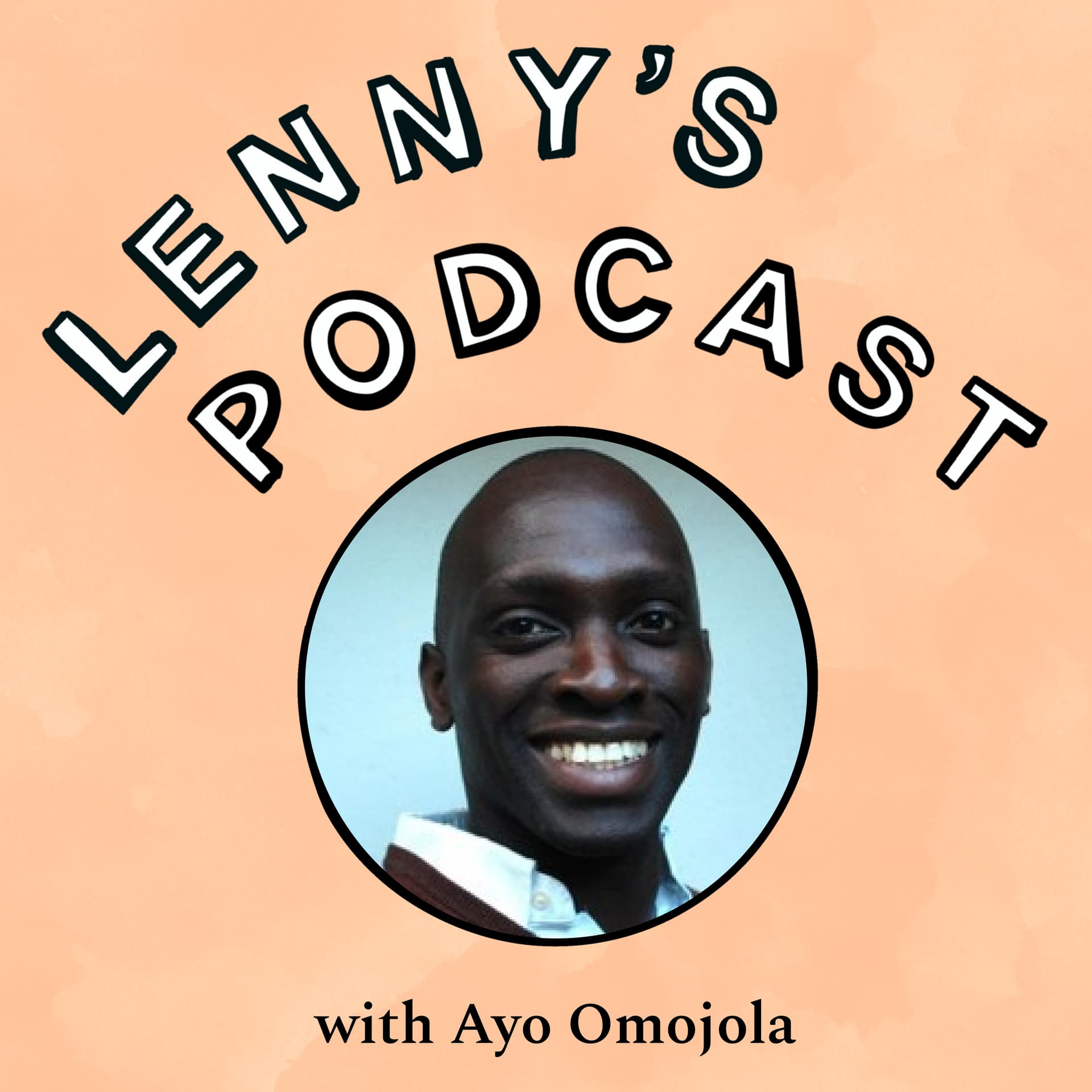
Guest: Ayo Omojola, Chief Product Officer at Carbon Health Host: Lenny Rachitsky
Overview
Ayo Omojola, a notable product leader with experience at Cash App and Carbon Health, shares his insights on product differentiation, team building, and the power of first-principles thinking. Ayo reflects on his journey from fintech to health tech, the importance of small, focused teams, and his approach to hiring and leadership.
Key Topics
- Product Differentiation and Success at Cash App
- Cash App's journey from a small user base to over 50 million active users.
- The importance of differentiation through features like instant transactions.
- Lessons learned: The compound effect of multiple strategic advantages.
- Team Building and Organizational Structure
- Advantages of small, senior, and tightly-knit teams.
- Challenges within large organizations: Balancing resource allocation and maintaining focus on consumer needs.
- First-Principles Thinking
- Importance of going deep into understanding problems and not relying solely on perceived experts.
- Asking questions that challenge assumptions to ensure accurate and effective solutions.
- Transition to Health Tech and Carbon Health
- Ayo's motivation and the seamless transition from fintech to health tech.
- Carbon Health's full-stack approach to healthcare: Combining clinics, in-house software, and integrated patient experiences.
- Hiring Strategies and Founder-Heavy Teams
- Preference for hiring former founders due to their unique perspectives and adaptability.
- The double-edged sword of high turnover among ambitious team members.
Key Takeaways
- Differentiation and Market Fit: Success in consumer apps hinges on being different in meaningful ways that matter to users, not just better.
- The Power of Small Teams: Keeping teams small and senior ensures higher agility and trust, fostering innovation and execution speed.
- Network and Relationships in Health Tech: Building strong networks is crucial for navigating complex healthcare landscapes.
- Continuous Learning and Adaptation: Leaders must remain curious and open to learning from every experience to grow and innovate effectively.
Advice for Health Tech Founders
- Network Importance: Utilize connections to access opportunities and navigate industry complexities.
- Clear Use Cases: Define crisp, specific use cases to streamline decision-making processes.
- Persistence and Adaptability: Stay resilient in the face of challenges, and be ready to pivot when necessary.
Resources and References
- Ayo on Quora: [Ayo Omojola's Quora](https://www.quora.com/profile/Ayo-Omojola)
- Carbon Health: [Website](https://carbonhealth.com/)
- Books Recommended by Ayo:
- *The Three-Body Problem* by Cixin Liu
- *Children of Time* Trilogy by Adrian Tchaikovsky
- *Stormlight Archive* by Brandon Sanderson
Connect with Ayo Omojola
- Twitter: [@ay_o](https://twitter.com/ay_o)
- LinkedIn: [Ayo Omojola](https://www.linkedin.com/in/omojola/)
- Blog: [Kunle.app](https://kunle.app/)
Connect with Lenny
- Newsletter: [Lenny's Newsletter](https://www.lennysnewsletter.com)
- Twitter: [@lennysan](https://twitter.com/lennysan)
- LinkedIn: [Lenny Rachitsky](https://www.linkedin.com/in/lennyrachitsky/)
Concluding Thoughts
Ayo Omojola's experiences and insights provide valuable lessons in product differentiation, team dynamics, and leadership. His ability to navigate complex regulatory environments and drive innovation makes his story a compelling guide for aspiring product leaders and entrepreneurs.
Written by AI. May contain mistakes. Listen to the episode to check what was said.
Transcript
Automatic transcript. May contain errors.0:00cash up as a team, we really cared about what we could do that was different and better than what else existed in market. Being different is not enough because very easy to build a thing that's different from what exists today because you just have to look at what exists and ain't built something else. Being better is not enough because it's also easy to say, hey, I'm going to make this thing better and just charge you more money for it. It has to be better than what it's today in a way that matters to the end of user. And for us, for a long time, it was when someone says, Hey, why are you being in the gunner?
0:28I'd be like, try and send me a dollar that I can use now. And there's only one I could do it with. Welcome to Lenny's podcast where I interview world -class product leaders and growth experts to learn from their hard -won experience as building and growing today's most successful products. Today, my guest is Io Omanjala. Io co -created and scaled squares popular cash cart, alongside the hugely popular cash app. He's currently chief product officer at Carbon Health, One of the biggest and fastest growing health tech companies in the world. He's a former founder, he's on the board of Pinwheel, and he's an angel investor in companies like Mercury Bank, Fair, Modern Treasury, and dozens of other startups.
1:06In today's episode, we dig into lessons from building and scaling the cash card and the cash app. The importance of differentiation when you're building a consumer product or any sort of product. How to successfully build a startup within a startup. How to succeed in both FinTech and in health tech. Plus, my favorite part of the conversation, a handful of incredibly insightful and practical principles and philosophies around hiring, team building, leadership, and going deep on problems. Io is such a fascinating human and leader, and I am excited for you to learn from him. With that, I bring you Io, Amagula, after a short word from our sponsors.
1:43This episode is brought to you by Microsoft Clarity, a free, easy to use tool that captures how real people are actually using your site. You can watch live session replays to discover where users are reasing through your flow and where they struggle. You can view instant heatmaps to see what parts of your page users are engaging with and what content they are ignoring. You can also pinpoint what's bothering your users with really cool frustration metrics, like rage clicks and dead clicks and much more. If you listen to this podcast, you know how often we talk about the importance of knowing your users and by seeing how users truly experience your product.
2:17You can identify product opportunities, version wins, and find big gaps between how you imagine people using your product and how they actually use it. Microsoft Clarity makes it all possible with a simple yet incredibly powerful set of features. You'll be blown away by how easy Clarity is to use, and it's completely free forever. You'll never run into traffic limits or be forced upgrade to a paid version. It also works across both apps and websites. Stop guessing. Get Clarity. Check out Clarity at Clarity .Microsoft .com This episode is brought to you by ECO. Last month, ECO users earned an average of $84 in cashback rewards.
2:58How? With ECO, the future of personal finance. ECO is the update to a misaligned financial system, providing an app that works just like your bank, but removes almost all of the middlemen, helping even the best money optimizers optimize in less time, automatically. What if you earn rewards for paying your rent? Or got rewarded for ordering food and shopping online? Or even earn rewards for saving each month? And then imagine if you got rewarded again, just for getting rewarded. With Eco, you can spend at some of your favorite merchants and automatically get 5 % cash back. Plus, Eco's APY rewards look more like $80, not $0 .80.
3:35And then there are Eco points. The world's first open reward system. You earn them whenever you do almost anything in the Eco app. ECO was working to make these points the most rewarding points ever so it pays to be early. Sound to get to be true? Go to eco .com slash Lenny, sign up for an onboarding and find out why it isn't. Lenny's podcast listeners who attend an ECO welcome session will get an exclusive 4 % APY on deposits over $1 ,000. Learn more at eco .com slash Lenny. That's eco .com slash Lenny.
4:09I owe welcome to the podcast. Thank you for having me. I owe a feeling this is going to be a really fun conversation as doing a little research on you ahead of this chat. And I found this interesting thing that you did in the past where I found you answered over 100 questions on Kora about people trying to ship stuff and mail stuff and have no idea what's going on there. And so tell us what is going on. In 2015, I'd been a cashmob for about a year. You know, I had massive burnout from my last company. Once you I see kind of like, did a hard pivot, imploded a little bit, stuff kind of picked up, sold to somebody eventually.
4:44And my brother, who's my co -founder and I had this idea. And I think it was, I think it was actually from printing and mailing my section 83B for something that I'd done. And I was like, why is there, why can't I just like go on the internet and like, do this? And so I had this idea to build an application where you could give a document and address and we would print an email for you for you. And it was right around when Bob was founded, which is Bob is like this printing a mailing API. So we built this thing called Mailform. I think it's like one of the top consumer print and mail things on the internet.
5:22Actually, I'm sure many people will listen to this. We'll have used them for it. And then we had to figure out how to grow it. And the way that I actually learned how to do SEO was running around the internet, trying to find ways to tell people that we did this and they would find us. And we actually ended up like, funny as it turns out, we ended up building a whole sort of SEO, like content infrastructure around it that has really, you know, impacted my thinking. But all the answers I'll call her were me just trying to get people like, you know, If you remember, a 2014 core was this massive thing.
6:00So all of the insulin core were me trying to get people who might be thinking about the problem that we were solving to realize that we exist. That was my guess. It was going to be either user research on the space of shipping and mailing things. There was a growth tactic and it clearly is the second. You're saying this product still exists? That some people can still use? Yeah, it exists. A lot of people use it. We have many big customers that you've heard of and use. I won't say their names because I don't know if they want me to do that. but like, you know, I would say like there are a couple of large like delivery tech companies that use us to mail $10 .99 W2 forms.
6:37What have you? Holy moly. Okay. And it's just a side project of yours. Yeah. What a many. Amazing. Let's talk about your cash app experience, which I imagine was a pretty transformative period in your career. And you from an understanding of a major impact on the success of the app and the business that was built there, to give folks a bit of scale and understanding of this, just the cash app in general. Can you just briefly talk about how big was it when you joined the scale of the app and then whatever you can share about just the scale today? So when I joined cash app was probably sub 50k active, like people moving money.
7:17Today, I think it's north of 50 million Active's on a monthly basis with all different types of money movement like the coin, PDP, card, stocks, and I think it's something like North of 70 or 80 million active zone and annual basis. Wow. Okay. Great. What I want to talk a bit about is the cash app to me is a rare example of a huge consumer app success story. I've been angel investing for a while now and I've just learned how rare consumer apps work, like they never were. And this one worked. Even within a big company, you think that there's a huge chance of something working if they have the support of a big company and the platform, things like that.
7:59Still, they almost all fail. And so what I'm curious about is what do you think you all did most right? One to launch it successfully in the consumer space and then two to keep it growing and scaling to where it got today. My perspective is that And I think this is a, you don't like this kind of answer. I'm like, I'm like the same. The thing Cash App did right was like 10 things, not one. Like it was, there were like 10 things that actually best in class, like insane talent density, insane focus, very strong at fraud. A lot of, a lot of the way, Brian and Dustin and Jesse and Downdy tried to organize them with Jack support was just really firewalls from the rest of Square.
8:54The hero customer was a consumer and up the merchant, so it was literally in 100 % of the trade -offs that consumers and needs came first. And that's a very, very hard thing to do inside a company, like it made people angry actually. Really insane focus on design. incredible like depth in this is the thing that I think you will appreciate but it's very hard to appreciate just like as a you know consumer of things people would be like hey what's the difference in you in Venmo and the only reason you would ask that is if you just hadn't thought about it for a second now today there's like a lot of converging some features like you know sort of Venmo sort of caught up on a lot of things but at the time like Venmo didn't have push to debit Venmo didn't have, instead, like, for like three or four years in the United States, the fastest and lowest cost -weight movement money in the country between any two people who had bank accounts was cash -up.
9:52And I think that kind of changed in 2017 when PayPal, Venom, Apple Cash, etc. kind of came out and launched a lot of things. And so I think actually it's possible that having done only one of those things while cash -up might have been successful. But I think the reason it's defrencially successful in the market today is the compound on effective all those things. What are some of the lasting lessons that you take to other consumer apps that you're like carbon health, for example, or founders that you work with? Because all those things are amazing, hard to replicate sometimes. Is there stuff you extract from that?
10:26Like, here's something that I'm gonna do at any time, I'm building a consumer app. Is it like the design led component? Is there anything else along those lines? This is the thing I struggle with. I saw on Twitter somebody say this comment that like a lot of times when people describe their success to you. What they're really saying is like, this is my lottery ticket number. So to be honest, before I go down this diet tribe, I don't actually know which of things are replicable. I just know like kind of what I believe to be true. And you know, I'm trying to sound some of the work that's on that, et cetera.
10:55So I think cash up as a team, we really cared about what we could do that was different and better than what else existed in market. And for us, for a long time, it was instant. And if you look at all the products, like you'll see this sort of theme of like, you know, when you cash out, there's an instant option. When you get a cash card, we issue your card to you instantly. When you sell stocks, money's available instantly. When you sell Bitcoin, money's available instantly. Like literally, there's no like, aw, circle, circle, circle, processing. It's like available to spend. And I think there's something actually lasting about the concept of instant because they're still in the world today are like lots of businesses and proceeds that are like asynchronous, but not for any reason other than that's just the way the world is.
11:48So I think that's like one thing that's kind of narrow. And then I would say another thing that I think is really broad is just be really crisp about why what you're doing is different and better than what exists today. And it's like being different is not enough because very easy to build a thing that's different from what exists today Because you just have to look at what exists to name build something else and being better is not enough because It's also easy to say hey, I'm going to make this thing better and just charge you more money from it for it And so I think that there's like you know different Like you optimize for doing a thing that's different.
12:25It has to be better than what exists today and it has to be better than what it's today in a way that matters to the end user or to the buyer, like kind of depending on where your market is. And then like after all that, it also, you have to be in a domain that matters. Because it's very easy to get those three right, like to build like a really like how to say this, a thing that's different and better than what exists today in way the matter is to end users could also just be art, which is just like art is a complex thing to scale. And so you have to like then also get the economics right, get the entire pipeline of like how you ship, how you build, how you talk about it, all that stuff has to work as well.
13:08I think there's some really great lessons there just to kind of mirror back what you're saying, just differentiation in this case ends up being really important. And if you're trying to disrupt someone doing something like say Venmo, like you can't just be better of Edmau you have to be different. And it sounds like incident was the differentiator in this case. For a long time. Yeah, yeah. Or rather, it was the cut through the clutter differentiator. There were like actually like a lot of other sort of long tail of things that were doing those different, but it was like instant was the same where you know, when someone says, hey, why are you better than me?
13:40I'm not, I'd be like, try and send me a dollar that I can use now. And there's only one I can do it with. And I think the other element of this, it connects to something I'm working on in the newsletter is when you're trying to find a big idea, especially in B2B, but in this case, it works in B2C, it needs to be important, and it needs some matter. Like, it can't be a better thing that nobody values highly, because then you will make money in B2B and B2C people won't even use it. So these are really great. You mentioned in passing, when we were preparing for this, that block was trying to kill the cash app for a lot of time.
14:15Early on. I wouldn't say like block was trying to kill a cash app. I think that there were many, many people who worked there that absolutely, like, and I mean, this is a nice way. Identity is retired with square being a merchant business. Believe that the investment in cash rap was, could have been better deployed elsewhere. Didn't want to work on consumer. There was just like a myriad of, and then I'm like, I'm sure people were there at time and say, like, we probably also made mistakes and didn't communicate get well and then sell it well and so on. But there was a crazy amount of friction.
14:50I'll put it that way. He wasn't like, he just wasn't like, you know, a thing I will 100 % give Brian credit for is he was really effective at making sure that we had a shot. Zooming out for a moment and thinking about just Square and Block and how they operate as a product company and as a business, is there anything that you've taken away from that experience that you bring with you to where you are now, which I want to talk about next. I don't know necessarily if this was intentional. My guess is it was probably just like a consequence of square going through going public and trying to be sort of a rigorous financial institution.
15:27I think when you are in a large organization trying to do a actually new thing, I think small teams are better than big ones, period. and forcing the teams to be super thoughtful about hitting milestones and actually adding value. Because there's this thing people say about, hey, it's started with an startup with a fake. And the reason I think it's fake is because, like, when you're in startup, you actually worry about paying the people work for you. And when you aren't side -by -coming, you just don't. And there's just a difference between having that existential fear of, are we going to be here tomorrow?
16:05and not. So I think a consequence of not having that existential fear is that it's easy to just be like, okay, anymore resources and the organization has some habits around how you acquire resources and if the leadership of the leadership building the new thing happens to be good at that, you can have growth in a new projects people size that doesn't match the new projects success potential. And I think that actually ends up being attacked over time. That's a really good point. I didn't think about asking about that. But in this case, it was a startup within a company that did well. And I also agreed, it rarely works.
16:45And it did here. What is it? What is it that you think that was so essential to make you work? And you just talked about it. How would you summarize just like here's the thing? Everyone should do when they're maybe starting something small within a big company that's new. There are some macro things where I do believe we were children are fortunate like mobile, etc. When I joined cashapp a lot of the people working on it were fairly tenured both at square and just like in their careers and had like done sort of really meaningful things. And as a consequence I do think there's like this is a thing I haven't quite been able to articulate it well but there is something around like a small tightly knit senior team super focused on a problem and the smallness means just like let's pair with some kitchen and then the tightly knit means a lot more trust and then I think like Brian was obviously just he'd been at square for a long time to be the organizational I was a color operator around there new like talent like who was good that he wanted or the, you know, Bren on board.
17:52And I think that combination of things, like, well, not my guess is, there are other things, but I think like without that thing, you would actually have been really, really difficult. I think that's an awesome lesson, just like a small trusted team that has seniority and leadership trusts to operate and not just like, hey, what the hell are you doing? It's time to, time to, time to ship faster. The cash -out team stayed super senior for a long time. And you said small, how small would you, was it slash what do you recommend when you say it should be a small team percent like this? You know, a lot depends on the thing.
18:28I don't think there's a one shot answer. When I joined Casabas like 11 or 12 and it wasn't much more than that for like a year.
18:41And even I forget how big it was when I was like, we had real scale and real business before we had a real headcount, I guess, the way I would say. And like, kind of had to fight for every headcount. And I think the headcount disposal was a Sarah Freier thing from Squares. She's just, you know, really, really disciplined about making sure that if you were trying to bring people on and spend the company's money, you'd really just fight it. I think that's a really good takeaway. Well, let's transition to talking about what you're currently doing, carbon health. You went from consumer fintech to consumer health tech.
19:17First of all, just real quick, just how did that transition happen? Was that some of your plan? Or is that just like you went and exploring that's re -ended up? There's more, I went on exploring it's where I ended up. I think I'd say there's maybe three parts. There's one part where when I was exploring, there's this guy, Russell Friend, who now works at Carbon, who introduced me to like a third of my network in Zombole. And the nicest guy and basically he said, hey, there's this guy who's amazing. He was founder of You to Me. And now he says come to call Carpenter Health. His name's Aaron. You need to talk to him.
19:55And I was like sure. And Aaron and Aaron is brilliant. And also had a this crazy way of explaining a complex problem in a way that made the solution obvious. And so it was like, who's like, oh yeah, like, here's how we're going to do it. And here's, you know, the thing we spent like two and a half hours together. And then at the end, I was like, oh yeah, like this is obviously somebody she's just built this thing. And then I think the second part was, I think everyone's the hero in their own story. I'm no different. So like, I think when I left cash app, I went out and think about to do next. I was thinking of starting a company and doing all that stuff.
20:35And one of the muscles that we really just spent a lot of time building in Kashaap was going really, really deep into the regulatory wallpaper of the problems we were trying to solve. And so we would have sessions where we'd be sitting in a room, like product engineering, legal compliance, et cetera, with some regs literally blown up on a projector screen and a section of text highlighted and being like, hey, what does this really mean? Okay, what if we build a product this way? What if we structure money movement this way, et cetera? And so I casted myself instead as, hey, what if I could be good at regular businesses instead of just good at money?
21:17And that was the way that I tied the two together. There were a bunch of other sort of very personal like ego things like I want to build teams as well as mostly founders. I both my parents were doctors and I've been through some sort of scary experiences in the healthcare system. So there was just like a part of it, there was about sort of mission and background, but the career part was really about how do you stitch two things together? And I also wanted to learn, there was this thing that happened in my like, fourth year at Cash App where I was like, oh, because other thing that we have to build, that would be amazing if we actually build it, which is what Pinwheel, the company I'm on the board of actually is, I was like, hey, we got to build like this platform for payroll.
22:00It's like, you know, the last giant money movement thing that hasn't really come to the needle in a long time and I can get the organization Convince the bill which kind of is what it is. I'm a and b I was like, oh, I want to have that insight How can I have that insight of like what the second thing is faster the second time around and? I'm sad to report the three years in a carbon I've not had it yet. You got a lot going on. I am not surprised So I was going to ask what draws you towards regulated, highly regulated industries being a cash app. And I like that you already went there. Basically, just found that that's maybe the thing that you could get really smart at.
22:42And that applies to a lot of different markets. That's an interesting insight about yourself. This could be the thing that I get good at. Yeah. Or differentially better at the other people. You kind of mentioned this off to the side. This idea that you like to hire founders. And can you speak more to that? just like what that means in your day to day and then maybe how your team looks today is that is a mostly founders or some large percentage. Yeah, I think team looks today about half and half. So I had this experience going through I see where and just like kind of growing up in my career in Silicon Valley where a new bunch of founders who were like absolute beast like incredible people could do amazing things and they would bounce off organizations they would be like, all right, I'm gonna go work Amazon and just like not last.
23:31And when I was a cash app, I went through a bunch of hiring processes where I was like, hey, like we should try to hire, you know, some founders to do this, like look at these companies, et cetera. And a thing would happen that, and this, this part really isn't about founders, although founders like one way, so do this happens. But I think that happened quite often is by the time you get us, as a higher men, you get a bunch of resumes to look at. You post a job, a bunch of people apply, you're partnering with a surcer. By the time you get a bunch of resumes to look at, they've screened out everyone that doesn't just fit inside a box.
24:06And it's like, at Google, Facebook, Amazon, Microsoft, Apple, and then at certain set of schools, and then a certain type of experience, et cetera. And so what happened is if you just happen to not look like that profile, I don't even see you. And I would say, hey, like, I would like to hire some non -traditional candidates here who were like founders or whatever. And I would just never get it. It was almost like the machine just worked a certain way. Like there was an algorithm and the algorithm was upstream of me. And I have this belief that these sort of these people that I'd seen many of whom have now gone on start companies that are doing quite well would be incredible value add.
24:52Like basically, if you just, it's kind of like, if you just hold on to a rock for a little bit, it can take you like pretty far. And so this is one of the things that I talked to Aaron about actually early on when I joined Cardin. And I would literally in the job posting, I'd be like, if you've been a founder before, even if your server was failed, please plot it this. Because like, you think that's, I think common among founders too, is there's this sort of imposter syndrome that goes hand in hand with the chip on the shoulder. And so my team is much longer than it was, but I probably think the whole time that I'm going to carbon hired about 50 % founders.
25:36And I'm actually a 100 % certain that thesis was right. And I think it just came with costs that were kind of theoretical time and I didn't and I now they're real. I think like the two big costs are if there's any waste or bullshit in your organization like they fucking see it right away and call it out. And so there's this like you have to like they're just these scenarios where I just be like I just have to sit and listen and somebody tell me all the things that were doing wrong. So there's one, it's just like, it's a way to cut your bullshit. That's one cost. And I think the second cost is, and I say cost as in like, it is not better for the organizations.
Read the full transcript
26:25You have these people come in, they're incredible. And you really can only keep them for like two or three or half years. And so as of happening is, they're just like, like, oh, I want to, you know, they're obviously, if you're going to be present, starts coming to your, like, she's from ambitious. So like, I'm going to go over on a team somewhere else, I'm going to go to a trust and other thing, I'm going to go to a global company. And so it's kind of like a team that I think is differentially higher output, but also differentially higher, a tuition on the market. Got it. I was going to ask about the cons and I like that you shared them already because I imagine working with a lot of founders adds a lot of stress to.
27:01Yeah, I mean, it is, it is, I'm a croakly awesome, like I love it. And I think the unexpected pro also is I do think it like levels up the team. Like people in a team that is like very fond of dance really likes it. And we ended up over time in carbon like there's lots of people who have found a company here in multiple functions, not just products. Today's episode is brought to you by Element. I just recently discovered this stuff actually from another podcast and it is such sweet salty goodness. Elements is a tasty electrolyte drink mix with a science -backed electrolyte ratio, and unlike most electrolyte drinks, there's no sugar coloring artificial ingredients gluten or any other BS.
27:43Getting enough electrolytes helps prevent and eliminate headaches, muscle cramps fatigue, sleeplessness, and other common symptoms of electrolyte deficiency. Elements is the exclusive hydration partner to team USA weightlifting and many other Olympic athletes. Also, dozens of NBA and NFL teams and players rely on elements to stay hydrated, along with Navy SEAL teams at the Ice Niper teams and Marines. You can try element totally risk free. If you don't like it, you can share it with a salty friend, and they'll give you your money back no questions asked. To give it a shot, go to drinklmnt .com slash Lenny.
28:17And you'll get a free sample pack with any purchase, which includes one packet of every flavor. My favorite is watermelon salt. You won't find this offer publicly available, so you have to have to drink LMNT .com slash Lenny to take advantage of this offer. Stay salty. While we're on this topic of team building and hiring, do you have any other lessons and approaches that you found to be effective in hiring or team building? Just general rules of thumb or philosophies? My biggest thing, and I say with all the time, is when you're hiring, you pick the people that they pick when. So you're actually, there's these people, there may be a lot of people on the team who, the time between when I first met them and the time when they joined the team was like months, there was one person who was like a year and a half false.
29:07And so, the way that I operationalize that is, like I'm meeting people all the time and and I'm just like, hey, like if I meet somebody I want to work with, and like, hey, how can I add value to your life so you will consider me that somebody who you would like to work with one day so that when the time comes and there's an opportunity for us to work together, you're actually open to it as opposed to just some guy that you met on the Zoom one time. And I would say that's like the biggest, the biggest thing is just like trying to be like, Like one of my core philosophy in life is that everybody wants something.
29:43And most of the time, it's not something you have to give or you can connect them to. But if it is something that you have to give or you can connect them to, it's criminal a lot too. Actually, it's like imagine you, like just imagine you're having a car and say you're somebody and that person knowing that you want something, having it, there's no cost for them to give to you and they just don't do it. How crazy is that? And so like I think, you know, the way that I sort of bring to life is, if I meet somebody who I want to work with, I'm like straight up with them about it and I'm like, hey, I hope we can find a way to work the other one day.
30:19In the meantime, it looks like the things you want are not to work with me right now, but they look like this category of things which I'm aware of. Can I connect you to this person this opportunity? What have you? and It's it's it's not my thing like actually rusted this for me when I joined when I like came still come back for the first time He was like hey, I'm not gonna invest your company. I think it's stupid, but Here are all these people who might go meet them and That was like transformational for me and and and it it is turned out that over a long time horizon It does come back. You just don't hold the cards close to just just give them away Is there a story or an example of that that comes to mind of you doing that for someone else?
30:59Now, it's a little bit of a professional hazard because I'm an angel investor and so I do this for a lot of my founders, but I probably made 600 -inch rows last year. And that probably drove like at least one person signed up somewhere as an advisor. A couple of people took some jobs. A bunch of angel investors invested in companies. A couple of companies found leads for a round. I'm not special in this way, but a lot of people do this. It's just I'm very aggressive about it. And you're also connected to a lot of people as you've shared, because of all these things you've done. And the fact that you prioritize this, I think it's a really cool combination of you really prioritize connecting and helping.
31:41Plus, you know, a lot of people from all the work they've done. And there's this element you just shared, which is just like, give people things that they want because a few people have you. I'm a reasonably good Mac maker except in love. Never once introduced to people who did it. Let's talk about now. We'll move on to that. I also think in M0, zero for some denominator I don't even know. I'm going to keep fishing in this pool of philosophies of how you build product and then we'll come back to carbon health. I was reading something that you wrote about how you're really big on understanding the thing, like going deep on stuff, just generally as a product leader and as a collaborator.
32:23Can you just talk about your approach there and where you apply that philosophy? This, I took away from cash up. There was, when we were working out of the cash card, the very first, you know, so this is like 2015, 2016, the very first iteration of the cash card, the head of design cash up, the guy Robert Anderson, his amazing designer, please hire him if you can, had like this design, he was like, Kav is like, we're gonna do this thing. And I'm like, great. I get some sketch files, maybe, PDFs. Prefigma. We mail them to some card vendors and the things they send us back are like, like you would put this out as the product in your life in the world, like what are you doing?
33:08And the consequence, Brian was like, hey, we just need somebody to go figure out and get this thing made. And so I ended up spending a long time just going to different card manufacturing factories around the country to figure out how do cards get made? Like what are the possibilities? Is there a new type where you can take advantage of? Well, the people who can talk to us is the thing we're talking about even possible. And we ended up doing, like at the time there was a, I wouldn't say like super new, and it had been on the Chase Sapphire for a few years, but it wasn't on the Eastern cards yet, at this concept of laser engraving.
33:43And it turns out that the machine that you use to make laser engraved cards has thousands of combinations of settings, which all create a different physical effect. Like you can increase power settings and get and literally burn the plastic. You get a red rough texture. And you can decrease power settings and decrease the aperture. You get a really fine smooth consistency. and this is like, again, a thing that I learned with you went through between plastic, the overlay, the paper, the envelope, and the finishes, easily a thousand combinations before we got to the first version of the cash card that we shipped.
34:33And there's a team still there, still doing like literally physical card objects that are not the same as anything that exists in the market. This is like going to differentiation thing. And then like a lot of the stuff we did around like our regulatory work around prepaid, you know, building digital wallet, etc. made me realize that like a thing that would happen very frequently is you want to work on something and you go talk to an expert. And usually for most people an expert is not like, hey the most expert person world because like that's a very very hard thing to know who that is, especially that you're not an expert.
35:07Usually an expert is the most tenured person in the world in the domain that you're questioning and like the level like the both the length of tenure and the depth of experience actually like can vary very wildly from person person. And so what happened is like you go ask somebody something and they would give you an answer which is like the thing that they they believe to be true. They're not lying and it's not malicious and it's just fucking wrong. And you just have to keep pushing till you get to an answer. Like I don't really know how the right way to articulate this all the way, but it's kind of like you can't stop till you get to the end.
35:46And this one of the reasons why being in a domain that matters is really important because that's a very, very expensive activity to do if you're in a small time environment. So the way that I apply that today, and I'm sure people at Carman will tell you this, is I end up asking lots of questions that people think don't matter, because I'm like, hey, we're trying to optimize something. And usually what I find is when you're trying to optimize something for the first time, they have an optimize for it, you actually have to remeasure it.
36:24You have to from scratch, you have to look at them like 15 different ways. And then every time some two things like are in Congress, you have to go and figure out why. And it's just like tedious work. And in regulated industries, and I think this is, my guess is this will end up being true in almost any complex environment with a lot of variables that are kind of, like, and the more sort of constrain my physics there, like I think actually the more this matters, you just, you can't avoid the details. You just have to get into it. And like, if you don't, you can still do well, but it's actually more than likely fortune than skill.
36:58You said you asked these questions that don't matter. Is there an example recently? Because that's a really interesting concept of just a question you asked or questions you like to ask that are just like, Goddamn, why is Ayo asking these questions? Yeah, I have, there's like one from yesterday where there is a field in a database table that tells you why Paymo was made. And there's a bunch of values in that field that are very articulate. Like, hey, this pain was made because it was copay, this pain was made because it was the patient who was visiting without insurance, right? And there's like a field that is empty.
37:34There's a value that's just null. And we use null as like, hey, like the way the null is described is after a claim is adjudicated it in complete and the patient has a balance. We leave that field blank if we're charging, if we're just billing the patient for their balance. The problem with that is if there is any other exception of reason why a pain might occur and we're in a complex environment, we have over 120 clinics, there's a lot of humans who can press the pay button and a bunch of different places, you will not know if it's including that field in that null value field. And so it's just this like one of those things where I like I'm in the middle of a slack with with a colleague Who's like why are you asking this question?
38:23I'm like I just need us to put residual balance in that field if that's what it's for that's all I'm asking
38:32So I do that a lot and I you know, I think people hate it Did they actually go ahead and do that? Where they bring them over right now? You're in slack. Okay, right? Okay, I love this So, I made a list of the kind of these lessons and I really like this area we're diving into of just your kind of philosophies to work in life. So just the ones that were down is the importance of going deep and doing the thing yourself and not trusting that somewhat is in response is the end. Like I love the way you phrase it, I've just stopped until you reach the end. Yes. This idea of helping people if you can, connecting people in the power of that, hiring founders and working with founders and clearly the story just told is very founder mentality of just like going to the warehouse and trying a hundred different cards.
39:18Is there more here? What else have you found to be an important approach to leadership or product building or things along those lines? Yeah, can I say one caveat about the first one I think you're a down? It's not that you have to do everything yourself. It's that the person who you trust in the executioner role, they have to become the expert. They have to be like, they can't stop till they hit the end. And I don't know, I think like so much in all these places where, you know, skrimper's people are trying big things. So much value is lost when the person in the execution role isn't really in command of all the details.
40:04And is like, and so I think like it's just the derailles like you can't to do and bitch things you have to work with people. I can't do everything myself and I know that. I just the real lesson there is, it's not like I have to, just somebody has to. And you, and you know, they have to know that that's like what you're holding on to in the calibur and that you trust them to do that and the organization is trusting them to do that as well. How do you actually operationalize that? It sounds like part of it is higher founders who naturally want to do the thing. Well, is there anything else in terms of how you set up the team where like this person has power to do the things that need to be done?
40:42Is it like an autonomy perspective? Is there anything else you do that allows for that in a product team in a company? It's like a trust but verify and I think it's just almost never enough for someone to say I can't do it because X person said. It is I can't do it because we are contractually obligated to do this another way. And if we do not honor the contract, these will be the consequences. Like, and another thing I like to do kind of long this is like, okay, articulate to me what actually will happen if we don't do it this way. Like what will break? Like, is it gonna find us? Is the patient gonna be doing any like, because in my mind, there are many things that are used as excuses because some persons understanding of how some regular charty thing works from like their last job is being applied here, where you're literally creating a worse experience for your consumer or for your patient.
41:35I'm like, why would you, like if we're not here to try and make the experience better for them, why are you even here? Let's come back to carbon health for a bit and just have a couple of questions that I wanted to touch on. One is just about starting a company in healthcare and health tech. There are so many companies that launch every day, every week trying to make the healthcare industry better in various ways. But for all these reasons, I don't know, incentives are off, there's regulatory capture, there's things take a long time, things just like off into work. Carbon health is an example of something that is working really well.
42:10What is your advice often to founders who want to go after the health care space as a tech company? What do you need to know? What should you do right? Do you wrong? What is your advice there? So one thing I would say in healthcare that fortunately, unfortunately I think is true is very often the way to make things happen is network dependent, not necessarily about the merit of the thing itself. So it's just like there's like companies that exist because the founders know the CEO of every major parent country. And so there's just like a deal they can get or data they can get that's like not available in any other context.
42:51So I think there's just a thing there of understanding of that's the business they're in. I think in Aaron and Caesar's case in carbon, because we're direct to Zoomer, we're not trying to sell its payers, we're not trying to sell employers. And Aaron obviously just hugely successful conservators and starting the largest education platform of the planet at EudaMe. like there was actually really, really good founder, Mark at Fit, who was like a person who had like very, very technical and had tons of DTC success. Doing no thing that was DTC. But there are businesses, like I'm, there's a company that I recently invested in our work in West with founders and credit them very, very technical and not super high on network and a thing.
43:38And so like a lot of what I try to do with them is like, hey, you need to start to talk to this person. And then also this is like a really crisp, specific use case that you need to like optimize around. And maybe I'm wrong, who cares? Like, I'm just some guy. What is the matter? What I think it doesn't have to be what I think. It just has to be crisp. And using that as a way to like, because the more crisp it is, the easier it is going to be for you to know who the decision maker and the organization you need to get to is because like I just find like, I'm sure you see this in B2B businesses says, so much, there's just so much leverage in knowing the person in the place who actually has their finger on the button versus trying to like network your way in and people don't spend their so capital introducing you to like this partner and or they've just got like 19 of things going on.
44:25So I think like that network thing is just the thing that like sticks in my mind that when I see like a lot of healthcare tech startup swings through the soup, a lot of it is about there's some organization to have to navigate to get to the right filmmaker and they have to do it a hundred times. And so much of it is like just waiting for the guy who promised me the intro to make the intro. That is really good and practical advice. Before we wrap up, I want to give you a chance just to like describe carbon health for folks that may not be familiar with it. Just like, what is it? Where can you use it?
44:59How do you sign up? Who's it for? Yeah, yeah, yeah, yeah, yeah, yeah, very, very happy to do this had it is a pay that because carbon health pays me. So, no one's paying me. I can't lose it. I'm losing this situation. I'm paying you, prestigely, and wisdom and insights in your attention. Exactly. So, carbon is an extremely vertical integrated healthcare provider, based in the United States. By extremely vertical integrated, what I mean is we build around the clinics, the providers work for carbon and we build around the software and we run the entire operation and it's all like full stack in house and when I say like we build in on software it's like Wait, how you book how you pay The like literal buttons that the provider presses to like say hey Lenny has Lenny's blood pressure looks good All of that is software that we build in house all the way from front from like the patient clicking book employment on Google calm to the claim being something to share, we build the whole thing, full stack ourselves.
46:04We have, I want to say, 130 clinics around the country, I believe we're in about 17 states. We do virtual care. I think we're one of the biggest health care providers in California, and we do both urgent care and primary care. And the thing that gets me super excited about carbon is a lot of the experiences we build are the things that, as a consumer, you believe shaves this in healthcare. So, I want to say, last year we launched this diabetes program where you slap on a continuous glucose monitor, you link it to carbon, and it streams your blood glucose measurements directly into our EMR, natively, and your providers can see it and interact with you around it.
46:43They can help intervene. They can tell you new dietary lifestyle choices to make, and we're going to do that with every device at some point on some scale and you don't have to pay $200 to use it. $200, you may say so. Amazing. Well with that we've reached our very exciting lightning round. I've got six questions for you. I'm going to go through them pretty quick. We'll see what comes to mind. No pressure. You can skip them too if you want. You ready? Yeah. What are two or three books that you recommend most to other people? Three body problem, children of time, trilogy, and a storm later archive.
47:24Are these all sci -fi books? The third is fantasy. Good clarification. Great. Amazing. I'm reading an epic sci -fi book right now called The Fire in the Deep. Oh, dude. Amazing. Okay. Yes. So something that's getting really pissed you off. I don't think it's spoiler. Don't know spoilers. I won't understand. It's not a spoiler.
47:49The story's not finished. There's like additional books that aren't done yet. Yeah, and I don't even know if they're being read. It's brutal It's okay. I find that the first book except for the three -body problem where the first book is the worst book I feel like with this and the many of these books the first one is like I'm just gonna stop I think it the first one was my plan So, so I'd say the other two are, in my opinion, very clever explorations of types of intelligence. Excellent timing for studying what might happen with AGI. Great. I love this. I love where this is going. Next question, what's a favorite recent movie or TV show?
48:29War of the Worlds was exceptional. Is that recent? Yeah, there's one that I think, I think It was a three season thing just ended maybe last year. And it's like it's like a kind of more modern take and it's just very thoughtful and it's sci -fi but such a deep drama. I also love succession but I'm still I haven't gotten through season two yet. Man, the season is incredible. I know. I know. I have to mute it on Twitter because I was like you guys are really good for me. Oh man, that's impossible to avoid. You just have to delete your Twitter account, I think, is the only strategy. There's an amazing Twitter account called No Context Succession.
49:11They just love it. Yeah, they just read random clips, but it's getting total. My favorite success in the EU is the Kendall on the phone. It would be good to connect. It would just be good to connect. Just like such a metaphor for life. Interesting, very subtle. Oh, I see what you're saying. That feels so appropriate to you, I .O. Just connecting people. It's like the core of your being. I can see why you love that meme. Next question. What's a favorite interview question that you like to ask when you're hiring and interviewing? This one's not too recrust. It's like there's kind of two sides to the question.
49:47It's like a, tell me something you did that worked out, but not for the reason that you thought it would work. Or tell me something you did that was a good decision that didn't work. Like, what? Tell me a bad decision to work out or a good student that did not. is like I think the way to frame it. And it's a lot of like my process is just teasing out in respect. It's just like, are you a person who is reflective about like the decisions you've made and why they're worth and why they did not and incorporating them to your models so you make different sins like that? Final question. Give a pro tip for mailing something or shipping something from your experience helping everyone on Kora, mail and ship stuff.
50:23I'd say my biggest hack is like if you're doing anything local where you're just like taking something point to point or can do it for it. Like I literally set somebody cookies at recently and I was like oh like I got shot of my house I gave him back cookies and like somebody my friend texted me like a couple of hours later I was like thank you. That is a hack. I owe this was amazing, you're amazing human. I really appreciate making time for this. Thank you for being here. Two final questions. Where can folks find you online? If they want to reach out, learn more. Maybe ask you follow up questions.
50:59And how can listeners be useful to you? I'm on Twitter at a y underscore o and I write at comley .app. KU NLE .app. And the way listeners can be useful to me is tell me what I'm wrong about. I love that. Just be like, hey, you said this thing. It's false. Here's an example of why I love that. I love these answers to this question because people love to leave comments on YouTube. And so we will see what comes in. We'll see what the YouTubers find for us. What have I just signed up for? Well, find out. Here we go. Yeah. All right. Well, thank you again so much for being here and bye everyone. Awesome.
51:41Thanks for doing this. Thanks for having me. Thank you so much for listening. If you found this valuable, you can subscribe to the show on Apple Podcasts, Spotify, or your favorite podcast app. Also, please consider giving us a rating or a leaving review, as that really helps other listeners find the podcast. You can find all past episodes or learn more about the show at Lenny'sPotcast .com. See you in the next episode.
From the publisher
Brought to you by Microsoft Clarity—See how people actually use your product | Eco—Your most rewarding app | LMNT—Zero-sugar hydration
—
Ayo Omojola is Chief Product Officer at Carbon Health, one of the fastest-growing and most innovative health tech companies in the world. Previously, he was a PM leader at Cash App, where he co-created the Cash Card and scaled it to a nine-figure revenue line for Square. He’s also an angel investor in companies like Mercury, Modern Treasury, Faire, and many others. In this episode, we discuss:
• How Cash App broke through the noise and became a consumer app success story
• Why small teams are better than big ones
• Hard-won lessons on team building and hiring
• Why it’s “criminal” not to connect people in your network to things that they need
• Why you sometimes shouldn’t listen to experts
• The importance of first-principles thinking
• Advice for health tech founders
—
Find the full transcript at: https://www.lennyspodcast.com/frameworks-for-product-differentiation-team-building-and-thinking-from-first-principles-ayo-omojola-carbon-health-cash-app/#transcript
—
Where to find Ayo Omojola:
• Twitter: https://twitter.com/ay_o
• LinkedIn: https://www.linkedin.com/in/omojola/
• Blog: https://kunle.app/
—
Where to find Lenny:
• Newsletter: https://www.lennysnewsletter.com
• Twitter: https://twitter.com/lennysan
• LinkedIn: https://www.linkedin.com/in/lennyrachitsky/
—
In this episode, we cover:
(00:00) Ayo’s background
(04:13) The story of how Ayo used Quora for discoverability
(06:44) The scale of Cash App
(07:37) What Cash App did well
(10:12) Lessons from building consumer apps
(13:08) Why it’s so important to be different
(14:08) What Ayo learned from how Square/Block operates
(16:36) How to succeed at building a startup within a startup
(19:06) How Ayo transitioned from fintech to health tech
(22:51) Why Ayo loves hiring founders
(28:32) Team-building strategies
(32:12) The importance of going deep and challenging assumptions
(36:58) Why you should always ask questions
(38:45) Lessons in leadership
(41:43) Advice for founders in the health-care space
(44:48) What Carbon Health is
(46:58) Lightning round
—
Referenced:
• Ayo on Quora: https://www.quora.com/profile/Ayo-Omojola
• Carbon Health: https://carbonhealth.com/
• Cash App: https://cash.app/
• Lob: https://www.lob.com/
• Mailform: https://www.mailform.io/
• Venmo: https://venmo.com/
• PayPal: https://www.paypal.com/us/home
• Apple Cash: https://www.apple.com/apple-cash/
• Square: https://squareup.com/us/en/home/
• Block: https://block.xyz/
• Pinwheel: https://www.pinwheelapi.com/
• The Three-Body Problem: https://www.amazon.com/Three-Body-Problem-Cixin-Liu/dp/0765382032
• Children of Time: https://www.amazon.com/Children-of-Time
• Children of Memory: https://www.amazon.com/Children-Memory-Adrian-Tchaikovsky/
• Children of Ruin: https://www.amazon.com/Children-Ruin-Time-Adrian-Tchaikovsky/
• Stormlight Archive: https://www.amazon.com/Stormlight-Archive-Boxed-Set-Books/
• Fire in the Deep: https://www.amazon.com/Fire-Deep-Robert-J-Miller/
• War of the Worlds on Amazon Prime: https://www.amazon.com/gp/video/detail/amzn1.dv.gti.49a287c2-44ed-4ffc-afa0-fab86dd0d31d
• Succession on HBO Max: https://play.hbomax.com/player/urn:hbo:episode:GWukCJAu0e4uHwwEAAAB5
• No Context Succession on Twitter: https://twitter.com/nocontextroyco
—
Production and marketing by https://penname.co/. For inquiries about sponsoring the podcast, email podcast@lennyrachitsky.com.
—
Lenny may be an investor in the companies discussed.
This is a public episode. If you'd like to discuss this with other subscribers or get access to bonus episodes, visit www.lennysnewsletter.com/subscribe