In short
Lenny's Podcast Episode Notes
Episode Title
What OpenAI and Google engineers learned deploying 50+ AI products in production
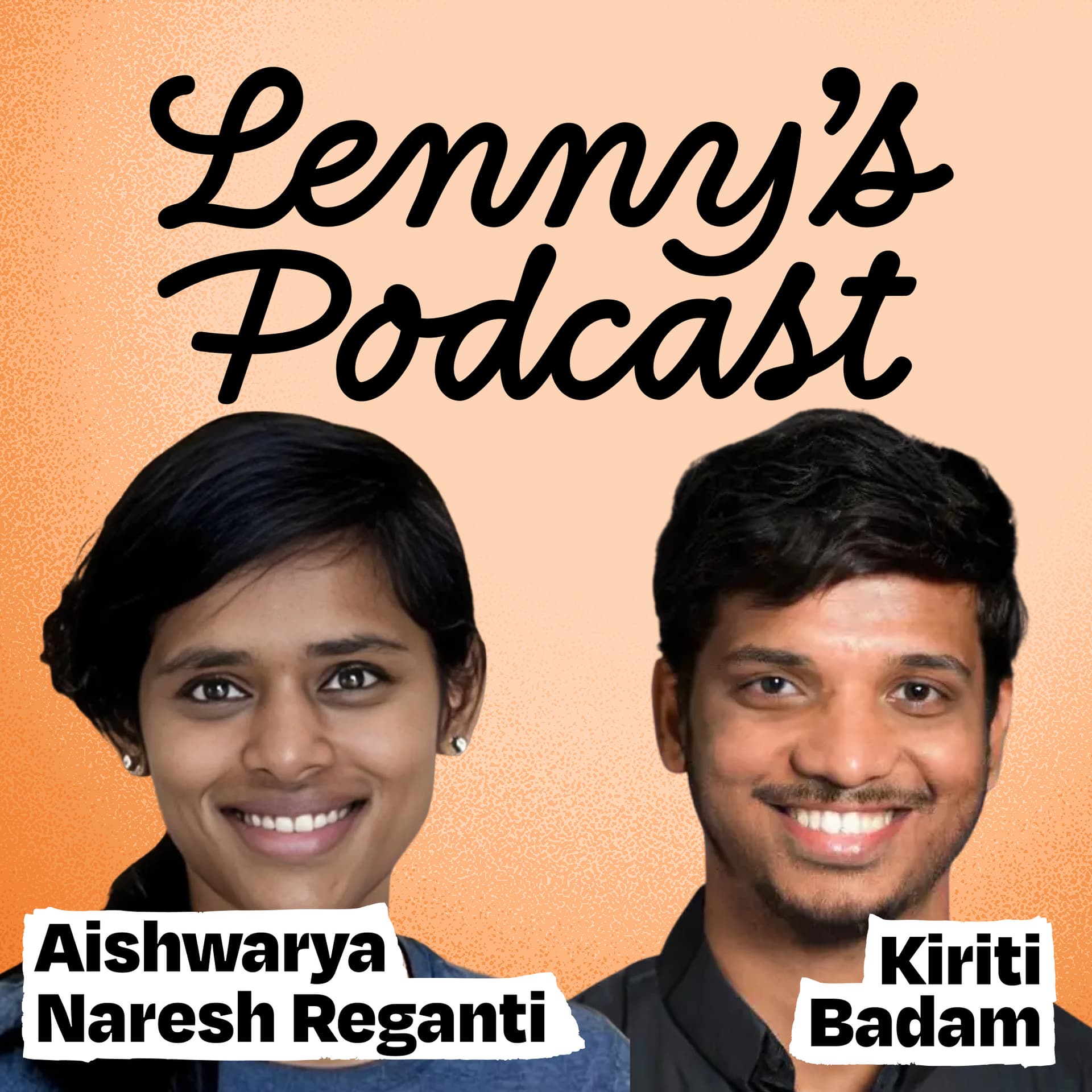
Episode Overview In this episode, Lenny interviews Aishwarya Naresh Reganti and Kiriti Badam, experts in AI product development who have launched over 50 AI products at various tech companies. They share their lessons learned and best practices for building and scaling successful AI products.
Key Points Discussed
Differences Between AI Products and Traditional Software
- Non-Determinism:
- AI products operate with non-deterministic APIs, meaning the input and output can vary significantly.
- Traditional software has predictable workflows that yield consistent results, while AI's fluid interface introduces uncertainty in user interaction and system responses.
- Agency-Control Trade-off:
- AI systems require a balance between automation (agency) and human control.
- As AI systems are given more autonomy, it is crucial to ensure they have earned user trust and reliability.
Best Practices for Building AI Products
- Start Small and Scale: Begin with high control and low agency. For instance, in customer support, start with AI suggesting responses before allowing it to take action independently.
- Continuous Calibration and Development (CC/CD):
- Establish a framework for iteratively improving AI products.
- Monitor performance regularly and adjust based on real user behavior rather than relying solely on evals.
Common Patterns and Anti-Patterns in Successful AI Product Development
- Successful companies:
- Foster a culture of learning and adaptation, encouraging leaders to be hands-on and willing to relearn as AI evolves.
- Focus on understanding workflows deeply to augment existing processes with AI rather than relying on generic solutions.
- Companies struggling with AI:
- Often lack alignment between technical and product teams regarding expected outcomes and user interactions.
- Misunderstand the capabilities and limitations of AI, jumping to complex solutions without proper foundations.
Challenges and Misconceptions
- Evals vs. Production Monitoring:
- Both evals (testing known aspects) and production monitoring (real-time user feedback) are essential but serve different purposes in ensuring product reliability.
- Misconceptions around evals often lead to neglecting the importance of ongoing monitoring and adaptation based on user interactions.
Future of AI
- Emerging Trends:
- Aishwarya emphasizes the importance of multimodal experiences, integrating various forms of data and interaction (text, visuals, etc.) to create richer user experiences.
- Kiriti predicts that proactive AI agents will become more common, providing users with insights and solutions before they even ask.
Key Takeaways
- Persistence is crucial for success in AI product development; learning from failures is part of the iterative process.
- Customer Trust is a major driver for successful AI products; prioritizing reliability and transparency will enhance user acceptance.
- Empower teams to understand and adapt to user behaviors rather than just implementing technology for technology’s sake.
Resources Mentioned
- [Aishwarya's LinkedIn](https://www.linkedin.com/in/areganti)
- [Kiriti's LinkedIn](https://www.linkedin.com/in/sai-kiriti-badam)
- [GitHub Repository of AI Resources](https://github.com/aishwaryanr/awesome-generative-ai-guide)
- [Maven Course on AI Applications](https://bit.ly/3V5XJFp)
Conclusion The conversation emphasizes the transformative potential of AI in product development while highlighting the unique challenges it presents. By focusing on user trust, iterative development, and effective collaboration, teams can successfully navigate the complexities of AI product creation.
---
This structured summary captures the essence of the podcast episode, offering insights into the key discussions and practical advice shared by the speakers.
Written by AI. May contain mistakes. Listen to the episode to check what was said.
Chapters
Tap a time to open that second in VOKey Insights on AI Product Development
0:46 to 2:15
Discussion of the important mindset and strategies for building AI products.
“It's about have you built the right flywheel in place so that you can improve over time.”
Expert Guests Introduction
2:16 to 4:10
Introduction of Aishwarya Riganti and Kuriti Bottom and their accomplishments.
“If you enjoy this podcast, don't forget to subscribe and follow it in your favorite podcasting app or YouTube.”
Current Trends in AI Development
4:11 to 6:40
Exploration of the changing landscape and challenges in AI product development.
“By the time the results are in, the moment to act has passed.”
Differences in Building AI vs. Non-AI Products
6:41 to 10:00
Explanation of the fundamental differences between AI products and traditional software.
“So you really need to figure out as you go.”
Agency and Control in AI
10:01 to 11:25
Discussion of the trade-off between user control and AI autonomy.
“What we mean by that, and I'm kind of shocked so many people don't talk about this.”
Building AI Products Gradually
11:26 to 13:00
Recommendation to start small and gradually increase complexity in AI product development.
“be building product and we're going to talk about the impact on how the product development lifecycle should change as a result.”
Practical Application: Customer Support AI
13:01 to 14:00
Illustration of implementing AI in customer support through a gradual approach.
“And the second part is like, it's also good.”
Building AI Systems with Human Feedback
14:00 to 16:20
Learn how human feedback is essential in developing effective AI systems.
“The kind of questions you get is different.”
Strategies for Gradually Increasing AI Autonomy
16:20 to 19:20
Understand the importance of gradual autonomy in AI product development.
“You keep that as is, but then remove the amount of control that the human has.”
Challenges of Non-Deterministic AI Outputs
19:20 to 22:40
Explore the complexities of managing non-deterministic AI and user experiences.
“you can be as natural as you would be with humans.”
Show all 39 chapters
The Importance of Human Oversight in AI
22:40 to 25:40
Discover the necessity of human oversight in developing and deploying AI products.
“I'm not going to go down that track, but that's a pretty scary conversation we had, but it'll be out before this conversation.”
Building a Culture for AI Success in Organizations
25:40 to 28:00
Learn how to foster a supportive culture for successful AI integration in companies.
“I almost think of it as like a success triangle with three dimensions.”
Building a Culture of Empowerment in AI
28:00 to 29:10
Learn how to foster a culture that embraces AI and empowers employees.
“their processes just because a competitor is doing it and just because it does make sense because there are use cases that are very right.”
Understanding Workflows for AI Integration
29:10 to 30:40
Discover the importance of understanding workflows to successfully integrate AI.
“And the third one is the technical part, which we talk about, right?”
Skepticism Towards One-Click AI Solutions
30:40 to 32:00
Explore the challenges of adopting quick AI solutions without proper setup.
“When someone comes up to me and says, we have this one-click agent, it's going to be deployed in your system.”
The Role of CEOs in AI Adoption
32:00 to 33:20
Understand the critical role of company leaders in driving AI success.
“There's a lot there that resonates so deeply with other conversations I've been having on this podcast.”
Evaluating Evals: The AI Debate
33:20 to 35:00
Dive into the ongoing debate around evaluation methods in AI development.
“Okay, let me talk about another topic that's very, it's been a hot topic on this podcast.”
Production Monitoring vs. Evals: A Balanced Approach
35:00 to 37:50
Learn the importance of both production monitoring and evals for AI applications.
“Just that now with AI agents, you need to be monitoring a lot more granularity.”
The Complexity of Defining Evals in AI
37:50 to 39:40
Examine the varying definitions and perceptions of evals in AI discussions.
“but this notion of only one of them is going to solve things for you, that is completely dismissible in my opinion.”
Customizable Coding Agents and Their Evaluation
39:40 to 42:00
Discover how coding agents require a unique approach to evaluation.
“That is kind of what is happening to evals or agents or any world in AI as of today.”
Building Customizable Coding Agents
42:00 to 45:00
Learn how coding agents differ from traditional products and the challenges of evaluating their effectiveness.
“And coding agents are extremely unique compared to agents for other domains in the sense that these are actually built for customizability, and these are built for engineers.”
Adapting AI Product Development
46:09 to 51:00
Understand how to shift AI product development processes to avoid common pitfalls.
“how teams can shift the way they build their AI products to this approach to help them avoid a lot of pain and suffering.”
Continuous Calibration in AI Products
51:00 to 56:00
Explore the principles of continuous development and calibration in AI systems.
“This is a nice image that kind of shows how you can think of agency and control as two dimensions.”
Building Evaluation Metrics in AI
56:00 to 57:23
Learn about the importance of creating evaluation metrics that adapt to user behavior and emerging patterns in AI products.
“You want to decide how you constrain your autonomy.”
Understanding Calibration in AI Systems
57:23 to 58:58
Discover how continuous calibration and understanding user interactions are vital for improving AI systems.
“And this idea of even calling continuous calibration, continuous development is communicating.”
Evolving User Behavior and AI Adaptation
58:58 to 1:01:24
Explore how user behavior evolves over time and the implications for AI product managers.
“But also, it really helps to understand that sometimes there are events that could completely, you know, mess up the calibration of your system.”
Misunderstandings in AI Systems
1:01:24 to 1:02:55
Discuss the misconceptions around multi-agent systems in AI and their potential.
“And even more importantly, what do you think is underhyped?”
Overrated and Underrated Aspects of AI
1:02:55 to 1:05:01
Reflect on what's overhyped and underrated in the AI landscape, exploring coding agents and the importance of design.
“So I feel like 2025 and 2026 is going to be like an incredible year for optimizing all of these processes.”
The Future of AI Product Development
1:05:01 to 1:09:44
Get insights into the anticipated developments in AI products and the importance of design and judgment in building them.
“And it will only become more true in the near future.”
Embracing Ownership in Product Development
1:10:02 to 1:11:34
Learn about the importance of ownership and agency in developing products.
“we use this very popular app for tracking our tasks, right?”
Persistence as a Key to Success
1:11:34 to 1:13:14
Discover how persistence in learning and adapting leads to success in AI products.
“He had 10 sales people, now he has 1.2 and 20 agents.”
Pain is the New Moat
1:13:14 to 1:13:49
Explore the concept that enduring challenges leads to valuable insights and success.
“and trade them off exactly with what are the features or what are the model capabilities that they can use to solve that problem.”
Understanding Customer Needs
1:13:49 to 1:14:41
Understand the critical focus on customer workflows and data in AI development.
“what translates into the mood of the company, right?”
The Lightning Round Begins
1:14:41 to 1:16:01
Engage with quick-fire questions about recommendations and insights.
“They're actually in the weeds understanding their customers' behavior and data.”
Books and Shows That Inspire
1:16:01 to 1:18:11
Hear about influential books and shows that resonate with the guests.
“But I remember one of them, he was kind of arguing against a very popular quote by Socrates, which is the unexamined life is not worth living or something like that.”
Final Thoughts and Online Presence
1:20:15 to 1:24:00
Get insights on where to find the guests' work and how to stay connected.
“I think people don't truly understand how incredible this is.”
Empowering Through Simplification
1:24:00 to 1:24:26
Learn how simplifying complex topics can empower others in the AI field.
Finding Resources and Learning AI
1:24:26 to 1:25:12
Discover valuable resources and courses for learning about AI products.
“So if you want to listen to Pragmatists who've been in the weeds working on AI products and what they're seeing, you can follow my work.”
Engaging with the AI Community
1:25:12 to 1:25:46
Understand how to connect and engage with professionals in the AI community.
“I don't like write a lot, I guess, but I'm super excited to just talk to any complex product that you're building.”
Transcript
Automatic transcript. May contain errors.0:28We worked on a guest post together. start small, it forces you to think about what is the problem that I'm going to solve. In all these advancements of the AI, one easy slippery slope is to keep thinking about complexities of the solution and forget the problem that you're trying to solve. It's not about being the first company to have an agent among your competitors. It's about have you built the right flywheel in place so that you can improve over time. What kind of ways of working do you see in companies that build AI products successfully? I used to work with the CEO of now Rackspace. He would have this block every day in the morning, which would say catching up with AI 4 to 6 a.m.
1:03Leaders have to get back to being hands-on. You must be comfortable with the fact that your intuitions might not be right. And you probably are the dumbest person in the room and you want to learn from everyone. What do you think the next year of AI is going to look like? Persistence is extremely valuable. Successful companies right now building in any new area, they are going through the pain of learning this, implementing this and understanding what works and what doesn't work. Pain is the new moat. Today, my guests are Aishwarya Riganti and Kuriti Bottom. Kuriti works on Codex at OpenAI and has spent the last decade building AI and ML infrastructure at Google and at Kumo.
1:40Ash was an early AI researcher at Alexa and Microsoft and has published over 35 research papers. Together, they've led and supported over 50 AI product deployments across companies like Amazon, Databricks, OpenAI, Google, and both startups and large enterprises. Together, they also teach the number one rated AI course on Maven, where they teach product leaders all of the key lessons they've learned about building successful AI products. The goal of this episode is to save you and your team a lot of pain and suffering and wasted time trying to build your AI product. Whether you are already struggling to make your product work or want to avoid that struggle, this episode is for you.
2:18If you enjoy this podcast, don't forget to subscribe and follow it in your favorite podcasting app or YouTube. It helps tremendously. And if you become an annual subscriber of my newsletter, you get a year free of a ton of incredible products, including a year free of Lovable, Replit, Bold, Gamma, N8N, Linear, Devon, Postalk, Superhuman, Descript, Whisperflow, Perplexity, Warp, Granola, Magic, Pattern, Draycast, Chapter, Demobit, and Stripe Atlas. Head on over to Lenny's Newsletter.com and click Product Pass. With that, I bring you Aishwarya, Riganti, and Kiriti Bado after a short word from our sponsors.
2:49This episode is brought to you by Merge. Product leaders hate building integrations. They're messy, they're slow to build, they're a huge drain on your roadmap. And they're definitely not why you got into product in the first place. Lucky for you, Merge is obsessed with integrations. With a single API, B2B SaaS companies embed Merge into their product and ship 220 plus customer-facing integrations in weeks, not quarters. Think of Merge like Plaid, but for everything B2B SaaS. Companies like Mistral AI, Ramp, and Drada use Merge to connect their customers as accounting, HR, ticketing, CRM, and file storage systems to power everything from automatic onboarding to AI-ready data pipelines.
3:31Even better, Merge now supports the secure deployment of connectors to AI agents with a new product so that you can safely power AI workflows with real customer data. If your product needs customer data from dozens of systems, Merge is the fastest, safest way to get it. Book and attend a meeting at merge.dev slash Lenny, and they'll send you a$50 Amazon gift card. That's merge.dev slash Lenny. This episode is brought to you by Strela, the customer research platform built for the AI era. Here's the truth about user research. It's never been more important or more painful. Teams want to understand why customers do what they do.
4:09But recruiting users, running interviews, and analyzing insights takes weeks. By the time the results are in, the moment to act has passed. Strela changes that. It's the first platform that uses AI to run and analyze in-depth interviews automatically, bringing fast and continuous user research to every team. Strela's AI moderator asks real follow-up questions, probing deeper when answers are vague, and surfaces patterns across hundreds of conversations all in a few hours, not weeks. Product, design, and research teams at companies like Amazon and Duolingo are already using Strela for Figma prototype testing, concept validation, and customer journey research, getting insights overnight instead of waiting for the next sprint.
4:51If your team wants to understand customers at the speed you ship products, try Strela. Run your next study at strela.io slash Lenny. That's S-T-R-E-L-L-A dot I-O slash Lenny.
5:07ash and kiretzi thank you so much for being here and welcome to the podcast thank you thank you for having us super excited for this let me set the stage for the conversation that we're going to have today so you two have built a bunch of ai products yourself you've gone deep with a lot of companies who have built ai products have struggled to build ai products build AI agents. We also teach our course on building AI products successfully. And you're kind of like on this mission to just reduce pain and suffering and failure that you constantly see people go through when they're building AI products.
5:43So to set a little just foundation for the conversation we're going to have, what are you seeing on the ground within companies trying to build AI products? What's going well? What's not going well? I think 2025 has been significantly different than 2024. One, the skepticism has significantly reduced. There were tons of leaders last year who probably thought this would be yet another crypto wave and kind of skeptical to get started. And a lot of the use cases that I saw last year were more of slap chat on your data. And that was, you know, calling themselves an AI product. And this year, a ton of companies are really rethinking their user experiences and their workflows and all of that and really understanding that you need to deconstruct and reconstruct your processes in order to build successful AI products, right?
6:33And that's the good stuff. The bad stuff is the execution is still all over the place. Think of it, right? This is a three-year-old field. There are no playbooks. There are no textbooks. So you really need to figure out as you go. And the AI lifecycle, both pre-deployment and post-deployment, is very different as compared to a traditional software lifecycle. And so a lot of old contracts and handoffs between traditional roles, like say PMs and engineers and data folks, has now been broken. And people are really getting adapted to this new way of working together and kind of owning the same feedback loop in a way.
7:14because previously I feel like PMs and engineers and all of these folks had their own feedback loops to optimize. And now you need to be probably sitting in the same room. You're probably looking at agent chases together and deciding how your product should behave. So it's a tighter form of collaboration. So companies are still kind of figuring that out. That's kind of what I see in my consulting practice this year. So let me follow that thread. We worked on a guest post together that came out a few months ago. And the thing that stood out to me most that stuck with me most after working on that post is you had this really key insight that building AI products is very different from building non-AI products.
7:53And the thing that you're big on getting across is there's two very big differences. Talk about those two differences. Yes. And again, I want to make sure that we drive home the right point. There are tons of similarities of building AI systems and software systems as well. But then there are some things that kind of fundamentally change the way you build software systems versus AI systems, right? And one of them that most people tend to ignore is the non-determinism. You're pretty much working with a non-deterministic API as compared to traditional software. What does that mean and why does that have to affect us is in traditional software, you pretty much have a very well-mapped decision engine or workflow.
8:38Think of something like booking.com, right? You have an intention that you want to make a booking in San Francisco for two nights, etc. The product has kind of been built so that your intention can be converted into a particular action. And you kind of are clicking through a bunch of buttons, options, forms, and all of that. And you finally achieve your intention. But now that layer in AI products has completely been replaced by a very fluid interface, which is mostly natural language. which means the user can literally come up with a ton of ways of saying or communicating their intentions, right?
9:15And that kind of changes a lot of things because now you don't know how your user is going to behave. That's on the input side. And the output is also that you're working with a non-deterministic, probabilistic API, which is your LLM. And LLMs are pretty sensitive to prompt phrasings and they're pretty much black boxes. So you don't even know how the output surface will look like, right? So you don't know how the user might behave with your product, and you also don't know how the LLM might respond to that. So you're now working with an input, output, and a process. You don't understand all the three very well.
9:49You're trying to kind of anticipate behavior and build for it. And with agentic systems, this kind of gets even harder. And that's where we talk about the second difference, which is the agency-controlled trade-off. What we mean by that, and I'm kind of shocked so many people don't talk about this. They're extremely obsessed with building autonomous systems, agents that can do work for you. But every time you hand over decision-making capabilities or autonomy to agentic systems, you're kind of relinquishing some amount of control on your end, right? And when you do that, you want to make sure that your agent has gained your trust or it is reliable enough that you can allow it to make decisions.
10:28And that's where we talk about this agency control tradeoff, which is if you give your AI agent or your AI system, whatever it is, more agency, which is the ability to make decisions, you are also losing some control. And you want to make sure that the agent or the AI system has earned that ability or has built up trust over time. So just to summarize what you're sharing here, essentially, people have been building software products for a long time. we're now in a world where the software you're building is one non-deterministic can just do things differently like you know as you said you go to booking.com you find a hotel it's going to be the same experience every time you'll see different hotels but it's a predictable experience with AI you can't predict that it's going to be the exact same thing the thing that you plan it to be every time and then the other is there's this trade-off between agency and control how much will the AI do for you versus how much should the person still be in charge and what I'm hearing is the big point here is this significantly changes the way you should be building product and we're going to talk about the impact on how the product development lifecycle should change as a result.
11:35Is there anything else you want to add there before we get into that? Yeah, it's definitely like one of the key points that this kind of distinction needs to exist in your mind like when you're starting to build. For example, think about if objective is to hike half-term in Yosemite. You don't start hiking it every day, but you start training yourself in minor parts, and then you slowly improve, and then you go to the end goal. I feel like that's extremely similar to what you want to build AI products, in the sense that you don't start with agents, with all the tools and all the contacts that you have in the company in day one, and expect it to work, or even tinker at that level.
12:14You need to be deliberately starting in places where there is minimal impact and more human control so that you have a good grip of what are the current capabilities and what can I do with them, and then slowly lean into the more agency and lesser control. So this gives you that confidence that, okay, I can know that, okay, this is the particular problem that I'm facing, and the AI can solve this extent of it, and then let me next think through what context I need to bring in, what kind of tools I need to add to this to improve the experience, right? So I feel like it's also, it's a good and a bad thing in the sense that it's good that you don't have to see the complexity of the outside world of like, you know, all of this fancy AI agents force and feel like I cannot do that.
12:58It's always, everyone is starting from very minimalistic structures and then evolving. And the second part is like, it's also good. The bad thing is that as you are like, you know, trying to build this one click agents into your company, you don't have to be overwhelmed with this complexity. you can like slowly graduate. So that's extremely important. And we see this as a repeating pattern over and over. Okay, so let's actually follow that through, because that's a really important component of how you recommend people build AI stuff, AI products, AI agents, all the AI things. So give us an example of what you're talking about here, this idea of starting slow with agency and control and then moving kind of up this rung.
13:38Yeah, for example, very important or like very prevalent application of AI agents is customer support. Imagine you are a company who has a lot of customer support tickets, and even imagine OpenAFS does the exact same thing when we were launching products, and there was a huge spike of support volume as we launched successful products like Image, like GPT-5, and things like that. The kind of questions you get is different. The kind of problems that the customers bring to you is different. It's not about just dumping all the list of help center articles that you have into the agent. You understand what are the things that you can build.
14:21Initially, the first step of it would be something like you have your support agents, the human support agents, but you will be suggesting in terms of, this is what the AI thinks that is the right thing to do. Then you get that feedback loop from the humans that, okay, this is actually a good solution for me in this particular case and this is a bad solution. Then you can go back and understand, okay, this is what the drawbacks are, this is where the blind spots are, and then how do I fix that? Once you get that, you can increase the autonomy to say that, okay, I don't need to suggest to the human, I'll actually show the answer directly to the customer.
14:59Then we can actually add more complexity in terms of, okay, I was only answering questions based on help center articles, but now let me add new functionality. Like I can actually issue refunds to the customers. I can actually raise feature requests with the engineering team and all of these things. So if you start with all of this on day one, it's incredibly hard to control the complexity. So we recommend like, you know, building step by step and then increasing it. Awesome. And you have a visual actually that we'll share of what this looks like. But just to kind of mirror back what you're describing, this idea of start with high control, low agency.
15:33In the example you gave is the support agents just kind of giving suggestions is not able to do anything. The user is in charge. And then as that becomes useful and you are confident it's doing the right sort of work, you give it a little more agency and you kind of pull back on the control the user has. And then if that's starting to go well, then you give it more agency and the user needs less control to control it. Awesome. I think the higher level idea here is with AI systems, it's all about behavior calibration. It's incredibly impossible to predict upfront how your system behaves. Now, what do you do about it?
16:16You make sure that you don't ruin your customer experience or your end user experience. You keep that as is, but then remove the amount of control that the human has. And there is no single right way of doing it. You can decide how to constrain that autonomy, right? A very, I mean, a different example of how you could constrain autonomy is pre-authorization use cases. Insurance pre-authorization is a very ripe use case for AI because clinicians spend a lot of time pre-authorizing things like blood tests, MRIs, and things like that. And there are some cases which are more of low-hanging fruits.
16:57For instance, MRIs and blood tests because as soon as you know patient's information, it's easier to approve that and AI could do that. versus something like an invasive surgery, et cetera, is more high risk. You don't want to be doing that autonomously. So you can kind of determine which of these use cases should go through that human in the loop layer versus which of the use cases AI can conveniently handle. And then all through this process, you're also logging what the human is doing, right? Because you want to build a flywheel that you could use in order to improve your system. So you're essentially not ruining the user experience, not eroding trust, at the same time logging what humans would otherwise do so that you can continuously improve your system.
17:41So let me give you a few more examples of this kind of progression that you recommend. And the reason I'm spending so much time here is this is a really key part of your recommendation to help people build more successful AI products. This idea of start slow with high control and low agency and then build up over time once you build confidence that it's doing the right sort of work. So a few more examples that you shared in your post that I'll just read. So say you're building a coding assistant. V1 would be just suggest inline completion and boilerplate snippets. V2 would be generate larger blocks like tests or refactors for humans to review.
18:14And then V3 is just apply the changes and open PRs autonomously. And then another example is a marketing assistant. So V1 would be draft emails or social copy, just like here's what I would do. V2 is build a multi-step campaign and run the campaign. and then launch and v3 is just launch it a b tested auto-optimized campaigns across channels awesome yeah and and again just to summarize where we're at just to give people the the advice we've shared so far uh one is just important to understand ai products are different they're non-deterministic and he pointed out and i forgot to actually mirror back this point both on the ins on the input and the output the user experience is non-deterministic like people will see different things, different outputs, different chat conversations, different maybe UI, if it's designing the UI for you.
19:02And also the output obviously is going to be non-terministic. So that's a problem and a challenge. And then... I mean, if you think of it, it's also the most beautiful part of AI, which is, I mean, we're all much more comfortable talking than following a bunch of buttons and all of that, right? So the bar to using AI products is much lower because you can be as natural as you would be with humans. But that's also the problem, which is there are tons of ways we communicate. And you want to make sure that that intent is rightly communicated and the right actions are taken because most of your systems are deterministic and you want to achieve a deterministic outcome, but with non-deterministic technology.
19:42And that's where it gets a little messy. Awesome. Okay. I love the optimistic version of why this is good. Okay. Right. And then the other piece is this idea of this tradeoff of botany versus control. And when you're designing a thing, and I imagine what you're seeing is people try to jump to the idea, like the V3 immediately. And that's when they get into trouble, both. It's probably a lot harder to build that and it just doesn't work. And then they're just like, okay, this is a failure. What are we even doing? Exactly. I feel that it's like a bunch of things that you actually have to get confidence in before you get to V3.
20:15And it's easy to get overwhelmed that, oh, my AI agent is doing these things wrong in like a hundred different ways, and you're not going to actually tabulate all of them and fix it. Even though you've learned how do you deal with the evaluation practices and stuff like that, if you're starting on the wrong spot, you are actually going to have a hard time correcting things from there. When you start small and when you start with a building like a very minimalistic portion with high human control and low agency, it also forces you to think about what is the problem that I'm going to solve. We use this term called problem first.
20:51And to me, it was obvious in the sense that, yeah, I do need to think about the problem, but it's incredible how well it resonates with the people that in all this advancements of the AI that we're seeing, one easy slippery slope is to just keep thinking about complexities of the solution and forget the problem that you're trying to solve. So when you're trying to start at a smaller scale of autonomy, you start to really think about what is the problem that I'm trying to solve and how do I break it down into like levels of autonomy that I can build later. So that is incredibly useful when like, and we keep repeating this pattern over and over with everyone we talk to.
21:30And there's so many other benefits to limiting autonomy because there's just danger also of the thing doing too much for you and just messing up your, I don't know, your database, sending out all these emails you never expected. There's like so many reasons this is a good idea. Yep. I recently read this paper from a bunch of folks at UC Berkeley, basically Matei, Zaharia, Eon Stoica and the folks at Databricks. And it said about 74 or 75 % of the enterprises that they had spoken to, their biggest problem was reliability. And that's also why they weren't comfortable deploying products to their end users and building customer facing products because they just weren't sure or they just weren't comfortable doing that and exposing their users to a bunch of these risks, right?
22:19And that's also why they think a lot of AI products today have to do with productivity because it's much low autonomy versus end-to-end agents that would replace workflows. And yeah, I love their work otherwise as well, but I think that's very in line with what at least we're seeing at my startup as well. Okay, very interesting. There's an episode that'll come out before this conversation where we go deep into another problem that this avoids, which is around prompt injection and jailbreaking and just how big of a risk that is for AI products where it's essentially an unsolved and unsolvable problem potentially.
22:56I'm not going to go down that track, but that's a pretty scary conversation we had, but it'll be out before this conversation. I think that will be a huge problem once systems go mainstream. We're still so busy building AI products that we're not worried about security, but it will be such a huge problem to kind of, especially with this non-deterministic API again, right? So you're kind of stuck because there are tons of instructions that you could inject within your prompt and then, yeah, it's going to be bad. Okay, let's actually spend a little time here because it's actually really interesting to me and no one's talking about this stuff, which is like the conversation we had is just, it's pretty easy to get AI to do stuff it shouldn't do.
23:39And there's all these guardrail systems people put in place, But it turns out these guardrails aren't actually very good and you can always get around them. And to your point, as agents become more autonomous and robots, it gets pretty scary that you could get AI to do things you shouldn't do. I think this is definitely a problem, but I feel in the current spectrum of customers adopting AI, the extent to which companies can actually get advantage of AI or improve their processes or streamline the existing processes that they have. I feel it's still in the very early stage. Like 2025 has been an extremely busy year for AI agents and customers trying to adopt AI.
24:20But I feel the penetration is still not as much as you would actually get advantage out of it. So with the right sort of human in the group points in here, I feel we can actually avoid a bunch of these things and focus more towards streamlining the processes. And I am more on the optimist side in the sense that like you need to try and adopt this before actually like trying to be only for highlighting the negative aspects of what would go wrong. So I feel like strongly that companies have to adopt this. They definitely like no company at OpenAI we talk to is, has never had been the case that, oh, AI cannot help me in this case.
25:00It has always been that, oh, there is this like set of things that it can optimize for me and then let me see how I can adopt it. Sweet. I always like the optimistic perspective. I'm excited for you to listen to this and see what you think because it's really interesting. And to your point, there's a lot of things to focus on. It's one of many things to worry about and think about. Okay, let's get back on track here. So we've shared a bunch of pro tips and important piece of advice. Let me ask what other patterns and kind of ways of working do you see in companies that do this well and teams that build AI products successfully?
25:33And then just what are the most common pitfalls people fall into? so we could just maybe start with what are other ways that companies do this well, build AI products successfully? I almost think of it as like a success triangle with three dimensions. It's never always technical. Every technology problem is a people problem first. And with companies that we have worked with, it's these three dimensions, right? Like great leaders, good culture, and technical prowess. with leaders itself we work with a lot of companies for their ai transformation training strategy and stuff like that and i feel like a lot of companies the leaders have built intuitions over 10 or 15 years and they are kind of highly regarded for those intuitions but now with ai in the picture those intuitions will have to be relearned and leaders have to be vulnerable to do that, right?
26:28I used to work with the CEO of now Rackspace, Gajan. So he would have this block every day in the morning, which would say catching up with AI 4 to 6 a.m. And he would not have any meetings or anything like that. And that was just his time to pick up on the latest AI, you know, podcasts or information and all of that. And he would have weekend wipe coding sessions and stuff like that. So I think leaders have to get back to being hands-on and that's not because they have to be implementing these things but more of rebuilding their intuitions because you must be comfortable with the fact that your intuitions might not be right and you probably are the dumbest person in the room and you want to learn from everyone.
Read the full transcript
27:10And I've seen that being a very distinguishing factor of companies that build products which are successful because you're kind of bringing in that top-down approach. It's almost always impossible for it to be bottom-up. You can't have a bunch of engineers go and get buy-in from the leader if they just don't trust in the technology or if they have misaligned expectations about the technology, right? I've heard from so many folks who are building that our leaders just don't understand the extent to which AI can solve a particular problem or they just wipe out something and assume it's easy to take it to production and you really need to understand the range of what AI can solve today so that you can guide decisions within the company.
27:51The second one is the culture itself, right? And again, I work with enterprises where AI is not their main thing and they need to bring in AI into their processes just because a competitor is doing it and just because it does make sense because there are use cases that are very right. Then along the way, I feel a lot of companies have this culture of FOMO and you will be replaced and those kind of things and people get really afraid. Subject matter experts are such a huge part of building AI products that work because you really need to consult them to understand how your AI is behaving or what the ideal behavior should be.
28:27But then I've spoken to a bunch of companies where the subject matter experts just don't want to talk to you because they think their job is being replaced. So as I mean, again, this comes from the leader itself. You want to build a culture of empowerment, of augmenting AI into your own workflows so that you can 10x in what you're doing instead of saying that probably you will be replaced if you don't adopt AI and stuff like that. So that kind of an empowering culture always helps. You want to make your entire organization be in it together and make AI work for you instead of trying to guard their own jobs, etc.
29:04And with AI, it's also true that it opens up a lot more opportunities than before. So you could have your employees doing a lot more things than before and 10x their productivity. And the third one is the technical part, which we talk about, right? I think folks that are successful are incredibly obsessed about understanding their workflows very well and augmenting parts that could be ripe for AI versus the ones that might need human in the loop somewhere, etc. Whenever you're trying to automate some part of a workflow, it's never the case that you could use an AI agent and that will kind of solve your problems, right?
29:46It's always you probably have a machine learning model that's going to do some part of the job. You have deterministic code doing some part of the job. So you really need to be obsessed with understanding that workflow so you can choose the right tool for the problem instead of being obsessed with the technology itself. And another pattern I see is also folks really understand this idea of working with a non-deterministic API, which is your LLM. And what that means is they also understand the AI development lifecycle looks very different. And they iterate pretty quickly, which is can I build something, iterate quickly in a way that it doesn't ruin my customer experience, at the same time gives me enough amount of data so that I can estimate behavior, right?
30:31So they build that flywheel very quickly. As of today, it's not about being the first company to have an agent among your competitors. It's about have you built the right flywheels in place so that you can improve over time. When someone comes up to me and says, we have this one-click agent, it's going to be deployed in your system. And then in two or three days, it'll start showing you significant gains. I would almost be skeptical because it's just not possible. And that's not because the models aren't there, but because enterprise data and infrastructure is very messy. and you need a bit to, even the agent needs a bit to understand how these systems work.
31:06There are very messy taxonomies everywhere. People tend to do things like get customer data, we want, get customer data, we do, and these kind of things. And all those functions exist and they are being called. And basically, there's a lot of tech debt that you need to deal with. So most of the times, if you're obsessed with the problem itself and you understand your workflows very well, you will know how to improve your agents over time instead of just slapping an agent and assuming that it will work from day one. I probably will go as far to say that if someone's selling you one-click agents, it's pure marketing.
31:41You don't want to buy into that. I would rather go with a company that says, we're going to build this pipeline for you and that will learn over time and kind of build a flywheel to improve than something that's going to work out of the box. To replace any critical workflow or to build something that can give you significant ROI, Quite easily it takes four to six months of work, even if you have the best data layer and infrastructure layer. Amazing. There's a lot there that resonates so deeply with other conversations I've been having on this podcast. One is just for a company to be successful at seeing a lot of impact from AI, the founder CEO has to be deep into it.
32:18I had Dan Shipper on the podcast and they work with a bunch of companies helping them adopt AI. And he said that's the number one predictor of success is the CEO chatting with ChatGPT, Claude, whatever. many times a day. I love this example he gave at the Rackspace CEO as like catch up on AI news in the morning every day. I was imagining he'd be like chatting with like the chatbot versus like reading news. With the kind of information you have as of today, you could just, I mean, you want to choose the right channels as well because everybody has an opinion. So whose opinion do you want to bank on?
32:53I feel like having that good quality set of people that you're listening to really make sense. So he just has a list of two or three sources that he always looks at. And then he comes back with a bunch of questions and bounces it around with a bunch of AI experts to see what they think about it. And I was part of that group. So I kind of know about the questions that he comes up with. So it's pretty cool. I was like, why are you doing so much? And then he says it trickles down into a bunch of decisions that we will take. Okay, let me talk about another topic that's very, it's been a hot topic on this podcast.
33:25It was a hot topic on Twitter for a while. Well, evals, a lot of people are obsessed with evals, think they're the solution to a lot of problems in AI. A lot of people think they're overrated. That way you don't need evals. You can just feel the vibes and you'll be all right. What's your take on evals? How far does that take people in solving a lot of the problems that you talk about? In terms of like what is going on in the community, I feel there's this false dichotomy of like there's either evals is going to solve everything. or online monitoring or production monitoring is going to solve everything.
33:59And I find no reason to trust one of the extremes in the sense that I will entirely bank my application on this or like that to solve the thing. So if you take a step back, think of what are evals. Evals are basically your trusted product thinking or your knowledge about the product that is going into this set of data sets that you're going to build in the sense that this is what matters to me. Like this is the kind of problems that my agent should not do. And let me build a list of data sets so that I'm going to do well on those. And in terms of production monitoring, what you're doing there is you're deploying an application.
34:39And then you're having this some sort of key metrics that actually communicate back to you on how customers are using your product. Like you could be deploying any agent. And like if the customer is giving a thumbs up for your interaction, you better want to know that. So that is what production monitoring is going to do. And this production monitoring has existed for products for a long time. Just that now with AI agents, you need to be monitoring a lot more granularity. It's not just the customer always giving you explicit feedback, but there is many implicit feedback that you can get. For example, in ChatGPT, if you are liking the answer, you can actually give a thumbs up.
35:17Or if you don't like the answer, sometimes customers don't give you thumbs down, but actually regenerate the answer. So that is a clear indication that the initial answer that you generated is not meeting the customer's expectation. So these are the kind of implicit signals you always need to think about, and that spectrum has been increasing in terms of production monitoring. Now, let's come back to the initial topic of, okay, is it evals or is it production monitoring? What does it matter? So I feel, again, we go back to this problem-first approach of what is it that you're trying to build? like you're trying to build a reliable application for your customers.
35:54That's not going to do a bad thing. Like it's always going to do the right thing. Or if it is doing a wrong thing, you are you are basically alerted like very quickly. Right? So the I break this down into two parts. Like one is you like nobody goes into deploying an application without actually like, you know, just testing that this testing could be wipes or this testing could be, okay, I have this like ten questions that it should not go wrong no matter what changes I make. And let me build this and let's call this an evaluation data set. Now, let's say you build this, you deployed this, and then you figured, okay, now I need to understand whether it's doing the right thing or not.
36:31So if you're a high throughput or like a high transaction customer, you cannot tactically sit and evaluate all the traces, right? You need some indication to understand what are the things that I should look at. And this is where production monitoring comes into the picture that you cannot predict the base in which your agent could be doing wrong, but all of these other implicit signals and explicit signals, those are going to communicate back to you what are the traces that you need to look at. And that is where production monitoring helps. And once you get this kind of traces, you need to examine what are the failure patterns that you're seeing in these different types of interactions.
37:10And is there something that I really care about that should not happen? And if that kind of failure modes are happening, then I need to think about building an evaluation data set for it. And okay, let's say I built an evaluation data set for my agent trying to offer refunds where explicitly I have configured it not to. So I built this evaluation data set and then I made my changes in tools or prompts or whatever, and then I deployed the second version of the product. Now, there is no guarantee that this is the only problem that you're going to see. You still need production monitoring to actually catch different kinds of problems that you might encounter.
37:48So I feel evals are important, production monitoring is important, but this notion of only one of them is going to solve things for you, that is completely dismissible in my opinion. All right, a very reasonable answer. And the point here isn't, it's not just as simple as do both, it's more that there are different things to catch, and one approach won't catch all the things you need to be paying attention to. Exactly. Awesome. I want to take two steps back and kind of talk about how much weight the term evals has had to take in the second half of 2025. Because you go meet a data labeling company and they tell you our experts are writing evals.
38:28And then you have all of these folks saying that PMs should be writing evals. They're the new PRDs. And then you have folks saying that evals is pretty much everything, which is the feedback loop you're supposed to be building to improve your products. Now, step back as a beginner and kind of think, what are evals? Why is everyone saying evals? And these are actually different parts of the process. And nobody's wrong in the sense that, yes, these are evals. But when a data labeling company is telling you that our experts are writing evals, they're actually referring to error analysis, or, you know, experts just leaving notes on what should be right.
39:02Lawyers and doctors write evals that doesn't mean they're building LLM judges or they're building this entire feedback loop. And when you say that a PM should be writing evals, doesn't mean they have to write an LLM judge that's good enough for production. I think there's also very prescriptive ways of doing this and plus one to KD, which is you cannot predict upfront if you need to be building an LLM judge versus you need to be using implicit signals from production monitoring, et cetera. I think Martin Fowler at some point had this term called semantic diffusion back in the 2000s, which kind of means that someone comes up with a term, everybody starts butchering it with their own definitions, and then you kind of lose the actual definition of it.
39:45That is kind of what is happening to evals or agents or any world in AI as of today. Everybody kind of sees a different side to it, I guess. But if you make a bunch of practitioners sit together and ask them, is it important to build an actionable feedback loop for AI products? I think all of them will agree. Now, how you do that really depends on your application itself. When you go to complex use cases, it's incredibly hard to build LLM judges because you see a lot of emerging patterns. If you build a judge that would, you know, test for verbosity or something like that, it turns out that you're seeing newer patterns that your LLM judge is not able to catch.
40:22and then you just end up building too many evals. And at that point, it just makes sense to look at your user signals, fix them, check if you've regressed and move on instead of actually building these charges. So it all depends. I think one statement that every ML practitioner will tell you is it really depends on the context. Don't be obsessed with prescriptions they're going to change. That's such an important point, this idea that especially that evals just means many things to different people now. It's just like a term for so many things. And it's complicated to just talk about evals when you see it as the stuff data labeling companies are giving you and things PM are right.
41:00And there's also benchmarks. People call benchmarks a little bit evals. I recently spoke to a client who told me, we do evals. And I was like, okay, can you show me your data set? And I said, no, we just checked LM Arena and artificial analysis. These are independent benchmarks. And we know that this model is the right one for our use case. And I'm like, you're not doing evals. That's not evals. Those are model evals. But it makes sense. It's like the word, you know, it could be used in that context. I get why people think that. But yeah, now it's just confusing it even more. Yep. Just like one more line of questioning here that I think that's on my mind is the reason this became kind of a big debate is Cloud Code, the head of Cloud Code, Boris, was like, nah, we don't do evals on Cloud Code.
41:37It's all vibes. What can you share, Kariti, on Codex and the Codex team of how you approach evals? So Codex, we have like this balanced approach of like, you know, you need to have evals and you need to definitely listen to your customers. And I think Alex has been on your podcast recently, and he's been talking about how you're extremely focused on building the right product, right? And a big part of it is basically listening to your customers. And coding agents are extremely unique compared to agents for other domains in the sense that these are actually built for customizability, and these are built for engineers.
42:12So coding agent is not a product which is going to solve these top five workflows or top six workflows or whatever, right? It's meant to be customizable in multi-different ways. And the implication of that is that your product is going to be used in different integrations and different kinds of tools and different kinds of things. So it gets really hard to build an evaluation data set for all kinds of interactions that your customers are going to use your product for. But that said, you also need to understand that, okay, if I'm going to make a change, it's at least not going to damage something that is really core to the product.
42:47So we have evaluations for doing that. At the same time, we take extreme care on understanding how the customers are using it. For example, we built this code review product recently. It has been gaining extreme amount of traction. And I feel like many, many bugs in OpenAI as well as external customers are getting caught with this. And now let's say if I'm making a model change to the code review or different kinds of RL mechanism that I trained with it. Now, if I'm going to deploy it, I definitely do want to A-B test and identify whether it's actually finding the right mistakes and how are users reacting to it.
43:28Sometimes, if users do get annoyed by your incorrect code reviews, they go to the extent of just switching off the product. Those are the signals that you want to look at and make sure that your new changes are doing the right thing. It's extremely hard for us to think of these kind of scenarios beforehand and develop evaluation data sets for it. So I feel like there's a bit of both. There's a lot of vibes and there's a lot of customer feedback. And we're super active on the social media to understand if anybody's having certain types of problems and quickly fix that. So I feel it's a how do I put this?
44:05It's like a domain of things that you do. That makes so much sense. Okay, what I'm hearing codex pro evals, but it's not enough. But also, just watch customer behavior and feedback. And also there's some vibes, just like, is this feeling good? Is this, as I'm using it, generating great code that I'm excited about that I think is great. I don't think if anybody is coming and saying that I have this concrete set of evals that I can bet my life on and then I don't need to think about anything else, it's not going to work. And every new model that we're going to launch, we get together as a team and test different things.
44:41Each person is concentrating on something else. And we have this list of hard problems that we have. And we throw that to the model and see how well they are progressing. So it's like custom evals for each engineer, you would say. And just understand what the product is doing in its new model. If you're a founder, the hardest part of starting a company isn't having the idea. It's scaling the business without getting buried in back office work. That's where Brex comes in. Brex is the intelligent finance platform for founders. With Brex, you get high limit corporate cards, easy banking, high yield treasury, plus a team of AI agents that handle manual finance tasks for you.
45:20They'll do all the stuff that you don't want to do, like file your expenses, scour transactions for waste, and run reports, all according to your rules. With Brex's AI agents, you can move faster while staying in full control. One in three startups in the United States already runs on Brex. You can too at brex.com.
46:08and then just walk us through what this is, how this works, how teams can shift the way they build their AI products to this approach to help them avoid a lot of pain and suffering. Before we go about explaining the life cycle, a quick story on why Kirita and I came up with this is because there are tons of companies that we keep talking to that have the pressure from their competitors because they're all building agents. We should be building agents that are entirely autonomous. And I did end up working with a few customers where we built these end-to-end agents. And it turns out that because you start off at a place where you don't know how the user might interact with your system and what kind of responses or actions the AI might come up with, it's really hard to fix problems when you have this really huge workflow, which is taking four or five steps, making tons of decisions.
47:00You just end up debugging so much and then kind of hot fixing to the point where at a time we were building for a customer support use case, which is the example that we give in the newsletter as well. And we just shut down the product because we were doing so many hot fixes and there was no way we could count all the emerging problems that were coming up. And there's also quite some news online. Recently, I think Air Canada had this thing where one of their agents predicted or hallucinated a policy for a refund, which was not part of their original playbook. And they had to go by it because legal stuff.
47:40And there have been a ton of really scary incidents. And that's where the idea comes from. How can you build so that you don't lose customer trust and you don't end up or your agent or AI system doesn't end up making decisions that are super dangerous to the company itself. At the same time, build a flywheel so that you can improve your product as you go. And that's where we came up with this idea of continuous calibration, continuous development. The idea is pretty simple, which is we have this right side of the loop, which is continuous development, where you scope capability and curate data, essentially get a data set of what your expected inputs are and what your expected outputs should be looking at.
48:24this is a very good exercise before you start building any AI product, because many times you figured out that a lot of the folks within the team are just not aligned on how the product should behave. And that's where your PMs can really give in a lot more information and your subject matter experts as well. So you have this data set that you know your AI product should be doing really well on. It's not comprehensive, but it lets you get started. And then you set up the application and then design the right kind of evaluation metrics. And I intentionally use the term evaluation metrics, although we say evals because I just want to be very specific with what it is, because evaluation is a process.
49:01Evaluation metrics are dimensions that you want to focus on during the process, right? And then you go about deploying, run your evaluation metrics. And the second part is the continuous calibration, which is the part where you understand what behavior you hadn't expected in the beginning, right? Because when you start the development process, you have this data set that you're optimizing for. But more often than not, you realize that that data set is not comprehensive enough because users start behaving with your systems in ways that you did not predict. And that's where you want to do the calibration piece, right?
49:40I've deployed my system. Now I see that there are patterns that I did not really expect. And your evaluation metrics should give you some insight into those patterns. But sometimes you figure out that those metrics were also not enough. And you probably have new error patterns that you've not thought about. And that's where you analyze your behavior, spot error patterns. You apply fixes for issues that you see, but you also design newer evaluation metrics to figure out that they are emerging patterns. And that doesn't mean you should always design evaluation metrics, there are some errors that you can just fix and not really come back to because they're very spot errors.
50:16For instance, there's a tool calling error just because your tool wasn't defined well and stuff like that. You can just fix it and move on, right? And this is pretty much how an AI product lifecycle would look like. But what we specifically also mention is while you're going through these iterations, try to think of lower agency iterations in the beginning and higher control iterations, what that means is constrain the number of decisions your AI systems can make and make sure that they're humans in the loop, and then increase that over time because you're kind of building a flywheel of behavior.
50:53And you're understanding what kind of use cases are coming in or how your users are using the system, right? And one example I think we give in the newsletter itself is the customer support. This is a nice image that kind of shows how you can think of agency and control as two dimensions. And each of your versions keep on increasing the agency or the ability of your AI system to make decisions and lower the control as you go. And one example that we gave is that of the customer support agent, where you can break it down into three versions. The first version is just routing, which is, is your agent able to classify and route a particular ticket to the right department?
51:34And sometimes when you read this, you probably think, is it so hard to just do routing? Why can't an agent easily do that? And when you go to enterprises, routing itself can be a super complex problem. Any retail company, any popular retail company that you can think of has hierarchical taxonomies. Most of the times the taxonomies are incredibly messy. I have worked in use cases where you probably have taxonomy that says some kind of hierarchy And then that says shoes and then women's shoes and men's shoes all at the same layer where ideally you should be having shoes and then women's shoes and men's shoes should be sub classes.
52:15And then you're like, OK, fine, I could just merge that. And you go further and you see that there's also another section on the shoes that says for women and for men. And it's just not aggregated. It's not fixed for some reason. So if an agent kind of sees this kind of a taxonomy, what is it supposed to do? where is it supposed to route? And a lot of the times we are not aware of these problems until you actually go about building something and understanding it, right? So, and when these kind of problems, real human agents see these kind of problems, they know what to check next. Maybe they realize that the node that says for women and for men that's under shoes was last updated in 2019, which means that it's just a dead node that's lying there and not being used.
52:56So they kind of know that, okay, we're supposed to be looking at a different node and stuff like that. And I'm not saying agents cannot understand this or models are not capable enough to understand this, but there are really weird rules within enterprises that are not documented anywhere and you want to make sure that the agents have all of that context instead of just throwing the problem at them, right? Yeah, coming back to the versions we had, routing was one where you have really high control because even if your agent routes to the wrong department, humans can take control and undo those actions.
53:30And along the way, you also figure out that you probably are dealing with a ton of data issues that you need to fix and make sure that your data layer is good enough for the agent to function. We do is what we said of a co-pilot, which is now that you've figured out routing works fine after a few iterations and you've fixed all of your data issues, you could go to the next step, which is, can my agent provide suggestions based on some standard operating procedures that we have for the customer support agent? And it could just generate a draft that the human can make changes to. And when you do this, you're also logging human behavior, which means that how much of this draft was used by the customer support agent or what was omitted.
54:13So you're actually getting error analysis for free when you do this, because you're literally logging everything that the user is doing that you could then build back into your flywheel. And then we say, post that once you figured out that those drafts look good. And most of the times, maybe humans are not making too many changes. They're using these drafts as is. That's when you want to go to your end to end resolution assistant that could, you know, draft a resolution that could solve the ticket as well. Right. And those are the stages of agency. where you start with low agency and then you go up high rate.
54:47We also have this really nice table that we put together, which is what do you do at each version and what you learn that can enable you to go to the next step and what information do you get that you can feed into the loop, right? When you're just doing your routing, you have better quality routing data. You also know what kind of prompts you need to be building to improve the routing system. Essentially, you're figuring out your structure for context engineering and building that flywheel that you want to write. And while I go through this, I want to also be very clear that two things. One is when you build with CCCD in mind, it doesn't mean that you fix the problem all for once.
55:27It's possible that you've probably gone through V3 and you see a new distribution of data that you never previously imagined. But this is just one way to lower your risk, which is you get enough information about how users behave with your system before going to a point of complete autonomy. And the second thing is you're also kind of building this implicit logging system. A lot of people come and tell us that, oh, wait, there are evals, right? Why do you need something like this? the issue with just building a bunch of evaluation metrics and then having them in production is evaluation metrics catch only the errors that you're already aware of, but there can be a lot of emerging patterns that you understand only after you put things in production, right?
56:17So for those emerging patterns, you're kind of creating, you know, a low risk kind of a framework so that you could understand user behavior and not really be in a position where there are tons of errors in You're trying to fix all of them at once. And this is not the only way to do it. There are tons of different ways. You want to decide how you constrain your autonomy. It could be based on the number of actions that the agent is taking, which is what we do in this example. It could be based on topic. There are just some domains where it's pretty high risk to make a system completely autonomous for certain decisions.
56:54But for some other topics, it's OK to make them completely autonomous and depending on the complexity of the problem. And that's where you really want your product managers, your engineers and subject matter experts to align on how to build this system and continuously improve it. The idea is just behavior calibration and not losing user trust as you do that behavior calibration, I guess. We'll link folks to this actual post if they want to go really deep. You basically go through all of these steps by step, a bunch of examples. And the idea here is, as you said, that like the reason everything about what you're describing here is about making it continuous and iterative and kind of moving along this progression of higher autonomy, less control.
57:36And this idea of even calling continuous calibration, continuous development is communicating. It's this kind of iterative process. And just to be clear, this this naming is kind of owed to CICD, continuous integration, continuous deployment suite. And the idea here is like that this is the version of that for AI, where instead of just like integrating to unit tests and deploying constantly, it's running evals, looking at results, iterating on the metrics you're watching, figuring out where it's breaking and iterating on that. Awesome. Okay. So again, we'll point people to this post if they want to go deeper.
58:11That was a great overview. Is there anything else before I go into a different topic around this framework specifically that you think is important for people to know? I think one of the most common questions we get is, how do I know if I need to go to the next stage or if this is calibrated enough, right? There's not really a rulebook you can follow, but it's all about minimizing surprise, which means, let's say you're calibrating every one or two days and you figure out that you're not seeing new data distribution patterns. Your users have been pretty consistent with how they're behaving with the system.
58:42then the amount of information you gain is kind of very low. And that's when you know you can actually go to the next stage. And it's all about the wipes at that point. Like, you know, you're ready. You're not receiving any new information. But also, it really helps to understand that sometimes there are events that could completely, you know, mess up the calibration of your system. An example is GPT-4O doesn't exist anymore, or it's going to be deprecated in APIs as well. So most companies that were using 4.0 should switch to 5, and 5 has very different properties. So that's where your calibration is off again.
59:24You want to go back and do this process again. Sometimes users start behaving with systems also differently over time, or user behavior evolves. Even with consumer products, you don't talk to chat GPT the same way you were talking, say, two years ago. just because you know the capabilities have increased so much. And also just people get excited when, you know, these systems can solve one task. They want to try it out on other tasks as well. We built this system for underwriters at some point, right? Underwriting is a painful task. There are agreements that are like, you know, loan applications that are like 30 or 40 pages.
1:00:03And the idea for this bank was to build a system that could help underwriters pick policies and information about the bank so that they could approve loans. And for a good three or four months, everybody was pretty impressed with the system. We had underwriters actually report gains in terms of how much time they were spending, etc. And post three months, we realized that they were so excited with the product that they started asking very deep questions that we never anticipated. They would just throw the entire application document at the system and go like, for a case that looks like this, what did previous underwriters do?
1:00:39And for a user, that just seems like a natural extension of what they were doing. But the building behind it should significantly change. Now, you need to understand what does for a case like this mean in the context of the loan itself? Is it referring to people of a particular income range? Or is it referring to people in a particular geo and stuff like that? And then you need to pick up historical documents, analyze those documents, and then tell them, okay, this is what it looks like, versus just saying that there's a policy X, Y, and Z, and you want to look up that policy. So something that might seem very natural to an end user might be very hard to build as a product builder.
1:01:17And you see that user behavior also evolves over time, and that's when you know that you want to go back and recalibrate. What do you think is overhyped in the AI space right now? And even more importantly, what do you think is underhyped? I am, as I said, like super optimistic in different things that are going in AI. So I wouldn't say overhyped, but I feel kind of misunderstood is the concept of multi-agents. People have this notion of like, I have this incredibly complex problem. Now I'm going to break it down into, hey, you're this agent, take care of this. you're this agent take care of this and now if I somehow connect all of these agents they think they're the agent utopia and it's never the case that there are incredibly successful multi-agent systems that are built right like there's no doubt about that but I feel a lot of it comes in terms of how are you limiting the ways in which the system can go off tracks and for example like if you're building a supervisor agent and there are like sub-agents that actually do the work for the supervisor agent, that is a very successful pattern.
1:02:24But coming with this notion of I'm going to divide the responsibilities based on functionality and somehow expect all of that to work together in some sort of gossip protocol, that is extremely misunderstood that you could do that. I don't think current ways of building and current model capabilities are right there in terms of building those kind of applications. I feel that is kind of misunderstood than overrated. Underrated, I feel it's hard to probably believe, but I still feel coding agents are underrated in the sense that I feel like you can go on Twitter and you can go on Reddit and you see a lot of chatter about coding agents, but talking to an engineer in any random company, especially outside of the area, you can see the amount of impact this coding agents can create and the penetration is very low.
1:03:17So I feel like 2025 and 2026 is going to be like an incredible year for optimizing all of these processes. And I feel that is going to be creating a lot of value with AI. That's really interesting on that first point. So the idea there is you'll probably be more successful building and using an agent that is able to do its own sub-agent splitting of work versus like a bunch of, say, codex agents where you do this task, you do that task? You can have agents to do these things and you as a human can orchestrate it or you can have like one larger agent that is going to orchestrate all of these things.
1:03:52But letting the agents communicate in terms of peer-to-peer kind of protocol and then especially doing this in a customer support kind of use case is incredibly hard to control what kind of agent is replying to your customer because you need to shift your guardrails everywhere and things like Yeah. Okay. Great picks. Okay. Ash, what do you got? Can I say evals? Will I be canceled? On which category? Which bucket do they go? Overrated. Overrated. Okay. Go for it. We won't let you get canceled. Just kidding. I think evals are misunderstood. They are important folks. I'm not saying they're not important.
1:04:27But I think just this, I'm going to keep jumping across tools and going to pick up and learn if new tool is overrated. I still am old school and feel like you would really need to be obsessed with the business problem you're trying to solve. AI is only a tool. Try to think of it that way. Of course, you need to be learning about the latest and greatest, but don't be so obsessed with just building so quickly. Building is really cheap today. Design is more expensive. Really thinking about your product, what you're going to build. Is it going to really solve a pain point? Is what is way more valuable today?
1:05:04And it will only become more true in the near future. So really obsessing about your problem and design is underrated and just rote building is overrated, I guess. Awesome. Okay. Similar sort of question. From a product point of view, what do you think the next year of AI is going to look like? Give us a vision of where you think things are going to go, say, by the end of 2026. Yeah, I feel there's a lot of promise in terms of this background agents or proactive agents who is like they are going to like basically understand your workflow even more. If you think of like where is AI failing to create value today, it's mainly about not understanding the context.
1:05:48And the reason that it's not understanding the context is it's not plugged into the right places where actual work is happening. right and as you do more of this you can give the agent more of context and then it starts to see the world around you and understand what is the what is the set of metrics that you're optimizing for or what are the kind of activities that you're trying to do it is a very easy extension from there to actually gain more out of it and then let the agent prompt you back we already do this in terms of chat gpt pulse which kind of gives you this daily update of things you might care about and And it's very nice to actually have that like jog your brain up in terms of, oh, this is something that I haven't thought about.
1:06:26Maybe this is good. And now when you extend this to more complex tasks, like a coding agent, which says that like, okay, I have fixed five of your linear tickets. And here are the patches just to review them at the start of your day. So I feel that is going to be like extremely useful. And I see that as like a strong direction in which like products are going to build in 2026. That is so cool. So essentially agents kind of anticipating what you want to do and getting ahead of you. And here's, I've solved these problems for you. Or I think this is going to crash your site. Maybe you should fix this thing right here.
1:06:56Or I see the spike here and let's refactor a database. Amazing. What a world. Okay. Ash, what do you got? I'm all in for multimodal experiences in 2026. I think we have done quite some progress in 2025. And not just in terms of generation, but also understanding. Until now, I think LLMs have been our most commonly used models. But as humans, we are multimodal creatures, I would say. Language is probably one of our last forms of evolution. As the three of us are talking, I think we're constantly getting so many signals. I'm like, oh, Lenny is not in his head, so probably I would go in this direction.
1:07:34Or Lenny's bored, so let me stop talking. So there's a chain of thought behind your chain of thought and you're constantly altering it with language that dimension of expression is not explored as well. So if we could build better multimodal experiences, that would get us closer to human-like conversation richness. And yeah, I think, and just you will also, just given the kind of models, there's a bunch of boring tasks as well, which are ripe for AI. if multimodal understanding gets better. There are so many handwritten documents and really messy PDFs that cannot be passed even by the best of the models as of today.
1:08:15And if it's possible, there'll be so much data that we can tap into. Awesome. I just saw Demis from DeepMind, AI, Google, whatever they call the whole org, talking about this, where he thinks that's going to be a big part of where they're going, combining the image model work, the LLM and also their world model stuff, Genie, I think is what it's called. So that's going to be a wild, wild time. Okay, last question. If someone wants to just get better at building AI products, what's just maybe one skill or maybe two skills that you think they should lean into and develop? I think we did cover a bunch of best practices for AI products, which is start small, try to get your iteration going well and build a flywheel and all of that.
1:09:02But again, if you kind of look at it at a 10 ,000 feet level for anybody building today, like I was saying, implementation is going to be ridiculously cheap in the next few years. So really nail down your design, your judgment, your taste and all of that. And in general, if you're building a career as well, I feel for the past few years, your former years, say the first two, three years of building your career is always focused on execution, mechanics, and all of that. And now we have AI that could help you ramp pretty quickly and post that. I mean, after a few years, I think everybody's job becomes about your taste, your judgment, and kind of, you know, what is uniquely you.
1:09:49I think nail down on that part and try to figure out how you can bring in that kind of a perspective. It doesn't have to, mean that you should be significantly older, have years of experience. We recently hired someone and we use this very popular app for tracking our tasks, right? And we've been using it for years and we pay a high subscription fee for it. And this guy just came with his own white coded app to the meeting. He onboarded us to all of it and he's like, okay, let's start using this. And I think that kind of agency and that kind of ownership to really rethink experiences is what will set people apart.
1:10:27And I'm not being blind to the fact that wipe-coded apps have high maintenance costs. And maybe as we scale as a company, we have to replace it or we have to think of better approaches. But given that we're a small-sized company now, I was really shocked because I never thought of it. If you've been used to working in a certain way, you associate a cost with building. And I feel like folks who grew up in this age have a much lower cost associated in their mind. They just don't mind building something and going ahead with it. They're also very enthusiastic to try out new tools. That's also probably why AI products have this retention problem because everybody's so excited about trying out these new tools and all of that.
1:11:08But essentially, having the agency and ownership, and I think it's also going to be the end of the busy work era. If you can't be sitting in a corner doing something that doesn't move the needle for a company, you really need to be thinking about, you know, end-to-end workflows, how you can bring in more impact. I think all of that would be super important. That reminds me, I just had Jason Lemkin on the podcast. He's very smart on sales, go to market, run Saster, and he replaced his whole sales team with agents. He had 10 sales people, now he has 1.2 and 20 agents. And one of the agents, it was just tracking everyone's updates to Salesforce and kind of updating it automatically for them based on their calls.
1:11:50And one of the salespeople is like, okay, I quit. And it turned out he wasn't really doing anything. He was just sitting around and he's like, okay, this will catch me. I got to get out of here. So to your point about it, it'll be harder to sit around and tootle your thumbs, I think is really right. Yeah, I think to add on to that, I feel like persistence is also something that is extremely valuable especially given that anybody who wants to build something is the information is like at your fingertips even more than like the past decade right you can learn anything overnight and become that sort of like iron man kind of approach so if you're like having that persistence and like going through the pain of like learning this implementing this and like understanding what works and what doesn't work and as you are going through this like pain of like developing multiple approaches and then solving the problem.
1:12:42I feel that is going to be the real moat as an individual. I like to call it pain is the new moat, but I feel that is exactly super useful to actually have this, especially in building these AI products. Say more about this. I love this concept. Pain is the new moat. Is there more there? Yeah, I feel as a company, I mean, successful companies right now building in any new area, they are successful not because they're first to the market or they have this fancy feature that more customers are liking it, they went through the pain of understanding what are the set of non-negotiable things and trade them off exactly with what are the features or what are the model capabilities that they can use to solve that problem.
1:13:24This is not a straightforward process. There's no textbook to do this or there's no straightforward way or a known threaded path to be here. So a lot of this pain I was talking about is just going through this iteration of, like, okay, let's try this. And if this doesn't work, let's try this. And that kind of knowledge that you built across the organization or across your own lived experiences, I feel that pain is what translates into the mood of the company, right? This could be a product of evals or something that you built. And I feel that is going to be the game changer. That is awesome. It's like turning a coal into diamond.
1:14:03Yes. Okay. I feel like we've done a great job helping people avoid some of the biggest issues people consistently run into building AI products. We've covered so many of the pitfalls and the ways to actually do it correctly. Before we get to our very exciting lightning round, is there anything else that you wanted to share? Anything else you want to leave listeners with? We're obsessed with your customers. We're obsessed with the problem. AI is just a tool. and try to make sure that you're really understanding your workflows. 80 % of so-called AI engineers, AI PMs, spend their time actually understanding their workflows very well.
1:14:40They're not building the fanciest and the most cool models or workflows around it. They're actually in the weeds understanding their customers' behavior and data. And whenever a software engineer who's never done AI before hears the term, look at your data, I think it's a huge revelation to them, but it's always been the case. You need to go there, look at your data, understand your users, and that's going to be a huge differentiator. It's a great way to close it. It's not the AI isn't the answer. It's a tool to solve the problem. With that, we have reached our very exciting lightning round. I've got five questions for both of you.
1:15:20Are you ready? Yay. Yes. All right. So you can both answer them. You can pick one which you want to answer either way up to you. what are two or three books you find yourself recommending most to other people? For me, it's this book called When Breath Becomes Air, Lenny. It was written by Paul Kalaniti. I think he was an Indian origin neurosurgeon who was diagnosed with lung cancer at 31 or 32. And the whole book is his memoir and just is written after he was diagnosed. And it's really beautiful, especially because I read it during COVID and all we ever wanted to do during COVID was stay alive.
1:15:57There are a bunch of really nice quotes within the book as well. But I remember one of them, he was kind of arguing against a very popular quote by Socrates, which is the unexamined life is not worth living or something like that. And which means you really need to be thinking about your choices. You need to understand your values, your mission and all of that. And Paul says, if the unexamined life is not worth living, was the unlived life worth examining? which means are you spending so much time just understanding your mission and purpose that you've forgotten to live? And I think everybody who's staying in the AI era and building and continuously going through this phase of reinventing themselves need to take a pause and live for a bit, I guess.
1:16:43They need to stop evaling life too much. I was going to say that. That's where my mind went. You've got to write some evals for your life. Oh, my God. We've gone too far. Yeah. Yeah. That's my favorite book. I like more of science fiction books. So I really like this three-party problem series. It's like a three-book series. It has elements of like grander than science fiction, life outside earth and how it impacts like human decision-making process. And it also has like elements of geopolitics and how much important or like valuable abstract science is for human progress. And then when that gets stopped, It's not noticeable in everyday life, but it can cause devastating effects.
1:17:27So I feel like AI helping in these areas, for example, is going to be extremely crucial. And that book is a nice example of what could happen otherwise. Completely agree. Absolutely. Love. Might be my favorite sci-fi book, except our series even. And it's three. I have to read them all three, by the way. I find that it only got really good about one and a half books in. So if anyone's tried it and like, what the heck is going on here? Just keep reading and get to the middle of the second one and then it gets mind blowing. yes uh if you love soft guy and you're an ai you got to read this book called a fire upon the deep by uh vernon vinge check it out it's incredible i saw noah smith on his newsletter recommend this book and there's like a whole there's like sequels to it but this is the one it's so incredible and it's actually turns out it's about agi and super intelligence and all these things and it's just like so epic.
1:18:19And no one's heard of it. There you go. I'm giving you one back. Okay, next question. What's a favorite recent movie or TV show that you've really enjoyed? I started rewatching Silicon Valley. And I think it's so true. It's so timeless. Everything is repeating all over again. Anybody who's watched it a few years ago should start rewatching it. And you'll see that it's really similar to everything that's happening right now with the AI wave. That's a good idea to rewatch it. I love that their whole business was like an algorithm to compress like a compression algorithm it's like maybe a precursor to lms in some small way oh my god all right kareet what you got uh i'm gonna drag this and say a lot a movie or a tv show but there's this game i picked up recently called expedition 33 uh it has nothing to do with ai but it's an incredibly incredibly well-made game in terms of the gameplay or like the movie and the story and the music uh it's been amazing i love that you have time to play games that's a great sign.
1:19:12I love that. Someone opened AI, I'm just imagining there's nothing else going on except just coding. Yeah, it has been incredibly hard to find time for that. That's good. That's a good sign. I'm happy to hear this. Okay, what's a favorite product that you've recently discovered that you really love? For me, it's Whisperflow. I think I've been using it quite a bit and I didn't know I needed it so much. The best part is it's a conceptual transcription tool, which means If you go to Codex and start using Whisperflow, it starts identifying variables and all of that. And it's so seamless in terms of transcription to instruction.
1:19:48You could say something like, I'm so excited today. Add three exclamation marks. And it seamlessly switches. It adds those three exclamation marks instead of writing, add three exclamation marks. And I think it's pretty cool. If you're not using it, you should try it. I'll do a plug. Get Whisperflow for free for an entire year. For a year. For free. By becoming an annual subscriber of my newsletter. That's how I got access to it, Lenny. There we go. It's like, I think I pitched this deal. I think people don't truly understand how incredible this is. They're like, no way, this is real. It's real.
1:20:22And 18 other products. Lenny'sProductPass.com. Check it out. Moving on. Kiriti. Awesome. I actually am a stickler for productivity. I keep experimenting new CLI tools and things which can make me faster. So I feel like Raycast has been amazing. I've discovered all this new shortcuts that you can use to open different things, type in shortcut commands and things like that. And Caffeinate is another thing that I've recently discovered from my teammates. It helps you prevent Mac from sleeping so you can run this really long codex task for like four or five hours locally, let it build the thing, and then you can wake up and be like, okay, this is good.
1:21:00I like this. That's hilarious, that combo. Codex and Caffeinate. You guys need to build that yourself, an open-air version of that. Or the Codex agent should just keep your Mac from sleeping. That's so funny. By the way, Raycast, also part of Lenny's product pass. One year free of Raycast. We weren't. Lenny didn't tell us these books. These are actually our favorite products. These are just two of 19 products. No caffeinate, though. I don't know if that's even paid. Okay, let's keep going. Do you have a favorite life motto that you find yourself coming back to in work or in life? For me, I think this is what my dad told me when I was a kid and it's always stuck, which is they told it couldn't be done, but the fool didn't know it.
1:21:44So he did it anyway. I think be foolish enough to believe that you can do anything if you put your heart to it, especially now because you have so much data at your hand that could be pointing towards the fact that you probably will be unsuccessful. How many podcasts made it to more than a thousand subscribers? Or how many companies hit more than one million Yara? And there's always data to show you that you want to be successful. But sometimes just be foolish and go ahead with it. That's great. Yeah, for me, I am more of an overthinker. So I really like this quote from Steve Jobs that you can only connect the dots looking backwards.
1:22:21So it's a lot of the times there are like numerous choices and you don't really know the optimal one to pick. but life's life works in ways that you can actually see back and be like oh these are actually beautiful in terms of how i would transition so i feel like that is extremely useful and like you know keep moving forward keep experimenting final question whenever i have two guests on the podcast at once i like to ask this question what's something that you admire about the other person i think with kiriti um it's about he's he's pretty calm and uh very grounded and he's always been my sounding board.
1:22:59I can throw a ton of ideas at him and he always comes up with, he's able to anticipate the kind of issues that might land into and he's extremely kind and lets his work speak instead of actually doing a lot of talking, I guess. If I had to pick one, I think he's the most incredible husband. Reveal, little do people know. So we've been married for four years and been the most beautiful four years of my life. Oh, wow. Okay. How do you follow that? Yeah, it's super hard to follow that. I would say I am extremely privileged in terms of working with like really smart people in great companies in the Silicon Valley.
1:23:43and I feel the unique thing that stands with Aishwarya across like any other smart folks I've worked on is like she has this really amazing knack of teaching and like explaining something in a very understandable and easy to comprehend way and that combined with persistence is like super useful especially in this fast moving AI world that we are in in the sense that there's so many new things coming up it feels overwhelming but when I hear her talk about like this is how you make sense of this entire thing this is where it plugs in i feel like oh that is so simple like i can also do that so she empowers a lot of people by simplifying things and you know like uh explaining things in the most understandable way so i feel that is like an incredible quality amazing how sweet i gotta do this all the time i need more more yes to that was that was great okay uh final questions where can folks find stuff that you're working on find you online talk about your share your course link and then just how can listeners be useful to you I write a lot on LinkedIn.
1:24:44So if you want to listen to Pragmatists who've been in the weeds working on AI products and what they're seeing, you can follow my work. We also have a GitHub repository with about 20k stars. And that repository is all about good resources for learning AI. It's completely free. and if you like what we spoke today we also run a super popular course we leave a link to it on building enterprise AI products and the course is a lot about unlearning mindsets and following like a problem first approach instead of a tool first or a hype first approach so you can check that out as well and if you don't want to do the course we write a lot we give out a lot of free resources we have free sessions so make sure you follow our work yeah I would also add that I you can also to find me on LinkedIn.
1:25:30I don't like write a lot, I guess, but I'm super excited to just talk to any complex product that you're building. And if you have thoughts on like how you can use coding agents to make your life better, or how, what are the problems that you're seeing? Always my DMs are open and like, we can have a great discussion. Awesome. Well, Kirithi and Ash, thank you so much for being here. Thank you so much. Thank you, Lenny. This was so much fun. So much fun. Bye, everyone. Thank you so much for listening. If you found this valuable, you can subscribe to the show on Apple Podcasts, Spotify, or your favorite podcast app.
1:26:05Also, please consider giving us a rating or leaving a review, as that really helps other listeners find the podcast. You can find all past episodes or learn more about the show at Lenny's podcast.com. See you in the next episode.
From the publisher
Aishwarya Naresh Reganti and Kiriti Badam have helped build and launch more than 50 enterprise AI products across companies like OpenAI, Google, Amazon, and Databricks. Based on these experiences, they’ve developed a small set of best practices for building and scaling successful AI products. The goal of this conversation is to save you and your team a lot of pain and suffering.
We discuss:
1. Two key ways AI products differ from traditional software, and why that fundamentally changes how they should be built
2. Common patterns and anti-patterns in companies that build strong AI products versus those that struggle
3. A framework they developed from real-world experience to iteratively build AI products that create a flywheel of improvement
4. Why obsessing about customer trust and reliability is an underrated driver of successful AI products
5. Why evals aren’t a cure-all, and the most common misconceptions people have about them
6. The skills that matter most for builders in the AI era
—
Brought to you by:
Merge—The fastest way to ship 220+ integrations: https://merge.dev/lenny
Strella—The AI-powered customer research platform: https://strella.io/lenny
Brex—The banking solution for startups: https://www.brex.com/product/business-account?ref_code=bmk_dp_brand1H25_ln_new_fs
—
Transcript: https://www.lennysnewsletter.com/p/what-openai-and-google-engineers-learned
—
My biggest takeaways (for paid newsletter subscribers): https://www.lennysnewsletter.com/i/183007822/referenced
—
Get 15% off Aishwarya and Kiriti’s Maven course, Building Agentic AI Applications with a Problem-First Approach, using this link: https://bit.ly/3V5XJFp
—
Where to find Aishwarya Naresh Reganti:
• LinkedIn: https://www.linkedin.com/in/areganti
• GitHub: https://github.com/aishwaryanr/awesome-generative-ai-guide
• X: https://x.com/aish_reganti
—
Where to find Kiriti Badam:
• LinkedIn: https://www.linkedin.com/in/sai-kiriti-badam
• X: https://x.com/kiritibadam
—
Where to find Lenny:
• Newsletter: https://www.lennysnewsletter.com
• X: https://twitter.com/lennysan
• LinkedIn: https://www.linkedin.com/in/lennyrachitsky/
—
In this episode, we cover:
(00:00) Introduction to Aishwarya and Kiriti
(05:03) Challenges in AI product development
(07:36) Key differences between AI and traditional software
(13:19) Building AI products: start small and scale
(15:23) The importance of human control in AI systems
(22:38) Avoiding prompt injection and jailbreaking
(25:18) Patterns for successful AI product development
(33:20) The debate on evals and production monitoring
(41:27) Codex team’s approach to evals and customer feedback
(45:41) Continuous calibration, continuous development (CC/CD) framework
(58:07) Emerging patterns and calibration
(01:01:24) Overhyped and under-hyped AI concepts
(01:05:17) The future of AI
(01:08:41) Skills and best practices for building AI products
(01:14:04) Lightning round and final thoughts
—
Referenced:
• LevelUp Labs: https://levelup-labs.ai/
• Why your AI product needs a different development lifecycle: https://www.lennysnewsletter.com/p/why-your-ai-product-needs-a-different
• Booking.com: https://www.booking.com
• Research paper on agents in production (by Matei Zaharia’s lab): https://arxiv.org/pdf/2512.04123
• Matei Zaharia’s research on Google Scholar: https://scholar.google.com/citations?user=I1EvjZsAAAAJ&hl=en
• The coming AI security crisis (and what to do about it) | Sander Schulhoff: https://www.lennysnewsletter.com/p/the-coming-ai-security-crisis
• Gajen Kandiah on LinkedIn: https://www.linkedin.com/in/gajenkandiah
• Rackspace: https://www.rackspace.com
• The AI-native startup: 5 products, 7-figure revenue, 100% AI-written code | Dan Shipper (co-founder/CEO of Every): https://www.lennysnewsletter.com/p/inside-every-dan-shipper
• Semantic Diffusion: https://martinfowler.com/bliki/SemanticDiffusion.html
• LMArena: https://lmarena.ai
• Artificial Analysis: https://artificialanalysis.ai/leaderboards/providers
• Why humans are AI’s biggest bottleneck (and what’s coming in 2026) | Alexander Embiricos (OpenAI Codex Product Lead): https://www.lennysnewsletter.com/p/why-humans-are-ais-biggest-bottleneck
• Airline held liable for its chatbot giving passenger bad advice—what this means for travellers: https://www.bbc.com/travel/article/20240222-air-canada-chatbot-misinformation-what-travellers-should-know
• Demis Hassabis on LinkedIn: https://www.linkedin.com/in/demishassabis
• We replaced our sales team with 20 AI agents—here’s what happened | Jason Lemkin (SaaStr): https://www.lennysnewsletter.com/p/we-replaced-our-sales-team-with-20-ai-agents
• Socrates’s quote: https://en.wikipedia.org/wiki/The_unexamined_life_is_not_worth_living
• Noah Smith’s newsletter: https://www.noahpinion.blog
• Silicon Valley on HBO Max: https://www.hbomax.com/shows/silicon-valley/b4583939-e39f-4b5c-822d-5b6cc186172d
• Clair Obscur: Expedition 33: https://store.steampowered.com/app/1903340/Clair_Obscur_Expedition_33/
• Wisprflow: https://wisprflow.ai
• Raycast: https://www.raycast.com
• Steve Jobs’s quote: https://www.goodreads.com/quotes/463176-you-can-t-connect-the-dots-looking-forward-you-can-only
—
Recommended books:
• When Breath Becomes Air: https://www.amazon.com/When-Breath-Becomes-Paul-Kalanithi/dp/081298840X
• The Three-Body Problem: https://www.amazon.com/Three-Body-Problem-Cixin-Liu/dp/0765382032
• A Fire Upon the Deep: https://www.amazon.com/Fire-Upon-Deep-Zones-Thought/dp/0812515285
—
Production and marketing by https://penname.co/. For inquiries about sponsoring the podcast, email podcast@lennyrachitsky.com.
—
Lenny may be an investor in the companies discussed.
To hear more, visit www.lennysnewsletter.com