In short
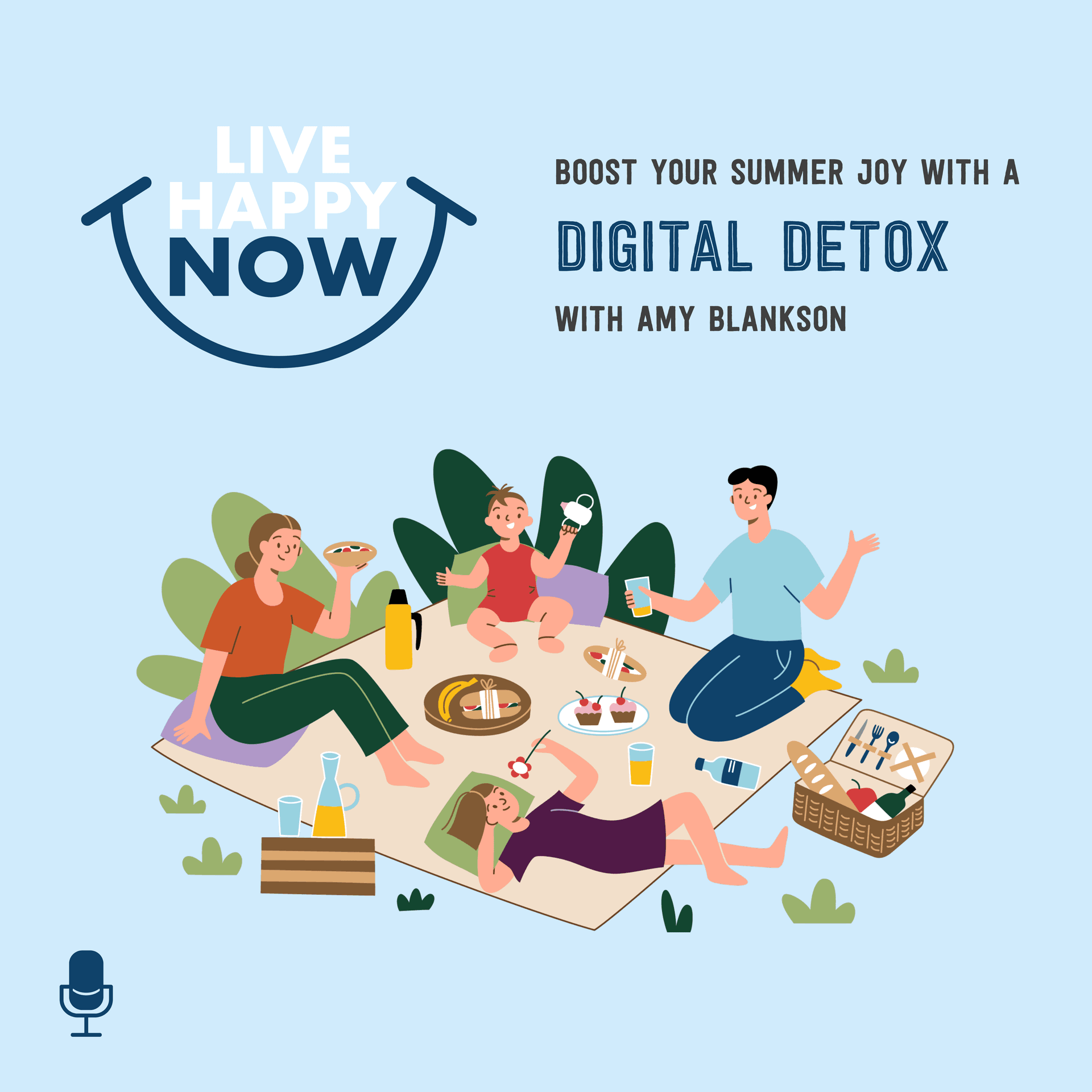
Summer digital detox—how to step away from phones/social media to restore balance, reduce stress, improve focus and relationships, and create more joyful time.
Guest
Amy Blankson, co-founder of the Digital Wellness Institute and author of The Future of Happiness (bestselling). Background includes positive psychology research and practical digital-wellness strategies.
Key claims
Detox doesn’t mean quitting forever; it’s intentional stepping away (5 minutes to 5 days). Signs include “phantom limb” reaching, phone anxiety when out of sight, and irritability. Start small (5–10 minutes or ~1 hour/day) to avoid rebound/“cold turkey” stress. Replace scrolling with meaningful activities; set intentions (more likely to follow through) and use accountability (social sharing, visual progress targets). Give a heads-up to coworkers/family for longer detoxes.
Notable examples
“Don’t take the phone into the bathroom”; first 5 minutes of the day no phone; airplane mode at night; brother’s remote-battery trick using a guitar instead; using giant poster-board “target” tracking.
Written by AI. May contain mistakes. Listen to the episode to check what was said.
Chapters
Tap a time to open that second in VOUnderstanding Digital Detox
0:44 to 1:48
Discover what a digital detox means and why it's beneficial.
“And if you're already getting Sunday Sillies, you'll see a prompt asking if you'd like to opt in.”
Signs You Need a Digital Detox
1:48 to 3:38
Learn the signs that indicate it's time for a digital detox.
“And I thought a great thing to work in would be the idea of how to do a digital detox because we all feel that guilt of spending too much time on our social media.”
Why Summer is Ideal for Detoxing
3:38 to 6:22
Explore why summer is a perfect time for a digital detox.
“Well, I think that if you feel like you have a phantom limb and you keep reaching for your device before you even realize you're doing it, that might be a sign.”
Challenges of Digital Detox in Summer
6:22 to 8:28
Discuss the difficulties of doing a digital detox during summer.
“Summer for me is an opportunity for kind of experimentation.”
Replacing Digital Time with Joyful Activities
8:28 to 13:40
Learn how to replace screen time with fulfilling activities for better mental health.
“that where it's just, even if I say mindfully that I'm not going to revert to that, it is, it's just almost like a reflex now to be like, oh, I got two minutes.”
Replacing Digital Time with Joyful Activities
13:44 to 13:57
Learn how to replace screen time with fulfilling activities for better mental health.
“You'll get the option to receive a free Wake Up Happy text every Monday.”
Starting Your Digital Detox: Gathering Data
14:05 to 19:13
Learn how to assess your screen time and set intentions for a digital detox.
“If you're on your iPhone, then it would be under setting screen time.”
Implementing Short-Term Detox Challenges
19:13 to 20:49
Discover strategies to implement short-term detox challenges effectively.
“I would say really, it's hard to answer that because I think everybody's a little bit different.”
Framing the Detox as a Positive Change
20:49 to 24:17
Explore how to view digital detoxes positively and set yourself up for success.
“Greek definition of optimism, which is the belief that your behavior matters.”
Transcript
Automatic transcript. May contain errors.0:00We're already helping you wrap up your weekend with a smile, so why not let us start your Monday with an encouraging boost, too? Wake Up Happy is the newest addition to our mission to make every day happier, and it's a Monday morning lift you don't want to miss. When you sign up, we'll send you one quick, uplifting text every Monday morning to kick those beginning-of-the-week blues to the curb and help you rise and shine a little easier. Think of it as the best wake-up call you'll get all week, delivered right when you need it the most. Sign up, sleep well, and let us help you start your week with a smile.
0:34To get your weekly Wake Up Happy text, visit livehappy.com and sign up for our Sunday Sillies newsletter. You'll get the option to receive a free Wake Up Happy text every Monday. And if you're already getting Sunday Sillies, you'll see a prompt asking if you'd like to opt in. So sign up and let us give your Monday mornings a makeover. The other days we'll be so jealous.
0:59Thank you for joining us for episode 528 of Live Happy Now. Summer is the perfect time to kick back and change some habits. So this week, we're going to look at what a digital detox can do for you. I'm your host, Paula Phelps. And this week, I'm talking with Amy Blankson, co-founder of the Digital Wellness Institute and author of the bestselling book, The Future of Happiness. She's here to talk about how summer is the perfect time to break up with your digital device and more importantly, how to do it and what to expect. Let's have a listen. Amy, welcome back to Live Happy Now. Thank you so much, Paula.
1:33I'm so happy to be here. Oh, it's been too long since you've been on the show and you always have such great insight. So I'm really, really happy to have you back here. Thank you so much. I can't wait. Well, as you know, we are having our summer of fun, the Live Happy Summer of Fun. And I thought a great thing to work in would be the idea of how to do a digital detox because we all feel that guilt of spending too much time on our social media. So I guess before we get really started, can you talk about what we mean when we say a digital detox? Oh, that's a great question. I think a digital detox is not a lifelong commitment to throwing your phone in the trash can.
2:11It is really about just stepping away from your device to get back into balance. and the exercise of stepping away is one of those that really helps you to become more aware of your habits and to be more intentional with your actions and that means really looking at what do you want to do with that time if you were to give up an hour on tiktok what are you going to do with that time and could you do something that really fills your spirit and gives you more fun this summer and i think the answer is almost always yes so we're talking about stepping away from your devices, whether it is for five minutes, five hours, or five days, doesn't have to be forever, but just some period of time that feels good to you.
2:55Yeah, I'd seen a guy on one of the channels who was talking about doing a dopamine reset challenge. And his things were as simple as don't take the phone into the bathroom with you. And it was interesting to see it be so simple like that. So the idea of us taking our phone into the bathroom. That's something many people do. And there was a time I remember the first time someone ever admitted to me that they took their phone into the bathroom. And I thought that was the most disgusting thing I had ever heard. And now it's like actually a thing. I think to me, that's like a big sign we've gone too far.
3:32It's like that's no, there just needs to be a line. So what would you say are some signs that we might need a digital detox? Well, I think that if you feel like you have a phantom limb and you keep reaching for your device before you even realize you're doing it, that might be a sign. I think that if you feel a little bit antsy when your phone is not in your line of sight, that might be a sign. If you feel like you are irritated easily and you want to regain that sense of joy and light and connection, that might be a sign. So for me, those are the alarm bells of your system saying, hey, it might be time for that reset.
4:17And you're right. I really like how you frame it, Paula, with that a digital detox doesn't have to be complete. It can be domain specific. It could be, I'm not going to take my phone into the bathroom. Ew, gross, right? Or it could be, and this is what I actually did for my spring cleaning detox, is that I set a policy where I wasn't going to check my phone for the first five minutes of the day because I didn't want to wake up to the tyranny of the urgent with the news and the emails and the phone calls and all the things that were going to come for the day. I wanted to start my day in peace. And so five minutes, that was it.
4:54And what's interesting is that that five minutes almost always turns into an hour. And it almost always is something that I turned back to almost by default. Now, I didn't mean to do it forever, but I liked what I felt like when I did that. And so some of these things, I think you might be surprised yourself that you don't need your phone and that it might actually bring you more joy. Absolutely. Because I know I put my phone into airplane mode at night because I don't want pings notifications, but I still want the alarm. And I'm doing the same thing where it used to be, I would get up and take it off of airplane mode.
5:27And then that became annoying. So, so now it's like, okay, I'm going to make coffee. I'm going to make breakfast. I'm going to do, it's kind of expanded what I do before I actually turn it on. And I've gotten to that point where it's like, you have that second before you turn it back on where it's like, okay, here we go. And it does make a difference. I'm glad to hear that you take that same approach. Absolutely. It has really worked for me. And I've talked to a lot of people about it who find that their stress levels are going down because they're not getting that cortisol spikes first thing in the morning where your system goes into full blown alarm mode when you realize what has happened in the last 24 hours.
6:08I'm all about being aware of what's going on in the world, but we can do so in a way that our system can handle and is good for us at a time when it's most beneficial. Yeah, I love that. So let's talk about why summer is a great time to do a digital detox. Summer for me is an opportunity for kind of experimentation. I am looking for a different season. I am looking for a bit more fun. the routine changes naturally based on what's going on in the summer with vacations and things. And so I think it's an opportunity to do something a little different. And it's also a defined period of time. Summer, whether it's two months, three months, wherever you live, that period of time feels like you can do just about anything.
6:54And so I love to set, I call them summer bucket list goals, and I'll make myself a little summer bucket list of the fun things I want to do. and it aligns perfectly with the detox because it'll say, I want to read this many books. I want to try to do these fun things, whether it is being able to make homemade ice cream, chase fireflies with the kids or go see Superman at the movie theater. Well, now I'm having these trade-offs where I think, okay, I have time to do these extra fun things because I'm doing a detox and I'm not giving up something. I'm getting something to do that is more beneficial.
7:31Yeah, that's a really important note to make. And I want to come back to that. But on the flip side of that, is there anything about summer that makes it more difficult to do a digital detox during that time? Yes, there's plenty of things that make it difficult to you. I mean, whether you have young children at home or your schedule and your routine is changing. I think that when we have downtime, one of the downfalls of society in the smartphone world has been that when we have downtime, or we have awkward, quiet space and we don't know what to do, we turn to our phones. Whether that is you're in the elevator awkwardly with someone else, pull out your phone.
8:09Or if you are sitting on the couch and twiddling your thumbs, we'll pull out our phone. And so in that unstructured space, I think it is a temptation that you really have to fight to default to a behavior that has become all too familiar and to do something different with it. Yeah. I know we all find ourselves doing that where it's just, even if I say mindfully that I'm not going to revert to that, it is, it's just almost like a reflex now to be like, oh, I got two minutes. Let's pick up that phone. No, let's not. So as you mentioned, this isn't about depriving yourself, it's about replacing it.
8:47So can we talk about that? How do digital detoxes actually encourage better focus and improved relationships and things like that? And what do we replace them with? So let's step back for a second, Paula, and let's talk positive psychology, because I think one of those really interesting points I talked about in my book, The Future of Happiness, several years ago, which is that there was a psychology experiment that give people a mug and half of the group got the mug for a week. They got to hold on to it. It became their mug. The other group had a mug for an hour and then they had to give it back.
9:24And the group that had the mug for an hour was okay giving it up. The group that had the mug for a week actually felt a physical pain. The receptors in their brain lit up as though they were feeling pain having to give up this random mug. And the idea is that the longer that we hold on to something, the harder it is to let go of it. And so when we recognize what's going on in our brain, that there is that pain receptor moment when you're trying to take something away, you want to replace it with something that's going to add a joyful feeling that will boost your serotonin that will replace this deficit in your brain.
10:03And so the simple way to do that is just instead of thinking about this as taking something away, we're thinking about what do I get to do with this extra time I'm creating? We always say, yeah, there's never enough time. I don't have time to do meditation. I don't have time to say gratitudes or do acts of service. Well, it doesn't take that long. And if you just cut five minutes on that app that keeps distracting you, think of all the things that you could be doing, learning a new language, trying a new instrument, connecting with that friend you meant to call. It's life-giving. And I think your brain quickly recognizes and picks up on the pattern and feels the joy of what you're doing.
10:42Yeah, because we've all been in that position where we've, we decide, well, okay, I'm going to spend five minutes on social media, or I'm just going to check this real quick and then go on to 20 minutes later. It's like, well, now I don't have time to start the thing that I was going to do. And then you end up being like, okay, well, I'll just stay where I am and keep doom scrolling. And then you kind of have this sense of guilt or like, my gosh, I've wasted my day or my time right now. Yeah, you need that little taste of victory to really encourage yourself. And so that's why when I talk about doing digital detoxes, I like to start small, I think the temptation is that when you get really frustrated with your phone, that you go big.
11:20You get rid of all social media. You delete it off your phone. You revert to an old analog phone. And research shows that works for a little bit. But just like a diet, when you do an elimination diet, your system goes into a bit of shock and then rebellion, and you find yourself right back where you started. So I like to start little bitty, five minutes, 10 minutes, whatever you feel capable of doing. That's the most important. I also want to make a really important note that for many people, stepping away from their phone feels like a security risk, particularly as a responsible working adult or a parent, you want to be responsive to people.
12:01And so five minutes seems doable, 10 minutes, but five days will cause some people to get frustrated with you. And so if you are going to do a longer detox, one of the best strategies I found is that give people a heads up before you do it. Tell them on social media, send a message to your coworkers, or even post something in your email signature saying, hey, I'm going to do a digital detox. I'm going to be not reachable for this period of time. That gives you permission as an adult to say, okay, I've told people they know where I'm at. It gives those people not only a heads up, but also a tremendous respect for what you're doing.
12:41And you will be surprised by the number of people who will come back to you and say, wow, that really inspired me. I wanted to do the same thing, or I loved how you let me know I shared this with so-and-so, and it becomes something that spreads over time. Oh, that's terrific. We'll be right back with more of Live Happy Now.
13:04We're already helping you wrap up your weekend with a smile, so why not let us start your Monday with an encouraging boost too. Wake Up Happy is the newest addition to our mission to make every day happier, and it's a Monday morning lift you don't want to miss. When you sign up, we'll send you one quick, uplifting text every Monday morning to kick those beginning of the week blues to the curb and help you rise and shine a little easier. Think of it as the best wake-up call you'll get all week, delivered right when you need it the most. Sign up, sleep well, and let us help you start your week with a smile.
13:38To get your weekly Wake Up Happy text, visit livehappy.com and sign up for our Sunday Sillies newsletter. You'll get the option to receive a free Wake Up Happy text every Monday. And if you're already getting Sunday Sillies, you'll see a prompt asking if you'd like to opt in. So sign up and let us give your Monday mornings a makeover. The other days we'll be so jealous.
14:04and now let's hear more from amy blankson so then where does someone start if you're saying okay this sounds like something i know i should do or maybe i want to do what is the best way to start and lay out your plan okay so i am a data girl the data geek actually and so i think it's best to start with a little bit of info gathering And that means going into your smartphone. If you're on your iPhone, then it would be under setting screen time. And if you're on Android, I believe it has a digital wellbeing tab. And so before you ever go there, I want you to mentally think about how much time you think you're spending online and what do you think are your top three to five apps that you're using and how long do you think you're on them?
14:50So it's kind of like a game. So challenge yourself to see how accurate you can be. Like the price is right, right? Write it down. And you could even do it with a friend or a spouse or one of your kids if you're really brave. So get that in your mind and then go and actually look and see how close you are. And from there, you have a data point to say, okay, here's where I'm at and here's where I want to be. Maybe you're at four hours of screen time and your number one most used app is Kindle. Good for you. You've been reading and you want to just scale back just a little bit because there's an opportunity cost there.
15:26So maybe it's three hours and 30 minutes on Kindle. So now you're just saying, I'm doing a 30 minute detox from this one particular app, and I'm going to be really mindful about it. That way you can check yourself. You can even set a calendar reminder in a couple of days to come back to it and say, how did I do? What does this look like? And I think that intentionality about how you're going to do the detox, how much time you want, and a system for holding yourself accountable is absolutely key to feeling like you can give yourself a gold star at the end of this process. And do you also need to have what you want to get out of it?
16:01Do we need to define like why we're doing this for ourselves? I think that is a great idea, Paula, whether it is, think about it like Mad Libs, if you remember the old Mad Libs, fill in the blank. So I am going to decrease my app or phone use by X number of minutes, fill in the blank, so that I can fill in the blank. So I'm decreasing X app by this many minutes so that I can do this. And it can be a simple sentence posted on your computer screen or your nightstand or your mirror for when you wake up in the morning, something visual to help you remember, this is why I'm doing it because you're right.
16:41Setting your intentions actually makes you 40 % more likely to actually follow through and to do the thing that you wanted to do instead. Because if you just fill in that time you are scrolling on your screen with staring at a wall, that may not fill you up in the way that you were hoping it would. So use that time wisely. This is the best part of summer fun is doing something fun. Yeah, it kind of reminds me of when I quit smoking many, many years ago. Hey, you know, it was the 80s. So So and it wasn't even the smoking that you missed. It's that I'm so used to reaching for that. It was the habit of having that to reach for and the ritual of it.
17:20And this seems similar to that in many ways because it becomes that habit of just reaching for that. So when we feel that boredom or that restlessness or just that impulse to reach for it, what should we have in our little arsenal to be doing instead? Mm-hmm. So the things that I recommend for doing instead, when you feel like reaching for it would be to have whatever your intention is within arm's reach. And many years ago, my brother actually tried this. He wasn't giving up the smartphone. He was, this was back when he had a television remote. And so he took his television remote, took the batteries out of the back of it, put one battery on either bookshelf on either side of his television.
18:02So it was extra effort to have to get to the remote. And instead he pulled his guitar out of the closet, got new strings, tuned it, bought a$5 guitar stand. And he put that right by where the remote used to be. So when he plopped down on the couch after a long day and he reached for the remote, he ran into his guitar, looked at his remote and was like, oh my gosh, I took the batteries out. I hate that I do these experiments, but the guitar sitting right here, I might as well play. And so guess what? He played for months where he played every single day simply because he kind of tricked his own mind into thinking it's a lower bar to do this thing I've been wanting to do than it was to default to the old habit.
18:47And sometimes we just need those tricks. We need that thing beside us. So whether it is, you know, you've been wanting to read a book, put that book on your nightstand, put the musical instrument there, put your exercise weights beside your bed, wherever your phone likely was, fill it with something else that's easily reachable. That makes such great sense. So this we're talking about this doing it for a short time. And I obviously every person is going to vary in which what do you recommend is a good time frame to say I'm going to detox for this amount? I would say really, it's hard to answer that because I think everybody's a little bit different.
19:26I think there's different generational temptations, different types and styles. If I was going to make a blanket suggestion, maybe an hour a day of detox, not the full, I'm going to detox for a whole week. I think that's really hard or even for a full day, because it can be nerve wracking. It can actually cause you quite a bit of stress to go cold turkey. So start with an hour a day, have a game plan, what you're going to do with that hour, tell people in advance and go do something amazingly fun with that time. And then report back, share it with somebody and say, hey, guess what I did today?
20:00Share it on social, tell a friend, get them involved with you. You can make this a very social activity or even a little challenge for your family members or some friends and say, hey, let's see how many days in a row we can actually do it. And you have to be honest. don't feel the guilt. It's okay to mess up. The most important thing is getting back on the horse when you mess up because it says, I'm committed to this. I'm still going to do it. Even if it's hard, I can do hard. But we're not telling people to text their parents and say, I'm going to see how long I can go without texting you, right?
20:33I do not recommend that. That is a good way to get disowned. So how can these short-term detoxes lead us to lasting change and how do we implement them so that it becomes a positive lasting impact? So I love to refer back to the ancient Greek definition of optimism, which is the belief that your behavior matters. And I think sometimes when we fall into habits, we start to think that our behavior doesn't matter, nothing will change. And what the digital detox is doing is saying, I am going to take a micro little challenge for myself, and I'm going to prove to myself that not only can I do it, but it's going to be great for me.
21:17And that psychology is something that will spill over into other aspects of your life. We see it all the time with people who exercise that those individuals tend to develop these constellations of positive habits because they feel like they can do it. They get this cognitive win and then they're like, wow, I want to do a digital detox and write gratitudes and I want to journal and I want to do all these other things. So that cognitive win becomes a really powerful kind of ripple effect in your life. So if someone wants to do this, but it also feels like such deprivation, how do we make it feel less like a punishment and more like a gift that we're giving ourselves?
21:58I think it's about framing, right? It's about that intention setting. It's about thinking about being the person that you want to be and being proud of yourself. And one of the things I did with my New Year's resolutions this year is I decided to switch things around every year. I'm like, what are my goals? And then you look back at the end of the year and you're like, I didn't do some of them. And you feel bad about yourself. So this year I reframed and I said, what would I be so proud of myself if I did by the end of this year? And I tried to do as many of the things to feel good as I could.
22:31And I think the same framework can work for this. You know, what would I be so proud of myself if I did this? And I think that makes it more fun. I think making it social with friends or colleagues, adding competition, like making it a game or a challenge for yourself. And then lastly, making it really visual. So I'm a big fan of putting giant poster boards in the kitchen. It is not maybe the most aesthetically beautiful thing. But one of the things that my brother writes about in The Happiness Advantage is this idea of painting the target. And it turns out that the bigger that you paint the target, and this actually comes from research with the U.S.
23:11Navy, the bigger you paint a target, the more likely it is you're going to hit it, no matter how far away you put it, because you're setting your sights on this. And so that's why I like the big giant poster board method in the kitchen, because every time you pass by it, you see it, you can track your progress. So you see that cognitive win and other people see it and they're going to ask you about it. And then they're going to say, how did that go? And so now you have social accountability as well. The last thing I would say, the fifth thing here is avoiding that guilt cycle, like feeling, oh my gosh, my screen time is so bad.
23:47I'm a horrible person. You know, screens are the, you know, the worst thing in the world. Let's change that mental tape and say, you know what? Like my device has been very useful. I use it all the time, but I want to be even better. I see the benefit it has and, and, and so that yes. And let's make it fun. let's do this because it's going to make you a better person, a happier person. And that's what it's all about. I love it. Amy, this is so fun. I hope listeners will be inspired to do their own digital detox, whether it be for 20 minutes, an hour, a day, whatever works for them. But thank you so much for sitting down and sharing this with us.
24:27This is really enlightening and I appreciate your time. Thank you so much, Paula. This is great and good luck, everyone.
Read the full transcript
24:36That was Amy Blankson talking about how we can make the most of our summer by participating in a digital detox. If you'd like to learn more about Amy, follow her on social media or check out her book, The Future of Happiness. Just visit us at livehappy.com and click on this podcast episode. That is all we have time for today. We'll meet you back here again next week for an all new episode. And until then, this is Paula Phelps reminding you to make every day a happy one.
From the publisher
This summer, recharge your happiness with a tech break! In this episode of Live Happy Now, Paula Felps sits down with digital wellness expert Amy Blankson to explore how an intentional digital detox can bring more joy, focus, and freedom to your day. Whether you're unplugging for five minutes or five days, Amy shares clever strategies to help you reconnect — with yourself and your summer bucket list.
In this episode, you’ll learn:
- Why summer is the perfect time to ditch your device.
- How tiny tech-free habits can spark lasting happiness and calm.
- Smart tips for replacing screen time with soul-filling activities.