
In short
Podcast Notes: Live Happy Now - Episode 563
Episode Title
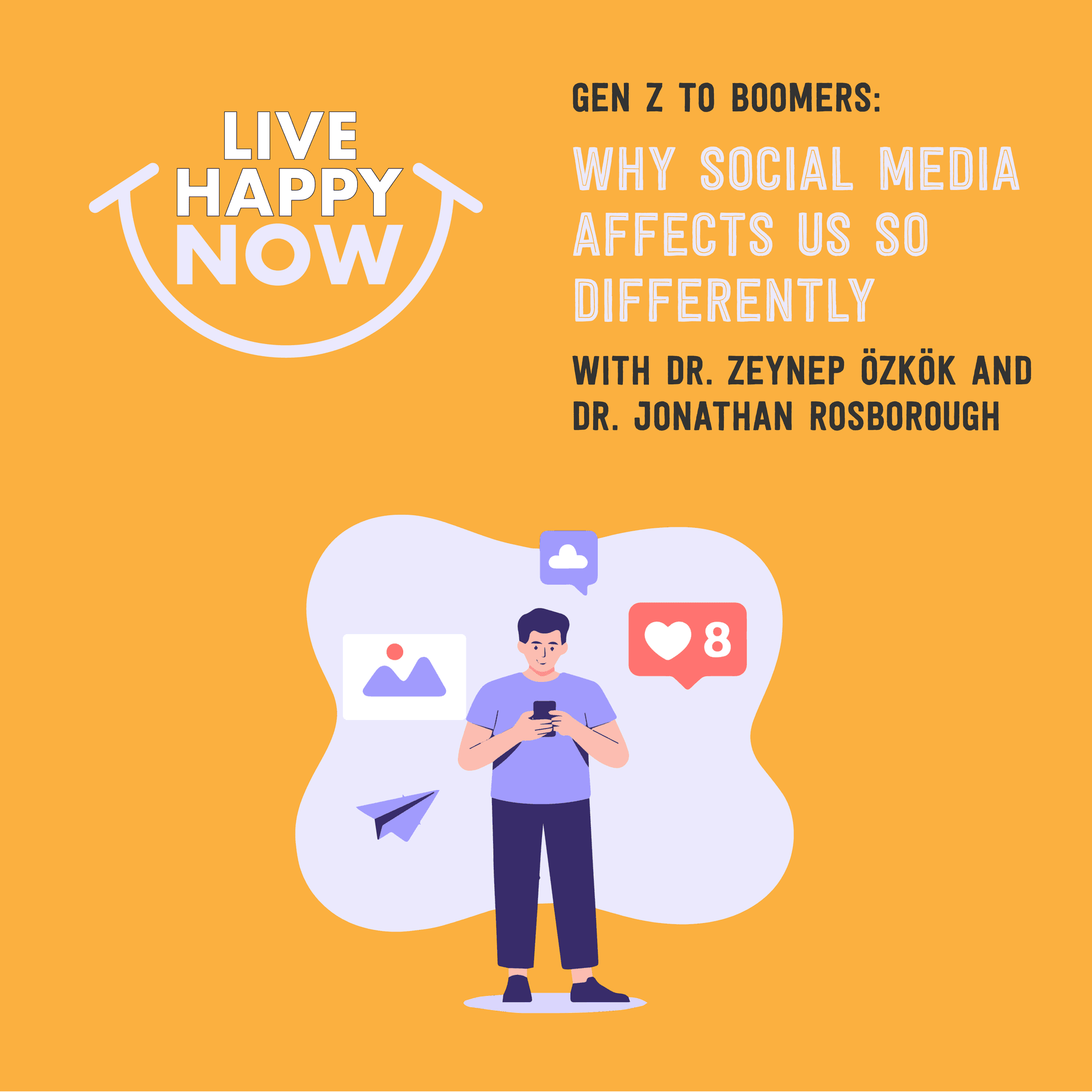
Gen Z to Boomers: Why Social Media Affects Us So Differently
Host
Paula Felps
Guests
Dr. Zeynep Özkök & Dr. Jonathan Rosborough
Date
[Insert Episode Date Here] Episode Summary In this episode, Paula Felps discusses the significant findings from the latest World Happiness Report, which centers on the effects of social media on well-being. The guests, both associate professors of economics at St. Francis Xavier University, share insights from their research on how social media influences trust, social connections, and emotional well-being differently across generations.
Key Concepts and Discussions
- Social Media's Impact on Well-Being
- Mixed Findings: The relationship between social media and well-being has been widely debated, with:
- Negative Associations: Issues like social comparison, fear of missing out (FOMO), social isolation, and loneliness.
- Positive Associations: Opportunities for connection, self-expression, and maintaining long-distance relationships.
- Generational Differences
- Variation Across Age Groups: The research revealed that the impact of social media varies significantly:
- Gen Z: Most negatively affected; heightened susceptibility to social comparisons and declining trust.
- Millennials: Moderately negative effects.
- Gen X: Neutral effects; not significantly impacted.
- Boomers: Slightly positive impact from social media use.
- Methodology
- The study utilized the European Social Survey, which provides extensive data on internet use, happiness levels, trust, and social connections across diverse demographics.
- Trust and Social Connections
- Declining Trust: Younger generations report lower levels of trust in people and institutions, which correlates with decreased well-being.
- Social Connections: A reduction in the frequency of social activities and perceived social status is evident among younger users, adversely affecting their happiness.
- The Role of Internet Use
- Causality: The researchers stress the complexity of establishing causality; internet use can affect social connections and trust, which in turn influences well-being.
- Frequency vs. Quality of Connections: The study raises concerns about whether online interactions are replacing in-person connections and whether these online relationships differ qualitatively.
- Future Generational Trends
- Generation Alpha: The researchers express anticipation regarding the insights on Generation Alpha, who have grown up in a fully digital environment.
- Potential Shifts: Optimism about changes in attitudes towards social media and well-being among incoming university students.
Key Takeaways
- Social media has a profound, yet complex, impact on various generations concerning well-being.
- There is a noticeable trend of declining trust and social connection among younger generations, which could lead to increased feelings of isolation and lower happiness levels.
- Future research is necessary to further explore the intricate dynamics between social media use, trust, social connections, and overall well-being across different age groups.
Conclusion The episode concludes with a call to action for listeners to consider their social media habits and how they may affect their well-being and relationships. The hosts express hope for future research to shed light on how digital interactions influence emotional health, especially with the upcoming Generation Alpha.
---
For more insights, listeners are encouraged to download the World Happiness Report and explore the multifaceted discussions surrounding social media and happiness. For additional resources and episode details, visit [Live Happy](http://livehappy.com).
Written by AI. May contain mistakes. Listen to the episode to check what was said.
Chapters
Tap a time to open that second in VOThe Impact of Social Media on Well-Being
0:45 to 2:16
Discussion on why social media became a focus in the World Happiness Report.
“Zainab and John, thank you for joining me today on Live Happy Now.”
Research Methodology and Findings
2:16 to 4:12
Exploration of the research methodology and key findings regarding different generations.
“And I know that we do tend to demonize social media.”
Understanding the Age Disparity in Social Media Effects
4:12 to 6:02
Analysis of how social media affects various age groups differently.
“There was a there's an issue that we first encountered, I think, with this is the issue of causality.”
Trust and Social Connections Among Generations
6:02 to 11:31
Examining the relationship between social media use, trust, and social connections.
“Now, as we mentioned a little bit earlier, different age groups are affected differently by social media.”
Trust Deterioration and Its Effects
12:40 to 14:05
Discussion on the decline of trust among younger generations and its implications.
“Your research really connects that social media use with the deterioration of trust, and we know, as we discussed earlier, trust contributes so much to our overall well-being.”
Trust and Well-Being Across Generations
14:05 to 17:45
Explore how trust affects the well-being of older and younger generations differently.
“So it's this hard idea where, sure, the younger generations are being more affected by the social connections piece of everything, but the trust piece matters a lot for the older generations.”
The Role of Social Media in Well-Being
17:45 to 19:46
Discuss the complex relationship between social media usage and overall well-being.
“It's not solely the social media, but it's also social media's effect on things like trust and social connections that then affect well-being.”
Future Research Directions
19:46 to 21:04
Learn about ongoing research into social media's impact on different generations.
“do we have a larger quantity of friendships as opposed to the quality of friendships.”
Teaching and Inspiring Future Generations
21:04 to 23:52
Discover the engagement of younger generations with happiness and well-being topics.
“Report team in general has been a wonderful experience.”
Transcript
Automatic transcript. May contain errors.0:02Thank you for joining us for episode 563 of Live Happy Now. Last week saw the release of the annual World Happiness Report, which focused heavily on the effects of social media. This week, we're going to dig a little bit deeper. I'm your host, Paula Felps, and today I'm joined by Dr. Zeynep Özkök and Dr. Jonathan Rosborough, both associate professors of economics at St. Francis Xavier University in Canada. Along with their colleague, Dr. Brandon Malloy, they co-authored the chapter in this year's report called Internet Use, Social Media, and Well-Being, The Role of Trust, Social Connections, and Emotional Bonds.
0:42Now, they're going to tell us what social media is doing to us and explain why it has different effects on every generation. Let's have a listen. Zainab and John, thank you for joining me today on Live Happy Now. Thank you so much for having us. Thanks. It's great to be here. This is an episode long in the making because you've been working on your chapter for the World Happiness Report since you tell me last summer. You wrote a great chapter. We're going to dig into that. But I wanted you to tell me first, like, why did social media become such a central focus of this year's report? I think it's been a topic that has been discussed so thoroughly.
1:22There's a lot of different debates all around. everybody has been talking about the negative associations with social media and well-being and these usually refer back to like the social comparison perspective, the fear of missing out, social isolation and loneliness that might be coming from social media. But then there are also other studies that kind of find some positive associations between social media and well-being and these kind of go back to potentially social media creating more opportunities for connection, more self-expression and support that might be coming out from social media, and social media potentially allowing us to have more long-distance relationships.
2:02So I think for the editors and the World Happiness Report community, it was really important to dive a little bit more in and just see the relationship between social media and well-being. And I think that's what they had in mind. And your chapter really focused on internet use and social media and how that's affected well-being. And I know that we do tend to demonize social media. As you just mentioned, we talk about all the negatives, the social comparison. But your findings are very interesting in that you tell us right up front the results vary across age groups. First of all, was that a surprise for you?
2:39Yeah, I think it was. I mean, when we approached this topic, I think we felt both sides of this. I mean, we use social media. and I think we live in a small town and so it's a small university town and we use it for figuring out if the roads are going to be icy. We figure out if there's going to be fresh donuts at the farmer's market. The important stuff, right? Yeah, the important stuff. But I think we also have this feeling too that it might not always be healthy, right? We might be pushing it too far. I think maybe if you're online for too long, you've been scrolling for too long, there's just this negative effect.
3:13And so I think for us, we were surprised. We thought maybe things are different for different people. And so we wanted to approach this with as big a data set as possible that goes across countries. It goes across individuals that are across all these different generations and over time. And so what we decided to use for this was the European Social Survey. And it's a gigantic data set that started in 2001. And it's administered every other year across over 30 countries. And it's got lots of information there, not only on how much you use the internet, but things like your happiness levels, your life satisfaction, as well as some of what we think of as foundations for happiness, your trust, your social connections, your attachments.
3:58And then as economists, we also want lots of additional controls, which it has your gender, your age, we're talking about your education, income levels, and things like that. And so when we looked at this, we started to try and pull this apart. There was a there's an issue that we first encountered, I think, with this is the issue of causality. We need to kind of think about when we look at large data sets, are we just looking at correlations here? Or what do we know is one thing maybe causing another? Because the amount of research you did is massive. Footnotes alone, it was staggering to me as I'm reading through this chapter.
4:35How did you start zeroing in on like, this is how we focus on this? And how did you distill so much research into a single chapter? I think we initially started with the idea that internet use can potentially have an impact on well-being. But internet use could also have an impact on some of these drivers of well-being that previous World Happiness reports have shown time and time again, like social connections, like trust. So when we look at some of the literature, we see that a lot of people have looked at the importance of social connections. So I think in starting our research, that was really important to us.
5:15There was a lot of work on social connections and the importance of that piece on well-being by one of the editors of the World Happiness Report, Dr. John Halliwell, and his colleagues. There was the Harvard Adult Study, and that was basically showing the importance of social connections. There were two different advisories put forward by the former US Surgeon General, Dr. Vivek Murthy, that was really like emphasizing how we should look at social connections and the trust piece as well. So we wanted to kind of narrow down on those channels and then also look at the overall impact of internet on well-being.
5:54And then with what John was saying, kind of narrow it down to the causality debate as well to see what the chicken or the egg problem was. I love that. Now, as we mentioned a little bit earlier, different age groups are affected differently by social media. Can we kind of dig into the four different generations and talk about because they have a different response to it? That was very interesting for us. So when we sort of started to sort out some of the issues in the data and we were able to control for what we looked at, when we look at the effect of internet use in general on well-being, overall, the average effect seems to be negative on your well-being.
6:34And so if we just lump everybody together, using the internet more seems to reduce how much you're reporting your reported levels of happiness and life satisfaction. but it's not the same for everybody. When we looked across the generations, it's almost like a gradient that we saw. I mean, where this effect was strongest in terms of its negative impacts appeared to be on the youngest people in our sample. That's Gen Z. And then as we start moving to the older people in our sample, and we get to say the millennials, it's still moderately negative, not as strong as the effect for Gen Z. And then when we get to people like Gen X, which I'm a proud member of.
7:12Gen X is me. And we're like, you know, whatever, you know, that's our Gen X motto. It doesn't seem to affect us that much positively or negatively. And then when we get to the baby boomers, it actually, the effect of the internet on your wellbeing appears to be positive, right? It's not a huge effect, but it is slightly positive when we get to the older generation. And so we thought this was fascinating. The fact that this tool or environment seems to be affecting different generations differently. And if we were to drill in on the Gen X in particular, because that's, I think, where we saw the most need for attention here, there were sort of two drivers that we think were causing this.
7:53One was what we think of as susceptibility or sensitivity. If you look at what we estimate the impact on your well-being of using the internet or social media for an additional hour, that negative effect is strongest for Gen Z. And then we couple that also with just simple exposure. So if we look at the reported use of how much you are online, it is much, it's an order of magnitude higher for Gen Z than it is for the older people in our data. So, you know, we're trying to make sense of this. We could think about this, you know, one plausible explanation would be the internet is just functioning differently for these generations.
8:34You know, for the older generations, you could think of it probably more as a tool that you use maybe to connect with people. You go online and you see your grandchildren maybe, or you connect with people. I think it's probably more accurate to think of the internet as more of an environment that you occupy if you're younger, given the usage rates of how much people are online. And so that was one, just the overall effect of using the internet that we observed. But it also seems to affect what we think of as these underlying foundations of well-being that Zeynep was talking about. And do you want to talk about how that's affecting those perceptions?
9:11So one of the first things that we found was that when we look at younger cohorts like Gen Z, we see that there are larger declines in terms of their trust levels. If we look at their trust in terms of people, that's declining. If we look at their trust in terms of systems, institutions, that's also declining for them as well. But on the social connections piece, we also see that their social connections are declining in terms of their frequency, in terms of them taking place in social activities compared to their peers and how they perceive this. So these are strong predictors of well-being. And when they see declines in these trust and social connections drivers, they will see declines in terms of their well-being as well.
9:54What we also find, in addition, once we put the internet piece back in together with these drivers, was that individuals that have high trust and strong attachments, they actually see positive effects from higher internet use. But individuals who report being more socially active, more socially connected, they tend to see more negative effects from higher use of the Internet. And for us, that was a really interesting result in terms of looking at like the social connections piece. If they're using the Internet more, they get less satisfaction. One thing is just how frequently you're socializing with people.
10:32And the other one is a slightly different question, which is how you perceive your social activity. So how do you compare how socially active you are to other people your age? And those two things are kind of changing. So we could imagine that using the internet more, and we suspect this, but we need to kind of dig deeper on this with when we have more data is that maybe online participation might be replacing some actual in-person face-to-face socializing. So that might be reducing the frequency that you actually socialize face-to-face. But the other one is a perception. It's really like maybe I see people online and they're really active and they're posting all these great things.
11:15And I perceive that my own social activity is lower than people that are like me. You know, I feel worse about myself and maybe I have a lower perception of how often I go out. So those two things do appear to be affected by how much you use the Internet. And we know those are both things that are going to contribute to your overall well-being. We'll be right back with more of Live Happy Now.
11:43The International Day of Happiness may be behind us, but its ripple effects are still going strong. And honestly, we're loving it. Hearing how you are spreading joy, kindness, and connection has been the highlight of our month. If you haven't already jumped into the conversation, now's the perfect time. Head over to our social pages at at mylivehappy and see how people everywhere are celebrating happiness in their own unique ways. And while you're there, tell us what's changed for you this March. What lifted you up? What inspired you? And what made you smile just a little bit bigger? Remember, happy acts don't have to end when March does.
12:20Happiness isn't a moment. It's a movement. So let's keep this wave rolling, keep lifting each other up, and keep choosing joy one small act at a time. because when we live happy, we live better. So tune in, get inspired, and keep the happiness going.
12:39And now, let's hear more. Your research really connects that social media use with the deterioration of trust, and we know, as we discussed earlier, trust contributes so much to our overall well-being. Even though we as individuals may not think of that, All the social science and the studies show that our trust in our structures around us and the government plays a huge, huge role in our well-being. So can you talk about, first of all, how our strong social connections relate to trust, not only in each other, but in institutions and organizations? So that piece is huge, like you said. And there's time and time again studies show that trust really matters for people's well-being.
13:26Now, one thing that we find is that, again, younger generations are now facing lower levels of trust, particularly for trust in people, trust in the system, in the institutions. And these lead to sizable, predicted declines in their well-being. Now, if you compare that to the older generations, the older generations show a little bit more resilience when it comes to trust. So in that sense, boomers, for example, show more resilience in terms of their stability of trust. They have more trust in institutions, more trust in people. But any type of a decline in terms of trust matters more for the boomers' well-being.
14:04So in that sense, there's that resilience, but there's also that big importance of trust piece, particularly for older generations in terms of their well-being equation, if you want to put it that way. So it's this hard idea where, sure, the younger generations are being more affected by the social connections piece of everything, but the trust piece matters a lot for the older generations. So we really need to think carefully about the sensitivity and the exposure and how these declines are taking place across different generations. And is it the misinformation that's destroying the trust? What exactly is it that is leading to this deterioration of trust?
14:51So that's an open question. You know, what we see in the data is how they report, how they report their levels of trust. And we don't necessarily see why that's happening. We know that there seems to be an erosion of this, but we might not know exactly what's causing that. You know, some plausible explanations here could be that just what you see online, right? I mean, we know that maybe news is geared towards things that might make you feel bad, right? That might erode your trust when we see political scandals and things like this that, you know, those are important to hear about. but there's also damaging potentially to people's trust in institutions and the legal system and things like that.
15:32And we see bad stories online. You know, we're noticing here too, that there's declines in people's feelings of safety. They use the internet and that might be that if some crime is committed, when it's online, it feels like it might be right next door. It might not be, right? But we might feel less safe and feelings of safety are really important when you're in a community and how that might contribute to your overall sense of happiness and well-being. And that is super interesting because especially with the things that are going on in just in the United States right now, it does create more of a feeling of a lack of safety for people of all generations.
16:12And I do, I know I've heard that parroted back to me by several different people of different age groups, where it's like the US just doesn't feel as safe as it used to. And so once we hit that, how does that just really deteriorate our well-being overall? When we lose that trust, when we lose that sense of safety, what kind of weight does that have in our well-being? I think in our study, we were able to show that not only that trust has a direct effect on well-being. It has this positive relationship on well-being. But if you have a higher use of the internet and you're starting to see erosions in terms of trust, that could potentially have detrimental impacts on well-being as well.
16:59Now, as a boring economist, obviously, I have to say that the more data that we get, basically going back to the questions that you asked about why the trust is eroding, if this is particularly related to online issues that people face, that will allow us to kind of put more pieces to that puzzle in terms of the relationship between social media, internet use, and trust, particularly on how trust then affects well-being through the social media perspective. But it seems for us, at least, that the trust piece is huge on well-being and that there is this channel that goes through internet use to trust and then to well-being.
17:41So that's something in terms of policy that we really need to care about. It's not solely the social media, but it's also social media's effect on things like trust and social connections that then affect well-being. And yeah, so your chapter really shows how social media and the internet are completely reshaping foundations of our well-being. I wondered your takeaway as you were doing this research, what do you think that this means for the future, particularly when we're looking at younger generations who are being raised in this digital internet environment? I think as I said at the beginning, we really kind of feel both sides of this issue.
18:20You can feel the sense in which there is good that comes out of this. There are things in which you can use the internet, you can use social media as a tool to connect with other people. but I think what we're finding here is that there's a level of this that seems to matter and in particular when I look at things like the saturation of social media that feels to me more like a collective problem than it is an individual problem you know putting the onus on an individual and saying that you know you need to just reduce your screen time and that that's going to change how your whole relationship with this digital environment it might not be the simplest solution to a problem that's as complex as this.
18:58It might require some kind of collective stuff where we work together on things. You know, there are some talks of phone-free schools or something where there's something where it's a collective thing where everyone is collectively opting out of something. And it solves this collective action problem where everyone feels like they can't do it on their own. They can't opt out socially alone. And maybe that'll affect some of these things, how you perceive your social activity compared to other people, How your feelings in terms of trust and connections with other people might change as a result?
19:30I think for me, the piece on social connections was really important coming out of this study that we've done. And I think I was always thinking about how much is the online time displacing our other activities that we might be doing offline. And I was also thinking about whether like the online relationships we have are distinct. do we have a larger quantity of friendships as opposed to the quality of friendships. And the balance of offline versus online ties was really important. Now, of course, we were not able to capture all of those perspectives because of the data that we have. But I think there's a lot of hope for the future in the sense that there is a lot more data collection.
20:13And we're going to be able to like pick out on these differences between online versus offline relationships and more about that social connections piece, hopefully, will be coming with more data availability. And I did want to ask that. So you did this chapter for the World Happiness Report. Is this an area of study you're going to continue in? Are you going to keep looking at this? I would love to. Yeah, I think we're both very interested in continuing to do more work. And even the European Social Survey has more detailed questions that are coming out now on particularly how, I think so in future rounds here, how you're spending your time online, like a bit more specifics about what platforms you use and things like that, that I think might be really fascinating to look at.
20:59And I would say just to working on this report with World Happiness Report team in general has been a wonderful experience. I mean, I think for readers or listeners that want to take a look at this report, if you're interested in social media, there is a wealth of different perspectives in this year's report. We've seen some of the early versions and we've talked to some of the other authors and they are approaching this problem from every direction you could imagine. And I think if you're interested in this, there's lots and lots of discussion that's going to take place. And I think it'll be well worth the read.
21:32I agree. I agree. Cause I've had the luxury of being able to see some of these things already. And I'm really excited. Well, first of all, that this is a topic that World Happiness report chose to dig into because it's something we see constantly popping up, the concern about it. And of course, your research began with Generation Z. Do you have any insights into Generation Alpha, the ones who are, what are they like, the oldest ones are 16 now, and they've been raised in this completely digital environment. Do you have any insight into what's going on with them? With our data here, it starts, they're not giving questionnaires for these kinds of surveys to people that are under 16.
22:12So I'm really excited about what's going to happen in the coming rounds of the European Social Survey, because they're going to start entering this survey now. So the youngest people we have right now that we can really look at and drill down and look at are Gen Z. But going forward, these next few rounds are going to be really telling, I think, about what's happening with this generation. You know, we teach all of these generations as we go, And we're meeting students that are part of this new generation that are coming. And to be honest, I teach Econ 101. I see half of the university, I think, in population when they first start.
22:48And I got to be honest, I'm optimistic about the youngest people that are at university right now. I feel like there might be a shift going on here. And I'm really excited to see what's happening with them because I've been noticing just a big difference in my classes with the youngest people. The first people that are coming in now, I'm really excited about. And just to add, I think I'm a nerd in the sense that every year I just print out the country rankings and just stick it on my door so that when students come just to ask random questions about something, they always see the rankings. And I kind of highlight Canada.
23:23I'm sorry. We just have to like show off a little bit. So I'm kind of crossing my fingers and hoping we don't do bad this year. But they ask so many questions. they're really interested. Happiness and well-being is something that really gets very closely to the new generations. And I think now that the social media piece is out there, I think they'll be even more interested in thinking about their habits and thinking about their environments. So I think this is just a very exciting time. That's terrific. And I'm glad that they have people like you who are doing this work and leading that charge and can inspire them toward that happiness.
24:01And I hope you will stay in touch with your future research that you do on this subject, because obviously social media isn't going away, the digital world isn't going away. And I'd love to see what else you discover for us in the future. Thank you so much. So much. It's been such a joy. Well, thank you for this fabulous chapter you've written. We are going to tell our listeners how they can find you and the work you're doing. We're going to tell them how they can download the World Happiness Report and get all this great information. And I do, I hope you'll stay in touch and we will talk about this again.
24:32Thank you so much.
24:37That was Dr. Zainab Oscock and Dr. Jonathan Rosborough talking about social media use and how it's affecting our well-being. If you'd like to learn more or download your copy of this year's World Happiness Report, just visit us at livehappy.com and click on this podcast episode. That is all we have time for today. We'll meet you back here again next week for an all-new episode. And until then, this is Paula Phelps, reminding you to make every day a happy one.
From the publisher
The latest edition of the World Happiness Report focuses on the effects of social media on well-being. In this episode of Live Happy Now, host Paula Felps sits down with Dr. Zeynep Özkök and Dr. Jonathan Rosborough, co-authors of one of the report’s chapters, to unpack their research on internet use, trust, social connections, and emotional well‑being. They reveal why social media affects Gen Z, Millennials, Gen X, and Boomers in dramatically different ways, and how online environments are reshaping foundational elements of happiness such as trust, safety, and real‑world social ties.
In this episode, you'll learn:
- Why the impact of social media on well‑being varies sharply across generations.
- How Internet use is linked to declining trust, social comparison, and reduced in‑person connection.
- What researchers believe this means for the future — especially for Gen Z and the emerging Generation Alpha.