
In short
The science and psychology of summer vacations as essential for mental/physical health; how to get benefits via staycations, unplugging, and post-vacation “reset” routines.
Guest
Deborah K. Heisz, Live Happy CEO and co-founder; describes her family vacation to Hawaii (outdoor time, surf lesson, hiking, kayaking) and her work travel habits.
Key claims
Vacations shouldn’t be optional; they reduce day-to-day stress by removing immediacy, break monotony via new experiences, and support creativity/strategic thinking. Staycations only work if treated like real vacations (planned activities, not just burning vacation days). Unplugging is crucial; structured email checking is acceptable. Don’t overspend—vacation within means. Re-entry matters (avoid midnight return; clear first work morning; rewrite priorities).
Notable examples
Downtown McKinney (Dallas area) walk/music as low-cost staycation; friend’s laptop-free vacation; “urgent” subject/email rule; Disney World “maximize everything” stress; Hawaii surf lesson as prioritized “must-do.”
Written by AI. May contain mistakes. Listen to the episode to check what was said.
Chapters
Tap a time to open that second in VOThe Psychology of Family Vacations
0:45 to 2:24
Discussion on the significance of family vacations and personal experiences during travel.
“frivolous, but the research, as you and I know, and we love to talk about, it shows us that it's way more important than we might have realized.”
Importance of Quality Family Time
2:24 to 4:40
Exploration of how vacations facilitate quality family interactions and alleviate daily stress.
“we really don't get to spend much time together as a family.”
Vacation vs. Staycation
4:40 to 5:54
Strategies for making the most of vacations and staycations to recharge mental health.
“So let's kind of talk about that, especially you mentioned a staycation.”
Unplugging During Vacations
5:54 to 9:16
Advice on the importance of unplugging and how to manage work while vacationing.
“And they're, I'm not trying to say they're not wrong, by the way.”
Gaining Perspective Through Distance
9:16 to 13:20
How taking time away can help address personal challenges and gain new perspectives.
“minutes at night or 30 minutes in the morning to make sure nothing urgent or truly important has occurred.”
The Stress of Immediate Solutions
14:00 to 15:00
Exploring how immediacy can lead to negative outcomes in relationships.
“I've got to get this done because it's driving me crazy.”
The Need for Time Away
15:00 to 16:40
Discussing the importance of taking vacations for mental health and clarity.
“And And I really think that's what vacations and time away from when I'm talking about vacations, I'm really talking about time away from our routine and not eight hours.”
Vacations Within Your Means
16:40 to 18:10
Understanding how financial stress can ruin the vacation experience.
“I love going to Disney, but we do what we can do.”
Planning Family Vacations
18:10 to 19:40
Tips for planning vacations that prioritize family interests and relaxation.
“We're just trying to do the things that everybody wants to do.”
Resetting After Vacation
19:40 to 21:20
Techniques for maintaining the clarity and benefits gained from vacation.
“And I do that so that I can come back and I can reorganize my to-do list.”
Show all 12 chapters
Looking Ahead to Season 11
21:20 to 24:40
Anticipating the upcoming season and discussing the importance of hope.
“I know that you're very intentional in how you take vacations and that's a, what a gift that you've passed on to your children to help them learn how to approach their vacations in such a positive way.”
The Science of Hope
24:40 to 26:00
Understanding the health benefits of hope and its impact on longevity.
“We're going to kick it off next week with our friend, Dr.”
Transcript
Automatic transcript. May contain errors.0:03Thank you for joining us for episode 530 of Live Happy Now. As we move through the summer, be sure to include one very important tradition, the summer vacation. I'm your host, Paula Phelps, and this week I'm talking with Live Happy CEO and co-founder Deborah Heisz, who's going to share some of the science behind vacations and explain why they're not optional. They're essential for your well-being. Let's have a listen. Deb, thanks for coming back on the show. I'm excited to be here, Paula. It's the end of July, so people are trying to like squeeze in their summer vacation or maybe squeeze in a second summer vacation.
0:40So I wanted to talk with you about kind of like the psychology of vacationing. I know that some people think of summer vacations as something that's frivolous, but the research, as you and I know, and we love to talk about, it shows us that it's way more important than we might have realized. So before we kind of dig into that and why it's so important, I know you and your family just had an incredible vacation. Tell us a little bit about that. Yeah, we just got back from a great week in Hawaii. My oldest son, my only son, he's also the oldest child. He graduated and we let the kids know years ago that when they graduated, they could help us plan their post-graduation vacation.
1:20And he chose Hawaii. And we went there as a family, and it was a great getaway. You know, lots of outdoor time, lots of time together. You know, there's something about forced traveling together where you come together as a family a little differently. But no, it was a wonderful vacation. That's great because, you know, we see all the movies. And having had trips with my family, I'm one of six children, so I'm very familiar with the she's touching me, stop looking at me, being in the car together for extended periods of time. But when you go on a trip together, even with those moments intact, talk about what it does for us as a family, as couples, why it's so important that we take that time together, especially in these busy, busy times that we're living in.
2:04Yeah, you know, it is critically important, I think, for us to get away and spend time away from our day to day. We get stuck in our day to day. I have an incredibly busy job, I guess would be the best way to put it, with some substantial travel on occasion. And, you know, we eat together when we're all home. But, you know, with kids and sports and going this way and that, particularly with three teenagers, we really don't get to spend much time together as a family. You know, we maybe an hour and a half in the evenings for dinner, maybe if somebody isn't running out the door to go to a game or get to a practice or whatever we have going on.
2:41And getting away as a family for vacation allows us to spend quality time with each other, but also be close enough to each other to have those conversations that may not come up in that hour and a half dinner, or you may not be around each other enough for certain things to come up or be brought up or become important. So that to me, if nothing else, just spending that time with my family is valuable. But on top of that, getting to do things that they don't ordinarily get to do, getting to be out of your comfort zone, out of your day to day, actually getting to engage in activities that are mentally, it's a mental break, you know, to get to go do something that you don't do ordinarily.
3:26And, you know, the best way I know how to put it is we take ourselves out of our regular environment, which is filled with got to do this, got to do that, got to run here, got to run there, got to do the laundry, got to do the dishes. The kids are in their daily drama of, as teenagers, who likes who, who doesn't like who, you know, is my best friend dissing me? Are we all good? Do we need to run out and go do something? Hey, everybody's doing something. I'm not there. There's all of this stress real and imagined in our daily life about the stuff we have to do. And when you're on vacation, you just don't have the opportunity to stress about that stuff because it's not actually going on.
4:06You kind of remove the immediacy of it. You know, if I stay at home for vacation, I'm going to end up doing laundry and cleaning the house or doing that project, clean out the closets because you have time and you see it. You go someplace else, no matter where it is, and that's off the table. And you really are forced to do something else and take a mental break from your life. and doing that with your family. The way I like to put it is we all end up the best versions of ourselves when we're on vacation or at least the real versions of ourselves. When we remove ourselves from that day-to-day stress, we can really kind of check in on how are we really doing?
4:42Where are we really? And it's a great experience, no matter where you go, whether you go camping, whether you go to the lake for a couple of days, whether you drive to grandma's, although being at grandma's may not be the same type of stress leaving vacation. but there's a whole different level of stress that comes with that there is but whatever it is to take yourself out of your normal day-to-day I think is critical for mental health and as you know Paul the studies show us that it's critical for mental health yeah and and there is really good research that says you know vacations should not be optional because they're important to our health our mental health our physical health and getting out of that cognitive comfort zone and having new experiences is so good for breaking monotony.
5:24So let's kind of talk about that, especially you mentioned a staycation. And so how can you apply that same kind of effect if you don't have the money, if you don't have the time right now, maybe you have family obligations that don't let you get away. How can you apply some of those same things to break that monotony, jumpstart your cognitive comfort zone a little bit? Well, I think it's really key to understand that a lot of people don't take vacations because they don't feel like they can afford them, or they don't feel like they can get away from whatever it is has them there. And they're, I'm not trying to say they're not wrong, by the way.
6:01We all know people in our lives that have care obligations, which make it virtually impossible for them to leave town for days, or even a day. So, you know, that's, that's real. But a staycation, you have to treat it like a vacation. And what that means is when you go on vacation, you don't, we went to Hawaii, but you don't go to Chicago and say, I'm going to go to Chicago and stay the entire time in your hotel room. You have plans, you have things to do. So if you really are going to do a staycation, find that thing that takes you out to do something you haven't done before, or that you don't do ordinarily or regularly.
6:38We've got a great little downtown in one of our suburbs here in Dallas that a lot of people just go walk around and they wave about how it feels like they're in a small town in another part of the country just by going and walking around there and seeing the little shops and the food they have and they have live music at night. And, you know, that's something that doesn't cost a lot. And if you're in our area and you want a staycation, it's a good idea to, you know, go walk around downtown McKinney. It's a great place to go and just experience something different that doesn't cost a lot of money, doesn't take a lot of effort.
7:11but what it really does is it gets you out of your house, out of your day-to-day rent. One of the other things about planning a staycation is make it a staycation. Don't like, hey, I'm going to do all the things I was going to do and I'm going to call it a staycation because I took the day off work. That's not what it is. You're kind of cheating yourself on that one. Well, but you see people do that. I'm doing a staycation. Well, what are you doing? Well, you know, nothing, but I have these vacation days and I can't afford to take a vacation. so I'm just going to burn them and stay home and do whatever I ordinarily do.
7:42I'm like, well, that's okay, but that's not the purpose of vacation. The purpose of vacation is a recharge, a reset. And if you're just doing the exact same things you always do, you're depriving yourself of that mental break opportunity. Absolutely. And you know, whether you're going away or doing the staycation to really get the full benefit, you do need to unplug. And I've got a very good friend who she goes on great vacations every year, but she always takes her laptop with her because work will call. And this year for the very first time she went on vacation without her laptop. And it was like anxiety producing, but exhilarating for her.
8:21So what do you say to people who say are like, I can't, I cannot unplug. I can't cut that cord. Well, I take my laptop on most vacations, But I do it in a planned environment. If I'm out of town for a week, I'll say, okay, I'm going to plug into this meeting and this meeting only for whatever reason, either the project's really important or there's something going on that I really can't be gone for two weeks, you know, that kind of thing. So I really encourage people to unplug. And one of the things I've actually done to force myself to unplug is I've taken a few vacations that when you say that there's no cell service, you're telling the truth.
9:03You know, I've been down the middle fork of the Salmon River and there is no cell phone to call because it doesn't work. You know, so there's a little bit of that unforced unplugging. But I do think the key is if you're out and you and you feel like you can't be away from the office and you need that crutch of your computer, maybe turn the email off on your phone and just plug in and look at your computer for 30 minutes at night or 30 minutes in the morning to make sure nothing urgent or truly important has occurred. What I do is while I check email on vacation, I tell everyone on my on my team that if you really want me to answer, you have to type urgent in the subject matter of the email.
9:47Otherwise, I'm not going to look at it till I get back. And if it's truly, truly urgent, text me and tell me you sent me an email that I have to look at. And I'll tell you when I can look at it. I mean, I'm on a middle of a snorkeling cruise. I'm not pulling out my laptop to check my email no matter when you sent me that text. So it's a little bit of you have to have the discipline to know that you're not going to be able to get completely away. But if you do feel like you need to check in, make it structured, make it scheduled, make sure that it's not, hey, I'm just working in a more beautiful location, but I'm still putting in 10 hours a day.
10:27That's not going to give you the mental break you need. But I do understand not everybody can get away completely, unplug completely. But unplugging for eight hours to do a snorkel trip is probably okay. Most of us don't have jobs that anybody's going to suffer severe consequences if something has to wait a day. Right. So be realistic. And I think we all fall into this trap at work, especially. And some of us fall into this trap at home, too, of feeling like we're the only one. Like we have to do it. Things are going to fall apart if we don't do it. Well, if you truly are that important to the organization or to what you're doing, and I'm not saying you're not, you could be, you're not going to be there forever.
11:11So not taking a vacation is going to shorten the amount of time and the amount of productivity you have. You actually need the vacation if you're that important, probably more than the person who can take a vacation and not worry about it. Oh, that's interesting. That's a great perspective on it. And what a great way, because some people have trouble giving themselves permission to step away. And so that is a great way to put that in perspective for yourself and say, like, this is something that I'm doing for the company, actually. Well, I think you are. I mean, I come back from vacation with more creative ways to look at things, new ideas, because even though I'm on vacation, my brain doesn't stop working.
11:51Right. It just quits working on the what's right in front of me because the problem walked into my office or the phone call came or the email came, which is day to day stuff to keep things moving forward. But I don't have the time always to do the deeper dives, to do the, hey, what is next? What should we be doing for five years from now? What are we missing right now? And getting away to vacation allows me to have those thoughts without having to do a day-to-day checklist. So it really does open up my creativity and my broader strategic brain to be away from the office. Whereas in the office, I'm more tactical.
12:33But that vacation allows that strategic brain to kick in and have some more meaningful and more long-term thinking about the company. We'll be right back with more of Live Happy Now.
12:52And now let's hear more from Deborah Heise. And that applies not just to work, that's to any family challenges we're facing, personal things that are going on, just kind of taking that break away from our normal environment and getting some perspective of distance can be very helpful just in working through family challenge us working through, again, personal quandaries that we might be contemplating? Well, I think I see that in my kids. You know, I talked earlier about, you know, we're on vacation and suddenly they're not worried about whether or not so-and-so and her boyfriend are breaking up or needing to be there for this, that, or the other, because there's this drama going on in their personal life.
13:38And that's not even family, but to teenagers, that's big stuff, right? As adults, it's bigger stuff. But getting away and getting a little perspective and realizing that things take time. I think a lot of us also have a tendency to, if there's a stress in our lives, we want to solve it right away. And sometimes solving it right away is the worst thing we could do. I see this in a lot of people. I've got to get this done because it's driving me crazy. I'm like, yes, but if you get it done now, you're choosing a bad outcome. You need to let it go for a while to see what actually develops, and you could have a more positive outcome.
14:14And I just don't think people always have that perspective because they want the stress to stop now. But if you're having trouble with the relationship and you want the stress to stop now, the only way to stop it now is to end the relationship, and then there's no more stress, right? But that makes it stop now. And that may not be the correct answer. Whereas if you work through some things, you end up in a more positive place. Now, with family, you don't ever get the option to stop now. Well, you do. But I think you hear what I'm saying. It's like a little perspective, a little less immediacy will allow things to improve.
14:53And, you know, all of that comes from having time to reflect, having time to get away, to remove yourself from the situation and really see it with a broader perspective. And And I really think that's what vacations and time away from when I'm talking about vacations, I'm really talking about time away from our routine and not eight hours. You know, you need a couple days. For me, the four day vacation, if you feel like you can't be out of the office all the time or you feel like you can't be away from stuff, if you can get a long weekend in, that can work miracles for your mental health. Yeah, I think people we do kind of get in that rut and blame social media as well, because it's like, well, look, they're on a 12 day cruise and they're doing that.
15:33You know, we see that everybody else gets these exotic vacations or that's how it feels. But yes, four days of just walking away from things can do incredible favors for your psyche and your spirit and your overall well-being. Well, you know, one of the things that I think it's really important that people understand about vacations is you have to vacation within your means. The worst thing you can do is go on vacation and think, oh my gosh, I'm really, really stretched to do this. I'm never going to be able to do this again. I'm causing myself stress. We're here, but we can't do anything because I've already spent every penny.
16:09And that's not a vacation anymore. That becomes a chore to maximize your investment. I've been to Disney World a lot with my family. And you see this. You see people who save for months and months and months or years to go to Disney World and they call it a dumbo or drop, right? I'm going to get on every ride. I'm going to see every show. I'm going to do everything. I got to maximize my experience. Yeah, they're dragging the kids and crying. I got a two-year-old in a stroller and a four-year-old who's just hot and wants to go back to the pool. Vacation should not be a new job. I love going to Disney, but we do what we can do.
16:49And then we go back to the hotel and we rest for a while and we enjoy ourselves. And And one of the main things I do when I plan a vacation, and I think this has really helped us as a family vacation a lot together and vacation well, because I don't sit well. I have to be in motion. That's just who I am. But what we do before we plan a trip is we ask everybody in the family, what is the one thing that if you don't get to do it, you're going to be disappointed? And then we make sure those things are on the calendar. And then everything else is a little more free form. So when we went to Hawaii, my older children both said, we want to take a surf lesson.
17:27Like, okay. So we put a surf lesson on the calendar. First day is what we did. It was there. They thought it was the best trip ever after that because they got to do the thing they wanted to do first. And, you know, Katie wanted to go hiking. So we went hiking and we did kayaking and it was great. We just made sure that everybody got to do the one thing they knew they wanted to do. and that makes all the difference in planning the vacation because it relieves you from feeling like you have to do everything. There's a million things to do in Hawaii. What are you going to be upset if you don't get to do is the way we approach it.
18:00We approach all of our vacations that way. That is such a great way to do it. Prioritize. Yeah, it is great. And that also means we can build in relaxation time because we're not overscheduled. We aren't trying to do everything. We're just trying to do the things that everybody wants to do. I love that. And once you come back, you know, the big thing is people talk about, I need a vacation from my vacation. So how do you make that reset of a vacation last? Like, how do you maximize that feeling you have when you're away so that you can carry it back with you? Well, one of the best things about vacations for me is really that clarity of thought and that idea generation and that creativity that comes from having time to actually think about things without the have to, have to, have to of day to day.
18:52And so when you come back I always make sure number one that don't get back at midnight and go back to work at seven in the morning That is a little bit of a harsh re-entry You're tired. You're exhausted. You're going to lose a lot of the benefits If you rush in and you feel like you're not ready to go back So don't get back at midnight get back at 10 a.m Get back on us if you're taking a week get back on a saturday have a sunday available to like get back to normal and to think about and plan your week, the rest of your week, like you ordinarily might have done if you were in town. But take that time.
19:29Don't just jump right back in. And the other thing I do is when I come back from vacation, I try and keep the first morning back at the office clear. And I do that so that I can come back and I can reorganize my to-do list. The last thing I do every week is do my to-do list for the next week. And I call it a to-do list, but really it's an everything list. It's not just stuff I have to do. It's stuff I'm thinking about, things I need to follow up on, priorities. It's my everything list. So last thing I do every week is my everything list. Well, I did that before I went on vacation. It's remarkable that when I get back, I redo it and some things come off that list because I realize they aren't important enough to be on the list while I was out of the office.
20:13It's not something I personally need to take care of or need to monitor, or it's something that I'm like, oh, well, you know, we could do that a different way. And then I add new things to the list based off the thinking I had. So my first morning back is kind of a reset of what I need to be doing at the office. I think you can do similar things with the family. It's like, okay, we went on vacation. We had all this stuff going on. We were really stressed. Why were we really stressed? What do I need to change to make my life better? And I think about that first for the office. And then when you come back, you can also think about it for the family.
20:50Maybe we shouldn't do X, Y, and Z. Maybe we should do X, Y, and Z. We really enjoyed hiking. Maybe we should plan for a daily walk or a hike or a bike ride. That being outside was really important. Whatever it is that you gained and knowledge from vacation. Take the time when you get back before you reenter to think about changes you may want to make based off of that and then do it. But my favorite thing is rewriting my to-do list because I find it changes more in the week I'm off than it does in the week that I'm in the office. It's kind of an amazing thing. That's fantastic. Well, I love those tips.
21:26I know that you're very intentional in how you take vacations and that's a, what a gift that you've passed on to your children to help them learn how to approach their vacations in such a positive way. And, you know, I know that we've been talking about vacations. I know you're about to head out for another little mini getaway. But before I let you go, I wanted to talk. There's something else. The end of summer is around the corner. But right now it's the end of the season. So next week we're going to launch season 11. So I just wanted to talk with you a couple of minutes about that, about how you're feeling as we move into this season 11.
21:59Well, first of all, let's congratulate you for season 10. You know, the Communicator Award of Excellence that you did, that particular podcast on loneliness, that was remarkable. So those of you who haven't listened to it, you can go to our website and it is just an amazing episode. But also it's touching on, you know, something that really, really is becoming what I think is a critical issue because of how we live these days, which is loneliness. More and more people are getting lonely. I think we've always known that people that are elderly tend to have loneliness. But the reality is you're seeing a lot more loneliness in 20-year-olds, in 30-year-olds, because our interaction is more digital and there's less interpersonal connection.
22:44And I think we're going to have a loneliness epidemic over the next 20 years. And I think it's an important thing for people to be aware of. And I think it was an amazing episode. Thank you. We thank Dr. Jeremy Noble for sitting down and breaking it down for us. He was an incredible guest. He was. And we also have coming up this season, some exciting stuff. We have the happiness makeover. I'm excited about this. We're going to give our listeners the opportunity to register and we're going to get five people are going to be selected to get a happiness makeover. And we've done this before and it's really exciting and it's an interesting process to watch.
23:20But one of my favorite things about it is through it, whether you get selected or not, and I hope you apply to be selected if you're listening to this. I think it'll be great. But whether you get selected or not, it really does reinforce the concept that we as humans can do things to make ourselves happier and that there are things that we do unintentionally that get in the way of our own happiness. And I think watching these people go through their happiness makeovers and the follow up of that and what's going on, I just think it's going to be a remarkable experience for all of us. Yeah, I'm excited to do that.
23:54Yeah, we've got five great coaches lined up who are going to help in different areas of life, parenting, anxiety, grief. It's going to be just a fantastic experience. And for us to be part of as well. And we get something out of watching these transformations as well. So I'm very excited about doing that again. I am too. And right now, we are still engaged in our summer of fun, which has been really exciting this year. We've had five times as many people participate with us this year. If you're not participating, please go to livehappy.com and register to be part of our Summer of Fun. It's been really fun to see what's in my inbox every Friday.
24:33That has been a good thing to plug into. Yeah, and we're going to have just more great stuff. Really looking forward to a strong Season 11. We're going to kick it off next week with our friend, Dr. Robin Hanley-Defoe, who's going to talk to us about hope, which is something we all want to talk about right now. And so I think it's a great start to what's going to be a very strong season. Well, and the topic of hope to me is something that we just don't talk about it enough or the role that it plays in our life and certainly not the role that it plays in our happiness. It is huge. It is a huge part of how we feel as people, whether or not we have hope.
25:08I do remember that I went to the IPA conference in, it was in Australia, I guess it was about Six years ago. And when we were there, there was somebody presenting and he was presenting on a brain science of hope, which he was a neurobiologist and he was studying hope. And what he showed was that people who have hope live longer. And the way they've done that is through looking at telomeres. Your telomeres are an indicator of how healthy or how long you're going to live. And people who had hope, higher levels of hope, had longer telomeres, which means that a lot of this stuff we think about as being only part of our mind, but it's also part of our actual overall health to be happier, to have more positive well-being.
Read the full transcript
25:56And hope is a part of that. It absolutely is. And it's wonderful to be able to share that. Again, I'm just really excited for all the topics and all the guests that we have coming up for season 11. And I thank you for closing out season 10 for us. I know how busy you are, and I always appreciate you giving me your time. Well, I hope everybody enjoys their summer vacation. I hope everybody takes a summer vacation. Find that three-day weekend if that's all you can do. Everybody take a vacation. But also, let's get back to work. It's going to be a great season 11. There's so much to do in this world.
26:28There's so much positive we can bring. I'm really looking forward to it. And Paula, you're doing an amazing job. Why, thank you. And we will talk again very soon.
26:40That was Deborah Heise talking about the importance of your summer vacation. If you'd like to learn more, just visit us at livehappy.com and click on this podcast episode. That is all we have time for today. We'll meet you back here again next week for an all new episode. And until then, this is Paula Phelps reminding you to make every day a happy one.
From the publisher
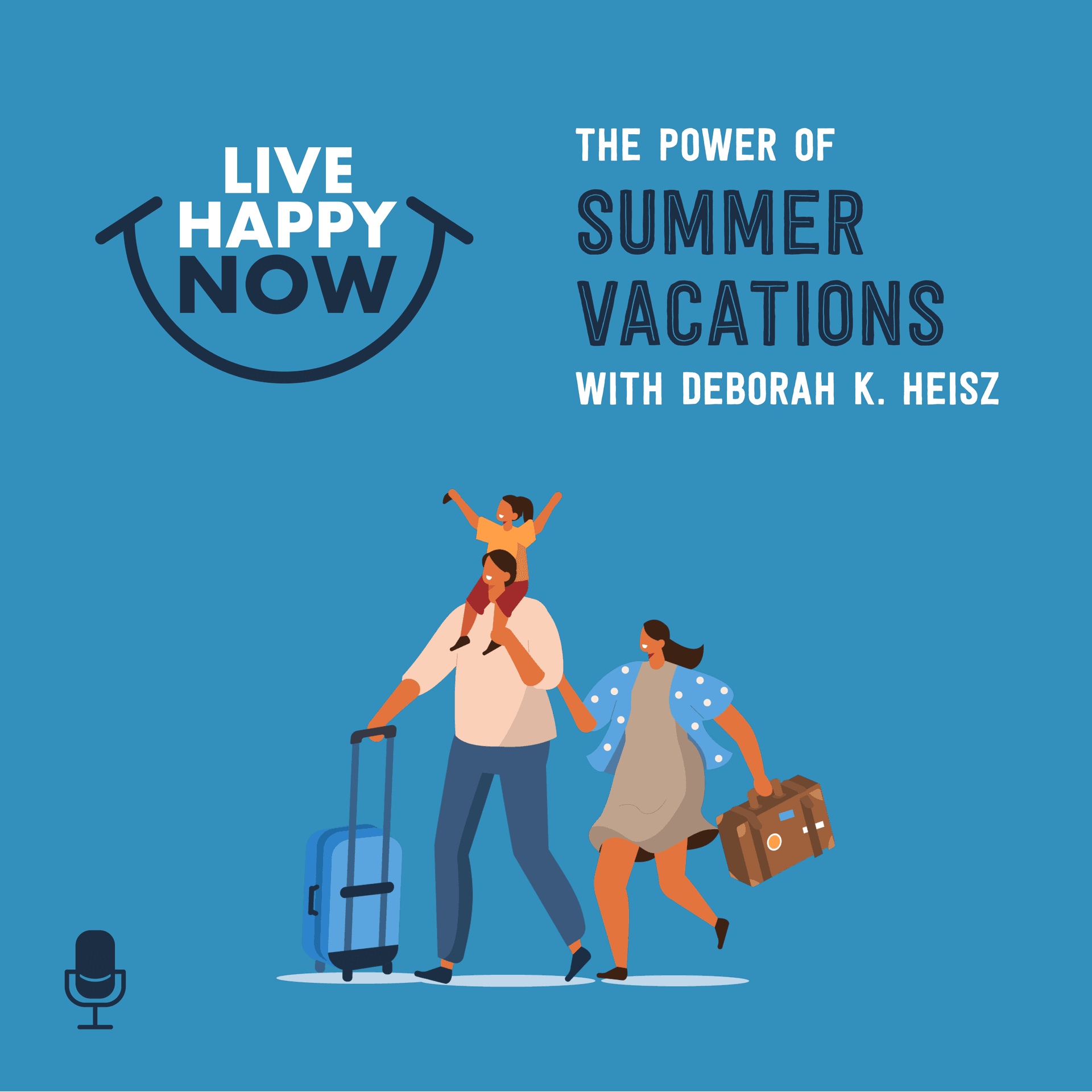
Summer vacations aren't just fun; they’re essential for your mental well-being. In this episode, host Paula Felps and Live Happy CEO Deborah Heisz share how unplugging from daily stress can spark creativity and emotional clarity, and why even a staycation (if done right!) can deliver major mood boosts. Whether you're heading to Hawaii or hanging out in your backyard, this episode is your permission slip to reset, reflect, and reconnect.
In this episode, you’ll learn:
- Why taking a vacation can make you a better parent, partner, and employee.
- The best ways to prepare for a vacation to make it more refreshing.
- How to make the “reset” of a vacation last longer.