
 Ask ChatGPT


- Podcasts
- Marketing Over Coffee Marketing Podcast
- Seth Godin on The Knot, Solving Problems, and Custom Blue Speakers
Marketing Over Coffee Marketing Podcast20 Nov 2026 · 39m · 15 chapters
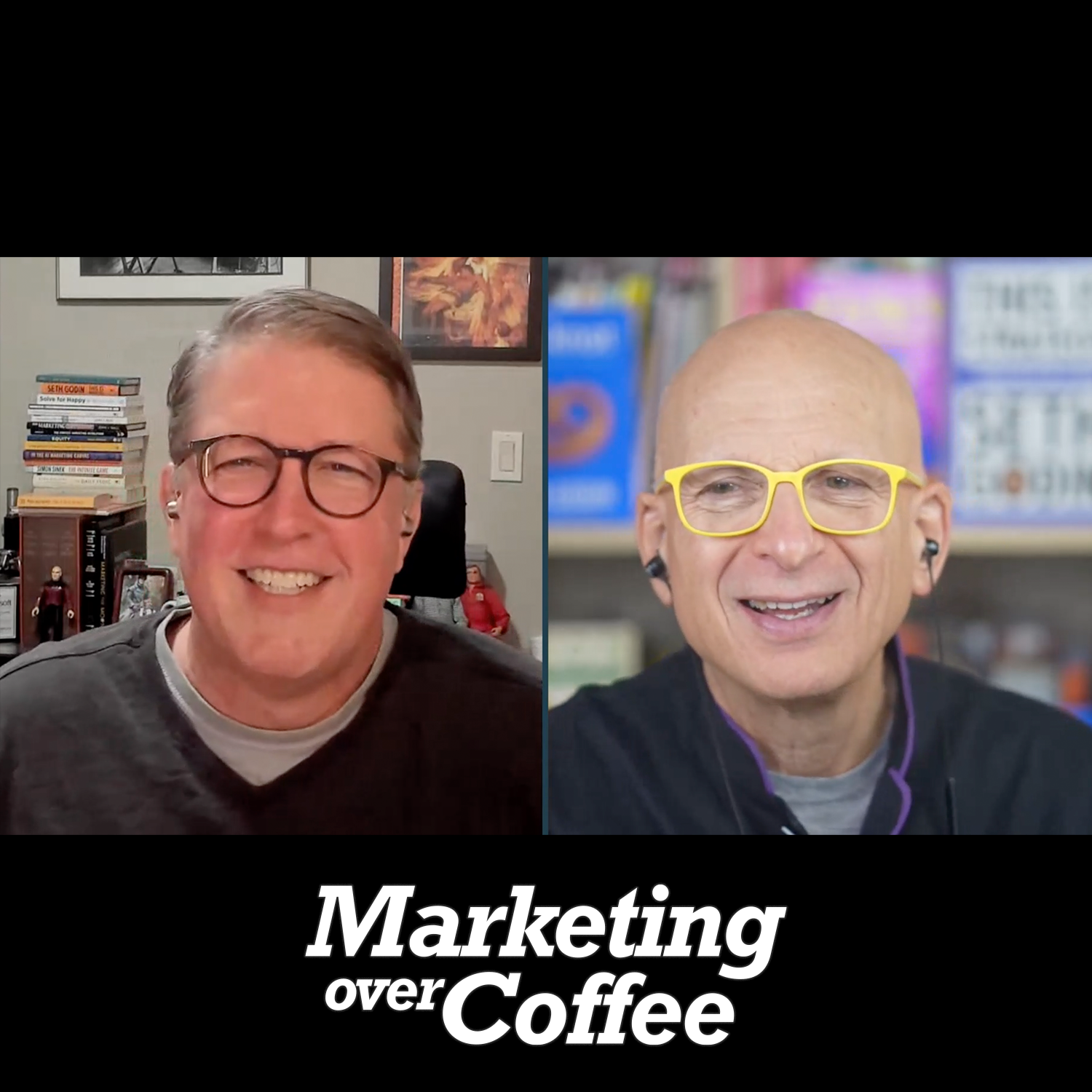
Seth Godin on The Knot, Solving Problems, and Custom Blue Speakers
In short
Seth Godin discusses his book The Knot, reframing “problems” vs “situations,” and how to untangle competing commitments (“and/but”), identity entanglements, and organizational inertia. He also applies the framework to healthcare, free public buses, feeding the hungry, and climate/topsoil challenges, plus how AI will change audio, writing, and work.
Guests
Seth Godin (marketing author; defined permission marketing; now focuses on human behavior, systems, and “getting unstuck”). Host: Christopher Penn and John Wall (marketing/AI practitioners).
Key claims
Situations can’t be removed (e.g., gravity, flu), but can be turned into solvable problems (e.g., vaccines, working with gravity). “But” contradictions must be dropped to resolve the knot. Compromise with committees creates mediocrity; buy-in compromise enables progress. Entanglements form from time/social/identity and defend sunk costs (Kodak vs Netflix). AI will accelerate “connecting” and will produce convincing voice/audio and writing.
Notable examples
Mel Robbins’ Let Them Theory; Olympic athletes’ identity crisis; Paul Farmer/Partners in Health in Haiti (zero non-conformance, $5 food incentives, home delivery); Dunkirk free buses (95% approval); Kodak vs Netflix; 11Labs AI narration feedback; hotlist.org and a new DTC small-business re-ranking site.
Written by AI. May contain mistakes.
Chapters
0:45
Philosophy of Marketing
Seth Godin discusses his philosophical approach to marketing.
“you're like the permission marketing guy.”
1:48
Problems vs. Situations
Exploring the distinction between problems and situations in life.
“And so, again, this book is all about solving problems.”
3:00
Competing Desires: The Power of 'But'
Discussing how conflicting desires are expressed and resolved.
“The thing that has hit me is there are so many things in life that like they're not problems, they're situations.”
4:24
Understanding Compromise
Seth Godin differentiates between productive and mediocre compromises.
“That's a good way to phrase that, to put that.”
6:52
Entanglements and Identity
Examining how identity entanglements affect decision-making.
“So you've got your problem and there's all these, find the entanglements is what you say about that.”
11:59
The Impact of AI on Productivity
Discussing the transformative potential of AI in various fields.
“It's a complete website platform, not just a builder, so your team can launch and keep improving their sites in one place.”
14:00
Redefining Problem Solving in Marketing
Learn how emerging tools can transform problem-solving in marketing and beyond.
“It's going to be a tool that enables us to choose to solve different problems, just like the steam shovel started by putting ditch diggers out of work.”
21:36
Understanding Glean: The Future of AI in Business
Discover how Glean is revolutionizing enterprise AI with context and efficiency.
“Glean is the context platform for enterprise AI.”
23:23
Seth Godin's Experience with AI in Audiobooks
Explore Seth Godin's insights on AI audio technology and its implications for the future.
“You've got a publisher that you've worked with for the past couple books.”
28:00
The Power of Books vs. Podcasts
Exploring how books provide unique benefits over podcasts and other media.
“They stayed till the end because they said, all right, I'm done.”
Show all 15 chapters
29:10
Understanding Stories and Their Impact
Discussing how the stories we tell ourselves can influence our lives.
“So my blog is a glimpse inside the weirdness of my head.”
30:20
Framing Perception: The Weight of Language
How language can shape our perceptions and biases in news.
“Like it's this list of terms and you literally have, here's what the thing is, but if you want it to make it sound like a bad thing, you use this word.”
31:00
Innovations in Music and Audio Gear
Discussion on new audio projects and the evolution of music experiences.
“Actually, things have not changed much for me in music.”
33:13
Auditory Perception and the Illusion of Sound
Exploring how our perception of sound can be deceived compared to other senses.
“And the second thing I'm building is I've got a half a dozen Raspberry Pis in the other room, each with a high quality bonnet from Switzerland that has a three watt amp in it.”
34:45
Creating Collaborative Book Listings
Introducing a new platform for authors to promote their books collaboratively.
“And so once I started to discover how good we are at this, but also how easy it is to fool people compared to sight or taste.”

Ask about this episode
Get the gist, explore an idea or ask about something said.
 Claude
On Marketing Over Coffee Marketing Podcast, what are the key points of this episode?
Searching your listeningTranscript
Automatic transcript. May contain errors.
0:00Today's episode is brought to you by Framer and Glean.
0:10This is Marketing Over Coffee with Christopher Penn and John Wall.
0:18Good morning. Welcome to Marketing Over Coffee. I'm John Wall. Today's episode, we have been fortunate enough to have our guest on many times to talk about some of the 20 plus bestselling books that he's written. He defined the transition to permission marketing, which changed everything in our industry. So Seth Godin, thanks for joining us.
0:36Seth Godin: Always a tweet. It's good to see you, sir. Okay. Now this book, The Knot, is about solving problems and we're going to talk about that, but it's just funny with this one because over the years you've transitioned, you know, as we said, you're like the permission marketing guy. Like that's your susudio, you know, like everybody knows you as that guy. But over the years, you've written more and more about life and how it works and how to improve it and with system things. And this made me realize that you are actually a philosopher. So do you think of yourself that way? That's my first question.
1:08Seth Godin: You know, if you went to college a thousand years ago, the only science was philosophy. And they keep carving things out of philosophy. Biology is capable of philosophy. So I only I started talking about marketing because I was interested in how we interact with each other and the game theory of that. But I have no interest in giving people a hack to grab some attention. So it's all philosophy to me. And I'm very flattered and honored that you're noticing that I keep coming back to this discussion of the human condition and how we get unstuck and how we contribute. Okay. And so, again, this book is all about solving problems.
1:51Like, this is the big thing. And I just remember, you know, as usual, you have a bunch of your ideas and you float them out on the blog first. You know, some of these you see years before the book. And the giant one that just hit me, you know, the lightning bolt was problems versus situations. Talk about the difference between those two things.
2:09Seth Godin: So the book came from a four-hour conversation I had with Mel Robbins. and when she invited me to be on her show, we didn't know each other, but she knew my work and I knew hers. And I wanted to bring a different sort of energy because it's two orders of magnitude bigger than a typical podcast. And in our conversations about her book, which is the Let Them Theory, which is about situations, things you can't change, I realized that she hadn't covered most of what we deal with all day, which are things we can change. And so I spent a lot of time cycling on my way there and then in conversation about that distinction.
2:51Seth Godin: And I wrote this book on the drive home. Okay. So that's why she's got the forward because I noticed that and you were in there, but so she was there when it first lit. So that makes a lot of sense. The thing that has hit me is there are so many things in life that like they're not problems, they're situations. The one that hit me like a train was two groups of people both want the same plot of land. Like, that's it. That's the whole thing. That's not a problem. You can't solve that. You can't fix that. And so I was able to let go of so many things because I realized that those are situations to me.
3:23Now, there are people who can fix that. Yeah.
3:26Seth Godin: So let's get into the distinction here because I think I gave it short shrift. A situation is something where we don't have the time or the energy or the leverage to make the thing go away. And some situations are universal. You cannot get rid of the flu virus, nor can you get rid of gravity. But there are problems like, how can I make it through the winter without getting sick? The flu vaccine solves that problem. How do I get to the moon? You don't make gravity go away to get to the moon. You work with gravity. So yes, physics creates situations that no one can solve, right? Mars is very, very far away and we cannot make it any closer.
4:08Seth Godin: But we can turn any situation we need to live with into a problem where we can come up with something better as a way forward, as opposed to just batting our head against something that's not going to change. Right, right. You don't have to bash your head against everything. That's a good way to phrase that, to put that. Okay, so now another idea that comes out is this wanting two things at once. It's just amazing how so many things fall into this problem. So talk about that, how people have competing. Right, so the symptom is a three-letter word. It's either and or but. And we use the word and all the time because it feels better, right?
4:46Seth Godin: I want to eat everything I feel like eating and I want to be skinny. It's not an and. It's a but. it contradicts the first half of the sentence. I want to run the marathon, but I don't want to get tired. I'm sorry. You cannot run a marathon well without getting tired. You can't have both. We ought to have a culture in the office that's based on positivity and dignity. And there's a bully down the hall who contributes so much to our bottom line, we can't get rid of him. That's not an and, that's a but. You can't have both at the same time. So what is it? Which one are you going to pick? Because if you're not willing to pick, you have to live with the situation.
5:29Seth Godin: But if you are willing to choose to commit to getting rid of the but, the problem goes away. It just goes away. That goes to the issue of compromise, right? You talk about compromise being commitment versus mediocrity. Where does that fall apart? Right. So two kinds of compromises. And if we go all the way back to the legendary Starbucks origin story, one kind of compromise is the compromise with the committee, the compromise with the people who don't want anything to change, the compromise with the people who just want you to go away. This is the compromise of mediocrity. This is the compromise of banality.
6:08Seth Godin: This is why most organizations stay where they are because they compromise their way into nothing. The other kind of compromise is the compromise with people who want to go where you're going, the compromise that gets buy-in from people. This is reasonable and thoughtful compromise that helps people move forward. So we've got to be very open to the second kind of compromise. If I need you to be part of my project and there's one thing I need to change to get you eagerly on board, I should do that because we're both going to come out ahead. But if it's the compromise of how do I sand off every single edge and make this thing banal, that's to be avoided.
6:50Seth Godin: And in marketing, we see this all the time. Entanglements is a concept. So you've got your problem and there's all these, find the entanglements is what you say about that. You have them broken down into three. So time, social, and identity. How do those three things work together? Like what's that all about? Okay. So entanglements are invisible connections, often unstated, that we have with the but, with the contradiction that's holding us in place. So we make mistakes when we entangle with who we used to be, with who the kids in high school need us to become, with who we want our mother-in-law to see when we show up.
7:35Seth Godin: These people are not in the room with us, and yet they're in our head, and they're getting in the way of us becoming. So if you think about the crisis of an Olympic athlete who has trained their whole life, they're 27 years old, There are no more Olympics left for them. So many of these young men and women don't have a great life after that because they're entangled with looking in the mirror and seeing an Olympic athlete, not connected to somebody who could make a new contribution in a new way. We defend who we thought we were. And in an organization, it's back to identity. It's something like the Kodak versus Netflix problem.
8:16Seth Godin: Kodak was a chemical company that happened to make film. They also invented the digital camera and had most of the patents on it. So why did they go bankrupt? Because at every turn, they defended the sunk costs that they had spent so much time on, the identity that they had spent so much energy defending. And every chance they had to whittle away at digital, they did. At Netflix, which put Blockbuster out of business by embracing the DVD, Reed, the founder, said, who's going to put us out of business? And presciently, he saw that streaming was going to happen somewhere. So why is Netflix still around?
8:57Seth Godin: Why didn't Netflix become Kodak? And the answer is that no one from the DVD division was allowed to come to the meetings of the streaming team because you leave the entanglements out of the room. We're not going to try to defend DVDs. There's nobody here who cares about DVDs, so we're going to put ourselves out of business. And so in the book, I highlight where do these entanglements show up? How do we get attached to something we're not even realizing we're attached to? And in an age of AI, where every rule is being changed, this is critical. because if you are attached to your identity as, say, a copywriter, you've got a problem because what you've said is my job is to please my boss and my job is to write slightly better than average copies slightly faster than most people.
9:49Seth Godin: Well, you know what else is going to please your boss? Getting instant copy that's slightly better than average for free. So you're going to have to give up the entanglements you have with what you think is important and what you do. The same way I had to give up setting type by hand and I had to give up doing my own spell checking and so many things that I've built in the past. I had a DVD division in my book company. Oh, we were winning, but then we lost because the world is changing. Okay. So we're pulling into some interesting territory here. So I will take just a second to take a break. We want to thank Framer for their support of marketing over coffee.
10:28if your team wants a website that looks and feels handcrafted, but is still fast to ship, Framer is built exactly for that. You design on a visual canvas with responsive layouts, hosting, and a content management system built in so the work is production ready from day one. Agents work alongside you to draft pages and polish sections, then you review and publish what goes live. We've talked about this all the time, human in the loop. You know, you can use the tools to automate things and take a lot of the grunt work out of it, but ultimately you make the decisions on style, hearing taste, judgment, and control.
11:01Agents and Framer work alongside teams to streamline collaboration on the same canvas, build custom code components, create and manage CMS content, optimize SEO settings, audit for issues, and ship everything all in one place. Framer is an enterprise-level solution powered by agents that provide premium hosting, enterprise-grade security, and 99.99 % uptime service-level agreements that gives the world's leading brands like Perplexity and Miro, the confidence they need to build their websites in Framer. Framer is the AI website builder that helps creators, teams, and businesses ship production-ready sites faster than ever while getting every detail right.
11:38Prompt, inspect, edit, and publish in one place at a whole new pace. Learn how you can get more out of your site from a Framer specialist or get started building for free today at framer.com slash MOC for 30 % off a Framer Pro annual plan. That's Framer.com slash MOC, F-R-A-M-E-R.com slash MOC. Rules and restrictions may apply. Yeah, check it out. It's a complete website platform, not just a builder, so your team can launch and keep improving their sites in one place. Thousands of businesses are using it from early stage startups to Fortune 500s. Get your site to the point where changes take minutes instead of days.
12:16Again, Framer.com slash And we thank them for their support of the show. We've got AI. From everything I've seen, it's making us more productive. Productivity is the thing. People are getting faster and easier. I still don't really see anything where it's completely changed the game. Like we're doing something completely different that we couldn't do because of the tools. I just see acceleration now. Have you seen the same thing? Or are you seeing some things that are changing the game entirely?
12:43Seth Godin: So when electricity was new, first of all, There were no electrical outlets. There was just the Edison socket in the home. And all it did was what we already had a lantern to do. So there was no giant breakthrough. The first appliance that was popular was the washing machine. And the way it worked is you had to unscrew the light bulb, which was hot, then screw in the washing machine. And the thing about washing machines is they're very hard to stay balanced. so it would start moving around the room and dozens of people were killed because the electrical cord would wrap around someone's neck wasn't paying attention and then kill them so it would be pretty easy to say back in those days what good is electricity and what we're seeing is the cheap easy wins first which is we can shut down a whole call center we can change the the pace at which someone codes.
13:43Seth Godin: And that's easy to sell. That's why they're selling it. Because every CEO is open to taking a meeting and buying something that pays for itself in a week. That's not what AI is going to be. AI is going to be a connecting machine, an honest broker between individuals, because it has awareness of more data. It's going to be a tool that enables us to choose to solve different problems, just like the steam shovel started by putting ditch diggers out of work. But if you look at our built environment now, almost nothing in our built environment could have been built with ditch diggers. It's a whole different level of accomplishment.
14:26Seth Godin: And so I'm already building websites that cost me$5 that are connecting people, selling books for dozens of my peers. I'm launching one in a couple of days. It's going to highlight more than 250 small businesses. I can build something like that in an hour. Therefore, I can do it. But if it was going to be something that would take me a month, I wouldn't. And so a whole different class of problems is going to get solved. Okay. And so as people get these ideas and move things to changing minds, getting people to go someplace else is part of that. And your book goes into this too, the idea of like, what do you have to do to get people to change their minds and where you want them to go?
15:06because you can't just show up and say, this is better. It has to be more.
15:10Seth Godin: Yeah. So let's talk about Paul Farmer for a second, because he doesn't get nearly enough attention. He's one of my heroes. Paul was a doctor in Boston and had all the privilege and all the momentum. And so he decided to spend it by flying to Haiti a couple of times a week and not just Port-au-Prince, but to rural Haiti. And at the time, tuberculosis was raging in rural Haiti for a whole bunch of colonialist reasons. And drug-resistant TB was on the rise. The way you avoid drug-resistant TB is by making sure your patients take all their meds to the end. And at the time, the breakage rate, non-conformance in a place like Boston was about 6 % because it's no fun to take your meds all the way to the end.
15:54Seth Godin: And every member of the establishment said, we just got to write Haiti off. Haiti is one of the poorest countries in the world. It's going to be a hotbed of drug-resistant TB. Just don't go there. Well, Paul realized that the way to get the world to pay attention was to model what better looked like. And he started a clinic there, Partners in Health. And after two years of unreasonable action, unreasonable expectations, he got the non-conformance rate to zero. Boston was six, Haiti was zero. And at that point, the WHO can't ignore you. At that point, people who want to follow an established path can follow an established path.
16:41Seth Godin: Because one person modeled what letting go of the entanglements might be like. So one of the entanglements is doctors aren't supposed to pay patients money. Another entanglement is doctor's time is very valuable. So what Paul did was, number one, he paid every patient$5 for food every time they came in to get their meds. And it worked. And another thing he did was, if one of your patients didn't come in, you had to go on foot and go to where they lived and give them their meds. So in his case, the head of the clinic, he would go six hours and then six hours back to give one patient their meds.
17:27Seth Godin: And you can bet the first or second or third time a doc has to do this, they're going to change their entire posture about people taking their meds. Because they don't want to go spend their day doing that. And so it shifted. One of the side effects of what he did is he drove the price of second line antibiotics for tuberculosis from$2 ,000 a dose to$2 a dose. because he questioned correctly the pharmaceutical companies and the intermediaries about why did it cost this much? What are we entangled with? What is the possibility here? And how do we solve this problem? So you talk about, you've got three other big knots that we face now too in our world.
18:13You're talking about healthcare because you've got buses, feed the hungry and reduce carbon. Those are the three kind of challenges that we have that are similar to public health crisis, things that could have outsized rewards. So just talk about those a little bit.
18:25Seth Godin: Yeah, so they're in the book as metaphors, not because I think these are the three things we have to do right now, but I wanted to highlight for people, there are small problems we've got to solve, like how do I increase the market share of my granola? And then there are bigger problems that are easy to just announce our situation. So we know that one of the best ways to improve the productivity of human beings is how I live in a city. And we know that cities work because people can get places. And we know that public transportation pays for itself. So why aren't the buses just free? And in the United States, there's very few, if any, major metropolitan areas where the buses are free.
19:07Seth Godin: And the list of entanglements about why buses shouldn't be free is long, from people will sleep on the bus to how are we going to pay for it. Wait a second, the roads are free. Why did we default to spending almost a trillion dollars a year to keep the roads free, but the buses aren't free? And a province or municipality in France called Dunkirk said, let's fix this problem. And the buses there are free. And it took a few years to get it right. But now in a recent survey, more than 95 % of the people who live in that region said it's the number one best use of their tax dollars. And traffic is better.
19:46Seth Godin: Parking is better. Productivity is up. Just make it free. It's not hard. We're just stuck. The second one is the idea of feeding the hungry. Also, housing the homeless. If you want people to have homes, if you want people to have food, give them a house. Give them food. There are plenty of things in our society. In every city in the United States, you can get water for free, clean, fresh water for free. Why don't we make basic food just free? Why do we need to bring with it this barbarian Protestant shame that says, we're not going to give you a bag of beans and some rice because you should go work?
20:27Seth Godin: Well, if you spend time at a food shelter, you see that that's not really what's going on. And we could solve this problem. We can afford to solve the problem and it pays for itself. We don't because we're entangled, right? And the third one is our challenge with a planet that by every single measure is warming, where we are running out of topsoil, and we're getting harder and harder to solve the problem going forward. And the question is, even though we know what to do and how to do it, why is it treated like a situation? And the answer is because we are entangled. We are entangled with the status quo.
21:06Seth Godin: We are entangled with our positions. We are entangled with late-stage capitalism and the value of cheap power. None of those things need to get in the way of solving the problem. But first, we have to announce what exactly is the problem? What are we entangled with? What is the but that is holding us where we are? Because there is a path forward, but if we get caught up thinking it's just a situation, we're going to be stuck. Today's episode is also brought to you by Glean. Glean is the context platform for enterprise AI. AI needs more than a capable model to do useful work. It needs context about your business.
21:47Glean connects enterprise knowledge, people, decisions, and workflows across systems, giving employees and AI agents the context they need to move their most important work forward while preserving your existing permissions and security boundaries. Your enterprise knowledge stays independent of any single model provider with access to 40 plus open and frontier models. Glean routes tasks based on performance and cost. So you can take advantage of better models as they emerge without locking your business into one provider. And that's really key. I really want to hammer that home. This idea that, you know, we've seen so many organizations just burning through tokens and having to manage tokens.
22:23Using Glean, you're able to have tasks routed. And so it's able to intelligently select the right models. So there's huge savings in tokens. Glean can cut AI costs by 75 % per task compared to Claude Cowork. And it's more than just token savings. Glean uses auto routing of multiple models to make sure you get all the AI power you need with all the cost savings your CFO wants. Ask Duolingo. They're saving more than a million dollars a year in employee time with Glean. And at super.com, they're seeing a 17 times return on investment with Glean. The right AI for the right job and not a token more.
22:58Check it out. I've been using it. You should check it out too. Again, it's just a better way to do business. Glean, the context platform for enterprise AI. Visit glean.com slash MOC to unlock an exclusive offer just for listeners of MOC. That's G-L-E-A-N dot com slash MOC. Terms and conditions apply. Again, check it out, and we thank them for their support of the show. So for this book, you've had some interesting things. You've got a publisher that you've worked with for the past couple books. It's different kind of than anything else that's going on. But the big one for me was you had an audio version of the book that 11 Labs put together.
23:36And I listened and it's really interesting to me because, you know, like I'm an audio jerk. And so I was like, oh, no, that's not that's not specifically Seth. But then at a certain point, I was like, well, if somebody was a normal person with audio, they'd be completely fine with this. Like it was close enough. So tell us about that. Yeah.
23:55Seth Godin: Well, so to be clear, I wasn't fine with it. And the real one is my voice. But what I wanted to do was two things, highlight for people just how fast this world is changing. But second, I wanted people to give me feedback on the book. And my voice has been having significant issues. I'm pleased to say that my last treatment seems to be working. And the thought of recording the book twice was impossible. I was only going to record it once. But if I only recorded it once, then I wouldn't accept any feedback because I would have to defend my entanglement with the recording. So by working with the way I trained 11LAB software, I didn't care about it.
24:35Seth Godin: I was going to throw it out anyway. So I was much more open to people giving me feedback because I wasn't entangled with the sunk cost of the original. I was a metaphor. work. It is true that when my wife on a couple of occasions has accidentally heard the 11 labs recording once I did on a podcast in this one, she thought it was me. And so if my wife is fooled, other people are, I don't think it's good enough. You notice things, but what I also believe, and I have a blog post about this tomorrow is it's amazing how quick we get acclimated to changes like this, what I have discovered is a whole bunch of people I respect are now writing like AI.
25:17Seth Godin: They're not using AI to write like that, but they are writing like AI because we read so much AI, it sounds normal to us again. And I think that is where between the improvements at 11 Labs and our minds, we're about to enter an era where it's going to sound correct if you hear something that's narrated by the next generation of audio. Once that happens, first scary thing, if you've got a family, you should talk to them face-to-face very soon and come up with a password regime that if someone calls you on the phone and says it's somebody you care about, you can ask them what's the code word because you're going to start getting spam that sounds like people you care about, voice spam, et cetera.
26:03Seth Godin: And it's going to be eerie. And then it's going to become widespread as organized crime embraces it. It's going to lead to a lot of really horrible speed bumps because some people aren't that good. So just be careful. But the second thing, the good thing is once we have instant audio all the time, think about how powerful things like tutoring get and things like space-aware, location-aware audio, that as I'm walking through a museum, it knows what I'm looking at and it can talk to me about something. I can't even begin to list the kinds of shifts we're going to see, but it's going to happen in the next two years.
26:46That it's coming, yeah. So I have to geek out a little bit though about the sound of your own voice there. The thing that got me was, I think the structure of the sound was perfect, but it was just that when you would read through a paragraph, I would know where the hottest ideas were and I would know your voice would emphasize those and they don't. The emphasis was just kind of all over the place. Is that?
27:08Seth Godin: Yes, that's exactly right. And so when I recorded the real one, knowing this, this recording is one of my best audio recordings because I overemphasized the kinds of stuff I wanted to highlight. Oh, that's interesting. So it changed the way you did the second round. Yeah. Oh, wow. That's interesting. There's a glossary in the book. Maybe you've done it in previous ones, but I know most of them not. So what was up with that? So, you know, I love book as object. And as the alternatives to books keep growing and impact, right? That someone listens to me, you know, here's an interesting data point.
27:47Seth Godin: Two million people have listened to my interview with Stephen on Diary of a CEO. Our data shows we sold 800 copies of the book. What's up with the other 1.9 million people? Obviously, they're interested. They stayed till the end because they said, all right, I'm done. Two hours with Stephen was enough. I get the joke. Okay, fine. I'm not here to defend books. If that gets you where you need to go, fine with me. I didn't do this so that you would send me$20. But books can still do things that a podcast can't, that an audio can't. And so one of the things that books do is their random access. You can jump ahead.
28:28Seth Godin: You can go back. You can go to the end. You can read the footnotes. So as I play with each media, I try to think about what would make this a jewel. And in the case of the glossary, the book, like this strategy, is layered and layered and layered. And I want you to come back to it, and I want you to highlight a page. And if you go to the end and you're not exactly sure what I meant by entanglements, there it is. Okay, so make an entanglement go away. I get that. That makes sense. One other post that I have to just pull out. you had a post about Betham Springs of action in an 1817 document that you then remixed through AI.
29:08And it was a whole interesting thing. So just like what sparked that and what's the story with that?
29:15Seth Godin: So my blog is a glimpse inside the weirdness of my head. And what I try to do every day blog or no blog is notice things. And if I notice something and I don't understand it, I try to explain it to myself. And if I can explain it to myself in a way that I think other people might want to hear it, then I share it. And so in this case, I think it was on Boing Boing. I read about this guy, Jeremy Bentham, and about what he, he was like one of the original self-help books, basically. but in the form of a poster and a short essay. And I then dug deeper into where was he coming from? And what I got out of what he posted is that we have a story in our head.
30:11Seth Godin: And we have to think about, is the story in our head helping? And if it's not helping, we can tell a different story. And it was a good excuse for me to be able to link to a PDF of the summary of what he had to say, because it was a little dense. Yeah. Well, and then it's just amazing. Like it's this list of terms and you literally have, here's what the thing is, but if you want it to make it sound like a bad thing, you use this word. And if you want it to sound like a good thing, you use the other word. And it just kind of blew my mind. Like this guy solved it. Like you can take today's newspaper and you can totally see where all the biases are, where everything's bending and where it's going.
30:49And so, yeah, I'll have a link to that so people can grab that and run with that because that, again, a mind-changing thing, you know, and framing things is all part of that. All right, we always catch up on music. Actually, things have not changed much for me in music. I've kind of settled into the gear and things are going. The one thing, though, we've talked about projectors in movies in the past. I've realized that Blu-ray discs are the new vinyl. like you can go on quests for blu-ray and there's different versions of things and different so that's the where i'm at but how about for yourself has anything changed as far as the music scene or
31:23Seth Godin: your gear okay so i'll get to gear in a second uh last night i bought tickets to see stevie wonder 50th anniversary songs in the key of life and you know i saw paul simon last year you realize that time only goes in one direction. And from what I'm reading about this concert, it's a celebration, but of course it's not just a celebration. Nothing lasts forever. And he's been the narrator of my life since I was seven. And so I'm bittersweet about going, but I'm looking forward to it. But in terms of audio, two gear things to share with you. The first one is I'm building with Helpful and Claude a whole new approach to a baffle-less speaker.
32:11Seth Godin: And I just popped this off the 3D printer just before we talked. So what's going to happen is this ring, for those of you who are just listening, is a ring about eight inches across, will go on a sonotube, those forms they use for concrete, a 12-inch sonotube. And there'll be a hole right here. The sonotube will have a cap at the top and open at the bottom. And then there'll be a couple of boards holding it suspended. So this will be at ear height. And there'll be a six inch LiSong driver in there, 95 dB efficient. And so I'll end up with the best of a baffle and the best of a port and the best of a sealed box.
32:54Seth Godin: Then I'm going to take the tube, wrap it in some paper mache for rigidity that I'm going to be using a PVA glue to set of wheat paste. And then I'll paint it in Eve Klein acrylic blue from Culture Hustle and stay tuned. It might sound terrible, but it's fun to build. And the second thing I'm building is I've got a half a dozen Raspberry Pis in the other room, each with a high quality bonnet from Switzerland that has a three watt amp in it. And so it's going to be a room with a dozen small speakers all throughout. And the goal is to program content that makes the room disappear, that creates a cathedral, a sense of wonder and awe.
33:42Seth Godin: And so I'm spending plenty of time on these projects and it's making me very happy. Oh, yeah, you are like going way out on the frontier. That's fantastic. Yeah, multi-speaker thing. I went to an exhibit that had like 40 speakers set in an orchestra configuration. and so you could feel what it was really like to be there. Oh, wow. Yeah, you are doing some very cool stuff. So here's one. You'll appreciate this. Here's one thing about, so we notice where sound is by a couple cues, one of which is the shape of our ears, which is why binaural amplification sounds different for different people because your ears are different shapes.
34:25Seth Godin: But if you have your head frozen in space, like a fixed, so you can't go like this back and forth and you're blindfolded and there's a sound, you cannot tell if the sound is three feet in front of you or three feet behind you. You are unable to tell the difference unless you're able to move your head slightly and then you can tell instantly. And so once I started to discover how good we are at this, but also how easy it is to fool people compared to sight or taste. Like you can tell artificial vanilla instantly from real vanilla. And you can tell, for now, AI video from real video. But you can't tell process sound from real sound.
35:11Seth Godin: It's easier to fool you. And so to play with that and with space feels like an interesting moment. Yeah, because I've noticed with a setup that I have, In my kitchen, I enjoy it more if the speakers are behind me and it's shooting forward. And there is something about sitting there and it seems like it's moving more, you know, where I'm at. And so, yeah, there's a billion things going on with it. And I do have to say, congrats on going to see Stevie Wonder. That's supposed to, that is a legendary show. I've heard people all over the world singing it. And in fact, a local guy who's part of the band Great Good Fine Okay, they're kind of like an 80s synth thing.
35:49One of those two guys is working that tour. He's actually a stylist and is on that tour. So quick shout out to John for working that tour. And yeah, I'd love to hear how that goes after you come back from that. So we've got the holiday season coming up. And yeah, you had a post, you've got your book and a bunch of peers, other folks on a page where they can kind of shop for all, you know, for that stuff. Tell us about that. All right.
36:12Seth Godin: So the kinds of things I'm building, I mentioned the other one. The one you're talking about is the hotlist.org. And I went to a dozen authors, maybe 20, and I said, let's put all of our books on one page. And so when we send readers there, it'll be leaky. Someone might buy your book, but they might buy somebody else's book too. And this page re-ranks on each load based on clicks. So the most popular book goes to the top. So each author has an incentive to send their ringers there. So they would show up. So it was sort of a friendly competition. And we sold thousands and thousands of books from that.
36:49Seth Godin: And the new one, I'm picking the same idea, but building it for 200 or 300 direct-to-consumer small businesses. And this time I have three views. I have the random view, which sorts by nothing. so it's super fair. I have the hot list, which is all the even ones are ranked by clicks. The odd ones are random. So that way there's always going to be fresh energy. And then the third view is category view just in text. So you can see them in a more organized fashion. But again, I love building stuff like this and to be able to iterate my total time spent on the thing. actual act of time is no more than five hours, but it took me two weeks because I'll give Claude something to do and it'll give it a version of it.
37:41Seth Godin: I'll say, I hate this and I like this and it'll revise it again. I can do this all day long. And I haven't tried to do one that makes a profit, but I probably will. Because the thing is, if you're connecting people and telling a story and making things better, there's plenty of room to do that. We're not out of problems to solve. that's excellent we'll have links to that in the show notes and of course to the book itself you can dig into that that's going to do it for us for this week seth thanks for joining us oh what a treat i'm so glad you do this you show up and you show up and you show up it makes a difference so thank you i appreciate that you're welcome and that'll do it for this week so until next week enjoy the coffee go make a ruckus you've been listening to marketing over coffee christopher pen blogs at christopherspenn.com read more from john j wall at jw5150.com the marketing over coffee theme song is called mellow g by funk masters and you can find it at music alley from mevio or follow the link in our show notes
From the publisher
In this Marketing Over Coffee: Real problems never have easy solutions. Seth Godin explains why, and outlines the framework to solve them. Direct Link to File The new book is The Knot, you can order it and partner books from The Hot List It’s not marketing, it’s discussion of the human condition Problems vs. Solutions […]
The post Seth Godin on The Knot, Solving Problems, and Custom Blue Speakers appeared first on Marketing Over Coffee Marketing Podcast.
More from Marketing Over Coffee Marketing Podcast
All episodesWe use cookies.They keep VO running smoothly and help us improve it. Privacy policy