

- Podcasts
- Materialism: A Materials Science Podcast
- Episode 121: Aluminum
 Materialism: A Materials Science Podcast
 Ask ChatGPT
In short
The history, production breakthroughs, properties, recycling, and alloy/temper designations of aluminum, explaining why it shifted from a precious metal to a ubiquitous engineering material.
Guests
Murat Latapov (University of Arizona; industry experience in aluminum R&D). Hosts: Andrew Volkowski (University of Utah graduate student) and Dr. Taylor Sparks.
Key claims
Aluminum is abundant but hard to isolate due to strong oxygen affinity; it forms a protective oxide layer that enables corrosion resistance and good formability. The Hall-Héroult process (Hall and Paul Héroult) made aluminum scalable and cheap; early aluminum cost dropped from silver-like levels to commodity pricing as electricity-driven smelting expanded (e.g., Niagara Falls). Aluminum’s strength largely comes from precipitation hardening via heat treatment (Wilm’s discovery leading to Duralumin). Recycling can cut CO2 because primary production emits significant greenhouse gases; however, impurities and alloying elements complicate recycling.
Notable examples
Herodotus’ alum; Napoleon III using aluminum cutlery; Washington Monument’s aluminum cap; Hall’s 1886 first aluminum; Taft ruling on patent priority; WWII strategic material for aircraft/ships; aluminum wiring fire hazards; Ford F-150 switching to 6xxx series to shed ~700 lb; alloy series (1xxx, 2xxx, 3xxx, 5xxx, 6xxx, 7xxx) and temper codes (T3/T4/T6/T7).
Written by AI. May contain mistakes.
Chapters
Introduction to Aluminum
Overview of the significance and historical context of aluminum.
“And today, we are also joined by Murat Latapov from University of Arizona for a really exciting episode.”
Early History of Aluminum
Discussion on aluminum's early uses and historical discoveries.
“We've got a similar, you know, splitting of the timeline with Illumina.”
The Hall Process Revolution
Introduction to the Hall process that revolutionized aluminum production.
“I don't know if that's in today's dollars or French dollars.”
Charles Martin Hall's Breakthrough
Detailed account of Hall's method for extracting aluminum.
“All of a sudden, we're going to see it shift from being comparable to silver and gold to being the everyday working material that takes over all around us.”
Patent Dispute and Impact
Discussion on the patent dispute between Hall and Herald and its consequences.
“I think that had something to do with the silicon containment or it removes silicon in some way.”
Commercialization of Aluminum
The establishment of the Pittsburgh Reduction Company and aluminum's market transformation.
The Founding of Alcoa
Learn about the founding of the Pittsburgh Reduction Company and Alcoa.
“And it gave birth to now this energy efficient, scalable process.”
Aluminum's Role in World War II
Explore how aluminum became a critical material during World War II.
“So really good guy giving back to education.”
Unique Properties of Aluminum
Discover the unique properties of aluminum, including its density and corrosion resistance.
“Couldn't do it with big heavy steel airplanes.”
Challenges with Aluminum Wiring
Learn about the challenges and hazards associated with aluminum wiring.
“Back in the 60s and 70s, if you bought a home and had your electrician come and wire it, there's a good chance that they were using aluminum wiring.”
Show all 19 chapters
Recycling Aluminum and Its Impact
Understand the significance of recycling aluminum and its impact on CO2 emissions.
“And in theory, it can be infinitely recycled.”
Issues with Aluminum Recycling
Examine the challenges faced in aluminum recycling and the need for purity.
“I mean, it's outside the scope of this episode, but I think Alcoa has their like Elysis project or something like that.”
Heat-Treatable vs Non-Heat-Treatable Alloys
Learn the differences between heat-treatable and non-heat-treatable aluminum alloys.
“some of the high-grade aluminum alloys into something mass-produced and still very useful, right?”
Understanding Precipitation in Aluminum Alloys
Learn about the processes of quenching and aging that strengthen aluminum alloys.
“In other words, you have to have some sort of impurity that dissolves into it so it's randomly distributed.”
Discovery of Aluminum Hardening
Explore Alfred Wilm's accidental discovery that revolutionized aluminum alloys.
“And the story behind discovery of precipitation in aluminum alloys is very interesting.”
The Evolution of Aluminum Alloys
Understand the different series of aluminum alloys and their applications.
“I'm just, I'm potentially waiting for an accidental discovery is all.”
Aluminum Alloys in Automotive Applications
Learn how aluminum alloys are used in automotive design and their implications.
“give me pros and cons for this from the lenses of how it impacts the environment, how it impacts society, how it impacts the bottom line of the company.”
Temper Designations in Aluminum Alloys
Dive into the classification of aluminum alloys based on temper designations and their significance.
“These are the highest strength rod alloys.”
Celebrating Materialism and Creativity
A reflection on the importance of materials in innovation and creativity.
“the materials of this world and are bound only by their imaginations in manipulating those materials.”

Ask about this episode
Get the gist, explore an idea or ask about something said.
 Claude
On Materialism: A Materials Science Podcast, what are the key points of this episode?
Searching your listeningTranscript
Automatic transcript. May contain errors.
0:01I would like to describe a field in which little has been done, but in which an enormous amount can be done. This field is not quite the same as the others in that it will tell us little of fundamental physics, but it will tell us much about the strange phenomena that occur just below our perception. In contrast to the natural philosophers of the past, the scientists of this field delve into the recesses of nature and show how she works in her hiding places. Their quest is to understand and create the imperceptible. After all, there is plenty of room at the bottom. Hey, everybody. Welcome to the Materialism Podcast, an exploration of the past, present, and future of material science and engineering.
0:41My name is Andrew Volkowski. I'm a graduate student at the University of Utah. I'm joined, as always, by my co-host, Dr. Taylor Sparks. And today, we are also joined by Murat Latapov from University of Arizona for a really exciting episode. How's everyone doing? Fantastic. It's a birthday weekend for me over here. It's the best time of the year. It's warm weather. My kids are on spring break. I've got them working in the garden. It's a fantastic time of year for me. Nice. Hi, I'm Murat, faculty at the University of Arizona with some industry experience in aluminum R &D and happy to be here. Today we're going to be talking about pretty much everything aluminum, at least giving you the broad strokes of not only the interesting history that has a lot of awesome intersections with other major historical figures, but also why it is so coveted, why it's so popular and ubiquitous, and all the special things that make it desirable.
1:35Yeah, if you've been listening, we did a deep dive on titanium in the past. We did a deep dive on steel, and people have loved those. And if you're going to cover those two, you can't not talk about aluminum. And, oh, my gosh, it's absolutely all around us. It's one of society's most important metals. And we'll explain why that is from a cost and a resource perspective, but also in terms of properties. It does stuff that other metals just don't do very well. So maybe we'll dive right into the history. This can be sort of thought, just like, you know, in the timeline, you've got like B.C. and A.D.
2:03We've got a similar, you know, splitting of the timeline with Illumina. You've got the early history before the Hall process, more on that later, and then everything that came after the Hall process. So let's go way back in the time machine to the days before, you know, Halt process. How did we go about getting aluminum, Andrew? Well, aluminum is kind of weird. It's the third most abundant element in Earth's crust. However, it's super, has a really high affinity for oxygen. So it forms an oxide almost immediately. So it actually wasn't isolated in a pure form that could be utilized until like the 1800s.
2:34Similar story to titanium then, right? All over the place, but not easy to extract. Yeah, the first – but that didn't stop people from at least finding it in its oxide form and observing it and utilizing it. The first written mention of aluminum compound is found in the writings of Herodotus in the 5th century BC. Here he discusses aluminum potassium sulfate or alum as it was called. That's the same stuff that you cook with, right, alum? Don't you make like pickles or something with that? Yeah, they use it in pickling and canning to keep things crispy. So every time you get that crispy pickle, that's alum, baby.
3:07Oh, wow. I didn't know it. Right? As well as like 7 ,000-ish years ago, like the Persians started – they found that in their strongest pottery, the clay would often have aluminum oxide in it. Or alumina is what you'll often hear a lot of material scientists or ceramicists call it. So they actually deliberately sought out these alumina-rich clays for their pottery as a result. Very cool. Now, the name aluminum actually comes from a British scientist, right? This is Sir Humphrey Davies, right? One of the early chemists, right? 1807, 1808, he points out that this compound aluminum must contain the metal element.
3:41And so he came up with the name aluminum to sort of accompany the alum, which had been traditionally been named for the oxide. Yeah. So he proposed that you might build an isolated metal, but it wasn't until a little bit later that we actually got someone who attempted to separate it. Yeah, I think it was in 1825 that Hans Christian Ørsted achieved the first separation of aluminum. But impurities remained an issue for a long time. I didn't know this was Orsted. That's the same guy with the magnetism, right? Yeah, exactly. Dude, that's so cool. And he's famous for the wrong thing. Aluminum is a bigger deal almost.
4:19And some other early successes were by Friedrich Waller, who achieved pinhead-sized aluminum globules. Yeah, by making these larger globules, He was actually one of the first to be able to be able to measure things like density because before that it was just kind of like powders or some sort of impurity like an iron-aluminum mixture. No physical properties basically. Yeah. But here's where we start to get it in sufficient purity and sufficient size to actually start to get some idea of what it – how it behaves. So that's the sort of lab scale proof of concept. But you're not selling alloys yet at that point.
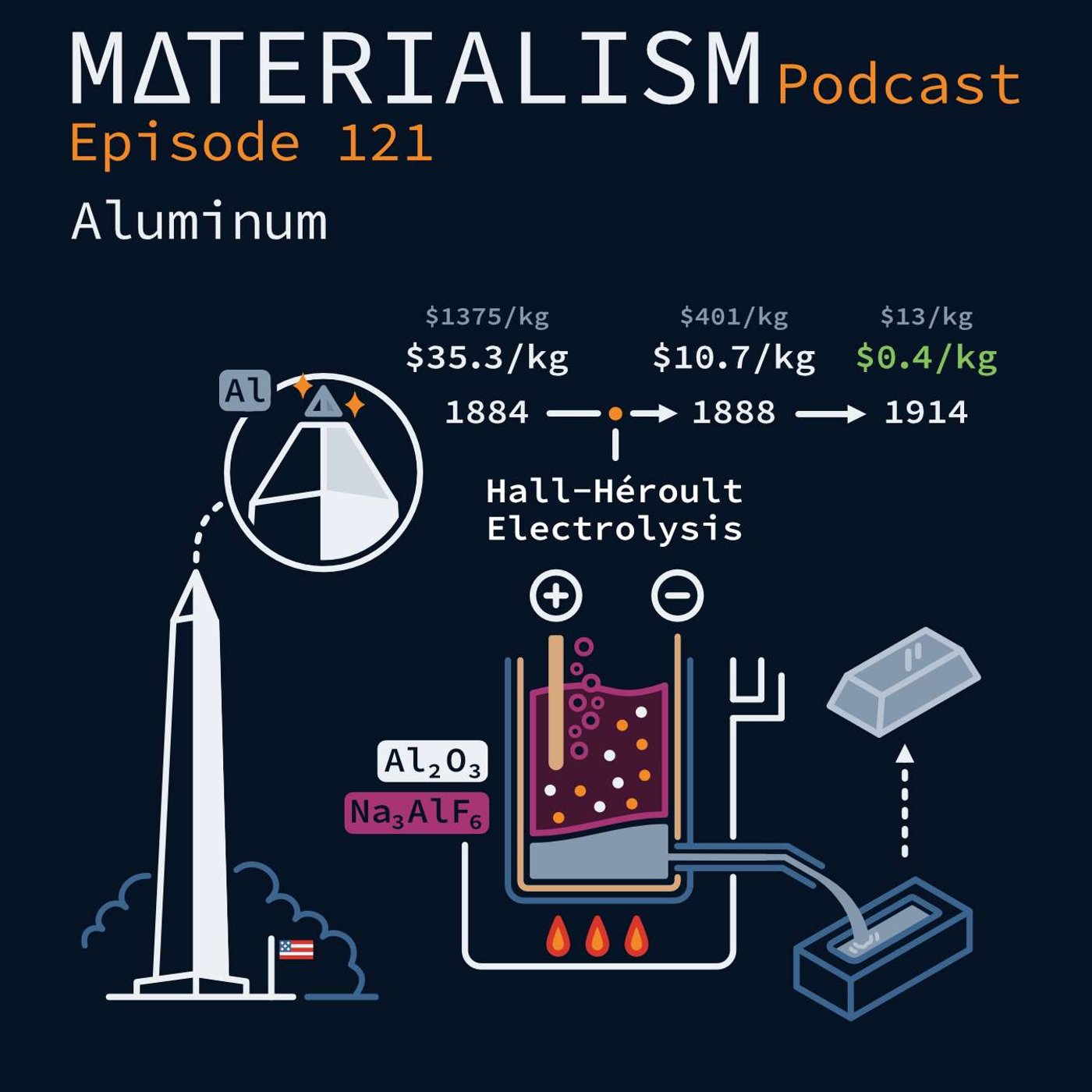
4:51That comes a little bit later, like 20 years later, right? Now we're in the 1850s. You got Henry St. Clair de Vil. He's got the very first process for making commercial aluminum. In 1854, he invents it. Basically, he takes sodium and reduces the aluminum chloride, leading to the very first aluminum factory in where? Paris in 1856. But that process was expensive. Can you imagine? Aluminum was$17 per pound back then. I don't know if that's in today's dollars or French dollars. I think that is back in those days. And even that is compressing the history quite a bit. His early process was much more expensive and then through industrialization and scaling up, it kind of averaged out around$17 per pound.
5:32I see. So not super useful when it's that expensive. And that gave it like a semi-precious metal character or reputation. It was comparable to the price of silver at the time. Oh, no way. Just to give a sense how precious it was, Napoleon III used aluminum cutlery for his most very important guests. and other less important people had to tolerate gold. Are you kidding me? He's got his gold set for the plebs that come. The real all-stars get the aluminum. That's wild because today it's this metal that's absolutely all around us. It sort of gives you a sense of how big of an achievement it was that they were able to make this back then.
6:13Yeah, I think it was 1884-ish. The U.S. government wanted to have a precious metal cap for the national monument. And so they thought about gold. They thought about silver. But they ultimately chose aluminum. And so they made this giant block, the tip of the National Monument, six pounds, 8.9, about nine inches tall. And the maker charged$225 at the time or$8 ,000 today for this giant chunk of aluminum. Wait, is this the Washington Monument? Yeah. It's still topped with aluminum then? It might have been damaged or something may have happened. I'm not sure if it's still there. But at the time, what is also interesting is that it was the largest piece of cast aluminum.
6:52At that time. And it was only nine inches tall. Like that's crazy how far we've come since that. I mean last week my – I've got a freshman group of students in my science for sports gear class and we cast an eight-inch thing in class, right? That's wild. OK. Well, yeah. And moving on, the funny thing is that like two years later – so they put this monument on there. They're all proud of it. It's this really precious, beautiful thing. Two years later when aluminum refinement was revolutionized, it dramatically dropped the price and the value of that monument piece. Oh, yeah, it totally would. That's awesome.
7:26So that is all the stuff that happened before the Hall process, but things change. Aluminum undergoes a transformation with the Hall process. All of a sudden, we're going to see it shift from being comparable to silver and gold to being the everyday working material that takes over all around us. Tell me about how that happened. I think it's a story of two gentlemen, Charles Martin Hall and Paul Eru, if I pronounce it right. Yeah, like the Hall-Herald process. Yes. And interestingly, both of these people who revolutionized aluminum were born in the same year. So Charles Martin Hall was born in 1863 in Thompson, Ohio.
8:08And he goes to Oberlin College where he takes classes and does research with Professor Frank Fanning Jewett, who knew the European scientific community, including Waller, who was one of the first to obtain aluminum whose physical properties could be measured. Yeah, and this Professor Jewett was really excited about the promise of aluminum. So he actually had himself a rare sample of aluminum, which was still very rare at the time. And he passed it around class and really got Hall excited about the prospect of aluminum. And there's this interesting legend that comes. It's considered to be apocryphal, I believe, but it's still kind of interesting.
8:53So Jewett, who had been a professor of chemistry at Oberlin in 1880, he passes around this lump of aluminum in class, stating that any person who discovers a process by which aluminum can be made on a commercial scale will bless humanity and make a fortune for himself. And Hall, who already had some interest in aluminum just by reading some textbooks in his father's study as a kid, he allegedly turned to one of his classmates and told them that he's going for that medal. I'm not sure if that was true, but it really sets an interesting stage. Real or not, can't you picture yourself in that same sort of situation?
9:23The professor brings the demo to class and the student's like, I can do better than that. I can figure this out. and goes for it. And he turns to an unconventional approach to doing it, electrical current, right? This was not the typically, this is not the pyrometallurgy that had been explored in the past. This was a fundamentally different approach that they were going to employ here, right? Yes. His initial attempts in Jewett's lab were to work with aluminum fluoride dissolved in water and applying electric current. But with these initial attempts, he mostly decomposed water into hydrogen gas and oxygen.
10:03Yeah, okay. The wrong thing reduced. Right. And then, interestingly, his success comes not in the lab, but in the shed of his parents' house next door to Oberlin College. So, Charles Hall often read Scientific American magazine and drawing inspiration from Grazl's process of magnesium reduction from molten chloride, he switches to chlorides. And specifically, he works with creolite, which can dissolve up to 25 % or even more of aluminum. Yeah, so he reads in the Scientific American about what's happening on the magnesium front. And the clever thing they did there is they switched to these molten fluoride salts.
10:53So he's like, well, maybe we should try that. So he switches to this cryolite. That's a sodium aluminum fluoride as the solvent. So it's no longer happening in water where you got the water being reduced. And the cool thing about that cryolite, sodium aluminum fluoride, is that it can actually dissolve a significant amount of aluminum oxide, like 25 % by weight, which is awesome. They do this in a graphite crucible. I think that had something to do with the silicon containment or it removes silicon in some way. And the addition, this aluminum fluoride has a lower melting point of the cryolite.
11:24And doing this, he was actually able to make the very first aluminum in this process back in 1886. We now know this reaction. It's got a special name. We call it Hall's reaction, right? Because it's electrochemically driven, you have an anode and a cathode, right? So the cathode's where your reduction, right? The gain of electrons. In other words, that's where you're taking Al3 plus from aluminum oxide, and it's going to pick up electrons to become the aluminum metal. That's what we want. But that means something has to surrender the electrons. That's going to happen at the anode. And there you've got oxygen and the carbon from the graphite crucible forming CO2 and liberating four electrons in the process.
12:00So the overall reaction is actually alumina and carbon get consumed to create aluminum and CO2. And so that was in like February. And interestingly, about two months later in April, Paul Herald made the exact same discovery in France. So both of them kind of were picking the idea out of the air, right? It's likely that this idea of using these fluoride salts or a molten salt to kind of end as well as electrical current to spur this reaction was kind of in the mindset of a lot of scientists at the time. And so both of them independently of one another tried this. And this actually led to a pretty significant legal dispute in the U.S.
12:40over patent rights. Didn't we have this exact same situation on our food packaging episode? I think we did in figuring out how to can foods like French and British like neck and neck in the discovery there. You can go back and check it out. So how did it shake out? Well, interestingly, we talked a little bit at the beginning about the intersections of history. At the time, prior to becoming president of the United States, William Howard Taft as a judge actually ruled in favor of Hall in terms of having priority for the U.S. patent. And even though he technically filed his patent later than Herald, he had lab notebooks that dated earlier.
13:13Oh, and that's still the case today. Today in the patent literature, all you have to do is propose the idea. You don't have to demonstrate that you could actually do it. It's you propose the idea, and that's enough to have your priority claim. Oh, that's wild. Tells you about the importance of keeping good lab notes, right? Yeah, absolutely. Write it down. earlier marami had mentioned that they were both born in the same year interestingly they also died in the same year as well so were they friends did they like each other like i think of them like lumped together but sounds like they had like a legal dispute they probably were sort of at least ideological adversaries yeah yeah twin sons of aluminum so cool all right so regardless of how you feel whether you're on Team Hall or Team Herald.
13:59I'm just happy that they did it. And it gave birth to now this energy efficient, scalable process. Yeah. And so then a few years later in 1888, a group of six industrialists led by Alfred E. Hunt, who was a MIT graduate involved in the metallurgical business in Pittsburgh, they kind of provided the financial backing that gave Hall the necessary funds to found the Pittsburgh Reduction Company. This is 1888. And actually on Thanksgiving Day, Hall and his first employee, Arthur Vinning Davis, actually poured the first commercial ingots of aluminum using their new process. And this success leads to significant drop in price for aluminum.
14:39So it goes from around$5 per pound to something below$1, like 78 cents by 1893. Yeah, so just five years later. Yeah, so it's like, yeah, almost tenfold drop. And at that time, with the success of this process, the cost of aluminum is mostly tied to the cost of electricity. And recognizing this, they do something smart. They build a smelter at Niagara Falls using cheap hydroelectricity. Yeah, and that actually brought the, you know, this was probably around like 1914. 2014, that further brought the price of aluminum down to like 18 cents per pound. So we went from five bucks to 18 cents in, what, 25 years or something?
15:32That's incredible. Yeah. And interestingly, since for a while, aluminum remained a precious material for exotic applications, people didn't know what to do with it. So the company, in addition to producing raw aluminum ingots, also had to do prototypes, what people can make with the aluminum, and now with much more available and accessible aluminum. For example, they were building cast aluminum tea kettles and other things to show the promise of now, instead of precious metal, something like a commodity. So then in about 1907-ish, the Pittsburgh Reduction Company changes its name to the Aluminum Company of America, or as we know today, Alcoa.
16:17and this is just right before the patent rights run out. And then about seven years later, Hall passes away in 1914 and his holdings in Alcoa stock amounted to a pretty sizable fortune at the time, most of which he ends up bequeathing to educational institutions in both America and abroad. So really good guy giving back to education. And just to come back, that Jewett's note was kind of prophetic. and again, as you remember, Eru dies in the same year and he passes away on his yacht in Caribbean. No way. So he was buying yachts. Does that mean that he didn't have as much fortune to bequeath the universities?
17:00Or maybe that he didn't bequeath it. Well, that's pretty rad. I'm teaching this science of sports gear class right now and we talked, you know, one of the first modules I cover is bike frames and we talk about how it went from wood to steel to aluminum and aluminum was like awesome in the early like pre-World War II era. But then during World War II, it disappears. You can't get a hold of aluminum. They had to go back to making bikes out of steel and other things because aluminum became this critical component for the war effort. Honestly, drove a lot of the lightweighting of ships and other things that made it this strategic material and also obviously in aviation where weight really starts to matter.
17:37So knowing the rise of aerospace industry, it's interesting that aluminum and its commercial and industrial scale production comes exactly at the right time. Oh, yeah. Nick of time, right, for aviation. Couldn't do it with big heavy steel airplanes. Yeah. So maybe that's a good transition then. Like fascinating history. One of these things where like the history is as interesting as the properties. But the material's properties are pretty incredible. Aluminum is unique in a lot of ways. When I think of aluminum, the stuff that comes to mind is obviously the density, right? If you consider steel, which has a density, depends on which grade, but call it about eight grams per cc.
18:16Aluminum comes in at a third, less than a third of that, at 2.7 grams per cc. So very light compared to titanium. Titanium, while it's light, it's still like four or five or something. So this is a very light metal. It's not the lightest, right? Lithium and others, magnesium are lighter, but aluminum is very light. What else makes it unique? I think maybe counterintuitive, but recognizing that aluminum has strong affinity to oxygen, but actually it has very good corrosion properties. And the reason is, and I think you covered a similar story in your episode on titanium, is that aluminum very quickly creates an oxide layer which prevents further oxidation.
18:58Yeah, if our students remember way back to your intro to material science class, if you learned about the pilling bed worth ratio, right? Basically, like if when you form an oxide, basically it has the same volume as the metal underneath it, then there will be a nice match. There won't be like strain that will cause it to chip off and spall off. The reason that iron keeps on rusting is because the pilling bed worth ratio is not matched. And so you end up with either – I can't remember iron if it spalls or if it's porous. I think it spalls. I have to check. In any case, aluminum doesn't. It forms this perfect layer that is a not very good aluminum ion or oxygen ion conductor, and so it passivates.
19:38the metal in its annealed states also very soft and ductile and malleable so it can be shaped and put through all sorts of metal forming processes to create you know whatever shape your heart desires you can cast it you can extrude it you can um you know shape it after the fact which made it amenable to being adapted and used in so many different applications yeah maybe we can put a link to uh this youtube video in the show notes the process of making aluminum foil you ought to watch it. It's wild. A giant, like a foot thick ingot, like it looks like a mattress, basically, of aluminum gets pressed all the way down to these itty bitty foils because it is so ductile and formable, especially when you hot form it.
20:17Yeah. And also in addition, it's non-magnetic, non-toxic and without any odor, which makes it perfect for food packaging and for catenary, as we already mentioned? One of the things that we discovered, like aluminum, pure aluminum is actually a little bit too weak for a lot of the applications where you'd want to use it. And one of the big innovations is that we've figured out ways to heat treat it to create precipitates, right? So basically, you're going to heat it into this region where it has solubility, but then when you cool it down, it's no longer soluble. So that has to come out that secondary phase.
20:54And if you control that heat treating annealing process, then you can get precipitates to form it. You can actually go too far, right? You can overage aluminum and then it loses that strengthening. But its ability to form those precipitates hardening is a big deal. Right. So in addition, aluminum is very conductive, electrically conductive. And while it's a bit lower than copper, but it's much lighter, which makes it very good for some of the conductivity applications. So you know what's wild? Back in the 60s and 70s, if you bought a home and had your electrician come and wire it, there's a good chance that they were using aluminum wiring.
21:30And it kind of makes sense from, at first glance anyways, it's light, it's very cheap compared to copper, and the conductivity is like pretty good. So you can actually make a case for why we should make wiring out of it. But there were these challenges that we didn't see coming. It turns into a fire hazard because you get this expansion and contraction as well as oxidation leading to loose or overheated connections. And so it actually, we don't do it anymore because they found that homes are 55 times more likely to have fire-prone connections. So we don't use it anymore. If you've got a really old home, you might still find it in there.
22:05My old house had it actually, and that has to be now updated to make it fire-safe and compliant. And one more interesting thing about aluminum is that when it's molten and very hot, it doesn't glow like iron or steel. And interestingly, in industry, it has some safety implications because if you don't see something glowing like a white hut, you wouldn't perceive it as danger. But of course, I mean, it's very high temperatures. It can lead to burns to the workers working with molten aluminum. There's a problem here tied into welding as well, right? If anybody's tried to weld aluminum, like hats off to you.
22:44I salute you because it is hard. First off, it melts at 660. Like you said, before it even glows orange, it'll just melt. And it has a relatively high thermal conductivity. So while you're trying to like locally heat some spot for the weld, that heat is spreading. So while you're trying to weld it, all of a sudden just a big gash of the material will just melt, which is why, and you can do it with traditional welding approaches, but mostly they use laser welding techniques now to try and weld this stuff together. So, I mean, it's not like a perfect material, but the amazing properties that it does have makes it worth trying to use.
23:18So, one more very good thing about aluminum is that it's 100 % recyclable. And in theory, it can be infinitely recycled. And there are also very good reasons to recycle aluminum. So, if you remember the Holtz reaction, it emits a lot of CO2. So if we want to keep the emissions under control, we want to recycle rather than use the alumina, right? And also since the aluminum has very low melting point, recycling can offer significant energy savings. Dude, and when you say like CO2 emissions, it's no joke. I just did a chat on this and 2 % of global greenhouse emissions come from aluminum production.
24:02Like it is no joke. They basically use these graphite anodes and that just gets obliterated, right? As you form the aluminum metal on the cathode side. In fact, there's a bunch of companies out there trying to come up with carbon-free anodes, basically something else that will allow you to oxidize the material without reducing CO2. Yeah. I mean, it's outside the scope of this episode, but I think Alcoa has their like Elysis project or something like that. that uses a carbon-free process. Yeah, industry is definitely looking into it. And so recycling could be one of the very good routes to kind of reduce the CO2 emissions.
24:46Yeah, basically, if it's in the metal form already, just use it in the metal form. Don't try and get it stripped away from the oxygen. Good call. But there are some challenges as well because it's very hard. I mean, imagine a scrapped car at the scrapyard, and then you will do your best to remove all the other metals and alloys. For example, I mean, steel, obviously it's magnetic, so you can separate from aluminum, but still, you cannot perfectly remove everything. And once impurities get into the aluminum melt, it's basically thermodynamically impossible to get rid of them. so there is a lot of ongoing research how can we reuse this metal from the scrapyard because we cannot get the impurities out perfectly but also we want to reduce the amount of primary aluminum we add to bring the alloy composition to the specification because of the co2 emissions associated with it.
25:52Yeah, you mentioned impurities here, but in many cases, these are intentionally added to alloy the aluminum to get desirable properties in the first place. It's just that now if you want to repurpose that into another application, you might need to change that alloying composition or those might be harmful. You might not want a specific alloying element in there for your target application. Jesus, I just looked it up. You can technically zone refine aluminum, but now you're dealing with like furnaces with carefully controlled regimes, and they'll do it for some of their really expensive aluminum-grade stuff.
26:25But remember, you're competing with really low-cost aluminum. So if you have to turn to these really expensive processes for refining it, it's probably not going to be economically viable. Right. And don't forget the steel as a competitor. Right. Yeah. And, yeah, interestingly, for a while, we could downcycle many of these alloys. And one of the reasons it was not that bad for a while, because internal combustion engines served as a very good channel to downcycle some of the high-grade aluminum alloys into something mass-produced and still very useful, right? But an interesting challenge that requires some rethinking of this is the rise of EVs, which don't consume that much cast aluminum anymore.
27:20Yeah. So, yeah, ICE engines were good and big consumers of cast aluminum alloys, which you could downcycle from like 6 ,000 grades, which we'll probably come back to later. Very cool. Yeah, if you down-cycle it enough, you eventually will get an aluminum HEA. Okay, so aluminum, we're going to dive into the alloys in a minute, but maybe before we do that, let's just zoom out big picture. You've got heat-treatable and non-heat-treatable alloys. When we say heat-treatable, what we're really getting at is that concept I described earlier of precipitation hardening. So that process, it's got a couple steps.
27:58First off, you have to be able to form a solid solution. In other words, you have to have some sort of impurity that dissolves into it so it's randomly distributed. The next step that it's going to involve is quenching. You're going to bring this down in temperature and you want to keep those atoms that were in solution sort of frozen in place for a moment. And then the last step is going to be aging where now you very intentionally introduce a heat treatment set such that these impurities then segregate out, form a secondary phase. That's your precipitates, right? And obviously the time and the temperature is very much tunable here to sort of control the size, the dispersion of these precipitates.
28:33But the precipitates, they're the magic, right? They're the ones that create strain fields around them. They impede dislocation motion. In intro to material science, student knows that if you make it harder for dislocations to move, you have strengthened and hardened your material. And that's really what's going on here. That said, there are some nuances, right? You can control whether or not the precipitates of form have a coherent or an incoherent match with the lattice around them. Obviously, if you have a coherent match, that means that the bonds try and line up. That will impel – that will – what's the word?
29:06It will allow the dislocation to move into the precipitate. And it will also introduce a strain field into the host lattice. So you get more strain dislocation hardening around the precipitate instead of just within the precipitate itself. And the story behind discovery of precipitation in aluminum alloys is very interesting. What happened there again? Yeah, the person behind this is Alfred Wilm. So he had chemistry training from Berlin and Göttingen Universities. and he knew all the state-of-the-art knowledge of metallurgy, of physical metallurgy, including steels. So for steels, it has been known for a while that if you quench, you will get a very high hardness.
29:58And drawing inspiration from quenching steels, Alfred Wilm tried quenching aluminum alloys. You get the opposite. it. Yeah. So he tried a bunch of compositions and alloys and to his frustration, he kept getting very low hardness, no matter the cooling rate, no matter the composition. And on one day, on one Saturday morning, once again, getting those unsatisfactory results, he was droned by the sun to go outside and sail. And he left in frustration, most likely, some of the samples on the sun. And then when he came back on Monday to his amusement, he found that all the samples had both much higher hardness and also much higher tensile strength of these samples.
30:57That's so rad. You don't actually have to get it crazy hot, right? The aging temperatures happen at 350 Fahrenheit, so that's 175 C. That's like, that's achievable. I could see that the sun could maybe do that. Yeah. And, yeah, so I think it's one of those examples of discovery by accident, and maybe it also emphasizes the importance of getting out of the lab once in a while. So you're saying I've got, it's not a bad thing that I go skiing or mountain biking. I'm just, I'm potentially waiting for an accidental discovery is all. Yes. So it was Havel River in case of Will where he went sailing. That's so rad.
31:37And so this discovery led to 1906 patent. And the alloy behind this patent is aluminum copper magnesium. And this is an alloy which is still being used until this day. 100 plus years later, and we're still using this invention from a guy who went boating. I love it. So a recent paper, which kind of commemorates the 100 years of this discovery, notes that Wilm unknowingly makes the first invention of nanotechnology. Because as you mentioned, the early precipitate. Oh, the precipitates are so small. Yeah, yeah. That's interesting. So the company that commercialized this aluminum, again, aluminum 3.5, copper, and 1 % magnesium, gets the commercial name of Duralumin.
32:39Duralumin. Which serve as a backbone of aluminum alloys for aerospace applications. Yeah, and this probably spawns a whole series of alloys that are targeting different applications. Just like in the steels, you have kind of a number system, although it's maybe a little bit more coherent than the steels. You have like your 1000 series. These are like pretty much like pure aluminum, like 99%. These are for those like electrical conductors or chemical equipment or foils that you see. Then you have your 2000 series. These are kind of like aerospace structures, high strength, heat treatable. This is where that aluminum, copper, magnesium alloy would probably fall in.
33:25And then you've heard 3 ,000. These are like general purpose. Moderate strength cannot be heat treatable. This is where you look at like beverage cans and things like that. The 5 ,000 series are for marine environments. So these are usually like aluminum, magnesium. I actually work with these a little bit. I was about to say, is this giving you like PTSD to read about these, Andrew? Yeah. Yeah, so they're usually for welded structures because they can be welded a little bit more easily and retain some of their properties after that. And they have better corrosion resistance against seawater or just in open air.
33:56But they do have some problems as well with that magnesium precipitating out and actually forming a galvanic cell. Then you have your 6000 series. These are like your versatile workforce. The extrudable, the weldable, 6061 is pretty ubiquitous. and Ford's decision to switch the F-150 body to a 6 ,000 series aluminum shed about 700 pounds from the truck and was one of the biggest aluminum automotive gambles in history. It's been like 20 years or something since that happened. When I was a new professor, I remember telling my grad students about that when we talked about sustainability saying like, give me pros and cons for this from the lenses of how it impacts the environment, how it impacts society, how it impacts the bottom line of the company.
34:38It's a fascinating case study, well worth a read to learn about that because it has tons of implications. Like let's say – like I have wrecked my truck before actually. I had a guy on a mountain road going around a blind corner. It wasn't major, but it did crunch the aluminum panel. And I couldn't take it to a regular body shop to get that fixed because they can't weld it. You have to go to a specialty shop to weld these things, right? But on the other hand, by shedding 700 pounds, you obviously make it more fuel efficient, which is really the reason why they did it. They had to. But you also increase the towing capacity.
35:07So you make it like a more capable vehicle. Anyway, fascinating series, the 6 ,000 series of alloys. I think how aluminum alloys found their way into automotive applications is also very interesting. It's once again a story of things coming together. So on one hand, we have this discovery and eventually a very good understanding of the phenomena behind H hardening, right? So those precipitates. and at some point when we make cars we have this process of paint baking so when you apply paint you will put the car body into an oven right and then at some point people realized that you can basically leverage this process to h-harden your aluminum alloys and this realization suddenly made use of aluminum alloys very reasonable, right?
36:07Because you will heat your car anyway and you can use that heating for giving very good properties to aluminum alloys in the car. Two for the price of one. Yeah. Yes. The last kind of common grid you'll see are these 7000 series. These are like aluminum zinc. These are the highest strength rod alloys. So you see them a lot in aerospace or sporting goods. Interestingly, these were originally developed by Sumitomo Metal in 1935 for Japanese military aircraft. And the 775, which is a common alloy you'll see, was actually reverse engineered by Alcoa in 1943. Dude, in the middle of the war. Heck yeah.
36:48So obviously now it's been used in American aerospace and beyond. All right. So when you get into – the last thing we'll sort of cover in this episode is tempering. There's all these designations. Like I remember teaching my students about T6 annealing. So what do these different letters mean? You've got F, O, H, W, and T. Marat, did you come across this in industry? Explain what's going on with these different categories. At a high level, since there is so much you can do with aluminum alloys, so you can heat treat it as we covered, and also you can even do some natural aging, right? So all those designations will basically tell you what is the process being used for this particular alloy.
37:32So you can just, let's say, heat treat it, solutionize, and then quench. That will be one designation. And then if you artificially age, for example, which is part of the paint bake process, that will get a different letter. And also, people also recognize that they may be taking the Wilms story to extreme, is that if you just leave aluminum alloy on the shelf, and I think it's the case for 7 ,000 series, the properties will also change. So for that reason, people differentiate artificial aging, AA, and also natural aging. So that's interesting. I've seen like W grade, right? And I know from that it says like W is this unstable transitional state from alloys still naturally aging after quenching.
38:25I didn't think about the fact that – so when would you use something like the W grade alloys that have this unstable transitional state? Yeah, natural aging is more like a problem, right? because if you think from a perspective of an aluminum alloy supplier, you ship it in certain condition and you expect certain properties, and then you kind of don't know how long it will stay on the shelf. And then depending on that shelf life, the properties will degrade. I see. It's not like you will treat the material with natural aging. It's more like consequences we should kind of worry about. You just have to consider it.
39:11It's reality that it's going to happen. And also fundamentally the mechanism of natural aging is complex and interesting. So it has to do with vacancies and how vacancies can interact with precipitates and lead to their growth. So actually people who want to study natural aging often go to the level of density functional theories. Oh, no way. Wow. Yeah, I think from an engineering side, you're mostly working with the tempers or the T processing. So you'll see T3, T4, T6, T7 really commonly, depending on what industry you're in. And as you mentioned, precipitation can go in stages, right? So you can catch precipitation at the early stage.
40:00You can also wait till the precipitation will reach its peak. and also before it loses coherency with the aluminum matrix. And also if you weigh it too much, the precipitates will lose coherency and also will lose, I mean, they will grow too much. So if you look at the hardness as a function of time, it will basically go through a peak. So some of those T designation will say that you aged to the peak hardness. Yes. And you could think this makes sense from a manufacturing perspective. You don't want to machine an alloy at its peak hardness. That would suck. That's going to blow through tools.
40:43It's going to be more expensive. You would maybe want to do a lower one, right? So T3, for example, solution-treated, cold-worked, and naturally aged. But T4 skips that cold working and keeps it soft, right? So you can do some sort of post-heat forming process, for example. T6 is at the peak of its strength. And you can even go past the peak, right? T7 overages it, where now you're You're trading strength for other things, other advantages. Like, for example, you get better stress corrosion, cracking resistance. Yeah, and sometimes you'll see like extra digits added. So you'll see like T6, 5, 1.
41:16These actually encode how residual stresses from the quench are relieved before aging. So like 5, 1 means it was like stretched to 1 to 3 percent. Of course, even – Who comes up with these? 5, 2 means compressed. 5, 4 means both. Without this step, thick plate will end up warping really badly when machined because of all those quenched residual stresses. Right. So paint bake that I already mentioned is a perfect example where you can form the material into the desired shape and then it will go into the oven and will reach its peak hardness as part of a different process that you would do anyway.
42:00so yeah it's like kind of win-win any way you look at it alright Marat this was a fascinating episode we could do more on aluminum if fans want to hear it you let us know what else do you want to learn about we are all ears we actually love making episodes in response to what people want to listen to that makes us happy to sort of serve our audience that way Marat we couldn't have done it without you appreciate your expertise man hope we'll chat with you on a future episode Thank you. It was fun. And thank you for having me. Okay. See you guys next time.
42:58Get a hold of us. We are materialism.podcast at gmail.com or the at materialism.podcast on Instagram or pretty much wherever else. We would love to hear what you want to hear next. So drop a comment, whether this is on Spotify or on YouTube or wherever you're listening to this. Leave a comment. I try and get to all of those. Send us a message on Instagram. We try and respond to everything because we appreciate our listeners. We love that you're out there. And with that said, we will wrap it up. See you, everybody. The inventors of fire, electricity, magnetism, iron, lead, glass, silk, cotton, the makers of tools, the captors of lightning, the architect, the engineer, the musician, are all beneficiaries of the materials of this world and are bound only by their imaginations in manipulating those materials.
From the publisher
Aluminum may seem like a common metal today, but did you know it was once considered on par with silver? Taylor and Andrew sit down with Marat Latypov, a professor at the University of Arizona, to explore how aluminum went from a precious metal to one of the go-to metals of modern society. We talk about the discovery that collapsed the price from dollars to cents per pound and the patent dispute it caused. We explore how a metal so hungry for oxygen resists corrosion so well and how precipitation hardening was discovered after a weekend getaway. Finally, we look at more recent issues like the challenges of Ford's aluminum F-150, the fire hazards of 1970s aluminum house wiring, and why recycling scrap is harder than it sounds.
How Aluminum Foil is made [LINK]
The Materialism Podcast is sponsored by Materials Today, an Elsevier community dedicated to the creation and sharing of materials science knowledge and experience through their peer-reviewed journals, academic conferences, educational webinars, and more. [LINK]
Thanks to Kolobyte and Alphabot for letting us use their music in the show!
If you have questions or feedback please send us emails at [email protected] or connect with us on social media: Instagram, Twitter.
Materialism Team: Taylor Sparks, Andrew Falkowski, & Jared Duffy.