Ask ChatGPT
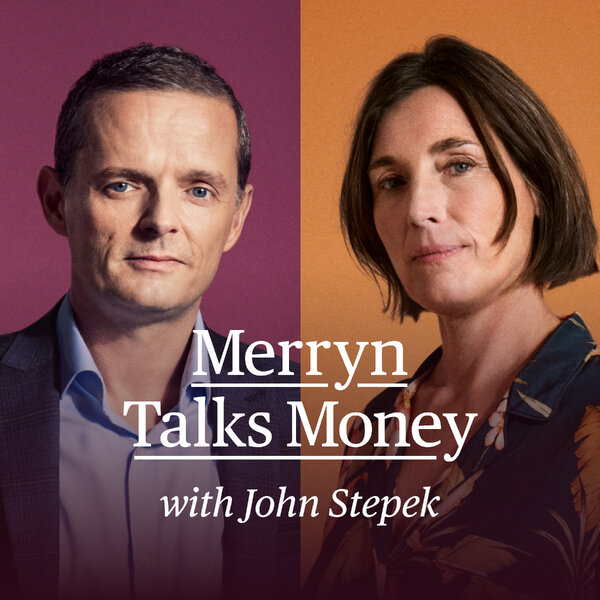

 Merryn Talks Money
2 Oct 2026 · 19m · 7 chapters
A UK-focused markets wrap covering (1) the political fight over the “triple lock” state pension, (2) bond-market implications for UK gilts and yields, and (3) housing market stress and a proposed “Your First Home”/Help-to-Buy-style scheme.
Merrin Somsep Webb (UK money editor at large, host) and John Stevick (senior Bloomberg reporter; author of Money Distilled newsletter).
The triple lock is being “reformed” (not scrapped) to link future state pension growth to average earnings, reducing fiscal cost versus the old trajectory; auto-enrolment means fewer people rely solely on the state pension. Bond markets aren’t alarmed yet, but budget funding and political credibility remain risks; France is a bigger yield driver. Housing policy repeats Help-to-Buy problems: low deposits + equity loans can trap buyers in negative equity; valuations and repayment terms can force repayment above sale price.
State pension share of average earnings rising from ~10% (after 2011) to ~25–30%; flats sold in 2024–25 losing money on purchase (about 45%); equity loan valuation valid for 3 months; example where a £300k valuation with a £280k sale still requires repaying based on £300k.
Written by AI. May contain mistakes.
Discussion on SpaceX's rigorous hiring criteria and culture.
“it's the space exploration dream that draws people to the company, and Musk invokes that dream regularly to remind workers why they're there.”
Exploration of the UK's triple lock pension system and its implications.
“And I'm John Stevick, senior reporter at Bloomberg and author of the Money Distilled newsletter.”
Discussion on potential reforms to the triple lock and their fiscal impact.
“And at the same time, we have introduced an auto-enrollment system, which means that everybody in work has the beginnings of quite a hefty backup in a defined contribution pension.”
Examination of proposals for social care funding and political challenges.
“And there's this vague sense we're going to set up some kind of social care NHS.”
Analysis of market reactions to recent political developments and bond yields.
“Was there anything in Burnham's speech that made you go, oh my goodness, yes, I'm going to rush out and buy those gilts?”
Discussion on how political issues influence bond yields across Europe.
“between the political ambitions and the actual money in the bank that we've got.”
In-depth analysis of the current state and challenges of the housing market.
“Obviously, things are pretty bad in the housing market.”

Get the gist, explore an idea or ask about something said.
 Claude
On Merryn Talks Money, what are the key points of this episode?
Searching your listeningAutomatic transcript. May contain errors.
0:01This is the Bloomberg Tech Minute brought to you by ChachiPT. I'm Carol Masser. Getting hired at SpaceX requires exceptional ability and may include having Elon Musk review a candidate's resume. So writes Bloomberg Businessweek's Lauren Grush. She reports that the company culture is defined by Musk and job candidates must understand that a commitment to SpaceX means adhering to this culture and exhibiting loyalty to Elon Musk. To get hired, candidates must demonstrate their achievements from past jobs, and hands-on experience matters more to recruiters than advanced degrees, with the company looking for people with raw, innate intelligence.
0:39A spokesperson for SpaceX didn't respond to a request for comment on its recruiting and hiring practices, but according to recruiters, advisors, and those who've interviewed for jobs there, it's the space exploration dream that draws people to the company, and Musk invokes that dream regularly to remind workers why they're there. Prospective hires are told that the job will require stamina, including in job ads that candidates, quote, must be willing to work extended hours and weekends as needed. One major perk for all that hard work? Employees' access to equity, either the right to buy shares or payment in the form of restricted stock units that vest over time.
1:16That's the Bloomberg Tech Minute brought to you by ChachiPT. Get started at ChachiPT.com. For big business, AI opened up a world of promise, but that world of promise turned into a world of pain. Cost spiraling, data trapped, security and governance risks multiplying, and ROI out of reach. That's why enterprises turned to Boomi to connect data, apps, and AI, helping them operate securely, efficiently, and at scale. Boomi turns a world of AI pain into a world of AI gain. As Boomi says, we got you. Head to boomi.com. That's B-O-O-M-I dot com.
2:21The Chase Mobile app is available for select mobile devices. Message and data rates may apply. JPMorgan Chase Bank, N.A. Member FDIC. Copyright 2026. JPMorgan Chase and Company.
2:36Bloomberg Audio Studios. Podcasts. Radio. News.
2:51Welcome to the Merrin Talks Money Market Wrap, where we talk about the biggest moves in the markets this week and what is driving them. I am Merrin Somsep Webb, UK money editor at large. And I'm John Stevick, senior reporter at Bloomberg and author of the Money Distilled newsletter. We're not at the Labour conference, are we, John? No, we've been banned. No, we haven't. We just went invited. It's different. I think that's called shadow banning these days. I think I probably was invited to sit on a panel actually about ages ago and I've forgotten. But it's been interesting, right? It's been interesting.
3:23And we're going to talk about that. We're going to talk a little about the bond market. We're going to talk about the triple lock, the triple lock, the triple lock. I mean, there's the little deck chairs and the Titanic fiddling while Rome burns, isn't it? All this relentless fuss about the triple lock. I mean, I believe and have written that the triple lock is about UK pensions. By the way, those of you who are unfortunate not to be living from another country and you don't know about the UK's obsession with our state pension and with the triple lock, the way in which the pension is supposed to every year go up by earnings, inflation, or 2.5%, whichever is the highest, which of course is outrageous.
4:00But our state pension was very low. It's up quite a lot in real terms. And at the same time, we have introduced an auto-enrollment system, which means that everybody in work has the beginnings of quite a hefty backup in a defined contribution pension. So that's the background. The triple lock, there is a view, should no longer exist because it is no longer required. Pensions have gone from the group that most frequently lived in poverty in the UK to the group who least frequently live in poverty in the UK. So there's a case for saying this is insanely expensive. Do you remember in the beginning, it was supposed to only cost 50 million quid or so over however many years now, because billions and billions and billions.
4:40So here's one of the big ideas from our new Prime Minister, Andy Burnham. This big reform to the triple lock, which has probably been the most headline grabbing point that he made. What they're doing is this. The way the triple lock has been set up so far means that the state pension will always rise faster than average earnings over the long term. And so in the long term, what you're going to get is a position where the state pension as a percentage of average earnings keeps climbing. And whenever it first kicked off in 2011, the state pension as a percentage of average earnings, the state pension was still going up with inflation every year, but it kind of collapsed to being about 10 % of average earnings.
5:20Now low after years of the triple lock, it's back to about 25 % or 30 % depending on which average earnings figure you use. The point is, it's back to pretty much the historic high, and it will go towards record levels quite soon. And as I say, you have the auto-enrollment as well, whereas in the old days, you had the state pension, and then some people had a DB. Public sector workers had a defined benefit pension. They still do, by the way. There's a lot of private sector workers. Yeah, and a lot of private sector workers. But if you didn't have a DB, you were reliant almost entirely on the state pension.
5:56So there are an awful lot of people for whom the state pension was it, was all there was. In the future, assuming you've worked and most people will work or most people should work, assuming you've done that, you will have backup in the form of your auto-enrollment. So apart from anything else, the pension's landscape in the UK has changed very dramatically since the days when the state pension was far from adequate. And you could argue it's far from adequate today if you had to live on it alone, but not that many people live on it alone, I hope. You don't have to live on it alone because the point is we've also got a welfare state that picks up after the people who do have to live on it alone.
6:36And so I think I always find this slightly irritating because this constant reference to a group of people who live on the state pension just by itself. And this tends to be made by people who are not in that position. It's a long story short, it'll now just go up with average earnings over the long run. This is sort of being presented as if he's kind of scrapped it in some places. All he's actually done is reform it. And he's actually reformed it in, it might feel politically radical because it has been such an untouchable part of the system for a long time. But fiscally speaking, it is very much the opposite of radical.
7:13It's going to save a little bit of money. and the key thing is the way he's trying to sell this to the population and to pensioners as a whole is by saying that there's also going to be some form of taxpayer funded social care because another big issue in Britain or certainly in England and Wales I know there's different systems elsewhere is that if you get dementia and you have to go into a care home then there's all kinds of worries about how much of your asset base that takes up in terms of paying for it. And there's this vague sense we're going to set up some kind of social care NHS. But the word NHS is a clue there, which means it's going to be a bottomless pit of money.
7:55And reforming the triple lock on the state pension will not raise a bottomless pit of money. It will save, relative to the original trajectory, some billions, but not many. I'm going to pull out a positive here. You ready? Oh, don't. Okay. So let's say that the introduction of the idea that there will be, and apparently this is a passion of Andy Burnham. He has long, his whole life wanted to do something about having a national social care, something like the other. Let's say that he follows through with this, has an election, wins an election, and she does some of the things he says he's going to do.
8:36In order to finance that, you would have to have a new broad base of tax. And one of the problems that you and I talk about on this podcast a lot is that there's a lot of talk in the UK about tax the wealthy more, tax the wealthy more, tax the rich, tax the rich. But the rich already pay a disproportionate amount of most taxes in the UK relative to other developed countries. We're really bad at taxing across the board. So maybe this is a suggestion that can begin to change that dynamic. If we're going to have another national something service, it has to be one that everyone contributes to. And therefore, we can take a step back from constantly loading tax after tax after tax after tax on the small group of people we believe to be the wealthy or the rich and watching them hoist their bags onto their broad shoulders and get on a plane to leave the UK.
9:29Well, I mean, that might be the case. I think the question you then have to ask is, why is Andy Burnham going to be in a position to achieve this politically when it has kind of crashed and burned the careers of various prime ministers beforehand? This is not the first time this issue has come up. And to be fair, when Burnham talks about wanting to have done it for a long time, I think it was the last thing he worked on before the new Labour government kind of obviously got voted out in 2010. this has been going on for ages but it killed off Theresa May because her solution to it was described as a dementia tax even though it would have left everyone with£100 ,000 at their asset base intact Boris Johnson kind of nodded to it with the national insurance add-on that wasn't national insurance it was called the social care contribution or whatever and none of these things has worked so far and I think it is something we need to fix I still don't really understand why we can't have an insurance market for it somehow make that work I don't know if it's because the costs are too high to insure against but even critical illness cover has taken off so I'm sure there must be a way to eventually get an insurance market to work but barring that I don't know what you do Alright so this point we've done anything in fact it didn't do anything to particularly calm the bond markets, no one got particularly upset but no one was particularly impressed either.
10:54Was there anything in Burnham's speech that made you go, oh my goodness, yes, I'm going to rush out and buy those gilts? Simon White, our colleague, put out a piece very quickly there. And the truth is the foreign markets are not especially worried about gilts at the moment relative to the premium they've demanded in the fairly recent past. And now you can say that it's because they approve it, Andy Burnham. I think it's probably more likely because their attention is being distracted by France. at the moment. It's amazing how sometimes you just get in the spotlight and then the spotlight is taken away from you and that can help.
11:30But at the moment, I think, obviously there are big forces pushing up bond yields everywhere and that includes the US, leads everyone, inflation, there are lots of issues with Britain, but none of them have got particularly worse. So I think at the moment, nobody's overtly worrying about Britain relative to other countries. but obviously we've got the budget coming up they can't relax over that and it's still not very clear how they're going to fund all of these ambitions that they've got and it's still not entirely clear either to me that they're not going to go for some sort of earlier election to get the sign off and all that because the other thing about the speech is he kept talking about 2030 so that's after the next election so again he's sort of saying this is what I want to do but I can't do it just now because the current manifesto has tied my hands and the only solution to that is right well get rid of the current manifesto by having an election and I'm still not convinced that despite his denials that's not what he's going to end up doing and if there was an election it would have to be quite soon if he wanted to get started in any of these things.
12:43Yeah you would think if that's what they decide to do it's kind of got to be 2027 and I don't see why you would leave it till later than that but we'll see Trying to think of something else optimistic to say about the I mean the I mean the guilt there are a lot of people quite clever people now saying that bonds generally are attractive enough to be putting some money into Jim Bianco who's a US commentator but somebody who's very kind of downbeat on bonds this week tweeted out that he thought treasuries offered a big enough yield here to stick money in and it was like a nice cushion. Obviously, the US is very different.
13:30Yeah, but he was talking about treasury yields. He's not diving into France, is he? No, no, I don't think anyone's particularly diving into France. I do think France stands out. And to be fair, it is the politics there. And I think that's why we can't relax here because we might have this brief period where markets have decided that the Burnham government isn't going to rock the boat, but there are still lots of wild cards and all the rest of it that could come out. And at some point, we're going to have to marry up this gap between the political ambitions and the actual money in the bank that we've got.
14:08And I don't really see how those two can't be married up without some sort of collision with either taxpayers or the bond market. But at the moment, we're not in the spotlight. Whereas France, obviously, they've got two people who are going to win the presidency next year. And one of them has said he's going to burn a load at French bonds. And the other one has sort of expressed some concern about the fiscal situation, but also wants to lower the pension age from its already ridiculously low French level. So you can see why everyone's a bit more worried about France than they are anywhere else.
14:41Yeah, but I think the same thing holds for all of these countries, which is that bond yields won't fix themselves until politics is fixed. Yeah. And we've got rubbish politics. I mean, every country suffering from high bond yields that are not related to great economic growth suffers from horrible politics and politicians that will not confront their fiscal problems. So you're not going to see a proper turnaround until you see either superbly fast growth across Europe, not holding my breath, or politicians who will genuinely confront their problems. And one of the things that Andy Burnham keeps saying is that he will make difficult decisions.
15:16But so far, as I say in the speech, all I heard was not I will make difficult decisions, but I will make some decisions at another time. Which is different. So make all these decisions in 2030. Yeah.
15:35This is the Bloomberg Tech Minute brought to you by Chachi PT. I'm Carol Masser. Getting hired at SpaceX requires exceptional ability and may include having Elon Musk review a candidate's resume. So writes Bloomberg Businessweek's Lauren Grush. She reports that the company culture is defined by Musk and job candidates must understand that a commitment to SpaceX means adhering to this culture and exhibiting loyalty to Elon Musk. To get hired, candidates must demonstrate their achievements from past jobs and hands-on experience matters more to recruiters than advanced degrees. with the company looking for people with raw, innate intelligence.
16:13A spokesperson for SpaceX didn't respond to a request for comment on its recruiting and hiring practices. But according to recruiters, advisors, and those who've interviewed for jobs there, it's the space exploration dream that draws people to the company. And Musk invokes that dream regularly to remind workers why they're there. Prospective hires are told that the job will require stamina, including in job ads that candidates, quote, must be willing to work extended hours and weekends as needed. One major perk for all that hard work? Employees' access to equity, either the right to buy shares or payment in the form of restricted stock units that vest over time.
16:51That's the Bloomberg Tech Minute brought to you by ChatGPT. Get started at chatgpt.com. Quick question for you. How much of your day is spent typing? Email, Slack, notes, prompts to ChatGPT? Whisperflow is a voice to text app. Instead of typing, you talk and it types for you in any app on your Mac, Windows, iPhone, or Android. It takes out the ums, fixes the typos, and the result sounds like you wrote it four times faster than typing. So the email that used to take two minutes now takes 30 seconds. Whisperflow is free. Download it at whisperflow.ai. That's W-I-S-P-R flow dot A-I. Running a small business takes everything you've got, but with Chase for Business, you're not alone.
17:33They bring together local support and a broad range of resources to more than 7 million customers. With a deep understanding of your day to day needs, they provide products and guidance built to help you thrive. Right now, earn$500 when you open a new Chase Business Complete Checking account for new business checking customers with qualifying activities. Offer expires January 21st, 2027. Chase Business Complete Checking has the flexible tools you need to accept payments, make deposits, and manage your finances with confidence. Learn more at chase.com slash podcast biz offer. Chase, make more of what's yours.
18:08Fees may apply to Chase Business Complete Checking Accounts. The$500 offer is available for new business checking accounts with qualifying activities through 1-21-2027. Eligibility and qualification requirements must be met. Additional restrictions may apply. Please speak with a business banker for more information. JPMorgan Chase Bank, N.A., member FDIC. Your team is on a deadline, but moving all your enterprise data will take time your business simply doesn't have. IBM technology lets AI work with your data where it already lives, with an open hybrid cloud approach designed to build on your existing investments.
18:46It's another way IBM helps you put your data to work. Let's create smarter business. IBM. Visit ibm.com to learn more.
19:02Okay, John, the other thing that I find it hard to feel optimistic about is the housing market. Obviously, things are pretty bad in the housing market. We hear endlessly from people who can't sell their houses at the price they bought it for, let alone anything more, and prices are being cut and cut again. And the statistics tell us that volumes are falling, that prices are falling. and into this comes the something must be done group who are putting in place another help to buy system. Now, last time I felt it was an absolute disaster. I think you agreed with me. What makes this time different?
19:34Well, nothing. I think it's just something that's easy to do. So they're launching something called Your First Home, which is just help to buy again. And we've not got the full details yet. They'll come out in the budget. but the idea is you can have a 2.5 % deposit and the taxpayer will back it up with a 20 % equity loan. So basically you can buy a house with a 22.5 % deposit and that means you can access probably a cheaper mortgage but also I guess probably more importantly from the government's point of view it might incentivise the builders to actually start building some more flats. At least they hope that will happen.
20:12I can't, it's not really convincing given the backdrop, I must admit. But it's basically, it's very similar to the last one. And that's also why it's worrying, because if you look at the statistics, they've actually got quite a lot of quite specific statistics for the numbers on help to buy. And of the flats, specifically flats, flats are the ones that lose money. The houses have actually not been too bad. But the flats, roughly, I think, 45 % of the ones that were sold in 2024, 2025 fiscal year lost money on their original purchase price. But you automatically lose money on your original purchase price.
20:53Exactly. The only way you can make money on a new build is in an absolutely storming build market. Because the second you buy a new flat, it becomes a secondhand flat. And I don't know if their numbers have been updated, but last time around, the number was 16 % on average. Second, you pick up those keys, turn the keys in the door, you have lost 16 % of the money that you paid for that apartment or that house. That's just how it is. So unless there's a massive bull market, you buy, you lose. Yeah. Yeah, and I mean, I think this is the problem. Because obviously, if you sell at a loss whenever you only had a 2.5 % deposit in the first place, I mean, all right, if you've been in there for a couple of years, it might have grown a bit.
21:38It's not going to be enough to offset, you know, thousands of pounds of loss. So you are... Trapped. Yeah, especially the ones that bought in the 2020s are now looking at negative equity. And that does mean that you're stuck, particularly if you haven't paid off the loan. because the other issue with the equity loan is obviously if you sell, you're going to have to repay the government. There's a couple of really sticky things there. For the start, you have to get an independent valuation from BRICS. Nothing wrong with that, but it only lasts for three months. And if you look at how long sales are taking at the moment, I can see you easily having to go back for another two valuations before you actually get rid of the house.
22:16and more another kind of problem is that the valuation is then what the equity loan demands back so if it gets valued at say 300 000 pounds but you sell for 280 000 you are still gonna have to pay back your equity loan based on the 300 000 valuation price no yep yep it's pretty bad isn't it so you could end up having to pay the government more than the percentage of the actual sales price because it's based on the valuation um so no i i think is it would be it's not a great deal at any time but during a rampant bull market for property like the reason the 2013 one wasn't so bad is because mortgage finance was really tight probably too tight following the financial crisis and also not much stuff was getting built but it was a lot of pent up you know pent up demands a terrible word but you know the builders were were going to build stuff um and there was their balance sheets were looking better and all that sort of stuff whereas now we're kind of like at the tail ends you know or actually we're quite quite the way into a real terms correction and it's hard to see why A.
23:33anyone would buy into this market and B. why anyone would still want to build into this market I mean as far as the house building stocks go I do think it's a lot they like it and I think it is a catalyst I think it also shows that they're politically favoured still oh to be in a politically favoured group would you like to be in a politically favoured group I think it would be marvellous I think we better leave it there We had better leave it there.
24:30you know a lot of time to spend thinking about what's next. The next opportunity. The next investment. The next move. But sometimes what matters most is being ready for what you never saw coming. For more than 75 years, Cincinnati Insurance has worked with independent agents to help protect businesses, homes, valuables, and more. Because planning for the future isn't only about knowing what's next. It's about making sure you're ready for what you can't predict. Let Cincinnati insurance make your bad day better. Find an independent agent at CINFIN.com. For big business, AI opened up a world of promise, but that world of promise turned into a world of pain.
25:11Cost spiraling, data trapped, security and governance risks multiplying, and ROI out of reach. That's why enterprises turned to Boomi to connect data, apps, and AI, helping them operate securely, efficiently, and at scale. Boomi turns a world of AI pain into a world of AI gain. As Boomi says, we got you. Head to boomi.com. That's B-O-O-M-I dot com. The world of business is constantly evolving, and Comcast Business keeps you totally in step with secure AI-backed networking in more than 100 countries. They're powering over 90 % of the Fortune 500 and millions of small businesses. That's a lot of muscle.
25:52And behind it all, thousands of experts answering your call at 2 a.m. like it's 2 p.m. One partner powering how business gets done for companies around the globe. When you add it all up, no one does business like Comcast Business. Quick question for you. How much of your day is spent typing? Email, Slack, notes, prompts to chat GPT? Whisperflow is a voice-to-text app. Instead of typing, you talk and it types for you in any app on your Mac, Windows, iPhone, or Android. It takes out the ums, fixes the typos, and the result sounds like you wrote it, four times faster than typing. So the email that used to take two minutes now takes 30 seconds.
26:30Whisperflow is free. Download it at whisperflow.ai. That's W-I-S-P-R flow dot A-I.
Fresh off the party conference, the Labour government is promising pension reform, a new approach to social care and yet another scheme to help first-time buyers. Merryn Somerset Webb and John Stepek ask whether the sums add up, what the bond market is making of it all — and why the latest Help to Buy plan could leave some buyers worse off.
See omnystudio.com/listener for privacy information.