
In short
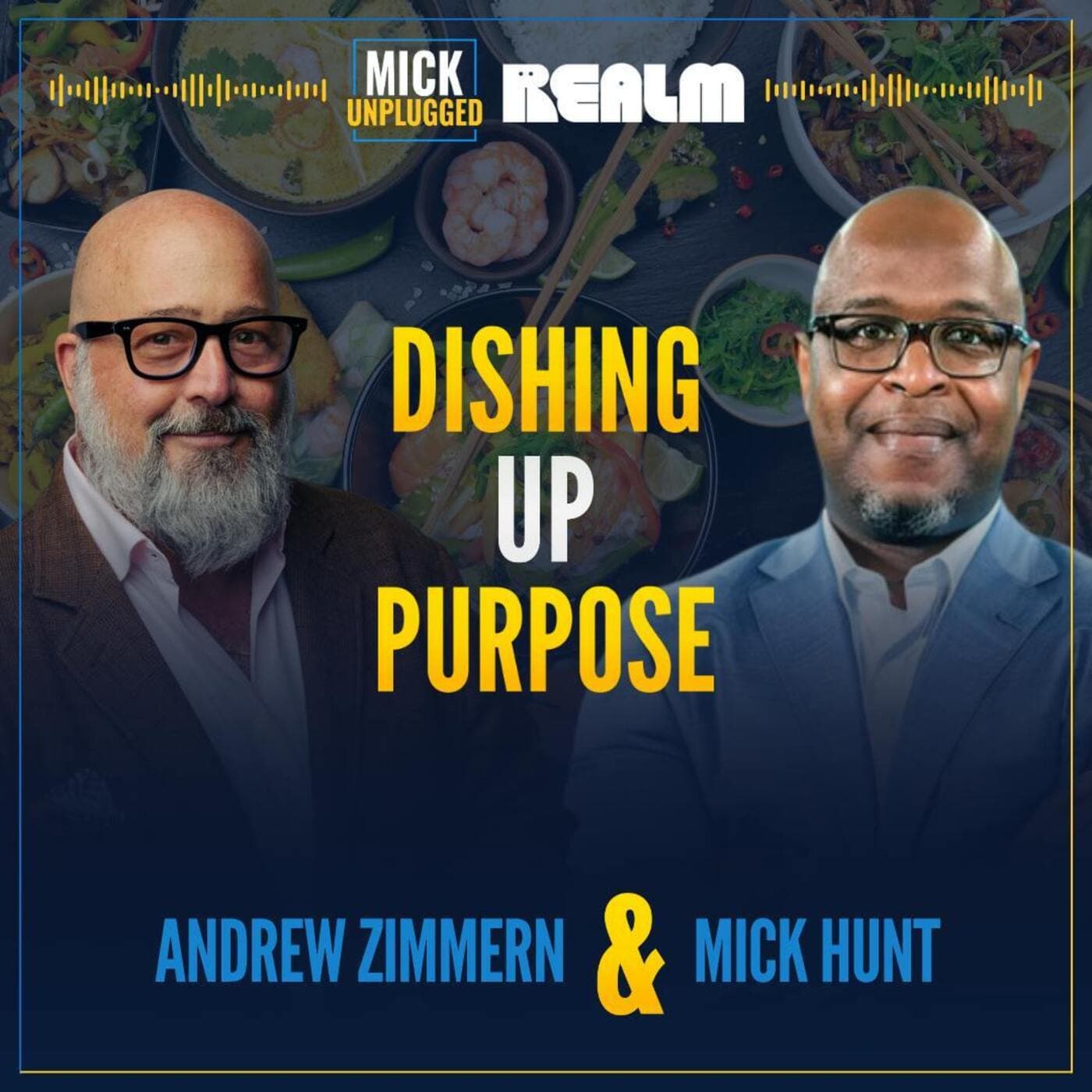
Podcast Episode Summary: Mick Unplugged - Breaking Bread and Barriers with Andrew Zimmern
Overview In this episode of Mick Unplugged, host Mick Hunt engages in a deep conversation with Andrew Zimmern, an Emmy-winning TV host and renowned chef. The episode explores themes of food as a universal connector, the importance of purpose-driven passion, and sustainable eating practices.
Guest Introduction Andrew Zimmern is celebrated for his adventurous culinary explorations on the show "Bizarre Foods." He is also recognized for advocating for food as a means to address hunger and connect cultures globally.
Key Takeaways
Food as a Universal Language
- Healing and Connection: Zimmern emphasizes that sharing a meal can heal and connect people, transcending cultural and social barriers.
- Humanity in Sharing: The act of eating together highlights our shared human experiences, regardless of backgrounds.
Purpose-Driven Passion
- Personal Journey: Zimmern discusses his own "because," rooted in a desire to give back, overcome past challenges, and maintain curiosity about the world.
- Relentless Curiosity: His drive to share stories and experiences is fueled by a commitment to making a positive impact.
Sustainable Eating
- Blue Food Cookbook: Zimmern introduces his new cookbook that focuses on sustainable seafood options.
- Advocates for diversifying diets with ocean-derived foods to combat hunger and climate change.
- Connects the concept of sustainable eating to global issues such as food security and environmental conservation.
Sound Bites
- “If we diversify our diets, we can save this planet. We can save families.”
- “Co-regulating with human beings before operationalizing with them is the most crucial thing that you can do.”
- “Sharing food is a neutral ground over which we can communicate with each other, and it has immense value.”
Discussion Highlights Andrew Zimmern's Early Influences
- Zimmern shares anecdotes from his childhood that shaped his culinary adventures and his approach to food, illustrating how early experiences with diverse cuisines fostered his lifelong passion.
The Importance of Balance
- Both Zimmern and Hunt discuss the challenges of balancing professional demands with personal relationships, emphasizing the need for co-regulation in interpersonal communications.
Storytelling Through Food
- Zimmern reflects on how food stories create connections and allow for understanding beyond cultural differences. His experiences include sharing meals with diverse communities, highlighting common ground between people.
Conclusion This episode of Mick Unplugged provides insights into how food can serve as a bridge between cultures, the importance of leading with purpose, and actionable strategies for sustainable living. Zimmern's passion for food and storytelling is evident, making this episode a potent reminder of the impact that culinary experiences can have on society.
Connect with Andrew Zimmern
- Website: [andrewzimmern.com](http://andrewzimmern.com/)
- Instagram: [@chefaz](https://www.instagram.com/chefaz/)
- Facebook: [@AndrewZimmern](https://www.facebook.com/AndrewZimmern)
- YouTube: [@andrewzimmerndotcom](https://www.youtube.com/user/andrewzimmerndotcom)
- Book: [The Blue Food Cookbook](https://a.co/d/egObPU8)
Additional Resources
- Mick Hunt's Book: "How to Be a Good Leader When You’ve Never Had One: The Blueprint for Modern Leadership" available on [Amazon](https://a.co/d/2wwLDE8), [Barnes & Noble](https://www.barnesandnoble.com/w/how-to-be-a-good-leader-when-youve-never-had-one-mick-hunt/1146931848?ean=9781394357956%20), and [Books A Million](https://www.booksamillion.com/p/How-Be-Good-Leader-Youve/Mick-Hunt/9781394357956).
Final Thoughts Listeners are encouraged to reflect on their own “because” and to harness this understanding to drive meaningful change in their lives and communities.
Written by AI. May contain mistakes. Listen to the episode to check what was said.
Transcript
Automatic transcript. May contain errors.0:00My advice for entrepreneurs is definitely to level up with Shopify. The platform is just never a worry. Like I have so many worries, but the platform is never one. I feel like Shopify really thinks about how they can optimize. It just always feels very ahead of the curve. Everything is just super easy to connect and link. They really know what we need. Time and money that is saved. I can spend on other things and on growth. Start your free trial at Shopify.com. Ladies and gentlemen, one of the coolest episodes I've ever done is this episode that you're about to listen to with Emmy-winning TV host, James Beard-nominated and winning chef, Andrew Zimmer.
0:42We're gonna talk through a lot of things and maybe not all the things that you actually think of when we talk about a chef. We're gonna talk about life. We're gonna talk about food as a healer. Absolutely. Make sure you listen to this entire episode because we're gonna give you the goods. If you're into food, if you're into life, if you're into wanting to be healed, this episode is for you. Ladies and gentlemen, I present Mr. Andrew Zimmer. Andrew, how are you doing today, brother? Good, Mick. How are you? I am awesome, man. I have been a huge fan of you for a long time. You know, I called it bizarre foods in the intro, but just, you know, foods that the everyday person like me wouldn't think that, oh, yeah, I'm going to go eat that.
1:23I'm going to go prepare that. When did you know that was a thing for you? The day magically that they told me that my travel food idea that I had finally gotten into the boardroom to pitch at Travel Channel in 2004 was a PBS show and not a commercial television show. And I had this idea called The Wandering Spoon, worst name for a food travel TV show of all time. And what I did was I wanted to, you know, teach the world about diving into other cultures through food. There was at the time, unbeknownst to me, because you have to remember, we're pushing our show 2002, three, four, five. Tony had yet to, Anthony Bourdain had yet to make Cook's Tour, which was on Food Network that got bought by Travel Channel.
2:19And they basically re-aired what didn't work on Food Network and renamed the show No Reservations and moved forward with that show that became so legendary. there was a huge part of my life where looking in the rearview mirror, I was eating whatever it was that was in that place. When I was seven years old in Spain with my dad, I ate angulas baby eels And we ate whole roasted partridge, red-legged partridge in Asturias together in little restaurants. And they were shot by a hunter. You had to be careful of eating any shotgun pellets. And then there was a tiny little resting cradle, looked like a chopstick rest.
3:16And there was a heavy knife there. And the idea was you would flip it around and use the handle and crack the skull and eat the brain. And, you know, this was something that was just been traditionally done for ever and ever there. You know, I was a little kid. I was eating bigorneau, little French periwinkle snails in Léa with my father when I was five. baby i mean literally two days you know past being fetal lamb and and pig in valley de los caedos uh in spain with my dad you can't just roll past that like just a few days past birth it's the most delicious you know that it's a single portion right you get a whole one yourself but the the first six eight nine weeks it varies between hoofed animal species before they go on to grass, when they're just eating mother's milk, that's it.
4:16The animal is at its tastiest. It's at its most delicious, regardless of what animal it is. It's why when I'm in Vietnam, Cambodia, Thailand, I love being out in the jungle markets and villages where they're taking tiny little birds, often little ducks or chicks, and dipping them and boiling water, removing all the feathers and deep frying them whole. And then you just eat them with a little bit of, of Nwak Chom and, and you eat the whole thing, except the beak. When birds hoofed animals, and so the first couple of weeks of life, they are at their, at their most delicious. But the point is, is that I didn't think there was anything of it.
5:02My father was the kind of person who was like, you know, when in Rome, what the Romans eat, right? So flash ahead to 2004, five, I'm pushing this show and about travel and they, they rejected it, but they let me come back the next day to repitch it because they, they said, look, if you can reverse this, give us 75 % entertainment instead of 75 % education in this show, we think we can do something with that. And so I came back the next day. I didn't have a clue in the world. And lucky for me, instead of them saying, have you thought about it? What's your idea? In which case I would have said I have nothing.
5:45pat young the head of travel channel threw me a laser pointer hit a button a map of the world came up on the wall in the discovery boardroom there were 20 different executives there at the time and me alone at the other end and he said take me through episode one and then season one and I just saw all I saw because I was standing on the North American side of the map and I could see the Philippines straight ahead of me. I just hit the laser pointer. I said, well, we would go to the Philippines and try Balut, which is a fertilized duck egg. And then I just made my way around the world and I realized I was about two, three examples in, I realized I had mentioned foods that for those people in the room were new.
6:43They hadn't heard of them. And they were exotic and different and unique. And I was getting quite a reaction from them. And the only thing, one of the few smart things I've ever done in my whole life was I read that room the right way. And I just kept going and I put the pointer down. And I think I'd named 30 foods in 30 countries and they were like, okay, go find a production company and let's make this show. And the rest is they say is history. The rest is history. And so that was 2004. And one of the reasons I adore you so much, Andrew, is just that passion, that energy, that creativity. It's like, it continues to evolve, right?
7:30Like you're, you're never stale, no, no pun intended from a food standpoint, right? But like you're always fresh, you're always palatable. And so I wanted to ask you what I ask all my guests, like what's your because? What's your purpose? What's that deeper thing that's deeper than your why for you to continue to do the things that you do? Because I'm going to say what Andrew won't say. You've accomplished so much, brother. You've accomplished a lot that if you wanted to, you could say, all right, I'm good. But you continue to do. What's your because? Because I spent 10, 12, 14 years being a user of people and a taker of things, because I owe the world a debt that I don't think I can ever repay, because I have such a lack of self-appreciation.
8:33I guess that I continue to want to do more because I'm endlessly curious. And so there's always something that I want to put out there in the world. Another story, another idea, another way of looking at something to try to make the world a better place. And I don't say that in a Pollyanna sense. I mean that really seriously. I believe, as I did when I created Bizarre Foods, that if we diversify our diets, we can save this planet. We can save families. We can lower prices on food. We can – I mean, you just look at what's going on in the supermarket today. The reason meat prices and seafood prices are so high is that we eat like four things, and that's it.
9:25And when you put all your eggs in one basket and that basket hits the ground, some eggs are going to break. And that's why ground beef is, which America literally lives on as a nation, is almost$10 a pound. And I would argue that, you know, fish raised in the aquaculture situation, if it if it received the investment it deserves, which is not that much more because it's almost been perfected, is would would be able to feed an ever increasingly in hungry planet cheaper and more effectively. And, you know, I got a lot of because's right. Right. And, you know, maybe I like solving global problems because I don't want to turn the mirror around and solve my own.
10:15It has been I'm not proud of it. I just I learned a long time ago to answer a question, honestly. And I think it's way more interesting for people to hear because I think there's more people out there who can relate to a human being who screws a lot of stuff up. relationships, fatherhood. I mean, I make a ton of mistakes every single day and I'm constantly trying to evaluate it before I go to bed at night and try to get better. And one of the places that I can both simultaneously hide and make a difference is at work. And so I keep doing what I'm doing. And I, I just, I don't know. There's, you know, I want to keep working.
11:05I want to die in the saddle. I mean, I don't, I have no interest in stopping and going off and playing golf and all the rest of that kind of stuff. I'd like to spend more time with my friends. I'd like to spend more time with my family. I'd like to do a couple other little things in there. So do I want to keep going 90 miles an hour? No, I don't think that's sustainable. But I'm going to go down to 50 or 60, whatever the speed limit is, and just keep cruising along. You know, I want to go there, man, because, again, I'm getting therapy from you by having this conversation. I run hard, right? I mean, I'm and you get it.
11:52I don't have to explain that to you. You've got a lot of velocity in your life, just like me. How do you find that balance? Because I try to make sure, and I hate saying the word try. I usually don't have that in my vocabulary. I put importance on making sure I give people time, even though I'm running hard. But what people don't see is there are moments where I just need to exist just by myself. Right. But you have to be committed to be the best parent, the best husband, the best friend that you can be all while still running at 150 miles an hour. How do you balance that? Because I need help.
12:38And this is me being honest. I need help. I'm in the same. Well, well, they were really screwed because I was hoping you'd help me with that when you were starting that last sentence. The I don't know because I struggle. I mean, I had a friend text me the other day that who told me that I had gotten lousy at responding to texts fast enough. And he wasn't talking about immediately. He said, like, you know, you know, I'm one of your two or three best friends. What's the, you know, within a day, you get back to me I'm asking you about important stuff about your your your kid your relationship you know whatever it is I mean and and I didn't and I know that my son needs more time from his father and I know that in my primary relationships be they at work or at home need more time from me but I'm a mile long and a quarter inch deep.
13:36And I want to get, I was, I use a football metaphor here. I no longer want to have a spread offense and be a wide receiver all the way at the end. I'd rather be an interior lineman at this point. I need to, I need to be an inch deep and a quarter mile long. And so that's my goal. How I get there is with legitimate action steps. I think, and it's never one thing. I had a behavioral scientist who I was talking to at a conference about 15 years ago say something that I've never forgotten. he he said he said in any human dilemma where you have choice because a problem exists the solution to the problem and the cause of the problem is never one thing he said as human beings we tend to look at it one way right oh mix background on his on our recording is is dark and mine is light.
14:47That's a problem. You know, like that's, that's the reason I'm having a bad day or where we want to pick one thing. He said, in fact, it's usually eight, nine, or 10 things that when taken together, either pile up on each other, or in some cases, relationships, business, can many of them can be intertwined. And so you really have to separate them and, and, and use what he called astronaut logic, which we've all heard of before, one task at a time in sequence. And so unraveling that and attacking that is what I try to do more of every single day. It's just tough, especially when dad's job takes him away.
15:30Right. And I'm not around the people in my life. And I'm going, you know, because primarily what I do is television, even though I'm shooting fewer days a year than I used to. I have a lot of days where from seven in the morning to seven at night, that phone is off. Right. And so I'm not around to answer tests. Then I get home and I'm exhausted or back to the hotel room. I just want to watch the football game or two episodes of whatever show I'm binging or whatever it is to relax because I need my me time. And, you know, we all hear about take care of yourself, put your own oxygen mask on first.
16:06So I rationalize not responding to solving the problems at hand in my life, even the little small ones. I've learned I'm better off handling those smaller problems. I'm less weary. I'm less world weary when I do that. The other thing that I've learned recently that I think is really fascinating, and I talk a lot about this when I'm giving talks in the wellness space. I, you know, schools, universities, conclaves, gatherings of any type will call my lectern agent. And they're just as likely to have me talk about wellness as they are to have me talk about travel and food. Just because I spent a lot of time in this space and long term sober and fascinated about creating better human beings, starting with myself.
17:03And I have found that the greatest tool for helping my, which is why I answered your question, honestly, at the very outset, is co-regulating with human beings before operationalizing with them is the most crucial thing that you can do. and I just had a friend in my office who I haven't seen in a decade and I rang him up and he's in the coffee business and I'm trying to work on a coffee project for a client and so he came here and as he's leaving he said I'll ask you this question he said my daughter's a teenager she's having her first party at our house how many people is a good number you know you're a dad your kids are older how many is a good number to have over and i said well you're turned it around what you should do is you should ask her what's a good number and then you should ask her why that's a good number and then you should ask her what she wants evening to look like and you should just keep asking questions until you don't have anymore let her tell you everything before you respond then you can tell her how that makes you feel, right?
18:17That you will then be co-regulated. She's told you, you've told her, and then you can say, so what do you think now? You know, like, because maybe one of your concerns is too many people would, for a first party might be, not dangerous, but, you know, put too many people at risk. She's only 15. You don't need 40 people there. Maybe 20 is a good number. Maybe that's better for economic reasons, whatever it is, But co-regulating before operationalizing allows you to connect with people on a very meaningful, direct way, almost literally in real time, very, very, very immediately. And I have found that to be of infinite value as I navigate my way through life.
19:05Good stuff. Good stuff. Ladies and gentlemen, you didn't know you were getting life lessons from Andrew, but that's what we're here for. And in part of this, Andrew, you know, I said it in the opener again. You're one of the greatest storytellers that I've ever seen. And to me, that's an art. Like, I know the culinary art that you have and the passion that you have. You're also an amazing storyteller. And I've heard you say many times that food is like a universal language, right? In Andrew's way, can you give us an example of how you've seen food heal or comfort or bring people together? Does the story come to mind?
19:47Well, sure. I mean, I've got millions of them. I do think the concept deserves a moment or two of illumination. We we only we only do several things all the time. And one of them is eat. Now, not everyone in America in 2025 has a food life. We have to be very careful about that. It's one of the other things that drives me. It's another because. Right. I've I've made a lot of money off of food. I have a lot of success because of food. I have made an impact because of food. And yet I'm also part of the problem because I fetishize food while 20 percent of Americans don't know where their next meal is coming from.
20:39So I work really hard to try to solve hunger and waste issues here in Minnesota, nationally in America and internationally with my work with the UN World Food Program. um but because we do this every day food is a universal right so i'll give you a couple very general examples perhaps from shows people have seen in every episode of bizarre foods we always had a family meal every single one we didn't put a circle around it we didn't put a lower third graphic underneath it we didn't flash lights to let everybody know here's the family meal but we always sat down with the family in every single episode in eight and the reason why i insisted on that along with several other storytelling silos i wanted a how it was made story i wanted to because i wanted there to be something for everyone to take from this experience in this culture.
21:42And we always had a family dinner episode because I wanted people in Finland to see how people in China ate. And I wanted people in Uruguay to see how people in China ate. And I wanted people in Arizona to see how people in Uruguay ate. And I did that very consciously because I wanted people to see how much they had in common with each other in a world that was increasingly defining itself by the things that divided us. So even though I may speak a different language, have different color skin, worship a different deity, listen to different music, have different sexuality, and on and on and on than whoever I was with, if we were sharing a meal, amazing things could happen, right?
22:34And we would find out that we wound up having way more in common, even though on the face of it, it may appear that we were very, very different people from very, very different walks of life. Yeah. I believe our humanity in the general sense of the capital H is what defines us, not all of those, those other things. And I remember being in Finland, we went up to Lapland and we were having a dinner with some reindeer herders and his family. And we did the usual thing, you know, shots of the reindeer, and I was milking a reindeer, which is very difficult. They give off the richest milk in the animal kingdom, but they give off the least of it because it's so intense.
23:19And then we made little pancakes with it, and we foraged for berries, and we gathered crayfish in the river. And then we wound up at his family table with his wife and her parents and they're uh he and his wife's kids and there's like eight of us at the table and me and we we edited it but in before when we were there live yeah it was it the what comes off as a minute in the show took two hours right and we're sitting there it always does and we're sitting there with this family and the grandmother is, is looking at the kids, you know, with this look very stern and opening up her eyes and kind of turning away from me and like using her head, kind of like a woodpecker at them.
24:10And I look over at the kids and they're getting fidgety and, you know, they're like six and eight. Right. And they've got to sit at this table for two hours. No kid can do that anywhere on planet earth I've watched. And, you know, it is, that's something every parent around the world can relate to. And then they were, I could hear the mom whispering to the kids across the table. I did not speak their dialect at all. Right. And in fact, in this part of finland they don't even speak the language that the people in helsinki speak yeah they have their own diversion of of finnish and i don't speak a word of it but i understood everything that she was saying she was saying i told you i'd give you that candy and cookies when you got you just have to be nice while the the strange people from the other part of the world are gone they're just you know and and and you know you promised me so just sit on your hands try to be quiet you and your sister can whisper to each other you know i because that's what i would say to my kids right and so i didn't need to know the language right so we are universally humanized by that experience.
25:40I was, and so were they, because I didn't react to them, right? I just let them do what they wanted to do. I didn't lean over and say, it's okay or anything like that. I just let it happen. I'm just there to experience their life. I don't want to impact it. I don't want to ruin anything magical that might happen on the TV. Once we start eating and the kids are eating, they're occupied and we're telling jokes and things are being translated because the dad spoke English. Right. And which is why we cast this family. And all of a sudden, the kids are kind of liking me. Right. And so what starts off as an awkward, fidgety, awful thing, even grandma started to think that I was an amusing fellow.
26:34Now, this is a very simple, basic example of how our shared humanity is so much bigger than the things that you would think might divide us, right? I would go all the way to a glass of juice that I had with one of the world's most famous terrorists who lives in seclusion in Jericho with Israeli tanks on a hill trained at his house. We did a story in one of our shows about a woman's couscous cooperative in Jericho. There are no men that live in this little village on the outskirts of Jericho. They all are either dead or off fighting jihad somewhere. The women, it's a patriarchal society. The women decided, screw this.
27:29We need a clinic. We need a library. We need a school, right? So several of the women got together and said, we're going to hand roll couscous, dry it, and sell it. It's an exquisite, beautiful product. And through the sale of this product throughout the Arab world, and it's even imported here into this country, at least it was, we're able to fund the school, the library, the clinic, and improve the lives of all the people in this village outside of Jericho. So we spent all day shooting the scene. It was unbelievable. I rolled couscous with them. Then they all cook lunch together, eat lunch, and then they go home because they do the work early in the morning and end about noon when the heat of the day just gets too hot at that time of year.
28:21the woman turns to us the person who was really the driving force that started this whole thing and says would you come home to my house my husband would like to meet you we said sure as we're getting into the vans several of our security details said to me do you know who her husband is i said i have no idea uh and she said her husband is i think it was abu abbas He was the head of the PLO's propaganda machine when Arafat was in power. He was the person, famously, for people who are a little bit older and remember these sort of things in the news, and I think it was in the late 70s or early 80s, Mossad, the Israeli intelligence agency, put a bomb inside a book that he opened and it failed.
29:20All of the explosives didn't go off. So he lived, but the gunpowder streaked his face with streaks of gray and black into his skin. And the Israelis had found him, confined him to house arrest, hence the tanks on the hill. and I was very eager to meet him and talk to him. And I say this as someone who I, I mean, I'm Jewish and in the entertainment business in America. I mean, I'm exactly what this guy has spent his life, you know, rallying against. And, but I was eager to meet him because I wanted to see what he was all about. I wanted to ask him, what's up with all the, why all the hate, dude?
30:06You know, and I know that sounds really flippant, But, you know, I wanted in my own way to see what was I never had an opportunity to do that. And like I said, I'm endlessly curious. So we go to the house. We have some mango juice. He's very polite. He says, I'd love to show you my office. We all go down. By the way, cameras are rolling. We go down to his office and on his office, just like, you know, on my wall, I have pictures of my friends. There's a picture of him with every famous terrorist there is, you know. And when I say every, I mean every. And I was stunned. It gave me chills. And I sat there.
30:48His daughter, this was like his third marriage, his wife. He was in his probably 70s. His current wife was in her 40s. They had a five-year-old playing on the ground. And I said to him, and I said, forget about you and me. But shouldn't your daughter and my son be able to live together in peace and harmony? Don't we want that at the end of the day? And he just looked at me as he sipped his juice. And I mean, very matter-of-factly, he neither was smiling nor scowling. Very neutrally, he just said, my daughter's daughter's daughter will bathe in the blood of your son's children's children and sipped his juice.
31:38And I looked at him and I said, you really believe that? He said, yes, I yes, I do. He says, that's that's our commitment. He was filled with so much hate and so much rage that that's all he saw as an outcome. And I thanked him for his hospitality and we left. Now, I didn't I already didn't like him and his peers going in. Right. But I was I was in his home and a lot of friends of mine were like, why would you even go to his home? I said, I needed to hear it out of his mouth. Was he really that filled with hate? Was he really that? Was he really living out these thousands of years of history and refusing to let go of any other outcome?
32:27And in fact, this gentleman was. And yet there was, and I mean this in the most serious way, I understood him and his people who also believe this 1 % more, 2 % more. I didn't agree with it, but I understood it more. And so at the end of the day, whether it's with a family in Lapland crushing crayfish and eating little blueberry pancakes made with reindeer milk or having juice with an internationally known terrorist. Sharing food is a neutral ground over which we can communicate with each other. And it has immense value. Now, I happen to find more immense value when I bring neighbors, friends, and loved ones together to celebrate, to take a respite from how hard the world is.
33:25I enjoy it more when I'm visiting you wherever you live and we connect and you take me out to a restaurant I've never been to before and we laugh. And I realize, geez, I've never met this guy. Look at how much I have in Kai. I thought we were just bald dudes with glasses. It turns out like we're living the same life, right? There you go. This is the beauty. This is the beauty of our time that's here on planet Earth. And I think the dining table, metaphorically speaking, is the best place to put aside grievances and share with people. I did it so often that I proposed to the production company that we shoot a show called Dinner with the Dictator because I thought, you know, you see all these news guys.
34:11and anchor women and everyone is going in to talk to some international narco-terrorist or some evil, you know, autocrat in some faraway country. And they get the big interview and they ask them all about international geopolitical matters and stuff like that. And a lot of people, frankly, tune out. And I'm sitting there talking to this guy about his kid and his office and the pictures. And when was this day? We're just two dudes, you know. shooting the crap, you know, until I wanted to ask him the big question that I was most curious about. And I think that when you say I'm such a good storyteller, thank you.
Read the full transcript
34:52I take that as a high compliment from someone like yourself who pays attention to this stuff. I find that I have a really good editor. That's number one. Most importantly, anyone who's in my kind of media, we have great editors, right? But I also, I think on camera, I have something that I don't have in my real life, which is the most amount of patience and curiosity. When the camera is rolling, I understand my job. I am the avatar for everyone who's sitting on a couch watching it. And so I try to be like them and channel them and ask the questions I think I would want to know if I was on a couch somewhere and I try to be somewhat entertaining.
35:38And along the way, it's worked. And it's just a muscle that happens automatically. I leave tomorrow. I'm shooting something in Illinois for a project that I am not allowed to talk about. But it's another piece of content that I'm making. And it's a two or three day shoot. And my production company is the one who's making the show. And, you know, we, we had a pre-production meeting that lasted like three minutes. And the reason was, is that all these people I've worked with for years making my other shows. And they, they said, yeah, you're just going to do what you do all the time. I'm like, right.
36:14You know, and you can boundary it, whoever we want. I mean, we're not shooting live, you know, the director can always say, ask this question or don't stand there, stand here, whatever it is, but I'm just going to do what I do. You, you, and anyone who hires me for a job knows I'm just going to do what I do. I don't, I don't act. I don't pretend to be something that I'm not. I'm the same person. If you and I had dinner, then I would be if you're watching me have dinner with someone on camera. I'm, I'm that dude. And it is much appreciated. It is much appreciated. So let's talk about something that you actually can discuss and talk about.
36:52So I teased it in the beginning. For those that don't know, I reached out to Andrew and said, Hey, my wife and I's anniversary is coming up and Andrew goes, Mick, I got something for you. And he sends me this book, the blue food cookbook. My wife loves seafood. I mean, I love seafood as well too, but my wife being a native Californian, seafood and tacos. And if you can figure out how to put those together, like she's in heaven. So she opens the book and she starts thumbing through these menus. And it is rare for my wife to say, oh, I like this or I'm impressed by this. It is rare. She stops and she says, honey, there's like four recipes and I'm only on the fifth one that I want to like start making like this weekend.
37:42And I said, yes, ma 'am. So, Andrew, talk to us about the it says cookbook, but it is a book as well to talk to us a little bit about the why, the because behind the book and what people can get out of it. We have a lot of problems in the world. I believe eating more seafood and protecting our oceans allows us to produce more out of them. It's not my idea. Jacques Cousteau said that in 1957. Yeah.
38:13The answers to all of our problems, I can tell through food. And I have several different lenses that say the word food on them that I use to point out what those solutions are. My most frequently used lens is the one that says blue food on it. Blue food is all the food, vegetables included. Think seaweed and other lichens and underwater vegetables that are edible. any food that comes from the ocean, the rivers, the streams, the lakes, the ponds, and there's lots of them. We have confused the consumer about what to buy and how to cook it. We have tons of myths about seafood. It's too expensive.
39:04It makes my house smell. My kids won't eat it. Ask any mother in Scandinavia or Japan or coastal Africa or anywhere else in the world where there's water and food that comes from it if their kids don't eat seafood. Now, it's in America. It's in America, right? We have this problem. Right. We have done some irreparable damage to our planet, some man-made, some not necessarily man-made. But the solution to all of it is to protect our oceans, which produce a vast amount of oxygen and sequesters a lot of CO2. And if we were able to eat more meals out of the ocean, we would eat fewer meals from the green economy, specifically from domesticated animals like chickens, pigs, goats and lambs and cows.
40:04Now, I love those animals. I am not a vegan or vegetarian, although I eat less meat than I ever have in my life currently. But the reason is, is that we're losing vast amounts of acreage on planet Earth every second, taking down forests to create arable land, not to feed human beings, but to grow food to feed animals that we eat. So we are literally devouring our own planet. It is the least sustainable, least regenerative action in human history. The ocean has vast amount of food. However, we only eat a narrow, narrow portion of it. You know, tuna, halibut, shrimp, add one or two other things, the salmon, right?
41:00Now, do we have recipes for those things in the book? Yes. But the majority of the book is about a lot of things that you can do with filter feeders like mussels, oysters and clams, tin fish, smaller species that that are closer to shore that not only are fresher, not only are being carried now in more seafood shops and supermarkets than ever before, but also ones that are being farmed on land or at sea. right? And aquaculture, the farming of seafood, is safe. It is profitable for those that do it. It is cost effective for the consumer because as demand for it rises, the producers have the system and the distribution points to create more seafood for us to eat grown in an aquaculture system.
41:56And for the first time in human history, it's essentially, yes, there are a couple bad actors out there. It's not perfect, but essentially problem-free. We've eliminated copper netting. The feed ratio is now one-to-one or better, right? We are not growing fish in overcrowded pens. We now have a system to feed them where the food is not dropping through these pens and causing pollution on the ocean floor. I mean, all the problems with aquaculture from the 70s have been solved. We need more investment in things like aquaculture globally to feed a hungrier and hungrier planet and less rainbow chasing like cell-based fish or seafood that will not scale for 20 years and will still be too expensive for the average consumer to afford.
42:50I believe that there isn't a problem that we have hunger, food waste, national security, international security, economic job equity, gender equity, pay equity, immigration, climate crisis. I've just named 10. I can probably think of more, but let's just leave it. You get the idea. Yeah. That doesn't have a substantial amount of solution to be found in how we interact with our oceans, rivers, streams, lakes, our ecosystem that's blue. And so the idea was to create a fun, One awesome cookbook, 145 great recipes. Thanks your wife for me. She's she she got the she understood the assignment. She did.
43:41Great recipes co-authored by my colleague Barton Seaver in collaboration with Fed by Blue and pictures by Eric Wolfinger. The photography is fantastic. The art illustrations by Yulia Shevchenko. Fantastic. We all created a book that has these incredible recipes, but we also have 100 plus pages of how to understand the blue world, how to purchase fish, where to turn to learn today, which is going to be different than two months from now. Is it OK to eat this fish in this part of the world? Right. Because fish are moving around all the time in our oceans. Right. we don't have mercury poisoning in an aquaculture system, but we hear all the time about tests on fish one day that are fine in the same school of fish a month later, there's rising mercury levels, right?
44:41So we need to know what to eat and when to eat. It's very confusing for consumers. We also, and pardon me if I made this joke before, but no one ever walked into a supermarket and said, can you point me to the wild chickens? Right. So I don't understand what the problem is with farmed fish. We, we eat cheap commodity farm chicken. That's probably the worst food for you on planet earth, not chicken. I'm talking about this, the, the really, really, really bad commodity stuff, right? Yeah. We eat that like crazy. It's so awful for you. These chickens that are in confinement cages and so on, cows that are sitting up to their knees in their own excrement, pigs, same thing.
45:29The commercialized big ag meat industry is so much less clean, but they just generate so much income that Washington, D.C. and our state houses find it almost impossible to legislate or mandate that they clean up their systems. Yeah. Right. They have incredible lobbying groups, you know, beef. It's what's for dinner, pork, you know, the other white meat, the other white meat, you know, these, all of these groups have incredible big lobbying efforts and seafood doesn't have an organized body. Right. Because it's spread all over the place. And because of that, I think we need books like ours to kind of let people know that as a consumer, as an eater, as a good global citizen, you can make a big difference by eating seafood.
46:27But you can make an even bigger difference for your family, eating healthy, nutritious protein, and do it in a way that I think is stylish and fun and make the world a better place and make your house a better place for everyone who's in it. amen to that brother amen to that where do you want people to buy and find the book the blue food cookbook you plug that into you know any search engine and up will pop you know go to amazon go to your local bookstore uh the if it's before october 28th the book is pre you You can pre-order it on Amazon. You can go to andrewzimmern.com. The minute the website opens, the first thing you'll see is where to buy the book.
47:19And I'm really excited for the public to see it. The advanced copy that you have is something that when I opened mine and started flipping through it, I was like, damn, this turned out good. We're very, very proud of it. It's different in a very good way. I mean, you start with stories. You know, you start with almost, I call it the because. It's like, it's the because of what we're doing here. Amazing photos. There's even a recipe. So it's fall and I love a good crumble. Oh yeah. You've got a kelp crumble in here. And I told wifey, I don't know where I'm going to get kelp, but we're doing this.
47:58Do you want to say that's amazing? You know, everyone has different tastes. the lasagna recipe with seaweed layered in it was one that barton developed and it was the first one that i made when we were exchanging recipes you know because we're co-authoring this thing so we're exchanging all of our work lengthy process and that little bit of brininess that little bit of oceanic salt and people put spinach inside their lasagna all the time well seaweed is arguably the healthiest thing that you can eat that exists on planet earth. Right. Great for your brain, your joints. I mean, nothing has more collagen, glucosamine, chondroitin, vitamins.
48:42I mean, it is a, you talk about superfoods, most seaweed falls into the superfood category. And whether it's fresh or dried and rehydrated, treated the right way, you can use it in all kinds of things. I am never making lasagna without it. It gave a counterpoint. Great food is about contrast without getting too chef nerdy on you. But think ice cream cone, warm, crunchy cone, cold, soft ice cream, right? It is a contrasting flavor and umami bomb that no lasagna should ever be made without it. And we wanted to, we have a seaweed salad in there, I think is one of my recipes that's in that section.
49:26And we have five or six recipes that are great. The brownies with seaweed in it are fantastic. It turns out seaweed and chocolate have an incredible affinity for each other. I know there's people listening to this saying that dude is crazy. And if you, if you watch my stuff for 25 years, you might be right. However, I would encourage people to try it once. and then you tell me if those brownies aren't delicious. There we go. Ladies and gentlemen, this has been Andrew Zimmer. Andrew, brother, I could talk to you and listen to you all day. I know how busy you are, so I'm just honored that you blessed us with your time and energy today, man.
50:06Like, I can't thank you enough for this book. Wifey, you're going to know I didn't buy it, but Andrew gave it to us as a gift. But I appreciate you, brother. I really, really, really do. Thanks, Mick. It's great to finally talk to you. Absolutely. Absolutely. And we should do it again. I know you're busy, but we'll find some time and maybe we'll just go through the book and we'll talk through a handful of these recipes. I still want people to buy the book. I spent a lot of time traveling. Next time I roll through your town, we'll have dinner. Let's do it. Let's do it. I'm sure our paths will cross somewhere, even if it's not here.
50:43We'll be in the same city somewhere soon. 100 % 100 % Thank you brother And for all the viewers and listeners Remember your because is your superpower Go unleash it You've been plugged into Mick Unplugged Don't just listen Take action Rate and subscribe Follow me on social And get the full experience At MickHuntOfficial.com Keep building Keep leading And most importantly Keep dominating
From the publisher
Andrew Zimmern is an Emmy-winning TV host, James Beard Award–winning chef, and one of the most influential food personalities in the world. Renowned for his adventurous spirit and groundbreaking show “Bizarre Foods,” Andrew has dedicated his life to exploring global cultures through their cuisines. Beyond being a culinary trailblazer, he is a passionate advocate for food as a connector and healer, working to address hunger and sustainability both locally and globally. Andrew’s curiosity, honesty, and genuine drive to make the world a better (and tastier) place set him apart, whether he’s sharing a meal with reindeer herders in Lapland or with friends at home.
Takeaways:
-
Food as a Universal Language: Andrew believes food has the power to heal, connect, and break down barriers – sharing a meal brings out the shared humanity between people regardless of background.
-
Purpose-Driven Passion: Despite monumental success, Andrew’s “because” is rooted in giving back, making amends, and never ceasing to be curious about the world—a relentless pursuit to make a difference through storytelling and action.
-
Eating for the Future: Through his new “Blue Food Cookbook,” Andrew advocates for sustainable, ocean-derived foods, arguing that diversifying and responsibly sourcing our diets is paramount to solving global issues from hunger to climate change.
Sound Bites:
-
“If we diversify our diets, we can save this planet. We can save families.” (Andrew Zimmern)
-
“Co-regulating with human beings before operationalizing with them is the most crucial thing that you can do.” (Andrew Zimmern)
-
“We are universally humanized by that experience... sharing food is a neutral ground over which we can communicate with each other, and it has immense value.” (Andrew Zimmern)
Connect & Discover Andrew:
Website: andrewzimmern.com
Instagram: @chefaz
Facebook: @AndrewZimmern
YouTube: @andrewzimmerndotcom
Book: The Blue Food Cookbook
🔥 Ready to Unleash Your Inner Game-Changer? 🔥
Mick Hunt’s BEST SELLING book, How to Be a Good Leader When You’ve Never Had One: The Blueprint for Modern Leadership, is here to light a fire under your ambition and arm you with the real-talk strategies that only Mick delivers.
👉 Grab your copy now and level up your life → Amazon, Barnes & Noble, Books A Million
FOLLOW MICK ON:
Spotify: MickUnplugged
Instagram: @mickunplugged
Facebook: @mickunplugged
YouTube: @MickUnpluggedPodcast
LinkedIn: @mickhunt
Website: MickHuntOfficial.com
Apple: MickUnplugged
Learn more about your ad choices. Visit megaphone.fm/adchoices
See Privacy Policy at https://art19.com/privacy and California Privacy Notice at https://art19.com/privacy#do-not-sell-my-info.


