Ask ChatGPT
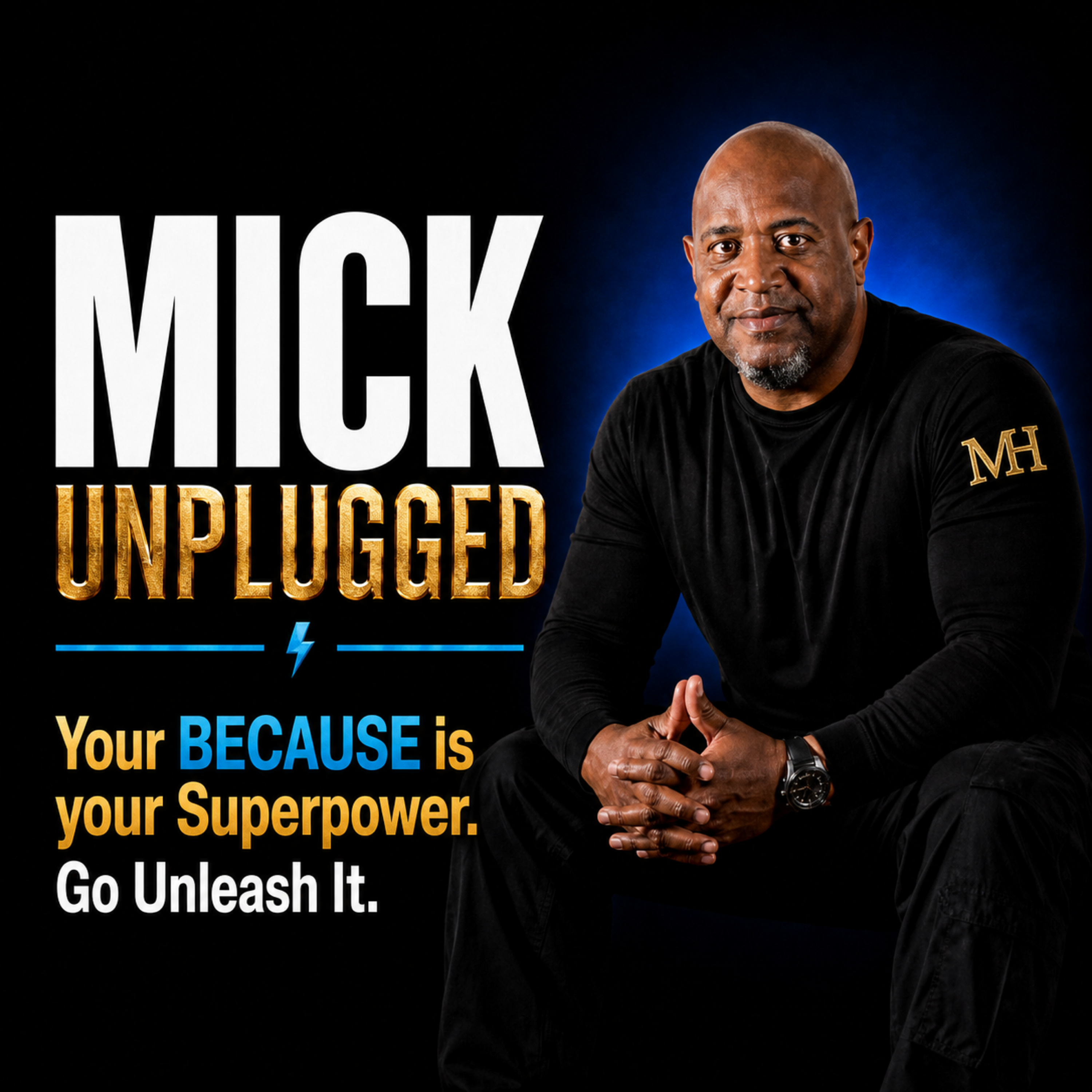
 Mick Unplugged
8 Oct 2026 · 49m · 17 chapters

D.L. Hughley’s memoir Charlie’s Boy, framed as the “conversation” he never got to have with his father after the father’s death. They discuss generational silence, duty over emotional talk, faith/hope, empathy, and modern culture’s confusion of hurt vs offense and free speech vs consequences. They also cover fatherhood, mentorship, and how comedy/media work functions like a “source” that can be used for multiple purposes.
D.L. Hughley is a comedian and media personality (described as a comedy Mount Rushmore figure). He grew up in the 135th and Avalon area and writes about his father, “Mr. Charlie,” a Delta Airlines teamster who earned a gold watch for never missing work.
Men of that era used duty and silence; hurt/embarrassment are necessary for growth; freedom of speech must include inconvenient beliefs; empathy can be “sad” and powerful; show business success depends on understanding analytics and rules.
The father’s gold watch never worn; funeral stories revealing the father “didn’t work at all”; a homeless man from 25 years ago later becoming a homeowner; D.L. mentoring the host on podcast “rules” and percentages.
Written by AI. May contain mistakes.
D.L. discusses his deeper purpose and the importance of faith.
“that sentence usually starts off with, well, because.”
D.L. shares his views on mentoring and human connection in comedy.
“And I think it feels like as a community, we're in jeopardy of running out of faith.”
The conversation shifts to D.L.'s father and the impact of silence in families.
“and here's what I'm going to put out there in the universe.”
Discussion on the generational differences in expressing love and duty.
“And one of the things that I love, because my grandfather was the same way, when you said, do you love me?”
D.L. explores the significance of laughter in human experience.
“you could have written this at any time.”
A deep dive into the distinction between being hurt and being offended.
“So I want to move to a segment I call the hot takes.”
Explore the nuances of freedom of speech and its societal implications.
“Corrective, you learned, most likely learned how to comport yourself in public or around people.”
Discover Chime's fee-free banking model and its benefits.
“They're not like traditional banks that charge fees and gatekeep perks and rewards.”
Reflect on fatherhood and the lessons from their fathers' experiences.
“You just brought up that there's things after your father's death that you wish you would have known.”
Explore D.L. Hughley's emotional reflections on his life, career, and empathy.
“He got a gold watch from Delta Airlines for never missing a day and never being late.”
D.L. shares impactful advice that changed the host's outlook on his career.
Explore D.L. Hughley's emotional reflections on his life, career, and empathy.
“You said you need to understand this is a game.”
D.L. discusses what makes him laugh and the critical conversations America avoids.
“But because it's my grandkids, it's funny and charming.”
D.L. Hughley discusses the unique intimacy of podcasting compared to other media.
“And I think it's just the apparatus I access this from.”
Conversations about listener stats and the importance of audience engagement.
“And that's the lesson you gave me backstage because we were talking about, you know, 1.5 million listeners and downloads, and you said, great.”
Hughley shares insights on his legacy and personal philosophy regarding public perception.
“It's going to be, it's only one of two things.”
Final thoughts and goodbyes between the hosts, encapsulating their connection.
“The only reason you hear me is because you choose to.”

Get the gist, explore an idea or ask about something said.
 Claude
On Mick Unplugged, what are the key points of this episode?
Searching your listeningAutomatic transcript. May contain errors.
0:00Mick: When it's time for hibachi, my protein comes from ButcherBox and ButcherBox only. Go to ButcherBox.com slash Mick to get$20 off your first box. Hostinger's AI builds your website in minutes. No coding needed. Go to Hostinger.com slash Mick and use code Mick for 10 % off. Join the millions who are already banking fee-free with America's number one choice for banking. Head to Chime.com slash Mick. Go to im8health.com slash Mick right now or click on the link in the description and use code Mick for a free welcome kit, five free travel sachets, plus 10 % off your order. It's a shame that the best conversation I ever had with my father was when he wasn't here anymore because he just never shut up and let it happen anyway.
0:44Mick: So ladies and gentlemen, welcome to another exciting episode of Mick Unplugged. And today we're having fun with someone who was on my Mount Rushmore of comedy. You can go back a year and a half ago, see the social posts that I put out there. We're talking to the dynamic, the legendary Mr. Charlie's boy himself, my guy, Mr. D.L. Hughley. D.L., how you doing? How you doing, Big Daddy? Thank you, man. That's very nice. How are you? Man, I am honored to be here with you. I've told you right before we got on, man, I've looked up to you for so long. You are my goat of comedy. I tell everybody the greatest dead or alive is D.L.
1:28Mick: Hughley, bro. Oh, man, I definitely appreciate that. Thank you very much, man. Yes, sir. Yes, sir. So, D.L., man, I love starting my show by asking my guest about their because. That thing that's deeper than your why, right? Like we've done the start with why, what's your why. I like to go a little bit deeper because if I say, well, why is that your why? that sentence usually starts off with, well, because. And to me, that tells me who everybody is. So if I were to say today in 2026, D.L. Hughley, what's your because? What's your purpose now? I think because we have, I think because I think we're on the verge of being, running out of faith and hope.
2:12And I think that is a very precarious position to be in. And so I think that it's important. I guess faith is like anything else. It has to be exercised. It has to be used. It has to function. And I think it feels like as a community, we're in jeopardy of running out of faith.
2:43Mick: man you are so spot on with that and and that's why I love you man like yep you're funny you're gonna give it to us every time but when I connected with DL Hughley it's because that's who you are man like you are you care about community you care about people like I could tell stories of backstage with DL Hughley in between sets right like like you know you got the seven o 'clock set and then you have the nine o 'clock set. I'm in between shows with DL backstage. We are drinking bourbon. We are watching the Lakers play. But then you were mentoring me on this media game, right? Because my podcast was like a year old then.
3:23Mick: And now look at you. Look at you now. You gave me the advice. You told me exactly what to do. But here's what's crazy. We talked the entire time you were offset to when they are announcing you for the next show. Like, I've never seen that in my life where you literally talk to me until it's like, and coming to the stage, and you're just like, all right, baby boy, I'll see you next time. And you just walk up to the stage. Like, where do you get that from where most comedians, most people in general, are just taking that moment for themselves? You were like, no, I'm going to mentor you. Like, let's talk through this a little bit.
4:02Well, I think it's, like I said, it's like a muscle. You got to keep working. I think that this there is a synergy. It's like it's not too much different than the symbiosis between a tree and humans. Like they both give each other something. I think that human interaction is like that, too. And I think that that interaction helps me be a better performer and be a more informed person, a more empathic path of human. And I think the whole time, there's an old expression that a really good friend of mine says, and I think it's true, whatever you're looking for is looking for you. And I think sometimes that's connectivity, sometimes that's a through line.
4:45So I think you get as good as you get.
4:49Mick: Amen to that. Amen to that. So I know we are here to talk about Charlie's Boy, and your team was awesome enough to send me a little pre-copy. and here's what I'm going to put out there in the universe. This is my unplugged truth. It's already about to be a national bestseller, bro. Oh, well. I hope so. To get that side of you and for you to tell the story the way that you did, man, like let's talk about Mr. Charlie. Let's talk about Mr. Charlie. I think he was like a lot of our fathers back then. He was a man of few words. I think, I don't know that men like that didn't know how to speak or that they came from the era where nobody really listened to them anyway.
5:41And I think that, you know, and like a lot of kids, you find out that one thing that's consistent, and I don't think it's specific to us, but I think it's pervasive in our communities. There are a lot of family secrets. And I remember when you were growing up, one way to get your ass good and beat was telling your mom and daddy secrets. Let information come outside the house. And I suspect some of that was privacy. But some of it was that there were so many lies out there, they didn't want nobody finding out nothing from somewhere else. Right. And I think, you know what I mean?
6:17And I also think that silence to a lot of men in that generation meant that they'd have to articulate the things that were going on. And I think that sometimes they didn't want to, saying it out loud was much more, was probably difficult. It added a concrete and a realness to it that I think many of them wouldn't have been able to handle.
6:36Mick: Absolutely, man. And one of the things, I see so many similarities between Mr. Charlie and my grandfather, because my grandfather pretty much raised me, right? And so one of the things my grandfather taught me was to move in silence. He said, when everybody knows what you have, you ain't got nothing. and when everybody knows where you're going, you'll never get there. And it took me until I was probably like 19, 20 to get what he was saying. It was just like, oh, don't broadcast your stuff. And now in this social media world, right? Like that's almost the norm. And now you're a broadcaster. Your grandfather would be ashamed of you, man.
7:15You didn't listen to him. Don't tell your business, but every day I'll do it.
7:21Mick: No, I tell DL's business. I don't tell him. There you go. Touche, touche, touche. No, but again, hearing you talk about Mr. Charlie, not just even in the book, but you've always talked about him. And one of the things that I love, because my grandfather was the same way, when you said, do you love me? Right. Like, break that down. Like, that tough love that we received is. I don't know if it was, like, to see, because tough love means, I just think they didn't know, I don't want to, it's like a majority, but I think he didn't know what to say a lot of times. Yeah. I think he, I think they think it is, he didn't have, you know, love languages.
8:08Then you ate, right? Right. You see these lights? Right. I mean, you could ask them something, but if it's never the question, like, look, you're eight, right? So I think having to say things out loud, I think had, and I think that our generationally, I think those men had, I think duty is stronger than love. I do. I think that people will take a vow. Duty is stronger than love, and it's stronger than a vow. Like people will cheat on their wife, but they won't cheat on their oath. They won't do that. You know, once you're in the military, once you're a Marine, you're always a Marine. There are oaths that you take, that you take and place above everything because you gave your solemn word.
8:57And I think that sometimes that is more resonant than love. And sometimes it is more resonant than the value to. And I think that those men were dutiful. So it never crossed their mind to have to articulate an emotional connectivity. Your mind, I'll take care of you and I got you. That to me is all we need to have. All that verbiage is kind of unnecessary. So I think there's a resonance and a real solidness in duty.
9:32Mick: A thousand percent. Like, I don't know if you remember this, but I remember the first time I heard my grandfather laugh. And I was like, wait, you laugh? Like, he was talking to one of his homeboys. And I was like, you laugh? Like, do you remember those moments for you too? I talk about this. I remember my father laughing five times. And everybody ran in the house to see what it was. And they didn't laugh. They broke. They broke in half. It was like everything broke. They could not stop snorting, tears coming out of their eyes. It was like, I think laughing out there was a frivolity they would never allow themselves.
10:14It seemed frivolous to them. I think tears seemed useless to them. Any outward display of anything other than this was. But laughter is so insidious that it gets you whether you want it to or not. Amen. Laughter, I think laughter, there are four, in my estimation, four universal languages, and they travel everywhere. They don't need interpreter. I think there's laughter. I think there's love. I think there's math, and I think there's art. And I think music, I'm sorry. And I think those are universal languages. And I think that every human has that, those things. You don't have to like all music, but you like something.
10:59You don't have to laugh at everything, but you're going to laugh at something. You don't have to love everything, but you're going to love something. And math is, of course, you know, math is the same all over the world. So I think those things are as human as you can be.
11:13Mick: Yes, sir. Yes, sir. So Charlie's Boy by D.L. Hughley. Out. Everybody make sure you get it. I've got links everywhere. But D.L., why now? You could have written this memoir. you could have written this at any time. Why now? It was a cheat code. It was really the chance under the auspices of talking about my life to talk about my father. It was a cheat code. It was the conversation I would have had with him that he never would let me have. It's my opus, my love letter to him. Remember Marvin Gaye had that album, Here My Dear, and he lost it. I remember he had to write this album, and he gave it to his ex-wife in a divorce settlement and it was his greatest work.
11:57This feels like that to me. It's like, I'll never see him again. I'll never have an opportunity to have ever said those things. And so where else could I put it? No, I mean, you know, so it is the only place it could have gone. And it's the only conversation I went. It's a shame that the best conversation I ever had with my father was when he wasn't here anymore. Because he just never shut up and let it happen anyway, so.
12:22Mick: Yes, sir. So I want to move to a segment I call the hot takes. And I've been waiting years to make this statement to get your opinion on it, because you are like the source of truth for me. And I'm being very honest with that. So that's very nice, man. I can't tell you how much I'm honored by that. My first hot take is this. I think people have confused being hurt with being offended. Right. I think people are so quick to say that they're hurt, but they're really just offended. And we confuse that now. And I say that because my boys are in their 20s, and I hear some of these conversations that they're having with their friends, and somebody's real quick to say, oh, well, that hurt.
13:13Mick: I'm like, wait, are you hurt or are you just offended? Because if you're offended, you can get over it. I think that's really the difference. There's no discernible difference. Like, do you know, if you were getting ready to, if you took a graph of your body when it was sneezing or when it was having an orgasm, your body wouldn't know the difference. The same physicality, whether it's the buildup, the climax and the resolution, it feels exactly the same thing. And I think those are kind of, there's not enough differences to make a distinction. It's a distinction without a difference. And I would say that it depends on your vantage point.
13:47But I think that they're all kind of the same thing. And I think that we live in a climate where as uncomfortable as those things are, there is a corrective. Corrective, you learned, most likely learned how to comport yourself in public or around people. You learned, you know, the do's and don'ts, the societal do's and don'ts. But I'd say one of those things. Right. Either you were hurt or you're embarrassed. You were hurt. So I think those things have a corrective quotient that is absolutely necessary. Like you can't make a chocolate cake without salt. And I don't think you can be a well-rounded human being without being hurt or embarrassed.
14:40Agree. I don't think so. I think that you can't be in good shape without hurting a little bit. Yeah. You can't be erudite and well-read without reading things that don't interest you. You can't. It's impossible. And so I think you can't be a fully formed human being unless you go through some of the things that you just talked about. I just don't think it's possible.
15:06Mick: I love that. I love that, man. That's why I want to have these conversations with you. I love that. My other hot take is this, and I've heard you kind of say it in a different way, but everybody wants freedom of speech till it's a person they don't want to talk that has it. Yeah. Right? But that's the ultimate freedom. That's when it's free. It can't be freedom only if I like what you're saying. The test of that, the test of character is believing what you believe when it's inconvenient for you to believe it. That's character. And so I think that we confuse, and people say it all the time, with freedom of speech, with freedom of consequences.
15:50That's not true. Are we oftentimes confusing with the government infringing on your right for freedom? That obviously is enshrined in the Constitution. But freedom from consequences, freedom from—I think that we have a convoluted perspective when it comes to deeply held beliefs and our definitions of things. and I think because now we have fractured truth to just a slogan as opposed to being an unassailable thing like I could literally say it's light outside and somebody would tell me how it's not and have a reasoned argument and the truth of the matter is I can't prove a negative you can't argue and prove a negative and I think that that's how we've gotten the minutia of truth instead of accepting as what it is.
16:49And I think that it becomes easier to do that when you fragment the very, we can't even have a conversation that's rooted in what either, we both agree is happening.
16:59Mick: Yeah. Yeah. I love that too. You know, I, again, a huge fan of you with your comedic genius, but also a huge fan of the human being that you are. And I've said that several times. I need people to understand when I'm giving you your flowers, I'm also going to say this about D.L. Hughley and I wonder if some of Mr. Charlie plays into this but you are a great father, bro. And I say that because I see what you do with your children. Your children are a part of what you do, right? Like you talk about your son all the time and your son has been there with you on the show. I love the fact that you make a priority to make your children a priority, if that makes sense.
17:54Mick: And as I got older, as my children got older, I understood that from you. I make sure that I make my kids a priority because you showed me how. Oh, man. I think I hadn't always done that. I think that I was very scared. And I think a lot of black parents, and black fathers, I would say, because I won't even pretend to know what women think. But the minute I became a father, there was a palpable sense of fear. It never went away, but it abated a lot. That you wouldn't be enough, that something would happen. that it's just you're afraid of everything. And because fear can be exhausting, you kind of have blinders on and try to get through a lot of things.
18:49And the dynamic I had with my children at first was just trying to make sure they had and they were okay and all that kind of stuff. The dynamic I have now is when you show up enough as a father or a parent, there's a level of trust just in showing up just in being there just in like to fill out a test no matter how good or bad you're doing you gotta put your name on and you gotta show up to take it and I think it's like that and I think
19:26I'm interested in having a closer relationship and a very close relationship with them because a lot of the fear is gone and now we're just people that made it through something and there's something we can all enjoy. And my daughters said something and I think they think I was going to be offended, but I wasn't. They said, we want a man who's just like you and a man who's nothing like you. And one married a Puerto Rican and one married a woman. So They were right. They were right. But it didn't offend me because that's 50%. Hey, man, if you in baseball and you bet 500, you a Hall of Famer.
20:16Mick: Yes, sir. I don't need—I think, you know, even in the book, there were things I found out about my father after he died that I really wish I had known. Not in a judgmental way, but it would have given me insight. And I think the one thing I don't ever want is my children to say they never knew me. Yeah. Because I make a concerted effort, good, bad, or indifferent, for them to know exactly why. And again, I'm giving you your flowers, man, because seeing you do those things gave me a blueprint of how to be that father. Because I talk about my grandfather raising me because my dad was physically in the household.
20:59Mick: But my dad was never emotionally there. I saw my dad every day, but I don't think he ever saw me, if that makes sense. First off, I don't think that that sounds like most men I know of a certain age. Because I wouldn't say that my father was emotionally there. I would say that he left breadcrumbs of the potential of being emotionally there. But I think that wasn't the game. I think, you know, like people always talk about, well, how come, you know, black people don't play baseball anymore? Is it because they don't have many baseball diamonds? Baseball, you learn from your father. It's a very intricate game.
21:42It's math, statistics. You play catch. Everything you learn about baseball, you learn because your father taught you. And I think there is probably less of that than we would like. but the reason that it's, for instance, bigger in the Latin community because there is a more communal aspect to that. That is where. And so it isn't about baseball fields. It isn't about, you know, access. It's not even about, I don't think, the ESPN. I think that the dynamic that you learn things from your father has. And I don't think it's because, I don't buy into the notion that black men are the absent fathers that society has tried to make us out to be.
22:22I believe that things have gotten so crucial that maybe we've dropped the ball on something and sometimes that was a baseball.
22:32Mick: You work hard for your money. Paying fees just to keep it somewhere? That deserves a second look. Chime is changing the way people bank. They're not like traditional banks that charge fees and gatekeep perks and rewards. Chime offers the most rewarding, fee-free banking. No overdraft fees. No monthly fees. No minimum balance fees. Get 5 % cash back on ChimeCard in a category of choice, like gas or groceries, while building credit through regular, everyday spending with no credit check. Grow your money faster with a savings rate that's nine times the national average. And in a pinch, SpotMe lets you overdraft up to$200 fee-free.
23:11Mick: Join the millions who are already banking fee-free with America's number one choice for banking. Head to Chime.com slash Mick. That is Chime.com slash Mick. Sign up now. It only takes a few minutes. Chime is a fintech, not a bank. Banking services and Chime card provided by Chime's bank partners. Qualifying direct deposits required. Terms and limits apply. Go to chime.com slash disclosures for detail. You ever open the fridge and think, what's for dinner? After a full day, that decision ought to be easy. That's where ButcherBox comes in. ButcherBox delivers 100 % grass-fed beef, organic chicken, wild-caught seafood, and more.
23:51Mick: all sourced to standards they can actually tell you about. They've already done the research and made the tough sourcing decisions, so all you have to do is decide what's for dinner. When it's time for hibachi, my protein comes from ButcherBox and ButcherBox only. Every box is customizable, so you can choose the cuts and proteins that fit your routine. Whether you're grilling for friends, feeding the family on a Tuesday, or trying to avoid another expensive takeout order, you've already got great protein ready to go. If you're looking for an easier way to get great meals on the table, give ButcherBox a try.
24:23Mick: Go to ButcherBox.com slash Mick to get$20 off your first box, plus ground beef, steak tips, or chicken breast in every box for life. With free shipping always. That's ButcherBox.com slash Mick. Again, that's ButcherBox.com slash Mick. Be sure to use our link so they know we sent you. Yeah. Yeah. Totally agree. You just brought up that there's things after your father's death that you wish you would have known. What's one thing that's in the book that you want to elaborate on? My father, I work every day. I never take vacations. And it's because I saw my father do that. I always wanted him to be proud of my work ethic.
25:08Whether I did anything. And this is even before I was an entertainer. I always worked hard at whatever it was I was doing. I wanted to be a hardworking man. And I think it's more of an obsession than anything else. But when my father died, all of his friends came to the funeral. And they started talking. And they worked with him, right? and they started talking about how, what it was like to work with him. And I found out my daddy didn't work at all. Like he didn't work at all. He showed up to work. He played cards. He made, you know, younger dudes get the bags. They barbecued and shit. And then he went home and he went home and played tired.
26:00Like he was always dragging her like he was tired and he didn't do shit. He really did. I was irritated when I found out. here I am wanting to make you proud of my work ethic and you didn't have one like he didn't work like I'm sure that to get to the point when you ain't got to work but my father and when I remember me and George Lopez at my father's funeral and he went what are you going to do like I would brag about my father's work ethic like everybody who knew me knew and he didn't do shit like literally and they sat up there and they were having these conversations while I'm at my father's funeral and I was like what and that's just I mean obviously you know it's something what it did for me is I felt like I was disappointing him in some way because already he thought what I did for a living was frivolous.
27:05But I didn't want him to think I didn't work hard at it. But in some ways, I think it would have helped me be a more present father. And I think it—because here's the template, and I got to at least do that to be like him. And he wasn't even like that. So, you know, it would have helped me to, you know, to understand that you can not go all out all the time. Yeah. Yeah.
27:39Mick: That's wild. So, Mr. Charlie, pretending. Mr. Charlie, I didn't have a whole tire on that big chicken. He was a teamster. So he didn't, like, how could I ever fire him? Yeah. Yeah. He never, my father, my father got a watch, a gold watch, because, you know, that's how he did them. He got a gold watch from Delta Airlines for never missing a day and never being late. And he throws the watch on the dresser and he never wore it, just kept it in the case. He never wore it. So one time, why did I think, oh, this ain't a big deal to him? And I wore that watch. and when I came home with that watch it was one of like handful of times he actually was physical with me and I thought he didn't care about that watch but he did I was messing with his life his life to him that was a symbol of his life's work and I was frivolous with it yeah so you talked about him and what he thought of your career again early on.
28:53Mick: Yes. I want to go to what I call the room. Was there a room, a moment in time when you were like comedy? That's what I'm going to do. Like, what was that first moment like for you when you said - When I first picked up a microphone. Mm-hmm. And then this is the weirdest thing. I grew up on 135th and Avalon. Mm-hmm. And everybody who everybody feared, loved, or respected was either, they were a gangster, they were a dope dealer, They were a good athlete. They were something, everything I wasn't, right? Mm-hmm. But I always felt so sad for them. And I could never articulate why. And the first time I picked up a microphone, I knew why.
29:41I knew that I had found a way out. I knew it instantly, and I knew they never would. And it made me so profoundly sad. But the very thing that I was feeling all that time was empathy. Empathy for a life that they would never, that it could never be as full. Already I was thinking of the things I would see that they never would. And it instantly made me so sad. And it's made me sad for a very long time.
30:14Mick: See, it's those things that I'm learning about you now. And I thought I knew everything about DL, man. that empathy, empathy is a motherfucker sometimes, right? Like, like sometimes when we reflect back and I never do the, the why me or the, the, the how come, but sometimes just like you looking back, I have friends like you that aren't here. Right. Right. I have people that were my partners that, that aren't here. And it's just like, how did I get out? Or not even get out, but how did I get out? Survivor's remorse. Right. It's survivor's guilt, survivor's remorse. And I think that that's how bad, at some level, feeling like, why did you deserve it and they didn't?
31:08That some kind of way you feel that you aren't worthy or that even more to the point that other people were more worthy. And why did you get this grace and this favor? Yeah. And I think it's a very pervasive thing because it manifests itself in something like people trying to pretend like they're not as far along as they are, playing down their blessing. When you are blessed with something, if you don't appreciate it, if you don't lift it up, if you don't amplify it, then whatever powers that be think you don't appreciate it, take it from you. and I think it's not even it's just such a that's what we do what we do is very rare anybody to achieve anything at all and I'm not talking about it don't have to be lofty goals I never forget like three weeks ago I was in Atlanta and I was going to see my granddaughter and I was going to have dinner with Killer Mike and I landed at the Atlanta airport and this dude came up to me in the middle of the airport and he was walking up to me and kept wanting to talk to me.
32:21I'm like, man, I got to go. And he pulls out a picture. He said, no, man, just take a minute. He pulls out a picture and he says, you remember this? And it was him. And it was 25 years ago and I met him. He was a homeless dude. He was homeless. He was dirty and homeless. And I met him at the varsity or J.R. Crickets in front of J.R. Crickets. and I talked to him and I gave him some money and I'll never forget I gave him some money and I let him come to the show and when I left I had two days on the room so I let him stay in my suite and that nigga drank the bar dry he drank the bar dry and I hadn't heard from him you know it was 25 years ago that guy is now a homeowner He's married.
33:13He has children. And he took a picture of that day. And he was that picture because he said he knew he would be different after that. I can't tell you what that meant to me. I can't tell you. It's two dudes, and I just, I could not believe that he had the wherewithal to take the picture and that he would be there when I landed. Like how, I mean, they would happen to be there. We just happened to be there. And I'm telling you, man, he looked tall and strong and had a wife and he owned a home. And he said, nobody can ever tell me nothing about you because I know you. And I just, I think that that level of humanity, not just from me to him, but him to listen to, I think there's nothing as beautiful as loving mankind or loving humans.
34:12And I think that now it is seen as something weak or something obscene or something to be ashamed of. And I think I just, I was, it is one of the joys of my life to have a story like that, that someone told me about something I did. Yep.
34:34Mick: And there's a ton of those stories from you, brother. And I am one of those stories. And I'm going to try not to get emotional right here. No, because don't start. This book is already, there's only so much to just take. This book tour should be sponsored by Kleenex. so again charlie's boy make sure you go get it i've got links everywhere but here's how you helped change my adult life in the last two years so we're at your comedy show backstage i'm with you for whatever duration and you're you're coaching me you're mentoring me you're you're saying hey mcmahon like this this media business is different and what you said to me, I'll never forget because it changed my outlook on the whole thing.
35:23Mick: You said you need to understand this is a game. And if you don't know the rules, then you're the one being played. And I was like, God damn. And so I said, well, what are the rules? And you started breaking down, understand how money is made, understand your percentages, understand the control that you actually have. Like, don't let anyone dictate things to you. You can say no. Like you told me no is a complete sentence. You don't have to justify it. If you don't want to do something, don't do it. Right. Brother, you don't understand that moment. I needed that guidance. I needed that mentorship and it changed everything I started doing with my podcast.
36:05Mick: And then thinking of not just the podcast, but the brand of who I am and all of that. And I owe you so much, bro. So much.
36:17Mick: Well, shit.
36:21Thank you, young man. I appreciate that. That's very nice. Thank you.
36:25Mick: Yes, sir. Yes, sir. And I'm going to get you out of here with my rapid five because I don't want to start getting emotional. I need a bourbon. Right. It's like three, four, five. I need a bourbon right now. Right, right. So here we go. I'm going to do this because. God damn it. Stop it. Stop it. I want to do this. I usually do 20 copies of a book that I love, but because of who you are to me and what you mean to me, and I've got, you know, your team and I've got their info. I'm getting a hundred copies of this book. And the first 100 people on Instagram that message me, Charlie's boy, I'm going to get your information and I'm sending you this book because to know DL is to know Charlie.
37:19It's no Charlie is to know my mentor and my mentors deal. Like I need people to understand who Dale Hughley is.
37:31Mick: The core values that he has, the reason he drives so hard. The reason that he does what he does, you're going to get in this book and it's going to teach you life lessons. You're going to see moments of you in DL's story. So I'll have Yvette and the rest of the team, a hundred copies. I'm ordering them now. But the first hundred people that message me on Instagram, Charlie's boy giving you that book because my guy DL means that much to me. On Mick Unplugged, we talk about showing up with purpose. For me, that includes taking care of myself without overcomplicating my day. That's what I appreciate about IM8.
38:12Mick: One drink makes my daily routine simpler and easier to stick with. IM8's daily ultimate essentials bring 16 supplements into one drink with 90 ingredients across 9 major organ systems for$2.61 a day. Co-founded by David Beckham, it was built by leading doctors and researchers. I use IM8. Give it a try. Go to im8health.com slash mick right now or click on the link in the description and use code mick for a free welcome kit, five free travel sachets, plus 10 % off your order. That's code mick at im8health.com slash mick. Code mick at im8health.com slash mick. These statements have not been evaluated by the Food and Drug Administration.
38:56Mick: This product is not intended to diagnose, treat, cure, or prevent any disease. thank you very much sir i appreciate it yes sir all right rapid fire let's let's change some of this momentum oh now it's rapid oh great let's change this momentum great this bourbon about to get me choked up so i um who makes dl hugley laugh you make so many people laugh who makes you laugh um you know what makes me laugh that i see the funniest shit on instagram
39:34but kids kids really make me laugh my granddaughters make me laugh you know it's so funny if my daughters or my kids acted like my grandkids i'd have literally thought they were retarded out of thought. But because it's my grandkids, it's funny and charming. And they make me laugh so hard. I can't believe that. I have never laughed at children this hard. Ever. They make me laugh. Just... And I think part of it is because I don't owe them anything. So no matter how bad they turn out, they ain't got shit to do with me. But they make me laugh very hard.
40:20Mick: There you go. There you go. What's one conversation that you think America keeps avoiding? The conversation about who we are. Like, you know, the thing about this country is, I think that it's almost like when you hear a recording of yourself or an audio version of yourself. And you go, that doesn't sound like me. And it's because you hear yourself from the inside out, but everybody else hears you from the outside in. You'll say that don't sound nothing like me, and everybody else thinks it sounds exactly like you. That is how off we are as a country. We do not see how we are to everybody else.
41:07We refuse to accept reality. We're a case study in contradictions. But full-throatedly, we cannot be that obtuse. We have to, at some point, understand exactly who we are, but we're pretending like we don't.
41:30Mick: That's why I love you, bro. You make me think every time. Every time. Every time. If you had to give up comedy, radio show, commentary, what you giving up first? I think they're not, and it's like this is like the water that comes into your house is a source. Now, you could use it for comedy. I mean, you could use it to take a shower. You could use it to cook. You could use it to wash clothes. You could use it as the source. And I think it's just the apparatus I access this from. So they all are the same thing to me. and they really are the same thing to me see here is what you are getting right now there is a level of intimacy
42:26to take a microphone and to speak for people and for them to stay because they have to invite you in movies are different because movies you go see a thing you go with all these strangers a concert you go to you see a thing you go it's an event it doesn't it's not in your space but this thing people got to invite you in their proximity they put you on when they are trying to distract themselves from things like i'm i'm driving i'm putting on a podcast i want to relax i'm gonna put on a cat i'm running i'm putting on a podcast there is a level of intimacy that cannot be approximated and i think that's where AI will fail because it can write all of these things but the human connected to be able to reach through an apparatus and demand people that's why they spend so much time ascertaining you know how you're it isn't the amount of people that listen to you you know what'll make you make money how long they listen yeah how long
43:27Mick: they listen yeah not the amount right two million people listen for a minute but a hundred thousand people listen for 10 minutes 15 minutes and the ability to make people wait and lean into what you have to say and to not have to ask permission to do it is, I think, the greatest thing technology's done for creatives ever. And that's the lesson you gave me backstage because we were talking about, you know, 1.5 million listeners and downloads, and you said, great. what are your stats on how long people are listening and are they re-listening? And I was like, I don't know. And you said, you need to go figure that out.
44:14Mick: Well, you can. You can know. Analytics will tell you. You can know. And then the thing is, the funniest thing about this is, you know, Alexander Graham Bell, in order to invent the telephone, he had to want to talk to people that weren't even there. Imagine going, you know what? I think I want to, That's exactly what you're doing. Yeah. I want to talk to people that aren't there. It isn't hard to get somebody to sign up for something they're not paying for. Yeah. It's hard to make them keep doing it. Yeah. It's hard to make them actually look at the free gift they got with proof of purchase. Mm-hmm.
44:58It's hard for them to access it.
45:00Mick: Yep. Yep. Fourth question. I promise we're getting out of here. Two more. Fourth one. Well, you know about 100 books. You can take all the time. You won't, God damn it. Hang on. No, no. I'm doing that because you're my guy, man. No, man. Thank you. And I can't tell you how much I appreciate that. Thank you. So, long day from work. You want to come home and have a nice D.L. Hughley beverage. Come on, baby boy. What you sipping on? Come on, baby boy. It's going to be, it's only one of two things. Okay. it's going to be a gin martini or a little, well, three things. It depends. Well, you know, if I'm going to perform, I have a half a martini and a half a cigar.
45:46I go on stage. If I'm talking shit to somebody that I really dig, I'm going to have a little bourbon. Or maybe rum is going to be a dark liquor. And if I just want to talk a woman into doing something, it's a tequila.
46:07There's a method to my spirit. My spirit consumption.
46:12Mick: I love it. I love it. I love it. Last question. When the story of D.L. Hughley is being told, the last paragraph, the last sentence, what's one thing that's going to be there? What's one word, one phrase you want to make sure is there? I can tell you that the phrase that I know for sure that it is from me, it ain't none of my business. What people think of me is none of my business. Yes, sir. Yes, sir. So, you know, I just, I don't have any allegiance or any interest in, And generally in what people think of me. And that's good or bad. I also have learned that from you. Because I have a cutoff button.
47:09Mick: And it's just like, all right, I'm out. You might still be talking. Like, why would I? Like, people think that people think access to you is mandatory. It's not. We live in a... This is a la carte. The only reason you hear me is because you choose to. Yeah. You don't have to hear me, but I ain't got to hear you either. Yep. I ain't got to, like, I don't cut my comments off because I'm not, I think that people have the right to say what they want to say. And I don't want to ever feel like my feelings are so sacrosanct that I can't let people express themselves. I'm not going to read them, but they have the right to post them.
47:52Right. And I think it is the price you pay for someone giving you their ear. And so that is not an expensive price to pay for me. But reading it, I can't invite you into my mind. I can't invite. The most expensive real estate in the world is what's between your ears.
48:11Mick: There you go. There you go. Ladies and gentlemen, this has been my GOAT, my greatest of all times, Mr. D.L. Hughley. Hey, man, good to see you. Now, what you sipping on tonight, young man? Oh, I'm about to have a double oat Woodford as soon as I press in. Come on, youngster. You don't know nothing about that. Come on now. Look, the next time you're in Greenville, I got some bourbons for you. I got some for you. Okay, for sure. Have you had, it's really, it's like wild turkey decade. I know that I mean I know it seems it seems yeah I'm going to show you something so we're here so this is my apartment in New York right so you see all that right alright baby boy I love you I love you back and I will see you very soon like we say when I'm here gonna say see you on the other side alright baby boy alright man later all love for sure for sure
D.L. Hughley wanted one more conversation with his father. He put it into Charlie's Boy.
In this episode of Mick Unplugged, D.L. joins me to talk about his new memoir, the man who raised him and the parts of fatherhood he understands differently now.
We get into duty, family silence and why providing for your children can become so consuming that being present gets pushed aside. D.L. shares what he learned about Charlie after his death and why he makes a deliberate effort to let his own children know him.
I also tell D.L. how his backstage mentorship changed the way I approached my podcast and my business. We talk about knowing the rules, owning your decisions and understanding why people keep listening.
You'll hear:
- The conversation behind Charlie's Boy
- What showing up does for a father-child relationship
- The pressure to keep working, even when it costs you time at home
- Why finding his way into comedy also brought survivor's guilt
- A reunion 25 years after an act of kindness
- D.L.'s take on freedom of speech, consequences and protecting your peace
I'm giving a copy of Charlie's Boy to the first 100 people who DM "Charlie's Boy" to @mickunplugged on Instagram.
https://www.instagram.com/mickunplugged/
CHAPTERS
00:00 The conversation D.L. never had with his father
00:11 Meet D.L. Hughley
00:55 The Because: Faith, hope and connection
04:12 The Unplugged Truth: The father behind Charlie's Boy
07:12 Duty, love and the words fathers do not say
10:36 Why D.L. wrote Charlie's Boy
11:45 Hot Takes: Hurt, offense and growth
14:30 Free speech and consequences
16:22 Fatherhood and the trust built by showing up
21:56 What D.L. learned about Charlie's work life
26:03 The Room: Finding a way forward through comedy
28:02 Survivor's guilt and appreciating your life
29:05 An act of kindness comes back 25 years later
32:06 The backstage advice that changed Mick's approach to media
34:11 Mick's 100-book offer
35:22 The Unplugged Five: What makes D.L. laugh
36:37 The conversation America avoids
37:45 Human connection and why people keep listening
41:34 D.L.'s go-to drinks
42:35 Other people's opinions and protecting your attention
44:27 Closing conversation
CONNECT & DISCOVER D.L. HUGHLEY
Book: Charlie's Boy: A Memoir
https://a.co/d/0bV9x1UZ
Instagram: @realdlhughley
https://www.instagram.com/realdlhughley/
Facebook: @RealDLHughley
https://www.facebook.com/RealDLHughley/
YouTube: DL Hughley
https://www.youtube.com/channel/UC6B_HuuSaR-IDsKuJVK0LEw
FOLLOW MICK
Instagram: @mickunplugged
https://www.instagram.com/mickunplugged/
Facebook: @mickunplugged
YouTube: @MickUnpluggedPodcast
https://www.youtube.com/@MickUnpluggedPodcast
LinkedIn: @mickhunt
https://www.linkedin.com/in/mickhunt/
Website: https://mickhuntofficial.com/
Book: How to Be a Good Leader When You've Never Had One
https://howtobeagoodleader.com/
Apple Podcasts: Mick Unplugged
https://podcasts.apple.com/us/podcast/mick-unplugged/id1731755953
Spotify: Mick Unplugged
https://open.spotify.com/show/2cUp7JRzkVqunYmD2ENe4g
Content note: Explicit language and discussion of grief and family relationships.