Ask ChatGPT


 Mick Unplugged
19 Jun 2025 · 26m · 9 chapters
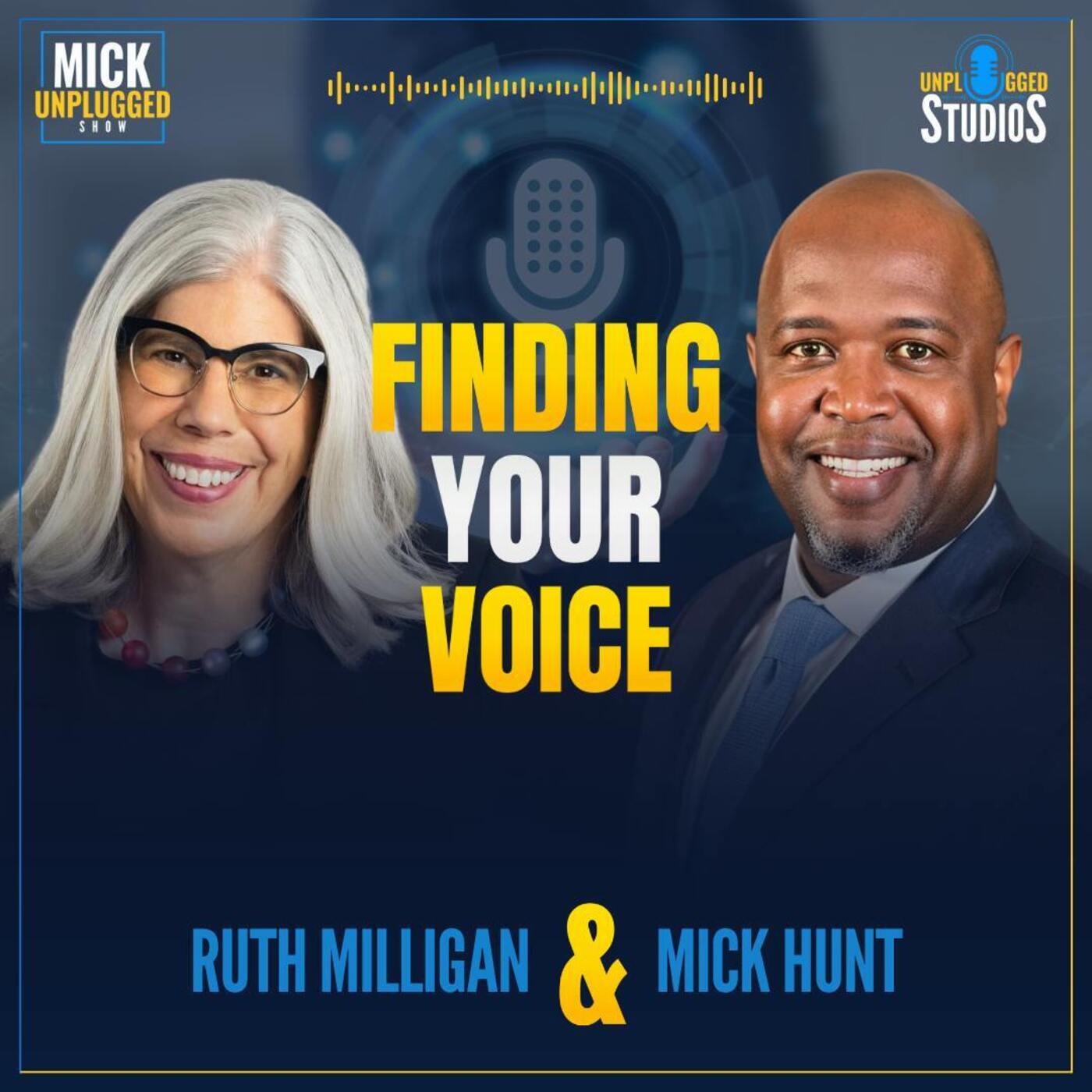
Ruth Milligan explains how to “find your voice” by structuring talks around key points, then supporting them with stories. She argues speaking is not natural—it’s habitual and can be trained—must be embodied, comes in different genres, is fleeting (so focus on impact), and requires feedback. She also highlights “speaking is messy” (the uncomfortable middle) and uses a “family tree” model to organize points before adding stories.
Ruth Milligan is a TEDx veteran, master storyteller, and coach who shapes leaders’ voices across stages and boardrooms. She co-authored The Motivated Speaker and previously led TEDxColumbus (2009–2021).
“Never tell a story without a point and never make a point without a story.” High-stakes presentations range from interviews to $5B contracts.
A scholarship/job interview vs a $5B contract; a short metaphor about “publishing day sprint vs marathon”; a “shaded habit” exercise where audiences whiteboard common speaking flaws.
Written by AI. May contain mistakes.
Ruth Milligan discusses her passion for helping others find their voice.
“I'm so good and really honored and delighted to be here.”
Discussion on how impactful storytelling enhances speaking effectiveness.
“And everyone needs to practice for it to be heard.”
Ruth explains how to effectively balance points and stories in presentations.
“You know, as a speaker, as a coach, you see a lot, right?”
Ruth shares insights about her book that guides speakers at all levels.
“And you're one of the few people that I can actually listen to.”
Ruth outlines key principles that can help anyone improve their speaking skills.
“And I'm going to hit all six, but very quickly.”
Learn about the various aspects that make public speaking challenging yet impactful.
“And this is sort of the Maya Angelou quote, right?”
Discover the importance of listening to your audience and adapting your message accordingly.
“No, I love that, Ruth, because I tell people the same thing.”
Understand the concept of shaded habits and how they can affect your speaking effectiveness.
“I can take the same keynote, Ruth, and do that keynote 15 different ways because of the audience listening or the audience reaction.”
Gain insights from Ruth's reflections on her career and the importance of personal growth.
“We're definitely going to do part two because we haven't even talked about TEDxColumbus.”

Get the gist, explore an idea or ask about something said.
 Claude
On Mick Unplugged, what are the key points of this episode?
Searching your listeningAutomatic transcript. May contain errors.
0:00When it's time for hibachi, my protein comes from ButcherBox and ButcherBox only. Go to ButcherBox.com slash Mick to get$20 off your first box. Hostinger's AI builds your website in minutes. No coding needed. Go to Hostinger.com slash Mick and use code Mick for 10 % off. Join the millions who are already banking fee-free with America's number one choice for banking. Head to Chime.com slash Mick. Go to im8health.com slash Mick right now or click on the link in the description and use code Mick for a free welcome kit. Five free travel sachets plus 10 % off your order.
0:36Ruth Milligan: There's no natural speaker. No one's born a speaker. Everyone is habitual. And if you are not a good speaker, you can become one. If you have a bad habit, you can work out of it. Welcome to Mick Unplugged, the number one podcast for self-improvement, leadership, and relentless growth. No fluff, no filters, just hard-hitting truths, unstoppable strategies, and the mindset shifts that separate the best from the rest. Ready to break limits? Let's go!
1:16Ladies and gentlemen, welcome to another exciting episode of Mick Unplugged. And today, I have a brilliant storyteller to introduce you to. She's a TEDx veteran, a master storyteller, and a coach shaping the voice of leaders around the world. From ideas to impact, from stages to boardrooms. She's a visionary. She's empowering. She's magnetic. She's a good friend of mine, Ms. Ruth Mulligan. Ruth, how are you doing today, dear?
1:43Ruth Milligan: Hi, Mick. I'm so good and really honored and delighted to be here. I can't wait to have our conversation. Well, I'm the honored one. You know, you are the master storyteller. And I think every story as a fellow keynote speaker starts with what I call a because. That thing that's deeper than your why, that thing that is really your true passion, your true purpose. And so I'd love to hear for the first time, Ruth Milligan, what's your because? What keeps you doing what you do? Because I really, truly believe that everyone has a voice and everyone has a story. That might sound trite, but it is true.
2:29Very true.
2:30Ruth Milligan: And everyone needs to practice for it to be heard. totally agree and that doesn't go well alone and we love to be the guide and the helper the body double the coach the whatever you want to call us to support those who are trying to find their place in the world in their lives in their business and it's a delight it's we we dedicated the book that just came out to the speakers that we work with because that takes a lot of trust for them to let us into their worlds. And that all is my because. I love that, Ruth. And I love how you broke that down. You know, as a speaker, as a coach, you see a lot, right?
3:20And you help transform a lot. And the reason I call you a master is because I know it's tough. You know, one of my mentors, you know, he calls me his son. I call him my father is Les Brown. So like you, Les, you know, started his career in Ohio as well. Great storyteller. And Les, the first lesson I ever got from Les is this, and I know you embody this. He said, Mick, the key to speaking is this, never tell a story without a point and never make a point without a story.
3:53Ruth Milligan: I love that. And if you can master that, you'll speak forever and you'll be hired forever because so many people, when they go on stage, it's words. So Ruth, for you, how do you help speakers transform what I'm going to call stories and points, points and stories, because that is something that you do brilliantly. And you're one of the few people that I can actually listen to. You're very kind and generous, by the way. You really are. I've seen a ton of your videos. I've seen a ton of your teachings and that's how I know that you do that. You do good research so i always start with the points yeah the points are far outweigh the stories and they're very difficult to organize bring hierarchy find the highest level meaning yeah and if i can get somebody i did this yesterday on a call there's a high you know i'm working generally in high stakes presentations things with lots of consequence that could and the The consequence is how you define it, but it can go from a job interview, your first interview for a scholarship in college to a$5 billion contract.
5:03Ruth Milligan: It's your definition of high stakes. And somebody had written out a script and I said, what are the three points? What's the one thing that you want to get across that's most important? You know, and the sort of puzzled look comes and I said, how can we support that? And it becomes the shifting and organizing and debating. and I give people this visual, which hopefully will help your listeners. I say, think of it like a family tree. And there's a grandparent and that grandparent had three kids. And that those three kids might've had three kids on their own. And that's all, those are the most number of points you're going to get.
5:42Ruth Milligan: And that's the hardest part. Once we get through that mess, the rest of it starts to fill in. The stories then support those points. If I started with the story, I don't know where it's going to lead. then that doesn't work. So points first, 10 stories. I love that. And then some stories might be a metaphor. It might be a one line. It might be something longer. Stories can take on so many different shapes and sizes. So then there's not like a uniform, like every grandchild is the same size. And I want to make that point, but I don't have a story to go with it. So I might say this is a um mick and i are both published by the same publisher and their advice to me was until publishing day it's a sprint and after publishing day it's a marathon and my publishing day was last week and i feel like i just started a marathon that's just that is a story of an author's journey it doesn't have to be long i don't I don't agree when people say I don't have time to tell stories.
6:47Ruth Milligan: That's just, you don't have time to give yourself the freedom to think about them, to be vulnerable, to trust that your audience wants to hear them. So great. I love points and stories. That's terrific. I love it. And I want to go straight to the book, The Motivated Speaker, right? The Motivated Speaker. That is you, Mick. Yes. You are the ultimate, you are, it is not about motivational speaking. No. This is about wanting to learn. That's what this book is about. Totally agree. And because I truly feel everyone may not be a keynote speaker. No. Right. But everyone needs the skills of speaking, whether you're doing presentations, sales calls, training your employees.
7:36Right. Everyone needs the skill of speaking. And I think that that's what this book truly delivers. Right. I would almost call it a blueprint in modern day form. May I quote you?
7:50Ruth Milligan: A blueprint in, I love that. A blueprint in modern day form. Absolutely. Absolutely. We sought that. I think we did it. And what I love most about our writing process is that we didn't set out to write a book. We specifically set out to answer a question. How can we be better coaches to our speakers, period? And we sought out a writing scholar who I knew from my alma mater, Miami University, who taught us the notion of threshold concepts, which are those troublesome, recursive, nudgy things that you have to push through in order to get to the learning. Remember, like, trying to learn calculus.
8:33Ruth Milligan: And if you didn't get that one, really, I can't tell you what it is because I don't remember calculus. those are the the liminal spaces they feel uncomfortable when you get there you're like oh i don't want to be here but when you get to the other side you're forever changed yeah and we went and asked had anyone written those or named them for speaking for learning to speak and that's what the book ended up being because we we spent a year writing blogging thinking about what were the calls that we'd get from people that didn't do well. And what were they missing along the way? And so those are the six principles.
9:13Ruth Milligan: And then we put a modern day blueprint in the back of every skill that you need to learn to speak. So if you were a fifth grader and you were 10 years old and I had a fifth grader start to read the book last week with a highlighter, somebody who got the book at the event and sent me a picture the next morning of her daughter who was there and I got on stage and I said, this book is meant to be read with a highlighter and post-it notes. And she said, mom, look, I'm on page 25 and I've already highlighted the things I want to remember. This book is for her. It's also for the 65 year old who's starting a consulting practice in their semi-retirement.
9:53Ruth Milligan: I have a client like that who's learning about what she needs to know about speaking that she never learned. So it is at its heart, a self-help book that reads like a novel, as someone else said. I love that. So stories and points. We have three different voices of stories in there from our three coaches. And then we have a collective voice of perspective and tips and advice that we have spent the better part of 15 years assembling. So come to this place honestly. I love it. So I want to go into some of the principles in the book. And oh, by the way, Ruth doesn't know this. And those that my avid followers and listeners know, I always do this when I have a great book that I specifically endorse.
10:38If you message me, and it's got to be the first 10 people, message me, motivated speaker, I don't care what platform, LinkedIn, Instagram, whatever, and I am going to go send you a copy of the book. So Ruth, I'm buying 10 copy or I'm going to buy 20 copies. I'm giving 10 away to the listeners and viewers and I'm going to give 10 to some of my family.
10:57Ruth Milligan: And I'm going to send you 10 of those myself. Well, I'm purchasing 20. So if 30 show up, but I'm purchasing 20. You are, you're a hero. That sounds great. We, we want as many people to be able to get it as possible. For sure. Perfect. So let's talk about some of the principles. What do people that are, I'm going to say truly speaking, just because you've been on a stage also doesn't mean that you're a speaker. So I'm going to debunk some and hurt some feelings. What are a couple of key things that people that want to speak, that want to improve their speaking, or that just want to get started?
11:45What are a couple of things from Ruth, the expert, that they need to incorporate now. You work hard for your money. Paying fees just to keep it somewhere? That deserves a second look. Chime is changing the way people bank. They're not like traditional banks that charge fees and gatekeep perks and rewards. Chime offers the most rewarding fee-free banking. No overdraft fees, no monthly fees, no minimum balance fees. Get 5 % cash back on Chime card in a category of choice, like gas or groceries, while building credit through regular, everyday spending with no credit check. Grow your money faster with a savings rate that's nine times the national average.
12:24And in a pinch, SpotMe lets you overdraft up to$200 fee-free. Join the millions who are already banking fee-free with America's number one choice for banking. Head to chime.com slash mick. That is chime.com slash mick. Sign up now. It only takes a few minutes. Chime is a fintech, not a bank. Banking services and Chime card provided by Chime's bank partners. Qualifying direct deposits required. Terms and limits apply. Go to chime.com slash disclosures for details.
12:54Ruth Milligan: So I think it would be Whova's, and I'm happy to run through them. And I'm going to hit all six, but very quickly. Yep. And I will tell you the top two of the six. Okay. And the top two are the first one and the last one. So you have to listen all the way through. Let's go. The first one is there's no natural speaker. no one's born a speaker everyone is habitual and if you are not a good speaker you can become one if you have a bad habit you can work out of it so that's number one number two speaking is embodied by the way this is not embodied imagine how much energy i was expending booing being who i thought I had, that's reading someone's written word.
13:39Right.
13:41Ruth Milligan: Comes through eye contact, body, hand gestures, our soma, our bones, our energy, our space, you know, how we, how we move in space. Speaking is embodied. Number three, speaking comes in many genres. This is a genre. I know that you and I are set up to have a conversation. Right. This is not meant to, for me to come on here and monologue to you right a panel should be a dialogue not a monologue often isn't a keynote has a genre an interview has a genre and if you're not ruthlessly interrogating them i say that pun intended no point you're right uh then you're gonna miss something you're gonna not read the room you're not gonna know how to how long to go you're not gonna know what kind of seat you're in right so speaking comes in many genres speaking is social and uh we have the uh we could edit that out speaking is social our audiences make meaning of our words you start talking jargon to an audience that doesn't get the jargon they're not going to listen to you it is fleeting actually one of my childhood friends posted on on linkedin this morning one sentence from the book that struck her most she's she was the former CIO of Ohio State.
15:06Ruth Milligan: She's big brain. Speaking, they will forget the words. And this is sort of the Maya Angelou quote, right? But it's because speaking is fleeting. We don't actually remember what you said. So we have to really think about the impact we want to make. Speaking is, of course, there's always one that I'm that I always sort of gloss over. But the last one, I'll come back. The last one, the most important one is speaking requires feedback. Yes. And your own. Yes. What are the bookmark that we had made said, you think speaking, public speaking is hard. Imagine trying to watch yourself on a recording. that's harder.
15:57Yeah.
15:58Ruth Milligan: We are really reluctant to listen to ourselves speak. Now, as a podcast host, you do all the time. So you catch things in your edits and review that have made you a better speaker naturally, even though I said speaking isn't natural, but the process of listening to yourself. I had a speaker not want to listen to themselves and refused then in that moment to not learn and not get better. It's so painful, but one minute of listening to yourself puts yourself in the audience and all of a sudden you're like, wait, do I want to be listening to myself? Yeah. Right. So the first one and the last one are definitely the most important.
16:41Ruth Milligan: Speaking is habitual. Speaking requires feedback. And speaking is messy. That's the last one. There's always something we forget. Speaking is messy and this goes back to the points. there's a messy middle in every talk we give. We think we know what we're going to say and we think we're down ahead. And then all of a sudden we have to switch. It's like a train track. We have to switch over to a different lane and we have to be willing to be uncomfortable and wrong. And we have to be willing not to be perfect the first time we try. Yep. And when you are willing to do that, then, then it'll flow and you run it by people, the right people with the right feedback speaking is messy.
17:19Ruth Milligan: And sometimes we forget things. Anyway, those are the six. It's as fast as I can do them. We are unpacked each one of those with sub points and lots of stories. But we tuck those stories in once the six were finished. So back to your point. No, I love that, Ruth, because I tell people the same thing. I don't call it messy. And so I'm not going to take that because it's yours. I always tell people that speaking is complex. But to your point, you've got to practice and you've got to rehearse. And I know it's boring. Right. But this is why you have to do it because you've got to feel the audience.
17:59Right. If there's one thing that I learned from, there's many things I learned from Les Brown, but if there's an important piece, it's listen to the listening.
18:06Ruth Milligan: Yes. And he says, that's where speakers go wrong. Because you've got this point that you want to make. Right. And maybe you're making that point and we can see each other. yeah yeah exactly by the way we can't the listeners can't see that unless they're watching the video but my daughter is two years older than my son and my son will start talking about something very nerdy and she won't say anything she'll just put her she'll just put her head back right it's hilarious she won't even say anything to him like i'm not listening she just tells him through her non-verbals, I'm not listening. And if he, if he, if he misses it, it's even funnier.
18:48Ruth Milligan: We have to speak, we have to listen to the listening or speak to the listening, as we like to say, we have to address it. I need to say, is that point making it for you? Cause it sounds like it might be bored or you're distracted or are you texting for dinner? No, exactly. And what I got from Les is this, right? Like you've got maybe four points that you want to make in a 30 minute keynote, right? Yeah, maybe. But if the listening says that point one is the point, then you've got to know, all right, I'm only going to get to three points. And the point that I'm making here is this, you've got to know how to tell your point or get to your point in a 60 second version, a three minute version, a seven minute version, because when you're listening to the listening, you never know where that's going to go.
19:40And I, you know, I have a lot of friends that are comedians and they do the same thing, right? Like this joke might not be hitting and I need to know how to wrap it up in 60 seconds or the audience is loving this joke. How can I keep hammering this joke over and over again? And now it's a five minute bit, but for, from a speaker's perspective, that should be the best feeling when what you thought was going to be a three minute point, you can feel the audience. And now you can go places and make that point five, seven, 10 minutes. And now you're engaged, they're engaged, and you just had an impactful keynote, but you rehearsed it, you practiced it.
20:19Going back to your point, it's complex. It's never the same. I can take the same keynote, Ruth, and do that keynote 15 different ways because of the audience listening or the audience reaction.
20:32Ruth Milligan: And it's also who came before you and did you have coffee or not? Is it after lunch? Like there's so many environmental things that you have to take into consideration. Hey Mick, can I run my one sentence keynote promised by you? Let's do it. Somebody taught me early in my career that you don't have a keynote unless you have a promise. What do I promise to leave you? So we've been working on what is that thing that we would say or, you know, it's because nobody wants to like be lectured about the threshold concepts. They are important to read and I digest. So here it goes. Let's see if I can get it down.
21:09Ruth Milligan: In every situation when you're speaking, there's something you do that's a little annoying. Could be a filler word, might talk on too long, talk too fast, not read the room. I call that a shaded habit. Not a habit in the shadows, but something that everyone can see. It's just a little muted, and everyone goes, yeah, that's just Mick. But the minute you move to something illuminated, an executive presentation, a board presentation, a keynote stage, a very big business pitch there's no more shade and that carries with you and now becomes a risk of them not hearing you of them getting in your own way of your message and it's my presumption that everyone's got at least one shaded habit and so in the next in our keynotes we invite people and we tell a few stories to get them thinking and then we invite them to whiteboard and I did it last night and I had a hundred habits on a whiteboard behind me within like a minute and a half.
22:22Ruth Milligan: And we see kind of by a vote, which one is the most pervasive in the room. And then we go there and we work on it. Wow. What do you think? That's amazing. That's why you're brilliant, Ruth. Oh, I'm not brilliant, but we've been working that, that, that took a lot of mess to get to as a demonstration for your listeners. We started in many different places. How do you actually take 240 pages of content and distill it down that makes it relevant in a live setting? Just hard. It's really hard. But we're excited. We're excited about that. And hopefully that struck a chord with you. It did. It did. Ruth, and I know we're short on time, but goodness, I could talk to you forever.
23:03Ruth Milligan: Really quick. You can do part two if you want. We're definitely going to do part two because we haven't even talked about TEDxColumbus. Oh, yeah. things you're doing with TEDx and all of that. I did officially retire. I don't know how many others have retired, but we had to give it up in COVID. I did it for 2009 to 2021. Yeah. Yeah. And I would be delighted to come back and it's still going strong, but it was the seminal moment for me in shifting my business to doing this work. Cool. Well, that's going to segue into my top five with Ruth. Okay, here we go. This is my quick five. One, what is your favorite TEDx talk of all time?
23:45Ruth Milligan: Oh,
23:53Ruth Milligan: you got to cut this out. I'm just, there's three and I want to give the one. It's, oh my gosh, the lawyer, the African-American lawyer. Help me out. Brian Stevenson. My favorite talk of all time is Brian Stevenson. Brian Stevenson. Got it. Love it. We're going to follow up on that one on part two. Yes. What is your go-to ritual before stepping on stage? It starts several weeks before and the exact moments before is I put my notes down and I tell myself, I got this. Love it. Love it. What's the most surprising lesson you've learned as a coach? um that i have to go to where people are but keep in mind where i want them to be i like that that was an early hard lesson i have this expectation i want them to be here it may take a seven steps when i thought it would only take two i love that if you and my clients now tell me trust ruth and trust the process like they'll say you know go work with ruth i'll get invited to another team and they'll say just trust the process because i have come to believe that everyone will get there, but maybe at different speeds and different paces.
25:06So that's
25:09Ruth Milligan: been everything for me, Mick, is realizing that everyone's got a different pathway. But I can keep in mind what I need them to do at the end. Describe Ruth. Describe Ruth in one word. Full. Ooh. I like that. I have had a full life. I'm full of ideas. I have full expectations for people. I feel very full in my privilege and my opportunities and I'm full of family. I just feel right now, at least in this moment in my life, I'm an author now. My children are both in college. Paid off my house. I feel full. I love that. I love that. And then the last one, where do you want people to go buy this book?
25:58Ruth Milligan: It's kind of a tricky question today. for purposes of reviews i would like you to buy it on amazon and i would like you to buy i would like you to review it all right i'm a big independent bookstore person though so go find go ask your independent bookstore and support them through bookshop i'm you know i'm a little torn because the book industry creates a little bit of tension but uh it's on all the channels and themotivatedspeaker.com will take you there. themotivatedspeaker.com. I'm going to have that in the show notes in the description. Ladies and gentlemen, this is my good friend, Ruth Milligan.
26:36Ruth, thank you so much for your time today. You mean the world to me, so thank you.
26:40Ruth Milligan: Mick, thank you. What a delight. Thank you so much for having me on. You got it. To all the viewers and listeners, remember, your because is your superpower. Go Unleashing. Thanks for tuning in to this episode of Mick Unplugged. If today hits you hard, then imagine what's next. Be sure to subscribe, rate, and share this with someone who needs it. And most of all, make a plan and take action. Because the next level is already waiting for you. Have a question or insight to share? Send us an email to hello at mickunplugged.com. Until next time, ask yourself how you can step up.
Ruth Mulligan demolishes the myth of the "natural speaker" in this conversation that will transform how you think about communication. A TEDx veteran and master storyteller, Ruth reveals why everyone develops speaking habits—and how to ensure yours serve rather than sabotage you.
At the heart of Ruth's approach is a profound belief that "everyone has a voice and everyone has a story." The challenge? Most people need guidance to make their voice heard effectively. Drawing from her new book "The Motivated Speaker," Ruth introduces the concept of "shaded habits"—those small, annoying speech patterns we all have that become major liabilities when illuminated on bigger stages. Whether it's filler words, failing to read the room, or speaking too quickly, these habits can derail your message when it matters most.
Ruth's practical frameworks revolutionize how we structure presentations. She recommends thinking of your content like a family tree—with a main message (the grandparent) that branches into three key points (children), each supporting up to three additional points (grandchildren). This hierarchy brings clarity while preventing information overload. Perhaps most counterintuitively, she insists we start with points before stories, ensuring our narratives serve our message rather than wander aimlessly.
The six principles from her book offer a comprehensive view of speaking: it's habitual, embodied, comes in many genres, is social, fleeting, and messy. Each provides actionable insights, particularly the emphasis on listening to recordings of yourself—uncomfortable yet transformational. As Ruth notes, "one minute of listening to yourself puts you in the audience," creating the perspective shift needed for improvement.
Whether you're delivering boardroom presentations, pitching clients, or simply communicating more effectively with colleagues, Ruth's approach offers a blueprint for becoming the speaker you've always wanted to be. As she reminds us, everyone can improve with practice and the right guidance. Ready to transform your speaking? This conversation is your first step.
Connect & Discover Ruth:
LinkedIn: https://www.linkedin.com/in/ruthmilligan/
Instagram: https://www.instagram.com/ruthmilligan/?hl=en
Website: https://www.articulationinc.com/
Book: The Motivated Speaker
FOLLOW MICK ON:
Instagram: https://www.instagram.com/mickunplugged/
Facebook: https://www.facebook.com/mickunplugged/
YouTube: https://www.youtube.com/@MickUnpluggedPodcast
LinkedIn: https://www.linkedin.com/in/mickhunt/
Website: https://www.mickhuntofficial.com Apple: https://podcasts.apple.com/us/podcast/mick-unplugged/
Learn more about your ad choices. Visit megaphone.fm/adchoices
See Privacy Policy at https://art19.com/privacy and California Privacy Notice at https://art19.com/privacy#do-not-sell-my-info.