Ask ChatGPT
 Mick Unplugged
17 Jun 2025 · 41m · 16 chapters
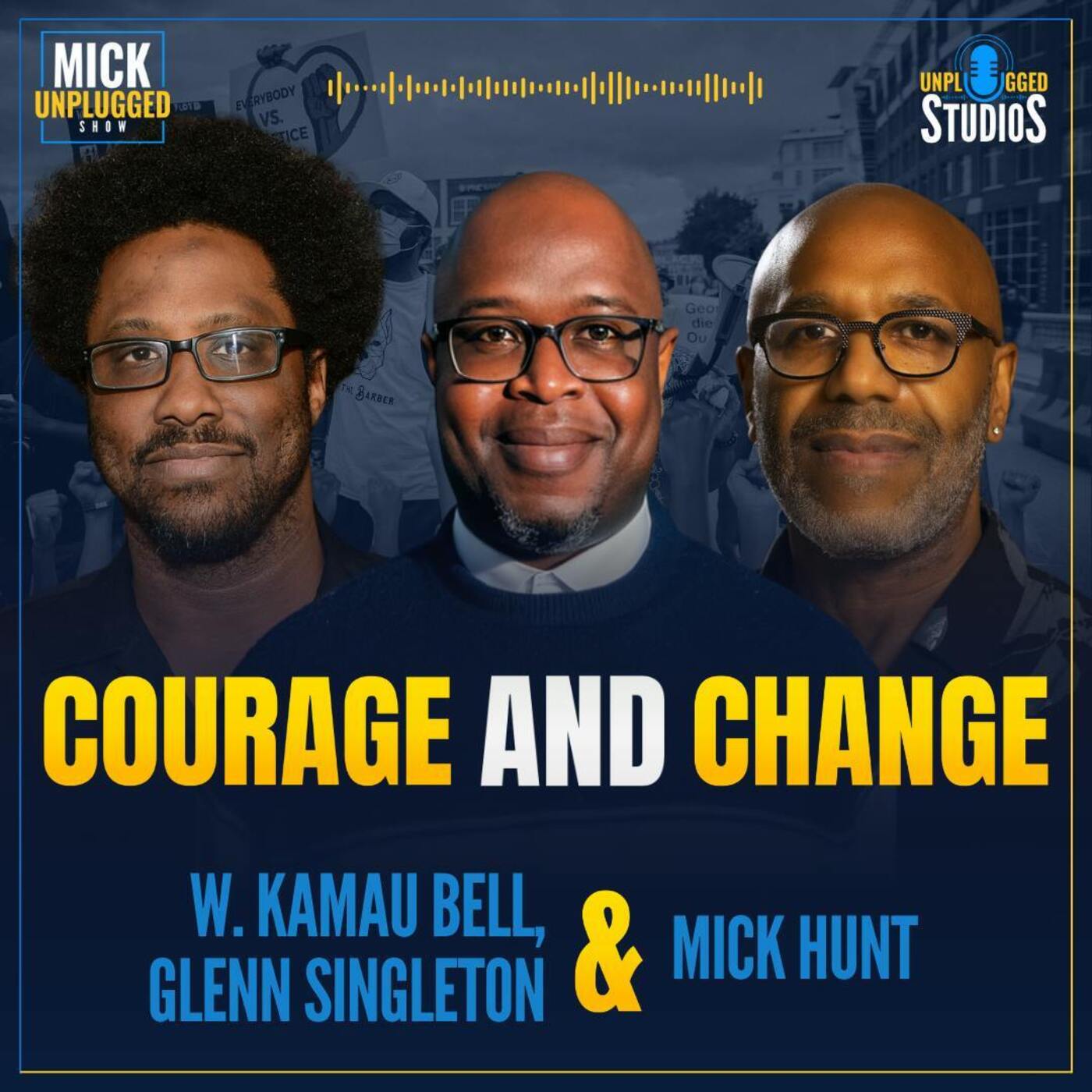
W. Kamau Bell and Glenn Singleton discuss “courageous conversations” about race—starting with inward racial introspection, then having dialogue inside families and workplaces, and building coalitions beyond comfort/defensiveness. They argue race is tied to power and that racial equity is when representation matches society’s “good stuff” (boards, CEO roles, top grades, record deals).
Glenn Singleton is an education equity architect/consultant to Fortune 50–level companies; he founded a “Courageous Conversations” training framework (30+ years). W. Kamau Bell is an Emmy and Peabody–winning storyteller/comedian who uses comedy to confront culture; he runs the “Who’s With Me” work and tour.
Start by asking how race impacts your life and your impact on others; don’t retreat when you meet disagreement; material “extra” isn’t enough—address education disparities (e.g., Black children’s third-grade reading levels). Politicians may be pushed by moral pressure (MLK analogy).
Baton-passing across generations; teaching kids “justice” at home; LBJ/Civil Rights Act pushed by MLK; Hollywood DEI backlash and stalled projects (e.g., “Batwoman”); “Who’s With Me” coalition-building.
Written by AI. May contain mistakes.
A discussion on the personal impact of race and the responsibility to future generations.
“moments of oppression for people like us.”
Exploring how to spark meaningful conversations about race in society.
“But but look, I got Glenn and you and other people working on that, too.”
Discussing how to raise awareness of social issues with children.
“So absolutely, it takes less time for me to create the guidelines for a conversation in these corporations now because I've got friendly AI, okay?”
Exploring the importance of Beyond Diversity as a movement for change.
“you can't have outside conversations if you don't have them inside first.”
Explore the foundational principles of the Beyond Diversity framework and its impact on racial introspection and equity.
“own voice in here, you'll never have it out there.”
Reflect on personal experiences of striving for excellence as a means of empowerment in racially charged environments.
“This only child syndrome, but, But we learn to be excellent.”
Discuss the complexities of DEI efforts in Hollywood and the impact of recent industry changes on content creation.
“And so a lot of projects were greenlit in that moment.”
Learn about the importance of coalitions in social justice and how diverse groups can come together for common causes.
“This is especially because I started the sub stack before Trump.”
Understanding how serving others leads to mutual benefits in society.
“We're thinking about the elderly, you know, and all of those things.”
Discussing the complexities of political figures and the importance of realistic expectations.
“This product is not intended to diagnose, treat, cure, or prevent any disease.”
Strategies for starting meaningful dialogues about race and power dynamics.
“I think today more than ever, courageous conversations need to happen, man.”
Advice on overcoming the fear of saying the wrong thing in conversations about race.
“One, congratulations on Celebrity Jeopardy.”
Wrapping up the conversation with final thoughts and information on upcoming events.
“What do you have going on you want to talk about the last 30 seconds?”
Learn about upcoming events and how to connect with the guests online.
“And so that's going to be down at Austin's the 17th and 18th.”
Discover Kamau Bell's comedy tour details and his writing on Substack.
“And I'll make sure I have all the links in the show notes and descriptions for everyone.”
Hear heartfelt messages of appreciation and support among the hosts.
“You can get everything or go to Substack, who's with me, or Wkamau Bell to find out everything.”

Get the gist, explore an idea or ask about something said.
 Claude
On Mick Unplugged, what are the key points of this episode?
Searching your listeningAutomatic transcript. May contain errors.
0:00Mick: When it's time for hibachi, my protein comes from ButcherBox and ButcherBox only. Go to ButcherBox.com slash Mick to get$20 off your first box. Hostinger's AI builds your website in minutes. No coding needed. Go to Hostinger.com slash Mick and use code Mick for 10 % off. Join the millions who are already banking fee-free with America's number one choice for banking. Head to Chime.com slash Mick. Go to im8health.com slash Mick right now or click on the link in the description and use code Mick for a free welcome kit, five free travel sachets, plus 10 % off your order. We have to do the first work of looking inward, right?
0:40And we have to ask that simple question of, you know, what impact does race have on my life? And what impact does my race have on my life? And as I look around my community, how is race playing out, babe?
0:58Mick: Welcome to Mick Unplugged, the number one podcast for self-improvement, leadership, and relentless growth. No fluff, no filters, just hard-hitting truths, unstoppable strategies, and the mindset shifts that separate the best from the rest. Ready to break limits? Let's go!
1:24Mick: Ladies and gentlemen, welcome back to another exciting episode of Mick Unplugged. And today I've got a special moment. I've got two guests and we're going to talk about it all. One is an Emmy and Peabody winning storyteller who uses comedy to confront culture. And the other is an education equity architect redefining how we talk about race in America. Together, they're pushing past comfort to spark the real change that we need today. Please join me in welcoming the brave, the brilliant, the uncompromising, two guys that I look up to the most, W. Kamau Bell and Glenn Singleton. Gentlemen, how are you both doing today?
2:04I mean, I know Glenn's used to those kind of intros, but I'm still getting used to them. So I know Glenn is like, that's exactly as it is.
2:12Mick: Glenn actually sent me everything to say about him ahead of time. It has to be these. Do not sway from the text. Exactly. This is not a suggestion. Right. If it doesn't go down this way, it's not going down at all. Yeah. So, Glenn, I'm actually going to start with you. I like talking about your because that thing that's deeper than your why. Right. Like Simon Sinek wrote a book, Start With Why. And I think everybody got stuck there. Right. You start with why, but it's your because that really keeps you going. So, again, Glenn, I'll start with you, man. If I were to say, what's your because today?
2:51Mick: What's that purpose, that passion behind what you do? What is that? You know, what is so clear to me is that everybody who's looked like me has had this journey before me. And when I think about, you know, coming all the way across, you know, the grounds of West Africa through this through through the transatlantic slave trade up through slavery, Jim Crow, you know, all of these moments of oppression for people like us. When we get to my generation and we have more than we've ever had. And so I just feel like it can't fall apart with me. Wow. Wow. I love that. I'm taking some notes because I have a follow up question on something you said.
3:46Mick: But come out, man. I'm going to give you the floor now. What is your because? Why do you continue to do what you do? I mean, the flippant and probably truest answer is because me and my wife have three kids and I can't just be like, good luck. I feel a responsibility to make sure that the world is as easy a place to navigate for my three daughters, my three mixed race black daughters as possible. And, you know, and I sort of think of it as the black baton. Like when my grandparents handed the black baton to my parents, it was lighter than when they got it because they had gotten it from people who hadn't been that disconnected from enslavement.
4:28And then when when when my mom passed it to me and my dad passed it to me, it was much lighter because they had gone through the civil rights movement and everything that that that entailed there and pushed the black black people forward, black folks forward. And I got it. I'm like, it might be heavier than when I had when I handed to my daughters. And so my goal right now is to sort of make sure that I do everything I can to make sure that when I hand them the black baton, that it's not heavier than it was when I got it, which is going to be a lot. But but look, I got Glenn and you and other people working on that, too.
4:59So I mean, I think the other thing is like I grew up in a household where you sort of knew you had two jobs, the job to put food on the table and the job to make it easier on all the people who look like you who couldn't get what you got. And there wasn't really a choice there. It was, no, it was just, it was just, it's what we do. So this is just, I think if I was a car mechanic, I'd be an anti-racist car mechanic. I just think this is just a part of the deal.
5:26Mick: I love that, man. I love that. And I'm going to tie that into the conversation I wanted to have with you, Glenn, and both you, Kamau, is this, like Glenn, you said, we have more now than we've ever had, right? And I truly believe that. I also feel to that point, enough of us don't realize that, right? Because those are the things that aren't talked about, right? And I'm not saying everyone and everything, but we'll talk about Lil Wayne's album that just dropped and how good or great that wasn't, right? But we won't talk about - Nobody said it was good. Slow down, slow down, slow down. Nobody said it was good.
6:06Let's not put misinformation out there. Okay, continue. him.
6:11Mick: He said it was good. Okay. Whoever was in the production booth said it was good, but, but Glenn, man, so how do we spark those conversations internally so that we can have them externally? Because you do a brilliant job of that, right? Like, I mean, you, you're a consultant to, to fortune 100 to fortune 50 companies, forget a hundred, right? Right on. How do you lead those conversations internally first so that we can have them outside? Well, you know, when I talk about having so much, oftentimes we get hung up with the new shiny stuff, right? So absolutely, it takes less time for me to create the guidelines for a conversation in these corporations now because I've got friendly AI, okay?
7:01We never had that. Right. I didn't have a cell phone when I was building this work at the beginning. Right. So this is, you know, this is three decades deep. And and so, you know, with those two, there's a whole group of people who have now flourished from these modern technologies and from, you know, the hard work that the entertainers, the athletes, the corporate people have done before. and they've got bank to prove it, right? So when I think about what's in the community in terms of resources right now, and I think about the challenges facing our community, third grade reading level in every major city across the country for Black children, I'm pushing right now on the multimillionaires and the billionaires to figure out, you know, what it is that you're doing with all that extra, right?
7:56Because you only can live in one house, you only can drive one car, and it can be a nice one, and it can be a big one. Okay. But after that, that space that's sitting around those extra material things that the ploy of capitalism have really hurt us there. And then the second thing, I'm going to go to the other side of the prism. And the other side of the prism is what requires our consciousness, Mick. Because, you know, when I sit and talk with my 80-year-old mother, I get the pearls, right? She tells me, no, don't go that way. Don't go that way because they're not going to like it, right? And so if I'm trying to get from A to Z, and I know I'm already running into a roadblock, okay, then why wouldn't I avoid that if my purpose, as we've talked about, is to not fail us right now?
8:47And so when I think of the trajectory from that elder and ancestral wisdom, all the way up to the modern technology and the material, we've got a buttload of stuff that we can use right now to get this thing moving in a way that those elders and ancestors would be proud of us. Amen.
9:10Mick: I love that. And I'm right there with you. So Kamal, for you, you talked about that baton, right? And how heavy it is, right? And just like you, I have three mixed race black kids, right? Black children. They don't like to be called kids anymore. So black children. There you go. How do you have that conversation about the baton internally with your children? Let's see. My seven-year-old hates the president and will say it out loud. so and i've been and you know and while we may we can have a grown-up discussion about hate i think it's a it's very savvy of her to understand that this person is not on my side you know and so therefore i put that person into the hate camp along with like you know lima beans whatever you want to say so for me the idea that my seven-year-old is aware of the state of the world and aware and even in a sort of a seven-year-old way is really important to me because it means that like if you because some people grow up not being aware of the state of the world and then when they're full grown adults you've had conversations with them and they're like so they say something like well you know how many senators are there and you're like oh no and it's fine and i will tell you and we can have that conversation but i think the more that in my house i grew up as an only child i heard my mom having every conversation and so with my kids they seem they're hearing me have a lot of conversations they're also seeing my work they're also saying how people talk to me in the street so they're aware that like data does things where he has to talk to people about the state of this country regularly and they've heard me speak enough to know which sides we're on and that we and they that we want to be on the side of the people and the people is not just people who look like us and we live in oakland so they can see those people and so then you have like my uh my 14 year old who just graduated from eighth grade who as part of her graduation celebration the her advisor said and Sammy Bell, who thanks to her and the administrator who talked to her, now every kid in this school knows the words to lift every voice and sing because my daughter sang it at every school function.
11:22There was a black woman who works in school who asked her to, and Sammy did it, and I said, Sammy, you got to learn the words. You can't fump her through any of it. We're probably not going to do the second verse, but learn it anyway. and so that's a kid who is like just through the power of her voice because she has a good voice is engaging a little bit of activism by teaching some white kids in her school and some non-black kids about the words that their voice is saying and so for me there's more than one way to do this but I think it's important that my kids are aware of what's going on in the world and my 10 year old who's pretty shy like I was when I was her age I go look you're never going to get in trouble with me if you're defending yourself or somebody else who needs to be defended, you think needs to be defended.
12:05And that's a very basic thing. But I think it's cool. You might hear the teacher said, I can do this and that. And I go, whatever the teacher says, you come home to me and we'll take care of it. And so for me, creating a sense of like justice is not always in the hands of authority. Justice is sometimes a thing you see that authority will tell you not to see. And so we are engaged in those conversations regularly in our household. And we also celebrate Kwanzaa, which is the final piece of raising a black family.
12:58Mick: choice, like gas or groceries, while building credit through regular, everyday spending with no credit check. Grow your money faster with a savings rate that's nine times the national average. And in a pinch, SpotMe lets you overdraft up to$200 fee-free. Join the millions who are already banking fee-free with America's number one choice for banking. Head to chime.com slash mick that is chime.com slash mick sign up now it only takes a few minutes chime is a fintech not a bank banking services and chime card provided by chimes bank partners qualifying direct deposits required terms and limits apply go to chime.com slash disclosures for details man that is deep that is deep but you're right man everything again i've been a big believer i was raised that you can't have outside conversations if you don't have them inside first.
13:49Mick: Right. And so my grandparents instilled that in me, my parents instilled that in me. And that's what I do with my children as well, too, is we got to talk about it. Yeah, because one, if you don't know your truth, if you don't if you can't have your own voice in here, you'll never have it out there. And so, you know, and I know, Glenn, that's something that you're passionate about as well, too. That's that's the pillar that you have, man. And I want to applaud you and talk a little bit about Beyond Diversity and all the good things that's going on there. Talk to the viewers and listeners a little bit about that, because to me, Beyond Diversity isn't just a conversation, man.
14:26Mick: It's, you know, in the 60s or 70s, we would call it a movement. Right. Like, like talk to us a little bit about that. Right. Right. Well, you hit on the first pillar, right, of Beyond Diversity is a training framework that I wrote over 30 years ago. So we're celebrating the marker of 30 years at LBJ Library next week. Right. And I think it's it's fitting that that's where we're going, because before we even think about the great society and the civil rights movement and, you know, gaining insights from that past, we have to do the first work of looking inward. Right. And and we have to ask that simple question of, you know, what impact does race have on my life?
15:15And and what impact does my race have on my life? And and as I look around my community, how is race playing out there so that so that when I come talk to you and Kamal, I'm I'm already at that place of racial introspection. And my consciousness is moving me beyond the first trappings of defensiveness and fear and all of those things that we've been given about this topic to, whoa, there's some power here. Right. And so 30 years ago, you know, I was looking at all of these disparities in education. I have worked in corporate and advertising. And so I'm seeing that that we are just not reflected in the goodies of society at the same proportion that we live in this society.
16:06And so for me, the equitable future, the mark of racial equity is when we start to see ourselves proportionately represented in all the good stuff. Right. All the good stuff. And so so if you can walk around society and say, hey, that's good. Right. To be on a board. Hey, that's good to be CEO. oh, hey, that's good to be at the top of the class when I graduate or to go off to the college of my choice. Hey, that's good to get that record deal. You know, then then, you know, that we've reached racial equity and beyond diversity was designed so that we could have the conversation to move a society, the movement of society to that place of the elusive yet tangible sometimes equality.
16:56Mick: Man, so I'm going to tell you this. You don't know this, Glenn, man. I'm going to try not to get emotional. I don't get emotional, but I'm going to hold it in, man. So, you know, been a huge fan of yours for a long time. Before the internet and all that, like, I knew who you were. And I was one of those kids, I can call myself a kid then, that you were talking to, man. Like, I had to be the best at everything I did, right? Like my graduating high school, if I didn't have a scholarship, Mike could have gone to college, but I couldn't have gone to the college I wanted to go to. Right. And so I genuinely had to be the best so that I could get either an academic or athletic scholarship.
17:36Mick: But then when I got to college, University of North Carolina, by the way, when I got to college, that same mentality was there because I knew that I had a purpose to show everybody that looked like me that we can be excellent. Right. That that we don't have a ceiling and the ceilings that we have are the ones we put on ourselves. Now, not saying the world is fair. Never going to say that there are things we're going to have to fight for that other people don't have to fight for. but damn it, I'm going to fight. Right. And so Glenn, I wanted to tell you, thank you for, for being that for me when you never knew that you were, man.
18:16Mick: Oh, brother. Thank you. Thank you for that. And those skills that all three of us have developed, you know, and Kamala and I carry this, this special pressure of being the only one of the next generation and families, right. This only child syndrome, but, But we learn to be excellent. And the world would be a great place if people had that skill of a desire to be excellent. So it's nothing wrong with that. It's just that when you have to be excellent and you might not be noticed as that. Right. As you look around and we think about the conditions which we're living in right now, the irony, right, of the challenge to DEI where, you know, we have just installed an entire government of people who are not excellent.
19:09That's the nicest way to say it. An entire government of people who are not excellent. That is not excellent, right? Not excellent, Nick, in the way that you needed to be at Chapel Hill, right? Not working over in the high school district right beside you, where this is a community of excellence and a resource community. But we couldn't get the black children and the brown children to the top of the class so that they could continue to walk right on over to that university. And so that's that's why we came together to make sure that your excellence was marked as as excellent and to make sure that those who were not feeling excellent were given the resources.
19:54So at least they could could be that if they put in the effort.
19:58Mick: Yes, sir. Yes, sir. Now, Kamala, I'll get to give you some praise that you don't know about, man. So in my household, you know, we watch a lot of the things that you've written, that you produce. We've seen specials. I want to talk about who's with me, man. Like, like seeing the title of this tour. And I know you're you're going towards the back leg of the tour. I'm a little upset you're not going to be in Greenville, South Carolina. Oh, no, no. First of all, we're still adding dates. So and I will be in Durham. and Charleston. Literally, that's what I was going to say. I know you go back-to-back in Charleston and Durham, so I'm going to have to come see you on one of those too, man.
20:38Talk to us about the framework. The community center was killer, by the way. That was a special night.
20:46Mick: Imagine where you are right now, Kamal. Yeah. Talk to us about the framework of this tour, man. Everything from the name, because the name of the tour is so compelling, right? And me and my children talked about it. But the message that you're trying to send throughout the tour, like, talk to us a little bit about that development. Well, I mean, so, you know, a lot of us who work in the sort of the showbiz, I was going to try to figure a nicer way to say it, but just in Hollywood, had the one-two punch of, so post George Floyd's murder by Minneapolis, Hollywood was like, we need to talk to more black creators and we need to give them a voice and let them.
21:26And so a lot of projects were greenlit in that moment. One of the projects that I got was a thousand percent me growing up mixed. That was about my mixed kids and also other mixed kids in the Oakland Bay area, which is great. But a lot of projects got greenlit, but never got made because by the time it was time to make them, we'd already had the backlash to the, to all the DEI and suddenly all the DEI people got fired. I had a lot of meetings with a lot of black women who were in charge of DEI of these, some of these corporations who then weren't there months later you'd send an email that said does not work here anymore and then i had a deal go through and so and then the then the strike happened the writers in the actor strike and although we won i'm in both those unions we won a lot of what we wanted they what they did was we're just going to stop employing you like we're just going to stop so we're going to stop making content famously warner brothers who owned cnn where I used to work, stopped the post-production on the Batwoman movie in post-production.
22:24So they were already$90 million in, and it was like a black Batwoman, which I don't know if that's why they stopped it, but didn't help it, I'm sure. But they were just like, we'd rather use this as a tax write-off than release this as a film. Even though the directors were in the edit bay, two Egyptian directors, I believe, again, who knows if this is all connected, were in the edit bay, editing the, finishing the movie and they're like stop stop your work it's never coming out and so not only so there came a point where like there's people I know in Hollywood who haven't worked since the strikes and that's when I had this moment and I a lot of projects I thought I was going to do just sort of disappeared and I'd stopped doing stand-up comedy and I had this moment of like wait a minute I was raised by Janet Cheatham Bell I was raised by Walter Alfred Bell and sometimes people would asked me, what did your parents do for a live when you were growing up?
23:17And I wanted to go, they're hustlers, but not in the way you think. And my mom's father, Smith Cheatham, was one of those guys who would walk onto a job site and just start working. And they're like, you don't work here, but wait, you did better than everybody else. You work here now. He was just like, I'm going to get a job. And so I chose this as an opportunity to start to really like, okay, what can I do? Well, I know I can write. Where can I take my writing? So I went to Substack, went to a sub stack and was able to go, okay, now that I can do whatever I want to do, what is the goal here? And the goal is to find out who's with me.
23:50Like, you know, literally it's that simple. Who is, who believes 80 % of the things I do and we can talk about the other 20 % or who believes very little of what I believe, but it seems like I'm making some good points and I want to like, I want to at least work through this. And so for me, that's where the, you know, it's sort of, I always feel like it's like a flip on Kendrick Lamar's way of saying it is they're not like us. My way of saying it is who's with me. It's a kind or gentle way of saying they not like us. And so and I know that for my CNN train, like the work that work on CNN, I got a lot of people who are with me who don't look like me.
24:24A lot of older white conservative folks who just like the way I said stuff and came to realize some things they never thought about before. And then because I've done podcasting, there's a lot of younger folks with me, a lot of black and brown activists who have been inspired by my work. And I'm just trying to, I feel like this is just me trying to build the coalition as Martin Luther King Jr. did towards the end of his life that he, I guess, I was going to say he didn't know, he knew. Where it's like, it's more than about black and white. It's about race. It's about class. It's about the United States affecting the entire world.
24:58And so for me, then it became time to like, I got back into standup and I very quickly was like, oh, I'm still asking who's with me. This is all connected. This is especially because I started the sub stack before Trump. But once Trump was in office, it was like, oh, it's still it's definitely who's with me now, because I think before we can figure out what we do, we got to figure out who's on our side. And right now in L.A., people are in the streets standing up to fascism, literally looking around and going, oh, these are all the people who are with me. And it's not just Latinos. It's not just poor folks.
25:27It's all sorts of types of people who who are in your coalition. So that's where that comes from.
25:33Mick: I love that. And I want to go deeper with both of you on that, too, because, you know, when when you have people like yourselves and us, the work that we do can never be alone. Right. Right. And so there are always people that don't look like less, that maybe don't even have the same political views that we have, but also know good versus evil. Right. And so talk to us about that, of how, you know, it's a coalition of people. It's a coalition of entities that actually help make the things that we do happen. Well, so many. I mean, if people don't want to stroll the history so far back, if we just look at this first design of the Great Society, neither Kennedy nor LVJ were really interested in the cause.
26:32OK, their purpose was something completely different. And oftentimes that same purpose that you see pervading those those halls of Congress right now, they want to get reelected. They want to they want to keep the gig going. Right. Right. And also America has this interesting part of its culture that we want to show the world that we're great, even though we're not acting great inside. And so so these two forces were happening. Right. And and the Kennedys and then LBJ, they came to understand that there is some goodness in this moral obligation for all folks to be real, feel real citizenship and dignity.
27:16But they also recognize that it was in their best interest to calm the storms. And that's what I worry about today, Mick, because this particular government is not interested in harmony and peace and community in this country. They're interested in their own individual personal gains. And so I don't know how you talk to people who are only interested in themselves. Right. Right. Because there's nothing that we have here. So I think our coalition now is really important to to come together as people who have a bigger interest than just ourselves. We're looking for, you know, what's going to happen for our children.
28:03We're thinking about the elderly, you know, and all of those things. And as we serve them, as we serve them, we actually serve ourselves better, too. And so that's the message. When folks come in, you know, and they're sort of directed one way on immigration and I'm directed over here on racial justice. OK, I've got to help them to see that when we all win, we all win. Right. That's that. That's the key in here.
28:33Mick: You ever open the fridge and think, what's for dinner? After a full day, that decision ought to be easy. That's where ButcherBox comes in. ButcherBox delivers 100 % grass-fed beef, organic chicken, wild-caught seafood, and more, all sourced to standards they can actually tell you about. They've already done the research and made the tough sourcing decisions, so all you have to do is decide what's for dinner. When it's time for hibachi, my protein comes from ButcherBox and ButcherBox only. Every box is customizable, so you can choose the cuts and proteins that fit your routine. Whether you're grilling for friends, feeding the family on a Tuesday, or trying to avoid another expensive takeout order, you've already got great protein ready to go.
29:15Mick: If you're looking for an easier way to get great meals on the table, give ButcherBox a try. Go to butcherbox.com slash mick to get$20 off your first box, plus ground beef, steak tips, or chicken breast in every box for life. With free shipping always. That's butcherbox.com slash mick. Again, that's butcherbox.com slash Mick. Be sure to use our link so they know we sent you. On Mick Unplugged, we talk about showing up with purpose. For me, that includes taking care of myself without overcomplicating my day. That's what I appreciate about IM8. One drink makes my daily routine simpler and easier to stick with.
29:50Mick: IM8's Daily Ultimate Essentials bring 16 supplements into one drink with 90 ingredients across nine major organ systems for$2.61 a day. Co-founded by David Beckham, it was built by leading doctors and researchers. I use IM8. Give it a try. Go to im8health.com slash mick right now or click on the link in the description and use code mick for a free welcome kit, five free travel sachets, plus 10 % off your order. That's code mick at im8health.com slash mick. Code mick at im8health.com slash mick. These statements have not been evaluated by the Food and Drug Administration. This product is not intended to diagnose, treat, cure, or prevent any disease.
30:36Mick: Totally agree. Totally agree. Kamal, your side on that one. I mean, mostly, as you saw, I was dancing while he was talking. I was like, yes, yes, yes. So the part that I really started excited about was when you talk about LBJ and Kennedy weren't just born into wanting to be on the right side of history. I mean, let's be clear, especially the Kennedys. They were a couple generations away from being bootleggers. You know what I mean? Like they were, you know, a lot of this is like these politicians putting their fingers in the air and saying which way the wind is blowing. And right now I'm in the middle of a lot of online back and forth with people because there's a lot of excitement in some parts of California about Gavin Newsom basically standing up to Trump and putting out some videos saying, hey, if you want to treat California this way, we're going to stop paying.
31:22And we're going to stop paying into this American system since we're the fourth largest economy in the world. If we just stop paying into the system, the country falls. The country collapses. And a lot of people got excited. And I think that's great. But, you know, I'm also don't talk about it. Be about it, you know. And I was sort of seeing some Californians who I know be like, we got to be careful with Newsom because he's not always on our side. He's not always clearly on our side. He's not always. He just started a podcast where he's interviewing right wing people. He also made gay marriage legal.
31:52He also wanted universal health care, but he didn't want$35 insulin. There's just a lot. There's just a lot. Yeah. There's just a lot. He has many pictures of him dismantling homeless encampments, but looking good looking. So it gets confusing. So I've just been here to say, hey, guys, let's not get, yes, he's saying the right thing, but let's also not forget who he is. And the number of people who are like, this is why the left can't ever win. This is why Democrats can't ever da-da-da. This is why we're just basically let him cook. Basically, this is what they're saying. Like, let him. And I brought up the example of, like, do you think LBJ signed or pushed the Civil Rights Act of 1964 because he was excited about it?
32:32No, he pushed it because Martin Luther King Jr. wouldn't stop showing up in his office. And he was like, I got a lot of people outside who are marching this way. Like, he was pushed into doing that and at some point realized, I want to be on the right side of history. whether or not he had a moral thing or not that's for him that's for his biographers to talk about but from the outside it was clear without mlk it doesn't happen it doesn't happen and so it's because so my feeling is like we you know we have politicians only exist to be pushed into the right forms and functions even if you support them 99 of the time there's gonna be one percent of the time you're like hey and look my mayor is barbara lee i don't know when she's been on the wrong side history but when she is eventually like i will be there to say hey barbara i need you to so but i think that like we really we so many of us we're so scared that we're looking for a hero instead of looking at ourselves and going what can i do so you want newsom to handle it and hope that he just handles it and takes care of it so you can get back to pilates and i'm saying like hey maybe you can have an anti-racism Pilates session and figure out what that is.
33:41I'm not telling you not to do your Pilates instead of just hoping that Newsom is the hero that we've always wanted when no politician is.
33:50Mick: Agree. I, you know, I talk to people all the time about when you understand the politics of politics, nothing actually surprises you because it's one of those things like I'm going to do this. Everybody's going to be excited about it. but there's these other four bills that I'm going to push through with this one big one that the world sees, but I'm going to push these others if they're not going to realize for a couple of months, a couple of years, and then they're going to be like, Oh wait, what was this? Well, you wanted this big shiny thing over here. Well, to get this big shiny thing, I had to pass these other three or four things that go along with it.
34:22As my mom used to say, or says, the only thing you can trust less than a politician who doesn't want your vote is a politician who wants your vote. There you go. like it's easier to deal with the politician who doesn't want your vote you can you can sort of like because you kind of know what that guy's going to do but the politician who wants your
34:40Mick: vote might say anything absolutely absolutely all right you guys have been gracious with your time i'm gonna ask each of you like one closing question and glenn i want to go with you because you know you pioneered the courageous conversations framework and i think you know today more than ever, and I'm not even talking about politics here. I think today more than ever, courageous conversations need to happen, man. So like, how does someone start that dialogue today with your framework? Right. So the first thing that I'm going to suggest, even before you go through the internet, buy a book, you know, take a seminar on courageous conversation, is you just get a sense of the paramount importance of racial justice in this society, right?
35:32This cannot be what everybody understands America to be without racial justice. You just have to cross through that. And so establishing that personal relationship to race in your life and to this trajectory of showing up on the side of anti-racism, right? And that is the on-ramp. Once you get into that on-ramp and you get into these conversations across the board, you're going to find people who don't agree with you. And rather than a retreat from that, that's when you know that you're entering the next level, right? Because we can all sit around and talk about people who pretty much share those, you know, those experiences and understandings of race.
36:20But it's when you get to people who don't live the same experience and their politics could be on the same side or shade of blue. OK, but but they're just having a different experience. And so we've got to be open to to really having the questions in that nuance. And then finally, Finally, we got to get to the place of understanding that race is a symbol of power. Right. It's metaphorical. Right. And so you've got to not see that, you know, we're all the same. and all of those things, red, black, yellow, green, or white, all the stories that you're told. No, no, no. There is a hierarchy of power, right?
37:01And you've got to understand this principle of whiteness. You've got to see white supremacy and you've got to see anti-Black racism, these two parts of that continuum, right? And as you can step into those three levels, it's about me, definitely. There are multiple understandings and experiences existing, And there is this system of power race that is about a hierarchy that holds power at white. When you get that, we're ready to go. Everything can change.
37:32Mick: Yes, sir. It's not that hard. Not that hard. Absolutely. Absolutely. So come out for you, man. One, congratulations on Celebrity Jeopardy. Absolutely. I jumped up when you won. For all the smart Negroes who are bullied, I'm here for you I know DonorsChoose was happy about that too I'm a big supporter of school systems So I know that was amazing So my question for you That I want you to be able to give insight to the viewers and listeners So for that person that's listening or watching right now That's afraid to say something wrong Right? What's some advice? What's some courage, some power you can give that person or those people today?
38:21I would say if you're afraid to say something wrong, I would first say you need to do an audit of your friend group and see who you're surrounding yourself with, that you can't be honest with who you are sitting near and who you are regularly in conversation with. so it doesn't mean that I don't think I'm going to say something wrong but I feel like if I do I am surrounded by people who one of them go hey come out come here for a second and they're going to do it with love unless I keep doing it unless I keep saying it you know what I mean that they're going to they're going to you know it's Adrian Brown taught me the difference between calling in and calling out they're going to call me in and if you haven't figured out a way to have a friend group that is that is also smart enough in different areas and have enough different experiences, backgrounds, that you don't feel like you can be lovingly called in and you don't have people who can do that, then you need to look at yourself and go, who did I surround myself with?
39:17You know, this goes back to the Lil Wayne album. Like, clearly Lil Wayne is not surrounded by people who can be, hey man, maybe not 19 tracks. Maybe Lin-Manuel Miranda is not the right producer for you. You know, whatever. He's not, he doesn't have those people around him. So just, so understand, be your, don't end up in that situation is what I'm saying like you have to and then you have to know that you're going to say something wrong sometime if you're trying and I know this is a stand up comedian if we don't try to say the wrong thing we're never going to say the funny thing now sometimes the wrong thing is so wrong people write you up in an article about it but I feel like that's just the nature of the business and you just got to as a stand up comedian you know I'm never going to go through what Lenny Bruce went through or where he got arrested for saying the wrong thing.
40:06Although maybe I am now. We're going to a different era of America. Maybe that's coming back again. But I just feel like, you know, I'm never going to go through what Dick Gregory went through performing at the Playboy Club in front of a group of white people for the first time a black comic had done that in this country that we know of. I'm not going to go through that situation. So, you know, as I talked about, I think I talked about that night at the Kennedy Center. Whenever I start to get caught up in my own, like, what if I say the wrong thing or why is this so hard? suddenly the ghost of harry tubman shows up and goes what what's hard can you explain to me what's hard that you're doing you're afraid to talk oh okay so let me just be clear you're afraid to talk you're afraid to share an idea you're afraid to do you're dreaded to try a new thing is that you're afraid to direct a documentary about bill cosby oh what's first of all what's a documentary you know what i mean so i understand that like at some point you got to get out of your own way and stop thinking that every word you say is so precious that you have to be so careful and scared of it and understand that like the the that true change happens in the uncomfortable spaces in the spaces of like i don't know how this is going to go down i don't know how this is going to work can you imagine being a young mlk and uh during the bus during when they're talking about the bus boycott and they said i think he should do it he's like i just moved here He was like, nobody even knows me.
41:32They're like, exactly. And so the idea being that that's where true change occurs is in those uncomfortable spaces where you might say the wrong thing or you do say the wrong thing and you build to a better day.
41:43Mick: Amen to that. Amen to that. So much wisdom today. Glenn Singleton, W. Kamau Bell, man. I appreciate both of you. Final one, Glenn. Where can people find you, follow you? What do you have going on you want to talk about the last 30 seconds? Well, I'm headed over to Austin for this big convening where we talk about, you know, the great society as opposed to make America great again. And so that's going to be down at Austin's the 17th and 18th. I would say go to our website, www.courageousconversation.com and check the events. You can follow me on Instagram. I'm Courageous Dove 444, LinkedIn, all of those sources.
42:38Facebook, I think, is the same at this point. And yeah, I haven't played around with Twitter too much, but I still am listed on there. Right. So I cross over the threads or something. I don't know.
42:51Mick: Yeah. But that's where I am. That's where you go. There you go. Appreciate it. And I'll make sure I have all the links in the show notes and descriptions for everyone. And we'll send people, we'll send people out to Austin. Kamal, what about you? So, yeah, as you were saying, like I'm doing, most of my work is gathered now at who's with me on Substack. So if you go to Substack and look up Debbie Kamal Bell or who's with me, you'll find me. It's been very good for me. And I try to write every week. I'm actually going to hopefully write today. I don't know if I can think of something to write about that's going on in the country.
43:21It's always about current events in the state of America. Hopefully I can come up with something. And then connected to that is my comedy tour, Who's With Me, where June 17th through the 22nd, we'll be at the Berkeley Rep. And the proceeds are actually going to go to local Bay Area organizations that lost NEA funding when Trump cut NEA funding. So that's coming up June 17th through 22nd. And then July 11th to 12th, I'll be in Charleston and Durham hanging out with Mick here. So we'll be there doing my Who's With Me tour. And, yeah, so I have other tour days. And also I have tour days coming up in the 26th and 27th of June in Seattle and Portland.
43:56So just wkamaubell.com. You can get everything or go to Substack, who's with me, or Wkamau Bell to find out everything.
44:04Mick: Gentlemen, both of you made my day. Both of you inspire me and have been a huge inspiration to the person that is before you today. So I just wanted to tell both of you I appreciate you. more than you'll both ever know. If you ever need me, don't ask. Consider me there. Consider it done. Supporting everything you do. And from the bottom of my soul, thank you for who you both are. Thank you. Thanks for having me. Thanks for having me. You got it. For all the viewers and listeners, remember your because is your superpower. Go Unleashed. Thanks for tuning in to this episode of Mick Unplugged. If today hits you hard, then imagine what's next.
44:46Mick: Be sure to subscribe, rate, and share this with someone who needs it. And most of all, make a plan and take action, because the next level is already waiting for you. Have a question or insight to share? Send us an email to hello at mickunplugged.com. Until next time, ask yourself how you can step up.
What happens when two of America's most fearless voices on race come together for an unfiltered conversation? In this powerful episode, host Mick sits down with Emmy and Peabody-winning storyteller W. Kamau Bell and education equity architect Glenn Singleton to explore what drives their decades-long commitment to racial justice.
The conversation dives deep into what Bell calls "the Black baton" – the generational responsibility passed down through families to make life better for those who come after. "When my grandparents handed the black baton to my parents, it was lighter than when they got it," Bell explains, describing his mission to ensure it doesn't become heavier during his lifetime. Singleton echoes this sentiment, sharing that his work stems from recognizing that his generation has "more than we've ever had" and feeling responsible to continue the progress.
Both men offer practical wisdom about having these crucial conversations. Singleton breaks down his groundbreaking "Beyond Diversity" framework, celebrating its 30th anniversary, which begins with the fundamental question: "What impact does race have on my life?" Bell shares how he navigates these discussions with his three daughters, emphasizing that even his seven-year-old understands political realities in age-appropriate ways. "Justice is sometimes a thing you see that authority will tell you not to see," he explains, highlighting how he empowers his children to recognize injustice.
Perhaps most valuable is their guidance for those hesitant to engage in race conversations for fear of saying something wrong. Bell suggests examining your social circle – are you surrounded by people who will lovingly "call you in" when you misspeak? Singleton adds that understanding the "paramount importance of racial justice" in American society is the starting point, followed by recognizing that "race is a symbol of power" with whiteness at the top of the hierarchy.
Whether you're a parent trying to have these conversations with your children, a professional navigating workplace dynamics, or simply someone committed to building a more equitable society, this episode offers both inspiration and practical approaches to moving beyond comfort into the spaces where real change happens.
Connect & Discover W. Kamau & Glenn:
W. Kamau:
Instagram: https://www.instagram.com/wkamaubell/
Website: https://www.wkamaubell.com/
Facebook: https://www.facebook.com/wkamaubellofficial/
Substack: @wkamaubell
Book: The Awkward Thoughts of W. Kamau Bell
Glenn:
Instagram: https://www.instagram.com/courageousdove444/
Website: https://courageousconversation.com/
Book: Courageous Conversations About Race
FOLLOW MICK ON:
Instagram: https://www.instagram.com/mickunplugged/
Facebook: https://www.facebook.com/mickunplugged/
YouTube: https://www.youtube.com/@MickUnpluggedPodcast
LinkedIn: https://www.linkedin.com/in/mickhunt/
Website: https://www.mickhuntofficial.com
Apple: https://podcasts.apple.com/us/podcast/mick-unplugged/
Learn more about your ad choices. Visit megaphone.fm/adchoices
See Privacy Policy at https://art19.com/privacy and California Privacy Notice at https://art19.com/privacy#do-not-sell-my-info.