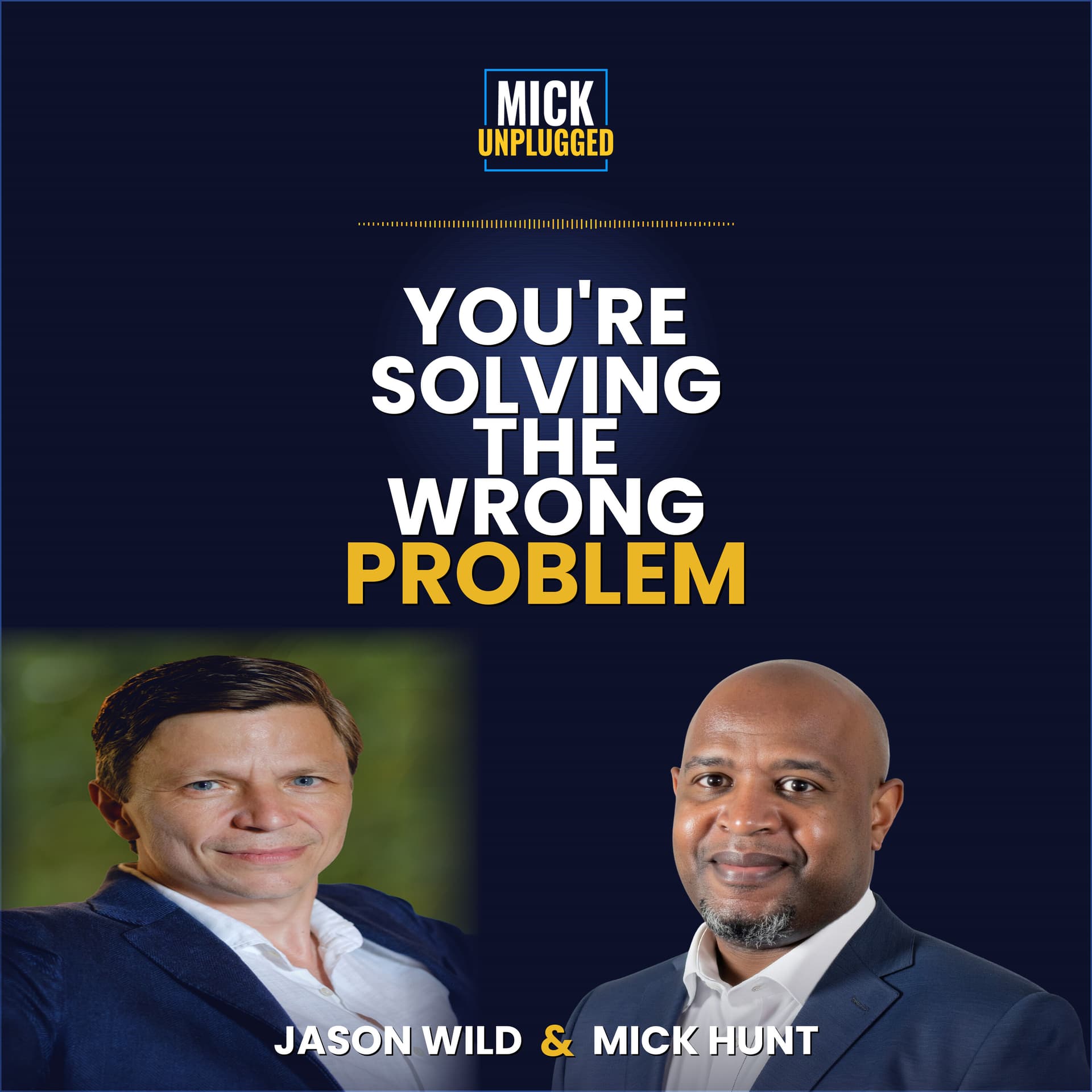

In short
Scaling innovation and leadership in uncertainty; “Genius at Scale” argues leaders must solve the right problem and shift from pathfinding (fixed destination) to wayfinding (destination emerges while moving), building environments where innovation is a social process.
Guest backgrounds
Jason Wild is a leadership/innovation practitioner and co-author of Genius at Scale. He has advised global CEOs and led innovation work across Microsoft, Salesforce, IBM, and other major organizations; he also references work with NATO and Disney. He began as a child actor, learning resilience through repeated rejection and the value of authenticity and storytelling.
Key claims
Innovation fails when teams fall in love with the “what” (ideas) instead of the “how” (conditions/community). Don’t over-focus on KPIs; measure learning fast. AI should enable creative problem solving, not replace leaders’ judgment.
Notable examples
IBM CEO Lou Gerstner’s customer-centric guidance; MasterCard’s cultural innovation (valuation growth from ~$13–14B to ~$335B); a Waldorf Astoria elevator renovation where mirrors fixed “slow” complaints.
Written by AI. May contain mistakes. Listen to the episode to check what was said.
Chapters
Tap a time to open that second in VOUnderstanding Your 'Because'
0:58 to 2:46
Jason Wild shares his deeper purpose and the significance of storytelling.
“Jason, how are you doing today, brother?”
Lessons from Child Acting
2:46 to 4:22
Jason reflects on his experiences as a child actor and the lessons learned about resilience and authenticity.
“We talk about like resilience and embrace resilience, but like how do you actually practice it?”
The Power of Storytelling in Business
4:22 to 7:01
Jason discusses the importance of storytelling in leadership and business success.
“Man, that was like a surreal moment, you know, because I've seen the old Johnny Carson segment where Mr.”
Early Career Inspirations
7:01 to 9:37
Jason recounts pivotal moments in his early career that fueled his passion for innovation.
“I think, you know, it used to be like three degrees of separation from Kevin Bacon.”
Redefining Innovation
9:37 to 13:20
Jason explores his evolving understanding of innovation and the pitfalls of focusing solely on ideation.
“And for a young person in my 20s to hear, because I had thought Wall Street and the stock market, nobody challenges them, right?”
The Role of Culture in Scaling Businesses
16:54 to 19:25
Explore the significance of culture in successfully scaling a business.
“You know, a lot of companies hire me to help them go from point A to point B from a scaling perspective.”
Navigating Change: Wayfinding vs. Pathfinding
19:25 to 22:25
Understand the difference between traditional leadership and innovative wayfinding.
“I've been a practitioner, like leading teams on the ground, leading projects, you know, in 40 countries.”
Creating Environments for Innovation
22:25 to 27:24
Learn how to foster a culture that promotes innovation through social processes.
“So I think that's, you know, if you were to say what the book is really about, it's about that.”
The Importance of Problem Selection
27:24 to 28:05
Gain insights on the art of choosing the right problems to solve for success.
Creative Problem Solving Insights
28:05 to 30:45
Learn about the importance of identifying the right problems to solve through creative thinking.
“So to your point, one of the things that I discovered is human beings, we're pretty good at solving problems, but we're terrible at picking them.”
Show all 12 chapters
The Power of a Simple Solution
30:45 to 31:03
Discover how a simple idea can solve complex issues, as illustrated by an intern's clever solution.
“like i i'm using that story probably tomorrow i'm using that story well that's good well you know i think we see in work and life there's uh yeah lots of opportunities.”
Building Frameworks for Growth
31:50 to 33:19
Understand the necessity of frameworks for business growth and innovation.
“And I think it's so timely with, you know, you talked about AI and businesses are trying to figure out growth and innovation, but they're missing the frameworks.”
Transcript
Automatic transcript. May contain errors.0:00Ladies and gentlemen, welcome back to another exciting episode of Mick Unplugged. And today I am joined by an absolute titan in the world of innovation and leadership. He is a visionary who has shaped strategy for global giants from Microsoft to Salesforce, advising CEOs across six continents, and whose new book, Genius at Scale, is going to revolutionize how we think about breakthrough ideas. Please join me in welcoming the transformative, pioneering, the unscopable Mr. Jason Wild.
0:34You're listening to Mick Unplugged, hosted by the one and only Mick Hunt. This is where purpose meets power and stories spark transformation. Mick takes you beyond the motivation and into meaning, helping you discover your because and becoming unstoppable. I'm Rudy Rush, and trust me, you're in the right place. Let's get unplugged. Jason, how are you doing today, brother? Doing great. Thank you so much, Mick. I hope I can live up to those expectations. You have already done that. And that's why I'm honored to have you on. You know, Jason, obviously I want to get into the book. But before I do that, you know, I love asking my guests and my audience loves hearing about what I have called your because.
1:19That thing that's deeper than your why, right? Like Simon Sinek, great guy, told us to start with why. But I think our because goes a little bit deeper, right? It's your true purpose, and it changes from time to time. So if I were to say, Jason Wild, it's 2026. What is your because today? What's your purpose today? Yeah, well, Mick, I think my mind and heart immediately goes to, you know, where I started kind of my first career, which was when I was still a kid. I was a child actor. And it was not my idea to get into acting. I had the classic stage model. And so from a very early age, I was rejected a lot, which I guess is good.
2:00It helps develop a thick skin. But more importantly, I think getting to your question was I saw the power of storytelling. And whether a play or a movie, you're part of something that just emotionally connects with people. Right. And will cause people's hair on the back of their neck to stand up. So as I grew up and became an adult, I became fascinated with just the power of storytelling. And as I entered business, it really was no more powerful than I wanted to help people shape stories and do things that hopefully in 5, 10, 20 years in the future, people look back and say, that was a turning point.
2:43That made a difference. And I was a part of that. so um creating stories that uh hopefully go viral for the good reason for the for the best reasons there you go and you do an amazing job at that so how did the child acting like what are some things that you learned on the stage and in that sets that you know led to what you're doing now yeah many things i think uh well i mean like i said you know i have kids i'm not sure i would put my own kids through this, but being rejected hundreds of times by the time you're 15 years old, does something, right? We talk about like resilience and embrace resilience, but like how do you actually practice it?
3:30So, you know, I think that enabled me to have a point of view of, you know, other people's opinions matter, but being able to bounce back fast, not worrying about, you know, making everybody happy. And I think, you know, being in Hollywood, which, you know, arguably is kind of the land of fakeness, not everybody is fake. I really saw the importance of authenticity and just being myself and embracing my own identity. So believe it or not, I could start in movies with Mr. T, Jane Fonda, Chris Christopherson. so dating myself with some of the a-list in the 70s and 80s and uh um like mr t i mean he he was amazing he would show up uh on set on the studio every day every morning you know fully in persona with you know the ba baracus with convertible red rolls royce and you know the big sunglasses and uh and was really intimidating and once i got to a point where i like had a good enough relationship with him because I had noticed that despite all of that and being in like 18 mode he always would show up with these like really chewed up old boots that had duct tape wrapped all around him and all around him I finally said hey Mr.
4:48T you know what's up with the boots and he said you know when he was growing up he didn't have much his father when he was 16 years old gave him a pair of work boots it was the only gift he ever got from his dad and he said he wears them every day to remember where he came from. So I think just that one moment taught me so much about really getting to know people as much success as you have, you know, the importance of perspective and remembering where you came from and empathizing with the many others who have not been as privileged. Man, that was like a surreal moment, you know, because I've seen the old Johnny Carson segment where Mr.
5:29T is telling that exact same story about the boots and to hear you say it from a personal experience, man, like that's very sweet. I didn't even know. I didn't even know that he did that on The Tonight Show. But yes, I told my own brother and he was like, yeah, you're making that up. So that's good. I'll have to follow up and find the YouTube videos so that my brother could see the real sources. There you go. There you go. Somebody believes Jason and it's me. I believe in you, brother, if nobody else does. And I think, you know, the other thing is I, I got touched on a little bit is, you know, you hear in life and business world, the power of storytelling.
6:09And it is, I think it is very, very true. And whether you've been at a conference and you see somebody up on stage and they're talking about something and it like literally almost puts you to sleep. And the next person is up there talking about the same thing. and it is moving you to want to do something and be a part of that movement. And the content is the same. It's just how that story is told. And there's a reason why great stories have gone viral for thousands and thousands of years. So I think it's an underappreciated art in the world of business, especially in leadership. And it can be too cheesy or over the top.
6:45You have to pick the right moments. But storytelling is something that's just very innate to us as human beings. I completely agree, man. Completely agree. And, you know, Jason, you've had an illustrious career, incredible career, you know, leading innovative, innovative teams at Salesforce, Microsoft, IBM, working with NATO, Disney, like you name it. I think, you know, it used to be like three degrees of separation from Kevin Bacon. I think now it's like one degree from Jason Wild with like all the connections that you have. Is there a pivotal moment or a key experience early in your career that ignited that passion for innovation?
7:30yeah yeah yeah absolutely so actually when I was going to college I was working at a law firm in Chicago to you know pay my way through college and you know making copies filing documents you know pre-internet stuff and I guess maybe law firms still do some of that they probably do and I just came to this realization of I was more passionate about ideas than debating and litigating interpretations of, you know, the past or current state. So it kind of led me to business, even though I had really very limited, you know, business experience. So I got my MBA, graduate with an MBA, but with like, have like no business experience.
8:10So luckily at that time, it was like the beginning of the build out of the internet. And there was just a tremendous amount of growth. So I was really, really lucky because they were hiring people that didn't have the experience because they needed bodies and they needed people to do that stuff. So I did that for a little while, started a family, going through the financial crisis. And as I started to really develop kind of my dream job, at that moment it was going to work for IBM. Why? Because IBM is international business machines. And I had been bitten by the travel bug. And when I thought of business and the gold standard, it was IBM.
8:52And so I eventually made it their first week. You know, it was a big turning point because I was really fortunate. It was the end of the tenure of CEO Lou Gerstner at IBM, you know, famous, famous CEO. It was kind of controversial when he started at IBM because he was an outsider to the world of tech. He came from American Express. So, you know, there are a lot of people who doubted whether he would be successful. And so in the employee onboarding in my first week, believe it or not, we're at headquarters and the CEO stops by to give a chat for 10 minutes. And I've been really fortunate to hear so many people through my life and literally been surrounded by geniuses.
9:36But, you know, Mick, when you have these moments where you feel like time stops and the person is like speaking to your soul. and the story was really about hey he takes over ibm he goes and meets with wall street wall street wall street says break up ibm right the portfolio fun days are over who says interesting thanks for the input but then goes and meets with a bunch of customers and the customers told him time after time don't break up ibm just find a way to get to bring together the best of ibm and harness it into this relationship. And for a young person in my 20s to hear, because I had thought Wall Street and the stock market, nobody challenges them, right?
10:24And to hear a CEO who was successful, basically talking about customer centricity, and one of the first things that I really learned. And I think it was that moment. So I became really passionate about customers. And I realized that for different reasons, it wasn't always natural that people think of customers first. You think of any company, 100 years old, a one-week-old, Mick, they pretty much have the same origin story. Some entrepreneur came up with an idea of a solution to solve some problem in the world. You find a customer, and it's kind of like you're right like this at the beginning of that relationship.
11:02But as you grow over time, you have lawyers and operations and supply chain, And the decision maker gets farther and farther away from customers. So as crazy as it was, one of the first projects I worked on was with a regulated utility. It was still like year 2000, 2001. We're talking about a customer strategy. And the client says, like, time out. We don't have any customers here. We have rate papers. And it was just shocking to me. And so the innovation bug bit me early because I saw that I had thought that innovation was really just disruptive innovation. These things that visionary geniuses come up with and they change the world.
11:48But I very early on broadened my definition of innovation. And innovation is that, but it's also can be little things and anything that's new and useful. And that sometimes the best innovation was not something that was new to the world. was something that was new to an industry or new to a context, that you were applying it, you know, in a way that made sense to whatever the problem they were trying to solve. And that as I was really surrounded by many of these geniuses, you know, I started to see that it just felt like they were approaching things the wrong way, even though they thought that they were doing it the right way.
12:27And what I mean by that is falling in love with their own ideas, celebrating pilots, rewarding ideas. But to me, I've never climbed a mountain. I've been up to a 3 ,000-foot one. But innovation kind of is like climbing a mountain, which is people think the goal is getting to the top. But it's not. Just like the goal of innovation is not just to generate the ideas. You may not know this, Mick, but there are more fatalities in mountain climbing going down a mountain than going up, which is counterintuitive until you think, right, your adrenaline goes down, you think the job is done, you relax, and bad things happen.
13:09So I saw millions of dollars and, like, the brightest minds focused at the beginning around ideation, but very few ideas actually getting far enough to change something and be meaningful enough to change a system. So it stuck with me. And it was a question as a practitioner doing the work around why is that when the conditions seem generally the same, but then the output can be very, very different. So I became a lifelong student of trying to understand why that is. And one of the key things was these people, we fall in love with the what of innovation. There's something I think human nature about being able to sleep at night and feeling like we can understand it by making it tangible and putting it in a little box and convincing ourselves that we understand it.
14:01But the most innovative companies don't focus on the what, they focus on the how. And they focus on creating a community where organically innovation happens. Starting or growing your own business can be intimidating and lonely at times. Your to-do list may feel endless with new tasks and lists can easily begin to overrun your life. So finding the right tool that not only helps you out, but simplifies everything as a built-in business partner can be a game changer. For millions of businesses, that tool is Shopify. Shopify is the commerce platform behind millions of businesses around the world and 10 % of all e-commerce in the U.S., from household names like Gymshark, Rare Beauty, and Heinz, to brands just getting started.
14:46Shopify has hundreds of ready-to-use templates that can help you build a beautiful online store that matches your brand's style. And you can tackle all the important tasks in one place, from inventory to payments to analytics and more. No need to save multiple websites or try to figure out what platform is hosting the tool that you need. And if people haven't heard about your brand, you can get the word out like you have a marketing team behind you. With easy-to-run email and social media campaigns to reach customers wherever they're scrolling or strolling. Start your business today with the industry's best business partner, Shopify.
15:20And start hearing... Sign up for your$1 per month trial today at shopify.com slash realm. Go to shopify.com slash realm. That's shopify.com slash realm. And their best ideas thrive and their shared intention, not where it's the person with the biggest title or the loudest voice pounding the table, pushing the ideas forward. So I became passionate about it as an art and realized that there were others who also, and that's how I found my co-authors, you know, to begin the book process. Real talk. I'm always on the move, always jumping on some airport Wi-Fi or hotel network without thinking twice.
16:05Then it hit me how exposed my passwords and banking information really were. And that is when I started using NordVPN. It locks down my data wherever I am, even on public Wi-Fi. It's the fastest VPN out there. No buffering when I'm streaming. And one account covers up to 10 devices. And it's the price of a cup of coffee a month. Premium cybersecurity, total no-brainer. To get the best discount off your NordVPN plan, go to nordvpn.com slash mickunplugged. Our link will also give you four extra months on the two-year plan. There's no risk with Nord's 30-day money-back guarantee. The link is in the podcast episode description box.
16:49Go check out NordVPN.com slash Mick Unplugged. Yeah, and we're going to get to the book now because, you know, being a huge fan of yours for as long as I have, we share very similar philosophies. You know, a lot of companies hire me to help them go from point A to point B from a scaling perspective. And a lot of times I start with culture because to me, as a leader, you don't really run your business. You run the culture and the culture is where it runs your business. Right. And I tell I tell CEOs and C-suite folks all the time. The reason that you find scaling hard is usually one of three things.
17:30And a lot of times it's all three. One scale is just a word and you really don't want to. Right. But it's a word that, you know, you need to talk about. two, you try to solve problems before they truly exist. Meaning, yeah, you know, when you double your business, there's going to be things you need to do differently or things you need to add problems that you're going to have, but don't try to solve them before you get there. And you spend so many moments trying to solve problems that haven't happened yet that now you can't scale. And then three, sometimes your key people need to change because there's, satisfied, meaning, you know, they've been with the company for X, they've achieved the goal that you set for them.
18:17And now just like you talked about going down the mountain, right? They're at that part of going down the mountain because they feel like they've already climbed it. And you need more people that are ready to climb the mountain alongside. So now I want to segue to genius at scale, because you hit on something that I think is also really important there. And Like sometimes you just need the framework, the path to actually do those things. So I'd love for you to talk about the book a little bit. I'm excited about the book. So the floor is yours. Genius at scale. Let's go. Well, thanks so much for that.
18:53And I love your points. So believe it or not, it's almost been 10 years. So when my co-author, Dr. Linda Hill, invited me to write the book, she's the chair of the leadership initiative at Harvard Business School. and she and I had collaborated a bit when I was leading some innovation projects at IBM. Honestly, Mick, in my mind, my first reaction was like, is this can of camera? This is a good joke. And, you know, like, why me? And, you know, in Linda's words, part of it was I've been doing the work. I've been a practitioner, like leading teams on the ground, leading projects, you know, in 40 countries.
19:31And so, you know, if we're going to talk about these concepts of creative abrasion, like intentionally tapping into diverse environments where there's psychological safety to challenge the status quo, we better practice that ourselves. Right. And not just write and talk about it. And the other reaction I had was like, not to date myself again, but like a Gilligan's Island moment. Oh, yeah, it's going to be a two year tour. Right. And we'll have a nice book. and everything will be great. And 10 years later, thousands of hours, and it's been worth every single minute. And I want to go through each of your points because I really like those.
20:12I mean, your first one you said around A to B. I think this is one of the reasons why we wrote the book. I didn't want to write a book just to write a book. But again, lots of people that I've collaborated with that I've tried to help, smarter than me, incredibly talented, just seeing them approach it the wrong way. And we'll get into that a little bit. And part of it is, and you mentioned this kind of traditional leadership has been, you know, what you could call pathfinding. We're here at A, meaning to get to B. The role of leadership is to remove the barriers and inhibitors, minimize the turbulence and get to B as quickly and efficiently as possible.
20:54And sometimes the debate is how much transparency should we give you know to everyone else etc and that's great when you have the luxury of time and now obviously with the arrival of ai i mean literally the world is like shifting underneath our feet like a couple of feet every week and it's not just ai quantum is coming blockchain so these are like game-changing disruptive technologies feeding off of each other i think creating even more uncertainty. So what we write about instead of pathfinding, which is more about leading change, right? Knowing what the destination is, having some conviction and saying, okay, let's figure out the most efficient path to get there as an organization.
21:38It's hard to do that when who knows what the world is going to be like in the not so distant future. People in Silicon Valley, and I think it's a little bizarre, but it shows you their perspective. Some people are saying, the five-year plan is dead because who can even think five years ahead so when you're leading in fog you know the traditional pathfinding leadership approach just doesn't work so our book is really a love letter to wayfinding and it's naturally uncomfortable for a lot of leaders especially the fortune 500 ones who have to be on earnings calls stick out their chest and be decisive and show confidence when the reality is wayfinding is about figuring out the destination while you're on the way there.
22:27And I think so that's number one. And it sounds very risky, but it's clearly riskier to do nothing and keep going the path that you're on and trying to renovate your current business by pouring new technology on old thinking than it is to, you know, embrace this kind of, you know, wayfinding approach. So I think that's, you know, if you were to say what the book is really about, it's about that. And then how do you make that practical? Where do you start depending on, you know, if you're a startup or the CEO of MasterCard? So each chapter is about, you know, different leader or leaders. And my co-author is an anthropologist where maybe other people write a book after they interview and the CEO for 45 I have five minutes and that's cool.
23:14We've literally studied these people in different contexts for years and years and years. So then the other points, I think, that are really important is, I've been in tech for 25 years. You mentioned Microsoft, Salesforce, IBM. So listen to me when I say this. It's more about people than it is about technology. and Linda and I were fortunate to be featured a few days ago in a fortune article where basically we were called leadership experts which was very generous and it was really about kind of our take on the AI doomsdayers and you know and the impact to you know jobs in the future of work and now don't get me wrong you know this may sound strange but as much hype as there is around AI I I think in many ways, Mac gets being under-hyped.
24:11Literally, it's going to change how we work and live in many, many, many ways. But, you know, I think the main point becomes, you know, how do you create environments where it's less about measuring KPIs and outputs a thousand different ways, and instead measuring two or three things and focusing on learning and learning fast? How do you get good at understanding that innovation is really a social process? You can't mandate it. You can't dictate it, nor can you delegate it. So finding this like delicate balance between creating the environment where people are willing and able to want to innovate and bring their personal passions.
24:53But it's connected to a bigger platform that represents whatever the organization or business is trying to achieve. So it's interesting to see how people are reacting to this very differently. You know, and I have kids. So I don't think people should be necessarily worried about the conversation of AI taking your job. Right. But I think you should be more worried about some leader who is clueless thinking that AI can do your job. Right. Right. I totally agree. So in the book, right, what was interesting is a co-author teaches classes at Harvard Business School, different levels, including high potential.
25:38Their first chapter is about MasterCard and the CEO. And when he joined MasterCard and their valuation was about$13,$14 billion. And about 10 years later, when he left, their valuation market cap was north of$335 billion. So a 25x increase. And after he left MasterCard, he was appointed by the White House to be the president of the World Bank. So take that transformation, cultural innovation playbook that you implemented at MasterCard and now take it to a level where you're trying to solve hunger and poverty at a planetary level. And I bring this up because, and I'll make a quick point, but when we tell that story to executives, there's an interesting part that really surprised us.
26:30It's a huge success story. The CEO not only did his job, but in a way got promoted to be the president of the World Bank. But when we ask people, would you take this job of being the chief innovation officer working for the CEO? In one of the classrooms, only three people raised their hand out of 85 people, even though they knew that it was wildly successful. So there's something. And I remember early in my career, someone telling me, oh, yeah, innovation programs, that's where careers go off to die. Now, whatever we want to call it, Mick, with the arrival of AI, the advice that I give people is get great at problem solving.
27:15We may not know what the problems are 1, 5, 10 years from now, but the world has always been a target rich environment for problems. And, you know, things like design thinking, which is featured a lot in our book, especially in one of the roles of the bridger, which really works across boundaries and the kind of kill zones of where innovation usually dies because people have their own agendas and nobody's focused on driving this change across silos. the bridgeers are really the unsung heroes of innovation and they're masters at creative problem solving and i think a little bit of design thinking got lost in the jargon and and you know wearing the black turtlenecks and steve jobs and all of that but if you strip away all of that at its core it's getting world-class of creative problem solving and i think that's what the world needs right now is for people to embrace, you know, AI as an enabler, not as a tool, as an enabler of being a creative problem solver.
28:23So to your point, one of the things that I discovered is human beings, we're pretty good at solving problems, but we're terrible at picking them. And even Einstein knew this a long time ago with his famous quote, like, if I had an hour to solve a super complex problem, they'll hold 55 minutes on the problem with five minutes on the solution. There's this great story around the Waldorf Astoria hotel opening up in Manhattan. And I'll end on this because I have a little poster here in my home office. It's a reminder that every few decades, you know, this iconic hotel on Park Avenue goes through massive renovations.
29:02And of course, they're very guest centric. So when they open up again, they pay very, very close attention to customer feedback, right? They open up immediately. There's a huge spike in complaints. So they call an emergency meeting. What's the complaint? The elevators are too slow. So let's get all of our brightest minds, million dollars to change the algorithm, multi-million dollars to convert a couple of, you know, worker elevator shafts to add capacity. There's an intern sitting in the room who's there supposed to take notes, listening to all of this. She raises her hand and says, can I have a few thousand dollars to run a couple of experiments?
Read the full transcript
29:44I'm like, yeah, yeah, whatever. Yeah, sure. A few thousand bucks, whatever. They end their meeting, right? A few days later, they're tracking the results. Complaints completely disappear. It's like, what? We haven't even got the RFP response in the algorithm yet. What happened? Oh, well, the intern solved it. What did the intern do? the intern put mirrors inside of the elevator and around the elevator areas. Because the problem was not that the elevator was too slow. The problem was the weight was too boring. So I think great leaders are great about creating those environments where people or anybody can come up with a good idea.
30:27And there's an open mindedness to what is the real problem that we're really trying to solve? And it almost becomes a working hypothesis. hmm jason i'm borrowing that story brother that story is and i'm gonna give you all the credit that's an amazing story and amazing parallel like that was perfect man like i i'm using that story probably tomorrow i'm using that story well that's good well you know i think we see in work and life there's uh yeah lots of opportunities. So getting the right mindset and you surround yourself with the right people that are willing and able to innovate and seemingly impossible is not.
31:10No, totally on the same page, man. And again, I'm excited about the book. What I want to do, and my listeners know this, books that I love and that I rave about, I like to purchase copies. So I want to get 20 copies. I'm going to buy 20 copies of Genius at Scale. And the first 20 people, so I'm going to do it both ways because I get yelled at all the time. The first 20 people that message me on LinkedIn and the first 20 people that message me on Instagram, the word genius, you're going to get a copy of the book. So I'm buying 40 copies, Jason. But I think the book is paramount. I don't think a book like this exists.
31:56And I think it's so timely with, you know, you talked about AI and businesses are trying to figure out growth and innovation, but they're missing the frameworks. And you can't do anything without the frameworks, right? I don't care how good you may be. If you don't have a framework, you're never going to be the version you were supposed to be. Your business is never going to be what it was supposed to if you don't have the frameworks. And I believe in the book that much, Jason, that it is the framework for scale. It's the framework for innovation. So 40 copies, LinkedIn, Instagram, the first 20 people, you're getting a copy of Jason Wilesman.
32:35Love it. Thank you so much. You got it. Where do you want people, if you're person number 41, where do you want them to buy the book, Jason? Because I'm buying 40, but 41, you're on your own. Yes, absolutely. So make sure you get genius in there quickly. And if you're 41 and beyond, and it's interesting, 41 is one of my lucky numbers. We do have a great book website called Genius at Scale.com. For you multilingual people out there, it's in English, Spanish, and Portuguese. And we're really trying to ignite a movement and not just write a book. So we'd love to hear your feedback. What did we get wrong?
33:18What would you like to hear us think about and study next? and I think we'd all agree that it's a great moment to think about different leadership styles in the world. There we go. Jason, huge fan of you. I'm going to have everything in the description and show notes as well. I'm going to have links to go follow Jason, interact with Jason. He's a great human being. He's an amazing, I hate the word thought leader, so I'm going to come up with something different. He's an amazing genius leader, but he truly is someone that not only gives you insights, but gives you the action that follows. And those that know me, I'm all about the action.
33:59You can give me insights, but when you give me action, you become my best friend. And Jason, you'll become that brother. I appreciate you. I love that. Well, it's very kind and we can be friends for life. Here is the book. And yeah, we talk about being thought doers. And to your point, we do need to think and continue to be creative, especially in this type of AI. But it's nothing without an action bias. There you go. Ladies and gentlemen, that is Jason Wild. And remember, your because is your superpower. Go Unleash It. That's another powerful conversation on Mick Unplugged. If this episode moved you, and I'm sure it did, follow the show wherever you listen.
34:42share it with someone who needs that spark and leave a review so more people can find their because. I'm Rudy Rush, and until next time, stay driven, stay focused, and stay unplugged.
From the publisher
Jason Wild is a globally recognized innovation strategist and co-author of the groundbreaking book “Genius at Scale: How Great Leaders Drive Innovation,” written alongside Dr. Linda A. Hill of Harvard Business School and Emily Tedards. A former child actor turned business leader, Jason has shaped innovation strategy for some of the world’s most iconic brands—including Microsoft, Salesforce, and IBM—while advising CEOs across six continents. As the former Global Vice President of CEO Co-Innovation and Customer Engagement at Microsoft, Jason brings a rare blend of practitioner experience and thought leadership to the art and science of scaling breakthrough ideas.
Takeaways:
- Stop Falling in Love with Ideas and Start Falling in Love with Problems: Most companies pour millions into brainstorming and ideation—and then wonder why nothing actually changes. Jason nails it: innovation isn’t about getting to the top of the mountain, it’s about making it back down alive. More initiatives die in execution than in conception. The Waldorf Astoria didn’t have a slow elevator problem—they had a boring wait problem. An intern with a mirror solved what a million-dollar algorithm couldn’t. Leaders, stop rewarding ideas and start rewarding impact. Pick the right problem and the solution will follow.
- Innovation Is a Social Process—You Can’t Mandate It, Delegate It, or Dictate It: Jason has spent 25 years in tech and he’ll tell you straight: it’s more about people than technology. The most innovative companies don’t obsess over the “what” of innovation—they master the “how.” They build communities where the best ideas rise organically, not because someone with the biggest title pounds the table. Creative abrasion, psychological safety, and diverse perspectives aren’t corporate buzzwords—they’re the operating system of every company that’s actually scaling something that matters. AI isn’t going to replace you. But a clueless leader who thinks AI can do your job? That’s the real threat.
- Wayfinding Is the New Leadership—Forget the Five-Year Plan: The old playbook of pathfinding—point A to point B, remove barriers, minimize turbulence—is dead. AI, quantum, blockchain—the ground is literally shifting under our feet every week. Jason and his co-authors call it wayfinding: figuring out the destination while you’re already on the way there. It’s uncomfortable. It demands humility. And it’s the only leadership approach that actually works when you’re leading in fog. Stop pouring new technology on old thinking and start building the framework to navigate what’s next.
Sound Bytes:
“The most innovative companies don’t focus on the what, they focus on how. And they focus on creating a community where organically innovation happens and the best ideas thrive.”
“I don’t think people should be necessarily worried about the conversation of AI taking your job. But I think you should be more worried about some leader who is clueless, thinking that AI can do your job.”
“Get in the right mindset and you surround yourself with the right people that are willing and able to innovate and seemingly impossible is not.”
Connect & Discover Jason Wild:
LinkedIn: Jason Wild
Book — Genius at Scale: How Great Leaders Drive Innovation
Amazon: Genius at Scale
Website: GeniusatScale.com
🔥 Ready to Lead Different & Win Bigger? 🔥
Leadership isn’t about a title — it’s about what you do when no one gave you a blueprint. In his book, How to Be a Good Leader When You’ve Never Had One, Mick Hunt delivers the raw, real leadership playbook for the rest of us. Whether you’re building a team, growing a business, or just trying to lead yourself better — this book is for you.
Straight talk. Real strategy. No fluff.
👉 Get your copy now on Amazon, Barnes & Noble, or Books A Million.
FOLLOW MICK ON:
Spotify: MickUnplugged
Instagram: @mickunplugged
Facebook: @mickunplugged
YouTube: @MickUnpluggedPodcast
LinkedIn: @mickhunt
Website: MickHuntOfficial.com
Website: howtobeagoodleader.com
Website: Leadloudseries.com
Apple: MickUnplugged
See Privacy Policy at https://art19.com/privacy and California Privacy Notice at https://art19.com/privacy#do-not-sell-my-info.


