
In short
A “Space Boffins” episode mixing three threads: (1) Wally Funk’s life and training for space, including her Mercury 13 background and later flights; (2) the UK Mars lander Beagle 2—why it went silent, how it was later found intact, and what might have prevented communication; (3) British space history via Royal Society archive films about Ariel 1 and Ariel 2, including the impact of the US high-altitude nuclear test “Starfish Prime.”
Guests (and backgrounds)
Mark Sims, professor of astrobiology and space instrumentation at the University of Leicester; Beagle 2 mission manager. Keith Moore, Royal Society librarian, discussing Ariel 1/Ariel 2 archive films.
Key claims
Beagle 2 likely landed successfully but the final panel may not have deployed, potentially covering the radio antenna. Ariel 1 was damaged by Starfish Prime, leading to a diplomatic embarrassment. Wally Funk’s training included cosmonaut training, parabolic flights, and centrifuge tests; she later flew with Blue Origin.
Notable examples
Beagle 2’s Christmas Day silence; later confirmation by Mars Reconnaissance Orbiter images (2014). Ariel 1’s tape recorder and ionosphere mission; Ariel 2 as follow-on.
Written by AI. May contain mistakes. Listen to the episode to check what was said.
Chapters
Tap a time to open that second in VOReturning to Space Boffins
1:04 to 2:12
The hosts reunite to discuss their recent projects and celebrate 15 years of the podcast.
The Legacy of Wally Funk
2:35 to 2:55
Reflection on Wally Funk's life and her impact on the space community.
“imagining, devoid of all that can sustain life.”
Wally Funk's Journey
2:57 to 10:53
A deep dive into Wally Funk's experiences, including her struggles and achievements in aviation and space.
“And it's amazing to see the outpouring of celebrating her life now she's died.”
Wally Funk's Inspiration
14:03 to 14:30
Discussion about Wally Funk and women's empowerment in science.
The Beagle 2 Mission Launch
14:30 to 16:37
Overview of the Beagle 2 mission's launch and challenges faced.
“The mission arrived at Mars in December 2003 and Beagle 2 was released.”
The Tense Wait for Communication
16:37 to 17:53
Recounting the intense period of waiting for signals from Beagle 2.
“And as lots of your listeners will know, you can only go to Mars roughly every 26 months.”
Public Scrutiny and Recriminations
17:53 to 20:41
Discussion on public and media reaction to Beagle 2's silence.
“That waiting for the signal was intense.”
The Discovery of Beagle 2's Success
20:41 to 22:28
How the discovery of Beagle 2's intact landing changed perceptions.
“It wasn't pleasant, but unfortunately it's a symptom of the UK system.”
Understanding the Deployment Failure
22:28 to 27:00
Exploring the potential reasons for Beagle 2's communication failure.
“failure was that prevented the rest of the mission from happening.”
Future Exploration of Beagle 2
27:00 to 28:00
Discussing the potential for future missions to investigate Beagle 2.
“that the radio antenna was under the last panel?”
Show all 28 chapters
The Significance of Beagle 2's Landing
28:00 to 28:58
Explore the nuances of Beagle 2's landing and its recognition.
“Potentially it could happen, but I suspect there'll be higher scientific priorities and higher mission priorities in looking for a lost dog on Mars, put it crudely.”
Plaques and Acknowledgment for Beagle 2 Team
28:58 to 30:57
Discussion about the plaques honoring the Beagle 2 team and their contributions.
“It all worked down to some late stage of the deployment.”
Changing Attitudes Towards Space Exploration
30:57 to 33:54
Analyzing the UK's risk appetite in space missions post-Beagle 2.
“Thank goodness most of them are still around and most of them can now take the kudos of having a plaque saying that they've successfully landed on Mars.”
The Upcoming Feature Film on Beagle 2
33:54 to 35:46
Insight into the feature film being made about Beagle 2 and its implications.
“And it's formed the backdrop of a lot of successful careers and encouraged a lot of people to actually take up careers in space, I think.”
The Cultural Impact of Beagle 2
35:46 to 38:06
Discussing the cultural legacy of Beagle 2 and its influence.
“We've still got our Beagle 2 Christmas baubel that was given to us at Airbus in Stephenies.”
Celebrating UK Innovations in Space
38:06 to 38:35
Celebrating the achievements of UK space missions and their innovative spirit.
“And we were talking about Molly Funk before.”
Exploring an Asteroid Impact Crater
39:25 to 42:00
Exploration of a significant asteroid impact crater and its geological importance.
“You definitely want to check out Game of Roses.”
Exploring the Nordlingen Crater and Apollo Connections
42:00 to 45:00
Discover the significance of the Nordlingen crater and its connection to Apollo missions.
“It's a kind of dark rock and much of the church, in fact, in Nordlingen, beautiful little town with, in fact, the Bavarian Railway Museum as well.”
Personal Connections to Space and Autographs
45:00 to 46:56
Listen to how personal experiences intertwine with space history, including an autograph story.
“Yeah the Bavarian train museum is also really good it's just really interesting.”
The Launch of Ariel 1 and Early Spaceflight
46:56 to 49:00
Learn about the launch of Ariel 1, the UK’s first satellite, and its historical context.
“Well, now archivists at the Royal Society in London have rediscovered two colour films made about the mission and its successor, Ariel 2, and Space Boffins have been given an exclusive first look.”
Ariel 1's Mission and Geopolitical Ramifications
49:00 to 56:01
Explore the mission of Ariel 1 and the implications of US nuclear tests on its operation.
“The event, man's first international orbital exploration of space.”
The Impact of Nuclear Testing on Satellites
56:01 to 58:14
Discussion on the effects of nuclear explosions on satellites, particularly Ariel-1.
“The legend is that Marbell sent a bill to the American government for their satellite, which is a bit of a different reaction to the Brits.”
Rediscovering Historical Films
58:14 to 1:00:04
Exploration of the digitization of historical films related to space exploration.
“Another step forward in the United States international program of space exploration.”
The Evolution of British Space Efforts
1:00:04 to 1:02:15
Overview of the British space program's development and challenges over time.
“And when you first saw it then, what were your reactions to it?”
Insights from the Royal Society's Films
1:02:15 to 1:04:05
Discussion on the significance and content of films from the Royal Society.
“As new tapes are completed, they are sent to Great Britain for analysis by scientists of the Royal Society.”
Exploring the Core Collection and Its History
1:04:26 to 1:10:05
Details about the core collection and the historical significance of the Nordlingen impact crater.
“in 2019 and that's where we are now with its director Dr Christian Bergerman.”
Exploring Moldavite and Moon Rocks
1:10:05 to 1:12:06
Learn about the significance of Moldavite and a piece of moon rock from Apollo 16.
“And they still use it for pieces of jewelry.”
Reflections on the Museum Visit
1:12:06 to 1:12:32
Hear reflections on the impact of visiting the museum and its exhibits.
“And it's just as wonderful, but even better second time around.”
Transcript
Automatic transcript. May contain errors.0:01ACAS powers the world's best podcasts. Here's a show that we recommend After three years The world of the award winning horror podcast The Magnus Archives Is back with the Magnus Protocol Immerse yourself in a brand new terror And uncover the secrets behind The mysterious work of the Office of Incident Assessment and Response And try to find out what really happened To the Magnus Institute Though remember that too many questions Can come at a cost The Magnus Protocol is available now, wherever you get your podcasts. ACAST helps creators launch, grow, and monetize their podcasts everywhere. ACAST.com
1:03it does it's dead on okay keep the chatter down in this room are you ready to begin
1:12hello welcome to space boffins we're in partnership with the naked scientists i'm richard hollingham and i'm sue nelson first an apology for the very late podcast i had a deadline to make for my book on autism and empathy and richard had to finish a radio program on cycling of all topics so it's rather nice to get back to space again especially because of where we are right now we are in the huge reese crater in bavaria germany it was formed by a massive asteroid impact about 15 million years ago and is where apollo astronauts from two missions trained in geology before heading to the moon and we'll have more on that a bit later we're also celebrating 15 years of space boffins 15 years i know it seems only 15 years ago yeah with a return to our roots as a british space podcast as we'll be hearing how the ill-fated beagle 2 mars lander is being celebrated around the uk in a revealing conversation with its former mission manager and in a space boffins exclusive i visit the royal society archive where they've unearthed films about the first UK satellite, which also provides us with probably our best ever teaser clip.
2:34Today we know that space is a violent, vicious place, black and frigid beyond imagining, devoid of all that can sustain life. A killer, an enormous, endless, boundless nothingness that seems to say to man, you shall not pass. Well, before we get into our British space history, we must talk about Wally Funk. And it's amazing to see the outpouring of celebrating her life now she's died. That's right. I think she would be so proud the fact that, you know, NASA, NASA, who later denied her chance because she applied to NASA several times to be an astronaut, celebrating her on social media and her life.
3:19And she would be thrilled by that. but I expect she would also say, well, you think they want to let me in. Yeah, and it's absolutely wonderful because I think hers is a life to be celebrated. She was 87 years old. Sadly, had had dementia for the last few years of her life. And in fact, what I never revealed in the book I wrote, Wally Funk's Race to Space, is that a week before the book tour, so I couldn't have written it in the book anyway, her best friend Mary who's since died said to me by the way she has dementia which you know a week before she arrived on the book tour I was like wait what but Mary said no no no this could be the last time Wally ever leaves the United States and she was right about that and she will love this and will remember this for the rest of her life and so we did the book tour in the UK and we you know we went to Europe and I think a few people one person did realize it was actually the BBC Radio 2 DJ Steve Wright he was the only person who after the interview he came up to me and said how long has she had dementia and I went oh I said how did you know he said I I just know from and he knew it from interviewing Glenn Campbell and and actually thinking back now of what I was writing in the book was how, I got to the stage now where it's hard to remember, you know, what we were discussing at the time because Wally stayed at our house, you know, we took her to, well, I took her to the Airbus to go to the Mars yard where they had the rover and, you know, basically, if you were with Wally, you wanted to spoil her and look after her.
5:02The butchers in the village still talk about the visit of Wally Funk. There you go. I mean, it was a force of nature definitely here. Exactly. Well, I took her to... Hit the village that we live in and also just everywhere she went. Yeah, well, I took her, everyone at the Mars Yard remembers her. I took her to my choir, my local choir, and they still talk about that visit. Because, yeah, force of nature, absolutely. You sort of wanted to spoil her. And also she had a sort of childlike enthusiasm for everything, which made her such good company. because you could take her anywhere. And she'd be very honest too.
5:39You know, she would say, this is boring me, honey. Or this is not like, or, you know, what are we doing here? When are we going to leave? But then I like that because, you know, I need people to tell me what they actually feel at the time. Otherwise I won't necessarily notice. Yeah, fantastic company. Very, very human. And I know we're all human, but, you know, to be human is to have strengths and weaknesses. And don't get me wrong, Wally did have weaknesses and did have flaws, but that didn't detract from the overall sort of firecracker nature and kindness. Incredibly kind, actually, to us. And she was great fun to have around.
6:21She drove me nuts now and then. I mean, we know that if you've read the book, you'll know that. But she was also absolutely marvellous. And I really enjoyed being in her company. In fact, one of the most enjoyable periods of my time with her was in Cocoa Beach. We were making a radio programme and I'd said to her, you know, it's a BBC budget, it's not very much. I said, but, you know, I'd get you a separate room. I said, but, I said, there is an economical sort of way around this. We could share a room with, you know, and it's got a little living room area. And she jumped on that because she liked to be with people.
7:00She liked company. She didn't like being on her own, which is why COVID was such a terrible period for her. Because, you know, that really, as it was for millions of people around the world, if you're isolated and you're a very social person, was to be there. In fact, she spent a lot of the time together. She really enjoyed it because she's very neat and tidy and would clear up things really well. I'm really untidy. She hates cooking. I love cooking. We were like an old married couple there. I would, you know, make meals for her. She was thrilled, very appreciative and absolutely loved everything I cooked for her.
7:37And again, I couldn't help spoil her getting her favourite stuff from the supermarket. And then she would make everything tidy and neat. But then in between that, I barely saw her because she was always wandering off and talking to somebody and having a conversation and talking to people. I know all these wonderful achievements, the Mercury 13. What she did then was absolutely amazing. In fact, here's a little clip from her, which was recorded in her home in Grapevine in Dallas. and it was just her just talking a little bit about just a tiny bit about the tests that she did but also what she wanted to do in the hope that she was eventually getting into space that the other training that she'd done in order to try and get into space they did things to people that they thought that would be needed in space which wasn't sticking water in your ears that was only 10 degrees and I'm making you go absolutely cuckoo and then waiting an hour and doing it in the other ear.
8:43They don't do that anymore. All the x-rays, all the going up your body, down your body, through your body, all the needles, all the, you'll see it in all the tests that I took. So when you did the cosmonaut training. So the cosmonaut training was very interesting in the fact they had one room and the guys took off their clothes over here to get checked out and the girl and I was over here. There was no sex discrimination at walls. So it was no big deal for me. I didn't care. It was long as they gave me all the tests that they needed which were so much less than what Dr. Loveless gave me. Then I got to do the parabolic several times.
9:30That's where you go up to 50 ,000 and then they dived down, and I had practiced in a swimming pool, so I could do, I've done this twice, do all kinds of maneuvers. And then the centrifuge test, which I excelled in because being an acrobatic pilot and my stearman, I could pull six Gs with no problem at all. Most people can't pull four Gs. In fact, I'm pretty sure that when Sir Richard Branson has his sum of 700 people go up, they're not going to be able to take the G-forces of liftoff. So I know I could, and just the other day, I did a loop and some really tight turns. I know I'm fine. Well, she was more than fine.
10:15And you heard that reference to Virgin Galactic there, which was the ticket that she'd originally bought to try and get herself into space. Well, as we all know she never went up into space but she did go up with blue origin and that I think for everyone who knew Wally who'd met her because she was always very generous like here's my number call me up here's my address write to me uh what have you so she had literally thousands and thousands of of friends watching her go up was well you know it was absolutely unbelievable it it was uh yeah it was lovely i'm getting a little emotional i think the other thing just to mention in and it comes out in in your book but we obviously talking about the space things that she did and and the mercury tests and then going up in in blue origin but her career as an air accident investigator and the crashes she investigated as a pilot i mean you know it's extraordinary if she'd been a man she would have been a probably a fighter pilot or a test pilot yeah and fast jets and to be fair all the mercury 13 women i think are equally impressive in terms of they were all trailblazers wally being the youngest of them and it's funny i've just been talking about her and barely mentioned the mercury 13 stuff because to me it's just like sort of wally as as an amazing person but you're you're right she's um astonishing really that just the flight when she was telling me about you know some of the crashes that she would investigate and how I said, well, you know, how do you deal?
11:51Because she would say that she would have to pick body parts up and stuff like that. It was just like, oh my goodness, how could you do that? And she saw it as a sort of service towards the loved ones, you know, to helping them. And so very practical, very thoughtful and kind and empathetic for the people who will have perished in those crashes. And she brought all that care into her job. She also taught thousands and thousands of people to fly, how to fly including in India she taught a lot of female pilots there so she's left in her wake and I think we mentioned in fact we had on the podcast didn't we a few months ago last year how she'd inspired an art exhibition in London with the artist Ava Dixon so it's just astonishing she's inspired a song because there was a song by an Australian band which to do with Wally Fung She's inspired artists.
12:47She's inspired musicians. She's inspired writers. She's inspired pilots and she's inspired astronauts. And most of all, it's that younger generation of kids. I will never forget when she was at the science centre, the space centre in Leicester. This picture with her with her arms wide, you know, playing to the crowd. Everyone was laughing at her. She was so funny. and it's all these young boys and girls at the front all little you know eyes wide open and awestruck um so you know the legend of wally funk will will live on and she's the epitome of never give up never accept what other people's limitations of you are she refused to do that she was bloody minded she was determined she was talented and she never let go of her dream and amazingly even though she had dementia at the time of her flight and a knee injury because she spoke to me on the phone and said she slipped off an exercise ball and hurt a knee but she wasn't going to tell anyone in case they cancelled her little place up in the capsule and so when I watched her I was really worried how this knee injury was going to affect her going up the gantry because there were no lifts and she practically sprinted up there so yeah never accept anyone's viewpoint of you as just a woman or you can't do this wally funk proved you can and she did
14:30on june 2nd 2003 the european space agency's mars express blasted off from bike and or cosmodrome in kazakhstan attached to the side a uk-built lander called beagle 2 led by a scientist at the Open University, Colin Pillinger. The mission arrived at Mars in December 2003 and Beagle 2 was released. It was due to land on Christmas Day but there was no signal. After several months of attempting to make contact, engineers assumed the lander had crashed. Well that led to an inquiry and plenty of bad feeling on all sides. But in 2015, images from NASA's Mars Reconnaissance orbiter showed that Beagle 2 had actually landed in one piece.
15:17Now at least 13 commemorative plaques are being put up around the UK to celebrate Beagle 2 and there's even a feature film being made about the mission. We spoke to Mark Sims, a professor of astrobiology and space instrumentation at the University of Leicester and Beagle 2 mission manager, about the mission's origins. Beagle 2 as a result of Colin Pillinger saying we should fly a lander on ESA's Mars Express mission. It was a unique opportunity at the time. Well, NASA was planning its various rover missions, the Mars Exploration Rover missions, which landed shortly after Beagle 2 in Atchipat, and it was obviously a roaring success with spirit and opportunity.
16:05The idea was to build a small lander, European but British led to do science on Mars and look for potential signs of life by looking at carbon isotope fractionation. So despite all the odds and despite all the trials, Beagle 2 was built and got to the launch site only just. It got there weeks before it was due to launch. Now, if we hadn't succeeded in doing that, it would never have been launched because it was a fixed opportunity. And as lots of your listeners will know, you can only go to Mars roughly every 26 months. So if we missed that, it wouldn't have happened. So Beagle 2 was launched.
16:52It was a very, very compressed timescale. It was 1997, though real hardware didn't start to get built to 1999, 2000. And there were lots of last minute crises in terms of getting Beagle 2 to potentially land. Issues with the airbags, need to put radar on it, all sorts of things. and it was a unique opportunity and Beagle 2 was spun off Mars Express 19th of December 2003 to land on Christmas Day. That's the last image we had of it and we didn't get any communication from Beagle 2 after it landed on Christmas Day and we tried all the way through to August 2004 or commanding it in the blind, listening for it, etc.
17:50And even Jodrell Bank listened for the radio signal. That waiting for the signal was intense. I was at the Royal Society, I think, in London, and there's a picture in Colin Pillinger's book with me sat on the floor because there were so many reporters there. And obviously there will have been lots of reporters up at Leicester, where you were. I'm assuming as well just waiting for that to happen I mean it was nerve-wracking but it was also a moment wasn't it because Colin Pillinger was so well known at the time yeah in the press because he had this very distinctive accent sort of west country west country accent bristol accent he looked like a man who'd come off a combine harvester with these enormous sort of sideburns and what have you.
18:44It was a moment in British history, wasn't it? It certainly was. There weren't actually that many people at Leicester. In fact, it was a very small select audience on Christmas Day. I think most people decided they were going to have a Christmas Day and wait for Beagle 2. But yes, Colin was an amazing character, an amazing leader, and it's due to him that we had Beagle 2. So, yes, it was intense, but being in charge of the flight operations, the job is to do the job, not think, oh, my God, what's wrong? As NASA would say, work the problem. And that's what we tried to do. We didn't get a signal.
19:25We were always the view that maybe we'd get a signal, maybe we wouldn't on the first attempt. so although it was quite disappointing there were other passes with the Mars Odyssey there were Jodrell Bank was going to listen for the transmitter when it was turned on and in actual fact when we didn't hear anything from Jodrell Bank then the actual whole chunk of the operations team said right we're getting in a car we're going to Jodrell Bank and we're going to listen for it And then as the days went on and we still didn't get a signal, it sort of dawned on us that maybe something had gone wrong.
20:09You never know what. There was no way of tracking Beagle 2 to the surface for very good risk reasons for Mars Express. And we didn't have any data to work on. At the time, I remember quite a lot of recrimination, certainly in the press. and I wrote a piece for the Thunderer column in the Times having a go at ESA, which I can say now because I no longer do any work for ESA. But, you know, it was quite a kind of backlash, wasn't there? I mean, what was that like inside the project? It wasn't pleasant, but unfortunately it's a symptom of the UK system. We don't like taking risks and when it goes wrong, we want to dish the blame out, OK?
20:55and in some respects there's nothing wrong with that it's just i think sometimes we go over the top and always i've got a vivid memory of being of colin myself uh and others being up in front of the public accounts committee which is not a fantastic experience to go through they're terrifying aren't they are terrifying yeah Oh, gosh. That's an understatement. It's a question of how you spend your money and how you account for your money. And, you know, there must be accountability. But it was very, oh, well, you know, you did a slip shop job. You're never going to work. Why did you try, et cetera?
21:40That was very much the attitude of all the naysayers on Beagle 2. And it was quite pleasing is the wrong word. And it was quite interesting to see the reaction in January 2015 when we'd actually got evidence that Beagle 2 had actually landed on the surface of Mars. The tragedy there is that Colin Pillinger died in 2014. Yeah, he had a good feel that Beagle 2 had landed in November 2014. Colin tragically died, I think, in April 2014. April or May and you know somehow I hope he knows that we succeeded or he succeeded. And remind us again we know it was intact it was on the surface and what that one crucial failure was that prevented the rest of the mission from happening.
22:39Let's say that we have a we have some clues on what may have gone wrong. We don't have definitive information. Mars Reconnaissance Orbiter got into orbit around Mars in 2006 and before that there was nothing with the resolution to actually see Beagle 2 on the surface. Beagle 2 is roughly two metres by one and a half metres in its deployed configuration and so unless you have an imager with a resolution below a metre, you're not going to stand much chance of seeing it. And between 2006 and 2014, a series of images were taken across the landing ellipse and a few people started looking through them.
23:30Michael Kroon in particular, who was an engineer on the operations team of Mars Express, That's he spent his evenings, I think, looking through these billion pixel images, looking for something interesting. And to be frank, it's a bit of luck that Beagle 2 was found. There just happened to be two images which overlapped. And in both images, there was a bright point in those images. And those images were taken some time apart. So you knew there was actually something on the surface. It wasn't a transient glint or a cosmic ray event in the image or whatever. And when you zoomed in on that, there was a misshapened dot, basically.
24:17And I was sat in somebody's lounge in November 2014. I got a text, and then somebody sent me an image. and there was this asymmetric shape sat on the surface of Mars, which my first instinct was that has to be Beagle. You don't get natural shapes which glint and have that sort of asymmetric open watch type configuration of Beagle. It wasn't a complete open watch. You couldn't see everything. And then as further images came in over the next couple of weeks, you could see things which could be the parachute you could see the rear cover and then that was certainty it was Beagle 2 down on the surface so it got all the way down it'd come to a halt and it's obviously started to deploy but the question is why didn't it talk to us now if you look at the image and you trace through the potential failure tree okay there are a number of things which could have gone wrong now part of the problem we've got in ascertaining what happened to beagle is the fact that mars reconnaissance orbiter is a sun synchronous spacecraft so it goes over the landing site at the same time of day every day on mars which means the illumination conditions are fixed ideally what you need is you need a series of illumination angles to see a target on the surface of Mars and understand that target.
26:00We don't have that. All we've got is the MRO images, I should say, plural images. They retargeted it once Tim Parker at JPL had seen this and talked to Michael Kroon and said, okay, there's something really interesting there. And Mars reconnaissance officers were looking for other spacecraft anyway. Coming back to Beagle 2, what went wrong or what could have gone wrong? If you look at the deployment sequence, it looks like Beagle 2 had landed successfully, swapped over to its operational ground software, started to deploy and started to open up. But with the illumination conditions we've got, it looks like, and I say looks like, not all the panels had deployed.
26:49and one of those panels, of course the last panel, would cover the radio antenna, which might explain why we didn't get any data. That's so frustrating, isn't it, that the radio antenna was under the last panel? Yeah, we had no choice in terms of the mass limits and the volume limits given to us by ESA's Mars Express. That could be the reason, but there could be other reasons. It may have landed very hard because the atmospheric density was low, A cable may have broken, etc. And if you look at the images, you can almost imagine in actual fact the last panel may have started to deploy and may even have deployed, but you can't tell because of the sun angle.
27:37What we need is an astronaut, like in The Martian, don't we, to go and have a look at Beagle 2 and use it for good, which is actually what happened, isn't it, in the story? What it does need is a helicopter or something like that with enough resolution to fly across and look at all the elements of Beagle 2. Is that doable? I mean, could it happen? Potentially it could happen, but I suspect there'll be higher scientific priorities and higher mission priorities in looking for a lost dog on Mars, put it crudely. Absolutely, absolutely. So how do you feel then about these plaques that are going up?
28:20There's quite a lot of them, aren't there? Yeah, I think there's 13 or more in that, planned ultimately, because some of the team members are actually going to purchase personal plaques as part of their work on Beagle 2. It's very nice to get the recognition that Beagle 2 successfully landed. There's a fine line you have to draw here between successfully landing and being a successful mission. And what the plaques do is they acknowledge the landing of Beagle 2 on the surface of Mars. It all worked down to some late stage of the deployment. And as Rob Manning said, who was chief engineer at JPL at one point, well, you've got 99 % of the way there.
29:12it's a pity the last one percent didn't work and that should be acknowledged that's a great way of putting it because up until it was discovered intact pretty much intact on the surface of mars it was the great british failure story wasn't it and as you say it's more nuanced than that because so many missions have failed in even landing successfully on mars because as you say that the atmosphere it's incredibly tricky. Yeah it's a tricky thing to do landing on something like the moon leave alone a planet like Mars with an atmosphere and winds and dust storms and everything else so yes it's a nice acknowledgement that the team built something which successfully landed.
30:03And where will the plaque be in Leicester? Will it be at the university or at the space centre? There's actually two in Leicester. There's one at the National Space Centre in Atchifat above the window, which was where the land operations response winter was. The whole area has been taken over for other things nowadays, but the plaque will be there. And there'll be a plaque in Space Park Leicester rather than the university, which is where all the space hardware research is focused nowadays. and then there'll be others scattered around the UK, some in Bristol, one in Airbus and Stevenage, etc., which is a nice acknowledgement to the teams.
30:46I think the issue is all the team members are getting older, including myself, and, you know, unfortunately, we've lost some of the people, some of the people that passed, which contributed to Beagle 2. Thank goodness most of them are still around and most of them can now take the kudos of having a plaque saying that they've successfully landed on Mars. And has that UK attitude that you mentioned changed? I mean, it's heartening, isn't it? I mean, the UK is building the next Mars rover, the Rosalind Franklin rover. I mean, one thing to say is that Beagle 2 started things happening in the UK in terms of having the ambition to do something like a rover and some of the lessons from Beagle 2 and some of the techniques of working industry and academia together are spilt over into future missions.
31:42My worry still is the appetite for risk in the UK in that we still, if something goes drastically wrong anywhere, what's going to be the attitude? I hope that everything works with Rosalind Franklin. It's a fantastic mission. It will do great science. But the thing the UK needs to do is change its appetite for risk in all sorts of things, not just space flight. It's a very good point, actually, because it's like that entrepreneurship mentality, which I think Americans are very good at, which is that they assume the process will involve failures. They assume it will involve things going wrong, but they see that as a strength, not a weakness.
32:33Whereas I think you're right. The UK attitude in the past has been like, oh, it's broken. Oh, it doesn't work then. Move on. Oh, we'll stop the funding. Oh, well, that's no good then. Instead of seeing it as a necessary part of success. Well, SpaceX is the epitome of that, isn't it? You know, of just, you know, the number of rockets they've lost in achieving these incredible technological goals. I mean, the issue with the UK is we never have enough money to do anything in terms of more than one-offs, typically. Which makes the risk so much higher then, doesn't it? Exactly. Exactly. And Beagle 2 was just full of risk.
33:12Having watched it being designed and built and tested, It was always a risky mission. It was always not quite a Hail Mary, but getting towards it. If it succeeded in terms of its science, you know, it would have done fantastic science. Some of the science that Colin proposed in the various PIs on the various instruments proposed have only just been done in the last few years. You know, with perseverance and curiosity and stuff like that. So it would have transformed Mars science and maybe we'd be doing different things nowadays. But that wasn't to be. And it's formed the backdrop of a lot of successful careers and encouraged a lot of people to actually take up careers in space, I think.
34:04How do you feel then about this TV drama that is being made about, well, the pillagers, but also about Beagle 2? Well, the first thing I'm going to do is I'm going to crack you. It's not a TV drama, it's a film. Oh, a feature film? Yeah. It's a feature film. Oh, okay. What I read, it's a TV drama. Yeah. I hope you've requested George Clooney play you. There's a colleague of mine who said, well, you can pick Tom Cruise, but he's getting a bit old.
34:36No, I've got no idea who will play me. I do know who will play Colin, but I'm not going to. Oh. to say at this point. But it's a great endorsement of what the team set out to do. And I think as well as telling the technical story, and they want to be technically accurate, having talked to the production team, it's going to cover the human side as well. And I believe it's going to look at what happened after Beagle 2 failed as well. Oh, great. Who's going to play Sue Nelson, though? Yeah, Richard and I were sort of saying, oh, well, you know, we were worried that any journalist portrayed would be a cliché of, ooh, boo, bad journalist, ooh, boo, journalist, not being immoral or something.
Read the full transcript
35:29And then we realised, no, we'll be ignored completely. I guess we spent, like a lot of journalists at the time, we spent a lot of time at Milton Keynes going back and forth and filming. And, you know, it's something we're very happy to have been involved with. Maybe we should get a plaque, Rich, don't you think? Yeah, we've got a Christmas decoration. We've still got our Beagle 2 Christmas baubel that was given to us at Airbus in Stephenies. That's still on the tree. No, I've put you over the years. I've lost mine. The only thing, one of the things I have retained is the beer mat where we drew the design of Beagle 2 on the back.
36:04Wow. Oh, that's lovely. Oh, you should, if you could send us a photo of that, That would be lovely if you're happy to share that. Yeah, yeah, yeah. We'd love to put that up on our website. I can do that. Jim Clemmer and myself actually met with the Pellinger family and the production crew a few weeks ago to go through some of the technical and personal details as well. I'm sure that they're going to do a good job. I haven't seen the script. Colin's son has and he thinks it's a very good script oh great I think a lot of British films like this I mean my mind went to another sort of story that everyone thinks of as a British failure but as somebody they love which was the movie they made of Eddie the Eagle the ski jumper who who came last but was always just kept on going and was participating and then you realize actually to get to that stage is absolutely incredible.
37:07And is it a British production company or an American one? I believe it's a British production company. That's what I wanted to hear, because I think that's what we're good at, these little quirky British films. And it's the first cinema film for the producer and that, in fact. Excellent. Well... It must be very exciting for you, being portrayed on screen. Beagle's become such a part of my life. that in actual fact it sort of just blends into all the other experiences with Beagle 2. It's great that it happens, it's great that it tells a story because people need to know the story. People need to know what the UK is capable of doing.
37:50We're capable of doing all sorts of wonderful, innovative things. And I don't think as a nation we give enough credit to the innovators and the disruptors. Beagle 2 mission manager Mark Sims. And we were talking about Molly Funk before. The legend of Beagle 2 lives on. Absolutely. And Colin Pillinger, in fact. And I'll be looking forward to that film. I think, as we said, I think it could be absolutely fantastic. And I loved his sign-off. I think definitely his to the innovators and disruptors. Colin Pillinger was a disruptor, as was Wally Funk. Well, at the moment, we celebrate another UK mission that came to an untimely end.
38:34This is Space Buffins. We're in partnership with The Naked Scientist.
38:42ACAST powers the world's best podcasts. Here's a show that we recommend. Hi, I'm Pace Case. And I'm Bachelor Clues. We host Game of Roses, the world's best reality TV podcast. We're covering every show in reality TV at the highest level possible. We analyze The Bachelor, Love is Blind, Perfect Match, Vanderpump, and anything else you find yourself watching with wine and popcorn. We break down errors, highlight plays, MVPs, and all the competitive elements that make reality TV a sport. And we interview superstar players like Bachelorette, Caitlin Bristow, and Big Brother champion Taylor Hale. If you want to know so much about reality TV, you can turn any casual conversation into a PhD-level dissertation.
39:25You definitely want to check out Game of Roses. acast helps creators launch grow and monetize their podcasts everywhere acast.com
39:40do get in touch on facebook instagram x or send us an email to podcast at spaceboffins.com and we ought to mention where we are again don't you think yeah and you you may ask why are we in Germany. We're in Germany, firstly, because our son is doing this challenge Arctic to Africa, which you will have seen probably on our social media feeds, which we've been sharing. So he's been swimming across the Arctic Circle. He's run marathons every day through Sweden. And he's currently cycling through Germany, Belgium, a little bit of the Netherlands, France, Spain, and we'll end up in Africa. So that's why we're in Germany.
40:21And then we thought, well, wouldn't it be great to come to somewhere space related and that is Nordlingen which is just a beautiful town. It's a walled circular medieval town looks something like out of a Grimm's fairy tale book and the reason we're here is because I went here in 2019 with Dallas Campbell to make a radio program about the moon and discovered that there was this enormous asteroid impact crater biggest in in europe absolutely huge and in fact if we look around in the distance we can see the rim of the crater and that's where it's got low-lying clouds you know around it so we're sort of in the central sort of quarry area yeah it's a 25 kilometer wide yeah impact crater apparently i was reading about this in the information when that um asteroid hit the impact so that the pressure wave could be felt right around the world that's right and it was equivalent i think because it was about the asteroid was about a kilometer across and it was something like the equivalent force of a hundred hundred thousand Hiroshima I mean it just I mean which it's you can't even imagine it but and that's what's so weird in that in the middle of this asteroid crater which is still used by European Space Agency astronauts by the way as part of their geology training because obviously the moon has all these impact craters you have one on the earth which will now have a mix of rocks that will be from the asteroid itself and obviously from the earth you need to be able to distinguish the different types of rocks see which are the really interesting ones so this is why it was chosen by Apollo 14 and Apollo 17 as part of their training and there were two astronauts from each mission yeah so pretty much where we're standing is we're overlooking a small quarry here which is partially flooded with a very large yellow sign in German saying verboten basically don't go anywhere near it and there's another much larger quarry behind So they're quarrying, you can see that the rock is limestone, but within that is this darker rock, which was this rock sort of formed by the huge pressures and the huge energy of that asteroid colliding.
42:42Suevite, I think it is. S-U-E-V-I-T-E. Suevite. I'm pretty sure it's Suevite. It's a kind of dark rock and much of the church, in fact, in Nordlingen, beautiful little town with, in fact, the Bavarian Railway Museum as well. There was also the hotel. The last time I was here, I stayed in this lovely little hotel by the church, which is made from fragments of the asteroid in it. It was called the Hotel Sone. Sadly, that is still there, but it closed last year. So it's empty. But that's where Gene Cernan and the Apollo astronauts stayed. So I actually did stay in that. And we were going to stay in that as well.
43:21and I wondered why no one would answer my emails or answer the phone. Yeah, so the Apollo astronauts that actually came here, so two Apollo 14 astronauts, so the commander Alan Shepard and then Ed Mitchell, who was the other moonwalker on that mission, and then their backup crew. So although he became the commander of Apollo 17, he was the backup crew for Apollo 14. That's Gene Cernan and then also Joe Engel, who never, of course, flew on the Apollo missions. They spent a week at the Nordlingen Rees crater here in August 1970 and obviously applied that knowledge then to the moon. So good location.
44:00I mean, a really great place to go at the sort of edge of Bavaria. And I want to share what Alan Shepard said about this place. I would have preferred to come to old Germany as a tourist. But this visit is for work and the field training here will surely be interesting. thing here we will learn what kind of rocks we'll have to bring back from the moon and in fact they did and when they came back they they actually said that it was hugely good practice and they recognized some of the rock on the moon that they recognized from this crater and brought back so it yeah excellent training so if you're ever in europe and you're in germany bavaria nordlingen definitely come you know it's it's a fabulous place but it's got this amazing um space connection to the Apollo mission still used by ESA astronauts and the town itself is absolutely stunning and as Richard said we also did some nerdy train train stuff.
45:01Yeah the Bavarian train museum is also really good it's just really interesting. And the beer is good. And the beer is of course excellent um you've got another Apollo 14 connection. Oh yes yes um I mentioned And, you know, the book deadline, I've been writing this book on autism and empathy for what feels like a decade now. But no, it's just making that deadline was hard work, really hard work. But one of the one of the chapters is on the genetics side of autism and and empathy. And I got in touch with a lovely guy called Joe Henry because of his son, because there's a connection with the genetic side of the son.
45:39and I interviewed him about it and we've sort of been keeping in touch and he's really really friendly really nice um lives in Oregon and um he'd done a bit of research and said I you like space would you like I've got an Apollo uh autograph would you like it and and it turned out it was Stuart Ruses from Apollo 14 yeah and there's a connection there because he was the guy who did the moon trees and we have and we did a few years ago there was a moon tree from one of the seeds that had gone into space it turned out not very far from where we lived and I have one of we have one of the leaves from the moon tree so it's like oh my goodness but I actually did turn him down because I said look you want to keep that that's that's you know that's really important keep keep that and so I refused and he broke me down he said no no he definitely wanted me to have it and bless him he sent sent it to me so we have Stuart Roos' autograph so thank you I think thank you we should mount that if we cut it out and mount it in a frame with one of the leaves yeah preserve one of the leaves yeah that would be so cool that would be cool yeah so it's yeah so it's really funny all these little connections with uh yeah with space and life and what have you yeah it's amazing it's almost like there's a connection a universal spider web no it's because loads of people like space yeah that's true yeah next a trip to the royal society in london and a remarkable archive discovery involving the uk's first satellite originally known as uk one aerial one was launched by the united states in april 1962 It was designed to investigate the Earth's ionosphere, but just a few months after launch, the satellite was damaged by a controversial high-altitude US nuclear test.
47:33Well, now archivists at the Royal Society in London have rediscovered two colour films made about the mission and its successor, Ariel 2, and Space Boffins have been given an exclusive first look. Now, as you'll hear in my conversation recorded in the Royal Society Library and mixed with some sound from the films, they are a fascinating insight into early 60s spaceflight.
48:00My name is Keith Moore. I'm the Royal Society's librarian. in? I've got to start with the extraordinary films and particularly the second film which starts off about Ariel 1 and then goes into Ariel 2 but you wouldn't know it was about anything like that because it actually starts with a man clearly in the home county somewhere well off getting into a nice car driving for well on the film a good minute and a half into central London going into Broadcasting House and then reading the news. It's the most extraordinary start to any film I think I've ever seen. It's almost avant-garde. It's fantastic and I really want to know what he had for breakfast because that's the only bit they missed out.
48:44This is the BBC Home Service. Here is the news. Three hours ago, the first Anglo-American satellite, the UK1, was launched from Cape Canaveral. it has gone into orbit and a few minutes ago completed its first circuit of the earth an american rocket fired it and it's carrying british instruments it's also weird he was carrying an umbrella and it was clearly a really sunny day yeah well we're british i mean i think the the contrast there i think was with how the british broadcasting was done at the time and then it moves to america which is far more glossy and new and go get it april 26 1962 the time 1pm.
49:26The event, man's first international orbital exploration of space. The countdown. 6, 5, 4, 3, 2, 1, 0.
49:47The satellite itself and this cooperation, what do we know about how that came about? Well, the Americans offered space on their Thor Delta rockets for science packages. A few countries proposed schemes. The Brits were first. And UK1, or Ariel 1 as we know it, was the first in that set of experiments to go up. And now you've got also here, what's this? You've got a magazine here from the time. What's this? Well, this is the New Scientist. Well, this is the old New Scientist. and this is an article on the British space research programme. So it basically gives you chapter and verse and aerial one and what the mission was all about.
50:33And you can see it's British space research and the author there is credited to the Royal Society. This is Burlington House on Piccadilly and inside its quiet courtyard is the home of the oldest scientific organisation in the world. Here is Britain's Royal Society. So this was what, a part Royal Society project? It was, yes. The leading light of this, who appears in the film actually, is Sir Harry Massey. Sir Harry Massey was the big noise in British space research at the time. He's associated with University College London. He's part of most of the major British rocket projects of the period.
51:16And he's behind the building of the aerial satellites. He's one of the British speakers in the film that looks less self-conscious than the others, because some of them are terribly stiff and British. Well, Alistair Cook's on there, who's a great journalist, of course. He's the professional of the lot. But Sir Harry Massey is interesting because he's presenting at the Royal Society. So again, you get this kind of the portraits and the sculpture busts of the organisation presented as something old and venerable. Massey is a pretty good presenter. Very slow, though. You know, he's clearly explaining science to idiots like you and me.
52:00Our cooperation in the field of space research began in 1959, when the United States delegate to the meeting of the International Committee on Space Research made the very generous offer that the United States would be prepared to launch satellites containing instruments designed and developed by scientists in other countries. This offer we took up without delay. Yeah, it is very much science by the numbers, isn't it? The graphics of the time, I like the sort of magnetic graphics of sticking bits up of the interior of the spacecraft. Let's go into some detail, and it is an amazing-looking spacecraft.
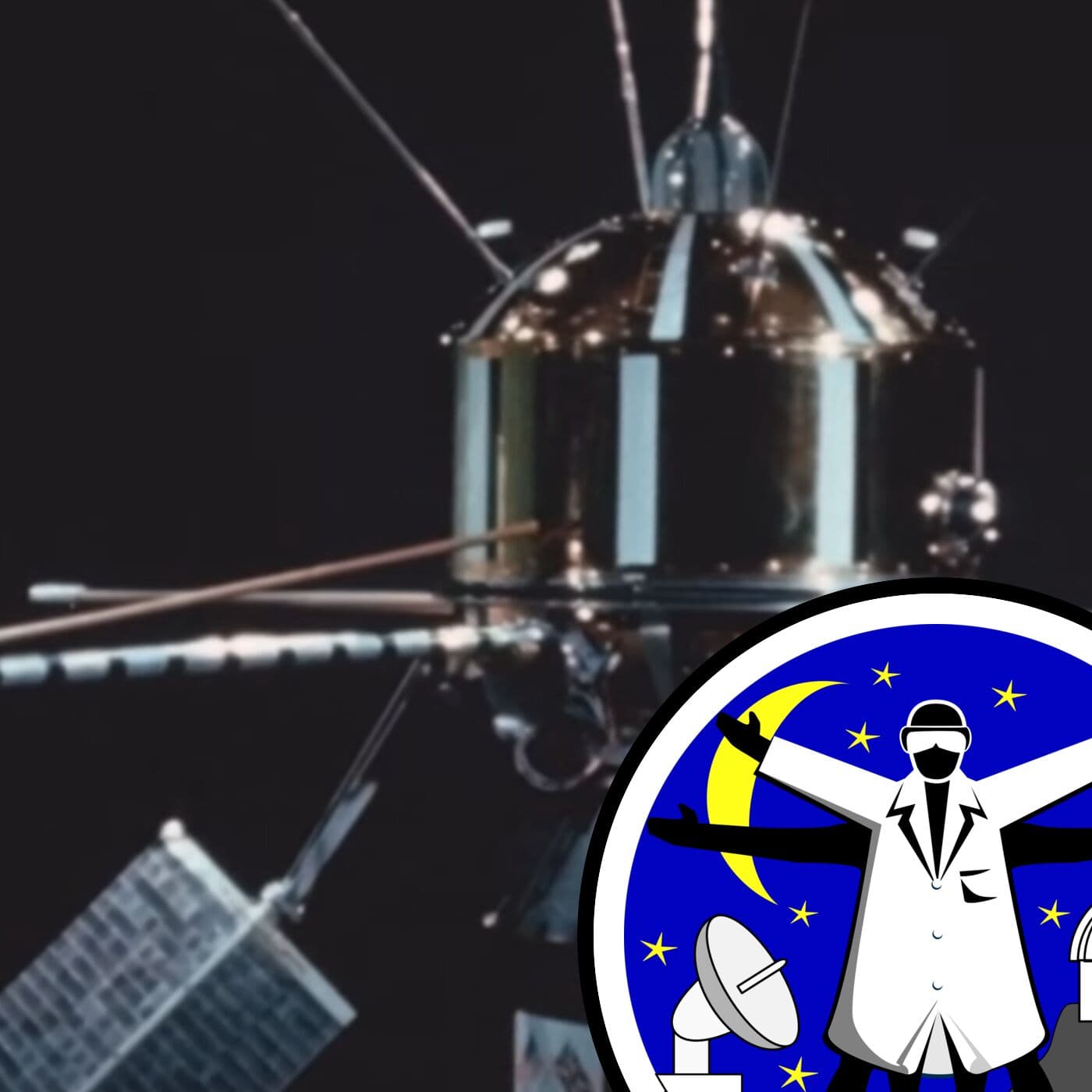
52:45I think they refer to that in one of the films, because how odd it is with these... It looks like a sci-fi spacecraft. It's a cylinder, but with lots of bits sort of sticking out all over the place. Yeah, I mean, we tend to think of space at that period as very glossy, very streamlined, very shiny. And this was referred to in the film as a space book. It looks like something from a kind of a Buck Rogers 1930s space epic, you know. But Massey did present it to the Royal Society and at one of the Royal Society of Soirees. And it's interesting that we're having Soirees at the Summer Science exhibition at the moment, so it's quite nice to get it out right now.
53:26But yes, he presented the model here at one of these exhibitions. This is a model of one of the more recent satellites to be launched, Ariel One, built jointly by the Americans and British in history's first cooperative space venture. Mission of the Ariel One? To discover more about the ionosphere. that vast canopy of ions and free electrons that starts about 50 miles above the earth's surface and extends out for at least 2 000 miles now you've also got some other articles here again in the royal society archive which i have to say you you do this really well you do actually keep stuff you do look after things yeah what's this article here the creaking gate in the hut in the field behind the village church um um so this is the creaking noise comes from ariel so it's a record of the noise made by the space satellite uh and one of my favorites is a cartoon this is harold mcmillan uh as ariel one orbiting kennedy oh i couldn't work that out i could not work that course so you look at this so it's a it's a caricature i could recognize kennedy the caricature of kennedy with the big the big teeth looking very american sort of large and then yeah absolutely the Prime Minister at the time, Harold Macmillan, looking kind of...
54:39I mean, he always looked fusty and old. He looks particularly fusty and old, but with the bits of Ariel sticking out, out of him whizzing around Kennedy. I'm happy to say there has been a successful launch this afternoon from Cape Canaveral of the first British satellite to be known as Ariel. That's good. And, of course, eventually he had to send a stiff letter to the Americans because the atomic bomb testing that they were doing at the time, took out Ariel One and quite a few other satellites. Yeah, I wanted to talk about that, actually, because you see in the film all about how advanced scientifically this satellite is.
55:18It had a tape recorder, which is pretty advanced for the time. It was sending back data. And then, yeah, it didn't last long in orbit. So just tell me the story of Ariel One. So from success to kind of geopolitical embarrassment. Well, yeah, because obviously this is an Anglo-British project, so it's bigged up as that, as a triumph of science diplomacy. And then, of course, yes, the Americans tested, I think they called it Starfish Prime, very weird name for a bomb, and it took out the satellite, which, of course, was quite scandalous. The Brits, I think, sent a letter of complaint to the Americans.
56:00It took out Telstar as well, I believe. The legend is that Marbell sent a bill to the American government for their satellite, which is a bit of a different reaction to the Brits. But yeah, it ended up being quite a bit of a debacle. And this nuclear explosion, we should say, so we were doing atmospheric nuclear explosions at that time. This was in the high atmosphere. So, I mean, it was really ill thought through. Well, that's right. And there are lots of articles at the time. interestingly, a new scientist and elsewhere about exactly this, what the problems would be if the Americans did test something in space.
56:36And therefore, it was a known quantity, but they went ahead and did it anyway. And yes, it took out, we think it eroded the solar panels on Ariel-1 and possibly affected the electronics and various other things about the satellite. Now, certainly the United States, United Kingdom's Ariel performed all its functions gracefully and efficiently. I love this headline. This could have been written today. This is the Daily Mirror, and it always shows how headline writers in the UK are so far ahead of their US counterparts. And the headline is, Britnik burbles on. So this is post this explosion. Yeah, so this is Sputnik, of course, and our first satellite is obviously going to be Britnik.
57:22So it's burbling around in orbit. Delhi Mirrors is a bit poo-pooey about the kind of the whole business of sending satellites in place. But it's interesting to see the various reactions of different parts of the press too, which should be a mighty event. Some of them are quite satirical, some of them quite respectful. And what, I mean, what was the reaction when you said that the government sent a stiff letter to the Americans after this nuclear testing? I mean, do we have any evidence of upset scientists or anything more made of that? Or was it kind of hushed up and we'll get on with Ariel 2?
58:01Well, as we know from the film, the British are very stiff about this kind of thing. So, yeah, Ariel 2 came next. So presumably all was papered over and the next satellite went up. Another step forward in the United States international program of space exploration. Let's talk about these films then, because the quality of the digitisation is spot on. They don't look like they're some dusty archive. Where were they found? We have lots of cans of film in the Royal Society's archives. And inevitably, when you get cans of film, nobody bothered to put on the outside of the can what was on the inside.
58:42So we're digitising them partly to find out what's there and quite what the significance of these things is. And we were really delighted with this one because we were already doing a Google Arts and Culture resource on cooperation between America and Britain for the great American anniversary, of course. and we found this quite late in the game but we instantly had to do it use it because it is such a nice example of a 20th century American British project now of course once we saw the thing we saw really how good it was and how funny as well it's hilarious it's good period stuff today we know that space is a violent vicious place black and frigid beyond imagining devoid of all that can sustain life.
59:35A killer, an enormous, endless, boundless nothingness that seems to say to man, you shall not pass. Why we had it at the time, we don't know. I mean, I think the one with Harry Massey in was presumably just because it had a fellow of the Royal Society in, so they kept it for that reason. And the film gets chopped off after he's presented his piece, so you kind of think that the Royal Society thought Harry Massey very important, And that stuff about the satellite later on, not so important. That's what we really wanted. And when you first saw it then, what were your reactions to it? Kind of mouth open, really.
1:00:14Because I just was firstly amazed at the quality of the film, because it is colour stock. It's really quite, quite good. The production values at the time, excellent. the performances of some of the journalists and others not quite so good i mean it's extraordinary extraordinarily stiff aren't they that they really are and you can understand that of the scientists but you know they're kind of trying to explain in a glossy uh film like this using a blackboard and chalk uh it's kind of it's a bit old school really but i guess that's what the scientists are used to doing remarkably beautiful handwriting though the ionosphere is composed of electrons and positive ions it does feel almost when you watch it older than it's this time you know this is 1960s we're talking about space and the space race but the way they've made the film it feels like it could have been made in the 1930s or 40s well i guess many of the scientists who involved like massey did a lot of the work in the Second World War, you know.
1:01:22So, I mean, they've got that mentality still. And yet here is quite a modern feeling medium for them to use. And so that continues. You had Ariel 1 and then you had Ariel 2. This cooperation between the US and the UK. Well, that's right. And eventually, of course, the Brits managed to launch one satellite on their own. I think it was called Prospero. So there's kind of a Shakespearean theme carrying on there. But of course, the British space program rapidly deteriorated, too expensive. Only Americans and the Russians could get to do that kind of thing. So it fell by the wayside. But of course, these days, Britain is quite well known for the development of satellite technology.
1:02:12So things have gone full circle. As new tapes are completed, they are sent to Great Britain for analysis by scientists of the Royal Society. I like to think the films we make are a little bit quicker and pacier than the films of the 1960s. Well, let's hope so, and we'll find out when you edit this. Yeah, that's right. What's going to happen to this film? Is this going to be available for everyone to see? Yeah, well, it's going to be launched on Saturday on Google Arts and Culture, so anybody can have a look at it with some other Ross-Sitey material from the American side of the Fellowship. So, yeah, have a watch of it, and we'd be interested to know, A, what your reactions are, B, if anybody's got the cut bit of that film.
1:02:55Yeah, because is it cut then, or is it just a real missile? I think it's a cut, but it's interesting that NASA didn't have the film. So, you know, we'll give them a copy. But if anybody out there has got the whole thing, we'd like to know. Have you got any other exciting films? Do you know? I mean, have you got some more unopened cans of film somewhere that you think, well, this could be, you know, this could be a goldmine here? Well, yeah, there are lots of other films. And it's all kinds of things that were presumably shown at the Royal Society in lectures or exhibitions over time. So we're gradually working our way through them.
1:03:32and some of them do look quite intriguing from what's left on the outside of the can, but you'll have to watch the space to see what we find. So on that cliffhanger? On that cliffhanger. Helping man acquire the knowledge he must have to master the dark beyond.
1:03:58Keith Moore, the head of the Royal Society Library, with some extracts from those rediscovered films. And as Keith said, you can find those films on the Royal Society's YouTube channel. They are brilliant. The first one, incidentally, is called The Dark Beyond. You're humming this up, aren't you? The Dark Beyond. and as you can probably hear we have moved to a very different location than outdoors next to a quarry. That's right now I mentioned earlier that I'd been to the Nordlingen Rees Crater Museum in 2019 and that's where we are now with its director Dr Christian Bergerman. Explain where we are right this moment because Richard and I have just looked around the museum which is really lovely but we've come to a rather special place behind the scenes thank you for the praise for the museum and welcome and it's um yeah right now we are in the in the core collection room of the museum where we have the house the main event basically is the the drill core from 1973 when they were looking at how a impact crater looks like in the underground because it was actually the second crater that was ever identified as an impact crater only the second Yes, after the Berenger crater, actually, which is rather obvious as an impact crater.
1:05:18Here they drilled then down 1.2 kilometres to get an idea of what the underground looks like. And we still have very often researchers coming asking to access the course. Just recently we had, for example, a group from China here. We just got a request from a group from Canada. So a lot of people are still interested in this. And we ought to explain what they look like because it's sort of a miniature version of the behind the scenes of Raiders of the Lost Ark when you have all those crates. But instead of big crates, you've got these tiny little wooden shoeboxes. Actually, they're not that tiny.
1:05:52They're very long shoeboxes. Yeah, that's huge. It's two metres long. And you can see the circular core of rock that you've pulled out there. So inside all these hundreds of miniature, which are slim but quite long crates with these rock cores in. These are all from the crater. Exactly. And why did you need to get so many? Well, I mean, it's the entire way down, as I said, to 1.2 kilometres. So you have to go through... So this is 1.2 kilometres worth of core, all in individual boxes. All of this in one room. And you have to go through the sediments that were deposited during the Ice Age, after the formation of the crater when there was a huge lake here inside for about two million years and then through the the sewer vides so the impact break shares that formed and all the way down to the basement to the crystalline basement to kind of see how it how it was affected there we're in this beautiful medieval walled town or city at the city at the time and then surrounding that and you can only really get a sense of it when you climb up the church tower you can see that this sort of flat landscape and then it's very clearly a kind of rim all the way around but no one realized this is what i can't get my head around no one realized that something hit the earth to to cause this until relatively recently and certainly in the 20th century yes actually i mean people found it always fascinating so like centuries ago people noticed that it was strange that it was a weird place like you have these hills all around and then suddenly you have this flat area which is almost perfectly circular so people were were wondering what it was and for a long time people were saying that probably it was a volcano or something like this and also the rocks look very similar if you look at the impact rocks they look quite similar to volcanic rocks so that was the general opinion here and from what i remember someone actually suggested at the beginning of the 20th century that it might have been an impact crater, but was kind of laughed out of the room, if you will.
1:08:03And then only after the Second World War, people actually came from outside and had a look again and knew how the crater that was first identified, the Berenczak crater in the US, how it looked like, how the minerals looked like. And then they checked here and they found the same kind of minerals. And so they could prove that it was actually an impact crater then. That's also why it's still also for universities, for the teaching activities. It's still in all the textbooks because it was just basically the only, the first complex crater that was found. It's sort of a geologist's dream really, isn't it?
1:08:43Basically, yes. Yes. Yeah, no, it actually is. We get all the time field trips from universities all over Europe coming here and then also as I said also researchers from from all over the world coming here. And when the asteroid actually impacted so that's 15 million years ago what was this region like what was Nordlingen like then? Well Nordlingen didn't exist let's just say the region yeah. Well it was a subtropical landscape at the time with the elephants and the predecessors of lions and small antelopes running around, crocodiles and everything. And then the impact happens. And as you can imagine, basically, middle of Europe ceased to exist almost like from life perspective.
1:09:30And there's actually some colleagues found now evidence that there was a time of very strong erosion also that they found. They cannot prove that it was the impact, but it's the only event that fits. And you can find material from the impact down to southern England, central Italy, and you can find the impact glass. This is called the, not coming to me, well, anyway, the impact glass all the way to the Czech Republic, where it basically kind of went out and then fell down as pieces of glass there in the Moldavite. The stuff is called Moldavite. And they still use it for pieces of jewelry. I think I've got something that's made of Maldivite.
1:10:14Exactly. It's a very nice green colour. Yes, that's why I got it. It's still collected there and it comes probably from this impact. Now, we talked about the cores here. You've also got quite a sophisticated amount of equipment here in terms of still studying the area. So your research lab as well as a museum. And that's what brought the astronauts here, really, the geology, the fact that they can see here on Earth what they were expecting to see on the moon. Exactly, yes. I mean, the museum did not exist in the time it only opened in 1990. But, yeah, that was the idea back then, because, as I said, I mean, there were only two craters really proven at the time, and this one was really accessible.
1:10:57And so they came to have a look at the rocks that would await them on the moon, so just to give them an idea of what they would see. And that's also why the AESA is still coming nowadays also. So astronauts still coming here? Yes, every couple of years, more or less, for the astronaut training. Before we came here, you know, we popped via sort of part of your office and we saw that lovely little NASA box, which had the old, the worm logo on it. And what was inside that? Inside that was actually a piece of the moon from Apollo 16, which the mayor at the time flew to the US, got the box with the moon rock inside as a permanent loan from NASA, then basically flew back hugging the box and then they put it here in the still where it is now.
1:11:43So that's amazing. It's almost the full circle of the story that you've got moon rock, not from an asteroid, not from a meteorite, but moon rock collected by a human, an Apollo astronaut on the moon. Exactly, yes. It's a very nice story for that, yes. Dr. Christian Bergman, thank you very much indeed for showing us around. And I must say, this is my second visit now to the museum. And it's just as wonderful, but even better second time around. So thank you. Thank you very much. I'm very happy that you came here. Do send us your reactions to anything you've heard in the podcast. Let us know as well if you have any other hidden UK space archive in your attic or anything.
1:12:28If it's a film, we can probably show it because we have a 16mm projector. and that's it for the 15th anniversary edition of space boffins 15 years that's not too bad is it thanks for listening and of the same
1:12:46acas powers the world's best podcasts here's a show that we recommend
1:12:55what if you laughed all through your commute or if you heard the funnier story while at the gym Well, now you can. I'm Jameeda Jamil, and guests on my new podcast, Wrong Turns, share their most mortifying and hilarious disaster stories. I'm talking people like Mae Martin, Bob the Drag Queen, Catherine Ryan, Jake Johnson, Margaret Cho, Simon Pegg, Penn Badgley, and so many more. So listen wherever you get your podcast, Wrong Turns, where dignity goes to die. Acast helps creators launch, grow, and monetize their podcasts everywhere.