Ask ChatGPT
 Newcomer Pod
16 Nov 2026 · 20m · 12 chapters
Databricks CEO discusses how Jensen Huang’s departure (and NVIDIA’s role in the AI ecosystem) affects open-source AI, AI chip timelines, and Databricks’ own business; plus Databricks’ model-agnostic strategy, smart routing, and its agent product Genie.
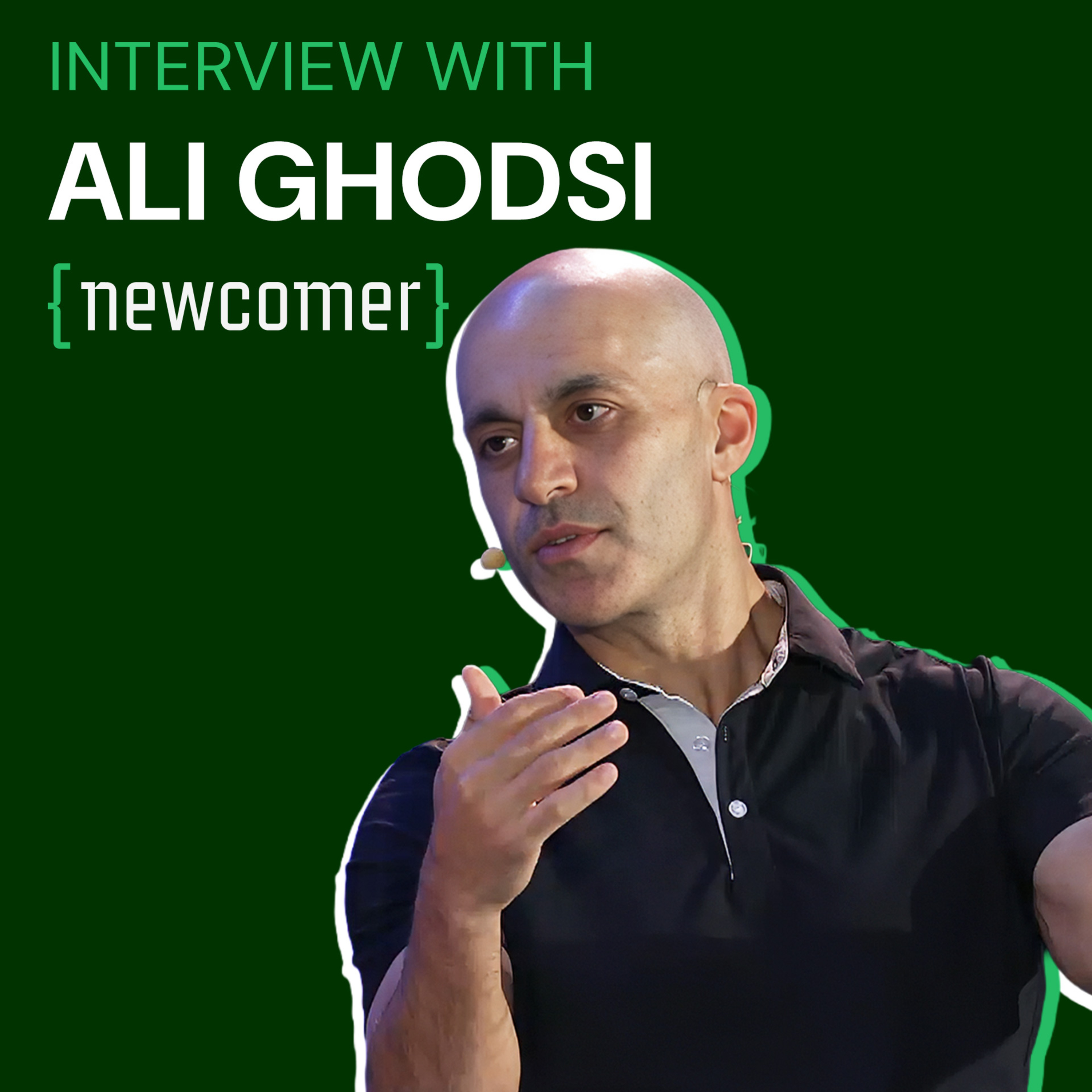
Ali Ghodsi, CEO of Databricks. No other named guests appear in the transcript.
NVIDIA will be fine short-term because chips take 2–3 years to produce; the “Jensen news” is bad for the broader ecosystem and open source, though Databricks is “a couple of layers removed” from chips. Databricks is fine and will eventually go public; 2026 would be a bad IPO year. Open-source will persist via distillation; fully stopping distillation is “literally impossible.”
Databricks AI Index (router across OpenAI, Anthropic, Gemini, Grok, and open-source); Omnigent omni-harness multiplexing; Genie agent building an ontology from email/Slack/docs and drafting decisions; Spark (open-source project started 2009; business took off in 2016).
Written by AI. May contain mistakes.
Discussion on Jensen Huang's influence on the AI and open-source ecosystem.
“NVIDIA will be, they'll do fine and they'll do great.”
Exploration of potential shifts in the AI ecosystem following Huang's exit.
“I think it was Igor River who was bringing up that point.”
Evaluating the lasting legacy of CEOs in tech companies after their departure.
“means the market is pricing in that they're fine besides the hit you know AI valuations what's the damage to Databricks specifically or where does it hurt you?”
Insights on market trends and the timing of potential IPOs for tech companies.
“many of the competitive sort of aspects of how he thought about how they strategize, how they bundle things, all of those things kind of lived on for many, many years to come.”
Introduction of Databricks AI Index and how it addresses customer cost concerns.
“I wouldn't be like, oh my god, I'm so shocked that it's like 2.5.”
Discussion on how Databricks manages model usage and costs for customers.
“over the, since the last summer, this summer is a huge surge in open source.”
Distinguishing between the stickiness of harnesses and models in AI applications.
“But the harness, once they get used to the keyboard shortcuts, their memory, how it acts, the ergonomics, they're like kind of, there's a stickiness there.”
Key insights and advice for aspiring startup founders in the tech industry.
“and it spits back English randomly to you and it's different every time.”
Overview of how AI agents are transforming operations within companies.
“project called Spark, which we started in 2009.”
Learn how AI transforms decision-making and operational efficiency in leadership roles.
“It has access to email is that the slack is access to all your documents and all of that And I run the whole company with this would you let it reach out to people on your own?”
Discover the implications of open source models in AI and their competitive landscape.
“I was like, so you're just getting it from Genie?”
Explore the future of AI models, including the balance between proprietary and open source solutions.
“Yeah, so I think that But this was obviously bad news.”

Get the gist, explore an idea or ask about something said.
 Claude
On Newcomer Pod, what are the key points of this episode?
Searching your listeningAutomatic transcript. May contain errors.
0:00NVIDIA will be, they'll do fine and they'll do great. And that's why you see their stock goes down like only 5%, which means the market is pricing in that they're fine. You can cut the cost down significantly. You can specialize the models. We specialize a lot of the models. I also think we're going to see more open source models come out of the United States that are pretty good. My life has changed. I'm like 10x better CEO now than a year ago, and it has nothing to do with me.
0:20Eric Newcomer: We should have prepped the questions so I knew what was coming. I tried. You're like, no, come at me. Zero chance. I'm very, very happy. I mean, you know, Jensen had started to position himself as, you know, the godfather of open source, something that you feel very strongly about, you know, acquiring companies dedicated to open source, funding them, obviously, and just being their biggest champion. We've heard that here on stage. I think it was Igor River who was bringing up that point. Is this a blow to the open source AI movement? Yes. It's a blow to, I think, everything. and pretty much every player in the space except direct competitors you know I mean direct competitors obviously benefit but yeah I mean like AMD you're saying chip makers yeah I mean if you're building a chip I mean I'm sure you know they knew him and they're sad about it as well just like the rest of us but I mean if you're a direct competitor and you have an iconic CEO of you know greatest company no longer being the CEO that's good for you at some level but everybody else.
1:29It's bad for the ecosystem, it's bad for open source, it's bad for, you know, I mean, near clouds, you know, everybody, right? Because they were kind of, they were the back kind of, you know, the backbone of the whole ecosystem. They would support all these companies and also companies that needed to sell, you know, many of them found the home at Nvidia. So yeah, I think it's all around just really, really bad. Having said that, you know, it takes two, three years to create these chips. So I think we're buying the chips today that were produced you know that they were working on two or three years ago I think Nvidia will be fine the next two three years it's not gonna be even affected and three years from now I don't even know I mean if you talk to AI people they say you know you know I don't know they think there's 10 % chance that the
2:09Eric Newcomer: world doesn't exist in right so so then you know what are we even talking about so how they're great partner and I think Nvidia will be they'll do fine and they'll do great and that's why you see their stock goes on like only 5 % which means the market is pricing in that they're fine besides the hit you know AI valuations what's the damage to Databricks specifically or where does it hurt you? I think Databricks is totally fine and I think also NVIDIA as a partner is fine I don't think it really affects us directly but I think the whole AI space You know, I mean they were just you know whenever whenever there's any doubts around anything any financials NVIDIA was there to say like oh don't worry.
2:46We'll walk back stop that we'll do this we'll help with this We'll help there, you know, it was just like a big supporter of startups and ecosystem. I mean Jensen himself was the supporter of that whole ecosystem so he was always there. So whenever there was like hesitation and things are in the bubble he was there to say oh don't worry about it I got their back. That's no longer there so I think on the margin it's gonna start hurting a lot of the players. Databricks is a couple of layers removed from the chips directly we run on top of the hyperscalers so we're fine. What's your view on the iconic CEO these days?
3:17Eric Newcomer: I mean you're an interesting case in that obviously a big personality looms large in a room but you were not the founding CEO you came you were a founder but you sort of came into it how much do you think you know a company like Nvidia lives or dies based on a Jensen or these companies can rewire and find new charismatic leaders I think the the essence of the personality of the CEO continues to live in the company for long to come so I think Jensen's legacy will continue to be there at NVIDIA for decades to come. So he built an epic company and I think that's going to continue. Why do I say this?
3:51Look, Bill Gates was Microsoft, right? It's like he was Microsoft. You could not disentangle the two and the two got disentangled. But still, many of the competitive sort of aspects of how he thought about how they strategize, how they bundle things, all of those things kind of lived on for many, many years to come. And Travis was Uber and so on and that continued living. So I think the culture of a company is a lot actually the personality of the CEO that is there for a long time. Over time, CEOs can change it. You can see with Steve Jobs and Apple and so on. So over time, it changes, and it depends on who the next CEO is, but by and large, I think it continues.
4:29It's all those little micro decisions that the company does every day and how they operate and how they think that has been put in places over many decades by Jensen. That will continue the same way.
4:39Eric Newcomer: I think you were on the record saying 2026 would be a terrible year to go public. I got so much shit for that. So many people reached out immediately after. I was like, why would you say that? Don't do that. You're like ruining the party while it's going. Are you glad you're not going public right now? Yeah, I stand by what I said. I think I was correct. Any advice to Anthropic? Anthropic is an epic company. They're doing great. I'm sure they'll have an amazing IPO. The way it's priced, I would be shocked if it doesn't pop like crazy. You think like above$2 trillion? I wouldn't be surprised. I wouldn't be like, oh my god, I'm so shocked that it's like 2.5.
5:15No, all right. But then it's stabilized at some point. But yeah, I think, you know. And I think also OpenAI, fantastic partner also.
5:22Eric Newcomer: What do you think Anthropic is worth today? I don't know. The markets, they go up and down, and it's scarcity, and it's floats, and it's gains, and so on. But after a while, as they say, in the short term, it's a beauty contest. But in the long run, it's going to be a scale that weighs the discounted cash flows of the future. So after a while, it'll stabilize. You saw that with SpaceX, right? It like popped and then it went down and it was like really down and then and now it's like stabilized It's something that makes sense. I think same thing will happen with Anthropic and same thing hopefully with OpenAI And what about Databricks?
5:52Eric Newcomer: When does Databricks go public? That will happen too. As I've said, I will not disappoint at some point We will also go public and you don't believe in this perpetually private, you know, strike. No, I don't believe in it I You know, I don't want to mention names, but I do have friends who believe in more perpetually private I don't believe in the perpetually private because you know every year we provide liquidity opportunity to our employees. So we have to facilitate that for 12 ,000. Actually, it's like more like 14 ,000 employees because we do it also for X employees. So we kind of have to like simulate a whole marketplace more or less where we, you know, buyers and sellers and set the price.
6:25And it's a big lift for my finance department to do every year so that all these employees can get liquidity. So it's just, there is something that was invented that can do that really, really well. It's the public markets. So eventually that will happen actually and we will do that. But people don't care so much about it anymore at Databricks, the employees at least, because they already have that opportunity.
6:45Eric Newcomer: Let's talk Databricks for a couple beats here. You've taken this really sort of model agnostic approach. Can you talk about that? What's the reception from the customers? I mean, on one hand, we're in this sort of, I guess, already post-token maxing world where people do care about cost. On the other hand, I'm running an AI conference, and I don't even necessarily feel sophisticated enough to choose which version of Anthropic I need for a given task. It's a lot to ask a customer. How much are you going to make the decision for them? What's your view on shuffling between models today? Yeah, we will release something called the Databricks AI Index, where you can actually see.
7:23We actually run one of the biggest routers. Over four quadrillion tokens go through us. and you can get tokens from us for OpenAI, Anthropic, Gemini, Grok, and all the open source models. So we get a cross-section of what everybody's doing, and we've seen huge surge in open source usage over the, since the last summer, this summer is a huge surge in open source. And so we released a smart router that automatically just detects if the question you asked is simple enough that it can route it to a simpler model, to an open source model, and you can get massive cost savings, and we allow people to opt out so if you kind of suspect that we're routing you and smart routing you and you feel like you got short change you can opt out of it and the opt-out is like 1 % or less so people would want to opt out because
8:10Eric Newcomer: they're worried that you're getting some cost savings by routing them no someone might say oh wait a minute I asked a very complicated question this would be the bad scenario I asked a very complicated question and I got a really dumb answer you know did you route me to a really cheap model that's not smart enough. That is basically non-existent. We're seeing in the data that is like 1%, less than 1 % that that happens. So basically, we're able to take a lot of questions and route them through cheaper models and significantly compress the cost. So check out the Databricks AI Index when it comes out.
8:39When's that? Very soon. Okay, we're working on it.
8:43Eric Newcomer: I mean, when your own employees use models, you're like, well, we're a sophisticated tech company. We get to use the state of the art. or what's your what do you hear from especially your coders in terms of their appetite for the best of the best yeah I'm saying there's very little opt out I mean we told them like we ran a B tests between the two groups as well and yeah people people are totally fine they're like this is great because you have to contrast that with the cost situation the costs are going up exponentially but revenue is not going up exponentially for all these companies that are using these models so something has to give so they really want to compress that cost down.
9:17So it's very common. I mean, we see in our data, over a majority of our customers have over three models. So you can just see there, right? So I think it's not super sticky, and people are pretty flexible with that. What is sticky are the harnesses. You know, the harnesses are sticky. And are you building your own there? Yeah. We announced Omnigent, which is an omni-harness that uses the existing harnesses. So you can have codecs, you can have cloud code, you can have Pi, you can have open code, and it just flips between these. Because we do see that otherwise the harnesses are sticky. And once people get stuck on a harness, they don't want to change.
9:52So that is very different from the models. The models are not sticky. People are like, oh, you know, anyway, it gives me a different answer. I'll take the cheaper one, the smarter one. That's changing very quickly. But the harness, once they get used to the keyboard shortcuts, their memory, how it acts, the ergonomics, they're like kind of, there's a stickiness there.
10:08Eric Newcomer: But is that because they're not that expensive that I mean would you spend a lot of money on a harness or it's just Okay, if you're giving me a harness as a free feature on some other service, I'm not gonna change it I just think over the last 40 years software has had these amazing gross margins Why is that? Well, it's because a lot of these software companies had this moat. What was the moat? The moat was that people once they get used to a UI It just we're humans. We haven't developed Right. I used to work at Bloomberg. It's like people learn all the yeah, you know the Bloomberg terminal you learn And shortcuts, same thing here.
10:40You're an Android person, you're an iPhone person, you know Windows, you know Mac OS, you don't want to switch. And the harnesses have that. The models don't have that. It's just something you speak English to and it spits back English randomly to you and it's different every time. So I think that there's a big difference between those two. So that's why we released Omnigent, so that you can actually now multiplex between any of them.
11:01Eric Newcomer: I think you were number three on the AI 100 we released today. What lessons would you give? you know we have sort of a next generation not that you're not the next generation but a new generation of startup founders growing today yeah like what advice would you give them in building their businesses both just growing teams like are you are you one do you sort of think we should have you know 10-person teams driving billion dollar companies today or you think they should still hire top talent aggressively like what advice would you give to startups i think they should strive at doing that. I think for, look, when you were a start, I was a startup, everything works against you.
11:40It's just, everything is uphill. It's all just bad news all the time. It's like you never get good news and it's just like this vicious cycle and then you see all these people that are like in the news and they're just crushing it and everything is going up up to the right and so on and you look at yourself and you're like I just suck and it's never gonna work. And it's just bad news after and then you have a board meeting and they yell at you. So that was our life for three years or something like that, right? It was like Databricks for three, four years. So...
12:04Eric Newcomer: Because for a while, you're dummies. You haven't figured it out. And then you're geniuses once you... Yeah, then it's like, okay, these guys obviously had everything right from the first moment. So the way you're going to beat the big guys is to exactly bet on that secular shift where the company is completely automated. And it's doing things in a completely different way from the big guys. That's what you should bet on, and you should go for it. No one's ever done it. No one's built a 10 % company that has billions of revenue, but you all should strive to do that. And some of you will succeed in doing that.
12:37And you need to make these bets that are asymmetric where people say, that's a bad idea. That's stupid. You cannot do that. You cannot have a 10 % company that has billions of revenue. You need to have that. And then you need to prove them wrong. Only then can you actually win because the big guys will then ignore you and say, yeah, it's a stupid strategy. You can't do that with AI. But you need to make that asymmetric bet and then you need to prove them all wrong. And that's how you become a great company. And I think some of you here will manage to do that. Some of you will fail, then try again.
13:06Because for most of us, it wasn't our first startup either. It's not like I started a company and that was Databricks. It wasn't. I had another one. It didn't go so well. So try again and again and again and eventually you're going to get there. It takes many years. Even for us, when I said those three years, we built the whole company on an open source project called Spark, which we started in 2009. 2016 was the year that we finally took off and people started saying maybe there is a there there. 17, everybody was like, okay, yeah, definitely the business model works, right? So that's eight years in.
13:35Eric Newcomer: Are you agent-pilled? Like, are you using a lot of agents yourself to interact on your behalf? Yeah, so we launched something called Agent Bricks or agent software that's called Genie. We launched it three, four years ago. We released a new version of Genie yesterday. So second generation of Genie, it's completely autonomous. It runs in the background and but the most important thing is it builds an ontology of your company's Orchart the people what they're working on, you know It has access to email is that the slack is access to all your documents and all of that And I run the whole company with this would you let it reach out to people on your own?
14:10Yeah, it's this I run the whole company like my life has changed I'm like 10x better CEO now than a year ago and it has nothing to do with me
14:17Eric Newcomer: But what happens if somebody's like, oh, is this the real Ollie or was this the agent Ollie? First of all, it knows how I, so it has access to all my emails, so it uses my tone for everything, right? So it's all in my tone. But do you click approve or just it's sending? The way I use it is that it has a draft mode, so things end up in my draft outbox and I look at them and send them. But it's all like prepared for me and it goes through all of those. But that's like not the most amazing thing. The most amazing thing is like, you know, you have this org chart of the company and everything has to go up and down the org chart.
14:46We're 12 ,000 people. So this is a very long time to make decisions. But the way Databricks or any company actually works is kind of horizontally, right? We're like, customers give us feedback to product management, which gives it to engineering, which builds it, which gives it to marketing, that puts it on websites, and gives it to sales, they sell it. So really, everything happens like this. But decision-making has to go up and down, and it's extremely slow. So with Genie and the ontology that it has, we can start going more this way. And it just speeds things up so much. So yeah, I run the company completely differently using Genie for everything You know in every department finance engineering I use it And it's been a game-changer
15:22Eric Newcomer: There's a risk of undermining your executives where it's like I'm Sort of pulling up the information about your own department and sort of knowing facts that you used to be the gatekeeper for How do you see those dynamics? But they do the same thing. They're doing the same thing I remember I needed to know at some point I was like I need this statistic to be correct I need to know the penetration of fortune 500 So I asked the person in sales that actually has that number and And she said, oh, sorry, I'm on a plane. I can't log into Genie. I was like, so you're just getting it from Genie? I can get it from Genie myself.
15:49So I got kind of irritated, and I sent it to our CFO, Dave. And I said, hey, Dave, can you get me this Fortune 500 presentation? And he sent me a screenshot of Genie. So everybody's using, so we're all doing the same thing in the company. So yeah, everybody has access to all of this. And I think it's a good democratizer. So yeah, you can't hoard information and guard it. And you have to be the gatekeeper of it. It's all there. Of course, this supports the access controls that we have in the company. so, you know, it's confidential information stays. You get to see everything. Pretty much everything, but not everything.
16:19Like, we did the culture survey just now of 10 ,000 people. I don't know who answered what.
16:24Eric Newcomer: What is your scorecard on American open source right now? I mean, you sort of, famously to me, like, invested in open source models yourself and then sort of realized, oh, my God, I'm going to sink endless amounts of money into this if I keep going. Let's not spend it and stop. And then obviously there have been a lot of Chinese companies that have distilled models that American companies have You know gone to our US inference providers to to help them access And they access directly now we've seen a wave of funding partially from Nvidia Into state-of-the-art open source US startups Are you optimistic about that effort or is open source really a Chinese thing that we take advantage of or how do you think about The actual open source models themselves?
17:07Yeah, so I think that But this was obviously bad news. The Jensen news is bad for open source, obviously. But I'm an open source bull, and I'm an American open source model bull. I also think we're going to have proprietary models. And I mean, Anthropoc is going to be fantastic, OpenAI. These companies are going to do amazing. But open source is going to be there. I think just distillation, which the original models were distilled of all the information on the internet, right? Destillation is just so powerful. It just works so well. It works even better when you're doing it on, you know, reasoning traces and so on.
17:43And it's nearly impossible to stop distillation, right? It's very hard.
17:47Eric Newcomer: They think Anthropic thinks they're gonna stop people from distilling. I think fully stopping distillation is literally impossible because how can you discern what questions you're asking from a model is being gonna be used for distillation. Some of it is just legitimate usage and this stuff also leaks out, right? So as a result of that, I just think it's really really effective to do reinforcement learning for specific use cases and compress the price down for use cases that are repetitive that you do again and again and again. And most of the work in the economy is in that class. Now, there are things we need to do, like new drugs that we need to discover and diseases that we want to cure and financial models and so on that where we need the latest, latest, best intelligence possible.
18:27That will remain, and we will use frontier models. But as our smart router shows that I just mentioned earlier, you can cut the cost down significantly. You can specialize the models. We specialize a lot of the models I also think we're gonna see more open source models come out of the United States that are pretty good
18:40Eric Newcomer: So you're done you're out of the model game for now. Yeah To change your mind or well, it's it's a it's a how much of your market cap do you have to spend on GPUs Okay to Be in as I come down or no it has come down but not enough for me to say hey, let's do it So either the database market cap has to go up really fast or the cost of training these things has come down or both then we might change our minds. Yeah, but yeah, I think I'm bullish on American open source. There will be models that are awesome that we're all gonna use and we will continue using Frontier proprietary models as well. Ali, great to have you.
19:15Eric Newcomer: Thank you for joining us. Thank you.
19:34Bye.
What does AI lose without Jensen Huang? Databricks CEO Ali Ghodsi explains the stakes for NVIDIA, startups, and open source AI.
Ghodsi joins Eric Newcomer to discuss Jensen’s role in backing the AI ecosystem and why he believes NVIDIA’s strength can outlast its iconic leader. He also shares his outlook on the Anthropic IPO, why Databricks won’t stay private forever, and the pressures of rising AI costs.
Inside Databricks, Ghodsi explains how routing between AI models can lower costs and how he uses the company’s Genie AI agent to help run a 12,000-person organization. Plus, why he’s bullish on American open source models and what startup founders should understand about building billion-dollar businesses with small teams.