
 Ask ChatGPT
 No Such Thing As A Fish
26 Jun 2025 · 52m · 21 chapters
Navigation and the brain, plus literary history and a Samoan cricket coup.
Miles Jupp (British comedian/actor; live show “On I Bang”; toured for 20 years; coming to New York’s Soho Playhouse in November).
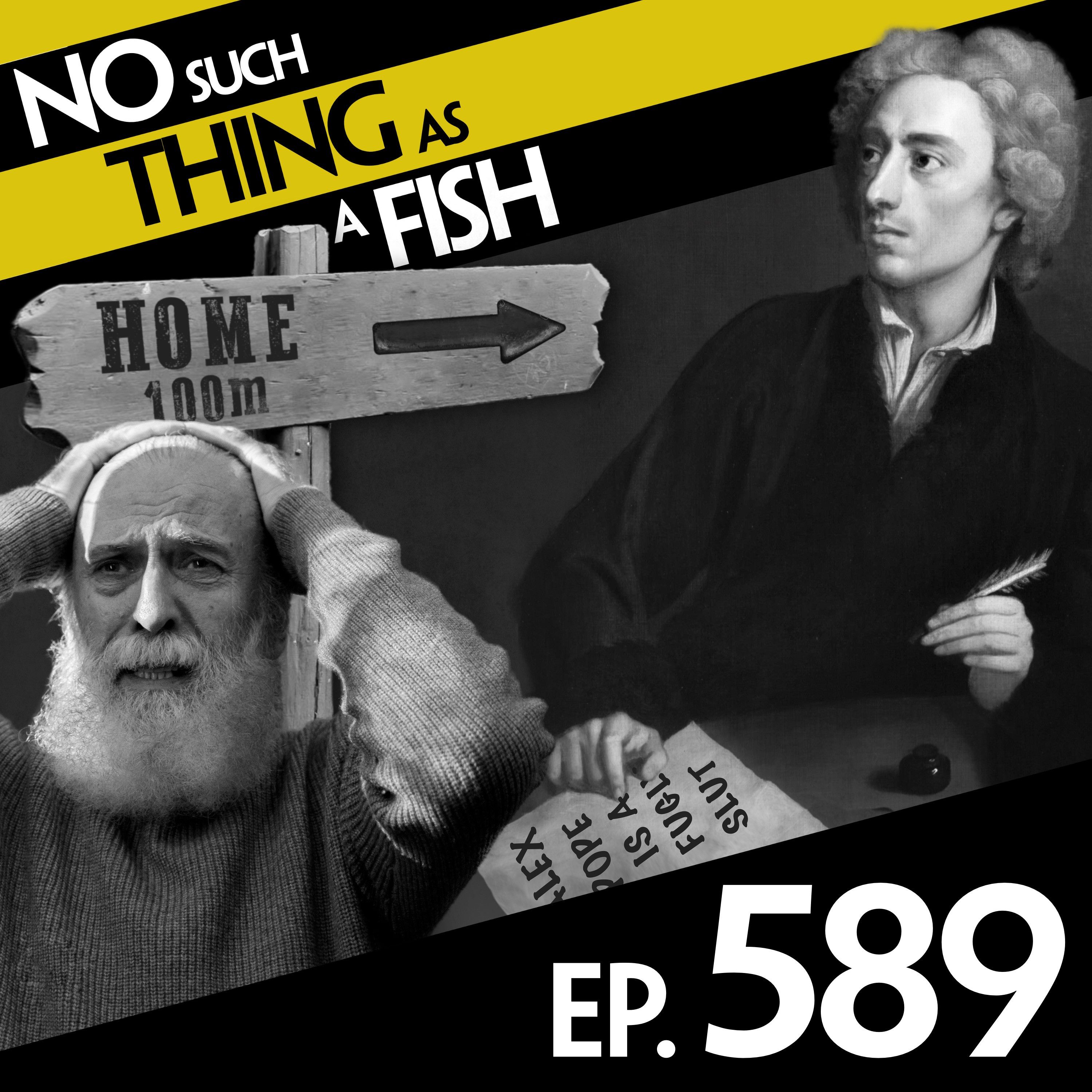
People who get lost typically don’t travel more than 100 metres from where they started, even if they keep walking; panic and over-correcting contribute. Navigation cues include landmarks, sun position (e.g., sunburn side), and even echolocation. Dung beetles use the Milky Way for orientation; covering it makes them go off in “wild directions,” and they get “lost” in a Madame Tussauds planetarium scenario.
Tristan Gooley’s wilderness tips (snails and calcium carbonate as chalky-land indicators; bonfires inferred from foliage). Wilder Penfield’s brain mapping via awake surgery and the homunculus. Alexander Pope’s critic “Esdras Barnevelt” (a pseudonym that turns out to be Pope himself) and Pope’s later feud with publisher Edmund Curl. Samoan king’s 1885 plot to disguise an army as a 200-man cricket team; local cricket (“Killikiti”) with different rules and huge player numbers.
Written by AI. May contain mistakes.
Discussing the psychological aspects of getting lost and the research behind it.
“And once again, we have gathered around the microphones with our four favourite facts from the last seven days.”
Exploring how humans tend to walk in circles when lost and the implications.
“I read a very good book about wayfaring by a man called, it's called Michael Bond, but it's not that Michael Bond.”
How virtual reality environments illustrate our inability to walk straight without landmarks.
“Oh yeah we did play a virtual cricket game.”
Discussing human echolocation and how people can navigate using sound.
“You just look at your surroundings, you can tell where you are.”
How dung beetles use the stars for navigation and the experiments proving this.
“Yeah, in the Northern Hemisphere, if you're more sunburned on the left side of your face or your left arms, you're probably going westward because the sun...”
Introducing a technology that encourages exploration by tracking predictable behaviors.
“Did you guys know you can all echolocate?”
Explore how our senses contribute to perception and navigation.
“But if you've got walled, say, two feet either side of you and then the other wall isn't there for sort of another 40 metres.”
Delve into the unique strategy of Alexander Pope's self-critique.
“Alright, there's time for fact number two, and that is Andy's fact.”
Uncover the competitive and playful literary antics of Alexander Pope.
“Or did he say it would have been better if you'd done it this way?”
Examine the complex persona and public image of Alexander Pope.
“about his vomiting, and so they really fell out, those two.”
Learn about the health challenges that shaped Alexander Pope's life.
“And I think that probably is what slightly made him an angry little man.”
Discover the awkward courtship between Alexander Pope and Mary Montagu.
“Well, he's small, he's got some confidence issues, and he hates everyone.”
Highlight the significant contributions of Lady Mary Wortley Montagu to medicine.
“He'd chosen a socially stupid moment to do it.”
Explore how personal rivalries influenced public health in history.
“You're already fighting some considerable disadvantages in the romance game.”
Discover how the brain controls different body parts and the concept of the homunculus.
“sort of following the line of the brain, you draw the size of bits of the body, depending on how much brain is allotted to them.”
Learn about a special promotional offer from Jewel Osco.
“It's time to stock up and save now through October 27th.”
Explore the fascinating story of how cricket evolved in Samoa, including unique rules and cultural implications.
“Okay, it is time for fact number four, and that's James.”
Explore the cultural significance of cricket and its societal effects.
“Whereas if you've got 200 people you really could turn up going, where's the sort of quiet area?”
Discuss the evolution of cricket and its different cultural expressions.
“So you know in cricket you're not allowed to throw the ball.”
Hear about unusual cricket games and experiences shared by the hosts.
“So they had, this was particularly Calicuti in Samoa, so slightly different between Pacific Islands, but they had cheerleaders called Lape, and they would dance and they would sing to support their batsmen.”
Listen to a funny story about cricketer David Gower's escapades on ice.
“I was going to say, if you're just turning up there with your mates on this sandbank, and Stuart Broad turns up one of the greatest bowlers of all time.”

Get the gist, explore an idea or ask about something said.
 Claude
On No Such Thing As A Fish, what are the key points of this episode?
Searching your listeningAutomatic transcript. May contain errors.
0:00Hey, it's Ryan Seacrest for Jewel Osco. It's time to stock up and save now through October 27th. Get$10 off when you spend$25 or more on participating items. Just look for participating item tags to earn on eligible items from brands like Bubbler, Ghost Energy, Lindor, Halo Top, Vital Farms, Kellogg's, Campbell's, and Heinz. Clip once and save through October 27th every time you shop. Grab these hot deals before they're gone. Restrictions apply. See website for full terms and conditions. Thumbtack presents Uncertainty Strikes. I was surrounded. The aisle and the options were closing in. There were paint rollers, satin and matte finish, angle brushes and natural bristles.
0:41There were too many choices. What if I never got my living room painted? What if I couldn't figure out what type of paint to use? What if I just used Thumbtack? I can hire a top-rated pro that knows everything about interior paint, easily compare prices and read reviews. Thumbtack knows homes. Download the app today. Hi, everyone. I'm afraid Dan Schreiber is away today, but we have an absolutely cracking guest for you. It's someone that I've wanted to get on the show for ages and ages. Definitely one of the wittiest, funniest people working in Britain today. And in fact, for the last 20 years, it is the fantastic Miles Jupp.
1:18We had such a great time with him. So I hope you like the show. And he has just done the first stint of a tour with his live show, On I Bang, which was brilliantly reviewed and for those of you listening in America get excited he's coming to you he will be going to New York in November do look up the dates that he's playing there you can go to his website milesjup.co.uk or just look it up it's at the Soho Playhouse in New York and I'm pretty sure more live dates are very soon to be announced both in the UK and America so keep your eyes peeled you definitely won't regret it he is so so funny and hope you enjoy this show as much as we did
2:11Hello and welcome to another episode of No Such Thing as a Fish, a weekly podcast coming to you from the QI offices in Holborn. My name is Anna Tashinsky and I am sitting here with James Harkin, Andrew Hunter-Murray and Miles Jupp. And once again, we have gathered around the microphones with our four favourite facts from the last seven days. In no particular order, here we go. Miles, what's your favourite fact? My favourite fact from the last seven days is people who get really lost usually don't travel more than 100 metres from their starting point, regardless of how long they walk for. That is insane.
2:49Is there stupid? Well, there's partly an element of humans have a tendency to walk in circles. And there was a theory it was literally because one leg is always slightly shorter than the other. That's what I thought it was. That sort of would happen, like, you know, like an enormous, perfect circle. Is that really what you thought, Andy? Because I think that sounds ridiculous. I did think that. And I was told this when I was at school that if you ever get lost in the wilderness, to walk for five minutes in a straight line and then turn around and walk backwards for five minutes in a straight line so that your one dodgy leg is on a different side each week.
3:22Oh, so walk backwards. Yeah, back where you started. That's what I thought you meant. No, walk backwards. Walk backwards. That's good. I went to quite a posh school, but we didn't have our own wilderness. It's a very extraordinary facility. That's what they call the graffiti-covered bit of tarmac out back. Yeah, yeah. But it's not that. Is that right? It's not that, but it doesn't seem like people we really know. I mean, is there an idea that it might be evolutionary because it's safer to end up back where you started and, you know, it's a good homing instinct to have? Yeah, that you would end up in the way that a drone now, if the battery fails, it gives itself just enough time, doesn't it, to work back to where it was launched from.
4:02It should do, I think, but occasionally you find old ones in rivers where that technology has sadly failed. In the rivers near where I grew up, you get shopping trolleys, not drones. Oh, yeah, shopping trolleys can't find their way back to where they're from. They do go around in circles, though. Yeah. This is people who, I think they were blindfolded, weren't they, in this particular study. I mean, people have been documented to walk around in circles so many times. But yeah, this guy did this study in 2009, blindfolded them, and literally they didn't travel any distance at all, not more than 100 metres regardless.
4:32In this experiment, were they on rough terrain? As in if I was blindfolded and in the woods, I probably wouldn't go more than 100 metres. As in I would feel my way quite carefully for the duration of the experiment. What if it was a day long and no, it's not to do with terrain. The worst place is to be on a massive open field with no landmarks whatsoever and no sun to look at and no moon. Because landmarks are such an important part in how we navigate. In the same way as how we tell time, you're able to remember when things happen because you've got little signposts, oh, the milk comes on Tuesday and I remember it was the day after that that I got my new trousers or whatever it might be.
5:07The milkman had a terribly traumatic day, didn't he? The trouser man has been, leave out the old trousers, don't you? Yeah, yeah, yeah. But you'd need those sort of landmarks. I read a very good book about wayfaring by a man called, it's called Michael Bond, but it's not that Michael Bond. But it was about that thing where things look so similar that you can get lost incredibly easily because there's nothing to tell it apart. And there were incidents in that. I say people at the Appalachian Trail, they wander off the path to go and have a piss and then take your rucksack off. You know, presumably if you wear a heavy rucksack every day and you take it off, you've got an absolutely set way of doing it.
5:40But if you're sort of quite new to it or whatever, you can't remember that I turned left as I took it off. And then when you go to put it back on, you think, is it facing towards the path? Is it not? And people are found dead, you know, just tens of yards away from where they left the path because they cannot find the way. But I think the distance thing is about panic as well. If you're feeling lost and you don't find where you need to get to within 100 metres and already you are uncertain where you were, for instance, then I imagine you think I better go back to where I was. So I think there's a there's a fear element to it.
6:07You've got to be very foolhardy to go. I'm just going to keep going in that way. Well, but I think we really can't walk straight. I mean, it's just really impossible for humans to walk straight without landmarks. But I think you're right. The panic thing, which sets in, means that we also over adjust. So you think you're walking straight, but I think instinctively you think, oh, I must have wobbled a bit there. Because your brain is constantly making little mistakes of perception. It thinks you just wobbled a bit. You better re-wobble. And then you sit down to measure your legs before you know it.
6:35There's an interesting thing about this with virtual reality. so because we can't really walk in a straight line if you're in a vr situation so you've got your goggles on and you're walking towards something the vr can slightly change the horizon and change the things around you that manipulates you into walking in a circle when you think you're walking in a straight line and what they can do is they can get someone in a vr who thinks they're walking in a straight line forever for miles and miles and miles and miles but you can do that in a room that's just 44 meters wide because it manipulates you to go into a 44 meter circle where you think you're going straight the whole time must be frightening because you know you've seen before they put the headset on that you're in a small room that's only 44 meters wide before they go in the room you say right we're about to go on to the savannah so good luck out there yeah yeah yeah but it is really interesting and it's it just means that for now you can have video games where the whole area goes on forever but you don't need a forever room that's useful we'll save costs because because of the realness if i my i don't have one but a friend of mine has a vr headset and i uh insisted that he bought a cricket game for it and then i which is money well spent his money but nevertheless well spent and although you've just gone into the sitting room you know where everything is within a while you're just in this different world and it's not even very realistic because the visual cues and you've got the ones in your ears you're so immersed in it that within seven minutes you have sort of collided with a radiator or whatever it might be because it's hard to imagine that you're not where you are and to hold in your head those things that you know you might signpost them before you put the goggles on but that's gone that information.
8:11We've played that haven't we Anna? Oh yeah we did play a virtual cricket game. Was that the oval? Yes. Well you think it was oval actually it was a 44 metre circle in the savannah. Have you guys heard of Tristan Gooley? No Sounds fun. I would remember that name, I think. He's terrific. So he's the only living person to have both solo flown and solo sailed across the Atlantic. So he's a very good explorer and adventurer and navigator. But he writes a lot of books about how you can tell your surroundings. You just look at your surroundings, you can tell where you are. But he has these amazing tips, which I just...
8:48If you're out in the wilderness listening to this podcast and you're lost, Snails need lots of calcium carbonate To build their shells So if you see any away from a pond That's a sign that you're on a chalky landscape Is that helpful? I might have just saved someone's life Do they not also need moisture snails? Yeah So why have they gone so far away from this pond? Well maybe some water's gathered in a leaf I don't know You've got to have a geological map in your head For the chalky bits You do have to remember which bits of the country I don't know where I am but gosh, it's chalky. Is that the same as we found?
9:25Yeah, it's Dorset. Did Dorset have a lot of chalky? Hello, is that the emergency services? I couldn't tell you where it is, but it is undoubtedly chalky. I know because there are snails. Thank you. Yes, I'll hold. Okay, fair point. Well, he can identify a bonfire if there was a bonfire somewhere years ago based only on the foliage that's grown around it since then. Again. Okay. That's the whole country. Every Guy Fawkes Day. I think he's terrific. I love him. On Going in Circles, Mark Twain had a nice story and he wrote a travelogue called Roughing It. And he had a nice story of how he went, they headed out in a snowstorm.
10:05They had to get somewhere. And there was one man in their crew who was a real cocky guy called Ollendorf who bragged about how he had natural navigation skills. They didn't need a map. He had inbuilt sense of direction. And they were all on horseback. And they wandered for about almost an hour on horseback. And then they found some fresh tracks and thought, brilliant, well, they'll be headed towards the place we're headed. We'll follow them. And then they kept noticing more and more people joining the party of fresh packs every half an hour. And they wanted for two or three hours before someone said, you arsehole Ollandor, these are our bloody footprints.
10:40If you've been walking in the savannah for a long time and it's sunny, then you can tell which way you're going by which side you're sunburnt on. Oh, that's... Yeah, in the Northern Hemisphere, if you're more sunburned on the left side of your face or your left arms, you're probably going westward because the sun... It's going to be in the south. Yeah, yeah. That's useful. You can also look at where the sun is, right? You can't look at the sun, of course, because you'll go blind. Of course, don't look at the sun. But I think that's how we instinctively... So which side you're blinded on? You know, you're sort of coming at it from an angle.
11:13But it's daytime, so you can't use the North Star. That's true. I didn't realise why the North Star is the North Star. As in why it's useful for navigation. Does it come out earliest? It's a fixed star, so all the other stars revolve around it. And that's because it's sort of above the North Pole, as it were. So it moves a tiny fraction in the sky, but really it doesn't. I just didn't know that. I mean, I never did my D of E. So it's aligned with the Earth's axis. So over the course of a night, it stays still, which is very helpful. Do you know who else uses the stars to navigate? Dung beetles.
11:43Oh, yeah. Yeah. and they found this out by taking them to a planetarium. There were some scientists at Lund University. They took some dung beetles to a planetarium and showed them the Milky Way and saw which way they went and then they covered up the Milky Way and saw they went in different wild directions. And when the planetarium turned into Madame Tussauds, they were completely lost. I thought I was going home. Now I'm heading towards Dr Crippen or Prince William. They all want to meet Attenborough. That's the time to go. Did you guys know you can all echolocate? Almost certainly. Most of our listeners can echolocate, like bats can.
12:23That's how I get here from the tube every time we record. I pop the blindfold on and start screaming. So you're listening for the echo and that tells you how to move. Tells you how to navigate and where you are. And there have been a few studies into this. I think the first one was in the 1940s and it blindfolded a few people and it told them to walk towards a wall and stop just before the wall. And they did it. But then when they carpeted the floor and then they walked and they weren't making footstep noises anymore, they all walked into the wall. And so it turns out we just didn't naturally.
12:58I've tried this myself and I think I do need a few minutes more practice. Come on, let's clear the furniture. Let's see how this goes. But isn't that amazing? And we can all do it and humans can actually be taught to be quite good, quite fast. Are you hearing things or are you sensing air pressure? You're hearing things. So you're hearing the slight difference in sound echoes. You're hearing the sound bouncing back from your footsteps off the wall. And we can tell amazing things. Like in studies, they found that people can tell the shape of something they're going towards. So they'll put a triangle in front of them and they'll say, you know, this is.
13:28Yeah. If you imagine yourself at one end, say, of a subway and you're spun around and you've got a blindfold on. So already it's quite terrifying. But don't worry, it's an experiment you're part of. But you imagine in a situation like that where you've got hard concrete walls or whatever, you would back yourself, wouldn't you, to work out, right, left of your own devices, which direction is the other end of the subway and where are the walls and whatever, because you'd be able to hear the echoes and where things were bouncing back from. Surely you'd back yourself. Well, do you not necessarily back yourself?
13:56I mean, we should be backing ourselves. I'm not sure. It depends on the stakes, really. But if you've got walled, say, two feet either side of you and then the other wall isn't there for sort of another 40 metres. Yeah. But then it's also just the ears, like the eyes, and the nostrils, isn't it? We're using the input from each of those to sort of work out the information. Our vision isn't real, is it? That sounds mad. What I mean is what we see, the image that we see, is that's constructed in our brain, isn't it, from the information from the two different eyes. In the same way with nostrils, if you were following smell, you could think that's more of a...
14:29You can triangulate and things like that. Can I tell you one more thing about getting lost? Yeah, go for it. This is in 2011. A computer scientist called Ben Kerman invented Get Lost Bot. And this was a technology which tracks your movements every day. And if you are too predictable, it sends you somewhere new. So if you have the same lunch at the same cafe every day, it will direct you to a different cafe. That's clever. I read that if someone had your mobile phone and got all the data off it, they'd be able to tell where you are at any time of any day to within a 90 % accuracy. Because we're doing the same rules.
15:06Yeah, yeah. So, exactly. And this thing was not popular, by the way. Not popular with office bosses going, where have all my staff gone? When you say if someone gets hold of your phone, I mean, they have got hold of our phones, haven't they? Yeah, no, absolutely. They know where we are and what we're doing now or whatever. It didn't work very well, Get Lost Bot, because one user found the app had noticed him going to church every Sunday and told him to visit a nearby mosque instead. That's very clever. Of course, we wouldn't necessarily be open on a Sunday. And other issues. Yeah.
15:38Hey, it's Ryan Seacrest for Jewel Osco. It's time to stock up and save now through October 27th. Get$10 off when you spend$25 or more on participating items. Just look for participating item tags to earn on eligible items from brands like Bubbler, Ghost Energy, Lindor, Halo Top, Vital Farms, Kellogg's, Campbell's, and Heinz. Clip once and save through October 27th every time you shop. Grab these hot deals before they're gone. Restrictions apply. See website for full terms and conditions. You're listening to a quick ad. You know what else is quick? Selling your car on Carvana. Just put in your vehicle information and we'll give you an offer.
16:17Done. No hassle. No negotiation. No guy from an online listing lowballing you. Which means by the time I'm done explaining this, you could have basically done it.
16:31Still haven't started? Hey, better late than never. Sell your car today on Carvana. Pickup fees may apply. Alright, there's time for fact number two, and that is Andy's fact. My fact is that one of the fiercest critics of poet Alexander Pope was a writer called Esdras Barnevelt. This was a secret identity, and the real person criticising Alexander Pope was... Alexander Pope. Wow, what a twist. The last person you'd expect. Yeah, he wrote a full thing slagging off his major work. Was he doing it? So why? Was he like being self-hating? Or was he trying to get ahead of his critics, maybe? I don't think he was.
17:13I think a lot of this stuff was done for fun. And loads of stuff was anonymous at the time. So it wasn't mad to have a lot of stuff coming out. So it was literally on the day that his epic poem, which is called The Rape of the Lock, is about a society woman who has a lock of her hair grabbed. So it's based on the Iliad and the Odyssey, but it's fun. More fun More fun, yeah, yeah But he wrote, on the day it was published He brought out a key to the lock Under this fake name, Esdras Barnevelt And he wrote to Pope He addressed Pope directly himself And said he's writing an antidote against the poison Which has been so artfully distilled through your quill So what did he do, like say this bit's shit?
17:54Or did he say it would have been better if you'd done it this way? I think he was advising a bit about the meaning of it And maybe throwing in some other games and things along the way I mean, it was just a fun thing to do. And he did this a second time, actually. So in 1735, there was a publisher who'd brought out an edition of Pope's letters. Apparently, his unauthorized letters were being published. Imagine just someone publishing your WhatsApp. It's like full, just nightmare. And this publisher was called Edmund Curl, with two L's. How many R's?
18:26It's so weird that you stress the R and not the L. I know. But this was not true. Pope had collected his own letters. He'd edited them very carefully, then arranged for Curl to get hold of them. But he had instigated it. And then he had them seized. They were actually fake letters. And then two years later, he releases his actual letters. All sorts of just horseplay going on. It's really confusing games. What's he playing out there? And wasn't his thing that he had a plan that some of those letters contained some correspondence with various members of parliament or the nobility where it was actually legal to expose them because they're of a certain status.
18:59So he thought, oh, good, Curl will be seized by the authorities, which he sort of was, but then no one cared. But then he fell out with Curl because Curl had now thought, oh, now this is cool, I can just do all the letters I want. So he got a load of other letters, ones that he didn't want anyone to see and published those. And so Pope met him at a pub, the Swan Tavern, and gave him an emetic to cause him to go into convulsions of vomiting. And that's why the toilet's still blocked in that place then. and then Pope wrote some pamphlets about that, about his vomiting, and so they really fell out, those two.
19:33But is it done for fun, or is it sinister? I think it's for fun. It depends whether you're Edmund Curl or being given a numatic in the pub. Yeah, yeah, having a spasm in a pub toilet and you think, this has gone beyond banter. Yes! This is perfectly harmless, just lads being lads. Did you do that? Yeah, yeah. I don't know. I mean, he was a really, really funny guy. He was. He was strange. He was called the Wasp of Twickenham was his nickname. I think he was quite cruel. He used to just turn up at picnics, didn't he? But yeah, even people who liked him. I think Virginia Woolf's dad, Leslie, wrote a biography of him.
20:10And even he said, look, I like his writing. It's very funny. It's very clever. And mostly, by the way, we should say he was famous for his serious translations of the Iliad and the Odyssey at the time. He said, I like his writing, but still morally, it's a bit indefensible to like this guy because he's so horrible about everyone. He called him a monkey pouring boiling oil on his victims. That's a good reason for him to criticise himself first, essentially, isn't it? So he's one of the people who are in the sights of this sort of mystery critic and then he goes, well, it can't be me, it's got to go with me.
20:40And then he can really go at people. So I suppose that's the mistake, is it, that more contemporaneous sock puppets have made is to not turn the gun on themselves first. He didn't do all his other criticism. The mistake he actually made was not criticising everyone under the pseudonym, sadly, which would have been safer. All of his other criticism was under his own name. It was very confusing because there was a big thing between Protestants and Catholics at the time. So this is end of the 18th century. William and Mary had come in. They'd swept the Catholics away. Pope was a Catholic. And so there was a lot of criticism of his work for being too popish.
21:14But that is quite confusing. It wasn't allowed to go to university. No. No positions of trust or power. So what do you do? The term wasp then, that would be not, he wouldn't refer to himself. Nowadays, you might label yourself waspish, wouldn't you? Yeah. I reckon he would have labeled himself. I think he quite liked things. But I think it was that other people called him that because he had an illness called Pots to Seize. He was only four foot six and he found it very difficult to do anything, basically. And I think that probably is what slightly made him an angry little man. He was four foot six, which made it difficult for him to do anything.
21:48Or he was four foot six. No, he was also, yeah. Yeah, like he had lung problems, heart problems. He had problems walking and standing up for long periods and stuff like that. There was a theory that his growth was restricted because of his nurse's milk. I believe that is true. Wow. Because it contained a bacteria called Myobacterium tuberculosis, which causes... It doesn't sound good. No, it doesn't, does it? Yeah, it causes this thing. And he was worried about it. and he wrote to Lady Mary Wortley Montague, who was someone who he really fancied for most of his life, saying that he imagined a place where women best like the ugliest fellows and look upon deformities as a signature of divine favour.
22:28So he was like really, he knew that he was not an attractive man. Yeah, be hard not to know because you clearly aren't and then everyone's telling you you're hideous as well. But you're also slagging them off in print. And you're slagging yourself off in print. And his options would be limited, wouldn't it? Nowadays, he could join an app that was basically a dating app for people who were short and have had odd milk. And he would be besieged with offers and opportunities. You do wonder if he might actually, in this day and age, be, this is a kind of facile thing people say on radio, isn't it? Be a meninist.
23:01What are they? An incel. An incel. Yes. Well, he's small, he's got some confidence issues, and he hates everyone. His podcast would have been terrific. We do know that. Very good, wouldn't it? Oh, yeah. Slagging everyone up. The podcast. which is really good he would never have called himself a wasp because that means white Anglo-Saxon Protestant he was white Anglo-Saxon Catholic that's true the nickname Unpickable I've already forgotten it the name he gave himself for writing criticism Esdras Barneveld stupidity I don't know if it's an acronym Esdras looks like cod Latin doesn't it it does a bit but it doesn't quite work.
23:43Thanks, Miles. I'm going to spend the rest of this fact just rearranging the letters over and over and over. No, you're right. Could be an anagram or something. I'm just going to write out a little spider map of the letters now. Just while you two are doing that, I was going to mention to Jane something about... It's a boorish little man. You think that I'm not getting involved with this anagram stuff? For sake. You've known me for 12 years, Adam. I'm not going to get involved then. You can talk to me. Thank you. I really appreciate that. This lady, Mary Montague, fancied her. She didn't fancy him.
24:12Quite an awkward moment where he made very, very passionate love to her in the old-fashioned sense. He didn't, you know, climb into bed with her. Sort of wooing. Wooing, yes. Propositioning. And she said that it was like a very awkward moment. He'd chosen a socially stupid moment to do it. She was basically convulsing in a pub toilet. Yes. She said that he did it so passionately that in spite of her utmost endeavours to be angry and look grave. She had an immediate fit of laughter. So she burst out laughing in his face. So then they became sworn enemies because he was quite upset. But the amazing thing about her is she invented the smallpox vaccine.
24:51And I think we, I'm surprised we haven't mentioned her before, actually. She was part of that, wasn't she? A few people. Jenna. Would claim. Jenna was there as well at the time in the area. She was the one who first, she went to Turkey because her husband was an ambassador. And she noticed that the locals in Turkey visited this lady who injected them with little bits of smallpox and the children seemed not to get it. And so she was the first person who said, right, I'm going to get my kid exposed to these weird smallpox rubbings. The really fun thing about that is that he then started writing horrible poems about her and saying, like making jokes about smallpox and the other kind of pox like venereal disease and saying that she, you know, she had syphilis or whatever.
25:34Oh, ditty. And she got really upset about it. And so what did she do? she went to Sir Robert Walpole, the Prime Minister, and asked him to have a word. Terrific. We could all do that with our enemies. I know. But yeah, he really fancied Lady Murray. Yes. Whenever he was with her, he would start talking in over-elaborate puns. Oh, Alexander. You're already fighting some considerable disadvantages in the romance game. Don't do the elaborate puns. I think it might work for some women. James, you're... James, you married you in spite of that.
26:16okay it is time for fact number three and that's my fact my fact this week is that the first person to map the functions of the brain did so by literally sticking labels to different bits of it on a living person sticky labels yeah they look like little post-its and i read the study and i couldn't find out exactly what they were made of it doesn't feel like because they must have glue on them. Yeah, I think. Doesn't feel very healthy for a brain. And also to have had a large chunk of their skull. Oh, yeah. Yes, no, also. I mean, that's what struck me first. It's temporary, isn't it? Yeah, temporal.
26:48It grows back. It's like earthworms. You just wear a cap for the rest of your life. This was a Canadian neurosurgeon called Wilder Penfield and he was the first person to do that thing that you might have seen in Hannibal but also in brain surgery which is safe if you do it right, where you can remove someone's scalp while they're awake and perform brain surgery on them. And he was trying to remove bits of brains that caused epileptic seizures on people who couldn't be cured any other way, but without damaging any other bits of the brain. And so he got a little electrode, stimulates lots of bits of the brain and then writes down exactly what those bits do.
27:26So he'd, you know, poke a bit and then he'd write something like twitching of the left arm or numbness of right side of the tongue. And you can ask them. Evacuation of the bells. Repeated cries of help. And so he'd put numbered labels and lettered labels on each bit and he was basically the person who created the map, the thing that mapped the brain onto the body, the homunculus. So he drew in his study, once he performed all these experiments, a picture that you've probably seen or seen variations of where you have the brain but then you draw, sort of following the line of the brain, you draw the size of bits of the body, depending on how much brain is allotted to them.
28:07So, you know, each section of this strip of brain he found that controlled all of our movement, there was a section devoted to each finger and the thumb and lots of big sections devoted to the face, the eyes, the nose, the ears. But then, you know, you've got a tiny torso because what does the brain need to do with this? So it's like a very monstrous figure with a big head, big hands, big genitals. Exactly. The male homunculus has big genitals because men devote more of their brain to, you know, conscious. but the female doesn't have any genitals at all and that might be because his sample size was very small of the women he was asking about this and experimenting on.
28:41I think it was a sample size of nine. It certainly isn't that women don't have a single bit of their brain devoted to their genitals. They've got everything else. But yes, we don't really know why he missed the women off. I think it was actually a woman who drew the homunculus for him called Mrs Hortense Cantley and I think some people have suggested she was a bit too prudish. She said, I'm not drawing that. Certainly not at the size you suggest. makes me look as if I think of nothing else
29:07exactly this thing, this method he invented that you're describing, you know, your brain is exposed and being operated on but you are awake is called, I just love this, the Montreal procedure and it sounds very spy filmy doesn't it you know like the Ottawa protocols it's quite cool but if you see people playing a musical instrument during their surgery. That's the thing. Because they need to work out how to not damage your brain and the bit of you that's doing fine motor movements. So if you play the violin, that's really useful to them. If you can't play the violin, it's very bad. And it's got to be an instrument that's sort of bearable as well within the slightly stressful environment of an operating table.
29:50Oh, yeah, you don't want bikepipes. Yeah, exactly that. There was last year. Not really space for a harmonium in here. There was someone last year in Wisconsin. He developed really shaking hands and it got to the point he couldn't pick up his granddaughter and he really wanted to sort that out, obviously. And he was operated on for deep brain stimulation and they said, well, do you play an instrument at all? Do you play the trombone? Well,
30:15in the end, he didn't play it. He did the fingering movements, but it turns out when you play the trombone, you know, it causes high pressure. You know, when you just said, when you do the fingering movements and then you mimed fingering. Yeah. Do you know how to play a trombone? you were playing the clarinet that's a alto sax that's why my big band failed it would have caused too much pressure inside his head which might have killed him and that's the last thing you want when you're doing brain surgery on someone I've had brain surgery I had brain surgery in 2021 and I found myself fascinated by you try not to think about it too much beforehand but then afterwards you think gosh I'd have to know how that worked I'm not saying I'd like to sort of witness it happening.
30:58I remember having knee surgery once and saying to a friend who's a physio, it sounds fascinating, the operation. It's a shame it's not a local anaesthetic. I quite like to watch it. And she said, you would absolutely not wish that. I've seen a lot of these. No, you would really struggle. Oh, really? But the actual brain aspect of it, I mean, it's so, you know, in terms of the sort of heavy machinery that is required and then there's sort of very sensitive work that's done once that bit's done, you know. Yes. It's absolutely, you know, a contrast of skills. Yeah, well, that sort of bit. Then you get a thing like an old-fashioned sort of 1970s ashtray basically plonked on top of your head so they can sort of lead instruments on into whatever so you turn you into a kind of giant fondue I suppose.
31:32Yeah, so I've got some dents in my head which are like, what's that bit from? Oh, that's just where the thing was attached. You know, there's trays they'd attached to people's car doors for their burgers and things that drive through. So sort of clip on. They'd clip on the equipment shelf onto your brain. Do you not kind of wish they left it there? It could be useful. Just for storage? Yeah, yeah. Get your car keys there. I feel like I would have... We've got a house that's got quite a few sort of low door frames and things like that. I can see it beginning to impact other members of the household as well.
31:58On my own, of course, I absolutely love it. So they sort of had to open and then... Yeah, they sort of went around the side of the back for me. I find it strange thinking of... Because what Wilder Penfield was doing was operating on the surface, but not the... I don't know if he got into the very deep tissues of the brain and how that's... I can't understand how they get through one bit of the brain to get to the rest of it. I think that's extraordinary. Well, now they can use a sort of laser knife, I think. So you're doing that's basically, you can target something specifically, not just in a sort of two-dimensional way, but in a three-dimensional way.
32:31Goodness knows how the science of that works. Is that what they did? Do they use a laser on you? For me, no. What I had was a fairly, within this particular field, quite a straightforward thing to do. Just a spoon. Just a spoon, yeah, yeah, yeah. Dessert spoon, please. Do you wish you'd been awake during it? No, I really don't. But I am sort of fascinated by the, I didn't used to be fascinated by it. I would slightly take it for granted, I suppose. But the idea of then doing something so extreme and the sheer usefulness that is now in terms of symptoms that can be related to an aspect of the brain and therefore you don't have to go in at all.
33:06You can just go, oh, no, this is textbook. If that's happening, it's because there's a specific issue and it can be got to without us even going inside you. A piece of laser equipment can handle that. I mean, it's completely remarkable. It is mad. I feel like we always owe such a big thank you to epileptics over the last hundred years for it, because it's basically them who are always being experimented on. Like hundreds of times. If you've got epilepsy, they're fascinated because you have an excuse to open the brain. So they say, while we're here, do you mind if we do lots of twiddling around to find out how the brain works?
33:33That's what Penfield was doing quite a lot, wasn't it? That's what Penfield was doing, yes. I find him so interesting. He had a really amazing life. He's a classic friend of the podcast, I'd say, in that served in the First World War. His ship was torpedoed and sank. His obituary was printed, despite him not being dead when that happened. He was a Rhodes Scholar at Oxford. He was a football coach before that in his homeland. He was a medical ambassador after all these big discoveries. His sister had a terrible brain cancer, and he operated on her to try and save her life. Really complicated surgery and very dangerous, and he had to remove an eighth of her brain in the process.
34:13He wasn't able to save her life in the end, but he did grant her years more of life that she wouldn't have had otherwise. But he was really, really pioneering. He was really just discovering new things all the time and then having to do the most difficult thing imaginable, I imagine, operating on a member of your family to try and save their life. Just extraordinary. And I think if you give... I think there's a time after which it does count as saving your life. If someone's lived an extra five years plus, I'd be like, save their life. You can claim that. It's a terrifying area in which to be a pioneer in, isn't it?
34:43I remember some builders saying to us when we lived in Peckham, we talked to them about loft extensions. We haven't done one before, but of course you have to do a first one, don't you? And we thought, no. Sorry, guys. The idea of having that conversation in a sort of neurology ward. Terrifying. Can I do something quickly about how the brain evolved? Because it's kind of mental, right? So you go back to the start of animals. You have something called coanoflagellates, and they're the relatives of all animals. and they are the first ones where the cells can talk to each other. So that's kind of where brain cells begin because you've got lots of cells talking to each other.
35:21And they have been described as a sperm wearing a skirt because that's what they look like, basically. They're very, very simple animals. Sounds like the sort of thing Pope would call someone. And then you've got neurons. Okay, so these are actual brain cells and they started in something called an herbilitarian, which is a hypothetical animal, but it's definitely a common ancestor of all the animals that are split in two. So like basically all mammals and lots of other animals as well. They had the first tiny brain. They also had the first eyes and the first anuses. And people usually draw them like a little slug.
35:57Okay. Okay. They're pioneers. Absolutely. And socially they must have been very popular. You know, they're cut above the neighbours. Oh yeah. They've got eyes. They've got, what was it? An anus. An anus and a brain. People must have been terribly bunged up till then. Very uncomfortable. Often things would come out of the same way as the mouth. Oh, dear. Very much an Alexander Pope and Mr. Curl situation. Pub toilets were ruined across the world. And then it's really difficult for brains to evolve, right? Because you kind of need them to work all the time. So you can't just keep trying things. Because if you try something, probably that animal will struggle to live, right?
36:38Sort of mutations. To mutate, right. So sometime around 500 million years ago, two organisms had sex and their entire genome was duplicated. Okay. And these are relatives of all the future mammals and all the future kind of this. And when you had two lots of the genome, that meant that one half of the genome could start practicing and start trying things out. And you get loads more mutations there. And you might have an extra arm here or an extra bigger brain or whatever. And that's really important for brains to develop. and then we now think and this is really recent we think that that happened a second time about 100 million years ago where the entire genome got duplicated and that's when the brain's got much much bigger and we're not sure about that but it's called the oh no hypothesis after japanese geneticists sumo oh no oh very good so there's no exclamation mark there's no exclamation mark That's terrific.
37:32And then you get the brain. There's a few other steps. But now you've got to the punchline. I just found this funny name and I thought, how am I going to get to it? Long and winding road.
37:47Hey, it's Ryan Seacrest for Jewel Osco. It's time to stock up and save now through October 27th. Get$10 off when you spend$25 or more on participating items. Just look for participating item tags to earn on eligible items from brands like Bubbler, Ghost Energy, Lindor, Halo Top, Vital Farms, Kellogg's, Campbell's and Heinz. Clip once and save through October 27th every time you shop. Grab these hot deals before they're gone. Restrictions apply. See website for full terms and conditions.
38:20Okay, it is time for fact number four, and that's James. Okay, my fact this week is that in 1885, a Samoan king plotted to kill a rival by disguising his army as a 200-man cricket team. Was he caught out? Oh, yeah, yeah, yeah. Very good. When he slipped. Yeah. Yeah, let's get those out of the way. Is it a bit sledgehammer to crack and not getting a 200-man team to kill one rival? Oh, well, the rival would have had an opposition army. Oh, he had his own men coming. Yeah, yeah. 400 ping pong players. So this is 19th century Samoa. Cricket had been brought over by the British and they kind of had their own version that had lots and lots and lots of players in a team.
39:09We might get to Pacific cricket in a minute and how that's different than normal cricket. But he was in Appia, the capital of Samoa, and he'd heard that his rival was going to come over and try and take over. And he decided he was going to get in there first. So he sent like a Trojan horse of cricketers because you might have a really big cricket team in those days. They had like their cricket bats and their cricket balls in these boats when they're going from one island to another. But underneath were guns and grenades and stuff like that. So they weren't just going to use the ball in the back because this was the days before Bodyline was banned.
39:43So you could really just kill people. That's true. Sharpened stumps and things like that. But the coup was filed in the end thanks to the indiscretion of one of the players. Oh, that's a very poor team member. Yes. That's like Kevin Peterson texting the opposition. I mean, what's going on? That's a very niche reference. But what specific cricket then, if you're going to have large... Because obviously to us, like 200, that would be like that's half the playing staff of the county championship. It would sort of stick out like a sore thumb, wouldn't it? But you could have specific cricket that has completely different rules.
40:16Yeah, definitely. So Samoa wasn't really into cricket for ages and then it turned out that the British brought cricket to Tonga and Tonga got really into it and the Tongans would go over to Samoa and say, oh, you guys can't play cricket, you idiots. And so the Samoans decided that they were going to get into it as well. They're very childish, aren't they, the Samoans? You're probably not supposed to say it. It comes across that way, doesn't it? But then it just kind of evolves that way, you know, like village against village. Even in those times, soccer and rugby and stuff was quite often much bigger teams like village against village.
40:51But in Samoa, yeah, it kind of evolved that way. And it's known as Killikitty. It's actually pronounced cricket, but it's spelled Killikitty. So most people would say Killikitty. It's really fun. Yeah. And you might have, instead of one batsman at each side, you might have three batsmen at each side. And you would have no sixes and fours. You would just whack the ball and then just keep running and running. As many as you can. Quite often you would have runners, which you don't really get in cricket these days. so much so if you were overweight you would just get a young person in to do all the running for you and stuff.
41:24This Killer Kitty, I'm going to say that. Let's say Killer Kitty. The Samoan version. It was so much fun that when in the year 1900 Britain ceded control of Samoa to Germany the Germans banned it. Yeah. Because it was taking up so much of people's time and in Tonga in fact they had to pass a law that you're only allowed to play it one day a week because everyone was just bunking off the whole time to go and play cricket. Because also if that many people were playing presumably you could be perhaps not very active in the game but be quite happily absorbed. If you've got 200 people on each team then there's quite a few passengers, aren't there?
41:54Absolutely. The level at which I play, you can have two or three people. I pulled a muscle the other week and I couldn't really move and that was fine. Whereas if you've got 200 people you really could turn up going, where's the sort of quiet area? The ball doesn't seem to be going anywhere much. Yeah, you're so right. They did ban it but actually no one paid any attention to it. They carried on playing anyway. But there was a civil servant there called Philip Snow. this was just before it was ceded to Germany and he said that work, Wesleyism and women were all suffering due to cricket basically he was saying because people were so into cricket they just were doing nothing else they weren't going to church, they weren't looking after the family and they weren't doing any work because cricket is more fun than all those things he was C.P.
42:35Snow's brother for anyone who likes to read C.P. Snow Philip Snow, this chap who went out and pitched about cricket and C.P. Snow was And C.P. Snow is a writer. I've actually never read any C.P. Snow. I've read. I've read the two cultures. Is he good? It's terrific. It's about the world of arts and the world of science and how... Anyway, back to cricket.
42:58It's basically saying, I'll just say it, if you say, I don't know what anatomy is, no one looks down on you in a social setting, right? Whereas if you say, I've never heard of Mozart, I've never read C.P. Snow, then people will think you're a complete irretrievable idiot. And he was saying this is not really a reasonable thing because actually atoms are arguably even more important than Mozart and you shouldn't have this huge divide between the two cultures. Mozart was made of atoms in many ways. Exactly. And so it's mad that the absolute granular, like the most basic floor level entry thing of science, for example, knowing what an atom is.
43:31We're not expected to know. We should be expected to know that. Anyway, it's a terrific essay. It's an essay. It's not even a book. It's short. Anyway, cricket. We're talking about cricket. Yeah, sorry. So in this Killer Kitty, the bowling is all throwing. So you know in cricket you're not allowed to throw the ball. You're not allowed to chuck. I've seen it. I've seen it on telly. You have to keep a straight arm the whole time and sort of go over the top of your head and throw the ball like that. But you're not allowed to... If you were to throw a snowball, for instance, you would bend your elbow, wouldn't you?
44:00Yes, I would. We've already said in the past that you're not great at throwing things. No, and this is taking me right back to a cricket ball throwing competition, which I lost as a boy. We don't need to get into a back of that mental snake pit. But it was to a nine-year-old, wasn't it? It was to a seven-year-old. Sorry, seven. And you were at what age? 14. Okay. Did they have particularly long arms? She did not. But she was German, and I think that gave her a certain athleticism, which meant that I... Yeah, anyway, look. When I was growing up in sort of Soviet-era Germany, she'd been one of these people that would be sent to a throwing college from the age of three.
44:33She'd heavily drugged. She'd clearly never seen a cricket ball before in her life. Roided up to the max. Anyway, look, we're not here to... If I could have one bit of my brain removed, I think it might actually be that memory. So this is according to a writer called CHB Pridham who said about the bowling is all throwing. He also said there is no idea of defensive play. So in cricket, if someone bowls to you, a lot of the time you're just trying to stop them from getting you out. You're not trying to score runs. But there was none of that. And he also said, barracking is not in the Australian model, but consists of pious invocations of the deity.
45:12So you wouldn't say, you know, why are you so fat? Because every time your wife shags me, she gives me a biscuit or whatever. As we would say. As Shane Moore famously said. But you would say instead, God's going to get you. You've been abandoning and neglecting your Wesleyanism. Would you say that? Yeah, exactly. But that really hurt in the 19th century. And they really, in Calicuti, they really sort of made it official, the barracking. So they had, this was particularly Calicuti in Samoa, so slightly different between Pacific Islands, but they had cheerleaders called Lape, and they would dance and they would sing to support their batsmen.
45:49The Lape dancers. No, darling. It's not what it sounds like. It does sound like, actually, it does sound like it. It could be that this was all just one man's excuse for something that I've read. But apparently the lappé dancers would sing around and the batsmen would get all G'd up. And then once their size balled out, then they switch over to the other group of lappés and they're the ones who barrack and hull abuse at. The opposition. This all sounds better than the hundred. As a format, I think. So you play cricket, Miles, don't you? Yes, not, I should say, to a very high standard. Your county days are behind you Long behind and in many ways ahead Are you a batter or a bowler?
46:37I'm bits and pieces really I particularly like the bit afterwards where you sit down in a camping chair and talk about what's just happened To me that's what the day is building up to James James you like going to really unusual places at unusual times Have you ever been to Bramble Bank? Give me more I have In the Solent? Yes I have Oh no I haven't In fact if it's in the Solent This is So we're talking For international listeners Just between Southampton And the Isle of Wight Basically Yeah Sort of in the channel In the French channel Yeah La Manche If you're listening from No we have no French listeners We've shaken them all off Why does that happen?
47:16Are we really Deliberate policy? Stuff about cricket basically Yeah As a group of people Who have played a gig In Paris We could definitely say We have no French listeners Oh really? But basically there is the sand bar in the middle of the solent which drains out twice a year for one hour or so yeah and they try and play a game of cricket on it as soon as it opens up and you've been there yeah i did a thing with um stewart broad the england cricketer we it was a sort of promotional thing but we had to get there very early in quite early in the morning we got on i think a boat called us rib which is like a some sort of speedboat thing but they came quite a lot of people on and arrive at this and they just start playing it's very it's not very big at all it was quite just as much as you get on as you can.
47:57And they do set up some stumps quickly and just play a game of knockabout cricket. I was umpiring. Stuart Broad was playing. I was going to say, if you're just turning up there with your mates on this sandbank, and Stuart Broad turns up one of the greatest bowlers of all time. It was, yeah, I mean, the golf obviously is extraordinary, but he was just whacking everything. But you have to, you know, you're fielding. You have to go and get the ball out of the sea. Yes, because it doesn't land in the water. And it just gets to a point where they go, okay, it's up to our ankles, we've got to go. The last bit you're playing.
48:28And there's spectators as well. Of course, the longer the game goes on, the closer the spectators have to stand. There are people playing the game who are further away from the wickets than the spectators. And all the lap dancers as well. That must be a nightmare. The idea of being on the south coast after the game is over, being a part of the immigration authorities and seeing one of these small inflatable boats coming back and looking at it and thinking, is that Miles Jupp and Stuart Broad? What are they? I hope we're not expecting a coup.
49:01Amazing. Have you heard of the Fellowship of Fairly Odd Places Cricket Club? No. So this is a Dutch team and they only play one game every year, but it always has to be somewhere strange. So the first game they played was on the borders of Belgium and Netherlands. It's a really sort of funky border where you can walk from Belgium into the Netherlands and cross the border like 10 times. The second game was against the Vatican They thought that they were going to win that easily But they got absolutely battered They thought it was going to be a load of Cardinals and stuff But it turned out to be a load of theology students Who were all great at cricket it turned out Should have called themselves the Vatican Carry on Sorry I'm trying to pull Lady Mary Waterley Montague after the show's over
49:53Oh dear It doesn't even feel worth carrying on after that They played Iceland It was hard to trump the invention of the anus They played Andorra And they In 2017 the last one I could find They played at a place called Hirschanga in Munich And they chose that as fairly odd because of the proximity Of the nude sunbathers In a nearby garden Were they sort of a target? Was it like, that's a four? That's a six? I guess they had six and out. Wide ball? No, it's just the way the lights show falling across it. Let me see your googly. Crikey. Oh, crikey. Oh, dear. You went on Mastermind years ago, didn't you?
50:39I've done it twice. Oh, have you? Well, once your specialist subject was David Gower. Yeah, that was unsuccessful. Was it? Yes, the first time, though, it was Michael Aston, cricketer Michael Aston. Okay. And I had no passes on that one, but I didn't really get out of the block second time around. Both times you picked a cricketer. So it's not a broad interest, is it? It's why, because they say, what's your... No, it's not at all. He has got a broad interest. Well, David Gower, do you know... I was like, I wonder if there's something that you don't know about him. But did he ever tell you? Have you met him?
51:09Many times, yeah. Okay, you have. I was reading about him, so he's famous. He was an England cricketer. Thank you. In the 80s. He sounds like quite a fun guy, actually. In 1990, he went on holiday to St. Moritz. And there was a frozen lake. And he was in a hire car at three in the morning. You can only imagine that if he was breathalyzed, it might not have gone well. But I'm not saying that I know that for sure. It was three in the morning. And he thought, I'll drive around on the lake. And he spent an hour zooming around on the lake, you know, doing handbrake turns and spins and having a great time.
51:41And then he saw a patch of what he knew was thin ice. He thought, cool, I'll try and drive towards that and brake just before I get to it. Just sensible decisions at 3am, you know. As if cricket isn't exciting enough on his own.
51:58And he misjudged it and he didn't brake in time and the car sort of went through the ice and got quite stuck and he tried to reverse out. So it didn't sink all the way down, it just got a bit wedged in the ice, broke through. So eventually he had to climb out and walk back to the hotel, went to bed and the next morning came down and said to the hotel manager would you mind sort of calling your people and checking if there's still a hire car on the lake because i need to come and pick it up and sadly the hotel manager said no there's not wow there's no longer any ice on the lake yeah exactly and that hire car was never seen again but that made me think he sounds like fun he's johnny yeah he very well he injured himself i think he did the cresta run i think he once had to miss some matches because he'd broken his elbow between the Crestorone.
52:43Did he? Not ideal. Bobsledding? Yeah, yeah. No, he also did that in a hire car. Hurt. Yeah, it certainly does. OK,
52:58that's all of our facts. Thank you so much for listening. If you'd like to get in contact with any of us, you can find some of these people on some of their social medias. James, you're on... My Instagram. It's no such things James Harkin. There you go, Andy. My Instagram is andrewhunterm. Miles, are you contactable? I'm not, actually. I'll share Miles' phone number with you all in the credits after the show. And to get in touch with us as a group, you can email podcast.qy.com or you can tweet at no such thing or go to Instagram at no such thing as a fish or head to our website, listen to all of our previous episodes for free.
53:33Or if you want to be part of the exclusive, awesome, really cool secret club, Club Fish, than pay a teeny bit of money in order to listen to extra bonus content and ad-free episodes and much else besides, but mostly that. And if not, we'll see you all again next week. Thanks for listening and bye-bye.
54:03Hey, it's Ryan Seacrest for Jewel Osco. It's time to stock up and save now through October 27th. Get$10 off when you spend$25 or more on participating items. Just look for participating item tags to earn on eligible items from brands like Chobani, Banquet, Pete's Coffee, Triscuit, and Ice Mountain. Clip once and save through October 27th every time you shop. Grab these hot deals before they're gone. Save on brands you trust. Restrictions apply. See website for full terms and conditions.

