Ask ChatGPT


 NVIDIA AI Podcast
18 Nov 2026 · 30m · 13 chapters
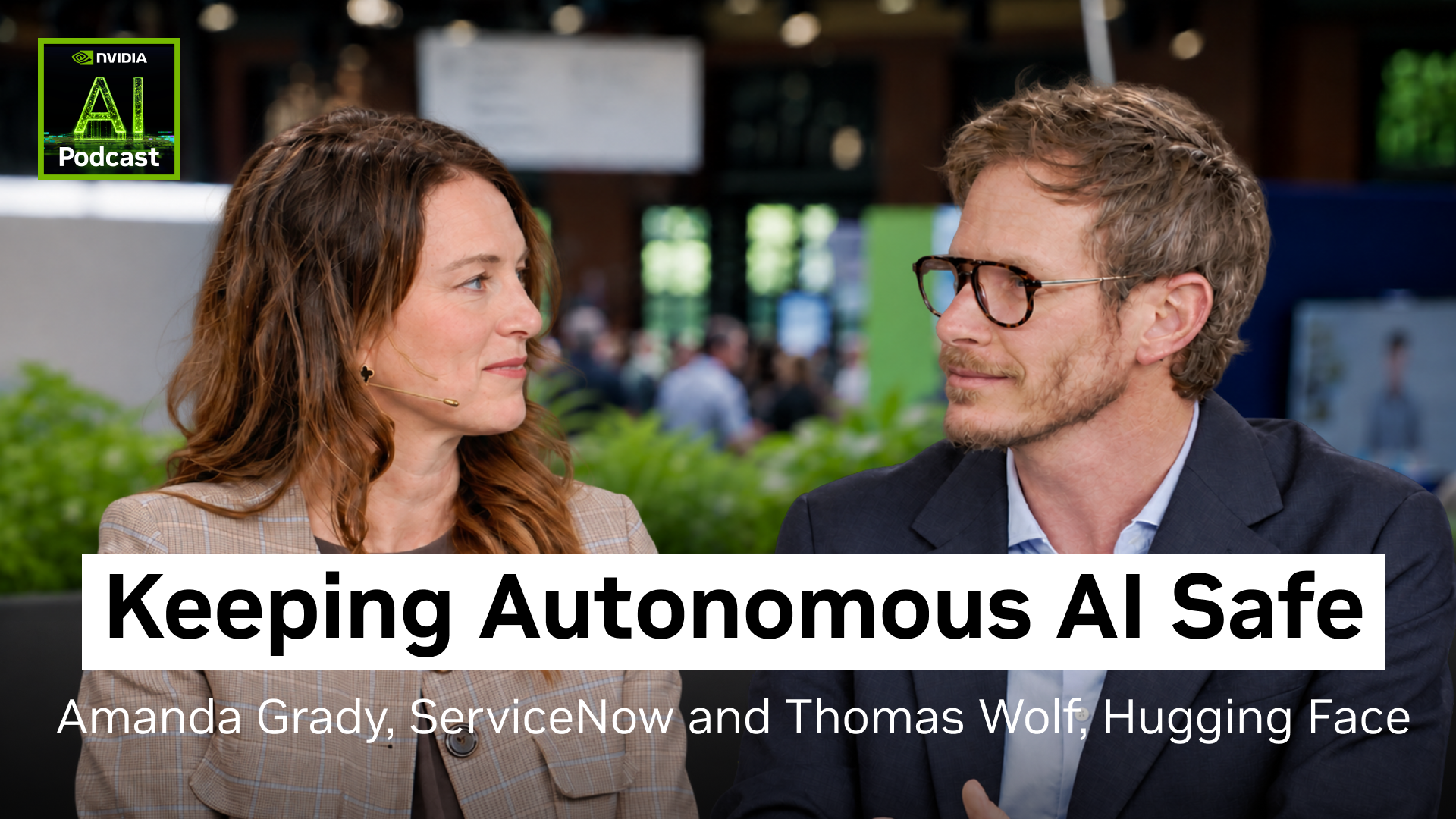
Whether open source can make AI agents safer, and how to secure agentic systems with layered, out-of-band controls (identity, access, hardware enforcement), including physical/robotic agents.
Thomas Wolf, physicist turned patent lawyer turned co-founder of Hugging Face; Amanda Grady, SVP of AI platform security at ServiceNow.
“Please don’t do this” guardrails aren’t enough; models can be persuaded, so controls must sit outside the LLM. Security must be agent-native and fast (machine speed), using identity/access context and containment rather than a slow kill switch. Open models help when frontier models’ guardrails block necessary defensive forensics. Security should enable deployment at scale.
ServiceNow/stack attacked by a swarm of 700 rogue agents; Hugging Face detected the attack quickly. ServiceNow’s AI Passport enforced at the hardware layer via NVIDIA Sentry; AI Control Tower for enterprise governance. Physical safety parallels IT/OT threats (e.g., Iranian plant “hyperdrive” attack).
Written by AI. May contain mistakes.
Discussion on the inadequacies of current AI governance methods.
“So thank you for the promotion, by the way.”
Insight on the role of open-source models in cybersecurity.
“When we were attacked early in the summer by this kind of rogue agents, we later discovered a whole swarm of 700 agents attacking us.”
Exploration of security measures needed for AI agents and controls.
“a lot of cybersecurity companies nowadays start with open models, they fine tune them, and then they ship them in their product.”
Discussing how security can enhance business capabilities and trust.
“Can you break down the security layers for us?”
Debate on the security merits of open-source software versus closed systems.
“After I secured my house, I protected the electrical plugs, this type of thing.”
Exploration of the limitations of security by obscurity in AI models.
“I think has been kind of proven as the golden standard for security in many areas.”
Discussion on establishing open standards for AI governance and collaboration.
“But with the tiles less, with the constant energy of this model, I think this is kind of a losing battle if you think you're going to be able to keep security by obscurity.”
Examining the safety implications of embodied AI and robotics.
“I want to pivot a little bit and talk about really the next frontier of AI, which is, of course, physical AI.”
Understanding the critical security needs in finance and healthcare industries.
“large enterprise and the digital economy that really does run our daily lives can feel invisible to us.”
Strategies for enabling companies to customize AI models effectively.
“Thomas, I want to head back to you and ask about the customization.”
Discussing the importance of educating users to participate in AI development.
“platform to be able to unlock that in the case of being able to help secure their systems?”
Explore the vision for expanding AI literacy and user engagement.
“Ultimately, the future we see going forward like five years from now, let's not go too far because in AI world, it's really hard to predict 20 years from now.”
Discuss the collaborative efforts needed in AI safety and development.
“I mean, I'm glad Thomas went first because he went in a whole different direction than I was expecting.”

Get the gist, explore an idea or ask about something said.
 Claude
On NVIDIA AI Podcast, what are the key points of this episode?
Searching your listeningAutomatic transcript. May contain errors.
0:00Let's talk about AI safety. I couldn't think of two better guests to discuss this with me today than Thomas Wolf, physicist turned patent lawyer turned co-founder of Hugging Face and Amanda Grady, the SVP of AI platform security at ServiceNow. Jensen Huang, in his keynote address at GTC Berlin, mentioned that we previously were in the please don't approach when it came to trying to control and govern AI systems. You would tell a model, please don't do this thing that you're not supposed to do. And increasingly, we're showing that that is no longer sufficient. And I want to hear from you, Amanda, to start how you think about AI and agent safety and what you need around the model beyond just telling it what it shouldn't do.
0:47Yes, absolutely. So thank you for the promotion, by the way. Of course. So I think I've been a great believer in this, I would say, for the last two years since I've been really focused on AI safety and AI security. we all in the security industry really firmly believe that we cannot rely solely on LLM-based controls because ultimately, models can be persuaded, but firm boundaries cannot. So while it's absolutely important, critically important that we do have models that are trained the right way and that do have those guardrails, it cannot be the only layer of defense. So having firm boundaries that are sitting outside the models, like for example, NVIDIA Sentry, which we are very excited to partner on, we think is critically important.
1:38Yeah, and increasingly important as well as we look towards securing these systems is who has access to what models and being able to not only see the deployments, control the deployments yourself, but actually in some cases even customize the models to protect your infrastructure. And I'm curious how you see the role of open and proprietary models together and how it's actually a yes and approach to securing the new world that we're in. Yeah, very much. And we experienced it firsthand, right? When we were attacked early in the summer by this kind of rogue agents, we later discovered a whole swarm of 700 agents attacking us.
2:21What we discovered first was that the typical stack we had, who was at that time based on cloud code and Opus, was not sufficient for that. I mean, the model keeps bumping this safety guard rail, saying, okay, these logs that you ask us to analyze, these are the logs of a cyber attack. We're not allowed to work on that. And so the only way for us to defend ourselves and to do this forensic processing of the logs to understand what was happening was to use open models. And that was kind of an eye-opening for us, which is if we all rely on just one company or two for our defense, we're also in a dangerous situation, I think.
3:01So just like I think in AI in general, I think we want a lot of resilience here, which means we want to have a lot of choice of models. We might want for cyber defense to have very fast models that are very spiky, very capable at one thing, let's say, analyzing very quickly these logs. Right? And the best way today to do that is actually to train your own model. So to train your own open source cyber defense model. And what we see is that a lot of security teams, a lot of cybersecurity companies nowadays start with open models, they fine tune them, and then they ship them in their product. Yes, Thomas, that was a fascinating insight that I was reading about in the news that you indeed, when you initially started trying to understand what happened, and then we're using the frontier models that, you know, the guardrails are actually stopping you from doing that analysis.
3:50So I think that's a great example of why the open models are very important and, you know, being able to train them for your own purposes. I also, I think logs are incredibly important. The forensics of being able to understand what happens. And I have to give a lot of kudos to Hugging Face for detecting what happened so quickly because I think a lot of people are under attack and they don't even know it. Yeah, the lucky thing for us is we're attacked all the time, right? We attack at least once per day. We even pay people to attack us through our bounty program. So we have a cybersecurity team.
4:20For us, that was a pretty small attack in the scheme of what we've experienced, but it was a very different one. And so that's why for this one, we decided, okay, we're going to publish a blog post actually on this specific attack because we think there is something different. There was a lot of parallel agents, some agents doing really strange things. And so we thought that was very clearly LLM power. Though at that time, we had no idea it was actually rogue agent. We thought there was still a hacker somewhere, you know, asking them to do that. And then one week later, OpenAI said, actually, first, that's us.
4:52And second, it was not really our intent to do that. But yeah. That's what you're touching on something very important, which is that these new agents that can go on the offensive are not humans, right? They're operating at machine speeds. And you described actually this morning the sort of arms race that happens every time in the security field. And that means that the defenses must also be at machine speed and additionally should be designed. Your security control should be designed not for a human, but they should be agent native. So, Amanda, I want to go back to you and think about where should the controls actually sit?
5:32What does this actually look like? We all believe that it's an engineering problem to solve. So how is ServiceNow approaching actually securing AI agents as we've seen that sometimes they can drift, right? It's not actually intended to be malicious, and yet they're doing things that you didn't intend. And just like when you ask a new employee, you still put systems around them. So even though you trust that they will do what you tell them to, in the case where they drift, that they do not have more access than they should. So what is that? Can you break down the security layers for us? Yes, absolutely.
6:03Absolutely. So, I think a lot of us in the security industry have believed for quite some time that identity and access controls are going to be a critical part of those hard boundaries that I talked about, those controls that live outside the LLM. And if you look at some of the investments in the cybersecurity space, you can see that that's where the money is moving as well. Very large acquisitions happening. Also, RSAC cybersecurity conference in San Francisco earlier this year, that was the largest category of startups. But we also know that identity borrowed from the human world is not really going to work.
6:40Because if you think about it, in the real world, you and I have an identity that goes far beyond what our digital identity is. A digital identity typically is an identifier and a collection of permissions of what you're allowed to access. But in real life, we have a a lot more context. I know that you work for HuggingVase, I can read your background on LinkedIn and we can collect this information. So first of all, identity needs a lot more business context or a lot more context about what its purpose is to enable us to make decisions about whether it should be authorized to do something in that moment.
7:18The other thing that I think is very different about agentic identity is the speed. So as a human, we join a company, We typically acquire some access. As time goes on, we acquire more access, but it's relatively static. AI agents are very ephemeral, and we need just-in-time access to determine what they should be allowed to do. So ServiceNow is building something called AI, or has built something called AI Control Tower to govern AI across the enterprise. And from that, we are bringing the business context to an attested artifact called AI Passport. And we're really excited to have NVIDIA Sentry as our first partner for that, enforcing AI Passport at the hardware layer in millisecond speed.
8:04So very exciting partnership for us. And so by putting the hardware enforcement away from the agents and we call it out of band, right, not on the same host as the machine, then you can actually revoke access of the agent, quarantining it fast enough before it can do some real damage. Exactly. So you can revoke access and you can also set contextual tool constraints so that, you know, maybe certain actions are blocked, but certain other business actions can proceed. So it's really more of a containment than a kill switch. Yes, absolutely. This is kind of a question for both of you, but I'll start with you, Thomas, which is as we increase these levels of security, as we're doing, many people kind of view security as antithetical to things moving faster, to us pushing the frontier.
8:53But to both of you, what are sort of new capabilities or new things that security will actually unlock for us if we can say with confidence that I can deploy many thousands of these things and feel confident that they're going to achieve the goal that I want? Yeah, I think security has to go really hand in hand with capabilities right now, which means we know that these agents now are capable of doing a lot of things. There is a case to be made that actually we only right now use, I would say, 20 % of what we can do with these agents. It's really the beginning. In particular, as larger companies start to use them, I think right now we exploit a very little part of what they do.
9:35And the remaining 80 % will be fully exploitable when security will be in place. Because this remaining place involves a lot of context, like finding the right access for all of these agents, and also the right way for these agents to take the right action in the action space of companies. So I think that's really the unlocker. Just like I have kids, I only started to put them on a bicycle or starting to let them do dangerous things or walk around. After I secured my house, I protected the electrical plugs, this type of thing. I think it's the same here. We have these new kids in industries, like in our enterprises.
10:12We need to secure the electric plugs before we let them roam around. And then when you can do that, I mean, it's all the promises of AI, right? There is tremendous productivity improvement. And maybe the thing that I, as a former physicist, find the most exciting is possible of new discovery, possible to accelerate the technological progress and R &D. But for instance, you cannot only start accelerating the progress in biology and put AI in a wet lab after you kind of put the safety in place. Right? That seems kind of logical. I would just add that I'm a big believer that I think security has to enable the business.
10:49So if you think about some of, and it can also be a great experience too. So if you think about human security, some of the greatest innovations in identity authentication around single sign-on or pass keys, These are actually a better experience, but deliver better security. But I think in general, security has to be about enabling business and enabling trust in leveraging more AI safely. That's what I think we all know the example of maybe people in our personal lives or to us a degree where you are a little bit hesitant of actually using, as you described, the full capabilities of these things because you just don't feel that you can trust it to be secure with your information.
11:31And when we have tools, as we are all collaborating on, hopefully we can sort of bridge that gap so that we can take advantage of the frontier capabilities. And in reality, it is a major point that we have to solve for mass wide adoption. So Amanda, I have a question for you, which is like these adopters. How is service now actually deploying these? And what are you seeing as sort of either early indicators or real indicators of success as they deploy the ARC platform to be able to unlock productivity from these AI systems? Well, I think the best security is security that's built in and that is very seamless.
12:12So I think it really comes down to ensuring sensitive data is properly managed, that you have the right, again, of course, the right identity and access controls, ensuring in some cases certain data is encrypted, customers have control over the encryption keys. I think a big thing is credential management. You need to ensure that that is kept away from the AI in a secure vault. And those kind of precautions is what really enables you to use AI with confidence. So I'll give you an example. I started recently using a personal AI assistant in my home life. And it's been life-changing. But I chose this particular one because of their credential management capabilities.
12:57because the credentials are in a secure vault that the agent doesn't have access to. All of us here care very strongly about open source. And I want to just foize something to both of you, which is that many people will look at open source and say, well, if all the code is out there, how can it possibly be secure? And yet we all believe that not only open source can help it be more secure, but it can also increase adoption of these very important concepts. So to somebody who says, oh, you know, open models or open code for these secure systems, wouldn't you rather trust the company that's working on cybersecurity to keep that private?
13:37I think there is two answers in the way of history. I mean, up to now, I think the main demonstration we've seen in the past is the most secure operating system we have right now are open source systems, right? variants of Unix, Linux, having these capabilities that so many contributors and users could look at the problem and fix them, I think has been kind of proven as the golden standard for security in many areas. I'm not saying this is every, but in many areas, in particular in many enterprise areas, I think this is kind of a gold standard. And now if you look in the future, we're seeing something very interesting happening, which is the obscurity that you think you had with a closed system is disappearing.
14:23Which means these models are now able to take byte-level code almost, right? Or very low-level code and start to reverse engineer and understanding what's happening. If you push forward in the future, like couple of generation models, they're only going to improve on that. Which is still kind of a personal opinion, has to be confirmed or not. but is that the security by obscurity is not going to last very long. And so you might as well embrace the open there and say, you know, we can't really hide this anyway because this model and are able to puck in these black box things so well that is the security that we achieve only by limitation of human because human at the limited time to be able to reverse engineer, there was a lot of complexity.
15:04But with the tiles less, with the constant energy of this model, I think this is kind of a losing battle if you think you're going to be able to keep security by obscurity. Thomas, you're speaking... Curious to have your opinion on that, by the way. You are speaking my language. Okay. Big believer that you cannot have security through obscurity. And, you know, again, with the speed of AI, that obscurity just isn't going to be there. It's going to find those loopholes. So I think, you know, even for us, as we look at AI Passport, you know, I see that I don't see that ServiceNow will be the only issuer of passports.
15:40We really want it to become a standard because we want to enable that governance standard to enable that runtime speed to bring that business context to make decisions. If, you know, an AI action should be allowed to proceed in that moment. So I think I'm, again, also a big believer in open source as well. I think it's very important. Yeah, I think that when you create the standard, it almost has to be open for it to be widely adopted. And if we're creating something that we'd see of value to the industry and we want it to be adopted by everybody, then the best way to do that is actually to put it out into the open source, to have other companies collaborate so that they can build solutions on top of tools like OpenShell, rather than everyone trying to invent in our own little silos, the next layer of security.
16:28Yeah. I want to pivot a little bit and talk about really the next frontier of AI, which is, of course, physical AI. And I think that when we think about traditional AI safeguards, many of the things actually map over and are arguably even more important when the AI system is embodied. And what I love with what you're doing with Hugging Face, speaking of open source and open standards, is creating these reference architectures, these robots that people can start with and play with and then build on top of. So how do you think about the same thing playing into the next stage of what we're seeing, which are robots walking among us and working alongside us?
17:12Yeah, I think security and safety is an important part, right? Because you take all the challenges we already have with agents and you add on top of that the physical component, which means there is a human that can interact with this, right? If it's like 80, 100 kilo humanoids that's going to fall on you, it's definitely a very tangible safety danger for one person. So the way we design that is we try to keep this openness in mind and to try to already provide some safety knowledge. So let's talk about the microdeck that were on stage with Jensen this morning, right? When you look at the microdeck, it's designed to be extremely safe.
17:52It's very light. It doesn't have any arms, so it just took it very... It looks very harmless. It's really hard to be harmed by your microdeck. So that's the way we designed it. We were like, okay, everyone is making humanoids. We think they're great, but also we think right now we have Uni3, we have some of these. they're not yet at the level where I feel the safety is good enough that I can put that next to my kids, right? And just deploy any policy. And so the robots we developed here for really a wide scope of user has to be very harmless. Now, pushing in the future, we kind of want robots not just to walk around like ducks, but we want them to grab things and do useful things.
18:32And so there's a whole new safety stack that will have to be built. Some of these will be similar challenges than agents around how LLM behave, and which behavior we want to stop. Some of these will be new challenges like how to detect when to stop, how to make what is called compliance, which is if you push the robot, it shouldn't go in any direction, it should just like smoothly react, like a human is reacting smoothly to a push. So there's a whole new step. There's a lot of team working on that, so I'm not so worried. The nice thing about robotics is in a way it's so tangible, the safety component that I know almost no team that doesn't think at least a bit about that.
19:11And I ask that question very intentionally because ServiceNow works with basically every large enterprise and the digital economy that really does run our daily lives can feel invisible to us. And yet, if something were to go wrong, the damage is very far reaching. So to you, Amanda, How do you see the same kind of conversation, but when it comes to, you know, financial institutions and some health care and some of our most private data in terms of how important it is to make sure that we get this right to avoid an incident before it happens? Yeah. So I actually think, you know, the threats to the physical environment from software have actually long been there.
19:54that this is actually not new. And a lot of what we think about in the security industry for the last 20 years has primarily been about securing IT and securing their laptops and servers and things like that. But actually, there's a lot more technology in the physical world like IoT, like operational technology that's used in manufacturing equipment. Think about there was a very famous attack on an Iranian processing plant about maybe 15 years ago, an attack called where the processors were spun into hyperdrive. So those attacks have always been there. And I think that's why it's very important that we have the right controls again at multiple layers.
20:36And we have to think about securing the hardware. We've actually made a big investment this year into a cybersecurity company called Armus that does exactly that. It does details discovery of all of your physical assets from IoT to OT to IT and assesses that for vulnerabilities so that you can quickly understand what your blast radius is and contain it as needed. Whether it's the robot that needs to know whether to stop or in this case, hardware level enforcement of many of the things you're doing, there is absolutely the tie from the software to the physical world. It's all going to be one story here.
21:18Yeah, absolutely. Thomas, I want to head back to you and ask about the customization. We talked about it briefly earlier of open models in specific domains and how you maybe have even done that internally. How do you see being able to sort of democratize that? Fine tuning or post training is not something that many companies actually have experience doing. ServiceNow actually has an incredible team. But many of the enterprises around the world who would love to create those versions that understand their systems. How do you see being able to democratize that ability to not only create the open standards and software, but also the model that is ready to protect you individually?
22:01I think I see three levels there, mostly in terms of size of the team. You have the first, which is, you know, a very large company or like significant one who are able to create their own amazing team internally for their use or for helping other customers. And this usually they use the build on top of our platform or with some of our tools and we provide tools for them, basic tool. But these are the company who have the ML engineering talents right now needed for that. I think this has been around, but this is catching up crazy. Like a lot of the customer users of our hub, we have several thousand companies, more than 3 ,000 companies are this type of companies, including ServiceNow.
22:40We're very happy about that. Then you have the middle size, which is maybe a smaller company. Okay, you're 20 people, 50 people. It's obviously a bit hard to say, okay, we're going to have 10 ML engineers, right? And so for this, you see a lot of teams now that are able to help them. I mean, ServiceNow is now, there's a lot of teams who are now, who have this knowledge and are ready to offer it. I think the discovery of this year for the people in this category of small or medium business or slightly larger is that it's not as expensive as they thought. So it's actually way cheaper. And the benefits of taking this step of asking someone or asking an organization to help you build specific models is that after that, you have this way lower cost, basically, and also way more control around where your data is going and how it's organized.
23:26And then you have the last part, which is new, which is the hobbyist almost, or single-person company. And here, the new thing that happened this year is that the model themselves are starting to be very good at guiding you through this process. So if you're ready to spend the time to ask, you know, a cloud code, a codex, a deep seek before, to help you fine-tune the model on a data set, you can start doing that. It's very surprising. One example, for instance, that Jensen also showed on stage this morning, I mean, he showed many things, But to take the microDuck again, if you have a microDuck, it's open source.
23:59You want to fine tune it on another behavior. The way you should do it is like you showed. You take on the screen, you ask Astra. You say, okay, go on Hugging Face. You spend some time doing your homework. You go on NVIDIA and Hugging Face to get the right library. And now you help me train my Duck to do this new behavior. And Astra or Opus can help you do that. So that's a new thing. It's been a very small team. If they're ready to spend some time, they don't need to get the degree anymore in ML. They don't need to get their PhD of ML and GD. They can just spend the time and work with coding agents.
24:32It's amazing. And of course, to actually fine tune or train a proprietary model, you need your business system data, which ServiceNow has a lot of. How are you helping customers that have, again, a wealth of their business knowledge in the platform to be able to unlock that in the case of being able to help secure their systems? Yeah, so I think, well, it's not just about security. It's also about, we're also building AI on our own platform. So I think there's a couple of examples I would call out around that. So we have something called Action Fabric, which enables customers to use ServiceNow in a headless mode.
25:08So enables them to really access their data and leverage the power of AI to more easily build. And then the other one I would call out, I talked about how much I'm in love with my home personal AI assistant. while we're also leveraging NVIDIA's open shell to build something called Arc, which is intended to be exactly the same thing. It's enabling a personal AI assistant for more professional life. So I think that to me is, if I get that kind of productivity, which I'm already, I'm one of the early users, so I'm already very excited by what I'm seeing. I think that's just gonna be so powerful. I'm really gonna make my life so much easier.
25:49That's what I have a power user of all these tools and a lot of my day is spent trying to, you know, give that feeling to as many people as possible. Kind of, you know, just a general question, but the world to me is so exciting. The future we're going into is so exciting. And yet there are many people who are very concerned. And obviously we are addressing some of those concerns today. But talk about just briefly the optimism that you have in the future of what your company's mission and the work that you do every day is going to help enable. The main challenge here is this challenge of concentration of power in a couple of teams.
26:32And that's the whole mission of Fraggy Face is to say, you know, there is a future where everyone's going to use AI. You're already a power user. I'm sure you're also a power user of AI. We're all already using, but this is going to diffuse. and everyone, I see that in my kids, they're using AI naturally, like everything. What we want is that not only everyone uses AI, but as much possible as possible, also build AI. So they feel like they actually own this technology. And the best way to own technology, like Richard Feynman was saying, I only understand something when I've been able to build it myself.
27:04There is this aspect, right? So can we make that as accessible as possible? Can we make it so that you're not this passive consumer of this technology built by two companies, but you actually participate. And if you think that this is a part of your data or your workflow or your life you don't want to share, you should be able to build a replacement, something. Just like in open source operating system, we have a closed system, but you also have Linux, Unix, if you want to customize very deeply. So we want to open this door and we also want to educate people. So that's even part of the safety and security discussion is how can we educate people to understand, you know, what's this and not just be, for instance, very scared by AI in a way that I don't understand it, but like this big company tell me it's dangerous.
27:51So I think it's dangerous. Like, can you go beyond this and say, okay, well, maybe you can understand. Maybe you can understand the challenge. There are a number of challenges, some cybersecurity, some in various areas. So how can you educate? That's a big part of our mission. Ultimately, the future we see going forward like five years from now, let's not go too far because in AI world, it's really hard to predict 20 years from now. Right now, there's like 80 million users of HuggingFace, which is 80 million people are fine-tuning, training models, understand what it means to build an AI. We see a future where there is 100 millions of them or 200 millions of them.
28:28Just like right now in software, you have about between 100 and 200 million software developers, which are people who know how to build software. Well, we should see and we should try to make the same future come, right? Like a future where everyone can use AI if they want, but also build it if they want. Amanda, how about you? I mean, I'm glad Thomas went first because he went in a whole different direction than I was expecting. But I think, yes, I think that's a very powerful message that we have to bring people along in this journey. I think everyone, once they get a taste of AI, it's very addictive because they realize the power that there is you know again in my personal life i've been educating some friends and my message was exactly the same as jensen's today use ai to help you learn ai and you know i think i think that's um and then of course you know as we've already talked about extensively you need you need the right controls in place but that that's uh that's going to be our job to make sure that we're doing that you know this is obviously an incredibly important topic.
29:25We could talk about it all day. Something that Jensen says a lot, which I really like, is that there are too many incredibly smart, good people who are working on this problem. And not too many as in that we need less of them, but rather that we will solve this problem. It is an engineering problem and the right people are working on it. And you guys are front lines there. And thanks so much for giving us your time today and sharing your expertise and helping us all feel and be safer. Thank you.
Hugging Face co-founder Thomas Wolf and ServiceNow’s Amanda Grady, SVP of AI Platform Security, join the NVIDIA AI Podcast to explain how to keep AI agents safe when telling a model “please don’t” is no longer enough.
They cover why firm boundaries beat persuadable models, what happened when Hugging Face was attacked by a swarm of AI agents, and why security is what lets companies put agents to real work. This is the 15-minute best-moments edit. The full-length episode is on your favorite podcast platform!
In this episode:
0:16 Why guardrails inside the model aren’t enough
2:00 The attack on Hugging Face, and why open models mattered
3:28 Agent identity and the AI Passport
6:03 Security as an unlocker for AI
8:33 Why open source is more secure, not less
10:59 Physical AI and the micro-duck
13:12 Fine-tuning for everyone
14:11 Who gets to build AI
Guests
Thomas Wolf, Co-founder, Hugging Face
Amanda Grady, SVP, AI Platform Security, ServiceNow
Follow on Spotify: https://open.spotify.com/show/4TB4pnynaiZ6YHoKmyVN0L?si=f6b8c3889c754e96
Follow on Apple Podcasts: https://podcasts.apple.com/us/podcast/nvidia-ai-podcast/id1186480811
Learn more: https://blogs.nvidia.com/blog/ai-security-agent-stack/