
 Ask ChatGPT


- Podcasts
- On Purpose with Jay Shetty
- Robert Greene: The Surprising Reason You Feel Unhappy Even When Life Is “Good”
On Purpose with Jay Shetty2 Nov 2026 · 1h 31m · 34 chapters
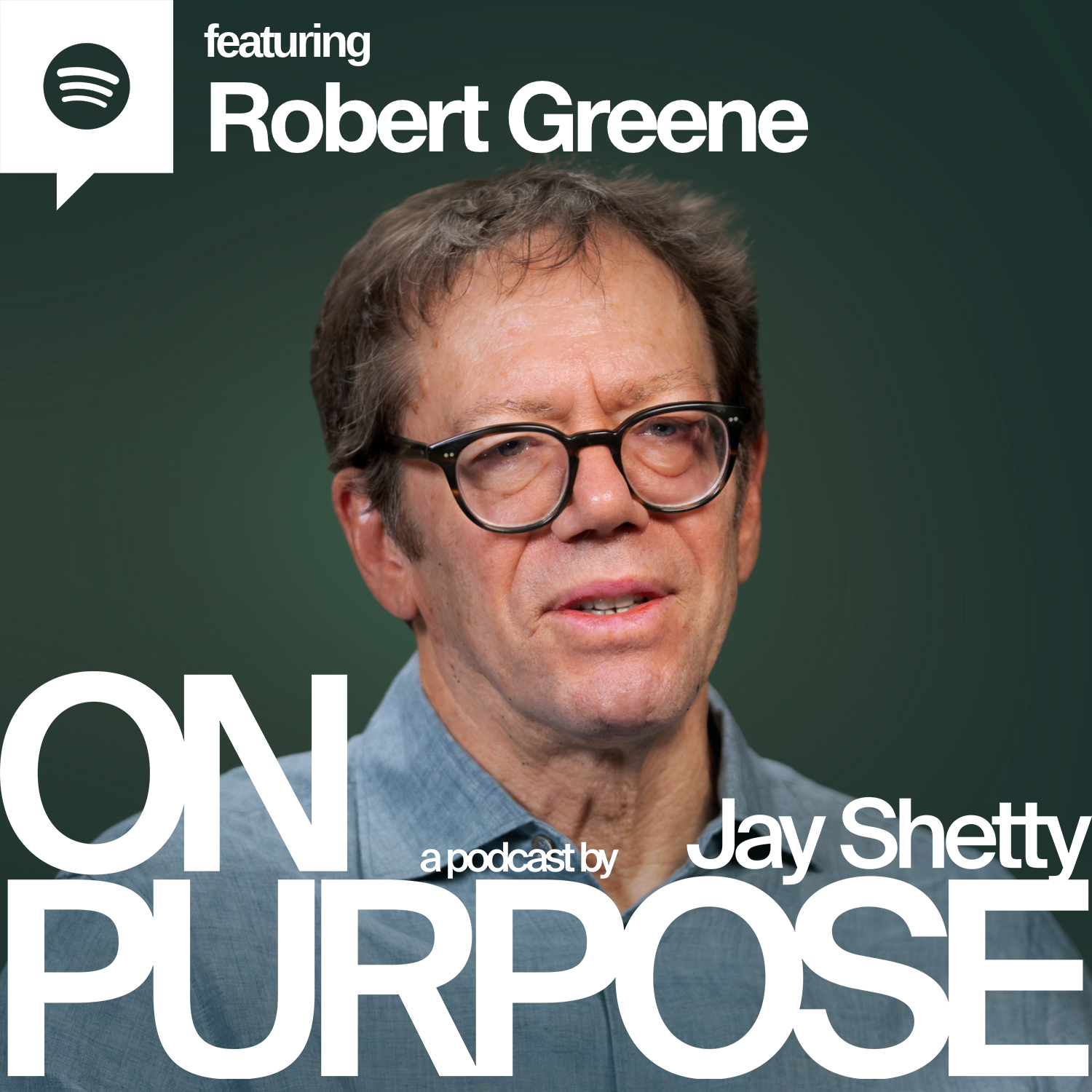
Robert Greene: The Surprising Reason You Feel Unhappy Even When Life Is “Good”
In short
Why people feel unhappy even when life looks “good,” driven by alienation, distraction, and pursuing goals based on a social persona rather than an inner “daemon” (life task). Greene argues humans need transcendent, primal experiences (the “sublime”) and fulfillment through skill-building, not short-lived happiness from external rewards.
Guest backgrounds
Robert Greene is a best-selling author known for The 48 Laws of Power and for writing on human nature and success. He discusses his own life, including a stroke that left him physically impaired but with preserved language/thinking, and how it pushed him to write The Law of the Sublime.
Key claims
- Modern life (language abstraction, algorithms, social media) increases painful disconnection.
- Happiness is reactive and addictive; fulfillment comes from creating, learning, and developing skills from within.
- The “daemon sublime” is a second self guiding authentic direction, distinct from the social mask.
- Pain/frustration can be the daemon signaling misalignment; listen to it, journal, and trace it back to childhood inclinations and what you hate.
Notable examples
- Social-media “hall of mirrors” and the looking-glass self; teacher belief experiments (Pygmalion effect).
- Harriet Tubman building strength through repeated hardship.
- Greene’s own delayed writing journey, then writing The Sublime after his stroke.
Written by AI. May contain mistakes.
Chapters
3:43
The Importance of Connection
Explore why humans crave deep connections and how modern life impacts this.
“And we haven't spent that much time together off camera at all, but I don't know what it is.”
5:26
The Crisis of Meaning
Discuss the mental health crisis and alienation in contemporary society.
“To be human and to be conscious and aware is to feel a deep connection to your environment, to people, to just being alive, right?”
7:26
Experiencing the Sublime
Understand the concept of the sublime and its relevance to personal experiences.
“We're like losing a connection to what it really means to be human.”
9:11
Pursuing the Right Goals
Delve into the pursuit of meaningful goals and the concept of the Daemon.
“I was looking at some research that was talking about how when humans achieve something, not only does it not make us happy, the happiness doesn't last as long.”
11:18
Following Your Daemon
Explore how connecting with your inner daemon leads to true fulfillment.
“This chapter that I talk about, The Day of Most of Limits, related to my book on Mastery, the first chapter about your life's task.”
14:04
The Journey to Authenticity
Robert Greene discusses the transformative effect of his stroke and the importance of authentic goals.
“And I had wanted to write a book on the Sublime 20 years ago, but I got distracted.”
15:10
Confronting Pain and Frustration
Emphasizing the need to listen to one's inner pain to uncover true desires and purpose.
“feeling of dissatisfaction like, why am I doing this?”
16:58
Exploring Childhood Passions
Greene encourages revisiting childhood interests to reconnect with one's true self.
“Go deep inside of yourself and go, why am I feeling pain?”
19:37
Identifying What Repulses You
Understanding personal dislikes as indicators of one's true calling and path.
“And it's not like a specific career, because obviously when you're four, you're not thinking of a career.”
21:28
The Impact of Perception
Greene discusses how perceptions of others shape our identities and choices in life.
“bullshit and all the games we had to play.”
Show all 34 chapters
24:02
Navigating Boredom and Choices
Exploring the root causes of boredom and the importance of engaging in fulfilling activities.
“And now we live in an age where he's writing in the 1890s.”
26:04
Finding Fulfillment Through Discipline
Greene advocates for the pursuit of challenging activities that foster long-term fulfillment.
“that are just weighing you down and distracting you and shattering your mind to a thousand different pieces.”
28:01
Embracing Boredom for Growth
Learn how to use boredom as a catalyst for personal growth and creativity.
“Similarly, it would be taking up a musical instrument.”
30:05
Happiness vs. Fulfillment
Understand the distinction between fleeting happiness and lasting fulfillment.
“And it's not going to all go away at once, as you said, and it will take time to just excavate a little by little, but it's possible.”
30:44
The Power of the Brain
Discover the incredible capabilities of the human brain and its desire for depth.
“It's like I've got to fill myself with something.”
35:56
Resisting Cultural Ease for Strength
Learn why resisting cultural comforts can lead to greater resilience and strength.
“What's it like to buy a car from Carvana 100 % online and get it delivered to your door?”
40:48
Building Confidence Through Small Steps
Explore how breaking goals into manageable steps can build confidence and strength.
“How do we learn to trust ourselves to do that when we feel we've made bad decisions in the past?”
45:51
The Pressure of Modern Expectations
Explore the pressures young people face regarding life achievements and financial success.
“And I think the challenge everyone's finding right now is everyone has this sense that they're behind.”
50:05
The True Nature of Fulfillment
Understand the importance of purpose and contribution over financial gain for true happiness.
“And you have to separate yourself from that.”
53:10
Creating for Connection, Not Just Money
Learn about the importance of creating meaningful work that contributes to society rather than focusing solely on financial gain.
“in this world where the people who have money say money isn't everything, but then the people who don't have money realize, well, money would be a lot better than where I'm at right now.”
56:00
Understanding Envy and Its Effects
Explore how envy can motivate success or lead to destructive behavior.
“You may not make tens of millions of dollars, but you will make more than enough to keep yourself comfortable because it'll come from within.”
59:32
Transforming Envy into Fulfillment
Learn how to turn feelings of envy into gratitude and fulfillment.
“access the abundance that the sublime considers that that's available to me as well.”
1:02:11
Money vs. Fulfillment
Discuss the relationship between money and true fulfillment in life.
“When I discovered Eastern wisdom in college more deeply and genuinely, I had a club and a society that I ran called Think Out Loud.”
1:03:28
Youth and the Pursuit of Happiness
Reflect on the simplicity of youth and the importance of learning.
“But if you didn't have enough of it, oh, you'd be stressed about it.”
1:05:22
Navigating the Workplace Dynamics
Strategies for recognizing and enhancing your value at work.
“Robert, we had our audience send in questions of things they're struggling with.”
1:07:16
Dealing with Inconsistent Relationships
Insights on managing emotional entanglements with inconsistent partners.
“If I had had my book, then it would have saved me a lot.”
1:09:52
Breaking Free from Routine
Explore ways to invigorate a seemingly perfect life that feels stagnant.
1:10:02
The Search for Meaning Beyond Comfort
Explore how comfort can lead to a feeling of stagnation and the need for new experiences.
“There's a kind of a sameness to your life.”
1:12:10
Confronting Mortality and Its Impact on Life
Discuss the transformative power of confronting one's mortality and its effects on perception.
“You need to do something that's going to shake it up.”
1:14:39
The Relationship Between Death and Life
Understand how acknowledging death can enhance the experience of being alive.
“It can be something else, an accident that happens, right?”
1:17:48
Seeking Connection Beyond Individual Existence
Delve into the human need for connection to something greater than oneself.
“But they are the ones that are involved in this experiment.”
1:21:41
The Uniqueness of Human Existence
Examine the extraordinary circumstances that led to human existence and its significance.
“But it's a religion because it's a faith that you are Buddha.”
1:24:00
The Need for Spiritual Connection
Explore the deep human need for spirituality and awe in life.
“So you need that connection to something beyond your individual existence, the deep, deep human need, and ignoring it is not being rational, it's not being scientific.”
1:29:51
Final Five Questions with Robert Greene
Hear Robert Greene share his best and worst advice along with insights on friendship and criticism.
“and I always feel like you're opening up new dimensions for me.”

Ask about this episode
Get the gist, explore an idea or ask about something said.
 Claude
On On Purpose with Jay Shetty, what are the key points of this episode?
Searching your listeningTranscript
Automatic transcript. May contain errors.
0:00Jay Shetty: This episode is brought to you by Bioptimizers. People often ask how I keep traveling, filming, and speaking across time zones. It's all about sleeping well. A few years ago, on my on-purpose tour, my sleep fell apart. That's when my doctor recommended Magnesium Breakthrough from Bioptimizers. Magnesium is responsible for over 300 essential functions in the body, and most supplements only give you one or two forms of it. This one has seven, including glycinate, the go-to form for sleep, plus malate and tau rate tied to energy production and heart function. If you want to try it yourself, go to buyoptimizers.com forward slash jsheddy and use code jsheddy for 15 % off your first order.
0:41Jay Shetty: That's B-I-O-P-T-I-M-I-Z-E-R-S. This is breakthrough science I trust. This episode is brought to you by Wayfair. I love the holiday season because that means I'm constantly bringing friends and family together. Wayfair makes spending quality time with the people I love incredibly easy. I can order extra dining chairs for a last-minute get-together that fit perfectly into the space, so I never have to worry about my guests being comfortable or feeling at home. I can find beautiful pieces to decorate my table that bring warmth to the space and make everyone feel welcome. For all things hosting, Wayfair delivers high-quality, customer-trusted products for your home so you can host and celebrate without the stress.
1:22Jay Shetty: When choosing something for my home, I want to know it's built to handle everyday life, especially when I'm hosting. That's why Wayfair Verified is so useful. Their products are hand vetted by specialists using a 10-point quality inspection, so I have more confidence in what I bring home. When refreshing your home this holiday season, Wayfair delivers exactly what you need. Head to wayfair.com to shop all things home. That's W-A-Y-F-A-I-R.com. This episode is brought to you by AG1. When it comes to looking after ourselves, consistency will always matter more than complexity. The best routines are the ones that are easy to keep up.
1:59Jay Shetty: And that's the beauty of AG1. One scoop, once a day, one simple daily health drink foundation that fits easily into your routine. And if you're someone who trains regularly or wants to get more from that routine, there's AG1 Pro. It has the same foundation as NextGen with added creatine, CAHMB, and zinc carnosine. Because a healthy routine doesn't need to take over your life. It just needs to give you something you can do day after day without thinking twice. Go to drinkag1.com forward slash on purpose and get a free immune support bundle, including vitamin D3 plus K2 with your first subscription of AG1 Next Gen or AG1 Pro.
2:40Jay Shetty: That's drinkag1.com forward slash on purpose. Hey, it's Jay. I don't know what your day's been like, but I was just thinking about you for a minute. And I hope you're being a little patient with yourself because you deserve it. And yeah, I'll talk to you soon.
3:09Jay Shetty: Hey everyone, welcome back to On Purpose, the place you come to become happier, healthier and more healed. Today's guest is back by popular demand. I'm sitting with the one and only Robert Greene, best-selling author of The 48 Laws of Power and one of the leading voices on human nature and success. His new book, The Law of the Sublime, explores how to find meaning and fulfillment in a world full of distractions. We're diving into why we're never satisfied, the decisions that hold us back, and how to better understand ourselves and others. go and grab a copy of this book right now if you're a fan of Robert's you're going to love this conversation like you did the last two that we've had on the show Robert welcome back to on purpose thank you for having me Jay it's an honor it's such a treat to get to sit down with you every couple of years honestly from the moment you walk into my home I feel like we just start riffing and it feels so natural as if I've known you for years, which we don't.
4:12Jay Shetty: And we haven't spent that much time together off camera at all, but I don't know what it is. There's a synergy and I really appreciate it because I kind of settle into my real self when I'm around you. Oh, that's very nice to hear. Yeah, it's a real gift. Yeah, I feel the same way. That's extremely kind. Yeah, no, I really feel that as soon as we start connecting. I don't know what it is. I actually don't have the words to describe, which fits very apt with today's book. There's a book by the writer, Jim Rader Goethe, called Elective Affinities. And it's about how certain people have this weird kind of nonverbal affinity with each other.
4:54And it's just on the level of energy. It's not on the level of words. So maybe that's what we're talking about to some degree.
5:01Jay Shetty: It seems like that's what all of us want to feel. You talk about it in The Sublime, this idea of us wanting to belong to something greater than ourselves. When you meet someone and they remind you of an old thought or an old friend or you feel connected, we all want that resonance. But we don't feel it that often anymore. Why is that? We're kind of disconnected. That would be the word for it. To be human and to be conscious and aware is to feel a deep connection to your environment, to people, to just being alive, right? And so you're present in all these different experiences. in the sublime you're going kind of deep into that to a depth where words can't even express what you feel and i think all of us have had moments you walk around the world everything is familiar everything's the same you're not paying attention but at moments you sense inside intuitively a feeling that there's something else out there there's something else beyond just the familiar world of words and patterns and cliches.
6:15And so I think what's happening today is there's always been a level of humans being somewhat alienated from the world that you're thrown into when you're born because we live in abstract symbols and words and language and we're not immersed in things as they actually are. But today it's reaching a degree that's very painful for all of us. There's a mental health crisis going on in America and around the world, particularly among young people, and a sense that you're just cut off from anything that's deep, that's meaningful. You're kind of floating continually on the surface. There are algorithms out there that are programming our minds, that are altering us, that are altering the wiring of our brains.
7:00And what I'm trying to get at in the sublime is we have a need, a human need for transcendent experiences. We want to be taken outside of ourselves to some degree. And so the idea that we can't access this, that we're kind of trapped in our egos and we're trapped in our little small worlds is a source of deep, deep, deep pain. We're like losing a connection to what it really means to be human. And so the sublime, if I could say one thing about it, is when you experience it, and I have, the book is filled with practical exercise. It's not an academic book. I mean, I have ideas in there, probably too many ideas.
7:48But at the end of each chapter, I take you through exercises where you can access that in your daily life. But the point of the sublime is when you experience it out in nature with another human, with an animal, wherever, it is your experience. You are feeling it. It's inside of you. It is something that is your own. You're the agent of it. Whereas so much of our experiences come from the outside. people telling us what we're supposed to think, telling us how we're supposed to access, telling us how we're supposed to react, telling us interpreting our world for us. And the sublime is completely your own.
8:23When you feel it climbing a mountain or wherever it is, there's no mediation. There's no phone or program that's telling you what's happening. It's completely your own sensation. It's taking you back to something very, very primal in humans.
8:41Jay Shetty: This episode of On Purpose is presented by Amazon. You might not know this about me, but I'm a huge Christmas person. Huge. There's no such thing as too soon to put on my holiday playlist, pick up a tree and start gift shopping. All of these little festive traditions bring me so much joy. So why not start early? And Amazon gets it, which is why you'll find low prices right now. Get a headstart on holiday gifting with Amazon's low prices. Shop now at amazon.com forward slash holiday. I was looking at some research that was talking about how when humans achieve something, not only does it not make us happy, the happiness doesn't last as long.
9:25Jay Shetty: And it feels like so much of our life is about pursuit. And before we end up thinking about pursuing the sublime, we may pursue other things. When we're in the pursuit of goals and dreams, how do we know we're pursuing the right things? Or is it that no matter what we pursue, we're never satisfied because that's something else that we have to deal with? Well, I have a chapter in the book. It's kind of a counterintuitive chapter called the Daemon Sublime. And the idea is that you have a second self within you. So the self that you normally think of is your social self, right? That's what you normally imagine if I had to ask you who you are, you'd say, I'm shy, I'm introverted, I'm extroverted, I'm ambitious, I'm humble.
10:17You also say, I'm successful. You think about your status, your level of power. These are all reflections of the social world. It's not who you are. It's not who you are at your core, right? Even if you tell yourself, you know, I'm being authentic right now. You're thinking in terms of, will other people perceive me as being authentic? You can't get outside this constant reflecting about what other people think of you. And that becomes who you think you are, right? The opinions that other people have. If people say again and again and again, Robert, you're shy, you're very thoughtful, then okay, then that's who I am.
10:58I internalize that and it becomes part of me, right? But it's not who you are. And so if you're always pursuing goals and things based on the social personality that people tell you are, there's always going to be a layer of, I'm not happy because it's not who I am. It doesn't fit me. Something isn't quite right there. This chapter that I talk about, The Day of Most of Limits, related to my book on Mastery, the first chapter about your life's task. The idea that when you were born, you're unique, you have a DNA that's one of a kind. There'll never be another Jay Shetty with the way your brain is wired, with your earliest experiences, how you were raised.
11:40You are unique, you are one of a kind. And in ancient Greece, they called it the daemon. And what the daemon was is the gods, the Greek gods, had pity on humans because they have no sense of direction. They don't know where they're going. They're lost. We gods, we can see everything. So out of pity, we're going to fit into each human being a daemon, a demigod inside of you, all right, that's going to give you guidance in your life. And it is the god Eros, the god of love and sexual desire, who's going to put the daemon inside of you. It's fitted completely to your uniqueness. It is in essence your soul, right?
12:24And when you hear the daemon, it's telling you what to do, right? And the great ancient Greek philosopher Socrates, who was so rational, he believed that he had a daemon and it was always telling him what not to do. It wasn't necessarily a voice. It's a feeling. It's an energy. It's a vibration inside of you that's saying something is wrong. So to connect these two things back together again, there's something unique about you out there listening to this, right? It is your soul. It is your daemon. It is life itself because you're not just this thinking creature. You have an energy. Your blood pumps in a certain way.
13:05You have a particular heartbeat. There's something about you that's different. You're wired differently. Your brain is wired differently. okay? It's almost impossible to put precisely into words, but it is you. When you are connected to that you, to that authentic self, to that demon, which is truly authentic because it has nothing to do with what people think about you, you're following it. And when you pursue a goal based on that, it's a much different feeling than following the social, the persona, the mask that you wear. It feels like, wow, this is what I was meant to do. It's like you're swimming and you're swimming with the tide as opposed to against it.
13:45Everything fits, everything seems natural. And when you attain a goal based on that daemon, based on that voice, it feels like something very real, something very powerful. So for me, my daemon, my life's task has always been writing books, right? And I had wanted to write a book on the Sublime 20 years ago, but I got distracted. I got the project I did with 50 Cent and things like that, and I kept getting sidetracked. And then I had my stroke. I came this close to dying, right? Basically, my girlfriend, now my wife, she essentially saved my life. It was a matter of seconds. And so I'm in the ambulance writing home from the hospital after I've recovered.
14:33And the idea is that Damon starts raising its voice and saying, this is the time to write the sublime. Your stroke happened for a reason. It saved, it didn't affect my cognition, more or less. I had some brain damage, but my language ability, my thinking was fine. My body was crippled, but my mind wasn't. And so in writing the book, it was very difficult. It was very frustrating because I had to handwrite the whole book. But it felt like something real, something authentic. It was a goal that was meant to have. It was coming from deep within me. Although there were many obstacles and many difficulties along the way, I never had a feeling of dissatisfaction like, why am I doing this?
15:18Because it wasn't for other people. I was doing it for myself. It was something coming from deep within. How do people begin to access that for themselves?
15:28Jay Shetty: Because I feel everyone feels like they're out of place, or they feel like they're out of alignment, or that they don't know what they're here to do or why they're here. and people have these existential thoughts maybe once in a while, but then their life goes back onto autopilot. They forget about it. We get distracted. We get overwhelmed. We get busy. And then all of a sudden something happens and you think about it again. What do you do to start uncovering it and not just keep avoiding it? The key is, and so again, I go into this in mastery, but also in the new book, is you want to have to have it.
16:06You have to desire something in order to get what you desire, right? You have to know that this is something missing in my life. So most of the time, you're not aware of that. You think you're just sort of floating by. You're doing what other people are doing. You're going to your job. You're getting by, etc. You're not thinking about this thing that's missing except in moments of deep frustration and deep pain. And what I try to tell people, because a lot of people come to me with that question, particularly after Mastery was published, like, Robert, you talk about the life's task, you talk about Leonardo da Vinci yourself.
16:46I have no idea what that is. And I say, when you have moments of pain and frustration, don't try and distract yourself. Don't try and blame it on other people or circumstances. Go deep inside of yourself and go, why am I feeling pain? Why am I feeling frustrated? Why do I feel alienated from myself? Because those moments of pain and frustration in your life, of dissatisfaction, is your daemon speaking to you? Now, I know you're probably going, there's no such thing as a daemon. Okay, it's a concept, but it relates to something actually very real. Who you are, your energy, your personality, your individuality is speaking to you.
17:28And they're saying, this partner, this relationship you have, this person isn't right for you. It's not fitting. This career path that you're on isn't suited for you. It's not working out. You've got to take a step back. So the first step is to listen to your pain and listen to your frustration. And understand that it comes from someplace real. And when I say listen to it, I really mean. Listen to it. And perhaps what you need to do is you need to pick up a journal and you need to write about it. You need to think about it. Writing about it is not just some silly little exercise. You're taking your thoughts and you're putting it on paper or on your computer.
18:07I recommend on paper, but whatever it suits you. And you're externalizing that pain and that frustration so it feels like something real and then you can act upon it. Then once you acknowledge that something is missing, that you're alienated from yourself, from who you truly are, now the seed is planted. Well, then who am I? I'm alienated from who I really am and it's causing me pain. Who am I? You are a mystery to yourself and you have to look at that way. You think you know who you are, but you don't really. So what I tell people is we have to voyage into your childhood, right? We have to go back to when you were three or four years old.
18:51Because when you were a child, you weren't socialized yet. People that weren't telling you who you were, you weren't told this is what a cool subject is to follow. It's good to do sports. It's good to do math, music, whatever it is. You felt these things deep. They were part of you. I call them primal inclinations in mastery. You're attracted to things without having to think, without mommy or daddy telling you what's good for you to think about. It's you as you naturally are, as you were born into this world, right? When you were a child, that demon was speaking to you, and you had a natural relationship to it.
19:31You've lost it. So let's go back and try and go into your early child and go, what were those things that excited me so much when I was that age that I felt like I loved doing? And it's not like a specific career, because obviously when you're four, you're not thinking of a career. It's something general. And I often refer people to a book that I love called The Five Frames of Intelligence by Howard Gardner. And the idea is we think of intelligence as just being this kind of intellectual thing, but that's not at all the case. There's social intelligence that some children are naturally drawn to.
20:11There's kinetic intelligence, what has to do with the body and sports and dancing or wherever it is. There's language intelligence, what has to do with words, which was my great inclination. There's patterns, which turns into like math or music. Then there's like mechanical intelligence, which has to do with building things and shapes and knowing how to put things together. You had one of those. it marked you as a child, you were drawn to it. It's a sign of your uniqueness. Nobody told you that this is what you should be doing. You've lost touch with that, okay? Let's try and dig underneath the surface of the earth and find those little fossils from your early childhood that indicate something deep, deep about you.
20:58Then we try and go into how you got distracted from it, the other voices that you started listening to. I also tell people, what repulses you? What do you hate? Because your daemon is telling you, I don't like this. It doesn't fit me. So for me personally, I hated working for other people. That's been my life story. I can't stand the politicking. I can't stand the ego. I can't stand all the currying up to the boss, all the bullshit and all the games we had to play. It drove me crazy. I never had one job more than 11 months in my entire, I had like 50, 60 different jobs. My girlfriend and I tried to count once.
21:40I couldn't take it. I hated it. That was my day once saying, Robert, you have to work for yourself, right? You can't work for other people. You have something similar. Something is like, I hate this. I hate this kind of work. I hate this kind of relationship. Listen to the things that you hate and then listen to how you got distracted and try to go back to that moment, perhaps when you were 18, 19, 20 years old or 22 years old, and your path strayed. You entered a career, you studied medicine or law or coding or whatever it was, but it wasn't really who you are at your core. Try and go back to that moment and see where you went astray.
22:24So these are little signs of ways of kind of pointing you back to the path of who you really are, your life's task, your calling in life, that voice that you should be hearing every day.
22:36Jay Shetty: One of my favorite thoughts is from Charles Houghton Cooley, where he said, the challenge today is, I'm not what I think I am. I'm not what you think I am. I am what I think you think I am. And we live in this, what he calls the looking glass self. The idea that If I think you think I'm smart, then I feel smart. And if I think you think I'm weak, then I feel weak. Now, when was he writing this? 1890. Well, look where we are now with social media. There's a very powerful and very thought-provoking series of experiments. There was a book called The Pygmalion Effect. And basically, the idea is they were studying students in classes and teachers, and the relationship between students and teachers.
23:25And if the teacher said, I don't think any of you guys are going to go to college. You're just not smart enough. Then they kind of internalized it and that became the reality. And lo and behold, they didn't end up going to college. But if the teacher said, I think all of you are smart. All of you are worthy of something better in life. It had a much different result. But what this study showed was the teacher didn't have to say it. They just had to think it. And the results were the same. So what people think of us, how they judge us, how they evaluate us, we internalize that we pick up that energy and it also creates who we are.
24:08And now we live in an age where he's writing in the 1890s. those mirrors are, it's like when you're in a barbershop and you see the reflection, you see like eight mirrors going into infinity. That's our reality because you're being reflected by all the people on Instagram, all the people on TikTok. You're entering a hall of mirrors. You're constantly focused on what other people are doing, what other people like, and you're completely losing any sense of who you are. And you become a reflection of what these people are programming you to think on social media.
24:43Jay Shetty: And I think we're all aware of that, but we feel so distracted and addicted to it. And we are not having enough of an experience of what the self is or who we are. And so then we kind of put it to the side. And so I find a lot of people today will feel bored. Like I'm bored. I don't enjoy anything. I'm not sure what I like. And on the other hand, people will say, I have so many things that I like. I don't know which one is my thing. What would you say to both those people? The first who says, I'm bored. I don't like anything. Nothing appeals to me. And then second, well, everything is kind of cool and I wish I could do everything.
25:22Well, you can't do everything. And that's kind of the false choice that we're offered. Why there's so many things available on so many skills I can learn on YouTube. I'm just never going to end, finish there. Well, when you're not connected to what you're learning, when it's kind of a superficial thing, oh, that's cool. What's going to happen is you're going to go into it for three months. You're going to start slowing down. You're going to go, oh, actually, I want to go into this. You're never to go deep enough to develop any kind of skill. What's the purpose of learning if you don't become skilled at it?
25:57It doesn't go into you. You're not able to do anything with it. It just becomes living on the surface. It just ends up like bits of knowledge that are just weighing you down and distracting you and shattering your mind to a thousand different pieces. The person who is bored, because that's the more common scenario that we find in our culture nowadays, is I'm bored, okay? But now we live in a world where at just a click, you can be entertained, right? So your reaction when you're bored is, I don't like that feeling, all right, a video game, all right, for a young man, online porn, or my Instagram feed, or my Netflix streaming, I'll just find something to amuse me and distract me and get me out of that painful feeling of emptiness.
26:44I talk in the book, emptiness is equivalent to actually to death. So what you're really afraid of in those moments of emptiness is you're not coming to terms with your own mortality. That's a whole other subject. I can go deep into that, but that is the root of that feeling of fear of emptiness, okay? Your whole pattern in life, and it's often set when you're five or six years old, particularly nowadays with parenting, with all the options that they can give children, is the moment I'm bored, I got to get something to amuse me. and what you really want to do and it's not easy i'm not saying it's easy is i'm bored i'm not going to try and get distracted i'm going to find something that i want to do that might be tedious but that is actually going to lead to something fulfilling in the end in other words i'm going to postpone immediate gratification for something higher now that can be what could that be for me it's meditation.
27:48For other people, it could be chess. Chess is a discipline. It's very exciting. It's very fun. But in the beginning, it's not easy, right? And you're not doing that because other people are telling you, cool. And it's not relieving your boredom because it's actually kind of boring to learn. But it's leading to something exciting. Similarly, it would be taking up a musical instrument. Similarly, it would be instead of going for your Netflix streaming to pick up a 600-page novel. It doesn't have to be 600 pages. War and Peace, The Brothers Karamazov, whatever you like or something contemporary. When you read a book, there's particularly a work of fiction.
28:27You have to keep going back and like, who is that character? What's really happening here? It's like a puzzle and it slows you down and it puts you inside of somebody else's experience, which is a powerful thing to get you outside of your own kind of misery and pain and outside of yourself, okay? It could be cooking, cooking something slow. Whenever I go to like to an Indian restaurant, and I've read about this, some dishes take like a whole day to prepare or two days to prepare, and that's why they're so good, right? The level of spices and complexity is insane. Cook something slow that's going to take a whole day.
29:09Don't go to get fast food or gardening. Gardening is a wonderfully pleasurable experience. I used to do a lot of it. I can't do it so now easily. But you're planting things. You're watching them grow. You feel like they're almost your children. You're taking care of them. It's slow. It's not immediate gratification. But at the end of three months, you have a tomato plant, and then you're eating the tomatoes, then you're cooking with the tomatoes. You're playing musical pieces that were hard to learn, but now they're starting to get exciting. So instead of immediate gratification, use boredom as a signal for, I want to lean into it.
29:49I want to learn something. I want to create something. I want to enrich my inner, my mental landscape instead of endless, endless distractions.
29:57Jay Shetty: Those are great practical tools that we can all implement today and start kind of chipping away at that distraction that we all are experiencing. And it's not going to all go away at once, as you said, and it will take time to just excavate a little by little, but it's possible. And I think that's almost what people need is a reminder that it's possible. I wonder, do you think people have confused boredom with unhappiness? I like to take the emphasis away from happiness to a sense of fulfillment. What's the difference between happiness and fulfillment? Well, they're just words. They're just language games we're playing here, but I define it differently.
30:43So happiness is a reaction to unhappiness. It's like I've got to fill myself with something. And filling myself with something kind of eases that unhappiness, but then it keeps coming back. It's like an addiction, right? Because something else, another feeling of emptiness or not having a desire met, new desires are constantly sprouting up. You're continually happy and unhappy, happy, unhappy. And those moments of happiness get shorter and shorter as an addiction, right? As I said, I'm just playing with words here, but fulfillment is something where you build something, you create something, you learn something, you develop a skill.
31:29And when you finish that, you never finish it, but let's just say the metaphor of chess, it's just a metaphor. You get good at that chess to the point where now you can start playing with people and thinking on a higher level. you have a sense of fulfillment. I'm not getting happiness from other people, from a game. It's coming from within me. It's something I've developed. It's something I've created. I've spent time. I've overcome my own weaknesses, my own need to be distracted. And I've built something really real inside of me. And in doing that, I feel proud. I've learned that I can go beyond my limits that I thought I had beforehand.
32:15What a sense of fulfillment, right? That isn't an addiction. Once you've become good at chess, it's not this like, oh, I've got to, I'm now like bad at it and I'm unhappy. It's just going to keep getting better and better and better. You're building on something real as opposed to this constant flitting inside of your blood about something isn't right, right? You were gifted with this brain. This is something in the Sublime book I talk about. You have no idea as you walk around this organ inside of your head, the insane power that it presents. Neuroscientists say, and who study like physics and such, that it is the most complex organism in the universe.
33:04When you study the brain, you see the unbelievable complexity of the neural pathways, the many different connections you can make. You were born with this brain. It is hungry. It is active. It is restless. If you try to meditate like I do, and you try to instill the brain, you realize how impossible it is. It's just always moving. There's so much energy in there. There's so much blood in there. Your mind wants to be active, but it wants to be active on its own. It doesn't want other people telling it what to do, right? That's what makes children so unhappy. They're like constantly being told this is the game you have to play, this is what you do, and it makes them nervous and anxious and upset.
33:48You want to use that brain. It wants to learn things. It wants to develop skills. It wants to go deep into things instead of skimming on the surface. You're going to get older. Your brain's going to slow down. You're in your 20s. Don't let that happened to you, take this gift that was given to you and use it.
34:07Jay Shetty: This episode is brought to you by Pandora's New Holiday Collection. There's so much I love about the holiday season, but finding meaningful gifts for my family and friends might be one of the best parts. Pandora makes shopping with intention really simple. I found a heart clasp snake chain bracelet and picked out a few charms that represent heartfelt memories and experiences my wife and I will remember and cherish forever. This season, celebrate the ones you know by heart with a gift that says it all. Pandora, more than a gift. Shop new styles in store or online at pandora.net. This episode is brought to you by Indeed.
34:41Jay Shetty: This podcast is only as great as it is because of all the different people working on it and the different skills they bring. When you need to find the right people for your team, that's a job for Indeed sponsored jobs. It helps make the hiring process less daunting while boosting your job post. So it reaches the quality talent you're looking for faster and you only pay for results. Join the 3.3 million employers worldwide that use Indeed to connect with quality talent that fits their needs. Listeners of this show will get a $75 sponsored job credit at indeed.com forward slash podcast. That's indeed.com forward slash podcast and support our show by saying you heard about Indeed here.
35:25Jay Shetty: Terms and conditions apply. Need the right hire fast? Then this is a job for Indeed Sponsored Jobs.
35:56Jay Shetty: and mineral salt. Shop holiday gifts at Macy's.com. Shaq here. What's it like to buy a car from Carvana 100 % online and get it delivered to your door? Let me tell you. Your car is here, Mr. Shaq. Thank you, Mr. Carvana guy. Can't wait to take it for a spin. Only the best for you, Mr. Shaq. Hey, have you always been so big, tall, and handsome? Not always. I was 6 '10 once. Seven days to love it or return it, Mr. Shaq. Not that I would. You never do. No, I never do. So buy your car today on Carvana. Delivery fees may apply. See our seven-day return policy at caravana.com. Is it for something productive?
36:33Jay Shetty: You're saying the brain wants depth and the world's giving us shallow pleasure immediately. You're saying the brain wants pursuit and curiosity and the world's giving us immediate return. Yeah. The ability to develop a skill and the fulfillment that comes with it is pretty unique and remarkable. And you're so right. It's not about the praise or applause from the outside. It's definitely something you feel within. And the challenge today is that we're not giving ourselves the opportunity to get better at something, to experience a more flow state version of that experience. We're only experiencing little tidbits of everything on the surface.
37:24What I tell people, and it's a major theme in the new book, is you have to learn to resist your own culture. When you want to get stronger physically, you go to the gym, maybe, and you're pushing against weights, and that's giving you resistance. And in pushing against that weight, you're making your muscles stronger and stronger, and it gives you a feeling of progress and it can be a fulfilling experience, right? But if there was no resistance, if you just push and push, your muscles would never develop. Your culture is creating problems for you. It is making things too easy for you. It would be as if you're just pushing and there's nothing.
38:07You want to resist your culture. You want to resist the social media. You want to resist your smartphone to some degree. I'm not saying do without it. Don't get me wrong. It all is in our lives. It's in my life as well. But you want a level of resistance because that's going to make you mentally stronger. It's going to make you emotionally stronger. It in some ways will actually even make you physically stronger because the mind and body cannot be separated, right? So you want to resist the ease. You want, just like you want to resist junk food because junk food is easy. I can just go to McDonald's.
38:44I can just eat this crap that they're feeding me and they put excitotoxins in there to like get you addicted to their food. Well, you resist that and you try and eat something healthy. You resist all the ease in the culture and you say, it's trying to make things easier for me. I'm going to make things harder for myself. I'm not going to have all this distraction. I'm going to pick up something that is actually difficult and is actually challenging. Instead of just sitting around watching streaming movies all day, I'm going to go climb a mountain. I'm going to go hike somewhere. It's going to be tough.
39:18I'm going to be out of breath. I'm going to realize how I'm in bad shape, but I'm going to get in better shape. I'm going to resist all the ease and comfort around me. I'm going to resist all the security and comfort that it gives me. I'm going to actually embrace danger. I'm actually going to embrace the pain that life involves. I'm actually going to embrace suffering because if you don't suffer in life, you don't develop any kind of internal resources. If somebody that you love dies or has a fatal illness and you watch them die, that is the greatest pain I think we humans can suffer. When we die, we just die and we're gone and it's all over.
40:00But when we see somebody else die, we have to go on living. The pain is intense. But you want that pain because what it teaches you is it teaches you about your own mortality. It teaches you about impermanence, how nothing is built to last. Everything dies. Everything is in the process of dying. Let yourself suffer. Let yourself have pain. Let yourself have toughness, difficulty, challenges, obstacles, because it'll make you stronger and tougher and resilient. Because I'm telling you, life in the 21st century is getting harder and harder and harder. We have to do things that people didn't have to deal with 70 years ago, right?
40:41You want to be tough. You want to be resilient. You don't want to be all just giving in to everything that your culture is feeding you, which is kind of like junk food.
40:49Jay Shetty: What we're saying is that you want to go out there and try new things and take on discomfort, but you don't have any confidence to do that or you don't have any sense of self to do that because you look back and you think, well, I ate the wrong food. I slept in too late. I haven't got organized. I'm behind in life. I'm underachieving. How do we learn to trust ourselves to do that when we feel we've made bad decisions in the past? You're tougher than you think you are, okay? Like if you're climbing a mountain, if you thought of yourself, God, I have 10 miles to go. I'll never get there. But if you go, I just got to get to this one level, this one mile, I can do that.
41:32I'm just going up to where that tree is. All right. Now I'm at that tree. Okay. Now I've gone to the next one. You don't think of the arduous journey ahead of you. You break things down, right? So you're eating bad food. It's not difficult to stop it. Yeah. They, they addict you. That's the problem. They get you addicted to the, to the kind of fake spices that are in there that make you think that that's what's delicious. Spend a couple of days getting off that and just juicing or just eating something raw. All right, it's not going to taste good to you, but then just explore the feeling and how your body feels different.
42:12Then you're going to go, all right, I spent three days eating differently. Okay, well, I did that. That wasn't that difficult. Maybe I can go another four days, right? You break it down. If you're going to the gym, you don't immediately want to look like Arnold Schwarzenegger or whomever because you know that's not possible. If you made that goal, I've got to be like that in a week, you'll never get there. You break it down small. You get stronger and stronger and stronger by all of these different challenges you meet. I have a story in the book of the great slave liberator Harriet Tubman during just before the Civil War and then You can't imagine worse circumstances for any human being.
42:57Born into slavery on a plantation, forced labor. She worked for a family when she was five years old, having to clean the house and look after the babies. She was completely mistreated and she hated it. So she rebelled, she rebelled, she rebelled. She went slowly. She didn't do exactly what they said. Finally, the owner of the plantation said, all right, Harriet, I'm sending you out to do manual labor with the men. And she was this kind of, had very poor health. She was sort of small and fragile. This is going to break her. Give that young girl, she's like eight years old, give her a week in the fields.
43:39She'll be screaming to come back in the house and she'll behave herself. She goes out, she's working with these men, lifting bales of whatever the materials, I don't know if it was, I don't think it was cotton, It was something else because this is in Maryland. And it's very difficult, but she starts getting stronger every day and she can start lifting things. And she has this feeling of insane confidence that she's building. She wants to prove to the men that she can be as strong as they are. And they sit there and they'll watch her lifting this crate that only two men can lift. It's insane. A 12-year-old girl can do that.
44:13the pride and confidence she built in those days lasted her entire life because later on she had to do these incredibly dangerous missions of going back into the south because she escaped and kind of help people you know lead them to the north incredibly difficult incredibly arduous very physically taxing but her days learning that the confidence that it gave her and it took months it was a pattern for her whole life you develop that for yourself it's a pattern for your whole life I overcame one weakness alright now I can overcome 12 other weaknesses that come my way
44:53Jay Shetty: I was just saying this to a friend earlier this idea that I remember when I began my career online my goal was simply to make one great video a week like that was it and then at one point it became to make three great videos a week and then it became to launch a podcast and to interview and then it became writing books and now if i think about it if someone was like jay what's your goal i would never say to make one great video a week because at that time that was the goal but it was that goal that small step that gave me trust that gave me confidence, that gave me faith to follow through, that built the skill, that built the confidence.
45:43Jay Shetty: And now that just expands and expands and expands when now your vision expands and you have so much proof and evidence that you can do it. And I couldn't agree with you more that I think sometimes we really struggle because we set ourselves these huge dreams and goals, or sometimes we do the opposite where we don't take the baby steps at all and think we have to make leaps. And I think the challenge everyone's finding right now is everyone has this sense that they're behind. People feel they're behind in relationships. They should be married and have kids by now. People feel behind in their careers.
46:19Jay Shetty: They should be making multiple six figures by now. People feel behind in life. What do you say to someone who feels behind in life? I tell people who are in their 20s that you don't want to feel that when you're in your 60s you don't want to become 60 years old and go damn it I had these dreams I had these skills I had these possibilities I thought I was going to be good about this it's too late because there is a point that arrives I hate to say it but it's kind of too late if you feel like you're behind you never tried to do any of these things and you're turning 50, there's a slight chance that you can figure you can turn around.
47:03I'm not saying that's impossible, but there is a point where you're settled. Your brain is not so fluid and creative anymore. Your energy levels dissipate. It's too late in a way. I don't want you to get to that point, right? So if you're in your 20s, realize that. Realize that that's the main thing. And if you're feeling behind and you're feeling anxious and you're feeling like, God damn it, and I know a lot of young people, because I consult with them and I help them a lot in their 20s, for some reason they're under immense pressure to be making six figures, seven figures at an age that for me, I never felt that way.
47:47When I was in my 20s, I just wanted to have adventure. I wanted to travel through Europe. I wanted to meet girls. I wanted to write. I wanted to read. I didn't feel like I wanted to make money. So where is that coming from? There's something in the culture that is creating this incredible anxiety. And a lot of it is, I know, that for young people, opportunities that they think their parents had for a home, for a family, are disappearing. So it's going to be harder for them to get those things. Your goal in life can't be just money because it doesn't satisfy you in a deep, soulful way. It's not who you are.
48:27It's not what you were meant to do. What you were meant to do was to create, contribute something to society, to build something that's a reflection of who you are. And then the money will come. I don't want to be like this raging narcissist, well, it's all about me. But for me personally, you know, my parents were very much into making money. That was one of their main values. And they wanted to instill that in me. And I didn't feel it. I didn't want money was not interesting to me. Maybe because I had a comfortable middle class life, I have to say, perhaps. But it never was my motivating factor.
49:04I'm given a chance to write the 48 Laws of Power. I want to write a book. I want to contribute. but I want to express my ideas. I take it incredibly seriously because it's my one ticket out of my miserable life that I was leading into my mid to late 30s. I worked so hard at it. I create this book and now the money starts coming to me, right? I have more money than I need right now because I never pursued it. So you can pursue the six figures and I know young people who do that. And I see how they get burned out on it. And I see how they don't feel fulfilled by it. But if you pursue something that you truly love, even if it's building a business, even if you want to be an entrepreneur, but instead of going for the thing that's going to make you the most money, build something that is you, that's satisfying to you, that maybe will contribute to humanity.
49:59The money will come, but what will come is a deeper sense of fulfillment. Your culture is putting pressures on you, is building anxieties in you that aren't from you. They're not natural. They're coming from the culture. And you have to separate yourself from that. You have to realize that my life has a purpose. Life goes back faster than you can think. As I said, I'm like heading into my late 60s. They went by that quickly. I was young just yesterday, I felt like. It goes faster than you think. and you want to have a life that's exciting, fulfilling, that has depth to it. You got to build that possibility up when you're in your 20s and you got to pursue things that relate to who you are, not just what the culture is telling you is important.
50:48Jay Shetty: Yeah, that seems to be the running theme of our conversation today, that ability to detach yourself and resist the urge to follow the path that everyone else is following and to pursue the goals that everyone else is following. Because even if you achieve them, you end up at the top of a mountain that you didn't want to climb. And so you can't enjoy the view because that view was someone else's and it made them happy. Or maybe it didn't even make them happy. There's a wonderful quote that I love and it says, before strongly desiring anything, we should examine what happiness he has who possesses it.
51:27You look at some of these trillionaires, billionaires, are they really happy? I don't think so. I think they've got some kind of demonic energy. In The Laws of Human Nature, I talk about Aristotle Onassis, who in the 60s and 70s was the wealthiest man in the world. He was married to Jacqueline Onassis, the widow of John F. Kennedy, the most sought after woman in the world, this man must be the happiest guy on the planet. He's got the most beautiful woman. He's got 20 yachts. He's the wealthiest man on the planet. Jacqueline Kennedy says he was the most miserable, unhappy person she had ever met in her life.
52:08So these people that have all the money, they're not happy. I don't look at Zuckerberg or Elon Musk as paragons of happiness and fulfillment. They're in fact miserable because they're driven by something that's almost inhuman.
52:24Jay Shetty: And the challenge is though, that people hear that and then they think, oh, well, maybe I shouldn't have any drive or ambition at all. No, no, no, no, no, no, no. This episode is brought to you by State Farm. As the main character of your life, you know how important it is to make the right choices for you and how rewarding it is to feel good about your decisions. With the State Farm Personal Price Plan, you have options to help create an affordable price for you, so you can continue living your best life. Talk to a State Farm agent today to learn how you can choose to bundle and save with the personal price plan.
52:57Jay Shetty: Like a good neighbor, State Farm is there. Prices are based on rating plans that vary by state, coverage options are selected by the customer, availability, amount of discounts and savings, and eligibility vary by state. It's so interesting that we live in this world where the people who have money say money isn't everything, but then the people who don't have money realize, well, money would be a lot better than where I'm at right now. And what I hear you saying, what I think is coming through is if you make it about contribution and building something and making an impact, then this will take care of itself and it will figure it out.
53:34Jay Shetty: But if you make the goal and the pursuit to be of service, contribution, impact, improving lives, building something, building something that makes a difference in people's lives, whether that be a product, a business, a service, an offering at work, whatever it may be, then everything gets taken care of. We're a social animal and we humans thrive, are fulfilled because we work together, we cooperate. You couldn't survive for one hour without help from other people because of your parents, because how we're born as children. You're educated by teachers. You are educated by a culture. You're given language, etc.
54:17You depend on others. And so we feel a very important connection to other people. And when you actually help somebody with a problem, it's an incredibly fulfilling sentiment. It's probably the most of all. I get satisfaction not from getting my royalty reports, which are very nice and happy and rich. I get the most happiness when people say, Robert, your book really helped me. It really saved me from the situation. I get these moments and I feel really, really satisfied because the main thing that makes me happy in life is to feel connected to other people, to feel that I'm actually helping them.
55:01Now, I don't want to diminish the importance of financial security and material comfort. Easy for me to say because I have those things. I get that. I understand that. But I've dealt with so many people. I've been around so many people in my life. I've experienced it over and over again that people who just have the material comforts are never completely satisfied. They're missing something in life. What are they missing? It's been the story of my life because I was always told that material comforts are what mattered the most and I never felt comfortable with that. And so I was searching for what it is that will truly fulfill me.
55:39And so the puzzle that I had to solve was writing the books. So I don't mean you don't want to be ambitious. You do want to be, you want to create something, but you want the sense that you're creating it for something larger than just your pocketbook. And when you do that, And you have skill and you've done the things I've mentioned where you take life seriously, you learn things, you develop real depth in knowledge and you build something. You may not make tens of millions of dollars, but you will make more than enough to keep yourself comfortable because it'll come from within. It will be powerful and it will have something that's actually real and concrete.
56:24You will be helping other people.
56:26Jay Shetty: Is envy always a bad thing or can it actually help you become successful? Well, in The Laws of Human Nature, I have a chapter in envy in all of my books, except this new one, because it's a very powerful, motivating force. It's mostly negative, but it comes from a very natural human development. Our earliest ancestors, our hunter-gathering ancestors, envy was a very powerful and frightening emotion. So when somebody was given a gift in these cultures, and indigenous cultures, hunter-gatherer cultures, existed until the 20th century, and so they were studied. You were given a gift. Oh my God, if I accept this gift, everybody else in my group is going to envy me.
57:11So you give it to somebody else. So they had all of these rituals to get rid of envy because they understood that if people in the group feel envy, someone's going to kill me. Where it comes from is the human brain operates by comparison. We look at a bit of information and we compare it to something else so that we can understand what it is. That's how the human brain, it's a dual processing system. I see this bit of information, how does it relate to that? And how in the relationship I can figure out what it is? If you listen to your thoughts in the course of a day, you would pick up hundreds of these signals of you comparing yourself to other people, often in inferior ways.
57:54Why is he getting more attention? Why does she have more followers? Why do they have a better relationship than me? It's natural, it's human, but it can be very destructive because it leads to behavior that you're not operating because of what you want, you're operating in comparison to other people. But if you feel that somebody has something that you don't have, like they have a career that's successful, and instead of trying to be bitter and bitchy and say passive-aggressive comments or do things to sabotage them, which is what envy can lead to you, go, I want to be like that person. Instead of seething and resentment, I'm going to actually work harder so that I can have the success that he or she has and it can create a kind of competitive spirit that can lead you to try and become better than who you are it's not natural you have to go to that place but that's the only way that I feel envy can be
58:59Jay Shetty: somewhat productive whenever someone tells me that they want what someone else has I always first is to envy them, or the second is to study them. And that's what I hear you saying, is that we have this choice of almost a lower and higher self. And the lower self that can get us into feelings of bitterness and pain and feeling behind are when we envy someone. But actually, when we study someone, we can appreciate, we can admire, we can celebrate. And I think we actually access the abundance that the sublime considers that that's available to me as well. That just because someone has something, it hasn't taken away my opportunity to have that experience.
59:46Jay Shetty: But for some reason, we live in this finite world in our mind where we think if someone has something, I can't have it. And that's what creates this friction. One thing you can do is turn envy around into gratitude. So that somebody might have more than me, but there are plenty of other people that have a lot less than you right now. Plenty of people who don't have food to eat, that don't have food on the table, who live in utter poverty, who have crippling diseases, who can't walk, who are miserable, who are depressed, who are suicidal. if you're going to compare yourself compare yourself to people on that level and then feel gratitude for what you have but i wanted to tell one very quick story of a young man i consult with i'm very close to i'm not going to say his real name when he hears this he'll know that i'm talking about him let's just call him jack it's not his real name i knew him when he was in his late teens and he was this incredibly successful entrepreneur you can't believe how some of these young people are using the internet now in their teen years to make incredible sums of money.
1:00:54But he wasn't happy. Something was missing from his life, and he couldn't pinpoint it. And so he came to me and he said, can you suggest some books for me to read? And I gave him a list of some philosophy of Nietzsche, of Hermann Hesse's novel Siddhartha, of Viktor Frankl's Man's Search for Meaning, to kind of maybe enrich him. And he got kind of very excited about that. And he started feeling like now what was missing was even deeper, a deeper sense of pain. He got very excited by this. And so he decided to go in a slightly new direction. He decided that he would help with these people in New York to create a philosophy club.
1:01:35It exists now, the New York Philosophy Club. They would gather people together in these settings, kind of modeled on ancient Greece. and they would have discussions about philosophical issues. They would break into groups and they would talk about it. And he put a lot of his money and energy into this. And suddenly he felt incredibly fulfilled and happy about it. He still is doing his side hustles and making the nice income. But now he's on a path that eventually maybe he'll just drop all of that and go into this other line which is much more suited to who he is. So to me, it's an example of something.
1:02:13you don't have to give up your whole sense of comfort and freedom and mobility, but you can align it with something that's closer and more fulfilling in your life and is kind of more of who you are and you're going to feel a deeper, deeper sense of fulfillment.
1:02:28Jay Shetty: When I discovered Eastern wisdom in college more deeply and genuinely, I had a club and a society that I ran called Think Out Loud. And it was exactly that. Now, I didn't have any money or resources. I did it as a student. And we just had students gather. And we'd often dissect Eastern texts. We'd watch movies and then dissect the characters and the psychology behind their drives. And it was so fulfilling and so much fun. And I truly believe that what I do today is inspired from that, doing that 20 years ago, of being in those spaces. And I almost think we confuse money into the conversation and equation of fulfillment.
1:03:11Jay Shetty: It's like money's a core need, just like oxygen is. Like we don't think, oh, I have too much oxygen or you would think about if you had too little oxygen, but you don't think oxygen makes you fulfilled or happy. But guess what? You need it to live. And so money to me is on the level of oxygen. You need it to live, but you don't rely on oxygen for fulfillment and happiness. But if you didn't have enough of it, oh, you'd be stressed about it. And that would affect your fulfillment and happiness. So to me, I think we often bring in money into the wrong equation. It's almost like involved in the wrong conversation around fulfillment and happiness when it's not actually correlated to that.
1:03:49I remember in my 20s, and it's not just me, a lot of people that I knew, we didn't need a lot of money. In fact, we were kind of fun about it. We would cook ramen, we would just drop it into boiling water. We didn't need money for that. I had a job when I lived in London that paid me the equivalent of 30 pounds a week, which you cannot live in London on 30 pounds a week. So I would go to Portobello Market, where I lived nearby, and I would buy turnips and potatoes, which was all I could afford. And my girlfriend and I, we would cook it up and we were happy. Because when you're young, you don't really feel like you need all those things, right?
1:04:32You've got energy, you look good, you know, and so you can get by on that as long as you feel like you're doing something that's building towards the future. If you're just sort of wasting your time and smoking pot and not trying to make any kind of money, then you are filled with anxiety. But I wasn't in a rush. A lot of people I knew, we weren't in a rush to make money. And we were just excited about learning and about figuring out what it means to be alive and about being young and being an exciting world. So don't be in such a hurry. Don't be so anxious. have a little bit of faith that if you're serious and you're studying something and you know the path that you're on more or less, great things will come to you if you have a little bit of faith and you're serious about life.
1:05:22Jay Shetty: Robert, we had our audience send in questions of things they're struggling with. The person says, I'm always the person at work who volunteers to help, stays late, and takes on extra responsibilities. But somehow the people who speak up the most are the ones getting promoted. I don't want to become someone who brags about everything they do, but clearly working hard isn't enough. How do I get people to recognize my value without changing who I am? I wrote a book called The 48 Laws of Power. You might have heard of it. The talented don't often aren't the ones that necessarily end up on top. In fact, often the equation is the reverse, unfortunately.
1:06:03And so what you want is you don't want to lose your soul. You don't want to like absorb the 48 laws and practice each one of them because you will become demonic and it will ruin you. You want to become aware of them though, so that you don't stop making mistakes. So let your talent flow. Be someone who stays late. Be someone who helps other people. That's good. but also learn that there are other skills that you need that are part of the political game that is involved in any kind of social environment. So never outshine the master law number one. You think that just by being really good at what you do, people will love you, but what you might be doing is making people envy you and be insecure and thinking that you're too good at it.
1:06:52So make other people appear better and deflect some of the colors and some of the praise onto them and just kind of go into the background a little bit. Always say less than necessary. Talk a little bit less. Make people come to you. In other words, learn some of these basic patterns of how to deal with people's egos. Because I told you, I hated that aspect of working in Hollywood in particular. It was a nightmare. If I had had my book, then it would have saved me a lot. I would have realized this is how you navigate these environments. This is how you make people feel comfortable about who you are.
1:07:30You play the game to some extent, but you don't lose yourself in the process. Learn some of the social skills that other people are using to get ahead. Maybe you need to be a little more flattering to your boss or whatever, but don't let that become who you are. Stay true to those things that you were mentioning before, but be a little bit wiser about the political games that are going on in your office.
1:07:55Jay Shetty: I've been seeing someone who is really inconsistent. Sometimes they're incredibly affectionate and other times I barely hear from them. I know this isn't what I want in a relationship, but every time they give me attention, I get pulled right back in. How do I stop wanting someone I know isn't good for me? Well, you've already started because you know that they're not good for you. It's a classic game of the coquette of the push and pull, which in the art of seduction I describe as the most powerful seductive type because when they give you attention, you feel excited and it's wonderful. You feel validated.
1:08:33Then when they pull back, you're wondering, did I do something wrong? Is something wrong with me? And you feel anxious. And then they come back and you get hooked. It's like an addiction and they know how to hook you like that. And they know how to play this game. Some of the people who are coquettes are conscious about it. Some of them are unconscious. They themselves don't want to get too attached to you. They have that issue. So they're pulling back naturally because they're afraid of being too vulnerable to you. You have to recognize the game as it happens. And what they're doing is they're entangling you in emotions and they're in control of the dynamic.
1:09:10So when they decide to pull back, you are manipulated to come pursue them, right? They're the ones that are manipulating the game. You have no control. You have to take control. The best way to deal with a coquette is to step back yourself and give them a taste of their own fucking medicine, right? They're the ones that are always initiating it. To save yourself, first of all, because you're emotionally addicted to them. You are the one that steps back now. And it's real. It's not a game. It's like I got to separate from them. And watch their reaction and watch how it stirs them up, how it makes them start pursuing you.
1:09:48You want to get out of that game because it's not healthy But the first thing you must do is you must withdraw your emotions and step back And not allow them this ability to pull the strings that are always making you chase after them
1:10:01Jay Shetty: I have a good job a nice apartment and people in my life who care about me I know I have a lot to be grateful for but lately everything feels repetitive I keep thinking that maybe i'd be happier if I quit my job or move somewhere new What do you do when your life looks good on paper, but you still feel like something is missing? There's a kind of a sameness to your life. Everything is sort of familiar, right? And you're in a pattern and you've got friends in your life and you've got a job, an apartment, but it's too comfortable and you're kind of suffocating in all of the comfort and your brain is not sparking to life.
1:10:37You need something new. You need some kind of different experience going on. when you put yourself in a new environment when you feel a little bit of discomfort and a little bit of insecurity suddenly your life your brain your energy starts sparking to life i would recommend moving out of your apartment moving to a new city and almost kind of starting over in some way i don't know how young you are if you're in your 20s i definitely recommend that if you're in your 30s, I don't know, maybe we have to adapt that a little bit. But I would definitely recommend moving somewhere else, not just for the sake of new stimuli, but to feel a level of discomfort.
1:11:19Like now I have to try and I have to feel life, my feet on the ground, I have to feel what it is to be alive. Because you're floating through life, and the comforts that you have are kind of suffocating you. What you need not necessarily is new concepts, new ideas, and things to stimulate you. What you need is your senses to experience a different environment. You need different sites, you need different things around you that are going to make your brain operate on a different level, maybe a different group of friends. But my advice to you, and I have a chapter in this about what I call the dynamical sublime, the sublimity of overcoming challenges and obstacles and immense discomfort, I'm advising you to get outside your comfort zone, to shake up your life a little bit.
1:12:09And you can't do that sitting in your apartment, watching a different kind of movie or reading a different kind of book. You need action. You need to do something that's going to shake it up. I'd say get out of the apartment, maybe new circle of friends and move to another city. Seriously, I think that would really, really bring a new level of experience to you. I love in this book how you talk about this idea of confronting the reality of being alive, this idea of almost having the experience of mortality.
1:12:45Jay Shetty: You spoke about this a bit earlier, briefly, the idea of exposing yourself to danger. Talk to me about that idea because I'm fascinated by it. I'm like, how do you do it intentionally in a way that isn't reckless, but it almost feels like we end up in those situations in life anyway, or I do at least. So I'm just thinking, how do you expose yourself to that without being reckless or careless? You can be a little bit reckless and careless. Sometimes it's fun to do that. Sometimes it's exciting. Sometimes it's invigorating. I came very close to dying. And when you're in the process of dying, something is happening to your body that you have no control over.
1:13:26It's like the energy of the universe, which is an energy of emptiness and entropy, is now inside your tiny little six foot body and is infilling you with the power of the universe and death, right, and mortality. when you get out of that the world feels and looks differently your neurology your physiology has been messed with and so when i first got out of it everything looked so intense almost incandescent the sky the leaves the trees the birds in the sky i became aware of being alive i became aware of how I have a chapter in the book of how strange it is to be alive and how weird the world looks when you have that kind of perspective, right?
1:14:15Now, I'm not telling you to go out there and have a stroke or put yourself where you're gonna die. But the truth is you are dying right now, right? You're just not aware of it. Your body is incredibly fragile, right? Any moment something can shut off. For me, it was blood coming to the brain. It could be your heart. It could be your nervous system. It can be something else, an accident that happens, right? Your body is incredibly fragile. So you are continually walking. I say you're walking on an edge, a cliff between life and death. And you can be aware of your mortality. And just being aware of it constantly, not as a thought, but as something physical, will spark some of that intensity, some of that incandescent I'm talking about.
1:15:06It won't be as strong as when you actually die. But at the end of the book, I have a chapter on the death sublime. And I talk about near-death experiences and how insane they are and what they teach us, and about how our own relationship to mortality has gone completely off track. And we need to become aware of the fact that life and death are part of the same phenomenon, so that your life, you're carrying death inside of you. I end the book with an exercise about how you can literally feel yourself dying, and I lead you through something where you're lying on the ground, and you're feeling the sensations based on all of my research, based on my own experience, so you can feel what it's like physically to be losing that.
1:15:52And then I say you take that, and I may try and make it as real as possible, then you go outside and you look at the world and the world will look differently to you. It will look like, ah, this is what it's going to be like. I only have so many years to live and now things look a little differently to me. I pay more attention. Everything seems more intense. So death is your ground. It is half of who you are, right? and living in a culture that denies death to such a degree like we are and you're not aware of this you're not aware that 200 years ago people saw people dying in the streets they saw their family they saw their parents dying in the house they saw the animals that they eat being literally killed they saw death we don't see it anywhere right you are denying this reality i'm saying if it's the one thing we can't argue about.
1:16:51It's the one thing that we know for a fact, right? If you're not continually aware of your mortality, you're living in an unreality. And that's why the world feels disconnected. That's why you feel like something isn't real, like you're living in the matrix, like you've been red-pilled, like you're living in a world that's a simulation because you're denying half of who you are. And so confronting your mortality and feeling it inside of you as a physical presence. It's literally in your body. It isn't morbid. It's not going to make you depressed. It's actually going to make you feel much more alive.
1:17:29Part of the research of the book is I looked a lot about mountain climbers because they kind of obsessed me. I'm very interested in them because they have some of the most ecstatic experiences that humans can have. And why do they get addicted to mountain climbing? It's because they're always front-facing death, right? They're the ones in control of their life and death at any moment they could fall, right? But they are the ones that are involved in this experiment. And the closeness of death, everything seems so insane, seems so magical, seems so marvelous. They have to repeat it over and over and over again.
1:18:04And it's always the same experience. You never get tired of it. You can have some of that without having necessarily to climb a mountain by just being aware that that is your reality. I want you to get closer to the fact that you are someday going to face it. And if you spend your whole life avoiding the thought of death, avoiding this idea of any kind of pain or suffering or danger, it's going to hit you when you're 40 and one of your parents dies. It's going to hit you later in life as your own body starts to break down and you won't be prepared for it. And you'll freak out and you'll have an episode and you'll make it even worse.
1:18:43You want to develop this habit of being continually aware of this one reality that is within you, it's inside of your body, and it will transform your experience of life as it transformed it for me.
1:18:56Jay Shetty: As I'm hearing you say that, every part of me resonates with what you're saying. there's there's such a truth to what you just said and i think that's at the crux of why i think the law of discipline is so special because we were talking about this when we were walking in today about how most of our conversations live on the mental and physical platform so most of us are thinking about what does my body need and what does my mind need or how does my mind feel and what does my body need but we all know that there's something beyond that that seems to perplex us or call us or require us to pay it attention.
1:19:36Jay Shetty: And you talk about in the book about how we're paying a price by not paying it attention. And it seems like our attention is preoccupied with everything else rather than this bigger question. And it almost needs to be dealt with in that extreme way in order to really come back to life. For millennia, religion played such an important part in human life. It was like the ground that kept us sane. Today we think of it as kind of like superstitious. It's kind of like the childhood phase of humanity that we have outgrown. But it's not. It's who we are because we are the animal that's conscious of our mortality.
1:20:20animals have a feeling of death and they know when they're about to die and they often go and hide and they're very graceful in dealing with death but they're not thinking about they're not aware of it we became conscious 30 40 000 years ago with language whatever when it probably earlier of our mortality and it crippled us the thought that everything i want everything i do in life getting by, surviving, it's all canceled out by death. How do I deal with that? Well, I need to feel connected to something greater than my own mortality. I need to feel connected to nature, to animals, to spirits, to eventually gods, right?
1:21:04I need to feel something transcendent in my life. Because if it's just my 50, 60, 70 years, it seems to have no purpose, no connection to anything deeper. It's not part of our childish past. It is a deep, deep, deep, deep human need to feel connected to something larger than our individual self, than our egos. Being trapped in your ego, being trapped in your individual self is the source of your misery. It is what's making you unhappy. You need this ability to feel connected to something much larger. In Buddhism, it's not, there is no real God. God. The God is inside of you. But it's a religion because it's a faith that you are Buddha.
1:21:53They say mind is Buddha, Buddha is mind, right? It's inside of you. It lives inside of you. In one of the chapters in the book, I called Awaken to the Strangeness of Being Alive. And I take you through some of the weirdness of evolution for the fact that your brain and your body evolved from single-celled organisms in the ocean 800 million years ago in the Cambrian explosion. Your brain's developed. There's a reptilian part of your whole body that you're not aware of is a product of this insane process of evolution. And then there are all these what are called bottlenecks in evolution, where if something had gone slightly differently, everything would have been changed.
1:22:38The most dramatic ones, which I talk about in there, was the meteor that hit planet Earth some 66 million years ago that made the dinosaurs go extinct, right? It killed 99 % of all life on planet Earth. It was this insane meteor that exploded, hit the Yucatan Peninsula in Mexico, and it hit these limestone beds that created the maximum amount of damage, the maximum amount of tsunamis and volcanoes erupting all over the planet. If that meteor had been deviated as it, because if you think about it, the universe is mostly empty space. And the fact that that meteor hit exactly in the place to create maximum damage, it's almost astronomically improbable, but it did.
1:23:26The slightest deviation, dinosaurs would be still walking around planet Earth. We wouldn't be here. Mammals wouldn't have emerged, right? On and on and on all these links in the chain, the fact that you are alive is the strangest and weirdest thing of all, right? And I say in the book, if we thought about all the steps that led to our existence in the present, we would be erecting temples and churches and we would be worshiping the fact that we are here alive, that the world is what it is, that it didn't happen differently. So you need that connection to something beyond your individual existence, the deep, deep human need, and ignoring it is not being rational, it's not being scientific.
1:24:15Perhaps our most celebrated scientist is Albert Einstein, and he felt continually in awe of the universe. He held very powerful spiritual inclinations, a very deep connection to God, and yet he's a physicist who's studying it, and a lot of physicists have similar experience, even neuroscientists do. So science and spirituality are not contradictory at all. In fact, it can lead to immense feelings of awe and the sublime and gratitude for being alive.
1:24:45Jay Shetty: What's the cost of living a life without the sublime exploration? I talk about two paths that happen. So I call it a law because it's a human need and it's part of our nature. I describe in the book 37 ,000 years ago, these people who are cave explorers come upon these cave paintings in France that go back to the early Paleolithic. It's like a drug experience. It's so insane. And I recommend this film by Werner Herzog called the Cave of Forgotten Dreams, where he documents this cave. You will not believe what you see. So these people 37 ,000 years ago went into caves and painted large animals very realistically coming out of the walls, almost attacking you.
1:25:48It had nothing to do with the need to survive. It had nothing to do, they were not gaining any longer life. They're not getting more food. They're doing it because they have this need to experience this kind of transcendent sensation. Early humans worshiped large animals. That's a very deep part of our spirituality. What I'm saying is it's part of our nature. And when you deny it, there are two things you can have. You can have the anti-sublime or the false sublime. The anti-sublime is, oh, come on, Robert. Everything is just what it is. you try to enchant the world, but there's no enchantment.
1:26:27It's just science. It's just data. It's just information. Science has debunked all of these things. There are no gods. A tree is just a tree. You're animating things. You're anthropomorphizing the universe, okay? Blah, blah, blah. And that level of total disenchantment with the world leads to a kind of pain where everything is familiar, everything is on the same plane, everything exists with the same degree of banality. You take the dimensions of being alive, the weirdness of being alive, and you shrink it down to this kind of very minimal level, and that's the life that you lead. And maybe you feel comfortable in it.
1:27:13What you think is being realistic is not being realistic at all. You're reducing reality to the slimmest little proportion and you're taking that for reality. But that's not really what's going on. So the anti-sublime, you live in a world of just facts and data and information and algorithms and it is boring as hell and the sameness is going to drive you absolutely insane. and you're going to go search for it somewhere else, which leads me to the false sublime. The false sublime is you feel the need to be transported outside yourself, but you don't want to make any effort. You don't want to climb a mountain.
1:27:55You don't want to deal, think about these things that I'm thinking about. You want it to come from the outside. So if movies to now give you a lot of that false sublime, where they marvel things, People are flying through the air. All these incredible things are happening. Horror movies. Witches. Whoa. It's not real sublime. It's the fake version of it, right? It's trying to titillate you and amuse you and excite you. An hour later, you've forgotten it. It doesn't have any transformative effect on you. Drugs and sex and online porn, addictions, anything to feel like there's something else going on because you're bored.
1:28:39are forms of the false sublime. It gives you a sense of kind of a fake transcendence. So now you can take a drug like ketamine. I'm not against drugs because I took a lot of drugs when I was younger, but it gives you like an hour of feeling transcendent and then you're kind of empty. And where do you go from there? It's not a practice. It's not a discipline, right? Right. So we have in our culture all kind of forms of giving us the false sublime because it is a need and there's a lot of money to be made by supplying it. But the real sublime is I'm aware of death. I'm aware of this strange universe.
1:29:23I'm aware of the Big Bang. I'm aware of my childhood experience and how weird it is what the brain does, etc. and it's me. I'm not getting it from Facebook or Instagram or anywhere else or Marvel movies. It's my experience. It's me. It's who I am. It's real. That is the real sublime. It's not getting it from these kinds of forms of stimulation.
1:29:47Jay Shetty: Robert, it's always eye-opening speaking to you, and I always feel like you're opening up new dimensions for me. I'm so grateful that we have someone like you who can take these really complex ideas and talk about them in ways that feel tangible and feel reachable, even though they are so hard to explain in words. I'm excited for people to read The Law of Sublime. Robert Green, these are your final five. We end every episode with five final questions. What is the best advice you've ever heard or received? to not pursue a career that you can't have money and be creatively fulfilled at the same time.
1:30:30You have to choose one or the other. My girlfriend, now my wife, told me that, and it changed the course of my life.
1:30:37Jay Shetty: Question number two, what is the worst advice you've ever heard or received? This journalist a long time ago said, you're never going to be a writer, Robert. Go to business school, go to law school, and save yourself all the trouble of trying to be a writer. Question number three, how do you define a good friend? A good friend can give you friction, can give you disagreement, can criticize you, and you don't take it personally, and you can do the same back to them. And that's a true friend. I agree. Question number four, do you think people have become too sensitive to criticism? Yes, with three exclamation points.
1:31:20Yes, I hire people and I fire them if they cannot take criticism. And young people are suffering from that.
1:31:27Jay Shetty: What do we do about it? You've got to be a little bit tougher in life. You've got to train yourself to realize criticism is not personal. It can be personal. How to differentiate people being political and mean-spirited or criticism that's actually trying to improve you. So even that man who said, go to business school, six months, four months later, I realized there was something right about it. Journalism wasn't right for me. And he had something true to say there. It wasn't a good fit. I know I'm going off more than one sentence. That's good. It's a hard question. Question number five. Can being too nice actually make people respect you less?
1:32:09Jay Shetty: And what do you do about it? Yes. You're a people pleaser and it's not coming from a place of loving people. It's coming from insecurity. So recognize the source of your insecurity, probably from your early childhood, and understand that it's probably making you look weak. And don't try always to please people. Maybe try and please yourself a little bit more. Robert, thank you so much. I highly recommend And if you enjoyed this conversation, please go and order a copy of The Law of the Sublime. This is Robert's new book. If you're a fan of Robert's work, this is the latest installment in his collection of phenomenal work.
1:32:51Jay Shetty: And so I know that it won't disappoint. I know you'll get so much out of it. Hey, Ryan Reynolds here from Mint Mobile. Now, I don't know if you've heard, but Mint's premium wireless is$15 a month. But I'd like to offer one other perk. We have no stores. That means no small talk. Crazy weather we're having. No, it's not. It's just weather. It is an introvert's dream. Give it a try at mintmobile.com slash switch. A upfront payment of$45 for a three-month plan,$15 per month equivalent required. New customer offer first three months only. Then full price plan options available. Taxes and fees extra.
1:33:24Jay Shetty: See mintmobile.com. Traditional home security only alerts you after a break-in. And that's too late. SimpliSafe is changing that. Stop. This is SimpliSafe. Police are on the way. We don't just alert. We help stop crime before it starts. Plan starting around$1 a day. Right now, get 70 % off your new system with professional monitoring at simplisafe.com slash Spotify. SimpliSafe, ahead of crime in real time. Outdoor deterrence plans start at$49.99 a month. Visit simplisafe.com slash licenses for alarm license information. My life is booked and busy. I don't have time to try on a million outfits that still don't feel right.
1:34:03Jay Shetty: That's why I get styled with Stitch Fix. My personal stylist sends outfits picked for my size, style, and budget so I can get dressed and get on with my day feeling confident. It's no risk. All style. Free shipping, free returns, no subscription required. Get started today at stitchfix.com. That's stitchfix.com. Thank you again, Robert. Thank you so much. Thank you again, Che. I really appreciate it. Thank you so much.
From the publisher
Bestselling author of The 48 Laws of Power and The Law of the Sublime, Robert Greene, joins Jay to explore why so many of us feel unfulfilled, even when we're achieving everything we thought we wanted. He opens up about the life-threatening stroke that changed his perspective and inspired his new book, and shares how reconnecting with our childhood interests can help us discover our true purpose. Robert also explains why boredom, struggle, and confronting our mortality can lead to a more meaningful life, how to turn envy into gratitude, and practical ways to navigate workplace politics, complicated relationships, and the feeling that life has become stagnant.
With Love and Gratitude,
Jay Shetty
Talk to a State Farm agent today to learn how you can choose to bundle and save with the Personal Price Plan®. Like a good neighbor, State Farm is there®.
JAY'S DAILY WISDOM DELIVERED STRAIGHT TO YOUR INBOX
Join 900,000+ readers discovering how small daily shifts create big life change with my free newsletter. Subscribe here: https://news.jayshetty.me/subscribe
Check out our Apple subscription to unlock bonus content of On Purpose! https://lnk.to/JayShettyPodcast
What I Discuss:
00:00 Introduction
02:18 Why We Feel Disconnected and Unfulfilled
06:27 Pursuing The Right Goals
11:32 Near-Death Experience And Writing The Sublime
13:13 Uncovering Your Authentic Self
19:51 The Looking-Glass Self
22:20 Overcoming Boredom Through Slow Disciplines
27:38 What is The Difference Between Happiness And Fulfillment?
32:15 Resisting Modern Culture And Embracing Difficulty
36:08 Building Confidence Through Small Steps
41:03 The Anxiety of Feeling Behind in Life
48:00 Connection To Others vs. Chasing Wealth
51:17 Turning Envy Into Gratitude
55:12 Real Fulfillment Beyond Financial Success
58:32 Money As Oxygen, Not Fulfillment
01:00:13 Workplace Politics And Power Dynamics
01:02:46 Why We’re Drawn to People Who Send Mixed Signals
01:04:53 Breaking Out of Repetitive Life Patterns
01:07:23 Confronting Mortality To Feel Alive
01:14:45 Transcendence, Evolution, And Spirituality
01:19:37 The Anti-Sublime Vs. the False Sublime
01:25:02 Robert On Final Five
Episode Resources:
Pre-order The Law of the Sublime https://sites.prh.com/lawofthesublime
Instagram | https://www.instagram.com/robertgreeneofficial
YouTube | https://youtube.com/@robertgreeneofficial
Learn more about your ad choices. Visit podcastchoices.com/adchoices
More from On Purpose with Jay Shetty
All episodes
We use cookies.They keep VO running smoothly and help us improve it. Privacy policy