
In short
Pod Save America - Episode Summary
Episode Title
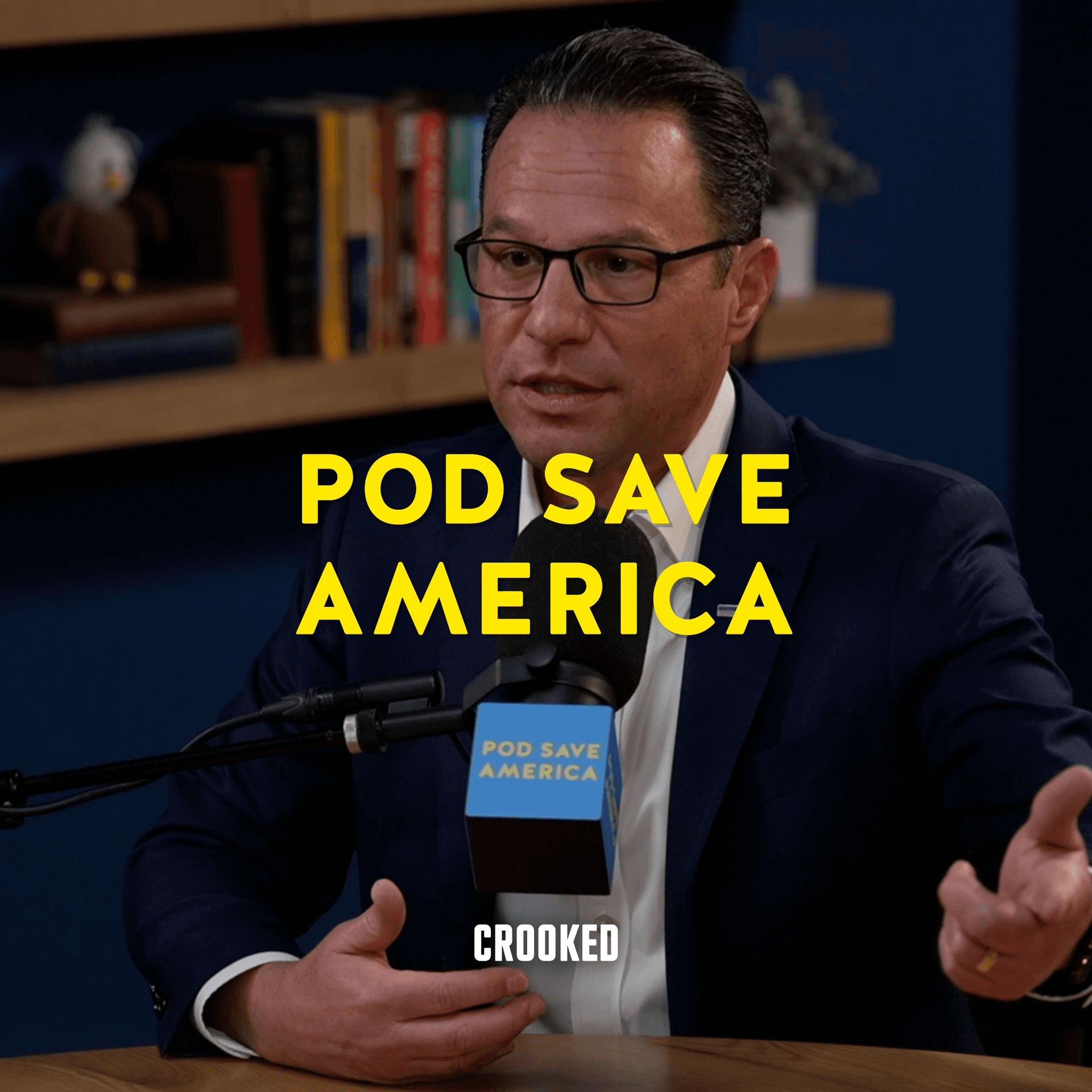
Josh Shapiro Is Calm but Not Cool
Hosts
Jon Lovett with Governor Josh Shapiro
Air Date
[Insert Air Date Here]
Episode Overview In this episode, Pennsylvania Governor Josh Shapiro engages in an in-depth conversation with Jon Lovett regarding various pressing political and social issues, including the war in Iran, rising antisemitism, and the challenges facing Democrats today. They explore Shapiro's evolution on key topics, notably the death penalty, and discuss the implications of political discourse in the current climate.
Key Themes and Topics Discussed
- Rising Antisemitism and Islamophobia
- Recent Events: Discussion begins with a recent attack on a Jewish community in Michigan, prompting Shapiro to emphasize the importance of moral clarity from leaders in addressing antisemitism.
- Calls for Unity: Shapiro advocates for a united front against hate and intolerance, urging leaders to condemn antisemitic rhetoric on both the left and right.
- Political Climate and Leadership
- Approach to Politics: Shapiro describes his calm demeanor in politics and how he resists the pressure to be provocative or inflammatory, contrasting his approach with the attention-seeking behavior rewarded in today's political landscape.
- Importance of Problem-Solving: He emphasizes that constituents want results rather than rhetoric, and he aims to deliver tangible outcomes for the people of Pennsylvania.
- Evolution on the Death Penalty
- Personal Journey: Shapiro recounts his initial support for the death penalty, highlighting his transformation to an abolitionist stance, influenced by personal experiences and conversations, particularly with his son.
- Moral Responsibility: He believes in the importance of explaining political changes to constituents, especially when it comes to issues of life and death.
- Government Efficiency and Infrastructure
- I-95 Reconstruction: Shapiro details the rapid reconstruction of I-95 in Pennsylvania, showcasing an efficient government response to emergencies and advocating for a faster permitting process.
- Economic Growth: He argues that a nimble government can lead to economic growth, citing Pennsylvania's achievements, including job creation and a budget surplus.
- War in Iran
- Critique of Trump's Administration: Shapiro criticizes the lack of clarity and rationale in the Trump administration's approach to the war in Iran, linking it to broader global instability.
- Concerns Over Leadership: He expresses concerns about the capabilities of current leadership, particularly regarding military decisions and foreign policy.
- Israeli-Palestinian Conflict
- Rights and Responsibilities: Shapiro discusses the complexities of the Israeli-Palestinian conflict, advocating for a two-state solution and the need for respectful dialogue.
- Criticism of Netanyahu: He articulates his disagreement with Netanyahu's policies and stresses the importance of addressing lawlessness and violence in the West Bank.
- Personal Reflections and Background
- Childhood and Ambitions: Shapiro shares anecdotes from his childhood, including his activism on behalf of Soviet Jews and his path to becoming a public servant.
- Political Aspirations: He reflects on the pressures of ambition in politics and the importance of authenticity in leadership.
Key Takeaways
- Moral Clarity: Leaders must confront hate and intolerance head-on and foster respectful dialogue across political divides.
- Value of Calmness: A measured approach can be effective in politics, as constituents seek meaningful solutions rather than sensationalism.
- Evolving Views: Politicians are expected to evolve on complex issues, and transparency in that evolution is crucial for building trust with voters.
- Government Efficiency: Streamlining processes can lead to significant achievements in infrastructure and economic performance.
- Importance of Context: In discussions about sensitive international relations, using precise language is necessary to foster understanding and prevent unnecessary conflict.
Conclusion This episode of Pod Save America provides a comprehensive look into the mind of Governor Josh Shapiro, highlighting the intersection of personal experience, political strategy, and social responsibility. The conversation serves as a reminder of the ongoing challenges facing leaders in today's political climate.
Listen to the Episode For more insights, listen to the full episode on [Pod Save America](https://crooked.com/podcast).
Written by AI. May contain mistakes. Listen to the episode to check what was said.
Chapters
Tap a time to open that second in VORising Anti-Semitism and Violence
1:24 to 2:15
Governor Shapiro discusses recent attacks on Jewish communities and the need for moral clarity.
“So yesterday, we are taping this on Friday morning.”
Political Responsibility Against Hate
2:15 to 4:25
The governor emphasizes the need for leaders to unite against anti-Semitism and Islamophobia.
“And by the way, thank God no one was killed.”
The Impact of Political Rhetoric
4:25 to 6:28
Shapiro critiques inflammatory political language and its consequences on societal division.
“I think it's a pretty black and white issue with very little nuance.”
Measured Approach to Politics
6:28 to 8:56
Shapiro reflects on the importance of thoughtful political discourse versus sensationalism.
“Look, I think a big reason for that is because of what Donald Trump has done to our politics over the last 10 years.”
Evolution on the Death Penalty
8:56 to 14:00
Shapiro shares his journey from supporting to opposing the death penalty based on personal experiences.
“And the way you deliver is by trying to find ways to find common ground, work with people, see that common thread of humanity that allows us to have dialogue and figure stuff out.”
The Importance of Listening in Politics
14:00 to 15:00
Learn how effective listening shapes political decision-making.
“that they need this for their community or that for their community.”
Evolving Political Positions
15:00 to 16:40
Discover the significance of explaining changes in political stance.
“A lot of people who disagree with me reached out and said, hey man, I really appreciate how you explained that.”
Debating End-of-Life Laws
19:40 to 21:00
Examine the complexities surrounding end-of-life legislation in the U.S.
“A life experience that I have never, thank God, had to deal with.”
Compassion and Decision Making
21:00 to 22:20
Understand the responsibility of leaders in navigating moral dilemmas.
“pressure right that that we start to say as a society that not that people's lives at the end of their lives aren't of the same value.”
ICE Operations and Community Trust
22:20 to 24:20
Discuss the impact of federal policies on local communities in Pennsylvania.
“I let people know where I was coming from and how I reached that conclusion.”
Show all 26 chapters
Fighting ICE Detention Facilities
24:20 to 26:20
Learn about the governor's efforts to block ICE detention centers.
“Not a badge, not a gun, not a radio, but it's trust.”
Efficient Infrastructure Response
26:20 to 28:00
Explore how quick responses to infrastructure issues can be achieved.
“And based on the sort of general plans that they have, they would not qualify for receiving a permit in Pennsylvania.”
Rapid Response to Infrastructure Crisis
28:00 to 30:49
Learn how innovative problem solving led to a swift I-95 reconstruction.
“and goes through Philly, about 200 ,000 cars and trucks every day.”
Transforming Pennsylvania's Permitting Process
30:50 to 33:32
Discover the changes made to streamline Pennsylvania's permitting system.
“And so we then set out to fix our permitting system in Pennsylvania.”
The Role of Leadership in Governance
33:33 to 35:38
Understand the importance of accountability and tangible results in governance.
“I'm not asking you to go back and just shit on the Biden administration.”
Critiquing War Strategies and Leadership
39:13 to 42:00
Analyze the complexities and criticisms of current military strategies.
“All right, let's talk about Iran because obviously we're in the midst of a war with Iran.”
The President's War and Its Consequences
42:00 to 45:01
Discusses the implications of the current president's military decisions and the resulting global instability.
“I said the first day of this or within the first hours that Congress needed to act, which I know some people think is sort of processy or whatever, but it is actually the way the law of this country works.”
Gavin Newsom's Controversial Comments on Israel
45:01 to 48:22
Analyzes Governor Gavin Newsom's remarks on Israel's political situation and the historical context of U.S.-Israel relations.
“that has fed into, I think, some of the kind of anti-Semitism you see on the far right, a bit of what you also see on the left that we're in this war because of Israel.”
The Complexities of Israeli Policies
48:22 to 52:40
Explores the nuances of Israeli policies and the implications for American foreign policy and national security.
“and dialogue where we're precise with our words, where we're able to acknowledge there's a lot of nuance on these issues and we should debate them.”
Josh Shapiro's Early Advocacy for Soviet Jews
55:08 to 56:00
Reflects on Josh Shapiro's childhood experiences advocating for Soviet Jewish refugees, highlighting his early activism.
“I want to talk about the book a little bit more, especially about when you were a kid.”
Bar Mitzvah Story and Advocacy
56:00 to 57:25
Explore the impactful story of a childhood advocacy experience that shaped a future leader.
“That was like the big prestigious temple.”
Childhood Ambitions and Challenges
57:25 to 58:29
Discuss the early ambitions and challenges faced growing up, including school experiences.
“However, look, I was an ambitious, smart Jewish boy, but I'm small, gay, and weird.”
College and Political Awakening
58:29 to 1:00:43
Learn about the transition from aspiring doctor to student government leader and the impact of that experience.
“And the principal told my parents that I could come back to school, but I had to make a decision.”
Career Path Choices and Political Impact
1:00:43 to 1:02:38
Discover the unconventional choices made in a political career aimed at maximizing community impact.
“Well, cause there's, there's a strange thing we do in our culture where we like people to be ambitious, but we also want them to pretend that they just happen upon great success.”
Reflections on the VP Consideration
1:02:38 to 1:04:40
Delve into the emotional journey and reflections regarding being considered for the vice presidency.
“And I want to use the position that people have entrusted me with to deliver for them.”
Light-Hearted Rapid Fire Questions
1:04:40 to 1:06:01
Engage in a fun rapid-fire segment discussing light-hearted topics related to culture and food.
“when she announced Tim Walz, who's a really good friend of mine, that he was the pick, man, I showed up in Philly that night.”
Transcript
Automatic transcript. May contain errors.0:00Work moves fast. Every email, report, and proposal counts. That's where Grammarly comes in. It's your one place to think, write, and finish. Grammarly's AI agents help you find natural phrasing, fine-tune tone, and confidently write wherever you work. It's the premier writing tool that 93 % of users trust to get more work done. In a world of generic AI, don't sound like everyone else. With Grammarly, you never will. Download Grammarly for free at Grammarly.com.
0:49Hey, everybody. Welcome to Pod Save America. I'm John Lovett. I just finished an hour-long conversation with Pennsylvania Governor Josh Shapiro. We covered a lot of ground. We talked about the war in Iran. We talked about Israel, Netanyahu, anti-Semitism. We talked about his relationship to the Biden administration, where he had to push back what it was like bowing out of the VP process. We did not talk about whether or not he's going to run for president. And we got into some tough questions about bagel orders. It was a really interesting conversation that went a lot of different places. And I hope you appreciate it.
1:24Governor, welcome back to the pod. It's good Good to see you. Good to be here. Thanks for having me. So yesterday, we are taping this on Friday morning. There was another attack on a Jewish community. This time, someone drove their car into a synagogue in West Bloomfield, Michigan. You were attorney general when there was the attack on the Tree of Life synagogue in Pittsburgh. There was the arson attack on the governor's residence when you and your family were home. What was your reaction to what happened yesterday? I mean, just another sad and scary example of how anti-Semitism is dangerous. It's on the rise across this country.
1:56And I think what we need more of is for leaders to speak and act with moral clarity, call it out, and leave no space for it. I was in touch with my dear friend Gretchen Whitmer yesterday. I thought she did an outstanding job speaking out against it and making clear that this is not going to be acceptable in our society anywhere. I think it is important for us to address these crises. And by the way, thank God no one was killed. I mean, this could have been far worse, but still incredibly dangerous. I think it is important to not just address these crises after they happen, after an attack, whether it's at the Pennsylvania governor's residence, at the Tree of Life or anywhere else.
2:35But we have to address it when the seedlings are planted of this kind of hate, of this kind of anti-Semitism. There should be no place for it in our society. And I think leaders have responsibility to call it out wherever they see it, on the political left or the political right. So on that note, obviously, like temperatures are high. just today, Josh Godheimer, he's a Democratic congressman whose district borders your state. He had harsh words for Zoran Mamdani, Maine Senate candidate Grant Plattner. He called them socialist anti-Semites and basically said, you're not against anti-Semitism if you support them.
3:11I know you checked in with Mamdani after the attack that happened in New York. What is your reaction to what Godheimer said? Look, it's hard for me to react to it. I haven't heard it. I don't know caught in responding. It's a tweet. There's no context. You have it all. Yeah. Look, I'll just tell you, I reached out to Mayor Momdani, I guess it was probably three or four days ago at this point, after that incident outside his residence. And I wanted to make clear, look, I've been through it. Now, thank God nothing detonated there, unlike in our situation in Pennsylvania. But I know that this can affect your psyche, affect the way you think about stuff.
3:50I want to make sure he and his wife were okay. And I think we had a good conversation and appreciate that. I think it is really important. I'm going to just make a general statement on this. I understand what you're getting at here and I want to try and address your point. I think it's really important that we have two distinct conversations happen. One, which is the way you started this, and that is about antisemitism. And there should be no room for that. And by the way, it shouldn't really be debatable. Like we should all stand universally against it on the left and on the right. And it shouldn't be hard to do that.
4:26I think it's a pretty black and white issue with very little nuance. And then there's a second conversation and that is about policies in the Middle East, about the war in Iran, about what's happening in Israel and Gaza and all that. I assume at some point you'll get into that in our conversation. That's full of nuance and there should be space for disagreement that doesn't lead to charges of anti-Semitism. I think if someone engages in anti-Semitism, we got to call it out. If they're engaging in expressing their opinion on an issue of the Middle East, we should leave room for respectful and responsible debate.
5:00So on the other side of this, you have Alabama Senator Tommy Tuberville retreating a photo of Momdani opposite a photo of the attack on the World Trade Center that said the enemy is inside the gates. Another congressman this week said Muslims don't belong in American society. We need more Islamophobia, not less. I can't imagine any elected official saying the same against Jewish people, other minorities, without facing a ton of calls for resignation. What do you make of the purchase that this kind of anti-Muslim bigotry has in the Republican Party? Yeah, look, I think I didn't see the tweets again.
5:37I apologize, but I get your point. And I actually addressed this, I guess it would have been two nights ago at an iftar in the Lehigh Valley in Pennsylvania, talking about the rise in both anti-Semitism, Islamophobia, and making clear that we have to stand together and unite against that and understand that our diversity makes us far stronger. I think that kind of language on the political right here, as you're describing it, is just simply unacceptable. And I think it's incumbent upon all of us to speak out against it. And it's one of the reasons why I try and do everything in my power to call it out wherever I see it, to reach out to Republicans, to reach out to Democrats, to reach out to people who disagree.
6:18I might disagree with on an issue if they're targeted, whether, God forbid, by violence or that type of incendiary language. I don't think there's a place for it. Look, I think a big reason for that is because of what Donald Trump has done to our politics over the last 10 years. You know, my wife, Laura, and I were talking about this the other night. We have four children, 24, just about 21, 17 and 15. Their entire political reference point or framework, aside from their dad, right, is Donald Trump. Now, they happen to not agree with Donald Trump, which is a good thing, but the way they view our politics is through this prism of just nastiness and cruelty and division.
7:01And that's something that we've got to figure out how to fix in this country. Get back to the guy you worked for, right? Which was about hope and change and bringing people together. We got to find our way back to that in this society. You're such a, I was thinking about this conversation and there's like a natural carefulness that you have, like a measured way you approach politics. I'm trying to give you a thoughtful answer. No, no, I'm not. I'm not, I'm not, I'm, and, and actually I like, it seems to be what a lot of people want. They, that, that the people are pretty sick of politicians that are just saying the most fringe attention grabbing clicky thing, but it is rewarded in our politics right now.
7:43And you seem to try to avoid being part of that. And I wonder if you feel that pressure in either direction, either to like, uh, let loose a little bit more or, uh, to be a kind of more sober minded person, even if sometimes people claim they want something a little bit more shoot from the hip. Yeah. I would just respectfully push back on one thing you said, the sort of notion of letting loose. I, I, I'm being very open and candid with you. And that's sort of what I think of is let loose. If you're talking about just like yelling and screaming and banging the table, like that ain't me. And I realized that might get me more likes on Twitter and that might get me more followers on different social media platforms.
8:22That ain't who I am. And by the way, that ain't what the people who elected me want. They want me to go solve their problems. They want me to get shit done for them. They want me to be able to deliver results for them. And if you're just out in the arena yelling and screaming every day, yeah, you'll get some more followers on social media, but you're not going to accomplish a damn thing. And so I think there's a difference between being thoughtful and sober minded and being, you know, willing to just sort of engage in the slash and burn politics. One might be, you know, again, more likely to get you some, some likes, but at At the end of the day, your job is to deliver.
8:56And the way you deliver is by trying to find ways to find common ground, work with people, see that common thread of humanity that allows us to have dialogue and figure stuff out. So I was reading your book. Thank you. And I would like to do a disclosure here, which is you worked on the book with my friend, Emily Jane Fox. And I want to be on the record that what I believe is interesting and good about the book comes from my friend. And the parts that I am critical of are the material you provided and are your fault. Okay, got it. Okay. All right. I'll make sure Emily hears that. There's a fascinating part.
9:30Let the record reflect. John smirked a little bit. I did smirk a little bit. It's on video. Yeah. I want to talk about your evolution on the death penalty because I thought it was interesting. Can you just give people a brief summary of what led you to go from being someone who was in favor of the death penalty to someone who was against it? Yeah. And by the way, genuinely in favor of the death penalty. an honestly held view throughout my career, including two runs for attorney general, where I was the chief law enforcement officer of the Commonwealth of Pennsylvania. And I believed that the death penalty should be reserved for the most heinous of cases.
10:06And it wasn't to score political points or get votes. It's what I believed. And what began to happen to me over many years kind of all happened at roughly the same time, One, more and more cases were coming across my desk as AG that could have led me to pursuing capital punishment. And each time I didn't, I sought a life sentence instead. I was dealing with the realities of tragedy striking in Pennsylvania where the tree of life, the deadliest act of anti-Semitism occurred in Pittsburgh, claiming 11 lives. And I supported the death penalty. in that case. It ended up being a federal case, not a state one, so it wasn't my active prosecution.
10:54But I heard from families, a small number of them, who didn't want the death penalty there. And then I had, as I was grappling with this, as I was seeing the problems in our justice system, I had a conversation with my then roughly 11-year-old son, Max. Out of nowhere, this was during COVID, we were kind of in the house a lot. And out of nowhere, Max says to me, Hey dad, we don't have the death penalty in Pennsylvania, do we? And I said, well, we do. He goes, well, you're not for it. Are you? And I found myself saying to him what I had said many times in the context of a campaign or my work. Well, son, in the most heinous of cases, you know, blah, blah, blah.
11:37And I'm going on and on. And I noticed that I wasn't looking at him in the eye, the way I am you right now when I said it. If you can't make eye contact with your kid, that should tell you something about what you're saying. And then my Max looked at me and said, well, I don't understand why killing someone as a punishment for them killing someone makes any sense. And man, I walked away thinking, I'm in the wrong place on this. By the way, I was probably in the right place on it politically in terms of polling and all that kind of stuff. But later on, I can't remember exactly what the timeframe was, but some number of months or so later, I announced my run for governor and said that I was against the death penalty.
12:20And within the first few weeks of my time as governor, the first execution warrant came across my desk. And literally, John, if I were to sign it, someone would have been put to death. And I made clear that I would put a moratorium in place. I wouldn't sign any execution warrants as long as I'm governor. And I didn't call on the legislature to reform the system. I called on the legislature to abolish the death penalty because I simply believe the state should not be in the business of killing people. So often there are these debates around hot button social issues. And the question is, you know, should Democrats moderate on this?
12:57And others say, don't throw that group of people under the bus. We should others say we need to take the popular point of view. But clearly there's a relationship between being willing to go to the voters of Pennsylvania, who I assume by majority approve of the death penalty and say, I'm not for this. That involves politics around it where you've built a level of trust and credibility where you feel like you have the where you can go to the voters and say, I'm not with you on this issue. Can you talk a little bit about that, about how you felt like you could confidently do this, take a position that you thought might be a little politically risky in this situation?
13:34First, I don't want to like overstate the politics in a sense that I really didn't think about the political calculus here. And it was just, to me, it was a moral issue. And I think it speaks to the challenge. I would hope every politician considers, but I can just speak for myself, which is, you know, you run on a platform, I'm going to do A, B, and C. That platform reflects your own views and values, along with what you pick up from listening to people along the way, that they need this for their community or that for their community. And you try and just sort of mash all that together into the work you do every day.
14:12Now, if someone says they want to do something, but it violates everything you believe in, you're not going to pursue it. Those are kind of extreme examples. But everything is this effort to be able to pull together what you hear when you're listening. And I pride myself on being a good listener and what's in your heart, what's in your gut, what's in your soul and how to fashion all that together in a platform. In this case, I did feel that even though I was on the wrong side of the polling, that I did owe it to the people of Pennsylvania to explain my rationale because I was taking a different position than what I had historically taken.
14:50And I wanted them to understand how I evolved on this issue. I think it's important for politicians to be able to change their mind, but I also think it's incumbent upon us to explain our rationale for that. And that's what I did. And you know what? A lot of people who disagree with me reached out and said, hey man, I really appreciate how you explained that. I disagree with you, but I respect where you're coming from.
15:41We'll see you next time. that actually work for your climate, space, and lifestyle. Fast-growing trees makes it easy to get your dream yard. Just click, order, and grow, and get healthy, thriving plants delivered to your door. Their Alive and Thrive guarantee promises that your plants thrive happy and healthy. Plus, get ongoing support from trained experts who can help you plan your landscape, choose the right plants, and learn how to care for them every step of the way. We're huge fans of fast-growing trees. It's a great way to get great plants. We have a bunch of stuff around the office from them.
16:08It's a great way to kind of find the right things for your yard. Because I don't know about plants. Yeah, I don't know. Everyone wants cool plants. You want them to look good. You want them to stay alive and they'll help you with all of that. They'll give you instructions, help you figure out what to buy. And then most importantly, how to make sure you don't kill them. Kill them. Right now, they have great deals on spring planting essentials, up to half off on select plants. And listeners to our show get 20 % off their first purchase when using the code Crooked at checkout. That's an additional 20 % off better plants and better growing at fastgrowingtrees.com.
16:35Use the code Crooked at checkout. Fastgrowingtrees.com, code Crooked. Now's the perfect time to plant. Let's grow together. Use Crooked to save today. offer is valid for a limited time. Terms and conditions may apply. Pod Save America is brought to you by Magic Spoon. We love Magic Spoon. I love Magic Spoon. Why? Because it tastes good. Okay, there's a lot of good healthy reasons. There's a lot of protein. There's a lot of fiber. There's no added sugar. There's like very little net carbs. I like it because it tastes really good. And I can inhale a bowl of it and not feel guilty because it's also good for you.
17:05But mostly it just tastes good. And they also have Magic Spoon treats, which are these crispy, kind of like airy protein pack snacks. Again, 12 grams of protein, seven grams of fiber, no added sugar, only two to three net carbs, and they're certified gluten-free. And they feel like a nice little treat, not a health bar. It's perfect for like throwing one in your gym bag, keeping one in the car, grabbing something between meetings or during a meeting, or just getting rid of that little craving that hits at night. And some of the flavors include marshmallow, chocolate peanut butter, double chocolate, and a bunch more.
17:33It's all very delicious, nostalgic, kind of dessert-coated, but without loading you up on sugar. You know Magic Spoon from their cereal. And yes, we still love their iconic cereal, but their high-protein, zero-sugar cereal bars bring all that childhood nostalgia without the high-sugar content. Again, 12 to 14 servings of protein in between zero to two grams of sugar. So it keeps you full. Great flavors like Fruity Frosted, Cinnamon Crunch, cocoa, peanut butter, and a lot more. Magic Spoon is easy to find. Just look for Magic Spoon at your local grocery store, and they just rolled out treats nationwide at 7-Eleven.
18:06or get five bucks off your next order at magicspoon.com slash crooked. That's magicspoon.com slash crooked for$5 off.
18:19I was thinking about this because there's this debate. There was a law passed in Canada about end of life. There's been a few laws in the U.S. passed about end of life and the rights people have, whether the state should sanction medically assisted suicide and terminal cases. There's a bill in Pennsylvania about this. Right now, several Democrats have introduced it in the legislature about compassion in dying. And it relates to the death penalty because if you believe that there is a distinction between the power of the state to end someone's life and the power of the state to put someone in jail for the rest of their lives, there's something intrinsic about life itself that comes into play here, something deeper and moral.
18:59And I'm wondering how you think about the state's role in end of life as someone who clearly grapples with these questions as a Jewish person, as a leader. Yeah, I mean, I grapple with it as a governor. I don't know that my faith is sort of the driver in this. But look, putting aside what's written in the specific bills and in the legislature, you know, I've heard from a number of people. I've heard from a handful of people on this issue who have, I think, really passionate perspectives on it. And seemingly every one of them that I've heard from, it's grounded in some life experience, right? A life experience that I have never, thank God, had to deal with.
19:46I tend to be someone in general that trusts people to make decisions over their own bodies. that whether it's a woman's right to choose, whether it's a parent's right to be able to vaccinate their kids, how they think, uh, you know, is, is best for them. And so I tend to be kind of libertarian on, on that stuff and creating a space for individuals to be able to make those decisions. Now, look, we're going to allow that. There has to be some rules of the road and some clear guidelines on how that would work. And I'd be lying to you if I was sitting here today, telling you that I've got it all figured out.
20:20It's an issue that comes up with some, but it's not an issue I think that's dominating our legislative process in Pennsylvania. Well, yeah. But I feel like it's coming. It's coming for the democratic debate about how we think about this. And I ask, I do think it gets at something about what we think about like the value of life because i believe in the right to abortion people should have control over their own destinies but then when it's the state when they're right when when when the state allows for something like this you have to also worry about people feeling if not coerced like pressure right that that we start to say as a society that not that people's lives at the end of their lives aren't of the same value.
21:09Yeah, I'm not suggesting that at all. And I know you're not. I'm just, I'm curious how you think about that. Because what I found in reading the book is that there is, you are grappling with moral questions. You are thinking about what the right thing to do is. And, you know, you are somebody that is potentially running for president. And this is an issue to me where it kind of accesses in an atypical way some of these sort of deeper questions. Yeah, look, I'm in general, first off, I'm running for re-election And I know that. And I know that. I'm speaking. Yeah. I think it's incumbent upon leaders to really think through these issues, not just based on what gets the most likes on social media, but how they really impact real people.
21:52How folks in the community who care about a particular issue like this bring it up to you and raise the issue. And to try and find compassion in your heart for people that you might even disagree with on foundational issues like this. And these are things I try and work through every day. I think what's incumbent upon me as a public official, which might be different from you or others, is I've got a responsibility to explain myself. The death penalty is an example of that where I evolved on the issue. I explained myself. I let people know where I was coming from and how I reached that conclusion.
22:28And I think on these underlying questions, you've got a responsibility to do that. So a lot of the attention was on Minnesota when Trump deployed the National Guard. It feels like ICE's operations in Pennsylvania have fallen under the radar a little bit. What is the scene like on the ground? What have you been doing in response to the way Trump has been deploying ICE in Pennsylvania? Well, first of all, what we saw in Minnesota was unconstitutional. It was dangerous. It made the community less safe and it claimed the lives of two American citizens, Miss Good and Mr. Petty. And there must be accountability for that.
23:06Just because they got rid of Noam and put in, what's his name, Holman, and now they're trying to put in the other guy, Mullen. Just because they're kind of shuffling the deck chairs here doesn't make it that the policies of this administration are just. Remember, the reason why ICE did what it did in Minnesota was because Donald Trump commanded them to do that. The problem here is Donald Trump. The problem here is the manner in which ICE is being funded and being directed by Donald Trump. So changing around who the bit players are in this isn't going to solve the problem. Relative to Pennsylvania, the crux of your question, I will tell you that, and this is probably where I'll maybe hold back in sharing with you a little bit.
23:52Hopefully you'll understand. We are prepared to be able to address this both in the court and in the communities. And we spent a lot of time working with law enforcement at the local level, working with some other federal partners who we do have the ability to work with on this to ensure the safety and well-being of the people of Pennsylvania. I would say as the former chief law enforcement officer of Pennsylvania, the most important tool law enforcement has to keep communities safe is trust, right? Not a badge, not a gun, not a radio, but it's trust. And it is really hard to build trust in a community between community and law enforcement.
24:28We pride ourselves on doing that hard work. We do not want the federal government coming in and eroding that trust. And so we're going to continue to do everything in our power to be prepared and to be able to be prepared to take the steps necessary to stop the influx should Donald Trump try? And should he bring them to Pennsylvania, be prepared to deal with that in the communities? I know you're fighting to block construction of two ICE detention facilities. What's the status of that? What levers do you have? So look, the federal government bought these two massive warehouses. Think like massive Amazon warehouses, that kind of thing.
Read the full transcript
25:07One in Berks County, Pennsylvania, one in Schuylkill County, Pennsylvania. These are huge. and they want to convert them to ICE detention centers, house about 9 ,000 people there. They did this without consulting with local officials, certainly without consulting with state officials. And by the way, pissed off not just me, but a whole bunch of Republican elected officials in those communities as well. I met with local leaders about, now it's probably about a week or two ago at this point, and heard their concerns. Putting aside the fact that I think this is unjust, there are also very practical reasons why this won't work and why we're not going to allow it.
25:47At one of the facilities, they're trying to attach to a water system that serves 700 households in that community. That water system, through No Faults Are Own, can barely keep up with the 700 households. You go put 9 ,000 bodies on that water system, You will literally use up all of the water in that water system in less than 24 hours That means the homeowner won't be able to turn on their sink in the kitchen to boil a pot of water They won't be able to flush the toilet or take a shower. We're not going to allow that I made clear to secretary noem. I know is on her way out But at the time she was still the secretary Uh that we would not tolerate this that we would take steps to stop it And just a few days ago, I put them on notice that for them to be able to build these facilities, they require – I'm going to nerd out on you here, but it's important – they require a number of permits through the Department of Environmental Protection in the state and other state agencies.
26:45And based on the sort of general plans that they have, they would not qualify for receiving a permit in Pennsylvania. And I'm going to use every lever of power I have to hold it up. Did you talk to them directly about it? I communicated with her in writing about it. Uh, did you ever, ever get on the phone with her, have any direct contact with her while she was running the department? Uh, one time, uh, we missed each other and exchanged voicemails about a snowstorm that was coming. Uh, speaking of, uh, permits, uh, you're, you, you fixed on 95 in like, like two weeks, right? Was that it? Two weeks?
27:19I mean, 12 days. 12, 12 days. Who's counting? 12 days. That was amazing. Yeah. Honestly, that was, that was, look, you, uh, uh, in California, man. You just the just just to think about a bike path. You're talking about six months just to think if you have the thought you have to wait six months. How did you do it in two weeks, 12 days? And why is it that we can do fast construction in emergencies, but we struggle to do it outside of those moments? Well, we're doing fast construction, period, now. And I'll talk about that in a sec. First on 95, we had a big chunk of I-95 collapse when a fuel tanker exploded underneath.
27:59That roadway, which connects, by the way, Maine all the way to Florida, but is a big heavy artery from, say, like New York to D.C. and goes through Philly, about 200 ,000 cars and trucks every day. The road literally collapsed. Found out at 6, 7 a.m., something like that. Immediately went to the scene once the fire was out. and you're looking at like a gaping hole. And my immediate response, I am not an engineer, was fill the damn hole with a bunch of dirt, pave over it, get traffic moving again. Why do I share that with you? Because that sort of set the tone for how we approach this. Number one, I signed an executive order doing away with all the procurement headaches and all the deadlines and delays that typically would slow down a project so that we could get the project started, not within days or hours, but within minutes.
28:52So that was number one. Number two, we put the best team on the ground who had the expertise to do the work, and that is the Philadelphia building trades, union building trades, who know how to build roads, who know how to build bridges and do this work. Number three, we trusted them to do this work. So every time there was a question about something, they didn't have to like call back to headquarters and wait weeks to get an answer. Here's an example of that. Remember I said before, fill it with dirt, pave over it, what have you. Someone there had the idea that, and they said this to me very politely, I'm sure they wanted to be like, you don't know what you're talking about, but they were polite.
29:30They said, you know, Governor, we can't use dirt because dirt's really heavy and it'll take a long time for the dirt to settle before we can put asphalt over it. But there's this recycled material that's made of recycled glass, requires no time to settle and it's super light. We can put that as a foundation and then pave over it. They had this innovative idea that people write out in the community. Now I immediately thought this stuff's going to be in like New Zealand or something. It's going to take forever to get here. It was in Delco, Delaware County, right around the corner from where we were in Philly.
30:03We trucked that stuff in while the road that was there was being demolished, getting ready to fill it up. The building trades work 24-7, 365, right? We put it on a live webcam so Philly could watch. You literally go in a Philly sports bar and you'd see the Phillies on one screen and you'd see the I-95 workers on the other. It became a point of pride for us, which is the final point I want to make. It showed that we can do big things in this country. It shows that when we kind of put our shoulder to the wheel, we can accomplish big things and we do not need to be mired in the slowness that typically dictates the speed of government.
30:43From that experience, we made clear that we're going to be about getting shit done in Pennsylvania, about getting rid of the limitations on us and about performing at a fast and high level. And so we then set out to fix our permitting system in Pennsylvania. We went from roughly 48th in the country in terms of speed to permit to being first or second or third in the country on speed. The day I took office took eight weeks to get a simple business license. Now you get it same day. The big buildings that we're trying to build used to take years and years and years to get permitted through our Department of Environmental Protection.
31:17You're not going to permit in less than six months. We are faster than other states. And so we not only rebuilt I-95 in record time, we're building and constructing right now in record time. And as a result of that, We've got the only growing economy in the northeastern part of the United States. Our unemployment rate has been below the national rate for 32 straight months. We created more jobs than all but three other states in the entire country. We cut taxes seven different times and have an$8 billion surplus. We're making really strategic investments. The economy is growing. And a huge reason why is because our government is nimble and it is fast.
31:57I-95 may be the sort of example of that. exhibit A of that that folks noticed. But every day we're doing the blocking and tackling of governing that's getting the job done and getting it done quickly. Do you view that as a way in which the Biden administration just didn't understand the need to have that kind of mentality and executing? There's a lot of examples, electric charging stations, what have you. Is that a failure of Democrats nationally to understand how to kind of quickly implement? Look, I'm not here to like shit on anybody or trash anybody. I will just tell you, I think that we have a responsibility when we're governing to show our work, to put the points on the board that people can see.
32:40Because I think at the end of the day, what people really want is their elected leaders, particularly executives, right? Mayors, governors, presidents. They want them to be out there fixing something for them. And I think the things they basically want are good schools for their kids, safe communities to live in, an economy that creates opportunity for them and their communities, in communities that they can afford, right, kind of fits together. And I think they want their rights and their freedoms protected. And I'll tell you, John, when I'm on a farm in a county that voted for Donald Trump 80-20 or whether I'm in the city of Philadelphia that voted for Kamala Harris, you know, roughly 80-20, I hear the same thing.
33:19That's what people want. And so I think it's incumbent upon leaders to not just pass the bill, but then actually drive out the funding and get the construction going. To not just talk about something, but deliver on it in order to make people's lives better. Yeah, and I hear you. I'm not asking you to go back and just shit on the Biden administration. But I do think if there's a perception in the public that Democrats, Republicans are extreme, but Democrats, they're just kind of weak and can't move things forward. We've got to figure out why people have that perception and what are the ways Democrats have failed.
33:52And I'm wondering if you see any ways in which you think like national Democrats right now are not doing enough to signal that they're not just sort of saying the right things but can actually get things done for people. Well, look, nationally, Democrats, you're talking about Democrats in Congress, they don't have the levers of power right now. We need to make sure we get them back. And I'm hopeful that if we have a national referendum in these midterms on Donald Trump, we will win back the U.S. House at least and be able to have a check and be able to have some authority at the table to affect outcomes.
34:24I think, for example, if you go back and look a few years ago when Democrats were in charge in Washington, they did an extraordinary job of passing some of the most sweeping infrastructure laws our country's ever seen. And I commend President Biden and the Democrats who were leading Congress at the time for getting that done. I was also really direct with the Biden administration that once we pass it, that's step one. We got to get the dollars out and get the construction going. That's the important step, too, so that people kind of see with their own eyes the effect of sending congressmen so-and-so or President Biden to the job to deliver for them.
35:04And so I think that that is something, you know, again, I can really just speak for myself. That is something I focus on every day is not just passing the bill or advocating for the change, but showing how it's making a tangible difference in people's lives. Were there ever moments after those bills passed, you're the governor, where you're like, hey, where's the fucking money? Like we said, we passed this years ago. Like, why aren't we doing this? How do we get this done? Like, are you calling Buttigieg? Are you calling Kamala Harris? Are you calling to try to speak to the president? Like, what was it like trying to get things moving with the administration?
35:34Yeah, I mean, I was, and I would call them directly and say, hey, look, we passed this, but we've got to drive the dollars out. Or we're kind of held up in a regulatory process here. Can you release the money so we can get started on this? And I was very clear about that.
35:59Pod Save America is brought to you by Bomba. Spring is basically here, and so we're starting to think about our outdoor adventures. but you know, when you're outside, inside, you still want to be super comfortable from weekend hikes to weekend errands. Bombas is here to upgrade your everyday go-tos with a spring in your step. The all new Bombas sports socks are engineered with sports specific comfort for running, golf, hiking, skiing, snowboarding, and all sport. They're cushioned where you need it most, sweat wicking and loaded with other tech features to keep you comfy and locked in. But if you're just hanging around the house, Bombas also has you covered with the comfiest footwear imaginable.
36:27They have Sherpa Sunday slippers that like are padded, but I have these slides, the Friday sandal that I really, really love. I genuinely use it basically every day. They're great to walk the dog. They're great to have with socks and then go to like a Pilates or yoga class. I'm just a huge fan. I took my own advice a couple of weeks back and I threw out a bunch of old crappy socks and just bought a whole bunch of new Bombas. And it's the best thing I've done. Cause like, you know, when you're like going to the gym and you're searching around for the socks you want, like you can't find them, it sucks.
36:53Not anymore. Not anymore. Not anymore. Not anymore. Not anymore. Head on over to Bombas. And for every item you purchase, an essential clothing item is donated to someone facing housing insecurity. One purchase, one donated with over 150 million donations and counting. Head over to bombas.com slash crooked and use the code crooked for 20 % off your first purchase. That's B-O-M-B-A-S.com slash crooked. Code crooked at checkout. Pod Save America is brought to you by Uplift Desk. We have three Uplift Desks in our office. We love them. Three Uplift Desks. Here's the thing about Uplift Desks. They're great desks when they're low.
37:25When you're just normal and seated at them, they're big and they're spacious. Classic desk height. Yeah, they're like well set up with the monitor and the cords and all that stuff. and then you press a little magic button and it raises up and you can stand for half an hour if you want to. Look, we got the uplift desks and I had no idea if we were going to use them or not. When I say that it's basically like, you know that game at the carnival where the mole pops up and you hit it with the hammer? That's what it's like in our office. We're just going up and down all day, all day. You look over, John's going up.
37:52Then that'll like remind one of the other, one of us to go up. Or like, you're like, time for lunch, I'm sitting. What you're describing is a game called Whack-A-Mole. Yeah, it's like Whack-A-Mole. We're like Whack-A-Mole. We're constantly like, you'll just be typing, and then you'll just look over to your left, and Tommy's just like, and he's up, and he's up. Whack-a-mole minus the concussions. Why sit still when you can stand out? The new Uplift V3 standing desk helps you move more and get more done. The V3 combines the best of Uplift's V2 and V2 commercial into one stronger, smarter frame. Redesigned feet and steel reinforcements make this the most stable standing desk yet.
38:22It assembles in minutes, no stress, no mess. The new flex-mount cable manager comes with every desk to keep cords hidden and tidy. They upgraded everything, speed, stability, ergonomics, and design. Ultimate customization options with the most extensive range of desktop styles and accessories in the industry. Transform your workspace and unlock your full potential with the new Uplift V3 standing desk. Go to upliftdesk.com slash PSA and use the code PSA to get four free accessories, free same-day shipping, free returns, and industry-leading 15-year warranty that covers your entire desk, plus an extra discount off your entire order.
38:54That's upliftdesk.com slash PSA for this exclusive offer. It's only available through our link. That's U-P-L-I-F-T-D-E-S-K.com slash PSA for this exclusive offer. It's only available through our link.
39:13All right, let's talk about Iran because obviously we're in the midst of a war with Iran. John, what is your view on the war right now, how it was launched, what the status is? Well, look, I mean, you absolutely cannot trust Donald Trump to wage this war. I mean, first he told us it was to go after their nuclear arsenal, which he also said seven months ago, six months ago, or whatever it was, that it was completely decimated. Then he said we went to war because if we didn't, Israel was going to strike first, and we had to, and Israel forced our hand. And then they kind of walked that back. Then it was to deteriorate their Navy.
39:52And then it was regime change. And now we're left with the son, who seemingly could be more dangerous than the father. The point I'm making here is that this guy's been all over the place. He's never once looked the American people in the eye, sitting in the Oval Office, where he should have been, not at his swim club in Florida, and said to the American people, this is why we have to do this. This is the imminent threat of which we've now learned there was no imminent threat. And so instead, the president engaged in a war of choice without being clear what the reason was for going in. Now, some might be watching this dismissing me saying, it doesn't matter why.
40:34They're bad guys. And by the way, bad guys indeed. The I-Tol is a bad guy. Largest exporter of terrorism around the world. Destabilized the entire Middle East. chanted death to America for five decades. These are bad people. Shouldn't be hard to say that. But if you don't know why you're going in, you don't know how the hell to get out. And what we're seeing more and more as the days go on are sadly the loss of American heroes' lives. We just lost six more Americans in the refueling accident. We lost six, seven, apologize, a week or so earlier. We are losing lives in battle when I think it's unclear why we were there in the first place.
41:24I also have a problem with the fact that the guy who is supposed to be in charge of this, Pete Hegseth, is wildly incompetent. He's like an eight-year-old playing with toy soldiers every day. His language is so fucking offensive. They talk about this in a way that doesn't respect the humanity in the region and certainly is disrespectful to our soldiers, of which there are Pennsylvanians who are engaged in this fight on behalf of a commander in chief who doesn't have a clue what he's doing. So this was a war of choice by the president. Wasn't clear why we went in. And it's unclear how we get out.
42:06I said the first day of this or within the first hours that Congress needed to act, which I know some people think is sort of processy or whatever, but it is actually the way the law of this country works. Sadly, Congress did act and they acted to give the president carte blanche here. They basically acted to be wildly weak and pathetic souls who are just going to give away their authority to this president. So this is the president's war he started, and now it's the president's war he's got to figure out how to get out of. And he's surrounded by an incompetent leader in Hegseth who I think really doesn't have a clue on what he's doing here.
42:42And right now we have a more destabilized situation. So I think that is dangerous for America. I think it is dangerous for the world. The last point I want to make, and thanks for letting me give a longer answer. I think our enemies are watching. And they are seeing weakness by Donald Trump. President Xi in China, who is calculating every day about when he's going to make his move on Taiwan, saw President of the United States not only not be able to rally the world around this cause, whatever the cause is, but couldn't even rally his own people, couldn't even rally the United States to be for this.
43:28Remember way back to George W. Bush. We know how it played out, but George W. Bush was the 85 % approval rating on the war when he started. Again, not suggesting what he did was right there, but he rallied the country around the response. And there was two votes in Congress, one vote to office in Afghanistan and Iraq. Exactly. So I think she is watching this, seeing that there's a weakness that the United States has. In addition, I think we've shown Xi we've got some military vulnerabilities by moving certain weaponry from one region of the world, one theater to another. I think they're seeing where there's some vulnerabilities.
44:06Second, I think Putin is watching this, realizing that we've now had to withdraw help from Ukraine. And by the way, at the same time, Putin is able to have more of his oil and more of his natural resources go into the flow of commerce as a result. So he's making more money and he's got a cleaner shot at Ukraine, which is unfortunate. So not only unfortunate, but dangerous, I should say. So I think it's bad because you can't trust this guy to prosecute the war. And I think it's bad because it is showing the rest of the world the weakness of Donald Trump and the weakness of this administration. And all of that combined leaves us worse off and leaves the world more destabilized.
44:50So it was genuinely surprising to see the Secretary of State, Marco Rubio, basically say we had to act because Israel was going to go first. And they've tried to walk that back. that has fed into, I think, some of the kind of anti-Semitism you see on the far right, a bit of what you also see on the left that we're in this war because of Israel. It brought us back to this debate over Israel. Governor Gavin Newsom, when talking to John and Tommy on Pod Save America, he was referencing an article by Thomas Friedman, but he said that people are talking about Israel appropriately as sort of an apartheid state.
45:34And I'm wondering what your reaction is to that comment and what it tells you about how the politics on Israel have shifted. Well, look, Gavin should speak for Gavin, and I'm not going to weigh in on his commentary. I'll just say, look, I think that there are sort of foundational issues here that a lot of people are grappling with. And I think a lot of people are grappling with it from an honestly held view or concern. I'll come back to the comment about, or I'll come back to answering your question about apartheid, because I think that was the comment he made, if I'm not mistaken. But I sort of start this conversation around the notion of the question a lot of people raise now is, does Israel even have the right to exist?
46:15Should we sort of be viewing Israel as an ally? Should they even be allowed to exist? And I would argue as someone who is desirous for peace, as someone who for the last 15, nearly 20 years has been calling for a two-state solution, which I realize feels very far away right now. I get that. But the idea of Israel and a Palestinian state where both recognize the other's right to exist, both want to live peacefully and both recognize that the future for their children is going to be rooted and the foundational principle will be around this idea of peace because that will allow their children to grow up in a society where they can be whatever they want to be.
47:01I want peace. And for those who begin by suggesting Israel doesn't have the right to exist as a Jewish state, I think that is a recipe for permanent war. And so I want to see peace in the region. I also do think it's sort of interesting that you've got 46 nations around the world where the majority religion is Islam. 23 of them recognize Islam as the official state religion. One has the official state religion of Judaism, and that's the one we keep talking about here. That then leads to a broader question. You mentioned apartheid, right? Or that was the comment that was made. And I would just say as we engage in that, we should first address this fundamental question of what do we want in that region?
47:58And if we really want peace, and I believe you want that, then we've also got to be acknowledging that language matters here, that words matter. And then we've got to use words that are actually rooted in reality and are able to bring the temperature down to create a space for that, for that peace, for that opportunity. And so that's how I view this entire conflict. I would also say that it is really important that we create space, which you do, for dialogue that is thoughtful and dialogue that's rooted in reality and dialogue where we're precise with our words, where we're able to acknowledge there's a lot of nuance on these issues and we should debate them.
48:47And just because people have different opinions doesn't make them a bad person. And just because someone doesn't agree with the Netanyahu government, which I don't on many, many things, doesn't make him an anti-Semite. Just because I disagree with Benjamin Netanyahu doesn't make me an anti-Semite in as much as because I disagree with Donald Trump doesn't make me any less of an American patriot. So I just think we've got to be really thoughtful and careful and not just look for buzzwords and not just sort of follow, you know, what's going to get maybe some likes on Twitter. But we've got to be thoughtful about a debate that is really, really hard to have.
49:22And we've got to have it. Discussion, not debate. Yeah. So I'm somebody that, you know, I see that kind of blurry line between anti-Zionism and anti-Semitism. It was genuinely shocking to see people defend Hamas or cheer the murder of Jews after October 7th. also horrified by what I view as ethnic cleansing that Israel engaged in in Gaza, the efforts to annex the West Bank, which are not only just wrong morally, but also put this idea of a two-state solution even further away, make Israel a pariah nation. I think there's a lot of Jewish people who feel this conflict. How do you think about that conflict, that sort of space between the Israel we were taught to believe in growing up and the Israel that we see and how it is conducting itself.
50:08I think, and I write about this a lot in my book, about the first trip I ever took to Israel, about how important that was for me, how it helped me get closer connected to my faith and closer connected to my girlfriend who ended up becoming my wife years later. I have profound differences with the policies of Netanyahu, who's largely dominated Israeli politics for the last two or more decades. I think he and Trump have politicized and poisoned the relationship between the United States and Israel. And I think at the end of the day, that makes America less safe and undermines our national security.
51:00I look through all of this through the prism of what's best for the United States of America. The hyper-politization of these kinds of relationships with Israel or with other countries in the realm of foreign policy, I think ultimately works to the detriment of American national security. I think it's fair game to criticize the Netanyahu government. And and I'm one who engages in that you mentioned the West Bank. Let me speak to that I think what is happening in the West Bank and I've spoken out quite a bit about this What's happening in the West Bank where settlers are taking farms of Palestinians are assaulting them We're in the case of a kid from northeast philadelphia a palestinian american killed him just a week or two ago.
51:49I've called on General Bondi to conduct a full investigation about the death of this American young person in the West Bank. I think that that is ultimately not in Israel's long-term interest. And I think the Netanyahu government has a responsibility to stamp that out, to stop that lawlessness. And I think the American government, the Trump administration, needs to speak up on this and needs to be more of a voice of clarity, moral clarity on this issue. Right. But those are two things that are simply not going to happen. Netanyahu wants to annex the West Bank and Trump and the ambassador to Israel for the United States, Huckabee, believes we're on some sort of biblical crusade.
52:35So those two things will not happen as long as Donald Trump is there and Benjamin Netanyahu is there. So then what is the value of, beyond just calling for them to become different people, what do we do? Well, these are the leaders that each country has chosen. I'm not going to speak to what the people in Israel chose. They'll have an election. They'll figure that out. Here in the United States of America, we need to have more of a check on this administration. That's going to start in these midterms. We've got to win the House of Representatives at least back. And that's why I think we need a national referendum on these policies, on Trump's policies, and encourage everybody, whether you're in a swing state like mine or a state that's maybe not as much of a swing state like yours here in California, to get out, to vote.
53:13to make sure our voices are heard, to change the makeup of Congress, and begin to put more checks in place.
53:29Pod Save America is brought to you by Armour Colonstrum. Armour Colonstrum is a simple, nature-inspired addition to your daily routine with over 400 bioactive nutrients. It helps support your gut and immune health to build a stronger foundation for your everyday wellness. When you prioritize your body's baseline, you're better equipped to show up with focus and energy no matter what the day holds. While many turn to probiotics for gut support, they often only focus on one part of a complex system. Armour Colostrum works differently by providing comprehensive nourishment for your gut's natural barrier.
53:55It's designed to help sustain your microbiome and support your body's natural defenses against the stressors of modern life. Elevate your self-care from the inside out. Armour Colostrum provides a blueprint of nutrients that complement your body's natural renewal process from supporting skin and hair vibrancy to assisting with your daily recovery. It's the ultimate tool. for those looking to optimize their well-being at the cellular level. Research has also shown that colostrum can be a powerful ally for your active life. It supports the body's natural ability to absorb nutrients and maintain lean muscle.
54:20We've worked out a special offer for our audience. Receive 30 % off your first subscription order. Go to arma.com slash crooked or enter crooked. Get 30 % off your first subscription order. That's A-R-M-R-A dot com slash crooked. Work moves fast. Every email, report, and proposal counts. That's where Grammarly comes in. It's your one place to think, write, and finish. Grammarly's AI agents help you find natural phrasing, fine-tune tone, and confidently write wherever you work. It's the premier writing tool that 93 % of users trust to get more work done. In a world of generic AI, don't sound like everyone else.
54:59With Grammarly, you never will. Download Grammarly for free at Grammarly.com. All right, let's switch gears. I want to talk about the book a little bit more, especially about when you were a kid. Were you a popular kid? Would you call yourself popular? My wife would say I was like one of the cool kids. Yeah. I think my coolness factor probably has gone down since then. Yeah, I think we'd have to have just based on this. Look, you're many things. I don't think you're cool. I don't think it's bad. I don't need cool. Well, the reason I ask is because so and it speaks to what we were just discussing.
55:34you and your mom were advocating for Soviet Jews who were trapped in the Soviet Union. You start this organization. You're advocating a Soviet Jew, a young boy manages to escape. He's at your bar mitzvah. You're speaking at your bar mitzvah. Your rabbi is praising you. All the other moms must have been just telling their sons like, boy, why wish you could be more like little Joshy Shapiro, right? You were like a star at that temple. It's a Frank Lloyd Wright temple. That's the, that's the cool. That was like the big prestigious temple. Come on. It's a Frank Lloyd Wright temple. You were the king of the bar mitzvah boys, weren't you?
56:13It was a pretty amazing moment. I mean, my mom taught me about the Soviet Union. I didn't know what the hell the Soviet Union was. I was like an eight year old kid when she's talking to me about it. She taught me about kids that were growing up without the kind of freedoms that I just literally took for granted as a, as a little kid here growing up. And she told me about this boy named Avi Goldstein, who was, you know, in this repressive regime being held basically captive. The family wanted to leave. And my mom said, we got to go to D.C. and we've got to advocate with our senators to see if they can do something about it.
56:47And I remember meeting with Senator Joe Biden. I remember meeting with Senator Arlen Specter, who was one of my senators from Pennsylvania. And they took me to meet with Senator Ted Kennedy. I guess he was the chairman of whatever the committee was that was relevant or something. I don't know. And through their work, through my advocacy of them and their work, they were able to secure the release of the Goldstein family just a couple days before my bar mitzvah and bring the kid to Elkins Park, Pennsylvania. We stood together, had our bar mitzvah together. I wish, John, I could tell you that was like my aha moment.
57:19I'm going to be a senator one day when I grow up. Man, I had no clue. Here's what you could. I believe you. I do believe you. However, look, I was an ambitious, smart Jewish boy, but I'm small, gay, and weird. So nobody said I was going to be president when I grow up, which is fine. I've accepted that. But I feel like you're handsome. You're speaking in front of your temple. You're traveling. You're smart. Weren't people saying like, boy, that Josh Shapiro, he's going to be president. I know how Jewish parents were. I don't know what the Jewish parents were saying, but if you would have asked my ninth grade girlfriend to go around our class and rank in order who would be governor at the age of whatever 50 i'd probably have been dead last because i was also you know a screw up and gotten some trouble and it was kind of a goofball and you know basically just focused on basketball your sister is here your sister's here she can attest to it was he really getting in trouble Come on.
58:18A little bit of a shrug. Come on. I think you were a good kid. I mean, I did write about how I got suspended that one time. What did you do? I locked a kid in this closet. Oh, you locked a kid and hurt his finger. I hurt his finger. And the principal told my parents that I could come back to school, but I had to make a decision. And she said it's the same decision her son actually had to make. Was I going to grow up to be a good kid or was I going to grow up to get in a lot of trouble? And I kind of decided to be the former, not the latter. And you've only lost one election in your life. It was your student council race.
58:51I'm still pissed about that. And now Jake Tapper is - I'm 12 and one, by the way. 12 and one. Jake Tapper actually ran and won, not in the same year, he ran and won his race. What are the qualities that Jake has as a leader that you do not have? By the way, Jake got in a lot of trouble too, his senior year of high school. I don't know if we want to get into that here, but I'm not sure. I guess Jake probably promised better soda in the machines than I did. Oh, you think he sort of told people what they wanted to hear? I think he probably told people what they wanted to hear. Okay. Okay. Now, freshman year of college, you run for student council president.
59:26Yeah. And you win at college at the University of Rochester. As a freshman, you're running for president. Man, accidentally, I sort of fell into it. I went to college to be a doctor like my dad because I saw my dad helping people growing up. I thought that was the most extraordinary thing, the way my parents helped people and my dad being the local like baby doctor, right? Every kid in our neighborhood went to see my dad and I wanted to be like him. I also was pretty good basketball back then. It was quick and it was good point guard. And so I'll tell you what, Jew, that's good at sports. Unicorn.
59:59Okay. Freshman year. Uh, I flunk out of pre-med same day later that day, I got cut from the men's basketball team. And that night someone knocked on my dorm room door and said, hey, Shapiro, we need somebody to run for student government. And I'm like, I remember that experience a couple of years ago. I'm not doing that. He's like, look, dude, you got nothing else going on in your life. You should give it a shot. I ran, I won for like our student Senate or whatever, and immediately fell in love with it. And we had a bunch of big issues that came up. I worked hard to resolve them. And then I thought as my freshman, into my freshman year, I'm like, I'll give it a shot.
1:00:34And I went around and knocked on a bunch of doors on college campus, became the first freshman to ever win. And I think that door knocking experience set me on this path. Well, cause there's, there's a strange thing we do in our culture where we like people to be ambitious, but we also want them to pretend that they just happen upon great success. There's something about, I don't know. It's the only people that are allowed to admit they want to be super famous and successful or real housewives. Everybody else has to do this all shucks routine. And, you know, you say in the book, like I didn't, I wanted to fish differently.
1:01:06I take an unconventional path, but you went from state rep to county commissioner to attorney general to governor. And I think that's a great path for an ambitious and a positive way, a person who wants to have more and more of an impact on their community, who believes they have talents and skills. And it seems to me like you're on a path to try to use what gifts you have to do as much good as possible, however high that can go. Is that right? Yeah. But what you didn't say was that there were several sort of whatever you call it, forks in the road or whatever, where the political class, where the conventional wisdom was, Shapiro should run for something else.
1:01:44First it was US Congress, then it was United States Senate. And what you didn't note when you were rattling that off is that I didn't choose those paths, even though that's where all the political folks thought I should go. Each step of the way, what I have tried to do is to choose a path where I could have the most impact, where I could serve the most people and where I could use, you know, whatever talent I have to make a difference in life. That was true when I called the vice president staff and said that I was not interested anymore in being considered for the vice presidency. It was true when I called Chuck Schumer and said, I don't want to run for the U.S.
1:02:18Senate. It was true when I decided not to run for Congress. I made some decisions throughout my career that I think the political class might look at and say, well, why did he choose that? That doesn't make any sense. but it was all rooted in kind of what you said in the crux of your question, which is how can I best serve? How can I best help? And yeah, I'm ambitious to get shit done for people. And I want to use the position that people have entrusted me with to deliver for them. You talked to Tim Alberta about the VP thing. And there's this moment where you just sort of said, she's trying to sell books and cover her ass.
1:02:53And then you're like, oh, I shouldn't have said that was too harsh. I should just be critical on the merits. And I was like, oh, that was a relief to me to say, like, because you know what? Maybe she is trying to sell books and cover her ass, and it's good that you can just say it. Clearly, there was like a real tension between in that process for VP. And I'm like, I'm curious. You talk about it a little bit in the book. I'm curious where your head's on it now, because when you first get the call, you're emotional about the possibility. And by the end, you're like, fuck this. It was unbelievably humbling and an honor to be considered in, I mean, really what was an incredibly truncated period.
1:03:35You went through it, obviously, with President Obama. You know, it was a long process and you know everything that occurred there. This was completely different, right? Just given the circumstances of the election. And I was humbled and I was grateful. And to this day, I'm really thankful to the vice president for the incredibly honest conversation that we had at her residence on that Sunday morning, sitting at a small table like this, just being really direct. And what was very clear to me at the conclusion of that very honest and direct conversation was that this was not the right fit and it was not going to be the best way for me to serve people.
1:04:18And I don't think it would have been the best way to serve her. And she deserved to have someone with her who would do it exactly the way she wanted. And that's why I telephoned that evening, which was roughly 48 hours before she announced her decision, just to say, look, you got some wonderful folks. I should not be in the mix as you consider this. And I'm going to be all in for whoever you pick. And as you know, and as I talk about in the book, when she announced Tim Walz, who's a really good friend of mine, that he was the pick, man, I showed up in Philly that night. I announced them to my hometown crowd and I campaigned all across the country for the two of them and worked my tail off to help them get elected.
1:04:56Wouldn't it be ironic if it turned out that Tim Walz was in Mossad? That'd have been crazy. What a twist that would have been. Yeah, that would have been a twist. You really think they did. You were that was it wasn't it like there's a is that just a box checking question? Do you really think you were being asked if you were an operative of Israel? We went through an entire process for whatever it was on a week or so where there are a lot of boxes being checked. This was a phone call to me roughly an hour before I walked in to meet with the vice president. And saying no is exactly what an agent of Mossad would say.
1:05:31something to think about. Before we let you go, rapid fire for Hanukkah. One big present for the kids or eight small presents? We do one. One big present? I like that. That's better. What do you do? We did, when we were very little, we had seven tiny, tiny gifts, like stickers, and then one. And then one. So like chalk, a little tiny thing. Similar deal. Yeah, yeah. Gefilte fish, yes or no? Disgusting. Really? Yeah. I think that's right. Yeah. It feels like there should be a way to fix it, but it never gets fixed. Yeah, I don't like judge people that like it. I just don't like it myself. You keep kosher.
1:06:02Do you have any non-kosher guilty pleasure snacks? No. No. And is there anything you want to try but can't try? Is there one thing? If you got a little note that said, you know, God's closing the, not looking for like, you know, sort of 20 minutes. What are we eating? A Philly cheesesteak at Angelo's in South Philly. Have you never had a Philly cheesesteak? No. You've never had a Philly cheesesteak? You also haven't had a pork sandwich from Danix. Yeah, that's right. That's a bummer. Do you eat kosher style at non-kosher places? would you get a sandwich from the next that wasn't pork or do you have to eat at a kosher establishment no no i eat at all kinds of establishment i just wouldn't eat pork or meat or things like that okay okay oh that's a shame i feel like we should get do you as a sister do you keep kosher wow wow just see if we can sneak you a pork sandwich by accident uh uh bagel order uh bagel egg and cheese get a little protein okay okay what kind of bagel um plain whole wheat sesame cinnamon raisin not a not a big everything guy okay yeah okay toasted or not toasted toasted it's got to be toasted no matter how fresh it is got to be toasted wow that's a horrible answer governor josh shapiro you wouldn't toast the bagel not if it's right out of the oven not if it's right out of the oven get a beautiful fresh bagel on your hands yeah but you kind of the little crispiness on top That might be just because you're in Pennsylvania and you're just sort of...
1:07:20Now you're going to knock Pennsylvania? Well, I'm just saying the quality of the bagels that are... Look, I mean, maybe it's a New York City thing that you would... Maybe the bagels do need a toast. Okay. Maybe they do in Pennsylvania. Maybe in Pennsylvania they need a toast. You're doing the... I'm just asking. I'm just asking questions. I'm just asking the question. I'm just asking questions. Governor Josh Shapiro, thank you for your time. Great to be with you. Really good talking to you. Thanks, John. All right, that's our show. Thanks, everybody, for listening. We will be back in your feed with a brand new episode on Tuesday.
1:07:45If you want to listen to Pod Save America ad-free and get access to exclusive podcasts, go to crooked.com slash friends to subscribe on Supercast, Substack, YouTube, or Apple Podcasts. Also, please consider leaving us a review. That helps boost this episode and everything we do here at Crooked. Pod Save America is a Crooked Media production. Our producer is Saul Rubin. Our associate producer is Farrah Safari. Austin Fisher is our senior producer. Reed Churlin is our executive editor. Adrian Hill is our head of news and politics. The show is mixed and edited by Andrew Chadwick. Jordan Cantor is our sound engineer with audio support from Kyle Seglin and Charlotte Landis.
1:08:19Matt DeGroat is our head of production. Naomi Sengel is our executive assistant. Thanks to our digital team, Elijah Cohn, Haley Jones, Ben Hefcoat, Mia Kelman, Carol Pellaviv, David Tolles, and Ryan Young. Our production staff is proudly unionized with the Writers Guild of America East.
1:08:42you
From the publisher
Pennsylvania Governor Josh Shapiro stops by the studio to talk to Jon Lovett about Trump's war in Iran, growing antisemitism and Islamophobia in America, and what it'll take for Democrats to learn how to do big things again. The two then unpack what it takes for a politician to honestly change their mind, ask the Governor's sister — who was sitting in the studio — to fact-check his claims about growing up as a troublemaker, and debate whether a calm, collected approach to politics can also be cool in our current political moment.
For a closed-captioned version of this episode, click here. For a transcript of this episode, please email transcripts@crooked.com and include the name of the podcast.