
In short
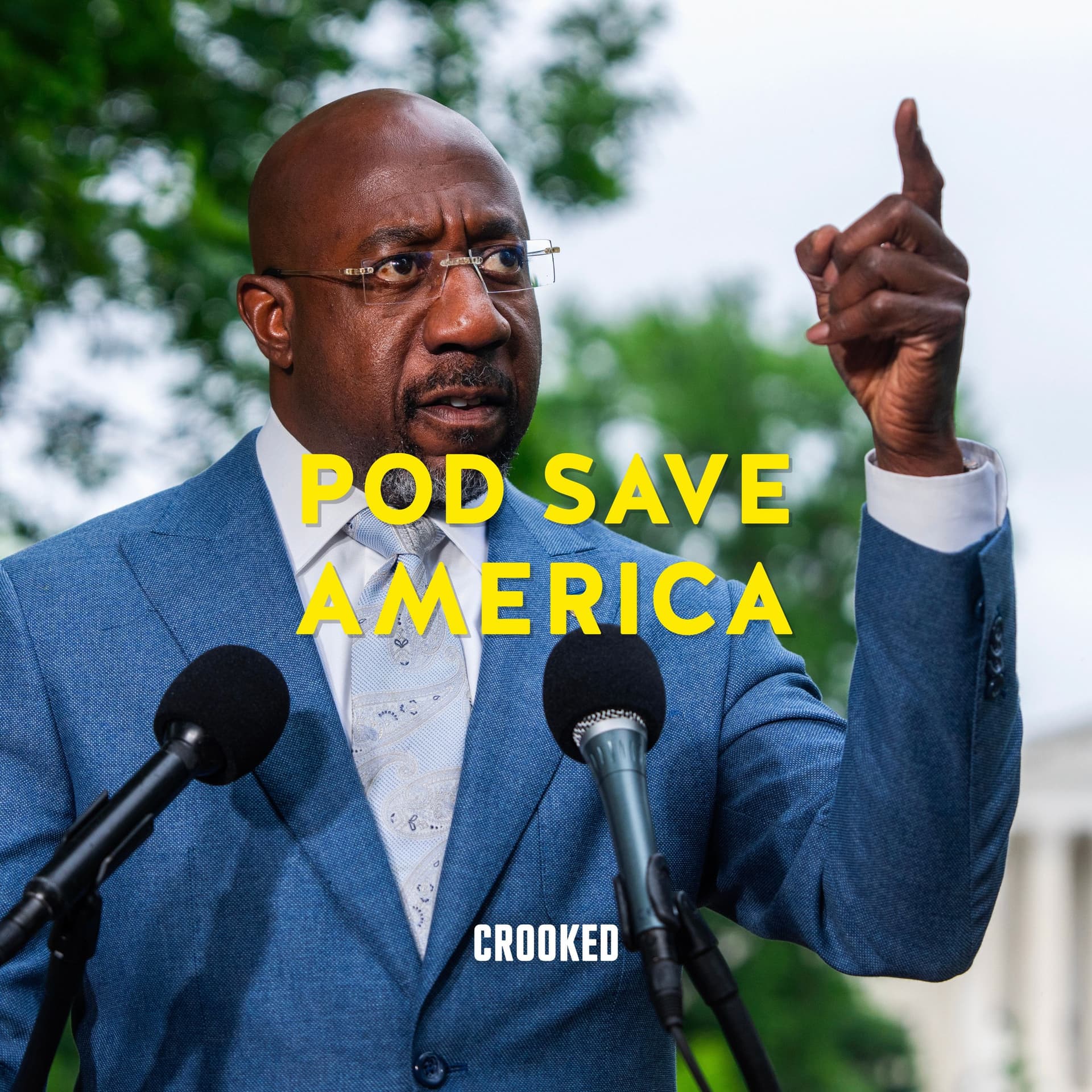
Sen. Raphael Warnock (D-GA) discusses the Supreme Court’s gutting of the Voting Rights Act, calling it a “Jim Crow method,” and links voting-rights rollback to broader “moral rot” and a “poverty of moral imagination.” He also argues for faith-driven civic leadership, warns about political violence and mass incarceration/detention expansion, and explains his new book, The Crooked Places Made Straight (Isaiah reflections for America’s 250th birthday).
Guest backgrounds
Raphael Warnock is a Georgia senator and senior pastor at Ebenezer Baptist Church, the same congregation where Dr. Martin Luther King Jr. preached. Host Jon Favreau is a political commentator (Pod Save America).
Key claims
The Voting Rights Act is the civil-rights “crown jewel,” and dismantling it will widen turnout gaps and mute Black and brown political power. People are demoralized by unmet needs and demagogues exploit despair. Democrats and Republicans both have contributed to mass incarceration; detention centers risk warehousing immigrants and later Black and brown communities.
Notable examples
Shelby v. Holder (2013) weakening Section 5; Georgia’s voter-roll purges and longer lines; a proposed 10,000-bed detention center near an elementary school in Social Circle, GA; Medicare negotiating drug prices (Inflation Reduction Act) and insulin capped at $35. He compares J.D. Vance’s “stay in his lane” theology remark to “Reich Christians” capitulation, and criticizes Trump depicting himself as Jesus.
Written by AI. May contain mistakes. Listen to the episode to check what was said.
Chapters
Tap a time to open that second in VOSenator Warnock's Background and Topics
0:45 to 1:45
Discussion of topics to be covered with Senator Warnock, including faith and political challenges.
“Martin Luther King, as many of you know.”
Exploring Isaiah: Senator Warnock's New Book
2:24 to 4:08
Senator Warnock discusses his upcoming book inspired by the prophet Isaiah.
“I've been very into thinking a lot, especially around the America's 250th and everything with what the Pope is doing too.”
The Crooked Places and Moral Imagination
4:08 to 8:00
Senator Warnock elaborates on the themes of moral integrity and political corruption.
“And the glory of the Lord shall be revealed and everybody will get to see it together.”
Critique of Political Leadership and Imagination
8:00 to 10:27
Discussion on the lack of moral imagination in politics and its impact on governance.
“And not only educated these children, I'm a big fan of zero to four investments because that's where the real power is.”
Housing Crisis and Legislative Efforts
10:27 to 12:49
Senator Warnock talks about housing legislation and the affordability crisis in America.
“But literally, we've gone into endless wars, cut taxes for people who don't need it.”
Spiritual Malady in Politics
12:49 to 14:02
Exploration of the spiritual and moral issues affecting political discourse in America.
“But I hope when we're in power, we will invest more.”
Addressing Voting Rights from the Pulpit
14:02 to 20:30
Learn about the impact of recent Supreme Court decisions on voting rights and their historical context.
“What did you say to your congregation on that day, and why did you say it?”
Personal Reflections on Fighting Racism
23:38 to 28:00
Explore the personal toll of fighting racism and the importance of perseverance in the struggle for civil rights.
“In response to the ruling, you said that you're tired of racism.”
The Legacy of John Lewis
28:00 to 28:40
Learn about the historical significance of John Lewis's fight for voting rights.
“and crossing that bridge with brute force under the color of law on the other side of that bridge, ready to bludgeon them before they allowed them to vote.”
Racial Polarization in the Trump Era
28:40 to 29:35
Explore the surprising trends in voting behavior among black men during the Trump presidency.
“We've been talking about the moral and political arguments surrounding racism and voting rights and democracy.”
Show all 21 chapters
Engaging Young Black Men
29:35 to 31:25
Discover the challenges facing young black men and the need for meaningful engagement.
“I think so many of our young people feel demoralized.”
Mass Incarceration and Its Impacts
31:25 to 33:06
Understand the implications of mass incarceration and the criticism of the system.
“While at the same time, just talking about the agency that all of us have and create opportunities for men and for our boys.”
Reimagining Economic Opportunities
33:06 to 36:14
Learn about the need to invest in training and opportunities for youth.
“But here's what I also know from our recent history.”
The Politics of Empowerment
36:14 to 41:22
Dive into the conversation about the disempowering narratives in politics.
“And what I would like to see us do in this moment is we look at these new emerging technologies, AI, which ain't going anywhere, and a whole range of things.”
Identity Beyond Politics
42:00 to 43:00
Exploration of personal identity outside of political roles.
“You know, like I have an identity outside of being a senator.”
Political Rhetoric and Faith
44:20 to 48:24
Discussion on political discourse, faith, and moral responsibility.
“You said something a few weeks ago to my pal Jen Psaki that stuck with me, which is that when J.D.”
The Role of Pastors in Politics
48:24 to 55:58
Importance of moral leadership in governance and broader society.
“And then Democrats kind of have to just, except for you and a couple others, have to just kind of sit back and watch because they're not familiar with that language.”
Values in Politics
56:00 to 56:45
Explore the importance of love and compassion in political leadership.
“So I bring my values and not my creeds to my work as a senator.”
Nonviolence and Political Violence
58:50 to 1:04:31
Discuss the relevance of nonviolence in today's political climate.
“King was the apostle of nonviolence in this country.”
The Fight for Democracy
1:04:31 to 1:08:36
Understand the struggle for democracy and the role of civic engagement.
“And we've got to use all of those tools.”
Mother's Day Reflections
1:08:36 to 1:09:46
Hear about the significance of mothers and their love in our lives.
“What sermon are you working on right now?”
Transcript
Automatic transcript. May contain errors.0:03Music
0:20Welcome to Pod Save America. I'm Jon Favreau. This Sunday, Georgia Senator Raphael Warnock. Senator Warnock stopped by the studio earlier this week. We talked about the Supreme Court's gutting of the Voting Rights Act, his trip to an ICE detention center in Georgia, the Democratic Party, all the topics you'd expect in a conversation with a Democratic senator. But we also had a surprisingly candid and really enjoyable conversation about faith. Religious faith, faith in our political system, and faith in America. We also talked about the legacy of Dr. Martin Luther King, as many of you know. Reverend Warnock serves as the senior pastor at Ebenezer Baptist Church, which is the same congregation that Dr.
0:58King once led. The senator spoke openly about J.D. Vance lecturing Pope Leo on theology, increasing political violence in America, the discipline required to build and sustain a political movement as successful as the civil rights movement, and we even talked about what it would take for a reverend like him to discern a call to run for president. And I will say he did not close the door to a run. We'll get to that conversation in a moment, but before we do, the Crooked Con presale begins next week, starting Tuesday, May 12th. Friends of the Pod subscribers can purchase tickets to Crooked Con and receive a special subscriber-only discount.
1:33General tickets go on sale the following week, Tuesday, May 19th, but if you want to guarantee your tickets for this year's Bigger Better Crooked Con, head on over to crooked.com slash friends and become a Friend of the Pod subscriber. All right, here's Senator Raphael Warnock.
1:51Senator Warnock, welcome back to the show. Great to be back with you. So you've written a book coming out next month. Yeah. That's a sermon on Isaiah for America's 250th birthday. So before I ask anything about the news, I wanted to ask you about Isaiah and why this prophet, why this text, and why now? Well, thank you so much. I think I should tell your viewers that honestly, I didn't tell you to ask me about my new book. You know, I saw that it was coming out and I was like, I know it's until mid-June. I'm surprised by this question. This is fascinating. I've been very into thinking a lot, especially around the America's 250th and everything with what the Pope is doing too.
2:33And it's just, I've gotten into that mindset. So when I saw that you were writing that book, I was like, oh, I gotta ask about that. Well, you know, I return every Sunday morning to my pulpit. I still lead Ebenezer Baptist Church where Dr. King preached. And I have been preaching a sermon literally for the last few years in my own pulpit and pulpits all across the country. Churches, some temples, and some other places, rural communities. Anyway, but it's based on this line from Isaiah that Dr. King used to quote sometimes in his sermons. every valley shall be exalted, every mountain and hill made low, the crooked places shall be made straight, and the rough places smooth, and the glory of the Lord shall be revealed, and all flesh shall see it together.
3:19It's a kind of a vision of the land. It's a grand vision, what I call a moral topography, a new way of thinking about who we are for one another, a reimagining of ourselves. And so I've got this book coming out. Thanks, John. On June 16th called The Crooked Places Made Straight. Reflections on the moral meaning of America. As we go into the 250th anniversary, I use these sort of images, you know, wonderful environmental images, if you will, as a way of talking about equity. You know, the valley shall be exalted, mountains made low, putting us on a level playing field. Crooked places made straight.
4:08Talk about integrity. Rough places, smooth possibility. And the glory of the Lord shall be revealed and everybody will get to see it together. Inclusivity. So equity, integrity, possibility, inclusivity. And I use that as a kind of values proposition or moral lens through which to engage some of the big issues that have been at the center of our politics, including poverty, climate change, mass incarceration, a whole range of issues. And I invite Americans to join me in that conversation. When you look around today in 2026, what are the crooked places that you see? Oh, God, there are crooked places all over the place.
4:53And, you know, we see it at the center of our politics. There's a kind of moral rot that's eating away at the fabric of our country. It's all the way from the White House on down. And you're seeing this infection and its impact in negative ways, the grift, the ways in which, you know, there's always been corruption. but my goodness the unabashed unapologetic corruption that we're seeing coming out from this white house and the ways in which it has set the tone uh for others uh just not to tell the truth and you know i don't i don't i don't know where to start but we're seeing this we're seeing that uh we're seeing a a president who is literally dismantling the country and literally selling it for parts and enriching his own family in the process.
5:51And I just think that we're in a moral moment where people are looking for leaders who are thinking about something other than themselves. I'm a Christian preacher. Jesus said that if you seek to save your life, you'll lose it. But if you lose your life, meaning if you give your life over to something bigger than you, you'll find something greater and lofty. I believe that, and it's what informs my work as a public servant. You talked about moral rot. You've also written that we suffer from a poverty of moral imagination. Whose imagination is impoverished? Well, I think that you see it at the center of our politics.
6:33Folks are always telling us the things we can't afford, and then we look around you know we can't afford health care you know a few months ago we were debating uh health care premiums in this country and uh we were trying to get them to expand the premium tax credits uh for the affordable care act and and they kept telling us oh we can't afford to do that and so as a result of that literally the health care costs for millions of Americans, some 22 million Americans doubled on average for some tripled, quadrupled. We can't afford health care. We can't afford child care. In fact, we heard Donald Trump literally say into the mic, we didn't think anybody would be listening.
7:20We can't afford that. We can't afford child care. In fact, he said Medicare, Medicaid, Social Security. He talked about all these things as if, you know, these are special interest groups and not the people who, by the way, it's their money. I mean, I love it when politicians talk about the people's money like it's theirs. We can't afford all of that. You know, we're just going to—all we can afford, he said, was the military. And so we heard him say that, and we're watching him literally live out that basic, sick, and flawed premise. So we're now in another war in the Middle East at the cost of$1 to$2 billion a day.
7:58Depends on whoever you ask. So far, with the money we've spent bombing Iran, we could have paid for pre-K for four-year-olds all across the country. And not only educated these children, I'm a big fan of zero to four investments because that's where the real power is. You'll never be as smart. I hate to tell you, John, you're a pretty smart guy. You'll never be as smart as you were when you were four. That is true. I mean, that's where— I have a five-year-old. That's where it is. And then allowing their parents to get to work so that we increase the productivity and the prosperity of our country.
8:38So we suffer not from a poverty of resources, but of moral imagination. What Dr. King called a revolution of values is what we need. And that's what I work for in the Senate. It's what I preach about on Sunday morning. And it's what I talk about in this book, The Quicket Place is Made Straight. So is the poverty of moral imagination, obviously it's clearly a problem with Trump, with the White House, with a lot of elements of the Republican Party right now. Is it a problem for the left, for the Democratic Party at all? Sure. Absolutely. And, you know, I think we've been told for a long time about the things we can't do.
9:22And, you know, as someone who, you know, came of age during the Reagan Revolution and then, you know, the days after that, I'll tell you the first time it occurred, it really became real to me that the issue is really not resources. was when we went into those first endless wars in the Middle East, the unnecessary war against Iraq. And for the first time, I realized, oh, it really ain't about the money. Because if it were, we wouldn't be bogged down doing this. And it's just amazing that some 20 years later, And here we are again. And so, yeah, your question, is it on the left? I think all of us have been told been sold a bill of goods.
10:21And I just I think that, yeah, you know, I'm concerned about the deficit, the national debt, like everybody else. But literally, we've gone into endless wars, cut taxes for people who don't need it. I mean, people who are literally at the top. And meanwhile, Donald Trump has literally raised taxes for everybody else. And it's just interesting to me how Republicans don't even talk about the national debt when they're in charge, when they're in control. They control the White House, the Senate, the House, and the Supreme Court. Have you noticed they're not talking about the national debt? No. We get a Democratic president in 28.
10:59Then they'll start talking about it again. And then I just think, I think on a whole range of things, housing, for example, we just need to go bigger. I'm proud of the fact that we passed the road to housing bill out of my committee, the Banking, Housing, and Urban Affairs Committee. By the way, a little glimmer of hope in these dark times, Tim Scott is the chair of the committee. Elizabeth Warren is the ranking member. Can you imagine that? Tim Scott and Elizabeth Warren went into a bar. They came out with a housing bill. Sounds like the beginning of a bad joke. And yet that bill passed our committee unanimously.
11:43Every Republican, every Democrat voted for it. Passed the Senate overwhelmingly. We'll see what the folks do in the House. I'm proud of it. It caps my provision, caps what private equity has been doing here in California, in Georgia, all across the country, We're literally swooping in the communities, buying up so much housing stock and renting it and sending the prices up for people who are trying to rent and people who are trying to buy. I've got other great provisions in the bill. As proud as I am of that bill, in a time when we're facing an affordability crisis, affordable housing, it will help.
12:17It will help a lot, but not enough. We're 5 million units short on housing. It's a supply-side problem. And I think there comes moments and there are particular problems in the world where sometimes government, which is certainly not the answer to everything, but sometimes government is singularly, uniquely situated to help with certain problems, to get things going. And so one of the things I'd like to see is for us to go much bigger than what we see even in that incredible bill. I'm glad that I'm hoping it's going to get passed. But I hope when we're in power, we will invest more. That maybe the government ought to get into buying or building houses and then selling it to the people.
12:59But we've got to get this thing going. The average age right now, the first-time homeowner is 40. And so we, whether you're talking about affordable housing or health care or just wages that are stagnant, wages are stagnant, prices are going up. People are experiencing a material deficit. that I think that has left them deeply, deeply frustrated and demoralized, quite frankly. And that, in turn, has created the context for this kind of spiritual sickness, as I see it in our country, of kind of spiritual malady that lets someone like Donald Trump emerge. It's when people are desperate, when people's needs are not met, that they are open to the lies of a demagogue who says, you know what your problem is?
13:49it's your neighbor it's that other person over there and uh the deep cynicism that that sets in like gangrene in the body politic um we we need we need moral medicine we need leaders who will tell us who we are when we stand together you um you preached at ebenezer last sunday on the supreme court's decision in calais um just the voting rights case from dr king's pulpit you know you You called it a Jim Crow method. Talk a bit about that sermon. What did you say to your congregation on that day, and why did you say it? Well, you know, I come from a tradition where we can't remain silent when that kind of thing happened.
14:31I don't know what I was planning to preach before that decision came down, but after it came down, I had to address it. Let's be really clear that what we witness in that Supreme Court decision is a devastating and massive blow to all of the progress we made that was led by Martin Luther King Jr. And the sad irony is that the people who are cheering that decision right now and who can't contain their glee, come January, they will stand up in Martin Luther King Jr. celebrations all across this country and extol the virtues of a Martin Luther King Jr. that they've created in their mind. I mean, you cannot remember Dr.
15:17King in January and spend the rest of the year dismembering his legacy. The Voting Rights Act of 1965 is the crown jewel achievement of the civil rights movement, without which I literally would not be sitting here with you right now as a United States senator from Georgia. and you would not have a congressional black caucus as large as it is, we wouldn't be living as much as we are into what I see as the creed of this nation, e pluribus unum, out of many, one. They are trying to remake this country into their dystopian, racist Jim Crow image. there are too many political hacks on the Supreme Court and they're doing the bidding of this president who's trying to stay in power at all costs he knows that Americans are not buying what he's selling he told them that that he was going to lower their costs that he's raised them he told them that he was going to keep us out of war he took us into another war And so we have to be full-throated in fighting for voting rights because while there are other issues, the democracy itself, the ability to have a voice, that's the framework in which we get to fight for all the other things that matter.
16:49And so I was deeply, deeply disappointed but not surprised by this decision. The Supreme Court has been working on dismantling voting rights for years. It's certainly one other tragic moment was Shelby versus Holder in 2013 when they hobbled Section 5 and now Section 2. And I don't want to go on and on about this, but sorry for the wrong answer. But, you know, when they, you know, they really should go back and look at what happened after their first decision. In 2013, you had Shelby versus Holder, and that was about Section 5. And John Roberts, who has appeared to be, you know, the umpire, you know, who just sort of call him balls and strikes.
17:37I think he has tarnished his legacy greatly. And the Supreme Court— And this has been his project for a while. This is his—we've learned that this is clearly his project. He said, we don't need this anymore. And Ruth Bader Ginsburg, God bless her memory, she said in her dissent that doing what we're doing in Section 5 is like getting rid of your umbrella in a rainstorm because you're not getting wet. And her words proved to be prophetic. Everybody's inclined. Everybody has a right to their own opinion, not their own facts. Here are the facts. Since they dismantled Section 5 in 2013, the racial voter turnout, that gap has actually widened.
18:24And I just think it's important to emphasize that because I think it's easy, even for people on our side, to look and see me sitting in this chair and not know that the turnout, the voting turnout gap has widened in the years since 2013. and it has widened twice as fast in the states that used to be under preclearance that are no longer under preclearance. In other words, they're not the only ones, but the same states, and I love Georgia, but the same states, I represent Georgia, the same states that were discriminating prior to the 1965, within hours. Found new ways. They started doing things that, you know, make the lines longer in black and brown communities, purging people from the voter rolls, which Georgia's last two secretaries of state have been very good at and all of these things.
19:26And now, so that had an impact on people showing up because it gets to access, right? And then the decision last week says, in effect, that even when you show up, after you overcome those barriers and you show up, we're going to mute your voice. We're going to minimize your voice so it won't have the same impact by playing with the lines. In that sense, it's a one-two punch. And all Americans who love our country, even with its flaws, but who believe in that basic creed, one person, one vote, who believe in we the people, the first three words of the Constitution, as I do, we all ought to be deeply concerned and we ought to be fighting for our democracy.
20:09and one of the best ways to do that for folks who are asking is to mobilize voters. Like part of how we can at least mitigate this gerrymandering that we're going to see is to overwhelm them by showing up.
20:28Pod Save America is brought to you by Tommy John. What do I love about Tommy John? They're the best. They feel great. I'm wearing them right now. I love them. They're super comfortable. I basically only wear Tommy John. I just got a bunch of, I had the cool cotton, which is great, but I just basically switched over to the second skin, which I like even more. They're breathable and lightweight for all-day comfort. There's a pouch for your comfort. Hmm. You know? And it says here, it flatters your natural shape. I just was feeling confident. I didn't even know that was happening. The stay-put waistband ensures your Tommy Johns won't roll, bunch, pinch, or leave marks.
21:00And their unique quick-draw fly provides a horizontal opening for fast, easy access when nature calls. How is Tommy John different from other men's underwear? I don't even remember at this point. I only wear Tommy John. They are the best. They're more comfortable. It's better fabric. They last forever. It's actually, that's the only problem, which is I actually got more Tommy John just because I wanted some new colors, but I like didn't need to get rid of the old ones because they just last forever. But I just got more because I was like, you know what? I like want more of these second skin ones and I have plenty of the cotton ones.
21:26So I like them. I did that the other day too because I was like, oh, do I have enough underwear? And I'm like, what? Do I have enough underwear? Just buy more underwear. Right, right. I want everything to be consistent. All my socks to be the same, so I have all the same bombas, and I want all my underwear to basically be the exact same thing. I want one kind of Tommy John. That's it. When you look at me, you know what I'm wearing is my underwear. Okay? Go to TommyJohn.com today and save 25 % off your first order with code CROOKED. Comfort is perfected. Just use code CROOKED at checkout and upgrade your essentials today.
22:02Pods of America is brought to you by ZBiotics Pre-Alcohol. I'm reading the script here. We love Z-Biotics. You know this if you've ever listened to this. Maybe if this is your first time listening, then let me tell you, you should be taking Z-Biotics if you drink, if you drink alcohol. Because what happens is you take Z-Biotics, little thing, tastes like nothing. You just drink it down. And then you drink and you feel great the next day. That's right. And I know you're probably thinking, come on, is that serious? It's serious. It's serious. And every person that we've talked to about this, that we've suggested this, they do it and they're like, oh my God, you guys were right.
22:36As if we were going to lie to them. You were lying to your faces. Why don't you trust us? ZBiotics pre-alcohol probiotic drink is the world's first genetically engineered probiotic. It was invented by PhD scientists to tackle rough mornings after drinking. Here's how it works. When you drink, alcohol gets converted into a toxic byproduct in the gut. It's a buildup of this byproduct, not dehydration, that's to blame for rough days after drinking. Pre-alcohol produces an enzyme to break this byproduct down. Just remember to make pre-alcohol your first drink of the night. Drink responsibly and you will feel your best tomorrow.
23:03From the crack of the bat at the stadium to the start of wedding season and the roar of the engines in Indy. May is packed with back-to-back reasons to be out. Don't let a rough morning after keep you on the sidelines. Drink pre-alcohol to stay ahead of it and make the most of every Saturday this month. Go to zbiotics.com slash crooked to learn more and get 15 % off your first order when you use crooked at checkout. ZBiotics is backed with 100 % money back guarantee. So if you're unsatisfied for any reason, they will refund your money, no questions asked. Remember to head to zbiotics.com slash crooked and use the code crooked at checkout for 15 % off.
23:38In response to the ruling, you said that you're tired of racism. And I'm just wondering for you personally, as a pastor, a black man, a human being, what does that tiredness feel like as to keep fighting this fight and and watch these civil rights laws get unwound piece by piece and you've been fighting for so long yeah well one title you left out is father i'm a father of a nine-year-old and daughter and a seven-year-old and uh anybody who knows me knows that those are the two brightest stars in my universe by far and so when i say i'm tired part of what i'm saying is i can't believe that my children are going to be wrestling with this you know that they that they that um they have managed to be born at a time when we're we're we're witnessing some things that i didn't you know didn't have to experience it you know i i lived i've lived most of my life under the protections of the voting rights law they're stepping into a world without it.
24:48And so here we are in a time when things that we would associate with a much darker period are literally, it's a 21st century fight. The fight against Jim Crow is now a 21st century fight. But I refuse to be, I get tired and that's true. It's both physical and it weighs on your spirit and your emotions. But here's what we can't afford to do. We cannot afford to give in to those who are trying to weaponize despair. Because that's part of what this administration is up to. We can talk about all the policies. And as we learned tragically last week, we'll win some, we'll lose some. We'll win some elections, we'll lose some.
25:36We'll win some policy fights. We'll lose some. But here's the fight we cannot afford to lose, the fight for your spirit. We cannot allow those who want to weaponize despair to win. We can't allow them to convince us that they've already won and so that there's no need to fight. And here's why I'm a blessed man. I was John Lewis's pastor. And, you know, I got to know him. I used to visit his wife when she was sick. I've spent time at his home. I presided over his funeral. And I think about him crossing that Edmund Pettus Bridge. And to even zoom out even more about how he ended up on that bridge, after they passed the Civil Rights Law of 1964, Dr.
26:33King went to see President Johnson. And Johnson, rightly, as you might imagine, was happy. He said, look, we passed the Civil Rights Bill. And Dr. King said, great. I need a voting rights bill. Did not even skip a beat. Great. Go ahead, pat yourself on the back. Guess what? I need a voting rights bill. And LBJ began to say, I get it, but we can't do that right now. There's no way we can get that passed right now. I don't have the power. He said, you know, the political capital, I had to spend to get that done. Martin, I just don't have the power to do it right now. And they left the meeting. The staff was feeling all demoralized and dejected.
27:17Andy Young, by the way, told me the story. He said, we're all feeling demoralized. And somebody said to Dr. King, what are we going to do? The president of the United States just told us that he doesn't have the power to get us voting rights. And Dr. King just sort of shrugged his shoulder and he said, you know, if the president doesn't have the power, I guess we're going to have to go and get him some. I love it. And they did. And they did. So they went to Selma to get the president some power. Dr. King understood that it's not about the people and power. It's about the power in the people. And that's how John Lewis and others ended up on that bridge.
28:00and crossing that bridge with brute force under the color of law on the other side of that bridge, ready to bludgeon them before they allowed them to vote. And John Lewis and so many others kept marching. They kept walking. They had no reason. I think it's easy for us to forget that, those of us who are post-civil rights generation babies. And then just the easy story we Americans tell ourselves, right? There was no reason for them to believe that they could win. And those victories were not inevitable. They were quite improbable. I'm so glad that John Lewis and so many others kept walking. And so my advice to us in this moment, keep walking.
Read the full transcript
28:37Keep walking. We've been talking about the moral and political arguments surrounding racism and voting rights and democracy. One surprising trend in the Trump era is that, according to election results, racial polarization has declined over the last decade, largely because a small but not insignificant share of black men, especially younger black men, have stopped voting for Democrats. Some are staying home. Some, I'm sure, you know, voting suppression, voter suppression has clearly played a role. But more also actually voting for Donald Trump. He doubled his support among black voters between 2020 and 2024.
29:19And clearly, some of these young men are hearing something from Trump and the right that they are not hearing from us. And I wonder, as a pastor, what do you think they're hearing and what have we failed to say? Yeah. No, it's a great question. And we got to engage and we have to resist the false dichotomy between standing up for women and being a very clear voice against misogyny and sexism, which I talked about at length a couple of Sundays ago in my pulpit, and at the same time seeing the ways in which men and young men in particular, young black men in unique ways, and Latino men are hurting.
30:14and somebody's got to speak to that. It's a whole range of issues. I think so many of our young people feel demoralized. I think about what I was able to do as a kid. I grew up in public housing. I'm one of seven boys in my house and the first college graduate, and I'm grateful that I had a path. You know, it'd be harder for me to do what I did now than it was for me as a kid growing up in the 80s. First college graduate in my family, one of 12 total kids, earned four degrees, coming out of projects, become the pastor of, you know, fairly famous church, become a United States senator. It'd be hard for me to do that now.
31:02And I think people feel that, and young men feel that in a particular way, and they feel demoralized. And I think we have to find a way to be really clear and full-throated in our condemnation of sexism, misogyny, sexual abuse. I talked about all this stuff a couple weeks ago. I do all the time. While at the same time, just talking about the agency that all of us have and create opportunities for men and for our boys. I think, you know, I've got a seven-year-old boy and a nine-year-old girl. I just want them to be okay. And I think sometimes we get caught up in our jargon on the left, and people sometimes don't know what the heck you're talking about.
31:53I think speaking plain English, because more often than not, our policies would actually be more helpful, right? But you've got to speak plain English to folks. You know, one of the things that I've been talking about for years has nothing to do with, you know, any political ambition, something that comes from deep experience. I've been talking about mass incarceration. And there's not enough talk about that even on our side. Not nearly enough. And I raise it inside the Democratic caucus from time to time. I'm worried, for example, about these detention centers that are being built. I'm worried about the implications for the immigrant community.
32:35And by the way, I went to Social Circle Georgia. That's another story I could tell you. But, you know, it's a red town where they're building a 10 ,000. They bought a warehouse. They want to put a 10 ,000-bed detention center in a 5 ,000-citizen town. And those folks even, they voted for Trump, but they didn't vote for that, right? But I'm worried about what that means. Think about it. Our government's getting ready to warehouse human beings. Literally put them in a warehouse, 10 ,000 people, by the way, across the street from an elementary school. And they want to do this all over the country.
33:08It's a moral atrocity. But here's what I also know from our recent history. When you build that kind of infrastructure, you're going to use it. And so as immigrant communities today, I'm worried that it will probably be black and brown folks tomorrow. you know, particularly young men. You know, we're the mass incarceration capital of the world. Over the last 40, 50 years and the years since Dr. King died, the land of the free has become the mass incarceration capital of the world. We're 4 % of the world's population. We warehouse 25 % of the world's prisoners. This has played itself out over decades in communities like, you know, in Baltimore and Philadelphia and in Atlanta and South Central LA.
34:02And we're under Republican and Democratic administrations, if we're honest. Men have been warehoused. And now I think we're seeing some of the children of those men who've been warehoused. And the impact of that is a kind of a social long COVID that we're experiencing in our country. and i think somebody's got to find a way uh we have to talk to that and give people spaces where they can talk i do it in my church but i think we've got to find a way to do it you know yeah it felt like we were for a while on a path where even folks on the right were willing to do something about you know rehabilitation prison reform conform and now we are in this situation where we're back to showing that, you know, you got to be sure that you're very tough on crime as if, like, we can't be tough on crime and also not be the capital, mass incarceration capital of the world.
35:07Yeah, I mean, for all of those prisons. And again, we have more prisons than anybody in the world. I mean, think about that. The United States of America warehouses more of its people, literally more people in prison, and a greater percentage of its people than any other nation on the planet, including those whose human rights records we love to deplore. So think North Korea. Think Iran. Think China. We got more people. And that's the policy that we followed, again, through Republican and Democratic administrations for decades. Our country could have decided in the wake of the post-industrial change that we saw as we move from an industrial nation to the post-industrial era to a service economy, we could have invested in training our young people, getting them ready for that new economy that was emerging.
36:03And instead, we invested in the infrastructure of death and incarceration, and we're seeing the results of that. And what I would like to see us do in this moment is we look at these new emerging technologies, AI, which ain't going anywhere, and a whole range of things. How do we get our kids ready? How do we invest in children so that no matter what zip code you're from, there's a path to the American dream? Your parents' income doesn't determine your outcome. that's that's what i mean when i say we suffer not from a poverty of resources but but of moral imagination we've got to we we need to reimagine who who we can be you said something a couple of minutes ago uh that stuck with me about agency and i think it's so important and you also talked about some of the the jargon and the democratic party's uh language i wonder sometimes like do you ever worry that the democratic party's argument that the system is structurally rigged against people which is has a lot of truth to it right do you worry that sometimes that can tip into being disempowering because it somehow robs people in that story of agency to fix the system well i i don't know that they need us to tell them that they're living it Every day people know that the system is stacked against them.
37:39They know it in their bones. And they don't always have the words that we want to use. They know it. Do they feel like they can change it? They feel it. Yeah, I think that's the thing. Do people feel empowered to change it? And I do think that there are a lot of people who feel powerless, which is why they signed up for Donald Trump. You asked me that question earlier. Let me ask you, answer it more directly. I think that there are people, and I do think it's overstated, Donald Trump didn't have this huge slew of black men voting for them. I think part of that was a game they played during the election in 24.
38:13I think they were trying to create a permission structure, a bandwagon, so people would jump on it. But they weren't overwhelming. One is too many, but there weren't overwhelming numbers of black men voting for Donald Trump. But I do think that people feel the ways in which the powerful and the well-connected have the cards. And in that situation, you do create the context for someone like Donald Trump with his dystopian vision of the country emerging. Here's what the Trump voters and Bernie Sanders voters had in common. And they're looking for somebody to tear the thing up because they're just like, look, it's not working.
39:01And they came to different conclusions. But I think people do feel some of that. And I've seen it up close, you know, now that I'm in the Senate. When we passed the Inflation Reduction Act, largest clean energy bill and investment in human history. Also, the thing we did there was prescription drugs. We capped the cost of prescription drugs. My own bill capped the cost of insulin to no more than$35 of out-of-pocket costs for seniors. But in that bill, for the first time, Medicare was empowered to force the pharmaceutical companies to have to negotiate the price of prescription drugs. So just think about that.
39:56We had to pass a law so that Medicare— To undo the other bad law that we passed in 2003, I guess. What kind of capitalism is that for folks? What kind of capitalism is that where the buyer gets, where the seller gets to tell you the price of something and you don't get to discuss it? What kind of capitalism? But that shows you how rigged the system is. And so we addressed it. We passed a bill so Medicare could negotiate. How many drugs? Ten. Ten whole drugs. I know. And then that wouldn't go into place for a few years after we did it. It shows you that the voices of the people are increasingly squeezed out of their democracy.
40:46Big money, well-connected folks have an outsized voice in our politics, which is why even when there's agreement on things on the left and the right, like universal background checks, for example, in the gun safety debate, We can't get it done because the politics too often is owned by somebody other than the people. And the people feel it. And I think they're looking for folks who will champion their concerns. I'll tell you, I can only speak for myself. I love this job. I love being a United States senator. I mean, first of all, it's a deep honor. literally for 11 million people that I represent in the state of Georgia, that I get to represent them.
41:32Even the ones who didn't vote for me, I get to fight for those. Most of those people in social circle Georgia, where they're detention centers, they're Trump voters. But I get to stand up to the administration that they elected to fight for them. I love this job. You know, it's who I am. I love to serve. But while I'd like to get reelected so I can continue to serve, I don't love this job enough to sell my soul. You know, like I have an identity outside of being a senator. I'm a pastor. I'm the father of two amazing little children who are nine and seven, and they're constantly telling me what to do.
42:15You know, I'm a lot of things. And I was an activist before I did this. I got arrested in the building where my office is before I had an office. I got arrested there as an activist. Also a building, I believe, named after a Georgia senator. Named after the segregationist. It was like an arch segregationist now that you sit in his seat. Yeah, yeah. So I guess what I'm saying to you is I love this job, but I don't need it that bad. Yeah. And I do think we need more. We could use more leaders who love doing the work, but they don't need it. Yeah, we do need that.
42:59Pod Save America is brought to you by Sundays. Is your dog's food created to maximize your dog's quality of life or to extend the food's shelf life? Think about it. And while you do, let me tell you about Sundays. Sundays was founded by a veterinarian and mom, Dr. Tori Waxman, who got tired of seeing so-called premium dog food full of fillers and synthetics. So she designed Sundays, air-dried real food made in a human-grade kitchen using the same ingredients and care you'd use to cook for yourself and your family. Every bite of sundaes is clean and made from real meat, fruit, and veggies with no kibble.
43:30That means no weird ingredients you can't pronounce and no fillers. Compared to kibble or other brands out there, sundaes invest 50 times more in its ingredients to ensure premium quality. And the best part, you just scoop and serve no freezer, no thawner, prep, no mess, just nutrient-rich, clean foods that fuel their happiest, healthiest days so you get more of them to share together. We love sundaes. Your dog, Leo, loves sundaes, right? Leo runs to the bowl, runs to the bowl, and we like filling the bowl with it because it's not like the wet dog food and it's easier to store and it's easier to give him and he loves it.
43:58So, you know, what are you going to do? What else would you do? Nothing. Just get some of this dog food. Make the switch to Sundays. Go right now to sundaysfordogs.com slash crooked50 and get 50 % off your first order or you can use code crooked50 at checkout. That's 50 % off your first order at sundaysfordogs.com slash crooked50 sundaysfordogs.com slash crooked50 or use code crooked50 at checkout.
44:24You said something a few weeks ago to my pal Jen Psaki that stuck with me, which is that when J.D. Vance told the Pope to be careful, stay in his lane. I know, it drove me insane. I didn't just roll my eyes, did it? You know, I was doing worse than that. That's not the look for the pastor than the senator who rolled his eyes. Well, you made a comment. You said that's how fascists talk. and you also brought up Reich Christians who were the German pastors who capitulated to Hitler by deciding the appropriate place of the church was in personal piety, not in systemic injustice. I'd love to know what made you draw that connection.
45:00When you say someone like Vance is talking like fascists, when you mention Bonhoeffer and the Reich Christians as a comparison, where does that argument come from in you? What is the tradition that you're drawing on there? Well, I've been thinking about faith and politics for a long time you know i'm a trained systematic theologian um i um you know i've studied that period i wrote a thesis on king and dietrich bonhoeffer bonhoeffer was was part of the very little christian resistance that hitler got most of the church in germany capitulated to hitler They became Reich Christians. And so, you know, no two periods are the same.
45:47And I'm not conflating it in that sense, but there are lessons to be learned. I have to say that in my view, J.D. Vance is one of the most craven politicians on the American landscape. Here is someone who literally said that Donald Trump is America's Hitler. And then he actually ran a campaign to become his running mate. He ran a campaign focused on one to be his running mate. So if Trump is America's Hitler and then he campaigned to be his running mate, what does that make J.D. Vance? I think we saw a glimpse of that cravenness in recent weeks when J.D. Vance, who is a recently converted Catholic, had the unmitigated audacity to lecture the Pope on how to be the Pope.
46:44The Pope is doing what we need more religious leaders to do. And that is to bring a kind of moral question to who we are. And he was literally advocating for peace. Imagine that. And I just— Which is what all the popes do. Yeah. So I just—I—well, you know, I just couldn't help but be struck by J.D. Vance, the newly converted Catholic, who wrote a whole book about his conversion, which is interesting. than turning around and saying that, you know, when the Pope is talking about theology, he ought to be careful talking about theology. He ought to stay in his lane. What are you talking about? It's fascinating to me, even from a theological perspective, and you hit on it, and obviously this was your thesis, but this sort of divide between personal piety and systemic injustice.
47:48And you could tell from what J.D. Vance was saying, and I think this is the case with a lot of the more recently converted Catholics who are on the right, evangelical Christians, the focus is very much on personal morality, sexual morality, and very little on the larger moral questions, as you say in your book, the moral topography of the world. And I do find that to be a, I find it to be clarifying and also perhaps something that, you know, that the left can kind of rally around. And I wonder if you think sometimes you worry that Democrats have sort of ceded the territory in terms of using more spiritual religious language, regardless of what your faith actually is, in a time where you have people like Vance and Trump, you know, attacking the Pope.
48:44And then Democrats kind of have to just, except for you and a couple others, have to just kind of sit back and watch because they're not familiar with that language. I worry about it deeply. It is something that I'm thinking about a lot because we have the historical lesson, right? And I don't want to keep going here because no two historical peers are alike, but it was J.D. Vance who said that Trump is America's Hitler. So he said that. The historical lessons are there. The church in Germany retreated into this very narrow, ghettoized view, privatized view of the faith, where faith is just limited to issues of, you know, maybe interpersonal relations and personal piety.
49:33but we're going to let the state carry on in our name and do all kinds. So we already know the lessons of that. We don't have to go to Germany. That's the lessons of the American Christian slavocracy also, which was built on the premise that we're enslaving human beings, but we're saving their souls. So it's all right. Matter of fact, we're doing them a favor. And so it's dangerous for people of faith, For people of moral courage who claim no faith tradition at all, to see these larger questions about the society and about how it's arranged and who gets crushed and who doesn't, it's dangerous for us to leave that to potentates, to leave that to politicians.
50:19And it's dangerous for those of us who are concerned about these issues to let the right dominate the space about faith and values, particularly since, in my view, they've got so much of it so very wrong. You know, Donald Trump recently depicted himself as Jesus Christ. I guess putting his names on the building wasn't enough. He's now King of Kings and Lord of Lords. And I have to call it out because it's blasphemy, and it's a deep, deep distortion. I'm a Matthew 25 Christian. Jesus came to feed the hungry. Donald Trump is taking food out of the mouths of hungry children through these draconian snap cuts.
51:14Jesus spent much of his life healing the sick. Donald Trump is taking their health care away. And so we have to condemn his actions and we have to condemn his speech. I thought it was interesting that there were faith leaders, even some in his camp, who came out and rightly criticized him depicting himself as Jesus Christ. Congratulations to them for that. But it's not enough just to condemn the picture and say nothing about his policies. Because his policies are far more blasphemous than the picture. Or even in that same weekend, some of them condemned the picture, but those same people did not condemn the, we're going to eradicate a civilization and the threats of the war crimes, which is just as blasphemous.
52:09Oh, he literally said a whole civilization will die tonight. And, you know, we've all heard Donald Trump's bluster over the years, but, you know, we can't dismiss that, you know, So, you know, because it's dangerous talk. It undermines the credibility of our nation on the globe. It undermines America's voice. It's moral credibility. It's doing a whole lot of damage. I mean, can't we stand together, no matter whether you're on the left or the right, and say, we don't want an American president who talks like that. And acts like that as well. One fellow Democrat who hasn't ceded that territory is James Tallarico, the 36-year-old Presbyterian seminarian from Texas who's running for Senate.
53:06He's named you publicly as a role model, said he wants to follow your playbook to flip a red state. You said back in March that you hope we'll have yet another pastor in the United States Senate. Why does it matter to have another pastor in that chamber? What is having more pastors in the Senate, what does that bring to the country? Well, it's something I think about all the time because I think it ought to make a difference. I don't think it automatically will. You know, like I ask myself all the time, what difference does it make that you're standing here as a pastor and as a pastor of Ebenezer Church?
53:44And that's an asset test that I bring to myself as I look at whether I'm going to vote this way or that way, where I'm going to fall on this policy or that. I can tell you that when I was running for the Senate in Georgia, there were those who cautioned me and said, I don't know about you wearing your identity as a pastor so clearly and unapologetically. You're going to alienate certain voters. And I don't know who else to be other than myself. and I'll you know I'll tell you that the folks who they put around me because I was running for office, I'd never run for office before my comps team used to put this thing on my memos when I'd get ready to do interviews and that kind of thing, it said remain the reverend and every time when I would see that I would laugh, I'm like well what else am I going to be I'm glad you didn't tell me to be somebody else because I don't know who else to be Easy instruction.
54:44Other than myself. But I talked about my faith, but I hope in a way that doesn't feel oppressive to people who don't share my particular faith tradition. What I'm always trying to do is open the tent, widen the tent so that everybody is a part of it. And what I discovered was that the people of Georgia found that refreshing, both Democrats and independents. And I think Republicans gave me a hearing because they heard a certain kind of voice. I do think we need people of moral courage in this moment. And so some of those people will be clergy. Some will not be clergy. Some will be Christians. Some will be Muslims.
55:40Some will be Jews, Hindus, Buddhists, Sikhs. Some will claim no particular faith tradition at all, but they will have a vision of our common humanity. And it's an important question because let me be really clear. Here's what I'm really clear about. I don't want to live in anybody's theocracy. So I bring my values and not my creeds to my work as a senator. And I think those values are resonant in all the great faith traditions and those who claim no faith tradition at all. I'm talking about love. I'm talking about compassion, empathy, truth-telling, empathy. In the words of Isaiah, who said, a little child shall lead them, looking into the eyes of other people's children and having enough moral capacity to see in the eyes of other people's children, even your adversaries, a glimpse of your own.
56:36That's the kind of politics I'm talking about.
56:45Pod Save America is brought to you by Mint Mobile. I don't know about you, but I like keeping my money where I can see it. Unfortunately, traditional big wireless carriers also seem to like keeping your money, too. If you're fed up with crazy high wireless bills, bogus fees, and free perks that actually cost more in the long run, switch to Mint Mobile. Stop overpaying for wireless just because that's how it's always been. Mint exists purely to fix that. Mint Mobile is here to rescue you with premium wireless plans starting at$15 a month. All plans come with high-speed data and unlimited talk and text delivered on the nation's largest 5G network.
57:12Bring your own phone and number, activate with eSIM in minutes, and start saving immediately. No long-term contracts, no hassle. Ditch overpriced wireless and get three months of premium wireless service from Mint Mobile for$15 a month. You could be saving a lot on your carrier if you just check out Mint Mobile. You probably don't even realize it, but you should check out what your bill is and then compare it to what you could be saving with Mint Mobile. If you like your money, Mint Mobile is for you. shop plans at mintmobile.com slash crooked. That's mintmobile.com slash crooked. Upfront payment of $45 for three month, five gigabyte plan required equivalent to$15 a month.
57:44New customer offer for first three months only, then full price plan options available, taxes and fees extra. See Mint Mobile for details. Hey, Chicagoland, Wayfair's Memorial Day sale is on at the Wayfair store at Edens Plaza in Wilmette. From May 11th through 26th, you can score huge deals on everything home in person. Like up to 70 % off area rugs, up to 50 % off outdoor furniture, and up to 50 % off mattresses. Plus, you can take home the small stuff that day and get the big stuff shipped fast and free right to your door. Shop Wayfair's Memorial Day Sale, May 11th through 26th at the Wayfair Store at Edens Plaza in Wilmette.
58:20Wayfair, every style, every home. This year, experience the NHL playoffs your way. Want to watch a single? Do or die Game 7, a full week of heavy-hitting back-and-forth series. Then check out Sling's 1-3 and 7-day passes. Watch the chase for the cup on ESPN and TNT, starting as low as$4.99. No long-term contracts or overpaying. Just live hockey at home or when you want it. Sling lets you do that. Visit sling.com to learn more.
58:56Dr. King was the apostle of nonviolence in this country. And it was as theological as much as it was a political strategy. He believed nonviolence was the only force in the universe that could break the cycle of violence. We are living right now through a moment of rising political violence on the right and on the left. Paul Pelosi, the Minnesota legislators, UnitedHealthcare CEO, Charlie Kirk, the multiple Trump assassination attempts, including one at the Correspondent Center a few weeks ago. What do you think King, the apostle of nonviolence in this country, would say to America right now? He used to say that an ethic of an eye for an eye leaves everybody blind.
59:45And, you know, I think that's an important lesson in this moment, which is why, you know, in the days after a day or so after Charlie Kirk was killed, I decided to go to the floor of the United States Senate and condemn that killing. Now, I've condemned other forms of violence, certainly against Paul Pelosi and others, but I thought it was particularly important for me to do that after Kirk's killing so that I could say as a moral voice that political violence is not acceptable. You cannot have a democracy and political violence. Political violence is the opposite of democracy. We have loud, robust, and sometimes rambunctious arguments in the American public square.
1:00:46And we have those arguments, if we're thinking about it right, not as a precursor to violence, but we have those arguments instead of violence. And so I said that day when I went to the floor of the Senate that I disagreed with Charlie Kirk on almost everything. I mean, he had the nerve to ask whether or not Dr. King was a force of good in the world. I didn't agree with that man about anything. But guess what? He had a right to think what he thought in America. And he had a right to change his mind, or not. And I genuinely mourn the idea that these small children were now robbed of their father and a wife of her husband.
1:01:34But we have to be consistent. what is deeply disappointing again unfortunately not surprising is that we have someone in the White House who is stirring the pot even after those assassination attempts he could have used those moments to bring us together I mean he could have used those terribly dramatic moments he could have used those moments to bring us together He could have reminded us of who we are when we stand together. And instead, he just leaned into more arguments about all of this is coming from the left. And this is not a difference between right and left. It's the difference between right and wrong.
1:02:22And we have to be consistent about that. and um this work shouldn't be so hazardous that good people have to ask themselves when they think about their own families whether or not they should get in this work or not that that's a that that at the end of the day is a huge loss for the american people king's strategy of non-violence sort of depended on a country that that could be shamed that like an audience whose conscience could be reached and changed by the site of suffering. And, you know, I have heard this too. I have argued with folks on the left about this as well, which is like, you know, yes, nonviolence is great.
1:03:07And that was great in the civil rights movement. But there was also violence back then. And there was obviously violence perpetrated on black Americans back then. And when the repression and the oppression is so great, sometimes people don't have a choice and it's justified. And I wonder if you think we still live in that country where the conscience of the country can be changed by the sight of suffering and the strategy of nonviolence is still not just the morally right strategy, but the politically effective strategy. I think that the genius of King was that he appealed to our conscience. And he also appealed to our charter documents.
1:03:50You know, he reminded of America what it said about itself, even in that very last sermon before he lost his own life, tragically, to political violence. He said, referring to the Declaration of Independence and the Constitution, be true to what you say on paper. And so I don't have an easy answer to that. Can the country be shamed? The story of America is that we have these moments when the democracy expands and we have these moments when it contracts. And we are clearly in a contraction moment right now. And with that Supreme Court ruling and others, they're squeezing the democracy. um but you know women who've given birth know that contractions are necessary for birth and my hope is that by continuing to speak the truth moral suasion but also you know the other part of the civil rights movement is there ways in which you force people to the table birmingham wasn't all moral suasion it was it was let's see if these shopkeepers think it's a good idea to continue to marginalize people in the days that lead up to Easter shopping.
1:05:09Right, right. So politics requires leverage. And it is an exercise in power. And we've got to use all of those tools. And I would encourage us to use them in this tough moment when they're literally doing everything to try to crush the voices of ordinary people. We've got to stand up a little taller, straighten our backs, speak a little bit louder. And I think the moment comes when the democracy expands. And we don't know when it's gonna happen, but we have to keep doing the work. One of those tools is discipline. And King certainly knew about that in the civil rights movement. One thing I always think about the civil rights movement that people sort of forget is just how incredibly well-disciplined it was and strategic.
1:06:03And - Also, can I give you a little bit of hope, too? Because I live in Atlanta, so I get to hang around Andy Young and John Lewis before he died and C.T. Vivian. I mean, I walked around with giants. So here's the other thing I want us to think about in this moment. Because they don't tell you if you asked them. There's a way in which they didn't know what the heck they were doing. So I want to encourage us because these answers are not easy, right? And I've got some ideas. You've got ideas. There are things that we know we need to do. but there you know I mean I think that's a mark also good leadership to be honest that there's life is hard and these problems are complex and so so there's a fog too right and they kept walking they didn't know that stuff would work and they didn't always know what to do and there were arguments among themselves you know you know you got you got Jose L.
1:06:57Williams and Stokely Carmichael you know on the one and and young all in the room and and and thesis antithesis and synthesis the kind of healthy arguments that are needed to get to the right answer i guess what mattered is that they were they were all in the room together and had those arguments and weren't fighting online with each other right we need a little bit more grace for each other um pastors like yourself um are people who discern calls. It's not a metaphor. That's obviously part of the vocation. So I'm not going to ask you whether you're running for president. I'm going to ask you something different, which is how would a pastor discern a call to run for president?
1:07:44Not whether you will, but what does discernment actually look like for someone whose life is built around listening for that kind of question? I think that part of discerning what what any of us ought to be doing is getting in the fray. You know, I won't quote a pastor here. Roosevelt had this thing about the man in the arena. And so another thing I love about this work is I get to be in the arena. I could be somewhere home wringing my hands about what's going on. I get to be in the fight, and all of us do. You don't have to run for office. We all get to be in the fight. So I think in the days ahead and the months ahead, part of what we have to do is get in the fight and do the work.
1:08:32And I think through the process of doing, we get the clarity about what we ought to do next. What sermon are you working on right now? Well, Sunday's Mother's Day. Can I tell you, a pastor has one job on Mother's Day. Make sure all the mamas feel good. Whatever else you do, if you fail at that, you have failed. You got to make sure that the mothers and the grandmothers. It's a nice and easy target there. Mama and big mama need to know, and godmothers and people who don't have biological children, but have been like mothers to all of us and mothers of sacred memory to lift them up. And I've said this on Mother's Day, and I really do mean it.
1:09:16And for folk who find, particularly who find religion to be a little bit mysterious. I think a mother's love, and that's not everybody's story, but whoever it was that mothered you, a mother's love is about the closest thing we have to the grace of God. If you want a glimpse of what God is like, see a mother in action, particularly when she's got to fight for her children. That is very true That is very true Senator Warnock, Reverend Warnock Thank you so much for joining Pod Save America And come back again soon Good to be with you
1:10:00Pod Save America is a Crooked Media production Our show is produced by Austin Fisher, Saul Rubin, McKenna Roberts, and Farrah Safari With Reed Sherlin, Elijah Cohn, and Adrian Hill Our team includes Matt DeGroat, Ben Hethcote, Jordan Cantor, Charlotte Landis, Carol Pellaviv, David Toles, Mia Kelman, Ryan Young, and Naomi Sengel Our staff is proudly unionized with the Writers Guild of America East.
1:10:43actually. Was it scary? Honey, it was as unscary as car buying could be. Did the car have a sunroof? It did, actually. Okay, good story. Car buying you'll want to tell stories about. Buy your car today on Carvana. Delivery fees may apply. Hey, sweetie, your mother showed me this Carvana thing for selling the car. I'm going to give it a try. Wish me luck. Me again. I put in the license plate. It gave me an offer. Unbelievable. Okay, I accepted the offer. They're picking it up Tuesday from the driveway. I haven't even left my chair. It's done. The car is gone. I'm holding a check. Anyway, Carvana, give it a whirl.
1:11:20Love ya. So good, you'll want to leave a voicemail about it. Sell your car today on Carvana. Pickup fees may apply. I sold my car in Carvana last night. Well, that's cool. No, you don't understand. It went perfectly. Real offer down to the penny. They're picking it up tomorrow. Nothing went wrong. So what's the problem? That is the problem. Nothing in my life goes to smoothie. I'm waiting for the catch. Maybe there's no catch. That's exactly what a catch would want me to think. Wow, you need to relax. I need to knock on wood. Do we have wood? Is this table wood? I think it's laminate. Okay, yeah, that's good.
1:11:51That's close enough. Car selling without a catch. Sell your car today on Carvana. Pick up these may apply.