

 ProductGrowth — AI deep-dives with Arjun & Meera
21 Nov 2026 · 8m

 Add vo to ChatGPT or Claude to ask about everything you hear
vo listened to this episode to put together the overview and transcript, so there may be the odd mistake.
A roundup of product and startup news focused on channel economics and consolidation, especially quick commerce, plus funding, healthcare M&A, RBI/fintech compliance, and energy trading counterparties.
The transcript names hosts Meera and Arjun. It also cites founder Durla Bravat (Barosi) as the source for quick-commerce operational “do’s and don’ts.” No other guest interviews are described.
Barosi’s revenue run rate rose from ₹56 crore (FY25/26) to ₹180 crore via 10-minute delivery; it’s listed on 98% of Blinkit dark stores. Rooter’s revenue more than doubled to ₹170.4 crore, but costs rose 69.5% and materials jumped 3.4x, narrowing losses 40% to ₹19.2 crore. Satshore raised ₹600M/US$7M from a government-backed space fund as part of a ₹2B round still open. Fusion Finance received an RBI monetary penalty; Yes Bank AI safeguards disrupted fintech workflows and payouts.
Blinkit dark-store footprint; Rooter’s in-game currency/voucher/gift-card resale economics; Satshore’s satellite development and AI/global expansion; Aster (Blackstone-backed) negotiating a potential $150M acquisition of Narayana Rudyalya hospitals; RBI enforcement for regulated NBFC lending/collections; supplement quick commerce projections (RedSeer) and Secchi seeking a trading partner for a 65.8 GW renewable portfolio.
0:01Arjun: 180 crore a year from a ghee brand that was doing 56 crore last financial year. That's Barosi's run rate today and it's built on 10-minute delivery.
0:13Meera: I'm Meera.
0:14Arjun: And I'm Arjun. Here are today's top stories.
0:17Meera: And they're bootstrapped. No venture money behind that jump, which is what makes the quick commerce story so interesting.
0:24Arjun: Let's start there. Barosi, a premium ghee brand from Delhi NCR. What exactly happened?
0:31Meera: Per Inc. 42, Barosi is clocking an annualised run rate of Rs 180 crore after closing FY26 with Rs 56 crore in revenue. Founded in 2016, it entered quick commerce in 2022 despite steep commissions and discounting.
0:49Arjun: And how deep is the footprint now?
0:50Meera: It's listed on 98 % of Blinkit's dark stores. That's the number that matters. Presence at that depth is what turns a niche premium product into a daily use habit.
1:02Arjun: Who does this hit?
1:04Meera: Every D2C brand weighing quick commerce and every founder selling to them. Managing dark store presence across many platforms is a real operational headache. Founder Durla Bravat shared his do's and don'ts with Inc42 and Nitro Commerce.
1:20Arjun: So, what should a builder do this week?
1:23Meera: If you sell to D2C brands, map what they need to track dark store presence across platforms. And watch how brands handle the economics before you build for them.
1:33Arjun: Next, router. Revenue more than doubled, but the cost line tells the story.
1:39Meera: Per NTracker, operating revenue hit Rs. 170.4 crore in FY26 from Rs. 78.9 crore a year earlier. Losses narrowed 40 % to Rs 19.2 crore.
1:54Arjun: So where's the catch?
1:56Meera: Total expenses rose 69.5 % to Rs 189.7 crore and cost of materials jumped 3.4 times to Rs 146.7 crore. Rooter sells in-game currencies, vouchers and gift cards alongside live streaming. So reselling is expensive.
2:17Arjun: So why does this matter to someone building for gamers?
2:21Meera: Revenue growth alone is a weak signal. Test whether commerce can sit beside streaming without swallowing your margins.
2:28Arjun: Now Satshore, which shows up in two reports. Your story says it raised 60 crore rupees from Antriksh, India's dedicated space tech fund.
2:38Meera: The money is meant for satellite development, AI capabilities and global expansion. It comes from the government-backed vehicle created for the space sector.
2:48Arjun: So what's the takeaway?
2:50Meera: The funding route is real for deep tech founders. If you build in space or geospatial AI, study how Satshaw positions itself and consider approaching this fund early.
3:01Arjun: Satshaw again, with ET Tech's figure. 600 million rupees or 7 million dollars from a government-backed space technology fund. Is that the same check?
3:11Meera: Same raise, different framing. The company said on Friday it's part of an ongoing 2 billion rupee round and that round is still open.
3:21Arjun: So more investors are expected?
3:23Meera: Yes, the company is expected to bring in more to complete it. Sovereign money in first usually signals who else might follow.
3:32Arjun: And for a founder competing in Space AI?
3:35Meera: Track the follow on investors and use this news to sharpen your own pitch to funds.
3:41Arjun: Next, Aster DM and Narayana Rudyalya. Blackstone-backed Aster is negotiating a$150 million acquisition?
3:50Meera: Per ET Health World, yes. It involves hospitals of Narayana Rudyalya in northern India and it reflects growing consolidation in healthcare. Important caveat, it's still in talks, no completion announced.
4:05Arjun: Why should a health tech builder care?
4:22Arjun: Next, Satshore. Satshore, an Indian space startup, has raised Rs 600 million or$7 million from a government-backed space technology fund.
4:35Meera: The money is part of an ongoing Rs 2 billion funding round, the company said on Friday. The round is still open, so the company is expected to bring in more investors to complete it.
4:46Arjun: Now the RBI A penalty on Fusion Finance Ltd
4:51Meera: The press release is dated 20 November 2026 per RBI. It's a monetary penalty and the practical point is for you. Any lending or collections product touching regulated NBFCs should be rechecked against the compliance rules this enforcement points to.
5:10Arjun: Next, Yes Bank. Inc. 42 reports its AI safeguards are hitting fintech platforms.
5:17Meera: Sources say cybersecurity upgrades against AI-driven attacks are disrupting workflows and delaying payouts at payment service providers. API changes are affecting processing and settlement timelines for some businesses.
5:33Arjun: Why now?
5:34Meera: Insiders link it to RBI directives to banks after the SPI data leak in October. Yesbank has been asked for comment.
5:43Arjun: So what do builders do?
5:45Meera: Build settlement delay alerts and a fallback with a second banking partner. Expect stricter authentication from banks and keep customer communication ready for delays.
5:57Arjun: Next, quick commerce in supplements. Red Seer has a big projection.
6:22And the market itself?
6:33Meera: by FY2031. Traditional marketplaces fall to 23-28 % from 44%.
6:41Arjun: What should supplement brands do?
6:43Meera: Treat quick commerce as a core channel, not an experiment. Plan replenishment and daily use products for fast delivery and keep marketplaces on your own site for research-heavy buyers.
6:54Arjun: Last one, Secchi. It's looking for a trading partner for its 65.8 gigawatt renewable portfolio.
7:16Arjun: Why does that matter if I sell energy software?
7:20Meera: One large trading partner means one counterparty defines how trading is run. Find out who bids and prepare an integration pitch for them and watch the selection outcome closely.
7:33Arjun: So what ties today together?
7:35Meera: Channels and counterparties are consolidating. Know which single partner, whether a dark store platform, a bank or a trader, can make or break your growth.
7:45Arjun: Then the action for this week? List your top three dependencies and write a fallback or a sales pitch for each.
7:54Meera: That's the short version. Every story and its source is on productgrowth.in.
7:59Arjun: Thanks for listening. The next brief is out tomorrow morning by half past nine.
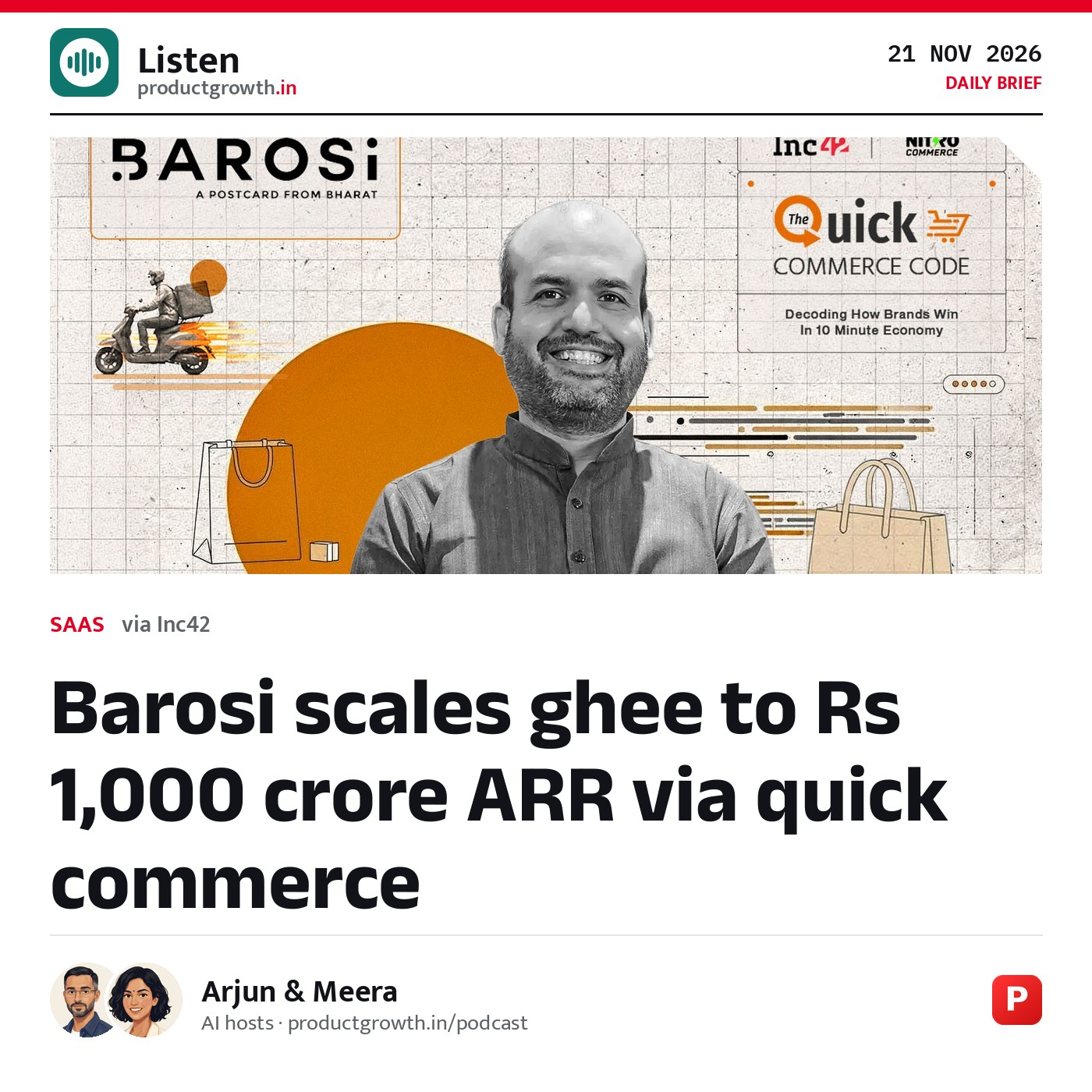
Barosi scales ghee to ₹1,000 Cr ARR via quick commerce · Rooter's FY26 revenue doubles…
Arjun and Meera on 21 November 2026: every story in this episode, with sources.
00:00 — Intro
00:24 — Barosi scales ghee to Rs 1,000 crore ARR via quick commerce
For SaaS builders selling to D2C brands, quick-commerce growth means prioritising inventory, restock and fulfilment integrations for fast-moving channels.
Source: Inc42 · Our story
01:34 — Rooter's FY26 revenue doubles to Rs 170 crore
Build creator-led live streaming and in-game commerce into your monetisation roadmap now, since these are where revenue is scaling for peers.
Source: Entrackr · Our story
02:29 — SatSure raises Rs 60 crore from Antariksh fund
Source: YourStory · Our story
03:42 — Aster DM in talks to buy Narayana Hrudayalaya hospitals
Source: ET HealthWorld · Our story
04:47 — RBI imposes monetary penalty on Fusion Finance Limited
Source: RBI · Our story
05:11 — Yes Bank's AI safeguards hit fintech platforms
Source: Inc42 · Our story
06:03 — Quick commerce to reach 37-47% of online supplement sales by FY31
Source: StartupTalky · Our story
06:55 — SECI seeks trading partner for 65.8 GW renewable portfolio
Source: Mercom India Clean Energy & EV · Our story
Spacetech startup SatSure raises $7 million from sovereign space fund
Source: ET Tech · Our story
Read the brief
Ask Kriyā about today’s stories
Hindi episode
Episode page and video


Scan the code with your iPhone camera
Listen in the app.